Al Quds Day: Supporting Palestinians against Israeli oppression
PressTVUK | June 1, 2018
Ramadan is an opportunity to show solidarity with the Palestinian cause. Annual Al Quds marches will take place around the world next week, renewing a commitment to resistance against Israeli crimes.
See also:
US vetoes Kuwait-drafted UN resolution on protecting Palestinians

US Ambassador to the UN, Nikki Haley with Israeli Ambassador Danny Danon. (Photo: Mintpress)
Press TV – June 1, 2018
The United States has vetoed a Kuwait-drafted UN resolution calling for protection of Palestinians in Gaza and the occupied West Bank.
Out of the 15 UN Security Council members, Russia, France and China along with seven others voted in favor of the resolution on Friday, while four including Britain abstained.
The draft called for “the consideration of measures to guarantee the safety and protection of the Palestinian civilian population in the Occupied Palestinian Territory, including in the Gaza Strip.”
Kuwait’s Ambassador Mansour al-Otaibi said the US veto “will increase the sentiment of despair among the Palestinians.”
US envoy to the UN Nikki Haley called the resolution a “grossly one-sided” view of the conflict between Palestine and Israel.
She also described Hamas as a major impediment to peace, proposing an alternative draft resolution which only gained Washington’s positive vote.
During a second vote, when the US put forward its own rival measure, eleven countries abstained, while Russia and two others opposed it.
At least 120 Palestinians have been killed by Israeli forces since the “Great March of Return” began in the Gaza Strip on March 30. Fourteen children are among the fallen Palestinians.
About 13,300 Palestinians also sustained injuries, of whom 300 are in a critical condition.
The occupied territories have witnessed new tensions ever since US President Donald Trump on December 6, 2017 announced Washington’s recognition of Jerusalem al-Quds as Israel’s “capital” and said the US would move its embassy to the city.
The dramatic decision triggered demonstrations in the occupied Palestinian territories and elsewhere in the world.
The status of Jerusalem al-Quds is the thorniest issue in the decades-long Israeli-Palestinian conflict.
The Palestinians see East Jerusalem al-Quds as the capital of their future state.
Mainstream media gets it wrong on Gaza AGAIN

The New York Times, the Washington Post, and CNN are 3 examples of the selective amnesia from which nearly every mainstream media news source seems to suffer when it comes to the subject of Israel. It doesn’t take much digging to discover the actual truth – the context that completely changes the story.
By Kathryn Shihadah | If Americans Knew | June 1, 2018
Palestinians of Gaza have been peacefully protesting for 2 months, unarmed, demanding only their human rights. They have been met with Israeli sniper fire week after week, killing at least 118.
And the United States hasn’t done anything.
Grant Smith points out on antiwar.com that “a stunning 81.5% of Americans say they never heard about the massacre through any channel,” which perhaps explains our apparent apathy.

Source: IRmep poll of 1,506 US adults through Google Surveys May 25-27, RMSE 4.1%. Raw data and demographic filters at Google
Mainstream media reports on incidents in Palestine-Israel, but its effectiveness as a source of accurate information is questionable. For example, most Americans don’t even know who is occupying whom.
On May 29, 2 weeks after the bloodiest day of protesting – in which at least 60 Palestinians were killed and thousands were injured – several factions in Gaza had enough and began shooting rockets toward Israel. Israel naturally responded with airstrikes from warplanes.
Mainstream media, with its short-term memory loss in all matters Israeli, forgot about the context of unarmed Palestinian protest and sniper fire, describing the Gazan rockets almost as though they represented an unprovoked attack on a peaceful state.
It is not hard to see that, when there is coverage, MSM tends to come down firmly on the side of Israel. In the interest of accurate education of American readers, we provide the following corrections of recent articles.
The New York Times published on May 29:
Gaza Militants Barrage Israel With Mortars and Rockets
NYT: Islamic militants in Gaza attacked southern Israel with rockets and mortars on Tuesday and Israel responded instantly with a wave of airstrikes across the Palestinian territory, a sharp escalation of violence after weeks of deadly protests, arson attacks and armed clashes along the border.
Everything about this paragraph is problematic.
Let’s talk chronology first: since March 30th there have been 9 weekends of nonviolent protests by Gazans, which were met by Israeli sniper fire, killing at least 118 and injuring 13,000. The number of Israeli casualties: three. The “deadly protests” were only deadly for Palestinians, who were unarmed. During this time, no rockets or mortars were fired out of Gaza. When “militants” responded after 2 months of Israeli violence, the NYT called it “an attack,” and Israel’s action “a response.”
NYT: The exchanges were the most intense cross-border hostilities in Gaza since the two sides fought a 50-day war in the summer of 2014.
“Cross-border hostilities” refers again to an unarmed population, protesting for their rights, vs. snipers. Palestinians never crossed any borders, but Israelis did. Likewise, Palestinians were not hostile, but Israelis were.
Similarly, the “two sides” that fought in 2014 included 34,000 unguided shells shot into Gaza by Israel (including 19,000 high-explosive artillery shells, which form a crater 50 feet wide and 36 feet deep, penetrate up to 15 inches of metal or 11 feet of concrete), and 4,500 rockets shot into Israel by Gaza. No wonder 72 Israelis (mostly military) vs. 2,200 Palestinians (mostly civilians, including 500 children), died in that “war.”
The “cross border hostilities” in 2014 and this week were similarly lopsided.

Israeli Air Force MK-84 crater from 2014 incursion on Gaza, “Operation Protective Edge.”
NYT: By 10 p.m. on Tuesday, Israel said there had been 70 rockets or mortars fired from Gaza throughout the day.
This may sound frightening, and it would indeed be unnerving to endure. But context matters: in 14 years of rockets from Gaza, only 17 Israelis have been killed during peacetime, and 44 total.
NYT: Tensions have been spiraling along the border in recent weeks during a series of Palestinian protests against the 11-year blockade of the Gaza Strip and to press Palestinian claims to lands in what is now Israel. Israel insisted that it was not seeking to escalate, and that it was up to Hamas to decide whether to ratchet things up or stand down.
We applaud NYT for mentioning the 11-year blockade and Palestinian claims to land in what is now Israel. Don’t be in such a rush, though, NYT. Linger over the blockade for a moment – at least long enough to help your readers understand the truth. The blockade is against international humanitarian law.The blockade is keeping food and medicine out of Gaza, and has done so for over a decade.
NYT: Early Wednesday, Israel announced a new wave of airstrikes against 25 more Hamas targets in Gaza, saying it was holding Hamas responsible for conducting and allowing a “wide-scale attack against Israeli citizens.”

U.S. Ambassador to the United Nations Nikki Haley (Drew Angerer/Getty Images)
The United States called for an emergency meeting of the United Nations Security Council to discuss the latest attacks on Israel from Gaza and said it expected the session to be held on Wednesday afternoon… [US ambassador to the UN Nikki Haley said], “The Security Council should be outraged and respond to this latest bout of violence directed at innocent Israeli civilians.”
It’s puzzling that the US sees Gaza’s nonlethal rockets as worthy of outrage, but Israel’s snipers killing over 100 as unworthy of comment.
NYT: As many as 120 Palestinians have been killed by Israeli fire since March 30, according to the Gaza Health Ministry, mostly by snipers during the protests and half of them in a single day, May 14, the peak of the campaign.
Israel said it was defending its border and the nearby communities against a mass breach by the protesters, adding that Gaza militants intended to use unarmed civilian protesters as cover to infiltrate Israeli territory and attack Israeli soldiers and civilians.
Oh, NYT, you started strong there, acknowledging the Palestinian deaths and the snipers. But then you gave your readers only Israel’s explanation (“Gaza militants intended to use unarmed civilian protesters as cover”) as though this was an indisputable fact instead of an opinion. A comment from a Palestinian spokesperson would have been in order at this juncture.
The Washington Post was similarly one-sided in its May 29 coverage:
Tensions rise as Gaza militants fire more than 70 mortars, rockets into Israel
WaPo: “This is something we cannot tolerate,” said [Israeli army spokesman Lt. Col. Jonathan] Conricus. “Hamas is turning the fence into an active combat zone, and we cannot tolerate attacks on Israeli civilians and military targets.”
Interestingly, even Ha’aretz has conceded that the Great March of Return is not a “Hamas project,” but a grassroots movement by people who are deeply invested in resistance and return. But WaPo prefers the official Israeli spin, that “Hamas is turning the fence into an active combat zone,” in spite of the obvious fact that one side of the fence has no combat weapons. There is also, apparently, nothing noteworthy in the statement, “we can not tolerate attacks on Israeli civilians and military targets” (as if Palestinians do not have the same right to be intolerant of violence being perpetrated on their people).
WaPo: Tensions have been soaring between Israel and Gaza for the past few months. Residents of the coastal enclave, which has been under land and sea blockade by Israel and Egypt since Hamas wrested power over the strip more than a decade ago, have been holding weekly demonstrations at the Israeli border fence. They are demanding a right to return to land that now sits inside Israel and expressing frustration over a growing humanitarian crisis in what they describe as an open-air prison.
WaPo came so close to getting the paragraph right. Fact is, Hamas did not “wrest power over the strip.” Rather, Hamas won a free and open election – which the US encouraged.
CNN likewise managed, on May 29, to miss the point:
Gaza militants launch mortars, rockets at Israel, which responds with airstrikes
CNN: In a statement, the IDF said the [launching of mortars and rockets by Gazans] was a “severe, dangerous, and orchestrated act of terror, aimed at Israeli civilians and children.”
The degree of self-deception required for the IDF to make such a statement is staggering. The “severity” and “danger” of Gaza rockets is minor in comparison to Israel’s snipers; the label “act of terror” belongs with the side that has been killing unarmed protesters; likewise, the targeted “civilians and children” were the ones killed (at least 12 children out of 118 dead) and injured (about 1,000 children out of over 13,000 injured).
CNN: UN chief Middle East envoy Nickolay Mladenov expressed his deep concern at what he called “indiscriminate firing” by Gaza militants toward communities in southern Israel.
“Such attacks are unacceptable and undermine the serious efforts by the international community to improve the situation in Gaza.”
Of course, “indiscriminate firing” is problematic (especially if it actually hits something, as Gazan rockets rarely do); how about “discriminate firing that hits people who are praying, or running from the border, or helping injured protesters, or children, or journalists, or medical personnel? Does discriminate firing help the “serious efforts by the international community”? And where in the international community is work actually being done to “improve the situation in Gaza”?

Israeli soldiers take aim as they lie prone over an earth barrier along the border with Gaza
Bottom line, these mainstream media articles were not aberrations, but business as usual. Every day in Gaza has yielded either similarly inaccurate news, or radio silence – the one exception perhaps being May 14, 2018. On that day there was opportunity for a dazzling visual display on every news channel: a split-screen exhibition contrasting the high-class, clueless crowd at the opening ceremony of the US embassy in Jerusalem, with the Israeli violence and Palestinian carnage at the Gaza border. For that brief moment, many commentators pointed out Israeli aggression against a besieged people group.
Shortly after that day, reporters’ memories were erased, and Gazans are once again aggressors and followers of Hamas. Avigdor Lieberman is correct again: there are “no innocent civilians in Gaza.”
Life is back to normal.
UN Officials Call on Israel to Halt Khan Al-Ahmar Demolition
IMEMC | June 1, 2018
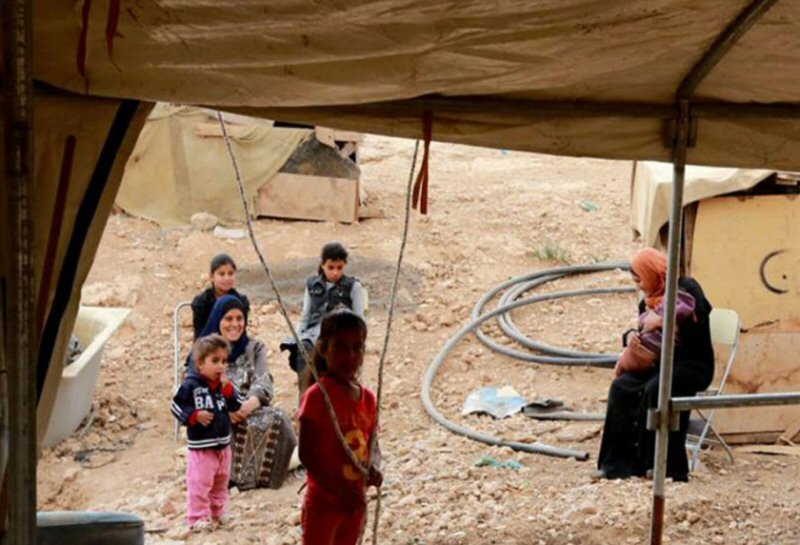
United Nations officials, on Friday, called on Israel to abandon plans to demolish the Palestinian community of Khan al-Ahmar, east of Jerusalem.
Humanitarian Coordinator, Jamie McGoldrick, and United Nations Relief and Works Agency for Palestine Refugees (UNRWA) Director of Operations in the West Bank, Scott Anderson, joined others in the international community in calling on the government of Israel to cease its plans to carry out the mass demolition and transfer of the Palestinian Bedouin community of Khan al Ahmar – Abu al Helu, located on the outskirts of East Jerusalem in the occupied West Bank.
“Like many Palestinians in Area C, the residents of Khan al Ahmar – Abu al Helu have fought for years to live with dignity, to protect their children, their homes, and their community,” said McGoldrick. “They have struggled in the face of tremendous daily pressure and are asking for the continued support of the international community to prevent the demolition of their homes.”
Following the Israeli Supreme Court’s May 24 rejection of the community’s petition to prevent the demolitions, marking an end to years-long legal efforts and leaving virtually no legal options to protect the community, nearly all of Khan al Ahmar – Abu al Helu’s structures are now at immediate risk of demolition by the Israeli authorities, including the school, initially built with donor support. The school serves some 170 students from the community and four surrounding ones. The proposed transfer seeks to move the rural livestock-dependent community to an urban site unsuitable for Bedouin livelihood, culture and traditions and is likely to increase their level of humanitarian need.
“After nine years of legal battle, this refugee community now faces the demolition of their homes, the loss of traditional livelihoods and the imminent risk of forcible transfer should the demolitions be conducted and the community be compelled to relocate, which would be a grave breach of the Geneva Convention,” said Anderson. “Many already displaced from the [Naqab] as a result of the 1948 conflict; they now face being displaced for a second time. As we have seen in similar circumstances in the past, the transfer of rural Bedouin to the urban setting of Jabal West, proposed by the Israeli state, will likely prove socially and economically devastating,” he concluded, according to WAFA.
Khan al Ahmar – Abu al Helu is one of 18 communities located in or next to an area slated in part for the E1 settlement plan, aimed at creating a continuous built-up area between the Maale Adumim settlement and East Jerusalem. This week, the Israeli authorities approved a planning scheme providing for the construction of 92 new housing units and an educational institution in the Kfar Adumim settlement, immediately adjacent to Khan al Ahmar; this settlement has also petitioned the High Court for the implementation of the outstanding demolition orders against the community.
“Israel’s obligations as an occupying power to protect the residents of Khan al Ahmar are clear,” said McGoldrick. “Should the Israeli authorities choose to implement the outstanding demolition orders in the community and force the people to leave, they would not only generate significant humanitarian hardship but also commit one of the grave breaches of international humanitarian law,” he concluded.
Palestinian ‘Medical Volunteer’ Killed by Israeli Fire in Gaza

Paramedic Razan al-Najjar was shot dead by an Israeli sniper on the Gaza border on June 1. (Photo: via Twitter)
Palestine Chronicle – June 1, 2018
A Palestinian woman – reportedly a medical volunteer – was shot dead by Israeli soldiers on Friday, Gaza’s health ministry has reported, as protests continued on the border with Israel.
Razan al-Najjar – a 21-year old volunteer with the ministry of health – was shot by Israeli forces on the eastern border of Khan Younis in the southern Gaza Strip.
There is little information yet on how Najjar was killed.
Friday’s death marks weeks of demonstrations on the Gaza border, beginning 30 March, which has seen at least 123 Palestinian protesters killed by Israeli gunfire.
The protests – dubbed “the Great Return March” – called for the right of return of refugees, and peaked on 14 May when the US moved its embassy in Israel from Tel Aviv to the contested city of Jerusalem.
Over 61 Palestinians were killed and 2,400 injured on that day, while tens of thousands protested along the besieged strip’s border.
Israeli snipers fired live rounds and tear gas at the protesters, with condemnation from the UN and human rights groups.
#Watch || Palestinians are marching to the eastrern border of #Gaza Strip to participate in #GreatReturnMarch.
Video from the middle area camp in the east of Al-Buraij Refugee Camp
Video by: @pallive_en pic.twitter.com/gAR3hvXCW2— Great Return March (@GreatReturnMa) June 1, 2018
Gaza Palestinians call for supporters around the world to mobilize in solidarity
Plan for mass protests to end the blockade and occupation

Participants in Gaza’s Great March of Return on the eighth Friday of the demonstration.
Contact:
U.S.: Pam Bailey | founder/director, We Are Not Numbers | +1 301-518-0199 | pam@wearenotnumbers.org
Gaza: Ahmed Alnaouq |+972 567676219 | ahmed@wearenotnumbers.org
Protests marking two historic dates are planned along Israel’s massive “security fence” in Gaza June 5 and 8. June 5 is the 51st commemoration of the Israeli invasion and occupation of Gaza, the West Bank and East Jerusalem and on June 7 of the same year, Israel seized control over Jerusalem’s Old City. The committee of Palestinians coordinating the ongoing, mass protests in the Gaza Strip are calling on human rights advocates around the world to mobilize June 5 and 8 in solidarity.
The largest protest in Gaza (as well as in the West Bank) is planned for June 8, since that is a Friday. It also marks the 51st anniversary of the Israeli attack on the USS Liberty in international waters off the Gaza Strip. The intelligence ship was well-marked as an American vessel and only lightly armed. This particular anniversary is ironic, since the Israeli navy just attacked and seized a Palestinian vessel called the Liberty when it attempted to sail out of the Gaza harbor May 29.
“We urge all free people everywhere to join the Palestinians by organizing solidarity events to demand that their governments exert pressure on Israel to end its oppression and occupation of the Palestinian people,” said a statement from the Legal Committee of the National Commission for the Return and Breaking-the-Siege Marches. Specifically, the committee calls on activists to push for a ban on the supply of weapons to Israel and support the public boycott of Israeli products.
“As a nation under occupation, siege and apartheid rule, we need your help to end this oppression, including the blockade of Gaza imposed 12 years ago,” the statement concluded. “We need you to scream out against injustice and double standards and urge your governments to carry out their moral and legal duties to protect the civilians of Palestine.”
Ahmed Alnaouq, project manager for We Are Not Numbers, a youth project in Gaza, notes, “The media and agencies are publishing charts and graphics showing the number of dead and wounded, but it is critical to remember that each one of those numbers represents an unarmed human who had a story to which most of us—even those in the West—could relate. Our team has been busy trying to write those stories so the world cannot hide behind the anonymity of ‘collateral damage’.”
——————————————
WeAreNotNumbers.org—a group of young adults in Gaza whose lives have been forced into a state of limbo by the world’s highest unemployment rate (60 percent among youth), a constant threat of war, a ban on most travel and shortages of electricity averaging 20 hours a day—has worked for the past three years to document the stories of the “silenced voices” in Gaza. Since March 30, when the massive, nonviolent protests began in Gaza, the team has produced regular stories and videos about the “human faces behind the numbers in the news”—including the 128 killed and 13,375 injured by Israeli snipers.
Working for Peace and Justice: Hebron Freedom Fund is a U.S. based 501c3 organization that supports the resiliency and nonviolent efforts of Palestinians living under the most difficult circumstances of Israel’s occupation.
The West & Gulf Couldn’t Sway These Lebanese Elections
By As`ad AbuKhalil | Consortium News | May 31, 2018
The recent Lebanese parliamentary election generated a lot of publicity in Western media. To be sure, free elections are rare in the Middle East, and Western media get excited over the prospects of success for what they dub as “pro-Western” candidates or coalitions anywhere. Also because foes of Israel and the U.S. were in the running, Western media become automatically invested in the outcome. This time, Western media decided that Hizbullah won “a majority of seats” in the election—as the headline of The Financial Times had it. The results were certainly a blow to Western and Gulf regimes who invest—politically and financially–heavily in Lebanese elections.
We can’t really talk about free elections in the Middle East—or anywhere else in the developing world for that matter. Not because people there don’t want them but essentially because Western governments and Gulf regimes won’t allow it. To be fair, the U.S. is clearly in favor of free elections, but only when the results guarantee a victory for its puppets. Thus, when Hamas won the legislative elections of 2006 (which the U.S. had been insisting on), the U.S. not only refused to recognize the free expressions of the Palestinian people but the U.S. worked on a covert operation to undermine the results and to overthrow Hamas in Gaza.
Historically, the U.S. (among other outside parties, chiefly Gulf regimes) intervened heavily in Lebanese elections through the provision of cash payments to its favored right-wing, anti-communist candidates. For instance, the 1947 election lives on as one of the most corrupt in Lebanese history, and former CIA agent, Wilbur Eveland, wrote about his adventures of driving to the residence of then president, Kamil Sham`un, with a load of cash to ensure that the right-candidates win. But the cash wasn’t really necessary because Sham`un forged the election anyway and arranged for the defeat of his opponents.
In 1968, the U.S. was most likely behind the rise of the far-right coalition of “the tripartite alliance,” which included the Phalanges, who swept through the election and, in few years, would—with U.S. help—trigger the Lebanese civil war. (New U.S. archival materials show the extremely close relations between those parties and U.S. and Israel).
But the U.S. and Saudi Arabia surpassed all previous foreign intervention in Lebanon in the 2009 election, when they threw close to a $1 billion to sway the vote on the side of the March 14 coalition, which included the Muslim Brotherhood and right-wing groups—all dubbed “pro-Western” by U.S. media. The victor was arranged although the election was very close: no one side was able to rule without veto power by the other side.
In this election, the Saudis didn’t spend as much as previously probably because they thought it wouldn’t make much difference since a new electoral system had changed the rules. But Western and Gulf governments convened a special economic conference in Paris to prop up the leadership of Sa`d Hariri, who claimed in the wake of the conference that he would be create no less than 900,000 jobs.
Elections in ‘Democracies’
Elections in democratic political systems are merely some of the people selecting representatives who speak on behalf of “all the people.” The propaganda about the virtue of elections is highly exaggerated in order to provide the political system with much more political legitimacy than warranted.
In the U.S., there is still a clear agenda to suppress wide political participation. The U.S. is one of the few countries in the world which holds the vote on a working day—and in the winter where much of the East coast is buried under rain and snow. Furthermore, the U.S. requires voter registration, when most democracies don’t. The low voter turnout in the U.S. is by design, and not by default. If the U.S. were to adopt a proportional representation system—which both parties won’t allow because they enjoy holding the exclusive monopoly over political representation—voter turnout would increase. Most world democracies have—at least partially or at some level—adopted proportional representation.
The leftist coalition during the Lebanese civil war years, the Lebanese National Movement, proposed political reforms in 1975. They included—among other things—the adoption of proportional representation at the national level, with Lebanon designated as one electoral district. The political class rejected that because they preferred the single-member district (at a small local level) since it facilitates the utilization of cash in swaying voters. Also, Lebanese national proportional representation wouldn’t fit well with regional sectarian leaderships.
The May 6 Lebanese election took place nine years after the previous one. Regional conflicts and Lebanese internal turmoil gave sectarian leaders the excuse to postpone the elections repeatedly. Sectarian leaders also had a hard time agreeing on a new electoral law. But the election of Gen. Michel Aoun to the presidency in 2016 expedited the process of finally holding a ballot. His parliamentary bloc had been vociferous in calling for new elections. After long months of acrimonious negotiations, the sectarian leaders agreed on a new electoral law.

Aoun: Pressed hard for a vote.
Hizbullah and the progressives in Lebanon called for a proportional representation system, while Hariri and his allies fought against it. Hizbullah was willing to risk losing a few seats in return for the election of some of its allies from different sects, while Hariri knew that his broad coalition in parliament would lose substantially because most of his Christian MPs were elected in specially-designed districts where the majority Muslims vote for Christian and Muslim MPs.
The design of electoral districts is not a simple matter in Lebanon because the system has to balance different political interests with a sectarian arithmetic formulae (which is incorporated into the political system of the country). For example, the top posts of government (presidency, speakership, and prime ministership) are distributed among Maronites, Shi`ites, and Sunnis respectively.
Elections to the 128-seat Lebanese parliament must split seats evenly between Christians and Muslims though Muslims surpassed Christians demographically long before the 1975 civil war. It is estimated that Christians are now no more than a third of the population. There is a quota for Christians in the Lebanese parliament that keeps up the pretense that they are half the population no matter how different the demographic reality. In fact, the Lebanese state refuses to conduct a census for fear of upsetting Christians. The last census was conducted in 1932.
So Lebanese leaders agreed on a new electoral law that would mix the proportional representation system with the single-member district. They arrived at a law which divided Lebanese governorates as electoral districts but then gave the voter the choice to rank one candidate on the electoral list as his/her “favored” candidate, which basically prioritized sectarian preferences of voters. The whole purpose of proportional representation was defeated.
The law was quite complicated and the low voter turnout (around 49 %, less than the 2009 election) seems to confirm that many voters and even Interior Ministry experts did not fully understand the rules. The low turnout can also be explained by the low level of enthusiasm among voters and the diminished sense of expectations for change. Furthermore, sectarian leaders in Lebanon suppress the vote by not allowing 18-year-olds to vote. If they did it’s estimated that it would substantially increase the Muslim voters—especially Shi`ites.
Part Two will look closely at the election’s winners and losers and what it means.
As’ad AbuKhalil is a Lebanese-American professor of political science at California State University, Stanislaus. He is the author of the Historical Dictionary of Lebanon (1998), Bin Laden, Islam & America’s New ‘War on Terrorism’ (2002), and The Battle for Saudi Arabia (2004). He also runs the popular blog The Angry Arab News Service.
Like Foxes Guarding the Henhouse: How Public Opinion is Manipulated on Wikipedia
Sputnik – June 1, 2018
Independent German investigators Markus Fiedler and Dirk Pohlmann have told Sputnik Deutschland about some of the mysterious Wikipedia editors they say are responsible for ‘safeguarding’ mainstream viewpoints on the world’s largest and most influential free online encyclopedia.
With Germans’ trust in the mass media on the decline, more and more people are turning to the internet for their news and information. However, here too, search engine inquiries are filtered, with Google often directing queries directly to Wikipedia, the free, multilingual online encyclopedia which anyone can theoretically edit.
However, as independent bloggers Markus Fiedler and Dirk Pohlmann have found out, as important and valuable as Wikipedia is, its ‘freely editable’ model definitely doesn’t mean an absence of censorship and biased political activism.
“If you’re a journalist preparing to interview someone, chances are you’ll look on Wikipedia to find out who this person is. If it’s written that they’re an anti-Semite and supporter of conspiracy theories, as is often the case with people who someone doesn’t happen to like, there probably won’t be much interest in interviewing them,” Pohlmann explained.
“In other words, on Wikipedia one quite often finds a [political] coloring of this or that public person and whether they are believable or not. And this is a very effective tool,” he added.
But just who are Wikipedia’s dedicated editors, and what sorts of people and issues do they focus on? Pohlmann and Fiedler researched the issue extensively in a multipart YouTube investigative series called “Wikipedia – Stories from Wikihausen.”
In their investigation, the researchers discovered that the online encyclopedia is home to a major edit war where corrections are constantly added, information removed, and value judgements made to fit a specific narrative.
Frontlines of the Edit Wars
According to Fiedler, such manipulations are particularly common in articles concerning geopolitics and topics which may be ideologically charged.
“Let’s say for example that you are critical of NATO, or the operations of the special services connected to NATO. Or you write about German media, such as Spiegel, Stern or Zeit, and their insistence that the war in Syria is a civil war. And maybe you write that this is not a civil war, but a proxy war perpetuated by the USA, Saudi Arabia and Israel. In this case, you’ll have a good chance of being smeared on Wikipedia, even if the information you present is correct,” Fiedler said.
Examples of German-language figures who have faced problems in this sense in the past include Swiss historian Daniele Ganser and former ARD Russia correspondent Gabriele Krone-Schmalz. But the English-language segment of Wikipedia is also subject to such edit wars, Fiedler noted, citing the case of the edit war over former British diplomat Craig Murray, whose Wikipedia article has faced constant editing by an editor going by the pseudonym Philip Cross, who immediately edits out anything on the topic that he doesn’t like. It’s worth nothing that Murray has been a major critic of London’s story and claims in the scandal around the poisoning of Russian ex-spy Sergei Skripal and his daughter Yulia, and that this doesn’t appear anywhere on his Wikipedia page.
Meet the Editors
In their research, Fiedler and Pohlmann identified a group of particularly ‘zealous’ editors. The investigators say there is a group of about 200 individuals pushing the German-language version of Wikipedia in the ‘proper’ direction.
“We have already described the fact that there is an inner circle of manipulators. We have dubbed them ‘members of the Transatlantifa’. This is not an Antifa, but rather those who subscribe to the theses of the American neocons, i.e. the right-wing radicals. To this group I would include characters such as JosFritz, Karl V, Kopilot, Phi, Schwarze Feder, Feliks, etc. If you see any of these people in the editing history, rest assured that the article was ‘corrected’ by them,” Fiedler noted.
Furthermore, Fiedler added, some of these editors seem to be truly prolific writers, spending ungodly amounts of time writing and editing Wikipedia articles.
“For example, we have Kopilot… who has been involved in the writing of about 50,000 articles over a five year period. That’s an average of 39 articles a day. He writes at Christmas, he writes at Easter. This guy writes articles all night while you sleep,” Fiedler joked.
At the same time, Fiedler and Pohlmann say that articles written by Wikipedia newbies or non-dedicated editors are often deleted just minutes after appearing, with the more active among them risking being reported as vandals and banned outright. In January alone, some 500 people were banned from Wikipedia in this way, Fiedler said.
“The structure allowing for such manipulations is similar to the proverb of ‘letting the fox guard the hen house’. In other words, the people deciding whether or not an article remains on the site are the same ones who engage in these manipulations. They are referees and players combined into one,” Pohlmann added.
Sputnik Caught in the Middle
“When you publish something on Wikipedia, you need to provide evidence and use reliable sources. But which sources are reliable and which are not is something that the 200 people described above decide. In this way, Sputnik is not considered a reliable source, the same way as Heise online or NachDenkSeiten.de [TheCriticalSite]. Meanwhile, media such as Spiegel, Stern, Zeit are considered reliable,” Fiedler explained.
The unflattering German language Wikipedia article on Sputnik News leaves no doubts as to the worldview of those who edited the article together. After a brief summary on the news agency’s creation and location, the rest of the article is just a list of criticism about “information warfare,” “propaganda,” the site’s “xenophobic and right-wing extremist orientation,” etc. The English-language version of the site is little better, and includes a New York Times claim that Sputnik “engages in bias and disinformation.”
The edit history for the German version of the Sputnik entry shows that the article was created in December 2014 by the user Kolja21 and originally consisted of a short description of Sputnik. Since then, it has been edited over 500 times.
“Let’s say your article was edited by Phi or Feliks. When I see these two, I know immediately that this article will not be serious. For example, on January 17, 2018 at 10:45 am, Feliks wrote: ‘In a study published in August 2016 by the independent US Center for European Policy Analysis about Sputnik’s influence in Central and Eastern Europe, its actions can be called one-sided and hostile to the mainstream.’ Feliks added the word ‘independent’; that is, he thinks that the Center for European Policy and Analysis is independent.”
However, Fiedler pointed out that even a cursory examination of CEPA’s sponsors and contributors reveals its true nature, with its advisory board including personalities such as former Secretary of State Madeleine Albright, former national security advisor Zbigniew Brzezinski, as well as companies from the US military-industrial complex like Bell Helicopters, Boeing, Chevron, and Lockheed Martin. And this is only one example.
Every Contact Leaves a Trace
Fiedler and Pohlmann say they are determined to continue their work. The good thing about the Wikipedia platform is that the site’s format, including its edit history tab, allows users to keep track of the ways in which the small but dedicated list of politicized editors carry out their work.
Is Duterte really threatening war with China? The opposite may be true…
By Darius Shahtahmasebi | RT | May 31, 2018
The media wants you to believe that the Philippines is headed towards war with China. The truth may in fact be the opposite.
If you followed international headlines this week, you may have been alarmed to see the shocking revelation that, despite wanting a closer relationship with China, Philippines’ President Rodrigo Duterte was now ready to risk war with Beijing to ‘protect the territorial integrity of his country’.
“Philippines’ Duterte threatens war in South China sea if troops are harmed,” Newsweek warns. “Philippines draw three hard lines on China,” Asia Times outlines. “Philippine President Rodrigo Duterte will go to war with China if it crosses ‘red lines’ and claims disputed resources, foreign ministry warns,” the South China Morning Post (SCMP ) explains. “Duterte will ‘go to war’ over South China Sea resources, minister says,” according to CNN.
Those are indeed some shocking headlines as the last thing anyone in their right mind wants is a regional conflict, not least one that involves a rising nuclear power with the capabilities that China has.
So what did President Duterte actually say, and how close to a regional standoff are we at this current juncture?
Well, according to the reports, Duterte didn’t actually say anything. The majority of these warnings came directly from Foreign Secretary Alan Peter Cayetano, the country’s top diplomat. While claiming to speak for Duterte, Cayetano drew up three major red lines that could allegedly lead the Philippines’ President to war with China. The first red line that supposedly won’t be tolerated is any Chinese move to reclaim or build on the Philippine-claimed Scarborough Shoal, which lies just over 100 nautical miles from Philippine shores. The second red line is any coercive Chinese move against the Philippine marine detachment guarding the Second Thomas Shoal. The third red line is any unilateral Chinese drilling for natural resources, mostly oil and gas, within the Philippines’ exclusive economic zone.
“Another red line is that nobody will get natural resources there on their own,” Cayetano said. “The President has said that: If anyone gets the natural resources in the West Philippine Sea, he will go to war.”
“If we lost a single island during Duterte’s time, I will pack my bags, go home,” he also added.
Hmmm. It is starting to sound a bit like Cayetano’s red lines; more so than the President’s red lines.
Then not long after, another headline which read “Philippines could go to war over South China Sea: Duterte aide” may have also caught your eye. Again, this involved National Security Adviser Hermogenes Esperon making the stunning revelation that “just the other night, the president said if my troops are hurt there, that could be my red line.”
Note that in none of these instances is Duterte himself doing any of the talking. When one digs a little bit deeper, this is when it becomes all the more interesting. In actuality, it was just over a week ago that the Philippines’ President was saying the complete opposite.
Even after the Chinese military landed long-range bombers at an airport on Woody Island in the South China Sea – reportedly placing the Philippines within strike range of Chinese bombers – Duterte’s response was to state that “you know they have the planes, not stationed in Spratly but near the provinces facing – Chinese provinces facing the Spratly and the China Sea. And with their hypersonic, they can reach Manila within seven to 10 minutes.”
The President also allegedly added: “What will we arm ourselves with if there’s a war? Will we resort to slapping each other? I couldn’t even buy myself a rifle. It was given to me. So how will we even fight with the Chinese?”
To the rest of us paying attention, Duterte’s comments appeared to indicate that he was ruling out the possibility of any war with China involving the Philippines. He even suggested that he doubts the Philippines could rely on the US in such a scenario. In other words, under Duterte’s leadership, the Philippines would not go to war with China as he is convinced that there is nothing the Philippines can do to confront China without suffering an immeasurable loss.
But don’t take my word for it.
“I cannot afford at this time to go to war. I cannot go into a battle which I cannot win and would only result in destruction for our armed forces. I really want to do something to assert. But you know, when I assumed the presidency, there was already this ruckus in the West Philippine Sea,” Duterte said during a speech at the Philippine Navy’s 120th anniversary in Manila.
“So will we be able to win that war? If my troops are massacred, after the war, the soldiers and police will come after me next. Our troops will really be finished off there,” the President also stated at the time.
So what is Duterte’s proposal to deal with the stand-off, bearing in mind that there are many Filipinos who do not see eye to eye with Duterte?
“We don’t have to fight. We can divide this in a joint development, joint exploration. And then we’ll give you [China] a bigger share rather than fight. It’s only America who’s worried because they lost a territory. You’re the ones who came first. I was just new and then you adapted the rascal’s propaganda,” Duterte proposed less than two weeks ago.
While the media continues to mislead the public on Duterte’s alleged new push to confront China in the South China Sea, it also failed to note that at around the same time Duterte was supposedly making these threats of war towards China, he had just appointed a special envoy to China with the specific intention of fostering closer relations with Beijing.
Of course, it could be the case that Duterte has changed his stance this week in a complete nonsensical 180 degree U-turn and will indeed confront China if he feels it is in the best interests of his country. However, it is curious to say the least, that as one of the world’s most vocal leaders (he once admitted killing suspected criminals while serving as Governor) he has not been the one to directly voice this U-turn himself, the statements having come from other subordinates from within his administration.
We also have to bear in mind that Duterte is a man who believes his presidency is protected by Chinese President Xi Jinping, acknowledging that he needs China “more than anybody else at this time of our national life.” He also once said to Beijing that if they wanted to, “just make [the Philippines] a province.” It doesn’t seem too likely that Duterte is all of a sudden prepared to give this dependency up, in light of his consistently pro-Chinese stance.
The other development to keep an eye on is the recent war-drills at the beginning of May this year involving US forces and Philippines’ forces which were the largest military exercises held in the Philippines since Duterte became president. Even then, these drills appeared to focus more on the domestic threat of terrorism inside the country and were not officially aimed at confronting China’s expanding influence.
For ease of reference, a month-long firefight between Islamist militants with allegiances to Islamic State (IS, formerly ISIS) and government forces left 1,100 people dead just under a year ago. In that context, it is not completely unusual that the President may have given the go-ahead for these drills to take place. (That being said, Duterte personally admitted he did not expressly authorize the US military’s involvement in its counter-terrorism efforts last year, suggesting that there may be other forces at play which may or may not be beyond his control). This also may be the case with the development that the Philippines has begun repairing a runway and upgrading facilities on Thitu Island, a major point of dispute between Chinese and Philippine vessels last year.
No matter how badly the media want Duterte to reject and confront China, the cold hard truth is that China is an “indispensable geographical reality,” as Richard Javad Heydarian in the National Interest recently put it. There is little that Duterte can do to confront China even if he really wanted to, as he is predicting a future in which Washington becomes increasingly irrelevant in the Asia-Pacific region all the while China begins to exert more and more influence in the area. Rather than butting heads with China, Duterte’s plan is exactly as he says – develop and explore the area jointly with China while coming to an arrangement, which does the complete opposite of what the media wants you to believe he will do, to avoid a war with China at all costs.
Trade War and the Nationalist Exchange: Trudeau Trails Trump
By Maximilian C. Forte | Zero Anthropology | June 1, 2018
“These tariffs are totally unacceptable. For 150 years, Canada has been America’s most steadfast ally. Canadians have served alongside Americans in two world wars and in Korea. From the beaches of Normandy to the mountains of Afghanistan, we have fought and died together. Canadian personnel are serving alongside Americans at this very moment. We are partners in NORAD, NATO, and around the world. We came to America’s aid after 9/11—as Americans have come to our aid in the past. We are fighting together against Daesh in Northern Iraq…. That Canada could be considered a national security threat to the United States is inconceivable…. these tariffs are an affront to the long-standing security partnership between Canada and the United States, and in particular, to the thousands of Canadians who have fought and died alongside American comrades-in-arms”—Justin Trudeau, Prime Minister of Canada, May 31, 2018
So we now see the launch of a trade war between the US versus Canada, Mexico, and the EU. Focusing on the place of residence of the writer, Canada, one can argue that this trade war is very good news, if one knows how to read this development properly. Justin Trudeau’s visible anger is a testament to the good news: his anger is that he is now required to perform in the role of an economic nationalist, something for which he was not trained. All of his apprenticeship under globalist mentors—such as the Center for American Progress, the Aga Khan and George Soros—only prepared him to play a supporting role as part of a now wounded and cornered neoliberal elite. Trudeau was only meant to be a builder of “team spirit” in service of the technocrats who facilitated neoliberal globalization. He was there to cheer “Canadians” (whatever that word means now) that they were becoming like everyone from everywhere: they were a bit of everything, and nothing in particular. Trudeau thus pranced at the front of gay pride parades, pushed legislation on transgender pronouns, introduced a gender quota for his cabinet, a gender budget, sorted out cabinet ministers according to skin colour and headwear, welcomed everyone to an open Canada, and chided citizens for saying “mankind” instead of “peoplekind,” because the latter is “more inclusive”. And what does he have to show for his efforts? He is now the one to speak of illegal border crossers who should stay away, and imposes counter-tariffs.
Trudeau opened his remarks on the national security front—a big mistake. It was a big mistake for two reasons. One reason, of lesser importance than the next, is that it shows the literalism that is at the heart of moral narcissism and virtue signalling—that you take your opponent’s statements to be literally true, at face value, and no contextualization is necessary. Trudeau thus took great offense at the suggestion that Canada somehow undermined US national security—as if our purpose as a sovereign nation-state was to always serve the Americans better. President Trump, however, is merely using the available tools—he does not think that Canada literally threatens US national security, but he has to invoke that notion because it permits him to use a particular instrument—and that’s all. Back in March, if one was paying attention, one of the arguments Trump used to defend US steel and aluminum industries is that they were vital to US national security and its weapons industries. The Trump administration cited Section 232 of the Trade Expansion Act of 1962. I predicted this would be the justification in 2016, when the media floated arguments dismissing the prospect of Trump’s protectionism, insisting he would need Congressional approval. Others instead advanced the murky argument that the “deep state” would prevent him. Some tried to cover their lack of insight by saying Trump invoked “a rarely used law”. The constant refrain—inexplicably maintained despite its obvious contradiction—was that Trump was a threat and yet Trump would also have no real power. Almost all instantly forgot the meaning of executive power, and how it has increased under the imperial presidency. President Trump proved he could take such action, especially when the action is declared an “emergency” and a “threat to national security”. The only “mystery” here was why Trump suddenly decided to return to a nationalist posture, after a full year of reversals that favoured the continuation of neoliberal globalization. Gary Cohn, Trump’s chief economic adviser and former president of Goldman Sachs, promptly resigned from the administration after Trump announced the tariffs. Some thus saw economic nationalists regaining the upper hand in the Trump administration. It could be that Trump is now reconciled to the realization that his family’s business empire will never become properly transnational, and is even having to pull back from simply experimenting with being international. Trump family fortunes have returned home to roost—that is one possible explanation, and it’s a side issue for now. What we do know, even so soon, is that there is in fact some evidence that jobs are returning to the US steel industry, thanks primarily to Trump’s protective tariffs.
The second reason it was a mistake for Trudeau to use national security as an entry point is that it now opens a valid question for Canadians: what good is our alliance with the US? Why are we in all those wars? Why are we always tagging along with the Yanks? What were we doing in Afghanistan? It’s not like Toronto was attacked on 9/11. Why should we be members of NATO and NORAD? All of it really does not count for anything in the end. Trump has played Trudeau, repeatedly, and is now forcing Trudeau to substantively and effectively call into question Canada’s subservient role as an upholder of American empire. This is an example of the indirectly, quietly subversive outcomes of Trump’s “America First” program, as I argued in “What Happened to the American Empire?”
As for virtue signalling, Trump can do that too. With an absolutely phony earnestness, which neither Trudeau nor anyone else correctly read, Trump would pretend to be enchanted with his Canadian guest, lavishing warmth and praise on him… and look, here’s my daughter, she’s so charmed by you too! All smiles, handshakes, and exuberant lyrics, and it was all deliberately calculated bullsh*t, like you would expect of an expert dealer. Meanwhile, Trump does not forget who his adversaries are, and quietly and indirectly at first—and now loudly and directly—he set about destabilizing Trudeau’s Canada. First there was the mysterious push of illegal border crossers toward Canada, with the US amply admitting Nigerians on visas when their only intention is to enter the US to cross into Canada illegally. Trudeau said Canada would remain open and welcoming, in a direct rebuke aimed at Trump, and now Trump would make him pay for his words—and he has, in spades. More on that in a future article. Then Trump imposed tariffs on Canadian dairy products, softwood lumber, newsprint, massively crushing tariffs on Bombardier passenger planes, and then the renegotiation of NAFTA itself, with the threat of simply tearing up the deal.
Where has Trudeau’s leadership been in all of this? With less people than California, the US market matters a lot more to Canada than vice versa. How has Trudeau prepared Canadians for possible job losses, perhaps in the tens of thousands, as a result of an abrupt trade shock? How will social services suffer in provinces most affected by a diminished export market? Today the Canadian media like to boast that Canada will hit Florida orange juice, so—hint, hint—good luck winning Florida in the next elections. They should be thinking about Canadian elections instead, rather than taking the attitude that only the US will suffer, or that it will suffer more than Canada. But that is what we get: instead of a plan, a program, just amateur cockiness.
How has Trudeau’s government coordinated with local and national industries to realign production to domestic suppliers and domestic consumption in the event of a trade war? Where are the “innovative” and “smart” plans now? Canadian ruling elites have been funding the training of a generation of students to think in globalist terms, and shun nationalism—when what they should have been teaching students is not just to start loving nationalism, but to love their nation. What nation is that, you ask? Writing from Quebec, but as someone raised in Ontario, my very strong impression is that it is Anglo-Canada in particular that has the real identity crisis—that is, not having an identity. We can forget about Aboriginal peoples planting the seeds of a new Canadian creolization, as I argued elsewhere; instead, Aboriginals are being effectively put back in their cultural ghettos, shielded by a paranoia over phony “cultural appropriation,” thus sequestered, contained, and removed from the Canadian conversation. Instead the model we have in Canada sounds like it was imported from Amazon.com: everyone in their appropriate box, and every box on its appropriate shelf.
“We’ll see what happens”. “Maybe this will be big, maybe it won’t. Who knows?” However, it is still worth raising the possibility that if the trade war continues, and lasts, it’s Canada that might not last. The Trump transfer of costs will have achieved its maximum effect. Part of that Trump transfer is that Canadians are being taught—forced—to become nationalist Trumps in their own right, or lose. Let’s see what happens.
A final thought: having lived for a few years in Cape Breton, one of Canada’s long-standing and primary centres in the production of steel, I saw first hand the degree of economic destruction and social devastation wrought on Canadian production by foreign competition, among many other factors. Real leadership would seek to maximize the benefits of protection that (counter)tariffs now offer us, a chance to make sure not all of Canada experiences the kind of econocide witnessed by Cape Breton.
Russia censures Iran, expects Israel to help restore ties with US
Vladimir Putin surprised many at the event known as Russia’s Davos with his comments on the Iran nuclear deal and Russia’s relations with the US
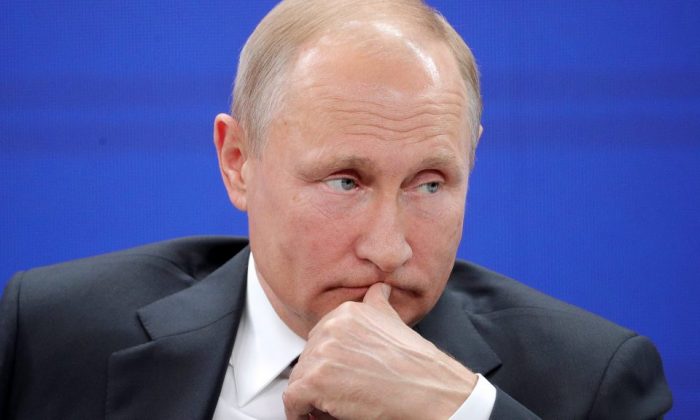
Russian President Vladimir Putin at the St Petersburg International Economic Forum on May 25, 2018. Photo: Reuters/Sergei Bobylev/TASS
By M.K. Bhadrakumar | Asian Times | June 1, 2018
The annual meeting of the St Petersburg International Economic Forum – dubbed as “Russia’s Davos” – on May 25, which traditionally promotes foreign investment in the Russian economy, ended this time around as a major political event signaling a renewed bid by President Vladimir Putin for détente with the West.
In wide-ranging remarks at the forum, Putin made an explicit overture to Washington for dialogue. The US decision to quit the Iran nuclear deal was the leitmotif of the Q&A at St Petersburg – which are generally choreographed by the Kremlin in advance – and Putin seized the opportunity to articulate a highly nuanced position on the topic with an eye on the overall Russian-American relationship.
Unsurprisingly, Putin criticized the US’ rejection of the Iran nuclear deal as a unilateralist move which would have negative consequences. But then, Putin also expressed understanding for President Donald Trump’s domestic compulsion in taking such a decision.
Putin also proposed that the US and Iran, which had negotiated the 2015 pact directly, could resume their negotiations to settle the differences: “Even now, the US President is not closing the door on talks. He is saying that he is not happy about many of the terms of the deal. But in general, he is not ruling out an agreement with Iran. But it can only be a two-way street. Therefore, there is no need for unnecessary pressure if we want to preserve something. Doors must be left open for negotiation and for the final outcome. I think there are still grounds for hope.”
Putin probably sees Russia as a facilitator-cum-moderator between the US and Iran, but at any rate, he has deflected the focus from the EU’s approach, which single-mindedly focuses on the downstream impact of US sanctions against Iran. It is smart thinking on Putin’s part to signal that Moscow does not propose to wade into any transatlantic rift over the Iran issue. He probably doubts if the rift is real enough for outsiders to exploit.
Putin and the Iran nuclear deal
But the really intriguing part was that Putin also brought into the matrix the “good, trust-based relations between us (Russia and Israel).” Significantly, the interpolation occurred while Putin was arguing that the preservation of the Iran nuclear deal was also in Israel’s interests.
Neither Moscow nor Tel Aviv has divulged the details of the recent meeting between Putin and Israeli Prime Minister Netanyahu in Moscow in early May. But Israeli sources have since divulged in bits and pieces that a major understanding might have been reached as regards the imperative need for an holistic approach toward the whole situation surrounding the “Iran question,” including Iran’s presence in Syria, which Israel indeed sees as existential threat.
Interestingly, three days after Putin spoke at St Petersburg, an influential Moscow think tank came up with a commentary regarding the emergent trends in the Syrian situation. Basically, the commentary stressed that Russian policy was switching tack and giving primacy to the search for political settlement and reconstruction of Syria. But it went on to discuss the rising tensions between Iran and Israel in Syria and blamed Iran for using Syria for the “export” of its policy of Resistance against Israel.
Hinting at growing resentment within the Sunni majority in Syria against Iran’s activities, the commentary contextualized Putin’s recent call for the withdrawal of all foreign forces from Syrian soil. It openly rapped the Iranians on the knuckle: “Iran’s operations in Syria go far beyond fighting terrorists and are hardly welcomed by anyone within the region and beyond. This heightens tensions in Israel’s relations with its bitter rivals … Serving as a platform for fighting the ‘Zionist’ enemy is something Syria needs the least.”
Indeed, these are extraordinary statements for an establishment think tank known to be close to the Kremlin. The key elements were: a) Russia holds Iran as responsible for ratcheting up tensions with Israel; b) Russia thoroughly disapproves of Syria being turned into a turf for Iran’s policy of “Resistance” against Israel; and, c) Moscow expects the Assad regime to distance itself from Iran’s anti-Israeli activities.
The patent shift in the Russian stance implies Moscow’s acknowledgment that the fate of the Iran nuclear deal is also linked to Iran’s regional policies. Arguably, this Russian stance harmonizes with what Trump and Netanyahu have been saying all along. Perhaps, Russia hopes to cajole Tehran to walk toward the negotiating table where Trump is waiting. Perhaps, Putin also calculates that such a helpful stance cannot but have positive fallout on US-Russia relations as a whole. Time will tell.
The bottom line is that the close ties between Russia and Israel are sailing into full view. Interestingly, Israel just obliged a famous Russian oligarch who is perceived as close to Putin, by granting him citizenship, which would enable him to visit Britain – although London refuses to renew his residence permit. The influential Kremlin-linked Russian oligarch now de facto becomes the wealthiest Israeli citizen, too.
Suffice to say, it all does seem a cozy condominium between Putin and Netanyahu. The big question will be how far Netanyahu can help Putin to bring about a Russian-American “thaw” under this complex set of circumstances.
Featured Video
American Military Failure in Afghanistan
or go to
Aletho News Archives – Video-Images
Frlom the Archives
The Fiction of the Jewish History in Palestine
By Hasan Afif El-Hasan | The Palestine Chronicle | April 8, 2011
Prime Minister Benjamin Netanyahu told NNC Pierce Morgan on March 18, 2011 that he might agree to a Palestinian state through negotiations. And he added, “We will make territorial concessions although it is very painful to do that in our ancestral land.” Netanyahu was not talking about Poland where his ancestors lived. He was talking about Palestine where generations of its indigenous population ancestors lived, cultivated the land and are buried.
By the end of the nineteenth century, Zionism created a new Jewish identity of blood and soil. To mobilize their followers and supporters and appeal to their emotions, the Zionists created myths. Zionism started as a tribal religion without god, but in order to fulfill its function as a unifying force, Zionism required external religious and race symbols, not inner content. Its leaders regarded metaphysical religious belief and purity of race as having value in itself. They created a divine paradisiacal state of merger with the gods. Despite his non-religious ideology, Herzl’s writings were replete with religious references. The Jews should settle in Palestine because, in his words, “the Temple will be visible from long distance, for it is only our ancient faith that has kept us together”.
The Zionists and their supporters have invested tremendous financial and scholarly resources to work within the Hebrew Bible historical narratives to affirm the links between the intrusive Zionist population and the ancient Israelite past, and by doing so assert the right of that population to the land. The political end-game shaped the investigation and the outcome. Tracing the roots of Israel’s ethnic state in biblical antiquity is effectively to silence the indigenous Palestinian claim to the past and therefore to the land. The Biblical scholarship employs a bewildering array of terms for the region: “the Holy Land”, “the Land of the Bible”, “Eretz Israel”, “the Land of Israel”, or “Judah and Samaria.” To the casual reader these names appear interchangeable, but they all imply connection to ancient Israel.
Biblical narratives or poems that cannot be supported by archeology and common sense are treated by the Zionists and their supporters as historical language. … continue
Blog Roll
 Aletho News
- CIA Assessment: The Resistance Cannot Be Crushed
- Hezbollah Returns: It Didn’t Start a War, It Is Ending One
- EU states seek ‘talks’ with Iran for access to Strait of Hormuz: Report
- Trump on Hormuz: “Others must take care of it” after US falters
- Who Is closer to collapse?
- A War that Backfired: Why the US-Israeli Campaign Is Strengthening Iran
- How Zionist Control Is Hurting US Interests
- Iran warns it may target US missile launch sites in UAE cities
- American Military Failure in Afghanistan
- Friendly Skies of Georgia: Are Israeli-Linked Drones Launching False Flags from Georgian Territory?
- If Americans Knew
- As US-Israel war on Iran rages, Gaza faces massive dust storm – Not a ceasefire Day 156
- No let-up in attacks on Gaza as Israel takes on Iran, Lebanon – Not a ceasefire Day 155
- ‘Of Course’: IDF Drops Case Against Soldiers Accused of Raping Palestinian Prisoner
- Don’t Fall for the Regime Change Talk. Israel Is ‘Mowing the Lawn’ in Iran
- Will Israel and the US wreck the Gulf States along with Iran?
- US so far burned through ‘years’ of munitions in Iran war: Report
- How the Israeli Tail Wags the American Dog
- Outdated intel likely led to deadly U.S. strike on Iranian elementary school, sources say
- Pentagon insider says high U.S official Douglas Feith reported to Netanyahu
- In fond memory of Walid Khalidi, the historian of Palestine
- No Tricks Zone
- Storing Green Energy To Last Germany 10 Days Would Require A 60-Million Tonne Battery
- New Studies: UK Sea Levels Were 4 Meters Higher Than Today During The Mid-Holocene
- Destructive Green New Deal: German Energy And Metal Group Warns Of Drastic Crisis
- New Study Documents A 20-Year Pause In Arctic Sea Ice Decline – Driven By Internal Variability
- Wake-up Call: Survey Shows Majority Of Germans Now Favor Postponing Climate Targets!
- Televised! Leading German Political Candidate Tells Schoolchildren CO2 Makes Sun Hotter!
- New Study: A Century Warming Of 1.1°C Is ‘Commonplace’ And ‘Not Unusual’ During This Interglacial
- New Study: ‘Internal Noise’ And Volcanic Forcing Can Trigger 10-15°C Warming Within Decades
- Glaciers Worldwide Are Suddendly Surging, Experts Blame Warming!
- Surprising Discovery: Sahara Is Greening…Billions Of Trees Where Once Thought To Be Barren
 Aletho News