How Corporate Media Got the Trump-Kim Summit All Wrong
By Gareth Porter | truthdig | June 11, 2018
For weeks, the corporate media have been saying that the Trump-Kim summit could have only two possible results: Either Trump will walk away angrily or Kim Jong Un will trick him into a deal in which he extracts concessions from Trump but never commits to complete denuclearization.
The idea that North Korea could not possibly agree to give up its nuclear weapons or its intercontinental ballistic missiles (ICBMs) has become an article of faith among the journalists covering the issue for big media. Two themes that have appeared again and again in their coverage are that the wily North Koreans are “playing” Trump and that previous administrations had also been taken by North Korea after signing agreements in good faith.
But the media have gotten it all wrong. They have assumed that North Korea cannot live without nuclear weapons—without making any effort to understand North Korea’s strategy in regard to nuclear weapons.They have invariably quoted “experts” who haven’t followed North Korean thinking closely but who express the requisite hostility toward the summit and negotiating an agreement with the Kim regime.
One of the few Americans who can speak with authority on North Korea’s calculus regarding nuclear weapons is Joel S. Wit, who was senior adviser to the U.S. negotiator with North Korea, Ambassador Robert L. Gallucci, from 1993 to 1995, and who from 1995 to 1999 was coordinator for the 1994 “Agreed Framework” with North Korea. More importantly, Wit also participated in a series of informal meetings with North Korean officials in 2013 about North Korea’s thinking on its nuclear weapons.
At a briefing on the Trump-Kim summit last week sponsored by the website 38 North, which he started and still manages, Wit made it clear that this dismissal of North Korea’s willingness to agree to denuclearization is misguided. “Everyone underestimates the momentum behind what North Korea is doing,” he said. “It’s not a charm offensive or a tactical trick.”
Wit revealed in an article last month that the North Koreans had informed the American participants in those 2013 meetings that Kim was already anticipating negotiations with the United States in which North Korea would agree to give up nuclear weapons in return for steps by the United States that removed its threatening posture toward North Korea. Wit said his North Korean interlocutors had pointed to a June 2013 statement by the National Defense Commission of North Korea—the nation’s highest policymaking body—which they stated emphatically had been ordered by Kim himself to indicate a readiness to negotiate with the United States on denuclearization. The statement declared, “The denuclearization of the Korean Peninsula is the behest of our leader” and “must be carried out . . . without fail.” And it went on to urge “high-level talks between the DPRK [North Korea] and the U.S. authorities to . . . establish peace and security in the region.”
The statement came a few months after Kim had resumed nuclear testing in an intensive effort to establish a credible nuclear deterrent. In part that was because of the young Kim’s conviction that the United States believed it could “bully” his regime in the transition after Kim father, Kim Jong Il, died in December 2011, according to Wit’s North Korean interlocutors.
But those same North Korean officials also told Wit that the new buildup would be of limited duration—only until it became possible to improve relations with the United States. That explanation suggested that Kim was pursuing a military capability primarily to serve as an incentive for Washington to come to the negotiating table and as a set of bargaining chips to obtain what it really wanted—an end to the hostile policy toward the regime by the United States.
Wit revealed that in the private meetings with Americans, North Korean officials presented a concrete plan for a three-phase agreement with the United States on denuclearization in which each side would undertake a set of related steps simultaneously.The American participants were told that the first stage of North Korea’s implementation would be a freeze on its nuclear weapons development, followed by disabling key facilities and finally dismantling the facilities as well the nuclear weapons. The U.S. steps would include diplomatic recognition, ending economic sanctions and removing the U.S. military threat to North Korea, in part by finally bringing the Korean War to a formal conclusion.
It was the same approach to a denuclearization agreement to which North Korea had agreed in 1994 and again in 2005 and 2007, but which had failed primarily because of the reluctance of the Clinton and Bush administrations to commit to entering into a normal political and economic relationship with North Korea.
The political context for U.S.-North Korean negotiations has changed dramatically since 2013. The most obvious change is that North Korea has an ICBM capable of reaching the United States for the first time. Although it provoked threats by the Trump administration in 2017 to attack North Korea if it completed work on the ICBM, it also has prompted the White House to consider going further than previous administrations in meeting North Korean diplomatic demands.
Furthermore, in 2013, the South Korean government was hostile to diplomacy with the North, and the Obama administration was unwilling to consider any major political or security concessions to North Korea until after it had given up its nuclear weapons. Now South Korean president Moon Jae-in has gone further than any previous government in pushing to end the 70-year military tension and formal state of war between North and South. Moon’s commitment to a Korean peace agreement appears to be the single biggest reason that Kim switched gears so dramatically in a New Year’s Day speech that presaged dramatic diplomatic moves in 2018.
Reflecting the new political-diplomatic situation, in April Kim put forward a new strategic line calling for the bulk of the state’s resources to go to economic development. That replaced the bjungjin line that Kim had introduced in March 2013 putting economic rebuilding and military needs on an equal footing.
Kim has made major adjustments in the North Korean negotiating posture that prevailed when the 2013 meetings were held with nonofficial Americans. The North Koreans had insisted then that the United States would have to remove their troops from South Korea as part of any agreement, according to Wit. But that demand has now been dropped, as Moon told Trump in mid-April.
Kim also has frozen his entire nuclear weapons and ICBM programs by suspending testing and blowing up facilities and tunnels at its nuclear test facility in front of foreign journalists in advance of negotiations with the United States. What gives the freeze far-reaching significance is the fact that North Korea still has not shown that it has mastered the reentry technology or the guidance system necessary to have a convincing deterrent capability, as Defense Secretary James Mattis observed last December. And then CIA Director Mike Pompeo agreed in January that it would take a “handful of months” for North Korea to be able to master the remaining technological challenges—but that would require additional testing. The willingness to freeze the program before it had reached its goal indicates the predominance of Kim’s diplomatic aim over North Korea’s military ambitions.
Contrary to the idea relentlessly repeated in media coverage that there is no objective basis for a denuclearization agreement, it has become clear to Pompeo that Kim is serious about reaching such an agreement. Pompeo noted in his press conference that he had spent “a great deal of time” discussing the prospective deal in two meetings with Kim himself and three meetings with Kim’s special envoy, Kim Yong-chol. And based on the many hours of discussion with them, Pompeo said he believes “they are contemplating a path forward where they can make a strategic shift, one that their country has not been prepared to make before.”
Trump and Kim will be able to agree only on a broad statement of principles that reflect Pompeo’s meetings with the North Koreans, leaving significant differences remaining to be resolved in negotiations over the coming weeks. But this summit between what is surely the oddest couple in modern diplomatic history may well launch the most serious effort yet to end the U.S.-North Korean conflict.
French Thought Police and the Creeping Dictatorship of Virtue
By Jean Bricmont | Consortium News | June 11, 2018
The French government of Emmanuel Macron has introduced a new law to protect the French from “fake news” during election periods. This vaguely drafted amendment to existing press law seems to have been inspired by Macron’s resentment at rumors circulated against him during last year’s presidential election – which didn’t prevent him from winning. Widely opposed by opposition parties from left to right, and by most journalists, this amendment fits in all too well with the growing establishment campaign to censor dissident opinion by one means or another. The main pretext is the copycat Clintonite accusation of Russian “interference in Western elections.”
Applying initially only to election periods, to protect “our democracy”, this attempt to legislate the difference between true and false is a dangerous step in the door toward official censorship. Similar plans to ban “fake news” are brewing on the European level.
The law is superfluous to start with, since the existing 1881 French press law already sanctions insults, defamation and the artificial creation of panic, such as shouting fire in a crowded theater. But Macron’s government wants to go much farther, outlawing the spread of “false information”, obscurely defined as “alleging or lending credibility to a fact lacking verifiable elements of a nature to make it believable”. (…“une allégation ou imputation d’un fait dépourvue d’éléments vérifiables de nature à la rendre vraisemblable”.)
This definition is both unclear and potentially far-reaching.
To start with, a skeptic could ask what are the “verifiable elements” proving the existence of God, of life after death or of the effectiveness of prayer. There goes religion. How about the “verifiable elements” proving the effectiveness of astrology? There go some popular daily newspaper features. Numerous scientists have raised questions as to the “verifiable elements” justifying psychoanalysis without receiving satisfactory answers. Should psychobabble be banned in the name of combatting fake news?
And what should be done with post-modern French philosophy, whose most famous names take psychoanalysis very seriously and pride themselves on leaping to subjective conclusions? No one proliferates more fact-free assertions than Bernard-Henri Lévy, which so far has not interfered with his position on the board of major media from Le Monde to the cultural channel Arte.
But that’s only the beginning. What do we do with scientific theories that have been advanced without experimental confirmation? For example, string theory in physics and various hypotheses in cosmology.
In fact, many scientific discoveries begin with unproven hypotheses. Better not mention them!
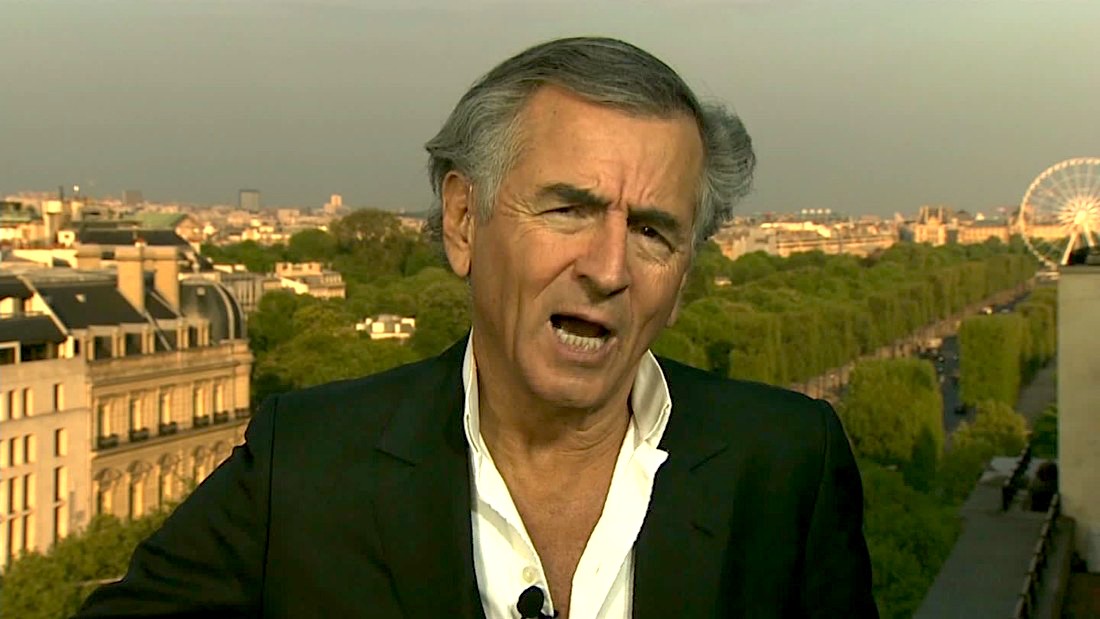
Bernard-Henri Lévy: No one proliferates more fact-free assertions. (CNN Screenshot.)
And what about mainstream media? In one recent news report after another (Skripal poisoning, chemical weapons attacks in Syria, the falsified murder in Ukraine of an anti-Putin journalist, not to mention the responsibility for firing a missile that shot down a Malaysian airliner in July 2014), there is a big difference between the Western version of the facts and that which prevails in Russia, Malaysia, Syria and much of the non-Western world.
A Mental Border with Russia
Instead of Pascal’s “truth on this side of the Pyrenees, and error on the other side”, we would be establishing “truth on one side of the Mediterranean, error on the other”. Or rather, truth exists up to the Eastern border of NATO, with error on the other side. This is no way to advance toward universal understanding. The only way to resolve our differences with the rest of the world is free discussion. Inasmuch as the law against fake news seems to be designed mainly to counter what Western governments describe as Russian propaganda, there is a strong likelihood that it can only enforce the mental border between us and the Russians.
When the independent journalist André Bercoff simply raised a couple of questions concerning anomalies in reports of the amazing rescue by Mamoudou Gassama of a child hanging from a Paris balcony, his own colleagues instantly condemned him for “provoking doubts” and engaging in “conspiracy theories”. The official regulatory agency, the Conseil Supérieur de l’Audiovisuel, hastened to open an investigation… of Bercoff. President Macron had invited Gassama to the Elysee Palace, offering him French citizenship and making the event an exemplary national legend. Thus sacred.
It is an odd sign of the times to reproach a journalist for asking questions. Leaving aside the rescue incident, raising questions used to be considered a primary function of journalism. If it is better to let ten guilty persons go free than to imprison one innocent man, in terms of rational scientific method, it is better to have ten extravagant doubts than one unchallengeable dogma.
It is true that what the dominant media call “conspiracy theories”, going everywhere from legitimate questioning of their own narratives and of official assertions to the wildest fantasies, do indeed proliferate on social media. But can anyone believe that describing Bercoff’s doubts as “conspiracy theorizing” will in any way stem that proliferation?

Françoise Nyssen: Public broadcasts must combat reactionary ideas.
The French Minister of culture, Françoise Nyssen, has decided that public radio and television, financed by taxpayers, should be devoted to combatting French people’s “highly reactionary” ideas, notably concerning “diversity”. Note that Macron’s ruling party, Republic in Movement, considers “reactionary” exactly what was considered progressive only a few decades ago: defense of public services and national sovereignty. Is it legitimate to oblige adults to pay for their own ideological re-education?
I by no means suggest that the current government is consciously intent on installing a totalitarian regime. The problem stems rather from the overwhelming subjectivism of contemporary culture in which talk of “values” leaves little space for concern for facts or objectivity. This is increasingly true even in discussions of scientific or technical progress. Of course, legislation cannot be fully objective, but since the Enlightenment reflection on freedom, the ideal has been to seek to establish reasonable rules to protect the individual from arbitrary power. This rule applies particularly to freedom of expression.
Those who speak endlessly of their values are merely trying to show off their own moral superiority. That is the basis of the corruption of the legal system in the matter of “fake news”, the reaction to Bercoff’s doubts, and the crusade of Madame Nyssen against what she considers “reactionary ideas”. Once a group of people convince themselves that they embody Virtue itself thanks to their “values”, they become unable to perceive any legitimate grounds for limiting their own power. That could be called the totalitarianism of the naïve.
This article originally appeared on RT’s French-language site. It was translated and adapted by Diana Johnstone.
Jean Bricmont is professor of theoretical physics at the Catholic University of Louvain (Belgium), and author of numerous articles and books, including Humanitarian Imperialism, La République des Censeurs,and Fashionable Nonsense (with Alan Sokal).
Anything Goes When You’re Saving the World
By Donna Laframboise | Big Picture News | May 30, 2018
SPOTLIGHT: Saving the world = barbaric behaviour.
BIG PICTURE: The paperback edition of biologist Paul Ehrlich’s 1968 bestseller, The Population Bomb, was 233 pages long. The first three chapters described a problem.
The final two chapters were titled “What Needs to be Done” and “What Can You Do?” They were followed by an Appendix of examples of letters readers might send to influential individuals. In other words, 83 pages of that book (more than a third) was an unabashedly political discussion.
These pages reiterated that the future was bleak. Overpopulation threatened America, the American way of life, and the “very lives” of US citizens (pp. 135, 138, 172, 180, 182).
The “only hope for survival,” was “drastic worldwide measures” lest civilization itself go “down the drain.” The “time of famines” had arrived (pp. 134, 143, 145, 148, 157-9, 161, 165, 198).
50 years later, we know Ehrlich’s apocalyptic predictions were wildly off target. Half a billion people did not starve to death during the 1970s. Instead, via ingenuity and technology, humanity grew more food and got better at transporting it to wherever it was desperately needed.
Americans weren’t forced to “slaughter” their dogs and cats so that pet food protein could be fed to the “starving masses.” Luxury taxes weren’t placed on diapers, and a powerful new arm of the US government wasn’t created to “take whatever steps are necessary,” in order to bring that country’s birth rate in line with its death rate. In 1968, there were 200 million Americans. Today, there are 326 million (pp. 134, 137-8).
Ehrlich’s fanaticism was on stark display when he described overpopulation as a cancer:
We must shift our efforts from treatment of the symptoms to the cutting out of the cancer. The operation will demand many apparently brutal and heartless decisions. The pain may be intense. But the disease is so far advanced that only with radical surgery does the patient have a chance of survival. (pp. 166-167)
In this regard, he declared that America should have pressured the Indian government to sterilize “all Indian males with three or more children”:
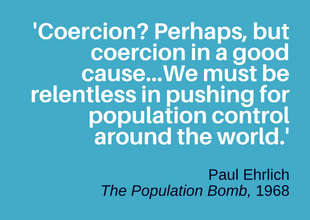
We should have volunteered logistic support in the form of helicopters, vehicles, and surgical instruments. We should have sent doctors to aid in the program…Coercion? Perhaps, but coercion in a good cause. (pp. 165-166)
TOP TAKEAWAY: Fifty years after The Population Bomb appeared, few people remember that it advocated dispatching US helicopters so that Indian peasants could be kidnapped & forcibly sterilized.
Israel closes Ibrahimi Mosque in Hebron

A view of Ibrahimi Mosque in Hebron, West Bank on 8 July 2017 [Issam Rimawi/ Anadolu Agency]
MEMO | June 11, 2018
The Israeli occupation forces yesterday closed the Ibrahimi Mosque in the occupied West Bank city of Hebron to Muslim worshippers without prior notice.
Israel’s 0404 website claimed that an explosive device was found in the vicinity of the mosque earlier in the day.
Israel forces intensified their presence in the area and closed the mosque following the incident, the sources added.
No further details were given, nor is it known when the mosque would be reopened.
Muslims are observing the fast during the holy month of Ramadan which is due to come to an end this weekend. Additional prayers are held in the mosque on a daily basis during this period.
Palestinian residents of Hebron’s Old City face a large Israeli military presence on a daily basis, with at least 20 checkpoints set up at the entrances of many streets, as well as the entrance of the Ibrahimi Mosque itself.
They are also not permitted to drive on Al-Shuhada Street, have had their homes and shops on the street welded shut, and are not allowed to walk on some roads in the Old City.
Meanwhile, some 800 notoriously violent Israeli settlers in Hebron move freely on the street, drive cars, and carry machine guns.
Israel branded ‘illegal state’ by Spain’s Podemos party leader
RT | June 11, 2018
Israel has been branded an “illegal state” by the leader of Spain’s third-largest party, Podemos, for conducting an apartheid-like massacre at the Gaza fence bordering Palestine.
“We need to act more firmly on an illegal country like Israel,” Iglesias Turrion told Spanish RTVE channel. Accusing the country of violating international law and resorting to what he called apartheid-like policies, the leader of the left-wing party questioned the legitimacy of the state of Israel.
“Israel’s actions are illegal. The apartheid policies of the state of Israel are illegal,” the politician said, adding that when it comes to international politics he and his party would continue to “defend international rights.”
Iglesias Turrion’s comments came mere days after a local faction of Podemos on Valencia’s city council “condemned” Israel’s illegal assassinations and declared that the third-largest Spanish city would be an “Israeli apartheid-free zone” from now on.
Valencia’s condemnation of disproportionate violence against Palestinians and the decision to refrain from any contact with Tel Aviv was supported by other Spanish cities, including Madrid, Barcelona and Andalusia, which decided to distance themselves from Israel in an expression of solidarity with the “boycott Israel“ movement.
While the number of casualties on the Israeli-Palestinian border is over 120, Israel has been trying to legitimize its bloodshed by portraying it as a lawful response to the presumed Palestinian violence and Israel’s attempt to protect its borders.
However, Israel’s Prime Minister Benjamin Netanyahu’s insistence that no Palestinian was killed “intentionally” and that “people died accidentally” revealed a disturbing inconsistency with an earlier statement by the Israel Defense [sic] Forces.
Tel Aviv’s oppression of the Palestinians, along with the US’ controversial decision to move its embassy to the disputed [illegally occupied] city of Jerusalem, have been openly condemned by the EU. Seeing no better solution to stop bloodshed at the Gaza border, the European Union, represented by Federica Mogherini, has insisted on a two-state solution with Jerusalem remapped as the capital of “both of the state of Israel and the state of Palestine.”
Featured Video
John Mearsheimer: US Already lost Iran war – No off-ramp in sight
or go to
Aletho News Archives – Video-Images
Frlom the Archives
70 Neocons Petition Congress To Effectively Allow Israel To Say When The US Should Attack Iran
By Damian Lataan | January 10, 2014
Seventy senior Israeli-centric neoconservatives have written an open letter to Congress imploring them to do more to ensure Iran complies with the conditions of any agreement finally reached with the P5+1 over Iran’s nuclear program.
While the neocons are ostensibly asking Congress to ensure compliance, it is clear that their real aim is to convince members of Congress to support the bill currently passing through the Senate which calls for tighter sanctions against Iran in the event of any waywardness on Iran’s part.
The neocons are eager to see the bill currently passing through the Senate with enough support to make it veto-proof, not so much because they are concerned about Iran’s so-called nuclear weapons program – there’s still not a skerrick of hard evidence that Iran has a nuclear weapons program – but, rather, because embedded within the bill is this clause:
… if the Government of Israel is compelled to take military action in legitimate self-defense against Iran’s nuclear weapon program, the United States Government should stand with Israel and provide, in accordance with the law of the United States and the constitutional responsibility of Congress to authorize the use of military force, diplomatic, military, and economic support to the Government of Israel in its defense of its territory, people, and existence…
Essentially, the clause is an automatic trigger for the US to attack Iran at any time the Israelis choose to launch a first strike – regardless of whether President Obama is in favour or not.
Partial list… continue
Blog Roll
 Aletho News
- ‘Heinous crime’: Iran denounces Israeli assassination of 4 Iranian diplomats in Lebanon
- John Mearsheimer: U.S. Already Lost Iran War – No Off-Ramp in Sight
- UK Parliament Plans ISP Blocking and Age Verification Powers
- World cannot remain silent as US and Israel attack ‘heritage of humankind’: Iran
- Emirati billionaire rebukes US senator over call for Gulf states to join war with Iran
- Op. True Promise 4: Iran’s missile blitzkrieg dismantles US war machine in West Asia
- Aramco CEO warns ‘catastrophe’ imminent if Strait of Hormuz remains shut
- What If Iran Says No?
- Trump Threatens to ‘Hit’ Iran ‘Twenty Times Harder’ Over Strait of Hormuz Oil Flows
- Spare the hypocrisy: Baghaei slams Ursula’s support for US
- If Americans Knew
- Israel Decided the War, But Trump’s America Fights and Pays the Bill
- Conscientious Objector Group: Phone ‘Ringing Off Hook’ As Huge Mobilization Underway
- U.S. support for Israel continues to plummet, despite media’s best efforts
- Threats and missiles fly, death tolls soar in Iran, Lebanon, Gaza – Not a ceasefire Day 151
- Lebanon: Israel’s White Phosphorous Use Risks Civilian Harm
- Corporate Media Go All Out To Support The US-Israeli War On Iran
- US-Israel war on Iran is creating a steady growing number of amputees
- Israel planned this war on Iran for 40 years. Everything else is a smoke screen
- The wrong question about the war in Iran
- ‘Your Tax Dollars Being Used to Raise Your Gas Prices’: US-Israel Bomb Major Iranian Oil Depots
- No Tricks Zone
- New Study Documents A 20-Year Pause In Arctic Sea Ice Decline – Driven By Internal Variability
- Wake-up Call: Survey Shows Majority Of Germans Now Favor Postponing Climate Targets!
- Televised! Leading German Political Candidate Tells Schoolchildren CO2 Makes Sun Hotter!
- New Study: A Century Warming Of 1.1°C Is ‘Commonplace’ And ‘Not Unusual’ During This Interglacial
- New Study: ‘Internal Noise’ And Volcanic Forcing Can Trigger 10-15°C Warming Within Decades
- Glaciers Worldwide Are Suddendly Surging, Experts Blame Warming!
- Surprising Discovery: Sahara Is Greening…Billions Of Trees Where Once Thought To Be Barren
- New Research Reaffirms Clouds, Aerosols, And Surface Solar Radiation Are ‘Driving The Climate System’
- Germany: Electric Car Catches Fire At Charging Station, Sets Off Local “Inferno”, Widespread Damage
- New Study: Canada’s New Brunswick Was 1°C Warmer Than Today During The Medieval Warm Period
 Aletho News