Massacres were indispensable to creation of the Israeli state
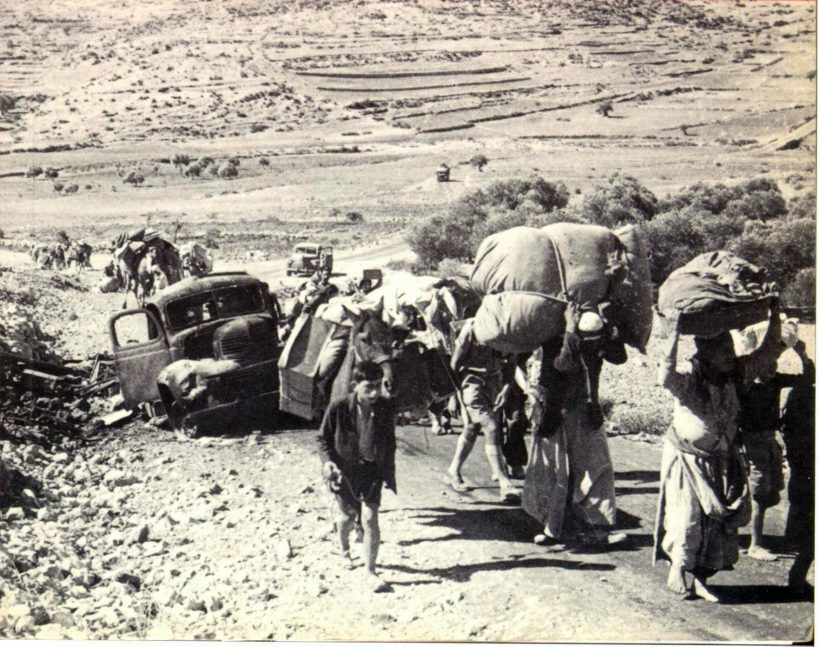
Palestinian refugees, 1948
By Richard Becker | Liberation School | May 29, 2018
As Israeli leaders and the Trump regime grotesquely celebrated the moving of the U.S. embassy to Jerusalem on the 70th anniversary of Israel’s declaration of independence, May 14, just 40 miles away Israeli troops were massacring unarmed Palestinians trapped inside Gaza. At least 61 Palestinians were killed, and more than 2,700 wounded, over a thousand shot by snipers firing military grade ammunition against unarmed protestors who were demanding an end to their isolation and the right to return to their homeland.
There was a bitter historical irony in the juxtaposition of these events
Most of the two million residents of Gaza are refugees and their descendants (who also have refugee status), driven from other parts of Palestine in 1948. Altogether, more than 750,000 Palestinians were expelled in 1948-49 to make way for the creation of the Israeli state. Another 300,000 were driven out after the Six Day War in 1967. Today, there are seven million registered Palestinians refugees, many still living in 59 refugee camps in Jordan, Lebanon, Syria, Egypt, the West Bank and Gaza. None have ever been allowed to return to their stolen homes, farms and shops, in blatant violation of their rights.
For many decades, Israeli leaders and their American apologists maintained the fiction that the Palestinians who left did so at the urging of their leaders. Even if that had been the case, it would have in no way invalidated their right of return, an inalienable right under international law.
But it was not the case. As has been irrefutably documented by numerous Israeli as well as Palestinian historians, mass ethnic cleansing was carried out by means of massacre and other forms of terror. It could not have been accomplished otherwise.
The Israeli colonial state was not, of course, the only one that employed terror and massacre to subjugate the indigenous population. All of the colonizers utilized such tactics, including the United States, Britain, France, Belgium, Japan, Netherlands, Italy, etc., to establish their empires.
“Transfer” – Zionist leaders’ intention from the start
The leaders of the Zionist movement that manifested itself as the Israeli state in 1948 had often been quite open about their intention to conquer all of Palestine and to force the indigenous population out. Their code word for ethnic cleansing was “transfer.” In 1937, David Ben-Gurion, a reputed “moderate” in the Zionist leadership who would later become Israel’s first prime minister wrote:
“Now a transfer of a completely different scope will have to be carried out. In many parts of the country new settlement will not be possible without transferring the Arab fellahin…Jewish power which grows steadily, will also increase our possibilities to carry out this transfer on a large scale.”
In 1940, another key Zionist leader, Josef Weiiz, director of the Jewish National Fund charged with acquiring as much land as possible, wrote: “Among ourselves it must be clear that there is no room for both people in this country . . . and there is no way besides transferring the Arabs from here to neighboring countries, to transfer them all, except maybe for Bethlehem, Nazareth and Old Jerusalem, we must not leave a single village, a single tribe.”
On November 29, 1947, the United Nations voted to partition the British colony of Palestine: 55% for a Jewish state, 44% for an Arab state, and 1% for an international zone. In true colonialist fashion, there was no consultation with the Palestinians before the vote. Widespread fighting broke out immediately.
A month after the vote, Ben-Gurion, said in a speech:
“In the area allocated to the Jewish state there are not more than 520,000 Jews and about 350, 000 non-Jews, mostly Arabs. Together with the Jews of Jerusalem, the total population of the Jewish State at the time of its establishment will be about one million, including almost 40 percent non-Jews. Such a [population] composition does not provide a stable basis for a Jewish state. This fact must be viewed in all its clarity and acuteness. With such a composition, there cannot event be absolute certainty that the control will remain in the hands of the Jewish majority . . . There can be no stable and strong Jewish state so long as it has a Jewish majority of only 60 percent.”
Ben-Gurion hailed ethnic cleansing
The ethnic cleansing of Palestine that began almost immediately after the fateful UN vote delighted Ben-Gurion. In a February 8, 1948 speech to the governing council of his Labor Party, he gloated:
“From your entry into Jerusalem, through Lifta, Romema [an East Jerusalem neighborhood] … there are no Arabs. One hundred percent Jews. Since Jerusalem was destroyed by the Romans, it has not been as Jewish as it is now. In many Arab neighborhoods in the west one sees not a single Arab. I do not assume that this will change … What has happened in Jerusalem … is likely to happen in many parts of the country … in the six, eight to ten months of the campaign there will certainly be great changes in the composition of the population in the country.”
But what so heartened Ben-Gurion in early 1948 was not yet reflected in most of the country. The much better armed and financed Zionist militias prevailed in most, though not all, battles. But in most areas, the objective of driving out the Palestinian population was not being achieved. Palestinian villagers would retreat during active combat, but only to nearby villages or towns, waiting for the fighting to stop so they could return to their homes and farms.
At the time, the majority of Palestinians were peasant farmers who could not leave their land and livestock for any extended period of time without disastrous consequences. The contention that they would have voluntarily abandoned their farms based on the call of some far-off “leader” is simply ludicrous.
By March 1, 1948, less than 5% of the Palestinian population had been driven out, which was viewed by the Zionist leaders as serious threat to their plan.
Two additional factors made this a crisis-in-the-making for Ben-Gurion and his cohorts. One was a shift in Washington. While the Truman administration had played a key role in ramming the partition plan through the UN, it was now evidencing second thoughts. The partition plan had not brought peace — just the opposite, and much of the anger in the Arab world and beyond was directed at the U.S.
The State Department was floating a proposal to scrap partition and replace it with a five-year trusteeship. The Zionist leaders rejected it outright, but were acutely conscious of the importance of maintaining support from the United States.
And, the approach of May 15, 1948, the date the British colonizers had set for withdrawing their troops from Palestine was fast approaching.
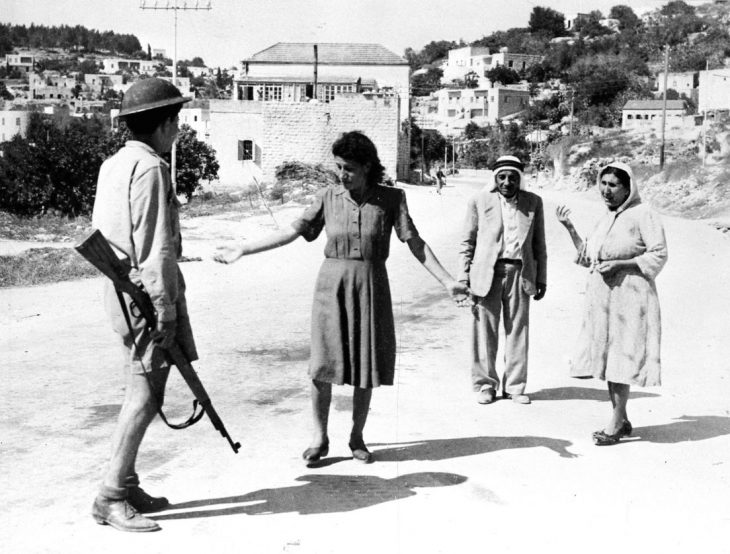
An Israeli soldier stops Palestinians in Nazareth, 1948, for traveling after the imposed curfew
Plan Dalet – terrorist violence on a mass scale
Confronted with what they viewed as multi-front crisis, Ben-Gurion and his commanders began to implement a new military doctrine under the name Plan Dalet, or Plan D. Under the plan, the official Zionist army, the Haganah, along with its supposed rival militias, Irgun and Lehi (Stern Gang), both of the latter self-proclaimed terrorist organizations, began attacking “quiet” Palestinian villages, those not involved in fighting.
The progressive Israeli historian Ilan Pappe asserts in his book, The Ethnic Cleansing of Palestine, that Ben-Gurion actually viewed the “quiet” villages as a bigger problem than those that resisted, as the latter provided a pretext for carrying out harsh repression and removal.
Among the directives of Plan Dalet were:
“Mounting operations against enemy population centres located inside or near our defensive system in order to prevent them from being used as bases by an active armed force. These operations can be divided into the following categories:
“Destruction of villages – setting fire to, blowing up, and planting mines in the debris – especially those population centers which are difficult to control continuously.
“Mounting search and control operations according to the following guidelines: encirclement of the village and conducting a search inside it. In the event of resistance, the armed force must be destroyed and the population must be expelled outside the borders of the state.”
Plan Dalet escalated the level of violence directed against the Palestinian civilian population to an extreme. A typical operation carried out by Zionist military units would involve planting explosives around Palestinian houses in the middle of the night, drenching them with gasoline and then opening fire. The point was to terrorize and expel the population. Arbitrary executions became routine, particularly targeting men and boys simply deemed to be of “fighting age,” regardless of whether they were actually engaged in combat.
Deir Yassin massacre – a turning point
Deir Yassin, on the outskirts of Jerusalem was on of the “quiet” villages. On April 9, 1948, the Irgun led by Menachem Begin, wiped out nearly its entire population The Irgun blew up houses with the inhabitants inside, executed others in their homes. Many of the women in the village were raped before being killed. The Irgun paraded the few survivors in a truck through Jerusalem where they were jeered and spit on.
Deir Yassin raised Plan Dalet to a new level of brutality, The Jewish Agency, which a few weeks later would become the Israeli government, officially condemned the massacre but on the same day brought Irgun into the Joint Command with the Haganah, and Lehi, led by another future prime minister, Yitzhak Shamir.
The massacres in Deir Yassin, Tantura and other villages were widely publicized by the Zionists themselves, for maximum effect. Pappe has documented at least 29 additional massacres by Zionist forces between December 1947 and January 1949.
Twelve days after the Deir Yassin massacre, on April 21, 1948, the British commander in Haifa, a major city in the north with a mixed population, advised the Jewish Agency that he would immediately begin withdrawing his forces. He did not inform the Palestinians. The same day, Hagahah forces launched a major attack on the Palestinian neighborhoods of the city, rolling barrel bombs filled with gasoline and dynamite down narrow alleys in the heavily populated city while shelling the same areas with mortars.
Haganah army loudspeakers and sound cars broadcast “horror recordings” of shrieks and screams of Arab women, mixed with calls of, “flee for your lives, the Jews are using poison gas and nuclear weapons. By early May, only 4,000 Palestinians of 65,000 remained in Haifa.
Irgun commander Menachem Begin, provided most vivid description of how well the slaughter at Deir Yassin was instrumental in the expulsion of the Palestinians from Haifa and other cities, towns and villages. In his book The Revolt, Begin wrote:
“Panic overwhelmed the Arabs of Eretz Israel [sic]. Kolonia village, which had previously repulsed every attack of the Haganah (the underground Jewish military organization that became the Israeli Army), was evacuated overnight and fell without further fighting. Beit-Iksa was also evacuated. These two places overlooked the road and their fall, together with the capture of Kastel by the Haganah, made it possible to keep open the road to Jerusalem. In the rest of the country, too, the Arabs began to flee in terror, even before they clashed with Jewish forces … The legend of Deir Yassin helped us in particular in the saving of Tiberias and the conquest of Haifa … All the Jewish forces proceeded to advance through Haifa like a knife through butter. The Arabs began fleeing in panic, shouting ‘Deir Yassin!’”
Three decades later, in an article for The American Zionist, Mordechai Nisan of the Truman Research Centre of the Hebrew University in Jerusalem expressed his concern about the failure to understand the major significance of terrorism in the struggle for Jewish sovereignty. He wrote: “Without terror it is unlikely that Jewish independence would have been achieved when it was.”
(Much of the historical material in this article can be found in the book, Palestine, Israel and the U.S. Empire, by Richard Becker. PSL Publications, 2009)
Bill Browder Escapes Again
By Philip Giraldi | American Herald Tribune | June 2, 2018
There was some good and bad news last week. The good news was that William Browder, a London-based investor and dedicated foe of Russian President Vladimir V. Putin was arrested by the Spanish police on Wednesday. The bad news is that even though Russia has on six occasions requested Browder’s arrest through Interpol for tax fraud, the Spanish national police determined that Browder had been detained in error because the international warrant was no longer valid and released him.
Interpol, an organization of 190 countries cannot legally enforce any action of a “political character.” This can make it difficult to obtain red notices such as those being sought by Russia on Browder, which are the equivalent of international arrest warrants.
One might reasonably ask why there is a crisis in US-Russia relations at all since Washington and Moscow have much more in common than not, to include confronting international terrorism, stabilizing Syria and other parts of the world that are in turmoil, and preventing the proliferation of nuclear weapons. In spite of all that, the U.S. and Russia are currently locked in a tit-for-tat unfriendly relationship somewhat reminiscent of the Cold War and it is only getting worse as self-appointed “experts” including Browder continue to prowl the fringes of policy making. Browder was in Spain to testify in a case against several Russian companies.
That William Browder might be regarded as controversial is somewhat of an understatement. Many who regard him as a crook serving as a catalyst for the bad policies relating to the U.S.-Russia relationship would like to see him in jail. Israel Shamir, a keen observer of the American-Russian relationship, and celebrated American journalist Robert Parry both think that Browder single-handedly deserves much of the credit for the new Cold War.
William Browder, the grandson of Earl Browder, former head of the American Communist Party, is a hedge fund operator who made his fortune in the corrupt 1990s world of Russian commodities trading. One of many Jewish profiteers who descended on Russia, his current role is symptomatic of why the United States government is so poorly informed about overseas developments as he appears before Congress frequently and is the source of much of the “testimony” contributing to the current bad international climate. He has somehow emerged as a trusted source in spite of the fact that he has considerable interest in cultivating a certain outcome favorable to himself. Also ignored is his renunciation of American citizenship in 1998, reportedly to avoid taxes. He is now a British citizen.
Browder is notoriously the man behind the 2012 Magnitsky Act, which exploited Congressional willingness to demonize Russia and has done so much to poison relations between Washington and Moscow. The Act has sanctioned individual Russian officials, which Moscow has rightly seen as unwarranted interference in the operation of its judicial system.
Browder, a media favorite who self-promotes as “Putin’s enemy #1,” portrays himself as a selfless human rights advocate, but is he? He has used his fortune to threaten lawsuits for anyone who challenges his version of events, effectively silencing many critics. He claims that his accountant Sergei Magnitsky was a crusading “lawyer” who discovered a $230 million tax-fraud scheme that involved the Browder business interest Hermitage Capital but was, in fact, engineered by corrupt Russian police officers who arrested Magnitsky and enabled his death in a Russian jail.
Many have been skeptical of the Browder narrative, suspecting that the fraud was in fact concocted by Browder and his accountant Magnitsky. A Russian court has supported that alternative narrative, ruling in late December 2013 that Browder had deliberately bankrupted his company and engaged in tax evasion. He was sentenced to nine years prison in absentia.
William Browder has also been regularly in the news in connection with testimony related to Russiagate. On December 16, 2017 Senator Diane Feinstein of the Senate Judiciary Committee released the transcript of the testimony provided by Glenn Simpson, founder of Fusion GPS. According to James Carden, Browder was mentioned 50 times, but the repeated citations apparently did not merit inclusion in media coverage of the story by the New York Times, Washington Post and Politico. Browder has become such an essential asset in the media story about “evil” Russia that he has become in a certain sense bullet proof in spite of his own personal very questionable history.
Fusion GPS, which was involved in the research producing the Steele Dossier used to discredit Donald Trump, was also retained to provide investigative services relating to a lawsuit in New York City involving a Russian company called Prevezon. As information provided by Browder was the basis of the lawsuit, his company and business practices while in Russia became part of the investigation. Simmons maintained that Browder proved to be somewhat evasive and his accounts of his activities were inconsistent. He claimed never to visit the United States and not own property or do business there, all of which were untrue, to include his ownership through a shell company of a $10 million house in Aspen Colorado. He repeatedly ran away, literally, from attempts to subpoena him so he would have to testify under oath.
Per Simmons, in Russia, Browder used shell companies locally and also worldwide to avoid taxes and conceal ownership, suggesting that he was likely one of many corrupt businessmen operating in what was a wild west business environment. My question is, “Why was such a man granted credibility and allowed a free run to poison the vitally important US-Russia relationship?” The answer might be follow the money. Israel Shamir reports that Browder was a major contributor to Senator Ben Cardin of Maryland, who was the major force behind the Magnitsky Act.
Cardin and others in Congress have made Russia the bete noir of American politics, finding it convenient to scapegoat Moscow for the failure of the United States to put together a coherent and functioning foreign policy. Bill Browder is an essential component in that effort. Perhaps someone should ask him how he became a billionaire in a corrupt Russia going through political crisis and democratization in the 1990s. It would be interesting to learn what he has to say in his defense.
Joining Some Dots on the Skripal Case: Part 1 – An Official Story That Doesn’t Hold Water
By Rob Slane | The Blog Mire | June 1, 2018
I have asked a lot of questions in relation to the Skripal case and many, if not most, are still unanswered. However, I want in this piece to go further than asking questions, and to start to join a few dots together. There is much to say, and rather than doing it in one long piece, which only three people will have the attention span to sit through, I want to do it over a number of articles. Probably four or five. We shall see.
When I say that I am hoping to join some dots together, please note that what I am not attempting to do is state anything conclusively. Rather, I am simply advancing a theory, based on what I have observed so far, and I do so in the full knowledge that there may well be things I have missed, facts which I am as yet unaware of, and other facts which are still to be revealed. These things may well blow any theory I advance apart.
But before I get to that, there is a question that must first be asked: Why is a theory needed in the first place? It’s not as if there isn’t an official one out there. Indeed there is. In which case, why the need for another theory to explain what happened?
The reason is that the official story, put forward by the British Government, is wholly lacking in credibility. It has actually come as a surprise to me just how many people there are out there who don’t buy the official story. Anecdotally, I would say that those looking at the official narrative and wondering how on earth it stacks up includes many who would perhaps not normally question the official line on things.
And so attempting to come up with another theory of what happened has nothing to do with advancing what is usually called a “conspiracy theory”. If the claims of the official story did match the facts, then advancing an entirely different theory could well be seen as a conspiracy theory. But since the claims made by the British Government and in the compliant media do not stack up, this is simply a case of seeking an alternative theory that tries to make more sense of the known facts.
But what is it about the Government story that makes it lack credibility? There are a number of things, but let’s just keep this simple. Let’s begin by looking at what it alleges. This can best be summed up by the words of the British Prime Minister, Theresa May, in the statement she made to the House of Commons on 14th March 2018:
“Mr Speaker, on Monday I set out that Mr Skripal and his daughter were poisoned with a Novichok: a military grade nerve agent developed by Russia. Based on this capability, combined with their record of conducting state sponsored assassinations – including against former intelligence officers whom they regard as legitimate targets – the UK government concluded it was highly likely that Russia was responsible for this reckless and despicable act. And there were only two plausible explanations.
Either this was a direct act by the Russian State against our country. Or conceivably, the Russian government could have lost control of a military-grade nerve agent and allowed it to get into the hands of others.”
Leaving aside Mrs May’s allegations for a moment, any impartial observer would immediately notice something odd about this. Her statement was made on 14th March. This was just 10 days since the Skripals were poisoned. At that time, the investigation had hardly begun, and had not yet established any of the following basic facts:
- Where the Skripals were poisoned
- When the Skripals were poisoned
- How they were poisoned
- Who it was that poisoned them.
In other words, she reached conclusions before the establishing of facts, and it goes without saying that this is the very opposite of a rational approach. Indeed, as Sir Arthur Conan Doyle warned us through his most famous creation, Sherlock Holmes:
“It is a capital mistake to theorise before one has data. Insensibly one begins to twist facts to suit theories, instead of theories to suit facts.”
But what of her actual claims? The statement that Russia has a record of conducting state-sponsored assassinations is entirely irrelevant to establishing guilt in this case. Past behaviour can be useful evidence to support a case, but guilt must always be proved on the basis of the facts and evidence in the case at hand, and on them alone. Anything else is simply dangerous and wrong.
Which means that the Government’s case essentially relies on just two parts:
- That Mr Skripal and his daughter, Yulia, along with Detective Sergeant Nick Bailey, were poisoned by the military grade nerve agent, A-234 (one of the so-called “Novichok” nerve agents).
- That because this substance was developed in Russia (actually the Soviet Union), it therefore must have originated from that country.
However, both of these apparent facts are demonstrably untrue.
To take the second point first, it has now been proven beyond any doubt whatsoever that a number of other countries have either produced the substance, or know how to produce it. The Czech Government has admitted producing a small quantity of the closely related substance, A-230; Iran has produced Novichok, which it registered with the OPCW; The German Intelligence Agency, BND, was given the formula back in the 1990s, and they shared it with a number of other NATO countries, including the US and UK. The Edgewood Chemical and Biological Defense Command in Maryland, USA, recorded the formula back in 1998.
What is more, as the Moon of Alabama website points out, David Collum, Professor of Organic Chemistry at Cornell University has not only stated that his students could create the substance, but he actually got them to do an experiment to make it. According to the results, 15 out of 16 students did so successfully!
All of which means that the claim that the poison must have come from Russia is demonstrably untrue.
But if analysis of that second claim shows the British Government’s theory to be somewhat dodgy, scrutiny of the first shows it to be entirely false. Given the toxicity of A-234, being around 5-8 times more toxic than VX (some reports state it as being 10 times more toxic), had the Skripals come into contact with it on the door handle of Mr Skripal’s house, as is alleged, one of two things would have occurred:
a) They would either have died within a few minutes of coming into contact with it or
b) In the remote possibility that they had survived, they would have suffered for the rest of their short lives from irreparable damage to their central nervous system, with a number of chronic health issues, such as cirrhosis, toxic hepatitis, and epilepsy (see here for details of what I understand to be the only known survivor of poisoning by this substance, Andrei Zheleznyakov).
What they would not have done is spent the next four hours swanning around Salisbury, going for a drink and then for a meal in a restaurant. What they would not have done is to exhibit symptoms closer to having been poisoned by a hallucinogenic than a military grade nerve agent. And they most certainly would not have collapsed at exactly the same time as each other, four hours later, after showing no previous signs of illness in the restaurant.
Yet as it is, not only are the Skripals and D.S. Bailey still alive, but none have suffered irreparable damage to their nervous system. In fact, in her conversation with her cousin, Viktoria, on 5th April, Yulia Skripal specifically made mention that “everyone’s health is fine, there are no irreparable things“.
Given that this is so, it is entirely rational to come to the following conclusion:
The claim that Sergei Skripal, Yulia Skripal and D.S. Bailey were poisoned by A-234, which is one of the most deadly nerve agents known to man, and which either kills or leaves its victims with irreparable damage, is demonstrably untrue.
Having dealt with the official story, I want in Part 2 to deal with what I believe to be some of the most interesting clues in this case, each of which is being ignored or swept under the carpet.
Some of my previous pieces on the Skripal Case:
♦ 30 Questions That Journalists Should be Asking About the Skripal Case
♦ 20 More Questions That Journalists Should be Asking About the Skripal Case
♦ The Skripal Case: 20 New Questions That Journalists Might Like to Start Asking
♦ The Lady and the Curiously Absent Suspect — Yet Another 20 Questions on the Skripal Case
♦ The Slowly Building Anger in the UK at the Government’s Handling of the Skripal Case
♦ The Three Most Important Aspects of the Skripal Case so Far … and Where They Might be Pointing
♦ A Bucketful of Novichok
♦ What Would Sherlock Holmes Have Made of the Government’s Explanation of the Case of Sergei and Yulia Skripal?
WaPo Editors: We Have to Help Destroy Yemen to Save It
By Adam Johnson | FAIR | May 31, 2018
Over the past year, the Washington Post editorial board has routinely ignored the US’s involvement in the siege of Yemen—a bombing and starvation campaign that has killed over 15,000 civilians and left roughly a million with cholera. As FAIR noted last November (11/20/17), the Washington Post ran a major editorial (11/8/17) and an explainer (11/19/17) detailing the carnage in Yemen without once mentioning the US’s role in the conflict—instead pinning it on the seemingly rogue Saudis and the dastardly Iranians.
This was in addition to an op-ed that summer by editorial page editor Jackson Diehl (6/26/17), which not only ignored the US’s support of Saudi bombing but actually spun the US as the savior of Yemenis, holding up Saudi Arabia’s biggest backer in the Senate, Lindsey Graham, as a champion of human rights.
In recent months, however, the Post has charted a new course: vaguely acknowledging Washington’s role in the bloody siege, but insisting that the US should remain involved in the bombing of Yemen for the sake of humanitarianism.
In two recent editorials, “Can Congress Push the Saudi Prince Toward an Exit From Yemen?” (3/24/18) and “The World’s Worst Humanitarian Crisis Could Get Even Worse” (5/28/18), the Washington Post board has cooked up a new, tortured position that the US should not stop supporting the Saudis––a move 30-year CIA veteran and Brookings fellow Bruce Riedel argued in 2016 would “end the war overnight”—but mildly chide the Saudis into committing slightly fewer war crimes while moving towards some vague exit strategy.
In the March editorial, the Post insisted “the United States… should use its leverage to stop this reckless venture,” and that Trump “condition further American military aid on humanitarian relief measures.” A step in the right direction, right? Quite the opposite. When one reads closer, it’s clear that while the Post wanted Trump to moderately roll back the most egregious war crimes, it still lobbied against the Lee/Sanders bill that would have actually ended the war.
Monday’s editorial took this faux-humanitarian half-measure one step further with this bit of revisionist history:
Both the Obama and Trump administrations have offered limited support to the Saudi coalition, while trying to restrain reckless bombing and the exacerbation of the humanitarian crisis.
The idea that Obama and Trump offered the Saudis “limited” support is a glaring lie. The US’s support—from logistical support, to refueling, to selling $110 billion in arms, to political cover at the UN, to literally choosing targets on a map—has been crucial to carrying out the three-and-a-half-year campaign. Again, according to one of the most white-bread, establishment commentators, US support isn’t ancillary, it’s essential. Without it, there is no bombing campaign.
The problem is the Washington Post is charged with a contradictory task: to act as a Very Concerned champion of human rights while propping up the core tenets of America’s imperial foreign policy. It’s an extremely difficult sleight-of-hand when the US is backing a bombing campaign targeting some of the poorest people on Earth, so their support of this slaughter is actually spun as an attempt to rein it in. The US is going to bring down the system from the inside!
The most logical way the US can stop the slaughter of Yemen is to stop engaging it in it. But to the Washington Post, this runs against the US policy of bombing and/or sanctioning anything that has the most remote connection to Iran, so this simple course is just not on the table. Instead, the Post’s propaganda objective—after years of simply ignoring the US role altogether—is to paint its participation in war crimes as a way of preventing slightly worse war crimes; a good cop to Saudi’s bad cop. This permits business as usual while maintaining the pretense the US cares about human rights—in other words, the Post’s basic ideological purpose.
US to claim $1.7bn penalty from China’s ZTE
Press TV – June 2, 2018
The administration of US President Donald Trump is reportedly planning to seek a penalty of $1.7 billion from China’s telecommunications major ZTE Corporation.
The move – as revealed by people familiar with the matter – would be meant to punish and tighten control over the company before allowing it back into business.
Reuters said in a report that the US Commerce Department would also seek “unfettered site visits” to verify US components are being used as claimed by ZTE.
One source was also reported as saying that Washington also wanted the Chinese company to replace its board and executive team as soon as 30 days.
Nevertheless, a deal still had not been finalized and the sources cautioned that the penalties were fluid and the terms could change, Reuters added.
ZTE has been crippled by a ban imposed in April on buying US technology components for seven years for breaking an agreement reached after it was caught illegally shipping goods to Iran and North Korea.
The US accordingly forced the company to pay as much as $1.2 billion in March 2017 for allegedly shipping telecommunications equipment to Iran and North Korea in violation of unilateral American sanctions.
American companies provide an estimated 25 percent to 30 percent of components in ZTE’s equipment, which includes smartphones and gear to build telecommunications networks.
The company’s status has become an important bargaining chip in high-level trade talks between China and Washington amid reports that if the United States eases up on ZTE, China will buy more American agricultural goods.
Al Quds Day: Supporting Palestinians against Israeli oppression
PressTVUK | June 1, 2018
Ramadan is an opportunity to show solidarity with the Palestinian cause. Annual Al Quds marches will take place around the world next week, renewing a commitment to resistance against Israeli crimes.
See also:
US vetoes Kuwait-drafted UN resolution on protecting Palestinians

US Ambassador to the UN, Nikki Haley with Israeli Ambassador Danny Danon. (Photo: Mintpress)
Press TV – June 1, 2018
The United States has vetoed a Kuwait-drafted UN resolution calling for protection of Palestinians in Gaza and the occupied West Bank.
Out of the 15 UN Security Council members, Russia, France and China along with seven others voted in favor of the resolution on Friday, while four including Britain abstained.
The draft called for “the consideration of measures to guarantee the safety and protection of the Palestinian civilian population in the Occupied Palestinian Territory, including in the Gaza Strip.”
Kuwait’s Ambassador Mansour al-Otaibi said the US veto “will increase the sentiment of despair among the Palestinians.”
US envoy to the UN Nikki Haley called the resolution a “grossly one-sided” view of the conflict between Palestine and Israel.
She also described Hamas as a major impediment to peace, proposing an alternative draft resolution which only gained Washington’s positive vote.
During a second vote, when the US put forward its own rival measure, eleven countries abstained, while Russia and two others opposed it.
At least 120 Palestinians have been killed by Israeli forces since the “Great March of Return” began in the Gaza Strip on March 30. Fourteen children are among the fallen Palestinians.
About 13,300 Palestinians also sustained injuries, of whom 300 are in a critical condition.
The occupied territories have witnessed new tensions ever since US President Donald Trump on December 6, 2017 announced Washington’s recognition of Jerusalem al-Quds as Israel’s “capital” and said the US would move its embassy to the city.
The dramatic decision triggered demonstrations in the occupied Palestinian territories and elsewhere in the world.
The status of Jerusalem al-Quds is the thorniest issue in the decades-long Israeli-Palestinian conflict.
The Palestinians see East Jerusalem al-Quds as the capital of their future state.
Mainstream media gets it wrong on Gaza AGAIN

The New York Times, the Washington Post, and CNN are 3 examples of the selective amnesia from which nearly every mainstream media news source seems to suffer when it comes to the subject of Israel. It doesn’t take much digging to discover the actual truth – the context that completely changes the story.
By Kathryn Shihadah | If Americans Knew | June 1, 2018
Palestinians of Gaza have been peacefully protesting for 2 months, unarmed, demanding only their human rights. They have been met with Israeli sniper fire week after week, killing at least 118.
And the United States hasn’t done anything.
Grant Smith points out on antiwar.com that “a stunning 81.5% of Americans say they never heard about the massacre through any channel,” which perhaps explains our apparent apathy.

Source: IRmep poll of 1,506 US adults through Google Surveys May 25-27, RMSE 4.1%. Raw data and demographic filters at Google
Mainstream media reports on incidents in Palestine-Israel, but its effectiveness as a source of accurate information is questionable. For example, most Americans don’t even know who is occupying whom.
On May 29, 2 weeks after the bloodiest day of protesting – in which at least 60 Palestinians were killed and thousands were injured – several factions in Gaza had enough and began shooting rockets toward Israel. Israel naturally responded with airstrikes from warplanes.
Mainstream media, with its short-term memory loss in all matters Israeli, forgot about the context of unarmed Palestinian protest and sniper fire, describing the Gazan rockets almost as though they represented an unprovoked attack on a peaceful state.
It is not hard to see that, when there is coverage, MSM tends to come down firmly on the side of Israel. In the interest of accurate education of American readers, we provide the following corrections of recent articles.
The New York Times published on May 29:
Gaza Militants Barrage Israel With Mortars and Rockets
NYT: Islamic militants in Gaza attacked southern Israel with rockets and mortars on Tuesday and Israel responded instantly with a wave of airstrikes across the Palestinian territory, a sharp escalation of violence after weeks of deadly protests, arson attacks and armed clashes along the border.
Everything about this paragraph is problematic.
Let’s talk chronology first: since March 30th there have been 9 weekends of nonviolent protests by Gazans, which were met by Israeli sniper fire, killing at least 118 and injuring 13,000. The number of Israeli casualties: three. The “deadly protests” were only deadly for Palestinians, who were unarmed. During this time, no rockets or mortars were fired out of Gaza. When “militants” responded after 2 months of Israeli violence, the NYT called it “an attack,” and Israel’s action “a response.”
NYT: The exchanges were the most intense cross-border hostilities in Gaza since the two sides fought a 50-day war in the summer of 2014.
“Cross-border hostilities” refers again to an unarmed population, protesting for their rights, vs. snipers. Palestinians never crossed any borders, but Israelis did. Likewise, Palestinians were not hostile, but Israelis were.
Similarly, the “two sides” that fought in 2014 included 34,000 unguided shells shot into Gaza by Israel (including 19,000 high-explosive artillery shells, which form a crater 50 feet wide and 36 feet deep, penetrate up to 15 inches of metal or 11 feet of concrete), and 4,500 rockets shot into Israel by Gaza. No wonder 72 Israelis (mostly military) vs. 2,200 Palestinians (mostly civilians, including 500 children), died in that “war.”
The “cross border hostilities” in 2014 and this week were similarly lopsided.

Israeli Air Force MK-84 crater from 2014 incursion on Gaza, “Operation Protective Edge.”
NYT: By 10 p.m. on Tuesday, Israel said there had been 70 rockets or mortars fired from Gaza throughout the day.
This may sound frightening, and it would indeed be unnerving to endure. But context matters: in 14 years of rockets from Gaza, only 17 Israelis have been killed during peacetime, and 44 total.
NYT: Tensions have been spiraling along the border in recent weeks during a series of Palestinian protests against the 11-year blockade of the Gaza Strip and to press Palestinian claims to lands in what is now Israel. Israel insisted that it was not seeking to escalate, and that it was up to Hamas to decide whether to ratchet things up or stand down.
We applaud NYT for mentioning the 11-year blockade and Palestinian claims to land in what is now Israel. Don’t be in such a rush, though, NYT. Linger over the blockade for a moment – at least long enough to help your readers understand the truth. The blockade is against international humanitarian law.The blockade is keeping food and medicine out of Gaza, and has done so for over a decade.
NYT: Early Wednesday, Israel announced a new wave of airstrikes against 25 more Hamas targets in Gaza, saying it was holding Hamas responsible for conducting and allowing a “wide-scale attack against Israeli citizens.”

U.S. Ambassador to the United Nations Nikki Haley (Drew Angerer/Getty Images)
The United States called for an emergency meeting of the United Nations Security Council to discuss the latest attacks on Israel from Gaza and said it expected the session to be held on Wednesday afternoon… [US ambassador to the UN Nikki Haley said], “The Security Council should be outraged and respond to this latest bout of violence directed at innocent Israeli civilians.”
It’s puzzling that the US sees Gaza’s nonlethal rockets as worthy of outrage, but Israel’s snipers killing over 100 as unworthy of comment.
NYT: As many as 120 Palestinians have been killed by Israeli fire since March 30, according to the Gaza Health Ministry, mostly by snipers during the protests and half of them in a single day, May 14, the peak of the campaign.
Israel said it was defending its border and the nearby communities against a mass breach by the protesters, adding that Gaza militants intended to use unarmed civilian protesters as cover to infiltrate Israeli territory and attack Israeli soldiers and civilians.
Oh, NYT, you started strong there, acknowledging the Palestinian deaths and the snipers. But then you gave your readers only Israel’s explanation (“Gaza militants intended to use unarmed civilian protesters as cover”) as though this was an indisputable fact instead of an opinion. A comment from a Palestinian spokesperson would have been in order at this juncture.
The Washington Post was similarly one-sided in its May 29 coverage:
Tensions rise as Gaza militants fire more than 70 mortars, rockets into Israel
WaPo: “This is something we cannot tolerate,” said [Israeli army spokesman Lt. Col. Jonathan] Conricus. “Hamas is turning the fence into an active combat zone, and we cannot tolerate attacks on Israeli civilians and military targets.”
Interestingly, even Ha’aretz has conceded that the Great March of Return is not a “Hamas project,” but a grassroots movement by people who are deeply invested in resistance and return. But WaPo prefers the official Israeli spin, that “Hamas is turning the fence into an active combat zone,” in spite of the obvious fact that one side of the fence has no combat weapons. There is also, apparently, nothing noteworthy in the statement, “we can not tolerate attacks on Israeli civilians and military targets” (as if Palestinians do not have the same right to be intolerant of violence being perpetrated on their people).
WaPo: Tensions have been soaring between Israel and Gaza for the past few months. Residents of the coastal enclave, which has been under land and sea blockade by Israel and Egypt since Hamas wrested power over the strip more than a decade ago, have been holding weekly demonstrations at the Israeli border fence. They are demanding a right to return to land that now sits inside Israel and expressing frustration over a growing humanitarian crisis in what they describe as an open-air prison.
WaPo came so close to getting the paragraph right. Fact is, Hamas did not “wrest power over the strip.” Rather, Hamas won a free and open election – which the US encouraged.
CNN likewise managed, on May 29, to miss the point:
Gaza militants launch mortars, rockets at Israel, which responds with airstrikes
CNN: In a statement, the IDF said the [launching of mortars and rockets by Gazans] was a “severe, dangerous, and orchestrated act of terror, aimed at Israeli civilians and children.”
The degree of self-deception required for the IDF to make such a statement is staggering. The “severity” and “danger” of Gaza rockets is minor in comparison to Israel’s snipers; the label “act of terror” belongs with the side that has been killing unarmed protesters; likewise, the targeted “civilians and children” were the ones killed (at least 12 children out of 118 dead) and injured (about 1,000 children out of over 13,000 injured).
CNN: UN chief Middle East envoy Nickolay Mladenov expressed his deep concern at what he called “indiscriminate firing” by Gaza militants toward communities in southern Israel.
“Such attacks are unacceptable and undermine the serious efforts by the international community to improve the situation in Gaza.”
Of course, “indiscriminate firing” is problematic (especially if it actually hits something, as Gazan rockets rarely do); how about “discriminate firing that hits people who are praying, or running from the border, or helping injured protesters, or children, or journalists, or medical personnel? Does discriminate firing help the “serious efforts by the international community”? And where in the international community is work actually being done to “improve the situation in Gaza”?

Israeli soldiers take aim as they lie prone over an earth barrier along the border with Gaza
Bottom line, these mainstream media articles were not aberrations, but business as usual. Every day in Gaza has yielded either similarly inaccurate news, or radio silence – the one exception perhaps being May 14, 2018. On that day there was opportunity for a dazzling visual display on every news channel: a split-screen exhibition contrasting the high-class, clueless crowd at the opening ceremony of the US embassy in Jerusalem, with the Israeli violence and Palestinian carnage at the Gaza border. For that brief moment, many commentators pointed out Israeli aggression against a besieged people group.
Shortly after that day, reporters’ memories were erased, and Gazans are once again aggressors and followers of Hamas. Avigdor Lieberman is correct again: there are “no innocent civilians in Gaza.”
Life is back to normal.
UN Officials Call on Israel to Halt Khan Al-Ahmar Demolition
IMEMC | June 1, 2018
United Nations officials, on Friday, called on Israel to abandon plans to demolish the Palestinian community of Khan al-Ahmar, east of Jerusalem.
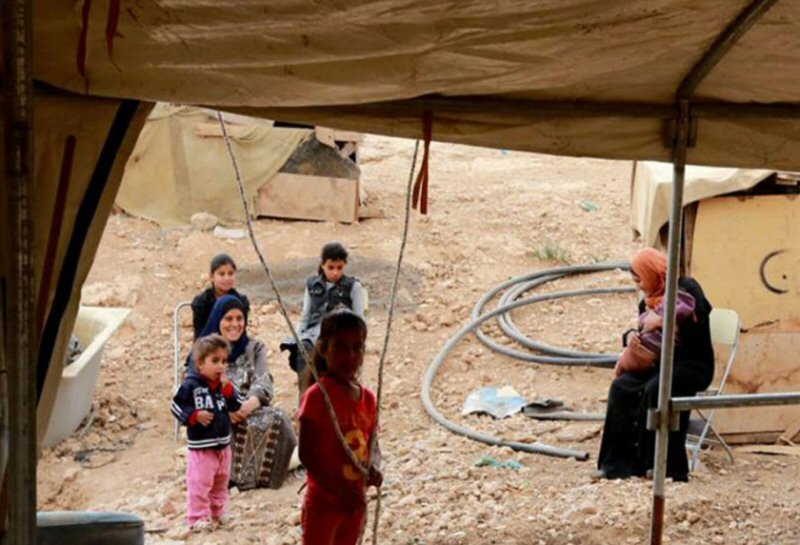
Humanitarian Coordinator, Jamie McGoldrick, and United Nations Relief and Works Agency for Palestine Refugees (UNRWA) Director of Operations in the West Bank, Scott Anderson, joined others in the international community in calling on the government of Israel to cease its plans to carry out the mass demolition and transfer of the Palestinian Bedouin community of Khan al Ahmar – Abu al Helu, located on the outskirts of East Jerusalem in the occupied West Bank.
“Like many Palestinians in Area C, the residents of Khan al Ahmar – Abu al Helu have fought for years to live with dignity, to protect their children, their homes, and their community,” said McGoldrick. “They have struggled in the face of tremendous daily pressure and are asking for the continued support of the international community to prevent the demolition of their homes.”
Following the Israeli Supreme Court’s May 24 rejection of the community’s petition to prevent the demolitions, marking an end to years-long legal efforts and leaving virtually no legal options to protect the community, nearly all of Khan al Ahmar – Abu al Helu’s structures are now at immediate risk of demolition by the Israeli authorities, including the school, initially built with donor support. The school serves some 170 students from the community and four surrounding ones. The proposed transfer seeks to move the rural livestock-dependent community to an urban site unsuitable for Bedouin livelihood, culture and traditions and is likely to increase their level of humanitarian need.
“After nine years of legal battle, this refugee community now faces the demolition of their homes, the loss of traditional livelihoods and the imminent risk of forcible transfer should the demolitions be conducted and the community be compelled to relocate, which would be a grave breach of the Geneva Convention,” said Anderson. “Many already displaced from the [Naqab] as a result of the 1948 conflict; they now face being displaced for a second time. As we have seen in similar circumstances in the past, the transfer of rural Bedouin to the urban setting of Jabal West, proposed by the Israeli state, will likely prove socially and economically devastating,” he concluded, according to WAFA.
Khan al Ahmar – Abu al Helu is one of 18 communities located in or next to an area slated in part for the E1 settlement plan, aimed at creating a continuous built-up area between the Maale Adumim settlement and East Jerusalem. This week, the Israeli authorities approved a planning scheme providing for the construction of 92 new housing units and an educational institution in the Kfar Adumim settlement, immediately adjacent to Khan al Ahmar; this settlement has also petitioned the High Court for the implementation of the outstanding demolition orders against the community.
“Israel’s obligations as an occupying power to protect the residents of Khan al Ahmar are clear,” said McGoldrick. “Should the Israeli authorities choose to implement the outstanding demolition orders in the community and force the people to leave, they would not only generate significant humanitarian hardship but also commit one of the grave breaches of international humanitarian law,” he concluded.
Palestinian ‘Medical Volunteer’ Killed by Israeli Fire in Gaza

Paramedic Razan al-Najjar was shot dead by an Israeli sniper on the Gaza border on June 1. (Photo: via Twitter)
Palestine Chronicle – June 1, 2018
A Palestinian woman – reportedly a medical volunteer – was shot dead by Israeli soldiers on Friday, Gaza’s health ministry has reported, as protests continued on the border with Israel.
Razan al-Najjar – a 21-year old volunteer with the ministry of health – was shot by Israeli forces on the eastern border of Khan Younis in the southern Gaza Strip.
There is little information yet on how Najjar was killed.
Friday’s death marks weeks of demonstrations on the Gaza border, beginning 30 March, which has seen at least 123 Palestinian protesters killed by Israeli gunfire.
The protests – dubbed “the Great Return March” – called for the right of return of refugees, and peaked on 14 May when the US moved its embassy in Israel from Tel Aviv to the contested city of Jerusalem.
Over 61 Palestinians were killed and 2,400 injured on that day, while tens of thousands protested along the besieged strip’s border.
Israeli snipers fired live rounds and tear gas at the protesters, with condemnation from the UN and human rights groups.
#Watch || Palestinians are marching to the eastrern border of #Gaza Strip to participate in #GreatReturnMarch.
Video from the middle area camp in the east of Al-Buraij Refugee Camp
Video by: @pallive_en pic.twitter.com/gAR3hvXCW2— Great Return March (@GreatReturnMa) June 1, 2018
Featured Video

Iran Is Not Our Enemy
or go to
Aletho News Archives – Video-Images
Frlom the Archives
The 52 Major Jewish American Organizations and Israel Celebrate Passover with the Slaughter of 25 Muslim, Christian and Secular Palestinians
By James Petras • Unz Review • April 8, 2018
Introduction
As of April 7, nearly three thousand unarmed Christian, Muslim and secular Palestinians have been wounded, over three dozen are in critical condition and at least twenty-five unarmed protestors, including children have been assassinated by hundreds of Israeli snipers and heavily armed troops shooting tank shells into crowds of civilians protesting their decades of incarceration by the racist Israeli state.
The Israeli government praised the ‘restraint and morality’ of the IDF, as did the fifty-two Major Jewish American Organizations (MJAO) who largely control the US Congress. These grotesque massacres began during the Christian Holy Week on Good Friday and Easter, coinciding with the Jewish Passover. The self-righteous officials of the MJAO and their relatives and friends broke matzos at joyful Seders as the blood of Palestinians soaked into ground at the fence containing the largest open-air prison camp in history, Gaza.
While tribal loyalties bonded the Israeli and Jewish American leaders, the politicians of the Western oligarchic electoral regimes refrained from criticizing the shocking display of brute force and even defended Israel’s cold blood mass killings of Palestinian civilians in their Gaza prison.
This paper will discuss and analyze the reasons for Israel’s willing Western accomplices and the centrality of its fifth column in the United States. … continue
Blog Roll
 Aletho News
- No Liability, No Studies, No Accountability: The Vaccine System Aaron Siri Exposed in Federal Court
- No time for losers: Why the war meant to save Israel may destroy it
- Top US Counterterrorism Official Resigns in Protest of Operation Against Iran
- Just Get Out! Now!
- Unpacking glaring contradictions in US-Zionist justifications for war against Iran
- Iranian model of warfare bleeds US dry while Persian Gulf states watch and learn: Analyst
- IRGC orders ‘defeated’ US to evacuate industrial facilities in region
- Hegseth’s call for ‘no mercy’ to Iranians deemed war crime
- Iran War Exposes Limits of US Military Power – Journalist
- Even The Neo-Cons Admit The Iran War Is Failing
- If Americans Knew
- Trump’s counterterrorism chief, whose own wife was killed by ISIS, quits over Iran War saying Tehran posed ‘no imminent threat’
- Here’s what US could fund instead of Bibi’s war on Iran
- Israel Killed Over a Dozen Lebanese Paramedics in Three Days, Now Claiming That Ambulances Are “Hezbollah” Targets
- War on Iran: These are the heritage sites devastated by US and Israeli attacks
- Four news stories from Israeli media that illustrate Israeli “justice”
- CIA Prepares Criminal Referral of Tucker Carlson, as Israel and Its Loyalists Demand His Arrest
- Top US counterterror advisor resigns in protest of “war manufactured by Israel” – Not a ceasefire Day 157
- ‘I Liked the House’: When Israeli Soldiers Turn Palestinian Homes into Barracks
- ‘They Were All I Had’: Lebanese Father Buries Parents, 4 Daughters Killed by Israeli Bombing
- Israel and its supporters are causing attacks on Jewish institutions. Case in point: Michigan synagogue tragedy.
- No Tricks Zone
- Storing Green Energy To Last Germany 10 Days Would Require A 60-Million Tonne Battery
- New Studies: UK Sea Levels Were 4 Meters Higher Than Today During The Mid-Holocene
- Destructive Green New Deal: German Energy And Metal Group Warns Of Drastic Crisis
- New Study Documents A 20-Year Pause In Arctic Sea Ice Decline – Driven By Internal Variability
- Wake-up Call: Survey Shows Majority Of Germans Now Favor Postponing Climate Targets!
- Televised! Leading German Political Candidate Tells Schoolchildren CO2 Makes Sun Hotter!
- New Study: A Century Warming Of 1.1°C Is ‘Commonplace’ And ‘Not Unusual’ During This Interglacial
- New Study: ‘Internal Noise’ And Volcanic Forcing Can Trigger 10-15°C Warming Within Decades
- Glaciers Worldwide Are Suddendly Surging, Experts Blame Warming!
- Surprising Discovery: Sahara Is Greening…Billions Of Trees Where Once Thought To Be Barren
 Aletho News