The Ups and Downs of Rebuilding Aleppo, Mosul
Veterans Today | June 23, 2018
Aleppo and Mosul, cities that endured some of the worst urban warfare in the 21st century, have quite different liberation stories, but they are alike in the way media treated them with oblivion once the post-war struggle began.
Both the Syrian city of Aleppo and Iraq’s Mosul found themselves gripped in fierce battles in late 2016. Syrian forces were trying to liberate the eastern part of Aleppo from militant groups to end the mortar shelling, which was killing civilians in the western half, and to begin rebuilding the war-ravaged districts of the city. An ambitious Russia-backed effort to evacuate civilians from the warzone set up humanitarian corridors. It was the US-backed Iraqi battle for Mosul, however, that captured the Western media’s favor as a heroic struggle to liberate civilians from Islamic State (IS, ISIS/ISIL), while the war in Aleppo was presented in a markedly different light.
‘Bombing kitten sanctuaries’ in Aleppo
It’s no secret that the mainstream media coverage of eastern Aleppo’s liberation – more often termed as the “siege” or the “fall of Aleppo” in the West – focused exclusively on alleged atrocities of the Syrian Army rather than the full picture. Reports tugged at the emotional strings of the viewers, describing children’s hospitals, schools and blood banks destroyed in the government bombing. However, they failed to mention that the former schools and hospitals often housed militant mortars, while the “last hospital in Aleppo” was destroyed multiple times as MSM readily cited militant-linked sources without verifying them.
But perhaps the most absurd of the stories spun by the media during the battle was the “bombing” of the cat sanctuary in the city. The home for orphaned felines, which was run by Mohammad Alaa Aljaleel, who was referred to as an “ambulance driver” and “the Catman of Aleppo,” was repeatedly brought into the spotlight, highlighting the hardships of the rebel-held parts of the city. In November 2016, the Catman reported that the facility was “bombed,” and several cats and a dog, aptly named Hope, were killed. The incident was squarely pinned on President Bashar Assad’s air forces and Russia. The next alleged attack on the sanctuary came with the MSM’s weapon of choice – chlorine – according to the owner, who was eventually safely evacuated from Aleppo.
home of Ernesto cats, will close !! now also they bombarded with chlorine. We go away with our cats and Dog .😔#HouseOfCatsErnestoinAleppopic.twitter.com/5cZ0pfh3CB
— The Aleppo CatMan (@theAleppoCatman) November 18, 2016
The man eventually settled in the militant-held western countryside of Aleppo, opening a new kitten sanctuary. The feline facility, sadly, has not received much media attention ever since. As the battle for Aleppo ended, the media largely lost its interest in the city, forgetting about the civilians who are now working hard to rebuild a peaceful life.
Hushed strikes on Mosul
The chaotic battle for Mosul, where IS terrorists ruthlessly used civilians as human shields amid relentless US-led coalition bombing, was no less of a tragic story of suffering, but the absence of evacuations for civilians made the city warfare particularly extreme. When it came to coverage, however, the MSM mostly picked military advances while the toll of the fighting was covered in a hushed and infrequent manner.
While footage and photos of the city, taken by a few real reporters on the ground, showed the vast destruction and carnage, no widespread outrage was to be seen in the aftermath of mass civilian casualties reported. Warnings from international human rights groups, including the UN bodies, which highlighted the dire refugee situation and apparent disregard for “collateral damage” by the coalition, were also left largely unaired.
But as the battle ended and the city was pronounced liberated from IS, the story of Mosul’s struggles was seemingly cut short in the media once and for all.
But what happened next?
The battle for Aleppo ended in the very end of 2016, and the city has been vigorously striving to get back to peaceful life ever since. The cafés have reopened, the World Cup is broadcasted, and people are celebrating holidays – of several different religions – in peace.
Latin Parish of St Francis marking the feast day of St Anthony of Padua #Aleppo#Syriapic.twitter.com/npHOKtn9nU
— G (@SyrianLionesss) June 14, 2018
Syrian football fans are watching the 2018 FIFA World Cup. During the match in the sports bars there is no free one. Most support the Russian team.#Syria#Aleppo#Rusia2018#FifaWorldCup18#FifaWorldCup2018#SoccerAid#Syrian#FIFA#SportWithoutPolitics#2018FIFAWorldCuppic.twitter.com/xDWj0Vtk9i
— RealNewsfromAleppo (@RealNewsAleppo) June 20, 2018
The Old City’s Sheraton Hotel, which was turned into a Syrian Army barracks during the battle, was restored to its former glory and is open for guests.
Sheraton #Aleppopic.twitter.com/Tx6VSQhIJ4
— maytham (@maytham956) June 13, 2018
The city is rebuilding, roads have been long cleared of rubble, and they are getting new asphalt.
Restoration work has started on the Old Markets in #Aleppo#Syriapic.twitter.com/xz5zzq82qa
— maytham (@maytham956) June 5, 2018
Now why is it that Syria’s Aleppo is of no mainstream media interest when it is rising again with its citizens cleaning and rebuilding their city after the defeat of ISIS and Al-Qaeda jihadists? 🤔
(Photos via @NamanTarcha) pic.twitter.com/O1csFbe90f— Sarah Abdallah (@sahouraxo) March 28, 2018
Mosul, which was liberated nearly a year ago, presents a more chilling picture. The authorities still haven’t managed to collect the dead – militants, civilians and those who fought against IS.
Last week, Mosul was visited by Hollywood superstar and Special Envoy of the High Commissioner for Refugees (UNHCR) Angelina Jolie, who found the “worst devastation” there that she has seen in her 17 years representing the UN watchdog. The streets of Mosul’s Old City are still laying in ruins, and the stench of decomposing corpses is still in the air.
“There are bodies in this rubble that stay here and you can smell the bodies and some of them have family members that are here and they are unable to move them,” Jolie said, walking the streets where the “liberators” made the last push against IS terrorists.
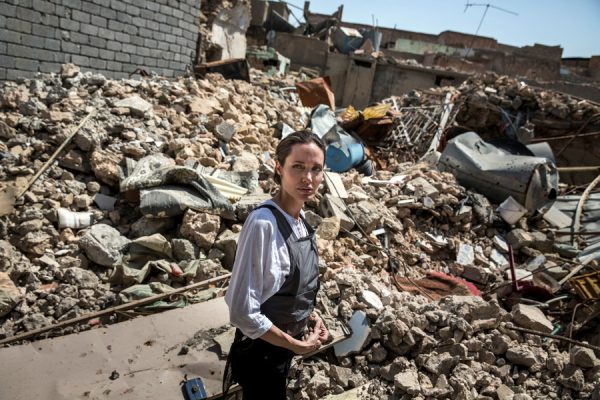
UNHCR Special Envoy Angelina Jolie visits the Old City in West Mosul, Iraq June 16, 2018. © UNHCR / Andrew McConnell
Surely, life is picking up in Mosul, yet at a very slow pace, with destruction seen in the background of every photo.
A photo worth a thousand words ❤#EidAlFitr in #Mosul#Iraq#BackToLifepic.twitter.com/5hZyPgToau
— ICRC Iraq (@ICRC_IQ) June 19, 2018

Iraqi workers repair a building in Mosul on March 15, 2018. © Ahmad Al-Rubaye / AFP
Restoring hope & heritage
Historical sites in both cities sustained massive damage during the fighting. An iconic landmark of Mosul, the Grand al-Nuri Mosque, was blown up by IS militants a month before the city was recaptured by the coalition. The monument was effectively reduced to rubble, and, nearly a year after, it remains in the same state – showing only signs of further deterioration and weathering.
The destroyed Grand al-Nuri Mosque is seen in the Old City of Mosul on January 17, 2018. © Ari Jalal / Reuters
Aleppo Citadel, on the other hand, not only endured the battle for the city, but it actually played one of the key roles in it, serving as a stronghold for Syria’s defenders once again. While the monument was damaged during the fighting, restoration – and demining – works were launched almost immediately after the city’s liberation. Now it’s open for everyone again.
Syrian children from the St. Francis Church summer camp enjoy an exploratory trip to Syria’s historic Citadel in Aleppo, free of terrorism.
You won’t be seeing these smiling faces on any mainstream media outlets because it doesn’t advance their agenda against Syria. pic.twitter.com/X3nrDoH0TH
— Sarah Abdallah (@sahouraxo) June 7, 2018
#Aleppo Citadel is back open for Syrian and Foreign Tourists. Fee to enter in US $ equivalent?
Foreign Tourists = $1.16
Syrian Visitors = $0.17
Syrian Soldiers = $0.12
Families of Martyrs = Free https://t.co/gMyRsQ3Rtupic.twitter.com/gZwLg4CCFG— EHSANI2 (@EHSANI22) June 20, 2018
Another iconic landmark of the city – the Umayyad Great Mosque – was less lucky and sustained way more serious damage, getting pierced with shrapnel and having one of its minarets toppled. While more work needs to be done, it looks way better now – and it actually serves its purpose.
‘Everyday Censorship’ Proposed That Should Enrage Us All
21st Century Wire | June 22, 2018
When one of the creators of the Internet as we know it today (not you Al Gore!) voices their discontent with the latest overstep of power towards full throttle censorship, you know it’s serious business.
Tim Berners-Lee, best known for his work helping to create the World Wide Web, along with other Internet pioneers, have penned an open letter opposing the Members of European Parliament (MEPs) who voted earlier this week in favor of a plan to force publishers to automatically remove any content that appears to violate copyright.
The Independent reports this means “memes, mixes, sampling, and even reuse of news and parliamentary footage, will get caught up and deleted without warning.”
Publishers will be expected to monitor all their content uploads and check for copyright material and remove it immediately, and ostensibly by doing so automatically, as outlined in Article 13 of the proposal.
In the open letter asking MEPs to remove Article 13, the letter’s 57 signatories write:
“Article 13 takes an unprecedented step towards the transformation of the internet, from an open platform for sharing and innovation, into a tool for the automated surveillance and control of its users.”
Read more about this latest Internet censorship plan at The Independent…
Facebook, Twitter Shut Hezbollah-Linked Accounts – Reports
Sputnik – 23.06.2018
Facebook and Twitter accounts of a Hezbollah-affiliated news service covering the Syrian war were shut down on Friday without explanation.
Central Military Media accused the US-based websites of running an “anti-media campaign,” in a post on the Telegram messaging app. It said both accounts were closed without warning.
The agency shared links to its new profiles on Facebook, Twitter and several other social media platforms. Sputnik was unable to obtain comments from the two networks.
Hezbollah was established in the 1980s as a paramilitary and political organization originating in Lebanon’s Shiite population. The group aims to end Israel’s occupation of Lebanese territory.
Israel, has repeatedly expressed its opposition to the presence of Iranian and pro-Iranian forces and the Hezbollah movement in Syria. Earlier this year, Israel several times attacked what it called the Iranian forces’ positions in Syria, citing aggressive actions on the part of the Iranian-backed militia in the Golan Heights, annexed by the country from Syria.
US-Backed Forces Claim to “Liberate” Yemenis, Instead Rape Detainees
By Randi Nord | Mint Press News | June 23, 2018
The so-called “liberators” in Yemen are sexually and physically torturing detainees at secret prisons. Survivors recall disturbing stories laden with gruesome interrogation tactics for extracting false confessions. Meanwhile, the Saudi-led coalition in Yemen attempts to portray themselves as the bearers of freedom and reason.
As an ally of the United States’ “counter-terrorism” operation in Yemen, the United Arab Emirates established 18 prisons throughout territory under their control. An ongoing investigation from the Associated Press has so far identified instances of deranged sexual torture at five of these facilities. The Emirati headquarters in Yemen houses one of such facilities where witnesses have seen American soldiers.
The United States provides the United Arab Emirates with billions in weapons, and military equipment through the Saudi-led coalition and counter-terror operations in Yemen. Washington also has ground troops in Yemen assisting and training Emirati forces.
Americans use Emiratis as gloves to do their dirty work,” at a prison in Mukallah told the Associated Press.
Two additional prison security officials said Americans were at all locations.
Witnesses say Emirati soldiers, mercenaries, and paid Blackwater mercenaries frequently raped detainees while others filmed the act. Other sexual torture includes electrocuting or hanging rocks from detainees’ testicles and sodomy with wooden or steel poles. The goal is to extract confessions.
They strip you naked, then tie your hands to a steel pole from the right and the left so you are spread open in front of them. Then the sodomizing starts,” said one man, a father of four.
Survivors told reporters about a mass torture event on March 10 at the Beir Ahmed prison in UAE-occupied Aden. Soldiers pulled hundreds of prisoners out of their cells, ordered them to disrobe, and searched their anal cavity looking for cell phones or contraband. One witness proclaimed, “Do you believe this! How could anyone hide a phone in there?” If anyone did not follow through with orders, soldiers threatened them with vicious dogs.
The detainee who drew the photos in the Tweet below spent time in at least three different prison centers.
They tortured me without even accusing me of anything. Sometimes I wish they would give me a charge so I can confess and end this pain,” he said. “The worst thing about it is that I wish for death every day and I can’t find it,” he said.
Unbelievable Hypocrisy
The Saudi-led coalition includes about 34 different countries from around the world. Many people don’t realize the scope of the war against Yemen. Even nations that tend to stay out of other major conflicts like Morocco, Sudan, Eritrea, and Croatia provide the Saudi coalition with military or logistic support.
The United States, United Kingdom, France, and Canada provide the bulk of the Saudi-coalition’s military support.
Considering that the available evidence linking Iran to Yemen’s resistance, Ansarullah (the “Houthis”), remains inconclusive, this is clearly a world war against Yemenis. Saudi Arabia launched this war in March of 2015 to reinstate their puppet government of Abdrabbuh Mansour Hadi who had already resigned from protests.
Throughout the course of this war, Saudi Arabia, the United Arab Emirates, and the United States have championed themselves as “liberators.” If anyone was fooled into believing a ragtag gang of head choppers and child killers were the “good guys” in this scenario, these torture prisons filled with rape should help change that perception.
Also throughout the course of this war, the Saudi coalition has peddled nonstop — and in most cases false — anti-Ansarullah (Houthi) propaganda about detaining journalists and activists. Of course, the stories about Ansarullah granting amnesty to political prisoners don’t fit the official Saudi narrative so they tend to not make headlines.
This story about rape at the secret prisons broke just as the United Arab Emirates launched their operation to take Hodeidah port from Ansarullah (indigenous Yemeni) forces. France sent special forces to assist the Saudi-UAE coalition. At this point, despite all the military might in the world behind them, coalition efforts to occupy Hodeidah remain unsuccessful.
The Saudi coalition that Ansarullah uses Hodeidah port to import Iranian weapons and military equipment under the front of aid. However, all ships entering the port must first dock at Djibouti or a neighboring port for inspection from the coalition themselves.
Experts say anywhere from 250,000 to 600,000 could die in operation “Golden Victory” to take Hodeidah port. Rough estimates put the casualty toll in Yemen at over 36,000 between killed and injured. Tens of thousands more have died from the Saudi-imposed and U.S.-enforced blockade which restricts land, sea, and air imports exports and the flow of movement.
The blockade has put between 18 and 22 million on the brink of famine and triggered a cholera epidemic completely unprecedented in modern times.
‘Forget sanctions, G7 & Assad – Trump-Putin summit should focus on America’s Ukraine interference’
RT | June 22, 2018
Ukraine, not Syria, is going to be in the spotlight at the potential meeting between Donald Trump and Vladimir Putin after the US supplied Kiev with Javelin missiles and imposed sanctions on Russia, former US diplomat told RT.
The NATO summit set for July is already being upstaged by rumors of a separate meeting between Trump and Putin – and news that National Security Advisor John Bolton will be heading to Moscow this month has only increased speculation. RT America’s Natasha Sweatte discussed this latest development with former US diplomat Jim Jatras.
RT: What are your thoughts on Bolton going to Russia? Do you think this is going to be a similar matter to how Mike Pompeo set things up for the president with Kim Jong-un?
Jim Jatras: I think in some ways, yes. I understand that ambassador (Jon) Huntsman, our ambassador in Moscow, was here not too long ago to begin some of the prep, Bolton is supposed to be in Moscow next week and then three Republican senators are supposed to be in Moscow the week after that. I think there’s some of the groundwork being prepared for this meeting.
RT: What do you think is the most important thing for them to discuss, if they do indeed meet. Do you think something like Syria?
JJ: Certainly, Syria. But to tell the truth, I think the mere fact of the meeting, like the meeting between Trump and Kim Jong-un, is the most important thing. The fact that they meet. Let’s remember, there has been a full-blown campaign of hysteria on so-called “Russian collusion” from not only the US deep state, but their friends in the United Kingdom, in MI6 and GCHQ, trying to try to sink this thing. And I think coming off of the summit with Kim and also some of the economic news, some of his domestic successes, Trump now feels he has the ability to go ahead with something he said he wanted to do during the campaign and has been frustrated from doing so.
RT: Do you think a positive meeting between the two will have any impact on Mueller’s investigation or do you see it as an important thing for Trump to block all of that out, if he does indeed meet with Putin?
JJ: I think it is going to be in the eye of the beholder. Obviously, the Trump-haters who actually believe all the nonsense about Russian collusion, they’ll just see this: “He is reporting to Moscow, he is reporting to headquarters. This proves everything we’ve been alleging.”
Of course, that’ll be total nonsense. I think just as a lot of people aimed potshots at him over North Korea, the fact that he comes back with something that looks like we’re making progress on a peaceful settlement, I think will resonate with a lot more people than the naysayers.
RT: Now to the G7 summit: do you think there is a seat at the table for Russia? Do you think maybe these talks with the US is the first step in that direction?
JJ: It could be. But to tell the truth, G7 isn’t all that important. And certainly not for the Russians. The Russians are looking more toward Eurasian integration with the, One Belt, One Road, initiative with the Chinese, with the Eurasian Economic Union. Sure, they’d like a seat at the table. But they’re not going to sit there and beg for it. And they’re not going to look at it as some kind of a cookie to be thrown to them.
RT: And what’s the ultimate outcome? Do you think just the meeting itself speaks volumes?
JJ: I think, the meeting itself speaks volumes. But I think, the question of sanctions, for example, is way in the background. You’ll never get that through Congress anytime soon. Although, I think we could look at some positive action in Europe in the very near future. I think that actually the thorniest question isn’t really Syria so much. Look, Assad has won, he is going to stay in power. The real issue is going to be what to do about Ukraine. During the campaign, Trump said that is a European issue. But, of course, you know, we’ve provided the Javelin missiles, we’ve added new sanctions to the Russians. We’ve got to find some way to get the US out of the driver’s seat on aggravating the situation in Ukraine.
RT: And maybe, if (Robert) Mueller’s investigation does wrap up sometime soon, maybe Congress’s outlook would change on sanctions?
JJ: No, I don’t think so. I think, unfortunately, there are just so many people who have planted their feet in concrete in an extreme, I would say, hysterical anti-Russian position, that just isn’t going to change. I think Trump basically has to move beyond them somehow and not really focus on the sanctions, which to tell the truth, do not have the same devastating impact on Russia that a lot of people here would like to think they have.
The War in Afghanistan is Killing More People Than Ever
By Edward Hunt | Lobe Log | June 20, 2018
Seventeen years into the war in Afghanistan, the longest war in U.S. history, violence has never been worse. In 2017, more than 20,000 Afghans died, a new record.
The dead include an estimated 10,000 Afghan security forces, 10,000 Taliban forces, and 3,438 civilians. Although there is no reliable data on Afghan casualties available to the public, reports published by the Costs of War Project at Brown University indicate that the annual death toll for the Afghan population has never been higher than it was in 2017.
For civilians, the last four years of the war have been the deadliest, with more than 3,400 civilians killed each year from 2014-2017, according to data from the United Nations and the Costs of War Project.
“We are concerned that we will see greater harm this year unless necessary steps are taken by all parties to prevent civilian casualties,” said Tadamichi Yamamoto, the UN Secretary General’s special representative for Afghanistan.
The record violence comes as the Trump administration has intensified the war against the Taliban. Although President Trump repeatedly indicated before he was president that he opposed the war and wanted to end it, he has instructed U.S. military forces to take more aggressive action.
“In Afghanistan, I’ve lifted restrictions and expanded authorities for commanders in the field,” Trump acknowledged last year. The new approach, according to Brigadier General Lance Bunch, means that “the gloves are off.” U.S. military forces are now looking for “any opportunity to target the enemies of Afghanistan wherever we find them in the theater.”
With the new authorities, the U.S.-led coalition has been waging a more aggressive war. In 2017, U.S. forces tripled the number of airstrikes against enemy forces. They also helped Afghan security forces intensify offensive operations against the Taliban.
“In the last year, we’ve seen offensive operations, kind of unprecedented over the last few years, by the Afghan security forces,” U.S. General John Nicholson, the commander of coalition forces in Afghanistan, has commented.
Administration officials acknowledge that they expected the Taliban to respond to the increase in military pressure with more violence. “And so we anticipated this,” Secretary of Defense James Mattis has said. In March, State Department official Alice Wells remarked that “it will not come as a surprise if we see more terrorist tactics addressed at urban audiences.”
The increase in violence has been devastating for the Afghan people. According to the UN Assistance Mission in Afghanistan, which tracks civilian casualties, more than 3,400 Afghan civilians have died and more than 6,800 Afghan civilians have been injured in each of the past four years of the war.
Afghan officials quietly acknowledge that about 10,000 Afghan security forces died last year, a significant increase from previous years. Fearing that the publication of the numbers could undermine morale and hinder ongoing recruitment efforts in Afghanistan, the U.S. military has begun censoring the records.
Although U.S. and Afghan officials estimate that about 10,000 Taliban forces were killed in 2017, Gen. Nicholson has said that “enemy casualty rates have been much higher.” Either way, last year’s combined death toll for Afghan combatants is about 20,000 people.
Despite the record death toll, the Trump administration remains committed to its strategy. “Progress and violence coexist in Afghanistan,” Secretary Mattis recently commented.
The U.S. military’s primary objective is to bring at least 80 percent of the Afghan population under the control of the Afghan government. According to a classified study, the Afghan government might prevail in the war if it achieves this goal. “The focus of our military operations is on increasing and expanding population control by the government of Afghanistan,” General Joseph Votel, the commander of U.S. Central Command, told Congress earlier this year.
The Trump administration’s approach is failing. Not only are record numbers of Afghans dying, but the Afghan government has been losing control of the population. In its latest report to Congress, the Special Inspector General for Afghanistan Reconstruction confirmed that the Afghan government’s control has dropped from 69 percent in August 2016 to 65 percent in January 2018.
Last year, the U.S. intelligence community largely predicted the failures. Director of National Intelligence Daniel Coats told the Senate Armed Services Committee that “the political and security situation in Afghanistan will almost certainly deteriorate through 2018 even with a modest increase in military assistance by the United States and its partners.”
Former Secretary of Defense Chuck Hagel has said that the war has reached a new low. “After 17 years in Afghanistan the situation is worse than it’s ever been,” Hagel commented earlier this year.
Perhaps the best hope for Afghanistan now lies with a growing Afghan peace movement, which has been calling for an immediate ceasefire and talks to end the war. Not only has it succeeded in getting Afghan President Ashraf Ghani to announce a temporary ceasefire, but the Taliban announced its own ceasefire, leading to a few days of peace and celebrations throughout the country.
“I think President Ghani is responding to and indeed reflecting the desire of a wide cross-section of Afghans… in desiring to see a reduction in violence and a way forward to an end to the conflict,” a senior State Department official said.
The Afghan government plans to maintain the ceasefire for the immediate future, despite the recent decision by Taliban officials to resume fighting.
Edward Hunt writes about war and empire. He has a PhD in American Studies from the College of William & Mary.
Russian Envoy: “Deal of Century” a Matter of Surrender to ‘Israel’, Not Peace
Al-Manar | June 22, 2018
Russian Envoy to Lebanon, Alexander Zasypkin, stressed that the so-called “deal of century” with the Zionist entity is a matter of surrender, not peace with the occupation regime.
In an interview with Lebanese daily, Al-Akhbar, the Russian diplomat said that Tel Aviv bets on the Arabic obedience.
“The deal of century is a matter of surrender. It’s not peace. Israel’s calculations which suit with some Arab states don’t match with the condition of Syria, Lebanon and Palestine,” Zasypkin told Al-Akhbar’s Firas Al-Shoufi.
He said stressed that the Syrian army will retake control of the war-torn country’s south, ruling out a possible confrontation between the Zionist entity from one side and Iranian and Hezbollah from the other side.
“When discussions started on de-escalation zones, there were talks with all sides on importance of confronting terrorism. Israel fears the presence of Iran and Hezbollah in Syria. We say that the Syrian army is now engaged with the Russian forces in liberating the country’s south, and there is no justification for any Israeli action that could derail confronting terrorism,” the Russian diplomat said.
But he acknowledged that the Zionist entity exploits the presence of terrorist in Syria’s south, but assured that the terrorists will be crushed at last.
“A confrontation is not of favor of any side. There exists a balance of deterrence,” Zasypkin said.
On the other hand, the Russian ambassador dismissed reports of alleged disagreements between Russia and Syria, stressing that such reports are just “out of place propaganda” aimed at sowing discord between the two states whose alliance is “deep”.
“Russia and Iran are bound by very big geopolitical and even economic interests and their alliance is deep, not only in Syria but in entire Eurasia,” Zasypkin added.
Meanwhile, the Russian envoy revealed that the US has been renewing its support to the terrorist groups in Syria, ISIL and Nusra Front.
“It’s right that ISIL and Nusra were dealt blows. However, they still exit and are being supported by US, and they pose a threat to stability and are capable of launching attacks. Now, we have information that the US has renewed its support to some terrorist groups, including to White Helmets which belongs to Nusra,” Zaspakin told the Lebanese daily.
Trump-Putin summit should be welcomed, not feared
By Neil Clark | RT | June 22, 2018
The news that Donald Trump and Vladimir Putin are preparing to meet in Europe next month has been causing consternation among those keen to keep the temperature of the new ‘Cold War’ close to freezing point.
But these voices should be ignored, as a summit is just what is needed at the present time.
“Meeting jaw to jaw is better than war,” Winston Churchill famously observed. Which sane person, desirous of world peace, could possibly disagree with the sentiment?
Yet, it seems that some people in the corridors of power in the West and in neocon think-tanks are seriously alarmed by the prospect of the presidents of the US and Russia getting together for a tete-a-tete and possibly defusing current tensions.
The London Times has cited Whitehall sources who told the paper how worried they were about a Trump-Putin get-together. “It would be a highly negative thing to do,” one unnamed insider said. “Everyone is perturbed by what is going on, and is fearing for the future of the [Atlantic] alliance,” said another.
Meanwhile, in the New Yorker, Susan B. Glasser informs us that many Russia ‘experts’ are worried that Putin “is intent upon securing major concessions from Trump.” She also cites George W. Bush’s former ambassador to Russia, Alexander Vershbow, who lambasted the idea of a meeting as a “bonding session with another dictator.”
“Get ready for another lavish televised love-fest, this time between Trump and Putin,” warns Anne Applebaum. The Washington Post columnist fears there will be a ‘trade.’ “We stop holding military exercises in Europe. In exchange, we allow Russia to keep Crimea.”
“Also,” she adds, “we will throw in Alaska.”
If we go back to the early 1970s, we’d find Applebaum’s predecessors equally concerned that President Nixon – another Republican president loathed by liberals – was keen on a rapprochement with the Soviet Union. In fact, a review of the diplomatic moves made by Nixon and the opposition he faced from uber-hawks inside America is highly instructive.
On May 22, 1972, Nixon became the first serving US president to set foot inside the Kremlin. Four days later, the president and his Soviet counterpart Leonid Brezhnev signed SALT 1 (the Strategic Arms Limitation Talks), described by Jeremy Isaacs and Taylor Downing in their book ‘Cold War’ as “an event of considerable significance.”
“After 25 years of hostility, the Soviet Union and the United States had agreed to curb spiraling arms-race costs, and reduce the risks of nuclear war,” they wrote.
Who couldn’t be happy about this? Senator Henry Jackson – aka the ‘Senator from Boeing’ – for one. As the New York Times explained in 1988.
SALT 1 was an executive agreement, not a treaty, so it could not be blocked by the Senate. “So Jackson pushed through a resolution that set stiff terms for any future treaties, demanding, among other things, that they produce rough numerical equality,” it wrote.
Jackson also opposed the agreement on Security and Cooperation in Europe, signed in Helsinki on August 1, 1975, commonly regarded as ‘detente’s high point.’
“As if to symbolize this new spirit of goodwill, the American Apollo and the Soviet Soyuz spacecraft docked together in outer space, 140 miles above Earth. For two days, the astronauts of rival systems carried out joint experiments while orbiting Earth. Detente had replaced decades of confrontation,” note Isaacs and Downing.
And remember, all this had happened under Republican presidents (Nixon and Ford).
Fast forward to today, and it’s the disciples of ‘Scoop’ Jackson who once again seem terrified that a meeting between Trump and Putin will lead to a new ‘spirit of goodwill’ between East and West.
That would never do, as Russia must always be regarded as the enemy – unless of course it does absolutely everything the West demands of it.
Trump and Putin could be a re-run of Nixon and Brezhnev. They could start to talk about arms limitation. They could start to talk about new security and co-operation arrangements. They could embrace each other warmly and declare that the US and Russia would never go to war with each other.
Of course, if such positive moves were made, people across the world would be delighted, as they were in 1972 and 1975. But defense industry lobbyists won’t be.
In ’Fog,’ a 1969 episode of the classic UK television series ‘The Avengers,’ members of the world disarmament committee meet in London, and are bumped off one by one by a mysterious ‘Gaslight Ghoul.’ We’re led to believe that the guilty party is an old-fashioned, politically incorrect ‘Empire loyalist’ Sir Geoffrey Armstrong but in fact (Plot Spoiler Alert), it’s the more ‘progressive’ Mark Travers. And his motive? He has an armaments business. He profits from wars and conflicts. That’s why the very idea of the great powers co-operating is anathema to him.
Mark is able to ‘disguise’ himself as a good guy because he doesn’t espouse the reactionary ‘Colonel Blimp’ views of Sir Geoffrey. Sound familiar?
Any US presidents who have worked for arms limitation and better relations with the Kremlin have faced fierce opposition, even if they’ve been former hawks themselves.
In 1975, Ronald Reagan opposed Helsinki, saying “All Americans should be against it.” He stepped up the arms race when he became president in 1981 and referred to the Soviet Union as ‘the evil empire.’ But in 1984, at the time when the pop group Frankie Goes to Hollywood were warning us of the dangers of nuclear Armageddon with their smash hit ‘Two Tribes,’ Reagan changed course quite dramatically. The president’s ambitious goal was a world without nuclear weapons. The hawks in the US and Britain were alarmed over this volte face. On November 19, 1985 Reagan met new Soviet leader Mikhail Gorbachev for the first time.
“They got on famously – even better when alone together,” Isaacs and Downing record. Just over two years later, the two men signed a historic arms-control agreement in the White House.
But it could have been even more extensive. At the Reykjavik summit in October 1986, Reagan said he was willing to eliminate all nuclear weapons within 10 years. The Star Wars (SDI) defense programme proved the sticking point – but in Downing Street there was enormous relief that a deal was not struck – wedded to concerns that nuclear disarmament might still happen at a future date.
“My own reaction when I heard how far the Americans had been prepared to go was as if there had been an earthquake beneath my feet,” British Prime Minister Margaret Thatcher later wrote. “I supported the idea of a 50-percent direction in strategic ballistic missiles over five years, but the president’s proposals to eliminate them all together after 10 years was a different matter… Somehow I had to get the Americans back onto the firm ground of a credible policy of nuclear deterrence. I arranged to fly to the United States to see President Reagan.”
The ‘Iron Lady’ went to Camp David and persuaded Reagan to take what she saw as a firmer line. A statement was released which declared: “The president reaffirmed the United States’ intention to proceed with its strategic modernization program, including Trident. He also confirmed his full support for the arrangements made to modernize Britain’s independent nuclear deterrent, with Trident.”
“I had reason to be well pleased,” wrote Thatcher.
Then, as now, it was Britain urging the US to maintain a tough stance towards Moscow. That’s worth remembering whenever you hear someone say that London always acts as Washington’s poodle – because sometimes it’s the UK government that’s the more hawkish.
Thatcher believed that Europe would have been ‘dangerously exposed’ if Reagan’s disarmament plans had been accepted. Today, we hear similar fears being expressed over a Trump-Putin summit. The future of NATO, we’re told, could be threatened. Yet significantly, NATO chief Jens Stoltenberg is not among the voices articulating this concern. Speaking in London this week, the former Norwegian PM dismissed fears that a meeting between Trump and Putin would undermine Western security.
“To meet President Putin is not in any way contradictory to NATO policies… Several NATO leaders have met Putin… We do not want a new Cold War. We do not want a new arms race. We want to talk to Russia,” Stoltenberg said.
The NATO chief’s diplomatic statements are a blow to those who don’t want any meaningful dialogue between East and West. But they will be welcomed by all those who want to see the US and its allies move towards a new era of detente with Moscow, which could only be for the benefit of the entire world.
Raised eyebrows as Madeleine Albright & Bana Alabed to be honored for ‘defending freedom’
RT | June 20, 2018
The pro-NATO Atlantic Council think tank is set to honor former US Secretary of State Madeleine Albright and Syrian child activist Bana Alabed at its Freedom Awards this week.
The Freedom Awards honor individuals who “defend and advance the cause of freedom around the world” and will be hosted in Berlin later this week — but the nominations have caused quite a few puzzled reactions online.
According to the Atlantic Council website, Albright will be recognized for her “championing of global democracy” and as an exemplar of “the power of diplomacy in achieving solutions to the most pressing challenges facing our world.”
Albright seems like an odd choice, however, given she is known around the world for defending US sanctions on Iraq which caused the deaths of more than half a million Iraqi children.
When asked in an infamous 1996 interview if she thought the sanctions were “worth” the price — the price being hundreds of thousands of dead children — Albright replied almost without hesitation, that “the price is worth it.”
Alongside Albright will be a 9-year-old Twitter activist who is no stranger to controversy herself. Numerous Syrian and international commentators have argued that Syrian opposition icon Bana Alabed has been exploited by her parents and others as a propaganda tool for a pro-war agenda.
Bana began tweeting pro-US intervention messages on Twitter when she was just seven years old. Her tweets were written in perfect English and often incendiary. On one occasion, Bana’s Twitter account posted that it was “better to start 3rd world war instead of letting Russia & assad commit #HolocaustAleppo.”
Despite the controversy surrounding her account and accusations of child exploitation, Alabed will be honored by the Atlantic Council for her “use of social media to bring global attention to the plight of children in rebel-held areas of Syria.”
But maybe the Atlantic Council’s choice of nominees for its Freedom Awards shouldn’t be so surprising. In 2016, the think tank chose to bestow the award on the Syrian Civil Defence, also known as the White Helmets – a controversial outfit which bills itself as a first-responders group in the Syrian war, but operates exclusively in militant-held areas and has been accused of links to terrorist groups, including Al Qaeda.
Featured Video
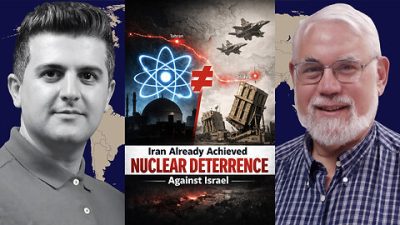
Prof. Ted Postol: Iran Already Achieved Nuclear Deterrence Against Israel
or go to
Aletho News Archives – Video-Images
From the Archives
How the occupied mentality syndrome works
Saudi Arabia on the American chessboard – Part 3
By B. J. Sabri | American Herald Tribune | June 27, 2016
Read part 2: “The occupied mentality Syndrome“
Previously I argued whether Saudi Arabia’s repeated involvements in U.S. interventions and wars stem from free national will or in response to a specific condition. For starters, in Saudi Arabia there is no national will. In Saudi Arabia, the national will is the will of the Al Saud clan. Still, when a major Arab state allies itself with a superpower that committed unspeakable crimes against humanity in almost every Arab country, then something is wrong. This fact alone should compel us to examine the U.S.-Saudi relation for one exceptional reason. As a result of the U.S.-Saudi wars, hundreds of thousands of people in Afghanistan, Iraq, Iran, Libya, Syria, Yemen, and Somalia have lost their lives. Millions became displaced in their own homelands. And millions more rendered refugees.
Attributing the Saudi policies to the bonds of “partnership” with the U.S. is frivolous. There are no bonds between these two thugs except those of business, military deals, secret plots, and wars. Proving this point, bonds such as these have no space for the American and Saudi peoples to share significant cultural or societal exchanges. If partnership is not the reason for the Saudi contribution to the U.S. strategy of empire and imperialism, then another reason must exist.
This leads to three possibilities. … continue
Blog Roll
 Aletho News
- Hezbollah hits Israeli warship off Lebanon’s coast, sets it aflame
- Iran slams US strikes on B1 bridge, Mahshahr petrochemical plants as ‘blatant acts of state terrorism’
- In letter to UN chief, Araghchi warns of dire consequences of US-Israeli attacks on Iran’s nuclear facilities
- Why the CIA conspiracy to invade Iran with Kurdish militias failed
- Why Are Upbeat US Claims About Mission to Rescue Pilot ‘Highly Questionable’?
- Aircraft destroyed during US ‘rescue’ of downed F-15 pilot cost more than $100 million each
- Washington University removes professor who condemned US-Israeli war on Iran
- Russia Warns of Retaliation as UK Authorizes Seizure of Vessels
- Serbia thwarts plot to bomb Russia-Hungary gas pipeline – Vucic
- Al Mayadeen voices solidarity with Dr. Marandi amid death threats
- If Americans Knew
- In Iran, Israel-US take aim at “reason, research, and freedom of thought” – Daily Update
- US loses planes over Iran, Israel downgrades Lebanon war goals – Daily Update
- Israel Is Blocking Palestinians from Easter at Church Where Jesus Resurrected
- Plot to assassinate Palestinian activist follows harassment campaign promoted by Zionist groups and elected officials
- Prominent New York synagogue hosts presentation on why U.S. Jews should support the ethnic cleansing of Gaza
- Tapper vs. Piker: Is the CNN Anchor Auditioning for David Ellison?
- Shouldn’t Democrats Be Able to Condemn Genocide?
- Israel-US kill negotiators, destroy civilian structures, but Iran’s military capabilities still largely intact – Daily Update
- ‘War crime’: Global condemnation as Israeli ministers celebrate death penalty law targeting Palestinian prisoners
- 7 Ways Israel Is Turning Lebanon Into Gaza
- No Tricks Zone
- An Inconvenient Tree: Uncovered In Alps… Europe Much Warmer Than Today 6000 Years Ago
- New Study Reports A 60% Slowdown In Greenland’s Ice Loss Rate In The Last Decade
- Low Intensity Tornado Wrecks Major Solar Farm, Creating A Potential Toxic Dump
- New Study Finds Warming Saves Lives…Cold Temperatures 12 Times More Deadly Than Excess Heat
- German Science Blog Accuses PIK Climate Institute Of Hallucinating Climate Tipping Points
- Devastating Assessment Of Comirnaty Vaccine By Former Senior Pfizer Europe Toxicologist
- New Study: CO2 Is ‘Effectively Negligible’ As An Explanatory Climate Change Factor Since 2000
- Former Pfizer Toxicologist Dr. Helmut Sterz Tells Bundestag Hearing Pfizer Vaccine Should Have Never Been Approved
- Energy Expert: Germany’s Nuclear Phaseout Was A “500 Billion Euro Mistake”
- New Research: South Australia’s Mid-Holocene Sea Surface Temperatures Were 4°C Warmer Than Today
 Aletho News