You’ll never guess where the next James Bond villain is from…
RT | July 19, 2018
James Bond’s nemesis in the upcoming 007 film will be (now whisper it)… Russian. In what could be a sign of the times, it’s the first time in 20 years the fictional English spy will be battling it out with a Moscow baddie.
1999’s ‘The World Is Not Enough’ was the last Bond film to star a significant Russian villain – Victor ‘Renard’ Zokas, an ex-KGB agent turned-high tech terrorist, played with a questionable accent by Scottish actor Robert Carlyle.
The movie, once again starring Daniel Craig as Bond, has the working title ‘Bond 25’. It will be directed by Danny Boyle. Filming is scheduled to commence in December, with a proposed release date of October 2019, the Mirror reports.
The makers of the 007 film franchise are said to be seeking a 30 to 60-year-old leading male, from Russia or the Balkans. Producers say he must be “charismatic, powerful, innovative, cold and vindictive.”
As if one leading role being Russian wasn’t a scary enough proposition for James Bond fans, producers have revealed they intend to also cast a female in a leading role as a Russian. They must be “very striking” with “strong physical combat skills.”
Her character is described as “intelligent, brave, fierce and charming, she’s witty and skilful, a survivor.” The two Russian principal characters are rumored to have a Maori henchman who must possess “combat skills” and be “ruthless and loyal.”
Bond has a history of trading shots with evil characters from behind the old Iron Curtain in movies such as ‘From Russia With Love’. The prospective Russian villains will be following in the footsteps of Rosa Klebb and General Orlov.
Dua Lipa, the London-born singer-songwriter, is rumored to have been chosen to perform the theme song.
Trump’s Russian Meddling Reversal Suggests US Becoming ‘Authoritarian’
Sputnik – July 19, 2018
Both media and political backlash being thrown against US President Donald Trump for his flip-flopping antics on whether or not Russia interfered in the 2016 presidential election suggests that the Land of the Free is heading toward an authoritarian route, historian and investigative journalist Gareth Porter told Sputnik.
POTUS spent a second day Wednesday attempting to reassure critics that he’d misspoken at the Helsinki summit on Monday, telling reporters that “there’s been no president ever as tough as I have been on Russia.”
“All you have to do is look at the numbers, look at what we’ve done, look at sanctions, look at ambassadors not there, look unfortunately at what happened in Syria recently,” Trump told journalists. “I think President Putin knows that better than anybody — certainly a lot better than the media — he understands it, and he’s not happy about it. And he shouldn’t be happy about it, because there’s never been a president as tough on Russia as I have been.”
Porter told Sputnik Radio’s Loud & Clear on Wednesday that 45’s decision to walk back his statements suggests that the US is going to be heading down a road where political heads won’t be able to speak freely.
“To me, this is really the primary case study of how this political system is moving at a very rapid pace toward a rather authoritarian — very authoritarian — political caste, in which it’s going to become much more difficult to take positions that are at odds with the extremely hardline new Cold War position of the combined political media and national security elites,” the historian told hosts Brian Becker and John Kiriakou.
When asked what might be driving the media’s persistent critiques of Trump, Porter indicated that it might have to do both with corporate media simply not liking the president and wanting to appease national security officials.
“There’s no doubt that 95 percent of the corporate media is partisan against Trump and in fact feels personally that he’s a menace to the United States,” he told Kiriakou. “At the same time, I think that 100 percent of the corporate media believe that it is vital to the interest of those people who they are close to in the military, the intelligence agencies and the political elites, that the United States start a new Cold War with Russia and that it be pursued to the hilt both militarily and especially in terms of intelligence and counterintelligence activities on the part of the US government.”
But would the media have reacted the same way if it was former US President Barack Obama who’d acted as Trump has? Yes, with maybe just some slight differences, according to Porter.
“If Obama had taken anything like in substance the position that Trump was taking… I think that the answer is pretty much yes,” he said. “It would be very similar; it would be different, of course, but it would be strikingly similar.”
Noting that Obama wasn’t attacked or vilified for his meeting with Russian President Vladimir Putin in 2009, Porter indicated that the US’ stance on Russia took a pivotal turn in 2014 when Crimeans made a decision and voted to reunify with the Russian Federation.
“The single most important watershed, if you will, was Ukraine and the fact that Russia took that kind of action… despite the fact that the US government was taking a strong position in the ‘Ukraine crisis,'” Porter explained. “This was both an insult to the US power on one hand and an opportunity on the other, and I would argue in a sense that it’s the opportunity that’s more important here.”
“My guess is that that was seen as an opportunity to retake advantage of the situation to push for a major plus up in the [US] military budget for Russia and to play up the threat from Russia in a way that they could not do before that.”
“You have sort of a continued growth in this idea that Russia is the enemy, that it’s the new threat and a major challenge to the United States,” the historian said.
US arrest of Russian attempt to undermine Trump-Putin summit
Press TV – July 18, 2018
Russia’s Foreign Ministry says the arrest this week of a Russian national in the United States was a deliberate attempt to undermine a summit between President Vladimir Putin and his US counterpart Donald Trump in Helsinki, Finland.
Spokeswoman Maria Zakharova said Wednesday the detention of Maria Butina, which took place on Sunday, a day before the summit, had no grounds and was meant to affect the positive outcome of the summit.
Putin and Trump met in a freighted atmosphere amid criticism that Trump was approaching Russia at the expense of Washington’s allies in Europe. Trump is also accused of trying to cover up his alleged links to the Russians in the run-up to his presidency two years ago.
US authorities said Monday that they had charged Butina, 29, with conspiracy to act as an agent of the Russian government through establishing relationships and infiltrating organizations that have influence in US politics.
“Butina worked at the direction of a high-level official in the Russian government who was previously a member of the legislature of the Russian Federation and later became a top official at the Russian Central Bank,” said the US Department of Justice in a press release, adding, “This Russian official was sanctioned by the US Department of the Treasury, Office of Foreign Assets Control in April 2018.”
Zakharova dismissed the charges and said the arrest happened “with the obvious task of minimizing the positive effect” of the summit between Putin and Trump.
Both leaders have described their meeting as positive, saying it would help Moscow and Washington improve their strained relations.
The US and Russia have clashed on several issues over the past years, including Russia’s alleged interference in Ukraine, which Moscow denies, its military presence in Syria and allegations that the Kremlin meddled in the 2016 presidential election, which led to Trump’s victory.
Politics and Psychiatry: the Cost of the Trauma Cover-Up
By Bruce E. Levine | CounterPunch | July 18, 2018
Despite increased spending on mental health treatment, mental illness disability and suicide rates have skyrocketed. “Perhaps more disturbingly,” notes clinical psychologist Noël Hunter, “recent evidence has demonstrated that as contact with psychiatric intervention increases, so too does completed suicide, suggesting the possibility that the current mental health system may be creating the very problems it purports to aid.” In Hunter’s recently published Trauma and Madness in Mental Health Services (Palgrave Macmillan, 2018), she asks, “Are we continuing to funnel money into a fundamentally broken system?”
For many on the Left, it is obvious that the military-industrial complex is devoted only to its own preservation and expansion, thus routinely jeopardizing national security and freedom—this despite many men and women serving in the U.S. military who care about national security and freedom. Far fewer on the Left recognize that the psychiatric-industrial complex (which includes the American Psychiatric Association and its Big Pharma financial partners) is also devoted only to its own preservation and expansion, thus routinely exacerbating emotional suffering—this despite many individual practitioners who want to help their patients.
The majority of psychiatrists and psychologists, owing to both ignorance and cowardice, routinely comply with diagnostic and treatment notions that pretend to be scientific but which have been politically and financially forged. There are, however, a handful of anti-authoritarian professionals who have rebelled, and Noël Hunter is one of them.
Hunter is a rare psychologist. She not only has extensive knowledge of the empirical research, but she herself was once diagnosed with serious mental illness, and she takes very seriously the insights of “experts by experience”—recovered ex-patients—who Hunter quotes throughout her book. Both objective and subjective sources make clear to Hunter that the essential cause for what is called serious mental illness is not some kind of biochemical or genetic defect but some kind of trauma, and that the essential remedy is healing from trauma. For critical thinkers who are not mental health professionals, Hunter’s assertions in Trauma and Madness in Mental Health Services may sound like simple common sense, but it is sense that is not common in the mental health profession.
Wisdom has been derailed by politics and misinformation in the mental health profession (as is the case for many other aspects of U.S. society). Despite what the general public repeatedly hears from the mass media, there is no actual science behind proclamations that “schizophrenia” or other “serious mental illnesses” are caused by a biochemical imbalance, a genetic flaw, or any other innate defect. After many years and much money spent attempting to prove defect theories, even establishment mental health has rejected the widely popularized chemical-imbalance theory of mental illness (though word of this rejection hasn’t gotten out to much of the U.S. general public or to even many practitioners).
In contrast, there is a great deal of scientific evidence showing that people diagnosed with schizophrenia and other serious mental illnesses are far more likely to have been victims of societal and familial trauma. Citing the empirical research, Hunter reports:
“Adverse experiences, particularly in childhood (such as physical and sexual abuse, parental separation, bullying, parental death, foster care, neighborhood violence, poverty, racism, etc.), have been demonstrated to have a direct and dose-response relationship (meaning the more adversity, the greater the risk) with adult mental health issues like hearing voices, suicidality, drug abuse, experiencing altered states of consciousness, extreme and intense emotions, fragmented sense of self, obesity, depression, paranoia, beliefs in conflict with consensus reality, anxiety, and more.”
A great tragedy for people viewed as biochemically defective rather than as victims of trauma is that such individuals who are already suffering are then stigmatized and marginalized owing to their defect status. Hunter reports that “ongoing efforts to combat stigma by asserting that ‘mental illness is an illness like any other’ are actually associated with increased stigma and increased efforts to distance oneself from those deemed mentally ill.”
Politics has long dictated a trauma cover-up. The significance of trauma, Hunter recounts, was obvious over a century ago to Pierre Janet, and so too did Sigmund Freud recognize the importance of sexual abuse as a cause of his patients’ problems. However, Freud then shifted his focus onto unconscious conflicts. While it took some courage for Freud to talk about repressed sexuality, it would have likely been reputation suicide if he had continued to focus on societal and familial trauma—this would have challenged those in society who had far greater status and influence than he had.
To be clear, modern psychiatry does not completely reject trauma as a cause of emotional suffering, and with good luck a patient can  get the kind of diagnosis in which trauma is taken seriously. Post-traumatic stress disorder (PTSD) was included in the American Psychiatric Association’s diagnostic bible, the DSM, in 1980. “This inclusion,” Hunter points out, “was largely the result of political efforts on the part of American veterans of war.”
Politics, not science, dictates not only the explanations for mental illnesses but their creation (as with the case of PTSD) and abolition, as was the case with homosexuality. By the 1970s, gay Americans, angry about their sexual preference being viewed as a disease and defect, finally had enough political power to compel the American Psychiatric Association to abolish homosexuality as a mental illness, and it was excluded from the APA’s 1980 DSM-III. Unfortunately, people diagnosed with schizophrenia and other serious mental illnesses lack the political power to change psychiatric dogma, and so they are seen as defective rather than as victims of trauma.
Phil Ochs sang: “There but for fortune may go you or I.” This is the reality when it comes to psychiatric diagnoses. You and I can exhibit the same behaviors, but whether you or I become a chronic psychiatric patient depends on our bad or good fortune. I’ve talked to many people who as teenagers and young adults innocently told their parents about voices that they were hearing and were then labeled by doctors as schizophrenic, resulting in long careers as mental patients. And I’ve talked with others who kept their voice hearing to themselves; these voices actually helped them have breakthroughs, and they have had no such careers as mental patients.
In a scientific sense, terms like “schizophrenia” are completely meaningless—wastebaskets to toss people who are behaving in ways that appear bizarre to doctors. Often what causes people acting in unusual ways to become chronically dysfunctional are their doctors’ problematic reactions and “treatments.” In other words, it is common for the source of chronic dysfunction to be physician-induced (iatrogenic) trauma.
In the real world of psychiatric diagnoses, probably the most important criteria for whether you are diagnosed with schizophrenia or dissociative identify disorder (DID) is how much your doctor likes you, and Hunter was likable enough to get a DID diagnosis. For reasons of dogma, not science, trauma is taken seriously for DID but not for schizophrenia (in which one is simply seen as defective). So, Hunter considers herself relatively lucky, and one senses her “survival guilt.”
Unlike many books critical of the psychiatric-industrial complex, Trauma and Madness in Mental Health Services offers a great deal of practical help for both practitioners and for those in emotional turmoil. In very concrete terms, Hunter offers chapters on what is helpful and what is not. The research, her own experience as a patient, and her discussions with other ex-patients inform her: “Relationships matter. Relaxation matters. Nutrition matters. Hope and purpose matter. Nature matters. Love matters.”
Professionals often waste their limited time obsessing over a diagnostic process that is scientifically invalid and unreliable. “Rather,” Hunter concludes, “what is more important is to take an individualized, collaborative, trauma-informed approach that is attuned to individual needs without making assumptions and considering the person’s subjective experiences as real and something to be respected.” It’s important, Hunter concludes, to help people find meaning and value in the adaptive nature of their atypical experiences.
In general, I have little hope for the mental health profession, but I have seen individual professionals rise above their desire for security and then revolt against the policies of institutions in the psychiatric-industrial complex. In academia, such rebellion can jeopardize one’s chances for tenure, yet a handful of educators are willing to take that risk. They care less about security than being remembered by their students for turning them on to a book in which they actually acquire knowledge about some very interesting human beings and that is of great value in helping them. Such a book is Noël Hunter’s Trauma and Madness in Mental Health Services.
Bruce E. Levine, a practicing clinical psychologist often at odds with the mainstream of his profession, writes and speaks about how society, culture, politics and psychology intersect. His most recent book is Resisting Illegitimate Authority: A Thinking Person’s Guide to Being an Anti-Authoritarian―Strategies, Tools, and Models(AK Press, September, 2018). His Web site is brucelevine.net
I’m the Reporter Mentioned in Mueller’s Indictment. Why Hasn’t He Spoken to Me?
By Lee Stranahan | Sputnik | July 18, 2018
I was as surprised as anyone last Friday, when just days before US President Donald Trump’s historic meeting with Russian President Vladimir Putin, special counsel Robert Mueller dropped an indictment against 12 Russian nationals claiming that they were Guccifer 2.0, the entity that took credit on June 15, 2016, for the hack of the DNC and DCCC.
I was even more surprised to find that I was discussed in Mueller’s indictment.
Section 43c of the indictment says, “On or about August 22, 2016, the Conspirators, posing as Guccifer 2.0, sent a reporter stolen documents pertaining to the Black Lives Matter Movement. The reporter responded by discussing when to release the documents and offering to write an article about their release.”
I am that reporter.
Part of the reason I was surprised is that I have never been contacted by anyone from Mueller’s investigative team. That’s one reason I personally know that this is a shoddy investigation, but I’ll come back to that in a moment.
When I saw that I was being discussed in the indictment, I immediately mentioned it on Twitter. I also made it clear to the media that I was available for interviews. No media outlet has contacted me.
I went public because I have nothing to hide and nothing to be ashamed of. In fact, the reason that Mueller’s team knew about my contacts with Guccifer 2.0 is because I posted the direct messages we exchanged over Twitter myself a year ago.
For the record, I didn’t know who Guccifer 2.0 was at the time and I still don’t, despite Mueller’s indictment. I have never believed that Guccifer 2.0 was a Russian state actor and have seen no evidence that persuades me otherwise.
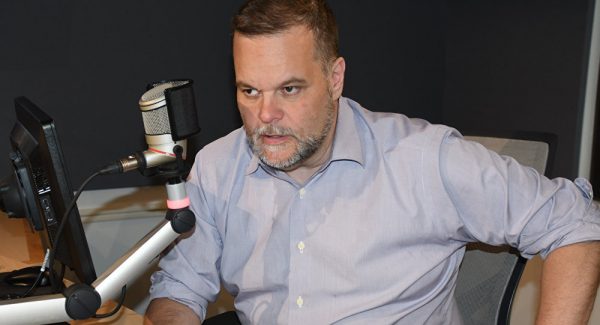
At the time of this contact with Guccifer 2.0, I was the lead investigative reporter for Breitbart News ; today, I co-host the best morning news radio show in America, Fault Lines with Nixon and Stranahan, which airs Monday through Friday, 7 a.m. to 10 a.m. Eastern Time on Radio Sputnik. Fault Lines is broadcast on 105.5 FM and 1390 AM in Washington, DC, and around the world on the Sputnik News website.
Of course, just seeing both Russian-funded Sputnik and formerly Steve Bannon-led-Breitbart News on my resume is enough to give many in the media the flutters. Never mind that I also wrote for years at the Huffington Post or did independent journalism on issues like the Syrian war, which I traveled to Beirut in 2013 to cover. All of that and more gets left out of media narrative on Russian CollusionTM!
Thus, the New York Times only mentions my work at Breitbart and Sputnik in their scarily titled article, Tracing Guccifer 2.0’s Many Tentacles in the 2016 Election. And like Mueller’s team, the New York Times also never bothered to get in touch with me for their story.
A few hours after the Mueller indictment came out, I left for my planned trip to Helsinki to cover the Trump-Putin summit for Sputnik.
A couple of days later, CNN’s Jake Tapper retweeted my initial tweet about my cameo in the indictment and added the comment “Employee for Sputnik confirms that when he was at Breitbart he was in touch with who DOJ says was Russian military intelligence masquerading as hacker Guccifer 2.0.”
I’ve spoken to Jake privately a number of times in the past. He’s praised my work on other stories. I’m easy to reach. Yet despite highlighting my contact with Guccifer 2.0, Tapper has also not reached out to interview me.
It’s almost like the media and Muller have no interest in hearing what I have to say. No, wait — it’s exactly like that, because there’s plenty that the indictment and the media leave out.
For example, when Guccifer 2.0 contacted me on August 22, 2016, Steve Bannon was no longer leading Breitbart News. Whoever Guccifer 2.0 is, they expressed no interest at all in the fact that Bannon had left Breitbart to head the Trump campaign.
Furthermore, when the indictment says I was given material on the Black Lives Matter movement, it’s not exactly accurate, something Mueller would know if he’d ever talked to me.
In fact, I was sent a file with a few documents, including one that was a memo about the Black Lives Matter movement that was sent out by the Democratic Congressional Campaign Committee (DCCC). That document sparked my interest because I’d been covering Black Lives Matter for months and had been arrested a little over a month earlier while covering the protests over the death of Alton Sterling in Baton Rouge. I was one of four journalists arrested. (All charges were dropped and we reached a very small settlement with the city.)
If the Muller investigation was legitimately trying to get to the truth, I’d think they would have asked me for this set of files, since it might contain useful information for a forensic investigation. I’d think they would also want to see my direct messages with Guccifer 2.0 for themselves.
That might not be possible now. You see, after Mueller’s indictment was released, the public Twitter account for Guccifer 2.0 was removed from Twitter. I no longer have live access to my direct messages, nor can the public see the account for themselves live on Twitter. For anyone wanting to make up his or her own mind about this facet of the Russiagate narrative, including through viewing the original information for themselves, this is an interesting development.
Luckily, researcher Adam Carter has saved screen captures of the entire account as well as Guccifer 2.0’s WordPress site on his must-read site dedicated to Guccifer 2.0.
People disinclined to simply take Mueller at his word on his unproven accusations will also want to read this article by Carter showing the contradictions between the information in the Mueller indictment and what is available already in public record.
Anyone who looks at that record for themselves can see what the media isn’t telling you — that I was far from the first journalist to talk to or interview Guccifer 2.0. It also makes clear that I did not request info from Guccifer 2.0, but was offered it.
However, as I’ve said, I did nothing remotely wrong in talking to Guccifer 2.0, no matter who is ultimately shown to be behind the account. I was following a story and working a lead. I wanted to find out who Guccifer 2.0 really was and I still do.
Robert Mueller’s investigation has now muddied that trail, and hindered the efforts of truth seekers everywhere.
The author is Lee Stranahan, co-host of Fault Lines on Radio Sputnik.
Israel’s nukes, not Syria: Man kicked out from Trump-Putin summit says AP misquoted him
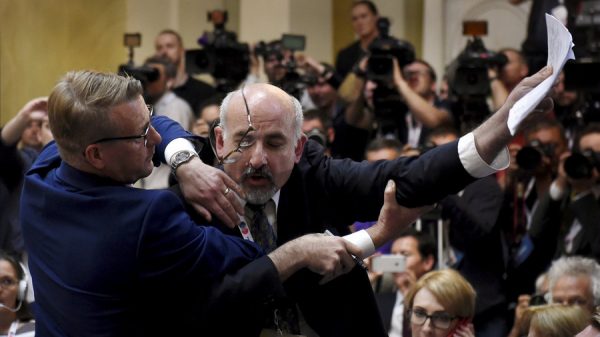
Security removes Sam Husseini before the Putin-Trump press conference in Helsinki. © Lehtikuva/Antti Aimo-Koivisto / Reuters
RT | July 18, 2018
Political activist and writer Sam Husseini, who was ousted from a joint media conference by Vladimir Putin and Donald Trump, accuses the media of lying about his goal at the event. He had a question about Israel’s nuclear arsenal.
Husseini, a contributor to The Nation who also wrote for a number of major media outlets as well as the media watchdog Fairness and Accuracy In Reporting (FAIR), was evicted from a media conference held by the two presidents on Tuesday in Helsinki.
The news agency Associated Press (AP) quoted him as saying that he had a question “on Syria’s nuclear policy” and the nuclear arsenals of the United States and Russia.
Husseini says AP misquoted him and that he wanted to hear Putin’s and Trump’s opinion on Israel’s clandestine nuclear arsenal, the existence of which the Jewish state neither acknowledges nor denies.
In further tweets Husseini called the AP story by Jari Tanner a “piece of garbage” that has spread to other media outlets. He added his ousting from the event was falsely attributed by many to Russian officials, while in fact the decision was made by Finnish security. The statement even made it to his Wikipedia page.
Ocasio-Cortez “Evolves” Her Position on Palestine to Please Zionist Democratic Mega-Donors
By Whitney Webb | Mint Press News | July 16, 2018
NEW YORK – During a recent interview with PBS and just two weeks after her historic upset victory against 10-term Congressman Joe Crowley (D-NY), Alexandria Ocasio-Cortez seemed already to be walking back from at least some of her more “radical” positions voiced prior to her Democratic primary win.
While her primary victory has certainly made the young New Yorker a new “rising star” in the Democratic Party, all the new attention seems to have come at a price, particularly as she now aims to court major Democratic Party donors as the general election approaches. Many of those donors, such as the Zionist entertainment billionaire Haim Saban, are unlikely to be supportive of her past positions on key issues, particularly her prior statements on Israel and Palestine.
Appearing on PBS’ Firing Line on Friday, Ocasio-Cortez surprised many of her supporters as she toned down statements she had made earlier this year regarding Israel, particularly Israel’s occupation of the West Bank and its brutal crackdown on demonstrators in the Gaza Strip. That crackdown saw over 6,000 unarmed protesters shot by Israeli Defense Forces and hundreds killed, resulting in international condemnation.
Though she had tweeted on May 14 that the Israeli crackdown in Gaza was a “massacre,” and expressed hope that her “peers have the moral courage to call it such,” Ocasio-Cortez distanced herself from that statement during her recent PBS interview, asserting that she had made that statement as an “activist” and not as a congressional candidate for the Democratic Party.
That statement alone suggests that other positions voiced by Ocasio-Cortez prior to her primary win could also be subject to revision over the next few months in the lead-up to the midterm elections in November.
Ocasio-Cortez went on to distance herself from other past statements she had made regarding the Israel-Palestine conflict, including having used the term “occupation” when referring to Israel’s military rule over Palestine’s West Bank. For instance, when asked to expand on what she had meant by “the occupation of Palestine,” Ocasio-Cortez only referred to the fact that “[Israeli] settlements … are increasing in some of these areas.” When prodded further, she stated that she was “not the expert on geo-politics on this issue” and that she may not always “use the right words” when discussing the Israel-Palestine conflict.
The 28-year-old candidate, whom PBS had introduced as “the vanguard of the American progressive movement,” also expressed during the interview that she believes “absolutely in Israel’s right to exist” and called herself a “proponent of the two-state solution.” However, given Israel’s aggressive policies aimed towards annexation of the West Bank and the U.S. government’s current support for such measures, Ocasio-Cortez’s support for the two-state solution reflects either a lack of knowledge on the subject or an unwillingness to face the fact that a two-state solution is largely impossible. Given her past statements on Palestine while still an “activist,” the latter seems to be more likely.
Indeed, prior to the PBS interview, Ocasio-Cortez had been promoted as a “pro-Palestine socialist” and had been praised by leftist pundits like Glenn Greenwald for her “moral courage” in standing up for the “human dignity” of Palestinians. Given the amount of attention her past pro-Palestine comments had received, her decision to walk back those positions just a few weeks after her primary win is particularly jarring.
Also eye-opening was the fact that Ocasio-Cortez concluded her statements on the topic by saying that she was willing to “learn and evolve on this issue.” In other words, she essentially rejected her past “activist” positions on Palestine in favor of allowing her position on the issue to “evolve” into one more acceptable to the Democratic centrists and the powerful pro-Israel elements that hold considerable sway within the Democratic party. Indeed, the pro-Israel lobby has already given over $5 million to the Democratic Party over the past year.
It remains to be seen whether Ocasio-Cortez is equally willing to renege, or rather “evolve,” on other progressive issues as the general election approaches. Yet, given that she is already walking back on her past rhetoric just a few weeks after her victory, it seems likely that Ocasio-Cortez of November could be very different in terms of policy from the Ocasio-Cortez of today.
Whitney Webb is a staff writer for MintPress News and a contributor to Ben Swann’s Truth in Media. Her work has appeared on Global Research, the Ron Paul Institute and 21st Century Wire, among others. She has also made radio and TV appearances on RT and Sputnik. She currently lives with her family in southern Chile.
Indictment of 12 Russians: Under the Shiny Wrapping, a Political Act
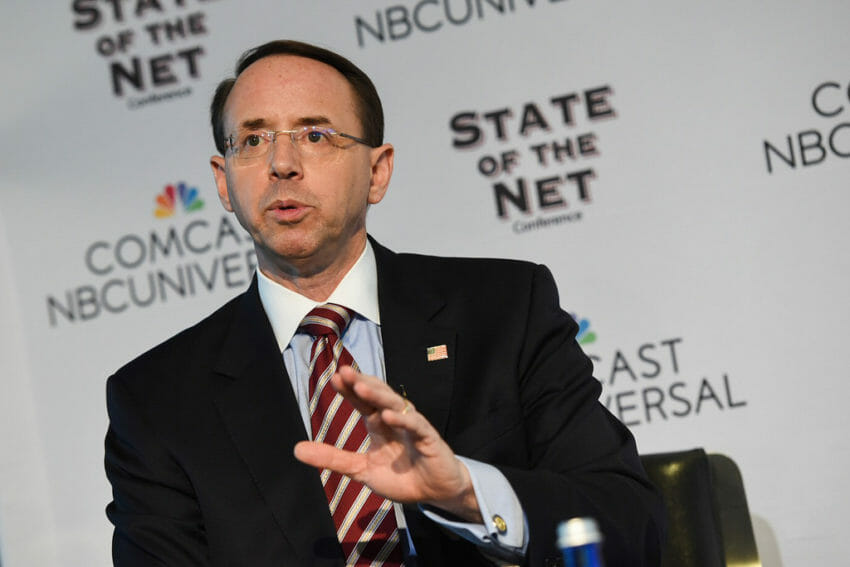
U.S. Deputy Attorney General Rod Rosenstein, released the indictment of 12 Russians days before President Trump was due to meet with Russian President Vladimir Putin.
By Scott Ritter | TruthDig | July 15, 2018
With great fanfare, Deputy Attorney General Rod Rosenstein on Friday released a 29-page indictment, a byproduct of the ongoing investigation by special counsel Robert Mueller into Russian meddling in the 2016 presidential election. Ostensibly, this indictment cemented the government’s case against the Russians and punched a hole in the arguments of those, like President Trump, who have been labeling Mueller’s investigation a “witch hunt.” This, of course, is precisely what Rosenstein and Mueller hoped to achieve through their carefully timed, and even more carefully scripted, indictment.
The indictment was made public at a time when the FBI is under increasing scrutiny for the appearance of strong anti-Trump bias on the part of some of its senior agents. This purported bias in turn generated rational concerns on the part of the president’s supporters that it possibly influenced decisions related to investigations being conducted by the FBI into allegations of collusion between persons affiliated with the campaign of then-Republican candidate Trump and the Russian government. The goal of this alleged collusion was to interfere in the American electoral processes and confer Trump an advantage against his Democratic rival, Hillary Clinton.
It also comes on the heels of a concerted effort on the part of the president and his political supporters to denigrate the investigation of Mueller and, by extension, the judgment and character of Rosenstein, who, since the recusal of Attorney General Jeff Sessions from the Russian investigation, has been giving Mueller his marching orders. Indeed, several conservative members of the House of Representatives are mulling the impeachment of Rosenstein, claiming he is refusing to cooperate with Congress by denying them access to documents related to the investigation that certain members of Congress, at least, deem relevant to their constitutionally mandated oversight function.
While the impeachment of Rosenstein is highly unlikely and the likelihood of the FBI being found guilty of its investigations being corrupted by individual bias is equally slim, in the world of politics, perception creates its own reality and the Mueller investigation had been taking a public beating for some time. By releasing an indictment predicated upon the operating assertion that 12 named Russian military intelligence officers orchestrated a series of cyberattacks that resulted in information being stolen from computer servers belonging to the Democratic Party, and then facilitated the release of this information in a manner designed to do damage to the candidacy of Clinton, Rosenstein sought to silence once and for all the voices that have attacked him, along with the Department of Justice, the FBI and the Mueller investigation, as a participant in a partisan plot against the president.
There is one major problem with the indictment, however: It doesn’t prove that which it asserts. True, it provides a compelling narrative that reads like a spy novel, and there is no doubt in my mind that many of the technical details related to the timing and functioning of the malware described within are accurate. But the leap of logic that takes the reader from the inner workings of the servers of the Democratic Party to the offices of Russian intelligence officers in Moscow is not backed up by anything that demonstrates how these connections were made.
That’s the point of an indictment, however—it doesn’t exist to provide evidence beyond a reasonable doubt, but rather to provide only enough information to demonstrate probable cause. No one would, or could, be convicted at trial from the information contained in the indictment alone. For that to happen, the government would have to produce the specific evidence linking the hacks to the named Russians, and provide details on how this evidence was collected, and by whom. In short, the government would have to be willing to reveal some of the most sensitive sources and methods of intelligence collection by the U.S. intelligence community and expose, and therefore ruin, the careers of those who collected this information. This is something the government has never been willing to do, and there is much doubt that if, for some odd reason, the Russians agreed to send one or more of these named intelligence officers to the United States to answer the indictment, this indictment would ever go to trial. It simply couldn’t survive the discovery to which any competent defense would subject the government’s assertions.
Robert Mueller knew this when he drafted the indictment, and Rob Rosenstein knew this when he presented it to the public. The assertions set forth in the indictment, while cloaked in the trappings of American justice, have nothing to do with actual justice or the rule of law; they cannot, and will never, be proved in a court of law. However, by releasing them in a manner that suggests that the government is willing to proceed to trial, a perception is created that implies that they can withstand the scrutiny necessary to prevail at trial.
And as we know, perception is its own reality.
Despite Rosenstein’s assertions to the contrary, the decision to release the indictment of the 12 named Russian military intelligence officers was an act of partisan warfare designed to tip the scale of public opinion against the supporters of President Trump, and in favor of those who oppose him politically, Democrat and Republican alike. Based upon the media coverage since Rosenstein’s press conference, it appears that in this he has been wildly successful.
But is the indictment factually correct? The biggest clue that Mueller and Rosenstein have crafted a criminal espionage narrative from whole cloth comes from none other than the very intelligence agency whose work would preclude Rosenstein’s indictment from ever going to trial: the National Security Agency. In June 2017 the online investigative journal The Intercept referenced a highly classified document from the NSA titled “Spear-Phishing Campaign TTPs Used Against U.S. And Foreign Government Political Entities.” It’s a highly technical document, derived from collection sources and methods the NSA has classified at the Top Secret/SI (i.e., Special Intelligence) level. This document was meant for internal consumption, not public release. As such, the drafters could be honest about what they knew and what they didn’t know—unlike those in the Mueller investigation who drafted the aforementioned indictment.
A cursory comparison of the leaked NSA document and the indictment presented by Rosenstein suggests that the events described in Count 11 of the indictment pertaining to an effort to penetrate state and county election offices responsible for administering the 2016 U.S. presidential election are precisely the events captured in the NSA document. While the indictment links the identity of a named Russian intelligence officer, Anatoliy Sergeyevich Kovalev, to specific actions detailed therein, the NSA document is much more circumspect. In a diagram supporting the text report, the NSA document specifically states that the organizational ties between the unnamed operators involved in the actions described and an organizational entity, Unit 74455, affiliated with Russian military intelligence is a product of the judgment of an analyst and not fact.
If we take this piece of information to its logical conclusion, then the Mueller indictment has taken detailed data related to hacking operations directed against various American political entities and shoehorned it into what amounts to little more than the organizational chart of a military intelligence unit assessed—but not known—to have overseen the operations described. This is a far cry from the kind of incontrovertible proof that Mueller’s team suggests exists to support its indictment of the 12 named Russian intelligence officers.
If this is indeed the case, then the indictment, as presented, is a politically motivated fraud. Mueller doesn’t know the identities of those involved in the hacking operations he describes—because the intelligence analysts who put the case together don’t know those names. If this case were to go to trial, the indictment would be dismissed in the preliminary hearing phase for insufficient evidence, even if the government were willing to lay out the totality of its case—which, because of classification reasons, it would never do.
But the purpose of the indictment wasn’t to bring to justice the perpetrators of a crime against the American people; it was to manipulate public opinion.
And therein lies the rub.
The timing of the release of the Mueller indictment unleashed a storm of political backlash directed at President Trump, and specifically at his scheduled July 16 summit with Russian President Vladimir Putin in Helsinki. This summit was never popular with the president’s political opponents, given the current state of affairs between Russia and the U.S., dominated as they are by events in Syria and Ukraine, perceived Russian threats against the northern flank of NATO, allegations of election meddling in the U.S. and Europe, and Russia’s nuclear arsenal. On that last point, critics claim Russia’s arsenal is irresponsibly expanding, operated in violation of existing arms control agreements, and is being used to underpin foreign policy objectives through the use of nuclear blackmail.
President Trump has publicly stated that it is his fervent desire that relations with Russia can be improved and that he views the Helsinki summit as an appropriate venue for initiating a process that could facilitate such an outcome. It is the president’s sole prerogative to formulate and implement foreign and national security policy on behalf of the American people. While his political critics are free to criticize this policy, they cannot undermine it without running afoul of sedition laws.
Rosenstein, by the timing and content of the indictment he publicly released Friday, committed an act that undermined the president of the United States’ ability to conduct critical affairs of state—in this case, a summit with a foreign leader the outcome of which could impact global nuclear nonproliferation policy. The hue and cry among the president’s political foes for him to cancel the summit with Putin—or, failing that, to use the summit to confront the Russian leader with the indictment—is a direct result of Rosenstein’s decision to release the Mueller indictment when he did and how he did. Through its content, the indictment was designed to shape public opinion against Russia.
This indictment, by any other name, is a political act, and should be treated as such by the American people and the media.
(Photo credit Internet Education Foundation / CC BY 2.0)
Conspiracy Humor and Irony in the Trump-Russia Brouhaha
By Jacob G. Hornberger | FFF | July 18, 2018
New York Times : Mr. Trump raised a series of largely irrelevant conspiracy theories — none of which were directly related to the evidence of Russian hacking activity.
Washington Post : And with that, yet another President Trump conspiracy theory is thoroughly repudiated by the Russia investigation.
Chicago Tribune : On Monday, Trump also resurrected several debunked conspiracy theories about his opponent Hillary Clinton and the Democratic Party.
Time: President Donald Trump gave a not-so subtle nod to an online conspiracy theory about the 2016 hacking of the Democratic National Committee.
NBC: President Donald Trump on Monday promoted two conspiracy theories and raised questions about his former Democratic rival Hillary Clinton’s email server.
CNN: Trump has made a lot of the conservative conspiracy theory that there’s an entrenched “deep state” out to get him even though he leads the government.
*****
Special Counsel Robert Mueller’s Indictment Against 12 Russians (which many in the mainstream media have accepted as gospel)
COUNT ONE: Conspiracy to Commit an Offense Against the United States).
COUNT TEN: Conspiracy to Launder Money.
COUNT ELEVEN: Conspiracy to Commit an Offense Against the United States).
Horror in Helsinki: Trumputin Strikes Again
By Michael Howard | American Herald Tribune | July 18, 2018
Something very extraordinary has just taken place—something unprecedented in American history. A sitting president, one Donald J. Trump, has committed treason against the United States. Don’t take my word for it. This is being documented by our nation’s most important political thinkers. New York Times headline from regular columnist Charles Blow: “Trump, Treasonous Traitor.” Quote from a column by regular New York Times columnist Thomas Friedman: “There is overwhelming evidence that our president … is deliberately or through gross negligence or because of his own twisted personality engaged in treasonous behavior.” Tweet from former CIA Director John Brennan: “[Trump’s meeting with Putin] was nothing short of treasonous.”
And for those whose tastes are a bit more lowbrow (not that the brows of the NYT and the CIA are especially high), here’s a front page headline from the venerable New York Daily News : “Open Treason: Trump Backs Enemy Putin Over U.S. Intel.” Not only treason, then, but open treason. The worst kind.
I know it’s trendy nowadays to play fast and loose with the Constitution, but—call me pedantic—it might be instructive to consult the much-cited document on this particular subject. Article III Section 3 states the following: “Treason against the United States, shall consist only in levying War against them, or in adhering to their Enemies, giving them Aid and Comfort.” Note the use of the word “only”—the Founders had very specific ideas in mind about what constituted treason, namely waging war against the U.S. and/or aiding and abetting its enemies. “Enemy” meaning a state with which we are at war, and the U.S. is, despite routinely bombing seven countries (probably the number is higher now; it’s hard to keep track), not officially at war with anyone, least of all Russia. Therefore, charges of treason in the context of Trump’s Helsinki gambit are rather untenable, and more than a little hysterical. But don’t tell that to Charles Blow’s Twitter followers.
There’s no point singling out one of the hundred manic articles about the Trump-Putin summit to pick apart: they’re all exactly the same. In a nutshell: Trump refuses to acknowledge the U.S. intelligence community’s conclusion that Russia “attacked” our country by hacking into the DNC’s emails; Trump refuses to say anything negative about Vladimir Putin; Trump is helping Moscow to splinter NATO; Trump refuses to condemn Russian aggression; Trump is a Kremlin puppet doing Moscow’s bidding; and so on and so forth.
Needless to say these are all specious arguments. Asked recently about America’s collective panic over Russia’s alleged interference in our presidential election, Noam Chomsky responded: “That has most of the world cracking up in laughter.” It doesn’t take a scholar to understand why. The United States is the world champion when it comes to meddling in the domestic affairs of foreign countries. But we don’t just meddle: we engineer military coups and install mass-murdering dictators or, when that’s not feasible, simply overthrow undesirable governments using unilateral military force. Examples abound. In 1953 the CIA, in tandem with MI6, orchestrated a coup against Iran’s first democratically elected Prime Minister, Mohammad Mossadegh, who had intolerable plans to nationalize his country’s oil industry. The coup was a success, restoring the despotic shah to his erstwhile throne where he remained until 1979, when he was chased into exile by the Islamic Revolution. The following year, Guatemala’s leftist president Jacobo Arbenz was deposed by another CIA-authored coup, Operation PBSUCCESS, paving the way for a series of ultraviolent dictatorships.
A mere three months into his presidency, and acting in accordance with the imperialist Monroe Doctrine, Jack Kennedy went after Fidel Castro’s revolutionary government in Cuba using CIA-sponsored militants. The Bay of Pigs failed miserably, but Uncle Sam was not to be deterred: “Operation Mongoose” was soon set in motion, and countless attempts on Castro’s life were made, all unsuccessful.
Sensing that CIA black ops might not be sufficient to neuter the movement for independence in Vietnam—and, more importantly, to discourage other countries in the region from adopting similar dangerous ideas—the U.S. government opted for full-scale military invasion, killing over three million people and decimating most of the country.
Skipping ahead a couple decades, the CIA armed, trained and financed the Contras, a terrorist gang in Nicaragua whose duty it was to take down the leftist Sandinista government. This particular affair is notable for the fact that, in 1986, the U.S. government was found by the International Court of Justice to be, inter alia, “in breach of its obligation under customary international law not to intervene in the affairs of another State” and “in breach of its obligation under customary international law not to use force against another State.” It was thus ordered by the court to pay an “interim award” of $370.2 million to the Republic of Nicaragua, with the total sum of reparations to be determined at a later date. The U.S. simply ignored the court’s ruling and continued supporting the terrorists.
Nicaragua to this day isn’t free from U.S. harassment. The country’s current political crisis, characterized by violent neoliberal opposition to President Daniel Ortega’s popular leftist government (Ortega won the 2016 election with over seventy-two percent of the vote), is supported by U.S. policy, with the National Endowment for Democracy—funded by the U.S. Congress—channeling millions of dollars to Ortega’s political opposition over the last five years. The reason for this is simple. As Kevin Zeese and Nils McCune wrote in Counterpunch:
Nicaragua has set [an example] for a successful social and economic model outside the US sphere of domination. Generating over 75% of its energy from renewable sources, Nicaragua was the only country with the moral authority to oppose the Paris Climate Agreement as being too weak…. The FMLN government of El Salvador, while less politically dominant than the Sandinista Front, has taken the example of good governance from Nicaragua, recently prohibiting mining and the privatization of water.
If the oligarchs in Nicaragua manage to pull off a coup, you can bet your bottom dollar Trump and co. will offer their full-throated support, as Obama and co. did following the 2009 military coup in Honduras, now one of the most dangerous and repressive countries in the world, and a leading source of those pesky migrants flooding the southern U.S. border.
Simply put, Washington is incapable of minding its own business. Cambodia, Laos, El Salvador, the Dominican Republic, Ecuador, Chile, Bolivia, Venezuela, Indonesia, Libya, Iraq, Afghanistan, Syria, Iran … they all know it all too well. If you step out of line, you get whacked. Iraq, Libya and Syria have been taught the ultimate lesson—they’ve all been pulverized. Iran may yet receive the sledgehammer treatment as well, given that various non-military means of destabilization and subversion have failed to bear fruit, and especially given that the hawkish theocrats governing Israel, along with their mouthpieces in Washington, would like nothing more than to see the mullahs blown to bits.
So yes, it’s easy to see why, in Chomsky’s words, “Russia-gate”—even if we grant that its core allegations are factual—“has most of the world cracking up in laughter.”
Nearly as laughable is the claim, made over and over again, that Trump is a “Russian asset.” Anyone leveling this charge is either a fool or a demagogue. Those amenable to it should put on their thinking caps for a moment. Would a Russian asset impose a series of damaging sanctions on Russian companies and individuals, including those accused of human rights abuses, as Trump has done? Would a Russian asset expel dozens of Russian diplomats from the U.S. in retaliation for a nerve agent attack on a former double agent in Britain that may or may not have been ordered by Moscow, as Trump did? Would a Russian asset twice order the (illegal) use of military force against the Syrian government, Russia’s ally, risking direct military confrontation with Russia, in retaliation for dubious chemical weapons attacks, as Trump did? Would a Russian asset void the Iranian nuclear accord of which Russia is strongly in favor, as Trump did? Would a Russian asset approve the sale of missiles to Ukraine’s stridently anti-Russian government, knowing those weapons will likely be used against pro-Russian counterrevolutionary fighters in the east, as Trump did? Would a Russian asset demand that NATO member states, most if not all of them adversarial toward Russia, increase their defense spending, as Trump did?
Ah, yes, but Trump has never said anything mean about Putin! True enough, but then has he ever criticized el-Sisi, whose security forces massacred over eight-hundred political protestors in the streets of Cairo in 2013? How about Mohammed bin Salman, whose air force daily bombs hospitals, weddings, funerals, mosques and schools in Yemen? Rodrigo Duterte, whose drug war includes widespread summary executions? George W. Bush, Dick Cheney, et al, who invaded two countries and instituted torture centers around the world? Trump has never had an unkind word for any of the forgoing thugs. Most strikingly, he’s offered only fulsome praise for “Bibi” Netanyahu, whose crimes are too numerous to record here. If Trump’s an “asset,” he’s plainly Israel’s.
All in all, the media delirium over Trump’s humdrum meeting with Putin pushes us ever further into the political Twilight Zone. Soon a fanatical opposition to all things Russian will serve as a litmus test for Democratic presidential candidates. Just as the GOP uses gays and guns to energize an otherwise disaffected base, so the Democrats will use this new and more dangerous form of McCarthyism. All this is by design: they understand they can’t rely on their actual policies, created for and by our corporate masters, to secure votes. Hence the diversionary tactics, all of which are beginning to merge into a rabid Russophobia—one that, if allowed to inform policy-making at the highest levels of government, may well get us all vaporized. In the words of Allen Ginsberg: America this is quite serious.
While His Opponents Cry Treason Trump Sues for Peace
By Tom LUONGO | Strategic Culture Foundation | 18.07.2018
For the second time in as many months President Trump went against the grain of US foreign policy.
I will not mince words. I was hoping for more from the Trump-Putin Summit in Helsinki; something concrete. Even a small agreement about a quid pro quo in Syria would have been welcome.
But, given the level of histrionics on display in the US media and on the left I guess I should have tempered my expectations. Cries of Trump being guilty of ‘treason’ and ‘high crimes and misdemeanors’ are rampant.
And they aren’t going to stop.
Crying treason for opening up diplomatic contact with a foreign leader whom we are not at war with is beyond hyperbole. It is the height of insanity. And I don’t use that term lightly.
Trump’s opponents both from members of the Deep State and media as well as those citizens supporting ‘The Resistance’ are so unhinged they have become indistinguishable from Colonel Jack T. Ripper from Dr. Strangelove.
I swear I saw a tweet from Obama Administration CIA Director John Brennan discussing bodily fluids, but I may have misread it.
They have nurtured their own angst and denial at having lost an election they have erected a bogeyman in Vladimir Putin as the only way in which the disgusting Trump could possibly have won.
And the Deep State of permanent government has cultivated this psychological poison perfectly. Now there are truly millions of otherwise normal people frothing at the mouth about everything Trump does is proof that he is the puppet of Putin, his evil master.
This has placed them firmly in the camp of wanting perpetual, undeclared war with everyone Trump wants peace with.
All because they don’t have the emotional maturity to accept reality.
And Trump, never one to miss an opportunity to twist the knife, in a moment of near sublime statesmanship during the post-summit press conference declared, “I would rather take a political risk in pursuit of peace than to risk peace in pursuit of politics. I will not make decisions on foreign policy in a futile effort to appease partisan critics, the media, or Democrats who want to resist and obstruct.”
That statement won his candidates the mid-term elections and likely won him re-election in 2020. It’s a statement that he can campaign on and give not only his base a boost but convince even more of the political center to reject the insanity of the left and side with him.
After all, he just put something above politics and that something is the very thing that got him elected in the first place, peace.
And that is eternally to his credit.
It is also in stark contrast to his ill-conceived bombing of the Al-Shairat airbase while hosting Chinese Premier Xi Jinping in April of 2017. This was an act of pure political optics, designed to appease his virulent critics.
But, as he learned from that act and many others since then, nothing will appease these people than his removal from the office. The Resistance needs it to vindicate their descent into madness. The Deep State needs it to ensure the gravy train keeps flowing.
There are too many cozy relationships at risk, too many think tank jobs on the block, and too many weapons contracts at stake and too many more taxpayer-funded junkets to attend for Trump and Putin to remake the post-WWII political order.
Putin, for his part, was obviously firm in his dealings with Trump. There were many rumors of offers being made which were rejected. As myself and many others have pointed out, Trump didn’t have much to offer Putin in concrete terms on many of the outstanding issues of the day.
I believe the only thing they can agree on is that Syria is nearly settled in Assad’s favor and all that needs to be done now is convince the Israelis and Iran to behave themselves. In all of the furor over Trump’s meeting with Putin this tweet from uber-hawk and MIC-mouthpiece, Senator Lindsay Graham is the most telling.
“It is beyond absurd to believe that Russia will ‘police Iran’ or drive them out of Syria. Iran is Assad’s biggest ally – even more so than Russia. Russia policing Iran makes about as much sense as trusting Russia to police the removal/destruction of chemical weapons in Syria.” — Lindsay Graham, July 16th
No one that I know of other than myself and a very small handful of equally obscure political commentators have broached the subject of Russia policing Syria after the US picks up and leaves as any Grand Bargain for Middle East Peace.
Remember, Graham was just in Syria trying to drum up further support for Kurdish independence in a clear attempt to undermine what he just told everyone Trump’s plan was.
So, to me, this signals strongly that peace in Syria is what Trump and Putin discussed at length in their meeting and why the Deep State has so thoroughly gone off the deep end. Graham just told everyone what the plan is, folks.
And the plan is peace in the Middle East.
Trump and Putin both referenced working with Israeli Prime Minister Benjamin Netanyahu to craft a post-Civil War plan of action in Syria. Putin mentioned restoring Syria to the 1974 border of the Golan Heights while Trump made it clear he no longer wants our people there.
Moreover, Trump sent an envoy from the US to sit down and talk peace with the Taliban in Afghanistan, putting paid Secretary of State Mike Pompeo’s assertion that the US is ready to talk. Lindsay must be shaking in his thigh-highs over the prospect of this as well.
Remember, the US only negotiates when it knows it is losing. Empires dictate terms, they don’t sue for peace.
And that is exactly what Trump is beginning to do with Russia on a number of fronts across Central Asia. And for this he is being vilified by his opponents for being a traitor. A traitor to what?
Chaos.
US Senate Democrats Demand Probe of Putin-Trump Summit
Sputnik – July 18, 2018
Democratic leaders are demanding an open hearing in which Trump administration officials, including the American translator, would explain what transpired in Monday’s meeting between President Donald Trump and Russian President Vladimir Putin.
“This is too important not to get the full story out before the Senate and the American people,” Senate Minority Leader Chuck Schumer said at a press conference on Tuesday while flanked by senior Democratic lawmakers.
In addition, Schumer demanded that the administration turn over to Congress all contemporaneous notes from the summit.
Trump’s first official summit with Putin featured a two hour long one-on-one meeting, followed up by an expanded bilateral meeting in Helsinki, Finland.
The two leaders positively assessed the results of the summit, where they discussed the most pressing international issues as well as Russia’s alleged meddling in the 2016 US election. Trump said after the meeting Washington was to blame for the poor state of bilateral relations, and cast doubt on the US intelligence community’s conclusion on the interference in the US vote.
Schumer and other Senators said the investigation should feature testimony from Secretary of State Mike Pompeo, Director of National Intelligence Dan Coats, US Ambassador to Russia Jon Huntsman and the American translator in the one-on-one meeting between Trump and Putin.
Senator Bob Menendez called Monday a “day of infamy” for the United States, borrowing a phrase used by President Franklin Roosevelt to describe the Japanese attack on Pearl Harbor.
“He violated his oath of office to protect and defend the constitution of the United States,” Menendez added.
Senator Ben Cardin called for immediate action to protect the United States from alleged Russian aggression.
“We need to use the independence of Congress to protect the national security of America, particularly in light of what President Trump has done with Mr. Putin,” Cardin said.
Senator Jeanne Shaheen called on the Foreign Relations Committee to hold a hearing with the American translator who was present during the private, two-hour meeting between Trump and Putin to determine what was discussed and what Trump agreed to on behalf of the United States.
Featured Video

The Most Important Bet You’ve Never Heard Of
or go to
Aletho News Archives – Video-Images
From the Archives
The Occupied Mentality Syndrome
Saudi Arabia on the American chessboard – Part 2
By B. J. Sabri | American Herald Tribune | April 19, 2016
Since the Korean War, but particularly since the Iranian Revolution of 1979 until today, the United States has been steadily escalating its military presence in the Persian Gulf. Taking advantage of many colossal events of the past 36 years, [1] the hyper-empire has institutionalized its massive presence on land and sea, and expanded its objectives to include the unambiguous physical control of the area, as well as the clear understanding that local Arab governments should abide by them. The pretext is always the same: in “defense” of the national interests and security of the United States. From observing how the United States has been interacting with the governments of the region, and by judging from the size of its expeditionary force, we could reach a basic conclusion. The United States is occupying, de facto, the entire Arabian Peninsula. (Yemen, devastated by Saudi and American jets is yet to be conquered. Oman? Britain returned not as colonial ruler but as a soft occupying power.)
Under this articulation, Saudi Arabia, Qatar, Kuwait, and the United Arab Emirates are virtually occupied countries. If we compare this type of occupation to the mandate and protectorate regimes of the past, the results might be identical—the nations affected by it lose sovereignty. When Arab governments comply with the objectives of a foreign power that station military forces on their national milieu, then that power controls them in multiple ways including how they react to policy deliberations and what decisions they intend to take on specific issues. A good method to verify the concept of effective occupation is this: take notice of what the United States says and wants, and then compare it to what the gulf rulers do in response. (I shall discuss this detail at some point in the upcoming parts.)
If the presence of US forces or other means of political pressure are a factor in Saudi Arabia’s interventionist Arab wars, then we need to debate this issue. However, from the history of resistance to colonialism, we learnt: if a powerful state imposes its order on a nation by military means or other forms of coercion, and if this nation does not resist that imposition, then a mental subordination to the powerful state will ensue. This is especially true in the case of Saudi Arabia. One single event, 9/11, has transformed it from a US “ally” into an instant political hostage of the American Empire. … continue
Blog Roll
 Aletho News
- Britain’s Lebanon surveillance network: A digital map for war
- Bahrain faces scrutiny for opposition crackdown after detainee killed
- Hegseth’s Pentagon Purge Designed to Prevent a Mutiny: Karen Kwiatkowski
- Greek shipping firms secretly transporting oil, weapons to Israel
- UN vote on Hormuz force delayed as Iran issues warning
- Trump and the debris of Iran war
- IRGC hits US tech giant Oracle’s data center, computing site in UAE over new assassinations
- Bombing Iran Back Into the Stone Age /Lt Col Daniel Davis & Jim Jatras
- UAE rejects report claiming it is ready to join war on Iran to reopen Hormuz
- A New Resistance Front: How Does Syria Factor into the Regional War?
- If Americans Knew
- Israel-US kill negotiators, destroy civilian structures, but Iran’s military capabilities still largely intact – Daily Update
- ‘War crime’: Global condemnation as Israeli ministers celebrate death penalty law targeting Palestinian prisoners
- 7 Ways Israel Is Turning Lebanon Into Gaza
- World’s Leading Football Bodies Under Fire Over Israel Policies
- Experts warn of possible use of nukes against Iran
- Israeli invasion of Lebanon could be worse than 1982, warn European officials
- Passover: Liberation and collective punishment
- Trump says the quiet part out loud: (Israel’s) war on Iran > Americans’ health – Daily Update
- Gaza families reunite years after babies evacuated amid Israel’s war
- International Rescue Committee warns Gaza’s children face grave protection risks
- No Tricks Zone
- Low Intensity Tornado Wrecks Major Solar Farm, Creating A Potential Toxic Dump
- New Study Finds Warming Saves Lives…Cold Temperatures 12 Times More Deadly Than Excess Heat
- German Science Blog Accuses PIK Climate Institute Of Hallucinating Climate Tipping Points
- Devastating Assessment Of Comirnaty Vaccine By Former Senior Pfizer Europe Toxicologist
- New Study: CO2 Is ‘Effectively Negligible’ As An Explanatory Climate Change Factor Since 2000
- Former Pfizer Toxicologist Dr. Helmut Sterz Tells Bundestag Hearing Pfizer Vaccine Should Have Never Been Approved
- Energy Expert: Germany’s Nuclear Phaseout Was A “500 Billion Euro Mistake”
- New Research: South Australia’s Mid-Holocene Sea Surface Temperatures Were 4°C Warmer Than Today
- Storing Green Energy To Last Germany 10 Days Would Require A 60-Million Tonne Battery
- New Studies: UK Sea Levels Were 4 Meters Higher Than Today During The Mid-Holocene
 Aletho News