NATO’s Dead?
If so, who killed it: Obama, Putin, Or Trump?
By Andrew Korbyko – InfoRoss – 06.07.2018
NATO, as the world knew it, is dead, and the organization’s demise is attributable to the combination of President Putin’s deft diplomacy in advancing the Russian-Turkish rapprochement and his American counterpart’s revolutionary reconceptualization of the very essence of the alliance, both of which wouldn’t have been possible had it not been for Obama.
NATO, as it was previously conceived of for decades, is dead, and while it might be reborn in a different format sometime in the future, its previous model has exhausted its purpose and is entering into the dustbin of history. The organization still officially exists, but everything about it is changing to the point where it might soon become unrecognizable. The consistently anti-Russian driving force behind the bloc has been decisively neutralized by President Putin’s deft diplomacy in winning over its second-largest military member, Turkey, as Russia’s newest strategic partner, while Trump’s revolutionary reconceptualization of the alliance as an equal collection of states combating the asymmetrical security challenges of terrorism and illegal migration will fundamentally transform what it means to be a NATO member.
The Shadow Of Obama
Before going through the post-mortem in detail, it’s worthwhile to describe how Obama’s shadow hangs heavy in the sense that he orchestrated the three greatest mistakes that inadvertently led to NATO’s demise. The 2011 NATO War on Libya has the chance of being seen in hindsight as the final flash of a fast- fading star, with its “shock-and-awe” destruction of the former Jamahiriya going down in history as perhaps the last real instance of the bloc’s members working in coordination with one another to conventionally wage war against a targeted state. The self-congratulatory pomp that followed this brief military campaign has since been proven to have been premature because of the country’s ongoing civil war and role as a transit state for facilitating the flood of hundreds of thousands of migrants into Europe, which sparked its own crisis that has since led to the rise of EuroRealist populists in the continent.
In addition, the Libyan model of Hybrid War destabilization was also applied to Syria, albeit minus the final conventional warfare form, and this exacerbated the Migrant Crisis to the point of no return in guaranteeing the inevitable rise of right-wing politicians in Europe. Taken together, the Wars on Libya and Syria, waged in different manners but nevertheless following the same neo-imperialist regime change form, generated unprecedented humanitarian blowback to the point of triggering far-reaching political changes in NATO’s EU members, making many of them reconsider the official anti-Russian purpose of the bloc when it could be better put to use in defending the organization’s southern shores from swarms of migrants. For as “constructive” of an idea as this may have been, it led to deep divisions within the EU itself between the pro-migrant Western countries, the anti-migrant Central & Eastern European ones, and the anti-Russian Baltic States, Poland, and Romania.
While these intra-NATO disagreements were percolating, Obama made another massive mistake in giving the greenlight for the failed pro-American coup attempt against Turkish President Erdogan in the summer of 2016, and the blowback from this sloppy operation was almost instantaneous in making the bloc’s second-largest military deeply suspicious of US intentions from then on out. Although Turkey had hitherto been mostly focused on facilitating American strategic objectives in the Mideast (which for the most part were disadvantageous to Russia’s long-term regional vision), its unchanging geopolitical position as an irreplaceable part of NATO’s anti-Russian “containment” policy was thought to have retained a consistent function that had been taken completely for granted up until that point. That was a huge error, as will be seen, because President Putin’s deft diplomacy succeeded in its judo-like maneuver to flip Turkey from an enemy into a partner.
Putin’s Judo
Taking advantage of President Erdogan’s understandable distrust of what he had presumed was his country’s closest ally, President Putin reached out to extend his support for the embattled Turkish leader in demonstrating which of the two Great Powers really had Ankara’s best interests in mind. It shouldn’t be forgotten that unconfirmed reports also alleged that Russian intelligence might have tipped President Erdogan off right before a fighter jet flown by one of the coup conspirators was set to bomb his residence, therefore saving his life and sealing a new bond of friendship between both countries. It might never be known whether that actually happened or not, but in any case, the Russian-Turkish rapprochement that followed soon thereafter was swift and even saw Moscow passively accepting Ankara’s limited “Euphrates Shield” incursion into northern Syria later that summer, something that would have been utterly unthinkable just a few months prior.
The revival of the Turkish Stream pipeline project and a related agreement on nuclear energy cooperation served as physical testimonies to the strength of the Russian-Turkish Strategic Partnership, which went one dramatic step much further in officially including a military dimension per Ankara’s desire to buy Moscow’s state-of-the-art S-400 air & missile defense system despite Washington’s threats to sanction it if the deal goes through. In the course of less than two years, President Putin’s deft diplomacy flipped the tables on the previous US-Turkish Strategic Partnership by replacing America with Russia and totally changing the overall dynamics of Mideast geopolitics. The de-facto removal of NATO’s second-largest military force from the organization, which is essentially the true state of affairs at the moment given Ankara’s planned S-400 military cooperation with Moscow and Washington’s CAATSA sanction threats, dealt a heavy blow to the bloc from which it has yet to recover.
Decades’ worth of strategic planning that went into using Turkey as a bulwark against the spread of Russian influence towards the Mediterranean are now worthless after Ankara has for all intents and purposes turned its back on the bloc out of protest of the US’ role in the failed summer 2016 coup attempt. The organization can no longer count on the cornerstone of its Mideast, Black Sea, and Eastern Mediterranean policies, and this has inevitably led to the alliance having to reinvent itself. As it happened, this took place concurrent with the rapid politicization of the Migrant Crisis and its resultant intra-NATO/-EU disputes about how best to respond to this civilizational challenge, further exacerbating divisions within the West and making Turkey’s “defection” (brought about through President Putin’s masterful diplomacy) all the more impactful of a destabilizing move for the already confused alliance.
Trump’s Turnaround
The last and most powerful factor that contributed to the death of NATO was Trump himself, who decided to turn everything around and reorient the bloc from its official anti-Russian purpose by transforming it into something entirely different. It’s true that some of the anti-Russian functions will still remain because of the Baltic States, Poland, and Romania’s membership as “frontline states”, but Trump’s vision is to use NATO as a platform for responding more to asymmetrical security threats such as terrorism and illegal immigration instead of conventional ones like Russia was portrayed as being since the organization’s inception. Words are one thing, but transforming them through action is another, and it’s here where Trump is “walking the walk” much more than “talking the talk” like his predecessors did in visibly pressuring his “allies” to contribute their required 2% of GDP towards defense like they were always supposed to do to begin with.
Trump, being the successful businessman that he is, can’t fathom why the US should subsidize the EU’s “socialist welfare states” especially given that the “foreboding challenge” of a “Soviet invasion” no longer makes that necessary like it may have once. Seeing world affairs from an economic perspective and therefore perceiving the EU to be America’s rival in this respect, Trump knows that the best way to “level the playing field” and “get a better deal” is to put pressure on America’s military underlings by compelling them to pay more for defense in order to advance their interests in a reconceptualized NATO, with this being coordinated alongside the US’ campaign to get the EU to lift its anti-American tariffs. The knock-on effect of this “double whammy” could hit the Europeans’ economic growth and possibly compel them into “cutting a deal’ of some sort for relief, one which can only be speculated upon at this time but which would undoubtedly strengthen American influence.
Far from representing the “united” West that NATO did during the Old Cold War and the brief period of unipolarity that followed, the New Cold War has seen the bloc weakened from within because of the blowback caused by Obama’s disastrous Wars on Libya & Syria as well as the failed pro-American coup attempt against President Erdogan in summer 2016.
President Putin skillfully exploited the latter in rapidly turning Turkey into a close partner and convincing it that its future interests are best served by keeping the bloc at arm’s length, while Trump dealt the deathblow against the alliance for his own reasons mainly having to do with a different view on contemporary security challenges and his economically driven vision of foreign affairs. While the shell of NATO still exists, its functional capacities are now divided into different regional blocs mostly constituting the new anti-migrant European Intervention Force in Western Europe and the remaining anti-Russian forces in the East, though Turkey’s de-facto “defection” means that the organization will never be the same as before.
UK Defense Secretary Blames Russia for Death of Woman in Amesbury
Sputnik – 09.07.2018
Though earlier in the day UK counter-terrorism officer Neil Basu was unable to confirm that a toxic substance allegedly used for the poisoning of Dawn Sturgess was similar to those claimed to be used for the attack on Skripals, the UK Defense Secretary blamed the incident on Russia.
UK Defense Secretary Gavin Williamson, when asked in parliament about a threat British people are facing after a woman died allegedly from a toxic agent, said that Russia had committed an attack on the UK soil, which resulted in the death of a British national.
“The simple reality is that Russia has committed an attack on British soil which has seen the death of a British citizen,” Williamson said, adding that the incident is something that in his opinion “the world will unite with us [the UK] in actually condemning.”
The statement came after one of the two people who were allegedly exposed to a toxic agent Amesbury died in a hospital on July 8.
The UK police were unable to confirm whether the toxin the couple was exposed to was the same as that allegedly used against Russian ex-military intelligence officer Sergei Skripal and his daughter Yulia in March.
On Thursday, UK Home Secretary Sajid Javid said that the United Kingdom would take “further action” should Russia’s involvement in the incident be confirmed. He noted, however, that “we don’t want to jump to conclusions.”
The news about the alleged poisoning in Amesbury broke on July 4, exactly four months after former Russian intelligence officer Sergei Skripal and his daughter Yulia were found unconscious on a bench near a shopping mall in Salisbury on March 4.
At the time, the UK authorities blamed Russia for attempting to assassinate Skripal, who worked for the British intelligence, with what is believed by London to be the A234 nerve agent. Although the UK failed to provide evidence to substantiate its accusations, London rushed to retaliate, expelling Russian diplomats.
Russia denied having any role in the alleged poisoning and has offered to assist in the investigation. However, its request for samples of the chemical substance used to poison the Skripals was rejected. Both Skripals have since been discharged from the hospital.
‘A matter of life & death’: 15,000 white South African farmers seek refuge in Russia – report
RT | July 9, 2018
A delegation of 30 South African farming families has arrived in Russia’s farmbelt Stavropol region, Rossiya 1 TV channel reports. The group says it is facing violent attacks and death threats at home.
Up to 15,000 Boers, descendants of Dutch settlers in South Africa, are planning to move to Russia amid rising violence stemming from government plans to expropriate their land, according to the delegation.
“It’s a matter of life and death — there are attacks on us. It’s got to the point where the politicians are stirring up a wave of violence,” Adi Slebus told the media. “The climate here [in the Stavropol region] is temperate, and this land is created by God for farming. All this is very attractive.”
The new South African government lead by President Cyril Ramaphosa has pledged to return the lands owned by white farmers since the 1600s to the black citizens of the country. The government said it is planning to put an end to what it calls the legacy of apartheid, where most of South Africa’s land is still in the hands of its minority white population.
Rights groups have said the initiative incites violence. There were 74 farm murders and 638 attacks, primarily against white farmers, in 2016-17 in South Africa, according to data by minority rights group AfriForum.
The farmers are ready to make a contribution to Russia’s booming agricultural sector, according to Rossiya 1. Each family is ready to bring up to $100,000 for leasing the land.
Russia has 43 million hectares of unused farmland. The country has recently begun giving out free land to Russian citizens to cultivate farming. The land giveaway program, which began in 2014, has been a huge success.
NATO wary about summit with Trump days before he meets Putin
Obama’s posturing of Russia as ‘the enemy’ after its assistance to Ukraine and Crimea means little to Trump; a warming of US/Russia ties could force NATO to rethink its entire outlook
By M.K. Bhadrakumar | Asia Times | July 9, 2018
The summit meeting of the North Atlantic Treaty Organization this week – on Wednesday and Thursday – is a landmark event. It will be the first summit the alliance hosts in its new $1.2-billion headquarters in Haren district in Brussels. It ought to be a happy get-together. However, the event is becoming a somber occasion.
The blame for this is being put squarely on the shoulders of President Donald Trump, who has questioned whether the US’ European allies spend 2% of their GDP on defense and making that a key issue of his security and defense agenda. The American think-tank German Marshall Fund of the United States said in a report last Thursday: “The big question is how the showdown will play out around the table when Trump raises the issue.”
The think tank made an astonishing allegation: “Even greater damage could be done at the Trump-Putin meeting four days later [in Helsinki on July 16]. Among European Allies, but also in a staunchly Russia-critical U.S. Congress, suspicion about why the President wanted to meet with his [Russian] counterpart now is rampant. Observers are fearful that the notoriously unpredictable and diplomatically idiosyncratic Trump might sell out NATO security interests by agreeing to some deal with Putin … Should such fears prove justified, expect the European security architecture to become seriously unhinged, maybe to a historic degree.”
The old warhorse fears Trump could sell them out. Simply put, the US’ NATO allies are horrified at the prospect of an easing of tensions between Russia and the West. And there is a congruence between them and forces arrayed against Trump in US politics today. A profound contradiction has arisen.
Unless this contradiction is resolved, the western alliance cannot continue turbo-charged on the path that was set at its historic summit in Wales in 2014 under Barack Obama’s watch when it formally cast Russia as the “enemy” and embarked on hostile military posturing along Russia’s border regions in a wide arc stretching from the Baltics to the Mediterranean.
NATO expansion broke vow to Gorbachev
NATO members at the Wales summit claimed they were reacting to Russia annexing Crimea and Moscow’s intervention in eastern Ukraine in 2014. But in reality it was fast-forwarding an agenda that can be traced to back to the Clinton presidency – 1994, to be exact. When Bill Clinton ordered in 1994 the expansion of the alliance into the former territories of the Warsaw Pact, he jettisoned solemn Western assurances held out to the former Soviet leader Mikhail Gorbachev that NATO would not expand even by an inch following the reunification of Germany.
American diplomat George Kennan had warned then and there that it was an epochal mistake that would alienate Russia forever, but Clinton’s intention was to keep America in Europe and keep Russians out. By March 1999, Hungary, Poland and the Czech Republic had signed up; and over the next five years, NATO incorporated a further seven states – Bulgaria, Estonia, Latvia, Lithuania, Romania, Slovakia and Slovenia. Then in 2009, Croatia and Albania joined, and in June 2017 Montenegro followed. Indeed, NATO had to commission Madeline Albright for a project to provide an intellectual construct to the NATO enlargement.
Again, the petard of a “Russian threat” was raised at NATO’s 2014 summit but the plain truth is that the crisis in Ukraine was caused by clumsy Western meddling with the aim of turning that country into a military adversary of Russia through a half-baked offer of EU and NATO membership.
The US Assistant Secretary of State in the Obama administration, Victoria Nuland, has admitted that since 1991, Washington had spent upwards of $5 billion on “pro-democracy initiatives” in Ukraine.
Putin scoffs at ‘Russia threat’
On the ground, NATO enjoys vast military superiority over Russia. Putin has scoffed at the talk of a Russian threat to NATO members being “the type of thing that only a crazy person thinks, and only when dreaming”. Suffice to say, without an honest introspection by NATO of how it reached the present point on the so-called “Russia threat”, the alliance is in a cul-de-sac. It has nothing to do with Trump.
Where Trump really differs from Clinton or Barack Obama is that he is a political outsider. Not being an Establishment figure, unlike his two predecessors, he sees that NATO’s real predicament is that it is all dressed up with nowhere to go. As Trump sees it, the alliance’s contrived posturing of a war footing imposes a set of financial and military burdens on the US, which is unacceptable.
Trump framed the paradigm at a rally in Montana on Wednesday: “And I said, ‘You know, Angela, I can’t guarantee it, but we’re protecting you and it means a lot more to you than protecting us ’cause I don’t know how much protection we get by protecting you.” And, if Trump constructively engages with Putin, NATO’s anti-Russia animus becomes unsustainable and the alliance loses its purpose.
Plan to counter a Russian attack
Curiously, the summit in Brussels next week – just four days before the Helsinki summit – is slated to formalize a “30-30-30-30” NATO plan to counter a Russian attack – 30 land battalions, 30 air fighter squadrons and 30 ships to be kept in readiness for deployment within 30 days of being put on alert. Poland is pushing for a new US military base on its soil and the Baltic States have also requested a permanent stationing of American troops.
Meanwhile, there are growing divergences among the NATO allies in regard to threat perception. The Baltic States, Poland and Romania see Russia as a national security threat and foreign policy challenge. But for France or Germany, Russia doesn’t pose any such threat and although they disapprove of aspects of Russian policies, they also underscore the importance of a productive relationship with Russia.
The countries of southern Europe – Hungary, the Balkans, Greece, Italy, etc – are outright disinterested in sanctioning against Russia and keenly seeking opportunities of cooperation. As for Turkey, it has become Russia’s strategic partner. Even for the US, selective engagement with Moscow has been a necessity during the Clinton and Obama administrations. Clearly, shoring up Euro-Atlantic solidarity on the Russia question is becoming difficult. And a confrontational approach toward Russia as a default position becomes illogical.
It is not that Trump fails to see NATO’s political significance. It is rather that he sees the alliance for what it is – old fraying knots tying the US to its Cold War-era allies at such heavy cost without commensurate benefit. He feels that the US is being taken advantage of by free riders. Basically, Trump has never been caught up in NATO’s existential need for Russia to be the enemy from the east.
Germans concerned about Trump
Senior German officials have openly complained that NATO states were not included in the planning for the Trump-Putin summit at Helsinki. Peter Beyer, trans-Atlantic coordinator for Chancellor Angela Merkel’s ruling coalition, told the Funke Mediengruppe newspaper chain on Saturday: “There are great concerns in the alliance about what agreements Trump and Putin could reach.” That sentiment echoes Trump’s political adversaries and the large corpus of Russophobes in the US.
This is the first time in a half-century after Dwight Eisenhower, that the US has a president who is convinced of the imperatives of cooperative – even friendly – relations with Russia. Eisenhower failed to push through the planned May 1960 summit with Nikita Khrushchev following the controversial U-2 affair and the Soviet arrest of spy pilot Gary Powers.
When he vacated the presidency, he was an embittered man warning starkly in his farewell speech against the machinations of his country’s “military-industrial complex”. Where the war hero of the beaches of Normandy failed, can Trump succeed? Unlike Eisenhower, Trump also has to tackle the curious line-up between the US’ NATO allies and his enemies in Washington. That makes the Brussels summit a momentous run-in for Trump.
British MP, establishment journalists rush for Putin’s blood after Amesbury chemical death
RT | July 9, 2018
The death of Dawn Sturgess from what police say was exposure to Novichok has sparked a new fit of Russia-blaming, as an MP, high-profile commentators and mainstream journalists pointed the finger at Moscow.
As British police launched a murder investigation into the poisoning and death of Dawn Sturgess, 44, in Amesbury, various self-styled chemical weapons experts on Twitter have cried for Russia’s blood, squarely blaming Moscow for the incident yet in the early stages of the investigation.
Mike Gapes, the Labour and Co-operative MP for Ilford South who recently got some limelight by urging British parliamentarians against providing any commentary to RT, immediately named Russia as a party responsible for Sturgess’ death.
“This was a murder of a British citizen as a result of use of a chemical nerve agent produced by the Russian state,” Gapes wrote on Twitter, voicing something even Theresa ‘highly likely’ May has yet been wary of saying.
Gapes’ vitriol was joined by Kremlin watchers from UK establishment media, Russia correspondent for The Telegraph Alec Luhn, and The Guardian’s Luke Harding.
Harding, a well-known critic of the Russian government, implied that Sturgess was “collateral damage” of the Kremlin-orchestrated operation that was the poisoning of former double agent Sergei Skripal and his daughter Yulia in March in Salisbury.
“Dawn Sturgess dies after exposure to #novichok. The circumstances unclear. An utter indifference to collateral damage one of the hallmarks of the #Putin regime and its extra-territorial operations,” he tweeted.
Harding was a long-time Guardian correspondent in Moscow until 2011, when he was denied entry into Russia after violating accreditation rules. While the issue was promptly resolved and he was allowed back several days later, Harding alleged that he was a victim of a Kremlin crackdown on dissenting opinions.
Alec Luhn, another high-profile Russia critic, has used Sturgess’ death to defy Russian President Vladimir Putin, who, commenting on the Skripals poisoning, said that if the father and daughter were indeed attacked by a military-grade toxic agent they would not have survived.
Putin’s remark, according to Luhn’s logic, somehow gives more credibility to the version that it was Moscow behind the Salisbury poisoning.
“Vladimir Putin previously argued that the Russian state couldn’t have used a military nerve agent in the UK because the victims would have died. Now one of them has,” Luhn wrote.
Some commentators have gone as far as accusing the Russian president of personally killing Sturgess. The upcoming Trump-Putin summit in Helsinki was inevitably dragged into the picture.
“Putin is a murderer. What are the odds Trump doesn’t bring this up next week. Putin is our ENEMY!!!” Brian Krassenstein, an editor at Hill Reporter with nearly 500,000 Twitter followers, wrote.
Since the 12 July meeting was announced, hardliners have ostracized the US President for cozying up to his supposed puppet master, denouncing him as “traitor-in-chief” for his intention to have good relations with Russia and calling the Russian leader “fine.”
Far from everyone was convinced by the allegations of Russian involvement, which is still based entirely on speculation, as it’s unclear at this stage how Sturgess came into contact with the substance. Moreover, neither Sturgess nor her partner Charlie Rowley, 45, who remains in critical condition in the hospital, have anything in their background to suggest they might be of interest to the Kremlin, police said.
However, when faced with backlash (or, indeed, legitimate questions) over his tweet, Gapes preferred to label anyone asking for evidence or doubting Russia’s guilt “Kremlin bots” and “squawking abusive trolls” from Russia.
Gapes reacted the same way when he was accused of attempting to censor alternative opinions in the wake of his attack on RT. At the time, he called those who ventured to disagree with him “Putin apologists.”
READ MORE:
Amesbury poisoning incident fuels another wave of anti-Russian hysteria
Israel set to indict Turkish woman
MEMO | July 8, 2018
 Israeli prosecutors are set to charge a Turkish national on Sunday with aiding Palestinian group Hamas, according to Israeli daily Haaretz.
Ebru Ozkan, 27, was arrested by Israeli forces at Ben Gurion Airport on June 11 when she was returning to Turkey for alleged links with terrorist groups. Haaretz said Israeli prosecutors will file an indictment against the Turkish national on Sunday.
Ebru’s detention had been extended four times, Elif Ozkan, a sister of Ebru, noted.
Her lawyer Omar Khamaysa says she was charged with asking to transfer money and a cellphone charger to Hamas members, but she wasn’t aware of their identity.
Israel labels Palestinian group Hamas, which rules the Gaza Strip, as a terrorist organisation.
Ozkan is not the first Turkish citizen to have been recently detained by Israeli authorities.
In January, Osman Hazir, a 46-year-old Turkish national, was arrested for snapping a selfie at East Jerusalem’s Al-Aqsa Mosque while holding a Turkish flag.
And last December, Israel arrested two other Turks – Abdullah Kizilirmak and Mehmet Gargili – after the pair had quarreled with Israeli police who had tried to bar them from entering the flashpoint holy site.
In the same month, Adem Koc, another Turkish national, was arrested inside the Al-Aqsa Mosque compound for allegedly “disturbing the peace and taking part in an illegal demonstration”.
Kizilirmak, Gargili and Koc were all subsequently released on bail.
Roads Melt In Oz “Winter Heatwave”!!
By Paul Homewood | Not A Lot Of People Know That | July 8, 2018
This is typical of the garbage we get so often from so called newspapers:
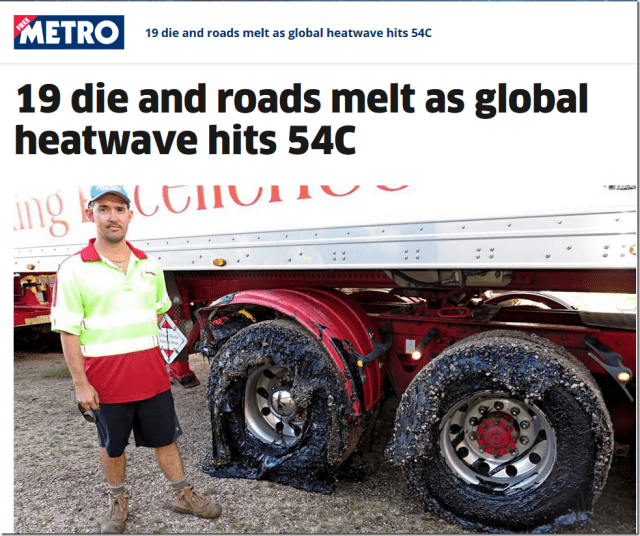
BRITAIN is not alone in experiencing a record-breaking heatwave, with soaring temperatures across the world being blamed for multiple deaths.
Roads have melted in Australia…..
Up to 50 motorists were left with their tyres covered in bitumen that had melted on a stretch of road outside the Australian city of Cairns in northern Queensland. Tablelands regional mayor Joe Paronella said: ‘I have never seen anything like it.’ … Full article
You will probably smell fake news already!
In Australia it just happens to be winter at the moment, and temperatures in July tend to be the lowest of the year.
In the week prior to July 6th, when the Metro article was published, temperatures ranged from 24.2C to 27.7C, perfectly consistent with a monthly mean of 25.8C:

But what about all of that melting tarmac? After all. photos don’t lie!
It turns out it was due to a botched road repair job:
A botched bitumen job on a road in Queensland’s far north has caused chaos, with tyres covered in tar and vehicles having to be abandoned.
Other cars have been damaged by lumps of tar thrown off the tyres of trucks and cars on a stretch of the Millaa Millaa-Malanda Road on the Atherton Tablelands.
Authorities closed the road on Wednesday after more than a dozen motorists had to have tyres replaced after the bitumen lifted.
Vince Whalley, who runs a tyre shop at Malanda, 70 kilometres south of Cairns, told the ABC that damage to vehicles had been significant: “The tar coming off the tyres is knocking bumper bars loose, taking panels out underneath.”
He said one tourist paid $1200 for a new set of tyres.
Motorist Bridget Daley told the ABC her tyres were covered in bitumen, which had also flown off, striking her bumper bar and snapping it off.
“I was absolutely horrified to find that there was [75 millimetres] of bitumen coated around all four wheels of my vehicle,” she said.
“It was like we were insects caught in a spider’s web and we were sinking.
“There were people that were pulled up on the side of the road and they were in total and complete disbelief as to what had happened to their vehicles.”
Another driver posted to social media saying the roads were a disgrace.
“We now have chipped paint and windscreen damage to our brand new car,” Anissa Rasmussen wrote.
“We were stopped by police at Tarzali, 10 kilometres from our destination, because cars were broken down, covered in tar, with it coating their wheels.”
Tablelands Regional Council Mayor Joe Paronella said a change of weather led to the chaos.
“I have never seen anything like it,” he said.
Cr Paronella said a section of the road was repaired by a Main Roads contractor a week ago. There were initial problems when gravel failed to stick to the bitumen.
“We started getting reports in the middle of last week from people getting stones and gravel flying up everywhere,” he said. “We helped with brooms to get the gravel off.”
That was during a period of cold, wet weather. But Deborah Stacey, from nearby Jaggan, told News Corp the problems really started when the weather improved on Wednesday and the bitumen turned to glue.
“We had a week of cracked windscreens, RACQ have been doing three to four a day,” she said.
“Then as soon as the sun came out, it started sticking … There was emulsion everywhere; a lot of soft tar sprayed in big globs and sticking to trucks wheels.”
Small towns, including Jaggan, were isolated while the main road was closed.
Cr Paronella urged those who had been caught up in the issues to contact Main Roads.
“I would certainly be talking to the department about possible compensation,” he said.
A spokesperson for Queensland’s Department of Transport and Main Roads said it was aware of the issues. The road had re-opened, with speed restrictions, after emergency repairs.
Queensland’s Dept of Transport has advised motorists affected to submit claims.
Transport and Main Roads District Director Sandra Burke said about 60 motorists had so far contacted the department seeking compensation for damage caused to their vehicles.
‘The situation is completely unacceptable and I apologise on behalf of the department to all those people whose vehicles were damaged and travel plans disrupted by this extremely unusual event.
We became aware of an issue with about two kilometres of road surface on June 25 and immediately reduced the road speed from 80km/h to 60km/h, swept the road surface and put signs in place.
‘What occurred yesterday will be the subject of a departmental investigation in close consultation with the contractors.
‘We believe recent cold and wet weather followed by a period of warmer conditions combined to destabilise the road surface which effectively became a sticky substance. “
Sandra Burke has missed a trick here though. It would be much cheaper to do what the clowns at the Metro have done, and blame it all on global warming!
Nothing about the latest ‘novichok’ attacks adds up
We simply cannot trust the Establishment media’s reporting on the dramatic events in Amesbury
By KENNY COYLE | Morning Star | July 9, 2018
Tranquil rural Wiltshire is now the epicentre of Cold War 2.0 it seems.
The dramatic events in Amesbury at the start of the month are once again creating a frenzy of media speculation and confusion, if not outright disinformation.
However idyllic this spot of the English countryside might appear, the Salisbury/Amesbury area is ground zero for Britain’s chemical, biological, radiological and nuclear (CBRN) warfare infrastructure.
Amesbury’s closeness to the Defence Science and Technology Laboratory (DSTL) at Porton Down has been noted in some media reports, although usually with the implication that the location is a stroke of good luck in allowing super-swift scientific identification of the mysterious “novichok” substance that apparently poisoned Charlie Rowley and Dawn Sturgess.
Less attention has been paid to the fact that the area is also home to the Defence Chemical Biological Radiological Nuclear Centre at RAF Winterbourne Gunner, Salisbury. This was originally established in 1926 as the Chemical Warfare School.
The centre, according to its website, is also “home of the joint CBRN medical faculty. The centre also provides CBRN medical training to all medical officers in the UK armed services as well as specialist medical training to UK and NATO/allied nations.
“As well as military training, [the Defence CBRN Centre] also supports civilian response in partnership with the Health Protection Agency and Department of Health.”
Amesbury is little more than 10 minutes away by car.
Also handily located nearby is Boscombe Down air base. The site is currently run, managed and operated by QinetiQ, a private military company created out of the breakup of the Defence Evaluation and Research Agency (Dera) in 2001 by the Ministry of Defence.
The other part of the former Dera is Porton Down’s DSTL.
QinetiQ’s US arm produces a range of military robots. The QinetiQ Talon Hazmat is specially designed for the chemical weapons market and the company boasts it can identify “over 7,500 explosives, precursors and chemicals.”
At £4.5 million apiece, this is big business and with an increasing media focus on CBRN threats, real or imagined, this is very good news for the company’s shareholders, who snapped up its Dera parent for a song.
Amesbury also sits close to Salisbury Plain Training Area, one of the largest military zones in Britain.
In February, just weeks before the Skripal attack, Salisbury Plain hosted Exercise Toxic Dagger, a three-week chemical weapons training exercise involving 40 Royal Marine Commandos, Public Health England, the Atomic Weapons Establishment and the Defence Science and Technology Laboratory of Porton Down.
It’s in this neck of the woods that we are asked to believe that a Russian agent or agents skillfully avoided all detection and identification and managed to attack the Skripals by smearing a doorknob.
These agents then left behind a chemical trail that could be traced all the way back to Moscow, rather than disposing of the substance securely.
All this within miles of a cluster of NATO’s key chemical weapons facilities.
Then there’s the issue of timing.
The Guardian’s Ewen MacAskill noted:“The latest twist comes at a time when Russia’s image has been burnished by a successful staging of the World Cup.
“More significantly though, it comes less than a week before a NATO summit in Brussels to discuss how the transatlantic alliance should deal with Russia and ahead of Donald Trump’s meeting with Vladimir Putin.”
Quite so.
The case might not cause quite so much scepticism if we only had the inconsistencies and absurdities of the Skripal case to contend with.
This second “novichok” case creates additional problems.
According to an initial statement on Wiltshire Police’s website, “emergency services were called to an address in Muggleton Road on Saturday evening after a man and woman, both in their 40s, were found unconscious in a property.
“They are both currently receiving treatment at Salisbury District Hospital and are both in a serious condition.
“Det Sgt Eirin Martin, from Salisbury CID, said: ‘At this stage we believe the two patients have fallen ill after using a contaminated batch of drugs, possibly heroin or crack cocaine’.”
This first police statement suggested that both victims were hospitalised at the same time, on Saturday evening and that it was being treated as a Class A drug-related incident.
However, a few days later Metropolitan Police Assistant Commissioner Neil Basu gave an entirely different timeline of events.
Basu’s statement said: “The ambulance service was called to Muggleton Road on Saturday (June 30) at about 10.15am where a 44-year-old woman had collapsed. She was taken to hospital.
“And at about 3.30pm, an ambulance was called to the same address where a 45-year-old man had also fallen ill. The man was taken to hospital and Wiltshire Police were informed.”
Video footage shown by BBC and Sky News claimed to show Rowley being put in an ambulance. One pictured paramedic was wearing a full hazmat suit, which is an uncommon response to an emergency call for what was supposedly a suspected drug overdose.
However, three separate local Wiltshire media reports from July 1 contradict the official narrative.
The website of Salisbury radio station Spire FM reported that:
“An incident in the Kings Gate area of Amesbury on Saturday evening (June 30) is thought to have been a drug-related medical episode.
“More than 10 emergency vehicles arrived on the scene from police, ambulance and fire service.
“A number of roads around the estate were closed for a time, but reopened within a couple of hours.
“A South Western Ambulance Trust spokesperson told Spire FM News they were called at 6.20pm.
“One patient has been taken to Salisbury District Hospital by land ambulance.”
Initial reports in the Salisbury Journal newspaper also put the ambulance call later than Basu.
“The ambulance service was called at about 6.20pm and the fire service were called just before 7pm.
“Witnesses told the Journal that a number of residents were evacuated from their homes by firefighters.
“They also reported seeing people in hazmat suits at the scene.
“Witnesses also said about eight fire engines along with police and ambulance vehicles as well as specialist incident response vehicles were also at the scene.”
The Journal report continues: “A police spokesman said: ‘At the moment it is not a police incident. It is being led by the fire and the ambulance.
“‘It appears that there are three people who have taken drugs and had a medical incident. They have all been taken to hospital’.”
Finally, Charlotte Callen, BBC West Home Affairs Correspondent, reported on BBC online, datelined July 4, that: “neighbours tell me the peace at this usually quiet new estate in Amesbury was broken at around 6.30 pm on Saturday evening.
“It was hot and many were out BBQ’ing when they heard sirens and saw flashing lights as first ambulances then the fire brigade and police arrived at Muggleton Road.
“They saw seven fire engines and fire officers wearing Hazmats at the scene. The house was cordoned off and the word here was that this was a suspected drugs overdose,” Callan reported from the scene.
So according to three local media reports, the ambulance was called much later than the times given by Basu. Although this was supposedly being treated as a drugs-related incident, fire crews were called, residents evacuated, roads closed, hazmat personnel deployed and specialist incident response vehicles, some from as far away as Swindon, were sent to the scene. Some details differ.
Three people were in the property, according to the local police version. Presumably this was Rowley, Sturgess and Hobson, with the police claiming that all three had been taken to hospital, but only one was confirmed to the media by the Ambulance Service as being hospitalised.
This simply does not add up.
The willingness of the Establishment media not only to echo official narratives but to help create them is impressive.
From the BBC to The Guardian, the Establishment media presents a neutral narrative that would not be so readily accepted if put forward directly by government officials or ministers.
Yet the interlocking of media, military and political elites is also now on show.
The Amesbury event apparently provides a new sample of the substance, helpfully kept in a carelessly discarded container in a public space, safe from the elements.
This is presented as the final missing piece of the puzzle that had so far eluded one of the biggest peacetime counter-terrorism hunts.
BBC diplomatic and defence correspondent Mark Urban took to the air on Newsnight this week to outline what may become the official standard explanation for the whole novichok case.
Yet only now has Urban revealed that he had in fact been meeting secretly with Sergei Skripal over a year ago.
“I met Sergei on a few occasions last summer and found him to be a private character who did not, even under the circumstances then prevailing, wish to draw attention to himself.
“He agreed to see me as a writer of history books rather than as a news journalist, since I was researching one on the post-Cold War espionage battle between Russia and the West.
“Information gained in these interviews was fed into my Newsnight coverage during the early days after the poisoning. I have not felt ready until now to acknowledge explicitly that we had met, but do now that the book is nearing completion,” Urban wrote on BBC online.
Urban has strong military links, penning nearly a dozen books on British army units over the years, while collecting his BBC salary.
He is a former second lieutenant in the fourth Royal Tank Regiment, which until 1993 was garrisoned in Tidworth, Wiltshire, 15 minutes or so from Amesbury.
Leaving aside Urban’s obvious contractual conflict of interest and his commitment to writing a spy book supposedly overruling his duty as an impartial public broadcaster, it is a bombshell to find that for four months the link between Skripal and a senior BBC journalist with intimate links to the British military was kept secret from viewers.
How much did Urban’s BBC managers know of his extra-curricular activities?
Did Skripal’s MI6 handlers introduce Urban to him, did they arrange his meetings, vet or coach Skripal’s answers?
It raises once again the question of just how cosy the links are between British intelligence and many senior employees of Auntie Beeb.
And why is this information only being revealed now? Because of a looming and now, no doubt, ultra-lucrative book deal for Urban or instead to bolster the case that Skripal was indeed a likely target for Russian assassination due to continuing work for British and NATO intelligence services?
More and more questions, but don’t expect the Establishment media to ask, never mind answer, them.
Appeals court judge overrules decision to release Brazil’s former President Lula from jail
RT | July 8, 2018
An appeals court judge has overruled an order to release former Brazilian President Luiz Inácio Lula da Silva from jail.
The move backed a decision made earlier on Sunday by Federal Judge Sérgio Moro, who had blocked a third judge’s decision to free Lula.
The former president, who is widely known as ‘Lula,’ has been in prison since April 7, serving a 12-year prison sentence for corruption and money laundering. He maintains he is innocent, claiming his conviction was politically motivated.
Brazil Judge Gives Police One Hour to Release Lula
teleSUR | July 8, 2018
Appeal judge Rogerio Favreto of the appeal Federal Regional Court of the 4th Region based in Porto Alegre, reaffirmed Sunday afternoon his decision to grant freedom to former President Luiz Inacio Lula da Silva, as two judges attempted to question his authority, further giving the police a deadline of one hour to release the former socialist president.
Lula has been imprisoned since April 7 in Curitiba over alleged charges of corruption that investigators failed to provide evidence for.
After his earlier order, Favreto Issued another decision later in the day reaffirming that he had full authority to accept the Habeas Corpus filed by his lawyers to the appeal court weeks ago.
His first order demands the suspension of the provisional sentence and grants Lula freedom immediately.
“The release order must be urgently complied with today by the presentation of this order to any police authority at the prison center of the federal police office in Curitiba, where the accused is being held,” says the release order.
Lula was sentenced to 12 years in prison for his alleged involvement in the Lava Jato Operation, accused of passive corruption and money laundering, charges he and his supporters flatly deny.
He was granted immediate freedom after the lawmakers Wadih Damous, Paulo Pimenta and Paulo Teixeira submitted a “Habeas Corpus” request to Favreto.
“At the current stage, the illegal and unconstitutional provisional execution of the sentence imposed on the former president Lula can’t stop his political rights neither restrict the right to acts related to his condition as a pre-candidate to president of the republic,” said Favreto, who was a member of the Workers’ Party for 19 years.
Lula’s Workers’ Party (PT) issued a statement shortly after the decision. “Through the decision of the Favreto, the judicial system, which was so often manipulated to persecute Lula and deprive him of freedom, now recognizes that he has the right to defend himself in freedom in the higher instances, as the Constitution guarantees to everyone,” the PT said in a press release Sunday afternoon.
“And it decides, mainly, that society has the right to know, through the voice of Lula himself, his proposals to get Brazil out of this immense crisis, to resume the path of democracy, social justice and the construction of the equality.”
However, the judge Sergio Moro, who sentenced Lula in the first place, is trying to revoke the release order.
Bahar: Gaza will not pay political prices for humanitarian aid
Palestine Information Center – July 8, 2018
GAZA – MP Ahmed Bahar, first deputy speaker of the Palestinian Legislative Council, has affirmed that there will be no political price for any humanitarian assistance provided for the Palestinian people in the Gaza Strip.
In press remarks on Saturday, Bahar stated that the recent decision that was taken by US president Donald Trump to suspend millions of dollars in aid to UNRWA was part of steps to end the issue of the Palestinian refugees and the Palestinian cause in order to pave the way for his deal of the century (the ultimate deal).
The lawmaker underscored that the Palestinian people have the right to defend their rights, their land and holy sites by all available means, including the armed struggle against the occupation.
“Our people have the right to establish a seaport and an airport and to receive humanitarian aid, but all this would never be in exchange for giving up anything of our people’s rights, and we will not pay any political price for it,” he said.
“We cannot accept any plan to exchange any part of our land for another land as part of US or regional projects in the area. Our people are resisting in order to restore their Palestinian land and not to exchange it for any other land,” he added.
He also called on the Palestinian Authority to lift its blockade on the Gaza. “How can the Palestinian Authority claim that it is against the deal of the century while it is imposing a siege on Gaza, persecuting the resistance through its security coordination with the occupation, and suppressing marches calling for lifting the siege on Gaza.”
Colombia: ELN Denies Responsibility For Murdered Social Leaders
teleSUR | July 7, 2018
Colombia’s National Liberation Army (ELN) has refuted allegations by the General Prosecutor that the group is responsible for the majority of social leaders murdered since the peace agreement was signed in 2016.
Posting on its official Twitter account on July 7, the insurgent group said: “The Office of the Prosecutor confuses and contaminates intentionally without providing information to support his accusations against us.”
The group also called attention to the General Prosecutor’s failure “to resolve the deaths and threats against leaders,” and said the words of National Director of Public Prosecutions Gonzalez Leon “represent a smokescreen to hide the true perpetrators of these murders.”
“The Prosecutor’s Office must stop participating in the ‘war of information’ and we urge the government to show its willingness to stop this extermination,” the ELN tweeted.
On July 6, Leon had told local media: “In the areas where these killings occur, we have found the (drug cartel) Clan del Golfo and the ELN as the main authors in Antioquia; the ELN in Choco and the municipalities of Cauca and Nariño, as well as FARC dissidents.”
The exchange followed a flurry of reports released by various social organizations earlier in the week, which variously accused the government and paramilitary groups of complicity in the killings.
One report, entitled ‘All The Names, All The Faces,’ names 123 of the 125 social leaders murdered between January 1 and July 4 this year. The two additional victims were murdered immediately after the report was published.
Another report on assassinations between 2002 and 2015 revealed that the majority of the murders aren’t related to Colombia’s half-century internal armed conflict, but are perpetrated by state security forces.
Featured Video
The Source of America’s Wars – Kristol Clear
or go to
Aletho News Archives – Video-Images
From the Archives
Is Israel to blame for the Iraq War?
American Goy | March 10, 2008
I am so tired of this old canard that “Israel had nothing to do with USA’s war with Iraq – in fact, it officially advised America against it”.
Bullshit. … continue
Blog Roll
 Aletho News
- Netanyahu unilaterally declares Lebanon outside of ceasefire deal
- Israeli leaders: ‘Not a single goal’ achieved in war with Iran
- What on earth just happened? Trump, Iran, and the unlikely ceasefire
- Alberta Bill Would Fine Political Deepfakes $10,000 Without Satire Exemptions
- Iran declares ‘historic victory’ over US, says enemy forced to accept its proposal
- Trump Claims Ceasefire, Reopening of Strait of Hormuz Agreement with Iran
- Israeli tank fire killed UN peacekeeper in Lebanon, UNIFIL investigation finds
- Russia, China block Bahrain-sponsored UN resolution on Strait of Hormuz
- The US-Israeli War on Science is an Assault on our Future
- Trump’s Promise to Bomb Iran ‘Like Never Before’ Faces Brutal Logistics — Expert
- If Americans Knew
- Thousands dead and neighborhoods razed to the ground: Aid agencies fear southern Lebanon is becoming the new Gaza
- The war the US is fighting for Israel could cost trillions
- ‘Cigarette Burns, Nail Wounds’: Toddler Tortured in Gaza to Coerce Father
- Trump Says US Sent ‘a Lot of Guns’ to Protesters in Iran
- Israeli forces destroy 17 UN peacekeeper cameras in south Lebanon
- US-Israeli strikes ‘completely destroy’ synagogue in Tehran
- Archbishop for US Military Says Iran War Is Unjust Under Catholic Teaching
- Iranian leaders’ Open Letters to the American People
- Trump says Iranians appreciate bombs, WHO warns of nuclear risks – Daily Update
- U.N. experts demand Israel release prominent Gaza doctor after reports of ‘severe torture’
- No Tricks Zone
- An Inconvenient Tree: Uncovered In Alps… Europe Much Warmer Than Today 6000 Years Ago
- New Study Reports A 60% Slowdown In Greenland’s Ice Loss Rate In The Last Decade
- Low Intensity Tornado Wrecks Major Solar Farm, Creating A Potential Toxic Dump
- New Study Finds Warming Saves Lives…Cold Temperatures 12 Times More Deadly Than Excess Heat
- German Science Blog Accuses PIK Climate Institute Of Hallucinating Climate Tipping Points
- Devastating Assessment Of Comirnaty Vaccine By Former Senior Pfizer Europe Toxicologist
- New Study: CO2 Is ‘Effectively Negligible’ As An Explanatory Climate Change Factor Since 2000
- Former Pfizer Toxicologist Dr. Helmut Sterz Tells Bundestag Hearing Pfizer Vaccine Should Have Never Been Approved
- Energy Expert: Germany’s Nuclear Phaseout Was A “500 Billion Euro Mistake”
- New Research: South Australia’s Mid-Holocene Sea Surface Temperatures Were 4°C Warmer Than Today
 Aletho News