WaPo recycles old Russiagate memes in latest gossip piece about Trump-Putin secret collusion
RT | January 13, 2019
Donald Trump’s reluctance to provide unfettered access to his conversations with Vladimir Putin has upset nameless American officials, the Washington Post has revealed. The US president dismissed the story as absurd and offensive.
According to the revered paper, Trump has “gone to extraordinary lengths to conceal details” of his face-to-face conversations with Putin. During a meeting with the Russian leader in Hamburg in 2017, Trump even purportedly confiscated the notes of his own interpreter, who was then instructed not to discuss what had transpired with other administration officials.
Various (and of course nameless) US officials have now apparently complained to the Washington Post about how they’ve been left in the dark about five conversations that Trump had with the Russian leader, colorfully described by the newspaper as “one of the United States’ main adversaries.”
The story’s thinly veiled assumption is of course that Donald Trump has used his handful of private meetings with Putin to receive secret instructions from Moscow – impose new sanctions on Russia, bomb Syria, send lethal weapons to Ukraine, shred the Iran deal and missile treaties, and so forth.
The creatively framed story suffers from a few other inconvenient plot holes. The super-secret meeting with Putin in Hamburg was also attended by then-secretary of state Rex Tillerson. Does this mean that Tillerson is also a deep-cover KGB agent? Tillerson even released a readout after the meeting – following completely standard, but apparently unsatisfactory protocol.
The self-contradictory report goes on to explain how, as part of Trump’s obsession with ultra-secret Putin pow-wows, the president “generally has allowed aides to listen to his phone conversations” with the Russian leader.
Trump “allies” interviewed by the Post said that the president’s caution when it comes to meeting with Putin may be “driven by embarrassing leaks that occurred early in his presidency.” This theory is of course way less fun than the airtight idea that Trump is actually a Russian agent – that’s why WaPo only gave it one sentence.
Responding to the report, Trump told Fox News that there was nothing scandalous about his talks with the Russian leader. When Fox News host Jeanine Pirro asked if he is or has ever been working on behalf of the Kremlin, Trump responded: “I think it’s the most insulting thing I’ve ever been asked.” Among hardcore Russiagaters, his answer was naturally interpreted as an explosive non-denial.
“Credit to Jeannine Pirro for asking Trump if he’s a Russian Agent. The President, notably, never actually answered that question,” Colby Hall, founding editor of Mediaite, tweeted.
Rehashing months-old Russiagate news, the Washington Post also disclosed that Democratic lawmakers are still demanding details about Trump’s meeting with Putin in Helsinki last summer. House Democrats reportedly plan to form a subcommittee which aims to obtain State Department records of Trump’s various encounters with the Russian president.
Pakistan wriggles out of IMF clutches
By M. K. BHADRAKUMAR | Indian Punchline | January 13, 2019
The visit by Saudi Arabia’s Energy Minister Khalid A Al-Falih on Saturday to Gwadar to inspect the site allocated for a multibillion oil refinery in the port city suggest that Riyadh and Islamabad are giving the final touch to reaching agreement for a Saudi Aramco Oil Refinery in Pakistan. Reports say that Saudi Arabia will be investing $10 billion in the proposed project.
Without doubt, this is a major development in the region. The Saudi-Pakistan relationship, which has been traditionally close and fraternal, is moving on to a new level of dynamism. The Saudi investment decision can be taken as signifying a vote of confidence in the Pakistani economy as well as in Prime Minister Imran Khan’s leadership. It comes on top of the $6 billion package that Saudi Arabia had pledged last year (which included help to finance crude imports) to help Pakistan tide over the current economic difficulties.
The visiting Saudi minister Khalid al-Falih told reporters in Gwadar, “Saudi Arabia wants to make Pakistan’s economic development stable through establishing an oil refinery and partnership with Pakistan in the China Pakistan Economic Corridor.” This remark highlights that Saudi Arabia is openly linking up with the China-Pakistan Economic Corridor (CPEC). China has welcomed this development, but countries that oppose the CPEC such as the US and India will feel disappointed.
From the Indian perspective, the Saudi investment in Gwadar becomes a game changer for the port city, which was struggling to gain habitation and a name. Inevitably, comparisons will be drawn with Chabahar. India has an added reason to feel worried that its Ratnagiri Refinery project, which has been described as the “world’s largest refinery-cum-petrochemical project” is spluttering due to the agitation by farmers against land acquisition. The Saudi Aramco was considering an investment in the project on the same scale as in Gwadar. Will Gwadar get precedence over Ratnagiri in the Saudi priorities? That should be the question worrying India.
The Saudi energy minister disclosed that Crown Prince Mohammed bin Salman will be visiting Pakistan in February and the agreement on the Gwadar project is expected to be signed at that time. Of course, it signifies that Saudi Arabia is prioritizing the relations with Pakistan. The fact remains that Saudi Arabia has come under immense pressure of isolation following the killing of Jamal Khashoggi.
There is much uncertainty about the dependability of the US as an ally and security provider. Riyadh is diversifying its external relations and a pivot to Asia is under way. Suffice to say, under the circumstances, a China-Pakistan-Saudi axis should not look too far-fetched. There is also some history behind it.
To be sure, Iran will be watching the surge in Saudi-Pakistani alliance with growing trepidation. The Saudi presence in Pakistan’s border region with Iran (such as Gwadar) has security implications for Tehran. Iran has been facing cross-border terrorism.
Tehran cannot but take note that Imran Khan has not shown any interest in reciprocating the overtures it made when he came to power. He is yet to visit Iran. The expectation in Tehran was that Imran Khan who often voiced the political idiom of justice and resistance as an opposition leader would have empathy with Iran. But, as it happened, Imran Khan appears to be far more comfortable as prime minister with the crown princes of Saudi Arabia and the UAE.
Simply put, Tehran misjudged Imran Khan. But Imran Khan’s priorities today are quite understandable. He wants the Gulf Sheikhs to make big investments in the Pakistani economy. He senses that left-wing slogans have served their purpose when he was seeking power but they become liabilities today. Why should he put Pakistan as a torchbearer of resistance politics? In his interview with WaPo, he didn’t mince words in implying that he intended to follow neo-liberal economic policies.
Besides, in strategic terms, one important fallout of the Saudi bailout of Pakistani economy is that there may be no more need for Islamabad to approach the International Monetary Fund for a rescue package. The earlier indication was that Pakistan might seek a $8 billion bailout package. From present indications, the help from Saudi Arabia, China and the UAE will enable Pakistan to avoid seeking IMF assistance. (The UAE and Pakistan formalized a $6.2 billion bailout package last week in Islamabad.)
The US had openly threatened that any IMF bailout would be conditional on a close scrutiny of the CPEC projects. Ironically, it proved counterproductive. As a result, in geopolitical terms, Washington’s capacity to leverage Pakistani policies is significantly diminishing. The impact will be most keenly felt in Afghanistan.
Cuba Denounces Attempt to Reactivate US Brain-Drain Program
teleSUR | January 12, 2019
Cuban President Miguel Diaz-Canel has condemned the call by two U.S. lawmakers of Cuban origin to reactivate the ‘brain-drain’ program established by George W. Bush and revoked during the administration of Barack Obama.
“They’re trying to impose a perverse strategy to stimulate brain drain. Another anti-Cuban campaign that shows the imperial impotence against the revolutionary conquests,” Diaz-Canel wrote on Twitter.
Senators Marco Rubio and Bob Menendez, respectively from the Republican and Democratic parties, filed a resolution at Congress on Thursday calling for the reactivation of the Cuban Medical Professional Parole (CMPP), known as “brain drain” by Cubans.
“Cuba has been sending medical brigades around the world, including Central and South America as well as Africa, for over forty years – in return for payments directly to the government estimated to be as much as $8 billion per year,” it reads.
“This blatant exploitation by the Castro regime of their healthcare professionals is not at all surprising, as they have long used the suffering of the Cuban people for their own personal gain.”
The resolution can define the Senate’s position on the issue, but the ultimate decision to re-establish the CMPP rests with the State Department.
Installed in 2006, the program aimed to lure Cuban doctors and health professionals working on special missions abroad to abandon their duties and emigrate to the United States with special incentives.
The Cuban president accused the senators of being “unable to promote a civilized relationship” and being “blinded by arrogance.”
Obama repealed the program in 2017 after the improvement of diplomatic relations between the two countries, and recognized the work of health professionals.
According to government data, Cuba has sent more than 600,000 doctors to over 160 countries since the foundation of the ‘More Doctors’ initiative in 1973. Their labour has been recognized by the UN and the World Health Organization as good practice and an important step toward the 2030 sustainable development objectives.
Also, Cuban medicine schools have trained over 35,613 foreigners from 138 countries, completely free of charge.
However, the senators described the missions as “human trafficking.”
Cuban Foreign Ministry director for the United States Office, Carlos Fernandez de Cossio, also rejected the initiative by Rubio and Menendez.
“Impotent resentment against Cuba has no limits. Unable to stop recognized human professional development, baseball quality and potential investment. Bob Menendez and Marco Rubio want to restore brain drain program against Cuban doctors,” said Fernandez de Cossio.
Both senators argued that Cuba was profiting from the work of its health professionals in Brazil, where Cuba ended its ‘More Doctors Program’ in November after comments by then President-Elect Jair Bolsonaro questioning the quality of Cuban doctors’ training.
The news was met with sadness by the Brazilian ‘Doctors for the People National Network‘ (RNMMP), who regretted the loss of about 8,500 health professionals working in historically marginalized areas.
“It was an example that favelas, backlands and the Amazon can have doctors. An example that the poor or black people can be a doctor. An example that the state must guarantee the right to health. An example of Latin American love,” the RNMMP press release declared.
The ‘More Doctors Program’ was approved by former President Dilma Rousseff in 2013 in order to increase access to public health for the Brazilian population.
One of those policies consisted of assuring budgetary resources for implementing family-based health strategies, increasing medical vacancies in universities and offering more courses in the field of medicine.
During the five years it lasted, about 20,000 Cuban physicians assisted thousands of Brazilians in primary health care.
Besides the CMPP resolution, Rubio is also attempting to veto an Obama-era ruling allowing Cuban athletes to join Major League Baseball without first having to defect to the United States.
Israel coerces PA to accept ‘Deal of the Century’
MEMO | January 12, 2019
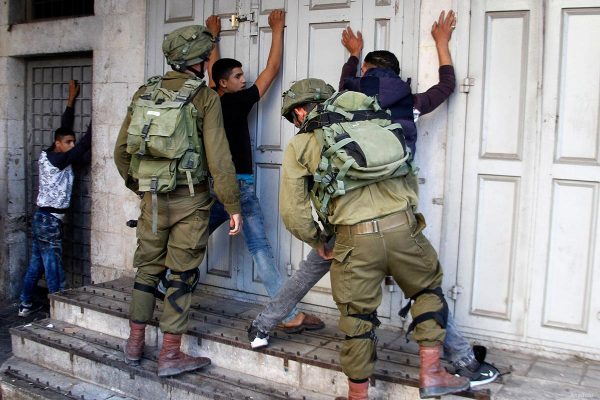
The Palestinian Authority (PA) said yesterday that Israel’s storming of Ramallah is an attempt to coerce it into accepting the “Deal of the Century”.
PA spokesman Yousef Al-Mahmoud said that “no power on the face of the earth can push the Palestinian people and their leadership to kneel down,” Safa news agency reported. Al-Mahmoud added: “The repeated invasions of Palestinian cities are attempts to undermine Palestinian sovereignty,” pointing to Israeli Prime Minister Benjamin Netanyahu’s warnings that it could “ignite wars”.
Al-Mahmoud continued: “Our people, with our leadership, announced a continuous confrontation with anything aiming to undermine our cause and against all the conspiracies aiming to undermine our efforts to achieve our freedom, independence and dream of a sovereign Palestinian state.”
The spokesman also blamed Israel for regional deterioration, pointing to its “continuous aggression, invasions and hunting of Palestinian people,” and the fact that it “unleashes the hands of the terrorist settlers to practice their terror under its official protection”.
The Israeli army has been invading the central West Bank city of Ramallah – the headquarters of the PA, the Palestine Liberation Organisation (PLO) and Fatah’s leadership. Israeli forces have carried out operations close to the residence of PA President Mahmoud Abbas, in the light of a complete absence of the PA security services or the president’s guards.
WATCH: Israeli occupation forces raid West Bank city of Ramallah
House passes bill to force Trump to nominate “anti-semitism” head who would monitor criticism of Israel
By Alison Weir | If Americans Knew | January 12, 2019
The U.S. House of Representatives voted 411-1 for a bill that would force President Trump to nominate an anti-Semitism envoy, a position that has been vacant since he took office. The definition of anti-Semitism the position uses includes certain criticisms of Israel.
The bipartisan bill upgrades the current position of Anti-Semitism Envoy to an ambassador rank, which requires the job to be filled within 90 days.
The law states that the Special Envoy shall “serve as the primary advisor to, and coordinate efforts across, the U.S. government relating to monitoring and combating anti-Semitism and anti-Semitic incitement in foreign countries.”
The bill, H.R.221- Special Envoy to Monitor and Combat Anti-Semitism Act, was sponsored by Rep. Christopher H. Smith [R-NJ-4] and has 87 co-sponsors. Smith’s largest campaign donor was NorPAC, a pro-Israel political action committee.
To become law the bill must next be passed by the Senate and then be signed by the president. If Trump vetoes it, Congress can override this through a two-thirds vote.
The position of anti-Semitism envoy was created in 2004 over the objections of the State Department, which said it wasn’t needed. It was urged by Israeli Minister for Diaspora Affairs Natan Sharansky, who had formulated a new definition of anti-Semitism that includes criticism of Israel.
Previous envoys before or after serving serving in the position worked for the Israel lobbying organization AIPAC, the American Israel Public Affairs Committee.
The second envoy, Hannah Rosenthal, adopted the Sharansky definition of anti-Semitism for use by the State Department. This is part of an international campaign to insert the new Israel-centric definition in governments and other bodies around the world.
The Times of Israel reports that the impetus for the current bill was “Trump’s failure to pick someone for that opening over the last two years, despite frequent calls from Jewish groups.”
The lawmaker who voted against the bill was Republican Justin Amash from Michigan, a civil libertarian who is Chairman of the House Liberty Caucus.
The Anti-Defamation League (ADL), one of whose missions is to advocate for Israel, has been heavily promoting the legislation, which was first introduced last year. The ADL, which includes certain criticisms of Israel as “anti-Semitic,” has issued reports that there has been a “rise in anti-Semitism.”
Some have disputed the ADL numbers, since the ADL does not make public the incident reports on which it bases its claims, since some include actions or statements regarding Israel rather than bigotry, and since the widely publicized bomb threats against Jewish institutions turned out to be the work of a Jewish Israeli. Similarly, some reportedly “anti-Semitic” cemetery damage turned out to have been caused by neglect.
The new Congress has been quick to take up legislation promoted by the Israel lobby. The first Senate bill of 2019 is a composite bill that would give Israel billions of dollars and “combat” the campaign to boycott Israel over its human rights violations among its measures.
The anti-Semitism envoy legislation had been passed in the House in 2018 but did not come to a vote in the Senate. The Senate bill was introduced by Republican Marco Rubio (FL) with eight co-sponsors, seven of them Democrats, including Elizabeth Warren (MA), Kirsten Gillibrand (NY) and Ron Wyden (OR).
The Times of Israel reports that ADL head Jonathan Greenblatt called on the Senate to “take up this bill in a timely manner.”
It is unclear when the bill will be re-introduced in the Senate. The current Israel bill S.1 has been blocked by Democrats over their battle with Trump and the government shutdown. The effort to bring that bill to a vote will resume on Monday.
The House anti-semitism envoy bill was expedited and voted on with little advance notice under a suspension of the rules procedure. The Senate could take a similar course of action.
Additional legislation regarding anti-Semitism may also be re-introduced at some point.
The Senate passed the Anti-Semitism Awareness Act unanimously in 2016, and it was reintroduced in both the Senate and the House last year.
The Israeli newspaper Ha’aretz reports: “The Act – pushed by AIPAC, the Anti-Defamation League and the Jewish Federations of America – instructs the Department of Education’s Civil Rights office to follow ‘the definition of anti-Semitism set forth by the Special Envoy to Monitor and Combat anti-Semitism of the Department of State in the Fact Sheet issued on June 8, 2010.’”
The bill has been held up over objections that it interferes with academic freedom and Americans’ constitutionally guaranteed right to free speech.
Click here to see video.
Alison Weir is executive director of If Americans Knew, president of the Council for the National Interest, and author of Against Our Better Judgment: The Hidden History of How the U.S. Was Used to Create Israel.
Eisenhower’s Starvation Order
A holocaust was what the Americans did to the Germans
By James Bacque
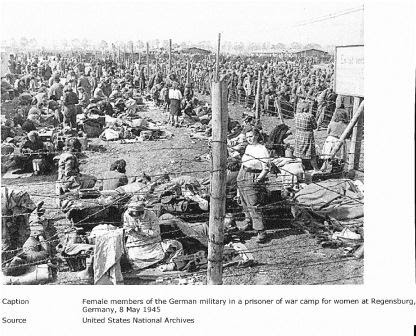
Never had so many people been put in prison. The size of the Allied captures was unprecedented in all history. The Soviets took prisoner some 3.5 million Europeans, the Americans about 6.1 million, the British about 2.4 million, the Canadians about 300,000, the French around 200,000. Uncounted millions of Japanese entered American captivity in 1945, plus about 640,000 entering Soviet captivity.
As soon as Germany surrendered on 8 May 1945, the American Military Governor, General Eisenhower, sent out an “urgent courier” throughout the huge area that he commanded, making it a crime punishable by death for German civilians to feed prisoners. It was even a death-penalty crime to gather food together in one place to take it to prisoners … The order was sent in German to the provincial governments, ordering them to distribute it immediately to local governments. Copies of the orders were discovered recently in several villages near the Rhine … The message [which Bacque reproduces] reads in part: “… under no circumstances may food supplies be assembled among the local inhabitants in order to deliver them to the prisoners of war. Those who violate this command and nevertheless try to circumvent this blockade to allow something to come to the prisoners place themselves in danger of being shot….”
Eisenhower’s order was also posted in English, German and Polish on the bulletin board of Military Government Headquarters in Bavaria, signed by the Chief of Staff of the Military Governor of Bavaria. Later it was posted in Polish in Straubing and Regensburg, where there were many Polish guard companies at nearby camps. One US Army officer who read the posted order in May 1945 has written that it was “the intention of Army command regarding the German POW camps in the US Zone from May 1945 through the end of 1947 to exterminate as many POWs as the traffic would bear without international scrutiny.”
… The [American] army’s policy was to starve [German] prisoners, according to several American soldiers who were there. Martin Brech, retired professor of philosophy at Mercy college in New York, who was a guard at Andernach in 1945, has said that he was told by an officer that “it is our policy that these men not be fed.” The 50,000 to 60,000 men in Andernach were starving, living with no shelter in holes in the ground, trying to nourish themselves on grass. When Brech smuggled bread to them through the wire, he was ordered to stop by an officer. Later, Brech sneaked more food to them, was caught, and told by the same officer, “If you do that again, you’ll be shot.” Brech saw bodies go out of the camp “by the truckload” but he was never told how many there were, where they were buried, or how.
… The prisoner Paul Schmitt was shot in the American camp at Bretzenheim after coming close to the wire to see his wife and young son who were bringing him a basket of food. The French followed suit: Agnes Spira was shot by French guards at Dietersheim in July 1945 for taking food to prisoners. The memorial to her in nearby Buedesheim, written by one of her chidren, reads: “On the 31st of July 1945, my mother was suddenly and unexpectedly torn from me because of her good deed toward the imprisoned soldiers.” The entry in the Catholic church register says simply: “A tragic demise, shot in Dietersheim on 31.07.1945. Buried on 03.08.1945.” Martin Brech watched in amazement as one officer at Andernach stood on a hillside firing shots towards German women running away from him in the valley below.
The prisoner Hans Scharf … was watching as a German woman with her two children came towards an American guard in the camp at Bad Kreuznach, carrying a wine bottle. She asked the guard to give the bottle to her husband, who was just inside the wire. The guard upended the bottle into his own mouth, and when it was empty, threw it on the ground and killed the prisoner with five shots.
…. Many prisoners and German civilians saw the American guards burn the food brought by civilian women. One former prisoner described it recently: “At first, the women from the nearby town brought food into the camp. The American soldiers took everything away from the women, threw it in a heap and poured gasoline [benzine] over it and burned it.” Eisenhower himself ordered that the food be destroyed, according to the writer Karl Vogel, who was the German camp commander appointed by the Americans in Camp 8 at Garmisch-Partenkirchen. Although the prisoners were getting only 800 calories per day, the Americans were destroying food outside the camp gate.
James Bacque, Crimes and Mercies: The Fate of German Civilians Under Allied Occupation, 1944-1950, pp. 41-45, 94-95.
India baits US while Pakistan tells Trump, ‘There’s nothing like free lunch’
By M. K. BHADRAKUMAR | Indian Punchline | January 12, 2019
Breaking a prolonged period of several months, the Pakistani allegation of Indian involvement in terrorist attacks has surged. This appears during the first detailed media briefing by the Pakistani authorities in Karachi on January 13 on the results of the investigation over the terrorist strike on the Chinese consulate in the city last November.
Pakistan has blamed the Balochistan Liberation Army for staging the terrorist attack. Graphic details have been given claiming that the attack was “planned in Afghanistan” from where the Balochi terrorists travelled to Karachi.
India’s alleged role has been described variously in the Pakistani press as rendering “assistance” to the terrorists and “funding” them. One report mentions that the attack was “carried out with the assistance of Indian intelligence agency.” Indeed, immediately after the attack on November, a Pakistani security official had suggested that India “orchestrated” it. An AP report at that time had mentioned that Pakistan was investigating whether the Baluch separatist commander Aslam Achhu, who masterminded the attack, was in India.
The Pakistani assessment is that the Karachi attack was well planned over months and intended to cause rift in the China-Pakistan ties as well as to undermine the China-Pakistan Economic Corridor (CPEC) by highlighting the volatility of the city. It stands to reason that Pakistan would have shared with the Chinese any details in this regard.
The salience that must be noted here is that Pakistan has not finger-pointed at Kabul authorities directly or implicitly. In the past, the Pakistani allegation used to be that Indian and Afghan agencies collaborated in such enterprises.
Some other things stand out as well. The timing of the Pakistani disclosure is significant. First and foremost, it comes amidst signs of US-Taliban talks intensifying. A fourth round was expected to take place on Wednesday, but was called off by the Taliban on grounds of “agenda disagreement” with the Americans, in a clear snub to the US special representative Zalmay Khalilzad. Elsewhere, Taliban spokesman also told Reuters, “We (Taliban) have the feeling that Zalmay Khalilzad doesn’t have enough power to make important decisions.” Evidently, there is a fly in the ointment.
Interestingly, a former Pakistani diplomat Zamir Akram, who is an old India hand, wrote yesterday counseling that Pakistan should not harbor “unrealistic expectations” out of the Trump administration, as there may not be a “real change in policy towards Pakistan.” To quote Akram, “Washington continues to view relations with Islamabad through the prism of Afghanistan and not on the basis of relations with Pakistan in and of itself.”
He added, “Our Prime Minister should also resist the temptation, which his predecessors did not, of accepting a meeting with the American President as a “reward” in itself — a meeting devoid of any substantive outcome for Pakistan. This has been a usual American tactic mainly reserved for light-weight leaders who can be fobbed off with an Oval office photo-opportunity. Any meeting with Trump must lead to concrete results otherwise it would not be worth the effort.”
Amongst other things, Akram voiced disquiet that Washington is disrupting the India-Pakistan strategic parity in favor of India, and that “Pakistan’s relations with China and CPEC in particular are emerging as contentious issues in Pakistan-US relations.” He said that in an environment of “a convergence in US-India relations but a growing divergence in the Islamabad-Washington equation,” Pakistan must diversify its foreign relations, and in particular, it “must further strengthen strategic partnership with China for which successful implementation of CPEC, despite American and Indian opposition, must be ensured.”
Zamir concluded by underscoring that a political settlement in Afghanistan should provide for an outcome that served Pakistan’s interests “in terms of ending Indian use of Afghan territory to promote terrorism in Pakistan, recognition of Pakistan’s security interests in Afghanistan, return of Afghan refugees and removal of US sanctions. We have the leverage to attain this, given the American reliance on Pakistan, not just for the dialogue with the Taliban but also due to the air and ground access we provide to the US for its presence in Afghanistan.” (Express Tribune )
Plainly put, strategic (nuclear) parity in South Asia, restrictions on Indian activities in Afghanistan, Pakistan’s security interests in Afghanistan, return of Afghan refugees and removal of US sanctions on Pakistan – they are still on the table. If Trump’s game plan is to swing a settlement riveted on Pakistani acquiescence with a reduced US military presence in Afghanistan (enabling him also to flaunt “troop withdrawal” by election year 2020) by pandering to PM Imran Khan’s vanities, it may not work.
Given India’s hardline policies toward Pakistan, it is improbable that Islamabad will compromise on its agenda to purge the Indian presence in Afghanistan. Therefore, the media disclosure on the terrorist attack in Karachi at this juncture must be taken as a signal to Washington as much as to Delhi. Most certainly, it coincides with the US Special Representative Zalmay Khalilzad’s visit to Delhi, where he enjoys a fabulous reputation for being an inveterate anti-Pakistani Afghan-American.
Unsurprisingly, chaffing under the Taliban’s snub, Khalilzad was assured of a warm reception in Delhi. The press reports based on briefings suggest that Indian officials tore into Pakistan warning the Trump administration about Islamabad’s machinations. Clearly, Delhi sized up that it has in Khalilzad a most receptive audience.
Alongside, there has also been a sudden burst of enthusiasm to inject some verve into the US-Indian ties, which have been languishing during recent years. It is entirely conceivable that India may place some orders for weaponry from American vendors, which would of course please Trump immensely.
To be sure, Trump’s travails in withdrawing US troops from Syria may turn out to be a picnic in comparison with what is in store in Afghanistan.
Tehran calls on Paris to ‘stop repeating irresponsible claims’ on Iran’s missile program
Press TV – January 12, 2019
Iranian Foreign Ministry Spokesman Bahram Qassemi has criticized the French Foreign Ministry’s provocative comments about Iran’s ballistic missile program, urging Paris to avoid repeating such “irresponsible and incorrect” claims regarding the Islamic Republic’s defensive programs.
“It is expected from France to stop echoing incorrect claims made by those who are against the JCPOA,” the senior diplomat further said, referring to Iran’s nuclear deal with world power in 2015, officially known as the Joint Comprehensive Plan of Action, and in a clear reference to the United States that unilaterally withdrew from the landmark accord last year.
The Iranian diplomat made the remarks on Friday, hours after French Foreign Ministry Spokeswoman Agnes von der Muhll called on Tehran to “immediately cease all ballistic missile-related activities designed to carry nuclear weapons, including tests using ballistic missile technology.”
“Contrary to the French Foreign Ministry spokeswoman’s claim, Iran’s missile program has neither been established for non-conventional purposes, nor the country’s natural right to strengthen its scientific and defensive capabilities as developed in the form of missile program is in violation of [UN Security Council] Resolution 2231,” said Qassemi.
The statement from the French ministry came just a day after Iranian President Hassan Rouhani said that Iran’s domestically-manufactured rockets would carry two new satellites into orbit in the coming weeks.
Earlier this month, US Secretary of State Mike Pompeo claimed that Iran’s planned launch of space rockets and missiles breaches Resolution 2231 that endorsed the JCPOA.
Iran’s Foreign Minister Mohammad Javad Zarif dismissed Pompeo’s claim, saying Washington has already violated that resolution and thus cannot “lecture” Tehran on it.
“We strongly believe that any attempt to induce and impose a wrong interpretation of Resolution 2231 regarding Iran’s missile program is an irresponsible act,” Qassemi further said, stressing that in any part of the resolution the Islamic Republic has not been prevented from developing defensive and conventional missile program and those with scientific application.
He also reiterated that Iran’s home-grown missile program is defensive, national and conventional, adding that it is not only legitimate but also “the Iranian nation’s natural right.”
Since its JCPOA exit in May, the administration of US President Donald Trump has unleashed its “toughest ever” sanctions against Iran. It has also warned of severe penalties for companies that evade the bans and engage in business dealings with the Islamic Republic.
Who or What Brought Down Dag Hammarskjöld?
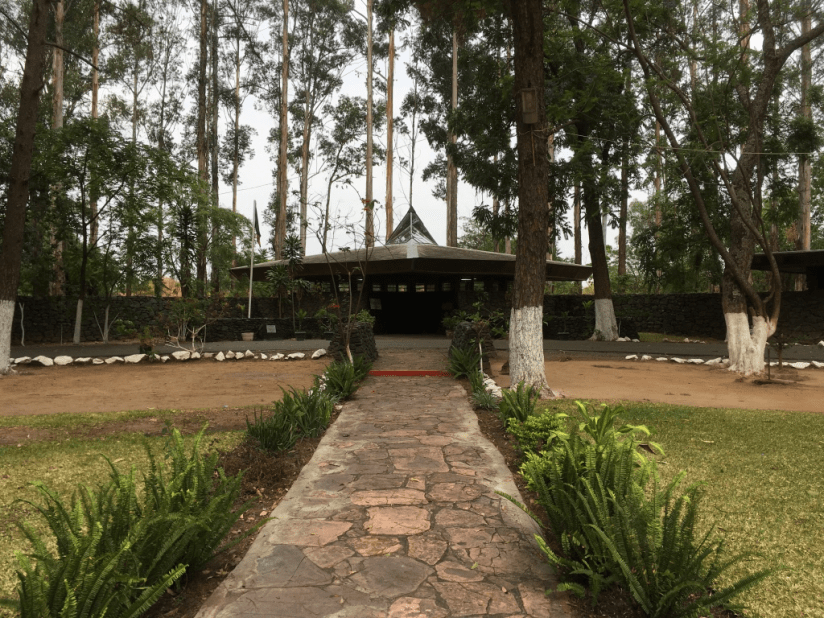
Ndola, Zambia, showing the roof of the memorial museum and Dag Hammarskjöld’s DC-6 as it would have appeared coming through the trees onto the crash site.
By Joseph Majerle III – Matthew Stevenson | CounterPunch | January 11, 2019
Background to the Crash
A plane carrying the Secretary General of the United Nations, Dag Hammarskjöld, crashed while approaching the Ndola (Zambia) airport on September 18, 1961. The exact time of the crash is unknown, although it was around midnight. The DC-6, named Albertina, had flown a circuitous route from Kinshasa, the capital of the Congo, to Ndola, a large town in what was then Northern Rhodesia. The purpose of the flight was to bring Secretary Hammarskjöld to a meeting with Moise Tshombe, the president of the breakaway republic of Katanga, in which many western (British, French, Belgian and American) investors had large stakes in various mineral deposits.
Those corporate interests had supported independence for Katanga after the Congolese leadership, notably Prime Minister Patrice Lumumba, had advocated closer relations with the Communist bloc. (Lumumba, himself, was assassinated in January 1961, in what some researchers now believe was part of a Central Intelligence Agency plot to get rid of him.)
For his part, Hammarskjöld believed that the Congo ought to remain one country, and toward that end he was flying to Ndola (just over the border of Northern Rhodesia from Katanga) to have ceasefire talks with Tshombe, in the hope of mediating a settlement to the conflict. Instead, his plane crashed in the darkness, killing fifteen of the sixteen passengers and crew aboard the DC-6. One security officer for Hammarskjöld survived for about eight days.
Since the fatal crash, various investigative instruments, including UN committees and independent aviation groups in the United Kingdom and Sweden, have looked into the cause of the crash. The initial investigation, conducted by colonial authorities in 1961, concluded that the pilots of the DC-6 (an experienced Swedish crew) had misjudged the night landing on an unfamiliar approach and flew the plane into the ground. A UN inquiry at the same time, however, failed to reach the same conclusion, although it was at a loss to explain the crash.
More recent inquiries, including one chaired by Stephen Sedley and with Hans Corell and Richard Goldstone as co-panellists, have come to more nuanced conclusions, saying that earlier investigators lacked a true picture of the situation on the ground and in the air around Ndola that night to come to definitive conclusion about what happened to the Albertina. It has led to new inquiry, originally supported by then Secretary General Ban Ki-Moon and approved by the UN Security Council, to reopen the investigation under the direction of the former chief justice of Tanzania, Mohamed Chande Othman, although for the moment the budget approved for such an exercise is little more than $300,000 (and the information needed is literally all over the world).
All of the recent re-examinations of the crash have concluded that the first conclusions of pilot error might well be in inaccurate. For example, the 2013 UN Hammarskjöld Commission, for example, concluded: “There is persuasive evidence that the aircraft was subjected to some form of attack or threat as it circled to land at Ndola, which was by then widely known to be its destination.” The 2017 report of Judge Othman concludes:
Based on the totality of the information that we have at hand, it appears plausible that an external attack or threat may have been a cause of the crash, whether by way of a direct attack causing SE-BDY to crash or by causing a momentary distraction of the pilots. Such a distraction need only have taken away the pilots’ attention for a matter of seconds at the critical point at which they were in their descent to have been potentially fatal. There is a significant amount of evidence from eyewitnesses that they observed more than one aircraft in the air, that the other aircraft may have been a jet, that SE-BDY was on fire before it crashed, and/or that SE-BDY was fired upon or otherwise actively engaged by another aircraft. In its totality, this evidence is not easily dismissed.
Both reports cite evidence that British, American, French, South African, or Belgian governments might hold but which remain unreleased, and they urge its release for the purpose of understanding exactly what happened to Hammarskjöld’s plane.
On November 8, 2018, when Judge Othman last updated the UN on the progress of his investigation, he concluded (with some frustration): “… the fact that certain Member States have not responded to repeated requests in 2018… or to engage with this process at all, has a crucial bearing on the success or failure on the full implementation of the above General Assembly resolution.”
It is where this case has gone—from the crash zone outside Ndola to the files of the great powers—but many countries, notably the United States and South Africa, have refused to cooperate or done so grudgingly.
* * *
In addition to the various international investigations of the crash, a professor at the University of London’s Institute of Commonwealth Studies, Dr. Susan Williams, has published a book about what could have happened to Hammarskjöld’s plane. The title of the book is Who Killed Hammarskjöld? The UN, the Cold War and White Supremacy in Africa, and it was originally published in 2011, laying the ground for the later UN inquiries.
In the book Dr. Williams lays out the facts of the plane crash and outlines various theories—including pilot error of the kind imagined after the plane went down—that could explain the crash. She also talks about the possibility that French or Belgian mercenaries had access that night to trainer Fouga Magister jets or other attack aircraft, and that one or several of those planes might have shot at SE-BDY or tried to force the Albertinato the ground (perhaps by shining spot lights into the cockpit or by dropping flash bombs). She examines the case for pilot error, noting that the pilots had flown a long way across the world, beginning on September 12, 1961, when they picked up the Secretary General in New York City). She discusses the possibility that the pilots mis-programmed the altimeter on the DC-6 or that someone placed a bomb on the doomed flight.
Dr. Williams also examines theories that have speculated on possible CIA interference with the Hammarskjöld mission, making the point that the anti-communist CIA had strong vested interests in wanting his African diplomacy to fail. Dr. Williams ends her book strongly hinting that her belief is that western mercenaries were more likely than pilot error to have brought down the Hammarskjöld plane, and she outlines many incongruent aspects of the fatal night in Ndola, such as the closure of the local airport (even though it was expecting the Hammarskjöld plane) and the local witnesses on the ground spoke about hearing or seeing a large flash and bang before the “big plane” came down.
The Williams book is not a polemic for any one theory about the Hammarskjöld plane crash. Instead, as a serious academic, she prefers to indicate the range of possible fates for the flight and to leave it to the reader to come to his or her own conclusions.
* * *
In my case, after reading the Williams book in 2017, I decided to visit the Hammarskjöld crash site outside Ndola and to compare what I would see and hear there on the ground with the words in the book. I had been planning for some time to visit Africa and to write about it, but having the Williams book in hand gave my visit to Zambia a direction and purpose, even though I am not an air-crash investigator or even a licensed pilot. Still, I decided it would be easier to read the many Hammarskjöld reports if I could visualize how far from the airport the plane had crashed and what local residents were saying on the ground about the plane.
Given the vagaries of African travel, I was not able to spend as much time on the ground in Ndola as I had planned. My train, from Dar es Salaam to the Zambian city of Kapiri Mposhi, was three days late, and I had other appointments in southern Africa, which made it hard to spend more than a day in Ndola. Nevertheless, I did get to the crash site, and there I met with some local investigators and museum officials, all of whom had their own ideas about what might have happened to the Albertina. (Most dismiss out of hand that pilot error was the cause.)
In particular, I learned that one local researcher had spoken with more than twenty eyewitnesses to the crash. Many of them were convinced that several smaller planes had swarmed around the larger DC-6 on its landing approach and that, prior to the crash, many people living in the bush near the crash site saw large flashes of light, consistent with the dropping of a bomb or bombs onto the Albertina. But because these witnesses were African natives of the area, their testimony was largely ignored by colonial authorities in Northern Rhodesia when in fall 1961 the first inquiry was held.
For my part, I came away from the crash site unable to believe that Hammarskjöld’s experienced Swedish crew had simply flown the Albertina into the ground. Maybe if the landscape of the crash site had been mountainous or even hilly, I could have imagined a sophisticated group of pilots—at night in Africa—making some fundamental errors of navigation. But two things made me think otherwise. First, the terrain around the crash site, while not a completely flat plain, is devoid of any serious hills. All I saw as I drove up to the crash site in a taxi and as I walked around the memorial were open fields and small clusters of forest land, none of which were very dense. The Albertina did not crash into the jungle or a mountain; it came down in the outskirts of Ndola where now there is open farmland that is part of a broad African plain.
Second, I doubted that the Swedish pilots misread the altitude of the plane, especially on a clear night. These were professional pilots, and that’s a rookie mistake. Nevertheless, early investigators in Northern Rhodesia concluded that the Albertina was the victim of what in the airline world is called Controlled Flight Into Terrain (CFIT). But standing at the somber Ndola memorial to the lost flight, I came to the conclusion that something other than pilot error had driven the plane into the ground on that fateful evening. To me it felt like an ambush.
I also concluded, while poking around the memorial in Ndola, that my brother-in-law, Joseph Majerle III, is the one person I know who could make sense of the technical details in the Williams book and in some of the many Hammarskjöld reports. Joe, as I call him, works in aviation in Alaska, and in his long career he has visited many crash sites and repaired many damaged planes. He is also a voracious reader of history, especially about aviation matters. Joe has also spent much of his adult life talking with other pilots about various aircraft and their deficiencies. If anyone could help me sort out the complexities of the Ndola crash, it would be Joe, and shortly after I got back from Africa, I mailed him a copy of the Williams book.
Joe read the book twice, took ample notes, discussed his thinking with other pilots in Alaska (some of whom are still flying on the DC-6), and answered my questions in several long emails, which I have copied here but which I also have edited (although only for the sake of clarity).
What follows might best be understood as a colloquy on the Williams book between two people who are struggling to make sense of a crash that happened more than fifty years ago.
* * *
Why does the Hammarskjöld crash still matter? It matters because Secretary General Hammarskjöld had undertaken his mission just as many countries in Africa were seeking their independence from the colonial world. Hammarskjöld was ahead of his time in pushing back against what today we might call the deep state—that confluence of interests between corporate investors, intelligence agencies, and governmental power brokers, all of whom were eager to siphon profits out of the breakaway territory of Katanga. Hammarskjöld thought that Katanga (and its extensive mineral wealth) belonged in the newly independent Republic of the Congo, and the purpose of his mission was to oppose independence for Katanga, which otherwise would fall under the spell of various French, British, Belgian and American multinational corporations.
If you believe—as I do—that Hammarskjöld was the victim of a plot, it can be concluded that the truth about his death has been covered up to shift the blame away from the usual suspects, including the CIA and various mercenary organizations that were then arming themselves across southern Africa. Hammarskjöld and his liberal internationalism were getting in the way of corporate profits, if not Cold War politics, and it was decided—somewhere, somehow—to cut him down to size. Maybe the plotters did not intend to kill him? Maybe they simply wanted to scare him away? But the facts about the Hammarskjöld crash have never been fully available, in part because invaluable transcripts (picked up in particular by US government eavesdropping on that night) have never been released.
What follows are the questions that I posed to Joe, and his responses, based on his reading of the Williams book and his lifetime as a pilot and in aviation. Neither of us pretends that what follows is anything approaching a “last word” in the Hammarskjöld investigation. At the same time it shows how much several concerned citizens, and a budget of $1500 (the cost of my African train travels), can discover. Let’s hope that the new UN investigation can take the Hammarskjöld matter much further. The Secretary’s exemplary life and work demand that the truth of his death be known. — Matthew Stevenson
* * *
Stevenson: Is it possible that pilot error was responsible for the crash of the Albertina?
Majerle: The facts that investigators admitted to in their original reports tell a different story from their conclusions. To me, their conclusions are laughable. This crash was not pilot error.
Per the chart at the beginning of the Williams book, it shows the crash site very close to the turn-back circle (on a safe instrument approach) of the official instrument approach path, which means that the Swedish pilots knew exactly where they were. I don’t think any accident investigation board in the world would dispute that that they were properly executing the published instrument approach procedure for Ndola airport.
The official report admitted that they were at least nominally executing the instrument approach properly, except that they were 1700 feet lower than they were supposed to be, and that was the pilots’ error.
On page 70, according to A. Campbell Martin, the controller on duty, the last communication received from SE-BDY (the code for the Albertina) was confirmation of 1021 millibars—the altimeter setting—which is something I and every pilot I have ever flown with has never failed to reset at the instant we are told the new number.
To me it is inconceivable that the Albertina pilots didn’t know their altitude at that time. If the controller had said he never got around to telling them the current millibars setting, they would have had a basis to sow doubt on that subject, even though that would have been a flimsy excuse in itself, for the following reason.
Explain to me how it is unlikely that the Albertina pilots flew the plane into the ground.
The radio (radar) altimeter came into widespread use in military and commercial airplanes by the end of WW2, even in single-seat fighters such as the P-38. I would bet that, without exception, every DC-6 was equipped with one when it left the factory. And it is the device you base your instrument approach on, if you have one, because a radio altimeter is more accurate and has large graduations up to 1000 feet AGL (Above Ground Level).
Even if the Albertina pilots didn’t have a current altimeter setting, they would have been using their radar altimeter anyway, assuming it was in working order. If not, I think it’s very likely the pilot would have informed the controller of that fact. Which, again, points to the fact that they knew exactly where they were, in all three dimensions.
In the book Dr. Williams writes that an evasive strategy to “lose height, veer and head for the airfield as quickly as possible… may possibly offer some explanation for the low height of SE-BDY as it made its approach to Ndola—about 1700 feet lower than it should have been.”
This conclusion is at the heart of her book and research, and any new investigation needs to focus on what she has written here.
To me it indicates that the Albertina pilots were already planning to evade an attack by getting low enough to prevent another airplane from getting beneath SE-BDY, which to an attacker is the easiest and most preferred way to shoot down another airplane—and there would have been no better way to do that at night than basing it on a radar altimeter.
Explain some of the discrepancies between the official crash report, and the data that Dr. Williams includes in her book, especially in regard to the crash site.
The official report stated that the ground scar at the wreck site was 150 yards long, which is 450 feet. The published stall speed of the DC-6 with flaps down is 92 mph, which is almost exactly 135 feet per second. That is the absolute slowest speed at which it would stay in the air—not the speed at which you would make an approach.
The original Jeppesen approach plate chart for the Ndola airport would have contained a sidebar that would have given the time, in seconds, required to reach the airport at several different approach speeds, usually spaced by 30 mph and 60 mph increments, which simplifies the mental calculations the pilot would need to make or eliminates them if it’s practical for the aircraft to fly at one of the stated speeds exactly.
I would estimate that, in this situation, for a light-to-moderately loaded DC-6, the pilots would have used either 150 or more probably 180 mph, which would be 220 or 264 feet per second of forward velocity.
If, as the official report says, the pilots misjudged their altitude and just flew the plane into the ground while making their final approach, it is beyond a stretch of the imagination that 80-to-90 thousand pounds of airplane would come to a stop in no more than 2.04 seconds, and that every last piece of it would be contained in a mere 450 feet.
This is just very basic math that a 4th-grader could do nine out of ten times and get right. It is an insult to human intelligence to suggest that that’s what happened.
Have you ever examined the crash site of a DC-6 airliner?
Many years ago I had opportunity several times to walk over the crash site of a DC-7 [very similar to the DC-6] that crashed shortly after takeoff due to an out-of-control engine fire in which the pilots tried to crash-land into a recently logged parcel of land.
The fuel dealer told me that he watched as an engine caught fire almost as soon as the plane started its takeoff run, but apparently the pilots didn’t realize it until they were committed to fly. But after clearing the end of the runway, they immediately angled off and headed for the clear-cut area, obviously in an effort to get the plane back on the ground.
It had been nine years since it happened when I first saw the site, and in that rain forest the vegetation had regenerated quite a bit, but the wreckage path of the DC-7 was still obvious. The crew had left the gear and flaps down in takeoff configuration, obviously intending to put it down at as slow a speed as possible in this off-airport area.
My recollection of the debris path was that it was at least 1200 feet long, with no standing trees throughout the path. The largest piece of wreckage at the end of the path was stopped and literally wrapped around what was at least a 6 foot diameter tree, in the flight engineers compartment. Control cables and wiring bundles were literally wrapped all the way around that tree. I would guess that the site is still that way today.
There are some fairly close parallels between that crash and Hammarskjöld’s. The DC-6B and DC-7 are very similar airplanes; sharing the same basic wing and fuselage with the DC-7 employing another short section of fuselage, more powerful engines and a higher gross weight due to the extra power, and with a higher cruise speed also because of the power. But they are both listed on the same type rating for pilots. Sitting side by side, you would have to study them carefully to see the differences.
In these two cases, both planes made it to the ground before impacting any real solid objects; in Hammarskjöld’s case it was the anthill and in the Yakutat crash it was tree stumps. In both cases, the immovable objects turned the airplanes sideways while they still had a lot of momentum, which began the breakup process while the kinetic energy just kept them going.
If they had been able to continue moving straight ahead they might have had a chance, more so for the passengers aft of the cockpit bulkhead. There isn’t a lot of metal in the nose ahead of the pilots compartment to crush and absorb energy.
The DC-7 was known to be overloaded with fresh salmon but would have been light on fuel. Hammarskjöld’s plane would have had a lighter cabin load but would have had considerably more fuel. I would assume that the DC-7 was somewhat heavier overall, but probably not by an amount that would have required a significant speed difference to stay airborne.
What I am getting at here is that in both these cases the airplanes probably hit the ground at roughly equivalent speeds. And the DC-7’s ground scar was about three times as long as Hammarskjöld’s, and still had some energy when it wrapped itself around a tree.
If Hammarskjöld’s pilots had inadvertently flown the aircraft into the ground, I think it is reasonable to assume that it would have traveled much farther before all the pieces came to rest.
This did not happen, which to me indicates that the physics of the official reports are all wrong—at least when matched to their conclusions.
What can we conclude from the configuration of the Hammarskjöld plane as it hit the ground?
The official report stated that the landing gear was down and locked, and the wing flaps were extended to the 30 degree position. I would have loved to cross examine the local accident board and ask them which pilots they know that would be 8-to-9 miles out on an instrument approach and have 30 degrees of flaps down at that point, to say nothing of having the gear down.
Thirty degrees of flap down on a DC-6 is a lot of flap; probably about optimal for a low speed approach over obstacle-free terrain to make a short-field landing. Maximum flap down angle on a DC-6 is 50 degrees, which you would normally only use to bleed off a lot of excess altitude, and it would require a lot of engine power with which to maintain altitude.
In my experience no pilot would drop the landing gear until about the point that you had crossed the “final approach fix,” in this case the non-directional (radio) beacon, which is at four miles or so from the end of the runway.
At four miles out the pilots would have had plenty of time to drop the gear and double check it before reaching the runway end roughly 90 seconds later. Experienced crews normally do that as late as they can just to get there sooner. This accident board didn’t even know how to lie to make the facts fit their case.
Recently I had opportunity to talk to a friend of mine that flew DC-6s about thirty years ago. He currently owns and flies two DC-4’s, a freighter and a fuel tanker, around the state.
He confirmed to me—as I thought earlier—that a DC-6 pilot would have flown that instrument approach at 156 to 160 knots (180 to 184 miles per hour) and would absolutely not have had gear and flaps down 8 or 9 miles from the runway.
And if he found his wing on fire, unless on short final to a runway, his only thought would be to get it on the ground.
What do you think happened?
To me, all of the admitted evidence (in UN reports and in the Williams book) adds up to one thing. The crew made a desperate attempt to save their lives by getting the airplane on the ground, most probably because they knew they had a wing fuel tank on fire.
A gasoline fire at night, to my experience, is very bright and from the cockpit side windows of a DC-6 you can see to the inboard nacelle without straining your neck. If it was a wing fire, the pilots would have known it. It would have taken all of their strength not to panic and just continue to do what needed to be done.
And here I take issue with one of the advisers to Dr. Williams—a Mr. Kjell Peterzén—who is quoted in the book as saying: “There is no way he would have gone down into the darkness and the woods…” I can name six incidents here in Alaska since 1977 in which pilots have descended into the woods, or whatever was below including a mountain ridge, to deliberately crash burning airplanes in an attempt to save their own lives.
In one of these cases—coincidentally it was a DC-6—the pilot hesitated because he didn’t want to have to do that, even though the cockpit voice recorder picked up other crew members urging him to get the airplane “on the ground, NOW!” But he didn’t. The wing folded up and moments later they all crashed to their deaths.
In all of the other cases the pilots understood how few seconds they had to live if they didn’t “put it on the ground.” Remarkably, most of the crews survived, although some had bad injuries.
I would say—at least from my corner of the world—that pilots will attempt a crash into the unknown if they understand how quickly an airplane made from aluminum can disintegrate in a raging fire.
Aluminum, of the kind used in the making of the Hammarskjöld DC-6,yields at 925 degrees Fahrenheit and liquifies at 1225 degrees Fahrenheit. When the fire gets much above the 1225 degrees Fahrenheit point, the metal itself actually ignites and burns up, which is why there is normally so few pounds of airplane left after one has burned uncontrollably.
Pilots know this, and will respond instinctively when they see, for example, one of their wings on fire.
What’s your reaction to the conclusion that the Albertina was simply flown into the ground, so-called Controlled Flight Into Terrain (CFIT)?
As for all of the talk about pilot error and CFIT, I still cannot believe that no-one ever mentions the fact that they had gear and flaps down when they were still at least three minutes from the runway, which you just wouldn’t do, unless you’re planning to land “very soon.”
I thought it curious when I read in the Williams book: “It was as if the aircraft was making a perfect landing…” That conclusion is a very astute observation. That doesn’t happen in CFIT situations.
In my experience, CFIT planes start breaking little things and leaving little pieces over a long area before you start seeing the larger pieces and more ground disturbance. If you see something that looks like a landing attempt was being made, it usually is. And this explains why the crash site itself was so contained in such a small area.
In the Williams book, Virving states that “an explosion a few yards from the aircraft could have dislodged vital control wires from their pulleys…” My reaction to that thesis: “Ah, no, generally not.”
All type certificated aircraft are required to have a cable guard at every pulley station to retain them and to prevent that very thing from happening. In all my time working on airplanes (some forty years), I have never seen that happen unless the whole pulley mounting structure was ripped away from the primary structure, in which case the pulley and guard assembly would still be hanging on the cable. But that requires the wing or fuselage or tail component itself to be massively damaged. In this case, the airplane was obviously under control when it started hitting the sapling trees—in order to be “making a perfect landing.”
It has occurred to me that, in a sense, the British investigators were right when they said that it was a CFIT accident. But they left out the part that it was an INTENTIONAL controlled flight into terrain accident.
Right now, it seems really hard to believe that the original 1962 UN report did not ever advance that notion, i.e., that no-one they consulted ever suggested that as a possibility. To me it seems obvious.
In any new UN investigation (led by Judge Othman) of the Hammarskjöld crash, one of the keys to discovering the truth about what happened could be found on intercepted transcripts of the voice communication from the Albertina, which, as Dr. Williams reports, were picked up at a CIA listening post on Cyprus. How would that have been possible in 1961?
In the Williamsbook, someone who was at the airport that night states that while waiting for Hammarskjöld’s plane to arrivehe “heard an airplane start up but never took off.”
I would speculate that what he heard would have been one of the USAF DC-3’s (C-47) that were parked that night at Ndola, and which explains how a CIA listening post in Cyprus would have intercepted the Albertina’s voice communications.
Here’s some background: At least some of the military C-47’s that were kept in service after World War II had radio rooms, for lack of a better word, that had gear that could transmit or receive (or both) on every frequency from LF through UHF. These rooms were state of the art. All of this gear and their trays, mount brackets, and bulkheads weighed over a thousand pounds.
In 1978 I did some work on a DC-3C that had recently been surplussed, sold, and converted from a VC-47D. I had opportunity to see all that analog electronic stuff on a shelf for about a dozen years after that and was always impressed.
I would suggest that the source of the radio conversation that Charles Southall listened into on Cyprus originated from a keyed HF microphone held into a headset speaker on the VHF frequency of Ndola airport by the crew of an idling USAF C-47.
They would have needed to have an engine generator online to run an inverter because some of that radio equipment was using AC voltage. And if it was going to take very long, they would have run down the batteries without a generator operating.
One of the persistent theories about the Hammarskjöld crash is that mercenaries, perhaps flying Fouga CM.170 Magister or other aircraft, might have intercepted SE-BDY on its approach, and either bombed it or caused the larger plane to crash. There is speculation that a De Havailland Dove might have been involved. What do you think?
About the speculation that aDe Havilland Dove might have been modified to drop small bombs from above the DC-6, I think not. That configuration has been tried since WW I with virtually nosuccess; when it worked it was a fluke.
In WWII, the Germans experimented with it a little and the Japanese more, and all with a very low success rate. The Dove also could have only kept up with the DC-6 in the landing pattern; the DC-6 was capable of roughly twice the Dove’s speed.
The Percival P.56 Provosts that were on the Ndola field at that time and had forward firing armament could have had some chance against the Albertina, but, as I recall, they were not thought to have flown that night.
But a single tracer round from even a 30-caliber gun at even 500 yards range could punch through the DC-6’s relatively thin aluminum skin and ignite a fuel vapor chamber that would break seams loose in the resulting explosion and doom any airplane. The Fouga Magister was known to have two such guns with a tracer in every fifth clip of the ammo belts.
Dr. Williams cites some of the Fouga’s performance and range specs, although other sources that I know give them as considerably lower. But, still, if you ask me, this operation was well within its capabilities.
When I visited the Ndola museum and spoke with some of the guides, they explained that the Hammarskjöld plane was flying away from the airport, in the direction of the plane replica at the site, which is headed west. You think it was heading toward the Ndola airport. Why?
I’m sure you heard the guide correctly; the problem is that the guide probably does not understand what happened. Which is really not at all surprising; even if the guide was someone that had seen it before the pieces were hauled away, the crash site would have appeared to be mostly chaos in a big charred spot with a lot of garbage laying around at random, especially if they weren’t familiar with airplanes.
Can you describe the crash site?
The UN chart tells the story, which is corroborated by Björn Virving’s account of the crash site. [Virving, a Swedish citizen, was an observer to the early investigation of the crash.]
Abeam the ant hill, way ahead of the main body of wreckage where it came to rest, was the warning horn, the primary function of which is to alert the pilots to the fact that the landing gear is still up if the throttles are retarded and is below a certain airspeed, and it is mounted in the cockpit area.
Coming a bit closer to the main body of wreckage (MBW), identified items are almost all from the fuselage nose area, except for a small piece of heavy spar section and wing fairing (fillet)—the spar section almost certainly being from the left wing.
Included in the distant cockpit area wreckage is the radio (radar) altimeter, I have just noticed for the first time. This is where the pilots’ bodies start to appear also. So there is no doubt now that it had a radar altimeter.
At the point about dead abeam the MBW, the airplane was pivoting on its belly to the left, the left wing was folding back and the fuselage ahead of the wing was splitting open and folding to the left also. The right hand horizontal stabilizer was probably catching on the tree stumps left after the right hand wing mowed the trees down and twisting the tail-cone loose before being sheared off completely.
The tail control cables evidently held and didn’t fail in tension in this case; otherwise the tail-cone section would have ended up near the right hand tailplane.
The left wing, compromised not only by impact with the ant hill but with the alleged inflight fire, is folded back to lie alongside the aft fuselage with to me, surprisingly, its engines in approximately their correct positions. I could easily have imagined them to be found up near the ant hill. The other surprising thing is that the main landing gear stayed under it, in place, which is almost unheard of in a wheels down landing out in the woods.
The chart doesn’t show, or at least so far I haven’t found, where the main nose gear strut came to rest. Associated parts are right where I’d expect them to be in the first third of the wreckage path. The DC-6 pilots I know say that the nose gear is a bit fragile; if it digs in to soft ground it will fold up or tear off and needs to be treated carefully.
If the Albertina hadn’t had the misfortune to hit he anthill, the skinny trees would probably have arrested its forward movement in a fairly short distance and the passengers, if they were strapped in, would have had a pretty good chance of walking away.
If the chart is to scale, and it appears to be, the airplane had already lost a lot of its momentum, i.e., it didn’t travel more than about eighty feet or so past the ant hill, which is not very far for a one hundred foot long fuselage. It might even have come to a stop still standing on all three gear. Just about like a Navy plane (on an aircraft carrier) missing the arresting cables and running into the net barrier.
The UN chart shows the Ndola runway orientation to be magnetic 100 – 280, or only 10 degrees from east-west. It says that the aircraft was on a heading (it should say “course,” because a heading is a course when corrected for wind) of 120 degrees, which would have been aiming them toward the non-directional beacon, to line them up with the runway. As I have said, they were very close to where the instrument approach procedure wants you to be for the procedure turn.
Can you hypothesize Hammarskjöld’s last moments? Alone of the passengers he was found propped up against an ant hill at the crash site, and he was not burned in any way.
In my view, Hammarskjöld himself was probably standing in the cockpit bulkhead doorway, behind the flight engineer, who sits behind and in between the pilots, facing forward in the DC-6, and all three of them would have been strapped into their seats.
After bouncing over the ant hill, the nose would have broken open as it would have been the first thing to hit the ground, and Hammarskjöld, not being fastened in, would have just been thrown out or fallen out through the opening.
The still-moving, burning remainder of the airplane just kept on moving past him, and was arrested by the trees as it swung around. It all fits, really, and has been seen to happen that way many times in history.
Can you sum up your thinking about what happened to Hammarskjöld’s plane, SE-BDY?
I would surmise that SE-BDY (Albertina) was attacked at the beginning of the procedure turn to return the plane to the non-directional beacon bearing. (To me the attacking planes had to have had the capacity to shoot bullets or tracers. I don’t believe anyone tried to bomb the DC-6.)
The pilot then quickly decided to finish the turn back toward where he knew there to be light and to get the plane on the ground as soon as he could, knowing that the runway, some three minutes away, was way too far to expect a burning wing to get him to.
In my opinion, the pilots (by name—Captain Per Hallonquist, Captain Nils-Erik Åhréus and Second Pilot Lars Litton) came very, very close to pulling it off and should be commended for their bravery and professionalism. They knew what they were doing.
What would you like to see the new investigation of the crash look into?
Keep in mind that all of the evidence from the crash site, at this point, has been compromised, by age or the dictates of the earlier crash examiners, who came to the wreckage only with the intent to blame the pilots for the accident. What we got from the first 1962 inquiry into the crash was a political judgment—not the informed thinking of experienced pilots or crash investigators. Since that time, most of the primary evidence has been lost to time.
Most of all I would like to see the Swedish crew and especially its pilot in command exonerated for blame in this crash. As I said before, the pilots acted heroically and professionally in trying to land a burning plane on the ground in order to save the lives of their passengers. Instead of being recognized for their valor, the crew, themselves victims, was blamed for the crash.
I would love to believe that physical evidence of the crash might help new investigators come to some conclusions about the crash, but the fact is that the plane was made of a zinc alloy aluminum that will have turned to mud and paste after more than fifty years under ground. I am not optimistic that the physical evidence will reveal anything new in the inquiry.
Instead, investigators should turn their attentions to old photographs, video, and audio recordings that might be found in archives around the world, and from these files try to reconstruct the last moments of the doomed flight. They might also make a microscopic reexamination of the original report for just the kinds of contradictions that even a reader like myself picked up in some of the files quoted in the Williams book. There have to be a lot more inconsistencies in the files that professionals of today would find.
If the files of the listening post on Cyprus were to have any transmissions from the flight deck (personally, I don’t think they exist), we might learn more details of what was said once it was discovered that their left wing was on fire. But cockpit recorders were not around in those days.
Please sum up what you think happened
In conclusion, let me state again what I think happened: I think one of the mercenary aircraft, operating around Ndola on that night, fired a tracer bullet into the fuel tanks of the Hammarskjöld plane, causing the left wing to catch on fire. Fearing that the left wing would fold up into the fuselage of the plane, the pilots did the only thing that was available to them: to configure the plane for a controlled (so to speak) crash landing in the short amount of time available to them. That action explains the 30 degrees of flaps setting on impact (nine miles out from the Ndola runway!), the relative slow speed at impact (they were just above the stall speed), and the compact crash site (not consistent with CFIT). The pilots had no choice but to put the plane “on the ground… now!” and that they did, skillfully, in my mind.
Had they succeeded and been able to tell their own story at the inquests, we would now have a clearer picture of what happened on that fatal approach. Because the crew was killed on impact or in the subsequent fires, it was left to colonial administrators—in places such as Northern Rhodesia—to whitewash the crash scene and to blame the pilots, who along with Hammarskjöld and his team were also the victims. Exonerating the pilots would go a long way in correcting an injustice that has lingered since 1961.
Finally, I hope the publishers of Dr. Williams’ book encourage her to release yet another edition of the book. (An updated edition did come out in late 2016.) Perhaps she might be able to integrate into her book the more recent findings of Judge Othman? I would hope so. As much as anyone outside the UN system, Dr. Williams has kept alive the tragic story of what happened to Secretary Hammarskjöld in Ndola, and I commend her for all of the excellent work she has done to uncover the truth. If someone wants to know more about this case, her book, Who Killed Hammarskjöld? The UN, the Cold War and White Supremacy in Africa, is the best place to begin.
Matthew Stevenson is the author of many books, including Reading the Rails and, most recently, Appalachia Spring, about the coal counties of West Virginia and Kentucky. He lives in Switzerland and was in Africa at the crash site in 2017.
Joseph Majerle has worked in aviation for the last forty-one years, both as a mechanic and a pilot, and he has worked on a number of historic planes. He lives in Alaska.
New Poll: US Military Occupations Supported By Far More Democrats Than Republicans
By Caitlin Johnstone | Medium | January 10, 2019
A new Politico/Morning Consult poll has found that there is much more support for ongoing military occupations among Democrats surveyed than Republicans.
To the question “As you may know, President Trump ordered an immediate withdrawal of more than 2,000 U.S. troops from Syria. Based on what you know, do you support or oppose President Trump’s decision?”, 29 percent of Democrats responded either “Somewhat support” or “Strongly support”, while 50 percent responded either “Somewhat oppose” or “Strongly oppose”. Republicans asked the same question responded with 73 percent either somewhat or strongly supporting and only 17 percent either somewhat or strongly opposing.
Those surveyed were also asked the question “As you may know, President Trump ordered the start of a reduction of U.S. military presence in Afghanistan, with about half of the approximately 14,000 U.S. troops there set to begin returning home in the near future. Based on what you know, do you support or oppose President Trump’s decision?” Forty percent of Democrats responded as either “Somewhat support” or “strongly support”, with 41 percent either somewhat or strongly opposing. Seventy-six percent of Republicans, in contrast, responded as either somewhat or strongly supporting Trump’s decision, while only 15 percent oppose it to any extent.
These results will be truly shocking and astonishing to anyone who has been in a coma since the Bush administration. For anyone who has been paying attention since then, however, especially for the last two years, this shouldn’t come as much of a surprise.
This didn’t happen by itself, and it didn’t happen by accident. American liberals didn’t just spontaneously start thinking endless military occupations of sovereign nations is a great idea yesterday, nor have they always been so unquestioningly supportive of the agendas of the US war machine. No, Democrats support the unconscionable bloodbaths that their government is inflicting around the world because they have been deliberately, methodically paced into that belief structure by an intensive mass media propaganda campaign.
The anti-war Democrats, after Barack Obama was elected on a pro-peace platform in 2008, went into an eight-year hibernation during which they gaslit themselves into ignoring or forgiving their president’s expansion of George W Bush’s wars, aided by a corporate media which marginalized, justified, and often outright ignored Obama’s horrifying military expansionism. Then in 2016 they were forced to gaslight themselves even further to justify their support for a fiendishly hawkish candidate who spearheaded the destruction of Libya, who facilitated the Iraq invasion, who was shockingly hawkish toward Russia, and who cited Henry Kissinger as a personal role model for foreign policy. I recall many online debates with Clinton fans in the lead up to the 2016 election who found themselves arguing that the Iraq invasion wasn’t that bad in order to justify their position.
After Clinton managed to botch the most winnable election of all time, mainstream liberal America was plunged into a panic that has been fueled at every turn by the plutocratic mass media, which have seized upon unthinking cultish anti-Trumpism to advance the cause of US military interventionism even further with campaigns like the sanctification of John McCain and the rehabilitation of George W Bush. Trump is constantly attacked as being too soft on Moscow despite having already dangerously escalated a new cold war against Russia which some experts are saying is more dangerous than the one the world miraculously survived. Trump’s occasional positive impulses, like the agenda to withdraw US troops from Syria and Afghanistan, are painted as weakness and foolishness by the intelligence veterans who now comprise so much of corporate liberal media punditry. And their audience laps it up because by now mainstream liberals have been trained to have far more interest in opposing Trump than in opposing war.
And how sick is that? Obviously Trump has advanced a lot of toxic agendas which need to be ferociously opposed, but how warped does your mind have to be to make a religion out of that opposition which is so all-consuming that it eclipses even the natural impulse to avoid inflicting death and destruction upon your fellow man? How viciously has the psyche of American liberals been brutalized with mass media psyops to drive them into this psychotic, twisted reality tunnel?
There was one group in the aforementioned survey which was not nearly as affected by the propaganda as armchair liberals. To the statement “The U.S. has been engaged in too many military conflicts in places such as Syria, Iraq and Afghanistan for too long, and should prioritize getting Americans out of harm’s way,” military households responded 54 percent that this statement aligns with their view. Turns out when it’s your own family’s blood and limbs on the line, people are a lot less willing to commit to endless violence. Sixty percent of Republicans agreed with this statement, while only 41 percent of Democrats did.
Could these statistics have something to do with the fact that younger veterans are statistically much more likely to be Republicans than Democrats? Is it possible that a major reason Trump beat Hillary Clinton, and a major reason Republicans are now far less bloodthirsty than Democrats, is because mothers, fathers, sisters and brothers are tired of flag-draped coffins being shipped home containing bodies which were ripped apart for no legitimate reason in senseless military entanglements on the other side of the world? Seems likely. And it also seems likely that the mass media propaganda machine is having a harder time steering people toward war once they’ve personally tasted its true cost.
Featured Video
Laith Marouf: Hezbollah’s position on US-Iran ceasefire
or go to
Aletho News Archives – Video-Images
From the Archives
Is Israel to blame for the Iraq War?
American Goy | March 10, 2008
I am so tired of this old canard that “Israel had nothing to do with USA’s war with Iraq – in fact, it officially advised America against it”.
Bullshit. … continue
Blog Roll
 Aletho News
- Laith Marouf: Hezbollah’s position on US-Iran ceasefire: What you’re not being told
- Israel’s priority lies in destroying chances of peace between Iran, US: Ex-UN nuclear chief
- Ceasefire for all or for none: Iran shuts Hormuz over Lebanon attacks
- Strait of Hormuz is Iran’s ‘nuclear weapon’ that forced US retreat: Medvedev
- Energy crisis will last for months – Kremlin envoy
- Europe’s quiet role in the war on Iran
- Forty days that shook the Empire: How Iran turned the tables on US and prevailed
- Netanyahu unilaterally declares Lebanon outside of ceasefire deal
- Israeli leaders: ‘Not a single goal’ achieved in war with Iran
- What on earth just happened? Trump, Iran, and the unlikely ceasefire
- If Americans Knew
- Gazans face a triple crisis: severe shortages of water and bread, healthcare in tatters
- NY Times reports how Netanyahu took the US into Iran War
- A sigh of relief over Iran, but Gaza and Lebanon in dire straits – Daily Update
- Thousands dead and neighborhoods razed to the ground: Aid agencies fear southern Lebanon is becoming the new Gaza
- The war the US is fighting for Israel could cost trillions
- ‘Cigarette Burns, Nail Wounds’: Toddler Tortured in Gaza to Coerce Father
- Trump Says US Sent ‘a Lot of Guns’ to Protesters in Iran
- Israeli forces destroy 17 UN peacekeeper cameras in south Lebanon
- US-Israeli strikes ‘completely destroy’ synagogue in Tehran
- Archbishop for US Military Says Iran War Is Unjust Under Catholic Teaching
- No Tricks Zone
- An Inconvenient Tree: Uncovered In Alps… Europe Much Warmer Than Today 6000 Years Ago
- New Study Reports A 60% Slowdown In Greenland’s Ice Loss Rate In The Last Decade
- Low Intensity Tornado Wrecks Major Solar Farm, Creating A Potential Toxic Dump
- New Study Finds Warming Saves Lives…Cold Temperatures 12 Times More Deadly Than Excess Heat
- German Science Blog Accuses PIK Climate Institute Of Hallucinating Climate Tipping Points
- Devastating Assessment Of Comirnaty Vaccine By Former Senior Pfizer Europe Toxicologist
- New Study: CO2 Is ‘Effectively Negligible’ As An Explanatory Climate Change Factor Since 2000
- Former Pfizer Toxicologist Dr. Helmut Sterz Tells Bundestag Hearing Pfizer Vaccine Should Have Never Been Approved
- Energy Expert: Germany’s Nuclear Phaseout Was A “500 Billion Euro Mistake”
- New Research: South Australia’s Mid-Holocene Sea Surface Temperatures Were 4°C Warmer Than Today
 Aletho News