Mueller’s Indictments and James R. Clapper Jr.
By Jacob G. Hornberger | FFF | January 30, 2019
Special Counsel’s Robert Mueller’s securing of an indictment against political operative Roger Stone adds to the list of people associated with President Trump who have been charged with making false statements to federal officials.
The question naturally arises: If false statements to federal officials are so important, then why hasn’t the Justice Department secured an indictment against James R. Clapper, Jr., former director of the Defense Intelligence Agency under President Barack Obama. Clapper lied to Congress about secret surveillance schemes that were being conducted on American citizens.
According to vox.com, the following is a list of the people who Mueller has prosecuted or is prosecuting for allegedly making false statements to U.S. officials:
Paul Manafort
Roger Stone
Rick Gates
Michael Flynn
Alex van der Zwaan
Michael Cohen
Obviously, Mueller considers it important that people tell the truth when they are talking to federal officials.
So, I repeat: Why hasn’t the Justice Department secured an indictment against James R. Clapper Jr.?
On March 12, 2013, in a hearing of the United States Senate Committee on Intelligence, Senator Ron Wyden asked Clapper, “Does the NSA collect any type of data at all on millions or hundreds of millions of Americans?”
Clapper responded, “No, sir.”
Wyden asked “It does not?”
Clapper said, “Not wittingly. There are cases where they could inadvertently, perhaps, collect, but not wittingly.”
On June 5, 2013, the Guardian published secret surveillance documents leaked by Edward Snowden. According to Wikipedia, these included “a top secret order showing that the NSA had collected phone records from over 120 million Verizon subscribers.”
Obviously, neither Clapper nor anyone else within America’s deep state could have anticipated that such records would ever see the light of day. Clapper must have believed that his lie to Congress was going to be preserved forever. But then Snowden came along and revealed the truth.
According to Wikipedia, “The following day, Clapper acknowledged that the NSA collects telephony metadata on millions of Americans’ telephone calls.”
It was clear that Clapper had lied to Congress, under oath. Again, from Wikipedia:
Representative Justin Amash became the first congressman to openly accuse Director Clapper of criminal perjury, calling for his resignation. In a series of tweets he stated: “It now appears clear that the director of national intelligence, James Clapper, lied under oath to Congress and the American people,” and “Perjury is a serious crime … [and] Clapper should resign immediately,” U.S. Senator Rand Paul (R-KY) said “The director of national intelligence, in March, did directly lie to Congress, which is against the law.” Paul later suggested that Clapper might deserve prison time for his testimony.
Why do Justice Department officials consider it bad when people who are associated with President Trump lie to federal officials but no big deal when it is done by people associated with former President Obama?
Project Raven: Using US Spies and Spying Tactics, UAE Snooped on Entire World
Sputnik – 30.01.2019
Thousands of documents and emails reveal that NSA surveillance techniques were central to the UAE’s efforts to monitor opponents.
In an exclusive report, Reuters has documented the work of ‘Project Raven’ — an operation run by the government of the United Arab Emirates, in which former US intelligence agency staff have spied on other governments, human rights activists and even US citizens.
The article primarily focuses on former NSA intelligence analyst Lori Stroud, the only Project operative willing to be named — eight others spoke on the condition of anonymity.
Stroud spent a decade at the NSA, first as military service member 2003 — 2009, then agency contractor for tech giant Booz Allen Hamilton 2009 — 2014. Her specialism was hunting for vulnerabilities in foreign government computer systems — such as China’s — and assessing what data could and should be stolen.
Her glittering career at the agency would be scuppered via an intriguing chain of events, kickstarted in 2013 when she recommended none other than Edward Snowden — then a Dell technician — be promoted to her team.
A mere two months later, Snowden infamously fled the US and passed on thousands of pages of top secret program files to journalists. Stroud and her team were unofficially blamed for enabling the massive security breach, and they became persona non grata at the agency.
Job Opportunity
In the wake of the scandal, Marc Baier, a former colleague of Stroud’s at NSA Hawaii, offered her the opportunity to work for CyberPoint, a US contractor. She was told the job involved counterterrorism work in cooperation with the Emiratis, but little else — although she was assured the project was approved by the NSA, and accepted the offer in May 2014.
A fortnight later, Stroud was in Abu Dhabi, one of over a dozen former US intelligence veterans working under the auspices of Project Raven — their primary task surveillance of citizens critical of the UAE’s ruling monarchy. They would use techniques invented and perfected by the US intelligence community, including a resource called ‘Karma’, which was employed to hack into hundreds of dissidents’ phones and computers. The team also investigated targets’ friends, relatives and associates, placing them under close surveillance too.
The work also involved monitoring social media for negative comments, which Stroud occasionally found difficult.
“Some days it was hard to swallow, like [when you target] a 16-year-old kid on Twitter. But it’s an intelligence mission, you are an intelligence operative. I never made it personal,” she told Reuters.
Raven’s targets eventually evolved to militants in Yemen, and foreign governments including Iran, Qatar and Turkey, all bitter enemies of UAE. On top of employing their existing knowledge of intelligence tactics, the American operatives also developed new software to carry out infiltration and monitoring tasks. An Emirati operative would usually “press the button” on an attack however, in order to give the former US spy agency staff “plausible deniability”.
Moreover, using fake identities and Bitcoin, the Project anonymously rented servers around the world, allowing them to launch attacks from a network of machines that couldn’t be traced back to its true origin.
Human Wrongs
Fake identities also played a role in the targeting of several individuals, including UK journalist and activist Rori Donaghy, who’d authored articles critical of the UAE’s human rights record. The Emiratis were acutely aware spying on Donaghy could harm diplomatic relations with its Western allies, and stressed the need for extreme caution, suggesting Project operatives “ingratiate [themselves] to the target by espousing similar beliefs”.
Posing as a single human rights activist, staff emailed Donaghy asking for his help to “bring hope to those who are long suffering”, managing to convince him to download software that would make messages “difficult to trace.” In reality, the malware allowed the Emiratis to continuously monitor Donaghy’s email account and Internet browsing. The surveillance against Donaghy remained a top priority for the Emirates until 2015, when he learned his email had been hacked.
Prominent Emirati activist Ahmed Mansoor was another key target — he’d criticized the country’s ruling elite for years over the war in Yemen, treatment of migrant workers and detention of political opponents. Evidence the Project collected on him was compiled in a PowerPoint presentation — it would later be used in a secret trial in 2017, which saw him sentenced to 10 years in solitary confinement.
Along the way, staff were told the NSA approved of and was regularly briefed on Raven’s activities — but in 2016, the Emiratis moved responsibility for Project Raven to UAE cybersecurity firm DarkMatter, but the former US spies remained. It would not be long before their mission began to involve the targeting of fellow Americans for surveillance, activity which not only raised serious ethical questions for all involved, but made their activities illegal in their home country.
While Stroud praises the lack of “bull****” red tape” and “limitations” in her work for Project Raven, she also alleges she helped create an policy detailing how data on Americans accidentally harvested by the team’s activities should be deleted, she said after its supposed implementation she kept on finding such information in the organization’s data stores.
At the same time, the Emiratis began hiding an increasing number of sections of Project Raven from the view of the Americans on the team.
Tough Questions
In 2016, FBI agents began questioning American Project Raven employees who’d reentered the US, in particular whether they’d spied on US citizens and shared sensitive information with the Emiratis — Stroud was among them, having been approached at Virginia’s Dulles airport as she was preparing to head back to the UAE after a trip home. She says she refused to tell them “jack”.
However, one morning in spring 2017 Stroud noticed a passport page of an American was in the Project system, and emailed supervisors to complain. She was told the data had been collected by mistake and would be deleted — but her concerns not allayed, she began searching a targeting request list usually limited to Emirati staff, which she was able to access because of her role as lead analyst.
She saw security forces had sought surveillance against two other Americans, and questioned her bosses on the find — their response was a rebuke, on the basis she wasn’t meant to be able to process such information. Days later, she came upon three more American names on the hidden targeting queue — all journalists.
When Stroud kept raising questions, she was put on leave, her phones and passport confiscated. She was allowed to return to her homeland after two months, whereupon she contacted the FBI agents who confronted her at the airport. The Bureau is now investigating Project Raven’s activities — but Stroud’s contributions are limited in specifics, as she claims to not remember the names of the Americans she came across in the files.
Colombia Witnesses Murder of 17th Social Leader in 2019
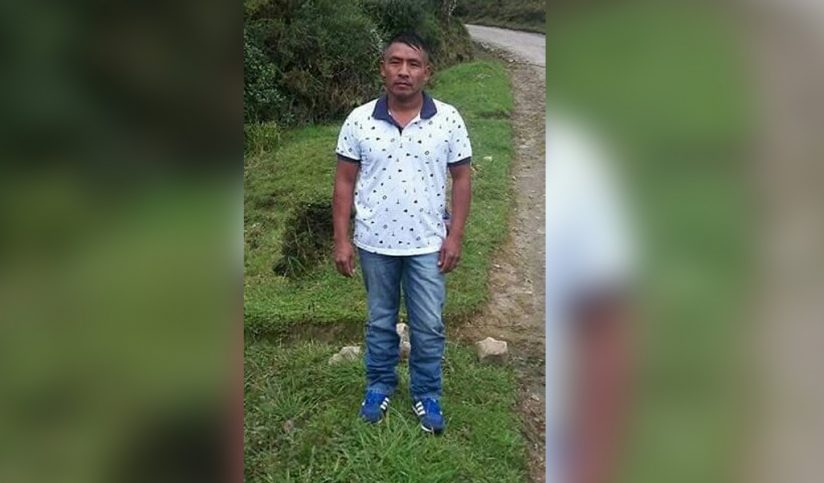
Dilio Corpus Guetio, a Campesino leader was murdered in Colombia, making it 17th murder in 2019. | Photo: Twitter / @Paola_teleSUR
teleSUR | January 30, 2019
A Colombian Campesino leader Dilio Corpus Guetio, 44, who was a member of Asocordillera (Mountain Area Association of Campesino Workers) and also a member of the local Campesino Guard militia was shot to death Tuesday.
Corpus Guetio left his home in the municipality of Suarez in the department of Cauca, in southwest Colombia, at around six in the morning for work. On the way armed men from a car shot him several times.
“The murderers were in a van which hit him and made him lose control of his bike. At that point, they got out of the car to get close to Dilio, who was already injured and he was shot repeatedly, killing him,” said a representative from the United National Federation of Agricultural Unions (FENSUAGRO).
Studies for Development and Peace, Indepaz, say that within the 29 days of 2019, 16 social leaders have been killed in Colombia, excluding Corpus Guetio.
Dilio was known for his work monitoring rural areas and protecting the territory and its inhabitants. His murder case has been registered in the village of Santa Barbara, his place of work.
This week another community leader from Cuca, Jose Jair Orozco, 52, was also assassinated.
Colombian Attorney General Nestor Humberto Martinez said in early January that the greatest number of Colombians murdered over the past two years since the signing of the peace agreement have been social leaders who serve on Communal Action Boards (JAC).
JACs began in the 1950s and are local-level councils where citizens decide upon, plan and develop community projects based on their own needs. The majority of JACs are in rural areas and members include mainly low-income Campesino, Indigenous, and Afro-Colombian members of society.
According to Martinez, the assassinations of JAC leaders is “passively systematic.” The attorney general said that those responsible are paramilitary groups “such as the “Gulf Clan” that works on behalf of narco traffickers and “Los Caparrapos” he added.
Indigenous people made up 13 percent of those killed and farmers 10 percent. Union leaders and social leaders, Afro-Colombians and LGBTI population were the other main murder victims.
US revisits Vietnam Syndrome in Afghanistan after 17 years of war and destruction
By Finian Cunningham | RT | January 30, 2019
It is America’s longest war, costing huge amounts of “blood and treasure” as US leaders claim. Yet, the signs are that Washington is finally accepting an historic defeat in Afghanistan comparable to the ignominious Vietnam War.
Intensive negotiations between American officials and Taliban insurgents have produced the “biggest tangible step” towards ending the nearly 18-year war in Afghanistan, according to the New York Times.
More talks are scheduled in the coming weeks to firm up details, but already it is reported that the US is to withdraw its remaining 14,000 troops from the Central Asian country over the next year without any guarantees of reciprocation by the enemy.
That unilateral pullout is not yet officially admitted by Washington, but analysts believe the US has tacitly accepted the long-held demand by the Taliban for foreign troops to get out.
At the height of the war, US forces numbered up to 100,000 personnel. The remnant American military therefore have no way of countering the growing insurgency. Even with an additional 8,000 NATO troops and thousands of private contractors also present in Afghanistan supporting the US-backed government in Kabul, the sordid game is up.
Zalmay Khalilzad, US Special Representative for Afghanistan Reconciliation, during the latest round of talks held in Doha, Qatar, sought to portray an “agreed framework for a peace deal” being contingent on the Taliban delivering on three items: a ceasefire; entering into negotiations with the government in Kabul; and a vow to never allow Afghanistan to become a haven for terror groups.
But media reports cite Taliban officials as giving no firm commitment to those US demands, while it appears Washington has accepted its troops are to be repatriated regardless. In other words, the American side is looking for a face-saving, apparent bilateral “deal” when the reality is Washington knows its war is over.
Ryan Crocker, a former US ambassador to Afghanistan, puts it acerbically. Washington is only polishing the optics, while finessing “the terms of surrender.”
He compares the American withdrawal from Afghanistan to the disorderly retreat and defeat that US forces incurred at the end of the Vietnam War in the mid-1970s. “Then, as now, it was clear that by going to the table we were surrendering; we are just negotiating the terms of our surrender,” opined Crocker in the Washington Post.
The defeat of US military might in Indochina gave rise to the Vietnam Syndrome which entailed a grave loss in national confidence and international standing. The war in Afghanistan has already exceeded the duration of the Vietnam debacle by nearly eight years. While the death toll among American forces is a lot less, the financial cost of Afghanistan is potentially ruinous. Up to $2 trillion of taxpayer money is estimated to have been poured into waging war in that country, yet the strategic achievements are arguably zero.
Not only that, but the launching of “Operation Enduring Freedom” in October 2001 by the GW Bush administration was the catalyst for a global so-called “war on terror” which engulfed several countries. The total financial cost for those wars is reckoned to be around $5 trillion – or nearly a quarter of America’s spiraling national debt.
In cost of human lives, the Afghan war and its derivative “anti-terror” operations elsewhere have resulted in millions of deaths and casualties, millions of refugees and the decimation of whole nations, which have further spawned conflict and the spread of terrorism. Suicide rates and pathological self-destruction among US veterans who served in Afghanistan (and Iraq) are off the charts and will have long-term detriment on American society for generations to come.
The Afghan Syndrome is going to haunt the US for decades in the same way the Vietnam forerunner did.
What’s more despicable is the utter waste and futility. When Bush ordered the troops into Afghanistan at the end of 2001, it was supposed to be in revenge for the terror attacks on the US on September 11. Never mind that the evidence linking those attacks to Afghanistan was tenuous at best.
The Taliban regime, which had been in power from 1996, was toppled by the US. But three presidents later, the Taliban now are reckoned to control over half the territory in Afghanistan, and can carry out deadly attacks on US-backed local forces seemingly at will on a daily basis, including in the capital Kabul.
Now it seems only a matter of time until the Taliban will be back in power with the US and allied NATO forces gone.
Richard Haass, a former senior US State Department planner, commented: “The Taliban have concluded that it is only a matter of time before the United States grows weary of stationing troops in a far-off country and spending $45 billion a year on a war that cannot be won… they have little need to compromise.”
The irony is that the Taliban grew out of the tribal militants that the US cultivated and armed to the teeth at the end of the 1970s when Afghanistan was governed by a Soviet-backed administration.
The American policy was gleefully calculated in Washington to give the “Soviets their Vietnam.” The proxy war was indeed a heavy loss for the Soviet Union, but in the longer-term it looks like Uncle Sam ended up getting another Vietnam in terms of creating the longest war ever for Washington, the unfolding ignominious defeat and the global blowback from Islamist terrorism it engendered.
Washington may be pretending it has reached a “framework deal for peace” in Afghanistan. But the brutal truth is Washington has lost another epic war.
The Taliban have always maintained they are not going to negotiate with the US-backed administration in Kabul, headed by President Ashraf Ghani. Like his predecessor, Hamid Karzai, the Taliban view Ghani and his government as a corrupt, venal puppet of the Americans.
The fact that the US sidelined the Kabul regime by talking directly with the Taliban is a crucial concession by Washington. By doing so, the US is effectively admitting that the insurgents are in the driving seat. All the talk out of Washington about supporting “intra-Afghani dialogue” and finding a “comprehensive peace settlement” is window-dressing rhetoric.
US President Donald Trump last month ordered about half of the American troops in Afghanistan – some 7,000 – to withdraw. Trump is said to be growing impatient with the huge financial drain of the never-ending war. His order to pull out forces before the latest round of negotiations in Qatar will have been taken by the Taliban as further proof the Americans know they are beaten.
Astoundingly, prominent voices in Washington are arguing that, in spite of the human calamity and cost of Afghanistan, US troops should remain there indefinitely. Senate Republican leader Mitch McConnell wants to pass legislation forbidding a withdrawal. The Washington Post’s editorial board – which reflects the foreign policy establishment view – admonished: “The Trump administration’s tentative deal with the Taliban could return Afghanistan to chaos.”
“Return to chaos”?
Afghanistan – known as the Graveyard of Empires – from centuries of defeating great powers is showing that the Americans are up their necks in chaos.
US warns Israel against keeping up strikes on Syria
Press TV – January 30, 2019
The top US intelligence official has warned Israel of the consequences of keeping up its military strikes on Syrian soil, saying the attacks could eventually trigger a response from Iran, which has its military advisors based in the Arab state.
Speaking at a hearing of the US Senate Select Committee on Intelligence in Washington on Tuesday, Director of National Intelligence Dan Coats said that Israel’s continued aerial assaults against Syria would increase the risk of Iran’s retaliation.
“We assess that Iran seeks to avoid a major armed conflict with Israel,” Coats said. “However, Israeli strikes that result in Iranian casualties increase the likelihood of Iranian conventional retaliation against Israel.”
Coats also raised concerns about “the long-term trajectory of Iranian influence in the region and the risk that conflict will escalate.”
He further claimed that Iran pursues “permanent military bases” in Syria and probably wants to maintain a network of “fighters” there despite the Israeli aerial assaults.
The American official was presenting the views of the US Intelligence Community to the congressional committee as part of the annual Worldwide Threat Assessment.
Tehran has been offering military advisory assistance to the Syrian army at the request of the Damascus government. Iran says it is not operating any military bases there.
The Israeli military has on multiple occasions launched air raids against targets inside Syria, some of which it claims belonged to Iranian forces.
Israel – which has been backing the terror groups operating against Damascus — views Iranian advisors in Syria as a threat and has openly pledged to target them until they leave the Arab country.
Earlier this month, the chief commander of the Islamic Revolution Guards Corps (IRGC) responded to Israeli Prime Minister Benjamin Netanyahu’s “ridiculous” threat of strikes against Iranian advisors.
Major General Ali Jafari vowed that the Islamic Republic will protect its military advisory mission against the regime’s acts of aggression.
Just days ago, Iran’s chief military commander raised the possibility of Iran adopting offensive military tactics to protect its interests.
The chief military commander says Iran is prepared to adopt offensive military tactics in order to protect its interests while generally adhering to its broad defense doctrine.
In April 2018, an Israeli airstrike against the T-4 airbase in Syria’s Homs Province killed more than a dozen people, reportedly including seven Iranian military advisors.
In May of the same year, Israel conducted its most intensive airstrikes on Syria in decades. According to Russia’s Defense Ministry, Israel had used 28 warplanes in its Syria strikes and fired 70 missiles. Both Damascus and Moscow said that the Syrian army had managed to shoot down over half of the missiles.
The Tel Aviv regime, at the time, claimed that its assault was in response to a barrage of 20 rockets that had been fired from Syria at Israeli military outposts in the occupied Golan Heights, and it blamed the rocket attack on Iran.
McConnell Mulls Introducing Amendment to Stop US Pullout from Syria, Afghanistan
Sputnik – 30.01.2019
WASHINGTON – Senate Majority Leader Mitch McConnell said on Tuesday he plans to introduce legislation to prevent what he called a “precipitous” withdrawal of US forces from Syria and Afghanistan before terrorist groups such as Al-Qaeda and the Daesh are defeated there.
“My amendment would acknowledge the plain fact that al Qaeda, ISIS[Daesh], and their affiliates in Syria and Afghanistan continue to pose a serious threat to our nation”, McConnell said in remarks on the Senate floor.
McConnell said his amendment, which he plans to introduce to a wide-ranging Senate bill on the Middle East, would “recognize the danger of a precipitous withdrawal from either conflict, and highlight the need for diplomatic engagement and political solutions to the underlying conflicts in Syria and Afghanistan”.
He stressed that his amendment would ensure the continued commitment of US forces until “vile terrorists” suffer an enduring defeat in both countries.
Moreover, McConnell emphasized that if the US exit the two countries before defeating the terrorists, the two conflicts would “reverberate in the United States”.
The comments mark a rare break between the Republican Senate majority leader and President Donald Trump, who has signaled that he intends to pull US troops out of both countries.
McConnell said he would introduce the amendment to the “Strengthening America’s Security in the Middle East Act”, a sweeping package of measures that would impose new sanctions against Syria, boost defense spending in the region and punish activists who call for economic boycotts of Israel to protest its policies in Palestine, among other measures.
The bill cleared a first Senate hurdle on Monday in a 74-19 vote, and the chamber is expected to decide on the final version of the legislation in the coming days.
In December, the US-based media reported that Washington planned to withdraw around 7,000 troops deployed in Afghanistan. The reports came in the wake of Trump’s announcement regarding his intention to pull the US troops out of Syria since, according to him, the Daesh had been defeated.
The White House, however, has dismissed the claims about Afghanistan, saying that Donald Trump had no such plans.
Coup in Venezuela: What Next?
By Marco Teruggi – Pagina 12 – January 25, 2019
Caracas ‐ The dice have been thrown and the game is on in Venezuela. This week has seen the country enter into new uncertain and dangerous terrain, although with some predictable elements. We have witnessed different variables develop, and now wait for new elements that may catalyse or justify an outcome.
The current chain of events seems to have been planned out step-by-step: the attempted theft of weapons by a group of members of the Bolivarian National Guard on the morning of January 21, followed by incidents of violence concentrated in the west of Caracas; US Vice-President Mike Pence’s video supporting Juan Guaidó and calling for demonstrations on January 23; the swearing-in of Guaidó; US President Donald Trump’s recognition of Guaidó a few minutes later; ongoing incidents of violence; the convening of a meeting of the Organization of American States (OAS) to seek recognition of the parallel government; the US$20 million announced by Pence for “humanitarian aid”; and yet more programmed violence.
Not everything went as planned. For now, there are two main variables at play: the international front and the violence.
International front
Regarding the international front, the attempt to get the OAS to recognise Guaidó as president failed, with only 16 votes out of 34. This is not a new failure: the Lima Group (formed in 2017 by right-wing Latin American governments), now weakened by the Mexican government’s anti-interventionist stance, emerged out of a similar situation.
Moreover, the European Union did not formally recognise Guaidó and agreed – an unstable agreement opposed by governments like France – on the need to have new elections in Venezuela.
The axis of the current situation originates and rests in the US, which has called a meeting of the United Nations Security Council for January 26. What kind of debate and agreement will they seek there in terms of the parallel government? The strategy is reminiscent of the way in which the operation to oust the Libyan government was conducted in 2011.
On the second front, a program of violence is underway. The incidents of violence have moved through different poor areas of Caracas: west, south and the outer edges of the east, namely Petare, one of the most populated barrios [poor neighbourhoods].
There, particularly in the latter, armed groups have been activated and funded to generate violent actions, seeking to create a big impact in the media. These incidents are scheduled to start at night and are carried out in such a way to enable them to be promoted on social media.
Human rights organisation Surgentes has stated that, “at least 38% of demonstrations were violent, and in 28.5% of them there were confrontations with security forces, with firearms and other substantial elements”.
A Bolivarian National Guard sergeant was murdered, and two members of that institution were beaten up in an attempted lynching carried out in broad daylight, in a zone dominated by the opposition.
In this context, there has been a rising number of deaths of youths in poor areas mobilised by the right. This is a well-known situation: the same method was used in 2017, which at critical points saw Chavista youths burnt alive on the street and attacks on military bases.
This is all part of the escalation of events unfolding in Caracas and other parts of the country, with situations of violence in areas that are not part of the right’s social base combined with demonstrations such as the one on January 23.
This coup strategy integrates different variables: international pressure for recognition of the parallel government and chaos and deaths inside the country. This is the current situation.
What next? One of the planned steps is to activate the parallel government, whose power lies on the international front, though it has no power or impact inside the country.
This could mean economic actions, like attempts to freeze state assets or a takeover of CITGO, the US branch of Venezuelan state oil company PDSVA. These attacks would increase economic hardship and push the economy towards collapse, something that has been sought since the blockades and sabotage began.
Additionally, the opposition is expected to start an operation to bring in the “humanitarian aid” that Pence promised at the OAS meeting. Will this be a Trojan horse?
This set of steps, designed and promoted from outside the country, does not seem to indicate how they expect to oust Maduro — who was democratically elected — from the government.
Violence
When Guaidó has been asked, he has replied that military intervention is “an element of force that is on the table”. Regarding the possibility of a coup by the Bolivarian National Armed Forced (FANB), he said, “it is an element that is always worth considering”.
Guaidó’s strategy, which is part of a larger plan devised from abroad, cannot be carried out without a component of violence. What directions this violence will take remains to be seen.
We know about previous attempts in 2014 and 2017, of what is already at play, and of what they need to achieve their goal. Overwhelmed by his role and his own will for success, Guaidó has extended to Maduro the same offer of amnesty he has said he will give to civilians and the military.
The gap between the announcement of this coup against Maduro and its materialisation is still large. The army stated that they “will never accept a president imposed in the shadow of dark interests and self-proclaimed outside the law”.
Defence minister Vladimir Padrino López also stated that they will “avoid a confrontation between Venezuelans; it’s not a civil war, but dialogue that will solve Venezuela’s problems”. This last sentence should be taken with complete seriousness: one of the violent strategies of the coup plan relies on generating clashes between civilians.
The right has repeated that it will neither dialogue nor negotiate. Maduro has stated his willingness to do so, following the declarations of the governments of Mexico and Uruguay.
What then, if there is no dialogue? Venezuela faces a point of no return: that of accelerating attacks on many fronts to oust the elected government by force, and the start of a mass revenge.
Those leading this push reside in the US and, once again, are doing so in the name of freedom.
Translated from Pagina 12 by Pedro Alvarez.
Source: Green Left Weekly
The Failure of Guaido’s Constitutional Claim to the Presidency of Venezuela
By William Walter Kay | Global Research | January 29, 2019
The three constitutional articles invoked by Juan Guaido to legitimise his presidency are: 233, 333, and 350. The latter two are broad affirmations of democracy and constitutionality, silent on Presidential lines of succession. Guaido’s claim rests entirely on 233; presented here in full:
The President of the Republic shall become permanently unavailable to serve by reason of any of the following events: death; resignation; removal from office by decision of the Supreme Tribunal of Justice; permanent physical or mental disability certified by a medical board designated by Supreme Tribunal of Justice with the approval of the National Assembly; abandonment of his position, duly declared by the National Assembly; and recall by popular vote.
When an elected President becomes permanently unavailable to serve prior to his inauguration, a new election by universal suffrage and direct ballot shall be held within 30 consecutive days. Pending election and inauguration of the new President, the President of the National Assembly shall take charge of the Presidency of the Republic.
When the President of the Republic becomes permanently unavailable to serve during the first four years of this constitutional term of office, a new election by universal suffrage and direct ballot shall be held within 30 consecutive days. Pending election and inauguration of the new President, the Executive Vice-President shall take charge of the Presidency of the Republic.
In the cases describes above, the new President shall complete the constitutional term of office.
If the President becomes permanently unavailable to serve during the last two years of his constitutional term of office, the Executive Vice-President shall over the Presidency of the Republic until such term is completed.
The opening paragraph envisions six scenarios whereby a President might no longer serve. The next paragraph sets out protocols to be followed should a President-elect become unavailable to serve pre-inauguration. The third paragraph contemplates presidential vacancies during the first four years of office. The last paragraph deals with presidential vacancies in the final two years of office.
Of the six scenarios envisioned (death, resignation etc.) Guaido relies on “abandonment of his position.” This clearly never happened. Maduro isn’t gone. He’s still there. “Abandonment” conjures images of a President fleeing on a plane freighted with bullion. Maduro, however, currently occupies presidential offices and residences. There has been no abandonment.
“Abandonment” is spun to mean “usurpation.” When did this occur? Are they suggesting that at no time since April 19, 2013 has Maduro ever been President? If Maduro was President, then he must have farcically usurped himself. “Usurp” typically means take power away from someone. There has been no usurpation.
If a President becomes unavailable to serve in the first four years of his term, then the Vice-President takes over and calls an election. If the calamity occurs in the last two years of the presidential term then the VP serves out the fallen President’s term.
Guaido, as head of the National Assembly, only becomes involved when the vacancy occurs in the twilight zone between election and inauguration. This definitely did not happen here. Moreover, by citing Article 233 Guaido implies there was a recent (lawful) election. Finally, Guaido’s January 23 self-anointment occurred 13 days after Maduro’s January 10 inauguration. He missed the boat.
Pursuant to 233, if the head of the National Assembly becomes Acting President he must immediately call an election; and serve only until the winner of that election is inaugurated. The Western media (and Wiki) butcher 233’s second paragraph, leaving only opening and closing clauses; discarding any mention of “election.” Guaido should have, at the moment of self-anointment, announced an election for February 22. For the head of the National Assembly to assume Presidential powers, and then fail to call an election so as to keep those powers, would be flagrantly unconstitutional.
This thread becomes rejoicefully rich considering the EU’s position. They are demanding Maduro call an election; …or else they will recognise Guaido. Can Maduro call an election if he is not President? By demanding Maduro hold an election they are recognising Maduro as President. If Maduro is President he has no obligation to call snap elections to satisfy foreign governments. Alternatively, if Guaido became President he would have an explicit, unavoidable constitutional obligation to call an immediate election.
Guaido is the figure-head of a coup attempt orchestrated by foreign powers without a constitutional leg to stand on.
Three Reasons Macron is a Hypocrite when it Comes to Venezuela
By Jim Carey | Geopolitics Alert | January 29, 2019
Paris – French President Emmanuel Macron recently voiced support for protesters in Venezuela as his own country has been ground to a halt by protests every weekend.
There is an overused saying that “people in glass houses shouldn’t throw stones.” While these few words may be cliche there is definitely one man that they can be applied to after this weekend: Emmanuel Macron.
Even though the French President is into the third month of protests against his government, he has decided to weigh in on the legitimacy of another country’s government and his latest outrageous statements just highlight the hypocrisy of Macron and Western leaders in general.
Macron: Maduro is ‘illegitimate’
Emmanuel Macron is a very unpopular man. Yet, if the French President is to be believed, there is a man who is more unpopular than him that needs to be removed from office immediately. This man is, of course, Venezuelan President Nicolas Maduro whose approval rating is estimated somewhere around twenty percent by Western media outlets (many with no journalists or pollsters in Venezuela).
The irony of Emmanuel Macron saying these approval ratings make a President “illegitimate” is that his own aren’t looking much better. Following the eleventh weekend of the ‘Gilets Jaunes’ protests, Macron has seen a slight bump in approval ratings (according to pro-Macron media) to a paltry thirty percent.
Thirty percent isn’t much better than 20 but there were also polls during the earlier stages of the Gilets Jaunes protests where just over seventy percent of French citizens polled did not have faith in Macron’s government. This means that at one point during the protests that are still sweeping through Paris every weekend, Macron was just as “illegitimate” as he claims Nicolas Maduro is.
Approval ratings aren’t the only thing Western powers use to paint Maduro as illegitimate. Another common tactic often deployed against the Venezuelan President is to claim that his latest electoral victory can’t be verified and this makes Maduro illegitimate.
One statistic cited to prove that the last Venezuelan election was “fraud” is the voter turnout. The voter turnout during last years presidential election in Venezuela was 46.1% but this statistic without context is misleading.
A key variable that has to be factored into the Venezuelan elections is that the now-“interim President” Juan Gauido’s own party called for a boycott. Apparently, most of the party got the message, listened to the leadership and just didn’t vote, meaning it’s impossible to tell if the re-election of Maduro would have gone differently.
One election that nobody was calling for a boycott of, is the French Presidential election in 2017 where only about 35% of the French electorate voted. This is the lowest turnout for any French election and modern history, and more than ten percentage points less than the turnout in Venezuela. If low turnout is the key to spotting a “rigged” election where the opposition is de facto barred from voting, perhaps international observers should examine the legitimacy of the French President.
Violence against protesters
Another major trope across western media used to try to characterize Nicolas Maduro as a tyrant is some of the responses of the Venezuelan security services to massive protests. At the same time, however, it seems strange for Emmanuel Macron to point to massive protests during “economic turmoil” as some kind of evidence a leader must step down.
As stated above, Macron is dealing with his own “pro-democracy” protests – or a bunch of Russian-manipulated fascists if western media is to believed – the Gilets Jaunes. While Macron has openly voiced his support for those protesters in the streets of Caracas, he has spent several weeks brutalizing and arresting protesters on the streets of Paris.
While networks all over the west love to point out the totals of dead or injured during riots in Venezuela, they usually fail to report when similar things happen in the west, and France is no different. Macron, much like what he says of Maduro, is also killing protesters and reached double-digit body count late last year.
Obviously, western media would like you to believe these two things are different, and obviously, they are in many ways. For instance, the Venezuelans protesting in Caracas work on behalf of western interests while those in Paris work against it.
There is also another key difference between the situations. In France, Macron has done nothing to hold any police accountable for the deaths of protesters in Paris. Unlike Macron, the Maduro government has actually prosecuted police found guilty of abuses against the opposition. Meanwhile, Macron’s police recently blinded a prominent Gilets Jaunes activist for life with their non-lethal weapons a day after the latest Venezuelan protests kicked off.
Counter-protesters
One thing you will not see in any western media coverage of Venezuela are those citizens of the country that do support President Nicolas Maduro. The western media has no problem repeatedly showing protests against the current government but almost no media covered the fact that thousands also mobilized in pro-Maduro protests to counter the opposition over the weekend.
Large Pro Maduro demonstrations taking place thoughout Venezuela. pic.twitter.com/23KfTrvSl3
— Warrior Reports (@WarriorReports) January 23, 2019
While the media ignore these pro-PSUV protests over the weekend though, they did fall in love with another new group of “pro-order” protesters, the Foulards Rouge, or Red Scarves. Although this movement didn’t explicitly say they back Macron, they did support something mainstream media love even more, the “institutions” of liberal democracy.
Unlike the yellow vests, who the western media did their best to ignore for weeks, these red scarf protesters were blasted all over mainstream media. This coverage is despite the fact that the red scarves were estimated to have been around 10,000 strong whereas some yellow vest protests have drawn hundreds of thousands to Paris from around France.
“More Than 100,000” Yellow Vests Protest in France #GiletsJaunes #ActeIX – @lifttheveil411 – LIVE NOW https://t.co/7yFaWNdj3n
— Jami 🇺🇸 (@Raven_Wren) January 12, 2019
These red scarf protests are being hailed as France’s silent majority, who may be unhappy with the state but still don’t wish for further instability. The same can likely be said about many of the pro-Maduro protesters who likely have some grievances but know much of this is caused by outside factors and anything besides the Bolivarian revolution will further destabilize Venezuela.
None of this matters to the western media or Emmanuel Macron who are still ramping up their anti-Maduro smear campaign at this very minute. Emmanuel Macron can “support” the protesters in Venezuela all he wants but he might want to worry about keeping his own house in order.
Fake News: ‘Hundreds Killed In Clashes Between Pro-Iranian, Pro-Russian Forces’
Syrian War Report – January 29, 2019
A fake-news story about large-scale clashes between pro-Russian and pro-Iranian factions in Syria is making jitters in English- and Russian-language mainstream media outlets. According to these reports citing anonymous sources and each other, “the pro-Russian Tiger Forces and 5th Assault Corps” clashed with “the pro-Iranian 4th Division” near the villages of “Shahta, Bredidg, Innab and Haydariye” in northern Hama.
Most of the reports claimed that there were casualties among the sides providing “precise” numbers varying from a dozen to 200 fighters from the both sides. No source was able to provide details into how clashes had started but the versions are varying from “some differences” to “a campaign to limit Iranian influence”.
Most of the media outlets presented these reports as some kind of breaking news. However, in fact, this is a week-old story. First such reports appeared in several pro-militant social media accounts and a local media outlet, al Modon Online. Later this rumor was reposted by anti-Assad, anti-Iranian and anti-Russian bloggers also citing anonymous sources to show the story look more reliable. By January 29, this rumor has reached large mainstream media outlets, but no evidence has appeared to confirm this kind of developments. However, the lack of factual data was ignored because this story is contributing to the US-Israeli-backed media efforts designed to undermine cooperation between Iran and Russia or at least to show that there are significant tensions between the sides.
The similar situation was observed in 2018 when various mainstream media outlets and even top US leadership like President Trump and Secretary of State Pompeo were claiming that “hundreds” of “Russian fighters” were killed by the US-led coalition in the province of Deir Ezzor. Both of these stories demonstrate how media forgery could reach the wide international audience and start being repeated as facts despite zero evidence supporting them.
On January 27, Russian forces launched at least three surface-to-air missiles at unidentified aerial objects near the Hmeimim airbase. According to local sources, at least 3 UAVs apparently launched from the Idlib de-escalation zone were intercepted.
The Syrian Arab Army deployed reinforcements at frontlines near the Idlib de-escalation zone and carried out a series of artillery strikes on militant positions in northwestern Hama and southern Idlib on January 28 and 29.
The US-backed Syrian Democratic Forces continue to claim dozens of casualties among ISIS members in the Euphrates Valley. However, a few remaining ISIS positions remaining there are still not captured.
Brits and the Holocaust
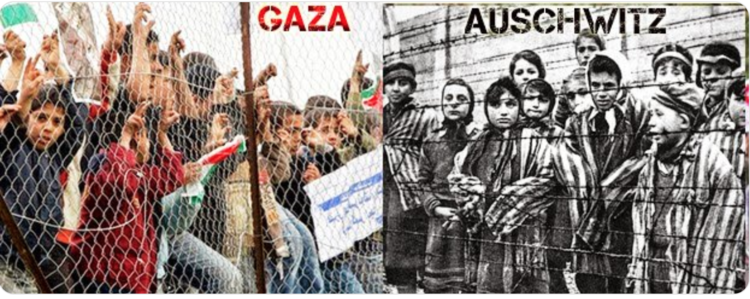
Not to see that Gaza is a concentration camp is a Holocaust denial!
By Gilad Atzmon | January 29, 2019
The British and Jewish press reported yesterday that a poll released to mark International Holocaust Remembrance Day found that “1 in 20 British adults does not believe the Holocaust happened and 12% think the scale of the genocide has been exaggerated.”
Nearly half of those questioned said they did not know “how many Jews were murdered by the Nazis and one in five people thought fewer than two million Jews were killed.”
This is proof, once again, that the more they dogmatically insist on trumpeting the primacy of Jewish suffering, the less people are interested in the Jewish plight. The same principle applies to anti-Semitism, the more Jewish institutions bemoan the tragedy, opposition to Jewry grows in the Kingdom and beyond.
Speaking for the Holocaust Memorial Day Trust, which commissioned the poll, Olivia Marks-Woldman told the BBC that: “without a basic understanding of this recent history, we are in danger of failing to learn where a lack of respect for difference and hostility to others can ultimately lead.” If Marks-Woldman is truly concerned about ‘respect for difference and hostility to others’ she may want to point out what she and the Trust have done to stop the holocaust now taking place in Palestine at the hands of no other than the Jewish State.
Karen Pollack, chief executive of the Holocaust Educational Trust, said in a statement that the survey showed “the need to increase education about the genocide.” How many more hours should BBC Radio 4 dedicate to the Nazi era and Jewish suffering bearing in mind that we have only 24 each day?
The Jewish press also noted that the poll results are consistent with CNN’s recent findings that one-fifth of Europeans believe Jewish people have too much influence in finance and politics, and one-third said they knew nothing at all or “just a little” about the Holocaust. I wonder if this means that it is time that Jewish institutions examine themselves and try to figure out what is at play here. Why are Europeans ‘denying’ the Jewish past? How is it possible that the more time, effort and money are invested in ‘Holocaust education’ the ‘less educated’ people seem to be?
But here’s the twist. The Times Of Israel reported yesterday that last December “a major European report found nearly 90 percent of European Jews feel that anti-Semitism has increased in their home countries.” Apparently the most common ‘anti-Semitic’ statements Jews heard were “comparisons between Israelis and the Nazis with regard to the Palestinians.”
Perhaps the Holocaust Memorial Trust ought to be reassured by this positive finding. Not only do Europeans and Brits understand the Holocaust, they manage to apply its message in a universal manner. They are disgusted by fascism, racism, ethnic cleansing and oppression and happen to see Israel’s leadership as the Nazis of our time. I accept that this may be offensive for some Jews, but it does indicate that the most important lesson of the Holocaust, the importance of opposition to racism and oppression, is well and widely understood.
Featured Video
America Racing to Strategic Defeat in Iran
or go to
Aletho News Archives – Video-Images
From the Archives
An Expert Military Analysis of War with China
Actually, None is Necessary
By Fred Reed • Unz Review • December 13, 2020
The Correlation of Armed Forces: U.S. goods and services trade with China totaled an estimated $634.8 billion in 2019. Exports were $163.0 billion; imports were $471.8 billion. The U.S. goods and services trade deficit with China was $308.8 billion in 2019. Trade in services with China (exports and imports) totaled an estimated $76.7 billion in 2019. Services exports were $56.5 billion; services imports were $20.1 billion. The U.S. services trade surplus with China was $36.4 billion in 2019.
There is talk within the Washingtoniat of a possible war with China. Steve Bannon, who apparently was dropped on his head as a child, actually favors such a war. We hear the usual shoo-the-boobs alarm about how the Chinese are doing something terrible and we must gird our loins and American values and show them what for, bow wow, woof. The danger is that the current game of who-blinks-first in Asian waters might actually provoke a shooting war. You know the kind of thing: One warship refuses to get out of the way of another, a collision ensues, some retard lieutenant who signed up on waivers opens fire, and we’re off and running. It is not a good idea to let children play with matches.
The said war is discussed either in emotional terms by idiots or in purely naval terms by those familiar with such things, so we hear of the First Island Chain and the Second Island Chain and whose missiles against the other’s missiles and so on. This would be appropriate if we were fighting World War Two again. Which we aren’t. Let’s take a quick-and-dirty look at how such a war might go.
To begin the war, America would overestimate itself and underestimate China. This is doctrine in the Pentagon. … continue
Blog Roll
 Aletho News
- Poland rules out sending Patriot missiles to US/Israel amid war on Iran
- Tehran approves new Hormuz plan with major restrictions
- No Threat Can Force Iran’s Surrender /Trita Parsi & Lt Cl Daniel Davis
- UK’s New Pandemic Plan Would Turn Big Tech Into a Mass Location Tracking Network
- Growing insecurity, soaring prices fuel protests in north as regime bans evacuation: Sources
- Iran denies responsibility for ‘depraved’ attack on Kuwait desalination plant
- Bring The Troops Back. End This War Now!
- Can we please stop calling Israel the ‘only democracy in the Middle East’ now?
- US should start removing its troops from Germany, proposes AfD co-leader Chrupalla
- Iran Red Crescent: 600 educational centers attacked in US-Israeli ‘war crimes’
- If Americans Knew
- The Line Between Affinity and Conspiracy
- As Iran targets US military bases, will they be relocated to Israel? Not a ceasefire Day 171
- Will Trump Go Kamikaze?
- Is the University of Florida Shutting Down College Republicans over Israel Criticism?
- Jewish extremist arrested over alleged plot to firebomb Palestinian activist Nerdeen Kiswani’s home
- More than half of Palestinian child detainees have no charges
- The More Murderous Israel Gets, The More We Hear About “Antisemitism”
- Land Day and the Palestinian struggle after 30 months of genocide
- The Iran War Is About Palestine
- Israeli soldiers echo settler ideology, talk of revenge after targeting Palestinians and detaining CNN crew in the West Bank
- No Tricks Zone
- New Study Finds Warming Saves Lives…Cold Temperatures 12 Times More Deadly Than Excess Heat
- German Science Blog Accuses PIK Climate Institute Of Hallucinating Climate Tipping Points
- Devastating Assessment Of Comirnaty Vaccine By Former Senior Pfizer Europe Toxicologist
- New Study: CO2 Is ‘Effectively Negligible’ As An Explanatory Climate Change Factor Since 2000
- Former Pfizer Toxicologist Dr. Helmut Sterz Tells Bundestag Hearing Pfizer Vaccine Should Have Never Been Approved
- Energy Expert: Germany’s Nuclear Phaseout Was A “500 Billion Euro Mistake”
- New Research: South Australia’s Mid-Holocene Sea Surface Temperatures Were 4°C Warmer Than Today
- Storing Green Energy To Last Germany 10 Days Would Require A 60-Million Tonne Battery
- New Studies: UK Sea Levels Were 4 Meters Higher Than Today During The Mid-Holocene
- Destructive Green New Deal: German Energy And Metal Group Warns Of Drastic Crisis
 Aletho News