President Carter: Congress should reject unconstitutional anti-BDS laws
Carter Center – April 5, 2019
In the past year, 26 states in the U.S. have adopted legislation to discourage support to the “Boycott, Divestment, Sanctions” (BDS) campaign advocated by Palestinian activists. The campaign aims to pressure Israel to respect Palestinian rights. These laws apply to individuals and business entities, and prevent them from receiving U.S. government contracts. Courts in Kansas and Arizona have struck down anti-BDS laws, declaring them unconstitutional as they infringe on rights protected by the First Amendment to freedom of expression.
On February 5, 2019, the US Senate adopted a bill to safeguard the right of states to adopt such anti-BDS laws. While stressing that they do not support the BDS movement, 23 senators opposed the anti-BDS provision on grounds that it is unconstitutional. The bill is now pending in the House of Representatives.
“Under our Constitution, people and legal entities have the right to express political views without fear of consequences,” stated former U.S. President Jimmy Carter. “U.S. courts have protected the right of individuals to participate in boycotts as a form of political protest. The same protection applies to the right to advocate or oppose BDS. The House of Representatives should reject this unconstitutional bill.”
[Read the text of the bill here. The bill would also decree that the U.S. give Israel a minimum of $38 billion over the coming ten years, over $7,000 per minute – approximately $23,000 per Jewish Israeli family of four]
Facebook Pulls Plug on Anti-Immigration News Site Ahead of Danish Elections
Sputnik – 12.04.2019
The Danish alternative news outlet 24Nyt has had its Facebook page with over 34,000 followers closed. State-owned Danish Radio (DR) has acknowledged its role in the shutdown.
According to 24Nyt, Facebook announced that its page “doesn’t follow Facebook’s policy”, which is the standard message for users and organisations who have their profiles switched off. “It is known that people and media critical of immigration are exposed to Facebook’s censorship”, 24Nyt suggested.
The same day, 24Nyt started a new Facebook page that was also subsequently shut down.
Later, state-run Danish Radio acknowledged its part in the shutdown of their independent competitor.
A week ago, DR contacted Facebook and presented a dossier of 24Nyt’s actions on their platform, triggering an investigation. Facebook later confirmed that 24Nyt’s page had been closed with info from that exact investigation, but without disclosing the reason.
Danish Radio described 24Nyt as a page “that urged to fight against established media and left-wing bias”. Danish Radio also admitted that over the past two years, 24Nyt had had a “significant impact” on Facebook, which is now “over”.
Social media expert Johan Farkas of Malmö University called the measure “extraordinary”.
“It is highly unusual that Facebook throws out a Danish media. As far as I know, this is a first”, Farkas said.
24Nyt was banned from Facebook only weeks or months before the Danish election, which is to be held no later than June this year.
“We have discovered that Facebook chose to close our site. Immediately afterwards, I was called by a journalist from Danish Radio. He wanted to know if I knew what the basis for Facebook’s decision was. I didn’t. Shortly afterwards, DR published an article on his website where they wrote that Facebook closed us down based on the material they received from them. We believe that this is very problematic, of course, because DR is a tax-financed media that does not have the task of silencing independent network media, or otherwise engaging in political activism”, 24Nyt’s editor-in-chief André Rossmann told the Swedish news outlet Samhällsnytt.
24Nyt is was founded in 2017 by Jeppe Juhl of the New Right party. The site is run by private enthusiasts and is funded by advertising revenues and donations. 24Nyt makes no secret that they are an opinion-based media. It bills itself as a “system-critical online newspaper with ‘dangerous opinions’ opposed to mainstream media”. Admittedly, they attempt “through strong opinions to open up the social debate trapped in an echo-chamber”. Their website informs that they are against “open EU borders and Muslim mass immigration”, “Islamisation of Danish society”, “totalitarian EU”, and “political correctness”.
Leading tech companies have been repeatedly accused of quietly suppressing conservative political views. Earlier this week, Republican lawmakers publicly accused the “big three” (Facebook, Google, Twitter) of political bias and suppression of free speech. The way Senator Ted Cruz (R-TX) put it, tech companies abuse their de-facto monopoly to promote left-leaning values.
Dozens of alt-media pages with millions of subscribers, including InfoWars and the Free Thought Project were previously banned from Facebook.
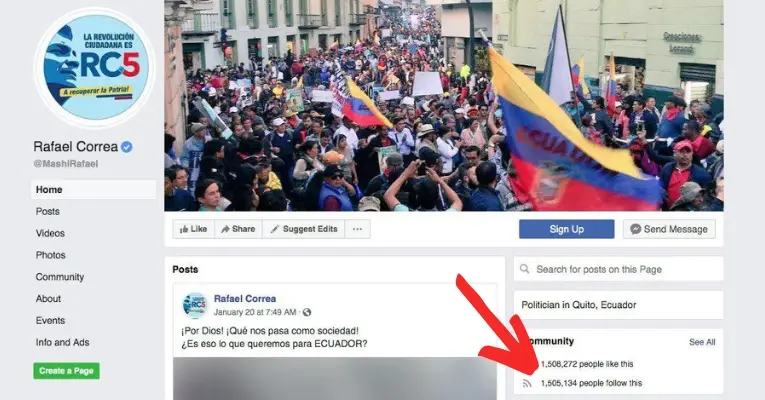
Facebook Removes Page of Ecuador’s Former President on Same Day as Assange’s Arrest
By Elias Marat | The Mind Unleashed | April 11, 2019
Facebook has unpublished the page of Ecuador’s former president, Rafael Correa, the social media giant confirmed on Thursday, claiming that the popular leftist leader violated the company’s security policies.
In a statement republished by Ecuadorean newspaper El Comercio, a company spokesperson said:
“Protecting the privacy and security of people is central to Facebook [and] we have clear policies that do not allow the disclosure of personal information such as phone numbers, addresses, bank account data, cards, or any record or data that could compromise the integrity physical or financial of the people in our community.”
The move comes on the same day that Ecuador’s government allowed British security personnel to enter their embassy in London to arrest journalist and WikiLeaks founder Julian Assange, who has been sought by U.S. officials for years due to his role in releasing scandalous information implicating Washington in a range of crimes, including war crimes.
US Threatens Venezuela at UNSC as IMF Freezes Funds
Diplomatic battles rage on at international bodies such as the UNSC, the OAS and the IMF
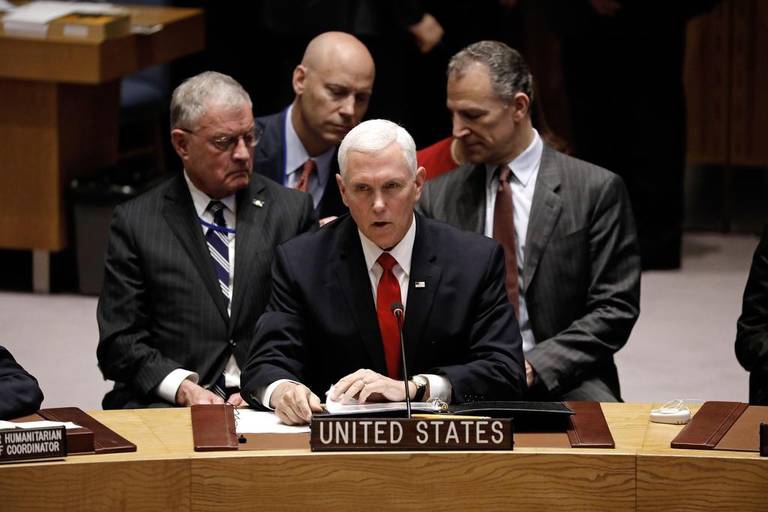
US VP Mike Pence called on the UN to recognize Guaido as Venezuela’s president. (EFE)
By Ricardo Vaz | Venezuelanalysis | April 11, 2019
Caracas – The United States pressured the United Nations to recognize self-proclaimed “Interim President” Juan Guaido during a Security Council (UNSC) meeting on Wednesday.
US Vice President Mike Pence told the UNSC that “the time has come” for the UN to recognize Guaido as Venezuela’s “legitimate president” and accept the latter’s representative to the world body. He added that the US would circulate a resolution to this effect, but offered no details on its timetable. A previous US resolution at the UNSC was vetoed by Russia and China on February 28.
Pence went on to reiterate the warning that “all options are on the table” to oust the Maduro government. “This is our neighborhood,” he told reporters afterward, calling on Russia to cease its support to the Maduro government.
Venezuela’s UN representative, Samuel Moncada, slammed what he called a “clear move to undermine” Venezuela’s rights, adding that his legitimacy depended on UN recognition and not on the declarations of the US vice president.
Russian ambassador Vassily Nebenzia accused the US of causing Venezuela “billions of dollars in losses” as a result of sanctions.
“[The US] deliberately provokes a crisis in Venezuela in order to change a legitimately elected leader for a US protege,” Nebenzia said in his speech.
Chinese representative Liu Jieyi likewise affirmed that Venezuelan affairs should be handled internally and criticized the imposition of sanctions, while his South African counterpart, Jerry Matjila, called for the UNSC to take a “constructive approach.”
Wednesday’s UNSC meeting came on the heels of a session at the Organization of American States (OAS) which approved Guaido’s appointment, Gustavo Tarre, as a representative to the body “until new elections are held.” The proposal had 18 votes in favor, 9 against, six abstentions and one absence.
Venezuelan authorities denounced the move as a violation of international law and of the OAS charter. The Foreign Ministry reiterated that Venezuela is due to leave the OAS on April 27, having started the process two years ago. Caracas denounced meddling in its internal affairs after the OAS had repeatedly tried to apply its democratic charter. However, it never managed to secure the necessary 24 votes.
Diplomatic battles surrounding Guaido’s recognition have extended to the International Monetary Fund (IMF). According to Bloomberg, the IMF cut off Caracas’ access to almost US $400 million in special drawing rights (SDR). While the IMF has shown no signs of recognizing Guaido, and lists Finance Minister Simon Zerpa as Venezuela’s representative, sources told Bloomberg that a government must be recognized by a majority of the Fund’s members to access its SDR reserves.
Venezuela remains mired in a deep economic crisis that has seen its international reserves shrink to around $9 billion. The cash crunch has been further compounded by US and allies freezing Venezuelan assets held abroad. In one such case, the Bank of England has refused to repatriate an estimated $1.2 billion worth of Venezuelan gold held in its vaults.
International tensions have also flared around the issue of humanitarian aid, with US and Venezuelan opposition ultimately failing to force an estimated $20 million worth of aid across the Venezuela-Colombia border on February 23. The operation faced strident criticism from international agencies such as the United Nations and the Red Cross, who refused to take part in the “politicization” of aid.
During Tuesday’s UNSC meeting, UN aid chief Mark Lowcock stated that Venezuela is facing a “very real humanitarian problem” and talked about the need to step up UN efforts in the Caribbean country. UN Secretary General Antonio Guterres later tweeted that the UN estimates there are 7 million people in need of aid in Venezuela, and that the UN is working to increase its assistance “in line with the principles of humanity, neutrality, impartiality and independence.”
UN agencies have increased their work in Venezuela in recent months, most recently via an agreement between Caracas and the UN’s Central Emergency Resource Fund for US $9.2 million to address the health and nutritional impacts of the country’s severe economic crisis. President Maduro has also appealed for UN assistance in countering US sanctions to bring medicines and medical equipment to Venezuela.
Likewise, the International Federation of the Red Cross (IFRC) recently announced a scaling up of its activities in Venezuela, doubling its annual country budget to $60 million as part of an agreement with the Venezuelan government.
Maduro met a Red Cross commission headed by IFRC President Peter Maurer on Tuesday to coordinate the agency’s work in Venezuela. Maurer had previously met Foreign Minister Jorge Arreaza to “strengthen cooperation agreements.”
Over 450 Refugees Left Syria’s Rukban Camp in Past 24 hours – Russian Military
Sputnik – 11.04.2019
MOSCOW – More than 450 refugees have left the Rukban camp in Syria through the humanitarian corridor in the past 24 hours, Maj. Gen. Viktor Kupchishin, head of the Russian centre for Syrian reconciliation, said Thursday.
“A total of 459 refugees left the Rukban camp through provided humanitarian corridor in the past 24 hours”, Kupchishin said at a daily news briefing. The Russian general added that almost 2,300 people have been able to leave the camp and reach the territory controlled by the Syrian authorities since 19 February 2019.
Russia and Syria have repeatedly tried to draw the attention of the international community to the deplorable conditions at the camp, which houses more than 40,000 internally displaced people, mostly women and children. Both Moscow and Damascus have criticized the United States over its reluctance to allow people to leave the camp, which lies in a US-controlled zone near its unauthorized military base in At Tanf.
Russian Ambassador to the UN Vassily Nebenzia said at a meeting of the UN Security Council on Tuesday that Moscow intends to continue negotiations with the United Nations, the United States and Jordan on the Rukban refugee camp.
Nebenzia pointed out that tens of thousands of internally displaced persons in the camp are being kept on “humanitarian drip” in unacceptable conditions and the vast majority of them wishes to leave the settlement and return to their places of origins.
Russia, the ambassador noted, had already opened up two humanitarian corridors to allow the passage of refugees from Rukban to chosen places of residence, including Latakia, Homs, Palmyra, suburban Damascus and Aleppo, among others.
On Sunday, Jordanian Foreign Minister Ayman Safadi said Amman is ready to cooperate both with Russia and the United States in a bilateral and trilateral format in order to reach an agreement on the resettlement of the inhabitants of Rukban camp.
Pakistan Asks India to Provide Intel Proving Pakistan’s Involvement in Pulwama Attack
Sputnik – 11.04.2019
Pakistan has handed over a “request for more information” to the India High Commissioner in Islamabad on the Pulwama dossier, Ministry of Foreign Affairs spokesman Dr Muhammad Faisal told reporters on Thursday.
The minister added that India had so far not provided any actionable intelligence that could lead to concluding Pakistan’s involvement in the Pulwama attack that took place on 14 February this year. The attack took the lives of more than 40 Indian soldiers.
“We hope India will answer these questions soon”, Dr Faisal said during a weekly briefing, adding that the reply to previous questions had so far also not been given.
Diplomatic sources told Sputnik that Islamabad has sought a specific response with regards to an individual who is allegedly based in India. Dr Faisal told reporters that Foreign Minister Shah Mehmood Qureshi had credible intelligence that India is preparing another act of aggression against Pakistan between 16 and 20 April.
“India will receive the same response as February 27 if it challenges our resolve,” Dr Faisal told reporters on Thursday.
On the basis of the first dossier submitted by the Indian government on 27 February, Pakistan’s Foreign Office on 28 March stated that it had thoroughly investigated the entire dossier related to the Pulwama terror attack and had neither found any evidence of terror camps at the locations mentioned by India, nor of any of the persons mentioned therein that could be linked to the said attack.
“While 54 detained individuals are being investigated, no details linking them to Pulwama have been found so far. Similarly, the 22 pin locations shared by India have been examined. No such camps exist. Pakistan is willing to allow visits, on request, to these locations”, the Foreign Ministry added.
The tensions between the two nuclear-armed nations escalated in February after the Pulwama terror attack, which expanded into a full-fledge aerial clash on 27 February. An Indian MiG-21 Bison was shot down by the Pakistanis, while India has claimed that it too shot down a Pakistani F-16. Pakistan has rubbished the Indian claims.
Arab Spring returns home to uncertain welcome
By M. K. BHADRAKUMAR | Indian Punchline | April 12, 2019
The Arab Spring has returned to the Middle East after nearly six years in exile. It was in July 2013 that reversing the tide of democracy in Egypt that swept away the dictatorship of Hosni Mubarak, army chief General Abdel Fattah el-Sisi led a coalition with the backing of Saudi Arabia and the UAE to remove the elected President of Egypt, Mohamed Morsi, from power and suspended the the country’s constitution of 2012.
The Arab Spring never quite recovered from that trauma. There is a nifty aphorism of obscure origin that ‘History does not repeat itself but it often rhymes.’ The return of the Arab Spring to Algeria and Sudan in the recent weeks fits into that description. The similarity with the past lies in the undeniable fact that the Arab Spring is riding the wave of anti-regime protests in both Algeria and Sudan, triggered spontaneously by enormous public hatred of the regimes for their brutal repression, corruption, indifference to poverty and the intolerable conditions of day-to-day life.
In Sudan, the tipping point came four months ago over the government decision to triple the price of bread. In Algeria, the proverbial straw that broke the camel’s back came in February when then President Abdelaziz Bouteflika announced that he would seek a fifth-term in office, whereupon tens of thousands took to the streets.
In the sheer spontaneity of the Arab Spring revolt in Sudan and Algeria, time seemed to stand still since 2013. First in Algeria, after some six weeks of protests, and in Sudan within days, after four months of protests, the dictators got ousted. But in reality, things are never quite the repetition of the past — protests this time around are on a significantly higher scale. Lessons may have been learnt from the tragic example of Egypt where a heroic popular struggle that brought the Muslim Brotherhood and Mohammed Morsi to power ended in the blood-soaked 2013 coup led by General Sisi. The tragic saga of the Arab Spring in Egypt showed that entrenched ruling elites do not relinquish power simply because of militant mass protests.
Thus, both in Algeria and Sudan, there is popular resistance to the all-too-familiar pattern repeating — the army generals stepping in as the apparent saviours to remove the unpopular, detested dictators from power — Algerian President Abdelaziz Bouteflika and Sudanese President Omar al-Bashir — but then, only to usurp power and establish military dictatorships, as had happened in Egypt. In Algeria, the protestors are openly shouting ‘No repeat of the Egyptian scenario.’ In Sudan, the exhortation to the protestors is: ‘Stay put and guard your revolution. To comply with the curfew (imposed by the generals) is to recognise the clone rescue government (led by the army.)’
However, the spectre that is haunting the masses in both Algeria and Sudan is the danger of bloody counterrevolution. Leadership is lacking among protestors and they lack the machinery or cadres to coordinate opposition to military-police repression. Meanwhile, the entrenched elite is co-opting the middle class and trying to lull protestors to sleep with (false) promises of a democratic capitalist future. The military junta in Algeria is promising to convene a constituent assembly to rewrite the constitution, while the counterpart in Sudan has voiced its intention to hold democratic elections in two years.
In Sudan, there is also the added factor of foreign interference. Egyptian President Abdel Fattah el-Sisi openly said this week, “We cannot afford a leadership emerging in … Sudan that tolerates, or even worse condones, militant Islamic activity. This is why … we are keeping a close eye on any possible transition of power in Sudan.” The reference is to the Muslim Brotherhood.
Of course, it is a phoney argument, since the Brothers in Sudan have historically rejected union with the Egyptian branch (forming an alliance instead with the Sudanese Ansar-Ummah political bloc in support of Sudanese independence.) Sisi’s real worry is that if Sudan takes the democratic path, Muslim Brotherhood that has dominated Sudanese politics will surge to take the elected leadership, as had happened in Egypt in 2011, and that would rekindle the clamour for democracy in his country too.
Alex de Waal at the Fletcher School of Law and Diplomacy at Tufts University writing for the BBC assesses that “the cabal (that usurped power in Sudan) is aligned with Egypt, Saudi Arabia and the United Arab Emirates. Meanwhile, Qatar and Turkey have lost out. The new leadership dissolved the ruling National Congress Party and reportedly arrested many veteran Muslim Brothers.”
“They are busy telling Western countries that the Islamists had planned a coup, which needed to be forestalled by the army takeover, and that the protesters demanding democracy are also Muslim Brothers in disguise. It’s not a very convincing story, but it points to future tensions because the Islamists still have a strong following in Sudan.”
Sadly, in the emergent “multipolar world order”, there are hardly any takers for democracy or the Arab Spring — except, arguably, Turkey, Qatar and Iran — especially if it smacks of political Islam The big powers feel cozy with dictatorships. On Wednesday, the US and Britain issued a statement effectively backing the pre-emptive military coup in Sudan. At a meeting with Sisi on April 9 (who was on an official visit to the US at the invitation of President Trump), US Secretary of State Mike Pompeo thanked the dictator “for his leadership in advancing Egypt’s and the region’s security and stability, including through counterterrorism efforts and countering the Iranian regime’s malign influence.”
Roméo Dallaire and the Toronto Star’s distortion of Rwanda’s tragedy
By Yves Engler · April 11, 2019
 The Toronto Star should get its facts straight and stop distorting Rwanda’s tragedy.
A day after the 25th anniversary of when two Hutu presidents were blown out of the sky, the Star’s editorial board published “There’s no excuse for ignoring lessons of Rwanda’s genocide”. It claims, “on Jan. 11, 1994, Canadian Maj.-Gen. Roméo Dallaire, at the time force commander with the United Nations Assistance Mission for Rwanda, sent a chilling and urgent cable to UN Headquarters in New York. He had been informed of the details of a plan for the ‘extermination’ of ethnic Tutsis by Hutus.” After stringing together a few hundred more humane-sounding, though meaningless, words Star editorialists returned to their core liberal interventionist Canadian hero theme: “In his cable of January 1994 he urged UN leaders to act by telling them the obvious: Where there’s a will to prevent mass killing, there is a way.”
The Star should check Dallaire’s fax more closely. Revealingly, the much-celebrated “genocide fax” the editorialists reference is not titled “‘genocide’ or ‘killing’ but an innocuous ‘Request for Protection of Informant’”, reports International Criminal Tribunal for Rwanda (ICTR) lawyer Christopher Black in a 2005 story titled “View from Rwanda: The Dallaire Genocide Fax: A Fabrication”. The two-page “genocide fax”, as New Yorker reporter Philip Gourevitch dubbed it in 1998, was probably doctored a year after the mass killings in Rwanda ended. In a chapter devoted to the fax in Enduring Lies: The Rwandan Genocide in the Propaganda System, 20 Years Later Edward S. Herman and David Peterson argue two paragraphs were added to a cable Dallaire sent to Canadian General Maurice Baril at the UN Department of Peacekeeping Operations in New York about a weapons cache and protecting an informant (Dallaire never personally met the informant). The added paragraphs said the informant was asked to compile a list of Tutsi for possible extermination in Kigali and mentioned a plan to assassinate select political leaders and Belgian peacekeepers.
At the ICTR former Cameroon foreign minister and overall head of the UN mission in Rwanda, Jacques-Roger Booh-Booh, denied seeing this information and there’s no evidence Dallaire warned the Belgians of a plan to attack them, which later transpired. Finally, a response to the cable from UN headquarters the next day ignores the (probably) added paragraphs. Herman and Peterson make a compelling case that a doctored version of the initial cable was placed in the UN file on November 27, 1995, by British Colonel Richard M. Connaughton as part of a Kigali-London-Washington effort to prove the existence of a plan by the Hutu government to exterminate Tutsi.
Even if the final two paragraphs were in the original version, the credibility of the information would be suspect. Informant “Jean-Pierre” was not a highly placed official in the defeated Hutu government, reports Robin Philpott in Rwanda and the New Scramble for Africa: From Tragedy to Useful Imperial Fiction. Instead, “Jean-Pierre” was a driver for the MRDN political party who later died fighting with the Rwandan Patriotic Front.
Incredibly, the “genocide fax” is the primary source of any documentary record demonstrating UN foreknowledge of a Hutu “conspiracy” to exterminate Tutsi, a charge even the victor’s justice at the ICTR failed to convict anyone of. According to Herman and Peterson, “when finding all four defendants not guilty of the ‘conspiracy to commit genocide’ charge, the [ICTR] trial chamber also dismissed the evidence provided by ‘informant Jean-Pierre’ due to ‘lingering questions concerning [his] reliability.’”
Tellingly, Dallaire didn’t even initially adhere to the “conspiracy to commit genocide” version of the Rwandan tragedy. Just after leaving his post as UNAMIR force commander Dallaire replied to a September 14, 1994, Radio Canada Le Point question by saying, “the plan was more political. The aim was to eliminate the coalition of moderates. … I think that the excesses that we saw were beyond people’s ability to plan and organize. There was a process to destroy the political elements in the moderate camp. There was a breakdown and hysteria absolutely. … But nobody could have foreseen or planned the magnitude of the destruction we saw.”
Doctoring a fax to make it appear the UN had foreknowledge of a plot to exterminate Tutsi may sound outlandish, but it’s more believable than many other elements of the dominant narrative of the Rwandan genocide. The day after their editorial, for instance, the Star published a story titled “25 years after genocide, Rwanda rebuilds” which included a photo of President Paul Kagame leading a walk to commemorate the mass killings. But, Kagame is the individual most responsible for unleashing the hundred days of genocidal violence by downing a plane carrying two Hutu presidents and much of the Rwandan military high command.
Even the Star has reported as much. A year ago they published a story titled “Did Rwanda’s Paul Kagame trigger the genocide of his own people?” For its part, the Globe and Mail has published a series of front-page reports in recent years confirming Kagame’s responsibility for blowing up the plane carrying Rwandan President Juvénal Habyarimana, which triggered mass killings in April 1994. In an October story titled “New information supports claims Kagame forces were involved in assassination that sparked Rwandan genocide” the Globe all but confirmed that the surface-to-air missiles used to assassinate the Rwandan and Burundian Hutu presidents on April 6, 1994, came from Uganda, which backed the RPF’s bid to conquer its smaller neighbour. (A few thousand exiled Tutsi Ugandan troops, including the deputy minister of defence, “deserted” to invade Rwanda in 1990.) These revelations strengthen the case of those who argue that responsibility for the mass killings in spring 1994 largely rests with the Ugandan/RPF aggressors and their US/British/Canadian backers.
By presenting the individual most culpable for the mass killings at the head of a commemoration for said violence the Star is flipping the facts on their head. The same might be said for their depiction of the Canadian general. At the end of their chapter tracing the history of the “genocide fax” Herman and Peterson write, “if all of this is true,” then “we would suggest that Dallaire should be regarded as a war criminal for positively facilitating the actual mass killings of April-July, rather than taken as a hero for giving allegedly disregarded warnings that might have stopped them.”
Like America With Russiagate, India Is Now Obsessed With Pakistangate
By Andrew Korybko | EurasiaFuture | 2019-04-11
The Indo-American Strategic Partnership has rapidly progressed to such a point that the South Asian state is now copying some of the same conspiracy theories as its new patron, though instead of India being obsessed with suspected Russian interference in its elections like America was, its people can’t stop talking about its imaginary Pakistani variant.
Pakistangate
Pakistani Prime Minister Khan made global headlines earlier this week when he said that it might be easier for his country to clinch peace talks with India and resolve the Kashmir Conflict if Modi wins re-election after his country’s month-long electoral process concludes at the end of May. This took many Indians completely off guard who had hitherto been preconditioned by none other than the ruling BJP itself to think that Pakistan was “meddling” in their elections in order to support the opposition Congress party and their coalition allies. The Pakistani leader explained his initially surprising position by rationally noting how it would be less likely that right-wing forces would oppose any BJP-led peace talks unlike the spoiling effect they could have if left-leaning Congress attempted to initiate the same, which makes sense upon further contemplation and is actually a very wise observation.
From -Gate To -Gate
Instead of being interpreted as such, however, India’s “confirmation bias” on all sides caused it to continue cannibalizing itself over the entirely speculative issue of “who Pakistan really supports”, with practically all parties refusing to believe that their neighbor is just sitting on the sidelines watching in awe as the Indian political class tears itself apart over this issue and discredits their claim to being the self-professed “world’s largest democracy”. Interestingly, what’s unfolding in India at the moment with Pakistangate is very similar to what has been taking place in its military-strategic partner over the past couple of years with Russiagate. This suggests that the vassal state is copying some of the same conspiracy theories as its new patron, including the role that elements of its permanent military, intelligence, and diplomatic bureaucracies (“deep state”) are playing in this process.
“Deep State” Meddling
Democratic-friendly elements of the American “deep state” essentially entrapped Carter Page, after which they consequently used this false flag as the pretext for “justifying” a far-reaching FISA surveillance operation against the entire Trump campaign which then sought to exploit its “six degrees of separation” from Russia to concoct a weaponized narrative that ultimately failed to prevent him from winning the election and then later getting him overthrown through a de-facto coup. Something along the same lines happened with the BJP-friendly elements of the Indian “deep state” that “passively facilitated” the Pulwama incident which was later blamed on Pakistan and used as the pretext for “justifying” a so-called “surgical strike” against it that also miserably failed in what it sought out to do, though it nevertheless succeeded in making Indians hysterical about anything to do with Pakistan.
Witch Hunts
The BJP has even gone as far as to imply that all dissidents who disagree with its official version of events are treasonous, which is reminiscent of how the then-ruling Democrats suggested that anyone supporting Trump was either under the influence of “Russian propaganda” or a “Russian bot” if they were expressing their views in cyberspace. Just as Russia became a convenient scapegoat for the pro-incumbent elements of the American “deep state” to centralize their power behind the scenes and meddle in their own country’s elections, so too has Pakistan been abused to serve the same purpose vis-a-vis the pro-incumbent elements of the Indian “deep state”, with both of their permanent bureaucracies presently in the process of merging their narratives into a geopolitically weaponized one ridiculously alleging that Russia and Pakistan are jointly waging “hybrid wars” across the world.
Concluding Thoughts
It therefore shouldn’t be surprising that India’s “deep state” is copying its American counterpart’s Russiagate conspiracy theory and remixing it with a national touch to produce Pakistangate in pursuit of the exact same purpose of remaining in power, though just like with its inspiration, this might ultimately end up backfiring against its practitioners since it’s impossible to control chaotic processes once Pandora’s Box has been opened. In any case and regardless of the eventual electoral outcome, the Indian and American “deep states” will continue to converge into a single unipolar shadow entity dedicated to the shared objective of stopping multipolarity, using the “bonding experience” of their respective manufactured -gate conspiracies to accelerate this ongoing process and ensure that the Indo-American Strategic Partnership is one of the Eastern Hemisphere’s most geopolitically disruptive developments this century.
Pakistan is blackmailing Modi and Doval
By M. K. BHADRAKUMAR | Indian Punchline | April 11, 2019
Doublespeak is commonplace in statecraft. A celebrated case is of the former US President Barack Obama who was facing re-election in 2012. Battered by criticism by his Republican contender Mitt Romney for being “soft” on Russia, Obama sought a private understanding with the Kremlin leadership that he couldn’t afford to be seen by the American public as flexible on relations with Russia until the presidential election in November that year got over.
Obama and his interlocutor then Russian President Dmitry Medvedev were unaware that their deal-making conversation on March 26, 2012 in Seoul was caught on open microphone, with the latter agreeing to Obama’s proposition that Russians would be patient until he secured his second term as president.
Quite obviously, the strong likelihood is that Pakistan Prime Minister Imran Khan’s reported optimism was not intuitively arrived at when he told the international media on Tuesday that if Prime Minister Narendra Modi won a second term in office, a Kashmir settlement was entirely conceivable.
Imran Khan would only have spoken with the full awareness of Modi’s complex political personality. In particular, he has the great advantage of being privy to the confidential exchanges between then Pakistan Prime Minister Nawaz Sharif and Modi during the latter’s celebrated surprise visit to Lahore in December 2015 as well as the ‘back channel’ conversations between the National Security Advisors of the two countries. Unlike in our dysfunctional system in the most recent years, Pakistan’s ISI keeps meticulous track of all high-level exchanges with India.
The Indian public knows hardly anything about what transpired between Modi and Nawaz in Lahore — or for that matter, during their famous “informal conversation” in Paris 25 days earlier, which probably set up the Lahore meeting.
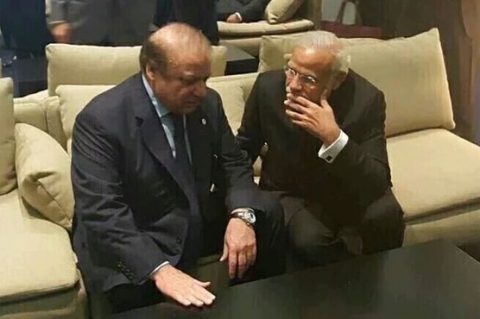
(Nawaz Sharif and Modi in “informal” conversation, Paris, Nov 30, 2015)
But make no mistake that the ISI kept track. The Pakistani side was actually expecting Modi’s surprise visit to Lahore and had made elaborate arrangements for a red carpet reception for the visiting Indian leader. Beyond doubt, every move that Modi made on Pakistani soil and every word he spoke to Nawaz was stored away as memory in the ISI archives.
Suffice to say, it is only Modi who is today in a position to clarify on what basis Imran Khan could have said with such audacity, “Perhaps if the BJP – a right-wing party – wins, some kind of settlement in Kashmir could be reached.”
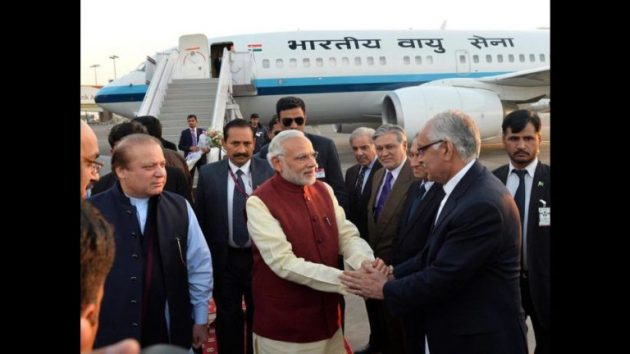
(Nawaz Sharif receiving Modi at the tarmac of Lahore airport, Dec 25, 2015)
Equally, Imran Khan’s caustic remark about the Congress is not unwarranted, when he said he didn’t expect the grand old party to deliver on a Kashmir settlement. Imran Khan cannot be unaware that although Manmohan Singh (or his NSAs) didn’t hang tough on Pakistan in the Indian media, he was tough as nail when it came to defending India’s national interests and didn’t make any concessions whatsoever to Pakistan.
In fact, Congress Party’s record has been consistently “hardline”, although it couldn’t match Modi’s rhetoric. Bangladesh war, occupation of Siachen, maritime boundary in Sir Creek — these are just three templates in India-Pakistan relations that alone should testify to the legacy of Congress rule. It must be remembered that the systematic erosion of Kashmir’s autonomy and India’s breach of promises to the Kashmir people took place in the decades since the fifties right up to the eighties only under Congress governments when BJP wasn’t even around as a gadfly.
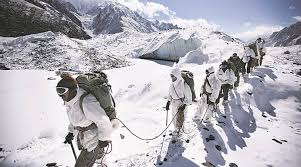
(Indian troops defending Siachen.)
So, the big question is about the signal that Imran Khan is giving when he reposes confidence in Modi to settle the Kashmir problem. Contextually, he would have three objectives — one, cautioning Modi against going too far in demonising Pakistan in his election rallies, no matter his political compulsions; two, projecting to the international audience an air of reasonableness in Pakistani policies ; and, three, forestalling any precipitate move by Modi to ratchet up tensions with Pakistan in the coming weeks between now and May 23, especially if a spectre of defeat haunts him in the election.
This last point is relevant if we factor in the decision by Islamabad only last Sunday to publicise “reliable intelligence” and “authentic information” available with it to the effect that India might make some military moves against Pakistan in the second half of April, once the elections got under way in India, out of which Modi could make political capital by whipping up jingoism.
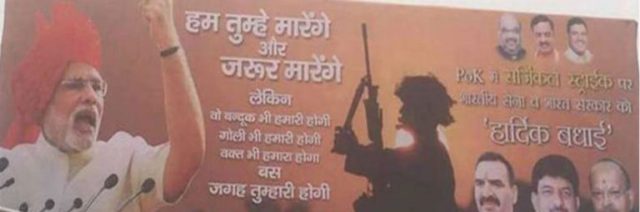
(BJP election poster with Modi and Indian soldier providing backdrop)
The intriguing part in all this is what Imran Khan really thinks of Modi as a politician. Historically, there is a perception in Pakistan that the BJP is a “Baniya party” of wheeler-dealers. But the past five years of BJP rule would have somewhat dispelled such notions. Imran Khan cannot but be aware that Modi is a creation of the RSS and unless and until he broke that umbilical cord, he cannot plough a de-ideologised furrow toward Pakistan.
Now, this is where the Modi-Nawaz exchanges and the back channel conversations between Ajit Doval and his counterpart in Islamabad, former NSA Lt. Gen. Nasser Khan Janjua, come into play. The Indian public knows nothing about the contents of these exchanges and conversations. But ISI knows, the GHQ in Rawalpindi knows and Imran Khan knows. (And, indeed, Modi and Doval know.)
Importantly, therefore, a Pakistani Prime Minister for the first time in the past 7 decades has interfered in an Indian general election and showed his preference for a particular political leader. This is unacceptable. This is blackmail.
Yet, Modi only is responsible for it. Figuring out that he has nothing positive to project before the Indian electorate, Modi made Pakistan the centre piece of his election campaign to malign and embarrass Congress and to deflect attention from burning issues such as unemployment, agrarian crisis, Rafale scam, etc. But by doing so, Modi held open a door through which Imran Khan has simply walked in.
Look at the kind of things Imran Khan says on the eve of an Indian general election — that he prefers Modi (to Rahul Gandhi) as his interlocutor; that “Muslim-ness is being attacked” in India; that Muslims in India are unhappy; that Modi is electioneering like Israel’s Netanyahu, exploiting “fear and nationalist feeling”; that J&K’s special status is under attack; that Kashmiris are waging a political struggle and there is no military solution to it; that “there is still the possibility if the polls turn against Modi in the next few weeks that India could take some further military action against Pakistan” and so on.
The most intriguing remark Imran Khan made was that Modi’s much-touted Balakot attack on February 27 was only an act of dissimulation and so the Pakistani retaliation the next day was a pro forma act — as if it were an elaborate pantomime being played out with Modi as the master choreographer. As he put it, the IAF bombed trees and the PAF retaliated by bombing stones.
These are exceptional remarks for the leader of a foreign country to make. But Modi cannot take exception, because he only invited this Pakistani slur on India’s democracy and its leadership. Clearly, Pakistan is blackmailing Modi and Doval. This seems like Modi’s “Obama moment” in Seoul 7 years ago.
Wealthy Immigrants, Netanyahu and the Movie Tycoon
By Eve Mykytyn | April 11, 2019
What connects wealthy immigrants to Israel, Benjamin Netanyahu and Arnon Milchan, (Israeli operative and producer of 145 movies including 12 Years a Slave and Pretty Woman)? They are all supporters of an Israeli tax exemption that is designed to encourage Jewish billionaires to move to Israel.
Since 1950, Israel’s Law of Return has offered automatic citizenship to anyone with one Jewish grandparent who resides in Israel for 90 days. Despite some tensions, immigration has overall been profitable for Israel. Ostensively to encourage immigration, during the 2008 global financial slowdown, Israel enacted Amendment 168 to its tax code exempting from both tax and reporting all foreign source income (income earned outside of Israel) of new or returning residents. By so exempting newcomers, Israel made itself into a tax haven.
Amendment 168 was called the Milchan Law in honor of the man who lobbied for the amendment and, in 2009, the Tablet announced that the “fertilizer company scion-turned-movie mogul Arnon Milchan is taking advantage of the generous benefits and moving back to Israel.”
In response to the law, in 2009-2010 many an expatriate Israeli billionaire decided to return to his homeland and in 2018 Russian Jewish billionaire Roman Abramovich became an Israeli citizen and instantly became the country’s wealthiest citizen with a net worth, according to Forbes, of $11.5 billion.
The provision may be a factor in the outsized number of millionaire immigrants to Israel In 2015 over 4000 millionaires moved to Israel, more than 10% of that year’s 31,013 immigrants. In fact, Israel was fourth in millionaire inflow — after Australia, the United States and Canada, in that order.
Haaretz called for a repeal to the exemption noting that it provides a “clear benefit to the billionaires who save on taxes for 10 years… [and] enjoy the fog of not having to report for 10 years – a fog that gives them time to conceal their assets and profits.” This benefit is paid for “by the citizens of countries where billionaires no longer have to pay taxes, and the citizens of Israel, who don’t benefit from a tax on the billionaires’ income.”
Israel’s Tax Authority Director, General Moshe Asher, said Milchan’s law made Israel into one of the world’s “most generous tax havens.” Asher defined a tax haven as a place where a) one doesn’t pay taxes and b) there is an exemption from reporting one’s income. And, Asher pointed out: “In Israel we have something extra. We have an expansive network of tax treaties with developed countries that a typical offshore tax haven does not have. [This means that the immigrant] would pay no taxes abroad because of the tax treaty with Israel, and no taxes in Israel because of the law here.”
Israel’s state comptroller worried that the Amendment gave immigrants an incentive to launder money or to use money that was laundered abroad, “activities which may encourage crime and damage the integrity of Israeli society and the economy.” In 2014, an audit of 600 bank accounts belonging to recent immigrants found one hundred accounts to have irregular activity that caused the bank to flag them for suspected money laundering.
The reporting exemption also prevents Israel from honoring its 2013 commitment to follow OECD rules and share tax information with other countries. But each year since 2014, a provision canceling the reporting exemption has been included in legislation and each year it has been removed before the legislation was even voted on.
Despite these issues, Netanyahu attempted to increase the exemption period to 20 years in a move that would have helped Milchan but was rejected by the Finance Ministry. The Attorney General has accused Netanyahu of seeking the extension on Milchan’s behalf.
Milchan‘s biography is novelistic. While running businesses in dozens of countries and producing hit Hollywood movies, Milchan secretly worked for Israel’s intelligence service, acquiring technology and weapons. His efforts included helping Israel develop its nuclear weapons by sourcing uranium from South Africa.
Netanyahu and Milchan’s difficulties began in 2013, when Milchan gave an interview to the Israeli news program Uvda. In the interview Milchan detailed his secret spy work. His revelations led the U.S. to deny Milchan an extension of his ten-year residence visa, jeopardizing his Hollywood career. Netanyahu intervened on Milchan’s behalf with U.S. Secretary of State John Kerry and Milchan was granted an extension.
Then, also in 2013, Milchan began expressing his gratitude by providing luxuries and cash that Netanyahu claims were just gifts from a friend. Under repeated questioning by Israel’s Attorney General Mandelblit, Milchan admitted that what Netanyahu and his wife received were not ‘gifts between friends’ but rather responses to demands made by the Netanyahus.
Mandelblit has announced that after Israel’s election he intends to charge Netanyahu with taking bribes to gain influence and political favors. (The charges resulting from his relationship with Milchan are not the only charges.) Borrowing a page from his friend Donald Trump, Netanyahu has dismissed the investigation as a political witch hunt. In another echo of Trump, polls show it wouldn’t cost Likud any seats in the Knesset if he were to face charges.
Airbnb Buckles under Zionist Pressure
By Jeremy Salt | Palestine Chronicle | April 11, 2019
Airbnb has reversed its decision to ban some 200 listings by Zionist settlers in the West Bank while allowing them to continue in occupied east Jerusalem and the occupied and illegally annexed Golan Heights.
The decision against the listing of West Bank settlements was taken in conformity with Airbnb’s policies of non-discrimination and a commitment to inclusion and respect. Through its reversal, Airbnb has now committed itself to discrimination, exclusion, disrespect and contempt for international law.
Airbnb finally backed down after a “settlement” with Israel’s Shurat Hadin law center, representing the interests of American Jews ‘owning’ property in the West Bank. The center claimed that the ban violated the US government’s 1968 Fair Housing Act, extended now, apparently, to territory outside the US defined as occupied in international law. Pressure was also applied by Zionist lobby groups, by the government of Israel and by US state governments that have introduced anti-BDS legislation.
Within Palestine, as occupied since 1948 some 20,000 people use Airbnb. The Zionist ‘strategic affairs minister’ Gilad Erdem urged them to respond to the original Airbnb decision by boycotting the organization and some did.
Ron de Santis, Florida governor, and former member of Congress said 45,000 Floridians used Airbnb and threatened sanctions that would affect its operations in his state. De Santis also referred to possible violations of the “civil rights” of Floridians who “own” property in the West Bank.
He said Airbnb’s decision violated legislation passed in November 2018, imposing penalties on any company giving support to the BDS campaign. “We have a moral obligation to oppose the Airbnb policy. It does target Jews specifically and when you target Jews for disfavoured treatment that is the essence of anti-semitism. In Florida, as long as I’m governor, BDS will be D.O.A.”
In May, de Santis will lead a party of 80 to Israel where, in Jerusalem, he will preside over a full meeting of the Florida Cabinet. He described Israel as being “a tiny little country in a troubled part of the world standing for freedom, for democratic principles … really, the foundation of our civilization here in the United States, and really the western world, can be traced back to that little plot of land.”
Illinois governor Bruce Rauner called the original Airbnb decision “abhorrent” and a violation of his state’s anti-BDS legislation.
The Simon Weisenthal Centre said the decision “against Jewish homeowners” on the West Bank was anti-semitic. The ADL (Anti-Defamation League), Bnei Brith (‘sons of the covenant’), which describes itself as advancing human rights around the world, and a string of other Zionist lobby groups, also denounced the original decision and welcomed its reversal.
The back down by Airbnb is only the latest in a series of reversals on the occupied territories by governments and organizations. In 2017 Canada’s Federal Food Agency rescinded a decision that wine produced in the occupied West Bank and the Golan Heights could not be labeled as being produced in Israel.
This decision followed the passage of legislation by the Canadian federal parliament early in 2016 denouncing the BDS campaign. In May the Ontario state parliament followed suit by passing a “Standing Up Against Discrimination in Ontario” bill which described the BDS campaign as “anti-semitic” and prohibited all state agencies, including pension funds and universities, from any involvement in the BDS campaign.
The bill is a clear threat to freedom of speech as well as the right of universities to make independent choices on moral questions. The bill has been rejected by academics and students alike, with the Canadian Federation of Students defending the BDS campaign.
In Ireland, the government and the parliament came under heavy pressure from lobbyists to drop the Control of Economic Activity (Occupied Territories) Bill of 2018, submitted in conformity with the 4th Geneva Convention, which protects civilian rights in occupied territories and prohibits their settlement by an occupying power.
Under the bill, the import or sale of any goods or services from settlements in the West Bank would be illegal. Although opposed by the government, the Dail (the parliament) passed the legislation in late January 2019.
The reaction in the US was almost instantaneous. Ten members of Congress penned a letter threatening that the bill would have “broader consequences” on Ireland’s economic relations with the US. Supporters of the BDS campaign should now be boycotting Airbnb while giving thanks for the Irish.
– Jeremy Salt taught at the University of Melbourne, at Bosporus University in Istanbul and Bilkent University in Ankara for many years, specializing in the modern history of the Middle East. Among his recent publications is his 2008 book, The Unmaking of the Middle East. A History of Western Disorder in Arab Lands (University of California Press).
Featured Video
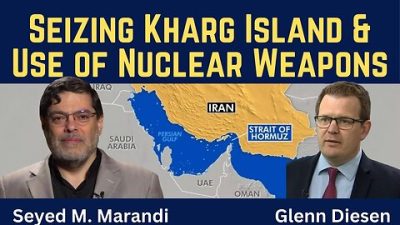
Marandi: Threat of Seizing Kharg Island & the Use of Nuclear Weapons
or go to
Aletho News Archives – Video-Images
Frlom the Archives
Provoking a Path to Persia
The Saban Center’s prescient paper on war with Iran
By Maidhc Ó Cathail | October 20, 2011
In June 2009, the Saban Center for Middle East Policy published “Which Path to Persia?—Options for a New American Strategy toward Iran.” Writing in a tone strikingly reminiscent of the Project for a New American Century’s infamous pre-9/11 paper “Rebuilding America’s Defenses,” the six co-authors noted that, “It seems highly unlikely that the United States would mount an invasion without any provocation or other buildup.” For a think tank specifically established by media mogul Haim Saban to protect Israel, this could prove to be a formidable obstacle impeding their desired march—of U.S. troops—to Tehran.
“In fact, if the United States were to decide that to garner greater international support, galvanize U.S. domestic support, and/or provide a legal justification for an invasion, it would be best to wait for an Iranian provocation, then the time frame for an invasion might stretch out indefinitely,” Saban’s think-tankers ruefully observed.
“With only one real exception, since the 1978 revolution, the Islamic Republic has never willingly provoked an American military response, although it certainly has taken actions that could have done so if Washington had been looking for a fight. Thus it is not impossible that Tehran might take some action that would justify an American invasion. And it is certainly the case that if Washington sought such a provocation, it could take actions that might make it more likely that Tehran would do so (although being too obvious about this could nullify the provocation). However, since it would be up to Iran to make the provocative move, which Iran has been wary of doing most times in the past, the United States would never know for sure when it would get the requisite Iranian provocation. In fact, it might never come at all.”
Seemingly undeterred by Iran’s frustrating unwillingness to provide the requisite provocation, the analysts continued to examine this option… continue
Blog Roll
 Aletho News
- Ukrainian Embassy in Beirut sheltering top Mossad agent
- Palestinian family displaced after settlers violently attack them in Humsa, Jordan Valley
- The EU never learns – except for the wrong lessons
- Iran attacks on UAE leaves RSF militia high and dry
- Hosting Washington’s war: Bahrain faces the consequences
- The US fell for its own Iran propaganda
- Seyed M. Marandi: Threat of Seizing Kharg Island & the Use of Nuclear Weapons
- Is there even an off ramp?
- Michael von der Schulenburg: Europe’s Self-Defeating Iran War Policy
- Sorry, The New Republic, Climate Change Isn’t Causing Somali Migration. Blame Civil Strife and Poverty.
- If Americans Knew
- ‘Of Course’: IDF Drops Case Against Soldiers Accused of Raping Palestinian Prisoner
- Don’t Fall for the Regime Change Talk. Israel Is ‘Mowing the Lawn’ in Iran
- Will Israel and the US wreck the Gulf States along with Iran?
- US so far burned through ‘years’ of munitions in Iran war: Report
- How the Israeli Tail Wags the American Dog
- Outdated intel likely led to deadly U.S. strike on Iranian elementary school, sources say
- Pentagon insider says high U.S official Douglas Feith reported to Netanyahu
- In fond memory of Walid Khalidi, the historian of Palestine
- 6 more Americans killed, as Israel ‘mows the lawn’ in Iran – Not a ceasefire Day 154
- Are we on the precipice of World War III?
- No Tricks Zone
- New Studies: UK Sea Levels Were 4 Meters Higher Than Today During The Mid-Holocene
- Destructive Green New Deal: German Energy And Metal Group Warns Of Drastic Crisis
- New Study Documents A 20-Year Pause In Arctic Sea Ice Decline – Driven By Internal Variability
- Wake-up Call: Survey Shows Majority Of Germans Now Favor Postponing Climate Targets!
- Televised! Leading German Political Candidate Tells Schoolchildren CO2 Makes Sun Hotter!
- New Study: A Century Warming Of 1.1°C Is ‘Commonplace’ And ‘Not Unusual’ During This Interglacial
- New Study: ‘Internal Noise’ And Volcanic Forcing Can Trigger 10-15°C Warming Within Decades
- Glaciers Worldwide Are Suddendly Surging, Experts Blame Warming!
- Surprising Discovery: Sahara Is Greening…Billions Of Trees Where Once Thought To Be Barren
- New Research Reaffirms Clouds, Aerosols, And Surface Solar Radiation Are ‘Driving The Climate System’
 Aletho News