Putin Open to Provocation-Free Dialogue With Ukraine’s Zelenskiy – Kremlin
Sputnik – 08.04.2019
MOSCOW – Russian President Vladimir Putin is ready to discuss any pressing issues with the Ukrainian presidential hopeful, Volodymyr Zelenskiy, if such a dialogue is free of provocations, Kremlin Spokesman Dmitry Peskov said Monday.
“In general, Putin is always open for dialogue, except for the situations when [Kiev] is trying to couple this dialogue with various provocations, sabotage and so on. In such cases, Putin’s reaction is very clear, unequivocal and decisive,” Peskov said.
Ukrainian frontrunner Zelenskiy said Sunday he was ready for talks with Putin on the Donbass conflict in the presence of Western powers.
Ukrainian presidential hopeful Zelensky has won first election round with 30.24 percent of votes, final results of the ballot count revealed, while Poroshenko has gained 15.95 percent of votes.
Hypocrisy Inc: Washington’s Selective Sanctions
By Brian CLOUGHLEY | Strategic Culture Foundation | 08.04.2019
On April 3 US Vice President Pence told Germany and Turkey to stop dealing with Russia. In a speech in Washington marking the 70th Anniversary of the US-NATO military alliance he declared that “If Germany persists in building the Nord Stream 2 pipeline, as President Trump said, it could turn Germany’s economy into literally a captive of Russia,” while Turkey is being “reckless” and “must choose — does it want to remain a critical partner of the most successful military alliance in the history of the world, or does it want to risk the security of that partnership by making reckless decisions that undermine our alliance?”
(We’ll pass over the fact that “the most successful military alliance in the history of the world” bombed and rocketed Libya in a nine-month blitz in 2011 and claimed a “model intervention” in a country it reduced to anarchy, as reported on April 5.)
Radio Free Europe noted that Pence “voiced US opposition to Turkey’s purchase of a Russian air-defense system… which he said ‘poses great danger to NATO’.” He also threatened that “we will not stand idly by while NATO allies purchase weapons from our adversaries”.
The weapons system to which Washington so violently objects is the S-400 Triumf surface-to-air missile which Army Technology describes as “capable of firing three types of missiles to create a layered defence [and] engaging all types of aerial targets including aircraft, unmanned aerial vehicles, and ballistic and cruise missiles within the range of 400 km, at an altitude of up to 30 km. The system can simultaneously engage 36 targets.” In other words it’s a world-beater with a real punch, as is evidenced by the fact that so many other countries have either got it or want it.
The first sanctions Washington imposed against Turkey concern supply of the 100 Lockheed Martin F-35 combat aircraft ordered at a cost of 16 billion dollars. According to CNN a US spokesman said “Pending an unequivocal Turkish decision to forgo delivery of the S-400, deliveries and activities associated with the stand-up of Turkey’s F-35 operational capability have been suspended.” This is harsh action against a longtime partner and military ally, but it doesn’t stop there, because Washington objects to Russia providing military equipment to other nations.
China is an example. In September 2018 sanctions were imposed on China by Washington because it had engaged in “significant transactions” with Russia’s Rosoboronexport by purchasing SU-35 combat aircraft and S-400 systems.
A US official told reporters “The ultimate target of these sanctions is Russia… [sanctions are] aimed at imposing costs upon Russia in response to its malign activities.” This is effected by US Public Law 115-44, the ‘Countering America’s Adversaries Through Sanctions Act’ (CAATSA) which is intended to “provide congressional review and to counter aggression by the Governments of Iran, the Russian Federation, and North Korea, and for other purposes.”
“Other purposes” is quite a large sphere of implied threat, but the ruling of US legislators in this case is clear, in that any country that acquires S-400 air defence missile systems (for example) from Russia is going to be penalised because Washington is determined to continue “imposing costs upon Russia” for providing such equipment. And it is inevitable that the imposed penalties will impact on the country that has dared to engage with Russia. The Diplomat summed it up by observing that the policy “decrees the imposition of mandatory economic sanctions on countries importing Russian military hardware.”
Except when it doesn’t.
It is apparent that the anti-Russia “Countering Adversaries” legislation directed by Congress is being selectively ignored by Washington, because India is being provided with the S-400 system, and no sanctions have been imposed by America. An agreement for supply of S-400s was signed on October 5, 2018 in Delhi during an India-Russia summit meeting attended by Indian Prime Minister Modi and President Putin. The Economic Times reported that India and Russia “have formally inked the $ 5.2 billion deal for S-400 system. The air defence system is expected to be delivered by the year 2020.”
Following the summit, Outlook India noted approvingly that “Other areas of collaboration, which figured prominently in the joint statement between the two sides, are nuclear reactors, investments by Indian diamond companies in Russian Far East, and ‘joint collaboration in precious metals, minerals, natural resources and forest produce, including timber, through joint investments, production processing and skilled labour’. The review of priority investment projects in the spheres of mining, metallurgy, power, oil, and gas, railways, pharmaceuticals, information technology, chemicals, infrastructure, automobiles, space, shipbuilding and manufacturing of different equipment reflects a focus on the desire for diversification. PM Modi has invited Russian companies to set up industrial parks in India for defence manufacturing.”
It might be thought that such bilateral collaboration in defence matters, especially in regard to provision of the S-400 system, would attract instant action by Washington, designed to penalise India for flagrant contravention of US directives.
But no.
In some fashion, India is different from Turkey and China when it comes to acquiring S-400 missile systems, and an explanation of sorts was offered by the Pentagon’s Assistant Defence Secretary Randall Schriver in testimony to the House of Representatives Armed Forces Committee on March 27. He declared that the US-India “Major Defence Partnership” was prospering by “moving toward deeper security cooperation by increasing operational cooperation and availing key maritime security capabilities.” But then there was mention of the purchase for over five billon dollars by India from Russia of a world-beating air defence system, and Mr Schriver wasn’t comfortable with that.
He was asked by Congressman Seth Moulton how India’s purchase of S-400 systems and the lease of Russian nuclear submarines would impact India-US relations and avoided any reply concerning the submarine lease while stating that purchase of S-400s has “not gone to contract or completed”, which, like so many official statements in Washington, was only half true. Certainly, delivery of the S-400s has not been completed; but for Mr Schriver to claim that the matter “has not gone to contract” is a downright lie.
The effects of Washington’s sanctions on its adversaries have been wide as well as selective. In the case of Turkey, what Pence calls the “reckless decision” to acquire S-400s has shown Ankara that America is not an ally and cannot be trusted, while encouraging it to further examine the dubious benefits of belonging to the US-NATO military alliance. China reacted by saying “We strongly urge the US side to immediately correct the mistake and rescind the so-called sanctions, otherwise the US side will necessarily bear responsibility for the consequences,” while reinforcing China-Russia cooperation and strengthening resistance to US policy of global dominance.
In the case of India, US sanctions’ policy was highlighted on April 2 when the Pentagon announced that India would be provided with 24 US Seahawk maritime attack helicopters for use against China and Pakistan, at a cost of 2.6 billion dollars. India is content that it can do whatever it wants, and New Delhi will continue to benefit from Washington’s total lack of principles and ethical consistency. Selective sanctions are the name of the game.
The US’ Plans To Designate The IRGC As “Terrorists” Aren’t Just For Show
EurasiaFuture | April 8, 2019
From Farce To Tragedy
Alt-Media is making a mockery out of the US’ reported plans to designate the IRGC as “terrorists”, giddily quoting the Iranians who spun this rhetoric around and announced that they’ll reciprocate by doing the same to the US military if that happens. The “chattering class” is having a field day using this opportunity to highlight the many abuses that America has committed across the Mideast and the world in general over the decades, seemingly not caring one bit for the possible consequences that could transpire if the US actually goes through with the unprecedented move of designating part of a foreign military as “terrorists”. That’s a mistake because the US’ plans need to be taken much more seriously than they are since they’ll likely herald a new escalation of the Hybrid War on Iran through the possible commencement of direct strikes against the IRGC and its Hezbollah allies in Syria.
“Sitting Ducks”
Like I wrote back in April 2017 after the US’ first conventional strike against Syria, “Trump’s Cruise Missile Message To Iran” was that his country won’t hesitate to hit it and its non-state allies there next, though provided that America was prepared for the inevitable backlash that this would undoubtedly unleash. In hindsight, the US preferred to “play it safe” and not “up the stakes” to the point of potentially triggering a larger Mideast war, but nowadays it appears as though Bolton has convinced Trump that now is the perfect time for striking Iranian positions in Syria due to the Islamic Republic’s refusal to agree to the dignified but “phased withdrawal” that Russia has been pressing them to commence for most of the past year as part of its broader “balancing” strategy. In addition, sanctions have finally begun to bite and a sudden increase in the physical and financial costs of Iran’s Syrian deployment might be all that’s needed to get it to begin the “phased withdrawal” process.
The US insists on maintaining a troop presence in Syria despite Trump’s promised “withdrawal” last year precisely because of its desire to “contain” Iran, so it’s not inconceivable that it will seek to intensify the pressure that it puts on its rival to the point of striking the IRGC and its Hezbollah ally if Washington “officially” regards them both as being “terrorists”. Iran has no air defense assets in the country and Russia is extremely unlikely to allow its Syrian partners to have full and independent control of the much-touted S-300 in order to avoid the scenario of Damascus escalating the situation by shooting at American warplanes and possibly dealing Moscow enormous embarrassment if Washington manages to destroy its surface-to-air missile systems in response. Simply put, Iranian forces are practically “sitting ducks” if the US decides to strike them.
A Likely Ultimatum In Latakia
It should be taken for granted that Iran has many asymmetrical means through which it could likely respond, whether in Syria, Lebanon, the Gulf, or even in “Israel”, but one also shouldn’t over-exaggerate its capabilities either since Tehran has yet to unleash the devastating consequences that it regularly promises every time “Israel” hits its forces in Syria. One can only speculate whether this is a prudent move to patiently wait until the “right moment” or if everything was nothing more than one big bluff to begin with, but whatever the case, the US evidently thinks that it can manage whatever response Iran might have to the potential bombing of the IRGC and Hezbollah by American forces in the event that the former is designated as “terrorists” and Trump wants a dramatic headline-grabbing news event to follow this development.
In fact, the US might even issue an ultimatum to Iran to withdraw from Syria or be militarily driven out after reports recently emerged that the country is about to clinch a deal for operating the Mediterranean port of Latakia just a few hundred kilometers from “Israel“, something that’s sure to set off alarm bells in both Washington and Tel Aviv because of speculation that this economic agreement might have military implications. The reason why an ultimatum might be issued in this case instead of just “bombing first and making demands later” (as is the usual US modus operandi) is because of how close Russia’s Hmeimim airbase is to the port, meaning that any possible strike against Iran’s assets there would be extremely complicated to pull off without coordinating with Russia otherwise another September-like midair tragedy might transpire.
Russia: An Ally To Whom?
“Israel” certainly doesn’t want to repeat the events of that fateful day, nor would the US be willing to risk the outbreak of World War III if a few missiles carelessly veered off course and either hit the Russian base or its assets, so it should be assumed that those two are already in secret talks with Moscow (likely facilitated by Netanyahu’s “shuttle diplomacy” between their two capitals) in order to agree upon a “solution” to this scenario. Syria and Iran should have anticipated that something of the sort was in the works because of Russia’s lengthy track record “passively facilitating” “Israeli” strikes against the IRGC and Hezbollah, so both of them probably predicted that their port deal might force Moscow to stop “balancing” and finally pick a side once and for all.
The “surprise”, however, is that Russia is completely disinclined to pick Iran over “Israel” because it derives enormous strategic benefit in Syria by removing its “friendly competitor” and strengthening its increasingly monopolistic control over the country in the economic, political, and military domains. Furthermore, Iran’s relative weakening is advantageous for Russia because it makes the Islamic Republic more desperate to agree to whatever “sanctions relief” deals Moscow might offer it irrespective of the possibly unfavorable conditions. “Israel”, meanwhile, is poised to become Russia’s top military-strategic partner in the Mideast, and Moscow believes that the comprehensive benefits of this relationship far surpass whatever Iran could provide for it. As such, it can be expected that Russia will silently work to avert the scenario of direct US strikes on the IRGC and especially the Latakia port by more actively encouraging Iran’s dignified but “phased withdrawal” from Syria.
Concluding Thoughts
The US’ very probable designation of the IRGC as a “terrorist” group in the near future would open up the Hybrid War floodgates by providing the “justification” that the Pentagon needs to commence strikes against its rival’s special forces or at least issue the threat thereof as part of a series of forthcoming escalations designed to trigger Iran’s dignified but “phased withdrawal” from Syria. The IRGC has reportedly suffered many casualties already because of Russia’s “passive facilitation” of “Israeli” strikes against it over the years but has yet to make either of them pay, so the likelihood of Iran doing anything real dramatic in response to the US possibly striking its special forces too is low.
In any case, Russia — as the undisputed hegemonic power in Syria — would prefer for the US and “Israel’s” issues with Iran’s military presence in the Arab Republic to be settled as peacefully as possible without posing a danger to its Aerospace Forces, fearful as it is of a repeat of last September’s tragedy in the event that either of those two bomb the Latakia port facilities near its Hmeimim airbase that Iran is on the brink of possessing. Therefore, the US’ reportedly impending designation of the IRGC as “terrorists” will probably cause Russia to cooperate more closely with it behind the scenes (possibly via “Israeli” mediation) to ensure Iran’s dignified but “phased withdrawal” from Syria.
Minnesota Committee Passes Bill to Reform Asset Forfeiture Laws, Opt Out of Federal Equitable Sharing Program
By Mike Maharrey | Tenth Amendment Center | March 27, 2019
ST PAUL, Minn. – A bill moving through the Minnesota House would reform the state’s asset forfeiture laws to require a criminal conviction in most cases and close a loophole allowing state and local police to circumvent the more stringent state asset forfeiture process by passing cases off to the feds.
A bipartisan coalition of representatives introduced House Bill 1971 (HF1971) on March 4. The legislation would effectively end civil asset forfeiture in the state and replace it with a criminal procedure. Under the proposed law, prosecutors would not be able to move forward with asset forfeiture proceedings without first obtaining a criminal conviction in most cases.
HF1971 also addresses the policing for profit motive inherent in the current forfeiture process. Under the proposed law, forfeiture proceeds would be deposited in the state’s general fund after payment of certain expenses. Under the current law, law enforcement agencies keep up to 90 percent of forfeiture proceeds in most cases.
On March 13, the Judiciary Finance and Civil Law Division Committee approved HF1971.
A companion bill (SF2155) was introduced in the Senate on March 7.
NECESSARY
While some people believe the Supreme Court “ended asset forfeiture,” the recent opinion in Timbs v. Indiana ended nothing. Without further action, civil asset forfeiture remains. Additionally, as law professor Ilya Somin noted, the Court left an important issue unresolved. What exactly counts as an “excessive” in the civil forfeiture context?
“That is likely to be a hotly contested issue in the lower federal courts over the next few years. The ultimate effect of today’s decision depends in large part on how that question is resolved. If courts rule that only a few unusually extreme cases qualify as excessive, the impact of Timbs might be relatively marginal.”
Going forward, opponents of civil asset forfeiture could wait and see how lower federal courts will address this “over the next few years,” or they can do what a number of states have already taken steps to do, end the practice on a state level, and opt out of the federal equitable sharing program as well.
FEDERAL LOOPHOLE
Passage of HF1971/SF2155 would take a big step toward closing a loophole that allows state and local police to get around more strict state asset forfeiture laws in a vast majority of situations. This is particularly important in light of a policy directive issued in July 2017 by then-Attorney General Jeff Sessions for the Department of Justice (DOJ).
A federal program known as “Equitable Sharing” allows prosecutors to bypass more stringent state asset forfeiture laws by passing cases off to the federal government through a process known as adoption. The DOJ directive reiterates full support for the equitable sharing program, directs federal law enforcement agencies to aggressively utilize it, and sets the stage to expand it in the future.
Law enforcement agencies can circumvent more strict state forfeiture laws by claiming cases are federal in nature. Under these arrangements, state officials simply hand cases over to a federal agency, participate in the case, and then receive up to 80 percent of the proceeds. However, when states merely withdraw from participation, the federal directive loses its impact.
Until recently, California faced this situation. The state has some of the strongest state-level restrictions on civil asset forfeiture in the country, but state and local police were circumventing the state process by passing cases to the feds. According to a report by the Institute for Justice, Policing for Profit, California ranked as the worst offender of all states in the country between 2000 and 2013. In other words, California law enforcement was passing off a lot of cases to the feds and collecting the loot. The state closed the loophole in 2016.
HF1971/SF2155 features language to close the loophole in most situations.
A local, county, or state law enforcement agency shall not refer, transfer, or otherwise relinquish possession of property seized under state law to a federal agency by way of adoption of the seized property or other means by the federal agency for the purpose of the property’s forfeiture under the federal Controlled Substances Act, United States Code, title 21,section 881; or the Comprehensive Drug Abuse Prevention and Control Act of 1970, Public Law 91-513, section 413.
In a case in which the aggregate net equity value of the property and currency seized has a value of $50,000 or less, excluding the value of contraband, a local, county, orstate law enforcement agency or participant in a joint task force or other multijurisdictional collaboration with the federal governmentshall transfer responsibility for the seized property to the state prosecuting authority for forfeiture under state law.
If the federal government prohibits the transfer of seized property and currency to the state prosecuting authority as required by paragraph (a) and instead requires the property be transferred to the federal government for forfeiture under federal law, the agency is prohibited from accepting payment of any kind or distribution of forfeiture proceeds from the federal government.
As the Tenth Amendment Center previously reported the federal government inserted itself into the asset forfeiture debate in California. The feds clearly want the policy to continue.
Why?
We can only guess. But perhaps the feds recognize paying state and local police agencies directly in cash for handling their enforcement would reveal their weakness. After all, the federal government would find it nearly impossible to prosecute its unconstitutional “War on Drugs” without state and local assistance. Asset forfeiture “equitable sharing” provides a pipeline the feds use to incentivize state and local police to serve as de facto arms of the federal government by funneling billions of dollars into their budgets.
WHAT’S NEXT
HF1971 was referred to the House Ways and Means Committee. SF2155 was referred to the Judiciary and Public Safety Finance and Policy Committee.
US Government’s Refusal to Confirm or Deny It Put American Journalist on Drone Kill List Called ‘Chilling’
“The government seeks to shield itself from all inquiry into the process by which it acts as prosecutor, judge, jury, and executioner.”
By Julia Conley |Common Dreams | April 2, 2019
Lawyers for an American journalist who believes he was placed on the government’s infamous “kill list” warned Tuesday that the rights of all U.S. citizens are at stake if the country’s drone assassination program is allowed to continue.
The organization’s comments came as part of a response to the U.S. government’s attempt to dismiss a lawsuit regarding its use of the list. Reprieve is representing Bilal Abdul Kareem, a journalist and U.S. citizen who claims he was repeatedly targeted —and nearly killed on five separate occasions—by drone and missile attacks in 2016 when he was reporting on the ongoing conflict in Syria.
Kareem joined an Al Jazeera journalist in 2017 in a lawsuit against the government, demanding that the Trump administration remove their names from the “kill list” of potential targets for the U.S. drone program.
If the government manages to have the lawsuit dismissed, legal experts warn it would allow the Trump administration and future presidents to secretly place any American on a kill list without telling them why, therefore stripping them of their constitutional right to due process.
“The right to due process has been a bedrock of the judicial system, and one of the pillars that support a free society going back eight centuries to the Magna Carta,” wrote Tom Emswiler and Will Isenberg in the Boston Globe last summer. “It is the birthright of every American. Gaining a tactical advantage is not worth losing that heritage.”
As Common Dreams reported at the time of the filing, Kareem believes the Obama administration placed him on the kill list and wants President Donald Trump to remove his name, asserting that his inclusion “is the result of arbitrary and capricious agency action, accomplished without due process, and in violation of the United States Constitution and U.S. and international law.”
The government responded that if those included on the U.S. kill list were to be informed and given a trial, national security could be jeopardized during the court case.
Such a claim suggests that the right of the U.S. to operate its drone program trumps Kareem’s—and all Americans’—Fifth and 14th Amendment rights, Reprieve said.
“By invoking the state secrets privilege in the context of designating a U.S. citizen for lethal action, the government seeks to shield itself from all inquiry into the process by which it acts as prosecutor, judge, jury, and executioner of plaintiff Bilal Abdul Kareem,” said Reprieve and the law firm Lewis Baach Kaufmann Middlemiss, which is also representing Kareem, in a statement Tuesday.
The government, in its motion to dismiss, said that Kareem’s due process rights would be satisfied simply by allowing him to present evidence that he has been wrongly placed on the kill list, and that the government was under no obligation to repond.
Reprieve rejected that argument, saying it was akin to “limiting the accused to unilaterally contending that he is innocent of unknown charges in the hopes of persuading a silent, opaque coterie of government officials not to kill him.”
“The government’s assertion that it has the right to mark its own citizens for death, based on secret information, without affording them the legal protections offered by the Constitution, is chilling,” said Jennifer Gibson, co-counsel for Kareem.
“The consequences of this action are too severe,” Reprieve added, “and the right [to due process] too foundational to a constitutional democracy, to allow the government to secretly condemn an American citizen to death.”
The One Jewish State Solution
By Gilad Atzmon | April 7, 2019
Some of the more advanced Israel/Palestine commentators have agreed amongst themselves that the ‘one-state solution’ amounts to empty talk for the simple reason that Palestine is ‘one-state’ already: It has natural borders, one electric grid and even one international pre-dial number (+972). But this beautiful and historic land, stretched from the river to the sea, is dominated by a foreign and hostile ideology that is racially supremacist and vile towards the indigenous people of the land.
Some of those perceptive analysts have been bewildered following a peculiar shift in Israeli politics: while the so-called Israeli ‘Left’ has been advocating racial and ethnic segregation between Jews and Palestinians by adopting the two-state solution, it is actually the Zionist ultra-right that has been pushing constantly for an integration of the ‘land’ by means of Israeli annexation.
While very few within the Israeli Left joined the call for a one-state solution, it seems as if PM Benjamin Netanyahu and the entire Israeli Right are thrilled by the idea.
Prime Minister Benjamin Netanyahu vowed on Saturday to extend Israeli sovereignty to the settlements of the West Bank if he is re-elected in Tuesday’s poll.
Netanyahu’s declaration shouldn’t take us by surprise. Two weeks ago, a Haaretz poll revealed that 42% of Israelis back West Bank annexation. Apparently, 16% of those polled support annexing the entire West Bank without giving any political rights to the Palestinians who live there. I guess that it is hard not to see the political reasoning behind PM Netanyahu’s promise to annex settlements. Netanyahu, who is likely to form the next Israeli government, is attempting to appeal to the Israeli ultra-right voters. He wants them to vote Likud on Tuesday rather than ‘wasting’ their vote on a small ultra-right party or another.
There is obviously a big difference between the one-state call that has been pushed by Palestinian solidarity activists and Netanyahu’s politics of annexation. While Palestinian rights advocates are referring to one democratic state, Netanyahu is not committed to democracy at all. He is solely faithful to the Jewish population and what he offers in practice is a ‘One Jewish State Solution.’ After all, Israel defines itself as ‘the Jewish State’ and it is there to serve one people while denying others their most elementary rights. Israel, as we know, is not a state of its citizens, it is a state of its Jewish citizens. By the time Israel comes to term with its sin and transcends into a state of its citizens regardless of their race, ethnicity or religious belief it will be renamed. It may as well be called Palestine.
Brunei Has Never Executed Anyone And This is Unlikely to Change
By Adam Garrie | Eurasia Future | 2019-04-07
Since 2014, the small south east Asian Sultanate of Brunei has been amending its penal code to reflect letter and spirit of Islamic law. Crucially, the Islamic law that forms the basis of the revised penal code will only apply to instances involving Muslims. This means that non-Muslim tourists in Brunei will still be subject to the same British penal law that Brunei had erstwhile enforced throughout its territory since becoming an independent state in 1984.
Most notably, because the British penal laws of many post-colonial states were never amended to reflect contemporary developments in the UK itself, countries like Brunei prohibited homosexual relations not due to Islamic law but due to post-colonial British laws. It was only in 1967 that homosexual relations were made legal in England and Wales. In 1980, homosexual relationships were made legal in Scotland whilst in 1982 the same became law in Northern Ireland. Even today, the UK’s legal system is not monolithic when it comes to the issue of same-sex rights under the law. Most notably, whilst same-sex marriage is legal in Great Britain, it remains illegal in Northern Ireland.
It is against this context that one must view contemporary legislative developments in Brunei. It is likewise true that just as Brunei inherited Britain’s laws regarding homosexuality, the country also inherited British laws regarding capital punishment. In fact, the last time that someone was executed on the soil of Brunei it was whilst the Sultanate was under British rule. This hanging took place in 1957 and there has not been a single execution in Brunei since. This means that in the history of Brunei as a post-colonial independent state, the death penalty has never been used and there is no reason to believe this will change.
It is a further misnomer that Brunei revised its penal code to specifically target homosexuals. The year-by-year shift from a British corpus of criminal law to an Islamic one has been one that covers all areas of the law. It just so happens that the Islamic legal view on homosexual relations has caught the eye of the international media whilst other elements of Brunei’s revised penal code have not. That being said, the illegality of same-sex relations is not new in Brunei, the issue has simply gone from one that was governed by a largely Victorian British conception of justice to one governed by a strict Islamic conception of justice.
For all intents and purposes however, the situation on the ground in Brunei will not change. Just as technically homosexuality remains illegal in Singapore although the law is openly not enforced, in Brunei there will not be any acts of violence against homosexuals in the small Sultanate whose indigenous population is a mere 428,697 people.
These are the facts – facts which have been woefully misinterpreted by so-called responsible media outlets.
There’s Something Rotten in Virginia: Israel Is a Malignant Force in Local Politics

Mel Chaskin, Chairman of Virginia Israel Advisory Board. Credit: YouTube
By Philip Giraldi | American Herald Tribune | April 7, 2019
One of the more interesting aspects of the relentless march of the Israel Lobby in the United States is the extent to which it has expanded its reach down into the state and even local level. Previously, the American Israel Public Affairs Committee (AIPAC) and the hundreds of other Jewish and Christian Zionist organization dedicated to promoting Israeli interests had concentrated on the federal government level and the media, believing correctly that those were the key players in benefiting Israel while also making sure that its public image was highly favorable. The media was the easy part as American Jews were already well placed in the industry and inclined to be helpful. It also turned out that many Congressmen and the political parties themselves had their hands out and were just waiting to be bought, so “Mission Accomplished” turned out to be a lot easier than had been anticipated.
But amidst all the success, the Israeli government and its diaspora supporters discovered that it was receiving a lot of unwelcome publicity from an essentially grassroots movement that went by the label “Boycott, Divest and Sanctions” or BDS. BDS was strong on American campuses and its appeal as a non-violent tool meant that it was growing, to include many young Jews disenchanted with the Prime Minister Benjamin Netanyahu version of the Jewish state.
Israel works hard to influence the United States at all levels and is generally very successful, but it seemed a stretch to try to pass legislation banning a non-violent movement at a national level so it focused on the states, where legislators would presumably be less concerned over the Bill of Rights. It mobilized its diaspora resources to focus on elections at local and state government levels where Jewish constituents were active in interviewing candidates regarding their views on the Middle East. Candidates understood very well what was happening and also appreciated that their answers could determine what level of donations and the kind of press coverage they might receive in return.
Put together enough intimidated legislators in that fashion and you eventually will have a majority willing to pass legislation blocking or even criminalizing the BDS movement while also granting special benefits to Israel. As of this writing, there is anti-BDS legislation in 27 states, some of which denies state services or jobs to anyone who does not sign an agreement to not boycott Israel. Particularly draconian bills currently advancing in Florida equate any criticism of Israel with anti-Semitism, explicitly define Israel as a Jewish state and also enable anyone who says otherwise to be sued.
Another blatant propaganda program that is being used with congressmen, as well as state and local officials plus spouses, is the sponsorship of free “educational” trips to Israel. The trips are carefully coordinated with the Israeli government and many of them are both organized and paid for by an affiliate of the American Israel Public Affairs Committee called the American Israel Education Foundation (AIEF). There are also other trips sponsored by AIEF as well as by regional Jewish organizations that particularly focus on politicians at state and even local levels as well as journalists who write about foreign policy.
 Everyone is expected to return from the carefully choreographed trips singing the praises of the wonderful little democracy in the Middle East, and many of the travelers do exactly that. The pro-Israel sentiment is buttressed by the activity of the state and local diaspora Jewish groups, which tend to be very politically active and generous with their political contributions.
This coziness often borders on corruption and inevitably leads to abuses that do not serve the public interest, particularly as American citizens are quite openly promoting the interests of a foreign nation. An interesting example of how this works and the abuse that it can produce has recently surfaced in Virginia, where a so-called Virginia-Israel Advisory Board (VIAB) has actually been funded by the Commonwealth of Virginia taxpayers to promote and even subsidize Israeli business in the state, business that currently runs an estimated $500 million per annum in favor of Israel.
Grant Smith’s Institute for Research: Middle Eastern Policy (IRMEP) has done considerable digging into digging into the affairs of VIAB, which was ostensibly “created to foster closer economic integration between the United States and Israel while supporting the Israeli government’s policy agenda” with a charter defining its role as “advis[ing] the Governor on ways to improve economic and cultural links between the Commonwealth and the State of Israel, with a focus on the areas of commerce and trade, art and education, and general government.” Smith has observed that “VIAB is a pilot for how Israel can quietly obtain taxpayer funding and official status for networked entities that advance Israel from within key state governments.”
Documents released under Virginia’s Freedom of Information Act indicate that not only does VIAB not create opportunities for Virginians, it also is active in working against the BDS movement. According to the documents, VIAB, which avoids any public disclosure of its activities, is currently also being scrutinized by the state Attorney General over its handling of government funds.
VIAB was founded in 2001 but it grew significantly under governor Terry McAuliffe’s administration (2014-2018). McAuliffe, regarded by many as the Clintons’ “bag man,” received what were regarded as generous out-of-state campaign contributors from actively pro-Israeli billionaires Haim Saban and J.B. Pritzker, who were both affiliated with the Democratic Party. McAuliffe met regularly in off-the-record “no press allowed” sessions with Israel advocacy groups and spoke about “the Virginia Advisory Board and its successes.”
The Virginia Coalition for Human Rights (VCHR) reports that VIAB is “the only Israel business promotion entity in the United States embedded within a state government and funded entirely by the state’s taxpayers. In terms of the overall state budget, VIAB’s direct share is small ($209,068 for fiscal years 2017 and 2018). However, VIAB’s diversion of state, federal and private grants, as well as demands on state-funded entities like colleges and universities to collaborate in projects designed primarily to benefit Israel, run in the millions of dollars per year. VIAB’s main objective is to provide preferential and unconditional funding to oftentimes secretive Israeli business projects designed to entwine Israeli industries into Virginia industries and government. VIAB seeks to transcend warranted, growing and legitimate American grassroots concerns about human rights in Israel-Palestine by pressuring state lawmakers and the local business community into providing unconditional support and developing a long-term ‘stake’ in Israel.”
Per VCHR, documents released under the Freedom of Information Act found that VIAB, among other suspect practices, had “Provided reports of success that the office of the Governor found to be “inflated without merit.” VCHR concluded that “there should be no preferential and unconditional Commonwealth of Virginia support for Israeli business projects for four key concerns: moral, economic, good governance and state public opinion.” Moral was due to Israel’s “dismal human rights record,” economic because Virginia has a half-billion dollar trade deficit with Israel, good governance because VIAB’s board and leadership are drawn from the “Israel advocacy ecosystem,” and public opinion because opinion polls suggest that over one third of Virginians favor halting all funding for “Israeli business ventures.”
On a similar issue a shadowy group called the Institute for Curriculum Services (ICS), which is actually a “partisan group with backing by state and local Israel advocacy organizations,” is seeking to change the information conveyed by the history and social studies textbooks used in K-12 classrooms across Virginia. ICS recommended changes include: “1. Emphasizing Arab culpability for crisis initiation leading to military action and failure of peace efforts—and never Israeli culpability, even when it is undisputed historic fact. 2. Replacing the commonly used words of “settlers” with “communities,” “occupation” with “control of,” “wall” with “security fence,” and “militant” with “terrorist.” 3. Referencing Israeli claims such as “Israel annexed East Jerusalem” and the Golan Heights as accepted facts without referencing lack of official recognition by the United Nations and most member nation states.”
The activity of the VIAB is little more than robbery of Virginia state resources being run by mostly local American Jews to benefit their co-religionists in Israel. What is significant is that the theft from the American taxpayer, having long occurred at the federal treasury level, now extends down to state and local jurisdictions. And the ICS is yet one more example of attempted Israeli brainwashing of the American public on behalf of the Jewish state to completely alter the narrative about what is going on in the Middle East. Will it ever end? Perhaps, but only when the American people finally wake up to what is being done to them and by whom.
Iran, Iraq ‘agree on aerial defense cooperation’
Press TV – April 7, 2019
Iran’s top military commander says the country and its neighbor Iraq have agreed to cooperate in the area of air defense to fend off the challenges facing their respective air spaces.
Chairman of the Chiefs of Staff of the Iranian Armed Forces Major General Mohammad Baqeri made the announcement to reporters following a meeting in Tehran with his visiting Iraqi counterpart, Lieutenant General Othman al-Ghanimi, Tasnim News Agency reported on Sunday.
The cooperation, Baqeri said, will be aimed at confronting aerial threats.
The meeting addressed “the integrated defense of Iran and Iraq’s skies, because we might sense threats coming from the direction of [our] western borders,” he added.
“Accordingly, it was agreed that the countries’ air defense sectors work together and more coordination be made in this regard,” the Iranian commander said.
Baqeri said the two sides also agreed on potential training cooperation, the transferring of Iran’s defensive experiences to Iraq, and joint military exercises. Agreements on these, he added, will be finalized during a future visit by the Iraqi military chief.
Ghanimi was in the Iranian capital as part of a delegation accompanying Iraqi Prime Minister Adel Abdul-Mahdi. On Saturday, the delegation met with Leader of the Islamic Revolution Ayatollah Seyyed Ali Khamenei and President Hassan Rouhani.
Baqeri cited the Iraqi commander as saying that Baghdad would be exercising stricter control on the United States’ military presence on its soil.
The American forces are only there to train Iraqis and their activities are under the Iraqi Army’s oversight, Baqeri added, citing al-Ghanimi.
In his meeting with Ghanimi, Ayatollah Khamenei had stressed that the Iraqi government should make sure that US forces leave Iraq as soon as possible.
Featured Video
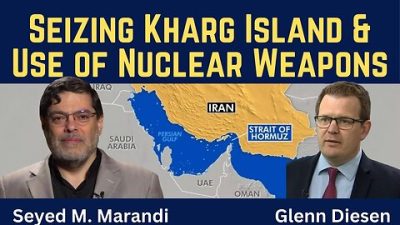
Marandi: Threat of Seizing Kharg Island & the Use of Nuclear Weapons
or go to
Aletho News Archives – Video-Images
Frlom the Archives
Iran War: United States Military Versus Israel Firsters
By James Petras | November 27, 2007
Why must Jewish organizations be and be seen as the loudest drum-beaters of all? Why can we not bring ourselves to say that military intervention is not on the table at all? Why not stash it under the table, out of sight and mount instead a diplomatic assault? – Leonard Fein, Forward
Introduction
As the White House and Congress escalate their economic sanctions and military threats against Iran, top military commanders and Pentagon officials have launched a counter-offensive, opposing a new Middle East War. While some commentators and journalists, like Chris Hedges (Truthdig, November 13, 2007), privy to this high stakes inter-elite conflict, attribute this to a White House cabal led by Vice President Cheney, a more stringent and accurate assessment puts the Zionist Power Configuration (ZPC) in the center of the Iran war debate.
There is a great deal riding in this conflict – the future of the American empire as well as the balance of power in the Middle East. Equally important is the future of the US military and our already heavily constrained democratic freedoms. The outcome of the continuous and deepening confrontation between top US military officials and the Israel Firsters over US foreign policy in the Middle East has raised fundamental questions over self-determination, colonization, civilian primacy and military political intervention, empire or republic. These and related issues are far from being of academic interest only; they concern the future of the United States. … continue
Blog Roll
 Aletho News
- Iran warns it may target US missile launch sites in UAE cities
- American Military Failure in Afghanistan
- Friendly Skies of Georgia: Are Israeli-Linked Drones Launching False Flags from Georgian Territory?
- The Three Big Lies about Mammography Screening
- Ukrainian Embassy in Beirut sheltering top Mossad agent
- Palestinian family displaced after settlers violently attack them in Humsa, Jordan Valley
- The EU never learns – except for the wrong lessons
- Iran attacks on UAE leaves RSF militia high and dry
- Hosting Washington’s war: Bahrain faces the consequences
- The US fell for its own Iran propaganda
- If Americans Knew
- ‘Of Course’: IDF Drops Case Against Soldiers Accused of Raping Palestinian Prisoner
- Don’t Fall for the Regime Change Talk. Israel Is ‘Mowing the Lawn’ in Iran
- Will Israel and the US wreck the Gulf States along with Iran?
- US so far burned through ‘years’ of munitions in Iran war: Report
- How the Israeli Tail Wags the American Dog
- Outdated intel likely led to deadly U.S. strike on Iranian elementary school, sources say
- Pentagon insider says high U.S official Douglas Feith reported to Netanyahu
- In fond memory of Walid Khalidi, the historian of Palestine
- 6 more Americans killed, as Israel ‘mows the lawn’ in Iran – Not a ceasefire Day 154
- Are we on the precipice of World War III?
- No Tricks Zone
- New Studies: UK Sea Levels Were 4 Meters Higher Than Today During The Mid-Holocene
- Destructive Green New Deal: German Energy And Metal Group Warns Of Drastic Crisis
- New Study Documents A 20-Year Pause In Arctic Sea Ice Decline – Driven By Internal Variability
- Wake-up Call: Survey Shows Majority Of Germans Now Favor Postponing Climate Targets!
- Televised! Leading German Political Candidate Tells Schoolchildren CO2 Makes Sun Hotter!
- New Study: A Century Warming Of 1.1°C Is ‘Commonplace’ And ‘Not Unusual’ During This Interglacial
- New Study: ‘Internal Noise’ And Volcanic Forcing Can Trigger 10-15°C Warming Within Decades
- Glaciers Worldwide Are Suddendly Surging, Experts Blame Warming!
- Surprising Discovery: Sahara Is Greening…Billions Of Trees Where Once Thought To Be Barren
- New Research Reaffirms Clouds, Aerosols, And Surface Solar Radiation Are ‘Driving The Climate System’
 Aletho News