OPCW Confirm Leaked Report is Genuine
By Kit Knightly | OffGuardian | May 16, 2019
The leaked OPCW report appears to have been confirmed genuine.
The report, titled “Engineering Assessment of Two Cylinders Observed at Douma Incident”, came to public prominence a few days ago after The Working Group on Syria, Propaganda and Media released their analysis of the text.
Since then it has gotten a lot of play all across the alternate media (you can read our original report here, but there were many others too).
It has received virtually zero coverage in the mainstream media, of course. And that doesn’t appear likely to change any time soon.
The report spells out, in unambiguous language, that the two chlorine gas canisters were likely planted, rather than dropped from a helicopter.
In summary, observations at the scene of the two locations, together with subsequent analysis, suggest that there is a higher probability that both cylinders were manually placed at those two locations rather than being dropped.”
This finding adds to the pile of evidence which makes it appear very likely the whole event was staged.
The only question was whether or not the document could be confirmed genuine. And now it has been.
Peter Hitchens, for a long time the only mainstream voice to express any doubts about the “official narrative” on Douma, wrote to the OPCW to ask about the leaked report.
He wrote a column about it. We suggest you read it, but the most important passage, taken directly from an OPCW statement, is this:
Pursuant to its established policies and practices, the OPCW Technical Secretariat is conducting an internal investigation about the unauthorised release of the document in question.
Note the language. Nowhere is it disputing either the findings of the document, nor the veracity. Instead, they are “conducting an investigation” into its “unauthorised release”.
That is as close to an admission as makes no difference. For now, we can safely conclude the document is real, and the findings genuine.
That means, not only that the Douma “chemical attack” was likely staged, but that the OPCW knew this and chose to cover it up.
A very distressing series of events, and one that could easily have lead to an all-out war between Syria, Russia and NATO.
We welcome the OPCW’s admission that this document is genuine. However, we would suggest the question is not “How was it leaked?”, but rather “Why was it suppressed in the first place?”
Islamic Republic No Threat to Anybody in Iraq or Elsewhere: Iran UN Mission
Al-Manar | May 16, 2019
Iran has rejected the United States’ claims that ‘Iranian activities’ endanger American sites and troops in Iraq, saying the Islamic Republic is no threat to anybody in Iraq or elsewhere.
“’Iran is no threat to anybody in Iraq or elsewhere, and Iran is not preparing for any attacks anywhere,” Alireza Miryousefi, the spokesman for Iran mission to the United Nations made the statement on Wednesday.
“Iran, as is evidenced by our history, only acts in self-defense, and has no offensive strategy against any nation,” he added, according to Mehr news agency.
The official censured the US for sticking to fake reports for spreading propaganda against the Islamic Republic, saying, “Iranians will never capitulate to this new psychological war.”
The US has recently built up its military presence in the region over what it calls an Iranian threat to American troops and interests.
Last week, US Secretary of State Mike Pompeo claimed that the US administration had received intelligence related to “Iranian activity” that put American facilities and service personnel at “substantial risk.”
Other senior officials within the US administration itself as well as other countries have however dismissed that claim.
Following Pompeo’s claims, the US on Wednesday ordered the partial evacuation of its embassy in Baghdad and a consulate in Erbil.
Israel lost $16.8m due to halt of gas production during Gaza offensive
MEMO | May 15, 2019
Israel lost 60 million shekels ($16.8 million) from gas exports as a result of the two-day assault launched against the Gaza Strip earlier this month, a member of the Knesset revealed yesterday.
Al-Wattan Voice reported the Hebrew newspaper Maariv saying that the loses were a result of Energy Minister Yuval Steinitz’s decision to halt gas production at the from Tamar gas field during the attack on Gaza on 4-5 May.
Israeli Member of the Knesset Orit Farkash-Hacohen revealed that 60 million shekels ($16.8 million) had been lost as a result and this would be recouped from tax funds.
Twenty-seven Palestinians were killed during Israel’s attack on the besieged Gaza Strip, including two toddlers, two expectant mothers and one minor. Four Israelis were also killed.
Experts have said the attack was halted because Israel is hosting the Eurovision Song Contest and it did not want news of the attacks to overshadow the global music event, or to deter participants and concert goers from attending.
Israel firm meddled in Africa, Asia and Latin America elections
MEMO – May 16, 2019
An Israel-based campaign to meddle in the elections of several African, Asian and Latin American countries has been uncovered by social media giant Facebook.
Facebook announced today that it had deactivated dozens of accounts found to be spreading disinformation by posing as local journalists and influencers. The social media giant traced these accounts to Archimedes Group, a private company based near Tel Aviv which had engineered the campaign.
Facebook’s head of cybersecurity policy, Nathaniel Gleicher, told reporters that the platform had deleted 65 accounts, 161 pages and dozens of groups linked to the misinformation campaign, noting that this activity had garnered 2.8 million followers and hundreds of thousands of views. Gleicher also told reporters that Archimedes has now been banned from Facebook, Haaretz reported.
For its part, the Times of Israel quoted Gleicher as saying that “these are actors that were essentially facilitating deception, and they appear to be commercially engaged to do this”. He added: “That type of business does not have a place on our platforms so we are removing them from the platform and our teams will continue to investigate to look for other instances of this type of behaviour, [whether] for commercial or other strategic purposes.”
Archimedes’ operations are thought to have focused on Nigeria, Senegal, Togo, Angola, Niger and Tunisia, as well as a handful of Asian and Latin American countries. It is thought that the campaign has spent over $800,000 on Facebook adverts since 2012.
Relatively little is known about Archimedes Group. The Washington Post noted that the group presents itself as “a consulting firm involved in campaigns for presidential elections,” using the slogan “winning campaigns worldwide”. The website also features a vague description of the group’s “mass social media management” software, which it claims can enable the operation of an “unlimited” number of online accounts.
The Washington Post added that Archimedes is headed by Elinadav Heymann, citing Swiss negotiations consultancy Negotiations.CH. Heymann is also reported to have been Executive Director of the European Friends of Israel since 2012 and an “advisor to various parties [in] the Israeli Knesset for 3 terms”.
Facebook’s Gleicher said he could not speculate as to whether Archimedes’ motives were political, and as yet it is not known who solicited and paid for the group’s services. However, given the campaign’s focus on predominantly central and west African countries – a region in which the Israeli state has recently tried to increase its influence – questions to this effect are likely to be raised going forward.
In January, Israeli Prime Minister Benjamin Netanyahu visited Chad to restore diplomatic relations between the two countries, which were severed in 1972. Speaking at a press conference before his departure, Netanyahu said that the visit was “part of the revolution we are doing in the Arab and Muslim world,” claiming that such an initiative “greatly worries, even greatly angers” Palestinians and the wider Arab world.
Though Israel’s normalisation drive in Africa has material benefits – often including lucrative arms deals, memorandums for economic cooperation and the use of airspace which will significantly shorten flight paths for commercial Israeli airlines – the initiative is also pursued for its propaganda value. Netanyahu has long been keen to emphasise these diplomatic successes, particularly in the run up to Israel’s general election which took place last month.
PA New Government Does Not Represent the Palestinian People
By Ramona Wadi | MEMO | April 18, 2019
The new Palestinian Authority government has been welcomed by the UN Special Coordinator for the Middle East Peace Process Nickolay Mladenov, who reiterated the rhetoric reserved for occasions on which the international organisation pledges to work closely with governments in line with their agenda. “At a time of significant financial and political changes to the Palestinian national project,” Mladenov stated, “all must support the government’s efforts and work to overcome internal divisions.”
There is nothing, though, to suggest that the new PA government under recently appointed Prime Minister Mohammad Shtayyeh is working towards reconciliation. Fatah’s insistence that Hamas must relinquish its political control of Gaza has not abated, implying that the PA agenda, as well as that of the UN, has not altered. Last year, there was an increase in the number of international statements, from UN envoys in particular, calling for a return to PA rule in Gaza. The PA, according to them, makes it easier for the UN to carry out its plans.
Mladenov’s statement referenced the previous PA government led by Rami Hamdallah, who had also advanced the call for Hamas to step aside. What followed afterwards is well documented, not least the punitive measures imposed by the PA upon the Palestinian people in Gaza in order to force civilians and politicians alike to surrender. From a PA perspective, ending the Palestinian schism means eliminating and suppressing political alternatives and challengers.
The recent news from Cairo indicates as much, with the Fatah delegation at reconciliation talks placing ultimatums upon Hamas and issuing ambiguous statements regarding the PA’s views on unity and the issue of the weapons in the hands of the armed wing of the Islamic Resistance Movement. In the event of reconciliation, asks Fatah, “What is the need for arms?”
There is thus little divergence from the previous government’s agenda, which is one of the reasons why Mladenov’s rhetoric about the previous and current PA governments overlaps in terms of content. As PA leader Mahmoud Abbas becomes even more irrelevant — due in part to the US efforts to ostracise any form of Palestinian representation and push through its own so-called “deal of the century” — international actors are increasingly taking over and determining the fate of Palestine’s remaining and cruelly fragmented territory.
Having a new PA government that adheres to the same definitions of reconciliation will provide the UN with a further opportunity to alter what remains of Palestine. Despite Mladenov’s praise for Hamdallah’s government keeping in line with the UN Sustainable Development Goals, for example, it is clear that the ongoing colonisation of Palestine, along with the international complicity to ensure that Israel continues to expand its presence, have impeded Palestinians from experiencing any benefits.
A little less “commitment to working with the Palestinian leadership” and more effort towards listening to what the Palestinian people demand and need would go a long way. The UN is not working to “end the occupation”, much less end Israel’s colonisation. The PA has, since its inception, followed suit. A new government that is void of different political strategies, yet has the audacity to speak about Palestinian reconciliation, does not represent the Palestinian people. Mladenov’s comments are another indication of how the new government and the UN intend to work, by persisting in the creation of a diplomatic network that isolates the Palestinian people from the politics determining their fate.
Why is the US always ‘stumbling’ or ‘sliding’ into war? How the media misleads with language

By Danielle Ryan | RT | May 15, 2019
The way the mainstream media tells it, the United States never, ever ends up embroiled in wars and military conflicts on purpose — only ever by mistake, or as a result of things like ‘bad planning’ or ‘strategic missteps’.
Very often when media coverage of war is analysed, there is a focus on how hawkish pundits cheerlead for conflict and journalists parrot official narratives while dissenting voices are drowned out. Mainstream networks, for example, have been heavily criticized by media watchdogs for almost exclusively inviting pro-war guests and ex-military hawks onto their news shows to convince Americans that war is the only reasonable course of action, while refusing to let anti-war commentators get a look in.
But there is another more subtle and unnoticeable way that the media deceives us. Even when they are not outright cheerleading for military action (as was the case in the lead up to the Iraq War), the language they use to describe events is designed to absolve Washington of blame.
Next time you read the news, notice how the US is always “stumbling into” war, or “drifting into” war or “sliding into” war — or even “sleepwalking into” war. To “stumble into” war seems to be a firm favorite among headline writers. The US has “stumbled” into war in Iraq and Syria and has been, at one time or another, at risk of “stumbling” into war with Russia, North Korea and most recently Iran.
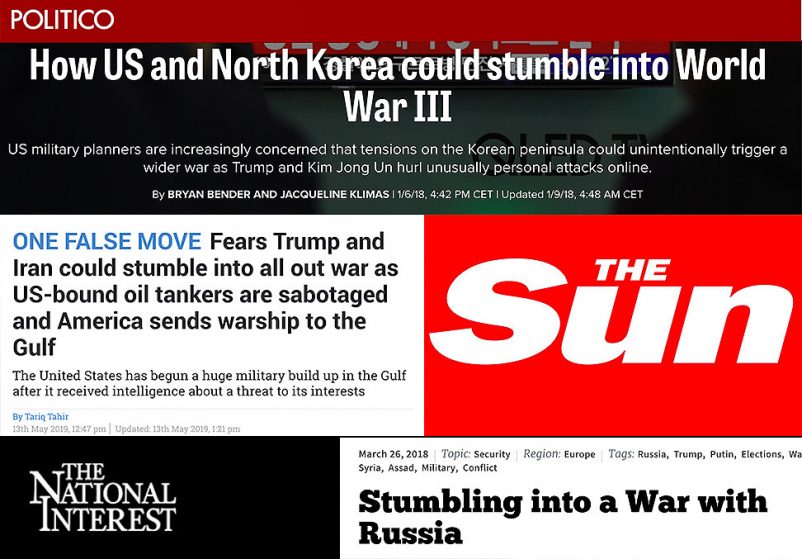
According to these headlines, the US has also been “dragged into” (CNN) and “sucked into” (NI ) war in Syria and Afghanistan, twice (NI, The Times ). In recent weeks, the Trump administration has been “sliding into” (AP ) a potential “accidental” war with Iran — and back in 2017, it was “dragged into” (FP ) the disastrous Yemen conflict.
The examples of the US stumbling, blundering and bumbling its way into wars are endless — and it does raise a question that no one ever seems to ask: If it’s so easy to trip and fall into massive never-ending wars, why isn’t it happening to everyone else? Is Washington just especially clumsy?
With this narrative of the bumbling superpower, agency is always removed from the architects of war. Instead of enthusiastically banging the drums for war, we’re told the White House is always ‘reluctant’ to deploy its military, but is ‘forced’ into it . Then, once the war is in full-swing, when things are not panning out exactly as planned, the US can become the sacrificial hero, propelled into a deadly conflict not of its own making.
A recent headline in the Miami Herald framed recent US actions on Venezuela as the US being “pushed to act.” Pushed by who? The Trump administration voluntarily helped organize and instigate the attempted coups that worsened the country’s political crisis and proudly imposed the economic sanctions which have led directly to thousands of premature deaths. There was no “pushing” involved.
In April, Foreign Policy magazine even had Venezuela’s self-declared interim president Juan Guaido “stumbling toward a coup.” How do you stumble into a military coup? Surely that’s the kind of thing that requires careful, deliberate planning and execution? The Washington Post had Trump “fumbling” an uprising in Caracas, too.
It’s not just media pundits and journalists who employ this kind of misleading language, either. British Foreign Secretary Jeremy Hunt said this week that a US war with Iran could happen “by accident.” Did Hunt take a vacation from reality and miss US Secretary of State Mike Pompeo and National Security Advisor John Bolton ramping up war rhetoric against Iran for months? Maybe Trump abandoned the 2015 Iran nuclear deal by accident and sent an aircraft carrier and bomber task force into the Persian Gulf last week to “send a message” to Iran by mistake.
Such framing obscures basic facts about Washington’s motives and predilection toward military conflict over diplomacy. Washington doesn’t get into wars by mistake. Unless a country is directly attacked, threatened or occupied, wars are quite easy to avoid getting into if you really don’t want to be in them — but the hawks in Washington, no matter how much they pretend to not want war, are always itching for more and they will stop at nothing to get what they want, even if that means fabricating evidence (as in Iraq) or pulling off false flag attacks to use as convenient pretexts for the US to ‘respond’ to.
US military actions are designed specifically to provoke the conflicts that they believe will be of benefit to their overall geopolitical strategy. Talk of freedom, democracy and human rights are just a convenient cover. Washington is never at risk, for example, of stumbling into war with Saudi Arabia, despite Riyadh’s laundry list of crimes against humanity.
Whether this propagandistic language is always employed in a totally conscious way or not, it’s difficult to tell. Either way, it’s a psychological trick which frames the most powerful, military-minded and trigger-happy country in the world as some kind of innocent victim of events beyond its control.
Also on rt.com:
US media’s love affair with war: Major outlets showed zero opposition to Syria strikes
Year of selective blindness: Russian journalist still in Ukrainian jail under bogus treason charges
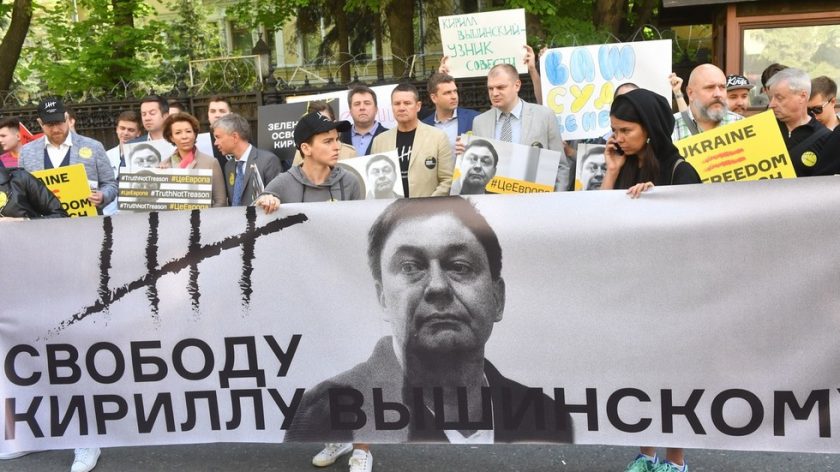
A rally in support of Kirill Vyshynsky in Moscow. ©Sputnik / Aleksey Kudenko
By Alexandre Antonov | RT | May 15, 2019
Exactly a year ago the head of a Russian-Ukrainian news agency was snatched in Kiev and put in jail under a charge of high treason. Western champions of media rights have shown spectacular will to ignore the scandalous case.
Being a journalist in a nation where the government can put you in jail for unfavorable reporting is understandably risky, but at least one can hope to find international support after getting into trouble. Foreign governments and international organizations would cry foul and try to pressure the persecutors.
Well, Kirill Vyshinsky didn’t get this response. On March 15, 2018 he was arrested by agents of the SBU, Ukraine’s powerful national security agency, and charged with treason. His alleged crime was that as head of a Russian-Ukrainian news agency he waged “information warfare” against Ukraine, or at least that’s what the SBU said at the time. The accusation may result in a 15 year jail term.
Vyshinsky has been kept in pre-trial detention since, denied bail or hospital treatment and restricted in visitation rights. The prosecution managed to formulate an 80-page indictment by March, listing 72 stories and opinion pieces published by the news agency since 2014, which the prosecution claims to be manipulative or false.
The journalist insists the accusations are absurd. How can a factually accurate news report about Crimea changing its time zone to that of Moscow or an opinion piece giving a historic overview of referenda held in Ukraine since gaining independence in 1991 be anti-Ukrainian, he argued. The prosecutors said even factually accurate stories can be “anti-Ukrainian in nature.”
Regardless of one’s attitude to what happened between Ukraine and Russia during and after the Maidan mass protests, accurate reporting of facts should not be criminalized. Just imagine what would happen, for example, if in 1999 Russia arrested and put on trial the head of the BBC Russian service, saying the British broadcaster’s coverage of the freshly reignited hostilities in Chechnya was “anti-Russian.” All hell would break loose, and rightfully so.
On Wednesday, there was a protest in front of the Ukrainian embassy in Moscow, calling on Kiev to free Vyshinsky. And a deafening silence from the usual Western defenders of media freedom. Amnesty International, for example, doesn’t mention Vyshinsky’s name on its website at all – not even on the Russian-language and Ukrainian-language versions.
Officials from the Organization for Security Cooperation in Europe and International Federation of Journalists voiced concern about Vyshinsky’s continued incarceration when asked for comments by the Russian media. But the organizations didn’t release any official statements on the occasion of the anniversary. Neither did the Committee to Protect Journalists, although it did report the start of Vyshynsky’s trial in early April.
As for mainstream media in the West, they don’t seem to be particularly interested in their Russian-Ukrainian colleague. Unless, of course, there is a chance to brand him a Russian propagandist who may threaten America’s democracy. A story that the Daily Beast ran in March says Vyshinsky’s wife hired US political consultant Ezra Friedlander to lobby for the journalist’s release in Ukraine, and implied that this may have compromised Friedlander’s other clients, including House Judiciary Committee Chairman Jerry Nadler. In other words, red-baiting at its best.
Apparently, not all reporters are made equal in the eyes of the West. There are those that deserve protection. And there are people like Vyshinsky, or WikiLeaks’ Julian Assange, who are not really reporters – just some guys telling true but unwelcomed facts about the US and its allies. They deserve to rot in jail, right?
Tishchenko’s Case Has Signs of US Intelligence Services’ Provocation – Embassy
Sputnik – 15.05.2019
The case of Russian citizen Oleg Tishchenko, who was extradited from Georgia to the United States, has signs of a provocation, staged by the US intelligence services, the Russian Embassy in the United States said in a statement.
“The Russian Embassy in the United States is closely following the situation around the arrest of Russian citizen O. M. Tishchenko, who has earlier been extradited from Georgia [to the United States]. He is accused of five charges, including smuggling, violation of the law on arms exports ban as well as conspiracy against the United States. The case has signs of the US intelligence services’ provocation,” the statement posted on the embassy’s Facebook page on late Tuesday said.
According to the embassy, Tishchenko is held now in a prison in the Weber County of the US state of Utah.
“Now we are seeking consular access to our compatriot. We will provide O. M. Tishchenko with the necessary consular assistance so that his rights will be respected,” the statement added.
Tishchenko, 42, is a video game developer, who worked on high-precision flight simulators. He is accused of online purchasing documentation about various planes, including F-16, F-22 and F-35 fighters. The criminal case was opened in 2016 and, in early 2019, Tishchenko was arrested in Georgia and later transferred to the United States.
India’s betrayal of Iran is only the beginning
By M. K. BHADRAKUMAR | Indian Punchline | May 15, 2019
The sudden visit to New Delhi by the Iranian Foreign Minister Mohammed Javad Zarif for a meeting on May 14 with the outgoing External Affairs Minister Sushma Swaraj in the dying days of the Modi government underscores dramatically how much Tehran has been traumatised by the Indian decision under American pressure to summarily stop all imports of Iranian oil w.e.f May 2.
If one were to encapsulate the anguish and bewilderment in the Iranian mind, an analogy would be the plaintive entreaty by Julius Caesar in William Shakespeare’s play of that name — ‘Et tu, Brute’ (Even you, Brute) — when on the Ides of March in 44 BC the great Roman statesman spotted amongst the conspirators in the Senate building the pale visage of his old dear friend Marcus Junius Brutus, who were stabbing him in a pre-conceived assassination plot.
To be sure, the unexpected betrayal by the old and dear Indian friend has shocked Tehran. According to reports, Swaraj offered her best explanation by taking a de tour and reportedly holding out a non-committal assurance that Delhi will review the situation after a new government is formed “keeping in mind our commercial considerations, energy security and economic interests.”
Now, this is a big shift from the Indian stance that it will only abide by UN sanctions. But then, it is not within Swaraj’s competence to commit anything. The Boss has to decide, and he’s busy campaigning. In the final analysis, if PM Modi keeps his job, it will be a tricky decision. For, Modi enjoys wonderful friendship with three players of the infamous “B Team” — Benjamin Netanyahu, bin Salman (Saudi Crown Prince), bin Zayed (UAE Crown Prince) — and is wary of the fourth player, Bolton (Trump’s national security advisor). And the B team sponsors the Iran project, which is about ‘regime change’ in Tehran.
The most galling thing about the Indian betrayal is that amongst the three top importers of Iranian oil — China, India and Iran — it’s only India that summarily packed up under American pressure. For the Modi government which claims to be ‘muscular’, such cowardly behaviour is a matter of shame. Simply put, the strategic understanding forged during the historic meeting between Modi and Iranian President Hassan Rouhani in Ufa, Russia, on the sidelines of the SCO summit in May 2019 turns out to be a damp squib. Tehran is bound to reflect over the quality of the hand of friendship that Modi extended.
To jog memory, India is party to a trilateral MOU with Iran and Afghanistan with plans to commit at least $21billion to developing the Chabahar–Hajigak corridor, including $85 million for Chabahar port development by India. This includes $150 million line of credit by India to Iran, $8 billion India-Iran MoU for Indian industrial investment in Chabahar Special Economic Zone, $11-billion for the Hajigak iron and steel mining project awarded to seven Indian companies in central Afghanistan, and $2 billion commitment to Afghanistan for developing supporting infrastructure including the construction of the Chabahar-Hajigaj railway line.
The Chabahar-Hajigaj railway line holds the potential to expand trade manifold via connectivity to the 7,200-km-long multi-mode North-South Transport Corridor India is working on to connect to Europe and Turkey — and all across Russia by linking with the R297 Amur highway and the Trans-Siberian Highway. Over and above, a planned Herat to Mazar-i-Sharif railway will provide access for the Central Asia states via Chabahar Port to link with the Indian market. The Chabahar Port also provides the only means of India developing direct access to its erstwhile air base in Farkhor in Tajikistan. Expert opinion is that the Chabahar route will result in 60% reduction in shipment costs and 50% reduction in shipment time from India to Central Asia.
The Indian media quoted government sources to the effect that the compliance with the US sanctions against Iran is the price that Washington demanded from India as quid pro quo for its support in the UN Security Council on the designation of Masood Azhar as global terrorist. The veracity of this interpretation can never be established, because the Americans will never claim ownership of any derailment of the India-Iran relationship.
Yet, it is an unfair linkage since Azhar designation has been a far from a solo US enterprise. It was collective effort where Britain and China probably played key roles alongside some very effective behind-the-scene bilateral negotiations between Delhi and Beijing aimed at carrying Pakistan along. The Americans are always quick to claim credit when something good happens — and there is always the Indian chorus that is only too keen to echo such tall claims.
Indeed, the “big picture” is not at all reassuring. For, Washington has now added two further templates to its “linkage diplomacy” vis-a-vis India. First, Washington has ratcheted up the pressure on India to remove “overly restrictive market access barriers” against American products — to quote from a speech in Delhi by visiting US Commerce Secretary Wilbur Ross in New Delhi last week. Ross repeated President Donald Trump’s accusation that India is a “tariff king”, and threatened India with “consequences” if it responded to U.S. tariffs with counter-tariffs. Ross audaciously proposed that India could balance the trade figures by buying more American weaponry.
So, what do we have here? Delhi falls in line with the US diktat on Iran sanctions, which of course will hit the Indian economy very badly, while the US is also at the same time aggressively demanding that India should open up its market for American exports. Why can’t the Modi government prioritise India’s economic concerns?
Second, the Trump administration cracking the whip on India to give up the S-400 missile defence system and conform to the US sanctions against Russia’s arms industry. A report in the Hindustan Times says that the US would expect India to instead buy from it the Terminal High Altitude Area Defense (THAAD) and Patriot Advance Capability (PAC-3) missile defence systems as an alternative to S-400s. But these American systems are far more expensive and may still not be on par with the advanced S-400 system in capability.
Evidently, like in the case with Iran, the US attempt is to complicate India-Russia relations by forcing Modi to resile from a commitment he gave to President Vladimir Putin on the S-400 deal.
Meanwhile, another report has appeared that under American pressure, India joined a US-led naval exercise in the South China Sea with America’s Asian allies Japan and the Philippines. Whereas the US, Japan and the Philippines are longstanding allies bound together under military pacts, India is not part of any alliance system. Yet, India took part in the exercise in the disputed South China Sea within a ‘Quad Lite’ format. The US secretary of state Mike Pompeo has a cute expression for it — “banding together”.
The running theme in all this is that India’s strategic ties with Iran, Russia and China are coming under challenge from Washington. But the big question is how come Washington regards the “muscular” Modi government with a 56″ chest to be made of such cowardly stuff? Are the ruling elites so thoroughly compromised with the Americans? There are no easy answers.
Who Really Gains from the Gulf Ship ‘Sabotage’
By Finian Cunningham | Strategic Culture Foundation | May 15, 2019
After dramatic and patently scripted warnings of “Iranian aggression” by bellicose US officials, there then follows – conveniently enough – an alleged sabotage incident in the Persian Gulf region implicating Iran.
Meanwhile, US Secretary of State Mike Pompeo poses with a straight face that his country doesn’t want war with Iran. His comments warp credulity given that American forces have suddenly escalated firepower in the Persian Gulf for the purpose of “responding” to alleged Iranian infractions.
Typically, Western news media are “reporting” (or rather, “echoing”) the purported sabotage incident as if it were fact, basing their source of information on Saudi and Emirati officials, sources which have a vested interest in creating a war pretext against Iran.
Given the grotesque, barefaced lies that have emanated from the Saudi regime over the past year with regard to the murder of journalist Jamal Khashoggi and also its barbaric, mass executions of political dissidents, it is nauseating how Western media can affect to be so credulous in citing Saudi claims as reliable over the latest alleged shipping incident.
“Two Saudi oil tankers have been sabotaged off the coast of the United Arab Emirates posing a potentially serious threat to world oil supplies,” reports [sic] Britain’s Guardian, attributing the source of this information to the “Saudi government”. What the Guardian omitted was the key word “alleged” before “sabotage”. Notice how the impression given is one of a factual incident of malicious intent. Most other Western news media adopted the same reliance on the official Saudi and Emirati claims.
Tellingly, however, Saudi and Emirati officials gave no details about the “significant damage” allegedly caused to a total of four tankers.
What we seem to know is that the four vessels were somehow disabled off the UAE port of Fujairah early on Sunday. The location at sea is in the Gulf of Oman, which lies outside the Persian Gulf, about 140 kilometers south from the Strait of Hormuz. The latter is the narrow passage from the Gulf of Oman into the Persian Gulf, through which up to 30 per cent of all globally shipped crude oil passes each day.
Last week, Iran once again threatened it would blockade its territorial waters in the Strait of Hormuz “if” the US carried out a military attack on it. Such a move by Iran would throw the global economy into chaos from the anticipated crisis in oil markets. It would also doubtless trigger an all-out war between the US and Iran, with American regional client regimes like Saudi Arabia and Israel piling in to facilitate attacks against Tehran.
So far, there have been no official accusations explicitly made against Iran over the latest shipping incident. But the implications are pointedly skewed to frame-up the Islamic Republic.
Saudi energy minister Khalid al Falih, whom Western media have quoted uncritically, claimed that one of the vessels allegedly attacked was on its way to load up on crude oil from the Saudi port of Ras Tanura, destined for the US market. The Saudi official did not give any substantiating details on the alleged sabotage, but emphasized that it was aimed “to undermine the freedom of navigation”. He called on international action to “protect security of oil tankers”. Wording that the American self-appointed global “policeman” (more accurately, “thug”) invokes all the time to cover for its imperialist missions anywhere on the planet.
When the US warned last week that it was sending a naval carrier strike armada to the Persian Gulf along with nuclear-capable B-52 bombers, it assumed the right to hit “Iran or its proxies” for any alleged attack on “American interests”. The wording out of Washington is so vague and subjective that it lends itself to any kind of perceived provocation.
An oil tanker on its way to collect crude from Saudi Arabia for the US market? That certainly could qualify as perceived Iranian aggression against American vital interests.
Last week, Washington issued hammed-up warnings that “Iran or its proxies” was set to “target commercial sea traffic”. Days later, as if on cue, the alleged sabotage of four ships appears to fit the theatrical bill.
Iran, for its part, has said it would not start a war with the US; that it will only act to defend itself from any American offensive. The foreign ministry in Tehran called the latest sabotage claims “highly alarming” and demanded more clarity from the Saudi and Emirati authorities as to what happened exactly. We can be sure that neither will come clean on that score, given their past record of calumny.
The clarifying question is, of course, who gains from the latest twist in tensions? Certainly, it fulfills American, Saudi and Israeli desires to intensify aggression towards Iran.
Another important question is the location of the alleged sabotage. If Iran wanted to carry out such an operation, it would be much more feasible to do it near the Iranian territorial waters in the Strait of Hormuz. Seriously: how feasible is it for several Iranian commando teams to strike four oil tankers in waters some 140 kms away? Waters that are forensically surveilled by the US Fifth Fleet based in the Persian Gulf.
Suspiciously, as already noted, there is no verifiable information about the alleged sabotage. All we’ve got are claims from Saudi and Emirati officials, the same kind of people who claim journalists disappear into thin air while in consular buildings, or that children in Yemen are slaughtered in air strikes by “mistake”, or that peaceful women protesters from Saudi’s oppressed Shia minority are “terrorists” to be executed by beheading with a sword.
And, shamefully, the Western media tamely go along doe-eyed and gullibly with this risible charade.
Sequencing, timing, sources, agenda and motives plus the dutiful Western media servility. The bets are this is a false-flag operation to incriminate Iran.
If it doesn’t result in a pretext for American military attack, at the very least Washington and its Saudi and Israeli clients are trying to make sure the European lackeys are bounced into toeing the line for increasing economic warfare on Iran over the floundering nuclear accord. An international treaty, by the way, which has been torpedoed – verifiably – by American political sabotage.
What’s really going on here is another brazen case of reality-inversion. Compare with contemporaneous US mendacity towards Venezuela, Syria, Cuba, Russia, China, North Korea, and so on. American criminal aggression is, incredibly, again being laundered with a moral license by lying corporate mass media which have the gall to call their blatant war propaganda a “news service”.
Indeed, the world is being lied into a potentially catastrophic war by a congenitally criminal US regime.
Trump considering replacing John Bolton: Report
Press TV – May 15, 2019
US media reports suggest that President Donald Trump is considering replacing his hawkish National Security Adviser John Bolton over his plans to push the United States towards a military conflict with Iran, Venezuela and North Korea.
Bolton “is headed for the exits, having flown too close to the sun on his regime change efforts for Iran, Venezuela and North Korea,” The National Interest magazine reported Tuesday, citing sources familiar with the matter.
“Hearing that Trump wants him out,” a former senior Trump administration official told the magazine.
There is speculation in Washington “that there’s now daylight between Trump and Bolton,” the report added.
The fighting has also expanded to include US Secretary of State Mike Pompeo, officials say. A State Department official and a former White House official both report that Bolton and Pompeo are “fighting all the time.”
A former senior official in the State Department said Pompeo is enthusiastic about isolating Iran, but fearful of an actual war that might engulf much of the Middle East.
“John Bolton is the problem … Trump’s national security adviser is getting dangerous… particularly to the president’s ideals,” Douglas Macgregor, a Bolton rival and would-be successor, writes in Spectator USA.
Trump ran his election campaign on the promise to pull the US military out of Iraq, Afghanistan and Syria — unwinnable post-9/11 wars that have consumed American lives and military budgets.
That partial retreat remains one of Trump’s strongest points in his pitch to be the so-called outsider president.
But Bolton is working in exactly the opposite direction.
The United States has been ratcheting up economic and military pressure on Iran, with Trump recently urging Tehran to talk to him.
“What I’d like to see with Iran, I’d like to see them call me,” Trump told reporters at the White House on Thursday.
But then he said he would not rule out the possibility of military action in Iran amid escalating tensions before slamming former secretary of state John Kerry for his involvement in the issue.
His remarks came after Bolton said on Sunday that the United States was sending an aircraft carrier strike group and a bomber task force to the Middle East in a “clear and unmistakable” message to Iran.
The Pentagon announced on Friday that the US was deploying an amphibious assault ship and a Patriot missile battery to bolster an aircraft carrier and B-52 bombers already sent to the Persian Gulf.
Featured Video

Iran Is Not Our Enemy
or go to
Aletho News Archives – Video-Images
Book Excerpt
“Vaccines Do Not Cause Autism!” The Science is Settled. Right?
ICAN urges the IACC to actually study infant vaccines and autism
 By Aaron Siri | Injecting Freedom | March 16, 2026
On behalf of ICAN, we just sent a copy of chapter 11 of Vaccines, Amen to the newly appointed members of the federal Interagency Autism Coordinating Committee (IACC).
If you haven’t already read this chapter, you can read the whole thing in the attached letter. I trust that after you read it, you’ll see why the statement “vaccines do not cause autism” is a belief, not science!

IACC Public Comment Letter
1.53MB ∙ PDF file
Includes chapter 11 of Vaccines, Amen
Blog Roll
 Aletho News
- IRGC says regional energy sites linked to US will be reduced to ashes
- Qatar condemns ‘dangerous’ Israeli attack on gas field
- Iran made ‘unexpectedly substantial’ offer during Geneva talks, US envoys ‘dragged’ Trump into war: Report
- Russia condemns Israel’s attack near Bushehr plant, files complaint
- Russia Strongly Condemns Actions Aimed at Harming Health of Iranian Leadership – Kremlin
- Israeli Journalist Demands Tucker Carlson and Candace Owens Be Placed in WWII-Style Internment Camps
- No Liability, No Studies, No Accountability: The Vaccine System Aaron Siri Exposed in Federal Court
- No time for losers: Why the war meant to save Israel may destroy it
- Top US Counterterrorism Official Resigns in Protest of Operation Against Iran
- Just Get Out! Now!
- If Americans Knew
- Tucker Carlson says ‘neocons’ will try to destroy Joe Kent over resignation
- Lebanon death toll exceeds 900, another assassination in Iran, bombing in Gaza – Not a ceasefire Day 159
- Trump’s counterterrorism chief, whose own wife was killed by ISIS, quits over Iran War saying Tehran posed ‘no imminent threat’
- Here’s what US could fund instead of Bibi’s war on Iran
- Israel Killed Over a Dozen Lebanese Paramedics in Three Days, Now Claiming That Ambulances Are “Hezbollah” Targets
- War on Iran: These are the heritage sites devastated by US and Israeli attacks
- Four news stories from Israeli media that illustrate Israeli “justice”
- CIA Prepares Criminal Referral of Tucker Carlson, as Israel and Its Loyalists Demand His Arrest
- Top US counterterror advisor resigns in protest of “war manufactured by Israel” – Not a ceasefire Day 157
- ‘I Liked the House’: When Israeli Soldiers Turn Palestinian Homes into Barracks
- No Tricks Zone
- Energy Expert: Germany’s Nuclear Phaseout Was A “500 Billion Euro Mistake”
- New Research: South Australia’s Mid-Holocene Sea Surface Temperatures Were 4°C Warmer Than Today
- Storing Green Energy To Last Germany 10 Days Would Require A 60-Million Tonne Battery
- New Studies: UK Sea Levels Were 4 Meters Higher Than Today During The Mid-Holocene
- Destructive Green New Deal: German Energy And Metal Group Warns Of Drastic Crisis
- New Study Documents A 20-Year Pause In Arctic Sea Ice Decline – Driven By Internal Variability
- Wake-up Call: Survey Shows Majority Of Germans Now Favor Postponing Climate Targets!
- Televised! Leading German Political Candidate Tells Schoolchildren CO2 Makes Sun Hotter!
- New Study: A Century Warming Of 1.1°C Is ‘Commonplace’ And ‘Not Unusual’ During This Interglacial
- New Study: ‘Internal Noise’ And Volcanic Forcing Can Trigger 10-15°C Warming Within Decades
 Aletho News