Hamas condemns Israel’s bombing of media offices in Gaza
Palestine Information Center – May 5, 2019
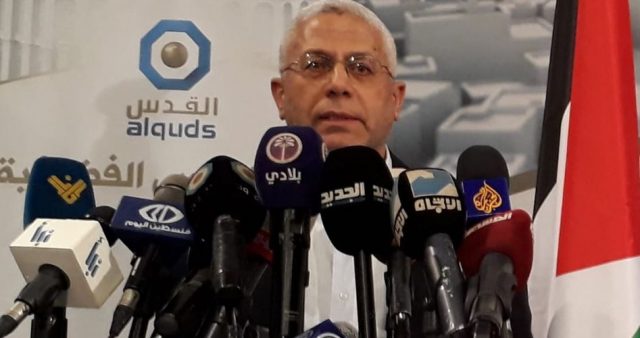
The Hamas leader Raafat Murra on Sunday decried the Israeli occupation army’s targeting of several media offices in the ongoing aggression on the Gaza Strip.
Murra condemned the Israeli attack on the Anadolu Agency office and described it as “terrorism” and “deliberate crime”.
He affirmed that Hamas fully supports all Palestinian, Arab, and international media platforms which cover the events in Gaza objectively and professionally.
Israeli warplanes on Saturday bombed the Anadolu Agency office and the Palestinian prisoners media office with several missiles during large-scale aerial attacks on Gaza.
Iran stops selling excess uranium, will enrich to higher level in 60 days unless Europe acts
RT | May 8, 2019
Iran’s President Rouhani announced a gradual scale-down of the country’s nuclear commitments. Tehran refused to dispose of excessive heavy water and uranium, and said additional measures will be taken over periods of 60 days.
The deal signed with Iran by leading world powers and the EU, offered Tehran a relief of sanctions in exchange for voluntarily restrictions of its nuclear industry. Last year the US broke its commitments under the deal and has been seeking to cripple Iran’s economy with economic sanction. Iran nevertheless remained faithful to its commitments as other signatories pledged to keep the deal alive by withstanding to US pressure.
On Wednesday, President Hassan Rouhani announced on national television that Iran will be suspending some of its commitments under the deal, which is also called Joint Comprehensive Plan of Action (JCPOA), due to continued US violation and a failure of European signatories to compensate for the damage done by Washington.
As of now, Tehran will no longer sell off excessive enriched uranium and heavy water, the Iranian president said. Under JCPOA terms, it is required to dispose of those materials if production exceeds certain thresholds.
Other signatories will have 60 days to negotiate with Iran and address its concerns, particularly in oil industry and banking sector, which Washington targets with its sanctions. If an agreement is reached, the suspension will be reversed.
Otherwise Iran will no longer be bound by an obligation not to enrich uranium over a certain level and may restore the shut heavy water nuclear reactor in Arak, which was supposed to be repurposed with the help of other signatories under the nuclear deal.
After those measures are implemented, 60 more days will be given for negotiations, Rouhani warned. And then Iran may take additional unspecified measures, he said.
Rouhani defended the JCPOA as a deal that was beneficial to Iran and detrimental to the enemies of Iran. He said only “radicals in the US,” Israel and Saudi-led Arab nations were interested in destroying it.
“Today is not the end of the nuclear deal,” he stated, calling on other signatories to act and salvage the agreement.
The deal was signed under US President Barack Obama, but the Trump administration sided with Israel, which believed the agreement to be a threat to its national security and sought to undermine it. Washington withdrew from the JCPOA in May last year.
US responsible for ‘unacceptable’ deadlock on JCPOA – Lavrov
RT | May 8, 2019
The irresponsible policies of the US have put the multilateral pact on Iran’s nuclear program at risk of failure, the Russian foreign minister said, adding that Washington should try diplomacy instead of threats for a change.
Sergey Lavrov criticized the US during a meeting with his Iranian counterpart Javad Zarif, who personally brought a letter from his government informing Russia about Tehran’s latest decision on the nuclear agreement. Russia is one of the signatories of the 2015 document, also known as JCPOA, which offered Iran relief from economic sanctions in exchange for accepting restriction on its nuclear industry.
“As I understand, our main task here is to discuss the unacceptable situation, which has unfolded around the JCPOA as a result of irresponsible behavior by the United States,” the Russian diplomat said before negotiations with the Iranians.
The Iranian minister said Tehran’s actions came in response to the US withdrawal from the deal, and were not meant to destroy the agreement. “[They] can be reversed. There is a 60-day windows of opportunity for diplomacy,” he said.
Later in the day, Lavrov lamented the current US administration’s habit of coercing other nations with threats of sanctions or direct use of military force, be it in the Middle East or Venezuela.
“The day before yesterday, I met US Secretary of State Mike Pompeo in Finland and called on him to use instruments of diplomacy instead of threats when dealing with all issues of contention, and to stick to international law and UN principles, which require the peaceful resolution of conflicts,” he said. “One has to have a taste for diplomacy, which probably not everyone has today.”
Iran on Wednesday announced that it will no longer observe the limits on reserves of enriched uranium and heavy water established by the deal, calling it a response to the US withdrawal from the JCPOA exactly a year ago. Unless European signatories of the agreement deliver on their promise to protect the Iranian economy from unilateral sanctions reimposed by the US over the last 12 months, Iran would take further action, President Hassan Rouhani said in a televised address.
All signatories were formally notified about Tehran’s decision, with Zarif using his coinciding visit to Moscow to offer personal explanations about why it was taken.
Lavrov stressed that Russia appreciated Iran’s continued compliance with the JCPOA even after the US broke its side of the bargain.
US to Sanction Implementation of UN Security Council Resolution
By Peter Jenkins | LobeLog | May 6, 2019
On May 3, the U.S. Department of State announced:
Starting May 4, assistance to expand Iran’s Bushehr Nuclear Power Plant beyond the existing reactor unit could be sanctionable. In addition, activities to transfer enriched uranium out of Iran in exchange for natural uranium could be sanctionable. Iran must stop all proliferation-sensitive activities, including uranium enrichment, and we will not accept actions that support the continuation of such enrichment. We will also no longer permit the storage for Iran of heavy water it has produced in excess of current limits; any such heavy water must no longer be available to Iran in any fashion.
This latest U.S. diktat amounts to a frontal assault on UN Security Council Resolution 2231 of July 20, 2015, which reads in part:
[The Security Council] Calls upon all member states…to take such actions as may be appropriate to support the implementation of the JCPOA, including by taking actions commensurate with the implementation plans set out in the JCPOA and this resolution, and by refraining from actions that undermine implementation of commitments under the JCPOA.
The Security Council adopted this resolution six days after Iran, the United States, the United Kingdom, France, Germany, Russia, China, and the European Union agreed to the Joint Comprehensive Plan of Action (JCPOA). This agreement was designed to restrict Iran’s nuclear activities while International Atomic Energy Agency (IAEA) inspectors look systematically into whether Iran’s nuclear program is “exclusively peaceful.”
Not content with ceasing to implement the JCPOA after the United States pulled out a year ago, the Trump administration is seeking to undermine the implementation of JCPOA commitments by threatening to punish others with sanctions.
The other state most clearly targeted by the diktat is Iran. Paragraph A.7 of the JCPOA stipulates:
During [a] 15 year period Iran will keep its uranium stockpile under 300 kg of enriched uranium hexafluoride…. The excess quantities are to be sold and delivered to [an] international buyer in return for natural uranium delivered to Iran.” And paragraph B.10 requires: “There will be no accumulation of heavy water in Iran for 15 years. All excess heavy water will be made available for export to the international market.
But the U.S. statement of May 3 leaves open the possibility that other states engaging in “activities to transfer enriched uranium” and activities that “support the continuation of enrichment” in Iran could be sanctionable, and that the storage of heavy water on Iran’s behalf will be punished. In other words, henceforth other states run the risk of attracting U.S. sanctions if they “support the implementation” of paragraphs A.7 and B.10 of the JCPOA.
It would be interesting to know whether this is a post-1945 “first.” On several occasions, the United States has turned a blind eye to a client state’s failure to implement the provisions of UN Security Council resolutions. But could this be the first time that the United States has threatened to sanction states for implementing such provisions?
On May 4, the EU High Representative and the Foreign Ministers of France, Germany, and the U.K. issued a statement:
We.…. take note with regret and concern of the decision by the United States not to extend waivers with regards to trade in oil with Iran. We also note with concern the decision by the United States not to fully renew waivers for nuclear non-proliferation projects in the framework of the JCPoA. The lifting of nuclear-related sanctions is an essential part of the JCPoA – it aims at having a positive impact not only on trade and economic relations with Iran, but most importantly on the lives of the Iranian people. We deeply regret the re-imposition of sanctions by the United States following their withdrawal from the JCPoA.
It may be that the reference to non-proliferation projects is intended to encompass the May 3 diktat. If so, this expression of concern is better than silence. But it is hardly commensurate with a frontal assault on the implementation of UN Security Council obligations.
What the situation requires is a Security Council debate and forthright condemnation of U.S. contravention of Resolution 2231.
Iran says not doing anything in breach of JCPOA
Press TV – May 7, 2019
Iran says the countermeasures it has vowed to unveil Wednesday are all within the framework of the 2015 nuclear deal, and the country is not leaving the Joint Comprehensive Plan of Action (JCPOA).
The remarks were made by Foreign Minister Mohammad Javad Zarif upon his arrival in the Russian capital Moscow, where he plans to hold talks with his Russian counterpart on the Iran nuclear deal, among others.
Speaking to reporters on Tuesday night, he said Iran’s “strategic patience” with the US’ violations of the nuclear accord during the past year is over.
“Unfortunately, the European Union and other members of the international community were not capable of standing up to the US’ pressures,” Zarif said.
Therefore, he added, Iran has decided to stop implementing some of the JCPOA commitments it used to fulfill voluntarily “for now”.
The Iranian top diplomat said the right to stop implementing commitments partially or in full in case of violation by other parties has been preserved for Iran in the JCPOA.
So Iran is not doing anything against JCPOA now; rather, it is acting totally within the framework of Articles 26 and 36 of the deal, Zarif noted.
He described the move as “an opportunity for other parties to the deal to take required measures, and not just issue statements.”
Zarif also noted that the decision has been passed by the Supreme National Security Council, and its details will be announced on Wednesday.
Iran said on Monday it seeks to unveil its countermeasures in response to the US’ 2018 withdraw from the landmark 2015 nuclear agreement signed between Tehran and six major world powers.
The plans will be announced on Wednesday, which marks the first anniversary of the US withdrawal from the nuclear deal.
US President Donald Trump withdrew Washington in May 2018 from the landmark Iran nuclear agreement, reached between Iran and the P5+1 group of countries — the US, Britain, France, Russia and China plus Germany — in July 2015. He also decided to re-impose unilateral sanctions against Tehran.
France threatens to re-impose bans
Sources at the French presidency said on Tuesday international sanctions could be re-imposed on Iran if it reneges on commitments under its nuclear deal.
A French presidential source said the European countries did not yet know precisely what steps Iran was now planning, but they could have to re-impose sanctions on Iran if those steps amount to reneging.
“We do not want Tehran to announce tomorrow actions that would violate the nuclear agreement, because in this case we Europeans would be obliged to re-impose sanctions as per the terms of the agreement,” the source said.
“We sent messages to Tehran to say that we were determined to implement the agreement, that we really wanted them to stay in this agreement even though we took into account the complexity of the situation and passed on the same messages to our American allies.”
A second French official later said that if Tehran failed to comply with the deal, the issue would be treated through a dispute mechanism under the accord itself, which could lead to the re-imposition of UN Security Council sanctions.
Letters to P4+1
Iranian President Hassan Rouhani is expected to write letters to the countries still signed up to the deal – Britain, France and Germany as well as Russia and China – on Wednesday to give them details about plans to “diminish its commitments” under the deal, ISNA quoted a source as saying.
The letters would be handed over to the ambassadors of the five countries by Deputy Foreign Minister Seyyed Abbas Araqchi. A separate letter would also be written to EU Foreign Policy Chief Federica Mogherini.
Offended By What Someone Said? Now You Can Report Them To Law Enforcement
MassPrivateI | May 7, 2019
Soon free speech will be a thing of the past in paranoid America.
DIGIT Lab’s “Hate Incident Reporting” app promises to turn complete strangers into secret, hate speech/bias spies.
Watch what you say, because the person sitting next to you could be reporting you to law enforcement.
Gone are the days when Americans were unafraid to voice their opinions or make snide comments in public. Because DIGIT Labs will turn smartphones into bias reporting devices.
According to a PHYS.org article, DIGIT LAB’s new app allows strangers to report someone for exercising their first Amendment rights.
“The first of its kind, the app accepts reports beyond crimes captured in police records. Users from around the country can document all incident types, from derogatory epithets written in bathrooms to slurs yelled from a car window in addition to violent assaults.”
This app will make swearing at a fellow motorist or flipping someone off: hate speech.
Where in our Constitution does it say that it is acceptable to report someone who has not committed a crime?
Since 9/11, Homeland Security has tried to turn the entire country into home-grown spies with their “See Something, Say Something” campaign that essentially does the same thing as DIGIT LAB’s Hate Reporting app. If someone see’s something or see’s someone acting suspiciously they are encouraged to report it to law enforcement.
But the University of Utah’s, Hate Incident Reporting app, promises to create a Federal free speech blacklist.
“The major problem we’re dealing with is that hate crimes are so underreported, not only to police, but from police to the federal government,” said Emily Nicolosi, researcher, and Richard Medina, professor of geography. (Nicolosi helped develop the app.)
Creating a national blacklist of people who use derogatory epithets and slurs will turn this country into a mirror image of China.
“We’d like to see it used nationally to get better hate incident statistics, and to understand why, how, and where people are active in hateful incidents, and how that offends or hurts people,” said Medina.
Although the PHYS article claims that all reporting is confidential and anonymous, the amount of detailed information a person is asked to provide would make it easy for law enforcement to identify someone.
The Same Guy Verhofstadt Who Wants a New Brexit Vote Decries a New Vote For Istanbul’s Mayoral Election
By Adam Garrie | Eurasia Future | 2019-05-07
The leader of the Liberal faction in the European Parliament, Guy Verhofstadt has just decried a decision by Turkish officials to conduct a re-vote in the contentious Istanbul Mayoral race. During the initial vote on 31 March, it was proclaimed that CH Party candidate Ekrem İmamoğlu beat AK Party candidate Binali Yıldırım by a razor thin margin.
Since the initial tally, AK representatives have challenged the result alleging serious irregularities that could have influenced the vote in favour of İmamoğlu. Today, the Turkish Supreme Election Council (YSK) annulled the result of the 31 March election for the Mayoralty in Istanbul and have scheduled a new election to take place on 23 June.
Although such re-run elections are never ideal, in circumstance when a preponderance of evidence indicates that there were enough irregularities present that could have changed the result, re-run elections become the least bad of no good options. This is what the YSK has decided upon in a manner consistent with the principles of mainstream 21st century democracy.
But while the re-run election will be conducted according to normal democratic principles, this has failed to satisfy the notoriously vocal Guy Verhofstadt. The EU Liberal big wig has taken to Twitter to say the following:
“This outrageous decision highlights how Erdogan’s Turkey is drifting towards a dictatorship. Under such leadership, accession talks are impossible. Full support to the Turkish people protesting for their democratic rights and for a free and open Turkey!”
First of all, it was not President Erdoğan who made the decision to hold a new election. It was the YSK’s decision, a body made up of members from multiple parties who then vote on a majoritarian basis in order to enact a decision. In this case, the democratic decision to hold a new election passed by a margin of seven against four.
Secondly, if Turkey’s long stalled quest to join the EU would portend future anti-democratic interference from the likes of Guy Verhofstadt, perhaps many in Turkey ought to be thankful that Brussels has recently leaned against full Turkish membership of the EU. Finally, it is not the “Turkish people” protesting. Those protesting are CH Party workers and supporters who are naturally upset by the electoral re-run. Likewise, supporters of the AK Party had peacefully protested in favour of a re-run. There is nothing unusual about this and of course the protests are occurring freely and without violence.
But the greatest absurdity of Guy Verhofstadt’s meddlesome comments is that while he decries a second vote in a local Turkish election, he has consistently agitated for Britain to hold a re-run vote in order to overturn the Brexit decision made by voters in 2016.
Unlike in the Istanbul election, the British government and opposition parties all accept that the 2016 election was without any worrisome irregularities. In other words, the Brexit referendum was a free and fair vote whilst Turkish authorities have decided that there were too many irregularities in the Istanbul vote for the initial result to be accepted as legitimate.
And yet, Verhofstadt is allying himself with forces that want to overturn a universally acknowledged legitimate vote whilst complaining that a vote in Turkey found to be illegitimate must be set in stone. Once again, double standards rule the day in Brussels.
Different when we do it: Why re-voting is ‘dictatorship’ in Turkey & ‘unity’ in EU

EU Brexit negotiator Guy Verhofstadt © Reuters / Eric Vidal
RT | May 7, 2019
The decision to rerun a local mayoral election in Istanbul has sparked scathing criticism in Brussels — ironically, from none other than the EU’s Brexit negotiator Guy Verhofstadt.
Tweeting about the move, which was branded a “coup” by a Turkish opposition newspaper, Verhofstadt said it highlighted that Turkey was “drifting towards a dictatorship” and offered “full support to the Turkish people protesting for their democratic rights.” Along with the verbal slap on the wrist, he said that under President Recep Tayyip Erdogan’s leadership, talks on Turkey joining the EU are “impossible.”
The irony in Verhofstadt’s outrage, is that the EU itself has a long history of either totally ignoring referendum votes — or just making people vote again until the ‘correct’ result is achieved. But that, of course, does not make the EU a dictatorship. It’s still a “bastion of hope, freedom, prosperity & stability” (as per another recent Verhofstadt tweet). Twitter users wasted no time in pointing out the “irony” and “hypocrisy.”
“How dare [Erdogan] use EU tactics,” one irritated Verhofstadt follower responded, with another saying that the UK itself was currently “battling for its democracy” — a reference to EU officials (including Verhofstadt) who have frequently voiced their personal opposition to Brexit and the ‘Remain’ factions in Britain who have been calling for a re-run of the 2016 referendum.
While there may be at least some merit to the idea of Brexit referendum re-run after two years of failed negotiations and with more accurate information now available to British voters, the idea of simply re-doing EU-related votes is hardly a one-off.
Maybe Verhofstadt should take a trip down memory lane.
France voted ‘no’ to accepting a proposed ‘EU Constitution’ by 54.9 percent in 2005, but the outcome was ignored. The same thing happened in the Netherlands, which rejected it by 61.5 percent. The ‘EU Constitution’ was later repackaged into the Lisbon Treaty and presented to the French parliament where it was adopted, without being put to the people this time (much easier!).
This new Lisbon Treaty was then rejected by Irish voters in 2008, once again sending Brussels into meltdown mode, as the pact needed to be ratified by all member states before taking effect. So, of course, they made some tweaks and asked people to vote again — and got the ‘right’ result the next time. It wasn’t the first time Ireland was asked to re-vote after giving the wrong answer, either. The country also rejected the Nice Treaty in 2001 and accepted it in a second vote a year later.
Greece voted overwhelmingly to reject severe austerity measures desired by the EU in 2015 in exchange for a multi-billion euro bailout. Not long after, under pressure from Brussels, the country’s government agreed to implement even harsher methods — totally ignoring the will of the Greek people.
But way before all that in 1992, Danes, displeased with plans for a single currency, common European defense policies and for joint rules on crime and immigration, rejected the Maastricht Treaty — and were asked to vote again.
Ironically, many European voters voted ‘no’ to these treaties because they were worried that the EU would be turned into some kind of undemocratic superstate where the wills of individual countries and people would be ignored. Being forced to vote until you give the ‘right’ answer doesn’t exactly put those worries to bed. It’s part of the reason why the British voted for Brexit in the first place.
Then there’s Catalonia, where pro-independence leaders were thrown in jail for their role in holding an independence referendum in 2017. One tweeter scolded Verhofstadt and other EU leaders for believing that they have some “moral authority” over Turkey while abuse of pro-independence forces in Catalonia is ignored. “Our leaders are still in prison because they let citizens vote,” they wrote.
With a history like that, maybe it’s a bit rich for Verhofstadt to be going around lamenting the lack of democracy in other countries.
US sanctions against Iran, Cuba, Venezuela breach human rights: UN expert
Press TV – May 7, 2019
A UN rights expert has slammed unilateral US sanctions against Iran, Cuba and Venezuela, saying the use of economic measures for political purposes violates human rights and international law.
In a statement released on Monday, Idriss Jazairy, UN special rapporteur on the negative impact of the unilateral coercive measures, warned that the US bans against the trio might precipitate man-made humanitarian catastrophes.
“Regime change through economic measures likely to lead to the denial of basic human rights and indeed possibly to starvation has never been an accepted practice of international relations,” he said.
“Real concerns and serious political differences between governments must never be resolved by precipitating economic and humanitarian disasters, making ordinary people pawns and hostages thereof,” he added.
Jazairy also voiced worries about Washington’s termination of sanctions waivers for major Iranian crude buyers, saying the move harms not only the Iranian nation, but also their trade partners.
“The extraterritorial application of unilateral sanctions is clearly contrary to international law,” he said.
“I am deeply concerned that one State can use its dominant position in international finance to harm not only the Iranian people, who have followed their obligations under the UN-approved nuclear deal to this day, but also everyone in the world who trades with them,” he noted, referring to the landmark 2015 agreement — officially called the Joint Comprehensive Plan of Action (JCPOA).
Recently, the US ended six months of waivers which allowed Tehran’s eight largest customers to continue importing limited volumes. It also threatened the buyers of Iranian oil with sanctions if they fail to stop their purchases.
The anti-Iran American sanctions had been lifted under the JCPOA, but they returned in place last year when the US abandoned the multilateral accord.
Elsewhere in his statement, the UN rights expert denounced the economic hardship caused by the US sanctions in Cuba and questioned Washington’s claim that its sanctions against Venezuela were aimed at “helping” its people.
He further called on the international community to “challenge” Washington’s restrictive measures against sovereign countries which amount to “a threat to world peace and security.”
“I call on the international community to engage in constructive dialogue with Venezuela, Cuba, Iran and the United States to find a peaceful resolution in compliance with the spirit and letter of the Charter of the United Nations before the arbitrary use of economic starvation becomes the new ‘normal’,” Jazairy said.
Iran to even the nuclear score with US
By M. K. BHADRAKUMAR | Indian Punchline | May 7, 2019
It is going to be 30 years in another six months since the USS Abraham Lincoln, named in honour of the 16th US President, was commissioned on Nov. 11, 1989 as the 5th Nimitz-class aircraft carrier of the American Navy. Now, as it leaves Croatia and heads toward the Persian Gulf, the carrier would have mixed emotions.
Its finest moment in all of these thirty years came on a sunny day off the coast of San Diego on May 1, 2003, when the then commander-in-chief President George W. Bush landed on its deck in the co-pilot’s seat of a Navy fighter jet to give a “thumbs-up” sign and declare victory in the war in Iraq.
“Major combat operations in Iraq have ended,” Bush said, the infamous “Mission Accomplished” banner hovering over him. “In the battle of Iraq, the United States and our allies have prevailed,” the C-in-C declared.
Sixteen years later, USS Abraham Lincoln is going back to the Persian Gulf in atonement — to confront the real winner of the Iraq War and US’ number one enemy, Iran. The irony of this improbable moment cannot be lost on the 5,000-odd men and women on board the carrier when the US National Security Advisor John Bolton announced their new deployment at 9.30 pm on Sunday. The statement said,
“In response to a number of troubling and escalatory indications and warnings, the United States is deploying the USS Abraham Lincoln Carrier Strike Group and a bomber task force to the U.S. Central Command region to send a clear and unmistakable message to the Iranian regime that any attack on United States interests or on those of our allies will be met with unrelenting force. The United States is not seeking war with the Iranian regime, but we are fully prepared to respond to any attack, whether by proxy, the Islamic Revolutionary Guard Corps, or regular Iranian forces.”
Bolton didn’t go into specifics. To be sure, the sudden announcement — unusual for a Sunday and extraordinary for its timing at 9.30 pm — has triggered speculation. However, Tehran has taken Bolton’s words in its stride, dismissing them as “psywar”. One plausible explanation seems to be that 8th May happens to be the first anniversary of the announcement by President Trump on the US’ withdrawal from the Iran nuclear deal and the fact of the matter is that the anniversary highlights three things.
First, the US and a clutch of Middle Eastern allies aside, the international community has continued to support the Iran nuclear deal. The US’ stark isolation is visible. Second, the US’ punitive sanctions against Iran have taken a heavy toll on the latter’s economy. Growth has stagnated while people face numerous privations in day-to-day life. Three, notwithstanding the above, there are no signs of Tehran changing its policies to compromise with the US’ regional strategies.
Importantly, Tehran has also let it be known that on the anniversary date on May 8, President Hassan Rouhani will announce its retaliatory actions against the US withdrawal from the nuclear deal. The Tehran Times, which reflects establishment views, quoted “sources” to the effect Iran proposes to jettison some of the limitations on its nuclear activities (which had been suspended under the 2015) agreement. Specifically, the report goes to explain, that while Tehran as of now does not intend to quit the nuclear deal (although discarded by Washington), it will take measured steps within the ambit of articles 26 and 36 of the 2015 agreement.
Tehran has already notified the European Union (which, along with UK, France and Germany, is a signatory of the agreement) of its intention. An urgent meeting of the so-called Joint Commission (E3+EU3) is due to take place in Brussels today with Iran’s deputy foreign minister and chief negotiator Abbas Araghchi. This is as per article 36 of the nuclear deal, which prescribes the modalities of arbitration. (The Tehran Times report is here.)
Meanwhile, Tehran is mulling over the options available to it. An influential Iranian strategic thinker who is close to the power circles in Tehran and used to be a spokesman for Iran’s nuclear negotiators in the past, Seyed Hossein Mousavian, wrote in the Middle East Eye on Monday about the growing perception in Tehran that the White House is “laying siege to Iran in ways similar to the way the Bush administration did as it prepared to wage an illegal war against Iraq.
Mousavian warned, “With the US constantly increasing sanctions and pressures, with other world powers failing to provide assurances for the JCPOA’s (Iran nuclear deal) economic benefits, Iran’s patience is running out. It is left with two options: A gradual withdrawal from the JCPOA or an immediate departure from Non-proliferation Treaty and the JCPOA simultaneously.”
Mousavian concludes: “Both options are risky. The possibility of military confrontation exists in both options, but the latter is more effective because the United States will no longer be able to use the NPT as an instrument against Iran. In return, withdrawing from the NPT will bolster Iran’s position on the negotiation table more than ever by giving it more bargaining power.” (Ambassador Mousavian’s opinion piece is here.)
Significantly, there have also been reports recently that Iran’s Foreign Minister Javad Zarif is planning to visit North Korea.
Of course, with its back pushed against the wall, Trump administration is leaving Iran with no choice but to retaliate. (The question of capitulation to US bullying simply does not arise.)
Now, if Iran quits the NPT, it has nothing to lose in the prevailing circumstances where its integration into the international community is in any case blocked by US sanctions. On the other hand, without Iran’s inclusion, the roof over the nuclear non-proliferation architecture will collapse overnight.
Suffice to say, Tehran is forcing the international community to push back at the Trump administration and restore the status quo ante in regard of the 2015 deal. But the Europeans have neither the political will nor the capacity or grit to measure up to Iran’s expectations.
The US knows it. Thus, a flashpoint is arising. Clearly, Iran will not precipitate any military confrontation. But then, Israel is also waiting in the wings to cook up some dirty tricks that leads to a US-Iran conflict. Herein lies the risk.
Having said that, Tehran is betting that Trump himself doesn’t want war with Iran. Possibly, Bolton who works for Israeli interests is punching above his weight. But the brinkmanship itself is incredibly dangerous. A US-Iran war is unthinkable, as the consequences will be disastrous not only for both and regionally but also for the world economy and international security. Worse still, Iran does not even threaten US interests directly.
It is highly unlikely that Trump would ever contemplate a replay of the infamous George W. Bush moment aboard the USS Abraham Lincoln. Simply put, Iran is not Saddam’s Iraq. In Syria, Iraq and Afghanistan alone, there are 20,000 American troops deployed within Iran’s missile range.

Besides, Hezbollah has comprehensively targeted Israel. Israeli estimates put the number of Hezbollah rockets at anywhere up to 200,000. Read a thoughtful analysis by the Atlantic magazine entitled The Many Ways Iran Could Target the United States, here.
Featured Video
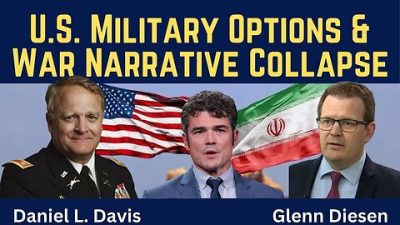
Daniel Davis: U.S. Military Options & War Narrative Collapse
or go to
Aletho News Archives – Video-Images
Book Excerpt
“Vaccines Do Not Cause Autism!” The Science is Settled. Right?
ICAN urges the IACC to actually study infant vaccines and autism
 By Aaron Siri | Injecting Freedom | March 16, 2026
On behalf of ICAN, we just sent a copy of chapter 11 of Vaccines, Amen to the newly appointed members of the federal Interagency Autism Coordinating Committee (IACC).
If you haven’t already read this chapter, you can read the whole thing in the attached letter. I trust that after you read it, you’ll see why the statement “vaccines do not cause autism” is a belief, not science!

IACC Public Comment Letter
1.53MB ∙ PDF file
Includes chapter 11 of Vaccines, Amen
Blog Roll
 Aletho News
- Washington’s War on Cuba Is Older Than You Think
- Daniel Davis: U.S. Military Options & War Narrative Collapse
- Protesters call on Brussels university to cut partnership with Israeli defense-linked firm
- Weapons makers cash in on Trump’s Iran war
- Why Trump’s anti-Iran naval coalition in Strait of Hormuz is doomed to fail
- IRGC says regional energy sites linked to US will be reduced to ashes
- Qatar condemns ‘dangerous’ Israeli attack on gas field
- Iran made ‘unexpectedly substantial’ offer during Geneva talks, US envoys ‘dragged’ Trump into war: Report
- Russia condemns Israel’s attack near Bushehr plant, files complaint
- Russia Strongly Condemns Actions Aimed at Harming Health of Iranian Leadership – Kremlin
- If Americans Knew
- How ignorance, misunderstanding and obfuscation ended Iran nuclear talks
- Israeli media reports grotesque settler attack in West Bank
- UK security adviser attended US-Iran talks and judged deal was within reach
- Tucker Carlson says ‘neocons’ will try to destroy Joe Kent over resignation
- Lebanon death toll exceeds 900, another assassination in Iran, bombing in Gaza – Not a ceasefire Day 159
- Trump’s counterterrorism chief, whose own wife was killed by ISIS, quits over Iran War saying Tehran posed ‘no imminent threat’
- Here’s what US could fund instead of Bibi’s war on Iran
- Israel Killed Over a Dozen Lebanese Paramedics in Three Days, Now Claiming That Ambulances Are “Hezbollah” Targets
- War on Iran: These are the heritage sites devastated by US and Israeli attacks
- Four news stories from Israeli media that illustrate Israeli “justice”
- No Tricks Zone
- Energy Expert: Germany’s Nuclear Phaseout Was A “500 Billion Euro Mistake”
- New Research: South Australia’s Mid-Holocene Sea Surface Temperatures Were 4°C Warmer Than Today
- Storing Green Energy To Last Germany 10 Days Would Require A 60-Million Tonne Battery
- New Studies: UK Sea Levels Were 4 Meters Higher Than Today During The Mid-Holocene
- Destructive Green New Deal: German Energy And Metal Group Warns Of Drastic Crisis
- New Study Documents A 20-Year Pause In Arctic Sea Ice Decline – Driven By Internal Variability
- Wake-up Call: Survey Shows Majority Of Germans Now Favor Postponing Climate Targets!
- Televised! Leading German Political Candidate Tells Schoolchildren CO2 Makes Sun Hotter!
- New Study: A Century Warming Of 1.1°C Is ‘Commonplace’ And ‘Not Unusual’ During This Interglacial
- New Study: ‘Internal Noise’ And Volcanic Forcing Can Trigger 10-15°C Warming Within Decades
 Aletho News