The Arab Emergency Summit in Mecca: Provocative and Invective
By Elias Samo | Strategic Culture Foundation | June 18, 2019
When an Arab emergency summit is called to convene, one would naturally assume the existence of an urgent Arab crisis which requires immediate attention. So, when king Salman of Saudi Arabia called for an emergency Arab summit to convene in Mecca, the holiest Muslim city, the natural assumption was that there is an urgent Arab crisis to be dealt with, immediately.
Therefore, one had to assume the urgent Arab emergency summit meeting in Mecca on May 30, 2019, would have to do, though belatedly, with the ramifications of Arab states destroying Arab states, Muslims killing Muslims, Arabs killing Arabs. Or perhaps more specific urgent Arab matters such as the American recognition of a united Jerusalem as the eternal capital of Israel, the moving of the American embassy to Jerusalem, the declaration by Netanyahu of his intention to annex the major Israeli settlements with American acquiescence or with the American recognition of the Israeli annexation of the Syrian Golan, or the “Deal of the Century”. Surprisingly and unfortunately the summit dealt with none of the above.
On the face of it, the summit was an official Arab emergency summit, but in reality, it was a Saudi Arabian summit and the agenda was a Saudi Arabian agenda: Iran, which was practically the exclusive item on the agenda and in the final communique. No perceptive Arab affairs genius would have thought of an urgent need for an emergency Arab summit to deal with a presumed ‘Iranian threat’ to the Arabs. There is mutual animosity and perception of security threats between Iran on the one hand and Saudi Arabia and a very few Arab states, mostly in the Gulf region, on the other hand. However, there are no similar feelings between the majority of other Arab states and Iran.
The final communique was delivered by the Secretary General of the Arab League, Ahmed Aboul Gheit, at the conclusion of the summit. It starts with a preamble and ten operative paragraphs. Iran is mentioned in the preamble and the operative paragraphs no less than fifteen times. The onslaught on Iran full of provocations and invectives started with the preamble and moved on with gusto in the operative paragraphs.
The impetus for convening the emergency summit, as noted by Mr. Aboul Gheit, was “the serious repercussions of the attack by the Iranian-backed Houthi terrorist militias on two oil pumping stations in the kingdom of Saudi Arabia and the attack on commercial vessels in the territorial waters of the United Arab Emirates.”
In view of the killing and wounding of millions of Muslim and non-Muslim Arabs, the immigration and displacement of more millions, the chaos and destruction and the rendering of several Arab states as failed states, it is amazing that attacks on two oil pumping stations in Saudi Arabia, and on four commercial vessels in the territorial waters of the UAE, in which the culprit is uncertain, warranted the convening of an emergency Arab League summit to target and condemn Iran. It is made clear in the preamble, and the ten substantive paragraphs, of the communique that the culprit is Iran. But why the certainty that Iran is the culprit? Because John Bolton, American National Security Adviser, who is not known for his honesty and truthfulness, said so! Mr. Bolton said he will provide the evidence later; thus, a new legal norm: Convict then provide the evidence.
Not only the reason for convening of the emergency summit is amazing, but the content of the ten-paragraph communique is shocking.
1. Historically and traditionally, Israel and Zionism are standard features in Arab League summit communiques. Thus, the present summit communique is a first for not including the terms Israel nor Zionism once.
2. Similarly, Palestinians are a standard feature in Arab League summit communiques. Thus, the present communique is also a first for not mentioning the Palestinians once. Although, as an afterthought, the last sentence of the last paragraph ten states that the issue of Palestine is “the main Arab issue”, but it did not merit a single operative paragraph.
3. While the communique does not include the aforementioned names, it has certainly gone overboard in provocatively and invectively mentioning Iran/Iranians and often preceded by ‘condemning’ and ‘denouncing’, no less than fifteen times.
4. Syria is mentioned once in paragraph ten for the purpose of condemning Iran. It is ironic that the Arab states, who expelled Syria from the League, the majority of which were not independent states when Syria and five Arab states established the League in 1945, met in a presumed Arab League summit and have suddenly become concerned about Syria. They denounced “the Iranian interference in the Syrian crisis and its implications for Syria’s future.”
The irony is that the ‘Iranian interference’ is legitimate, because it came at the request of the legitimate Syrian government and “supported Damascus’s efforts in fighting terrorism which was supported by some of those meeting in this summit”, as noted by the Syrian Foreign Ministry.
The Arab summit in Mecca was a Saudi Arabian conference attended by Arab states to discuss Saudi Arabia’s perceived and contrived Iranian threats. Threats which are, largely, not shared by most of the Arab states, not even shared by some of the Arab Gulf states. The contention that Iran constitutes a threat to the Arab states is contentious, and irrespective of what Netanyahu, Bolton and Pompeo claim, it is Iran which is threatened by the US, Israel and Saudi Arabia.
Finally, why manufacture a new crisis, and a potential war in the Muslim Arab region which is already ravaged by a multitude of crises, conflicts and wars?
West’s black ops like virus, secretly destroying nations until it’s too late – Russian intel chief
RT | June 18, 2019
Western secret services are perfecting clandestine tools which are designed to weaken countries like viruses weaken bodies, the Russian foreign intelligence chief has said. This kind of warfare is currently used in Venezuela.
The criticism came from Sergey Naryshkin, who heads Russia’s foreign intelligence agency SVR. He said spies are constantly improving the tool used to dispose of governments that the West does not like.
“We are talking about creating a universal algorithm for conducting clandestine influence operations in a continuous manner and on a global scale,” he said. According to the official, this clandestine work “never stops and targets not only enemies, but also friends and neutral powers in the times of peace, crisis and war.”
It can be compared to the action of a virus; it can spend decades destroying a human organism without symptoms, and once diagnosed, often it’s too late to treat it.
The methods used to influence and destabilize other nations include creating network-oriented structures that can operate on a premise of public activism, art, science, religion or extremism, the Russian official said. After collecting data on the fault lines in a targeted society, those structures are used to attack those weak points in a synchronized assault, overwhelming the nation’s capability to respond to crises.
Simultaneously the perpetrators push a narrative through local and global media and social networks that claims that the only way to resolve problems is to replace the government of the victim nation with another one, possibly with direct foreign support.
“We can observe this scenario being implemented in Venezuela,” Naryshkin said.
The US is currently trying to replace Venezuela’s elected President Nicolas Maduro with another person, Juan Guaido, whom Washington recognized as the legitimate head of the South American nation.
Among others, the US backs his bid with economic sanctions against Venezuela and a massive diplomatic and media campaign in support of the pretender. Guaido’s attempts to actually seize power in Caracas have been futile, so far.
The Russian intelligence chief was speaking at an international security forum in Ufa, Russia, which is hosted by the Russian National Security Council. The event is meant for officials directly involved in policy making on security issues. Almost 120 nations are participating in this year’s gathering.
Ottawa hires hit man to overthrow Venezuelan government
By Yves Engler · June 17, 2019

Allan Culham
Meet the hired gun Ottawa is using to overthrow the Venezuelan government.
The brazenness of Ottawa’s intervention in the South American country’s affairs is remarkable. Recently Global Affairs Canada tendered a contract for an individual to coordinate its bid to oust President Nicolás Maduro. According to buyandsell.gc.ca, the Special Advisor on Venezuela needs to be able to:
“Use your network of contacts to advocate for expanded support to pressure the illegitimate government to return constitutional order.
“Use your network of civil society contacts on the ground in Venezuela to advance priority issues (as identified by civil society/Government of Canada).
Must have valid Government of Canada personnel TOP SECRET security clearance.”
The “Proposed Contractor” is Allan Culham who has been Special Advisor on Venezuela since the fall of 2017. But, the government is required to post the $200,000 contract to coordinate Canada’s effort to overthrow the Maduro government.
Culham is a former Canadian ambassador to Venezuela, El Salvador, Guatemala and the Organization of American States. During his time as ambassador to Venezuela from 2002 to 2005 Culham was hostile to Hugo Chavez’s government. According to a WikiLeaks publication of US diplomatic messages, “Canadian Ambassador Culham expressed surprise at the tone of Chavez’s statements during his weekly television and radio show ‘Hello President’ on February 15 [2004]. Culham observed that Chavez’s rhetoric was as tough as he had ever heard him. ‘He sounded like a bully,’ said Culham, more intransigent and more aggressive.”
The US cable quotes Culham criticizing the national electoral council and speaking positively about the group overseeing a presidential recall referendum targeting Chavez. “Culham added that Sumate is impressive, transparent, and run entirely by volunteers”, it noted. The name of then head of Súmate, Maria Corina Machado, was on a list of people who endorsed the April 2002 military coup against Chavez, for which she faced charges of treason. She denied signing the now-infamous Carmona Decree that dissolved the National Assembly and Supreme Court and suspended the elected government, attorney general, comptroller general, and governors as well as mayors elected during Chavez’s administration. It also annulled land reforms and reversed increases in royalties paid by oil companies.
After retiring from the civil service in 2015 Culham described his affinity for another leading hard-line opposition leader. Canada’s current Special Advisor on Venezuela wrote, “I met [Leopoldo] López when he was the mayor of the Caracas municipality of Chacao where the Canadian Embassy is located. He too became a good friend and a useful contact in trying to understand the many political realities of Venezuela.” But, López also endorsed the failed 2002 coup against Chavez and was convicted of inciting violence during the 2014 “guarimbas” protests that sought to oust Maduro. Forty-three Venezuelans died, hundreds were hurt and a great deal of property was damaged during the “guarimbas” protests. Lopez was also a key organizer of the recent plan to anoint the marginal opposition legislator Juan Guaidó interim president.
In his role as Canada’s ambassador to the OAS Culham repeatedly took positions viewed as hostile by the Chavez/Maduro governments. When Chavez fell gravely ill in 2013, he proposed the OAS send a mission to study the situation, which then Vice-president Maduro described as a “miserable” intervention in the country’s affairs. Culham’s comments on the 2014 “guarimbas” protests and support for Machado speaking at the OAS were also unpopular with Caracas.
At the OAS Culham criticized other left-of-centre governments. Culham blamed elected President Rafael Correa for supposedly closing “democratic space” in Ecuador, not long after a failed coup attempt in 2010. When describing the Honduran military’s overthrow of social democratic president Manuel Zelaya in 2009 Culham refused to employ the term coup and instead described it as a “political crisis”.
In June 2012, the left-leaning president of Paraguay, Fernando Lugo, was ousted in what some called an “institutional coup”. Upset with Lugo for disrupting 61-years of one-party rule, Paraguay’s ruling class claimed he was responsible for a murky incident that left 17 peasants and police dead and the senate voted to impeach the president. The vast majority of countries in the hemisphere refused to recognize the new government. The Union of South American Nations (UNASUR) suspended Paraguay’s membership after Lugo’s ouster, as did the MERCOSUR trading bloc. A week after the coup Culham participated in an OAS mission that many member countries opposed. Largely designed to undermine those countries calling for Paraguay’s suspension from the OAS, delegates from the US, Canada, Haiti, Honduras and Mexico traveled to Paraguay to investigate Lugo’s removal from office. The delegation concluded that the OAS should not suspend Paraguay, which displeased many South American countries.
Four years later Culham still blamed Lugo for his ouster. He wrote: “President Lugo was removed from office for ‘dereliction and abandonment of duty’ in the face of rising violence and street protests (that his government was itself instigating through his inflammatory rhetoric) over the issue of land rights. Violence in both the countryside and the streets of Asuncion threatened to engulf Paraguay’s already fragile democratic institutions. Lugo’s impeachment and removal from office by the Paraguayan Congress, later ratified by the Supreme Court, launched a firestorm of protest and outrage amongst the presidents of Paraguay’s neighbours. Presidents Rousseff of Brazil, Hugo Chavez of Venezuela and Cristina Kirchner of Argentina, were the chief defenders of Lugo’s right to remain in office.”
After retiring from the civil service Culham became more candid about his hostility to those trying to overcome extreme power imbalances in the hemisphere, decrying “the nationalist, bombastic and populist rhetoric that many leaders of Latin America have used to great effect over the last 15 years.” For Culham, “the Bolivarian Alliance … specialized in sowing its own divisive ideology and its hopes for a revolutionary ‘class struggle’ across the hemisphere.”
Culham praised the defeat of Cristina Kirchner in Argentina and Dilma Rousseff Brazil.
In a 2015 piece titled “So long, Kirchners” he wrote, “the Kirchner era in Argentine politics and economics is thankfully coming to an end.” (Kirchner is the front runner in the upcoming election.) The next year Culham criticized Brazilian President Dilma Rousseff’s bid to have UNASUR challenge her impeachment, which he celebrated as “a sign of change in Latin America”.
Culham denounced regional integration efforts. In a long February 2016 Senate foreign affairs committee discussion of Argentina, he denounced diplomatic forums set up by Brazil, Ecuador, Bolivia, Argentina, Venezuela and others to break from US domination of the region. “Since I’m no longer a civil servant”, Culham stated, “I will say that CELAC [The Community of Latin American and Caribbean States] is not a positive organization within the Americas. Mainly because it’s built on the principle of exclusion. It purposefully excludes Canada and United States. It was the product of President Chavez and the Chavista Bolivarian revolution.” Every single country in the hemisphere except for Canada and the US were members of CELAC.
Culham criticized left-wing governments position at the US dominated OAS. Culham bemoaned the “negative influence ALBA [Bolivarian Alliance for the Peoples of our America] countries have brought to the OAS” and said Argentina “often sided with Bolivarian revolution members” in their “negative agenda” at the OAS, which he called “very close to my heart”.
In his comments to the Senate committee Culham criticized Kirchner for failing to pay the full price to US “vulture funds”, which bought up the country’s debt at a steep discount after it defaulted in 2001. He described Kirchner’s refusal to bow down to highly predatory hedge funds as a threat to the “Toronto Stock Exchange” and labeled a Scotia Bank claim from the 2001 financial crisis a “bilateral irritant” for Canada.
Canadian taxpayers are paying a hardline pro-corporate, pro-Washington, former diplomat hundreds of thousands of dollars to coordinate the Liberal government’s bid to oust Venezuela’s government. Surely, there is someone in the House of Commons willing to inquire about Canada’s Elliot Abrams?
Recruiting American Spies for Israel
Tax-exempt American foundations lay the groundwork
By Philip Giraldi • Unz Review • June 18, 2019
Israel never loses an opportunity to promote what it perceives to be its interests. That any nation would do just that most of the time should surprise no one, but Israel is perhaps unique in terms of how assiduously it works at creating situations that favor it through the use of corruption of foreign governments and subversion of existing institutions. For most countries, the actions of a minority that seeks to advance the interests of a foreign nation would face strong resistance, but Israel manages to get away with what it does due to the presence of powerful and wealthy diaspora communities, most particularly in the Anglophone countries, but also in France.
The Israel Lobby in the United States has been subjected to some scrutiny thanks largely to the impetus provided by Professors John Mearsheimer and Stephen Walt’s groundbreaking study The Israel Lobby and U.S. Foreign Policy. More recent revelations have come from undercover journalism undertaken by al-Jazeera, which has demonstrated how British Jewish groups and parliamentarians have worked together with Israeli Embassy intelligence officers to remove public officials believed to be critical of Israel. Jeremy Corbyn, leader of the Labour Party, has been on the receiving end of a campaign to replace him for his alleged anti-Semitism solely because he has condemned Israeli oppression of the Palestinians. A second al-Jazeera investigation demonstrated how The Lobby, cooperating with the Israeli Embassy, has been controlling discussion of the Middle East in the United States, which should have surprised no one.
Europe indeed appears to be a hotbed of anti-Semitism, or so Israel and its friends would have us believe. Leaders in France, Germany and Britain feel compelled to frequently address the issue, making the equivalent of a war on anti-Semitism a principal objective of government. The United States has joined this effort, appointing a Special Envoy to Monitor and Combat Anti-Semitism whose job includes reporting other countries’ treatment of Jews and Israel.
The newest wrinkle comes under the category of Lawfare. It consists of hate crime laws that are directed against anyone criticizing Jews and, increasingly, Israel. In fact, any criticism of Israel is frequently being seen as a criminal offense, a trend that is also evident in the United States at the national, state and local levels, where Jewish groups have also been quick off the mark in claiming that anti-Semitism is surging. Freedom of speech in the western world has been diminished as a result.
Diaspora Jews are well entrenched in the media, which has enabled them to promote a narrative favorable to Israel no matter what it does, to include a repetitive dose of holocaust guilt that plays out from Hollywood and elsewhere in the media. The assiduously cultivated message for the public is that Jews are always the victims, never the aggressors, even when IDF snipers shoot Arab children and medical workers during protests.
Perhaps more seriously damaging are the technology thefts and deliberate export of American jobs to the Jewish state by Israelis and their diaspora billionaire friends, as well as general interference in and spying on the U.S. government at all levels. But perhaps the most outrageous initiatives engaged in by the Jewish state are the direct attempts to manage U.S. policies by subverting individual Americans who are or will be well placed to influence U.S. government decision making. It is well known how new Congressmen and spouses are treated to an all expenses paid trip to Israel by an affiliate of the American Israel Public Affairs Committee (AIPAC), which is little more than a propaganda exercise designed to influence their thinking about what is going on in the Middle East while at the same time impressing them regarding the power and wealth of The Lobby. The pandering to Israel is frequently extreme. Late last month, Florida’s governor Ron DeSantis, who has declared himself the most pro-Israel governor in the U.S., held a possibly illegal meeting of his state’s governing cabinet in Jerusalem.
A recent article in the Jerusalem Post demonstrates another aspect of how extensive Israeli efforts to infiltrate and corrupt American institutions to their benefit actually are. The article describes how “Close to 40 American cadets and officers wrapped up a two-week long trip to Poland and Israel on Monday, meeting with high-ranking military officers to learn about the Jewish State and the reality of its security situation. The trip, organized by Our Soldiers Speak (OSS), left a deep impression on the visiting service members who hail from the West Point Military Academy, the Air Force Academy, and the Virginia Military Institute, with some even voicing their readiness to fight and if necessary die alongside IDF troops.”

It was the third such visit to Israel by a group of representative military cadets. The travelers were treated to guilt first with stops at concentration camps in Poland. They then were subjected to the Israeli point of view through “high-level briefings from current and former policymakers and commentators from across the spectrum in the areas of security, strategy, international relations, law, politics, and more.”
Make no mistake, the entire exercise was a scarcely concealed bid to set up what one might regard as the recruitment of future Israeli spies within the U.S. military. Such spies, who will plausibly be able to promote policies favorable to Israel, are referred to as “agents of influence.” Benjamin Anthony, the Director of OSS, admitted as much, saying that “This unparalleled experience enables American cadets to learn about hot-button issues and matters of utmost strategic importance in the Middle East firsthand. By forging bonds between the cadets and Israeli military officers, we are laying the groundwork for future understanding and productive interactions. We wanted to impact people who will be in leaderships positions a short time after the trip to Israel. All of them will be in command positions two or three years after this trip and they will be better informed about America’s greatest ally in the Middle East and the world.”
The cadets, who apparently received no pre-trip briefings from their respective institutions regarding Israeli spying, naively accepted everything they were presented with and appear to have believed they were hearing the unvarnished truth about the Middle East. They even compared the Jewish state favorably to their own country. One cadet, Stephen Marn of the Virginia Military Institute, enthused that “Israel has so many enemies knocking on their back door yet the people in Jerusalem were happy, enjoying life… it was an amount of true patriotism that I don’t see in America today. I got pretty emotional.”
Marn, who will receive a commission in the U.S. Army, said that he can “absolutely” see himself fighting alongside IDF officers. “No question, without a doubt,” he said with a smile. West Point cadet Travis Afuso agreed, saying “Absolutely. We have a shared understanding of the threats, a shared set of values based on freedom and democracy and those are the things which will allow us to fight together and if necessary to die by each other’s side if that’s what it comes to. If that is what my country asked of us, if I was sent here, I would be proud to stand by the soldiers of the IDF.”
Afuso also admired how “Every soldier we spoke to had a deep need to serve. They understand that there will be no Israel unless people are willing to die for Israel. A lot of people in America need to understand that nothing is free and you have to work for it.”
The comments of the cadets are regrettably similar to the effusions by U.S. Air Force Lieutenant General Richard Clark, who has enthused that American soldiers are “prepared to die for the Jewish state” and also added that they would “probably” be under the command of Israeli Air Force General Zvika Haimovitch, who would decide on the involvement of U.S. personnel. Haimovitch commented “I am sure… we will find U.S. troops on the ground… to defend the state of Israel.” The two generals were referring to the fact that the U.S. already has airmen stationed permanently at Israel’s Mashabim Air Base in spite of the fact that the two countries have no defense agreement of any kind. The Americans, though few in number, would serve as a trip wire to guarantee that Washington would become involved in any war that Israel chooses to start.
The fact that future military officers are so naïve as to accept a dog and pony show presented by a foreign government that urgently needs uncritical American support is discouraging. The VIP tour they took was no doubt escorted by good looking young Israeli male and female soldiers, the food they ate was probably exceptional, and one might bet that the high officials they spoke to actually pretended to care about the cadets on a personal level. Once those cadets become military officers in responsible positions a few years down the road good buddy Benjamin from the IDF will show up with a dinner invitation to talk about old times. At dinner, Ben will ask for a favor. That is how an intelligence operation targeting certain groups or demographics works. Relax, we love you.
But what is really surprising is how the trip was organized and paid for. In spite of all the activity by the organization being focused on Israel and its interests, OSS is not Israeli. It is American, funded by the usual Jewish oligarchs and organizations. The “Our Soldiers” referred to are Israelis, demonstrating one again where the actual loyalty of some American Jews resides. OSS is somewhat similar to the odious U.S.-based Friends of the Israel Defense Forces, which routinely raises millions of dollars in gala events in Hollywood and New York City.
Both of the Israeli front organizations are IRS approved 501(c)3, a status normally granted to groups that are either educational or charitable. Donations are tax exempt, which means that the American taxpayers are footing part of the bill for organizations that are plausibly recruiting spies within the United States government and also supporting a military that is in no way allied with the U.S. It would be very interesting to ask a Congressman how that came about, but he or she would be too terrified to respond, while inquiries to Treasury would undoubtedly land on the desk of the same Jewish bureaucrat who granted the exemptions in the first place. Unfortunately, in Washington some things never change.
Philip M. Giraldi, Ph.D., is Executive Director of the Council for the National Interest, a 501(c)3 tax deductible educational foundation (Federal ID Number #52-1739023) that seeks a more interests-based U.S. foreign policy in the Middle East. Website is councilforthenationalinterest.org, address is P.O. Box 2157, Purcellville VA 20134 and its email is <a:inform@cnionline.org” title=”mailto:inform@cnionline.org” href=”mailto:inform@cnionline.org”>inform@cnionline.org.
Israel’s Secretive Nuclear Facility Leaking as Watchdog Finds Israel Has Nearly 100 Nukes
By Whitney Webb | MintPress News | June 17, 2019
The Stockholm International Peace Research Institute (SIPRI) — an international watchdog organization focusing on conflicts, the arms trade and nuclear proliferation — released a new report on Monday that claimed that Israel has nearly a hundred nuclear warheads, more than previously thought.
The SIPRI report described Israel’s nuclear arsenal as follows: 30 gravity bombs capable of delivering nuclear weapons by fighter jets; an additional 50 warheads that can be delivered by land-based ballistic missiles; and an unknown number of nuclear-armed, sea-launched cruise missiles that would grant Israel a sea-based second-strike capability.
In total, the SIPRI report estimated that Israel possesses between 80 and 90 nuclear weapons, an increase over previous years. SIPRI was unable, however, to confirm those estimates with Israel’s government, which has a long-standing policy of refusing to comment on its nuclear weapons program — a policy it describes as “nuclear ambiguity.”
As a result of this “nuclear ambiguity” policy, the actual number of Israeli nuclear weapons is unknown. Some other organizations, such as the U.S.-based Nuclear Threat Initiative, have estimated that Israel has produced enough weapons-grade plutonium to arm between 100 and 200 nuclear warheads. Israel is one of only five nations in the world that refuse to sign the Treaty on the Non-Proliferation of Nuclear Weapons, an international treaty aimed at ending the proliferation of nuclear weapons and achieving global nuclear disarmament.
During a speech last August in front of the Dimona nuclear reactor in the Negev Desert, Israeli Prime Minister Benjamin Netanyahu threatened to use nuclear weapons to “wipe out” Israel’s enemies. More recently, Netanyahu and his allies in the U.S. accused Iran of seeking to develop nuclear weapons, despite the fact that intelligence agencies of both the U.S. and Israel have long recognized that Iran has no such program.
Unsafe, but only for those whose lives don’t matter
Just as the new SIPRI report has again brought scrutiny to Israel’s nuclear program, new information about Israel’s nuclear facility — the Shimon Peres Negev Nuclear Research Center, which houses the Dimona reactor — has also raised concerns about the facility’s safety.
Late last week, an Israeli court heard arguments that the site had leaked radioactive waste on more than one occasion and that information about those leaks had been hidden from some of the facility’s employees. One of those employees, Faridi Taweel, is suing the facility after learning he had cancer, which he suspects was the result of exposure to leaked radioactive material at the site.
The exposure of the numerous leaks at the Dimona facility is greatly concerning, especially in light of the revelation just a few years ago that the Dimona reactor is believed, according to a group of Israeli scientists, to have an estimated 1,537 defects. Israel has reportedly refused to consider replacing or fixing the aging nuclear core.
The fact that the site has leaked and is rife with defects should be a major issue for Israelis, as the facility is just 30 miles south of Israel’s capital Tel Aviv. Yet it is the city of Dimona itself that is in the greatest danger, as it is located just eight miles from the highly defective reactor.
But Dimona is largely populated by Jews from Northern Africa. This minority, referred to as “Black Hebrews” in Israel, is routinely discriminated against by Israel’s government, a recent example of which was the revelation of a covert Israeli government program of forcibly sterilizing African Jewish immigrants.
In addition to its large population of African Jews, Dimona and the surrounding Negev Desert are home to several Palestinian Bedouin villages, villages that are frequently labeled as “illegal” and demolished by Israel’s government. The fact that there is no political will or effort to clean up the site or prevent future leaks, coupled with the fact that the most at-risk populations are minorities frequently discriminated against by Israel’s government, reveals yet another troubling and overlooked aspect of Israel’s secretive nuclear program.
Whitney Webb is a MintPress News journalist based in Chile. She has contributed to several independent media outlets including Global Research, EcoWatch, the Ron Paul Institute and 21st Century Wire, among others. She has made several radio and television appearances and is the 2019 winner of the Serena Shim Award for Uncompromised Integrity in Journalism.
FBI Never Saw CrowdStrike Unredacted or Final Report on Alleged Russian Hacking Because None was Produced
By Ray McGovern | Consortium News | June 17, 2019
CrowdStrike, the controversial cybersecurity firm that the Democratic National Committee chose over the FBI in 2016 to examine its compromised computer servers, never produced an un-redacted or final forensic report for the government because the FBI never required it to, the Justice Department has admitted.
The revelation came in a court filing by the government in the pre-trial phase of Roger Stone, a long-time Republican operative who had an unofficial role in the campaign of candidate Donald Trump. Stone has been charged with misleading Congress, obstructing justice and intimidating a witness.
The filing was in response to a motion by Stone’s lawyers asking for “unredacted reports” from CrowdStrike in an effort to get the government to prove that Russia hacked the DNC server. “The government … does not possess the information the defandant seeks,” the filing says.
In his motion, Stone’s lawyers said he had only been given three redacted drafts. In a startling footnote in the government’s response, the DOJ admits the drafts are all that exist. “Although the reports produced to the defendant are marked ‘draft,’ counsel for the DNC and DCCC informed the government that they are the last version of the report produced,” the footnote says.
In other words CrowdStrike, upon which the FBI relied to conclude that Russia hacked the DNC, never completed a final report and only turned over three redacted drafts to the government.
These drafts were “voluntarily” given to the FBI by DNC lawyers, the filing says. “No redacted information concerned the attribution of the attack to Russian actors,” the filing quotes DNC lawyers as saying.
In Stone’s motion his lawyers argued: “If the Russian state did not hack the DNC, DCCC, or [Clinton campaign chairman John] Podesta’s servers, then Roger Stone was prosecuted for obstructing a congressional investigation into an unproven Russian state hacking conspiracy … The issue of whether or not the DNC was hacked is central to the Defendant’s defense.”
The DOJ responded: “The government does not need to prove at the defendant’s trial that the Russians hacked the DNC in order to prove the defendant made false statements, tampered with a witness, and obstructed justice into a congressional investigation regarding election interference.”
Thousands of emails from the DNC server were published by WikiLeaks in July 2016 revealing that the DNC interfered in the Democratic primary process to favor former Secretary of State Hillary Clinton over Senator Bernie Sanders for the party’s presidential nomination. The U.S. indicted 12 Russian military intelligence agents in 2018 for allegedly hacking the DNC server and giving the emails to WikiLeaks.
Comey Can’t Say Why
At a time of high tension in the 2016 presidential campaign, when the late Sen. John McCain and others were calling Russian “hacking” an “act of war,” the FBI settled for three redacted “draft reports” from CrowdStrike rather than investigate the alleged hacking itself, the court document shows.
Then FBI Director James Comey admitted in congressional testimony that he chose not to take control of the DNC’s “hacked” computers, and did not dispatch FBI computer experts to inspect them, but has had trouble explaining why.
In his testimony, he conceded that “best practices” would have dictated that forensic experts gain physical access to the computers. Nevertheless, the FBI decided to rely on forensics performed by a firm being paid for by the DNC.
Suspicions grew as Comey started referring to CrowdStrike as the “pros that they hired.” Doubts became more intense when he referred to CrowdStrike as “a high-class entity.” In fact the company had a tarnished reputation for reliability and objectivity well before it was hired by the DNC.
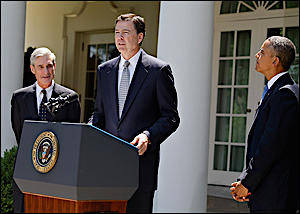
Comey in 2013 with Robert Mueller and Barack Obama
Dimitri Alperovitch, a CrowdStrike co-founder, is an opponent of Russian President Vladimir Putin and a senior fellow at the anti-Russian Atlantic Council think tank in Washington. CrowdStrike said it determined that Russia had hacked the DNC server because it found Cyrillic letters in the metadata, as well as the name of the first Soviet intelligence chief—clues an amateur might leave.
CrowdStrike was forced to “revise(d) and retract(ed) statements it used to buttress claims of Russian hacking during last year’s American presidential election campaign, Voice of America reported in March 2017.
CrowdStrike’s Early Role
In a Memorandum for the President on July 24, 2017, Veteran Intelligence Professionals for Sanity referred prominently to this instructive time sequence:
June 12, 2016: Julian Assange announces WikiLeaks is about to publish ‘emails related to Hillary Clinton.’
June 14, 2016: DNC contractor CrowdStrike, (with a dubious professional record and multiple conflicts of interest) announces that malware has been found on the DNC server and claims there is evidence it was injected by Russians.
June 15, 2016: ‘Guccifer 2.0’ affirms the DNC statement; claims responsibility for the ‘hack;’ claims to be a WikiLeaks source; and posts a document that the forensics show was synthetically tainted with ‘Russian fingerprints.’
VIPS does not believe the June 12, 14, & 15 timing was pure coincidence. Rather, it suggests the start of a pre-emptive move to associate Russia with anything WikiLeaks might have been about to publish and to “show” that it came from a Russian hack.
Bill Binney, a former NSA technical director and a VIPS member, filed an affidavit in Stone’s case. Binney said: “WikiLeaks did not receive stolen data from the Russian government. Intrinsic metadata in the publicly available files on WikiLeaks demonstrates that the files acquired by WikiLeaks were delivered in a medium such as a thumb drive.”
Preferring CrowdStrike; ’Splaining to Congress
Why did FBI Director James Comey not simply insist on access to the DNC computers? Surely he could have gotten the appropriate authorization. In early January 2017, reacting to media reports that the FBI never asked for access, Comey told the Senate Intelligence Committee there were “multiple requests at different levels” for access to the DNC servers. “Ultimately what was agreed to is the private company would share with us what they saw,” he said. Comey described CrowdStrike as a “highly respected” cybersecurity company.
Asked by committee Chairman Richard Burr (R-NC) whether direct access to the servers and devices would have helped the FBI in their investigation, Comey said it would have. “Our forensics folks would always prefer to get access to the original device or server that’s involved, so it’s the best evidence,” he said.
Five months later, after Comey had been fired, Burr gave him a Mulligan in the form of a few kid-gloves, clearly well-rehearsed, questions:
BURR: And the FBI, in this case, unlike other cases that you might investigate — did you ever have access to the actual hardware that was hacked? Or did you have to rely on a third party to provide you the data that they had collected?
COMEY: In the case of the DNC, … we did not have access to the devices themselves. We got relevant forensic information from a private party, a high-class entity, that had done the work. But we didn’t get direct access.
BURR: But no content?
COMEY: Correct.
BURR: Isn’t content an important part of the forensics from a counterintelligence standpoint?
COMEY: It is, although what was briefed to me by my folks — the people who were my folks at the time is that they had gotten the information from the private party that they needed to understand the intrusion by the spring of 2016.
More telling was earlier questioning by House Intelligence Committee member, Rep. Will Hurd (R-TX), who had been a CIA officer for a decade.On March 20, 2017 while he was still FBI director, Comey evidenced some considerable discomfort as he tried to explain to the committee why the FBI did not insist on getting physical access to the DNC computers and do its own forensics:
HURD: So there was about a year between the FBI’s first notification of some potential problems with the DNC network and then that information getting on — getting on Wikileaks.
COMEY: Yes, sir.
HURD: … when did the DNC provide access for — to the FBI for your technical folks to review what happened?
COMEY: Well we never got direct access to the machines themselves. The DNC in the spring of 2016 hired a firm that ultimately shared with us their forensics from their review of the system. …
HURD: … So, Director FBI notified the DNC early, before any information was put on Wikileaksand when — youhave still been — never been given access to any of the technical or the physical machines that were — that were hacked by the Russians.
COMEY: That’s correct although we got the forensics from the pros that they hired which — again, best practice is always to get access to the machines themselves, but this — my folks tell me was an appropriate substitute.
Comey Spikes Deal With Assange
Director Comey’s March 20, 2017 testimony to the House Intelligence Committee came at the same time he was scuttling months-long negotiations between Assange and lawyers representing the DOJ and CIA to grant some limited immunity for the WikiLeaks founder. In return, Assange offered to: (1) redact “some classified CIA information he might release in the future,” and (2) “provide technical evidence and discussion regarding who did not engage in the DNC releases.”
Investigative journalist John Solomon, quoting WikiLeaks’ intermediary with the government, broke this story, based on “interviews and a trove of internal DOJ documents turned over to Senate investigators.” It would be a safe assumption that Assange was offering to prove that Russia was not WikiLeaks’ source of the DNC emails, something Assange has repeatedly said.
That, of course, would have been the last thing Comey would have wanted.
On March 31, 2017 WikiLeaks released the most damaging disclosure up to that point from what it called “Vault 7” — a treasure trove of CIA cybertools leaked from CIA files. This disclosure featured the tool “Marble Framework,” which enabled the CIA to hack into computers, disguise who hacked in, and falsely attribute the hack to someone else by leaving so-called tell-tale signs — like Cyrillic, for example.
The CIA documents also showed that the “Marble” tool had been employed in 2016.
Two weeks later, then CIA Director Mike Pompeo branded WikiLeaks a “non-state hostile intelligence service,” and the U.S. put pressure on Ecuador, which had given Assange asylum, to expel him from its London embassy. He was on April 11 when British police arrested him. On the same day he was convicted of skipping bail on a Swedish investigation that had since been dropped. Assange was sentenced to 50 weeks in London’s max-security Belmarsh prison.
Comey, it seems a safe bet, still worries that Assange or one of his associates, will provide “technical evidence” enough to prove “who did not engage in the DNC releases.”
What Were They Thinking?
At the March 20, 2017 House Intelligence Committee hearing, Congressman Trey Gowdy heaped effusive praise on then-FBI Director Comey, calling him “incredibly respected.” At that early stage, no doubt Gowdy meant no double entendre. He might now.
As Russia-gate transmogrifies into Deep State-gate, the DOJ is launching a probe into the origins of Russia-gate and the intelligence agencies alleged role in it. It remains to be seen whether U.S. Attorney for the District of Connecticut John Durham, who is leading the probe, will interview Assange, unlike Special Counsel Robert Mueller, who did not.
It is proving very difficult for some of my old FBI friends and others to believe that Comey and other justice, intelligence, and security officials at the very top could have played fast and loose with the Constitution and the law and lived a lie over the past few years.
“How did they ever think they could get away with it?” they ask. The answer is deceivingly simple. Comey himself has explained it in a moment of seemingly unintentional candor in his pretentious book, “A Higher Loyalty.” He wrote, “I was making decisions in an environment where Hillary Clinton was sure to be the next president.”
There would be no problem, of course, if Mrs. Clinton had won the election. That’s what they all thought; and that probably explains their lack of care in keeping their activities off the written record and out of computers. Elementary tradecraft goes out the window with these upper-echelon, “high-class-entity” officials, when they are sure that she, and they, are going to be the inevitable winners — with promotions, not indictments in store for them.
Additional reporting by Joe Lauria
Background Reading on Deep State-Gate
https://consortiumnews.com/2019/03/13/vips-muellers-forensics-free-findings/
https://consortiumnews.com/2019/05/03/orwellian-cloud-hovers-over-russia-gate/
https://consortiumnews.com/2017/07/24/intel-vets-challenge-russia-hack-evidence/
https://consortiumnews.com/2019/06/13/ray-mcgovern-doj-bloodhounds-on-the-scent-of-john-brennan/
https://consortiumnews.com/2018/11/14/clappers-credibility-collapses/
https://raymcgovern.com/2019/01/06/transcript-when-clapper-was-asked-real-questions/
http://www.baltimoresun.com/news/opinion/oped/bs-ed-hacking-intelligence-20170105-story.html
http://www.baltimoresun.com/news/opinion/oped/bs-ed-trump-russia-phony-20170517-story.html
Ray McGovern works with Tell the Word, a publishing arm of the ecumenical Church of the Saviour in inner-city Washington. During his 27-year career as a CIA analyst, he led the Soviet Foreign Policy Branch and prepared the President’s Daily Brief for three presidents. He is co-founder of Veteran Intelligence Professionals for Sanity.
The Broader View Reveals the Ugliest of Prospects
By Craig Murray | June 17, 2019
Standing back a little and surveying the events of the last couple of weeks, gives a bleak view of the current state of western democracy.
We have seen what appears to be the most unconvincing of false flags in the Gulf. I pointed out why it was improbable Iran would attack these particular ships. Since then we have had American military sources pointing to video evidence of a packed small Iranian boat allegedly removing a limpet mine from the ship the Iranians helped to rescue, which was somehow supposed to prove it was the Iranians who planted the alleged device. We also have had the Japanese owner specifically contradict the American account and say that the ship was hit by flying objects.
The Iranians certainly have a strange method of bomb disposal if they carry it out using unarmoured personnel, with as many as possible crammed into a small boat in immediate contact with the “mine”. It is also hard to understand why the alleged “limpet mines” would be four feet above the waterline.
Limpet mines are placed below the waterline. There are numerous reasons for this. Firstly, holes above the waterline will not sink a ship. Secondly, the weight of the water helps contain the blast against the ship. Thirdly, it is obviously harder to detect both the diver placing the mine and the mine once placed if it is below the water. In fact it would be very difficult for a diver to place a limpet mine four feet above the waterline, even if they wanted to.
There seems to be a remarkable disconnect between the widespread popular disdain at yet another fake western power causus belli in the Middle East, and the near universal complicity of the UK political and media class in promoting this transparent lie. It is as though even pretending to have any respect for truth and fact has simply been discarded within the UK’s governmental system. Which ought to worry us a lot.
The second development ought to have been the biggest media story of the decade in the UK, if we had anything like a free and honest media. Mike Pompeo, US Secretary of State, made plain the Trump administration’s intent to prevent the election of Jeremy Corbyn as Prime Minister. Pompeo told a meeting of Jewish leaders:
It could be that Mr. Corbyn manages to run the gantlet and get elected. It’s possible. You should know, we won’t wait for him to do those things to begin to push back.
This blatant interference by a foreign power in the UK’s democracy is an absolute scandal. Compare the lack of media outrage at Pompeo’s intervention with the ludicrous claims made about much less high profile Russian attempts at influence. This incident provides incontrovertible proof that the world does indeed operate in the way that I have been explaining here for a decade. It is not a “conspiracy theory” that democracy is manipulated by hidden powers, it is fact. Pompeo’s description of Corbyn’s route to election as “running the gauntlet” is particularly revealing. Even more so is the cursory coverage this story was given, and I have seen no evidence to date of any MSM “journalist” attempting any follow-up investigation on the methods the US are planning to employ – or more likely already employing – against Corbyn.
Everybody should be incandescent at this, no matter who they vote for.
Something else which revealed the truth of the way the political world now operates, and which again did not get nearly the media attention it deserves, was Matt Kennard’s stunning revelation of the way the Guardian has been taken over by the security services. I have been explaining for years that the Guardian has become the security services’ news outlet of choice, and it is very helpful to have documentation to prove it.
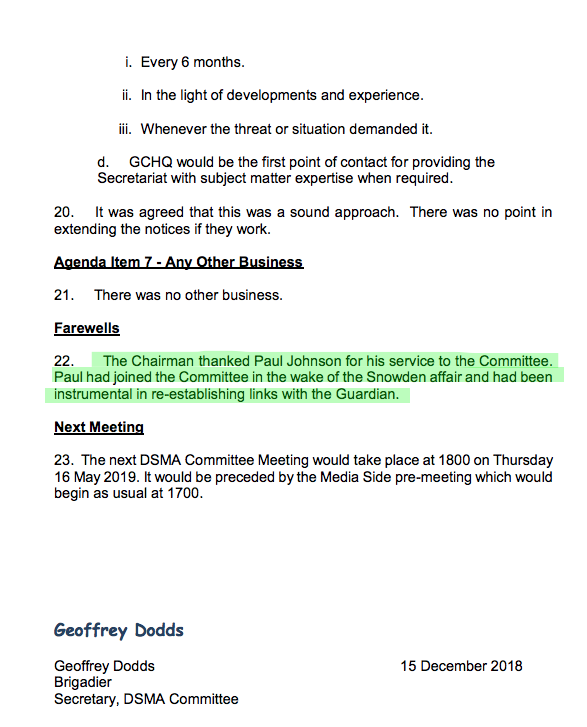
It is worth noting that the Guardian obeyed completely the DSMA committee ban on mentioning Pablo Miller in reporting the security service fantasy version of the Skripal story. As Kennard points out, it is also very interesting indeed that the Guardian published Luke Harding’s front page fabrication of Manafort/Assange meetings two weeks after MOD Director Dominic Wilson congratulated Guardian deputy editor Paul Johnson on “re-establishing links” with the security services. The Guardian is, like other British newspapers, as controlled by the military and security services just like in any other decent autocracy.
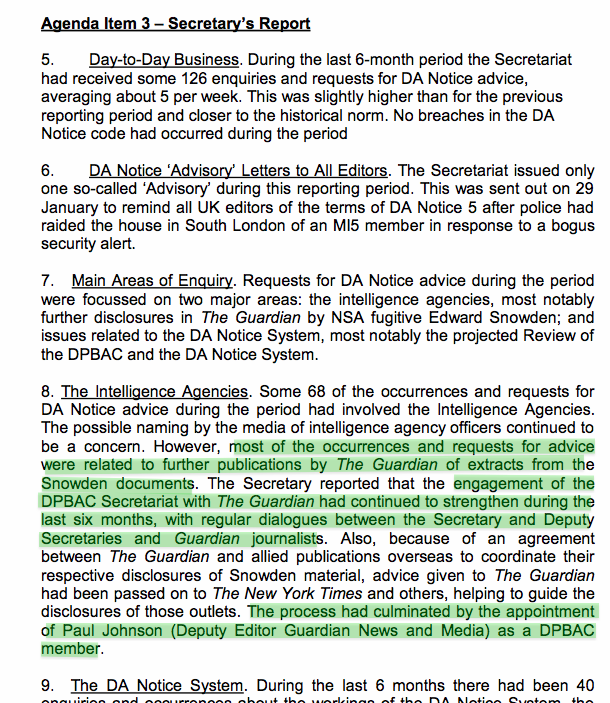
Incidentally, I cannot find Matt Kennard’s excellent work set out anywhere, except in that twitter stream. Surely there is an article on a website somewhere? I cannot find anything on Google, but as it is exactly the kind of information Google routinely suppresses, that does not mean it is not out there. Anyone seen it?
Finally, we have of course seen Sajid Javid sign the extradition warrant for Julian Assange to be sent to the United States for the “crime” of publishing truthful information about US government illegalities. Julian’s extradition hearing was, contrary to normal practice, held despite the fact he was too sick to attend in person. And it was presided over by Judge Arbuthnot, despite the fact that her husband is a former Tory defence minister who started a “security consultancy” in partnership with a former head of MI6, the war criminal John Scarlett who oversaw the fabrication of the dossier of lies about Iraqi WMD, in order to launch an illegal war of aggression that killed and maimed millions. The Assange team had asked her to recuse herself on that pretty obvious basis, but she had refused. At an earlier hearing she taunted Assange with the observation that he could get adequate exercise in the Embassy on a 1.5 meter Juliet balcony.
Just as the Guardian has never apologised for, nor withdrawn, the utter lie of the Assange/Manafort story, so the identity politics promoting, false “left” has never apologised for its pursuit of Assange over sexual allegations in Sweden, which were obvious on the slightest scrutiny to be only a fit-up designed to get him into custody. Those figures like David Allen Green, Joan Smith and David Aaronovitch, among scores of other pustulous hacks, who mocked and scorned those of us who always said that Assange faced not extradition to Sweden but to the United States for publishing, have been shown up as, at the very best, stupid naive and unwitting tools of the state, and more likely, insincere and vicious propagandists.
This brief review of current issues reveal that not only do western governments lie and fake, they have really given up on trying to pretend that they do not. The abuse of power is naked and the propaganda is revealed by the lightest effort to brush away the veneer of democracy.
I find it hard to believe that I live in times where Assange suffers as he does for telling the truth, where a dedicated anti-racist like Corbyn is subjected to daily false accusations of racism and to US and security service backed efforts to thwart his democratic prospects, where the most laughable false flag is paraded to move us towards war with Iran, and where there is no semblance of a genuinely independent media. But, starkly, that is where we are. This is not unrelated to the massive and fast growing inequality of wealth; the erosion of freedom is the necessary precondition that allows the ultra-wealthy to loot the rest of us. It remains my hope there will eventually come a public reaction against the political classes as strong as the situation demands.
The Gulf of Credibility
By Craig Murray | June 17, 2019
I really cannot begin to fathom how stupid you would have to be to believe that Iran would attack a Japanese oil tanker at the very moment that the Japanese Prime Minister was sitting down to friendly, US-disapproved talks in Tehran on economic cooperation that can help Iran survive the effects of US economic sanctions.
The Japanese-owned Kokuka Courageous was holed above the water line. That rules out a torpedo attack, which is the explanation being touted by the neo-cons.
The second vessel, the Front Altair, is Norwegian owned and 50% Russian crewed (the others being Filipinos). It is owned by Frontline, a massive tanker leasing company that also has a specific record of being helpful to Iran in continuing to ship oil despite sanctions.
It was Iran that rescued the crews and helped bring the damaged vessels under control.
That Iran would target a Japanese ship and a friendly Russian crewed ship is a ludicrous allegation. They are however very much the targets that the USA allies in the region – the Saudis, their Gulf Cooperation Council colleagues, and Israel – would target for a false flag. It is worth noting that John Bolton was meeting with United Arab Emirates ministers two weeks ago – both ships had just left the UAE.
The USA and their UK stooges have both immediately leapt in to blame Iran. The media is amplifying this with almost none of the scepticism which is required. I cannot think of a single reason why anybody would believe this particular false flag. It is notable that neither Norway nor Japan has joined in with this ridiculous assertion.
For Israel, Annexation of the West Bank is a Long-established Goal
With Benjamin Netanyahu under pressure and the US signalling its support, the time to realise this catastrophic ambition may be fast approaching
By Jonathan Cook • The National • June 17, 2019
When Israeli prime ministers are in trouble, facing difficult elections or a corruption scandal, the temptation has typically been for them to unleash a military operation to bolster their standing. In recent years, Gaza has served as a favourite punching bag.
Benjamin Netanyahu is confronting both difficulties at once: a second round of elections in September that he may struggle to win; and an attorney general who is widely expected to indict him on corruption charges shortly afterwards.
Mr Netanyahu is in an unusually tight spot, even by the standards of an often chaotic and fractious Israeli political system. After a decade in power, his electoral magic may be deserting him. There are already rumblings of discontent among his allies on the far right.
Given his desperate straits, some observers fear that he may need to pull a new kind of rabbit out of the hat.
In the past two elections, Mr Netanyahu rode to success after issuing dramatic last-minute statements. In 2015, he agitated against the fifth of Israel’s citizens who are Palestinian asserting their democratic rights, warning that they were “coming out in droves to vote”.
Back in April, he declared his intention to annex large chunks of the occupied West Bank, in violation of international law, during the next parliament.
Amos Harel, a veteran military analyst with Haaretz newspaper, observed last week that Mr Netanyahu may decide words are no longer enough to win. Action is needed, possibly in the form of an announcement on the eve of September’s ballot that as much as two-thirds of the West Bank is to be annexed.
Washington does not look like it will stand in his way.
Shortly before April’s election, the Trump administration offered Mr Netanyahu a campaign fillip by recognising Israel’s illegal annexation of the Golan Heights, territory Israel seized from Syria in 1967.
This month David Friedman, US ambassador to Israel and one of the chief architects of Donald Trump’s long-delayed “deal of the century” peace plan, appeared to offer a similar, early election boost.
In interviews, he claimed Israel was “on the side of God” – unlike, or so it was implied, the Palestinians. He further argued that Israel had the “right to retain” much of the West Bank.
Both statements suggest that the Trump administration will not object to any Israeli moves towards annexation, especially if it ensures their favoured candidate returns to power.
Whatever Mr Friedman suggests, it is not God who has intervened on Israel’s behalf. The hands that have carefully cleared a path over many decades to the West Bank’s annexation are all too human.
Israeli officials have been preparing for this moment for more than half a century, since the West Bank, East Jerusalem and Gaza were seized back in 1967.
That point is underscored by an innovative interactive map of the occupied territories. This valuable new resource is a joint project of the Israeli human rights group B’Tselem and Forensic Architecture, a London-based team that uses new technology to visualise and map political violence and environmental destruction.
Titled Conquer and Divide, it reveals in detail how Israel has “torn apart Palestinian space, divided the Palestinian population into dozens of disconnected enclaves and unravelled its social, cultural and economic fabric”.
The map proves beyond doubt that Israel’s colonisation of the West Bank was never accidental, defensive or reluctant. It was coldly calculated and intricately planned, with one goal in mind – and the moment to realise that goal is fast approaching.
Annexation is not a right-wing project that has hijacked the benign intentions of Israel’s founding generation. Annexation was on the cards from the occupation’s very beginnings in 1967, when the so-called centre-left – now presented as a peace-loving alternative to Mr Netanyahu – ran the government.
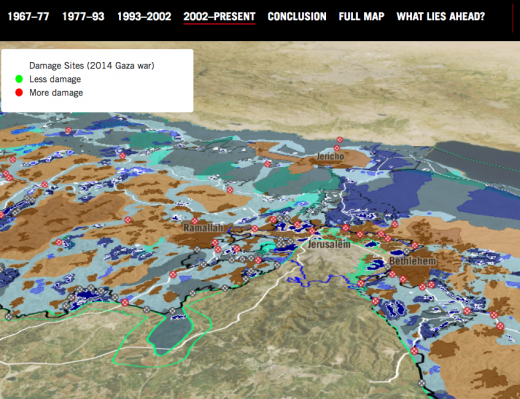
The map shows how Israeli military planners created a complex web of pretexts to seize Palestinian land: closed military zones today cover a third of the West Bank; firing ranges impact 38 Palestinian communities; nature reserves are located on 6 per cent of the territory; nearly a quarter has been declared Israeli “state” land; some 250 settlements have been established; dozens of permanent checkpoints severely limit movement; and hundreds of kilometres of walls and fences have been completed.
These interlocking land seizures seamlessly carved up the territory, establishing the walls of dozens of tightly contained prisons for Palestinians in their own homeland.
Two Nasa satellite images of the region separated by 30 years – from 1987 and 2017 – reveal how Israel’s settlements and transport infrastructure have gradually scarred the West Bank’s landscape, clearing away natural vegetation and replacing it with concrete.
The land grabs were not simply about acquisition of territory. They were a weapon, along with increasingly draconian movement restrictions, to force the native Palestinian population to submit, to recognise its defeat, to give up hope.
In the immediate wake of the West Bank’s occupation, defence minister Moshe Dayan, Israel’s hero of the hour and one of the architects of the settlement project, observed that Palestinians should be made “to live like dogs, and whoever wants to can leave – and we shall see where this process leads”.
Although Israel has concentrated Palestinians in 165 disconnected areas across the West Bank, its actions effectively won the international community’s seal of approval in 1995. The Oslo accords cemented Israel’s absolute control over 62 per cent of the West Bank, containing the Palestinians’ key agricultural land and water sources, which was classified as Area C.
Occupations are intended to be temporary – and the Oslo accords promised the same. Gradually, the Palestinians would be allowed to take back more of their territory to build a state. But Israel made sure both the occupation and the land thefts sanctioned by Oslo continued.
The new map reveals more than just the methods Israel used to commandeer the West Bank. Decades of land seizures highlight a trajectory, plotting a course that indicates the project is still not complete.
If Mr. Netanyahu partially annexes the West Bank – Area C – it will be simply another stage in Israel’s tireless efforts to immiserate the Palestinian population and bully them into leaving. This is a war of attrition – what Israelis have long understood as “creeping annexation”, carried out by stealth to avoid a backlash from the international community.
Ultimately, Israel wants the Palestinians gone entirely, squeezed out into neighbouring Arab states, such as Egypt and Jordan. That next chapter is likely to begin in earnest if Mr Trump ever gets the chance to unveil his “deal of the century”.
Florida Passes Bill Suppressing Free Speech on Israel, Palestine

Florida Governor Ron De Santis during his recent tour of Israel. (Photo: via Social Media)
Palestine Chronicle | June 17, 2019
Israel has been granted protection from its critics by the state of Florida in recent amendments to the Florida Educational Equality Act (FEEA) that suppresses free speech.
Under new definitions of anti-Semitism adopted by the American state, limits have been placed on discussions of the plight of the Palestinian people and underscoring the brutality of Israel’s occupation.
The bill is likely to open the door for criminal charges to be leveled against human rights activists and critics that advocate a single democratic state in which Israeli Jews, Palestinians, and all others are granted full, equal rights.
Supporters of the Palestine cause face the prospect of being silenced on the grounds that calls for equality under a single democratic state is deemed to be an attempt to deny the Jewish people their right to self-determination and that such a call for non-discrimination questions Israel’s right to exist.
Florida signed the bill while its governor, Ron DeSantis, was on tour of Israel and the occupied territories.
DeSantis, who has called Florida “the most Israel-friendly state in the country”, visited the US embassy in Jerusalem to ceremonially sign the new law. He also paid a visit to Ariel University, located in an illegal settlement, to receive an honor for “his dedication, leadership, and commitment to the State of Israel.”
Reports also confirm that he had met with Sheldon Adelson, a top funder of the Republican Party and Israeli Prime Minister Benjamin Netanyahu.
Guilty or Not, Iran’s Fate Is in Trump’s Hands
By Tim Kirby | Strategic Culture Foundation | June 17, 2019
The USS Maine sank, someone shot something at somebody during the Gulf of Tonkin Incident and many non-Iraqis triggered the invasion of Iraq by flying planes into skyscrapers. The media hyped attacks on two oil tankers in the Gulf of Oman seem like another blatant attempt to pull the US into yet another war based on questionable pretenses. The information war regarding the incident is already very hot but ultimately the future of Iran is in Donald Trump’s hands.
The Mainstream Media has already come out in force to push the narrative that Iran was probably behind the attacks on the oil tankers even though US Secretary of State Mike Pompeo offered no actual evidence whatsoever to support his claim that the Persians did it. (Since then grainy video has come out showing nondescript men trying to attach or detach something presumably to the tanker from what is supposedly an Iranian vessel).
From a legal or moral sense it would have been much more proper if Pompeo would have waited long enough to provide solid proof that the Iranians did it before making a public condemnation of them. But then again, if his objective was to simply plant the idea that the Iranians did it into the Mainstream Media (and thus into the minds of the masses) then he played it perfectly as evidence is not required to achieve this objective.
From the standpoint of Information Warfare, it is very critical when a new event happens to put forward one’s version of the “truth” first before any other possible competing theories can arise. This could be why Pompeo or someone like him would chose to immediately come out with accusations thrown around as facts with no evidence to support them and no respect for the great Western concepts of “innocence until proven guilty” or the “right to a fair trial”.
Pompeo’s objective here is not the truth but to take that virgin intellectual territory regarding the interpretation of this issue before anyone else can, because once a concept has become normalized in the minds of the masses it is very difficult to change it and many people in Washington cannot risk blowing the chance to waste thousands of American lives invading Iran based on an ultimately false but widely accepted/believed narrative.
Not surprisingly foreign and especially Russian media has quickly attempted to counter the “Iran obviously did it” narrative before it becomes an accepted fact. Shockingly Slavic infowarriors actually decided to speak to the captain of a tanker that was hit to get his opinion rather than simply assert that Iran didn’t do it because they are a long time buddy of Moscow. The captain’s testimony of what happened strongly contradicts the version of reality that Washington is pushing. And over all Russia as usual takes the reasonable position of “let’s gather the evidence and then see who did it”, which is good PR for itself as a nation beyond this single issue.
In terms of finding the actual guilty party the media on both sides has thus far ignored the simple fact that if Iran wanted to sink a tanker it would be sunk. No civilian vessel is going to withstand an attack from a 21st century navy by having a particularly thick hull and the idea that the Iranians need to physically attach bombs to boats is mental. Physically planting bombs is for goofball inept terrorists, not a professional military. After all, even the West acknowledges that the Iranians use the best Russian goodies that they can afford and Russian 21st century arms will sink civilian ships guaranteed. The Iranians have everything they need to smoke any civilian vessel on the planet guaranteed from much farther away than 3 feet.
If Iran’s goal was to scare or intimidate the tanker they could have just shot at it with rifles or done something else to spook the crew and get a media response. When looked at from the standpoint of military logic, these “attacks” seem baffling as Iran could have just destroyed the boats or directly tried to terrorize them to make a statement.
Then again perhaps the Iranians do want to provoke the US into a war with them, by “kind of but not really” attacking these ships. Maybe they do want to fight a war they will ultimately lose destroying everything they have built after the revolution, but this seems highly unlikely. The Iranians for decade after decade have taken a reactive stance to US aggression and encirclement, why would they change that policy right now in order to go on offense against an enemy they cannot defeat in direct confrontation?
What may be reassuring to some but terrifying to others is that the final result of what is to be done about these “attacks” lies in the hands of Donald Trump. So far Trump has agreed with the Pompeo/Mainstream Media view of the incident. But Trump like all politicians says “a lot of things” and what really matters are his actions. As the President he can take this convenient incident and use it as a casus belli or he can simply and safely “condemn” Tehran with rhetoric and literally ignore the situation until it goes away which seems to be The Donald’s preferred method of keeping the peace. He has scolded many a nation but not actually pushed for a full fledged military response against any of them.
Proving who is guilty for the attacks on the tankers may take a long time or ultimately be impossible, but how this incident will be used by Washington will prove who Trump is… a patriot who wants to Make America Great Again by ignoring the chance to jump into foreign conflicts or yet another cowardly warmonger sitting in the Oval Office ready to waste US lives and resources without a care in the world.
False Identities Become the New Weapon: War with Iran Promoted by Fake Journalists

By Philip Giraldi | American Herald Tribune | June 17, 2019
One of the claims made about alleged Russian interference in the 2016 U.S. election was that Kremlin-controlled entities were using fake identities to create dissension and confusion on social network sites. This should surprise no one, if it is true, as intelligence operatives have been using false names since Sumerian times.
The concern over fake identities no doubt comes from the deception involved, meaning that if you are dealing with a real person you at least have some handle on making an assessment of what something means and what is likely to occur. A false persona, however, can pretend to be anything and can advocate or do something without any yardstick to measure what is actually taking place. In other words, if Mike Pompeo says something you know that he is a liar and can judge his words accordingly but if it is someone otherwise unknown named Qwert Uiop you have to wonder if he or she just might be telling the truth. You might even give them the benefit of the doubt.
A prime example of a false internet persona has recently surfaced in the form of an alleged “activist” invented by the Iranian terrorist group Mojahedin e Khalq (MEK). MEK is a curious hybrid creature in any event in that it pretends to be an alternative government option for Iran even though it is despised by nearly all Iranians. At the same time, it is greatly loved by the Washington Establishment which would like to see the Mullahs deposed and replaced by something more amenable to western and Israeli worldviews.

MEK is run like a cult by its leader Maryam Rajavi, with a number of rules that restrict and control the behavior of its members. One commentary likens membership in MEK to a modern day equivalent of slavery. The group currently operates out of a secretive, heavily guarded 84 acre compound in Albania that is covertly supported by the United States, as well as through a “political wing” front office in Paris, where it refers to itself as the National Council of Resistance of Iran.
MEK, which is financially supported by Saudi Arabia, stages events in the United States in Europe where it generously pays politicians like John Bolton, Rudy Giuliani and Elaine Chao to make fifteen-minute speeches praising the organization and everything it does. It’s paying of inside the Beltway power brokers proved so successful that it was removed from the State Department terrorist list in 2012 by Hillary Clinton even though it had killed Americans in the 1970s. MEK also finds favor in Washington because it is used by Israel as a resource for anti-Iranian terrorism acts currently, including assassinations carried out in Tehran.
MEK’s fake journalist, who has recently been exposed by The Intercept, is named Heshmat Alavi. He, or if you prefer “it,” has very successfully gained access to a considerable body of generally conservative mainstream western media, including Forbes, The Hill, the Daily Beast and The Federalist. Alavi has placed scores of articles as “an activist with a passion for human rights,” aimed at discrediting Iran and its government while also subtly praising MEK as an alternative to the current regime. His bona fides have never been questioned, even by Forbes, which placed no less than 61 articles under the name between April 2017 and April 2018. The pieces appearing allegedly by Alavi are reportedly composed at a “troll factory” as a so-called “group account” in Albania where MEK members who belong to the organization’s “political wing” toil under tight security.
Alavi’s contribution to the damning of Iran has not been insignificant. An article written by him/it that appeared in Forbes claiming that the Mullahs had been able to increase their military budget due to having money freed up by the Joint Comprehensive Plan of Action (JCPOA) agreement. The article reached the White House and reportedly helped convince the Trump Administration to withdraw from the pact.

*(MEK members working in the ‘Twitter troll factory’ in Manez Camp, Albania)
To supplement the Alavi propaganda effort, MEK’s Albania operation uses banks of computers manned by followers, some of whom are fluent in English, who serve as bots unleashing scores of comments supporting regime change in Iran while also directing waves of criticism against any pro-Iranian pieces that appear on social media, to include Facebook and Twitter. By one account, more than a thousand MEK supporters manage thousands of accounts on social media simultaneously. The objective of all the chatter is to convince the mostly English-speaking audience that there is a large body of Iranians who are hostile to the regime and supportive of MEK as a replacement.
While the Iranian government and MEK might well be regarded by most Americans as a far-away problem, there was considerable shock expressed even by congress and the media when it was learned shortly before The Intercept’s revelations that the United States government had been funding a so-called Iran Disinformation Project that was employing tactics remarkably similar to those of MEK in an attempt to control the discussion over Iran policy.
The project, run by the State Department’s global engagement center, consisted of a trolling campaign which targeted online American citizens critical of the government’s Iran policy, labeling them as disloyal to the United States and tools of the Iranian government. It used, for example, the website IranDisInfo.org and the hashtag #NIACLobbies4Mullahs. Iranian-American activist and long-time State Department contractor Mariam Memarsadeghi headed the program, receiving hundreds of thousands of dollars to “relentlessly attack critics of the Iran policy on social media… accusing them of being paid operatives of the regime in Tehran.” In all, the “Iran Disinfo” operation received over $1.5 million through the Memarsadeghi contract entity the oddly named E-Collaborative for Civic Education.
The investigation of Iran Disinfo also revealed that the neoconservative Foundation for Defense of Democracies (FDD), which has been leading the charge for war with Iran, had at least one employee working with E-Collaborative. FDD, which has been advising the Trump White House on a more aggressive policy towards Iran, has also been actively involved in the State Department effort and cross-posting material from the Disinfo campaign.
FDD has long been targeting Iran. It received $3.63 million in 2017 from Bernard Marcus, co-founder of Home Depot. Marcus is a hard-core Zionist who hates Iran and once referred to that nation as “the devil.” FDD has also received billions from Las Vegas casino mega billionaire Sheldon Adelson, the GOP’s largest individual donor, who has advocated dropping a nuclear bomb on Iran to send a message. The link between major Republican donors supporting FDD and an increase in FDD quasi-overt cooperation with the Trump Administration in demonizing Iran should not surprise anyone.
Even though the State Department operation was relatively insignificant compared to similar initiatives undertaken by Israel, the idea that an ostensibly democratic government should propagate lies to defend its own policies was definitely unsettling. Some might think that disinformation on Iran is of little importance, that it has little impact on actual policy, but they would be wrong. Bad information that is allowed to circulate freely creates its own reality. Most Americans believe that Iran actually threatens the United States, though they would be at a loss to explain exactly how that could be the case. Dubious stories that originated with Reuters about corruption in Iran have been used by Mike Pompeo to justify sanctions against the regime on humanitarian grounds, measures which have ironically hurt average Iranians disproportionately. The same story was also used in at least four books to discredit the Iranian leadership.
To be sure, the mainstream media is itself largely at fault, as it was with Heshmat Alavi, for not vetting their sources more carefully, particularly when a story is clearly providing unique information or representing a point of view that might be considered controversial. In some cases, of course, the news outlet wants the story to be perceived as true even when it knows that it is not, so it becomes an accomplice in the propaganda effort. A recent attempt to create a mechanism to establish standards by determining the reliability of online news content has, in fact, been little more than a neoconservative scheme to discredit sites that do not support the neocon point of view.
Since governments and various non-governmental constituencies now, by their own admission, are heavily into the game of providing false information and discrediting critics, most Americans will completely tune out of the process, meaning that there will be little or no measurable difference between truth and lies. One already hears complaints from all across the political spectrum that most news is fake. When one reaches the point where such skepticism becomes the consensus, both elections and democracy itself will be rendered pretty much meaningless.
Philip M. Giraldi is a former CIA counter-terrorism specialist and military intelligence officer who served nineteen years overseas in Turkey, Italy, Germany, and Spain. He was the CIA Chief of Base for the Barcelona Olympics in 1992 and was one of the first Americans to enter Afghanistan in December 2001. Phil is Executive Director of the Council for the National Interest, a Washington-based advocacy group that seeks to encourage and promote a U.S. foreign policy in the Middle East that is consistent with American values and interests.
Featured Video

The 1964 Coup in Brazil
or go to
Aletho News Archives – Video-Images
Frlom the Archives
70 Neocons Petition Congress To Effectively Allow Israel To Say When The US Should Attack Iran
By Damian Lataan | January 10, 2014
Seventy senior Israeli-centric neoconservatives have written an open letter to Congress imploring them to do more to ensure Iran complies with the conditions of any agreement finally reached with the P5+1 over Iran’s nuclear program.
While the neocons are ostensibly asking Congress to ensure compliance, it is clear that their real aim is to convince members of Congress to support the bill currently passing through the Senate which calls for tighter sanctions against Iran in the event of any waywardness on Iran’s part.
The neocons are eager to see the bill currently passing through the Senate with enough support to make it veto-proof, not so much because they are concerned about Iran’s so-called nuclear weapons program – there’s still not a skerrick of hard evidence that Iran has a nuclear weapons program – but, rather, because embedded within the bill is this clause:
… if the Government of Israel is compelled to take military action in legitimate self-defense against Iran’s nuclear weapon program, the United States Government should stand with Israel and provide, in accordance with the law of the United States and the constitutional responsibility of Congress to authorize the use of military force, diplomatic, military, and economic support to the Government of Israel in its defense of its territory, people, and existence…
Essentially, the clause is an automatic trigger for the US to attack Iran at any time the Israelis choose to launch a first strike – regardless of whether President Obama is in favour or not.
Partial list… continue
Blog Roll
 Aletho News
- UK Parliament Plans ISP Blocking and Age Verification Powers
- World cannot remain silent as US and Israel attack ‘heritage of humankind’: Iran
- Emirati billionaire rebukes US senator over call for Gulf states to join war with Iran
- Op. True Promise 4: Iran’s missile blitzkrieg dismantles US war machine in West Asia
- Aramco CEO warns ‘catastrophe’ imminent if Strait of Hormuz remains shut
- What If Iran Says No?
- Trump Threatens to ‘Hit’ Iran ‘Twenty Times Harder’ Over Strait of Hormuz Oil Flows
- Spare the hypocrisy: Baghaei slams Ursula’s support for US
- Iran War Supporters Invent a New and Absurd Justification: It Is All About China
- Corporate Media Go All Out To Support The US-Israeli War on Iran
- If Americans Knew
- U.S. support for Israel continues to plummet, despite media’s best efforts
- Threats and missiles fly, death tolls soar in Iran, Lebanon, Gaza – Not a ceasefire Day 151
- Lebanon: Israel’s White Phosphorous Use Risks Civilian Harm
- Corporate Media Go All Out To Support The US-Israeli War On Iran
- US-Israel war on Iran is creating a steady growing number of amputees
- Israel planned this war on Iran for 40 years. Everything else is a smoke screen
- The wrong question about the war in Iran
- ‘Your Tax Dollars Being Used to Raise Your Gas Prices’: US-Israel Bomb Major Iranian Oil Depots
- ‘Bogus Evidence’: Former Nuclear Watchdog Head Debunks US Justification for Iran War
- EXPLAINER – Dimona: What to know about Israel’s nuclear site
- No Tricks Zone
- Wake-up Call: Survey Shows Majority Of Germans Now Favor Postponing Climate Targets!
- Televised! Leading German Political Candidate Tells Schoolchildren CO2 Makes Sun Hotter!
- New Study: A Century Warming Of 1.1°C Is ‘Commonplace’ And ‘Not Unusual’ During This Interglacial
- New Study: ‘Internal Noise’ And Volcanic Forcing Can Trigger 10-15°C Warming Within Decades
- Glaciers Worldwide Are Suddendly Surging, Experts Blame Warming!
- Surprising Discovery: Sahara Is Greening…Billions Of Trees Where Once Thought To Be Barren
- New Research Reaffirms Clouds, Aerosols, And Surface Solar Radiation Are ‘Driving The Climate System’
- Germany: Electric Car Catches Fire At Charging Station, Sets Off Local “Inferno”, Widespread Damage
- New Study: Canada’s New Brunswick Was 1°C Warmer Than Today During The Medieval Warm Period
- Coal Power Back In Trend As Globe Tries To Keep Pace With Growing Demand For Power
 Aletho News