Parents of French babies born with deformities angry after official probe yields no answers
RT | July 13, 2019
A much-delayed government report failed to identify the cause in a spate of arm malformations across France, and despite calls for a more in-depth study, scientists say a definitive explanation may never be found.
Commissioned last year, the 265-page report examined 18 cases of congenital deformities since 2007 in four different regions across the country, studying whether they were linked by a common cause, such as environmental pollution, toxic drug exposure, or genetic damage.
“Scientific studies screening, questionnaires and local environment testing have been conducted by Sante Publique France which has not identified an obvious cause,” the public health body, which had been asked repeatedly about the case by RT, said in its summary.
The commission did admit that there is a “cluster” of cases in the commune of Guidel in the north-western department of Morbihan, where three babies missing arms were born in 22 months. But for the region of Ain in the east of the country, where eight such babies were born between 2009 and 2014, researchers said there was no statistical anomaly or telling pattern.
Pesticides blamed
But parents and activists who were present during the unveiling of the report were not satisfied, with some saying that only a superficial study was conducted, that some cases were excluded due to arbitrary cut-off points, and that the criteria for why some cases were dismissed as statistical noise were never explained.
“I did not expect big news, but I am surprised by the removal of ‘clusters’, it seems scandalous,” Samuel Bernard, the father of a daughter born without a hand in Morbihan, told France Info.
Bernard complained that an independent body was not put in charge, and bemoaned the lack of communication or investigation of specific hypotheses.
Emmanuelle Amar, the director of the malformations register of the Rhone-Alpes region, who helped bring the story to prominence, continues to believe that pesticides or other manmade chemical agents could be to blame.
“Exactly the same deformity, it never happened in the history of deformities,” she said following the report presentation. “The probability that it is linked to chance is more than infinitesimal. We are facing a possible health scandal.”
It is notable that the investigation said all the pregnancies occurred in the vicinity of growing cereal crops.
“We need to bring together specialists to define what kind of studies we need for this type of reporting, but the answer so far is to say: ‘We do not want to know what kind of studies because we do not want to study,’” Amar said. “And that is irresponsible.”
Field tests are poised to continue, with another report expected at the end of the year.
But there are reasons for believing that even with the best of intentions and sufficient resources, answers may be hard to come by.
One of the problems is the sheer rarity of such malformations. They occur on average in 1.7 cases each 10,000 births, and while several more cases look drastic, they could still just be a relatively random blip. Additionally, with so few cases, it gives doctors fewer children to examine among whom shared explanations could be located.
With many of the children now several years old, the evidence for whatever may have affected their mothers during pregnancy may also be long gone, particularly as the researchers don’t actually know what exactly they are looking for.
In addition to that, only 20 percent of France’s population is covered by registries that record deformities, meaning that even the true scale of the problem, or if it even exists, is impossible to ascertain without overhauling the medical records system, and collecting new data from millions.
Isabelle Taymans-Grassin, mother of another child born in Morbihan without a hand, says that while they are not giving up their fight, they despair at the chances of ever proving a certain link or punishing a culprit.
“Accountability will be impossible to find,” she said.
Ending the myth of the ‘Millionaire Mullah’
Part 1

By Ramin Mazaheri | Press TV | July 2, 2019
There are many pieces of nonsense about Iran, which are fervently believed in the West but which have zero credibility inside Iran. “Millionaire Mullahs” is a concept which has captivated the Western imagination, even though it has no basis in reality.
The idea of “Millionaire Mullahs” was conceived in 2003 by the uber-capitalist magazine Forbes. What’s worse, it was created by their longtime Russia editor during the age of Yeltsin, when neoliberal capitalism was shamelessly gutting all the nations of the former Soviet Union and transferring the longtime assets of the people/state to Western high finance.
The idea “sounds right” to Western ears for three likely reasons: they are often ardently secular and suspicious of all religious authority; they assume all Muslim religious authorities are as rabidly capitalist as the Roman Catholic Church has often been; and also because they know nothing about the revolutionary (unique) and inherently anti-capitalist post-1979 changes to the Iranian economy.
Let’s stop with the nonsense: being a mullah in Iran usually places one in the lower middle class. Iranian Shia clergy do not have extravagant lifestyles, and they have certainly chosen the wrong calling if that was their aim. Furthermore, the Iranian press – which casts an open and intensely critical eye on the government, contrary to Western perceptions – would absolutely have a field day were there any mullahs living the lavish lives of millionaires. The entire idea is absurd and – rather crucially – unproven.
The subject has come up again, due to the incredibly foolish sanctions by the US against Leader of Iran’s Islamic Revolution Ayatollah Seyyed Ali Khamenei.
Ayatollah Khamenei, like his predecessor in the Leader post, Ruhollah Khomeini, and his family are known by all Iranians for living simple lifestyles and for possessing absolutely common levels of personal wealth. How does all of Iran know this? Well, doesn’t everyone in the US know the general financial background of Trump?
But first, a bit of background for non-Iranians: Ayatollah Khamenei is from clerical families on both sides of his parents. They were not rich clerics, but lower-middle class, like the majority of Iranian clergy. The 1979 Revolution was decidedly class-based — it was called “the revolution of the barefooted” — and this extended to the clerical class as well, so it should not be surprising that someone from Ayatollah Khamenei’s class background rose so high.
Because clerics are humans, they have a right to have varied personal interests: ex-Iranian President Hashemi Rafsanjani was rather an Iranian Islamic Revolution anomaly – a revolutionary cleric from a rich background (pistachio farmers) – and he had a personal interest in the affairs of business. It is common knowledge that Ayatollah Khamenei has never evinced this interest, and nor have his several brothers, who are also clerics – the family’s interests are clearly religion and politics.
Furthermore, simply check out his speeches on YouTube (and perhaps while you still can do so, as Press TV was banned from YouTube in April): Ayatollah Khamenei is always discussing the example of his namesake, Imam Ali, the personification of personal austerity in Islam. “Shia” means “partisan of Ali,” so non-Muslims should be able to easily imagine that if Ayatollah Khamenei was constantly exhorting everyone to follow “Pope” Ali’s worthy example, yet not following it himself, this would be cause for immediate and widespread comment among the highly-educated, very politically-involved Iranian general public.
So even the whiff of a mere rumor of personal embezzlement would be a major risk to Ayatollah Khamenei’s job status!
Part 2 will fully quote and explain the begrudging exoneration of Ayatollah Khamenei by one of his biggest adversaries – Western mainstream media – that there is “no evidence” that Ayatollah Khamenei has used Iran’s wealth to enrich himself. And, of course, there is no logical reason why he would thus tolerate theft and fraud among his fellow lower-ranking clergy who also work as civil servants.
Ayatollah Khomeini’s and Ayatollah Khamenei’s precedents of clearly living in a manner, which rejects worldly riches will certainly help produce this same type of Leader in the future, but whoever is the Leader at any time in the Islamic Republic of Iran will likely be forced to live lives of transparent piety and to display moral, spiritual and fiscal rectitude, which combined with self-sacrificing patriotism, is the very essence of the job. The Leader’s post is not that of a technocrat, as Western leaders are now often merely supposed to be; he is essentially called to act as the “soul of the nation,” and, I would also add, “of the government.”
Such values are anathema to Western secularism, which is a governmental philosophy that was certainly available in 1979 for Iranians to select. However, even atheistic secularists must concede that Western-style secularism was democratically rejected by Iranians, and this fact cannot be ignored no matter how disagreeable non-Iranians may find this fact.
To put it plainly: Does the West really think that Iranians don’t have a good sense of Ayatollah Khamenei’s personal morality? He has been living in the public eye longer than French President Emmanuel Macron has been alive, and the French all know about Macron’s privileged upbringing, marriage to a chocolate heiress who was his high school teacher, and Rothschild banker-paid lifestyle. An entire nation simply cannot be kept in the dark about the true personal nature of its leaders; people are not stupid, anywhere, and the Iranian press is far from being either non-existent or totally subservient to power.
You can take the average Iranian’s word for it: if Ayatollah Seyyed Ali Khamenei was living lavishly – or, living like every single Western CEO does – and with absolutely zero Western media condemnation, sadly – all of Iran would know it, and there would be serious repercussions.
This all explains why Iranians view the recent US sanctions on their Leader Ayatollah Khamenei as absurd and based on both propaganda and ignorance. The sanctions put The New York Times in a quandary: they had to choose between their iron-law Iranophobia and their equally unobjective anti-Trump editorial policy. Their jeering-but-accurate headline, “Iran Greets Latest US Sanctions with Mockery,” reflects that the anti-Trumpers drowned out the Irano-/Islamophobes on that day in their newsroom.
Beyond Ayatollah Khamenei, I can very briefly explain how and why the West can persist with their “Millionaire Mullah” mythology:
There are many economic principles that guide the Iranian economy, which have no basis in the West – they are, after all, “revolutionary.” Many are based on principles of Islamic charity and of Islamic finance; many are also based on anti-capitalist principles, which were obviously drawn from 20th century socialism. There are almost too many to list, but in Part 2 of this three-part article I will pick a few key ones, which specifically relate to clergy, and which – when added with Iranophobia – create such widespread and ignorant propaganda.
Ramin Mazaheri is the chief correspondent in Paris for PressTV and has lived in France since 2009. He has been a daily newspaper reporter in the US, and has reported from Iran, Cuba, Egypt, Tunisia, South Korea and elsewhere. He is the author of “I’ll Ruin Everything You Are: Ending Western Propaganda on Red China”.
Republicans & Democrats agree: No war on Iran (without Congress at least)
RT | July 12, 2019
The House of Representatives has adopted the 2020 military spending bill, but with an amendment that blocks war on Iran without congressional approval – backed by President Donald Trump’s outspoken critics and supporters alike.
A bipartisan amendment to bar the executive branch from offensive action against Iran without explicit authorization from Congress was adopted with a 250-170 vote, with 27 Republicans joining the Democrats in support, and seven Democrats crossing the aisle in opposition.
Khanna made the point that Trump himself had campaigned against endless wars, but had advisers around him that were pushing him into a conflict with Iran.
“I believe he doesn’t want one,” Khanna said. After the amendment passed, he told reporters that it was “proof that opposition to war with Iran transcends partisan politics.”
Not surprisingly, the mainstream media outlets reported on the amendment’s passage as a rebuke of Trump by the Democrat-led House.
“The Democratic-controlled House votes to limit President Trump’s authority to make war against Iran,” said AP. “House votes to prevent Trump from entering an unauthorized war with Iran,” said the Washington Post. “The House voted to check President Trump’s authority to strike Iran by requiring him to get Congress’s approval first,” declared the New York Times.
Far from being a warmonger, however, Trump called off the strike against Iran last month – citing concerns over Iranian casualties – after Tehran shot down a US spy drone over the Straits of Hormuz. He has also opened dialogue with North Korea, ordered the US withdrawal from Syria, and his administration is currently conducting peace talks to conclude the 18-year-long conflict in Afghanistan.
Secretary of State Mike Pompeo and National Security Advisor John Bolton are considered hard-liners on the issue of Iran, as are many establishment Republicans in the House, including Liz Cheney (R-Wyoming), daughter of George W. Bush’s VP Dick Cheney, one of the architects of the 2003 Iraq invasion.
“A Cheney wanting us to get into war? Weird,” Gaetz joked to Fox, when asked about her objections to the amendment he and Khanna had proposed.
Another amendment, seeking to repeal the 2002 Authorization for Use of Military Force (AUMF) against Iraq, passed with a vote of 242-180. It was sponsored by Reps. Barbara Lee (D-California) and Justin Amash (I-Michigan), a former Republican.
The final vote on the 2020 National Defense Authorization Act (NDAA) passed by a vote of 220-197, along party lines. It authorizes $733 billion for the Pentagon in the next fiscal year, some $17 billion less than what the White House asked for.
How Real is the Trump Administration’s New Flexibility with North Korea?
By Gregory Elich | CounterPunch | July 12, 2019
Although widely derided by the Washington Establishment as an empty photo opportunity, the recent meeting between President Trump and Chairman Kim Jong Un at Panmunjom produced an agreement to resume working-level talks in the near future. According to the North Korean news agency KCNA, the two leaders discussed stumbling blocks in improving relations and easing tensions, and agreed to work towards a “breakthrough in the denuclearization of the Korean Peninsula and in the bilateral relations.”
The resumption of working-level talks comes as welcome relief after months of stalled progress since Trump pulled the plug on the Hanoi Summit due to North Korea’s failure to accede to the demand that it unilaterally disarm. At Hanoi, U.S. negotiators presented a plan that called for North Korea to denuclearize, while promising nothing in exchange. Nothing, that is, other than punishment in the form of “maximum pressure” sanctions. All that was on offer to the Democratic People’s Republic of Korea (DPRK, the official name for North Korea) was the vague mention of unspecified economic benefits after it had fully denuclearized.
In addition to denuclearization, the U.S. side widened the scope of talks at Hanoi by delivering a document to the North Koreans that demanded the dismantlement of chemical and biological warfare programs, as well as ballistic missiles and facilities. U.S. negotiators also wanted a detailed accounting of nuclear facilities, subject to intrusive U.S. inspections. For the North Koreans, to implement such a proposal would allow inspectors to map the bombing coordinates of its nuclear facilities, an obvious non-starter when the U.S. has yet to provide any semblance of a security guarantee.
In essence, what the U.S. offered at Hanoi was the Libya Model of denuclearization, in which obligations are loaded solely on its negotiating partner. That is not an approach that is going to work with North Korea, as among other reasons, its nuclear program is far more advanced than was the case with Libya’s. The DPRK has something substantial to trade, and it is not going to relinquish it for free.
The sanctions against the DPRK are designed to strangle its economy. The North Koreans regard sanctions relief as an essential element in the trade-off for denuclearization. The fate of small nations that the United States has attacked, such as Yugoslavia, Iraq, and Libya, did not go unnoticed in the DPRK. Those object lessons led the North Koreans to draw the logical conclusion that the only way for a small targeted nation to ensure its survival would be to develop a nuclear deterrent.
There has been much talk in the U.S. media about the Trump administration’s apparent intent to adopt a more flexible approach to negotiations. This has resulted in much hand-wringing among the Washington Establishment, panicked over a potential reduction in tensions, which it fears could have knock-on effects in sales of military hardware to Asian allies like South Korea and Japan. New pretexts would need to be developed to explain the military buildup in the Asia-Pacific that is aimed at China.
How real is this new flexibility? In a widely misread report in the New York Times, it is suggested that Trump may “settle” for a nuclear freeze, leaving the DPRK as a nuclear power. A careful reading of the article indicates, however, that the Trump administration does not envision a nuclear freeze as an end state, but rather as a “foundation for a new round of negotiations.” Talks “would begin with a significant – but limited – first step.” From there, U.S. negotiators would seek to persuade Kim to expand the range of nuclear facilities that would be dismantled.
On Trump’s return flight from South Korea, U.S. Special Representative for North Korea Stephen Biegun talked about U.S. plans for the next summit between Trump and Kim. Biegun said that the U.S. wanted a complete freeze on the DPRK’s weapons of mass destruction (WMD) programs while negotiations are underway. This is not different than what was stated in the New York Times report, leaving aside the misleading use of the word “settle” and the fretful comments the Times quoted from Establishment analysts.
Biegun’s choice of words is significant: ‘WMD,’ rather than ‘nuclear.’ John Bolton’s insistence on including chemical and biological weapons programs in any negotiated settlement remains very much to the fore. North Korea denies having any such operations and U.S. belief in their existence is predicated primarily on supposition, backed by weak and inconclusive indications. If the DPRK does not have a chemical or biological weapons program, then it cannot freeze what it does not have, and it cannot provide details on programs that remain a fantasy in the minds of Washington. It requires little imagination to anticipate how hawks in the Trump administration would seize upon North Korean denials as a means of sabotaging negotiations.
Whether North Korea has chemical and biological programs or not, it is likely to have misgivings about the United States adding demands while at the same time offering no concessions. When Libya denuclearized, it too faced an ever-expanding array of conditions, including visits by John Bolton and other U.S. officials, telling it how to vote at the United Nations and ordering it to cut military ties with Syria, Iran, and North Korea.
It is notable that at no time has any U.S. official mentioned what kind of security guarantee it could offer to the DPRK. Given the record of U.S. militarism in recent decades, it is difficult to conceive of any assurance the U.S. would provide that could be trusted. Whatever the U.S. may offer will need to be supplemented, and protection will have to come from elsewhere. Chinese President Xi Jinping alluded to the same during his recent visit to Pyongyang, when he stated, “China will take an active role in resolving North Korea’s security concerns.” In May, Russian Foreign Minister Sergey Lavrov announced that security guarantees are an “absolutely mandatory” component of any negotiated agreement with the DPRK. “Russia and China are prepared to work on such guarantees,” he added.
In his meeting with U.S. Secretary of State Mike Pompeo on May 14, Lavrov stressed the importance of providing security guarantees to the DPRK, but all Pompeo wanted to talk about was hitting North Korea as hard as possible with sanctions, without letup.
Much has been made of Stephen Biegun’s claim that the United States plans on a more flexible “simultaneous and parallel” approach to negotiations. When examined, there is less change than many suppose. Biegun is in line with the rest of the Trump administration, emphasizing that “in the abstract, we have no interest in sanctions relief before denuclearization.”
Since sanctions relief and security guarantees are off the negotiating table as far as U.S. officials are concerned, what are they ready to offer? According to Biegun, flexibility means the U.S. would consider agreeing to the two nations opening liaison offices in each other’s capitals, permitting some people-to-people talks, and humanitarian aid. That last point may mean that the United States would consider stopping its efforts to block humanitarian assistance. Or it could indicate a willingness by the U.S. to directly provide a token amount of aid while continuing to shut down independent aid operations in the DPRK.
To the North Koreans, this “flexibility” is a distinction without a difference. It remains the Libya Model. As such, it is a recipe for failure if the U.S. rigidly adheres to this strategy.
Complicating matters further is the rider the U.S. Senate attached to the National Defense Authorization Act for Fiscal Year 2020. If the rider makes it into the House version, then once the defense budget is signed into law, it would mandate secondary sanctions on any financial institution that does business with the DPRK. Current sanctions leave it to the discretion of the Treasury Department as to which firms to sanction. The Senate bill aims to cut off the North Korean economy from what little international trade it still has after sanctions, so as to inflict further harm on the population. Certainly, this also signals the Senate’s opposition to any negotiated settlement.
The North Koreans need two things in exchange for denuclearization: the lifting of sanctions and a security guarantee. What that security guarantee would look like is difficult to discern. A piece of paper is not going to do it. The DPRK needs a reliable means of assuring its security if it is going to denuclearize.
Across the entire U.S. Establishment, both within and outside the Trump administration, there is an unwavering belief that every action the DPRK takes towards denuclearization should be rewarded with “maximum pressure” sanctions.
It is a curious notion, this expectation that nothing need be offered to North Korea in exchange for meeting U.S. demands. Odder still is the conviction that the DPRK ought to be satisfied with being tormented by crippling sanctions for each concession it makes. But then, imperialism and arrogance go hand-in-hand. There is no reason, however, to expect the North Koreans to be servile. “North Korea wants actions, not words,” observes Christopher Green of the International Crisis Group. “I’m not sure the U.S. is mentally ready for it, even now.”
Whether or not North Korea denuclearizes depends entirely on the United States. If the Trump administration believes it can bully the DPRK into unilateral disarmament, then it is sadly mistaken. If on the other hand, it eventually comes to recognize that the only way to achieve its objective is to offer some measure of reciprocity, then denuclearization becomes an achievable goal. At this point, there is little indication that the U.S. is prepared to move beyond the former position.
Gregory Elich is a Korea Policy Institute associate and on the Board of Directors of the Jasenovac Research Institute. He is a member of the Solidarity Committee for Democracy and Peace in Korea, a columnist for Voice of the People, and one of the co-authors of Killing Democracy: CIA and Pentagon Operations in the Post-Soviet Period, published in the Russian language. He is also a member of the Task Force to Stop THAAD in Korea and Militarism in Asia and the Pacific. His website is https://gregoryelich.org
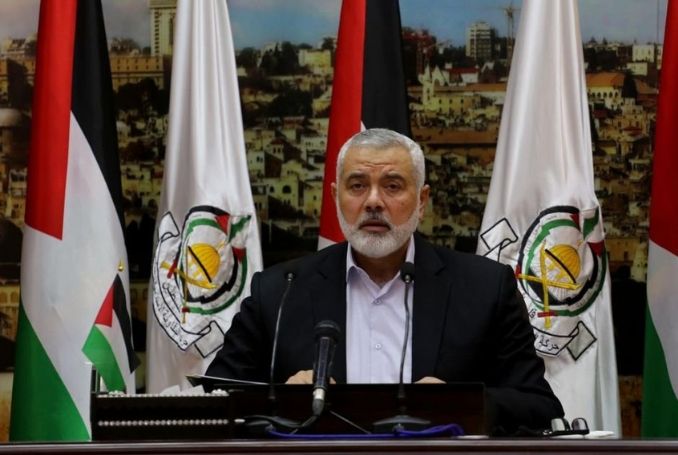
Egypt Rejects Hamas’ Request for Haniyeh to Travel
Palestine Chronicle | July 12, 2019
Egypt has rejected a request by Hamas to allow the head of its political bureau, Ismail Haniyeh, to travel to a number of countries including Iran, Turkey, Qatar, and Russia.
Al-Araby Al-Jadeed reported Egyptian sources as saying that after postponing its response, Cairo finally rejected it saying that regional and security conditions do not allow for Haniyeh to travel.
The news site quoted a Hamas source as saying:
“It is clear that Egypt completely objects to Haniyeh’s foreign tour, in protest against the countries which he will visit.”
The source pointed out that Hamas has decided that Mousa Abu Marzouk will head the movement’s delegation to Moscow next week to discuss the Palestinian reconciliation file among other issues.
The source added that the visit has been postponed more than once in the hope that Egypt would allow Haniyeh to travel.
Israel’s Barak, US sex trafficking suspect Epstein ties exposed
MEMO | July 12, 2019
Former Israeli Prime Minister and election candidate Ehud Barak held a multi-million-dollar business partnership with Jeffrey Epstein, the US billionaire who was this week arrested for sex trafficking underage girls.
According to an exposé yesterday by Israeli daily Haaretz, Barak – who served as Israel’s Prime Minister between 1999 and 2001 and recently announced his formation of a new party, Democratic Israel, ahead of the country’s general election in September – held business ties with Epstein as recently as 2015.
Epstein is a US billionaire who made his fortune on Wall Street and is known to have close relationships with influential political figures, including former US President Bill Clinton and current US President Donald Trump.
In 2008 Epstein pleaded guilty to soliciting underage girls for prostitution, paying dozens of 14 and 15-year olds to perform sex acts over a period of six years. He spent 13 months in county jail, but was given lenient terms under which he was allowed to leave prison six days per week to go to work.
On Saturday, Epstein was arrested on fresh charges of sexually exploiting underage girls at his New York and Florida mansions, as well as “recruiting” other teenagers to carry out sex acts. He pleaded not guilty to sex trafficking and conspiracy to sex traffic minors.
Now Haaretz has exposed that Barak had close ties with Epstein as recently as 2015. It was previously known that the pair held connections, with an Israeli journalist last year reporting that, in 2004, Epstein gave Barak $2.3 million for “research”. The details of this research were never exposed, with Barak refusing to comment on his work as a “private citizen”.
The Israeli daily explained that, “in 2015, Barak set up a limited partnership [called Sum (E.B.)], in which he is the sole shareholder. That company invested in Reporty Homeland Security, established in 2014, becoming a major shareholder.” Last year Reporty, which provides geolocation technology for the emergency services, changed its name to Carbyne.

Former Israeli Prime Minister Ehud Barak [Ynhockey/Wikipedia]
“Barak is [and remains] the chairman of Carbyne and, according to reports by business media outlets, his personal investment in the company totals millions of dollars,” Haaretz explained, adding that it “has learned that Epstein financed a considerable part of the investment, thus becoming a partner in the project”. This means that a large part of the money used by Sum to buy Reporty/Carbyne stock was supplied by Epstein.
In a statement to the newspaper, Barak said that “since these are private investments, it wouldn’t be proper or right for me to expose the investors’ details”, but conceded that “a small number of people I know invest in [the company]”.
Israeli Prime Minister Benjamin Netanyahu has been quick to jump on the revelations in a bid to hamper Barak’s prospects of success in the upcoming election.
Netanyahu took to Facebook yesterday to demand: “Investigate Ehud Barak immediately.” However, as the Times of Israel points out, “the prime minister did not say what behavior on Barak’s part could be the subject of a criminal probe, as no action described in the report appeared illegal”.
For his part, Barak responded to Netanyahu’s calls for an investigation by pointing out the prime minister’s own legal woes, saying that Netanyahu, like Epstein, is “now neck-deep in criminality”. Netanyahu is slated to appear in court in October charged with fraud, bribery and breach of trust in connection with three corruption cases. If found guilty, he could face up to ten years in prison.
This political mudslinging has been seen as an attempt by Netanyahu to “go on the attack,” rather than the defence against the myriad corruption allegations against him. Netanyahu is famous for attacking his political rivals to boost his own popularity, labelling head of the Blue and White (Kahol Lavan) alliance Benny Gantz “mentally unstable” ahead of the last Israeli election in April.
Netanyahu and Barak have a long history of rivalry. Barak was Netanyahu’s commander in the elite Sayeret Matkal unit of the Israeli army, and as such is reportedly one of the few people Netanyahu both respects and fears. It is this history that has likely prompted Netanyahu’s attack on Barak over his connections to Epstein, as opposed to a belief that Barak is a serious electoral opponent – the latest election polls put Barak’s Democratic Israel party at only four seats, the minimum needed to sit in the Knesset, compared to the Likud party’s 33 seats.
US pours oil into fire in Gulf, mum’s the word for India
By M. K. BHADRAKUMAR | Indian Punchline | July 12, 2019
The illegal seizure of an Iranian oil tanker off Gibralter by the British Navy last Friday is fast acquiring farcical character. Britain acted at the behest of the US; in turn, the US probably acted at the behest of the ‘B Team’. So far, only one top US official has expressed joy over the incident — National Security Advisor John Bolton, who is of course the member-secretary of the B Team. None of the other three members of the B Team — Israeli PM Benjamin Netanyahu or either of the two Gulf Crown Princes (bin Salman and bin Zayed)) has waded into the controversy.
The original intention behind the Anglo-American operation was clearly to provoke the Iranians into some retaliatory action. But Iran refused to be provoked and is biding its time. Had Iran acted impulsively or rashly, a military conflagration might have ensued, which would have provided just the alibi for a large-scale US military strike at Iranian targets. Even Article 5 of the NATO Charter on collective security might be invoked. The B Team has been angling for just such a window of opportunity. The US defence secretary’s last visit to Brussels was a mission to rally NATO support for a military strike against Iran.
Now, Iran is savvy enough to figure out the Anglo-American game plan. Tehran is indignant and has warned of consequences, but all in good time. Since Iran refused to be provoked, Britain made a false allegation that Tehran made an abortive attempt to “intimidate” a British oil tanker. Tehran, of course, furiously denied the allegation. Meanwhile, there is a parallel move by the US to assemble a ‘coalition of the willing’ ostensibly to protect oil tankers in the Strait of Hormuz, an Iranian waterway. Therein hangs a tale.
The false allegation by Britain has been promptly seized by the US Navy to press ahead with its master plan to establish military escorts for shipping in the Strait of Hormuz. General Mark Milley, who has been nominated to become chairman of the US Joint Chiefs of Staff, has been quoted as saying on July 11 during testimony before the Senate Armed Services Committee in Washington that the Pentagon is working to put together a coalition “in terms of providing military escort, naval escort to commercial shipping.” In his words, “I think that that will be developing over the next couple weeks.” Milley characterised the project as an assertion of a fundamental principle of “freedom of navigation”, a coinage Washington uses arbitrarily in its “Indo-Pacific” rule book.
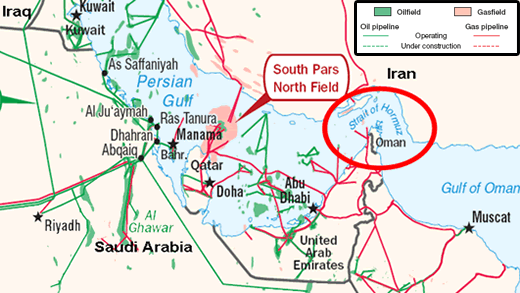
The Strait of Hormuz, located betweenIran and Oman connects the Persian Gulf with the Gulf of Oman and the Arabian Sea and is the world’s most important oil chokepoint.
It doesn’t need much ingenuity to figure out that the US intends to take control of the Strait of Hormuz — although the strait is Iranian-Omani waters under international law. As the narrowest point of the Strait of Hormuz is twenty-one nautical miles, all vessels passing through the Strait must traverse the territorial waters of Iran and Oman. The rights of passage for foreign vessels under international law will consequently be subject to either the rules of non-suspendable innocent passage or transit passage depending on the applicable legal regime.
The topic has come before the International Court of Justice. The ICJ confirmed the customary international law rule, used in international navigation, that foreign warships have the right of innocent passage in straits during peacetime, which means that during peacetime the coastal state could only prohibit the passage of any foreign-flagged vessel if its passage was non-innocent.
However, the grey area here (which the US wants to challenge) is that Iran has the legal right as a coastal state to prevent transit or non-suspendable innocent passage of ships if the ship that is in engaged in passage through the strait constitutes a threat or actual use of force against Iran’s sovereignty, territorial integrity, or political independence, or could be acting in any other manner in violation of the principles of international law embodied in the Charter of the United Nations.
In strategic terms, therefore, by precipitating the seizure of the Iranian oil tanker, the US and Britain are proceeding on a track to create a pretext to challenge Iran’s rights over the Strait of Hormuz and to take control of the strait. This is also contingency planning in advance insofar as under international law, if the US were to attack Iranian territory without a decision of the UN Security Council, the question would arise whether the provisions for transit passage under UNCLOS would continue to apply to the Strait of Hormuz or whether Iran could invoke the laws of war and take action against tankers, especially if they are deemed to be assisting the enemy.
Suffice to say, it is possible to see that what might have appeared as a maverick or silly act by Britain off Gibralter when it seized the Iranian tanker could actually be the tip of a calibrated project aimed at imposing effectively a naval blockade against Iran. Indeed, this forms the latest chapter in the US’‘maximum pressure’ policy against Iran.
By the way, a second leg of the current project is also to seize control of the strategic shipping lanes via the the Bab al-Mandab (off Yemen), which leads to the Suez Canal. (The narrow Bab al-Mandab connects the Red Sea with the Gulf of Aden and the Arabian Sea.)
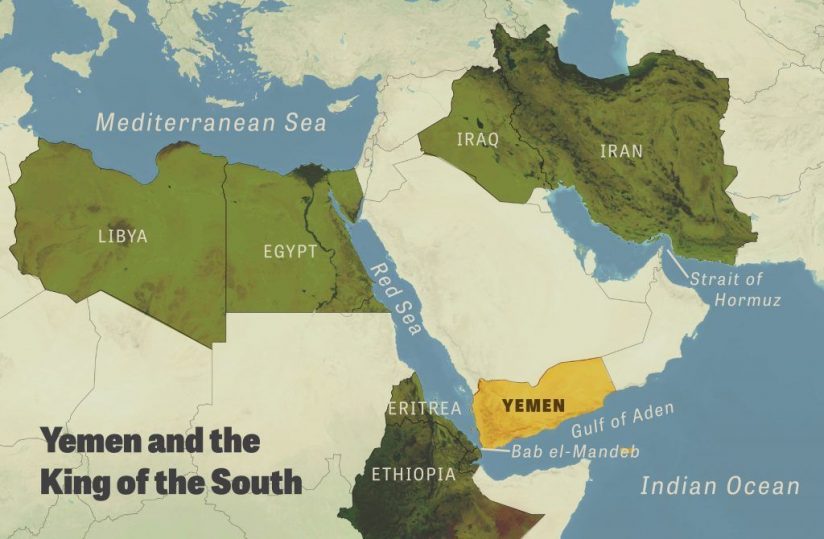
The chokepoint of Bab el-Mandab off Yemen connecting Indian Ocean to the Suez Canal via Red Sea
The US control of the Bab al-Mandab will mean that Iran’s use of the Suez Canal will come under intense US monitoring. The US has a military base in Djibouti facing the Bab al-Mandab. (Against this backdrop, the bitterly-fought war in Yemen falls into perspective, too.)
Of course, all this constitutes acts that are in gross violation of international law and the UN Charter and India should keep miles away from the Anglo-American project to impose naval blockade against Iran on whatever pretext.
Indeed, India will be called upon to take some tough decisions in the period ahead vis-a-vis the emergent situation in the Persian Gulf. First and foremost, India should stay clear of the US-led project to establish military escorts for ships in the Persian Gulf. There are reports that the Indian Navy has deployed two ships with helicopters in the Gulf of Oman. Presumably, this deployment will not form part of the US-led naval flotilla to intimidate and blockade Iran.
Second, there is a strong likelihood of the US invoking its privileges under the Logistics Exchange Memorandum of Agreement to gain access to Indian military facilities for the purpose of refuelling and replenishment of its ships. At the signing of the LEMOA in 2016, much criticism was expressed by Indian experts that it was a “strategic mistake”. In an impassioned plea, Bharat Karnad wrote in August 2016: “It (LEMOA) is, perhaps, the most serious strategic mistake made by the country in its nearly seven decades of independent existence.” Karnad’s criticism forewarning the serious consequences has turned out to be prescient. (here)
The LEMOA’s text remains secret. The Indian public doesn’t even know if India has an option to reject any US demarche for access to our military bases for their ships in a situation such as today’s when war clouds are gathering in our extended neighbourhood and Washington is stepping up preparations for a military operation against Iran, a friendly country with which India has had profound civilisational ties and common concerns in the contemporary regional setting.
The government will be betraying India’s medium and long-term national interests if it provides the US Navy with back-up facilities in its military bases at present under the LEMOA.
Third, most important, Delhi is maintaining deafening silence — for reasons best known to the policymakers — over the gathering storms in the Persian Gulf region. Damn it, over 7 million Indians live and work in that region. Even if one were to overlook that these Gulf-based NRIs give significant budgetary support to the Indian economy, running into billions of dollars annually through their remittances, the government owes it to its citizens to leave no stone unturned to ensure their physical safety and security. Tens of millions of their relatives in India depend on them critically for livelihood.
Shouldn’t the government say something to the effect that India opposes a war situation in the Persian Gulf and that the Trump administration should act with utmost restraint? If this is not a foreign policy issue of consequence for the Prime Minister to articulate, what else could be? Other countries such as Russia, China and the US’ close allies have spoken on the Persian Gulf crisis.
What explains the government’s cowardice? Fear of Trump? Are our elites far too compromised with the B Team? Faustian deal with Netanyahu (who is reportedly heading for Delhi to meet PM)? Or, plain Ostrich Approach of seeing no evil, hearing no evil or speaking no evil if it is about Uncle Sam? At any rate, what kind of impression of a regional power of India is it that the government is projecting? Shame on India!
Concord Management and the End of Russiagate?
By Daniel Lazare | Consortium News | July 12, 2019
Don’t look now, but a federal judge in Washington, D.C., has just shut down half of Robert Mueller’s Russian-interference case.
In February 2018, the special prosecutor indicted a St. Petersburg troll farm called the Internet Research Agency along with two other companies, their owner, Yevgeniy Prigozhin, and 12 employees. The charge: fraud, traveling to the United States under false pretenses, and using social media platforms such as Facebook and Twitter to “sow discord” and “interfere in US political and electoral processes without detection of their Russian affiliation.”
The charge was both legally dubious and heavy-handed, a case of using a sledge hammer to swat a fly. But Mueller went even further in his report, an expurgated version of which was made public in April. No longer just a Russian company, the IRA was now an arm of the Russian government. “[T]he Special Counsel’s investigation,” it declared on page one, “established that Russia interfered in the 2016 election principally through two operations. First, a Russian entity carried out a social media campaign that favored presidential candidate Donald J. Trump and disparaged presidential candidate Hillary Clinton. Second, a Russian intelligence service conducted computer-intrusion operations against entities, employees, and volunteers working in the Clinton campaign and then released stolen documents.”
“Prigozhin,” the report added, referring to the IRA owner, “is widely reported to have ties to Russian President Vladimir Putin.” A few pages later, it said that the IRA’s efforts “constituted ‘active measures’ … a term that typically refers to operations conducted by Russian security services aimed at influencing the course of international affairs.”
Thus, the IRA played a major role in the vast Kremlin conspiracy to alter the outcome of the 2016 election and install Donald Trump in office. But now Judge Dabney Friedrich has ordered Mueller to stop pushing such stories because they’re unfair to Concord Management and Consulting, another Prigozhin company, which astonished the legal world in May 2018 by hiring an expensive Washington law firm and demanding its day in court.
Silent on IRA-Kremlin Connection
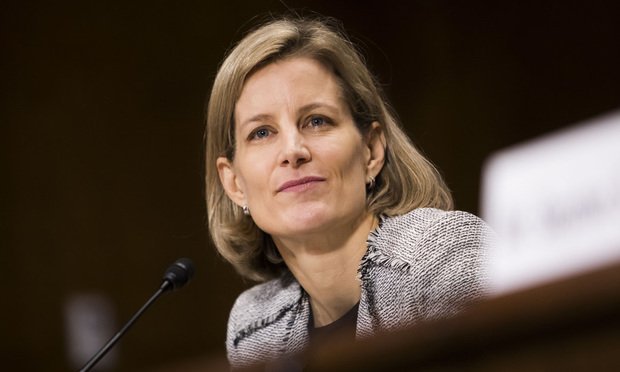
Judge Dabney Friedrich. (Twitter)
Contrary to internet chatter, Friedrich did not offer an opinion as to whether the IRA-Kremlin connection is true or false. Rather, she told the special prosecutor to keep quiet because such statements go beyond the scope of the original indictment and are therefore prejudicial to the defendant. But it may be a distinction without a difference since the only evidence that Mueller puts forth in the public version of his report is a New York Times article from February 2018 entitled “Yevgeny Prigozhin, Russian Oligarch Indicted by US, Is Known as ‘Putin’s Cook.’”
It’s a case of trial by press clip that should have been laughed out of court – and now, more or less, it is. Without the IRA, the only argument left in Mueller’s brief is that Russia stole some 28,000 emails and other electronic documents from Democratic National Committee computers and then passed them along to WikiLeaks, which published them to great fanfare in July 2016.
But as Consortium Newspointed out the day the Mueller report came out, that’s dubious as well. [See “The ‘Guccifer 2.0’ Gaps in Mueller’s Full Report,” April 18.] The reason: it rests on a timeline that doesn’t make sense:
- June 12, 2016: WikiLeaks founder Julian Assange announces that “leaks in relation to Hillary Clinton” were on the way.
- June 15: Guccifer 2.0, allegedly a stand-in for Russian military intelligence, goes on line to claim credit for the hack.
- June 22: Guccifer and WikiLeaks establish contact.
- July 14: Guccifer sends WikiLeaks an encrypted file.
- July 18: WikiLeaks confirms that it’s opened it up.
- July 22: The group releases a giant email cache indicating that the DNC rigged the nominating process in favor of Hillary Clinton and against Bernie Sanders.
But why would Assange announce the leaked emails on June 12 before hearing from the source on June 22? Was he clairvoyant? Why would he release a massive file just eight days after receiving it and as a little as four days after opening it up? How could that be enough time to review the contents and ensure they were genuine? “If a single one of those emails had been shown to be maliciously altered,” blogger Mark F. McCarty points out, “WikiLeaks’s reputation would have been in tatters.” Quite right. So if Mueller’s chronology doesn’t hold up, then Assange’s original statement that “our source is not the Russian government and it is not a state party” still stands – which it plainly does.
Going Up in Smoke
Bottom line: Russiagate is going up in smoke. The claim that Russian military intelligence fed thousands of emails to WikiLeaks doesn’t stand up to scrutiny while Mueller is not only unable to a prove a connection between the Internet Research Agency and the Kremlin but is barred from even discussing it, according to Friedrich’s ruling, without risking a charge of contempt. After 22 months of investigating the ins and outs of Russian interference, Mueller seems to have finally come up dry.

Reed Smith’s Pittsburgh office. (Wikimedia Commons)
“Revenge of the oligarchs” might be a good headline for this story. The IRA indictment initially seemed to be a no-lose proposition for Mueller. He got to look good in the press, the media got to indulge in yet another round of Russia-bashing, while, best of all, no one had to prove a thing. “Mueller’s allegations will never be tested in court,” noted Andrew C. McCarthy, a former federal prosecutor turned pundit for the rightwing National Review. “That makes his indictment more a political statement than a charging instrument.”
Then came the unexpected. Concord Management hired Reed Smith, a top-flight law firm with offices around the world, and demanded to be heard. The move was “a real head-scratcher,” one Washington attorney told Buzzfeed, because Concord was beyond the reach of U.S. law and therefore had nothing to fear from an indictment and nothing to gain, apparently, from going to court. But then the firm demanded to exercise its right of discovery, meaning that it wanted access to Mueller’s immense investigative file. Blindsided, Mueller’s requested a delay “on the astonishing ground,” according to McCarthy, “that the defendant has not been properly served – notwithstanding that the defendant has shown up in court and asked to be arraigned.”

Prigozhin: Forced Mueller to show his hand. (YouTube)
Prigozhin was forcing the special prosecutor to show what he’s got, McCarthy went on, at zero risk to himself since he was not on U.S. soil. What was once a no-lose proposition for Mueller was suddenly a no-lose proposition for Putin’s unexpectedly clever cook.
Now Mueller is in an even worse pickle because he’s barred from mentioning a major chunk of his report. What will he discuss if Democrats succeed in getting him to testify before the House intelligence and judiciary committees next week – the weather? If his team goes forward with the Concord prosecution, he’ll risk having to turn over sensitive information while involving himself in a legal tangle that could go on for years, all without any conceivable payoff. If he drops it, the upshot will be a public-relations disaster of the first order.
As skeptics have pointed out, the IRA’s social-media campaign was both more modest and more ineffectual than the Mueller report’s over-the-top language about a “sweeping and systematic” conspiracy would suggest. Yet after Facebook Vice President Rob Goldman tweeted that “the majority of the Russian ad spend happened AFTER the election,” he was forced to beg for forgiveness like a defendant in a Moscow show trial for daring to play down the magnitude of the crime.
But it wasn’t Goldman who shaved the truth. Rather, it was Mueller. Thanks to the unexpected appearance of Concord Management, he’s now paying the price.
Daniel Lazare is the author of “The Frozen Republic: How the Constitution Is Paralyzing Democracy” (Harcourt Brace, 1996) and other books about American politics.
‘Any lie will do’: Head of US international broadcast agency Lies to Congress about RT’s funding
RT | July 12, 2019
The CEO of the American agency that governs international broadcasting has made a powerful, if blatantly false, sales pitch for his fight against ‘Russian disinformation’… right after saying “any lie will do” for the Kremlin.
John Lansing, the CEO of the United States Agency for Global Media (USAGM), which supervises Voice of America and Radio Free Europe/Radio Liberty, among others, raised the alarm over Washington’s favorite shadowboxing opponent – ‘fake news’ allegedly spread by the Kremlin – at a recent House Committee on Appropriations hearing.
He is worried his agency isn’t getting enough government money to fight “Russian disinformation.”
As the main perpetrators, he named RT and Sputnik (no surprise there). Their goal, according to Lansing, is to “destroy the very idea of an objective, verifiable set of facts,” their modus operandi – “in a world where nothing is empirically truthful, any lie will do.”
He then set his own pants on fire by claiming that while he doesn’t know for certain how much the Russian government invests in those outlets, he knows “it’s more than the US government invests.” How much more? “I think it’s around the 10x factor, absolutely.”
Which is about a 19x factor away from the truth. USAGM’s 2019 budget is $808 million. The combined 2019 budget of the Russian media group that runs RT and Sputnik (as well as a few other outlets) is around $440 million – a far cry from the $8bn+ Lansing generously estimated.
Featured Video
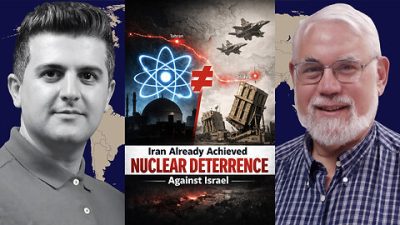
Prof. Ted Postol: Iran Already Achieved Nuclear Deterrence Against Israel
or go to
Aletho News Archives – Video-Images
From the Archives
How the occupied mentality syndrome works
Saudi Arabia on the American chessboard – Part 3
By B. J. Sabri | American Herald Tribune | June 27, 2016
Read part 2: “The occupied mentality Syndrome“
Previously I argued whether Saudi Arabia’s repeated involvements in U.S. interventions and wars stem from free national will or in response to a specific condition. For starters, in Saudi Arabia there is no national will. In Saudi Arabia, the national will is the will of the Al Saud clan. Still, when a major Arab state allies itself with a superpower that committed unspeakable crimes against humanity in almost every Arab country, then something is wrong. This fact alone should compel us to examine the U.S.-Saudi relation for one exceptional reason. As a result of the U.S.-Saudi wars, hundreds of thousands of people in Afghanistan, Iraq, Iran, Libya, Syria, Yemen, and Somalia have lost their lives. Millions became displaced in their own homelands. And millions more rendered refugees.
Attributing the Saudi policies to the bonds of “partnership” with the U.S. is frivolous. There are no bonds between these two thugs except those of business, military deals, secret plots, and wars. Proving this point, bonds such as these have no space for the American and Saudi peoples to share significant cultural or societal exchanges. If partnership is not the reason for the Saudi contribution to the U.S. strategy of empire and imperialism, then another reason must exist.
This leads to three possibilities. … continue
Blog Roll
 Aletho News
- Hezbollah hits Israeli warship off Lebanon’s coast, sets it aflame
- Iran slams US strikes on B1 bridge, Mahshahr petrochemical plants as ‘blatant acts of state terrorism’
- In letter to UN chief, Araghchi warns of dire consequences of US-Israeli attacks on Iran’s nuclear facilities
- Why the CIA conspiracy to invade Iran with Kurdish militias failed
- Why Are Upbeat US Claims About Mission to Rescue Pilot ‘Highly Questionable’?
- Aircraft destroyed during US ‘rescue’ of downed F-15 pilot cost more than $100 million each
- Washington University removes professor who condemned US-Israeli war on Iran
- Russia Warns of Retaliation as UK Authorizes Seizure of Vessels
- Serbia thwarts plot to bomb Russia-Hungary gas pipeline – Vucic
- Al Mayadeen voices solidarity with Dr. Marandi amid death threats
- If Americans Knew
- In Iran, Israel-US take aim at “reason, research, and freedom of thought” – Daily Update
- US loses planes over Iran, Israel downgrades Lebanon war goals – Daily Update
- Israel Is Blocking Palestinians from Easter at Church Where Jesus Resurrected
- Plot to assassinate Palestinian activist follows harassment campaign promoted by Zionist groups and elected officials
- Prominent New York synagogue hosts presentation on why U.S. Jews should support the ethnic cleansing of Gaza
- Tapper vs. Piker: Is the CNN Anchor Auditioning for David Ellison?
- Shouldn’t Democrats Be Able to Condemn Genocide?
- Israel-US kill negotiators, destroy civilian structures, but Iran’s military capabilities still largely intact – Daily Update
- ‘War crime’: Global condemnation as Israeli ministers celebrate death penalty law targeting Palestinian prisoners
- 7 Ways Israel Is Turning Lebanon Into Gaza
- No Tricks Zone
- An Inconvenient Tree: Uncovered In Alps… Europe Much Warmer Than Today 6000 Years Ago
- New Study Reports A 60% Slowdown In Greenland’s Ice Loss Rate In The Last Decade
- Low Intensity Tornado Wrecks Major Solar Farm, Creating A Potential Toxic Dump
- New Study Finds Warming Saves Lives…Cold Temperatures 12 Times More Deadly Than Excess Heat
- German Science Blog Accuses PIK Climate Institute Of Hallucinating Climate Tipping Points
- Devastating Assessment Of Comirnaty Vaccine By Former Senior Pfizer Europe Toxicologist
- New Study: CO2 Is ‘Effectively Negligible’ As An Explanatory Climate Change Factor Since 2000
- Former Pfizer Toxicologist Dr. Helmut Sterz Tells Bundestag Hearing Pfizer Vaccine Should Have Never Been Approved
- Energy Expert: Germany’s Nuclear Phaseout Was A “500 Billion Euro Mistake”
- New Research: South Australia’s Mid-Holocene Sea Surface Temperatures Were 4°C Warmer Than Today
 Aletho News