US Demand to Detain Iranian Tanker Rejected by Gibraltar – Government
Sputnik – August 18, 2019
Gibraltar authorities on Sunday rejected another US request not to release Iranian oil tanker Grace 1.
“The Central Authority’s inability to seek the Orders requested is a result of the operation of European Union law and the differences in the sanctions regimes applicable to Iran in the EU and the US,” a Gibraltar government statement said.
“The EU sanctions regime against Iran – which is applicable in Gibraltar – is much narrower than that applicable in the US,” according to the statement.
Commenting on the decision, Iranian Navy commander, Adm. Hossein Khanzadi said Iran was ready, if necessary, to send warships to escort Iranian tanker.
“We do not plan to send ships to Gibraltar to escort Grace 1, however, as soon as such a request from the Iranian government is received, the Navy will be ready to send its fleet,” Khanzadi said, as cited the Mehr news agency.
On Friday, the US Justice Department issued a warrant for the seizure of the Iranian supertanker. According to the document, the vessel, all the oil aboard and $995,000 are subject to forfeiture based on violations of the International Emergency Economic Powers Act (IEEPA), bank fraud, money laundering, and terrorism forfeiture statutes.
Following the detention of the tanker last month, acting Spanish Foreign Minister Josep Borrell claimed that the vessel was detained at the request of the United States, which has long been seeking to curtail Iranian oil exports.
Gibraltar’s authorities later confirmed that Washington had made a last-ditch request to seize the tanker on a number of allegations.
US Air Force launches surveillance flights in newly-built airfield in Niger
Press TV – August 17, 2019
US Air Force has launched flying operations from a recently constructed remote air base in the West African country of Niger in efforts to carry out intelligence gathering missions over the impoverished region.
“This joint-use runway allows for a better response to regional security requirements and provides strategic access and flexibility,” said commander of US Air Forces in Europe-Air forces Africa (USAFE-AFAFRICA), Gen. Jeff Harrigian in a statement as quoted Friday in a report by the US-based Stars and Stripes military news outlet.
“Air Base 201 gives Niger and the US incredible capability in a challenging region of the world,” Harrigian added, referring to the 6,200-foot runway built by American forces in the southern Sahara Desert in Niger.
The USAFE-AFAFRICA commander further praised the American troops for completing the largest-ever, airmen-led construction project in Air Force history.
According to the report, Niger’s government granted authority to the US military for conducting armed drone flights over the country back in 2018, shortly after the ambush killing of four American soldiers in the country by alleged ISIL-linked militants in October 2017.
Citing a USAFE-AFAFRICA spokesman, the report further noted that construction on Niger’s Air Base 201 is still continuing, with full flying operations expected to begin later this year.
Air Force C-130 cargo planes and other aircraft on resupply missions, in coordination with the Nigerien air force and the country’s civil aviation authorities, began flying limited Visual Flight Rule (VFR) operations into and out of the air base on August 1, added a USAFE-AFAFRICA statement as cited in the report.
It further noted that VFR operations are conducted without instruments to assess an airfield before full flight operations begin, including drone missions.
The report also cited the US Air Force as saying that the $110-million airfield in Niger “is the most austere location from which the Air Force has attempted to operate,” noting that it was finished earlier this summer following delays caused by the challenges of working in a remote desert, “including sandstorms, locust swarms and difficulties in transporting supplies to the base in central Niger.”
US Africa Command says several militant groups operate in the border area between Niger, Nigeria and Chad, including ISIL in West Africa, which has emerged as a priority for the American forces in the region.
Babi Yar: The Einsatzgruppen Killings

Babi Yar Memorial in Ukraine
By John Wear | Inconvenient History | May 19, 2018
One of the worst atrocities attributed to the Einsatzgruppen was the Babi Yar massacre, which allegedly occurred in a large ravine outside Kiev in the Ukraine. The allegation is that Einsatzgruppe C rounded up 33,771 Jews in Kiev and shot all of them over the period September 29-30, 1941.[1] German Reserve Police Battalion 45 and Police Battalion 303 are said to have assisted in the operation.[2] This article will examine the veracity of these allegations.
Einsatzgruppen Report
The figure of 33,771 Jews murdered at Babi Yar comes from Einsatzgruppen Event Report 106 of October 7, 1941.[3] That the Germans let copies of the Einsatzgruppen reports fall into the hands of the Allies is strikingly odd. They could have easily burned these few stacks of incriminating papers before the Allies conquered Germany.[4] The authenticity of the Einsatzgruppen reports has also been questioned because, like so much other “evidence” of Nazi atrocities, the documents emerged from the Soviet occupation zone.[5]
The Einsatzgruppen reports that have been produced are copies which often show clear signs of postwar additions, inaccurate and inflated figures, and rare signatures which appear on non-incriminating pages. Such reports would not constitute valid proof to historians or a legitimate court of law.[6] It is also surprising that the alleged mass murder at Babi Yar took place almost four months prior to the Wannsee Conference, where the mass killing of Jews was allegedly first planned.[7]
The very few figures given in Event Report 106 are provable fabrications. This report claims that there were about 300,000 Jews in Kiev at the time the report was made. The population of Kiev at the time of the report, however, had shrunk from 850,000 or more persons to about 305,000 due to evacuations. So if there had still been 300,000 Jews in Kiev on October 7, 1941, there would have been practically no one in Kiev who was not Jewish. The German experts who made the Einsatzgruppen reports would not have made such a major mistake in their report.[8]
Cremation Eyewitness
Today there are no remains to be found of the tens of thousands of Jews allegedly murdered by the Einsatzgruppen at Babi Yar. The official Holocaust story claims that the Nazis sent a special team back to the site in 1943 to exhume and burn the bodies.[9]
The Jew Vladimir K. Davidov is apparently the only survivor who claims to have participated in the cremation of bodies at Babi Yar. Davidov stated that on August 18, 1943, he and 99 other prisoners were taken to Babi Yar and forced to dig up the bodies of the Jews shot in 1941. He claimed that 70,000 bodies had been buried in the mass graves of Babi Yar. Davidov said that he and about 35 to 40 other prisoners escaped their own murders during the night of September 29. About 10 of his comrades were killed during this escape.[10]
According to Davidov, the prisoners exhumed the dead bodies and later burned them on grilles that consisted of granite blocks with train rails laid upon them. A layer of wood was piled on top of these grilles with the dead bodies piled on top of the wood. This resulted in an enormous stack of bodies 10 to 12 meters high. According to Davidov, there was only a single grille in the beginning, but later 75 grilles were built.[11]
Davidov said that the cremation of the bodies at Babi Yar was finished on September 25 or 26, 1943. The German Luftwaffe took an aerial photograph of the area around Babi Yar on September 26, 1943.[12]
John C. Ball, a Canadian mineral-exploration geologist with experience interpreting air photos, has published this photograph with the following commentary:
Photo 2—September 26th, 1943:
This photo was taken one week after the end of the supposed mass cremations in the ravine. If 33,000 people were exhumed and burned evidence of vehicle and foot traffic to supply fuel should be evident in the area where the Jewish cemetery meets Babi Yar ravine, however there is no evidence of traffic either on the end of the narrow road that proceeds to the ravine from the end of Melnik Street, or on the grass and shrubbery or on the sides of the cemetery.[13]
Ball writes regarding an enlarged section of the same photograph:
An enlargement reveals no evidence that 325 people were working in the ravine finishing the cremation of 33,000 bodies just one week earlier, for many truckloads of fuel would have had to be brought in, and there are no scars from vehicle traffic either on the grass and shrubs at the side of the Jewish cemetery or in the ravine where the bodies were supposedly burned.
1943 air photos of Babi Yar Ravine and the adjoining Jewish cemetery in Kiev reveal that neither the soil nor the vegetation is disturbed as would be expected if materials and fuel had been transported one week earlier to hundreds of workers who had dug up and burned tens of thousands of bodies in one month.[14]
 Ball’s findings are all the more valuable since according to Davidov the cremation of the bodies at Babi Yar was completed on the same day or the day before the photo of September 26, 1943 was taken. This would have left behind clear evidence from the cremation of the bodies that would have shown on the photo. Carlo Mattogno and Jürgen Graf write:
[T]he cremation of 33,771 bodies would have required approximately 4,500 tons of firewood and approximately 430 tons of wood ashes and about 190 tons of human ashes would have been generated by the process. Moreover, several dozen tons of granite (gravestones and monuments) would have had to have been transported from the Jewish cemetery to Babi Yar and back again in order to construct the support for the 75 “ovens.” If the claims put forward about Babi Yar were true, all of this would have had to leave behind unmistakable traces on the air photo of September 26, 1943.[15]
If 33,771 Jews had been shot at Babi Yar, large numbers of rifle bullets would have also remained at the site. To shoot people with rifles, one needs at least twice as many bullets as there are people to be shot. Since the lead core of bullets survives practically forever, finding the remains of these bullets would have been an easy matter.[16]
No one ever conducted a detailed forensic investigation to confirm the witness statements and allegations at Babi Yar. Why was no detailed forensic investigation ever conducted at Babi Yar? The only reasonable answer is that the mass shootings of Jews at Babi Yar never took place. Since there is no material evidence for the mass shootings and cremation of the bodies at Babi Yar, and since the photograph of September 26, 1943 disproves these allegations, Davidov’s eyewitness testimony is clearly inaccurate.[17]
Survivor Eyewitnesses
Some Jewish survivors and authors have described the massacre at Babi Yar. Elie Wiesel wrote in one of his books that after Jews were executed at Babi Yar: “Eye witnesses say that for months after the killings the ground continued to spurt geysers of blood. One was always treading on corpses.”[18] Wiesel later repeated this claim with some embellishment: “Later, I learn from a witness that, for month after month, the ground never stopped trembling; and that, from time to time, geysers of blood spurted from it.”[19] This story lacks all credibility.
A. Anatoli Kuznetsov wrote a novel titled Babi Yar to document the alleged Babi Yar massacre. The author was born in Kiev on August 18, 1929.[20] Thus, he was only 12 years old when the alleged massacre of Jews at Babi Yar took place. This is a relatively young age and tends to lessen his credibility.
Kuznetsov wrote: “On September 29th, 1941, for example, every single eye witness of what happened in Babi Yar was executed, but the people of Kurenyovka knew all about it an hour after the first shots had been fired.”[21]
So Kuznetsov says that he knows of no living eyewitnesses to the massacre of some 33,771 Jews at Babi Yar. Kuznetsov attempts to document the alleged atrocity at Babi Yar with almost exclusively hearsay evidence.
Dina Mironovna Pronicheva was a Jewess who says she survived the alleged massacre at Babi Yar. She is the only person believed to have fallen into the ravine unwounded and feigned death. Assuming various non-Jewish identities, she survived the German occupation of the Soviet Union during World War II. While nobody seems to have interviewed Pronicheva with a tape recorder, there are 12 written records of her testimony dating back to the 1940s. These records differ in substance, and most of the texts fail to meet the standards of contemporary oral history interviews.[22]
Despite the inconsistencies in her testimony, historian Karel C. Berkhoff writes that historians of the alleged Babi Yar massacre should use Pronicheva’s and other testimonies much more extensively. Berkhoff writes: “The fact remains that only very few sources come as close as Pronicheva’s testimonies do to the horrendous details of Kiev’s Jewish Holocaust.”[23]
Berkhoff and other historians fail to acknowledge the extreme disparity in the eyewitness testimonies regarding the events at Babi Yar. For example, Pronicheva’s accounts emphasize guns and rifles as the murder weapons. Other eyewitness accounts have included clubs, rocks, rifle butts, tanks, mines, hand grenades, gas vans, bayonets and knives, burial alive, drowning, injections, and electric shock as the murder weapons at Babi Yar. Herbert Tiedemann asked: “What would an unbiased court do if it had to pass judgement on an alleged mass murderer, if the witnesses were in such thorough disagreement?”[24]
Jürgen Graf writes concerning the contradictory testimony of witnesses at Babi Yar:
According to the established version of the facts, these 33,711 Jews were shot and their bodies thrown into the ravine of Babi Yar on 29 September 1941. But the first witnesses told completely different stories: The massacre was perpetrated in a graveyard, or near a graveyard, or in a forest, or in the very city of Kiev, or on the banks of the Dnieper. As to the murder weapons, the early witnesses spoke of rifles, or machine guns, or submachine guns, or hand grenades, or bayonets, or knives; some witnesses claimed that the victims had been put to death via lethal injections whereas others asserted that they had been drowned in the Dnieper, or buried alive, or killed by means of electric current, or squashed by tanks, or driven into minefields, or that their skulls had been crushed with rocks, or that they had been murdered in gas vans.[25]
Conclusion
Witness testimonies of the alleged Babi Yar massacre have been given full credence by historians even though these testimonies contradict each other and claim the most ridiculous impossibilities. Also, no one ever tried to secure any evidence in order to prove the murders. The Soviets after the end of the war turned the ravine of Babi Yar into a municipal garbage dump, and later into a garbage-incineration site. It is no less incomprehensible that the Soviets intended to build a sports facility over this site of the alleged mass murder of 33,771 Jews.[26]
The air photo taken of the ravine of Babi Yar on September 26, 1943 shows a placid and peaceful valley. Neither the vegetation nor the topography has been disturbed by human activity. There are no burning sites, no smoke, no excavations, no fuel depots, and no access roads for the transport of humans or fuel. We can conclude with certainty from this photo that no part of Babi Yar was subjected to topographical changes of any magnitude right up to the Soviet reoccupation of the area. Hence, the mass graves and mass cremations attested to by witnesses at Babi Yar did not take place.[27]
Endnotes
[1] Winter, Peter, The Six Million: Fact or Fiction?, The Revisionist Press, 2015, p. 25.
[2] Brandon, Ray and Lower, Wendy, The Shoah in Ukraine: History, Testimony, Memorialization: Bloomington, Ind.: Indiana University Press, 2008, p. 292.
[3] Tiedemann, Herbert, “Babi Yar: Critical Questions and Comments,” in Gauss, Ernst (ed.), Dissecting the Holocaust: The Growing Critique of Truth and Memory, Capshaw, Ala.: Theses and Dissertations Press, 2000, p. 521.
[4] Mattogno, Carlo and Graf, Jürgen, Treblinka: Transit Camp or Extermination Camp?, Washington, D.C.: The Barnes Review, 2010, p. 204.
[5] Winter, Peter, The Six Million: Fact or Fiction?, The Revisionist Press, 2015, p. 25
[6] Mattogno, Carlo and Graf, Jürgen, Treblinka: Transit Camp or Extermination Camp?, Washington, D.C.: The Barnes Review, 2010, pp. 203-211.
[7] Tiedemann, Herbert, “Babi Yar: Critical Questions and Comments,” in Gauss, Ernst (ed.), Dissecting the Holocaust: The Growing Critique of Truth and Memory, Capshaw, Ala.: Theses and Dissertations Press, 2000, p. 497.
[8] Ibid., pp. 499, 521.
[9] Winter, Peter, The Six Million: Fact or Fiction?, The Revisionist Press, 2015, p. 25.
[10] Mattogno, Carlo and Graf, Jürgen, Treblinka: Transit Camp or Extermination Camp?, Washington, D.C.: The Barnes Review, 2010, pp. 220-221.
[11] Ibid., p. 220.
[12] Ibid., p. 221.
[13] Ball, John C., Air Photo Evidence: Auschwitz, Treblinka, Majdanek, Sobibor, Bergen Belsen, Belzec, Babi Yar, Katyn Forest, Delta, B.C., Canada: Ball Resources Services Limited, 1992, p. 107.
[14] Ibid., p. 108.
[15] Mattogno, Carlo and Graf, Jürgen, Treblinka: Transit Camp or Extermination Camp?, Washington, D.C.: The Barnes Review, 2010, p. 222.
[16] Tiedemann, Herbert, “Babi Yar: Critical Questions and Comments,” in Gauss, Ernst (ed.), Dissecting the Holocaust: The Growing Critique of Truth and Memory, Capshaw, Ala.: Theses and Dissertations Press, 2000, p. 500.
[17] Ibid., pp. 498-524.
[18] Wiesel, Elie, The Jews of Silence, London: Vallentine Mitchell, 1968, p. 37.
[19] Wiesel, Elie, Paroles d’étranger, Paris: Editions du Seuil, 1982, p. 86.
[20] Kuznetsov, A. Anatoli, Babi Yar: A Document in the Form of a Novel, New York: Farrar, Straus and Giroux, 1970, p. 14.
[21] Ibid., p. 365.
[22] Brandon, Ray (editor) and Lower, Wendy (editor), The Shoah in Ukraine: History, Testimony, Memorialization, Bloomington, Ind.: Indiana University Press, 2008, pp. 294-295.
[23] Ibid., p. 309.
[24] Tiedemann, Herbert, “Babi Yar: Critical Questions and Comments,” in Gauss, Ernst (ed.), Dissecting the Holocaust: The Growing Critique of Truth and Memory, Capshaw, Ala.: Theses and Dissertations Press, 2000, p. 523.
[25] Graf, Jürgen, “The Moral and Intellectual Bankruptcy of a Scholar,” Inconvenient History, Vol. 3, No. 4, 2011.
[26] Tiedemann, Herbert, “Babi Yar: Critical Questions and Comments,” in Gauss, Ernst (ed.), Dissecting the Holocaust: The Growing Critique of Truth and Memory, Capshaw, Ala.: Theses and Dissertations Press, 2000, pp. 524-525.
[27] Ball, John Clive, “Air Photo Evidence,” in Gauss, Ernst (ed.), Dissecting the Holocaust: The Growing Critique of Truth and Memory, Capshaw, Ala.: Theses and Dissertations Press, 2000, pp. 275, 284.
Kashmir Caged: A Fact-Finding Report

Army patrol on the road | Image courtesy Kavita Krishnan
By Jean Drèze, Kavita Krishnan, Maimoona Mollah and Vimal Bhai | Indian Cultural Forum | August 14, 2019
We spent five days (9-13 August 2019) traveling extensively in Kashmir. Our visit began on 9 August 2019 – four days after the Indian government abrogated Articles 370 and 35A, dissolved the state of Jammu and Kashmir, and bifurcated it into two Union Territories.
When we arrived in Srinagar on 9 August, we found the city silenced and desolated by curfew, and bristling with Indian military and paramilitary presence. The curfew was total, as it had been since 5th August. The streets of Srinagar were empty and all institutions and establishments were closed (shops, schools, libraries, petrol pumps, government offices, banks). Only some ATMs and chemists’ shops – and all police stations – were open. People were moving about in ones and twos here and there, but not in groups.
We travelled widely, inside and outside Srinagar – far beyond the small enclave (in the centre of Srinagar) where the Indian media operates. In that small enclave, a semblance of normalcy returns from time to time, and this has enabled the Indian media to claim that life in Kashmir is back to normal. Nothing could be further from the truth.
We spent five days moving around and talking to hundreds of ordinary people in Srinagar city, as well as villages and small towns of Kashmir. We spoke to women, school and college students, shopkeepers, journalists, people who run small businesses, daily wage labourers, workers and migrants from UP, West Bengal and other states. We spoke to Kashmiri Pandits and Sikhs who live in the Valley, as well as Kashmiri Muslims.
Everywhere, we were cordially received, even by people who were very angry about the situation or sceptical of our purpose. Even as people expressed their pain, anger, and sense of betrayal against the Government of India, they extended warmth and unstinting hospitality to us. We are deeply moved by this.
Except for the BJP spokesperson on Kashmir Affairs, we did not meet a single person who supported the Indian government’s decision to abrogate Article 370. On the contrary, most people were extremely angry, both at the abrogation of Article 370 (and 35A) and at the manner in which it had been done.
Anger and fear were the dominant emotions we encountered everywhere. People expressed their anger freely in informal conversation, but no-one was willing to speak on camera. Anyone who speaks up is at risk of persecution from the government.
Many told us that they expected massive protests to erupt sooner or later (after restrictions were relaxed, after Eid, after 15 August, or even later), and anticipated violent repression even if the protests were peaceful.
A summary of our observations
-
There is intense and virtually unanimous anger in Kashmir against the Indian government’s decision to abrogate Articles 370 and 35A, and also about the way this has been done.
-
To control this anger, the government has imposed curfew-like conditions in Kashmir. Except for some ATMs, chemists’ shops and police stations, most establishments are closed for now.
-
The clampdown on public life and effective imposition of curfew have also crippled economic life in Kashmir, that too at a time of the BakrEid festival that is meant for abundance and celebration.
-
People live in fear of harassment from the government, army or police. People expressed their anger freely in informal conversation, but no-one was willing to speak on camera.
-
The Indian media’s claims of a rapid return to normalcy in Kashmir are grossly misleading. They are based on selective reports from a small enclave in the centre of Srinagar.
-
As things stand, there is no space in Kashmir for any sort of protest, however peaceful. However, mass protests are likely to erupt sooner or later.
Reactions To The Government’s Treatment of J&K
-
When our flight landed, and the airlines staff announced that passengers could switch on our mobiles, the entire flight (with mostly Kashmiris in it) burst into mocking laughter. “What a joke”, we could hear people say – since mobile and landline phones and internet have all been blocked since 5 August!
-
As soon as we set foot in Srinagar, we came across a few small children playacting in a park. We could hear them say ‘Iblees Modi’. ‘Iblees’ means ‘Satan’.
-
The words we heard over and over from people about the Government decisions on J&K were ‘zulm’ (oppression), ‘zyadti’ (excess/cruelty), and ‘dhokha’ (betrayal). As one man in Safakadal (downtown Srinagar) put it, “The Government has treated us Kashmiris like slaves, taking decisions about our lives and our future while we are captive. It’s like forcing something down our throats while keeping us bound and gagged, with a gun to our heads.”
-
In every lane of Srinagar city, every town, every village, that we visited, we received an extensive schooling from ordinary people, including school kids, on the history of the Kashmir dispute. They were angry and appalled at the manner in which the Indian media was whitewashing this history. Many said: “Article 370 was the contract between Kashmir’s leadership and India’s. Had that contract not been signed, Kashmir would never have acceded to India. With Article 370 gone, India no longer has any basis for its claim over Kashmir.” One man in the Jahangir Chowk area near Lal Chowk, described Article 370 as a ‘mangalsutra’ (sacred necklace worn by married women) symbolising a contract (analogous to the marital contract) between Kashmir and India. (More on people’s reactions to the abrogation of Articles 370 and 35A below)
-
There is widespread anger against the Indian media. People are imprisoned in their homes, unable to communicate with each other, express themselves on social media, or make their voices heard in any way. In their homes, they watch Indian TV claim that Kashmir welcomes the Government decisions. They seethe with rage at the erasure of their voices. As one young man in Safakadal put it, “Kiski shaadi hai, aur kaun naach raha hai?! (It’s supposed to be our wedding, but it’s only others who are dancing!) If this move is supposed to be for our benefit and development, why not ask what we ourselves think about it?”
Reactions To The Abrogation Of Article 370 and 35A
-
A man in Guree village (Anantnag district) said: “Hamara unse rishta Article 370 aur 35A se tha. Ab unhone apne hi paer par kulhadi mar di hai. In Articles ko khatm kar diya hai. Ab to ham azad ho gaye hain.” (Our relation with them (India) was through Article 370 and Article 35A. Now they have themselves committed the folly of dissolving these Articles. So now we are free.” The same man raised slogans of “We want freedom” followed by slogans of “Restore Articles 370 and 35A.”
-
Many described Article 370 and 35A as Kashmir’s “pehchan” (identity). They felt that the abrogation of these Articles is a humiliating attack on Kashmir’s self-respect and identity.
-
Not all demanded restoration of Article 370. Many said that it was only the parliamentary parties who had asked people to have faith that India would honour the contract that was Article 370. The abrogation of Article 370 only discredited those “pro-India parties”, and vindicated those who argued for Kashmir’s “azaadi” (independence) from India, they felt. One man in Batamaloo said: “Jo india ke geet gate hain, apne bande hain, ve bhi band hain! (Those who sang praises of India, India’s own agents, they too are imprisoned!” A Kashmiri journalist observed, “Many people are happy about the treatment the mainstream parties are getting. These parties batted for the Indian State and are being humiliated now.”
-
“Modi has destroyed India’s own law, its own Constitution” was another common refrain. Those who said this, felt that Article 370 was more important to India (to legitimise its claim to Kashmir) than it was to Kashmir. But the Modi Government had not only sought to destroy Kashmir, it had destroyed a law and Constitution that was India’s own.
-
A hosiery businessman in Jahangir Chowk, Srinagar said, “Congress ne peeth mein choora bhonka tha, BJP ne saamne se choora bhonka hai.” (Congress had stabbed us from the back, BJP is stabbing us up front). He added, “They strangled their own Constitution. It’s first step towards Hindu Rashtra.”
-
In some ways, people were more concerned about the effects of the abrogation of 35A than that of 370. It is widely recognised that Article 370 retained only nominal, symbolic autonomy and had already been diluted. With 35A gone, though, people fear that “State land will be sold cheap to investors. Ambani, Patanjali etc can come in easily. Kashmir’s resources and land will be grabbed. In Kashmir as it stands now, education and employment levels are better than in the mainland. But tomorrow Kashmiris will have to compete for Government jobs with those from other states. After one generation, most Kashmiris won’t have jobs or be forced to move to the mainland.”
“Normalcy” – Or “Peace Of The Graveyard”?
Is the situation in Kashmir “normal” and “peaceful”? The answer is an emphatic NO.
-
One young man in Sopore said: “This is bandook ki khamoshi (the silence at gunpoint), kabristan ki khamoshi (the peace of the graveyard).”
-
The newspaper Greater Kashmir had one (front) page of news and a sports page at the back: the two inside pages were full of cancellation announcements of weddings or receptions!
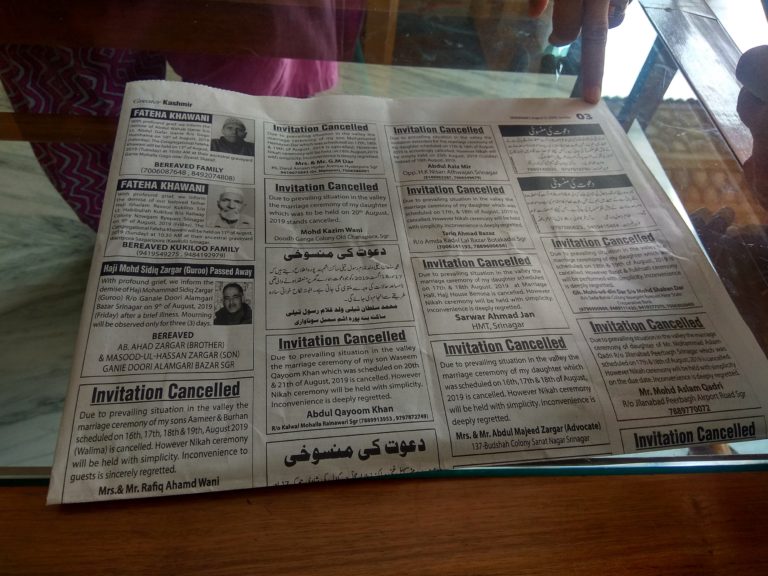
Invitations cancelled I Image courtesy Kavita Krishnan
-
Between 5-9 August, people had suffered for lack of food, milk, and basic needs. People had been prevented even from going to hospitals in case of sickness.
-
The Government claim is that only Section 144 has been imposed, not “curfew”. But in reality, police vans keep patrolling Srinagar warning people to “stay safe at home and not venture out during the curfew”, and tell shops to close their shutters. They demand that people display “curfew passes” to be allowed to move about.
-
All of Kashmir is under curfew. Even on Eid, the roads and bazaars were silent and desolate. All over Srinagar, mobility is restricted by concertina wires on streets, and massive paramilitary deployment. Even on Eid, this was the case. In many villages, azaan was prohibited by the paramilitary and people were forced to do namaaz prayers at home rather than collectively at the mosque as it usual on Eid.
-
In Anantnag, Shopian and Pampore (South Kashmir) on the day of Eid, we only saw very small kids dressed in Eid finery. Everyone else was in mourning. “We feel like we’re in jail”, said a woman in Guree (Anantnag). Girls in Nagbal (Shopian) said, “With our brothers in police or army custody, how can we celebrate Eid?”
-
On 11 August, on the eve of Eid, a woman at Sopore told us she had come to the bazaar during a brief respite in the curfew, to buy a few supplies for Eid. She said: “We were prisoners in our own homes for 7 days. Even today, shops are closed in my village Langet, so I came to Sopore town to shop for Eid and to check on my daughter who is a nursing student here.”
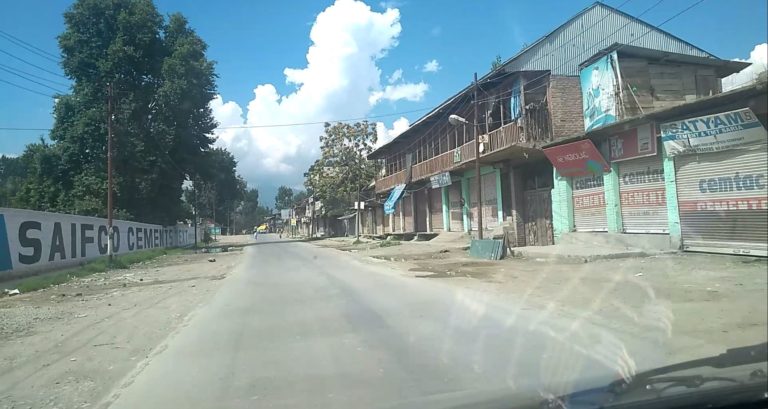
Eid in Pulwama | Image courtesy Kavita Krishnan
-
“It’s Army rule not Modi rule. There are more soldiers here than people”, said a young baker at Watpura near Bandipora. His friend added, “We’re afraid, because the army camp nearby keeps imposing impossible rules. They insist we have to return within half an hour if we leave home. If my kid isn’t well, and I have to take her to the hospital, it may take more than half an hour. If someone visits their daughter who lives in next village, they may take more than half hour to return. But if there’s any delay, they will harass us.” The CRPF paramilitary is everywhere, outside nearly every home in Kashmir. These are clearly not there to provide “security” to Kashmiris – on the contrary, their presence creates fear for the people.
-
Sheep traders and herders could be seen with unsold sheep and goats. Animals they had been rearing all year long, would not be sold. This meant they would incur a huge loss. With people unable to earn, many could not afford to buy animals for the Eid sacrifice.
-
A shopkeeper from Bijnore (UP) showed us the stacks of unsold sweets and delicacies going waste, since people could not buy them. Shops and bakeries wore a deserted look on the eve of Eid, with their perishable food items lying unsold.
-
An asthmatic auto driver in Srinagar, showed us his last remaining dose of salbutamol and asthalin. He had been trying for the past several days to buy more – but the chemists’ shops and hospitals in his area had run out of stocks. He could go to other, bigger hospitals – but CRPF would prevent him. He showed us the empty, crushed cover of one asthalin inhaler – when he told a CRPF man he needed to go further to get the medicine, the man stamped on the cover with his boot. “Why stamp on it? He hates us, that’s why”, said the auto driver.
Protests, Repression, and Brutality
-
Some 10,000 people protested in Soura (Srinagar) on 9 August. The forces responded with pellet gun fire, injuring several. We attempted to go to Soura on 10 August, but were stopped by a CRPF barricade. We did see young protestors on the road that day as well, blockading the road.
-
We met two victims of pellet gun injuries in SMHS hospital in Srinagar. The two young men (Waqar Ahmad and Wahid) had faces, arms and torso full of pellets. Their eyes were bloodshot and blinded. Waqar had a catheter in which the urine, red with blood from internal bleeding, could be seen. Their family members, weeping with grief and rage, told us that the two men had not been pelting stones. They had been peacefully protesting.
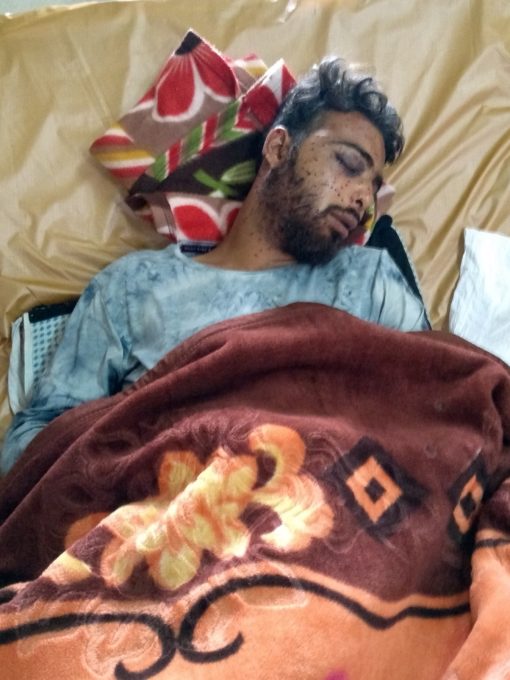
Pellet gun victim | Image courtesy Vimal Bhai
-
On 6 August, a graphic designer for the Rising Kashmir newspaper, Samir Ahmad, (in his early 20s) had remonstrated with a CRPF man near his home in the Manderbag area of Srinagar, asking him to allow an old man to pass. Later the same day, when Samir opened the door to his house, CRPF fired at him with a pellet gun, unprovoked. He got 172 pellets in his arm and face near the eyes, but his eyesight is safe. It is clear that the pellet guns are deliberately aimed at the face and eyes, and unarmed, peaceful civilians standing at their own front doors can be targets.
-
At least 600 political leaders and civil society activists are under arrest. There is no clear information on what laws are invoked to arrest them, or where they are being held.
-
A very large number of political leaders are under house arrest – it is impossible to ascertain how many. We tried to meet CPIM MLA Mohd Yusuf Tarigami – but were refused entry into his home in Srinagar, where he is being under house arrest.
-
In every village we visited, as well as in downtown Srinagar, there were very young schoolboys and teenagers who had been arbitrarily picked up by police or army/paramilitary and held in illegal detention. We met a 11-year-old boy in Pampore who had been held in a police station between 5 August and 11 August. He had been beaten up, and he said there were boys even younger than him in custody, from nearby villages.
-
Hundreds of boys and teens are being picked up from their beds in midnight raids. The only purpose of these raids is to create fear. Women and girls told us of molestation by armed forces during these raids. Parents feared meeting us and telling us about the “arrests” (abductions) of their boys. They are afraid of Public Security Act cases being filed. The other fear is that the boys may be “disappeared” – i.e killed in custody and dumped in mass graves of which Kashmir has a grim history. As one neighbour of an arrested boy said, “There is no record of these arrests. It is illegal detention. So if the boy “disappears” – i.e is killed in custody – the police/army can just say they never had him in custody in the first place.”
-
But the protests are not likely to stop. A young man at Sopore said: “Jitna zulm karenge, utna ham ubharenge” (The more you oppress us, the more we will rise up) A familiar refrain we heard at many places was: “Never mind if leaders are arrested. We don’t need leaders. As long as even a single Kashmiri baby is alive, we will struggle.”
The Gag On Media
-
A journalist told us: “Newspapers are printing in spite of everything. Without the internet, we do not get any feed from agencies. We were reduced to reporting the J&K related developments in Parliament, from NDTV! This is undeclared censorship. If Govt is giving internet and phone connectivity to police but not to media houses what does it mean? We had some people come to our offices, speaking on behalf of Army and CRPF, asking “Why are you publishing photos of the curfew-affected streets?”
-
Kashmiri TV channels are completely closed and unable to function.
-
Kashmiri newspapers that carry the barest mention of protests (such as the one on Soura) are made to feel the heat from the authorities.
-
Foreign press reporters told us that they are facing restrictions on their movement by the authorities. Also, because of the lack of internet, they are unable to communicate with their own main offices.
-
When we visited Press Enclave in Srinagar on 13 August, we found the newspaper offices closed and the area deserted except for a few stray journalists, and some CID men. One of the journalists told us that papers could not be printed till at least 17 August, because they have run out of newsprint which comes from Delhi.
-
As mentioned above, one graphic designer working with a newspaper suffered pellet gun injuries, during a completely unprovoked attack by CRPF

A checkpoint in Srinagar | Image courtesy Vimal Bhai
Does Kashmir Lack Development?
In an op-ed in the Times Of India (August 9, 2019), former Foreign Secretary and Ambassador Nirupama Rao wrote: “A young Kashmiri told this writer a few months ago her birthplace was in the “stone age”; that in terms of economic development, Kashmir was two hundred years behind the rest of India.”
We struggled to find this “backward”, “stone age” Kashmir anywhere at all.
-
It is striking how in every Kashmiri village, we found young men and women who go to college or University; speak Kashmiri, Hindi and English fluently; and are able to argue points of Constitutional and international law in relation to the Kashmir conflict with factual accuracy and erudition. All four of the team members are familiar with villages in North Indian states. This high level of education is extremely rare in any village in, say, Bihar, UP, MP, or Jharkhand.
-
The homes in rural Kashmir are all pucca constructions. We saw no shacks like the ones that are common in rural Bihar, UP, Jharkhand.
-
There are poor people in Kashmir, certainly. But the levels of destitution, starvation and abject poverty seen in many North Indian states, is simply absent in rural Kashmir.
-
We met migrant labourers from North India and West Bengal at many places. They told us that they feel safe and free from xenophobic violence that they face in, say, Maharashtra or Gujarat. Daily wage migrant labourers told us “Kashmir is our Dubai. We earn Rs 600 to Rs 800 per day here – that is three or four times what we earn in other states.”
-
We found Kashmir refreshingly free of communal tension or mob lynchings. We met Kashmiri pandits who told us they felt safe in Kashmir, and that the Kashmiris always celebrate their festivals together. “We celebrate Eid, Holi, Diwali together. That is our Kashmiriyat. It is something different, special,” said one Kashmiri Pandit young man.
-
The myth of the “backward” Kashmiri woman is perhaps the biggest lie. Kashmiri girls enjoy a high level of education. They are articulate and assertive. Of course, they face and resist patriarchy and gender discrimination in their societies. But does BJP, whose Haryana CM and Muzaffarnagar MLA speak of “getting Kashmiri brides” as though Kashmiri women are property to be looted, have any right to preach feminism to Kashmir? Kashmiri girls and women told us, “We are capable of fighting our own battles. We don’t want our oppressors to claim to liberate us!”
The BJP Spokesperson’s “Warning”
We met BJP spokesperson on Kashmir affairs, Ashwani Kumar Chrungoo at the office of Rising Kashmir, a Kashmir newspaper. The conversation was initially cordial. He told us he had come to Kashmir from Jammu to persuade people to support the abrogation of Article 370. His main argument was that since the BJP had won a 46% vote share in J&K and had won an unprecedented majority in Parliament, they had not only a right but a duty to keep their promise of scrapping Article 370. “46% vote share – that’s a license”, he said.
He refused to acknowledge that this 46% vote share while winning only three Lok Sabha seats (Jammu, Udhampur and Ladakh) was possible only because the voter turnout in the three other LS seats (Srinagar, Anantnag and Baramulla) was the lowest in the whole country.
Should a Government impose an unpopular decision on people of Kashmir who have not voted for that decision, at gunpoint? Chrungoo said, “In Bihar when Nitish Kumar imposed prohibition, he didn’t ask the alcoholics for their permission or consent. It’s the same here.” His contempt for the people of Kashmir was evident from this analogy.
Towards the end of the conversation, he became increasingly edgy when confronted by facts and arguments by us. He got up and wagged a finger at Jean Dreze, saying “We won’t let anti-nationals like you do your work here. I am warning you.”
Conclusion
The whole of Kashmir is, at the moment, a prison, under military control. The decisions taken by the Modi Government on J&K are immoral, unconstitutional and illegal. The means being adopted by the Modi Government to hold Kashmiris captive and suppress potential protests are also immoral, unconstitutional, and illegal.
-
We demand the immediate restoration of Articles 370 and 35A.
-
We assert that no decision about the status or future of J&K should be taken without the will of its people.
-
We demand that communications – including landline telephones, mobile phones and internet be restored with immediate effect.
-
We demand that the gags on the freedom of speech, expression and protest be lifted from J&K with immediate effect. The people of J&K are anguished – and they must be allowed to express their protest through media, social media, public gatherings and other peaceful means.
-
We demand that the gags on journalists in J&K be lifted immediately.
Jean Drèze, economist
Kavita Krishnan, Communist Party of India (Marxist-Leninist) and AIPWA
Maimoona Mollah, All India Democratic Women’s Association (AIDWA)
Vimal Bhai, National Alliance of People’s Movements (NAPM)
More than two thirds of Americans don’t believe Epstein died by suicide
RT | August 16, 2019
It appears most Americans don’t believe the official narrative on the death of convicted sex offender Jeffrey Epstein after a poll found that more people believe the financier died as a result of murder rather than suicide.
The curious circumstances surrounding Epstein’s reported suicide last Saturday raised more than a few eyebrows. Now, a poll from Rasmussen has found that only 29 percent of Americans believe he died by suicide in jail. That figure pales in comparison to the 42 percent of people who think that Epstein was murdered to prevent him from testifying against some of his powerful associates.*
The news attracted a huge level of interest with more than two thirds of people saying that they followed developments ‘closely’ and one quarter of people saying they followed it ‘very closely.’ Among Americans following the story ‘very closely’, 56 percent believe Epstein was murdered, Rasmussen found.
The survey was carried out in the days after Epstein’s death and it involved 1,000 respondents. It found that men were more likely than women to suspect that the disgraced financier was murdered. White respondents were also found to be less suspicious than people from minority backgrounds.
On Thursday, the Washington Post reported that Epstein’s autopsy found that the 66-year old had several broken bones in his neck including his hyoid bone. Forensic experts told the paper that breaks in the bone can occur in those who hang themselves, however, they are more common in victims of homicide by strangulation.
* (To see survey question wording, click here.)
US slaps crew of Iranian supertanker with visa ban after it set sail from Gibraltar
RT | August 16, 2019
Hours after Washington failed to persuade the Gibraltar authorities to not release the Iranian oil tanker, the State Department warned that anyone linked to the vessel will not be able to travel to the US.
Unable to stop the Iranian supertanker Grace 1 from leaving Gibraltar, the US will target its crew, comprised of Indian, Filipino, Latvian, and Russian citizens. The sailors are now accused of aiding Iran’s elite Islamic Revolutionary Guard Corps (IRGC), labeled as a “terrorist organization” by the US.
“Crewmembers of vessels assisting the IRGC by transporting oil from Iran may be ineligible for visas or admission to the United States under the terrorism-related inadmissibility grounds,” a statement released by the State Department reads.
On Thursday, Washington unsuccessfully sought the seizure of the Grace 1, filing a request that formally postponed the lifting of Gibraltar’s detention order by a few hours. Iran’s ambassador to the UK, Hamid Baeidinejad, called Washington’s move “its desperate, last-minute efforts, intended to prevent the release of the [Grace 1] oil tanker from detention,” which ended in “humiliation.”
Nevertheless, the authorities chose not to bow to the US pressure and allowed the Panamanian-flagged ship to finally set sail.
The Grace 1 was seized by the British Royal Marines outside of Gibraltar in early July, prompting Tehran to retaliate in kind by capturing a British-flagged vessel in the Persian Gulf two weeks later. The seizures added fuel to the simmering feud between Iran and the West, prompting the UK to seek to defuse the tensions.
Iran made ‘no commitments’ over released tanker, Syria ‘wasn’t its destination’
RT | August 16, 2019
Iran has made no commitments to gain the release of its tanker from detention in Gibraltar, an Iranian Foreign Ministry spokesman said on Friday.
“Iran has given no assurances over the ‘Grace 1’ not going to Syria to secure its release,” a state broadcaster’s website quoted Abbas Mousavi as saying. “The tanker’s destination was not Syria… and even if it was, it did not concern anyone else.”
Fabian Picardo, chief minister for the British territory, said the detention order was lifted after written assurances from Tehran that the ship would not discharge oil in Syria in violation of EU sanctions.
The tanker carrying Iranian oil is preparing to set sail into the Mediterranean, the deputy head of Iran’s Ports and Maritime Organization, Jalil Eslami, said on Friday. The ‘Grace 1’ will be renamed and switch to the Iranian flag for its onward journey, Eslami told state television.
Russia’s Sound Proposal for Gulf Peace
Strategic Culture Foundation | August 16, 2019
There is an eminently reasonable and feasible way to avoid conflict in the Persian Gulf, and to secure peace. The principles of multilateralism and international law must be adhered to. It seems almost astounding that one has to appeal for such obvious basic norms.
Fortunately, Russia has presented a roadmap for implementing a security concept in the vital waterway based on the above principles.
Russia’s deputy envoy to the United Nations, Dmitry Polyansky, outlined a possible international coalition to provide security for commercial shipping through the strategically important Persian Gulf. The narrow outlet accounts for up to 30 per cent of all globally shipped oil on a daily basis. Virtually every nation has a stake in the safe passage of tankers. Any disruption would have huge negative consequences for the world economy, impacting all nations.
The Russian proposal, which has been submitted to the UN Security Council, is currently being considered by various parties. Crucially, the security concept put forward by Moscow relies on the participation of the Gulf nations, including Iran. Rather than being led by an outside power, the Russian proposal envisages a region-led effort.
This multilateral arrangement for cooperation between nations is solidly within the principles of the UN Charter and international law. Potentially, it can build trust and positive relations, and thereby reduce the climate of tensions and uncertainty which have intensified over recent months, primarily between the United States and Iran.
Washington has blamed Iran for several sabotage incidents on commercial shipping since June. The Americans have not provided any proof for their claims. Iran, for its part, denies any malfeasance and instead has pointed to a “malign conspiracy” aimed at stoking tensions, or worse, precipitate an all-out military confrontation between the US and Iran. Significantly, too, the problem of alleged sabotage and danger to shipping followed the increased deployment of US forces in the region during May, ostensibly to counter anticipated “Iranian aggression”.
One thing for sure is that the US proposal for a naval coalition led by Washington, purportedly to “protect shipping” in the Gulf, is a non-starter. Most nations have rebuffed the American plan. Germany, France and other European Union states have given it a resounding pass. Even Arab nations allied with the US, such as Saudi Arabia and the United Arab Emirates, have demurred on the idea. Significantly, too, the Gulf states have refrained from following Washington’s line of fingering Iran for the unknown sabotage incidents.
After weeks of lobbying for its US-led “navy coalition”, Washington appears to have recruited just two other partners: Britain and Israel.
The term “coalition” is therefore a misnomer in this context. It also has no credibility as a force serving to uphold international law and security. The position of the US-led axis is one of outright hostility towards Iran. It is premised on the flawed assumption that Iran is the “problem”.
Any such extra-regional military force is by definition a source of further insecurity and tensions in the Persian Gulf, as Iranian Foreign Minister Mohammad Javad Zarif has noted. Arguably, any such US-led deployment is illegal because it is not mandated by the UN Security Council. The US plan relies on a unilateral imposition of American force along with a coterie of allies who have a long history of facilitating Washington’s militaristic adventures.
Indeed, moreover, one can easily perceive that the US claims about maritime security and safe passage are dubious. What Washington appears to be doing is cynically using “security concerns” as a cover for forming an aggressive front against Iran. The real purpose is to augment the Trump administration’s “maximum pressure” policy towards Tehran in order to coerce that nation into ceding to American strategic demands. This US policy is, of course, illegitimate, arguably criminal. But it is being concealed, as the Americans usually do, with the pseudo-image of acting as the world’s “policeman”.
By contrast, it may be hoped that the UN and the nations of the Gulf region move forward to embrace Russia’s proposal for a genuinely cooperative, mutual effort to maintain peace. The only way forward is through multilateralism, mutual respect, dialogue and adherence to international law. Conflict is a lose-lose scenario. Peace is win-win.
Surely, if any party cannot support such a reasonable proposition, then the telling question is: why not? A negative response strongly suggests there is a disingenuousness about putative “security concerns”, and that an ulterior, sinister agenda is actually at play.
It should also be borne in mind that the present mounting tensions in the Persian Gulf have come about because the Trump administration took the reprehensible step of repudiating the international nuclear accord with Iran. That accord was signed by Iran, the US, Russia, China, Britain, France, Germany and the European Union back in July 2015. The international treaty was endorsed by the UN Security Council. When Trump walked away from the US legal obligation last year, all the tensions that we now see with Iran have transpired.
As Russian envoy Dmitry Polyanksy told the press conference at the UN recently it is incumbent on Washington to return to the nuclear accord. Until then, for Washington to pose as some kind of security arbiter in the Middle East is too ludicrous for words.
Why does Trump need Zelensky
By Alexander Ponomarenko | August 16, 2019
On August 9, Voice of America journalist Mikhail Komadovsky asked President of the United States Donald Trump whether he plans to invite President Vladimir Zelensky to the White House and how he would advise him to communicate with Russian President Vladimir Putin to end the conflict in Eastern Ukraine.
The US President’s response was eyebrow-raising enough: “He’s going to make a deal with President Putin. And he will be invited to the White House. He is a reasonable guy. He wants to see peace in Ukraine. I think he’ll be coming very soon.”
The sensation was that a few hours earlier, United States Ambassador to Ukraine William Taylor said that a possibility of a Zelensky-Trump meeting in Warsaw and New York is only being worked out. It was clear that it was about a symbolic act, a brief meeting and a succinct conversation on the sidelines of a UN General Assembly session and arrangements timed to the 80th anniversary of the World War II outbreak.
And suddenly the American President himself says Zelensky’s visit will take place soon and pays him generous compliments. Why would he? We certainly need to take heed that Trump said not a single negative word about Russia and welcomed an early settlement. All of this sustains the hypothesis that he wants to get along with Moscow, but I do not think that this was the President’s number-one motivation. For Trump, the main thing is his re-election next year, as well as his key alleged rival, Joe Biden. And his compliments to the President of Ukraine seem to testify to his having enlisted cooperation of the new Kiev authorities in this regard.
Here it is appropriate to recall the conversation between Trump and Zelensky of July 25. The press service of the President of Ukraine reported that the US leader offered his congratulations to the former on the victory of the Servant of the People party at the parliamentary elections and expressed conviction that the new Ukrainian government proves able to quickly improve the image of Ukraine and to complete the investigation into corruption cases that hampered cooperation between Ukraine and the United States.
It is clear that the above phrase about the image and corruption cases restraining bilateral relations is a broad hint at both Kiev’s help in the 2016 struggle of the Democratic Party with Trump, which resulted in the Manafort case, and the dark Ukraine business of former US Vice President and Trump’s likely opponent Joe Biden.
But the most interesting thing is that the entire text with its transparent hints is a product of the Ukrainian President’s press service. After all, it is the only source of information in this respect, as the conversation between the two presidents has been mentioned neither on the White House website nor on Donald Trump’s Twitter. As press services traditionally provide a summary of the conversation, if both parties report on it, their messages are never identical, because each focuses on the facts considered the most fascinating to it.
In other words, it’s not just that Trump took interest in the part Hunter Biden, the son of his rival, had in the Burisma gas producing company and the role of the last Kiev administration and the Soros grant-eaters in digging up dirt while fighting against his election campaign in 2016, but that the Zelensky press service has actually voiced this. But they could have erased the hints and just report that “the US President stressed the importance of combating corruption.”
The presence of such a hint could be explained by the unsophistication of the Ukrainian President’s press service, but an explanation of this kind is out of place after Trump’s statement about his imminent meeting with Zelensky. Compliments to the President of Ukraine are a likely consequence of his willingness to help Trump in the issue key for him.
Yes, a week before the Kiev inauguration, The Washington Post reported Zelensky as afraid to be involved in the internal American conflict, as well as that he was surrounded by people who were enemies of Trump. The last phrase is an expression by attorney to the American President and former mayor of the New York City Rudolf Giuliani in justification of his planned trip to Kiev. He did not mention any names, but there could be only one person behind the transparent hint – Deputy of the eighth Verkhovna Rada convocation Serhiy Leshchenko, who was first to make a point of Manafort’s getting money from the Party of Regions. Leshchenko did really support Zelensky and attended events arranged by him, but all of this was before the inauguration.
The Zelensky team set a course for a criminal prosecution of former President Petro Poroshenko. And there is an opinion among Kiev experts that it is through the imprisonment of old team representatives that the new President will try to ensure his ratings, because succeeding here appears incomparably easier than in economy or in the Donbass region. However, with the patrons Poroshenko has in the West, the victory may be hollow. And those patrons will stand up for the ex-President even notwithstanding such skeletons in the closet as Poroshenko’s role in digging up Trump’s dirt in 2016 and the role of Yuri Lutsenko (№1 on list to the PPB in the 2014 elections), his political appointee to the post of Prosecutor General, as regards the termination of the Prosecutor’s Office’s interest in Burisma. And if probing into those “skeletons”, one can expect a favorable attitude of the White House.
But that’s not all of Zelensky’s motivation to support Trump. In exchange for such assistance one can ensure patronage in matters important. For instance, the presence of those close to Igor Kolomoyskyi in the establishment. I am primarily referring to Head of the Office of the President of Ukraine (the former Presidential Administration) Andriy Bohdan. Let me remind you that in May Giuliani hurled forth his rage upon Kolomoyskyi as a “criminal oligarch”.
However, the Ukrainian media have published leaked information that Trump refuses to meet with Zelensky while Bohdan heads the administration. But the compliments of the American President to the President of Ukraine obviously disavow such a rumor. By the way, it is quite possible that pressure on Zelensky through Kolomoyskyi has originally been a lever to persuade him to cooperate in the Biden case and other things Trump is concerned with.
Yes, getting involved in domestic political games of the United States is risky for Zelensky, because there is no guarantee that the White House will not be occupied by the Democrats in 2021. But it’s a long way off, and the situation is far from being easy under pressure coming from Washington. In addition, assistance to Trump in matters essential to him will obviously be delivered through the Ukrainian Prosecutor General’s Office, with its leadership to change after a new Rada convocation starts its work. And Zelensky will get an opportunity to say that the Prosecutor’s Office is an independent agency free from presidential interference.
Alexander Ponomarenko is a political scientist with BRICS.
Baghdad Says it Will Down Any Vehicle Violating Iraqi Airspace After Depot Blast
Sputnik – August 16, 2019
Iraqi Prime Minister Adil Abd Mahdi, following a mysterious blast that hit a munitions depot in Baghdad, has ordered the air defences to immediately bring down any aerial vehicle that will violate the country’s airspace, the government’s press service said on Thursday.
The decision came after a blast hit the ammo depot in the Iraqi capital on Monday, leaving one civilian killed and dozens injured.
Though the causes of the explosion remain unknown, the incident has given rise to a number of theories, including that Israel might have been allegedly behind the airstrike on the depot belonging to the Iran-backed Popular Mobilization Forces.
“The prime minister ordered to revoke all special flight permits in Iraqi airspace for reconnaissance aircraft, reconnaissance aircraft with weapons, fighters, helicopters, unmanned aerial vehicles of all kinds available to the Iraqi and non-Iraqi sides”, the press service said following the Iraqi National Security Council meeting.
The council also ruled that flight permits would now be issued exclusively by the commander-in-chief of the Iraqi Armed Forces, i.e. Mahdi, or officials authorized by him.
“All authorities are required to comply with this order. Any flights that violate this regulation will be considered an aggression, which our air defence will immediately respond to”, the statement added.
It is noteworthy that the decision also comes amid the Turkish Air Force’s regular raids against the Kurdistan Workers Party’s positions in Iraq, which the latter has repeatedly slammed as an assault on its sovereignty.
Jeffrey Epstein and the Spectacle of Secrecy
By Edward Curtin | Behind the Curtain | August 15, 2019
When phrases such as “the deep state” and “conspiracy theory” become staples of both the corporate mainstream media and the alternative press, we know the realities behind these phrases have outlasted their usefulness for the ruling elites that control the United States and for their critics, each of whom uses them refutably or corrobatively. These phrases are bandied about so often that they have become hackneyed and inane.
Everything is shallow now, in our faces, and by being in our faces the truth is taking place behind our backs. The obvious can’t be true since it’s so obvious, so let us search for other explanations, and when the searchers search, let us call them “conspiracy nuts.” It is a mind game of extraordinary proportions, orchestrated by the perverted power elites that run the show and ably abetted by their partners in the corporate mass media, even some in the alternative press who mean well but are confused, or are disinformation agents in the business of sowing confusion together with their mainstream Operation Mockingbird partners. It is a spectacle of open secrecy, in which the CIA, which created the “conspiracy theory” meme to ridicule critics of the Warren Commission’s absurd explanation of the Kennedy assassination, has effectively sucked everyone into a game of to and fro in which only they win.
“When I make a word do a lot of work like that,” said Humpty Dumpty, “I always pay it extra.”
Only by stepping outside this narrative frame with its vocabulary can we begin to grasp the truth here in our Wonderland of endless illusions.
Death, sex, power, intrigue, murder, suicide – these are the staples of the penny press of the 19th century, Joseph Pulitzer’s New York World, Hearst’s New York Journal, the tabloids, today’s mass media, and the CIA. People hunger for these stories, not for the real truth that impacts their lives, but for the titillation that gives a frisson to their humdrum lives. It is why post-modern detective stories are so popular, as if never solving the crime is the point.
To say “we will never know” is the mantra of a postmodern culture created to keep people running in circles. (Note the commentaries about the Jeffrey Epstein case.) Elusive and allusive indeterminacy characterizes everything in the culture of postmodernity. Robert Pfaller, a professor at the University of Art and Industrial Design in Linz, Austria and a founding member of the Viennese psychoanalytic research group “stuzzicandenti,” put it clearly in a recent interview:
The ruling ideology since the fall of the Berlin Wall, or even earlier, is postmodernism. This is the ideological embellishment that the brutal neoliberal attack on Western societies’ welfare (that was launched in the late 1970s) required in order to attain a “human”, “liberal” and “progressive” face. This coalition between an economic policy that serves the interest of a tiny minority, and an ideology that appears to “include” everybody is what Nancy Fraser has aptly called “progressive neoliberalism”. It consists of neoliberalism, plus postmodernism as its ideological superstructure
The propagandists know this; they created it. They are psychologically astute, having hijacked many intelligent but soul-less people of the right and left to do their handiwork. Money buys souls, and the number of those who have sold theirs is numerous, including those leftists who have been bought by the CIA, as Cord Meyer, the CIA official phrased it so sexually in the 1950s: we need to “court the compatible left.” He knew that drawing leftists into the CIA’s orbit was the key to efficient propaganda. For so many of the compatible left, those making a lot of money posing as opponents of the ruling elites but taking the money of the super-rich, the JFK assassination and the truth of September 11, 2001 are inconsequential, never to be broached, as if they never happened, except as the authorities say they did. By ignoring these most in-your-face events with their eyes wide shut, a coterie of influential leftists has done the work of Orwell’s crime-stop and has effectively succeeded in situating current events in an ahistorical and therefore misleading context that abets U.S. propaganda.
The debate over whether Jeffrey Epstein committed suicide or not is a pseudo-debate meant to keep people spinning their wheels over nothing. It attracts attention and will do so for many days to come. There are even some usually astute people suggesting that he may not be dead but might have been secretly whisked off somewhere and replaced with a dead look-alike. Now who would profit from suggesting something as insane as this? The speculation runs rampant and feeds the spectacle. Whether he was allowed to kill himself or was killed makes little difference.
It’s akin to asking who pulled the trigger that killed President Kennedy. That’s a debate that was intended to go nowhere, as it has, after it became apparent that Lee Harvey Oswald surely did not kill JFK. John Kennedy’s murder in broad daylight in public view is the paradigmatic event of modern times. It is obvious to anyone that gives minimal study to the issue that it was organized and carried out by elements within the national security state, notably the CIA. Their message was meant to be unequivocal and clear: We can kill him and we can kill you; we are in full control; beware. Then they went on to kill others, including RFK and MLK. It takes little intelligence to see this obvious fact, unless you wish not to or are totally lost in the neighborhood of make-believe.
As it was with Jack Ruby killing Lee Harvey Oswald, so it is with Epstein. There will be no trial. Nothing is really hidden except the essential truth. Guess, debate, wonder, watch, read to your sad heart’s content. You will have gotten nowhere unless you step outside the frame of the reigning narrative.
A corollary example of another recent national headline grabber, the Mueller investigation, is apropos here. Douglass Valentine, expert on the CIA and author of The CIA as Organized Crime, said in a recent interview that in all the endless mass media discussions of the Mueller investigation, one obvious question was never asked: What is the CIA’s role in it all? It was never asked because the job of the corporate mass media is to work for the CIA, not to expose it as a nest of organized criminals and murderers that it is.
What is important in the Epstein case is the deep back story, a tale that goes back decades and is explored by Whitney Webb in a series of fine articles for the Mint Press. Read her articles and you will see how Epstein is just the current manifestation of the sordid history of the American marriage between various factions of the American ruling elites, whose business is sexual exploitation as a fringe benefit of being willing members of the economic and military exploitation of the world. A marriage of spies, mafia, intelligence agencies, sexual perverts, foreign governments, and American traitors who will stop at nothing to advance their interests.
It is a hard story to swallow because it destroys the fairy tale that has been constructed about American “democracy” and the decency of our leaders. Webb’s articles are not based on secret documents but on readily available information open to a diligent researcher. It’s known history that has been buried, as is most history in a country of amnesiacs and educational illiterates. The average person doesn’t have Webb’s skill or time to pull it all together, but they can read her illuminating work. Often, however, it is the will to truth that is lacking.
While Webb places the Epstein matter in an historical context, she does not “solve” the case, since there is nothing to solve. It is another story from a long litany of sex/espionage stories openly available to anyone willing to look. They tell the same story. Like many commentators, she draws many linkages to the Israeli Mossad’s long-standing connections to this criminal under and over world in the United States and throughout the world. She writes:
Ultimately, the picture painted by the evidence is not a direct tie to a single intelligence agency but a web linking key members of the Mega Group [a secretive group of Jewish billionaires, including Epstein’s patron Leslie Wexner], politicians, and officials in both the U.S. and Israel, and an organized-crime network with deep business and intelligence ties in both nations.
If anything is obvious about the Epstein case, it is that he was part of a sexual blackmail operation tied to intelligence agencies. Such blackmail has long been central to the methods of intelligence agencies worldwide and many arrows rightfully point to the Mossad.
However, while throughout Webb’s articles she draws linkages that lead to the Mossad, she only suggests CIA connections. This is similar to but milder than a point made in an article written by Philip Giraldi, a former CIA counter-terrorism specialist, Did Pedophile Jeffrey Epstein Work for Mossad? Giraldi writes that the CIA “would have no particular motive to acquire an agent like Epstein.” This makes no sense. Of course, they would. The CIA and the FBI have a long record of such activities, and to hold such a club over the heads of presidents, senators, et al to make sure they do their bidding is obviously a strong motivation.
Valentine’s point about not asking the question about the CIA’s involvement in the Mueller investigation pertains. Does Giraldi believe that the Mossad operates independently of the CIA? Or that they don’t work in tandem? His statement is very strange.
The CIA is organized crime, and if Epstein is Mossad connected, he is CIA also, which is most likely. No one like Epstein could have operated as he did for decades without being sustained and protected. Now that he is dead there will be no trial, just as there will be no mainstream media or justice department revelations about the CIA or Mossad. There will be a lot of gibberish about conspiracy theories and the open secret that is the spectacle of secrecy will roll on. There will, of course, be much sex talk and outrage. We will anxiously await the movie and the TV “exposés.” Most people will know, and pretend they don’t, that the country is ruled by gangsters who would pimp their mothers if it served their interests.
Those of us who oppose these criminals – and there are growing numbers all over the world – must avoid being sucked into the establishment narratives and the counter-narratives they spawn or create. We must refuse to get involved in pseudo-debates that are meant to lead nowhere. We must reject the language created to confuse.
If revolutionary change is to come, we must learn to tell a new story in language so beautiful, illuminating, and heart-rending that no one will listen to the lying words of child molesters, mass murderers, and those who hate and persecute truth tellers.
As John Berger said, “In storytelling everything depends on what follows what. And the truest order is seldom obvious.”
Featured Video
No Threat Can Force Iran’s Surrender /Trita Parsi & Lt Cl Daniel Davis
or go to
Aletho News Archives – Video-Images
From the Archives
An Expert Military Analysis of War with China
Actually, None is Necessary
By Fred Reed • Unz Review • December 13, 2020
The Correlation of Armed Forces: U.S. goods and services trade with China totaled an estimated $634.8 billion in 2019. Exports were $163.0 billion; imports were $471.8 billion. The U.S. goods and services trade deficit with China was $308.8 billion in 2019. Trade in services with China (exports and imports) totaled an estimated $76.7 billion in 2019. Services exports were $56.5 billion; services imports were $20.1 billion. The U.S. services trade surplus with China was $36.4 billion in 2019.
There is talk within the Washingtoniat of a possible war with China. Steve Bannon, who apparently was dropped on his head as a child, actually favors such a war. We hear the usual shoo-the-boobs alarm about how the Chinese are doing something terrible and we must gird our loins and American values and show them what for, bow wow, woof. The danger is that the current game of who-blinks-first in Asian waters might actually provoke a shooting war. You know the kind of thing: One warship refuses to get out of the way of another, a collision ensues, some retard lieutenant who signed up on waivers opens fire, and we’re off and running. It is not a good idea to let children play with matches.
The said war is discussed either in emotional terms by idiots or in purely naval terms by those familiar with such things, so we hear of the First Island Chain and the Second Island Chain and whose missiles against the other’s missiles and so on. This would be appropriate if we were fighting World War Two again. Which we aren’t. Let’s take a quick-and-dirty look at how such a war might go.
To begin the war, America would overestimate itself and underestimate China. This is doctrine in the Pentagon. … continue
Blog Roll
 Aletho News
- Iran To Target Military Industrial-Tech Complex That Facilitated Gaza Genocide
- Collapsing Empire: The Resistance Disarms ‘Israel’
- Suicide Should Not Be a Government Service
- Rethinking America’s greatest threat: Iran vs. Israel-Firsters
- Iran accuses adversaries of false flags to strain Turkey ties
- Poland rules out sending Patriot missiles to US/Israel amid war on Iran
- Tehran approves new Hormuz plan with major restrictions
- No Threat Can Force Iran’s Surrender /Trita Parsi & Lt Cl Daniel Davis
- UK’s New Pandemic Plan Would Turn Big Tech Into a Mass Location Tracking Network
- Growing insecurity, soaring prices fuel protests in north as regime bans evacuation: Sources
- If Americans Knew
- Ann Coulter Rips Into Fox News for Iran War Coverage, Compares to False Rigged 2020 Election Reporting
- Joe Kent Urges Americans To Call White House and Congress To Object To Sending Troops Into Iran
- DNC Resolution to Reject AIPAC Funding Puts Democratic Leaders in the Hot Seat
- Swedish foundation to build 400 schools as over 650,000 Gaza children remain without education for 2 years
- Israeli army admits photshopping image of slain Lebanese journalist
- This is how Israel is systematically killing health workers under the cover of war in Lebanon
- Carrying life under fire: Israeli invasion of Lebanon leaves pregnant women facing deadly risks
- Champagne all around for the new death penalty (for Palestinians) law – Not a ceasefire Day 172
- Why are Palestinian books struggling to be seen on Amazon?
- The Line Between Affinity and Conspiracy
- No Tricks Zone
- New Study Finds Warming Saves Lives…Cold Temperatures 12 Times More Deadly Than Excess Heat
- German Science Blog Accuses PIK Climate Institute Of Hallucinating Climate Tipping Points
- Devastating Assessment Of Comirnaty Vaccine By Former Senior Pfizer Europe Toxicologist
- New Study: CO2 Is ‘Effectively Negligible’ As An Explanatory Climate Change Factor Since 2000
- Former Pfizer Toxicologist Dr. Helmut Sterz Tells Bundestag Hearing Pfizer Vaccine Should Have Never Been Approved
- Energy Expert: Germany’s Nuclear Phaseout Was A “500 Billion Euro Mistake”
- New Research: South Australia’s Mid-Holocene Sea Surface Temperatures Were 4°C Warmer Than Today
- Storing Green Energy To Last Germany 10 Days Would Require A 60-Million Tonne Battery
- New Studies: UK Sea Levels Were 4 Meters Higher Than Today During The Mid-Holocene
- Destructive Green New Deal: German Energy And Metal Group Warns Of Drastic Crisis
 Aletho News