Why do so many spy agencies take so much interest in Gaza?
By Motasem A Dalloul | MEMO | September 16, 2019
The Gaza Strip is a part of Palestine with more than two million Palestinians living in around 365 square kilometres. It has been occupied by Israel since 1967, which has imposed a near-total 13-year land, air and sea blockade. It is regarded as one of the most densely populated areas on earth.
The coastal enclave has been subject to many Israeli military offensives, with three major attacks during the past decade alone. It has no natural resources and “less than four per cent of fresh water is drinkable and the surrounding sea is polluted by sewage.” Tragic humanitarian statistics — unemployment at 52 per cent; poverty 53 per cent; water pollution 95 per cent; and daily power outage 75 per cent — convey a bleak picture. A United Nations report warned in 2018 that it could soon become unfit for humans to live in by 2020.
However, Gaza has a presence in many corridors of power around the world, in both the East and the West. Last week, a security source in Gaza told me that they had so far discovered agents for 25 regional and international intelligence agencies operating in the territory.
Furthermore, every official or partisan Israeli election list has the issue of Gaza at the top of the agenda in their current campaigns. What are they promising to do with the Gaza Strip?
According to Ron Ben-Yishai, the military correspondent of Yedioth Ahronoth, for example, the Likud Party is planning a large-scale military ground operation in Gaza to deter the Palestinians’ “military power”, after which, he claimed, Israel will call for the world to disarm the security forces there and reconstruct the infrastructure and economy. The Blue and White party, said Ben-Yishai, is promising potential voters that it will do more or less the same thing as Likud.
The veteran journalist pointed out that the head of Israel’s Jewish Home party, Avigdor Lieberman, is promising its voters to carry out a similarly “strong” military operation in Gaza to “completely” remove its government before rebuilding the enclave “from zero”. Again, the intention is to have a disarmed population on Israel’s doorstep. The Yamina alliance led by the former Justice Minister Ayelet Shaked, meanwhile, is promising to carry out a massive air strike in Gaza and carry out assassinations (“targeted killings”) of Palestinian leaders.
It is no secret that Egypt is a major player in the situation in Gaza. It plays a role in the Israeli and internationally-backed blockade, and has a special unit in almost every security agency tasked with dealing with the Gaza Strip. In practice, Egypt, is the only state beside Israel which has a land border with the Gaza Strip, but regards it as a security issue and is dealing with it as such. As far as the Palestinians can see, though, since the time of ousted President Hosni Mubarak, Egypt’s deep state gives priority to Israel’s interests in Cairo’s relationship with Gaza.

End Gaza Siege! – Cartoon [Sabaaneh/MiddleEastMonitor]
The UAE has imposed severe restrictions on Gaza since the victory of the Palestinian Islamic Resistance Movement, Hamas, in the 2006 elections. Hamas has been the de facto government in Gaza ever since. The government in Abu Dhabi has since deported or asked hundreds of Palestinians from Gaza to leave the Emirates, and has been running active intelligence agencies in the Gaza Strip with the help of Palestinian MP Mohammed Dahlan who lives in the UAE with his family.
During the 2014 Israeli military offensive against Gaza, the security services discovered that an ostensibly medical aid convoy which entered the territory included intelligence staff instead of doctors and medical staff. To avoid clashes with the UAE, the Gaza security officials immediately deported the UAE nationals.
Jordan also has a hidden agenda in Gaza. A security source told me that a Jordanian MP who visited the territory during the 2014 Israeli offensive was discovered collecting and reporting intelligence on behalf of a certain country. He was immediately deported with the threat that he would be exposed to the media if he did not leave his hotel in the enclave at once.
Other known agents active in Gaza include those working on behalf of Saudi Arabia, Western powers, the US and Russia. Prior to 2008/9, an American citizen in her 20s entered Gaza posing as a journalist and claimed to me that she was a CIA agent. Israel, of course, has many Palestinian collaborators in the territory.
Why are the countries of the world paying so much attention to the sliver of land known as the Gaza Strip? Could it be because Gaza is the only place in the whole Arab world which is being ruled by the people who were chosen by democratic elections declared to be free and fair by international monitoring bodies, including the NGO run by former US President Jimmy Carter? Or is it because the Gaza Strip is a “superpower” that the whole world is afraid of? May be the latter is true precisely because of that electoral accountability.
Will pro-Israel rabbi heading top theology center change its direction?

Rabbi Daniel Lehmann, with a history of advocating for Israel despite its many human rights abuses, is about to be inaugurated president of the ‘most comprehensive center for the graduate study of religion in North America’ – a ‘mostly-Christian’ center with a focus on peace and justice. Lehmann has already opposed a prominent Muslim professor and aired misgivings about America’s first Muslim college, located right across the street…
By Alison Weir | If Americans Knew | September 16, 2019
On October 24th, Rabbi Daniel Lehmann will be inaugurated as the President of the Graduate Theology Union (GTU), reportedly “the most comprehensive center for the graduate study of religion in North America.” The Jewish Telegraphic Agency (JTA), reports GTU is a “mostly Christian theology center,” stating that it is “a consortium of more than 20 mostly Christian institutions.”
Located in Berkeley, California, GTU is known for its focus on world peace and social justice.
Its website emphasizes that it is “more than a school of theology” and “more than a graduate school.” It works to educate “innovative leaders for the academy, religious organizations, and the nonprofit sector” in ways that will equip them to build “a more just, peaceful, and sustainable world.”
In the announcement naming Lehmann as the new president, GTU board chair Susan Cook said: “Rabbi Daniel Lehmann is unquestionably the right person to lead the Graduate Theological Union in its interreligious engagement of the critical issues of our time.”
Lehmann supports Israel despite its human rights violations
Regarding one of those critical issues – Israel/Palestine – Rabbi Lehmann’s past history and current statements suggest that he brings a perspective opposed, at least on this issue, to GTU’s avowed goal of justice and peace.
Rabbi Lehmann has a long history of advocating for Israel in spite of its violations of international law and human rights (he calls himself a “Zionist”), and publicly opposes the international nonviolent protest movement to boycott Israel over those violations, known as “BDS” – Boycott, Divestment, Sanctions. According to its website, “BDS is a Palestinian-led movement for freedom, justice and equality. BDS upholds the simple principle that Palestinians are entitled to the same rights as the rest of humanity.” (Lehmann’s statements are quoted extensively below.)
Numerous highly respected humanitarian organizations, including Human Rights Watch, Amnesty International, Christian Aid, the Red Cross, Unicef, the National Lawyers Guild and many others have documented Israel’s long record of human rights violations and systemic discrimination.
Israel was established in 1948 through a war of ethnic cleansing, as Israeli historian Ilan Pappé and many others have documented.
It then instituted a discriminatory system in which most of the previous inhabitants, largely Muslim and Christian, were either forced out of the new state or treated as second-class citizens.
In 1967 Israel launched a war against its neighbors, resulting in the military occupation of the rest of Mandatory Palestine. Ever since, it has oppressed the inhabitants of what are now called the Occupied Palestinian Territory, the West Bank and Gaza Strip. Israeli forces invade Palestinian towns and villages, demolish homes, abduct people, raze farmland, and more on a weekly and often a daily basis.
Israel has also steadily confiscated more and more Palestinian land to create Jewish-only settlements, which are illegal under international law, and perpetrated major military invasions of Gaza that have killed and injured thousands of civilians, including numerous children.
Antipathy toward Muslim college & professor
Furthermore, some of Rabbi Lehmann’s statements seem unbecoming to a leader of interfaith programs.
While Rabbi Lehmann is the past president of a Jewish college, he appears ill-disposed toward a Muslim college across the street from GTU and verbally attacked one of its professors: a respected, decades-long member of Berkeley’s peace and social justice community – a faculty member at UC Berkeley who is also a leader in the Muslim community.
In a 2018 interview with Rabbi Lehmann after he had been named GTU head, Jewish News Syndicate (JNS) asked him: “What do you expect will be the biggest challenges in your new position?”
Lehmann replied:
“UC Berkeley, from a BDS perspective, is a challenging place. GTU is only a block off the Berkeley campus, and I suspect there will be times in which what happens there will impact me and others at GTU.”
Lehmann was referring to the fact that Berkeley’s student senate has twice passed pro-BDS resolutions. (After the first resolution, an AIPAC official said: “ We’re going to make certain that pro-Israel students take over the student government and reverse the vote. This is how AIPAC operates in our nation’s capital. This is how AIPAC must operate on our nation’s campuses.”) GTU has long had a collaborative arrangement with Berkeley.
Muslim college across the street “a challenge”
Lehmann continued:
“Another challenge is that across the street is the first and currently only Muslim undergraduate college, Zaytuna. The relationships so far between them and GTU have been good, but depending on the culture there and what kind of political engagement is taking place on the Israeli-Palestinian situation, there could be challenges.”
In the past year, Israeli forces have killed over 300 unarmed demonstrators and injured about 30,000 (6,000 of them children) in Gaza. In response, Palestinian resistance groups in Gaza killed 8 Israelis and injured around 280. Most of those listed in Israel’s official count of “injuries” were never hospitalized; many of them were described as “suffering from shock.”
By contrast, the UK Guardian reports about Gaza: “Thousands have bullet wounds through their legs. The streets of Gaza are filled with people limping or in wheelchairs. Children, journalists and medics have been killed, even when they were standing far back from the fence. The UN has said Israel’s military may have committed war crimes, deliberately targeting civilians.”
(More information on deaths among both populations is here.)
While the U.S. has long had Christian and Jewish colleges, Zaytuna College is the first accredited Muslim undergraduate college in the United States. It was founded in 2009 by individuals considered to be “among the best-known and most-respected Muslim scholars in America.”
Religious News Service reports that Zaytuna, which means ‘olive tree’ in Arabic, hopes to be a vehicle for interfaith dialogue and help promote cross-cultural understanding.
A college official says:
“These kinds of institutions in the long term are absolutely necessary for bridging the divide that currently exists and the misunderstanding that many have about Islam and Muslims.”
In his interview with JNS, Lehmann went on to say:
“I know they have a prominent member of their community who is a vociferous and vitriolic pro-Palestinian voice from Nablus; he is a concern for me, as I’m interested in making sure the culture is not toxic in any way or has tension as a result of that. I’m pretty out there as a Zionist…”
The individual he is referring to is Dr. Hatem Bazian. Dr. Bazian, a longtime member of the UC Berkeley faculty, has been active in anti-racist, pro-peace activities for decades. He is widely respected in the community, including by members of GTU’s consortium.
In fact, two GTU member institutions, Pacific School of Religion and Pacific Lutheran Theological Seminary, sponsored a talk in which he was a panelist. It is unknown whether these institutions are aware that Rabbi Lehmann called Dr. Bazian “vitriolic” and potentially “toxic.” Both institutions are founding members of GTU.
As a leader in the BDS movement and founder of American Muslims for Palestine, Dr. Bazian has been attacked by Israel partisans for many years. The New Yorker reports that internal documents from a private Israeli intelligence firm called Psy-Group show that it was “targeting Bazian because of his leadership role in promoting the Boycott, Divestment, Sanctions movement, known as B.D.S.”
In former position, Lehmann worked to strengthen Hebrew College’s connections to Israel
Lehmann moved to Berkeley from Massachusetts, where he was president of Hebrew College, a Jewish graduate school in Newton Centre, outside of Boston. While there, Lehmann “emphasized and nurtured Hebrew College’s relationship with Israel, expanding partnerships and collaborations with institutions there, and spearheading the formulation of the College’s Israel Statement,” according to Hebrew’s chairman.
In Lehman’s farewell letter to Hebrew, he wrote that the “the strong connections we have made with Israel” were among the actions that “brought new life to our sacred mission.”
In an article for Jewish Boston, Lehmann wrote:
“Hebrew College from its inception has been and continues to be a Zionist institution with strong bonds to Israel and the Hebrew language. Our rabbinical school shares our commitment to foster a deep attachment to the land, people and state of Israel.”
In the article he discussed how to “foster a love for Israel among our rabbinical students.”
Lehmann stated:
“We need to help [students] understand what is necessary to protect the Jewish people and the State of Israel from nefarious and hateful groups and governments, especially those that David Brooks has recently described as ‘depraved regimes.’ [Editor’s note: Brooks’ son served in the Israeli military.] We must do a better job in bringing this awareness of our precarious condition to those students who bask in the light of the universal, but we ought not to ignore the powerful messages of strength and independence that the State of Israel sends about its place in the world.”
Israel’s “messages of strength” have been excruciating for multitudes of Palestinians and others. Its forces have launched several major invasions of Gaza in which multitudes of children have been killed and injured alongside adults and the elderly, equally ruthless invasions of Lebanon, and also frequent invasions of the West Bank, where they regularly abduct Palestinians, demolish homes, and oppress villagers, as mentioned above.
Lehmann is also a cofounder of the Hevruta gap-year program in Israel. The program’s website states: “After completing the program, Hevruta alumni will be well-positioned to use their influential voices to shape the Jewish people’s most important conversations and communal decisions.”
Chair of world’s largest theological consortium
While he was living in Massachusetts, Rabbi Lehmann was board chair of the Boston Theological Institute, a historically Christian institution that has been called “the largest theological consortium in the world.”
The Complete Pilgrim, a blog that focuses on religious sites around the world, reports:
“The Boston Theological Institute is possibly the largest religious education institution of its kind in the world. Not itself a school, it is a consortium of ten of the most prestigious and historic theology colleges and departments in the United States. Some of the oldest divinity schools in the nation are part of the BTI, including the oldest, Andover Newton Theological School.”
JNS reports that Lehmann had “successfully led Hebrew College to become the first non-Christian institution to join that theological consortium.”
In a 2016 article, New Boston Post described how this came about:
“Five years ago, Lehmann approached the Boston Theological Institute, a consortium of nine Christian theology schools. He thought Hebrew College should join other institutions that train clergy. The organization had been entirely Christian, but they modified their mission statement to welcome their new participant. Lehmann was recently elected board chair of the organization.”
In an article for Jewish Boston, Lehmann wrote:
“Our request for membership was not without some controversy given the explicit Christian orientation of the consortium for more than 40 years, but after some intense conversations within the BTI board, the invitation to join was extended and in January of 2011 we officially became a member of the consortium of nine other schools.”
Lehmann states:
“Subsequent to our joining the BTI, the mission statement of the BTI had to be revised to reflect the new interreligious nature of the consortium. I, together with a number of other board members, drafted a new mission statement that focused on our goals as theological institutions preparing religious leaders and scholars for a pluralistic world.”
In May 2018, the institution changed its name to “Boston Theological Interreligious Consortium.”
Why is all this relevant? To understand, we need to look at BTI’s history on Israel-Palestine.
A few years before Lehmann approached BTI about joining, the institute had co-sponsored a pro-Palestinian conference by a Christian organization, Sabeel, that featured a keynote address by South African anti-apartheid leader, Bishop Desmond Tutu, as well as talks by Noam Chomsky, UN Rapporteur John Dugard, and others. We can’t find any evidence that BTI has supported such events in recent years.
Lehmann will bring ‘different set of perspectives”
While Berkeley’s GTU does not seem to have sponsored similar conferences, in past years it has promoted events that have included speakers such as Sabeel member Rosemary Radford Ruether, a longtime supporter of Justice and peace for Palestinians; Stanford Professor Khalil Barhoum, a Palestinian refugee and eloquent speaker on the issue; Judith Butler, a Jewish journalist who opposes Zionism; Rabbi Lynn Gottlieb, an advocate for Palestinian human rights; and an event against Islamophobia at Zaytuna College.
Now that Rabbi Lehmann is in place, it is uncertain whether GTU will again announce these or similar speakers. While the past events it has endorsed have often featured voices from both sides of the issue, Rabbi Lehmann’s appointment means that one side will now be at the helm – and a side that is a particularly hardcore. An event featuring a prominent Palestinian theologian that took place after Rabbi Lehmann began acting as president does not seem to have been announced on the GTU Website, even though it was co-sponsored by members of the GTU consortium, and the event took place on the GTU campus.
Last year, Jewish News of Northern California interviewed Rabbi Lehman about his appointment to lead GTU.
In the interview Lehmann said:
“I’m coming as an outsider to the dominant Christian culture that has nurtured GTU, and that’s inevitably going to bring a different set of perspectives.”
Rabbi Lehmann told JNS :
“I’m pretty out there as a Zionist and politically centrist, while most GTU leadership has been on the progressive Christian side.”
A diversity of perspectives could be a good thing. But only time will tell what Lehmann’s perspectives on the Middle East will mean for GTU’s actions regarding Israel-Palestine – and for its neighbors who are Palestinian and Muslim.
GTU officials were asked to comment for this article, but a GTU spokesperson (recently hired by Rabbi Lehmann) said they were unable to be reached.
Alison Weir is executive director of If Americans Knew, president of the Council for the National Interest, and author of the best selling book Against Our Better Judgment: The Hidden History of How the U.S. Was Used to Create Israel.
Israel to rule on revoking BDS founder’s residency

Omar Barghouti, the Palestinian co-founder of the BDS movement
MEMO | September 16, 2019
Efforts to revoke the residency of Omar Barghouti, the co-founder of the Boycott, Divestment and Sanctions Movement (BDS), have been escalated to Israel’s deputy Attorney General for a decision over his status in the country.
Barghouti, considered “major threat to the citizens of Israel” by the country’s ultra-right politicians, has already been banned from entering the US; a decision denounced by the Palestinian human rights activists as “McCarthyite repression”. His entry ban in April along with Israel’s decision to block American Congresswomen Rashida Tlaib and Ilhan Omar from entering the country due to their support for BDS, is being used by Barghouti’s opponents in Israel to revoke his residency status.
Keti Shitrit, a member of the Likud Party, which does not recognise the right of Palestinians to a state of their own and campaigns for a Zionist state from the “Jordan River to the Sea”, is reported protesting against the “absurd situation where Israel denied entry to two Congresswomen due to their support of BDS, while allowing the BDS founder and leader to reside in Israel and receive full benefits from the State of Israel”.
The remarks came as the Israeli government faces further pressure to expel Barghouti from the country. The initial call to revoke his residency status came from Betzalmo. In its letter to the Israeli Attorney-General Avichai Mandelblit and Interior Minister Arye Deri, the right-wing NGO noted the US’ denial of entry and asked why the Israeli government has not acted in a similar fashion to strip Barghouti of his residency rights.
According to Arutz Sheva, Mandelblit has referred the decision to Deputy Attorney General, Dina Zilber.
“We are pleased that the AG [Attorney General] has finally decided, after years of appeals from Betzlamo and several MKs, including the Minister of the Interior who addressed him on the matter, to pass this decision to the Deputy AG,” the Israeli group said in a letter. “We have no doubt that the Deputy AG shall decide that anyone who harms the State of Israel will not receive benefits from it. Any other decision would ridicule and curtail Israel’s struggle against the boycott movement and the Israel’s demand from other countries to fight against it,” it added.
Knesset member Shitrit is reported to have written to Deputy Attorney General, in what seems to be an attempt to put further pressure on Zilber. “It has been brought to my attention the decision whether to revoke the BDS leader Omar Barghouti’s residency is at your desk,” the Likud MK said. After denouncing BDS she added: “honorable Deputy AG, I urge you to exercise your authority, to weaken the power of the BDS leader, to maintain our dignity and not to let our major enemy dwell within us.”
Saudi officials detain another Hamas leader in crackdown on Palestinian movement
Press TV – September 16, 2019
Saudi authorities have reportedly arrested another senior Hamas leader, as the conservative kingdom steps up its crackdown and repressive measures against the Palestinian resistance movement as well as those seeking to collect donations for people living in the impoverished Gaza Strip.
Palestinian political and family sources told Arabic-language al-Khaleej Online news website on Sunday that Saudi officials have detained Saudi Arabian citizen Abu Ubaydah Khayri Hafiz al-Agha – the son of one of the most prominent founders of Hamas, identified as Khayri al-Agha, who died of natural causes in Saudi Arabia in 2014.
The source added that Saudi authorities had put Agha in Dhahban Central Prison, which is a maximum security prison facility located near the Red Sea port city of Jeddah.
The director general of al-Zaytouna Center for Studies and Consultations, Dr. Mohsen Mohammad Saleh, told Khaleej Online that Agha is being kept behind bars for more than a year and a half, without any specific information about the reason for his detention.
On Saturday, Hamas called on Saudi authorities to immediately release its high-ranking official Muhammad al-Khudari, who was detained in the country five months ago without any clear charges.
Khudari, who has been living in Saudi Arabia for over 30 years, represented Hamas between mid-1990s and 2003 in Saudi Arabia. He has held other important positions in the Palestinian resistance movement as well.
Back on June 3, Lebanese Arabic-language daily newspaper al-Akhbar, citing informed sources who requested anonymity, reported that Saudi officials had been holding dozens of Saudi nationals and Palestinian expatriates in detention for months over affiliation to Hamas.
The report added that the most prominent figure among those arrested was Dr. Khudari.
Al-Akhbar went on to say that the campaign of arrests coincided with the closure and tight control of bank accounts, and a ban on sending any money from Saudi Arabia to the Gaza Strip.
Over the past two years, Saudi authorities have deported more than 100 Palestinians from the kingdom, mostly on charges of supporting Hamas financially, politically or through social networking sites.
The Riyadh regime has imposed strict control over Palestinian funds in Saudi Arabia since the end of 2017.
All remittances of Palestinian expatriates are being tightly controlled, under the pretext that these funds could be diverted indirectly and through other countries to Hamas.
Money transfer offices are asking the Palestinians to bring forward strong arguments for conversion, and do not allow the ceiling of one’s money transfer to exceed $3,000.
Israel Will Begin Training Ecuadorean Military Units
teleSUR | September 16, 2019
Ecuador’s minister of Defense Oswaldo Jarrin confirmed Thursday that ‘elite’ units of Ecuador’s military will begin training in Israel. Jarrin made the announcement as he hailed a new era of close Israel-Ecuador relations, a turn away from the approach of leftist former President Rafael Correa who cut military ties in 2010, in solidarity with Palestine.
The cooperation will be to ‘modernize’ Ecuador’s armed forces and to take ‘counter-terrorism’ courses, given by Israel’s military. Details also emerged about US$30 million worth of weapons that Ecuador has purchased from Israel in the last year alone.
Israeli officials have told Ecuadorean media that there is now a ‘flourishing relationship’ between the two countries.
Jarrin said this is because there is “now an environment of international cooperation that did not exist before”, in reference to the breakdown in relations that took place under the previous government of Rafael Correa.
During Correa’s period in office, he joined other leftist leaders in the region and formally recognized a Palestinian state and established diplomatic ties. There was also a long period of tension during that time, in 2010, Correa put an end to military cooperation with Israel and stopped the purchase of weapons.
Relations hit their lowest point in 2014, following Israel’s 50-day military campigan against Gaza in which over 1,500 Palestinian were killed. In protest, Ecuador, along with a number of Latin American countries, recalled their ambassador in Israel.
However, under current President Lenin Moreno, there has been a sharp turn in foreign policy. The country has begun a thawing of relations with the U.S. and Israel. The country has also joined in regional attacks on former allies of Ecuador, especially Venezuela, with President Moreno joining the so-called ‘Lima Group’ aimed at isolating Venezuela on the international stage.
Many analysts have also said this rapprochement with U.S. foreign policy interests, along with a new multi-billion-dollar IMF loan, were the driving forces behind Moreno’s decision to hand Julian Assange over to British authorities, where he is currently in prison and faces possible extradition to the U.S. to face charges related to his work exposing U.S. war crimes in Iraq and Afghanistan.
Jews vs. Israelis
By Gilad Atzmon | September 16, 2019
Now would be the correct time for Ali Abunimah, JVP, & CO to form an orderly queue to issue their deep and sincere apology to me. Since the early 2000s my detractors within the so called Jewish ‘Left’ together with their sometime stooges, have been harassing me, my publishers and my readers for pointing out that Zionism is an obsolete concept with little meaning for Israel, Israelis and their politics let alone the conflict that has been destroying the Eastern Mediterranean region.
In my 2011 book The Wandering Who, I argue that “Since Israel defines itself openly as the ‘Jewish State’, we should ask what the notions of ’Judaism’, ‘Jewishness’, ‘Jewish culture’ and ‘Jewish ideology’ stand for.” Just before the publication of the book I was urged by both JVP’s leader and Ali Abunimah to drop the J-Word and focus solely on Zionism. In Britain, a gang of so called ‘anti’ Zionist Jews relentlessly terrorised my publisher and promoters. Funny, most of these authoritarian tribals who worked 24/7 to silence me have been expelled from the British Labour Party for alleged anti-Semitism. Now, they promote the ideal of ‘freedom of speech.’
In ‘The Wandering Who’ and in the years preceding its publication, I realised that the Palestinian solidarity discourse has been suffocated with misleading and often duplicitous terminology that was set to divert attention from the root cause of the conflict and that acted to prevent intelligible discussion of possible solutions.
Let’s face it. Israel doesn’t see itself as the Zionist State: not one Israeli party integrated the word ‘Zionism’ into its name. To Israelis, Zionism is a dated and clichéd concept that describes the ideology that promised to erect a Jewish homeland in Palestine. For Israelis, Zionism fulfilled its purpose in 1948, it is now an archaic term. In ‘The Wandering Who’ I presented a so-far unrefuted argument that an understanding of ‘Jewishness’, a term familiar to every self-identified Jew, may provide answers to most questions related to Israel and its politics. It may also help us to grasp the fake dissent that has dominated the so- called Jewish ‘anti’ Zionist campaign for the last two decades.
Though I was probably the first to write about the crucial shift in Israeli society in favour of Judeo-centrism, this shift is now mainstream news. Haaretz’s lead writer, Anshel Pfeffer, just wrote a spectacular analysis of this transformation. Pfeffer’s view is that Israelis are going to the polls this Tuesday to decide whether they are “Jews” or “Israelis.”
According to Pfeffer, in the mid 1990s it was Netanyahu’s American campaign guru, Arthur Finkelstein, who promoted “a message that could reach secular and religious voters alike. In his polling, he had asked voters whether they considered themselves ‘more Jewish’ or ‘more Israeli.’ The results convinced him there was a much larger constituency of voters, not just religious ones, who emphasized their Jewish identity over their Israeli one.”
In light of Finkelstein’s observation, Likud focused its message on Jerusalem. Its campaign slogan was: “Peres will divide Jerusalem.” In the final 48 hours before Election Day there was also “an unofficial slogan, emblazoned on millions of posters and bumper stickers distributed by Chabad Hasidim: “Netanyahu is good for the Jews.”
In a Haaretz interview after his narrow 1996 defeat, Peres lamented that “the Israelis lost the election.” When asked then who had won, he answered, “The Jews won.”
Pfeffer points out that Netanyahu learned from Finkelstein that the “Jew” is the primary unifier for Israelis. This certainly applies to religious Jews but also to those who regard themselves as secular. After all, Israel has really been the “Jewish State” for a while.
This is probably the right place to point out that Netanyahu’s move of locating Jewishness at the heart of Israel is a reversal of the original Zionist promise. While early Zionism was a desperate attempt to divorce the Jews from the ghetto and their tribal obsession and make them “people like all other people,” the present adherence to Jewishness and kinship induces a return to Judeo-centric chauvinism. As odd as this may sound, Netanyahu’s transformation of Israel into a ‘Jewish realm’ makes him an ardent anti Zionist probably more anti Zionist than JVP, Mondoweiss and the BDS together.
Pfeffer points out that when Netanyahu returned to power in 2009 and formed a right-wing/ religious coalition, was when “the Jews prevailed — and have done so ever since in four consecutive elections, including the last one in April 2019.”
To illustrate this Pfeffer cites the 2012 Israeli High Court of Justice decision to deny a petition by writer Yoram Kaniuk and others to allow themselves to be registered solely as ‘Israelis’ as opposed to ‘Jews.’
Every so often we hear from one Torah rabbi or another that “Zionism is not Judaism.” Those who have reached this point surely grasp that ‘Zionism vs. Judaism’ is a fake dichotomy. It serves to confuse and to divert questioning minds from the path toward an understanding of the conflict: In Israel Zionism is an empty concept, politically, ideologically and spiritually. Israel defines itself as ‘The Jewish state’ and orthodox rabbis are at the centre of this transition in Israeli politics and life.
I guess that Abunimah and JVP were desperate to silence me at the time as they foolishly believed that shooting the messenger or alternatively burning books was the way forward for human rights activism. I stood firm. The observations I produced in ‘The Wandering Who’ were endorsed by the most profound thinkers associated with the conflict and the anti war movement. My observations are more relevant than ever and in Israel they have entered mainstream analysis. When it comes to Palestine solidarity we have managed to waste a good two decades of intellectual progress thanks to authoritarian lobbies operating in our midst. For truth and justice to prevail, we have to learn to speak the truth as we see it, and to accept JVP and Abumimah’s apologies when they are mature enough to come clean.
Will Trump Take Neocon Bait and Attack Iran Over Saudi Strike?
By Ron Paul | September 16, 2019
The recent attacks on Saudi oil facilities by Yemeni Houthi forces demonstrate once again that an aggressive foreign policy often brings unintended consequences and can result in blowback. In 2015 Saudi Arabia attacked its neighbor, Yemen, because a coup in that country ousted the Saudi-backed dictator. Four years later Yemen is in ruins, with nearly 100,000 Yemenis killed and millions more facing death by starvation. It has been rightly called the worst humanitarian catastrophe on the planet.
But rich and powerful Saudi Arabia did not defeat Yemen. In fact, the Saudis last month asked the Trump Administration to help facilitate talks with the Houthis in hopes that the war, which has cost Saudi Arabia tens of billions of dollars, could finally end without Saudi crown prince Mohammad bin Salman losing too much face. Washington admitted earlier this month that those talks had begun.
The surprise Houthi attack on Saturday disrupted half of Saudi Arabia’s oil and gas production and shocked Washington. Predictably, however, the neocons are using the attack to call for war with Iran!
Sen. Lindsay Graham, one of the few people in Washington who makes John Bolton look like a dove, Tweeted yesterday that, “It is now time for the US to put on the table an attack on Iranian oil refineries…” Graham is the perfect embodiment of the saying, “when all you have is a hammer, everything looks like a nail.” No matter what the problem, for Graham the solution is war.
Likewise, Secretary of State Mike Pompeo – who is supposed to represent US diplomacy – jumped to blame Iran for the attack on Saudi Arabia, Tweeting that, “Iran has now launched an unprecedented attack on the world’s energy supply.” Of course, he provided no evidence even as the Houthis themselves took responsibility for the bombing.
What is remarkable is that all of Washington’s warmongers are ready for war over what is actually a retaliatory strike by a country that is the victim of Saudi aggression, not the aggressor itself. Yemen did not attack Saudi Arabia in 2015. It was the other way around. If you start a war and the other country fights back, you should not be entitled to complain about how unfair the whole thing is.
The establishment reaction to the Yemeni oilfield strike reminds me of a hearing in the House Foreign Affairs Committee just before the US launched the 2003 Iraq war. As I was arguing against the authorization for that war, I pointed out that Iraq had never attacked the United States. One of my colleagues stopped me in mid-sentence, saying, “let me remind the gentleman that the Iraqis have been shooting at our planes for years.” True, but those planes were bombing Iraq!
The neocons want a US war on Iran at any cost. They may feel temporarily at a disadvantage with the departure of their ally in the Trump Administration, John Bolton. However, the sad truth is that there are plenty more John Boltons in the Administration. And they have allies in the Lindsay Grahams in Congress.
Yemen has demonstrated that it can fight back against Saudi aggression. The only sensible way forward is for a rapid end to this four-year travesty, and the Saudis would be wise to wake up to the mess they’ve created for themselves. Whatever the case, US participation in Saudi Arabia’s war on Yemen must end immediately and neocon lies about Iran’s role in the war must be refuted and resisted.
Winners and losers from Saudi Aramco’s travails
By M. K. BHADRAKUMAR | Indian Punchline | September 16, 2019
The US President Donald Trump’s tweet Sunday regarding the attack on two Saudi Aramco plants says as follows:
“Saudi Arabia oil supply was attacked. There is reason to believe that we know the culprit, are locked and loaded depending on verification, but are waiting to hear from the Kingdom as to who they believe was the cause of this attack, and under what terms we would proceed!”
It’s a cleverly-worded tweet with multiple audiences in view. Trump took time to react. And he’s stopped short of blaming Iran. The US lacks hard evidence. Therefore, “verification” is needed and it is Riyadh’s call to estimate “the cause of this attack, and under what terms we would proceed.”
Trump boasted that the US is “locked and loaded” to go to Saudi Arabia’s aid. Yet, only the previous day, when Trump telephoned Saudi Crown Prince Mohammed bin Salman, the latter had “underscored the Kingdom’s willingness and strength to thwart such a terrorist aggression and deal with its consequences.”
In fact, this has become the Saudi refrain — that it is within Saudi capability to handle the crisis. During a phone call from UAE Crown Prince condemning the drone attacks, MbS stressed that “the Kingdom has the ability to confront and deal with this terrorist aggression.” King Salman also told the Emir of Kuwait that “the Kingdom has the ability to confront such terrorist attack and deal with its fallout.”
None of the regional states — Egypt, UAE, Kuwait, Bahrain, Jordan, Turkey, etc. — or any foreign power has blamed Iran for staging the drone attacks on the Saudi Aramco plants. That leaves US states secretary Mike Pompeo as the solitary exception.
Interestingly, MbS received the Russian ambassador Sergei Kozlov for a one-on-one Sunday. No details have been divulged; the Saudi readout merely said, but highlighted that “a number of issues of mutual concern to the two friendly countries were discussed.”
Of course, the Russian interest lies in de-escalating regional tensions and Moscow and Tehran are in close touch. President Vladimir Putin is scheduled to meet Iran’s president Hassan Rouhani later today on the sidelines of the trilateral summit in Turkey of the Astana troika. Putin is also due to visit Saudi Arabia in October.
However, it is improbable that Saudis would want US to get involved. The trust deficit is palpable. (The Trump administration has decided to reveal the identity of the Saudi official who allegedly helped the 9/11 terrorists.)
The Saudi confidence in the US’ grit and commitment to stand by Saudi Arabia’s defence when the crunch time comes is shaky. Riyadh’s clout in the Washington Beltway has significantly diminished, especially after the murder of Jamal Khashoggi. The mood in the US Congress is hostile.
Again, there are highly sensitive aspects, which Riyadh would want to handle by itself. The Houthis claim to have had “intelligence and cooperation” from within Saudi Arabia for staging the drone attacks. If so, Houthis have contacts inside Saudi Arabia’s eastern province where the Shi’ite majority is agitating for empowerment and autonomy.
Riyadh will want to dig deep, but by itself without the CIA holding searchlights — since this ultimately concerns the Kingdom’s internal security and unity and the destiny of the royal family.
Saturday’s attacks have shown that Saudi defence is highly vulnerable. Any escalation by the US may lead to military confrontation with Iran and is fraught with the grave danger of the destruction of the Kingdom.
The UAE (and other GCC states) would also be averse to any further escalation. In the recent weeks, both Saudi Arabia and the UAE have made overtures toward Iran aimed tamping down tensions.
Yet another wrinkle is that differences have appeared between the Saudis and Emiratis over Yemen, with the latter projecting power in southern Yemen through proxy militia groups, undercutting the government headed by Mansur Hadi (whom Riyadh mentors.)
Over and above, Aramco’s IPO now hangs by a thread — and the Saudi Crown Prince’s Vision 300 programme to restructure the country’s economy and initiate much-needed reforms loses traction.
Saturday’s events have shown that the roof will come down on the world economy if any regional conflagration erupts leading to destruction of the petrodollar states. Brent Crude jumped 20% higher Sunday night.
If the Saudi outage could last for months, as seems likely, expect the Brent onslaught to continue until the price hits $80, and keeps moving higher. Suffice to say, Iran’s threat that it won’t be the only loser in a military confrontation with the US must be taken very seriously. The IRGC has reiterated this on Sunday.
In sum, the US has run out of options on Iran. If the intention behind Trump’s tweet is to unnerve Tehran and compel it to agree to a meeting between him and Rouhani in New York, that is sheer naivety. Nonetheless, the chances are there that a Trump-Rouhani meeting is likely.
Tehran never misses an opportunity to highlight that: a) it can be a factor of stability in the Persian Gulf; and, b) regional security is best handled by the regional states exclusively, through dialogue.
Rouhani’s first detailed remarks Sunday on these lines are significant. Some sort of contacts between and amongst Saudi Arabia and the UAE and Iran cannot be ruled out.
The bottom line is that the Saudis and Emiratis egged on Trump to take to the path of ‘maximum pressure’ against Iran, but as they look down the abyss today, they don’t like what they’re seeing.
The Houthis have been behind a number of assaults on Saudi pipelines, vessels and other energy infrastructure. A Houthi spokesperson explained, “We promise the Saudi regime that our future operations will expand and be more painful as long as its aggression and siege continue.” The focus should be on winding down the war in Yemen, where it becomes crucial for Riyadh and Abu Dhabi to engage with Tehran.
Prematurely assigning blame for attack on Saudi oil facilities is irresponsible, says China
RT | September 16, 2019
Beijing has warned that it would be irresponsible to guess who is the culprit behind the attacks on Saudi Arabia’s oil facilities without conducting a proper investigation. The US had immediately blamed Iran for the operation.
“Pondering who is to blame in the absence of a conclusive investigation, I think, is in itself not very responsible. China’s position is that we oppose any moves that expand or intensify conflict,” Hua said on Monday during a press briefing.
She implored all parties concerned to “restrain themselves” in order to “safeguard peace and stability” in the Middle East.
Washington wasted little time in pointing the finger at Iran. In an ominous tweet, President Donald Trump said on Sunday that his country’s military was “locked and loaded” for a potential response to the attack. Tehran has denied any involvement in the incident, accusing the Trump administration of trying to tarnish the Islamic Republic’s image in order to justify “future actions” against the country.
Contradicting the US narrative, Houthi rebels in Yemen have already admitted responsibility for the attack. The group said they used 10 armed drones to hit two Aramco oil refineries on Saturday. The attacks caused massive fires and other damage to the sites, halving Saudi Arabia’s oil output.
In a statement, the Houthis said that Aramco facilities remained a target and could be attacked again at “any moment.”
Saudi says unclear when oil output will return to normal after ‘massive’ damage
Press TV – September 15, 2019
An informed Saudi source says the damages inflicted on the Aramco oil facilities in the recent Yemeni drone attacks are so massive that it is not clear when the country’s oil output can return to normal.
Attacks by 10 Yemeni drones on Saudi Arabia’s key oil facilities in Abqaiq and Khurais have shut down about 50 percent of the kingdom’s crude and gas production, cutting the state oil giant’s crude oil supply by around 5.7 million barrels per day.
An oil industry source briefed on the developments said on Sunday it is unclear how long the oil production shutdown will continue, as it is impossible to fix the “big” damages overnight.
Aramco has given no timeline for output resumption. However, a source close to the matter told Reuters the return to full oil capacity could take “weeks, not days”.
Another source briefed on the developments said the kingdom’s oil exports would continue to run as normal this week thanks to large storage in the country.
High-resolution satellite photos of the damaged facilities “declassified” by the US administration on Sunday show the drone attacks have hit at least 19 points with great precision.
A senior US official, asked not to be named, has claimed that evidence shows the launch area was west-northwest of the targets – the direction of Iran and Iraq – not south from Yemen.
The official has also quoted Saudi officials as saying that there are signs that cruise missiles were used in the attack.
This comes as Yemen has clearly stated it used 10 drones for Saturday’s operation, which was one of their largest retaliatory attacks ever inside the kingdom.
Earlier in the day, Tehran dismissed the US’ claim of Iranian involvement in the drone attacks, saying “futile allegations and blind statements as such are incomprehensible and meaningless within the framework of diplomacy.”
Foreign Ministry spokesman Abbas Mousavi said such remarks “seem more like a plot being hatched by secret and intelligence organizations aimed at tarnishing a country’s image and setting the stage for future actions.”
He also criticized Saudi Arabia for fueling the flames of war in the region by committing various war crimes in Yemen for about five years, and hailed Yemen for putting up resistance in the face of the aggression.
Iraq has also denied reports alleging that the country was the site from where Yemeni drones were launched to attack Saudi oil installations.
The statement came from Iraqi Prime Minister Adil Abdul-Mahdi’s office on Sunday. It said Iraq would act “decisively” if anyone tried to use its territory to attack other countries, AP reported.
Featured Video
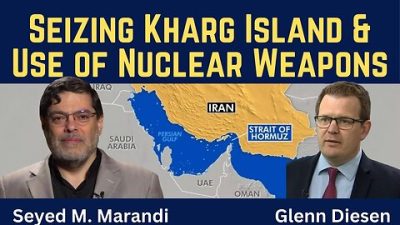
Marandi: Threat of Seizing Kharg Island & the Use of Nuclear Weapons
or go to
Aletho News Archives – Video-Images
Frlom the Archives
Provoking a Path to Persia
The Saban Center’s prescient paper on war with Iran
By Maidhc Ó Cathail | October 20, 2011
In June 2009, the Saban Center for Middle East Policy published “Which Path to Persia?—Options for a New American Strategy toward Iran.” Writing in a tone strikingly reminiscent of the Project for a New American Century’s infamous pre-9/11 paper “Rebuilding America’s Defenses,” the six co-authors noted that, “It seems highly unlikely that the United States would mount an invasion without any provocation or other buildup.” For a think tank specifically established by media mogul Haim Saban to protect Israel, this could prove to be a formidable obstacle impeding their desired march—of U.S. troops—to Tehran.
“In fact, if the United States were to decide that to garner greater international support, galvanize U.S. domestic support, and/or provide a legal justification for an invasion, it would be best to wait for an Iranian provocation, then the time frame for an invasion might stretch out indefinitely,” Saban’s think-tankers ruefully observed.
“With only one real exception, since the 1978 revolution, the Islamic Republic has never willingly provoked an American military response, although it certainly has taken actions that could have done so if Washington had been looking for a fight. Thus it is not impossible that Tehran might take some action that would justify an American invasion. And it is certainly the case that if Washington sought such a provocation, it could take actions that might make it more likely that Tehran would do so (although being too obvious about this could nullify the provocation). However, since it would be up to Iran to make the provocative move, which Iran has been wary of doing most times in the past, the United States would never know for sure when it would get the requisite Iranian provocation. In fact, it might never come at all.”
Seemingly undeterred by Iran’s frustrating unwillingness to provide the requisite provocation, the analysts continued to examine this option… continue
Blog Roll
 Aletho News
- Ukrainian Embassy in Beirut sheltering top Mossad agent
- Palestinian family displaced after settlers violently attack them in Humsa, Jordan Valley
- The EU never learns – except for the wrong lessons
- Iran attacks on UAE leaves RSF militia high and dry
- Hosting Washington’s war: Bahrain faces the consequences
- The US fell for its own Iran propaganda
- Seyed M. Marandi: Threat of Seizing Kharg Island & the Use of Nuclear Weapons
- Is there even an off ramp?
- Michael von der Schulenburg: Europe’s Self-Defeating Iran War Policy
- Sorry, The New Republic, Climate Change Isn’t Causing Somali Migration. Blame Civil Strife and Poverty.
- If Americans Knew
- Don’t Fall for the Regime Change Talk. Israel Is ‘Mowing the Lawn’ in Iran
- Will Israel and the US wreck the Gulf States along with Iran?
- US so far burned through ‘years’ of munitions in Iran war: Report
- How the Israeli Tail Wags the American Dog
- Outdated intel likely led to deadly U.S. strike on Iranian elementary school, sources say
- Pentagon insider says high U.S official Douglas Feith reported to Netanyahu
- In fond memory of Walid Khalidi, the historian of Palestine
- 6 more Americans killed, as Israel ‘mows the lawn’ in Iran – Not a ceasefire Day 154
- Are we on the precipice of World War III?
- ‘Catastrophic,’ Says UNICEF: 1,100+ Children Killed or Wounded in Mideast Since US-Israel Launched Iran War
- No Tricks Zone
- New Studies: UK Sea Levels Were 4 Meters Higher Than Today During The Mid-Holocene
- Destructive Green New Deal: German Energy And Metal Group Warns Of Drastic Crisis
- New Study Documents A 20-Year Pause In Arctic Sea Ice Decline – Driven By Internal Variability
- Wake-up Call: Survey Shows Majority Of Germans Now Favor Postponing Climate Targets!
- Televised! Leading German Political Candidate Tells Schoolchildren CO2 Makes Sun Hotter!
- New Study: A Century Warming Of 1.1°C Is ‘Commonplace’ And ‘Not Unusual’ During This Interglacial
- New Study: ‘Internal Noise’ And Volcanic Forcing Can Trigger 10-15°C Warming Within Decades
- Glaciers Worldwide Are Suddendly Surging, Experts Blame Warming!
- Surprising Discovery: Sahara Is Greening…Billions Of Trees Where Once Thought To Be Barren
- New Research Reaffirms Clouds, Aerosols, And Surface Solar Radiation Are ‘Driving The Climate System’
 Aletho News