Israel’s Many Wars
Escalating could be intended to involve the United States
By Philip Giraldi • Unz Review • September 3, 2019
Two years ago I wrote an article entitled “America’s Jews Are Driving America’s Wars.” Though I made clear in the piece that I was writing about specific, identifiable Jews who fund and staff the think-tanks and foundations that make up the Israel Lobby, I was immediately fired by the Editor of The American Conservative (TAC) magazine and website, a timid little man who had been trying to get rid of me for some time. He evidently wished to do so because I did not share his “restraint” in my allusions to Jewish power in the United States and was particularly incensed over my suggestion that when Zionist propagandists like Bill Kristol appear on television the network should be required to display a warning label under the picture advising that Kristol was toxic.
As I had been writing for TAC for fifteen years and had been regarded as very popular among the magazine’s supporters, my dismissal was noted by many. I therefore followed up with a second article entitled “How I got fired,” which, inter alia, noted that Pat Buchanan, the TAC co-founder, had pretty much written the same thing that I did back in 2003 in a famous essay entitled “Whose War?”, though he had definitely been more polite than I was.
Pat Buchanan continues to be one of the few publicly visible political analysts currently active who dares to tell it like it is when it comes to Israel’s power in America. His article last week “Will Israel’s War Become America’s War” as always gets to the heart of the problem, i.e. that the completely contrived “special relationship” with Israel could easily lead the United States into another totally unnecessary war or even a series of wars in the Middle East.
Pat starts with “President Donald Trump, who canceled a missile strike on Iran after the shoot-down of a U.S. Predator drone to avoid killing Iranians, may not want a war. But the same cannot be said of Bibi Netanyahu.” He observes that Israeli Prime Minister Netanyahu is facing re-election on September 17th, and though most polls indicate that he will win, the opposition to him is strong based on his personal corruption and his pandering to the country’s most extreme right-wing parties. So Bibi is concerned that he might lose and even go to jail and there is nothing like a little war to make a leader look strong and righteous, so he is lashing out at all his neighbors in hopes that one or more of them will be drawn into what would be for Israel, given its massive military superiority, a manageable confrontation.
Buchanan sums up Netanyahu’s recent escalation, writing that on “Saturday, Israel launched a night attack on a village south of Damascus to abort what Israel claims was a plot by Iran’s Revolutionary Guards’ Quds Force… Sunday, two Israeli drones crashed outside the media offices of Hezbollah in Beirut. Israel then attacked a base camp of the Popular Front for the Liberation of Palestine-General Command in north Lebanon. Monday, Israel admitted to a strike on Iranian-backed militias of the Popular Mobilization Forces in Iraq. And Israel does not deny responsibility for last month’s attacks on munitions dumps and bases of pro-Iran militias [also] in Iraq. Israel has also confirmed that, during Syria’s civil war, it conducted hundreds of strikes against pro-Iranian militias and ammunition depots to prevent the transfer of missiles to Hezbollah in Lebanon.”
So, Israel has staged literally hundreds of attacks against targets in Lebanon, Syria and now Iraq while it is also at the same time shooting scores of unarmed demonstrators inside Gaza every Friday. Netanyahu has also threatened both perennial foe Iran and the Houthi rebels in Yemen. As the Jewish state is not at war with any of those countries it is engaging in war crimes. Both Hezbollah in Lebanon and the Iranian Revolutionary Guard Force are vowing revenge.
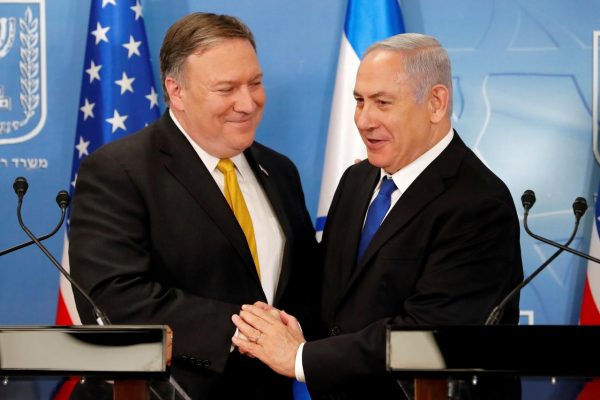
Pat Buchanan goes on to make the case that Netanyahu is willy-nilly pulling the United States into a situation from which there is no exit. Indeed, one might well conclude that the trap has already been sprung as the Trump Administration is reflexively blaming Israel’s actions on Iran. The Jewish state’s escalation produced a telephone call to Bibi by American Secretary of State Mike Pompeo promising that the United States would unconditionally support Israel. Vice President Mike Pence also joined in, boasting of a “great conversation” with Netanyahu and tweeting that “The United States fully supports Israel’s right to defend itself from imminent threats. Under President @realDonaldTrump, America will always stand with Israel!”
So, if a war in the Middle East does begin one can count on a number of developments in Washington, all of which favor Netanyahu. As Pompeo and Pence have made clear, the Trump Administration already accepts that whatever Israel does is fully justified and there are even reports that the White House will endorse Israeli annexation of all the illegal settlements on the West Bank at some point either before or immediately after the upcoming Knesset election to help Bibi. And don’t look for any dissent from even the most extreme views developing inside the White House or the State Department. The president has completely surrendered to the Israel Lobby while National Security Adviser John Bolton, Pence and Pompeo are all outspoken supporters of war with Iran. And nearly all the important government posts dealing with the Middle East are staffed by Jewish Zionists, to include the president’s son-in-law and two Donald Trump lawyers. The most recent addition to that sorry line-up is Peter Berkowitz, who has been appointed head of the Policy Planning Staff at State. Berkowitz studied at the Hebrew University in Jerusalem and is co-founder and director of the “Israel Program on Constitutional Government.”
And Congress would also be singing the “amen” chorus in support of U.S. intervention to help the country it has ridiculously but nevertheless repeatedly described as America’s “best friend and closest ally.” The occupied mainstream media would echo that line, as would the millions of Christian Zionists and every one of the more than 600 American Jewish organizations that in one way, shape or form support Israel.
Buchanan warns that the U.S. could find itself in real trouble, particularly given the attacks on Iraq, where Washington still has 5,000 troops, hugely outnumbered by the local pro-Iranian militias. And American aircraft carriers could find themselves vulnerable if they dare to enter the Straits of Hormuz or Persian Gulf, where they would be in range of the Iranian batteries of anti-ship missiles. He concludes that a war for Israel that goes badly could cost Trump the election in 2020, asking “… have we ceded to Netanyahu something no nation should ever cede to another, even an ally: the right to take our country into a war of their choosing but not of ours?”
Philip M. Giraldi, Ph.D., is Executive Director of the Council for the National Interest, a 501(c)3 tax deductible educational foundation (Federal ID Number #52-1739023) that seeks a more interests-based U.S. foreign policy in the Middle East. Website is councilforthenationalinterest.org, address is P.O. Box 2157, Purcellville VA 20134 and its email is inform@cnionline.org.
DARPA unleashes anti-meme militia to fight deepfakes & ‘polarizing’ viral content
By Helen Buyniski | RT | September 2, 2019
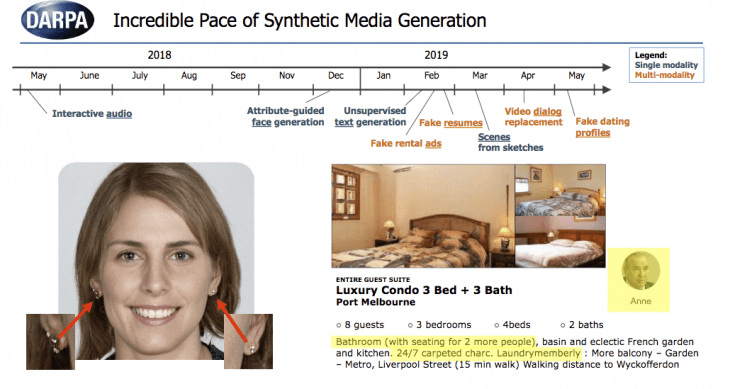
The Pentagon has unveiled an initiative to fight ‘large-scale, automated disinformation attacks’ by unearthing deep-fakes and other polarizing content – with the eventual goal of rooting out so-called ‘malicious intent’ entirely.
The Defense Advanced Research Projects Agency (DARPA) is seeking software capable of churning through a test set of half a million news stories, photos, and audio/video clips to target and neutralize potentially viral information before it spreads. In DARPA jargon, the aim is to “automatically detect, attribute, and characterize falsified multi-modal media to defend against large-scale, automated disinformation attacks.” “Polarizing viral content,” however, includes inflammatory truths, and the program’s ultimate goal seems to be to stamp out dissent.
© DARPA
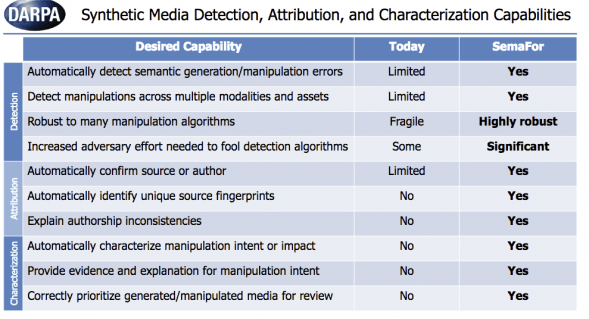
The Semantic Forensics program will scan news stories and social media posts with a barrage of algorithms in the hope of identifying inconsistencies that could mark a story as fake. The desired program will not just identify a meme as inauthentic – it will identify the source of that meme, the alleged intent behind it, and predict the impact of its spread.
To hear them tell it, the Pentagon just wants to even the playing field between the ‘good guys’ – the fake-hunters pursuing the cause of truth in media – and the ‘bad guys’ sowing discord one slowed-down Nancy Pelosi speech at a time. But the Pentagon’s targets aren’t limited to deepfakes, the bogeyman-of-the-month being used to justify this unprecedented military intrusion into the social media and news realm, or fake news at all. If the program is successful after four years of trials, it will be expanded to target all “malicious intent” – a possibility that should send chills down the spine of any journalist who’s ever disagreed with the establishment narrative.
To adequately test the program, the Pentagon has to spike its array of 500,000 test stories with 5,000 convincing fakes, some of which could conceivably make their way into the “live” news stream – although the mainstream media has not exactly had trouble generating false stories on its own in recent weeks. MSNBC’s wholly unverified and still incompletely-retracted “Russian cosigners” fiction and the scare story that the Trump administration would end birthright citizenship for the children of US service members born overseas both took social media by storm before the fact-checkers could boot up their computers.
And the government itself, including the Pentagon, has an extensive history of running fake social media profiles to collect data on persons of interest, including through the NSA’s JTRIG information-war program revealed in the Snowden documents. Agents regularly deploy reputational attacks against dissidents using false information. Fake identities are used to cajole unsuspecting individuals into collaborating in fake FBI “terror” plots, a phenomenon which might once have been called entrapment but is merely business as usual in post-9/11 America.
© DARPA
Which begs the question – how will DARPA handle the malicious falsehoods generated by “friendly” media? This, it would seem, is where the “impact” and “intent” fields come in – fakes from “trusted sources” will be let through, while fakes (and real stories) designed to “undermine key individuals and organizations” will be terminated before they have an impact. When “disinformation” is redefined to include all potentially polarizing stories that don’t conform to the establishment narrative, reality is discarded as so much fake news and replaced with Pentagon-approved pablum.
Helen Buyniski is an American journalist and political commentator.
McCarthyism 101: Actors demand ‘blacklist’ of Trump supporters in Hollywood
RT | September 2, 2019
Entertainment industry figures could soon find themselves on a “blacklist” of Donald Trump supporters if Will & Grace co-stars Debra Messing and Eric McCormack have their way. Have we reached peak neo-McCarthyism?
The pair are demanding that the Hollywood Reporter prints a full list of attendees for an upcoming Trump fundraiser in Beverly Hills – an appeal which has drawn natural comparisons to the late Sen. Joe McCarthy’s efforts in the 1950s to rid Hollywood of “Communist sympathizers.”
The difference is, this time the calls for a political blacklist are coming from the Hollywood left itself.
McCormack was the first to request a list of “everyone attending” the upcoming Beverly Hills fundraiser, “so the rest of us can be clear about who we don’t wanna (sic) work with.” Messing soon joined in, tweeting that the “public has a right to know” who is supporting Trump.
The public does indeed have a “right to know” who a political candidate’s donors are – particularly when those donors are rich and powerful. This is exactly why campaign finance information is made publicly available online. Few would argue against this kind of transparency in a democracy, because voters are entitled to know how their elected officials are being influenced on policy matters.
The motivation behind Messing and McCormack’s blacklist, however, is entirely different and even sinister. They are not concerned that Hollywood celebrities might be influencing Trump on policy. It’s far simpler than that: They want those who disagree with their politics to be publicly shamed and punished for it.
Responding to criticism, Messing tweeted that she would be“happy to be listed” when she attends a political fundraiser. Why wouldn’t Trump supporters feel the same? she asked.
Perhaps because of people like you, Debra, who advocate for those people to be targeted for public harassment, intimidation and shaming while demanding professional repercussions for their political views.
If voters aren’t happy with their favorite celebrity’s political leanings, they are absolutely free to abstain from viewing their movies, listening to their music or reading their books etc. That’s the risk public figures take when they make their political views public.
The difference is, when Messing and McCormack contribute to the candidates of their choosing, no one demands that they are placed on a list to make it easier for their industry colleagues to avoid working with them.
The Trump blacklist is reminiscent of ‘Red Channels’ – a 1950s pamphlet on “communist influence in radio and television” that listed 150 industry figures whose loyalties to the US were questioned because of their leftist political beliefs. Red Channels was published in the right-wing Counterattack journal, the purpose of which was to “expose” the alleged communists to the wider public.
Messing and McCormack’s crusade is empty activism emblematic of the ‘Resistance’ celebrities. It requires no courage or effort to “expose” Trump supporters in Hollywood on Twitter. It does not help to produce political change – and serves purely as an egoic exercise for those who crave public approval and pats on the back from their colleagues.
Messing has become known for lobbing ad hominem Twitter attacks at those who fall foul of her own political agenda in a craven effort to fit in with the Hollywood crowd.
She has been one of those leading the attacks against fellow actress Susan Sarandon since 2016, delusionally attempting to pin blame on the vocal Bernie Sanders supporter for Hillary Clinton’s defeat. Messing’s disturbing obsession with Sarandon indicates she is more interested in grandstanding and condemning others for wrongthink than she is in engaging in substantial, impactful activism.
If ‘Resistance’ Hollywood was really interested in fighting Trump on the issues, they wouldn’t waste their time on vindictive witch hunts and personal vendettas, designed to plump up their own profiles.
There is a big difference between political donors having their names publicly available online in the appropriate context and actually demanding an industry blacklist with the express purpose of damaging careers and reputations.
That is the very definition of McCarthyism.
By Danielle Ryan, an Irish freelance writer based in Dublin.
What if the Palestinians Won a Battle and No One Knew?
By Eve Mykytyn | September 2, 2019
There is a lawsuit, Al-Tammimi v. Adelson, that is making its way through the federal courts. The lawsuit was brought by a group of Palestinians and Palestinian/Americans asking for damages of 34.5 billion dollars resulting from Israeli settlements in the West Bank including East Jerusalem and the Gaza Strip. The Palestinians claim that the defendants, pro-Israel donors and organizations, banks, contractors working for Israel and deputy National Security Advisor Abrams conspired to expel Non Jews from their land and otherwise harm them. Defendants include Americans Sheldon Adelson, Lawrence Ellison, Haim Saban, Irving Moskowitz, John Hagee and Israeli Lev Leviev. The appeals court decision is here.
The suit was first brought in a US Federal district court (the “trial court”) alleging that the defendants “funneled millions of dollars through the defendant tax-exempt entities and banks to Israeli villages called “settlements.” Armed with this financial assistance, the settlement leaders hired full-time security coordinators who trained a militia of Israeli settlers to kill Palestinians and confiscate their property. The defendant construction and support firms destroyed property belonging to the Palestinians and built settlements in its place” and deputy national security advisor of the United States publicly endorsed the settlements.
The plaintiffs pressed four claims: “(1) civil conspiracy, (2) genocide and other war crimes, (3) aiding and abetting genocide and other war crimes and (4) trespass.”
The trial court dismissed the suit, relying on the doctrine that it is inappropriate for a court to determine matters that are inherently political and more properly decided by Congress and/or the President. The trial court found that the case required it to “adjudicate and resolve the lawfulness of the development of Israeli settlements…” Such a ruling, the trial court said, was “simply inappropriate for this court to resolve. Instead, these issues must be decided by the political branches.”
According to Haaretz, Israeli legal organization, Shurat Hadin, that claims to represent victims of terror, praised the trial court decision, and incorrectly stated that “cases such as this are brought solely to furnish a foundation of legal legitimacy for the BDS movement, and undermine the legitimacy of Israel.” And then, perhaps for vengeance, added the hope that “the judge will see clear to impose the large costs of these proceedings on the plaintiffs.” Imposition of costs is routine in some countries but unusual in the US.
On February 19, 2019 a panel of the Washington, DC Federal Circuit Court of Appeals (the “appeals court”) unanimously reversed the trial court and ruled that a trial court could find the defendants liable without deciding who owns the land. Although the appeals court did not decide liability, it sent the case back to the trial court for trial.
The appeals court agreed with the trial court that the issue of sovereignty over the land is political, but found that the case could be dismissed only if none of its claims could be resolved without deciding the political issue. In other words, they ruled that the Plaintiff’s claims can be separated from the issue of sovereignty over the land.
The lawsuit was brought primarily under a federal law entitled, the Alien Tort Statute (“ATS”). The ATS provides, in part, that federal courts can hear a civil action by a nonresident non- US citizen for a wrong “that is committed in violation of the law of nations.” The appeals court noted that “it is well settled that genocide violates the law of nations.” The court found that there is a definition of genocide within international law, that is: “[k]illing members of [a national, ethnic, racial or religious group] with intent to destroy [the group], in whole or in part.”
“Thus, the ATS—by incorporating the law of nations … —provides a judicially manageable standard to determine whether Israeli settlers are committing genocide.” In so stating, the appeals court is telling the trial court that this is the proper standard for its decision, and that this is not a “political” issue. (by political, they mean in the narrow sense of sovereignty involved in this case).
This decision can be appealed to a larger panel of the appeals court or to the Supreme Court, absent a successful appeal by the defendants, the Palestinians will be able to proceed. The district court has not yet reheard the case.
It seems to me like a big deal that three federal appeals judges ruled unanimously that the plaintiffs may proceed to argue that Israeli settlers and their benefactors have committed or aided in genocide.
However, the mainstream media has declined to cover this crucial case. A search of The New York Times, the Wall Street Journal and Bloomberg yielded no results. The case was covered by a few smaller outlets and by Bloomberg, Reuters (which included a summary that was at least partially correct) and by the Jerusalem Post (that complained the Palestinian plaintiffs failed to present the Israeli narrative). The Electronic Intifada covered the initial filing but does not seem to have followed the case. And Haaretz and the Times of Israel wrote about the dismissal by the district court but not that it was overturned on appeal. This strikes me as scant coverage of an important case.
Finally, a part of the United States government is treating Palestinians as people who have at least potential rights even against billionaires, and most of our media has not bothered to tell us the story.
How Japanese scientists confronted the U.S. and Japanese governments to reveal the effects of Bikini H-bomb tests
By Okuaki Satoru¹ – The Asia Pacific Journal – September 1, 2019 – Volume 17 | Issue 17 | Number 2
Introduction and translation by Steve Rabson
Introduction
The March, 1954 “Bravo Shot” H-bomb test in the Pacific dumped radioactive debris on the Marshall Islands, U.S. servicemen, and the crew of a Japanese fishing boat. The multi-megaton blast infected Marshall Islanders with radiation sickness and caused cancers in the years that followed. Their contaminated home on Bikini Atoll remains uninhabitable to this day. U.S. servicemen who had been purposely transported by the Navy into the blast zone have suffered from multiple cancers from radiation exposure. For years their claims denied were denied by the Veterans Administration. It took an act of Congress in 1990 to provide compensation for them and their children with birth defects. The crew of the Japanese fishing boat, Lucky Dragon No. 5, suffered from acute radiation poisoning. One crew member, Kuboyama Aikichi (age 40), died while in treatment for exposure.

“Bravo Shot” H-bomb test, Bikini, March 1, 1954

U.S. military forcibly evacuating Marshall Islanders from Bikini Atoll

U.S. servicemen transported under orders into the Bikini blast zone

Japanese scientists examine the hull of contaminated Lucky Dragon at Yaizu City port
Okuaki Satoru tells below how Japanese scientists confronted, and eventually overcame, roadblocks thrown up by both the U.S. and Japanese governments to obtain urgently needed information for the treatment of radiation poisoning and to determine the extent of environmental contamination. As Jacob Darwin Hamblin and Linda M. Richards explain in the journal Historia Scientarium, “Japanese perspectives influenced several American scientists to think differently about the implications of nuclear tests for humans and the natural environment . . . despite stiff resistance from offices of the U.S. government.”2
The U.S. government withholds information on lethal fallout
On March 16, 1954, the newspaper Yomiuri Shimbun first reported victims of a U.S. nuclear test in the Pacific among Japanese crew members of the fishing boat Lucky Dragon. The U.S. government acknowledged that tests had been carried out, but, insisting on secrecy, refused to provide information about them to Japanese scientists. Today it is known that they were hydrogen bomb tests, but even that wasn’t disclosed at the time. The only information Japanese scientists could obtain was from radioactive contamination of the Lucky Dragon’s hull.
Several scientists visited the fishing port at Yaizu City in Shizuoka Prefecture and recorded high levels of radioactive contamination from fallout on the boat’s hull. Okano Masaharu, a specialist in measuring radioactivity, was twenty-eight at the time and on the faculty of the Institute for Scientific Research (now known as RIKEN).
After World War II when Japan was under Allied Occupation (1945-1952), research on atomic energy was strictly prohibited. However, in 1950 permission was granted for research on radioactive isotopes. Okano traveled throughout the country giving lectures to inform Japanese about isotopes, and became skilled in handling radioactive materials. On April 16, 1954, he traveled with his supervisor, Dr. Yamazaki Fumio, to examine the hull of the Lucky Dragon. A full month had passed since fallout had contaminated the boat, but both men were astonished to see the needle of their radiation meter swing wildly up into the danger zone. This was the first time they had detected significant radiation outside their laboratories, and it exceeded one hundred times the level occurring in nature. With the discovery that radioactive fallout had contaminated the Lucky Dragon, scientists at universities in Tokyo, Kyoto, Shizuoka, Osaka and Kanazawa began their own studies, communicating their findings by telephone.
Ikeda Nobutaka conducted research on radioactive fallout in Professor Kimura Kenjirō’s research laboratory in the Chemistry Department of Tokyo University. He also visited the Lucky Dragon at Yaizu, and collected samples of fallout-contaminated material. Returning with them to the laboratory, he and about a dozen other researchers spent the next several days and nights frantically analyzing the material out of acute concern for the Lucky Dragon’s crew.
“We needed the results as soon as possible,” said Ikeda, now eighty-eight. “Without knowing the characteristics of the fallout, there would be no way to find a treatment for the crew. We were also aware that the reputation of Japanese scientists was at stake. If our results turned out to be wrong, it would be a disgrace for Japan’s scientific methods.”
Over the next month Ikeda and his colleagues found twenty-seven types of atomic radiation including Strontium (Sr) 89, Yttrium (Y) 90, and Cerium (Ce) 141. “We were overjoyed because knowing the radiation characteristics meant that it could be located in patients’ bodies and a way might be found to eliminate it. I can still remember how lovely the sunset looked the evening we finally finished the analyses.”
U.S. Atomic Energy Commission declares “no risk” from radioactive contamination
The U.S. carried out many nuclear weapons tests in the Pacific; however, the one named “Castle Bravo” on March 1, 1954, which showered fallout on the Lucky Dragon, was the most powerful conducted to that time, 1,000 times the fifteen megatons of the Hiroshima bomb. On March 31, Lewis Strauss, Chairman of the U.S. Atomic Energy Commission, issued a statement denying that there had been any contamination of fish or seawater.
With respect to the stories concerning widespread contamination of tuna and other fish as a result of the tests, the facts do not confirm them. The only contaminated fish discovered were in the open hold of a Japanese trawler [that had been] well within the danger zone. The Federal Drug Administration has informed us that their thorough survey found no radioactive contamination of boats or fish. The fallout dissipated rapidly in the ocean current and has posed no risk. No radioactivity has been detected in an area between five and five hundred miles of the test site.
There was a rumor last week of a danger from radioactivity falling in the United States. As with Soviet nuclear tests, there might be a small increase in natural background radiation in some local areas. However, it is only infinitesimally higher than what has been observed after previous tests in the continental United States and overseas, far too small to pose any risk to persons, animals or plants. Radioactivity dissipates rapidly after tests, and soon returns to normal levels of natural background radiation.
Did American officials deny that radioactivity had contaminated the ocean because they wanted to conceal the possibility that it had, or because they didn’t believe it would spread over a wide area beyond the test site?
Professor Higuchi Toshihiro at the Institute for the Study of Diplomacy of Georgetown University cites radioactive contamination from the Bikini tests as having initiated world-wide concern over the problem of environmental pollution; and he has studied how the governments and societies in Japan and in the United States took opposing positions over the issue of radioactive pollution.
It was known among scientists at the time that, at least in theory, radioactive contamination of the ocean from nuclear tests could be detected in seawater, plants, and animals. So when the U.S. conducted the first hydrogen bomb test in 1953, the Atomic Energy Commission began surveying seawater, tuna, and other ocean life for radioactivity. The Bikini test that contaminated the Lucky Dragon occurred the following year, but the data collected by the survey was still insufficient. Nevertheless, the Atomic Energy Commission sought first and foremost to quiet the furor over the tests at home and abroad, and issued a series of announcements for political reasons. Lacking reliable scientific data, the Commission surveyed a large area of seawater in which any trace of radiation would have been much diluted, and then claimed no contamination had been detected. Thus, it wasn’t that the Commission was trying to conceal findings of contamination, or that it was ignorant of the possibility. For strictly political reasons, it quickly declared the ocean safe.3
Contradicting its own denials of radioactive contamination, the U.S. government banned imports of Japanese tuna
The U.S. government was greatly alarmed by news that radiation had contaminated tuna in Japan. At the time of the Bikini tests the U.S. was importing large quantities of canned tuna from Japan. Cheap and plentiful, long-finned tuna was canned in vegetable oil.
The development of Japan’s canning industry had begun before World War II in the fresh waters of Shizuoka Prefecture. In the 1950’s before Japan’s heavy industry recovered from the war, the government strongly encouraged the production of goods for export of which canned tuna was a key enterprise. Sold under the brand names “Fujiyama” and “Geisha,” high-quality and inexpensive Japanese canned tuna became so popular it dominated the American market.
Now the U.S. government became deeply concerned that contaminated tuna was being imported and distributed in America. Located by Professor Higuchi in the U.S. National Archives, an official U.S. government memo entitled “fish exports” was sent to Washington from the American Embassy in Tokyo on March 21, 1954, five days after the Yomiuri Shimbun reported contamination of the fishing boat Lucky Dragon. Higuchi described the memo:
The memo explained that embassy officials and representatives of the American fishing industry had warned the Japanese government to stop exports of contaminated fish. The government agreed that no fish would be exported to the United States in which radiation was detected.4
Subsequently, a member of the Atomic Energy Commission came to Japan and went to Yokohama Port. There, he ordered thorough monitoring tests for the fins and bellies of frozen tuna scheduled for export to the United States. People in Japan were outraged because, on the one hand, the U.S. government was denying that radiation from nuclear tests had contaminated the ocean or fish, yet it was suspiciously monitoring fish being exported to America.
The Japanese government refuses to pursue U.S. responsibility for contamination and supports continuation of nuclear tests
How, then, in the wake of radiation injuries to the Lucky Dragon’s crew and nuclear contamination of tuna, did the Japanese government deal with the U.S. government that had carried out the tests?
On March 17, with the Diet in an uproar over the Bikini tests, Foreign Minister Okazaki Katsuo came under persistent questioning in a session of the Lower House Budget Committee. Representative Imazumi Isamu, a member of the Socialist Party, severely criticized the Japanese government for failing to request crucial information from the U.S. about the nuclear tests. “America has inflicted radiation injuries on our country’s innocent fishermen. The treatment varies depending on what kind of bomb was detonated. A Japanese government that fails to seek this information for treating the victims is in no way worthy of representing our citizens. It is truly unforgivable.”5
Representative Kawasaki Hideji of the Progressive Party insisted that the Japanese government confront the U.S. government.
We have learned that the test was of either a hydrogen or a cobalt bomb. Should Japan bring the case to the International Court of Justice, world opinion would be deeply sympathetic to a nation that has been victimized three times by nuclear explosions. Our foreign policy must be courageous enough to petition the court. Does the Foreign Minister agree? Please answer the question directly.6
“We know from the information they already provided us that the Americans are very sympathetic,” replied Foreign Minister Okazaki. “They have said they will send doctors specializing in atomic bomb injuries and pay compensation no matter the cost. I am confident we can resolve the issue without going to the International Court of Justice.”7
Foreign Minister Okazaki reiterated the decision not to pursue America’s legal responsibility at a party given by the America-Japan Society in Tokyo on April 9, 1954. A tape recording of his speech before guests that included the American ambassador is available at the Society’s office in Akasaka.
Although it goes without saying that the fishing industry Japan’s economy relies on has suffered major losses as a result of the ban in the area of the ocean affected by the atomic tests, we have no intention of asking the U.S. government to stop them. We recognize that they are indispensable to the security, not only of America, but of Japan and other democratic nations. Thus, we join the other democratic nations in helping to make sure the atomic tests are successful.8
Radioactive contamination from the Bikini test occurred two years after Japan regained its independence in 1952 under the San Francisco Peace Treaty. Yet, despite the damage the test inflicted on the nation, the Japanese government supported their continuation. This attitude provoked outrage among the citizenry.
Japanese scientists respond
Japanese government leaders refused to pursue U.S. responsibility for the damages inflicted by the Bikini test. However, among all government departments, the Fisheries Agency was most acutely aware of the danger. It alone planned a survey of radiation contamination in the ocean area around the Bikini atoll where the test was conducted. “The U.S. government was entirely downplaying the test’s effects,” explained Miyake Yasuo who joined the scientific advisory group organized to carry out the survey. “The Japanese government was seeking compensation for injuries to the Lucky Dragon’s crew and the major damage to our fishing industry, but conducting a survey at the site for crucial information about the radioactive contamination was absolutely essential.”
With daily reporting in the newspapers on their expedition aboard the ship Shunkotsu Maru, the scientists were given a heroes’ welcome when they returned to Tokyo on July 4, 1954 from their fifty-one day voyage. It was their survey that first determined the extent of ocean contamination and damage to the environment from atomic tests. Though conducted for the Fisheries Agency, the results advanced knowledge in several scientific fields including radiology, oceanography, meteorology and medicine.
Notes
1From Okuaki Satoru, 海の放射能に立ち向かった日本人:ビキニからフクシマへの伝言 Radioactive Contamination of the Ocean Revealed by Japanese Scientists: From Bikini to Fukushima, Junpō-sha, Tokyo, 2017.
2Jacob Darwin Hamblin and Linda M. Richards, “Beyond the Lucky Dragon: Japanese Scientists and Fallout Discourse in the 1950s,” Historia Scientiarum, Vol. 25, No. 1 (2015), pp. 36-56.
3Okuaki, pp. 44-45.
4Ibid., p. 46.
5Ibid., p. 47.
6Ibid., pp. 47-48.
7Ibid., p. 48.
8Ibid., pp. 48-49.
Okuaki Satoru is a program director at NHK. Born in Kanagawa Prefecture, he graduated with a Masters Degree from the Life Sciences Division of Tokyo University, joining NHK in 1999. He has directed television documentaries on the work of novelist Inoue Yasushi and the massacres of Koreans following the 1923 Tokyo earthquake. He was awarded the Media Ambitious Prize in 2013 for the documentary “Radioactive Contamination of the Ocean Revealed by Japanese Scientists: the Bikini Test Nuclear Fallout and the Ship Shunkotsu Maru,” which is the subject of the excerpts below from his book.
Steve Rabson is Professor Emeritus of East Asian Studies, Brown University, and a contributing editor to the Asia-Pacific Journal. He is the author of Righteous Cause or Tragic Folly: Changing View of War in Modern Japanese Poetry (Center For Japanese Studies, University of Michigan, 1998) and The Okinawan Diaspora in Japan: Crossing the Borders Within (University of Hawaii Press, 2012). His recent articles include “Okinawa was a ‘storage location’ for nuclear weapons: published accounts,” Asia-Pacific Journal, January 7, 2013, Volume 11 | Issue 1 | Number 6 and “Nuclear Hawks in Tokyo Call for Stronger US Nuclear Posture in Japan and Okinawa,” Gregory Kulacki with a comment by Steve Rabson, Asia-Pacific Journal, June 1, 2018, Volume 16 | Issue 11 | Number 1. He was stationed as a U.S. Army draftee at a nuclear weapons storage base in Henoko, Okinawa, 1967-68.
The original Japanese text can be found here.
Related articles:
Ōishi Matashichi and Richard Falk, “The Day the Sun Rose in the West. Bikini, the Lucky Dragon and I,” Asia-Pacific Journal, June 19,2011, Vol. 9, No. 3
Steve Rabson, “Okinawa was a ‘storage location’ for nuclear weapons: Published accounts,” Asia-Pacific Journal, January 7, 2013, Volume 11 | Issue 1 | Number 6
“Nuclear Hawks in Tokyo Call for Stronger US Nuclear Posture in Japan and Okinawa,” Gregory Kulacki with a comment by Steve Rabson, Asia-Pacific Journal, June 1, 2018, Volume 16 | Issue 11 | Number 1
24 Palestinian journalists held in Israeli jails
![An Israeli soldier attacks AFP'S photo journalist Jafer Eshtayah during a protest against building of illegal settlements and the separation wall at the Kafr Qaddum village of Nablus, West Bank on March 22, 2019 [Nedal Eshtayah / Anadolu Agency]](https://i1.wp.com/www.middleeastmonitor.com/wp-content/uploads/2019/03/20190322_2_35583879_42875884.jpg?resize=1200%2C800&quality=75&strip=all&ssl=1)
Israeli soldier attacks AFP journalist during protest against building illegal settlements and the separation wall at Kafr Qaddum village, Nablus, West Bank on March 22, 2019
Nedal Eshtayah / Anadolu Agency
MEMO – September 2, 2019
Israel’s military occupation authorities continue to target Palestinian journalists, the Journalist Support Committee (JSC) said on Sunday, Quds Press has reported. The JSC pointed out that the number of Palestinian journalists held in Israeli jails has risen to 24.
Information about the imprisoned journalists was included in a statement issued by the committee in the wake of Israel’s detention of Palestinian media Professor Widad Al-Barghouti. She is a media lecturer at Birzeit University.
According to the JSC, the Israelis arrested four journalists in August and extended the detention of two others. It also noted that five out of the 24 journalists in prison are being held by Israel under administrative detention with neither charges nor a trial. Seven have been sentenced and 12 are being held in custody pending prosecution.
The JSC reiterated its concern that the Israeli occupation authorities “insist on hindering the work of journalists” who carry out their national duty regarding the documentation of Israel’s crimes which amount to violations of international laws and conventions.
Highlighting the situation of Palestinian journalist Bassam Al-Sayeh, the committee explained that his health is deteriorating badly in prison. The JSC added that the Palestinian prisoners held by Israel face “intentional medical negligence”.
In conclusion, the Journalist Support Committee called for the international community to protect Palestinian journalists and compel Israel to adhere to the terms of UN Security Council Resolution 2222 regarding the protection of civilians in armed conflict.
See also:
Report: Israel’s targeting of Palestinian photojournalists increasing
Netanyahu Does Something Stupid Again
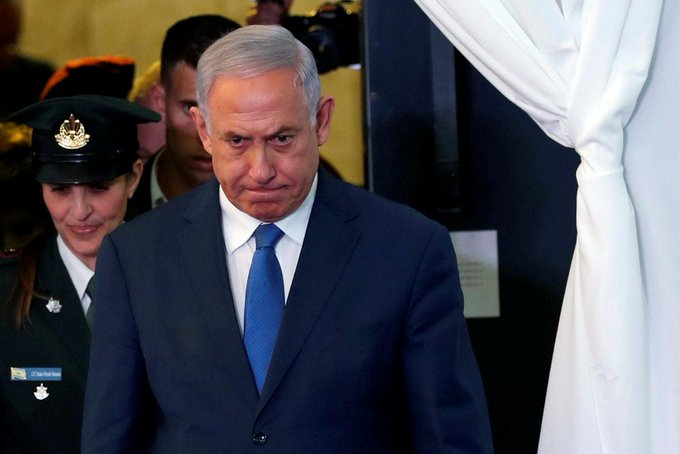
Israeli PM Benjamin Netanyahu arrives to review an honor guard with his Ethiopian counterpart Abiy Ahmed in Jerusalem September 1, 2019. Credit: Ronen Zvulun/ Reuters/ Twitter)
By Jeremy Salt | American Herald Tribune | September 2, 2019
With general elections coming up on September 17, Benyamin Netanyahu made a calculated gamble last week and lost.
The attempt to assassinate someone by drone in Beirut failed. Two drones were sent into the largely Shia suburb of Dahiya, where Hizbullah’s political, media and welfare offices are based. The first drone, for surveillance, crashed on to the roof of a Hizbullah media office, causing damage inside but no human casualties. This forced the Israelis to abort the entire mission. They themselves destroyed the second drone, for assassination, according to the veteran Middle East correspondent Abdul Bari Atwan. The target for murder was clearly a senior Hizbullah figure or – as some have speculated – a representative of the Iranian government. Israel certainly did not send a drone to Beirut just to put a hole in the roof of a building.
As this was the first attack on Beirut since 2006, when Israel jets pulverized Dahiya day after day, Hizbullah threatened retaliation. It never says when, how or where it will strike back but this time it retaliated almost immediately, destroying an Israeli APC (armored personnel carrier) at a military outpost across the armistice line.
That Netanyahu would launch such an attack without taking precautions to ensure the safety of civilians and military personnel in the north would have played badly before the public had not the government covered its tracks by firing a flurry of missiles into Lebanon and claiming in a media barrage that while the APC was indeed hit by the ‘terrorists’ no-one suffered even a scratch, as Netanyahu eventually claimed.
It may be some time, it may be never, that the truth comes out but the story pitched by the Israeli government and military has all the elements of high comedy, not sophisticated, more Bud Abbott and Lou Costello than Lenny Bruce. First the Israelis said the vehicle that was struck was a military ambulance, with no-one inside it. Then they admitted it was an APC, but again no-one was inside, as they had all gone somewhere else half an hour earlier, whether for a smoke, a meal or a pee we don’t know.
Likud minister Yoav Galllant said no-one had been hurt in the missile strike, even as footage was being shown of wounded soldiers being flown by helicopter to an army hospital but he was speaking out of turn, so the government said.
In fact, noone had been hurt. This was no more than a decoy operation. Israel wanted Hizbullah to think it had scored some kind of victory, so it dressed up store dummies as soldiers and had them carried away on stretchers. It turned out that Israel just wanted to fool Hizbullah. That was the point of the whole exercise. Ha ha, Hasan, the joke’s on you. Noone had been hurt after all. “The staged evacuation seems to have worked” wrote the veteran Zionist propagandist David Horowitz.
The fact that settlers in the north had been sent scurrying into their bomb shelters by the Hizbullah missile strike was soon overtaken by glowing reports of farmers back in the fields and children back in the classroom as usual now that the cross-armistice line missile fusillade had died down.
Readers will decide how much of this malarky they can believe. For most, probably none of it. Behind the propaganda smokescreen lies a core truth, which is that Netanyahu, Israel’s nincompoop-in-chief, launched a failed mission into Beirut, rather reminiscent of his failed attempt to kill the senior Hamas figure Khalid Mishael in 1997. The would-be assassins were arrested, and the panicked, sweating Netanyahu, close to nervous collapse, saved from his own folly only by the intervention of the Jordanian king.
The drone attack in Beirut was designed to deliver an election victory but backfired badly and had to be covered up as quickly as possible with what seems on the surface to be a complete cock and bull story.
The APC held eight men. If they had been inside when it was struck by Hizbullah’s missile, all would have died or would have been badly wounded, as Hizbullah claimed they were. If they were killed or wounded, Netanyahu, approaching the end of an election campaign, would have had to prevent the public from knowing, even to the ludicrous extent of telling it that the wounded soldiers shown in video footage were actually store dummies dressed up as wounded men. The truth – if there were casualties – would have doomed his re-election prospects.
The drone attacks on Beirut included a strike on a PFLP (Popular Front for the Liberation of Palestine) base in the Bika’a valley. Other drone attacks on the same day were launched against Hashd al Sha’abi (Popular Mobilization Forces) units and regular Iraqi army bases in north Iraq close to the Syrian border. Iraqi intelligence believes the attacks were launched from the Kurdish region of northeastern Syria, controlled by the largely Kurdish Syrian Democratic Forces (SDF), the US puppet militia. In the same time frame, the Zionists also attacked a military position close to Damascus.
These simultaneous attacks on three countries call to mind the rabid dog running around snapping at anyone who comes close. There was no immediate provocation for any of these missile strikes and drone attacks but in Israel’s case there never has to be. The Israelis say Hizbullah’s missile retaliation brought the two sides to within 30 minutes of another war, and they say another one is coming anyway. This can hardly be news to anyone. Hizbullah has enough precision missiles to devastate Israel and the longer the Israelis wait the more it will have, so unfortunately another war is only a matter of time and perhaps a much shorter time than people might think.
Even though Israel has been flying drones over Lebanon for decades, an attack in central Beirut is unusual. It might not be the first, however: Lebanon’s former Prime Minister, Rafiq Hariri, may have been assassinated in 2005 by a missile fired from an Israeli drone, and not killed by a car bomb, the generally accepted explanation. The UN investigation into Hariri’s death was grossly prejudicial, especially in the case of the reports filed by the first lead investigator, Detlev Mehlis, and came to nothing anyway. The charges against Lebanese suspects were dropped, at which point the UN tribunal switched its suspicions to Hizbullah, without having any prior evidence. This investigative route has ended in a dead end as well. The one chief suspect never investigated, even though standing out above all the others because of its long track record of murder and mayhem in Lebanon, is Israel.
In 2010 Hasan Nasrallah revealed that Hizbullah had intercepted Israel’s electronic communications and had captured images of an Israeli drone tracking Hariri across Beirut and into the mountains every day for three months. Along with an AWACS (Airborne Warning and Control System) plane, an Israeli drone was hovering over the precise point on the corniche road when Hariri was assassinated.
Looking at the evidence, Thierry Meyssan has argued that a highly refined missile fitted with a warhead based on a ‘nano’ amount of enriched uranium may have been used rather than a car bomb (‘Revelations on Rafik Hariri’s Assassination,’ Voltaire Network, November 29, 2010).
However, whether drone missile or car bomb, Nasrallah implicated Israel in the murder. If the question cui bono is to be asked the answers are clear. It was immediately assumed in the ‘west’ that Syria must have been responsible, given the often difficult relationship between Hariri and the Syrian government, but the only beneficiaries of the assassination were Israel and its rightwing proxies in Lebanon.
Israel violates Lebanon’s air space as a matter of course. Over the years it has overflown Lebanon many thousands of time. It frequently flies across Lebanon to attack Syria. At the international level, no sanctions have ever been introduced to stop it, just as no sanctions have ever been introduced to stop it doing anything it wants to do. This will continue until the big war comes along, and then all those who could have done something to head it off but did nothing will be throwing up their hands in horror.
Apart from flights aimed at bombing targets in Lebanon or Syria, Israel’s aerial intrusions would have other purposes, including intimidation of the Lebanese civilian population and the unrest this might generate.
Most probably it would also want to draw Hizbullah out and, through retaliation to one of its attacks, see if it has missiles capable of bringing down its aircraft. A lost plane and pilot would be worth the cost of knowing. As the neutralization of Israeli air power must be a primary objective of Hizbullah and Iran, Hizbullah probably does have such weapons, but Israel is going to have to wait until the next war to find out.
America Loses Asia-Pacific as Full Spectrum Dominance Continues to Fail
By Matthew Ehret | Strategic Culture Foundation | September 2, 2019
Always working a little harder than most to stay a step below reality, US Secretary of Defense Mark Esper made especially candid remarks this week that America’s INF pullout was timed for a targeting of forces against China.
Speaking to Fox on August 21st, Esper said: “We want to make sure that we, as we need to, have the capability to deter Chinese bad behavior… China is the number one priority for this department. It’s outlined in the national defense strategy, why we think it’s a long term strategic competitor and one that is pursuing a maximization campaign, if you will, throughout the indo-Pacific theater, whether its politically, economically or militarily…”
Echoing a little Dr. Strangelove, Esper stated that there is “a coming shift” from “low intensity conflict that lasts 18 years to high intensity conflicts against competitors such as Russia and China.”
While American military exercises in the Pacific have played out on China’s doorstep at an accelerating rate since the Pivot to Asia was announced in 2011 with the most recent US-Australia Talisman Sabre bi-annual exercise and US-South Korea Ulchi Freedom war games this month, China has not remained idle.
In response to America’s vast array of military infrastructure built up on China’s border, China has responded by the unveiling of cutting edge anti-ballistic missile technologies, including hypersonic weaponry to counteract the American threat. A large part of China’s defensive response includes the Russian S400 anti-missile system which is also being adopted by India, Turkey, Syria and the United Arab Emirates as a unified system which renders the American THAAD and ABM systems impotent and obsolete. Although unconfirmed, American generals have freaked out that China is building a joint China-Cambodia naval base in Preah Sihanouk Province that gives China easy access to coastal waters on the Gulf of Thailand and ready access to the South China Sea.
America’s military impotence when faced with the new cutting edge technologies unveiled by Russia and China was outlined in a recent report released by the US Studies Center at the University of Sydney which stated that “America no longer enjoys military primacy in the indo Pacific and its capacity to uphold a favorable balance of power is increasingly uncertain.” Referring to China’s advanced anti-aircraft weapons, the report says “Chinese counter-intervention systems have undermined America’s ability to project power in the Indo-Pacific region” which the authors say, could be rendered impotent within the first 8 hours of conflict.
Rather than use this information to propose a new security doctrine premised on cooperation and dialogue as China has offered on countless occasions, the report’s authors join the fantasy world of Esper calling instead for a “collective defense” strategy akin to a Pacific NATO, whereby all of America’s Pacific allies could join in an anti-Chinese military alliance together, and relieving America of the burden of carrying WWIII on its own.
We know that this Pacific NATO has been discussed for some time and was at the heart of recent Pacific Vanguard naval drills conducted between the USA, Australia, Japan and South Korea in May 2019 which saw the participation of 3000 soldiers, two Japanese destroyers, a South Korean destroyer and two Australian frigates in their first joint war game. This outlook was also behind the August naval drill played out by Malaysia, USA, New Zealand and Australia in Guam. The USA has 54,000 troops in Japan and 28,000 in South Korea.
When China and Russia conducted their first long range joint air patrol in the Asia Pacific in July 2019, South Korea and Japan scrambled jets to intercept the Chinese and Russian aircraft, with South Korea firing hundreds of warning shots. Backed up by the USA, both Asian countries screamed loudly (and without evidence) that their air space had been violated.
In response to the belligerent comments by Esper and the Australian report, the Chinese Foreign Ministry said “China is firmly on a path of peaceful development and our national defense policy is defensive in nature”. China has gone further by providing a cooperative framework under the Belt and Road Initiative which is built around the brilliant political agenda of providing diplomatic solutions to geopolitical points of tension through economic development strategies that enrich all participants. This approach has provided China great payback through the defusing of tensions with other nations claiming territory within the South China Sea- especially under the pro-BRI orientation of Malaysia’s Dr. Mahathir Mohammed and the Philippines’ President Duterte.
Not feeling at ease being caught in the crossfire of a nuclear exchange, Japan and South Korea have also gone so far as to create a new trilateral cooperation agreement with China on August 21 premised on “next generation exchange projects in three countries… We hope to discuss future-oriented partnerships and regional affairs, including North Korea.” The agreement also enables international joint investment in all countries operating under the BRI framework. Together the three countries account for over a quarter of the world’s productivity and have everything to gain by working together.
Those American military officials promoting the obsolete doctrine of Full Spectrum dominance are dancing to the tune of a song that stopped playing some time ago. Both Russia and China have changed the rules of the game on a multitude of levels, and can respond with fatal force to any attack upon their soil with next generation weaponry beyond the scope of anything imagined by ivory tower game theorists in the west.
The ship of world history has changed course away from the rapids of war and economic collapse, as the Belt and Road Initiative has grown to proportions not imagined possible just a few years earlier and the coming months will be decisive as the west does some soul searching and decides which future it would like to have.
Moscow Concerned, Puzzled Over US Airstrike in Syria’s Idlib
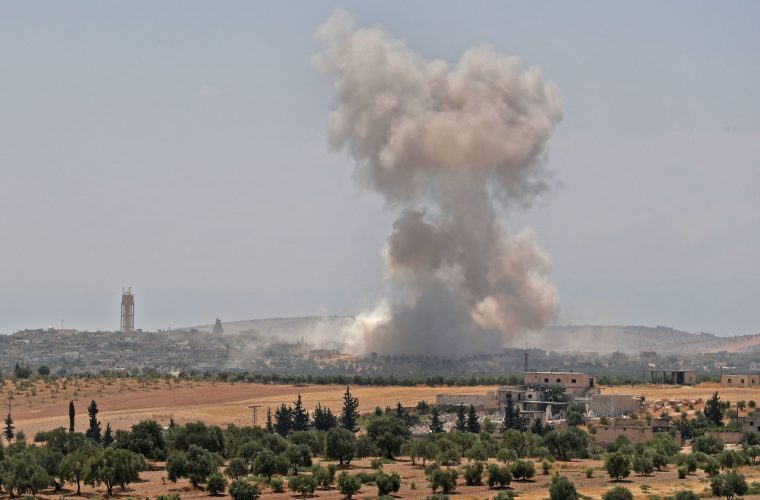
Smoke billows above buildings near the town of Hish in Syria’s Idlib province © AFP 2019 / Omar Haj Kadour
Sputnik – September 2, 2019
The Russian Foreign Ministry said in a statement on Monday that it was concerned and puzzled by Washington’s recent airstrike in Syria’s Idlib, slamming the move as “inconsistent” and “contradictory.”
“Inconsistent and contradictory steps that the United States makes in Idlib cannot but cause bewilderment and concern. On the one hand, US representatives … call for halting escalations in Idlib … On the other hand, they conduct an airstrike, which results in large-scale damage and victims”, the Russian Foreign Ministry said.
Moscow added it expected the United Nations to take the consequences of the airstrike into consideration when preparing reports on the situation in Syria, and also to brief members of the UN Security Council on “the consequences for civilians and civilian infrastructure” and to check the airstrike’s compliance with international humanitarian law.
Although the strike has put the ceasefire under threat, a moratorium on military campaigns is still in place, the ministry emphasised.
US forces struck on Saturday what they said were positions of leaders of the al-Qaeda terrorist group in the north of Idlib.
The strike came on the same day when a new ceasefire entered into force in the rebel-held province. According to the Russian Defence Ministry, Washington violated the ceasefire agreement in Syrian de-escalation zone by launching an attack on it without informing the ceasefire guarantors, namely Russia and Turkey.
The attack resulted in an unspecified number of casualties and damage to surrounding structures.
Questions Nobody Is Asking About Jeffrey Epstein
By Eric Rasmusen • Unz Review • September 2, 2019
The Jeffrey Epstein case is notable for the ups and downs in media coverage it’s gotten over the years. Everybody, it seems, in New York society knew by 2000 that Jeffrey Epstein and Ghislaine Maxwell were corrupting teenage girls, but the press wouldn’t cover it. Articles by New York in 2002 and Vanity Fair in 2003 alluded to it gently, while probing Epstein’s finances more closely. In 2005, the Palm Beach police investigated. The county prosecutor, Democrat Barry Krischer, wouldn’t prosecute for more than prostitution, so they went to the federal prosecutor, Republican Alexander Acosta, and got the FBI involved. Acosta’s office prepared an indictment, but before it was filed, he made a deal: Epstein agreed to plead guilty to a state law felony and receive a prison term of 18 months. In exchange, the federal interstate sex trafficking charges would not be prosecuted by Acosta’s office. Epstein was officially at the county jail for 13 months, where the county officials under Democratic Sheriff Ric Bradshaw gave him scandalously easy treatment, letting him spend his days outside, and letting him serve a year of probation in place of the last 5 months of his sentence. Acosta’s office complained, but it was a county jail, not a federal jail, so he was powerless.
Epstein was released, and various lawsuits were filed against him and settled out of court, presumably in exchange for silence. The media was quiet or complimentary as Epstein worked his way back into high society. Two books were written about the affair, and fell flat. The FBI became interested again around 2011 (a little known fact) and maybe things were happening behind the scenes, but the next big event was in 2018 when the Miami Herald published a series of investigative articles rehashing what had happened. In 2019 federal prosecutors indicted Epstein, he was put in jail, and he mysteriously died. Now, after much complaining in the press about how awful jails are and how many people commit suicide, things are quiet again, at least until the Justice Department and the State of Florida finish their investigation a few years from now. (For details and more links, see “Investigation: Jeffrey Epstein” at Medium.com and “Jeffrey Epstein” at Wikipedia.)
I’m an expert in the field of “game theory”, strategic thinking. What would I do if I were Epstein? I’d try to get the President, the Attorney-General, or the U.S. Attorney for the Southern District of New York to shut down the investigation before it went public. I’d have all my friends and all my money try to pressure them. If it failed and I were arrested, it would be time for the backup plan— the Deal. I’d try to minimize my prison time, and, just as important, to be put in one of the nicer federal prisons where I could associate with financial wizards and drug lords instead of serial killers, black nationalists, and people with bad breath.
That’s what Epstein would do. What about the powerful people Epstein would turn in to get his deal? They aren’t as smart as Epstein, but they would know the Deal was coming— that Epstein would be quite happy to sacrifice them in exchange for a prison with a slightly better golf course. What could they do? There’s only one good option— to kill Epstein, and do it quickly, before he could start giving information samples to the U. S. Attorney.
Trying to kill informers is absolutely routine in the mafia, or indeed, for gangs of any kind. The reason people call such talk “conspiracy theories” when it comes to Epstein is that his friends are WASPs and Jews, not Italians and Mexicans. But WASPs and Jews are human too. They want to protect themselves. Famous politicians, unlike gangsters, don’t have full-time professional hit men on their staffs, but that’s just common sense—politicians rarely need hit men, so it makes more sense to hire them on a piecework basis than as full-time employees. How would they find hit men? You or I wouldn’t know how to start, but it would be easy for them. Rich powerful people have bodyguards. Bodyguards are for defense, but the guys who do defense know guys who do offense. And Epstein’s friends are professional networkers. One reporter said of Ghislaine Maxwell, “Her Rolodex would blow away almost anyone else’s I can think of—probably even Rupert Murdoch’s.” They know people who know people. Maybe I’m six degrees of separation from a mafia hit man, but not Ghislaine Maxwell. I bet she knows at least one mafioso personally who knows more than one hit man.
In light of this, it would be very surprising if someone with a spare $50 million to spend to solve the Epstein problem didn’t give it a try. A lot of people can be bribed for $50 million. Thus, we should have expected to see bribery attempts. If none were detected, it must have been because prison workers are not reporting they’d been approached.
Some people say that government incompetence is always a better explanation than government malfeasance. That’s obviously wrong— when an undeserving business gets a contract, it’s not always because the government official in charge was just not paying attention. I can well believe that prisons often take prisoners off of suicide watch too soon, have guards who go to sleep and falsify records, remove cellmates from prisoners at risk of suicide or murder, let the TV cameras watching their most important prisoners go on the blink, and so forth. But that cuts both ways. Remember, in the case of Epstein, we’d expect a murder attempt whether the warden of the most important federal jail in the country is competent or not. If the warden is incompetent, we should expect that murder attempt to succeed. Murder becomes all the more plausible. Instead of spending $50 million to bribe 20 guards and the warden, you just pay some thug $30,000 to walk in past the snoring guards, open the cell door, and strangle the sleeping prisoner, no fancy James Bond necessary. Or, if you can hire a New York Times reporter for $30,000 (as Epstein famously did a couple of years ago), you can spend $200,000 on a competent hit man to make double sure. Government incompetence does not lend support to the suicide theory; quite the opposite.
Now to my questions.
- Why is nobody blaming the Florida and New York state prosecutors for not prosecuting Epstein and others for statutory rape?
Statutory rape is not a federal crime, so it is not something the Justice Dept. is supposed to investigate or prosecute. They are going after things like interstate sex trafficking. Interstate sex trafficking is generally much harder to prove than statutory rape, which is very easy if the victims will testify.
At any time from 2008 to the present, Florida and New York prosecutors could have gone after Epstein and easily convicted him. The federal nonprosecution agreement did not bind them. And, of course, it is not just Epstein who should have been prosecuted. Other culprits such as Prince Andrew are still at large.
Note that even if the evidence is just the girl’s word against Ghislaine Maxwell’s or Prince Andrew’s, it’s still quite possible to get a jury to convict. After all, who would you believe, in a choice between Maxwell, Andrew, and Anyone Else in the World? For an example of what can be done if the government is eager to convict, instead of eager to protect important people, see the 2019 Cardinal Pell case in Australia. He was convicted by the secret testimony of a former choirboy, the only complainant, who claimed Pell had committed indecent acts during a chance encounter after Mass before Pell had even unrobed. Naturally, the only cardinal to be convicted of anything in the Catholic Church scandals is also the one who’s done the most to fight corruption. Where there’s a will, there’s a way to prosecute. It’s even easier to convict someone if he’s actually guilty.
- Why isn’t anybody but Ann Coulter talking about Barry Krischer and Ric Bradshaw, the Florida state prosecutor and sheriff who went easy on Epstein, or the New York City police who let him violate the sex offender regulations?
Krischer refused to use the evidence the Palm Beach police gave him except to file a no-jail-time prostitution charge (they eventually went to Acosta, the federal prosecutor, instead, who got a guilty plea with an 18-month sentence). Bradshaw let him spend his days at home instead of at jail. In New York State, the county prosecutor, Cyrus Vance, fought to prevent Epstein from being classified as a Level III sex offender. Once he was, the police didn’t enforce the rule that required him to check in every 90 days.
- How easy would it have been to prove in 2016 or 2019 that Epstein and his people were guilty of federal sex trafficking?
Not easy, I should think. It wouldn’t be enough to prove that Epstein debauched teenagers. Trafficking is a federal offense, so it would have to involve commerce across state lines. It also must involve sale and profit, not just personal pleasure. The 2019 indictment is weak on this. The “interstate commerce” looks like it’s limited to Epstein making phone calls between Florida and New York. This is why I am not completely skeptical when former U.S. Attorney Acosta says that the 2008 nonprosecution deal was reasonable. He had strong evidence that Epstein violated Florida state law— but that wasn’t relevant. He had to prove violations of federal law.
- Why didn’t Epstein ask the Court, or the Justice Dept., for permission to have an unarmed guard share his cell with him?
Epstein had no chance at bail without bribing the judge, but this request would have been reasonable. That he didn’t request a guard is, I think, the strongest evidence that he wanted to die. If he didn’t commit suicide himself, he was sure making it easy for someone else to kill him.
- Could Epstein have used the safeguard of leaving a trove of photos with a friend or lawyer to be published if he died an unnatural death?
Well, think about it— Epstein’s lawyer was Alan Dershowitz. If he left photos with someone like Dershowitz, that someone could earn a lot more by using the photos for blackmail himself than by dutifully carrying out his perverted customer’s instructions. The evidence is just too valuable, and Epstein was someone whose friends weren’t the kind of people he could trust. Probably not even his brother.
- Who is in danger of dying next?
Prison workers from guard to warden should be told that if they took bribes, their lives are now in danger. Prison guards may not be bright enough to realize this. Anybody who knows anything important about Epstein should be advised to publicize their information immediately. That is the best way to stay alive. This is not like a typical case where witnesses get killed so they won’t testify. It’s not like with gangsters. Here, the publicity and investigative lead is what is most important, because these are reputable and rich offenders for whom publicity is a bigger threat than losing in court. They have very good lawyers, and probably aren’t guilty of federal crimes anyway, just state crimes, in corrupt states where they can use clout more effectively. Thus, killing potential informants before they tell the public is more important than killing informants to prevent their testimony at trial, a much more leisurely task.
- What happened to Epstein’s body?
The Justice Dept. had better not have let Epstein’s body be cremated. And they’d better give us convincing evidence that it’s his body. If I had $100 million to get out of jail with, acquiring a corpse and bribing a few people to switch fingerprints and DNA wouldn’t be hard. I find it worrying that the government has not released proof that Epstein is dead or a copy of the autopsy.
- Was Epstein’s jail really full of mice?
The New York Times says,
“Beyond its isolation, the wing is infested with rodents and cockroaches, and inmates often have to navigate standing water — as well as urine and fecal matter — that spills from faulty plumbing, accounts from former inmates and lawyers said. One lawyer said mice often eat his clients’ papers.”
“Often have to navigate standing water”? “Mice often eat his clients’ papers?” Really? I’m skeptical. What do the vermin eat— do inmates leave Snickers bars open in their cells? Has anyone checked on what the prison conditions are really like?
- Is it just a coincidence that Epstein made a new will two days before he died?
I can answer this one. Yes, it is coincidence, though it’s not a coincidence that he rewrote the will shortly after being denied bail. The will leaves everything to a trust, and it is the trust document (which is confidential), not the will (which is public), that determines who gets the money. Probably the only thing that Epstein changed in his will was the listing of assets, and he probably changed that because he’d just updated his list of assets for the bail hearing anyway, so it was a convenient time to update the will.
- Did Epstein’s veiled threat against DOJ officials in his bail filing backfire?
Epstein’s lawyers wrote in his bail request,
“If the government is correct that the NPA does not, and never did, preclude a prosecution in this district, then the government will likely have to explain why it purposefully delayed a prosecution of someone like Mr. Epstein, who registered as a sex offender 10 years ago and was certainly no stranger to law enforcement. There is no legitimate explanation for the delay.”
I see this as a veiled threat. The threat is that Epstein would subpoena people and documents from the Justice Department relevant to the question of why there was a ten-year delay before prosecution, to expose the illegitimate explanation for the delay. Somebody is to blame for that delay, and court-ordered disclosure is a bigger threat than an internal federal investigation.
- Who can we trust?
Geoffrey Berman, U.S. Attorney for the Southern District of New York, is the only government official who is clearly trustworthy, because he could have stopped the 2019 Epstein indictment and he didn’t. I don’t think Attorney-General Barr could have blocked it, and I don’t think President Trump could have except by firing Berman. I do trust Attorney-General Barr, however, from what I’ve heard of him and because he instantly and publicly said he would have not just the FBI but the Justice Dept. Inspector-General investigate Epstein’s death, and he quickly fired the federal prison head honcho. The FBI is untrustworthy, but Inspector-Generals are often honorable.
Someone else who may be a hero in this is Senator Ben Sasse. Vicki Ward writes in the Daily Beast:
“It was that heart-wrenching series that caught the attention of Congress. Ben Sasse, the Republican senator from Nebraska, joined with his Democratic colleagues and demanded to know how justice had been so miscarried.
Given the political sentiment, it’s unsurprising that the FBI should feel newly emboldened to investigate Epstein—basing some of their work on Brown’s excellent reporting.”
- Will President Trump Cover Up Epstein’s Death in Exchange for Political Leverage?
President Trump didn’t have anything personally to fear from Epstein. He is too canny to have gotten involved with him, and the press has been eagerly at work to find the slightest connection between him and Epstein and have come up dry as far as anything but acquaintanceship. But we must worry about a cover-up anyway, because rich and important people would be willing to pay Trump a lot in money or, more likely, in political support, if he does a cover-up.
- Why did Judge Sweet order Epstein documents sealed in 2017. Did he die naturally in 2019?
Judge Robert Sweet in 2017 ordered all documents in an Epstein-related case sealed. He died in May 2019 at age 96, at home in Idaho. The sealing was completely illegal, as the appeals court politely but devastatingly noted in 2019, and the documents were released a day or two before Epstein died. Someone should check into Judge Sweet’s finance and death. He was an ultra-Establishment figure— a Yale man, alas, like me, and Taft School— so he might just have been protecting what he considered good people, but his decision to seal the court records was grossly improper.
- Did Epstein have any dealings in sex, favors, or investments with any Republican except Wexner?
Dershowitz, Mitchell, Clinton, Richardson, Dubin, George Stephanopolous, Lawrence Krauss, Katie Couric, Mortimer Zuckerman, Chelsea Handler, Cyrus Vance, and Woody Allen, are all Democrats. Did Epstein ever make use of Republicans? Don’t count Trump, who has not been implicated despite the media’s best efforts and was probably not even a Republican back in the 90’s. Don’t count Ken Starr– he’s just one of Epstein’s lawyers. Don’t count scientists who just took money gifts from him. (By the way, Epstein made very little in the way of political contributions, though that little went mostly to Democrats ($139,000 vs. $18,000. I bet he extracted more from politicians than he gave to them.
- What role did Israeli politician Ehud Barak play in all this?
Remember Marc Rich? He was a billionaire who fled the country to avoid a possible 300 years prison term, and was pardoned by Bill Clinton in 2001. Ehud Barak, one of Epstein’s friends, was one of the people who asked for Rich to be pardoned. Epstein, his killers, and other rich people know that as a last resort they can flee the country and wait for someone like Clinton to come to office and pardon them.
Acosta said that Washington Bush Administration people told him to go easy on Epstein because he was an intelligence source. That is plausible. Epstein had info and blackmailing ability with people like Ehud Barak, leader of Israel’s Labor Party. But “intelligence” is also the kind of excuse people make up so they don’t have to say “political pressure.”
- Why did nobody pay attention to the two 2016 books on Epstein?
James Patterson and John Connolly published Filthy Rich: A Powerful Billionaire, the Sex Scandal that Undid Him, and All the Justice that Money Can Buy: The Shocking True Story of Jeffrey Epstein. Conchita Sarnoff published TrafficKing: The Jeffrey Epstein Case. I never heard of these before 2019. Did the media bury them?
- Which newspapers reported Epstein’s death as “suicide” and which as “apparent suicide”?
More generally, which media outlets seem to be trying to brush Epstein’s death under the rug? There seems to have been an orchestrated attempt to divert attention to the issue of suicides in prison. Subtle differences in phrasing might help reveal who’s been paid off. National Review had an article, “The Conspiracy Theories about Jeffrey Epstein’s Death Don’t Make Much Sense.” The article contains no evidence or argument to support the headline’s assertion, just bluster about “madness” and “conspiracy theories”. Who else publishes stuff like this?
- How much did Epstein corrupt the media from 2008 to 2019?
Even outlets that generally publish good articles must be suspected of corruption. Epstein made an effort to get good publicity. The New York Times wrote,
“The effort led to the publication of articles describing him as a selfless and forward-thinking philanthropist with an interest in science on websites like Forbes, National Review and HuffPost….
All three articles have been removed from their sites in recent days, after inquiries from The New York Times….
The National Review piece, from the same year, called him “a smart businessman” with a “passion for cutting-edge science.”…
Ms. Galbraith was also a publicist for Mr. Epstein, according to several news releases promoting Mr. Epstein’s foundations… In the article that appeared on the National Review site, she described him as having “given thoughtfully to countless organizations that help educate underprivileged children.”
“We took down the piece, and regret publishing it,” Rich Lowry, the editor of National Review since 1997, said in an email. He added that the publication had “had a process in place for a while now to weed out such commercially self-interested pieces from lobbyists and PR flacks.””
The New York Times was, to its credit, willing to embarrass other publications by 2019. But the Times itself had been part of the cover-up in previous years. Who else was?
Eric Rasmusen is an economist who has held an endowed chair at Indiana University’s Kelley School of Business and visiting positions at Harvard Law School, Yale Law School, the Harvard Economics Department, Chicago’s Booth School of Business, Nuffield College/Oxford, and the University of Tokyo Economics Department. He is best known for his book Games and Information. He has published extensively in law and economics, including recent articles on the burakumin outcastes in Japan, the use of game theory in jurisprudence, and quasi-concave functions. The views expressed here are his personal views and are not intended to represent the views of the Kelley School of Business or Indiana University. His vitae is at http://www.rasmusen.org/vita.htm .
Moratorium on US oil sanctions to open talks with Iran
By M. K. BHADRAKUMAR | Indian Punchline | September 2, 2019
The diplomatic manoeuvrings over the situation around Iran are entering a crucial phase with an Iranian delegation led by Deputy Foreign Minister Abbas Araqchi leaving from Tehran for Paris today to pick up the threads of the 3-way discussions involving France, Iran and the United States at Biarritz a week ago on the sidelines of the G7 summit.
Araqchi is Iran’s chief negotiator with the E3 — France, UK and Germany — on the nuclear issue. Interestingly, Araqchi openly acknowledged on Saturday that the US has “shown some flexibility on the licensing of Iranian oil sales.”
The formula that was tossed around in Biarritz that the US will not oppose income being generated for Iran through oil sales is being finessed and linked to the working of the European Union’s trade mechanism for legitimate trade with Iran known as INSTEX. In essence, the formula is based on the French proposal of “freeze for freeze” — US freezing oil sanctions against Iran while Iran will freeze its steady pullback from the JCPOA commitments.
Araqchi said Iran and its European partners in the nuclear deal faced “difficult and complex” talks towards salvaging the pact. But a note of cautious optimism is apparent in Foreign Minister Javad Zarif’s remark in Tehran following a meeting of the National Security and Foreign Policy Committee at the Iranian parliament on Sunday afternoon that Iran may review the decision to further reduce JCPOA commitments if the European countries take action on INSTEX to live up to their own obligations. Tehran expects the Europeans to take a final decision by Thursday.
In the above backdrop, Iranian President Hassan Rouhani telephoned French President Emmanuel Macron on Saturday to convey Tehran’s interest in resuming the discussions under the latter’s mediation. Macron welcomed the move. Rouhani also assured Macron that Iran is supportive of a political settlement in Yemen and is willing to guarantee the security of the shipping lanes in the Persian Gulf and the Strait of Hormuz.
Perhaps, in an indirect alert to the US President Trump, Rouhani conveyed to Macron Iran’s misgivings that Israel is pulling all stops to derail the current negotiations which are at a delicate stage. Rouhani specifically referred to the Israeli attempt to provoke a flare-up involving Iran somehow, as evident in its recent air attacks on Lebanon, Syria and Iraq successively. The Hezbollah retaliated on Sunday by attacking Israel’s military vehicles, leaving a number of Israeli forces reportedly dead or injured.
In a sure sign that a broad settlement of the situation around Iran is under discussion, Zarif has travelled to Moscow with a high-level delegation aimed at coordinating the Iranian and Russian positions. Iran’s special envoys for Afghanistan, Yemen, and Syria are accompanying him. (Interestingly, Zarif referred to “serious developments” in Afghanistan, hinting at imminent US-Taliban deal this week.) Indeed, Iran is across the board addressing the western disquiet over Iran’s role in the conflicts in Yemen, Syria and Afghanistan. Tehran’s diplomatic priority will be to underscore that it can be a factor of regional security and stability.
From all appearance, Macron is steering the negotiations along three parallel tracks: a) forestall any precipitate crisis in the implementation of the 2015 nuclear deal by enabling Tehran to generate income out of oil sales that helps alleviate the hardships in the Iranian economy; b) persuade the Trump administration to concede Iran’s prerogative to resume trade relations with Europe and generate income through oil sales; and, c) defuse and de-escalate the various ‘hotspots’ in the Middle East where Iran’s role is regarded as critical — principally, Yemen, Syria and Afghanistan.
A convergence of the three tracks can be expected to lead to a new understanding between Tehran and Washington, possibly even a near-future summit involving the US and Iranian presidents. The clock is ticking and there is urgency to generate momentum for Macron’s efforts, as Trump and Rouhani are due to attend the UN General Assembly in September. A meeting is entirely conceivable as things stand.
Indeed, a deeply troubled relationship such as the Iranian-American is bedeviled with a lot of signalling and grandstanding, especially on the part of Tehran where Rouhani has to overcome significant resistance to the very idea of engaging with the US. The Supreme Leader Ali Khamenei has not said a word so far on Zarif’s visit to Biarritz or the 3-way France-Iran-US discussions under way. Tehran keeps repeating the demand on the lifting of the US sanctions as a pre-requisite for a face-to-face meeting between Rouhani and Trump.
However, it is possible to discern that Tehran is open to negotiations without preconditions and to strive for a meaningful breakthrough by optimally resorting to creative and flexible diplomacy. This flexibility factors in the assessment that Washington too is in a chastened mood.
Trump will not brook disruption by “hardliners”. Several Israeli attempts to have a phone conversation between PM Benjamin Netanyahu and Trump at Biarritz failed to materialise. Trump understands that all attempts by the US to create an international coalition against Iran have failed.
The law of diminishing returns is at work. The maximum pressure strategy against Iran is opening the window for an unprecedented expansion of Russian and Chinese influence in Tehran which may damage American regional interests in the long-term. The planned first-ever naval exercises between Iran and Russia in the Persian Gulf has rattled the US.
All in all, we may expect a moratorium on US oil sanctions in exchange for Iran’s compliance with its JCPOA obligations, which would be followed by direct negotiations for a historic thaw in the US-Iran relations.
Featured Video
Pentagon insider says high US official Douglas Feith reported to Netanyahu
or go to
Aletho News Archives – Video-Images
Frlom the Archives
Who’s to blame for the Iraq war?
A not-so-trivial quiz
By Maidhc Ó Cathail | 14 March 2010
Maidhc Ó Cathail names and shames the top 19 politicians, academics and policy makers – all con men and all Zionist Jews – who lied and conspired to steer the US toward aggression against the Iraqi people. … continue
Blog Roll
 Aletho News
- Iranian model of warfare bleeds US dry while Persian Gulf states watch and learn: Analyst
- IRGC orders ‘defeated’ US to evacuate industrial facilities in region
- Hegseth’s call for ‘no mercy’ to Iranians deemed war crime
- Iran War Exposes Limits of US Military Power – Journalist
- Even The Neo-Cons Admit The Iran War Is Failing
- Inside the Caucasus Drone Corridor Fueling Tensions With Iran
- ‘Not our war’: Trump’s naval coalition to reopen Strait of Hormuz dead in the water
- Iran declares support centers for USS Gerald R. Ford legitimate targets
- Moscow issues warning over Trump’s Golden Dome plan
- Brussels wants ‘our sons to die for Ukraine’ – Orban
- If Americans Knew
- ‘I Liked the House’: When Israeli Soldiers Turn Palestinian Homes into Barracks
- ‘They Were All I Had’: Lebanese Father Buries Parents, 4 Daughters Killed by Israeli Bombing
- Israel and its supporters are causing attacks on Jewish institutions. Case in point: Michigan synagogue tragedy.
- These are the casualties and cost of the war in Iran 2 weeks into the conflict
- Chicago Teachers Union accuses AIPAC of swaying elections with ‘dark money’
- Predictions of another 9/11, amid Israel-US killing spree – Not a ceasefire Day 157
- As US-Israel war on Iran rages, Gaza faces massive dust storm – Not a ceasefire Day 156
- No let-up in attacks on Gaza as Israel takes on Iran, Lebanon – Not a ceasefire Day 155
- ‘Of Course’: IDF Drops Case Against Soldiers Accused of Raping Palestinian Prisoner
- Don’t Fall for the Regime Change Talk. Israel Is ‘Mowing the Lawn’ in Iran
- No Tricks Zone
- Storing Green Energy To Last Germany 10 Days Would Require A 60-Million Tonne Battery
- New Studies: UK Sea Levels Were 4 Meters Higher Than Today During The Mid-Holocene
- Destructive Green New Deal: German Energy And Metal Group Warns Of Drastic Crisis
- New Study Documents A 20-Year Pause In Arctic Sea Ice Decline – Driven By Internal Variability
- Wake-up Call: Survey Shows Majority Of Germans Now Favor Postponing Climate Targets!
- Televised! Leading German Political Candidate Tells Schoolchildren CO2 Makes Sun Hotter!
- New Study: A Century Warming Of 1.1°C Is ‘Commonplace’ And ‘Not Unusual’ During This Interglacial
- New Study: ‘Internal Noise’ And Volcanic Forcing Can Trigger 10-15°C Warming Within Decades
- Glaciers Worldwide Are Suddendly Surging, Experts Blame Warming!
- Surprising Discovery: Sahara Is Greening…Billions Of Trees Where Once Thought To Be Barren
 Aletho News