Australian media stages front-page ‘blackout’ to protest against govt clampdown on press freedom
RT | October 21, 2019
In a rare show of unity, all major news outlets in Australia have staged a mass protest against increasingly draconian secrecy laws passed by the government, which are infringing on press freedom and the public’s right to know.
Rivals News Corp Australia and Nine, among others, printed front pages which showed blacked-out, ‘redacted’ text emblazoned with red stamps that read “secret.”
The protest was organized by the Right to Know Coalition, with the support of numerous TV, radio, newspaper and digital outlets.
Collectively, the press are arguing against national security laws which are stifling the freedom of the press and, in doing so, creating a “culture of secrecy” in Australia wherein freedom of information requests relating to even the most trivial government affairs are being denied. Some 60 laws relating to secrecy have been passed in the past two decades.
ABC Managing Director David Anderson warned that “Australia is at risk of becoming the world’s most secretive democracy.” The Australian media argue the government is trying to penalize whistleblowing, criminalize journalism, and infringe upon the public’s right to know.
The protest comes after a series of high-profile raids on the offices of the Australian Broadcasting Corporation (ABC) and the home of a News Corp Australia journalist following the publication of articles detailing alleged war crimes and domestic spying carried out by the government.
Three journalists may face prosecution following the raids for their part in the whistleblower articles’ publication.
During these press investigations, it was revealed that the Australian Secret Intelligence Service had bugged the offices of Timor-Leste officials during a multimillion-dollar resource negotiation in 2004.
Meanwhile, Australian Tax Office whistleblower Richard Boyle is facing up to 161 years in prison for revealing abuse of powers by the Australian tax authority apparatus.
Prime Minister Scott Morrison said that while press freedom was important, it is still subject to the rule of law, adding that “no one was above the law.”
“That includes me, or any journalist, or anyone else.”
A press freedom inquiry is under way, the findings of which will be revealed in parliament next year. The media are fighting for the right to challenge government applications for warrants against journalists, while calling for freedom of information and defamation law reform, and the introduction of special protections for journalists and public sector whistleblowers.
4 Sinai civilians killed after Egypt army bombs house
MEMO | October 21, 2019
At least four civilians have been killed and 12 injured after a bomb was dropped on a house in Abu Al-Araj, Sheikh Zuweid, on Saturday.
Ten-year-old Mohammed Masoud, 90-year-old Farha Ibrahim, 24-year-old Aya Juma Eid and 28 year-old Rania Juma Eid all died in the drone attack in Egypt’s northern Sinai Peninsula.
For years now the Egyptian government has waged a war on Sinai it says is against terrorism, but which locals say is a war on civilians aimed at systematically displacing them from their land.
In the last seven years 14 villages in Sheikh Zuweid have been razed by the Egyptian military. According to a Facebook post written by Sinai researcher Ahmed Salem:
There is no such thing as a random aerial bombing and there is no such thing as a flight that makes mistakes 20 times in the coordination and rockets directed with modern technologies, the error rate is almost zero; the village has 20 or 30 homes and you know them by name.
The aggression continues across the peninsula. Just one week ago a shell hit a truck carrying civilians from an olive farm to the city of Bir Al-Abd as they were travelling home, killing at least ten people from the same family. Six others were injured and taken to hospital.
Following the attack the Arabic hashtag “Al-Sisi kills Sinai residents” was one of the top trending in the country.
A photograph of a baby with cuts on his head circulated online – the only survivor after the rest of his family died.
According to activists, the Egyptian government has been trying to remove the population of Bir Al-Abed for months now. Locals fear it will become the next Rafah, a city along the border with Gaza that has been completely flattened and the population displaced.
On 30 September the Egyptian military killed a six-year-old boy and his father in a revenge attack after Daesh attacked the Toffaha military checkpoint in Bir Al-Abed.
Suleyman Abu Dabbous, who works in a petrol station, was on his way home with his son Karim, 24, and his six-year-old grandson when the army opened fire on the car.
Can Trump Survive Ending Project Syria?
By Tom Luongo | Strategic Culture Foundation | October 21, 2019
From the moment that Speaker Nancy Pelosi (D-Davos) announced reluctantly that impeachment proceedings would begin against President Trump I knew this was about his shift in Middle East policy.
It happened on Terrible Tuesday where both Trump and UK Prime Minister Boris Johnson were handed smackdowns by their respective Deep States over their plans to unwind multiple decades of aggressive foreign policy on the one hand and subjugation to the growing European Union on the other.
Now that Trump has fully embraced ending some of the US’s involvement in Syria the knives have come out in full. There have been nothing but howls of pain from every corner of neoconservatism and liberal interventionism on both sides of the domestic political aisle, about how Trump is unfit for office because he abandoned the heroic Kurds to genocide by the Turks after fighting for freedom against the brutal Bashar al-Assad.
Even the impressive Tulsi Gabbard (D-HI) promoted this narrative at the recent Democratic debate.
This narrative is so wrong on so many levels that it amazes me anyone still promulgating it can do so without their brain seizing up from the cognitive dissonance.
The Kurds were mercenaries in a cynical multi-country operation to atomize Syria into a failed state, a la the Libya model which John Bolton threatened North Korea with (and led to the public reason for his firing). This atomization would have seen Turkey take Idlib and the north eastern Arab lands its moving into now, the Kurds get a country comprised of Southeastern Syria and Northern Iraq with the eventual annexation of Kurdish territory in Iran.
This operation was paid for by the US, Saudi Arabia, Israel, the UK as well as sanctioned by EU leadership in Paris and Berlin. Russia’s intervention put the kibosh on all of it and the alliance formed in Syria’s defense between it, China, Hezbollah and Iran not only won back most of the country over the past four years but also defeated the Iraqi Kurds at Erbil after a failed rebellion by Mamoud Barzani and his Peshmerga forces.
Once Aleppo was retaken, Raqqa demolished, and the Peshmerga defeated the Kurds’ fate was sealed. The past two and a half years have been nothing more than delaying actions against the day that Trump finally gained control over the White House insurrections amongst his staff and ordered the operation ended.
Trump ordering US troops out of the region put the Kurds on notice that they either make a deal with Russia and the Syrian government or get slaughtered by the Turks. That took all of a day.
It also, as the great Pat Buchanan points out in his latest article, put the Saudis on notice that they no longer set US foreign policy objectives because they sell their oil in dollars and splash some money around D.C. and the media.
Their bloodthirst for war with Iran can be done on their dime or not at all.
The most shocking part in all of this is Trump just made the same statement to, of all people, Israel.
And that’s where the highest concentration of anguish is coming from in the media and elsewhere.
Finally, a Republican president had the stones to call AIPAC’s bluff and stop kowtowing to them over their highly sought-after election funds. Trump doesn’t need AIPAC’s money anymore. He raised $125 million in Q3 and with these moves will likely raise more in Q4.
His firing John Bolton was the clue you needed that AIPAC and Sheldon Adelson were no longer important voices in Trump’s White House. He doesn’t need favorable media coverage from a media dominated by Saudi and Israeli money.
It’s not like he’s gotten good press from them on any consistent basis since 2015. He only gets that when he’s willing to bomb people in the name of their agendas and call it ‘freedom.’
But at the same time, he made powerful enemies doing so.
This was finally the right move made by a US president standing firm in front of oppressive political and media opposition. Trump is showing a strength we haven’t seen since Ronald Reagan pulled troops out of Beirut after the massacre of more than 200 marines in 1983.
That he didn’t immediately cave to the pressure like he did in December is noteworthy. I’ve given Trump no end of grief over his lack of moral courage on this very issue, but now that he’s been unleashed by the move to impeach him, he has little left to lose.
It proves that changing personnel can change policy. John Bolton is out and he’s running his mouth about how terrible Trump is trying to become the Hero of the Resistance in the process.
He and former Trump adviser on Russia, Fiona Hill, dominated the news cycle in the wake of the Kurds making a deal with Syria and Russia, to paint Trump with the Nixon brush of spying on his political enemies.
Meanwhile, his replacement Robert O’Brien is gutting the National Security bureaucracy, reportedly cutting the staff in half. Good. That’s more than a hundred people no longer employed to feed the president false information to suit an agenda that contravenes US security.
These moves by Trump have upset the status quo in a fundamental way. It has blown up the narrative that we were in Syria to defeat ISIS. That was the cover story. And Trump has neatly called it out for exactly that.
The real story is that partitioning Syria has been the long-held goal of Israel, the neoconservatives, PNAC and so many others. And that goal is now looking to be out of reach lest they can convict Trump for doing his job for the first time since he became President.
With the rapid changes happening across the region and the collapse of so many narratives concurrently, Trump is in an excellent position to make good on many of his long-delayed promises.
What’s also clear is that Putin has played everyone in the region perfectly, balancing his relationships with Turkey, Saudi Arabia and Israel so that once Trump made his move to pull back the curtain in Syria, they would all turn to him to broker their terms.
What’s also clear is that any move he makes now will be interpreted through the impeachment lens as proof he’s trying to save himself or that he really is a Putin puppet or whatever random anti-Trump thought flits through the tiny openings in the minds of his opponents.
Trump has stepped on sacred ground here, US interventionist foreign policy. And, right now, only he has the platform and the ability to separate fact from fiction about its efficacy and who it really serves.
Because it doesn’t serve the American people, nor does it serve the people our continued presence is supposed to protect. Trump won’t come out and say that he’s turned his back on Israel’s goals in the Middle East. But with his Deal of the Century dead, its proponents on their last legs politically (Netanyahu and Kushner) it seems likely that he’s cutting bait and changing course.
And even if he doesn’t survive this politically, the vacuum he’s creating right now is big enough that it won’t matter. With Putin signing major deals with Saudi Arabia and the UAE, China welcoming Iraq into the Belt and Road family and Turkey all but leaving NATO, what are a bunch of feckless and politically spent neocons going to do?
Not much from where I’m sitting.
Ceasefire ends, talks on Syria between Erdogan and Putin begin
By Sarah Abed | October 21, 2019
Monday marks the thirteenth day since Turkey began its third cross border military operation in Syria ironically named “Operation Peace Spring”. In the past two weeks civilian and militant lives on both sides have been lost, a large exodus has taken place, the House of Representatives overwhelmingly approved a resolution that opposes US troop withdrawal, a five-day ceasefire was brokered between Turkey and the United States, and Kurdish militias have withdrawn from the “safe-zone”.
On Wednesday, there was overwhelming bipartisan approval for a measure that opposes President Trump’s U.S. forces withdrawal from Syria. The resolution was introduced by Reps. Michael McCaul, Republican from Texas and Eliot Engel, Democrat from NY and it calls on the White House to put forth a plan for the “enduring defeat” of Daesh and demand that Turkey cease its military operations in Syria.
The measure which passed 354-60 with four members voting present and all sixty of the nays coming from Republican’s stated, “An abrupt withdrawal of United States military personnel from certain parts of Northeast Syria is beneficial to adversaries of the United States government, including Syria, Iran and Russia.”
It’s absurd that there’s outrage about ending a war and allowing Syria to handle its own domestic affairs. However, nothing of the sort happened when Nobel Peace Prize winner and former US President Barack Obama was bombing seven countries and creating some of the wars that President Trump has inherited including Syria. Bipartisan support for carrying on with endless wars is mindboggling.
On Thursday, a ceasefire was brokered between the United States and Turkey. This pause was meant to for the Kurdish militias to dismantle their posts and retreat from the 32km “safe zone” and in response the US would not impose any new sanctions on Turkey. However, there’s a lesser mentioned point that prompted the ceasefire and that’s the entrapment of US/UK Coalition Joint Special Operations Task forces in northern Syria. It was necessary for hostilities to cease long enough for them to withdrawal out of harm’s way.
Washington and Turkey do not want the Kurdish militias to work in conjunction with the Syrian Arab Army, but for different reasons. The US would rather see them stay independent from the SAA and keep them as an ally in case US troops return. Remember northeast Syria is advantageous to the US because they can keep an eye on Iran and protect Israel plus there’s oil. Turkey would like to see the Kurdish militias dissolved along with any separatist Kurdish hopes and dreams of establishing an independent Kurdistan on its border.
Ankara has made it clear that if the Syrian Arab Army (SAA) plans on protecting the YPG/SDF that this will be considered an “act of war”. The Turkish administration is worried that the SAA will enter Manbij, Ayn al-Arab, and Qamishli to protect the Kurdish militias, but that wouldn’t be in the Syrian governments best interest.
There’s been some disagreement among the Kurdish militias as to where they need to be withdrawing from, Turkey is demanding that they entirely vacate the 32km border, and not just some of their posts. If the Kurdish militias withdraw entirely from Turkey’s “safe zone” by the ceasefire deadline, what excuse will Ankara have to continue their military operation? None.
In the past week or so Syrian troops have made significant progress in regaining territory previously occupied by Kurdish militias in northern Syria, and Russia tried to broker negotiations between the Kurdish militias and the Syrian government.
Turkey’s stated goals are to fight the terrorist organizations on their southern border, create a safe-zone, and a “peace corridor” for the resettlement of 1-2 million Syrian refugees. They have stated that they are not looking to land grab or encroach but if we know anything about Turkey’s politics it’s that surprises lie behind every corner, much like the United States.
It’s no coincidence that the 120-hour ceasefire ends on Tuesday, and that’s precisely when President Erdogan will be going to Russia to meet with President Vladimir Putin. President Putin has taken on the role of negotiator and is usually the most level-headed adult in the room when it comes to the Syria conflict and dealing with Turkey, Syria, the Kurdish militias, and yes even the United States, Israel and Saudi Arabia along with other players.
I assume the seasoned politician serving his fourth term in office will handle the Sochi meeting on Tuesday with Turkey, in the same polite and diplomatic manner we’ve grown accustomed to.
There were some questions as to whether the ceasefire will continue till then, due to violations on both sides. Turkey’s defense ministry stated on Sunday that one of their soldiers was killed and that the Kurdish militias violated the ceasefire over 20 times in the past three days. The SDF is stating that 16 of their fighters have been killed. Also, as part of the agreement between the US and Turkey, an 86- vehicle Kurdish convoy left Ras al-Ayn toward the town of Tal Tamr this weekend.
On Sunday, hundreds of trucks carrying almost 500 US personnel were seen withdrawing troops near Al Hasakah to Iraq’s border. It’s also been noted that US troops are destroying their own airfields and equipment before fleeing.
It appears that out of the supposed 1,000 US troops that about 500-700 will be sent to Iraq and about 200-300 will remain in Syria to perform what a senior US official referred to as a “counter Daesh mission”. Back in December President Trump had said he wanted to bring all 2,000 troops back home, and now it doesn’t seem like any of them will be coming back home anytime soon.
University Feels No Need to Explain: Crockford Story Part 2
The University of Victoria receives hundreds of millions of tax dollars, yet refused to answer a single question about the firing of Susan Crockford.
By Donna Laframboise | Big Picture News | October 21, 2019
I recently wrote about Susan Crockford, a world-renowned Canadian zoologist. After serving 15 years as an unpaid Adjunct Professor at the University of Victoria (UVic), her adjunct status has now been revoked. First she was banned from participating in UVic’s Speakers Bureau. Then she was excommunicated from UVic altogether.
In an era in which others bite their tongues and keep their heads down, Crockford courageously disputes the claim that polar bears are at risk from climate change. She has now paid a heavy price.
It’s time to remind ourselves that UVic is a public institution funded by tax dollars. According to its most recent budget document, it spends more than half a billion a year. 52% of its general operating revenue comes directly from provincial and federal government grants. An additional 37% of its revenue comes from student fees – which themselves rely heavily on government grants.
The UVic budget document says a great deal about government funding, but not once does it use the word taxpayer. This institution appears to have forgotten that it owes its very existence to ordinary Canadians. Money is taken away from ordinary people, in the form of taxes, and handed over to UVic to spend.
Publicly funded entities have a special obligation to be transparent. Under British Columbia law, for example, they must publish the salaries of everyone earning above $75,000 a year (see UVic’s annual Financial Information Act report, posted online here).
Crockford was purged even though she didn’t cost UVic one red cent. Compare that to the $188,510 in salary plus $14,583 in expenses Ann Stahl earned last year. While serving as chair of the Anthropology Department, Stahl stopped Crockford from giving free lectures via UVic’s Speakers Bureau.
Compare Crockford’s pricetag to the $145,532 plus $17,272 in expenses April Nowell earned last year. Nowell was chair of the Anthropology Department when it excommunicated Crockford altogether.
We can also compare Crockford’s unpaid position to the $85,851 salary of Paul Marck, the UVic spokesperson I dealt with. He advised me that UVic department heads earning the salaries mentioned above aren’t allowed to speak to journalists working on stories for national newspapers. Everything has to go through Media Relations and Public Affairs, he said, inviting me to e-mail him written questions. That was on September 13th.
I submitted questions the same day. Two dozen of them. Do you know how many Marck answered? Zero. Zip.
I began by asking him to confirm that Crockford had been an adjunct professor for 15 years. He refused to say. After a ridiculous delay of 18 days, a man who’s paid $85,000 annually replied to my long list of questions with a single paragraph. Here’s his October 1st response, in its entirety:
Hello Donna;
Yes, you are correct that Dr. Susan Crockford held an appointment as a non-remunerated, adjunct assistant professor with the University of Victoria’s Department of Anthropology. Under the constraints of provincial privacy legislation, the university is unable to provide personal information relating to the status or renewal of adjunct appointments. For clarification, those who hold adjunct positions are neither faculty members nor employees of the university. As to your remaining questions, the university does not disclose identifying or personal information about our faculty members, staff or students including information about internal processes. We respect the privacy rights of all members of our campus community.
Sincerely,
Paul
My first group of questions merely attempted to verify dates and basic information. Double-checking facts with both sides of a story is important, but UVic made that impossible. If my understanding of events was inaccurate, this was UVic’s opportunity to let me know. Instead, it chose to stonewall, refusing to say if the Speakers Bureau had ever given Crockford negative feedback, or if anyone in the Anthropology Department had advised her she was at risk of losing her adjunct status.
My next six questions were emphatically not about identifiable individuals. I asked how many people had been on the committee that revoked Crockford’s adjunct status. How many had voted for her versus against her. How many were zoologists? How many adjuncts had the Anthropology Department severed ties with over the past decade? How many adjuncts had UVic as a whole severed ties with? I also asked about safeguards that would prevent adjuncts from being punished for politically incorrect views.
Answering those questions would have violated the privacy of absolutely no one. It’s hilarious that, when I then asked how many UVic professors had matched Crockford’s achievement by being recently published in a prestigious scientific journal, UVic declined even to answer that. University PR people spend their days boasting about this sort of thing. They normally send journalists press releases begging for celebratory coverage.
My final group of questions concerned Crockford’s banishment from the Speakers Bureau. The first one asked why Stahl had refused to endorse – and had therefore silenced – Crockford. This clearly involved identifiable individuals, but the eight questions that followed did not. Here are four of them, typo and all. I’ve inserted the italics here:
ii. Since 2017, how many other UVic adjunct professors (within and beyond the Anthropology Department) are no longer participating in the Speakers Bureau due to a similar refusal on the part of their department chair?
iii. Since 2017, what percentage of UVic graduate students participating in the Speaker’s Bureau have been similarly required to secure written endorsement from their department chair?
iv. How many of these graduate studetns have been refused? [sic]
ix. What mechanisms exist to vet the content of Speakers Bureau presentations, particularly regarding controversial topics such as climate justice, renewable energy, Israeli-Palestinian relations, restorative justice, and so forth?
That last issue is of particular importance. Either there’s a system to vet presentations or there isn’t. I was seeking basic information, trying hard to understand what’s normal, sincerely trying to sort out what had transpired. UVic felt absolutely no need to explain, to reassure Canadian taxpayers that it had behaved honourably and fairly.
Let me repeat. The University of Victoria was given ample opportunity – 18 bleeping days. Like an untouchable and unaccountable monarch, it chose not to answer a single question.
Turkish Army Surrounded by Syrian One in Ras al-Ain, Soon to Leave – Syrian Lawmaker
Sputnik – 21.10.2019
DAMASCUS – The Syrian Army has surrounded the Turkish one in the border town of Ras al-Ain in north Syria, where Ankara has launched a military operation, and the Turkish forces are soon to withdraw from that area, member of the Syrian parliament, Jansit Kazan, said on Sunday.
Earlier in the day, the Syrian state-run broadcaster said that the Turkish troops entered Ras al-Ain after the Kurdish-led Syrian Democratic Forces (SDF) had left it. Shortly after, the SDF and Ankara confirmed the report.
“The Turkish Army might possibly be inside Ras al-Ain, but it will not last for long, it [the army] will retreat … the Turkish Army is already surrounded by the Syrian one. So we are not afraid,” Kazan said when asked whether the towns of Ras al-Ain and Tal Abyad had completely gone under the Turkish control.
The lawmaker stressed that even though the priority is now given to the diplomatic front of settling the conflict in Syria, Damascus will not tolerate any foreign occupation of the Syrian territory.
“There will be no Turks. Even if there are Kurds, they will be within the Syrian state and under the protection of the Syrian Army. Under no circumstance we accept occupation of any kind – neither by Turkey, nor by anybody else after nine years of war,” Kazan said.
She claimed that Syria’s north would be subject to “certain agreements in the interests of the Syrian government,” and added that Damascus highly appreciated the help of its allies, especially Moscow, in countering the terrorist threat.
On October 9, Turkish President Recep Tayyip Erdogan announced the launch of Operation Peace Spring in north Syria. The offensive is part of Ankara’s goal to clear its Syria-facing border area of terrorists and Kurdish militia, which Ankara sees interchangeable, and create a safe zone where Turkey could relocate part of some 3.6 million Syrian refugees it currently hosts. Ras al-Ain was the town where the air component of the operation began.
Operation Peace Spring is currently on hold for 120 hours as per the agreement between Ankara and Washington.
Last Sunday, the administration of the Kurdish authority in north Syria announced striking a deal with the Syrian government under which the latter committed to send troops to the border with Turkey to help the Kurds repel Ankara’s offensive.
Ms. Pumpkin Head for President: A Nightmare
By Edward Curtin | Behind the Curtain | October 20, 2019
A few weeks ago I had a terrifying nightmare, so gruesome was it that I awoke screaming and had to run to the bathroom to vomit in the toilet. In this dark horror show, I was carving a pumpkin for Halloween. The cap came off easily and I disemboweled the slimy interior quickly, but as I did, I felt a strange sensation on my hand, as if a tongue were biting it. When I was finishing carving the face, however, the trouble really started. The pumpkin head came alive as the eyes and mouth moved and then it started speaking in a voice that was familiar but one I couldn’t place. Blond hair started sprouting from its head as it started shrieking and bouncing on the table in an hysterical manner. I jumped back in fear and trembling as it started cackling, “I running, I running.” Blood ran from between the carved teeth and the blue eyes pulsated with the mania of a serial killer in a horror movie.
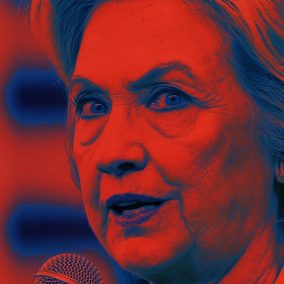 I awoke with a scream when I realized it was Hillary Clinton.
So hideous was this night terror that I kept it to myself. But a week later when the next Democratic pseudo-debate was being promoted, I said to my wife that something told me that Hillary Clinton would be the Democratic nominee and the debates were a sideshow. She said she thought that would never happen and that Clinton was now hated and done for. I disagreed without recounting my nightmare because to describe it at that point would have induced more retching at the thought of the night monster.
Then this past week during the Democratic debate, the courageous Tulsi Gabbard put the lie to the murderous militarism of U.S. foreign policy and its regime change operations with its use of American supported terrorists in Syria and throughout the world. She calmly and eloquently denounced the militarist positions of the other candidates standing beside her, as they listened disquieted and disturbed to a patriotic American speaking truth that they dare not even think, so bought and sold are they.
She was a woman alone among a cast of sycophants denouncing the murderous policies carried out by presidents Democratic and Republican and foisted on the American people through a vast network of propaganda, appealing to their worst instincts. It was a stunning few minutes, for it is so rare, almost unheard of, for a politician to tell Americans the brutal truth about their government.
To many it was a sign of hope, but to the evil forces that run this country, Rep. Gabbard had gone too far and the knives came out in force, this time led by the pumpkin-headed Hillary Clinton and her accomplices at The New York Times and The Washington Post, who have consistently trashed Tulsi Gabbard in an effort to destroy her candidacy.
I felt my dream was prophetic when Clinton, in her slimy manner, attacked Tulsi Gabbard, without naming her, by saying,
I’m not making any predictions but I think they’ve [The Russians] got their eye on somebody who is currently in the Democratic primary and are grooming her to be the third-party candidate. She’s the favorite of the Russians. They have a bunch of sites and bots and other ways of supporting her so far.
Well, I ain’t making any prediction either; I’m leaving that up to my nightmare to do my talking.
It tells me that Hillary-O-Lantern, spitting blood, is running and gunning again.
She’s the favorite of the CIA and the military industrial complex and all those who profit from war and live off the deaths of victims everywhere. They have bunches of sites and bots and fake news conspirators and all sorts of ways of supporting her, which they have been doing for many years, straight through their constructed Russia-gate and Ukraine-gate conspiracies and her barbaric support for wars everywhere, including the destruction of Libya and her joyful response to the fiendish death of Muammar Gaddafi, among so may atrocities.
Tulsi, never cowered, said it straight and true in response:
Great, Thank you. You the Queen of warmongers, embodiment of corruption, and of the rot that has sickened the Democratic Party for so long, have finally come out from behind the curtain. From the day I announced my candidacy, there has been a concerted campaign to destroy my reputation. We wondered who was behind it and why. Now we know — it was always you, through your proxies and concerted campaign to destroy my reputation. We wondered who was behind it and why. Now we know — it was always you, through your proxies and powerful allies in the corporate media and war machine, afraid of the threat I pose. It’s now clear that this primary is between you and me. Don’t cowardly hide behind your proxies. Join the race directly.
She later said, “I stand against everything she represents.”
Halloween is the time for masks and dissembling. Hillary Clinton is a figure straight out of a grotesque Halloween party, as are her clones in the Democratic party. Tulsi Gabbard was not invited to their party but came anyway, and came to tell the truth about the masquerade.
She has torn off Clinton’s mask and asks the American people to see the true face of Clinton and all her minions, who represent the triumph of war and death, and the sick play we have been living through, an endless war on terror justified by endless lies.
Norman O. Brown so well describes our stage set:
Ancestral voices prophesying war; ancestral spirits in the danse macabre or war dance; Valhalla, ghostly warriors who kill each other and are reborn to fight again. All warfare is ghostly, every army an exercitus feralis (army of ghosts), every soldier a living corpse.
Lying is the leading cause of living death in the United States.
Tulsi Gabbard has told the truth.
Like me, I am sure you don’t want your nightmares to become reality. Let’s live in the truth.
Paternalistic Non-interventionism
The examples of Venezuela and Hong Kong
By John V. Walsh | Dissident Voice | October 20, 2019
The summer of 2019 has seen a series of events in Hong Kong beginning with two massive demonstrations that called for the withdrawal of the Extradition Bill to Macao, Taiwan and Mainland China. The demonstrations were peaceful and the bill was quickly “suspended” and labeled “dead” by the Hong Kong government and then withdrawn by summer’s end, meeting the demand of the demonstrations.
But that was not the end of the matter. Over the summer and to this day smaller demonstrations, of hundreds or at most a few thousand, broke out, mainly taking the form of marauding with Molotov cocktails and attacks on police stations, subway stations, police themselves and even on bystanders. Another four demands were added to the original demand to bury the extradition bill. Some, not the majority, called for the secession of Hong Kong from China of which it is legally a part.
But these events did not simply evolve internally in Hong Kong and the rest of China. Although internal forces were at work, the US government had a hand in these events.1 Unfortunately, this readily accessible material has barely been mentioned, if mentioned at all, in the US mainstream media. The most recent and in some ways most blatant examples of interference in the internal affairs of Hong Kong takes the form of the bipartisan “Hong Kong Human Rights and Democracy Act (HKHRD Act)” (H.R. 3289 and S. 1838, an identical bill in the Senate). On September 15 H.R. 3289 was passed in the House by a voice vote. By threat of sanctions and other economic and political measures, the HKHRD Act seeks to determine which laws the Chinese city of Hong Kong will legislate and which not. This is clearly interventionism on the part of the U.S. How would the US react to such threats from another country? How would the U.S. react if China informed us that it was going to put sanctions in place against the U.S. if we would did not change our laws that result in mass incarceration which is clearly racist in character?
Sadly, most peace activists in the US and the West have been silent on the US role in the Hong Kong riots. Or they have gone so far as to echo the narrative of events in Hong Kong put about by Pence, Pompeo, Pelosi and their ilk. For contrast, consider the situation in Venezuela where the US government, its proxies and the same chorus of politicians call for sanctions and other interventions. The peace community in general is clear on its opposition to US intervention of any sort in Venezuela whether from the machinations of the National Endowment for Democracy (NED) or sanctions or attacks on Venezuela’s financial system or actual armed intervention. Why the difference between Venezuela and Hong Kong?
In both Hong Kong and Venezuela, the interventionists tell us that human rights are at stake and an alleged “tyranny,” the Maduro government in one case and the Carrie Lam/Xi Jinping governments in the other, must be fought. So that cannot be the difference in the attitude of progressives to the two cases. Wherein lies the difference?
Here is the difference. Hong Kong is a part of China which presents a real challenge to US global hegemony and a force in the world which may balance the unrestrained power of the US Empire. With the world’s largest economy in PPP-GDP terms since November 2014, now roughly 125% that of the US and growing 2-3 times faster even at its “slowed” rate, China will inevitably have great military and soft power since the latter grow out of economic power. China also serves as an economic anchor for the developing world, an anchor that provides a viable alternative to the economic and financial hegemony of the US Empire. China opens the possibility of a multipolar world where no single nation can dictate to the entire world.
In contrast Venezuela is no threat to US hegemony. It instills no fear in the imperial Elite; if Venezuela maintains its independence, the Empire can roll on pretty much as before. As a consequence, a stance against US intervention in Venezuela will not meet with intense opposition from the US imperial Elite and its minions. Non-intervention in the case of Venezuela is the proper course and should be supported and praised. But such opposition can fall within the ambit of a loyal imperial “opposition,” that is, a harmless opposition if it is not accompanied by nonintervention in cases like that of China’s city of Hong Kong.
“US Hands Off Venezuela” is principled if it is accompanied by “US Hands Off Hong Kong.” By itself “US Hands Off Venezuela” can be seen as a kind of token anti-Empire stance. Such tokenism treats Venezuela not as a part of a powerful worldwide struggle against US hegemony but as a harmless effort which the loyal imperial opposition deigns to help. In short it is Paternalistic Non-interventionism, and DemocracyNow! is one good example of Paternalistic Non-interventionism. The Ron Paul Institute for Peace and Prosperity or the newsletter PopularResistance.org are good examples of principled non-interventionism.
One evidence of the difference between the two is that those who refuse to call for US Hands Off Hong Kong are also partisans for Russiagate, for US intervention in Syria and for US interference in Ukraine. (Or at the least they are silent on these issues.) Russia like China is a serious hindrance to the US drive for world hegemony and so the Paternalistic Non-interventionists cease to be non-interventionists when it comes to Syria, a state protected by Russia, or Ukraine, a country with which Russia must have good relations to live in peace.
Interventionism of the sort practiced by the NED in Hong Kong and the rest of China puts us on a road where antagonisms mount and ever sharper forms of conflict emerge with a major power rivaling the US. In short it puts us on a path to war since China is a full-fledged nuclear power now with a fully developed nuclear triad, that war could easily carry us to Armageddon.
At this moment “U.S. Hands Off Hong Kong” is the cutting edge of Principled Non-interventionism. Those who fail to take that stance, like the crew at DemocracyNow!, among many others, are at best Paternalistic Non-interventionists. They should make no claim to being antiwar or anti-Empire. They are not.
John V. Walsh can be reached at john.endwar@gmail.com. He writes about issues of war, peace and empire, and about health care, for Antiwar.com, Consortium News, Dissident Voice.org and other outlets. Now living in the East Bay, he was until recently Professor of Physiology and Cellular Neuroscience at a Massachusetts Medical School.
Featured Video
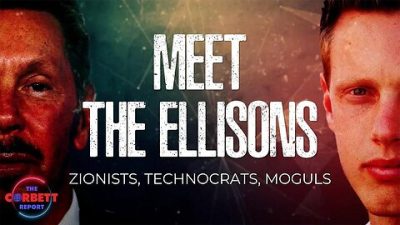
Meet The Ellisons: Zionists, Technocrats, Moguls
or go to
Aletho News Archives – Video-Images
Frlom the Archives
With apparently fabricated nuclear documents, Netanyahu pushed the US towards war with Iran
By Gareth Porter | The Grayzone | April 29, 2020
President Donald Trump scrapped the nuclear deal with Iran and continued to risk war with Iran based on Israeli Prime Minister Benjamin Netanyahu’s claim to have proven definitively that Iran was determined to manufacture nuclear weapons. Netanyahu not only spun Trump but much of the corporate media as well, duping them with the public unveiling of what he claimed was the entire secret Iranian “nuclear archive.”
In early April 2018, Netanyahu briefed Trump privately on the supposed Iranian nuclear archive and secured his promise to leave the Joint Comprehensive Plan of Action (JCPOA). That April 30, Netanyahu took the briefing to the public in a characteristically dramatic live performance in which he claimed Israel’s Mossad intelligence services had stolen Iran’s entire nuclear archive from Tehran. “You may well know that Iran’s leaders repeatedly deny ever pursuing nuclear weapons…” Netanyahu declared. “Well, tonight, I’m here to tell you one thing: Iran lied. Big time.”
However, an investigation of the supposed Iranian nuclear documents by The Grayzone reveals them to be the product of an Israeli disinformation operation that helped trigger the most serious threat of war since the conflict with Iran began nearly four decades ago. This investigation found multiple indications that the story of Mossad’s heist of 50,000 pages of secret nuclear files from Tehran was very likely an elaborate fiction and that the documents were fabricated by the Mossad itself. … continue
Blog Roll
 Aletho News
- Meet The Ellisons: Zionists, Technocrats, Moguls
- US failures in Iran reveal Russia is key to South Korea’s strategic security
- ‘All ports in Persian Gulf will be legitimate targets if Iranian ports are attacked’
- 40 Years of Endless War, Data Point by Data Point
- Department of War Using Palantir AI to Pick Targets in Iran
- American bases do not protect – they attack the peoples of the Persian Gulf
- ‘We’ve Obliterated Their Missiles’
- Syrian president vows ‘absolute support’ to disarm Hezbollah
- Ukraine attacking Russian gas pipeline to stop deliveries to Europe – Defense Ministry
- ‘Heinous crime’: Iran denounces Israeli assassination of 4 Iranian diplomats in Lebanon
- If Americans Knew
- Israeli strategic plans to “remake the Middle East” from the 1950s and since
- Honoring Gaza’s women who refused to let the world look away
- 97% of victims of war on Iran are Iranian, 98% of victims in war on Gaza are Gazans – Not a ceasefire Day 152
- Early Iran strikes cost $5.6 billion in munitions, Pentagon estimates
- Israel Decided the War, But Trump’s America Fights and Pays the Bill
- Conscientious Objector Group: Phone ‘Ringing Off Hook’ As Huge Mobilization Underway
- U.S. support for Israel continues to plummet, despite media’s best efforts
- Threats and missiles fly, death tolls soar in Iran, Lebanon, Gaza – Not a ceasefire Day 151
- Lebanon: Israel’s White Phosphorous Use Risks Civilian Harm
- Corporate Media Go All Out To Support The US-Israeli War On Iran
- No Tricks Zone
- Destructive Green New Deal: German Energy And Metal Group Warns Of Drastic Crisis
- New Study Documents A 20-Year Pause In Arctic Sea Ice Decline – Driven By Internal Variability
- Wake-up Call: Survey Shows Majority Of Germans Now Favor Postponing Climate Targets!
- Televised! Leading German Political Candidate Tells Schoolchildren CO2 Makes Sun Hotter!
- New Study: A Century Warming Of 1.1°C Is ‘Commonplace’ And ‘Not Unusual’ During This Interglacial
- New Study: ‘Internal Noise’ And Volcanic Forcing Can Trigger 10-15°C Warming Within Decades
- Glaciers Worldwide Are Suddendly Surging, Experts Blame Warming!
- Surprising Discovery: Sahara Is Greening…Billions Of Trees Where Once Thought To Be Barren
- New Research Reaffirms Clouds, Aerosols, And Surface Solar Radiation Are ‘Driving The Climate System’
- Germany: Electric Car Catches Fire At Charging Station, Sets Off Local “Inferno”, Widespread Damage
 Aletho News