Legacy of Climategate – 10 years later
By Judith Curry | Climate Etc. | November 12, 2019
My reflections on Climategate 10 years later, and also reflections on my reflections of 5 years ago.
Last week, an email from Rob Bradley reminded me of my previous blog post The legacy of Climategate: 5 years later. That post was the last in a sequence of posts at Climate Etc. since 2010 on Climategate; for the entire group of posts, see [link] Rereading these was quite a blast from the past.
While I still mention Climategate in interviews, the general reaction I get is ‘yawn . . . old hat . . . so 2010 . . . nothingburger . . . the scientists were all exonerated . . . the science has proven to be robust.’ I hadn’t even thought of a ’10 years later’ post until Rob Bradley’s email.
Now I see that, at least in the UK, the 10 year anniversary looks to be rather a big deal. Already we are seeing some analyses published in the mainstream media:
- The Guardian – Climategate 10 years on: What lessons have we learned?
- The Spectator – James Delingpole: My finest hour
Two starkly different perspectives. While I personally think Delingpole’s article is a superb analysis, it would not surprise me if the ‘establishment’ media in the UK is looking to rewrite history and cement the ‘exoneration,’ especially with this forthcoming one hour BBC special Climategate: Science of a Scandal, set to air November 14.
According to Cliscep (not sure what the source of this information is), McKitrick and McIntyre were both interviewed for the BBC special, but apparently McKitrick was cut completely. Lets see how they edit McIntyre.
Exoneration?
The mainstream media and the Climategater scientists themselves claim complete exoneration by the various ‘inquiries’. Were they exonerated?
There was no exoneration by any objective analysis of the various inquiries. Ross McKitrick lays all this out in his article Understanding the Climategate Inquiries
“The evidence points to some clear conclusions.
- The scientists involved in the email exchanges manipulated evidence in IPCC and WMO reports with the effect of misleading readers, including policymakers. The divergence problem was concealed by deleting data to “hide the decline.” The panels that examined the issue in detail, namely Muir Russell’s panel, concurred that the graph was “misleading.” The ridiculous attempt by the Penn State Inquiry to defend an instance of deleting data and splicing in other data to conceal a divergence problem only discredits their claims to have investigated the issue.
- Phil Jones admitted deleting emails, and it appears to have been directed towards preventing disclosure of information subject to Freedom of Information laws, and he asked his colleagues to do the same. The inquiries largely fumbled this question, or averted their eyes.
- The scientists privately expressed greater doubts or uncertainties about the science in their own professional writings and in their interactions with one another than they allowed to be stated in reports of the IPCC or WMO that were intended for policymakers. Rather than criticise the scientists for this, the inquiries (particularly the House of Commons and Oxburgh inquiries) took the astonishing view that as long as scientists expressed doubts and uncertainties in their academic papers and among themselves, it was acceptable for them to conceal those uncertainties in documents prepared for policy makers.
- The scientists took steps individually or in collusion to block access to data or methodologies in order to prevent external examination of their work. This point was accepted by the Commons Inquiry and Muir Russell, and the authors were admonished and encouraged to improve their conduct in the future.
- The inquiries were largely unable to deal with the issue of blocking publication of papers, or intimidating journals. But academics reading the emails could see quite clearly the tribalism at work, and in comparison to other fields, climatology comes off looking juvenile, corrupt and in the grip of a handful of self-appointed gatekeepers and bullies.
Is the science concerning the current concerns about climate change sound? Many people, starting with the members of the UK House of Commons Science and Technology Committee, had hoped this question would be answered during the inquiry process, and there is a frequent refrain in the media that the investigations affirmed the science. But the reality is that none of the inquiries actually investigated the science. The one inquiry supposedly set up to address this, namely Lord Oxburgh’s, actually operated under a different remit altogether, despite multiple claims by the UEA that it was a science reappraisal panel.
Over the course of the five reviews, a few complaints were investigated and upheld, such as the problem of data secrecy at the CRU and the misleading nature of the “hide the decline” graph. And the IAC leveled enough serious criticisms about the IPCC process to substantiate concerns that the organization is unsound for the purpose of providing balanced, rigorous science assessments. But many other concerns were left unaddressed, or slipped through the cracks between the inquiries, or were set aside after taking CRU responses at face value.”
Steve McIntyre’s Brief submitted for the defendants in one Mann’s lawsuits addresses the key scientific aspects related to Michael Mann’s conduct and hockey stick research:
“Even before the release of the Climategate emails, numerous public concerns were raised about Mann’s conduct. Concerns about Mann’s research included:
- Mann’s undisclosed use in a 1998 paper (“MBH98”) of an algorithm which mined data for hockey-stick shaped series. The algorithm was so powerful that it could produce hockey-stick shaped “reconstructions” from auto-correlated red noise. Mann’s failure to disclose the algorithm continued even in a 2004 corrigendum.
- Mann’s failure to disclose adverse verification statistics in MBH98. Mann also did not archive results that would permit calculation of the adverse statistics. Climategate emails later revealed that Mann regarded this information as his “dirty laundry” and required an associate at the Climatic Research Unit (“CRU”) to withhold the information from potential critics.
- Mann’s misleading claims about the “robustness” of his reconstruction to the presence/absence of tree ring chronologies, including failing to fully disclose calculations excluding questionable data from strip bark bristlecone pine trees.
- Mann’s deletion of the late 20th century portion of the Briffa temperature reconstruction in Figure 2.21 in the IPCC Third Assessment Report (2001) to conceal its sharp decline, in apparent response to concerns that showing the data would “dilute the message” and give “fodder to the skeptics.” Mann’s insistence in 2004 that “no researchers in this field have ever, to our knowledge, ‘grafted the thermometer record onto’ any reconstruction. But it was later revealed that in one figure for the cover of the 1999 World Meteorological Organization (WMO) annual report, the temperature record had not only been grafted onto the various reconstructions—and in the case of the Briffa reconstruction, had been substituted for the actual proxy
- Mann’s undisclosed grafting of temperature data for “Mike’s Nature trick,” a manipulation of data which involved: (1) grafting the temperature record after 1980 onto the proxy reconstruction up to 1980; (2) “smoothing” the data; and (3) truncating the smooth back to 1980. ”
Exoneration? Not even close. However, is all this even relevant anymore? “the science has moved on . . . independently verified . . . 97% consensus . . . 8 warmest years occurred since Climategate’ . . . etc. etc.
So did all this ‘matter’, in the larger scheme of things? During the period 2001 to ~2012, the public debate on climate change rose and fell with the fortunes of the hockey stick: the IPCC TAR (2001) prominently featured the hockey stick, which made the public realize that something unusual was going on; the famous elevator version of the hockey stick in Al Gore’s 2006 documentary; in late 2009, Climategate contributed to derailing the UNFCCC COP15 outcome; and in 2010 was the clincher for the failure of the Waxman-Markey Bill (carbon cap and trade) in the U.S. Senate.
Since about 2014 or so, the public debate on climate change has become less ‘scientized’, with economics, social justice and raw politics taking center stage.
Did climate scientists learn anything from Climategate?
Looking forward, should Climategate matter? Only if scientists failed to learn the appropriate lessons.
At the time of Climategate, I wrote an essay entitled On the credibility of climate research. I raised four key issues: Lack of transparency, climate tribalism, the need for improved analysis and communication of uncertainty, and engagement with ‘skeptics’ and critics of our work.
At the time, I was rather astonished by the failure of climate science ‘leaders’ (apart from the climagaters defending themselves) to make public statements about this and show some leadership.
Interesting insights into the ‘leadership’ void at the time of Climategate are revealed by a tranche of emails obtained by the CEI [link] dated the first half of 2010, involving scientists involved in Climategate emails as well as others who are regarded as the keepers of the IPCC ‘flame’ – e.g. Michael Oppenheimer, Steve Schneider, Gabi Hegerl, Eric Steig, Kevin Trenberth.
It is very interesting to see what they were concerned about in the aftermath of Climategate. They were trying to understand why Climategate was newsworthy, and they were mostly concerned about protecting themselves from the same things that Climategate emails revealed: attacks on scientists’ reputation, ‘skeptics’ getting mentions in the mainstream media, public perceptions of scientists’ credibility, how to convince the public that AGW is ‘real’ with 3 slides in 10 minutes, top 10 list of denialist mistakes.
Steve Schneider perceptively states: “A mega heat wave this summer is worth 3 orders of magnitude more in the PR wars–too bad we have to wait for random events since evidence doesn’t seem to cut it anymore with the MSM.”
In my post Climategate essays, I pointed the way for climate science out of this morass. How was this received by climate scientists? Michael Lemonick’s follow up essay Why I Wrote About Judith Curry to his article Climate Heretic: Judith Curry Turns on her Colleagues, provides the following insights:
“Simply by giving Judith Curry’s views a respectful airing, I’ve already drawn accusations of being irresponsible — and it’s valid to raise the question of whether giving her any sort of platform is a bad idea.
I also argue, as you’ll see in Scientific American, that the vehement reaction of climate scientists, while perfectly understandable, might be akin to the violent reaction of the human immune system to some bacteria and viruses — a reaction that’s sometimes more damaging than the original microbe.”
Given the huge stakes and the serious structural issues surrounding the assessment of climate science and policy that had emerged from Climategate, these concerns of the climate scientists seem small-minded and naïve, not to mention counter-productive – ‘circling the wagons’ even tighter made the situation even worse.
Clearly any leadership that might lead climate science out of this morass would have to come from outside the community of climate scientists and probity would need to come from outside of the field of climate science. Climate science subsequently became an important topic in the fields of science and technology studies, philosophy of science, social psychology, law, statistics, computer science and communications.
The broader institutions that support climate science have implemented some improvements post Climategate:
- The UN IAC review of the IPCC has resulted in some improvements to the IPCC practices of reviewing, conflicts of interest, uncertainty assessment
- Elite journals now require data to be made publicly available and also conflict of interest statements.
On the downside:
- Politically correct and ‘woke’ universities have become hostile places for climate scientists that are not sufficiently ‘politically correct’
- Professional societies have damaged their integrity by publishing policy statements advocating emissions reductions and marginalizing research that is not consistent with the ‘party line’
- The gate-keeping by elite journals has gotten worse IMO, although the profusion of new journals makes it possible for anyone to get pretty much anything published somewhere.
The main long-term impact of Climategate on climate scientists seems to have been to put a halo around Michael Mann’s head over his ‘victim’ status, giving him full reign to attack in a Trumpian manner anyone who disagrees with him.
Cultural shifts
The social culture surrounding climate change has changed substantially in the past 10 years and even the past 5 years.
10 years ago, the climate blogs were highly influential – the big four were WUWT, Climate Progress, Real Climate and Climate Audit. Climate Progress (subsequently Think Progress ) is now defunct – what the heck happened to Joe Romm? Climate Audit has a very low level of activity. Real Climate publishes posts at a leisurely pace (about the same pace as Climate Etc.). Only WUWT has maintained its pace of publishing and its influence.
At this point, twitter has almost totally eclipsed the climate blogs; this has accelerated in the past 5 years. Also, there are now some not-for-profit organizations that have hired writers on the climate topic, notably Carbon Brief.
Further, a number of climate scientists and scientists in related fields now either have regular columns in the mainstream media (Roger Pielk Jr and Michael Schellenberger at Forbes are notable examples) or write frequent op-eds (e.g. Michael Mann).
Communication of climate science has become a big priority in climate science, although what is judged as desirable and worthy of professional recognition is more often propaganda than ‘science to inform.’
At the time of Climategate, public advocacy by climate scientists of climate policy was generally frowned upon, and only a few senior, well-established scientists dared to do this (e.g. Jim Hansen). At this point, climate scientist/activists are very large in number, and such activism seems to be a ticket to professional success.
With regards to the advocacy groups and think tanks on both sides, the conflicts a decade ago between the environmental advocacy groups (e.g. Greenpeace) and the libertarian groups (e.g. CEI, CATO) seems almost quaint at this point. With the exception of Heartland, GWPF and the newly formed CO2 Coalition, the libertarian groups no longer bother with climate science (even the long standing program at CATO with Pat Michaels no longer exists).
Instead, we have Extinction Rebellion and the Sunrise Movement on one hand, and the Yellow Vests and related movements on the other hand. These are populist movements (although apparently with some big $$ backing, esp for Extinction Rebellion). The zombie stuff of the Extinction Rebellion makes me nostalgic for the relative rationality of Greenpeace versus CEI.
‘Skeptics’ these days are generally defined by ‘lukewarmerism’ (e.g. climate sensitivity on the low end of the IPCC range), a focus on historical and paleo data records, and a focus on natural climate variability. Skeptics frequently cite the IPCC reports. Skeptics generally support nuclear energy and natural gas, but are dubious of rapid expansion of wind and solar and biofuels.
Scientists on the ‘warm’ side of the spectrum think that IPCC is old hat and too conservative/cautious (see esp Naomi Oreskes’ new book); in short, insufficiently alarming. The ‘alarmed’ scientists are focused on attributing extreme weather to AGW (heeding Steve Schneider’s ‘wisdom’), and also in generating implausible scenarios of huge amounts of sea level rise. As a result, consensus of the 97% is less frequently invoked.
Such alarmism by the climate scientists has spawned doomsterism, to the dismay of these same climate scientists – things are so bad that we are all doomed, so why should we bother.
There is also a growing dichotomy on both sides of this between the Boomers and the Millennials/GenZ. On the ‘skeptics’ side, there is a general paucity of younger scientists, with the center of mass being scientists in their 60’s and 70’s (and even older).
On the ‘alarmed’ side, there is a steady stream of younger scientists fueled by propaganda in K-12 and hiring practices and professional rewards in the universities. Some of the younger scientists think that the likes of Michael Mann are too conservative and insufficiently ‘woke’ and unconcerned about social justice objectives. This recent exchange on twitter was particularly illuminating:
Mann: “I share her (Klein’s) concern over each of these societal afflictions, but I wonder at the assertion that it’s not possible to address climate change without solving all that plagues us. My worry is this. Saddling a climate movement with a laundry list of other worthy social programmes risks alienating needed supporters (say, independents and moderate conservatives) who are apprehensive about a broader agenda of progressive social change. The pessimist in me also doubts that we’ll eliminate greed and intolerance within the next decade.”
This elicited the following responses:
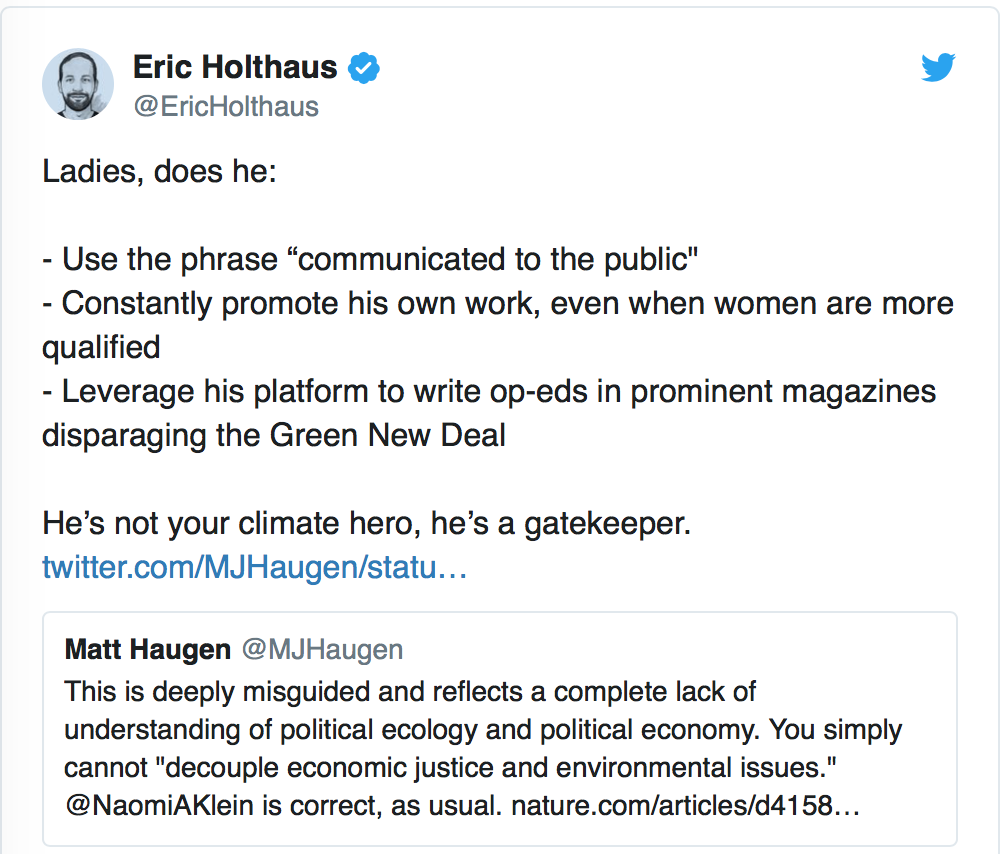
Apparently this elicited a 15 hour tweet storm from Mann. P.S. I side with Mann in this particular dispute.
‘Cancel culture’ is also booming, but this is nothing new in the climate arena; the Climategaters plus Naomi Oreskes were pioneers in cancel culture as related to climate scientists or anyone else who doesn’t toe the party line (although the party line is now splitting between boomer alarmists and the Millennials). At the time of Climategate, the cancel efforts were conducted via the ‘back channels’ (e.g. emails); these days they are conducted in the open on twitter. From Hayhoe to Mann on twitter in response to a recently published paper:
“I’m also concerned as I’ve been getting some dismissives citing this. Have you had a chat with Tom about it?”
Social justice has become a major driver in climate policy (e.g. the Green New Deal), increasingly overtaking climate policy in its objectives.
‘Boomer’ Mann has the more defensible position this one. Yes, any policies should avoid making the situation of disadvantaged individuals worse. But seeking to solve the myriad problems of social justice through climate/energy policy is a recipe for accomplishing nothing for either. So Mann and I are in agreement on this one (see spat above with Holthaus).
With all these changes, you’ll be relieved to hear that Climategate lives on in numerous lawsuits that Michael Mann has filed related to criticisms of his behavior related to the hockeystick. Most of these lawsuits continue to languish since they were filed about 8 years ago (although Mann did lose his lawsuit against Tim Ball). With these lawsuits, there is no denying that the impacts of Climategate are still playing out.
Whither the debate on climate change?
I’ll lead off this section with a quote from Delingpole’s recent article:
“Right now, the struggle against this nonsense seems pretty hopeless. But we sceptics do have at least two things on our side – time and economics. Time is doing us a favour by showing that none of the alarmists’ doomsday predictions are coming to pass. Economics – from the blackouts in South Australia caused by excessive reliance on renewables (aka unreliables) to the current riots and demonstrations taking place from France and the Netherlands to Chile over their governments’ green policies – suggest that common sense will prevail in the end. Bloody hell, though – taking its time, isn’t it?”
I’ll extend Delingpole’s sentiments a bit further, to include these additional things that are on the side of an eventual rational outcome to this:
- Energy engineering realities: for a superb overview, see Michael Kelly’s recent essay Energy Utopias and Engineering Realities
- Growing concerns about energy reliability and security, e.g. the recent experience of California with massive power shutdowns and blackouts in Australia
- The climate itself; even with huge 2016 (see this recent overview by Ross McKitrick), the temperatures are not keeping pace with the CMIP5 predictions
- At some point, a spate of La Nina events, a shift to the cold phase of the AMO, increased volcanic activity, impacts of a solar minimum and another ‘hiatus’ are inevitable; sort of the reverse of what Steve Schneider was waiting for.
- Most of the CMIP6 climate models have gone somewhat bonkers, with a majority having values of ECS that exceed 4.5C and do a poor job of simulating the temperatures since 1950; makes it difficult to take seriously their 21st century projections
Ideas that are genuinely irrational eventually burn themselves out as reality bites, but we have certainly seen such ideas, policies and politics persist for decades in the past 100 years. Perhaps the information age, the internet and social media will speed this one along.
What’s wrong with current climate/energy policy? This 2013 quote by Hans von Storch sums up it up:
“Unfortunately, some scientists behave like preachers, delivering sermons to people. What this approach ignores is the fact that there are many threats in our world that must be weighed against one another. If I’m driving my car and find myself speeding toward an obstacle, I can’t simple yank the wheel to the side without first checking to see if I’ll instead be driving straight into a crowd of people. Climate researchers cannot and should not take this process of weighing different factors out of the hands of politics and society.”
Common sense approaches to reducing vulnerability to extreme weather events, improving environmental quality, developing better energy technologies, improving agricultural and land use practices, better water management polices and engineering can lead the way to a more prosperous and secure future. Each of these solutions is ‘no regrets’ – make sense however the 21st century climate plays out.
For those that are concerned about social justice: the biggest social justice issue that I see for the 21st century is to provide reliable grid electricity to Africa.
In terms of climate scientists and their influence. The relative sensibility of Boomer scientists (even Michael Mann; although this recent article is slightly nuts) are being eclipsed by the zombie-dom of the Extinction Rebellion and ‘wokeness’.
Regarding Boomer wisdom, I was particularly struck by this recent interview of Barack Obama about the ‘call-out’ and ‘cancel’ culture. This was greeted by numerous criticisms typified by this article in the New York Times Obama’s Very Boomer View of ‘Cancel Culture’ and the epithet ‘Yo Boomer.’ Michael Schermer of Skeptical Inquirer nails it with this tweet:
“I’m trying to understand Millennial/GenZ cancel culture & not just be an old Baby Boomer, but it seems to me that if you think @BarackObama is not woke enough to understand what injustice means I think you’ve gone off the rails of moral progress.”
“Gone off the rails of moral progress” – a perfect description of where this seems to be headed, at least in the short term.
Personal impact
My personal saga in the five years following Climategate was summarized in my essay ‘5 years later.’ Upon rereading, I was struck by these excerpts:
“In 2014, I no longer feel the major ostracism by my peers in the climate establishment; after all, many of the issues I’ve been raising that seemed so controversial have now become mainstream. And the hiatus has helped open some minds.
The net effect of all this is that my ‘academic career advancement’ in terms of professional recognition, climbing the administrative ladder, etc. has been pretty much halted. I’ve exchanged academic advancement that now seems to be of dubious advantage to me for a much more interesting and influential existence that feels right in terms of my personal and scientific integrity.
Climategate was career changing for me; I’ll let history decide if this was for better or worse (if history even cares).”
In the end, Climategate ended my academic career prematurely (JC in transition). I realized how shallow the ‘academic game’ has become, and the games one needs to play to succeed. Throwing all that off has been personally and intellectually liberating for me.
I now have more time to read and think. Unfortunately I have less time to write blog posts since I am focusing my efforts on projects of relevance to the clients of my company Climate Forecast Applications Network. These projects are pretty wide ranging and pushing me in interesting new directions.
As for my ‘influence’ in the public debate on climate change, I never cared too much about this and probably care even less at this point. I have a unique perspective, and I appreciate any substantive opportunities that come my way to share this with the public and decision makers.
As Roger Pielke Jr tweeted:
“It wasn’t all fun, I’ll tell ya, but I’d do it all over again if it meant I get to now”
No comments yet.
Featured Video

Yemen joins the war – Red Sea could be blocked next – Saudi regime at risk
or go to
Aletho News Archives – Video-Images
From the Archives
A superpower and “the world’s sickest warrior state”
By Paul J. Balles | March 8, 2010
Living through five or six major wars has hardened me to what I thought were the extremes of inhuman cruelty and brutality.
Two things made those extremes almost bearable: the brutality always revealed – at least according to the media coverage – the viciousness of the enemy. It was therefore quite understandable when our “brave men and women” pulverized the enemy.
Films of Japanese torturing captive Americans somehow justified holding Japanese Americans in internment camps during World War II; and only a small percentage of Americans found the bombing of Hiroshima and Nagasaki unreasonably vengeful at best, at worst, depraved.
The media giants in America portrayed the North Koreans as barbaric beasts with their captives, quite unlike their southern counterpoints – our allies during the Korean War. No one ever felt the need to explain how the South Koreans were a civilized breed while the North Koreans were absolute savages, at least according to the official line.
In Vietnam, our warriors justifiably (or so the media made us believe) dropped napalm on the North Vietnamese who had the gall to hide in villages and tunnels to ravage our invaders. At least it was accepted practice until some rogue photojournalist filmed a young girl screaming down a Vietnamese road in flames. … continue
Blog Roll
 Aletho News
- Russian tanker approaches Cuba despite US oil blockade
- Marandi: Yemen joins the war – Red Sea could be blocked next – Saudi regime at risk
- Pro-Palestinian French member of European Parliament denied entry to Canada
- Pakistan to Host US-Iran Talks
- How Indonesia’s tilt toward the US left it stranded in the Strait of Hormuz
- US has no choice but to retreat from Iranian borders: Top commander
- Iran Retaliation Strikes Chemical Plant Near Dimona
- AWACS’ Destruction is a Major Loss for US Military – Ex-DoW Analyst
- Israel’s Iran Strategy Uses US Military & Gulf States as Its Pawns
- Iran: Trump wanted regime change, now just begging for Hormuz to open
- If Americans Knew
- Israeli police block Catholic cardinal from entering Church of the Holy Sepulchre on Palm Sunday
- Israel is assassinating journalists again, more than any other nation, anywhere, ever – Not a ceasefire Day 170
- Over 300 US service members wounded, majority have brain injuries – Not a ceasefire Day 169
- Researchers at Human Rights Watch Resign Over Blocked Report on Palestinian Refugee Return
- Jewish Groups Are Backing a War Americans Don’t Want
- Eric Fingerhut Thinks He’s the President of the Jews
- Top Jewish Philanthropists, Rabbis Urge Israeli President to Take Action Against ‘Jewish Extremists’
- Don’t Be Fooled. Zionist Leaders Have Always Wanted to Control Southern Lebanon
- Israel’s widespread use of torture is a core element of its genocide against the Palestinian people
- In Israel’s War on Iran, Many Middle East US Bases Rendered “All But Uninhabitable”
- No Tricks Zone
- German Science Blog Accuses PIK Climate Institute Of Hallucinating Climate Tipping Points
- Devastating Assessment Of Comirnaty Vaccine By Former Senior Pfizer Europe Toxicologist
- New Study: CO2 Is ‘Effectively Negligible’ As An Explanatory Climate Change Factor Since 2000
- Former Pfizer Toxicologist Dr. Helmut Sterz Tells Bundestag Hearing Pfizer Vaccine Should Have Never Been Approved
- Energy Expert: Germany’s Nuclear Phaseout Was A “500 Billion Euro Mistake”
- New Research: South Australia’s Mid-Holocene Sea Surface Temperatures Were 4°C Warmer Than Today
- Storing Green Energy To Last Germany 10 Days Would Require A 60-Million Tonne Battery
- New Studies: UK Sea Levels Were 4 Meters Higher Than Today During The Mid-Holocene
- Destructive Green New Deal: German Energy And Metal Group Warns Of Drastic Crisis
- New Study Documents A 20-Year Pause In Arctic Sea Ice Decline – Driven By Internal Variability
 Aletho News
Leave a comment