DHS Head Claims Russia Seeks to ‘Undermine American Way of Life’, Expects US 2020 Voter Interference
Sputnik – 18.01.2020
Acting Secretary of the US Department of Homeland Security (DHS) Chad Wolf has joined the ranks of US officials who observe the DC political creed that Russia interferes in US internal affairs.
Wolf, in his 17 January speech, most of which was dedicated to what he referred to as the “top threats facing the Homeland” – Iran, China and Russia, claimed that even though Moscow does not strive to diminish the US role in the international arena, the nation is nonetheless looking to disrupt and undermine the “American way of life”.
“Lastly, let me touch on Russia. Unlike China, Russia doesn’t seek to weaken our economy and surpass us on the world-stage; rather they focus on actions that disrupt and undermine the American way of life. As we saw in 2016, we fully expect Russia to attempt to interfere in the 2020 elections to sow public discord and undermine our democratic institutions”, Wolf, serving as DHS acting secretary since November 2019, said, during an event hosted by the Homeland Security Experts Group in Washington DC.The official claimed that the 2018 midterm elections were “the most secure elections in the modern era” as the US created “classified and unclassified election war rooms” that “connected election officials in all 50 states, political parties, social media companies and agencies across the US Government, including DOD, the FBI and the Intelligence Community”.
“Let me be clear: We are prepared,” Wolf said. “More importantly, the state and local officials who run our elections are prepared. We are working with our federal partners to make sure those officials on the front lines of our elections have the information and the tools they need to combat Russian interference.”
“In 2020, we’re doing this and more to prevent our adversaries from degrading faith in our democracy and election results”, Wolf said.The acting secretary acknowledged that “100 percent security is never realistic” and asserted that US federal government and intelligence agencies were “laser-focused” on securing the upcoming elections.
Russian Trail
US intelligence agencies and lawmakers have accused Moscow of meddling in US elections since Trump’s 2016 victory, a political event that provoked allegations of Trump’s cooperation with Moscow as a means spreading anti-opponent propaganda online.
The US Department of Justice at the time launched an investigation headed by US Special Prosecutor Robert Mueller but the report concluded that no sufficient evidence existed to prove the allegations.
Both Trump and Russian officials have together repeatedly denied claims that they worked together to influence the results of the election.
In December 2019, Russian Foreign Minister Sergey Lavrov said that he had not seen any proof in support of allegations that Russia interfered in US elections, arguing that “No one has given us this proof because simply it does not exist”, while noting that Moscow is prepared to exchange assurances with Washington on non-interference in each other’s domestic affairs.Besides the US, the narrative of Russian involvement in the internal affairs of other countries has been used by a variety of European nations, however, again, no proof has been furnished.
In November 2019, El Pais published several stories alleging Russian influence in Catalonia, according to Spanish intelligence officers, again without providing evidence. The Russian embassy in Spain responded by joking about the allegations.
“With regards to the tireless work of El Pais researchers on linking the source of the Catalan crisis to Russia, we would like to draw their attention to a revealing fact. There is a suspicious coincidence: the number of the alleged Russian unit, which is mentioned in the newspaper, ends with 155, which itself creates a new reality. So – [follow] the trail,” the embassy tweeted.Spain’s constitution contains Article 155, used by Madrid to suspend Catalonia’s autonomy and violently introduce direct rule in the wake of a 2017 independence declaration.
An American Oligarch‘s Dirty Tale of Corruption
By F. William Engdahl – New Eastern Outlook – 12.06.2015
Rarely does the world get a true look inside the corrupt world of Western oligarchs and the brazen manipulations they use to enhance their fortunes at the expense of the public good. The following comes from correspondence of the Hungarian-born billionaire, now naturalized American speculator, George Soros. The hacker group CyberBerkut has published online letters allegedly written by Soros that reveal him not only as puppet master of the US-backed Ukraine regime. They also reveal his machinations with the US Government and the officials of the European Union in a scheme where, if he succeeds, he could win billions in the plunder of Ukraine assets. All, of course, would be at the expense of Ukrainian citizens and of EU taxpayers.
What the three hacked documents reveal is a degree of behind-the-scene manipulation of the most minute details of the Kiev regime by the New York billionaire.
In the longest memo, dated March 15, 2015 and marked “Confidential” Soros outlines a detailed map of actions for the Ukraine regime. Titled, “A short and medium term comprehensive strategy for the new Ukraine,” the memo from Soros calls for steps to “restore the fighting capacity of Ukraine without violating the Minsk agreement.” To do the restoring, Soros blithely notes that “General Wesley Clark, Polish General Skrzypczak and a few specialists under the auspices of the Atlantic Council [emphasis added—f.w.e.] will advise President Poroshenko how to restore the fighting capacity of Ukraine without violating the Minsk agreement.”
Soros also calls for supplying lethal arms to Ukraine and secretly training Ukrainian army personnel in Romania to avoid direct NATO presence in Ukraine. The Atlantic Council is a leading Washington pro-NATO think tank.
Notably, Wesley Clark is also a business associate of Soros in BNK Petroleum which does business in Poland.
Clark, some might recall, was the mentally-unstable NATO General in charge of the 1999 bombing of Serbia who ordered NATO soldiers to fire on Russian soldiers guarding the Pristina International Airport. The Russians were there as a part of an agreed joint NATO–Russia peacekeeping operation supposed to police Kosovo. The British Commander, General Mike Jackson refused Clark, retorting, “I’m not going to start the Third World War for you.” Now Clark apparently decided to come out of retirement for the chance to go at Russia directly.
Naked asset grab
In his March 2015 memo Soros further writes that Ukrainian President Poroshenko’s “first priority must be to regain control of financial markets,” which he assures Poroshenko that Soros would be ready to assist in: “I am ready to call Jack Lew of the US Treasury to sound him out about the swap agreement.”
He also calls on the EU to give Ukraine an annual aid sum of €11 billion via a special EU borrowing facility. Soros proposes in effect using the EU’s “AAA” top credit rating to provide a risk insurance for investment into Ukraine.
Whose risk would the EU insure?
Soros details, “I am prepared to invest up to €1 billion in Ukrainian businesses. This is likely to attract the interest of the investment community. As stated above, Ukraine must become an attractive investment destination.” Not to leave any doubt, Soros continues, “The investments will be for-profit but I will pledge to contribute the profits to my foundations. This should allay suspicions that I am advocating policies in search of personal gain. “
Anyone familiar with the history of the Soros Open Society Foundations in Eastern Europe and around the world since the late 1980’s, will know that his supposedly philanthropic “democracy-building” projects in Poland, Russia, or Ukraine in the 1990’s allowed Soros the businessman to literally plunder the former communist countries using Harvard University’s “shock therapy” messiah, and Soros associate, Jeffrey Sachs, to convince the post-Soviet governments to privatize and open to a “free market” at once, rather than gradually.
The example of Soros in Liberia is instructive for understanding the seemingly seamless interplay between Soros the shrewd businessman and Soros the philanthropist. In West Africa George Soros backed a former Open Society employee of his, Liberian President Ellen Johnson Sirleaf, giving her international publicity and through his influence, even arranging a Nobel Peace Prize for her in 2011, insuring her election as president. Before her presidency she had been well-indoctrinated into the Western free market game, studying economics at Harvard and working for the US-controlled World Bank in Washington and the Rockefeller Citibank in Nairobi. Before becoming Liberia’s President, she worked for Soros directly as chair of his Open Society Initiative for West Africa (OSIWA).
Once in office, President Sirleaf opened the doors for Soros to take over major Liberian gold and base metals assets along with his partner, Nathaniel Rothschild. One of her first acts as President was to also invite the Pentagon’s new Africa Command, AFRICOM, into Liberia whose purpose as a Liberian investigation revealed, was to “protect George Soros and Rothschild mining operations in West Africa rather than champion stability and human rights.”
Naftogaz the target
The Soros memo makes clear he has his eyes on the Ukrainian state gas and energy monopoly, Naftogaz. He writes, “The centerpiece of economic reforms will be the reorganization of Naftogaz and the introduction of market pricing for all forms of energy, replacing hidden subsidies…”
In an earlier letter Soros wrote in December 2014 to both President Poroshenko and Prime Minister Yatsenyuk, Soros openly called for his Shock Therapy: “I want to appeal to you to unite behind the reformers in your government and give your wholehearted support to a radical, ‘big bang’ type of approach. That is to say, administrative controls would be removed and the economy would move to market prices rapidly rather than gradually… Naftogaz needs to be reorganized with a big bang replacing the hidden subsidies…”
Splitting Naftogaz into separate companies could allow Soros to take control of one of the new branches and essentially privatize its profits. He already suggested that he indirectly brought in US consulting company, McKinsey, to advise Naftogaz on the privatization “big bang.”
The Puppet-Master?
The totality of what is revealed in the three hacked documents show that Soros is effectively the puppet-master pulling most of the strings in Kiev. Soros Foundation’s Ukraine branch, International Renaissance Foundation (IRF) has been involved in Ukraine since 1989. His IRF doled out more than $100 million to Ukrainian NGOs two years before the fall of the Soviet Union, creating the preconditions for Ukraine’s independence from Russia in 1991. Soros also admitted to financing the 2013-2014 Maidan Square protests that brought the current government into power.
Soros’ foundations were also deeply involved in the 2004 Orange Revolution that brought the corrupt but pro-NATO Viktor Yushchenko into power with his American wife who had been in the US State Department. In 2004 just weeks after Soros’ International Renaissance Foundation had succeeded in getting Viktor Yushchenko as President of Ukraine, Michael McFaul wrote an OpEd for the Washington Post. McFaul, a specialist in organizing color revolutions, who later became US Ambassador to Russia, revealed:
Did Americans meddle in the internal affairs of Ukraine? Yes. The American agents of influence would prefer different language to describe their activities — democratic assistance, democracy promotion, civil society support, etc. — but their work, however labeled, seeks to influence political change in Ukraine. The U.S. Agency for International Development, the National Endowment for Democracy and a few other foundations sponsored certain U.S. organizations, including Freedom House, the International Republican Institute, the National Democratic Institute, the Solidarity Center, the Eurasia Foundation, Internews and several others to provide small grants and technical assistance to Ukrainian civil society. The European Union, individual European countries and the Soros-funded International Renaissance Foundation did the same.
Soros shapes ‘New Ukraine’
Today the CyberBerkut hacked papers show that Soros’ IRF money is behind creation of a National Reform Council, a body organized by presidential decree from Poroshenko which allows the Ukrainian president to push bills through Ukraine’s legislature. Soros writes, “The framework for bringing the various branches of government together has also emerged. The National Reform Council (NRC) brings together the presidential administration, the cabinet of ministers, the Rada and its committees and civil society. The International Renaissance Foundation which is the Ukrainian branch of the Soros Foundations was the sole financial supporter of the NRC until now…”
Soros’ NRC in effect is the vehicle to allow the President to override parliamentary debate to push through “reforms,” with the declared first priority being privatization of Naftogaz and raising gas prices drastically to Ukrainian industry and households, something the bankrupt country can hardly afford.
In his letter to Poroshenko and Yatsenyuk, Soros hints that he played a key role in selection of three key non-Ukrainian ministers—Natalia Jaresko, an American ex- State Department official as Finance Minister; Aivras Abromavicius of Lithuania as Economics Minister, and a health minister from Georgia. Soros in his December 2014 letter, referring to his proposal for a “big bank” privatization of Naftogaz and price rise, states, “You are fortunate to have appointed three ‘new Ukrainian’ ministers and several natives (sic) who are committed to this approach.”
Elsewhere Soros speaks about de facto creating the impression within the EU that the current government of Yatsenyuk is finally cleaning out the notorious corruption that has dominated every Kiev regime since 1991. Creating that temporary reform illusion, he remarks, will convince the EU to cough up the €11 billion annual investment insurance fund. His March 2015 paper says that, “It is essential for the government to produce a visible demonstration (sic) during the next three months in order to change the widely prevailing image of Ukraine as an utterly corrupt country.” That he states will open the EU to make the €11 billion insurance guarantee investment fund.
While saying that it is important to show Ukraine as a country that is not corrupt, Soros reveals he has little concern when transparency and proper procedures block his agenda. Talking about his proposals to reform Ukraine’s constitution to enable privatizations and other Soros-friendly moves, he complains, “The process has been slowed down by the insistence of the newly elected Rada on proper procedures and total transparency.”
Soros suggests that he intends to create this “visible demonstration” through his initiatives, such as using the Soros-funded National Reform Council, a body organized by presidential decree which allows the Ukrainian president to push bills through Ukraine’s legislature.
George Soros is also using his new European Council on Foreign Relations think-tank to lobby his Ukraine strategy, with his council members such as Alexander Graf Lambsdorff or Joschka Fischer or Karl-Theodor zu Guttenberg, not to mention former ECB head, Jean-Claude Trichet no doubt playing a subtle role.
George Soros, now 84, was born in Hungary as a Jew, George Sorosz. Soros once boasted in a TV interview that he posed during the war as a gentile with forged papers, assisting the Horthy government to seize property of other Hungarian Jews who were being shipped to the Nazi death camps. Soros told the TV moderator, “There was no sense that I shouldn’t be there, because that was–well, actually, in a funny way, it’s just like in markets–that if I weren’t there–of course, I wasn’t doing it, but somebody else would.”
This is the same morality apparently behind Soros’ activities in Ukraine today. It seems again to matter not to him that the Ukrainian government he helped bring to power in the February 2014 US coup d’etat is riddled with explicit anti-semites and self-proclaimed neo-Nazis from the Svoboda Party and Pravy Sektor. George Soros is clearly a devotee of “public-private-partnership.” Only here the public gets fleeced to enrich private investors like Mr. Soros and friends. Cynically, Soros signs his Ukraine strategy memo, “George Soros–A self-appointed advocate of the new Ukraine, March 12, 2015.”
Canada citizens fighting for Israel given warm reception by embassy
MEMO | January 17, 2020
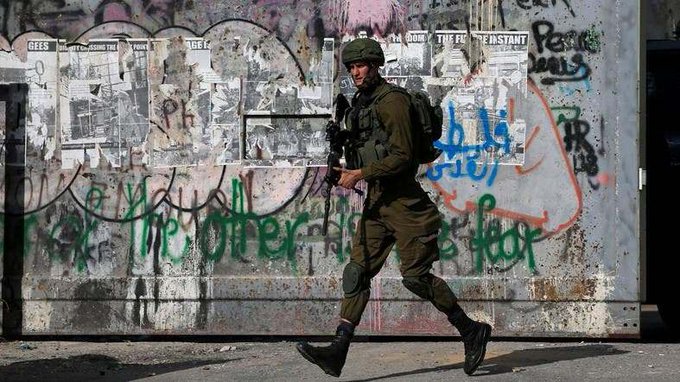
The Canadian embassy in Tel Aviv hosted a party yesterday for its citizens serving in the Israeli army.
It was organised by Ambassador Deborah Lyons, who told The Jerusalem Post that she wanted to show the appreciation and care felt by the embassy for the “lone soldiers” who left their homes to serve in the Israeli army.
“Lone soldiers” are Jewish citizens of a foreign country serving in the Israeli army. As many as 6,000 such soldiers with dual citizenship are said to be in the programme.
Israel’s President Reuven Rivlin calls them “true Zionists,” while Jewish Agency Chairman Isaac Herzog has described them as “a true example of what Zionism is all about.”
Lyons told the Post that she had been wanting to hold a reception for Canadians serving in the Israeli army “for a very long time.” Three years in fact, since she was posted in Tel Aviv.
“Canadian lone soldiers are a particularly special group. I know some of the parents of these kids and I wanted to reach out and let them know that their Canadian family of the embassy is here if they want to talk hockey and a home cooked meal,” she said.
Canada’s Defence Attaché Col. Rick Thompson told the Post “the ambassador thought it would be a nice gesture to reach out to Canadian lone soldiers and make some social connections and talk hockey … If you get homesick, we embassy staff are connected to the wider Canadian community.”
There is a high risk of depression amongst “lone soldiers.” Young Diaspora Jews, according to a report in Haaretz, account for only 2 per cent of soldiers serving in the Israeli army, but in the past year the suicide rate among them has been disproportionately high.
Their recruitment has also been a cause of controversy. An Al Jazeera report found that radical organisations in Europe were recruiting western citizens to serve in the Israeli army where many of these foreign fighters took part in the 2014 Gaza war.
In the UK there have been calls for British citizens who volunteer for the Israeli army to be prosecuted like others who fight for foreign forces.
Dutch government criticises pro-Israel lobby group NGO Monitor’s ‘half-facts and insinuations’
MEMO | January 17, 2020
The Dutch government has criticised the conduct of pro-Israel advocacy group NGO Monitor, singling out the unreliability of their accusations against human rights defenders.
Responding to a parliamentary question, Dutch Foreign Minister Stef Blok stated that the Netherlands is “concerned about the shrinking civil space in Israel”, and “therefore consistently brings this matter up in conversations with Israeli authorities”.
In recent years, Israeli politicians have pursued legislation that targets, as well as publicly incited against, organisations focusing on Israel’s military occupation and the violation of Palestinian rights.
The Israeli government’s attacks on human rights defenders are aided by organisations such as NGO Monitor, which in particular lobby European authorities to cease funding such human rights groups.
The Dutch minister added that “the government is familiar with the accusations by NGO Monitor against a broad group of Israeli and Palestinian human rights organisations, as well as with criticism of the conduct of NGO Monitor itself”, citing a September 2018 report by the Policy Working Group.
“This research shows that many of NGO Monitor’s accusations are based on selective citations, half-facts and insinuations, but not necessarily on hard evidence”, Minister Blok added.
“These accusations have contributed to a climate in which human rights organisations have come under increasing pressure”.
In response to a separate question, the Dutch foreign minister noted that, “to the best of the government’s knowledge, NGO Monitor… focuses exclusively on organisations and donors who are critical of Israeli policy in the territories occupied by Israel”.
After US killing of Iran’s Soleimani, narrative control on social media is getting worse
By Eva Bartlett | RT | January 17, 2020
Twitter has been on a narrative-control rampage, removing or censoring legitimate accounts that are critical of US-led wars, propaganda and lies. Facebook and Instagram have increased their Big Brother policing, too.
Attempts by American-based social media behemoths to silence or censor voices critical of the establishment-approved narrative is nothing new, but this trend seems to have intensified lately.
Just in the past several days, following the criminal US assassination of Iranian General Qassem Soleimani, Instagram and Facebook have been removing posts supportive of Soleimani, even profile photos honouring the general, allegedly to comply with US sanctions, a truly absurd explanation for the narrative control.
On January 7, it was reported that Twitter had suspended numerous Venezuelan accounts, including those of the central bank, the Bolivarian National Armed Forces, public media, political leaders, the Finance & Oil ministries.
At the end of last year, Italy’s Rai News conducted an interview with Syrian President Bashar Assad, but then decided not to air it. Days later, as the interview was being aired instead by the Syrian Presidency, its respective Twitter account was inexplicably and suddenly restricted.
It returned to normal some days later but, at the start of January, the account was again no longer available. Admin used a backup account with a dramatically smaller following and, although after about a week—and many Twitter protests later—the account was again restored, it has not since tweeted and thus appears to be restricted.
In mid-2019, the account of the Russian embassy in Syria disappeared not long after tweeting about the White Helmets, terrorists, and war propaganda. This, again, begged the question of what ‘Twitter rules’ had been violated.
These aren’t some isolated incidents, they’re part of a systematic purging by the NATO-aligned social media corporations who bleat about alleged “Russian propaganda” but are themselves the (transparently poor) masters of propaganda.
Many anti-war voices have been scrubbed from Twitter and Facebook, including the prominent anti-war voice of Daniel McAdams – Executive Director of the Ron Paul Institute for Peace and Prosperity– who was banned from Twitter for using the word “retarded” to describe a Fox News host, something I’m sure many people would think an insufficient and mild description of such corporate media entities…
Accounts Calling For Genocide A-Okay on Twitter
While accounts like McAdams’ are taken down allegedly for reasons of political correctness, other accounts can call for genocide and destruction with no repercussions.
Take the rather no-name lobbyist Jack Burkman, who, after the US assassination of Iran’s beloved General Soleimani, tweeted about the “need to burn every major Iranian city to the ground.” His tweet actually included “Load up the [chemical weapon] napalm.” On several more occasions, Burkman tweeted about destroying Iran, including his tweet on the firebombing of Dresden and his desire to “replicate the campaign against Iran.” Some of those tweets have been removed, but his account remains active, without restrictions, as though he hadn’t violated Twitter rules on multiple occasions.
Then there is the President of the United States, who, after having General Soleimani illegally assassinated, went on to threaten to destroy 52 Iranian cultural sites. That tweet remains up on Twitter, in spite of surely violating rules on threatening violence (and not only against a person but a nation). I mean, most normal people consider threatening to destroy places somewhat violent.
On the other hand, allegations about genocide risk being censored, as happened to Mint Press News’ editor in chief, Mnar Muhawesh, whose video on the US-Saudi led war on Yemen was deemed “child nudity” by Facebook.
Muhawesh protested: “This is false. Images show skeleton, dying children wearing diapers.”
Terrorist Accounts, Exploited Children, And More Twitter Restrictions
Accounts abound on Twitter and Facebook that are openly supportive of suicide bombers, ISIS and al-Qaeda. I’ve found Western corporate journalists citing terrorist-supporting accounts as “media activists” in areas militarily surrounded by the Syrian army, as was the case when eastern Ghouta was being liberated, although the ‘activists’ allegiance to Jaysh al-Islam and al-Qaeda was easily identified.
And there are accounts representing the terrorists themselves, whose graphic content certainly ought to be deemed violations of Twitter’s rules, yet so many of these accounts remain intact.
Twitter serves as a platform for war propaganda, that’s fairly clear. But there’s a point that some people might not know about Twitter and Syria: Twitter doesn’t recognize the Syrian country code, thus you’d need a non-Syrian phone number to open an account.
So how do all these poster children like Bana al-Abed (one of the chief faces of war propaganda in the lead-up to the liberation of Aleppo in late 2016) and those which popped up later in eastern Ghouta and then in Idlib get accounts?
Keep that in mind when the war propaganda again resurges around Idlib and the children holding English posters and hashtagging #SaveIdlib pop into your feed. More exploitation of kids, and Twitter the perfect platform.
In researching for this piece last week, I came across a recent article announcing a new feature Twitter would test, in its valiant efforts to quash trolls: limiting who may reply to tweets before sending a tweet.
This smacks not of cutting out trolls, but of making echo chambers more impenetrable, so war propagandists can back-slap one another without allowing intelligent voices to poke holes in their lies.
But in the end, perhaps even that doesn’t matter, because at any moment your account can be zapped. Nestled in Twitter’s terms of service is this line: “We may suspend or terminate your account…for any or no reason…” This means any protest over suspended accounts is thus a waste of time after all.
This is total narrative control, and it’s only getting worse.
Eva Bartlett is a Canadian independent journalist and activist. She has spent years on the ground covering conflict zones in the Middle East, especially in Syria and Palestine (where she lived for nearly four years).
Governing Russia
Irrussianality | January 15, 2020
Putin has spoken. The Russian constitution needs some tweaking, he told legislators in his annual address to the Federal Assembly yesterday. Restrictions on how often someone can be president will remain, thus clearing up the question of whether Putin will stay on as president after 2024 – he won’t. But, under the changes Putin proposes, the Prime Minister will henceforth be appointed by parliament not the president, an amendment which should shift power towards the legislature. All this would have to be approved in a national referendum, but still it got the pundits buzzing.
In reality, though, this wasn’t the main focus of Putin’s speech, and while it’s what got the headlines it wasn’t what struck me most about what the Russian president had to say. What hit me was how he was to a large degree repeating stuff he’d said before and how this indicated the extreme limits of his power. Most notably, Putin started off with a long exposition of Russia’s demographic problems and the need to find ways to support families with young children so as to encourage parents to have more kids. This had been the main thing he’d talked about last year, at which point he had unveiled a series of financial measures to try and resolve the demographic problem. What were the results? Well, if this year’s speech is anything to go by, last year’s measures had no effect at all. In fact, the birth rate actually fell! Perhaps the most revealing section of Putin’s speech to me was the following segment, in which he said:
The most sensitive and crucial issue is the opportunity to enrol one’s child in a day nursery. Earlier, we allocated funds from the federal budget to help the regions create 255,000 new places in day nurseries by the end of 2021. However, in 2018 to 2019, instead of 90,000, 78,000 new places were created, out of which only 37,500 places can actually be provided to kids. Other places are unavailable simply because an educational licence is still not obtained. This means that these nurseries are not ready to enrol children.
Why do I find this so interesting? Because it shows very clearly that there’s a world of difference between making policy statements and even transposing those statements into specific policies with assigned budgets, and actually putting those policies into effect, let alone achieving the objectives for which the policies were created. Supposedly, Putin is all-powerful; the state is highly centralized; the leader just has to wave his wand, and the system obeys. What the statement above shows is that this isn’t the case. Putin can issue whatever instructions he likes, but that doesn’t mean that it’s done.
This isn’t an isolated case. In the past, I’ve noted how other issues keep cropping up year after year in Putin’s speeches, indicating that all his decrees on the issue in question have resulted in naught. For instance, in a 2016 blogpost, ‘The Limits of Power’, I talked about Putin’s complaints that his orders on economic deregulation had not been carried out. Just a couple of weeks ago, I came across another reference somewhere (unfortunately I can’t remember where) to a speech Putin recently gave calling for a ‘bonfire of regulations’. The fact that he felt a need to demand this yet again is quite striking.
A similar story can be seen in the case of the key economic policy of the past couple of years, namely billions of dollars which have been assigned to infrastructure spending. It promises a lot, but as numerous reports have demonstrated, only a fraction of the assigned money has been spent, in part because bureaucrats are afraid of the scrutiny they’ll come under once they start dispensing a lot of cash.
And then there’s this story from Intellinews a few days ago:
Russia is suffering from a crisis of confidence that is visible in the extremely high dividend payments (owners take cash rather than invest) and extremely low corporate borrowing, which is the other side of the same coin. The government understands it needs to do something about boosting investors’ confidence in the economy, but while the draft version of a new investor protection law was very radical, the version that was submitted to the Duma was so twisted by state-owned enterprise lobbying that everyone hates it and it is very unlikely to be passed.
In this case, what we see is one part of the Russia state lobbying another part of the state in order to undermine what a third part of the state (the government) wants to do. In circumstances like this, it’s remarkable that anything gets done at all.
In short, governing Russia is a tough business. The ship of state doesn’t always go where the pilot wants it to. This is, of course, hardly a uniquely Russian problem, but the Russian response to it has not always been successful. Historically speaking, when faced with the sort of difficulties mentioned here, Russian rulers have tended to try to bureaucratize and centralize, thereby reinforcing autocracy. Another response has been to find reliable people to whom large powers are then delegated as sort of autocratic plenipotentiaries. At the start of yesterday’s speech, Putin suggested that perhaps Russia needed to move in the other direction. As he put it:
Our society is clearly calling for change. People want development, and they strive to move forward in their careers and knowledge, in achieving prosperity, and they are ready to assume responsibility for specific work. Quite often, they have better knowledge of what, how and when should be changed where they live and work, that is, in cities, districts, villages and all across the nation.
If the proposed constitutional changes help prod Russia in that direction, they may well prove to be worthwhile. But don’t hold your breath.
UPDATE: Within seconds of posting this, news arrived that the Russian government had resigned, with Prime Minister Medvedev citing the proposed constitutional changes as the reason. I will ponder my response over the next 24 hours.
Putin Updates Russian Constitution as Western Media Tries to Catch Up
By Johanna Ross | January 17, 2020
Russian President Vladimir Putin gave his annual inauguration speech on Wednesday, announcing a welfare package for women and children which would put the average western democracy to shame. But it wasn’t the social reform which caused shockwaves across global media. Instead it was the changes to the constitution aimed at giving more power to parliament and less to the President, as Putin sets the scene for Russia’s democratic future once he leaves his post (as it is widely believed he will) in 2024. Putin’s speech yesterday was followed by the resignation of Prime Minister Medvedev and his government, a procedure which, although took many by surprise, was a natural follow-on from the announcements.
Western media however was aghast. ‘What is Putin up to?’ read the headlines as Russia watchers frantically tried to work out what was going on. There must be something more to this, the narrative was spun. ‘The details are murky’ professed The Economist, as it bought time to figure out what it all meant. The Twittersphere was completely unprepared and perplexed by the government’s resignation. Many commentators couldn’t work out whether it was a good or bad thing. The general line was ‘we’re not quite sure what’s happening; more details to follow.’
This then evolved quickly into the line that the constitutional reforms were all part of Putin’s strategy to stay in power indefinitely. ‘Vladimir Putin proposed sweeping reforms that could extend his decades-long grip on power beyond the end of his presidency.” boasted CNN. This particular article even went as far as to misrepresent what the Russian President had actually said, by taking it completely out of context. Although Putin said regarding the resignation of the government: “I want to express satisfaction with the results that have been achieved. Of course not everything worked out, but nothing ever works out in full”, the CNN piece quoted him as saying ‘not everything worked out’ which by itself gives a completely different meaning, implying Putin was dissatisfied with the government’s work.
The Economist followed suit, taking up its usual antagonistic stance towards Russia with the headline “How Vladimir Putin is preparing to rule forever.” Furthermore on Twitter it alleged ‘Vladimir Putin’s regime has killed too many people to make it plausible that he would voluntarily give up power’, to which journalist Mary Dejevsky rightfully responded: ‘why would a president who, according to your interpretation, is intent on staying in power, be preparing a transition?’
Wednesday’s events in Russia really proved problematic for the western commentariat. For what in essence was clearly an attempt by Putin to further democratise Russia: reducing the number of terms a President can run to two, and ensuring the parliament appoints the Prime Minister as opposed to the President doing so; was perversely portrayed as a sign of authoritarianism, in a desperate attempt to fit the narrative. Absent from most analysis was the fact that Putin wants to put his proposals to a public vote: if that’s not democracy then I don’t know what is.
What has also been largely ignored by the western media was the implications of certain constitutional reforms on the future government and President. For arguably most significant of all was Putin’s proposal that any future President ought to have lived in Russia continuously for a period of 25 years and that civil servants should be barred from holding foreign citizenship.
So what should be regarded as a positive attempt to consolidate democracy in Russia, is being unfortunately, and rather predictably, interpreted as the opposite. But even if Vladimir Putin does continue a central role in Russia’s future, with record approval ratings I don’t see many people having a problem with that. This is the man who restored Russia as a world power to be reckoned with after the collapse of the USSR and the ensuing deep economic crisis during the 1990s. Russians won’t forget that.
Johanna Ross is a journalist based in Edinburgh, Scotland.
US, Russia Agree to Begin Expert-Level Engagement on Strategic Security – State Dept.
Sputnik – 16.01.2020
WASHINGTON – US and Russian delegations during their talks in Vienna decided to begin expert-level engagement on issues of strategic security and expand the dialogue beyond a bilateral format, the State Department said in a press release on Thursday.
“The delegations decided to continue the Strategic Security Dialogue and also to begin expert-level engagement on particular topics in the near future”, the release said. “The delegations discussed their respective national strategic policies as a means to reduce misunderstandings and misperceptions on key security issues. The US and Russian delegations discussed nuclear stockpiles and strategy, crisis and arms race stability, and the role and potential future of arms control, including the importance of moving beyond a solely bilateral format”.
Earlier, Russian Permanent Representative to International Organizations in Vienna Mikhail Ulyanov said in a statement on Twitter that the two sides discussed issues of strategic stability during the talks, which were led by Russian Deputy Foreign Minister Sergei Ryabkov and US Acting Undersecretary of State Chris Ford.
New START (Strategic Arms Reduction Treaty) is the last remaining arms control treaty in force between Russia and the United States. Signed in 2010, the pact stipulates that the number of strategic nuclear missiles launchers must be cut by half and limits the number of deployed strategic nuclear warheads to 1,550.
Russia has repeatedly stated its readiness to extend the New START without any preconditions, but the US is yet undecided about the extension.
Israel announces 7 nature reserves in West Bank and expansion of 12 others
MEMO | January 16, 2020
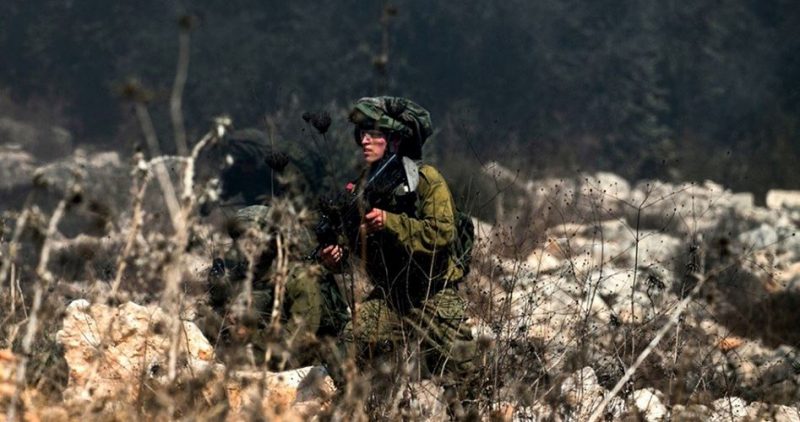
The Israeli defence minister, Naftali Bennett, on Wednesday approved the creation of seven nature reserves and the expansion of 12 others in Area C of the occupied West Bank, a statement confirmed.
In his statement, Bennett ordered the Israeli Civil Administration – the Israeli governing body that operates in the West Bank – to start preparing for the opening of the reserves.
The Times of Israel disclosed that this is the first time that such a step has been taken by the Israeli government, since the Oslo Peace Accords were reached in the 1990s.
“Today, we provide a big boost for the land of Israel and continue to develop the Jewish communities in Area C, with actions, not with words,” Bennett announced in his statement.
“The Judea and Samaria [West Bank] area has nature sites with amazing views. We will expand the existing ones and also open new ones,” he added.
“I invite all the citizens of Israel to tour and walk the land, to come to Judea and Samaria, sight-see, discover and continue the Zionist enterprise,” Bennett continued.
Bennett identified the seven new locations in his statement as: Soreq Cave, Al-Shomoo’a Cave, Wadi Al-Muqallek, Wadi Malha, Bitronot, Wadi Al-Far’a and the north of Jordan Valley.
Evidence suggests US lied about Iranian strikes on US facilities in Iraq
By Robert Inlakesh | Press TV | January 16, 2020
During the early morning hours of January 8, 2020, Iranian strategic missile units launched a precision attack, branded ‘Operation Martyr Soleimani’, against US forces at the American-operated section of the ‘Ain al-Asad’ air base in Iraq.
The response, coming in response to the illegal assassination of General Qassem Soleimani, was a high-observable attack using ballistic missile forces – as opposed to a low-observable attack using terrain-reading cruise missiles and suicide drones.
With US forces already having been in a heightened state of alert, American radar and satellite reconnaissance would have spotted the attack within a minute of it being launched (and a six hour pre-warning of an imminent attack before that), giving the US and other coalition troops present at the base time to seek cover in hardened shelter areas. This, however, did not prevent the success of the attack which, according to primary source evidence, destroyed highly-expensive US aviation assets.
THE RESULT – U.S. FORCES ASSET LOSSES
According to the evidence that has been made available to us at this point, it is obvious that the US is lying about the extent of the damage inflicted upon its assets and infrastructure at the Ain al-Asad base.
No American media group or official Pentagon report initially released the satellite pictures shown in this report, and probably for good reason. To downplay the event (as Trump did in his official address, as did the Pentagon in its later report), they simply dismissed the damaged equipment, referring to the destroyed assets as simple “tents, a parking lot and a damaged helicopter” (per the Department of Defense).
The Iranian missile attack for the most part targeted Apache (AH-64) attack helicopter shelters (refer to Picture 1). Refer to Picture 3 and Picture 4 to see what those “tent”-like Apache steel-frame shelters look like at ground level.
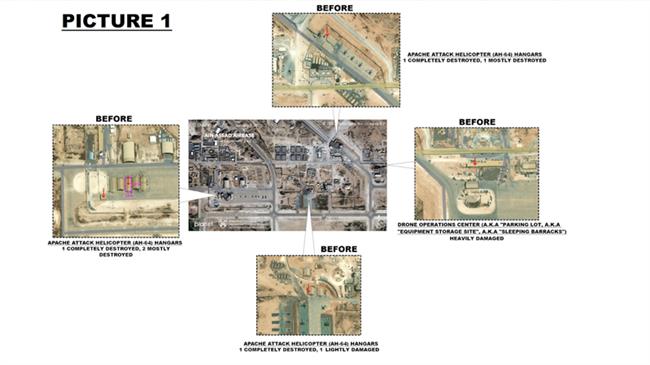
They are the standard steel-frame soft shelter design for US helicopter units based in overseas areas at second-rate airfields (such as the Ain al-Asad Base) – US helicopter units operating from old Afghan airfields are also housed in this kind of shelter design. Each one of those Apache attack helicopter shelters can house two such aircraft. With six structures of the type provably destroyed, demonstrated through the satellite images showing blackened scorch marks (suggesting assets inside them were destroyed with the shelter itself, refer to Picture 1) AND assuming each only had one Apache in them, it can be concluded that at least 6 Apache gunships were destroyed in the attack.
Recently, Danish media, citing a Danish coalition soldier who was present at the base at the time of the attack, admitted that multiple helicopters were destroyed to the point of being “split in half”.
Another Apache hangar (refer to Picture 2) was also directly struck, located to the far eastern end of the Ain al-Asad Base and destroyed. However, note that there is no scorch-blackened concrete underneath it, suggesting nothing was inside it that led to additional burning beyond the impact of the warhead itself.
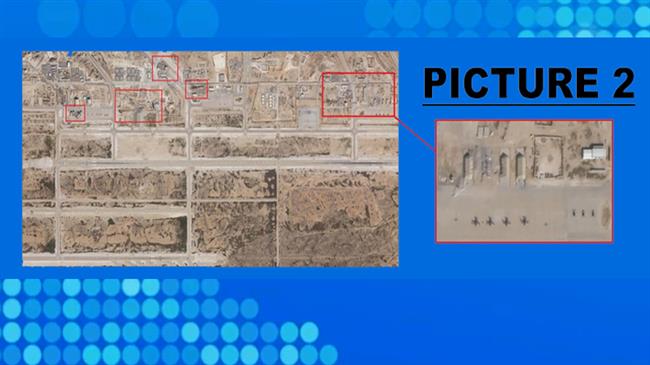
Indeed, just to the south of that destroyed hangar and the undamaged three hangars next to it, 4 Apache helicopters can be seen sitting out on the open tarmac. They were spared as they were, ironically, not being sheltered.
The official US story on the other structure targeted beyond the “tents” (i.e. Apache gunship hangars) has already changed twice – first it was called a parking lot, then an equipment storage area and now, apparently, a barracks for drone operators. Picture 1 (far right) shows the result of the attack on this structure.
It is hard to imagine that base zoning regulators within the US military would chose to place sleeping quarters right next to a strip alert (ready-to-go) aircraft parking area, itself right next to a major taxiway, given the constant noise that comes from these areas.
A more astute assessment would place this structure as an operations center, which lines up with the Iranian claim that the command site from which the Qassem Soleimani assassination operation had been coordinated, was targeted and destroyed in Iran’s retaliation strike.

Indeed, AFP recently released an exclusive report in which a US drone operator present at the Ain al-Asad Airbase, one First Sergeant Wesley Kilpatrick, admitted that airborne drones were rendered inoperable after a direct hit penetrated the base’s UAV operations center and destroyed the fiber lines which connect remote stations to satellite communication equipment(needed for drone control and visuals).
In all of this, one thing is obvious. US officials and media are stumbling over their own statements trying to cover up the extent of the damage dealt to the US-operated section of the Ain al-Asad base – in fact, going so far to cease calling the military site a US airbase (as it had been called for the last 16 years) to (all of a sudden) just an “Iraqi facility”.
THE WEAPONS USED BY IRAN
Short-range ballistic missiles (SRBM) of the upgraded Fateh-313 (range 500 km) and Qiam (range 800 km) types were launched from Western Iran towards the US-operated Ain al-Asad Base in Iraq.
Fateh-313s represent the majority of the missile type used for the attack. Their accuracy still seems to have been to within a matter of meters of their intended targets, except for two stray shots that hit the open tarmac area.

Whilst the Fateh-313 missiles use a combination of INS and electro-optical guidance, the Qiam missiles reportedly use a mix of INS, GPS and radar-mapping target acquisition. The latter method being the archaic predecessor version of DSMAC (imaging automatic target acquisition) terminal-phase guidance used in high-end ground-attack cruise missiles, such as the Tomahawk.
THE OPERATION –OTHER DETAILS
Satellite pictures show that some targeted sites were double-tapped (hit twice-over for good measure).
Initial reports from the Ain al-Asad Base claimed nearly 40 detonations in total despite the fact the number of actual warhead impacts was about fifteen, indicating that there were around two dozen cases of secondary explosions (fuel and ammo going off after being ignited).
In conclusion, according to the evidence we have available to us currently, there is no doubt that the United States has completely distorted the gravitude of Iran’s strikes. The mainstream media in the West have also seemingly refrained from acknowledging much of the damage, apart from on occasion.
Robert Inlakesh is a journalist, writer and political analyst, who has lived in and reported from the occupied Palestinian West Bank. He has written for publications such as Mint Press, Mondoweiss, MEMO, and various other outlets. He specializes in analysis of the Middle East, in particular Palestine-Israel. He also works for Press TV as a European correspondent.
Iraq denies report it has restarted joint military operations with US
Press TV – January 16, 2020
The Iraqi government has denied claims that the country’s military is resuming joint operations with the US-led coalition after Washington’s assassination of top Iranian and Iraqi commanders.
“The joint operations have not resumed and we have not given our authorization,” Major General Abdul Karim Khalaf, the spokesman for the commander-in-chief of the Iraqi armed forces, said on Thursday.
He added that the coalition did not have a permission from Baghdad to carry out any joint missions.
The remarks came after the New York Times, citing two American military officials, reported Thursday that the US had resumed the operations.
Khalaf said the Iraqi government had ordered the coalition to halt its joint operations following the US assassination of top Iranian anti-terror commander, Lieutenant General Qassem Soleimani, and Abu Mahdi al-Muhandis, the second-in-command of Popular Mobilization Units (PMU).
Last month, another US airstrike killed 25 members of PMU in the Arab country’s west.
On January 3, a US drone strike outside Baghdad airport killed General Soleimani and al-Muhandis.
Washington began the pause on January 5, two days after the strike, but furious Iraqi lawmakers voted to expel more than 5,000 US troops based in their country.
The Pentagon said it had no information with regard the the alleged resumption of joint operations with Iraqi troops.
The US-led coalition’s spokesman in Baghdad also declined to comment.
Featured Video
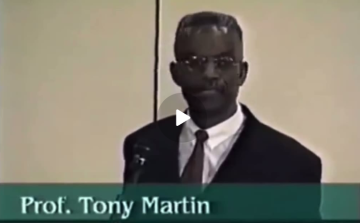
Dr. Tony Martin – The Jewish Role in the African Slave Trade
or go to
Aletho News Archives – Video-Images
In Memoriam
James Petras, In Memoriam
 02.13.2026
Professor James Petras, 89, world-renowned sociologist, public intellectual, and scholar of Latin American politics and global economics, died peacefully on January 17, 2026, in Seattle, WA, surrounded by family.
A prolific scholar and activist, he devoted his life to challenging power, imperialism, and inequality. … continue
Blog Roll
 Aletho News
- Friedrich Merz’s Push to End Online Anonymity Has a Troubling Subtext
- Macron: French citizens fighting for Israel cannot be labeled ‘genociders’
- US eyes Gaza security force drawn from armed gangs
- The Only Motive Behind The ‘Imminent’ U.S. War With Iran Is The Zionist Lobby
- Trump eyes 350-acre US military base housing 5,000 troops in Gaza
- Israel Pushing US Toward a Big and Damaging War With Iran – Ex-Pentagon Analyst
- Meet The Liberal Zionist And Ukraine War Supporter Advising AOC On Foreign Policy
- Buck Dancing for Zion: Kenya’s and Nigeria’s Growing Love Affair With Israel
- Israel installed, oversaw security system at Barak-Epstein residence in New York: Report
- ‘Britain’s Index of Repression’ documents 964 incidents of anti-Palestinian crackdown
- If Americans Knew
- The Israeli Government Installed and Maintained Security System at Epstein Apartment
- Tucker Carlson interrogated in Israel, has passport seized after interviewing US ambassador
- 6,000 Amputees in Gaza Face Impossible Recovery amid Israeli War Ultimatum
- The Lancet: Gaza death toll far higher than reported – Not a ceasefire Day 132
- Compliant aid: Who are the Israel-approved NGOs scaling up in Gaza?
- Why won’t Trump’s “Board of Peace” bring peace? – Not a ceasefire Day 131
- Help end the injustice against Shadi
- Israel’s Favorite American President
- Israel’s “Yellow Line” Is a Death Trap for Palestinians. We Drove Into It.
- Why Israel’s expanding occupation in Syria presents a critical legal test
- No Tricks Zone
- Coal Power Back In Trend As Globe Tries To Keep Pace With Growing Demand For Power
- New Study: A 4°C Warmer Beaufort Sea Had ‘No Sea Ice’ 11,700 – 8200 Years Ago
- Unfudging The Data: Dutch Meteorological Institute Reinstates Early 20th Centruy Heat Waves It Had Erased Earlier
- German Gas Crisis…Chancellor Merz Allegedly Bans Gas Debate Ahead of Elections!
- Pollen Reconstructions Show The Last Glacial’s Warming Events Were Global, 10x Greater Than Modern
- Germany’s Natural Gas Storage Level Dwindles To Just 28%… Increasingly Critical
- New Study Rebuts The Assumption That Anthropogenic CO2 Molecules Have ‘Special’ Properties
- Climate Scientist Who Predicted End Of “Heavy Frost And Snow” Now Refuses Media Inquiries
- Polar Bear Numbers Rising And Health Improving In Areas With The Most Rapid Sea Ice Decline
- One Reason Only For Germany’s Heating Gas Crisis: Its Hardcore-Dumbass Energy Policy
 Aletho News