Iraq may defy Washington to buy the Russian S-400 missile defense system
By Paul Antonopoulos | January 16, 2020
With tensions mounting between Iran and the United States after the latter assassinated Iranian General Qassem Soleimani in Iraq, Baghdad has now been pushing to free itself from American domination by calling for foreign troops to leave the country and announcing its intensions in buying the Russian S-400 missile defense system. The complete destruction of the U.S. military base in Anbar province earlier this month demonstrated to Iraqi leaders that it certainly needs to strengthen its air defences since not even American air defense systems could protect their base from the barrage of Iranian missiles. The Iraqi government’s intention to buy the S-400 air defense systems from Russia has been talked about since May last year, when the country’s ambassador to Moscow said Baghdad had decided to buy the systems. However, no roadmap to purchase the systems has been made yet.
Karim Elaiwi, an Iraqi member of parliament who sits on the security and defense committee, said last week that “We are talking to Russia about the S-400 missiles but no contracts have been signed yet. We need to get these missiles, especially after Americans have disappointed us many times by not helping us in getting proper weapons.”
It appears the Iraqis will no longer tolerate U.S. occupation and demands in its country, with parliamentarian and security and defense committee member Abdul Khaleq Al Azzawi, defiantly saying “We authorized the prime minister to get air defense weapons from any country he wants and we authorized him to spend the money for it, from any country. From Russia or anyone.”
This comes as hostilities between Iraq and the U.S. increase, with U.S. President Donald Trump threatening to cut Baghdad’s access to its key account at the Federal Reserve Bank in New York if they follow through with the Iraqi Parliament’s decision to expel the U.S. military from their country. Not only has there been a threat to cut Iraq from its own money based in the U.S., but there are now threats of $250 million in military aid to Iraq being cut.
Although these are tactics to force Baghdad into maintaining ‘permission’ for the U.S. military to remain in Iraq, the clearest sign that this is an American occupation of the West Asian country was with White House National Security Adviser Robert O’Brien’s comments last week that the U.S. will leave Iraq on its “own terms.” The U.S. are not even trying to hide the fact that they are occupying Iraq and rebelling against the government.
Despite the clear occupation, Iraq continues to defy the U.S., and the willingness to purchase the S-400 system is a clear indication of this. It is for this reason that Joey Hood, the U.S. State Department’s principal deputy assistant secretary for Near Eastern Affairs, said on Tuesday in an appearance at the Middle East Institute, an extremely influential Washington think tank, that “A purchase [of the S-400] would probably trigger sanctions, so we advise our partners not to make such purchases.”
This was an expected response considering the continued threats of sanctions the U.S. has put against Turkey for its own acquisition of the S-400. Iraq wants to strengthen its air defense and the S-400 systems are considered the best in the world. It must also be remembered that Iraq is already buying modern weapons from Russia, such as the Mi-28 fighter helicopters and T-90 tanks. However, it is likely that Washington considers the purchase of the S-400 from Russia as an indication that the U.S. is losing political and military support in the country – but this was already consolidated by the assassination of Soleimani, an extremely popular figure in Iraq.
Baghdad is already in negotiations for the S-300, the older generation of the S-400. However, it is the S-400, the newest model available for foreign markets, that will provoke resistance in Washington, especially as the U.S.-made Patriot missile defense system has proven to be a failure by not being able to defend U.S. bases in Iraq or Saudi oil facilities, if we remember the Houthi-led Ansarullah Movement’s attack on the ARAMCO site in September last year.
The question then becomes how will Iraq will pay for Russian weapons if their accounts in the U.S. are frozen. Delivery is not so much of an issue despite the U.S. occupation, it is more a matter of how payments will be made. Although Iraqi parliamentarians are boldly declaring their intentions for the S-400 to be purchased, there are significant problems that Baghdad must first be able to overcome, including the extremely strong pressure being applied by the U.S. against Iraq not to buy them. If Baghdad did successfully defy Washington and purchase the systems, it will certainly weaken the U.S.’ image in the region, something the North American country will unlikely want to risk.
Will Iraq boldly defy the U.S.? This remains to be seen now.
Paul Antonopoulos is a Research Fellow at the Center for Syncretic Studies.
What’s the Point of NATO If You Are Not Prepared to Use It Against Iran?
By Philip Giraldi | Strategic Culture Foundation | January 16, 2020
Article 5 of the North Atlantic Treaty Organization (NATO) alliance commits all members to participate in the defense of any single member that is attacked. An attack on one is an attack on all. Forged in the early stages of the cold war, the alliance originally included most of the leading non-communist states in Western Europe, as well as Turkey. It was intended to deter any attacks orchestrated by the Soviet Union and was defensive in nature.
Currently NATO is an anachronism as the Soviet Union collapsed in 1991, but the desire to continue to play soldier on an international stage has granted it a measure of life support. Indeed, the alliance is regularly auditioning for new members. Its latest addition is Montenegro, which has a military consisting of 2,000 men and women, roughly one brigade. If Montenegro should be attacked, the United States is obligated to come to its assistance.
It would all be something like comic opera featuring the Duke of Plaza Toro but for the fact that there are certain things that NATO does that are not really defensive in nature but are rather destabilizing. Having expanded NATO right up to the border with Russia, which the U.S. promised not to do and then reneged, military exercises staged by the alliance currently occur right next to Russian airspace and coastal waters. To support the incursions, the myth that Moscow is expansionistic (while also seeking to destroy what passes for democracy in the West) is constantly cited. According to the current version, Russian President Vladimir Putin is just waiting to resume control over Ukraine, Georgia, Poland and the Baltic States in an effort to reconstitute the old Soviet Union. This has led to demands from the usual suspects in the U.S. Congress that Georgia and Ukraine be admitted into the alliance, which would really create an existential threat for Russia that it would have to respond to. There have also been some suggestions that Israel might join NATO. A war that no one wants either in the Middle East or in Europe could be the result if the expansion plans bear fruit.
Having nothing to do beyond aggravating the Russians, the alliance has gone along with some of the transnational abominations initially created by virtue of the Global War on Terror initiated by the loosely wrapped American president George W. Bush. The NATO alliance currently has 8,000 service members participating in a training mission in Afghanistan and its key member states have also been parts of the various coalitions that Washington has bribed or coerced into being. NATO was also actively involved in the fiasco that turned Libya into a gangster state. It had previously been the most developed nation in Africa. Currently French and British soldiers are part of the Operation Inherent Resolve (don’t you love the names!) in Syria and NATO itself is part of the Global Coalition to Defeat ISIS.
NATO will now be doing its part to help defend the United States against terrorist attack. Last Wednesday the alliance Secretary General Jens Stoltenberg spoke with President Donald Trump on the phone in the wake of the assassination of Iranian Major General Qassem Soleimani at the Baghdad International Airport. The killing was apparently carried out using missiles fired by a U.S. Reaper drone and was justified by the U.S. by claiming that Soleimani was a terrorist due to his affiliation with the listed terrorist Quds Force. It was also asserted that Soleimani was planning an attack on the U.S. Embassy in Baghdad and would have killed “hundreds” of Americans. Evidence supporting the claims was so flimsy that even some Republicans balked at approving the chain of events.
Nine Iraqis also died in the attack, including the Iraqi General who headed the Kata’Ib Hezbollah Militia, which had been incorporated into the Iraqi Army to fight against the terrorist group ISIS. During the week preceding the execution of Soleimani, the U.S. had staged an air attack that killed 25 Iraqi members of Kata’Ib, the incident that then sparked the rioting at the American Embassy in Baghdad’s Green Zone.
Bearing in mind that the alleged thwarted terrorist attacks took place seven thousand miles away from the United States, it is hard to make the case that the U.S. was directly threatened requiring a response from NATO under Article 5. No doubt the Mike Pompeo State Department will claim that its Embassy is sovereign territory and therefor part of the United States. It is a bullshit argument, but it will no doubt be made. The White House has already made a similar sovereignty claim vis-à-vis the two U.S. bases in Iraq that were hit by a barrage of a dozen Iranian missiles a day after the killing of Soleimani. Unlike the case of Soleimani and his party, no one was killed by the Iranian attacks, quite possibly a deliberate mis-targeting to avoid an escalation in the conflict.
In spite of the fact that there was no actual threat and no factual basis for a call to arms, last Wednesday, NATO Secretary General Jens Stoltenberg spoke by phone with President Donald Trump “on developments in the Middle East.” A NATO press release stated that the two men discussed “the situation in the region and NATO’s role.”
According to the press release “The President asked the Secretary General for NATO to become more involved in the Middle East. They agreed that NATO could contribute more to regional stability and the fight against international terrorism.” A tweet by White House deputy press secretary Judd Deere later confirmed that Trump had “emphasized the value of NATO increasing its role in preventing conflict and preserving peace in the Middle East.” Prior to the phone call, Trump had announced that he would ask NATO “to become much more involved in the Middle East process.”
As the Trumpean concept of a peace process is total surrender on the part of the targeted parties, be they Palestinians or Iranians, it will be interesting to see just how the new arrangement works. Sending soldiers into unstable places to do unnecessary things as part of a non-existent strategy will not sit well with many Europeans. It should not sit well with Americans either.
Burisma Hack Story: Attempt to Put ‘Trump’, ‘Russia’ & ‘Impeachment’ in the Same Headline?
Sputnik – January 16, 2020
The timing of the media fuss over the alleged “Russian hack” of Burisma coincides with the resumption of the impeachment process by the Senate, say American academics, suggesting that the story could be a mere distraction aimed at evoking the spectre of “Trump-Russia” collusion amid the 2020 election cycle.
Ukraine has kicked off an investigation into a suspected cyberattack by so-called “Russian military hackers” on the energy company Burisma requesting assistance from the FBI. As The New York Times claimed Monday, Fancy Bears or Advanced Persistent Threat (APT) 28, allegedly subjected the energy company to phishing attacks, citing a recent report by Area 1 Security, a California-based American cybersecurity firm.
Burisma entered the spotlight light during the Democrats-driven impeachment process against Donald Trump due to its connections with the son of presidential candidate and former Vice President Joe Biden, Hunter, who previously served on the company’s board of directors and is believed to have financially benefitted from the apparent nepotistic scheme.
Falling short of confirming whether the hackers obtained any information, the Area 1 report says that the timing of the alleged malicious activities in relation to the 2020 US elections “raises the spectre that this is an early warning of what we have anticipated since the successful cyberattacks undertaken during the 2016 US elections”, referring to unfounded allegations of Russia’s interference in the previous US presidential race and hacking of the Democratic National Committee (DNC).
Media Fuss Over Alleged Burisma Hack is ‘Distraction’
“The level of media attention given to this story in the United States is curious”, says Matthew Wilson, an associate professor of political science at Southern Methodist University. “Assuming that this hacking did, in fact, occur – and I have no reason to doubt that it did – nothing has yet come of it. No one in Russia (or elsewhere) has released anything about the Bidens gleaned from a hack of Burisma’s servers, and discussion of the motives behind the hack is entirely speculative”.
According to the professor, “one almost suspects that it is simply an attempt by some in the American media to get the words ‘Trump’, ‘Russia’, and ‘impeachment’ into the same headline” ahead of a Senate impeachment trial that is likely to commence very shortly.
For her part, Laura Wilson, a political science professor at the University of Indianapolis, does not rule out that the hacking allegations serve as distraction from two important events: the Trump impeachment and the US 2020 presidential elections.
“As the Senate takes up the question of removal of office after the House passed the impeachment resolution, and the parties and candidates prepare for the upcoming primary elections, these major events will undoubtedly play a significant role in shaping the future of our country and require attention and focus”, she says.
According to Wilson, “distractions in any way should be considered just that, distractions, and though other issues will come up, they need to be evaluated fairly and swiftly given their potential impact relative to the importance of the impeachment and election”.
It’s ‘Less Than Definitive’ That Fancy Bears Hacked Burisma
American monthly Wired noted Tuesday that “it’s still not entirely proven” that Fancy Bears did hack Burisma citing cybersecurity analysts who see Area 1’s evidence tying the alleged phishing campaign to the aforementioned hackers as “less than definitive”.
The media outlet quotes security firm ThreatConnect that shared its brief analysis of the phishing campaign’s features on Twitter concluding that “none of these characteristics are definitively indicative of APT28 activity” and that “we don’t have any specific information on how the domains have been operationalised”.
Wired added that in response to its request, Area 1 Security said it has more evidence to back up its findings but declined to share it publicly.
Area 1 Security’s belief that the hacking was conducted by “Russian military hackers” originates from earlier assumptions made by Crowdstrike, a former DNC contractor, that hacker group Fancy Bear, which supposedly broke into the DNC email servers in 2016, had something to do with Russia’s Main Intelligence Department (GRU). However, this connection has never been proven beyond a reasonable doubt. Furthermore, according to some cyber experts, the so-called “Fancy Bear” or Advanced Persistent Threat (APT) 28 could be nothing more than a collection of hacking tools originating from the dark web that can be used by virtually anyone.
On the other hand, Veteran Intelligence Professionals for Sanity (VIPS), a group of former officers from the United States Intelligence Community, has repeatedly stated that the leak of DNC files was an inside job and not an external breach into the committee’s system.
Red Flag Nation: Anti-Gun Laws, Sanctuary Cities and the Second Amendment
By John W. Whitehead | The Rutherford Institute | January 15, 2020
“A well regulated militia, being necessary to the security of a free state, the right of the people to keep and bear arms, shall not be infringed.” – The Second Amendment to the US Constitution
We never learn.
In the right (or wrong) hands, benevolent plans can easily be put to malevolent purposes.
Even the most well-intentioned government law or program can be—and has been—perverted, corrupted and used to advance illegitimate purposes once profit and power are added to the equation.
Mark my words: gun control legislation, especially in the form of red flag gun laws, which allow the police to remove guns from people suspected of being threats, will only add to the government’s power.
Seventeen states now have red flag laws on their books.
That number is growing.
As The Washington Post reports, these laws “allow a family member, roommate, beau, law enforcement officer or any type of medical professional to file a petition [with a court] asking that a person’s home be temporarily cleared of firearms. It doesn’t require a mental-health diagnosis or an arrest.”
While in theory it appears perfectly reasonable to want to disarm individuals who are clearly suicidal and/or pose an “immediate danger” to themselves or others, where the problem arises is when you put the power to determine who is a potential danger in the hands of government agencies, the courts and the police.
We’ve been down this road before.
Remember, this is the same government that has a growing list—shared with fusion centers and law enforcement agencies—of ideologies, behaviors, affiliations and other characteristics that could flag someone as suspicious and result in their being labeled potential enemies of the state.
For instance, if you believe in and exercise your rights under the Constitution (namely, your right to speak freely, worship freely, associate with like-minded individuals who share your political views, criticize the government, own a weapon, demand a warrant before being questioned or searched, or any other activity viewed as potentially anti-government, racist, bigoted, anarchic or sovereign), you could be at the top of the government’s terrorism watch list.
Moreover, as a New York Times editorial warns, you may be an anti-government extremist (a.k.a. domestic terrorist) in the eyes of the police if you are afraid that the government is plotting to confiscate your firearms, if you believe the economy is about to collapse and the government will soon declare martial law, or if you display an unusual number of political and/or ideological bumper stickers on your car.
Let that sink in a moment.
Therein lies the danger of these red flag laws, specifically, and pre-crime laws such as these generally where the burden of proof is reversed and you are guilty before you are given any chance to prove you are innocent.
Red flag gun laws merely push us that much closer towards a suspect society where everyone is potentially guilty of some crime or another and must be preemptively rendered harmless.
Where many Americans go wrong is in naively assuming that you have to be doing something illegal or harmful in order to be flagged and targeted for some form of intervention or detention.
Be warned: once you get on such a government watch list—whether it’s a terrorist watch list, a mental health watch list, a dissident watch list, or a red flag gun watch list—there’s no clear-cut way to get off, whether or not you should actually be on there.
Unfortunately, the U.S. government has adopted a “do what I say, not what I do” mindset when it comes to Americans’ rights overall. Nowhere is this double standard more evident than in the government’s attempts to arm itself to the teeth, all the while treating anyone who dares to legally own a gun, let alone use one, as suspicious and/or on the road to being an outlaw.
In Virginia, for instance, legislation has been introduced that would “require background checks on all firearms purchases, allow law enforcement to temporarily remove guns from individuals deemed a risk to themselves or others, let localities ban weapons from certain events and government buildings, and cap handgun purchases at one per month.”
To those who subscribe to George Orwell’s views about gun ownership (“That rifle hanging on the wall of the working-class flat or labourer’s cottage is the symbol of democracy. It is our job to see that it stays there”), these legislative attempts to regulate and control gun usage among the citizenry is nothing short of tyranny.
Not surprisingly, then, in Virginia and a growing number of states across the country, momentum is building for 2A “sanctuary” cities that adopt resolutions opposing any “unconstitutional restrictions” on the Second Amendment right to keep and bear arms.
Personally, I’m all for any attempt by the citizenry to nullify government actions that run afoul of the Constitution.
“We the people” have been so focused on debating who or what is responsible for gun violence—the guns, the gun owners, or our violent culture—and whether the Second Amendment “allows” us to own guns that we’ve overlooked the most important and most consistent theme throughout the Constitution: the fact that it is not merely an enumeration of our rights but was intended to be a clear shackle on the government’s powers.
When considered in the context of prohibitions against the government, the Second Amendment reads as a clear rebuke against any attempt to restrict the citizenry’s gun ownership.
As such, it is as necessary an ingredient for maintaining that tenuous balance between the citizenry and their republic as any of the other amendments in the Bill of Rights, especially the right to freedom of speech, assembly, press, petition, security, and due process.
Supreme Court Justice William O. Douglas understood this tension well.
“The Constitution is not neutral,” Douglas remarked, “It was designed to take the government off the backs of people.”
In this way, the freedoms enshrined in the Bill of Rights in their entirety stand as a bulwark against a police state.
To our detriment, as I make clear in my book Battlefield America: The War on the American People, these rights have been steadily weakened, eroded and undermined in recent years.
Yet without any one of them, including the Second Amendment right to own and bear arms, we are that much more vulnerable to the vagaries of out-of-control policemen, benevolent dictators, genuflecting politicians, and overly ambitious bureaucrats.
Constitutional attorney and author John W. Whitehead is founder and president of The Rutherford Institute. His new book Battlefield America: The War on the American People is available at www.amazon.com. Whitehead can be contacted at johnw@rutherford.org.
Media Censorship & OAS’ Participation in Election Process May Ruin Bolivia’s Democracy
By Ekaterina Blinova – Sputnik – 15.01.2020
The Anez government sought to undermine the Movement Towards Socialism (MAS) by trying to accuse it of fraud, says La Resistencia Bolivia journalist Camila Ugalde Soria Galvarro, adding that the persecution of alternative media and the enlistment of the Organisation of American States (OAS) to arrange the 2020 vote are part of the same trend.
As Bolivia braces for its 3 May elections, officials from the Organisation of American States (OAS) came to the country last week to provide technical support. According to Bolivia’s ambassador to the OAS Jaime Aparicio, the transnational organisation is slated to be involved in the entire election process through the day of vote.
With that in mind, it’s worth noting that it was the OAS that issued a misleading statement the day after the 20 October vote in Bolivia, as a group of political researchers explained in their analysis for the Guardian in December. The organisation presented no evidence to back its “deep concern and surprise” at the “hard-to-explain change in the trend of the preliminary results” revealed after polls were closed, which was interpreted as evidence of probable “election fraud” and subsequently led to social unrest and Evo Morales’ ouster.
Why OAS Lost Its Credibility in Bolivia & Beyond
“Most recently due to its role in past elections, the OAS has lost credibility in our country and not only among Movement Towards Socialism (MAS) supporters,” says Camila Ugalde Soria Galvarro, a journalist with the left-wing media outlet La Resistencia Bolivia. “If the persecution and censorship that was seen during the last months continues – against MAS supporters or anyone who opposes the current de facto government – there are no basic conditions for free and fair elections in Bolivia. If on top of all that the OAS participates in the organisation of the new elections, democracy in our country will continue to be weakened.
“Previously, the OAS refused to recognise the legitimacy of Nicolas Maduro’s new term following the May 2018 Venezuelan presidential election and went on to embrace self-proclaimed interim president Juan Guaido and his cabinet.
Ugalde recalls that during the “black October” of 2003 in Bolivia, the OAS supported US-backed President Gonzalo Sánchez de Lozada, who ordered a massive crack-down on protesters in El Alto which resulted in the death of 60 people.
According to the journalist, instead of the OAS, the electoral commission should include other international bodies and elected governments to ensure the fairness and transparency of the May vote. She echoed Andrónico Rodríguez, MAS’ potential vice president pick, who earlier argued that the OAS “should stay on the margins of this electoral process”.
Anez Gov’t Silencing Opposition Voices Ahead of Elections
The wide-scale persecution of left-wing and independent media sources by the de facto interim government of Jeanine Anez has prompted the further concern of MAS and its supporters.
“In the past several months, 53 local and community-based radio stations have been shut down, two important international media networks, TeleSUR and RT, were taken off the airwaves, and independent journalists and political cartoonists are being censored and even detained,” Ugalde underscores.She warns that “given this context – particularly months before the elections – the plurality of views that strengthen any democracy is currently being heavily besieged”.
La Resistencia Bolivia’s Alejandra Salinas and Orestes Sotomayor were detained on New Year’s Eve and charged with “sedition” and “misuse of state assets”, even though no evidence was presented to back the claims. Ugalde highlights that the two journalists have been publicly labelled as “Morales’ digital warriors” by the de facto government.
According to her, “such an attack against freedom of speech, directed at an alternative media platform that has been operating throughout the last couple of years and has provided information on a daily basis on the events that transpired during the coup, can only be seen as clear political persecution.”
In sharp contrast to the de facto government in La Paz, former Bolivian President Evo Morales “never used his power to silence opposition media” she stresses.
Anez’ Attempts to Weaken MAS Prove Futile
Ugalde points out that the de facto government of Anez has sought to weaken MAS and disrupt the party’s potential campaign from day one of the coup d’etat.
“Part of the efforts to weaken MAS’ position in this electoral race was to proscribe the party under the argument of the alleged fraud, as Jeanine Anez declared in an interview: ‘The Electoral Tribunal that is going to be formed has to carry it out (the ban). They will have to give a ruling in relation to a political party that has committed electoral fraud.’ These statements have raised many questions around the fairness and transparency of the upcoming elections, particularly among MAS supporters,” the journalist notes.
Nonetheless, despite the aforementioned measures, the Morales party leads the latest polls, with a margin of 20 points even without a clear presidential candidate, Ugalde says, adding that MAS actually represents over 40 percent of Bolivia’s population.
”Currently there are many strong leaders in MAS but four names stand out; these are: Luis Arce Catacora former Minister of Economy and Finance and an important figure in Bolivia’s historical economic transformation in the past 14 years, Andrónico Rodriguez, current vice president and leader of the Six Federations of the Tropics, a 30-year-old who has become a natural successor to Morales, and David Choquehuanca and Diego Pary both former foreign ministers,” she elaborates, adding that “it is likely that a unifying and strong pairing might include Andrónico and Luis Arce to continue Bolivia’s Process of Change”.
Facebook censors explainer clip recalling when western media liked Soleimani – and demonetizes popular account for sharing it
RT | January 15, 2020
Facebook is doubling down on censorship of anything less than villification of slain Iranian Major General Qassem Soleimani, deleting a clip showing his history of fighting terrorism – and demonetizing the account posting it.
The social media behemoth didn’t just remove independent journalist Dan Cohen’s ‘In the Now’ segment, “How ‘good guy’ Soleimani became US media’s ‘bad guy,” from the show’s page on Tuesday – it demonetized In the Now entirely, citing the typical unspecified violations of “community standards.” The move comes amid an alarming escalation in the platform’s crackdown on political speech that runs contrary to US foreign policy, a wave of censorship that has not been limited to Facebook.
Cohen’s video calmly and accurately explains how Soleimani “saved the region from falling to ISIS,” fighting the terrorist group alongside the US and its Kurdish allies before he was recast posthumously by a complicit western media as “actually a huge terrorist and a ticking time bomb who was born to kill Americans.” The video exposes the ideological inconsistency of the outlets currently depicting the Quds Force commander as the devil incarnate, showcasing clips from those same outlets in recent years praising Soleimani’s battlefield performance.
Rania Khalek, who runs In the Now, tweeted in shock that a video merely stating facts about Soleimani had gotten her page demonetized, asking “where is the outrage” now that Facebook was so explicitly deleting material for ideological reasons.
Facebook and its subsidiary Instagram have come under fire from independent journalists and media organizations like the International Federation of Journalists for embarking on a wholesale campaign to deplatform all support for Soleimani in the weeks following the US airstrike that killed him. The company has claimed the extensive US sanctions placed on Iran, including the designation of the Islamic Revolutionary Guard Corps as a terrorist organization, require it to censor such posts, though even legal experts quoted by CNN took a dim view of that rationale.
Facebook and Instagram not only remove accounts run by or for sanctioned individuals or groups, but also posts that (they claim) praise or seek to assist the people in question – making sanctions a convenient excuse for mass-deplatforming any user who holds a political view the US government has deemed heresy.
Iranians saw insult added to injury when over a dozen Iranian journalists, several state-run media organizations, and countless ordinary individuals and activists’ Instagram accounts were yanked entirely in the days following Soleimani’s assassination. Many more saw pro-Soleimani posts removed, even when they carefully avoided saying his name – one Lebanese researcher praised “Q*ssem S*leim*ni” for protecting Christians from ISIS and al-Qaeda, only to have his video removed anyway.
The rank ideological discrimination not only left them unable to publicly mourn for a leader beloved by the lion’s share of the people, but allowed pro-regime-change trolls to dominate the narrative. Facebook has recently taken flack from the US political establishment for refusing to “fact-check” political ads, but non-advertising content is more tightly controlled than ever.
Facebook and Instagram are far from alone in clamping down on the speech of Iranian users, however – YouTube briefly deleted state-backed PressTV’s channel earlier this week, only to reactivate it after an outpouring of popular support.
Twitter removed state-backed media outlet Al-Alam News’ account, as well as that of the popular Iran-backed Spanish-language media outlet HispanTV, only reinstating the latter after a massive public backlash. Dozens of individual Iranians who supported their government were also deplatformed on Twitter, while anti-government users – many linked to notorious exile terror group Mujahedin e-Khalq (MEK) – were allowed to continue slinging hate against Soleimani and his supporters. Twitter even dished out a ban to Syrian President Bashar Assad, but restored the account after a few days.
UK’s Lord Polak says new Tory government is opportunity for pro-Israel lobbyists
![Stuart Polak, Baron Polak CBE is a British Conservative politician and member of the House of Lords [Youtube]](https://i1.wp.com/www.middleeastmonitor.com/wp-content/uploads/2020/01/POLK.png?resize=1200%2C800&quality=85&strip=all&ssl=1)
Stuart Polak, Baron Polak CBE is a British Conservative politician and member of the House of Lords [Youtube]
MEMO | January 15, 2020
A veteran pro-Israel lobbyist in Westminster believes the recently-elected Conservative government represents an important opportunity to advance Israel’s interests amongst British decision-makers.
Lord Polak, a Tory peer, and president of Conservative Friends of Israel, was speaking to right-wing news outlet JNS days after a speech in the House of Lords in which he attacked the so-called “singling out” of Israel in international forums such as the United Nations.
“I have no problem with legitimate criticism where it is due, but this obsession with Israel needs to be addressed. This singling out of the Jewish state is wrong, unjustified and plays a role in the rise and rise of anti-Semitism,” Polak told the chamber on 7 January.
In his speech, Polak echoed a familiar complaint of the Israeli government, namely the payments made by the Palestinian Authority (PA) to prisoners in Israeli jails and to the families of those killed by occupation forces – what the Tory peer described as “salaries to killers and murderers”.
“We must find a method by which aid payments serve the recipients who need our support in Palestinian society, and at the same time, serve the interests of the British taxpayer,” he added.
In his subsequent interview with JNS, Polak claimed that the substantial Conservative majority in Parliament means that now is the time to raise the issues they want and “set an agenda”.
“My speech was signal that this is a priority for the pro-Israel community,” he told the news site.
During the speech, Polak also praised the government’s proposed legislation attacking the right to boycott companies complicit in Israeli human rights abuses.
“The promise by the government to legislate against BDS [Boycott, Divestment, Sanctions] was a first and shows where the new government is at in relation to these sorts of issues,” he told JNS.
Who Targeted Ukraine Airlines Flight 752? Iran Shot It Down But There May Be More to the Story
By Philip Giraldi | American Herald Tribune | January 15, 2020
The claim that Major General Qassem Soleimani was a “terrorist” on a mission to carry out an “imminent” attack that would kill hundreds of Americans turned out to be a lie, so why should one believe anything else relating to recent developments in Iran and Iraq? To be sure, Ukraine International Airlines Flight 752 departing from Tehran’s Imam Khomeini International Airport on the morning of January 8th with 176 passengers and crew on board was shot down by Iranian air defenses, something which the government of the Islamic Republic has admitted, but there just might be considerably more to the story involving cyberwarfare carried out by the U.S. and possibly Israeli governments.
To be sure, the Iranian air defenses were on high alert fearing an American attack in the wake of the U.S. government’s assassination of Soleimani on January 3rd followed by a missile strike from Iran directed against two U.S. bases in Iraq. In spite of the tension and the escalation, the Iranian government did not shut down the country’s airspace. Civilian passenger flights were still departing and arriving in Tehran, almost certainly an error in judgment on the part of the airport authorities. Inexplicably, civilian aircraft continued to take off and land even after Flight 752 was shot down.
Fifty-seven of the passengers on the flight were Canadians of Iranian descent, leading Prime Minister Justin Trudeau to point the finger both at the Iranian government for its carelessness and also at Washington, observing angrily that the Trump Administration had deliberately and recklessly sought to “escalate tensions” with Iran through an attack near Baghdad Airport, heedless of the impact on travelers and other civilians in the region.
What seems to have been a case of bad judgements and human error does, however, include some elements that have yet to be explained. The Iranian missile operator reportedly experienced considerable “jamming” and the planes transponder switched off and stopped transmitting several minutes before the missiles were launched. There were also problems with the communication network of the air defense command, which may have been related.
The electronic jamming coming from an unknown source meant that the air defense system was placed on manual operation, relying on human intervention to launch. The human role meant that an operator had to make a quick judgment in a pressure situation in which he had only moments to react. The shutdown of the transponder, which would have automatically signaled to the operator and Tor electronics that the plane was civilian, instead automatically indicated that it was hostile. The operator, having been particularly briefed on the possibility of incoming American cruise missiles, then fired.
The two missiles that brought the plane down came from a Russian-made system designated SA-15 by NATO and called Tor by the Russians. Its eight missiles are normally mounted on a tracked vehicle. The system includes both radar to detect and track targets as well as an independent launch system, which includes an Identification Friend or Foe (IFF) system functionality capable of reading call signs and transponder signals to prevent accidents. Given what happened on that morning in Tehran, it is plausible to assume that something or someone deliberately interfered with both the Iranian air defenses and with the transponder on the airplane, possibly as part of an attempt to create an aviation accident that would be attributed to the Iranian government.
The SA-15 Tor defense system used by Iran has one major vulnerability. It can be hacked or “spoofed,” permitting an intruder to impersonate a legitimate user and take control. The United States Navy and Air Force reportedly have developed technologies “that can fool enemy radar systems with false and deceptively moving targets.” Fooling the system also means fooling the operator. The Guardian has also reported independently how the United States military has long been developing systems that can from a distance alter the electronics and targeting of Iran’s available missiles.
The same technology can, of course, be used to alter or even mask the transponder on a civilian airliner in such a fashion as to send false information about identity and location. The United States has the cyber and electronic warfare capability to both jam and alter signals relating to both airliner transponders and to the Iranian air defenses. Israel presumably has the same ability. Joe Quinn at Sott.net also notes an interested back story to those photos and video footage that have appeared in the New York Times and elsewhere showing the Iranian missile launch, the impact with the plane and the remains after the crash, to include the missile remains. They appeared on January 9th, in an Instagram account called ‘Rich Kids of Tehran‘. Quinn asks how the Rich Kids happened to be in “a low-income housing estate on the city’s outskirts [near the airport] at 6 a.m. on the morning of January 8th with cameras pointed at the right part of the sky in time to capture a missile hitting a Ukrainian passenger plane…?”
Put together the Rich Kids and the possibility of electronic warfare and it all suggests a premeditated and carefully planned event of which the Soleimani assassination was only a part. There have been riots in Iran subsequent to the shooting down of the plane, blaming the government for its ineptitude. Some of the people in the street are clearly calling for the goal long sought by the United States and Israel, i.e. “regime change.” If nothing else, Iran, which was widely seen as the victim in the killing of Soleimani, is being depicted in much of the international media as little more than another unprincipled actor with blood on its hands. There is much still to explain about the downing of Ukrainian International Airlines Flight 752.
Philip M. Giraldi is a former CIA counter-terrorism specialist and military intelligence officer who served nineteen years overseas in Turkey, Italy, Germany, and Spain. He was the CIA Chief of Base for the Barcelona Olympics in 1992 and was one of the first Americans to enter Afghanistan in December 2001. Phil is Executive Director of the Council for the National Interest, a Washington-based advocacy group that seeks to encourage and promote a U.S. foreign policy in the Middle East that is consistent with American values and interests.
Iraq’s Sadr urges million-man march against US military presence
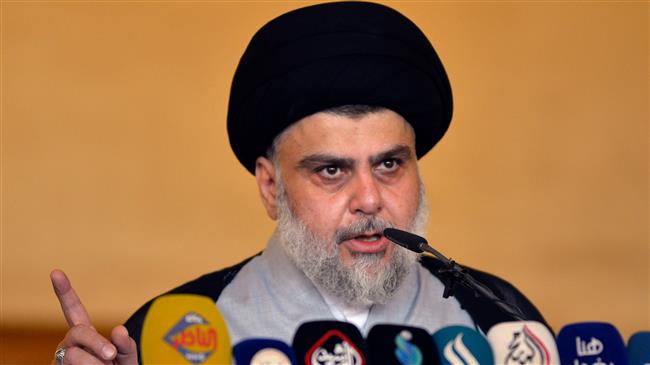
Influential Iraqi Shia cleric Muqtada al-Sadr (Photo by AFP )
Press TV – January 15, 2020
Influential Iraqi Shia cleric Muqtada al-Sadr has demanded that Iraqis stage a “million-man march” against the continued US military presence in the country, days after Iraq’s parliament voted to expel the American troops following an assassination operation by Washington on Iraqi soil.
The march is needed “to condemn the American presence and its violations,” Sadr, who leads the largest parliamentary bloc, Sairoon, said in a tweet on Tuesday.
“The skies, land, and sovereignty of Iraq are being violated every day by occupying forces,” he added. The cleric, however, cautioned that such a show of popular disapproval should be a “peaceful, unified demonstration,” but did not offer a date or location for the proposed rally.
On January 5, the parliament voted overwhelmingly in favor of a resolution calling for the expulsion of all US-led forces, two days after the US military assassinated senior Iranian commander Lieutenant General Qassem Soleimani and along with Abu Mahdi al-Muhandis, the second-in-command of Iraq’s Popular Mobilization Units (PMU), among others, near the Baghdad airport.
The parliament resolution also urged the Baghdad government to drop a request for assistance from a US-led coalition of foreign troops purportedly operating against Daesh remnants in Iraq.
The Iraqis censured the targeted killings — which were ordered by US President Donald Trump — as a blatant violation of the country’s sovereignty as well as the security agreement between Baghdad and Washington.
In a letter to the parliament following the vote, Sadr called for an immediate cancellation of the security agreement with the US, the closure of the US embassy, the expulsion of US troops in “a humiliating manner,” and the criminalization of communication with the US administration.
Following the parliamentary vote, the office of Iraq’s caretaker Prime Minister Adel Abdul-Mahdi asked Washington to dispatch a delegation to Baghdad to initiate preparations for the withdrawal of American troops, who number around 5,200.
In response, Trump threatened to sanction Iraq “like they’ve never seen before ever” if Baghdad were to expel US troops.
Based on reports by the Wall Street Journal the US administration has threatened to shut off Iraq’s access to its main account at the Federal Reserve Bank of New York, which is used to collect revenues from the Arab country’s overseas oil sales, if Baghdad expelled the American forces.
Featured Video
Dr. Tony Martin – The Jewish Role in the African Slave Trade
or go to
Aletho News Archives – Video-Images
In Memoriam
James Petras, In Memoriam
 02.13.2026
Professor James Petras, 89, world-renowned sociologist, public intellectual, and scholar of Latin American politics and global economics, died peacefully on January 17, 2026, in Seattle, WA, surrounded by family.
A prolific scholar and activist, he devoted his life to challenging power, imperialism, and inequality. … continue
Blog Roll
 Aletho News
- Israel ready to strike Iran-backed armed groups – media
- Behind US war drums against Iran: No goals, no plan, no off-ramp
- With Ukraine blamed for cutting oil flows to Hungary, Croatia also refuses to transfer Russian oil in violation of EU law
- Friedrich Merz’s Push to End Online Anonymity Has a Troubling Subtext
- Macron: French citizens fighting for Israel cannot be labeled ‘genociders’
- US eyes Gaza security force drawn from armed gangs
- The Only Motive Behind The ‘Imminent’ U.S. War With Iran Is The Zionist Lobby
- Trump eyes 350-acre US military base housing 5,000 troops in Gaza
- Israel Pushing US Toward a Big and Damaging War With Iran – Ex-Pentagon Analyst
- Meet The Liberal Zionist And Ukraine War Supporter Advising AOC On Foreign Policy
- If Americans Knew
- The Israeli Government Installed and Maintained Security System at Epstein Apartment
- Tucker Carlson interrogated in Israel, has passport seized after interviewing US ambassador
- 6,000 Amputees in Gaza Face Impossible Recovery amid Israeli War Ultimatum
- The Lancet: Gaza death toll far higher than reported – Not a ceasefire Day 132
- Compliant aid: Who are the Israel-approved NGOs scaling up in Gaza?
- Why won’t Trump’s “Board of Peace” bring peace? – Not a ceasefire Day 131
- Help end the injustice against Shadi
- Israel’s Favorite American President
- Israel’s “Yellow Line” Is a Death Trap for Palestinians. We Drove Into It.
- Why Israel’s expanding occupation in Syria presents a critical legal test
- No Tricks Zone
- Coal Power Back In Trend As Globe Tries To Keep Pace With Growing Demand For Power
- New Study: A 4°C Warmer Beaufort Sea Had ‘No Sea Ice’ 11,700 – 8200 Years Ago
- Unfudging The Data: Dutch Meteorological Institute Reinstates Early 20th Centruy Heat Waves It Had Erased Earlier
- German Gas Crisis…Chancellor Merz Allegedly Bans Gas Debate Ahead of Elections!
- Pollen Reconstructions Show The Last Glacial’s Warming Events Were Global, 10x Greater Than Modern
- Germany’s Natural Gas Storage Level Dwindles To Just 28%… Increasingly Critical
- New Study Rebuts The Assumption That Anthropogenic CO2 Molecules Have ‘Special’ Properties
- Climate Scientist Who Predicted End Of “Heavy Frost And Snow” Now Refuses Media Inquiries
- Polar Bear Numbers Rising And Health Improving In Areas With The Most Rapid Sea Ice Decline
- One Reason Only For Germany’s Heating Gas Crisis: Its Hardcore-Dumbass Energy Policy
 Aletho News