Oslo Accords and the PA are a Hindrance to Palestinian Liberation
By Marion Kawas | Palestine Chronicle | February 8, 2020
On January 28, 2020, US President Donald Trump unveiled the details of his ‘Deal of the Century’ in Washington D.C. with Benjamin Netanyahu by his side.
Many of these details had been leaked before, but this press conference put it all together in one package, replete with maps. For many Palestinians, this exercise simply acknowledged what is already the reality on the ground.
But for those still clinging to the façade of “international order”, Trump’s apartheid plan is the final nail in the coffin of the much-touted “two-state” solution. The “two-state” solution that has dragged on for over 25 years, and only resulted in more theft of Palestinian land, more illegal Israeli settlements and more oppression for Palestinians.
It is time to realize that the “state-building” exercise, initiated by the Oslo accords, has failed and failed in a way that has crippled the Palestinian struggle for decades. It is also time to acknowledge that Trump’s Steal/Scam/Theft of the Century is regrettably the logical outcome of those same Oslo Accords.
In the 1970s, the Palestine Liberation Organization PLO was widely recognized as the sole, legitimate representative of the Palestinian people. One of the main planks in its platform was the creation of an independent, secular, democratic state in Palestine. Western governments of the day went out of their way to attempt to vilify and exclude the PLO from international forums and other events.
How did we possibly come from that to what we are witnessing today? How and when did the PLO change its focus and what were the repercussions on the Palestinian struggle? Why did the Palestine National Council PNC vote in 1998, under the guns of the occupier, to amend and nullify crucial articles in the PLO charter? A vote that ultimately neutered and marginalized both the PNC and the PLO as effective representative bodies for Palestinians, a vote that was boycotted at the time by many PNC members and leading visionary Palestinian intellectuals, such as Edward Said.
The Oslo Accords dramatically re-framed the parameters of the Palestinian movement and what was considered “acceptable”; but did they also succeed in laying the foundation and granting legitimacy for greater normalization with Israel?
If you want a favor from the U.S. government, it seems normalization with Israel is the road to take, as happened recently with Sudan’s leader al-Burhan. These are all important questions that need serious discussion in the entire Palestinian movement, including those in diaspora and in refugee camps. The fight for Palestinian liberation cannot move forward until the setbacks of the past are addressed, and the disgraced Palestinian Authority, and its job as a security contractor for Israel, held to account.
It’s immaterial now if the Oslo Accords could have worked if they had been honored and implemented as promised – they weren’t. In fact, it is now apparent that the whole intent of the Oslo Accords (or at least its backers) was to contain, control and censor the militant spirit and legacy of the Palestinian struggle. History has brought us to another pivotal moment for the Palestinian national collective. This moment can either be met with a recognition of these realities and give birth to bold ways for new leadership to move forward, or be squandered and add more unnecessary years to the arduous path for liberation.
Palestinians around the world demonstrated and protested in the last week to show their total rejection of this latest attempt on their national dignity and existence. And no, it’s not because they insist to “miss an opportunity to miss an opportunity”! It’s because they refuse these “opportunities” to surrender, to commit national suicide, and to sell-out their and their children’s birthright.
As in the darkest periods that have come before, the Palestinian people will prevail and foil all conspiracies against their legitimate national and human rights. The right of return, the right to genuine self-determination, the right to live in dignity and freedom – the new generation of Palestinians are as committed as any before them that these rights are sacred and will NOT be sacrificed.
– Marion Kawas is a member of the Canada Palestine Association and co-host of Voice of Palestine.
Is Hollywood about to award an Oscar to ‘For Sama’ – a propagandumentary that pushes Al Qaeda’s narrative in Aleppo?

Screenshot from the trailer for For Sama (2019) PBS distribution
By Vanessa Beeley | RT | February 8, 2020
Oscar-nominated ‘For Sama’ is a gritty, well produced “documentary” claiming to present the reality of the five-year siege of the Syrian city of Aleppo. Just how deceptive is this portrayal?
The 90-minute video directed by UK Channel 4’s Waad Al-Kateab and English filmmaker Edward Watts has been unanimously praised in the mainstream media and tonight it might win this year’s Academy Award for Best Documentary Feature. But does the film present a truly unbiased picture of the Syrian conflict or, rather, just the side of the story that fits the Western narrative about the war?

Waad al-Kateab and Edward Watts, February 4, 2020 © REUTERS/Mario Anzuoni
The armed-group occupation of East Aleppo portrayed as “freedom”
East Aleppo was the armed group hinterland of the city of Aleppo for five years. During this time the shape-shifting militant cadres mingled and confronted each other in mafia-style gang warfare over territory, status, financing and control over the civilians living through their occupation. Ultimately the dominant force was Al-Qaeda or Nusra Front in Syria.
Very few journalists could safely enter this barren and desolate zone reigned over by brutal, extremist groups. Channel 4 teamed up with Syrian “revolution” sympathiser and camera-woman, Waad Al-Kateab, and her alleged “doctor” husband who goes by the pseudonym of Hamza Al Kateab (real name Zahed Katurji) to produce “citizen journalist” reportage that would effectively choreograph the events in Aleppo for an unsuspecting public in the West.
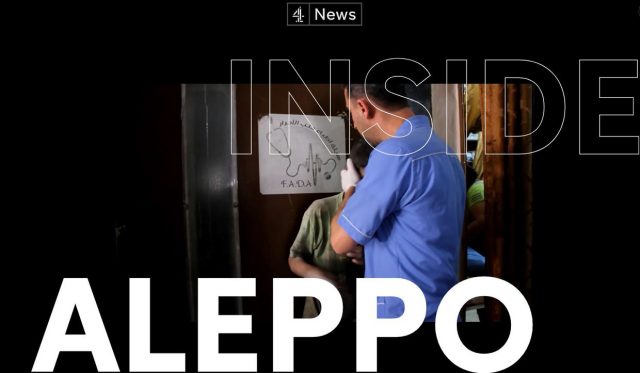
Screenshot taken from Channel 4’s series of reports on Aleppo, provided by Wa’ad Al Kateab
Inside Aleppo consisted of a series of video reports produced by Waad, for Channel4, that claimed to record the daily life inside the extremist group-controlled districts of East Aleppo. Channel 4 accepted and republished these reports without any apparent independent verification or investigation.
Aleppo was Channel 4’s perceived “Guernica,” their reporting was consistently one-sided and partisan towards the “moderate rebels” who, according to the British TV network, were being “disproportionately” targeted by the “dictator Assad” and the Syrian Arab Army. The reality for journalists, like myself, who spent time in Syrian-government secured West Aleppo, sheltering 1.5 million civilians including an estimated 500,000 who had fled East Aleppo when it was invaded by armed militants in 2012, was diametrically different from the narrative being marketed by Channel 4 and the majority of state-aligned media in the West. Aleppo, according to residents, was opposed to the “revolution” from day one.
Channel 4 normalising terrorism and extremism
Channel 4’s reporting in Aleppo and Syria has almost invariably presented the child-beheading, ethnic-cleansing sectarian groups as “rebels with a cause.” In a 2016 report, ‘Aleppo: up close with the rebels’, Krishnan Guru Murthy follows none other than members of formerly US-funded Nour Al Din Zinki, responsible for the horrific public torture and decapitation of 12-year-old Palestinian child, Abdullah, in July 2016.
In the same report, Murthy appears to legitimize the armed group strategy of mass suicide bombing as an act of “defense” without mentioning that many of these suicide bombers were targeting civilian and residential areas. Channel 4 removed this report after their lack of recognition of the war crimes committed by its protagonists was exposed.
‘For Sama’ is little more than a compilation of the ‘Inside Aleppo’ reports, skilfully converted into a feature-length documentary that has already been awarded the Bafta for best documentary and is nominated for the Oscars this weekend.
Dedicated to Waad’s daughter, the documentary can only be described as a grotesque misrepresentation of life in East Aleppo under the tyranny of sectarian armed groups. Anyone watching this movie will assume that East Aleppo was the “free country” as described by Waad, besieged and preyed upon by the Syrian government. The film literally airbrushes Nusra Front from the scenario. Groups like Nour al-Din al-Zenki are not referred to, their crimes go unmentioned.
The role of Hamza Al-Kateab affiliated with the armed groups in East Aleppo
Many journalists have pointed out the dangers of working in areas occupied by the militant factions. Waad and her husband have no apparent issues living side by side with groups renowned for their brutal violence against anyone who would challenge their rule. In fact, a number of videos and social media interactions demonstrate the close relationship that Hamza had with members of these groups – in particular with the aforementioned Nour al-Din al-Zenki.
While corporate media and ‘For Sama’ portray Hamza as a compassionate “doctor,” we must ask how deceptive that image is. Many interactions have been deleted from Hamza’s social media accounts but are still available as screenshots. In these interactions Hamza is involved in military strategy discussions with extremist groups. Hamza is clearly aware of the violence and abuse meted out against civilians by the occupying forces but he never condemned it to the media outlets who relied heavily upon his testimony to file their Aleppo reports.
When the terrorists were evacuated from the last district of East Aleppo, Al Sukare, where Al Quds hospital was located, they left behind a deadly trail of mines and booby traps designed to kill civilians returning to their homes. I was, myself, witness to one of these explosions, after a booby trap left in a washing machine was detonated – murdering and injuring civilians on Christmas Eve 2016.
According to social media conversations, Hamza was aware of this heinous practice. He and Waad evacuated at the same time as the armed groups. Therefore, it can be assumed that they knew about the dangers that awaited civilians, yet they apparently did nothing to warn them.
Much of ‘For Sama’ footage is located in the Al Quds hospital which was, itself, the center of controversy in East Aleppo when Doctors without Borders (MSF) declared it “destroyed” by a Russian airstrike in May 2016. Various independent researchers and journalists exposed this narrative as misleading and unsubstantiated.

Screenshot from movie ‘For Sama’ (2019) Dir: Waad Al-Kateab, Edward Watts, Channel 4/PBS Distribution
‘For Sama’ omits the reality that hospitals in East Aleppo were taken over by the armed groups, often converted into military headquarters. The vast complex of the Childrens and Eye hospital was transformed into a torture and detainment center for civilians who did not comply with the armed group ideology or those perceived to be Syrian government-loyalists. After liberation of East Aleppo, civilians testified that they did not receive medical treatment in the remaining hospitals which were effectively militant triage centers. I spoke with children and teenagers whose injured limbs had been amputated by the so-called medical staff who preferred such cruel expediency over long-term treatment. Why does ‘For Sama’ not cover any of these inconvenient truths?
The children I interviewed in East Aleppo who were forced to witness public executions and crucifixions, by the extremist groups, are ignored by Channel 4 and ‘For Sama’. Journalists like Theo Padnos and Matthew Schrier, who were imprisoned and tortured by the armed groups in the Eye Hospital compound are not referred to.
The mortars fired daily into West Aleppo by the militants that Waad does not refer to were responsible for thousands of civilian deaths and the maiming of countless more who lost limbs in the rain of lethal “Hell-cannon” gas canister missiles or were sniped in the streets that bordered the Nusra Front-dominated enclaves.
The 2013 Queiq River narrative explained
The 2013 River Queiq massacre is portrayed, in the film, as a Syrian government crime, the gory scenes exploited to further criminalise the SAA. If Channel 4 had conducted any kind of investigation into this event, they might have fulfilled their duty to provide context and evidence that would have better informed their audiences in the West. Channel 4 must be considered grossly negligent in their distorted representation of the Syrian conflict.
Aleppo-based journalist, Khaled Iskef, did exactly this investigation over a period of years before Al Mayadeen channel published his findings based upon forensic DNA reports and witness testimony. ‘For Sama’ glosses over fact in favor of propaganda and denies justice for the victims of extremist violence & brutality. According to Iskef’s evidence, River Queiq was a convenient dumping ground for these armed groups to dispose of evidence, Waad and Channel 4 have apparently provided cover for the crimes they committed.

Screenshot from Khaled Iskef documentary on the 2013 River Queiq massacre, blamed on the Syrian government
Channel 4, media architects of war
It is no surprise that Channel 4 has been instrumental in the production of ‘For Sama’. I have extensively documented the channel’s role in the behind-the-scenes management of other such revisionist projects on Syria. The White Helmets, another terrorist-linked entity operating in East Aleppo, produced an award winning, Oscar nominated movie, ‘Last Men in Aleppo’, which also eradicated the presence of extremist fighters and terrorist groups from the conflict landscape – reducing the narrative down to “bad Assad” and “good rebels.”
Channel 4 were among the hidden architects of this production and were also at the forefront of support for the White Helmets Nobel Peace Prize nomination while this UK/US funded group stands accused of all manner of war crimes by the Syrian people who lived under militant-group-occupation across Syria.
‘For Sama’ is an exploitative and well packaged instrument of injustice. It is an attempt by governments and media in the West to rewrite history, to erase their shameful role in maintaining a nine-year conflict, in Syria, based on lies and obfuscation of fact.
If you were to speak to the Syrian people in Aleppo who lived through the period covered by ‘For Sama’, they would tell you that this film does not represent their suffering or abuse at the hands of the armed gangs. They would tell you that ‘For Sama’ effectively defends those who tortured, imprisoned and subjected them to all manner of horror and bloodshed. They would tell you that ‘For Sama’ is just another insult from the billionaire funded PR industry for war that has denied the real Syrian victims a voice for nine years while those who help perpetrate the crimes against them will, once again, be on Hollywood’s red carpet.
Vanessa Beeley is an independent journalist and photographer who has worked extensively in the Middle East – on the ground in Syria, Egypt, Iraq and Palestine, while also covering the conflict in Yemen since 2015. In 2017, Vanessa was a finalist for the prestigious Martha Gellhorn Prize for Journalism, which was won by the much-acclaimed Robert Parry that year. In 2018, Vanessa was named one of the 238 most respected journalists in the UK by the British National Council for the Training of Journalists. In 2019, Vanessa was among the recipients of the Serena Shim Award for uncompromised integrity in journalism. Follow Vanessa Beeley on Patreon.com and on Twitter @VanessaBeeley.
OPCW attack on whistleblowers only proves its own credibility is shot
By Nebojsa Malic | RT | February 8, 2020
Attempting to discredit the whistleblowers casting doubt on its report about a chemical attack in Syria, the OPCW has only confirmed the authenticity of the leaked documents, the expertise of individuals involved, and its own rot.
For months now, two whistleblowers – an individual only identified as “Alex” and former specialist Ian Henderson – have testified and presented documents indicating that the final report on the April 2018 incident in Douma was doctored to suggest Syrian government forces may have used chemical weapons, and therefore retroactively justify US, UK and French missile strikes against Syria, which had been carried out before the OPCW mission even got there to investigate.
On Thursday, the Organisation for the Prohibition of Chemical Weapons tried to discredit them by arguing they were not actual whistleblowers, but disgruntled employees who breached confidentiality, and lacked expertise and access to all the evidence.
That was enough for the legion of mainstream propagandists (looking at you, Bellingcat ) to declare that they had been vindicated, the whistleblowers discredited, and the Douma report 100 percent correct.
They must have not bothered to read the OPCW’s little exercise in semantics, because what it actually did – perhaps inadvertently – was confirm that the leaked documents were authentic and that the whistleblowers did have access to the evidence they discussed.
For example, it says that one of the whistleblowers was “not a member” of the fact-finding mission in Douma – but then also says that he “accompanied” and “assisted” the FFM, and was later “assigned to conduct an inventory” of the sensitive evidence gathered.
The OPCW has only itself to blame for this predicament. After all, the organization certified back in 2013 that Syria had dismantled its chemical weapons laboratories and handed over the agents to the US and UK to destroy, having supervised the process and inspected the facilities. Yet it allowed itself to be used by Western powers, and the jihadist militants they’ve backed – in a campaign to effect “regime change” in Damascus anyway.
Way back in 2012, the Obama administration set chemical weapons use as a “red line” that would trigger a Libya-style “kinetic military action” in Syria. The Russian diplomatic initiative that saw Syria disarm had thwarted that plan, but didn’t stop “moderate rebels” such as the Al-Qaeda affiliate Al-Nusra from staging incidents that could be blamed on President Bashar Assad’s government, all in the hope of provoking an outside intervention and winning the war for them.
The thing about these “chemical attacks” is that they always happen when the “rebels” are losing and the Syrian army is advancing with ease. This means that the Syrian government has absolutely no need to use chemical weapons for any reason, military or political – unlike the militants, who absolutely need such incidents to keep their cause alive.
By publishing a report on Douma filled with omissions and insinuations, the OPCW effectively sided with these terrorists – as well as countries that unilaterally launched attacks against Syria in open defiance of international law.
Then it chose to address criticism of its complicity in the biggest lie since the Iraqi WMDs, by attacking the whistleblowers. For an organization that’s supposed to safeguard the world from the proliferation of dangerous weapons, that’s not just a bad look – it’s a credibility killer.
Nebojsa Malic is a Serbian-American journalist, blogger and translator, who wrote a regular column for Antiwar.com from 2000 to 2015, and is now senior writer at RT. Follow him on Twitter @NebojsaMalic
Douma Incident: Why Whistleblowers’ Accounts Hold More Credibility Than ‘Bald Assertions’ by OPCW
Sputnik – February 8, 2020
The Organisation for the Prohibition of Chemical Weapons (OPCW) smear campaign against the whistleblowers who questioned the watchdog’s Douma report has failed to achieve the desired effect, British observers say, stressing that the OPCW has yet to dispel suspicions triggered by its apparently doctored dossier.
On 6 February, the Organisation for the Prohibition of Chemical Weapons (OPCW) issued what it called findings of possible breaches of confidentiality with regard to two whistleblowers’ exposure of the watchdog’s manipulation of facts concerning the April 2018 Douma chemical incident.
Having denied that it sexed up its Douma report, the OPCW lambasted the whistleblowers behind the disclosure, referring to them as “Inspector A” and “Inspector B”, and proposed certain measures to prevent future leaks. Inspector A is believed to be a former member of OPCW team on Douma, Ian Henderson, and Inspector B is presumably an investigator described as “Alex” and quoted by WikiLeaks.
Previously, the two specialists expressed concerns about the apparently doctored OPCW dossier describing the chemical incident in Douma. According to Ian Henderson, the watchdog wiped out evidence indicating that chemical canisters allegedly containing chlorine were “manually placed” in Douma instead of being airdropped. Henderson’s statement upends the US’ claim that the Syrian government forces were behind the supposed attack.
Why OPCW Review Fails to Discredit Whistleblowers
According to Piers Robinson, co-director of the Organisation for Propaganda Studies (OPS) and former professor at the University of Sheffield, the centerpiece of the OPCW’s investigation is an attempt to discredit “brave and highly experienced inspectors who have evidently been trying to tell the truth to the world”.
“In doing so the OPCW is evading the compelling scientific evidence now in the public domain which indicates both that the cylinders were placed by hand and that the victims were not killed by chlorine from gas canisters dropped by helicopter. The OPCW is covering up the scientific truth and preventing justice and truth for the victims. But the truth will continue to come out and the OPCW management inevitably faced with having to get its house in order or otherwise lose credibility”, the scholar emphasises.
1) To date there remains no adequate explanation as to how the cylinder a location 4 managed to alter trajectory and land on the bed. @bellingcat’s recent attempted rebuttal ignores this entirely whilst suppressed OPCW documents confirm the trajectory is implausible pic.twitter.com/A06e4MB4JK
— Piers Robinson (@PiersRobinson1) January 19, 2020
Peter Ford, former UK ambassador to Syria and an expert on Middle East affairs, echoes the non-profit’s co-director, by saying that “it is not the whistleblowers who lack credibility as claimed by the OPCW but the OPCW itself”.
Ford draws attention to the fact the OPCW “fail even to make any effort to answer the substance of the reservations expressed by the whistleblowers”.
“Any rebuttal of those reservations would have to explain away the signs of evidence tampering noted by inspectors (manual positioning of the chlorine canisters) and the inconsistency of the videoed symptoms of the alleged victims with the known effects of chlorine gas”, he elaborates.
According to him, “until these points are addressed the whistleblowers’ accounts will hold more credibility than bald assertions by the OPCW”. Additionally, one might ask to what extent any review can be ‘independent’ when it is commissioned and paid for by the OPCW itself, Ford adds.
OPCW’s Behaviour Prompts Further Suspicions
The former diplomat draws attention to the timing of the OPCW review release which coincided with the Syrian government forces advance on terrorist-held Idlib.
“It is ominous that the attempts by Western powers and the international organisation they control to restore some credibility to that organisation should be emerging just as Western corporate media attempts to whip up a frenzy of humanitarian concern about Idlib are reaching a climax and just as the Syrian and other forces attempting to remove Western-supported jihadis from Idlib are poised for victory”, Ford suggests.
According to him, the unfolding situation evokes strong memories of Douma, “where a fake chemical weapons attack was fabricated to enable the Western powers to make a last ditch attempt to save their proxies”.
“Are we about to see a new Oscar-winning production, as some alarming reports indicate?” the British diplomat asks rhetorically.
The Douma chemical incident took place on 7 April 2018 prompting an immediate backlash from the US and its British and French allies who initiated a series of strikes involving aircraft and ship-based missiles targeting multiple Syrian government sites on 14 April, before the inquiry into what happened in Douma was carried out.
In March 2019, the OPCW released a report describing the Douma incident and claiming that chlorine was “most likely” the chemical agent used in an alleged chemical attack. The dossier come under heavy criticism from the whistleblowers, while Russia’s OPCW Permanent Representative Alexander Shulgin told the United Nations Security Council gathering convened to discuss the OPCW report that Russian and Syrian military had been able to collect evidence on the ground indicating that the incident was nothing short of a provocation by jihadi militants to win international support.
Erdogan’s biggest gamble yet
The Turkish president’s misguided dispatch of troops to Syria risks an unwinnable showdown with Russia
By Abdel Bari Atwan | Rai al-Youm | February 4, 2020
The Turkish-Syrian clash in Idlib province – resulting in the death of six Turkish soldiers when their convoy was shelled by the Syrian army near the town of Saraqeb – ultimately reflects Russia’s growing frustration with President Recep Tayyip Erodgan. Moscow has lost patience with the Turkish leader’s failure to evacuate terrorist-designated groups and factions from Idlib city under the terms of the 2017 de-escalation agreement.
The Syrian army’s advance in the Idlib countryside, retaking a succession of towns and villages from the Turkish-backed Hay’ at Tahrir ash-Sham (the former Nusra Front) and its allies, left Erdogan in a predicament. With the recapture of the strategic town of Maarat al-Numan and the imminent fall of Saraqeb, he faced the prospect of his allies being ejected from Idlib city too – which would, in turn, cause the flight of tens of thousands of its inhabitants across the Turkish border.
This prompted him to make his biggest gamble since he began his intervention in the Syrian conflict nine years ago. He sent a 350-vehicle military convoy to Saraqeb and fresh arms supplies to the opposition forces defending the town, effectively trashing his understandings with his Russian allies.
The official Russian account, given by Kremlin spokesman Dmitri Peskov, is that the Turks did not inform Moscow of their incursion, and their troops came under fire from Syrian forces targeting terrorists to the west of Saraqeb. Moscow also denied Erdogan’s claim that Turkey launched retaliatory airstrikes in which up to 35 Syrian troops were killed, as did Syria’s official news agency – basically accusing him of lying.
In short, when forced to choose between its Syrian and Turkish allies, Russia opted for the former, having grown weary of Erdogan’s foot-dragging and failure to live up to his commitment in the 2018 Sochi agreement to clear Idlib of terrorist groups.
Erdogan could not, or rather would not, curb Hay’ at Tahrir Ash-Sham and stop it from attacking the Syrian army in the Idlib an Aleppo countrysides. It even launched repeated drone strikes against the Russian airbase at Hmeimim near Latakia. This enraged the Russians and prompted then to launch a joint offensive with the Syrian army to capture Idlib, resorting to the military option after the political option failed.
It is hard to predict how events will unfold. But it is clear that if Turkey persists with its intervention it well end up clashing with the Russians as well as the Syrians – unless Erdogan backs down, as he has done in the past, and seeks a deal or truce with President Vladimir Putin. This would have to be based on a renewed commitment to implementing the Sochi agreement and abandoning the Nusra Front and its allies.
All the makings of a showdown are in place. The Russians and Syrians are not prepared to halt their campaign to retake Idlib, and Erdogan is not prepared to see his allies there defeated and bloodily decimated. Moscow, meanwhile, no longer feels bound by the Sochi agreement after it was broken by Ankara and its clients.
Erdogan is in escalation mode for now. His visit to Kyiv, where he denounced Russia’s annexation of Crimea, was a deliberate jibe, which Putin may not take lightly.
The death and injury of Turkish soldiers in Syria for the first time since the start of Ankara’s intervention in the crisis will also have domestic repercussions for Erdogan. The Turkish public is becoming increasingly hostile to Syrian migrants, and critical of the ruling AK Party in general. It will not easily put up with Turkish boys losing their lives in Syria. The risk of sustaining military casualties prompted a majority of Turks to oppose military intervention in Libya. How about a war of attrition in Syria, against both the Russians and the Syrians?
And what would it be for? Nine years of fighting sponsored by an array of world and regional powers – entailing the expenditure of tens of billions of dollars and the recruitment of 250,000 fighters – failed to bring down the Syrian regime. The despatch of a few thousand Turkish troops to Saraqeb cannot change that reality.
France’s exposure of Turkish arms shipments to Libya and its arrest of Jaish al-Islam spokesman Islam Alloush, and Russia’s bombing of the Nusra Front in al-Bab, serve as a message to Turkey. They signal that times have changed and that its adversaries are growing in number.
But will the message be received and acted upon? Or will Turkey continue walking into the traps set for it by the US – first in Syria, now in Libya, with Russia as a principal adversary in both cases – with eyes wide open?
NYT: ‘Iran-Backed Militia’ Attack That Provoked Soleimani Killing Was Possible ISIS False Flag
By Tyler Durden – Zero Hedge – 02/06/2020
The initial major rationale and justification the US administration offered for the drone assassination of IRGC Gen. Qassem Soleimani and commander of Iraq’s Popular Mobilization Forces Abu Mahdi al-Muhandis was the Dec. 27 rocket attack on K1 camp in Kirkuk, which houses coalition forces.
That attack involving surface-to-surface missile strikes killed an American contractor and reportedly wounded several US troops. Washington immediately blamed the Iran-backed Iraqi paramilitary group Khataib Hezbollah, with Mike Pompeo saying of the attack: “We will not stand for the Islamic Republic of Iran to take actions that put American men and women in jeopardy,” after he briefed President Trump. But top Iraqi military and intelligence officials are now calling this entire narrative into question.
A new lengthy New York Times investigative report cites multiple top Iraqi officials who go on record to say of their analysis of the Dec.27 Kirkuk incident: “These facts all point to the Islamic State, Iraqi officials say.”
The Pentagon says it has evidence decisively pinning it on Khataib Hezbollah, known for its closeness to Tehran; however, the paramilitary group itself has denied that it was behind the operation. US officials have from the start been scant on details and have not made public any evidence or intelligence.
This led some analysts in the days after the attack to question whether ISIS cells, still known to be active in the area, might have been behind it — given also it would be to the Sunni terrorist group’s benefit to sow a major rift between US and local Iraqi Shia forces, which is precisely what happened (Trump has recently gone so far as to threaten “very big sanctions” on Baghdad if US forces are kicked out). Alternately the White House perhaps appeared ready to manufacture a justification to take out Soleimani.
Further, as detailed in the Times report, the white Kia pick-up from which the rockets were launched was found near a known ISIS execution site, in a heavily Sunni area not known to have had a Shia paramilitary presence since 2014:
But Iraqi military and intelligence officials have raised doubts about who fired the rockets that started the spiral of events, saying they believe it is unlikely that the militia the United States blamed for the attack, Khataib Hezbollah, carried it out.
… Iraqi officials say their doubts are based on circumstantial evidence and long experience in the area where the attack took place.
The rockets were launched from a Sunni Muslim part of Kirkuk Province notorious for attacks by the Islamic State, a Sunni terrorist group, which would have made the area hostile territory for a Shiite militia like Khataib Hezbollah.
Khataib Hezbollah has not had a presence in Kirkuk Province since 2014.
The Islamic State, however, had carried out three attacks relatively close to the base in the 10 days before the attack on K-1. Iraqi intelligence officials sent reports to the Americans in November and December warning that ISIS intended to target K-1, an Iraqi air base in Kirkuk Province that is also used by American forces.
And the abandoned Kia pickup was found was less than 1,000 feet from the site of an ISIS execution in September of five Shiite buffalo herders.
The NYT further says this single event set off “a chain of events that brought the United States and Iran to the brink of war” which President Trump confided at a private luncheon this week was “closer than you thought”.
Brig. General Ahmed Adnan, the Iraqi chief of intelligence for the federal police at K-1, told the NYT : “All the indications are that it was Daesh.” He said further: “I told you about the three incidents in the days just before in the area — we know Daesh’s movements.”
“We as Iraqi forces cannot even come to this area unless we have a large force because it is not secure. How could it be that someone who doesn’t know the area could come here and find that firing position and launch an attack?” he questioned.
Anonymous US officials, however, claim that evidence from within the Kia pickup points to Khataib Hezbollah, and also cited “multiple strains of intelligence” though without making it known.
Interestingly, amid a general breakdown in trust between Baghdad and Washington, a top Iraqi general has said the US side hasn’t even shared its claimed evidence that Khataib Hezbollah was behind the Kirkuk attack:
“We have requested the American side to share with us any information, any evidence, but they have not sent us any information,” Lt. Gen. Muhammad al-Bayati, the chief of staff for former Prime Minister Adel Abdul Mahdi, said in an interview.
The director general of Iraqi Intelligence and Counterterrorism, Abu Ali al-Basri, said the United States did not consult Iraq before carrying out the Dec. 29 counterattacks on Khataib Hezbollah.
“They did not ask for my analysis of what happened in Kirkuk and neither did they share any of their information,” he said. “Usually, they would do both.”
The bombshell NYT report further collects eyewitness accounts and other Iraqi official statements, all of which strongly suggests the chain of events which led to Soleimani’s Jan. 3 killing, which in turn led to an Iranian ‘revenge’ attack with ballistic missiles on Ain al-Asad Air Base, wounding scores of troops (we later found out as part of an ever growing number of solders with ‘Traumatic Brain Injury’ from the blasts), was a possible ‘false flag’ event undertaken by ISIS meant to be pinned on the Islamic State’s Shia enemies backed by Iran.
German TV Exposes the Lies That Entrapped Julian Assange
By Ray McGovern | Consortium News | February 6, 2020
Truth has broken through for those confused about how a publisher ended up in a maximum security prison in London with a one-way extradition ticket to court in the U.S. and the rest of his life behind bars.
One of the main German TV channels (ZDF) ran two prime-time segments on Wednesday night exposing authorities in Sweden for having “made up” the story about Julian Assange being a rapist.
Until last night most Germans, as well as other consumers of “major media” in Europe, had no idea of the trickery that enmeshed Assange in a spider-web almost certainly designed by the U.S. and woven by accomplices in vassal states like Sweden, Britain and, eventually, Ecuador.
ZDF punctured that web by interviewing UN Rapporteur on Torture Nils Melzer. One ZDF “Heute Sendung” segment (in German) is especially telling from minute 13:00 to 15:30. The second is ZDF “Heute Journal” (minute 25:49 to 30:19.)
Both ZDF programs show Melzer being interviewed, with minimal interruption or commentary, letting his findings speak for themselves about how allegations against Assange were “made up” and manipulated to hold him captive.
The particularly scurrilous allegation that led many, including initially Melzer, to believe Assange was a rapist — a tried and tested smear technique of covert action — was especially effective. The Swedes never formally charged him with rape — or with any crime, for that matter. ZDF exhibited some of the documents Melzer uncovered that show the sexual allegations were just as “invented” as the evidence for WMD before the attack on Iraq.
Melzer had previously admitted to having been so misled by media portrayals of Assange that he was initially reluctant to investigate Assange’s case. Here is what Melzer wrote last year in an op-ed marking the International Day in Support of Torture Victims, June 26.
No major media would print or post it. Medium.com posted it under the title “Demasking the Torture of Julian Assange.”
Excerpts:
“But surely, I found myself pleading, Assange must be a selfish narcissist, skateboarding through the Ecuadorian Embassy and smearing feces on the walls? Well, all I heard from Embassy staff is that the inevitable inconveniences of his accommodation at their offices were handled with mutual respect and consideration.
This changed only after the election of President Moreno, when they were suddenly instructed to find smears against Assange and, when they didn’t, they were soon replaced. The President even took it upon himself to bless the world with his gossip, and to personally strip Assange of his asylum and citizenship without any due process of law.
In the end it finally dawned on me that I had been blinded by propaganda, and that Assange had been systematically slandered to divert attention from the crimes he exposed.” (Emphasis added.)
Melzer ended his op-ed with this somber warning:
“… This is not only about protecting Assange, but about preventing a precedent likely to seal the fate of Western democracy. For once telling the truth has become a crime, while the powerful enjoy impunity, it will be too late to correct the course. We will have surrendered our voice to censorship and our fate to unrestrained tyranny.” (Emphasis added.)
Melzer’s indefatigable efforts to expose what Assange has gone through, including “psychological torture,” met with some modest success in the days before the German ZDF aired their stories. Embedded in the linked article is by far the best interview of Melzer on Assange.
Opposition to extraditing Assange to the U.S. is becoming more widespread. Another straw in an Assange-favorable wind came last week when the Parliamentary Assembly of the Council of Europe (PACE) called for Assange’s immediate release, ending years of silence by such European institutions.
It remains, nonetheless, an uphill struggle to prompt the British to think back 800 years to the courage of the nobles who wrested the Magna Carta from King John.
Russia rejects Turkish narrative on Syria
By M. K. BHADRAKUMAR | Indian Punchline | February 7, 2020
The Russian reaction to Turkey’s latest military moves in the northwestern Syrian province of Idlib has appeared in the form of a lengthy interview with the government daily Rossiyskaya Gazeta by Foreign Minister Sergey Lavrov on February 4, which has since been followed by a formal statement by the foreign ministry on Thursday.
Moscow has underscored that the current Syrian operation in Idlib is about vanquishing the al-Qaeda affiliates supported by Turkey and the western countries.
Lavrov dwelt on the backdrop to the so-called Astana format, which resulted from the collapse of the regime change project of “our Western and other foreign partners” in Syria following the Russian intervention in 2015.
He outlined how the Astana process led to the “de-escalation zone” in Idlib where “terrorist groups herded together”. Russia and Turkey reached specific written agreements spelling out their commitments to oversee Idlib. However, to quote Lavrov,
“Regrettably, so far, Turkey has failed to fulfil a couple of its key commitments that were designed to resolve the core of the Idlib problem. It was necessary to separate the armed opposition that cooperates with Turkey and is ready for a dialogue with the government in the political process, from the terrorists of Jabhat al-Nusra, which became Hayat Tahrir al-Sham. Both are blacklisted as terrorist groups by the UN Security Council, so neither Jabhat al-Nusra nor the latest version, Hayat Tahrir al-Sham, has anything to do in Idlib.”
Even after repeated reminders from Russia, Turkey didn’t act. Equally, Lavrov repeated that the recent Turkish military deployments to Idlib were undertaken without any advance intimation to the Russian side. He said, “We urge them (Turkey) to strictly comply with the 2018 and 2019 Sochi accords on Idlib.”
The Russian Foreign Ministry statement of February 6, as reported by Tass news agency, disclosed that there have been Russian casualties due to the “increasing terrorist activities.” It justified the operations of the Syrian government forces as reaction to “the unacceptable rise in terrorist activities.”
Through the month of December, “over 1,400 militant attacks involving tanks, machine guns, infantry fighting vehicles, mortars and artillery took place.” During the past fortnight alone, “more than 1,000 attacks have been recorded” and hundreds of Syrian troops and civilians have been killed and wounded and the Russian base at Hmeymim came under attack repeatedly.
The foreign ministry statement says, “all this points to an unacceptable increase in terrorist strength in Idlib, where militants have complete impunity and free hands” which left the Syrian government with no alternative but to “react to these developments.”
In a rebuff to Turkish President Recep Erdogan’s demand that the Syrian government should terminate the military operations in Idlib and withdraw, the Russian statement said, “A thing to note is that the Syrian army is fighting on its own soil against those designated as terrorists by the UN Security Council. There can be no interpretations. It is the Syrian government’s right and responsibility to combat terrorists in the country.”
Curiously, both Lavrov’s interview as well as the Foreign Ministry statement drew attention to the transfer of terror groups from Idlib to northeastern Syria and from there to Libya in the recent weeks. The implication is clear — Ankara continues to deploy terrorist groups as tools of regional strategies in Syria (and Libya).
Russia has contacts with all parties in Libya, including Khalifa Haftar. The implicit warning here is that Erdogan will have a high price to pay in Libya where he cannot count on Russian empathy. Turkey is already under withering criticism from EU, France, Italy, Greece, Cyprus, Israel, UAE and Saudi Arabia for its military intervention in Libya, especially by deploying its proxy groups from Syria. Turkey’s regional isolation over Libya is now complete.
The Russian Foreign Ministry statement concluded saying, “We reaffirm our commitment to the agreements reached at the Astana talks, which envisage fighting terrorist groups in Syria on the condition of respect for the sovereignty and territorial integrity of the country. We will maintain close coordination with our Turkish and Iranian partners for the sake of achieving lasting stability and security on the ground.”
It is highly significant that the Foreign Ministry statement singled out the “Iranian partners” for reference. On February 5, while receiving the new Iranian ambassador to Moscow, President Putin also said Russia and Iran were “key powerful players” in the fight against global terrorism and will continue their cooperation. Putin added, “(Russia’s) cooperation with Iran within the Astana framework has played an effective role in the settlement of the Syria conflict.”
What emerges is that Moscow senses that behind Turkish president Erdogan’s mercurial behaviour, there is the old pattern of Turkey using terror groups as proxies, with covert support from western powers. Moscow cannot but be aware that the US is making overtures to Erdogan with a view to shift the military balance against Russia and Iran on the Syrian-Iraqi chessboard in the downstream of the killing of General Qassem Soleimani.
Curiously, on Monday, a US appeals court agreed to “pause” a case alleging that Turkey’s state-owned HalkBank evaded US sanctions on Iran. The US Senate Finance Committee member Ron Wyden, a Democrat, has since addressed a letter to the US Attorney General William Barr asking if President Trump had tried to intervene on behalf of Halkbank!
A Reuters report said Senator Wyden asked Barr to detail his interactions with Trump, President Tayyip Erdogan and Turkish Finance Minister Berat Albayrak (who is also Erdogan’s son-in-law).
The HalkBank scandal implicates Erdogan and family members and an adverse court verdict can be highly damaging politically to the president and his son-in-law who is groomed as a potential successor. (A commentary on the scandal featured in the Foundation for Defense of Democracies authored by a former Turkish member of parliament is here.) The HalkBank case hangs like the sword of Damocles over Erdogan. Washington is adept at using such pressure tactics against recalcitrant interlocutors abroad.
On the other hand, if Trump has done a favour to Erdogan (or anyone for that matter), he’d expect a quid pro quo. And it is to be expected that the Trump administration would visualise that Erdogan’s cooperation can be a game changer in the geopolitics of Syria and Iraq. However, Moscow has kept the line open to Ankara.
To be sure, it is with deliberation that Moscow has highlighted the salience of the Russian-Iranian alliance in Syria where Washington is escalating tensions lately as part of its “maximum pressure” approach threatening Tehran with a region-wide war.
The Dramatic Fall of Chile as Latin America’s Neoliberal Role Model
By Ariela Ruiz Caro | CounterPunch | February 5, 2020
After the outbreak of the most intense and massive social protests ever recorded in the history of Chile, on November 16 the government and most political parties signed an agreement to restore peace and public order and initiate a process to draft a new constitution.
The protests, triggered by the rise in subway fares on Oct. 18, called into question the supposed Chilean success story of the neoliberal economic model implemented in the country during the dictatorship of General Augusto Pinochet (1973-1989). Developed by the so-called Chicago Boys, successive administrations since the 1990 return to democracy in 1990 sustained the model as state policy.
Economic and especially financial liberalization; privatization of public services, including water; the subsidiary role of the State; unlimited protection for foreign investments; and insertion in the international economy that serves US policies designed for the region were the fundamental elements of the economic model that Chile pioneered globally.
Chile’s achievements in macroeconomic stability, sustained economic growth and significant reduction in poverty levels solidified its image–promoted by the international system–as a role model in Latin America. For many years, Chilean citizens also believed it. However, behind the stable statistics and the high growth rates per capita, lurked growing inequality and concentration of wealth that eventually revealed the deep cracks in the system and sparked the recent protests. Chile is currently the 12th most unequal economy in the world. [1]
The Chilean Government’s Declining Legitimacy
Most analisis of Chile’s surprising social uprising have focused on economic aspects and less on Chile’s deep political crisis, characterized by the loss of citizen representation in political parties and government. An important part of the protest movement’s demands include greater citizen participation.
According to the October Social Thermometer Survey, 85% of citizens support the grassroots protests, and 80% demand a new constitution. The current constitution, written during the military dictatorship, dates from August 1980. The decline in the legitimacy of the Piñera government in the eyes of the popularion has been intensified by the serious criticisms of the Inter-American Commission on Human Rights, the Human Rights Commission of Chile and the OAS General Secretary for violation of human rights by the government to suppress protests.
Loss of Leadership in the International Sphere
All this has resulted in an unquestionable loss of leadership of Chile in the international arena. The Piñera government had to suspend the Asia-Pacific Economic Cooperation Forum (APEC) Summit that should have taken place in Santiago. Likewise, the United Nations Conference on Climate Change (COP25) was forced to make a last-minute move to Madrid. Chile today cannot offer basic guarantees even as the venue for international sporting events. The South American Football Confederation (Conmebol) decided to move the venue of the 2019 Copa Libertadores final that will be played by the Flamengo (Brazil) and River Plate (Argentina) teams from Santiago to Lima.
Chile has lost leadership in regional bodies. It no longer can play its leading role in the Lima Group, an ad hoc body created by 13 Latin American countries and the United States in August 2017 to press for regime change in Venezuela; in the creation of the Forum for the Progress and Development of South America (Prosur) [2] launched March 22 to replace the Union of South American Nations (Unasur); or in the aborted U.S. plot to deliver humanitarian aid to Venezuela across the border with Colombia that had the region in suspense in February. The grassroots explosion, has not only knocked Chile off the pedestal on which the success of its neo-liberal model was erected, but also removed its articulating role with the United States and allied countries in the region.
The demonstrations have also had an impact on the country’s economy. The volume of sales and consumption has dropped, along with imports and exports. The stock market has gone down, and the national currency has been devalued. The limited operation of many domestic activities and the suspension of the aforementioned international events will have an impact on economic growth. In this scenario, the opposition presented the departure of President Piñera and the call to a Constituent Assembly as the key pieces to achieve a solution.
The Hidden Face of Chilean Economic Success
Although Chile sustained per capita economic growth above the Latin American average and poverty levels fell from above 40% of the population to less than 10% in the last three decades, those who came out of poverty generally did not reach the levels of consumption that are usually associated with middle class status.
Fifty percent of the economically active population earns less than 550 dollars per month, with the minimum wage equivalent to 414 dollars. Overwhelmed by the narrow strip that separates it from the poverty, an important part of the population lives in fear of seeing their income fall. [3] In Chile, downward social mobility is greater than upward social mobility, and downward mobility is more highly correlated to political protest than poverty itself. [4]
The biggest factor that exacerbates inequality is probably the nation’s pension system, in force since 1982. Designed during the military government [5], the pension mechanism has not met Chileans’ expectations. According to the group No + AFP (No More Pension Fund Managers), which in 2016 organized a march of 600,000 people, these are “undercover banks of the richest entrepreneurs in our country who use the pension funds to expand their investments and further concentrate capital in a few hands.” [6] The average pension for retirees is $286 per month, and 80% receive pensions below the minimum wage. The amount of pensions is on average close to 40% of people’s income at the time of retirement.
Education is the second major source of inequality. In 2006 and 2011, student s organized massive demonstrations calling for profound reforms in the education system. Chilean education is characterized by the huge gap between public and private education. The withdrawal of the State from its functions as generator, regulator and supervisor of the education sector led to the gap as part of neoliberal reforms beginning in the 1980s.
Former Chilean rulers unanimously recognize that the situation of inequality generated social unrest and led directly to current protests in this country. Rolf Luders, Pînochet’s former minister of economics and now a professor at the Institute of Economics of the Catholic University of Chile, admits that “the income of the vast majority of Chileans is still low in absolute terms and the income differences are very significant.” Luders adds that “there have been abuses not duly sanctioned by the State.” Former president Ricardo Lagos points out that “citizens feel that although poverty has decreased substantially, there is a very high concentration of income, and a level of inequality that has not been adequately addressed.”
Lagos told local press that “Chile needs to increase taxes, especially for the rich because more public services are needed” and warns that people demand a new social contract so that the fruits of growth reach everyone.“ [7] President Piñera himself, after denying and ignoring the protests, said that “It is true that problems had accumulated for many decades and that different governments were not able to recognize this situation in all its magnitude.” In the early days of the demonstrations Piñera sought to disqualify the protests, stating that they were “at war against a powerful, relentless enemy, that respects nothing and no one and is willing to use violence and crime without any limits, even when it means the loss of human lives, with the sole purpose of producing as much damage as possible.” [8]
But the punitive approach of declaring a state of emergency in the country and giving control of citizen security to military commanders only served to fuel the fire and increase violence. Now that the protests have produced some two dozen deaths, thousands of wounded and detained, and complaints of torture, Piñera has been forced to make changes in his Cabinet, to suspend the state of emergency and curfew in force in some cities, and to announce economic measures that favor popular demands.
Politics for the Elite
The uprising has revealed cracks not only in the Chilean economic model, but also in the political and social spheres. The neoliberal economic system requires an exclusionary and limited democracy, which Chile successfully built in the three decades of democracy since the end of the military dictatorship in 1990. For many years, a binomial electoral system designed during the dictatorship encouraged the participation of only two political blocs that alternated in government. [9] That system resulted in the concentration of power among a narrow elite.
One of those two blocks was the Concertation of Forces for Democracy (since 2011, New Majority) while the other, is the center right Alliance for Chile (since 2009, Coalition for Change). Except for the previous period of the government of Sebastián Piñera of the National Renewal Party (2010-2014) and the current one, (2018-2022), the government has been in the hands of the Concertación parties. The Socialist Party ruled three times: first, with Ricardo Lagos (2000-2006), and then Michel Bachelet twice: (2008-2010) and (2014-2018). But in essence, they never moved away from the model, which resulted in political and economic stability that governed for market needs, but not for the citizenry. [10] In La violence des riches, Michel and Monique Pinçon describe a similar phenomenon in Europe, particularly in England and Germany, in which socialist leaders joined neoliberalism and capitulated to the neoliberal model. [11]
The authors point out that neoliberalism creates a social class that mobilizes based on its interests on all fronts (politics, finances, the media, art, music, among others). It leaves nothing to chance. Ideological and linguistic manipulation prevails that causes a loss of critical thinking, also neutralized by the voracity of consumption that paralyzes the claims of citizenship against inequality. In this neoliberal phase, they point out, the financial system imposes policy.
Economic power, they argue, acts to preserve order and the middle and popular classes rarely question it. That is why the model is presented as natural and eternal, like the sun that heats the earth or the moon that shines. However, they warn, this situation could change “when respect for that hierarchy is lost, when citizens recognize themselves as human beings and wonder ‘If I didn’t work, what would they do? They could not achieve anything.’ It is then that, through questioning this type of aristocracy of money, chaos and rebellion ensue.”
This is what is happening in Chile. The WhatsApp audio leaked at the beginning of the protests Chile’s first lady, Cecilia Morel and a friend where she describes the Chilean protesters as “a foreign invasion, alien” [12], evokes Marie Antoinette and the gaping distance between her spouse, Louis XIV, and the French people.
Chile has a deeply elitist society. “People’s capacity for development is limited by their last name, by where they live, by the school they can pay for or not pay for for their children”, in a scenario in which citizens have the perception that 80% of the state administration is corrupt or very corrupt. [13]
Although Chile does not hold the prize for the highest rate of corruption in Latin America, it is not exempt from it. [14] Illegal financing to political parties, embezzlement of public funds in the army, fraud in the police, and collusion between large companies to increase the price of medicines (especially for chronic diseases) and some essential products, have discredited politics and institutions. In addition to economic inequality, a sense of impunity and loss of citizen representation among their elected officials prevail. That also explains why abstention has increased.
Those who refuse to admit the failure of Chile’s development model describe the recent grassroots protests as revolts of the First World, similar to the “indignados” in Spain or the “yellow vests” of France. They argue that the popular demands reflect a crisis of unfulfilled expectations in developed countries. These countries have a margin of negotiation to overcome the conflicts arising from their demands. That is not the case of Chile, whose government is against the ropes because there is no room to negotiate if no profound changes are made in the model.
Others, such as President Trump, have denounced “the interference of other nations in Chile, with the aim of” undermining “Chilean institutions, democracy and society.” [15] Officials from the U.S. State Department have reported that “false accounts that emanate from Russia have been identified, pretending to be Chilean and trying to undermine Chilean institutions and society.” [16] But the Minister of Interior and Public Security of Chile, Gonzalo Blumel, did not corroborate the U.S. claim and instead stated “I prefer to be prudent, to check out the antecedents and, if they are indeed true, to investigate them in the corresponding instances.”
The OAS General Secretariat, on the other hand, stated that the protests in Chile follow the pattern of those that occurred previously in Ecuador and Colombia and noted that “the breezes of the Bolivarian regime driven by madurismo and the Cuban regime bring violence, looting , destruction and a political purpose of directly attacking the democratic system and trying to force disruptions to constitutional mandates.” [18]
The newspaper La Tercera de Chile reported that foreigners of Cuban and Venezuelan origin were behind the attacks on subway stations. However, the prosecutors in charge of the investigation concluded that “there is no evidence regarding specific identities or nationalities”. [19]
Some analysts conclude that the government itself could be behind some violence and destruction of public and private property throughout the country, noting “there are serious suspicions, testimonies and eloquent visual records that, while indicating that they were organized, could have been carried out by Chilean intelligence services”. [22]
The accusations against the protesters sought to justify the declaration of a state of emergency and the consequent control of public security by the military forces after President Piñera pointed out, at the outset, that the country was in a war against a powerful enemy. But it was a serious mistake to criminalize social protest instead of responding politically. Days later, he had to withdraw the measures after apologizing to the citizens for not having listened to their demands.
Piñera Backed in a Corner
Although the president withdrew the price hikes in public transportation and electricity and approved a set of social measures including an increase in minimum wages and pensions of retirees, a plan to support small and medium-sized companies affected by the protests, and higher taxes for the rich, protesters continue to organize throughout the country. Although they lacked a central leadership, their organization began to take shape in the barrios and in neighborhood associations and social groups convened in open councils, in which the common demand was to change the constitution. They view the text of the current constitution as the major limitation to satisfying many of their demands, in particular, that referring to the subsidiary role of the State.
To gain the upper hand and more time, on Nov. 6 Piñera announced his intention to open up a 60-day period of “citizen dialogues” to collect proposals on the public’s main demands. It is a mechanism similar to the one used by Macron when he confronted the yellow vests movement. But Chile is not France. The discontent and social frustration in the Andean country has been incubating for more than three decades and its level of unionization is low. France, on the other hand, has strong civil society organizations and a much more consolidated democratic tradition.
The intensification of the protests reached a level that forced Piñera to announce on November 9 that his government was preparing a project to update the Constitution promulgated in 1980, during the dictatorship of Augusto Pinochet. He stated that it should be discussed with other proposals that had already been presented in Congress. His announcement represented a shift with respect to his initial positions, since when he assumed the presidency in March 2018 he affirmed that he would shelve a bill that his predecessor, Michelle Bachelet, sent to Congress to modify the Constitution. Bachelet’s initiative sought to consecrate the inviolability of human rights, the right to health and education, and guarantee for equal pay for men and women.
Although the government and citizens technically agreed to change the Constitution, there was no agreement on how to do it. Citizens did not agree to modify the Constitution through a Constituent Congress as proposed by President Piñera, since this implied that the current Congress would designate a group among its own members to modify the Constitution for a period of twelve months. The problem was that civic and social organizations wanted to participate directly in the new Constitution so they proposed to draft it through the election of a Constituent Assembly, a group of people directly elected by the population who cannot be members of the current Congress and whose specific function is to design a new Constitution and present it for ratification by plebiscite.
The central point of contention in the text of the Constitution is the principle of state subsidiarity, which mandates that the state can only intervene when basic needs cannot be met by private agents. As historian Nicole Schwabe of the Center for Inter-American Studies at the University of Bielefeld points out, the State left a great void when it withdrew from provision of social services since many basic rights, such as education, health and pensions, were left to private individuals, who applied strictly commercial criteria.
“This has caused the major problems of recent years and the emergence of movements and a series of social protests,” she noted, adding that while there were improvements, “the political system has not been able to respond to the demands of the social movements that have been coming for years. There is no way out of this conflict if there is no constitutional change. If the necessary measures are not taken, the violence could escalate further.” [23]
In this same line of thought, the Catholic Church spoke through the apostolic administrator of Santiago, Celestino Aos, who expressed the imperative need to change the Constitution, arguing that “if no profound changes are made, we will be talking about cosmetic changes and we will go back to repeating the same story.” [24]
Piñera is backed into a corner. His current approval rating stands at 13%, and is in free fall. The massive protests continue. While Chilean citizens have demonstrated peacefully, there is so much discontent and frustration accumulated over the years that, in the midst of these, groups of anarchists and others have lit fires, erected barricades and looted to create chaos.
The high military commanders have pressured the government to respond. At the same time that Piñera extended a hand to citizens by satisfying certain demands, such as proposing French-style citizen dialogues and offering to draft a new constitution, military commanders urged him to exercise a heavy hand against citizen ingovernability and lack of control. This would explain why on Nov. 8, Piñera chose to harden his speech again and criminalize grassroots demonstrations. He announced several measures such as the Anti-hood Law, convening of the National Security Council and initiatives to support the work of Carabineros (militarized police) and the Chilean Investigative Police. This would only contribute to worsening violence.
Meanwhile, complaints of violation of human rights in this country continue to accumulate. The UN denounced the arbitrary and indiscriminate use of tear gas and rubber bullets to contain the protests and asked the country’s security forces to stop using these projectiles immediately. It also drew attention to “the large number of dead and wounded” and made an appeal to “align violence control actions to existing international standards, ratified by the Chilean State.” [25]
The OAS General Secretariat also deplored the deaths, both those caused by the use of force by the State, and those that have occurred in the context of the looting. The regional organization announced it would endorse the investigations and conclusions of the Inter-American Commission on Human Rights (IACHR) on human rights violations in Chile. [26] Representatives of the IACHR traveled to Chile “to respond to the requests of dozens of organizations of Human Rights, Social Movements and Indigenous Peoples, representatives of Political Parties, legislators and legislators, intellectuals, artists, in addition to the Ombudsman’s Office Rights of the Child.” [27]
According to the November report of the National Institute of Human Rights of Chile, 2,365 people have been injured in demonstrations, more than 6,000 have been arrested and the agency has filed 335 complaints of torture, sexual violence, homicide and attempted homicide, among other crimes. It reported that since the beginning of the demonstrations on October 18, a total of 217 people have suffered eye injuries. The current figure is closer to 300. The Chilean Society of Ophthalmology warned of a health emergency in these cases, and the vice president of the Medical College of Chile, Patricio Meza, said that government security forces have not respected the safe distance for firing projectiles, has aimed above the waist and on occasion fired in the presence of children, pregnant women or people with reduced mobility. Both the BBC and the New York Times have reported on the attacks, the latter in an article entitled “It’s Mutilation”: The Police in Chile are Blinding Protesters”. [28]
The Chilean opposition signed a constitutional accusation in Parliament to remove Piñera, who has racked up multiple complaints for human rights violations. At least one of them has been accepted by a Chilean court of justice. This lawsuit filed by a group of human rights lawyers cites “the responsibility that falls (to the president) in his capacity as author, as head of state and of all those responsible as perpetrators, enablers and/or accomplices of these crimes against humanity.” [29]
Can a Peace Agreement and the Promise of a New Constitution Deactivate Protest?
In this context, on Nov. 16 most Chilean political forces represented in Congress reached an agreement to restore peace and public order and convene, in April 2020, a plebiscite for a new Constitution that replace the current one. [30] The popular consultation will contain two questions: Do you agree to change the Constitution, and what should be the mechanism for drafting it. This may be through a mixed constitutional convention – composed of one half of active parliamentarians and the other half new delegates, or with a totally new convention, similar to a constituent assembly.
If citizens choose a constitutional convention, their members must be elected in the same electoral process that will elect regional mayors and governors in October 2020, with universal suffrage. Once the new Constitution has been drafted, within a maximum period of one year, the text will be submitted to a ratifying plebiscite, carried out through mandatory universal suffrage. Finally, Congress will vote again.
Although the agreement has long deadlines given the urgency of citizen demands, the decision to draft a new Constitution and get rid of the current one represents a historical moment for Chile and the world. It demonstrates that it is possible, through citizen protest, for a government to relinquish the primary legal instrument that guarantees political and economic control of society to powerful elites. However, it will be necessary to see how much political parties truly represent the people and how much tolerance economic and media power groups will have with the measure, which threatens their stability. Both factors will depend on whether the measure can deactivate grassroots protest, the citizen councils and the acts of violence.
The popular uprising in Chile has unmasked the image of well-being in Chilean society that the international establishment has been selling. It has affected the government’s regional leadership and its projections of economic growth and has revealed an injured society, which has added issues pending solution such as trials for violations of human rights, reparation for victims of violence and freedom for political prisoners.
Ariela Ruiz Caro obtained her degree in Economics from Humboldt University of Berlin and holds a master’s degree in Economic Integration Processes from the University of Buenos Aires. She has been an international consultant on trade, integration and natural resources issues at ECLAC, Latin American Economic System (SELA), Institute for the Integration of Latin America and the Caribbean (INTAL), among others. She worked in the Andean Community between 1985 and 1994, and as an advisor to the Commission of Permanent Representatives of MERCOSUR between 2006 and 2008, and Economic Attaché of the Embassy of Peru in Argentina between 2010 and 2015. She is an analyst for the Americas Program for the Andean/Southern Cone region.
FOOTNOTES
[1] According to the latest edition of the Social Panorama of Latin America report prepared by the Economic Commission for Latin America and the Caribbean (ECLAC), the wealthiest 1% of the country accumulated in 2017 26.5% of wealth, while that 50% of lower income households accessed only 2.1% of the country’s net wealth.
[2] According to the host of Prosur’s first presidential summit, Sebastián Piñera, it was about “creating a new reference in South America for better coordination, cooperation and regional integration, free of ideologies, open to all and 100% committed to the democracy and human rights.” The problem is that there are no ideology-free forums. Prosur is closely allied with the U.S. government and is an ideological response to the failure of Unasur in its attempt to autonomously solve the problems of the region.
[3] While a Chilean citizen has a 9% chance of seeing their income grow until they join 20% of the population with the highest income, they have a 16% chance of seeing their income decrease and fall into the 20% of the population in the lower income bracket.
[4] Kahhat Farid, “The eternal return, the radical right in the contemporary world”. https://elcomercio.pe/mundo/latinoamerica/la-paradoja-chilena-por-farid-kahhat-noticia/
[5] The pension system in Chile is provided by the Pension Fund Administrators (AFP), which are private financial institutions that are responsible for managing individual pension savings account funds.
[6] https://www.bbc.com/mundo/noticias-america-latina-50124583
[7] “The protests in Chile are from the First World”, Andrés Oppenheimer https://www.elnuevoherald.com/opinion-es/opin-col-blogs/andres-oppenheimer-es/article236564373.html
“The Chilean enigma”, Mario Vargas Llosa, https://www.losandes.com.ar/article/view?slug=el-enigma-chileno-por-mario-vargas-llosa-2
[8] https://www.dw.com/es/pi%C3%B1era-estamos-en-guerra-contra-un-enemigo-poderoso/a-50910426
[9] In January 2015, the binomial electoral system created by the Pinochet dictatorship was eliminated, which, in practice, favored the political right, which under this system controlled half of the Congress with one third of the votes .
[10] The Broad Front founded in 2017 is the exception. It is a Chilean political coalition made up of left-wing political parties and movements, egalitarian liberals and citizens who seek to overcome the dichotomy of Chilean bipartisanship, formed by the New Majority and Chile Vamos
[11] La violance des Riches, Michel Pinçon & Monique Pinçon-Charlot, Paris, 2014 https://www.youtube.com/watch?v=Ys3cjJlTcDE
[12] “We are absolutely overwhelmed, it is like a foreign invasion, alien (…) Please, keep calm, call people of good will, take advantage of rationing meals and we will have to decrease our privileges and share with others. (…) Friend, I think that the most important thing is to try to keep our heads cool, not to get overexcited, because what is coming is very, very, very serious.” “They moved up the curfew because it was known that the strategy is to break the entire food supply chain, even in some areas water, pharmacies. They tried to burn a hospital and tried to take the airport.”
[13] https://www.bbc.com/mundo/noticias-america-latina-50208871
[14] Between 2014 and 2017, both the right-wing political coalition (with the Penta Case and SQM) and Michelle Bachelet’s government (with the Caval case) were tainted by issues related to illegal financing of political campaigns and false ballots
[15] Days earlier, in an interview with Efe, the head of Latin America in the State Department, Michael Kozak, said that the United States had identified in the social networks “false accounts” from Russia that are trying to sow discord in the network. At the moment he has not mentioned a possible interference of Cuba or Venezuela in this country.
[19] Statements by the Eastern Metropolitan Regional Prosecutor, Omar Mérida, said that the investigation he heads “has no precedents regarding specific identities or specific nationalities.”
[20] Héctor Barros, South Metropolitan Regional Prosecutor https://www.t13.cl/noticia/politica/prefiero-ser-prudente-ministro-blumel-se-desmarca-supuesta-intervencion-extranjera-chile
[21] Rubén Alvarado, general manager of the Metro de Santiago https://www.t13.cl/noticia/politica/prefiero-ser-prudente-ministro-blumel-se-desmarca-supuesta-intervencion-extranjera-chile
[22] http://www.noticiasser.pe/opinion/la-nacion-insurrecta-y-el-fin-de-los-tiempos
[24] https://www.cnnchile.com/pais/celestino-aos-pidio-cambio-de-constitucion_20191108/
[27] https://www.cnnchile.com/pais/cidh-visita-chile-derechos-humanos_20191106/
[30] The Communist Party did not participate and the Broad Front split.
Israel uses civilian flight as shield to raid Damascus after Syrian troops liberate Saraqib
Press TV – February 7, 2020
An Israeli airstrike, carried out as Syria troops were liberating the terrorist-held town of Saraqib in northwestern Idlib province, has endangered a civilian flight carrying 172 passengers, according to the Russian Defense Ministry.
Defense Ministry spokesman Major General Igor Konashenkov said Friday the civil Airbus-320 was heading to Damascus from the Iranian capital early Thursday when it was forced to divert its route as the Syrian capital’s air defenses were intercepting Israeli missiles.
The plane made an emergency landing in the Hmeymim air base in Syria’s western coastal province of Latakia.
“Only due to timely actions of the Damascus airport dispatchers and the efficient operation of the automated air traffic control system, the Airbus-320 managed to… successfully land at the closest alternative airfield,” Konashenkov said.
‘Israel using passenger jets as shields’
The spokesman stressed that Israel was well aware of civilian flights around Damascus and that such missions demonstrated the regime’s reckless disregard for human lives.
“The Israeli general staff’s use of passenger jets as a cover for its military operations or as a shield from Syrian missile system fire is becoming a typical trait of Israeli air force,” he said.
Russia had previously warned that Israeli airstrikes against Damascus were endangering civilian jets.
Lebanese officials have also stated that Israeli jets illegally conducting operations against Syria from the country’s airspace pose a danger to civilian aircraft in Lebanon.
In 2018, Syrian air defenses mistakenly shot down a Russian Ilyushin Il-20 reconnaissance plane after it was similarly used as a cover by Israeli warplanes, killing 15 people on board.
Syria: Saraqib fully liberated
The Israeli airstrikes took place as Syrian troops were entering the terrorist-controlled town of Saraqib, which lies at the crossroads of two key highways in the Idlib province, the last major terrorist bastion in Syria.
The town has currently been fully liberated by Syrian forces.
Damascus has highlighted that the Israeli airstrike on Thursday happened at the same time the Turkish military was deploying a military caravan in Idlib to “protect the terrorists” and halt the Syrian military advance in the province.
Damascus has slammed the operation as evidence of Tel Aviv and Ankara’s coordinated support for the terrorists.
Israel is known for conducting airstrikes against Damascus during major Syrian military advancements.
The reported joint Israeli-Turkish operations in Syria come as Ankara – which has also been a major backer for terrorists in Syria – has warned that it may resort to military action if Syria does not withdraw its troops battling terrorist forces in Idlib until the end of February.
The ongoing Syrian army offensive in Idlib was launched last August after terrorists failed to honor the Sochi de-escalation zone agreement brokered between Russian and Turkey in September 2018.
Large swathes of the province have since been liberated by Syrian troops.
Tehran offers mediation, stresses political resolution
Iran’s Ambassador to the United Nations Majid Takht-Ravanchi said Iran, as a main party to the Astana peace process, was ready to help solve disputes between Damascus and Ankara regarding the Idlib province.
“We have to guarantee that this crisis is solved politically while at the same time prohibiting terrorists from using this as an opportunity to fortify their positions, turn Idlib into a safe refuge and target more civilians,” he said.
“We have to be aware that the goal of protecting civilians doesn’t get replaced with protecting terrorists,” he added.
The UN envoy added that an Astana meeting, which is planned to be held in the near future in Tehran, provides an “indispensable opportunity” to resolve issues related to the Syria conflict.
The Astana peace process was launched by Iran, Turkey and Russia in 2017 and had a major role in reducing violence in the country by agreeing to de-escalation zones in the war-wracked country.
OPCW Report (Predictably) Smears Whistleblowers
Despite leaking credibility like a sieve, chemical weapons watchdog doubles down on Douma narrative
By Kit Knightly | OffGuardian | February 6, 2020
The OPCW has released a briefing note summarising the recent “independent investigation” into their recent Titanic-sized leaks. (You can read the summary at the link above, or the full “independent” report here).
It’s a fairly narrow statement, focusing entirely on the two unnamed inspectors (Inspector A and Inspector B) who worked with the Working Group on Syria, Propaganda and Media to leak the censored reports. (There is not a word about the e-mails later released by WikiLeaks).
You won’t be surprised to know that the report finds the two leakers, Ian Henderson and “Alex”, were wrong to leak the confidential information.
In that sense, it’s entirely self-contradictory. Attempting to tell us the information is at once “sensitive”, and also incomplete, incorrect and easily refuted.
Of course, none of that refutation is present here, because that wasn’t the remit of this report. This is just an investigation into the “Possible Breaches of Confidentiality” and not the veracity of the leaks, or the pertinence of the information therein.
Sometimes an incredibly narrow purview is a sound defence against an undesirable reality.
There’s really no new information here, just six pages of waffle telling us very little we didn’t already know. It’s not a report that really means anything at all. It’s just something that the OPCW literally had to say. Institutions have immune responses, they simply must attack their critics. It’s automatic.
If a CIA whistleblower were to announce the sky was blue, the CIA would release a memo claiming to have no official records concerning the visual appearance of our atmosphere and detailing the leaker’s history of alcohol abuse.
Attacking whistleblowers is just a reflex of self-defence, the most base instinct of every lifeform.
In its content and tone, this report is a clear example of that behaviour. Far more a smear and hit piece than a refutation or investigation (at one point it even straight-up lies about Ian Henderson’s career at the OPCW).
Essentially, it’s just a series of attacks on the competence and motivations of the whistleblowers, even to the point of attempting to deny them that status:
“spectors A and B are not whistle-blowers”
The head of OPCW bafflingly declares, before going on to explain:
“They are individuals who could not accept that their views were not backed by evidence. When their views could not gain traction, they took matters into their own hands and breached their obligations to the Organisation. Their behaviour is even more egregious as they had manifestly incomplete information about the Douma investigation.”
See – they’re not “whistleblowers”, they’re just individuals who believed that some documents being kept secret should be made public, and “took matters into their own hands”.
Apparently, that’s different from being a whistleblower. Somehow.
As with so much else in the current political sphere, it’s not so much an argument as an exercise in semantics.
Just as Julian Assange’s arrest became a debate over whether or not he was “really a journalist”, and “antisemitism” is redefined to increasingly ludicrous vagueness, here we are confronted by a memo essentially saying “ignore these leaks, these people are not real whistleblowers”.
It’s really not a report designed to make a case or prove a point. It won’t convert anybody or change a single mind. It’s just there to be at the other end of a link. To supply gate-keeping “journalists” with soundbites to bounce back and forth across twitter and blockquote in their articles.
A final redoubt to provide mainstream attack-dogs like Chris York or Scott Lucas some cover as they make a hasty retreat.
In that sense, it’s already doing its job:
A more obvious example of papering over the cracks, you will not see.
Featured Video
Prof. Ted Postol: Iran Already Achieved Nuclear Deterrence Against Israel
or go to
Aletho News Archives – Video-Images
From the Archives
How the occupied mentality syndrome works
Saudi Arabia on the American chessboard – Part 3
By B. J. Sabri | American Herald Tribune | June 27, 2016
Read part 2: “The occupied mentality Syndrome“
Previously I argued whether Saudi Arabia’s repeated involvements in U.S. interventions and wars stem from free national will or in response to a specific condition. For starters, in Saudi Arabia there is no national will. In Saudi Arabia, the national will is the will of the Al Saud clan. Still, when a major Arab state allies itself with a superpower that committed unspeakable crimes against humanity in almost every Arab country, then something is wrong. This fact alone should compel us to examine the U.S.-Saudi relation for one exceptional reason. As a result of the U.S.-Saudi wars, hundreds of thousands of people in Afghanistan, Iraq, Iran, Libya, Syria, Yemen, and Somalia have lost their lives. Millions became displaced in their own homelands. And millions more rendered refugees.
Attributing the Saudi policies to the bonds of “partnership” with the U.S. is frivolous. There are no bonds between these two thugs except those of business, military deals, secret plots, and wars. Proving this point, bonds such as these have no space for the American and Saudi peoples to share significant cultural or societal exchanges. If partnership is not the reason for the Saudi contribution to the U.S. strategy of empire and imperialism, then another reason must exist.
This leads to three possibilities. … continue
Blog Roll
 Aletho News
- “Davos Can Really Replace the UN”
- NIAID/NIH and USDA Fund Bioengineered Chimeric Influenza Viruses Built Using Pandemic H1N1 Components: Journal ‘Science Advances’
- Hezbollah hits Israeli warship off Lebanon’s coast, sets it aflame
- Iran slams US strikes on B1 bridge, Mahshahr petrochemical plants as ‘blatant acts of state terrorism’
- In letter to UN chief, Araghchi warns of dire consequences of US-Israeli attacks on Iran’s nuclear facilities
- Why the CIA conspiracy to invade Iran with Kurdish militias failed
- Why Are Upbeat US Claims About Mission to Rescue Pilot ‘Highly Questionable’?
- Aircraft destroyed during US ‘rescue’ of downed F-15 pilot cost more than $100 million each
- Washington University removes professor who condemned US-Israeli war on Iran
- Russia Warns of Retaliation as UK Authorizes Seizure of Vessels
- If Americans Knew
- In Iran, Israel-US take aim at “reason, research, and freedom of thought” – Daily Update
- US loses planes over Iran, Israel downgrades Lebanon war goals – Daily Update
- Israel Is Blocking Palestinians from Easter at Church Where Jesus Resurrected
- Plot to assassinate Palestinian activist follows harassment campaign promoted by Zionist groups and elected officials
- Prominent New York synagogue hosts presentation on why U.S. Jews should support the ethnic cleansing of Gaza
- Tapper vs. Piker: Is the CNN Anchor Auditioning for David Ellison?
- Shouldn’t Democrats Be Able to Condemn Genocide?
- Israel-US kill negotiators, destroy civilian structures, but Iran’s military capabilities still largely intact – Daily Update
- ‘War crime’: Global condemnation as Israeli ministers celebrate death penalty law targeting Palestinian prisoners
- 7 Ways Israel Is Turning Lebanon Into Gaza
- No Tricks Zone
- An Inconvenient Tree: Uncovered In Alps… Europe Much Warmer Than Today 6000 Years Ago
- New Study Reports A 60% Slowdown In Greenland’s Ice Loss Rate In The Last Decade
- Low Intensity Tornado Wrecks Major Solar Farm, Creating A Potential Toxic Dump
- New Study Finds Warming Saves Lives…Cold Temperatures 12 Times More Deadly Than Excess Heat
- German Science Blog Accuses PIK Climate Institute Of Hallucinating Climate Tipping Points
- Devastating Assessment Of Comirnaty Vaccine By Former Senior Pfizer Europe Toxicologist
- New Study: CO2 Is ‘Effectively Negligible’ As An Explanatory Climate Change Factor Since 2000
- Former Pfizer Toxicologist Dr. Helmut Sterz Tells Bundestag Hearing Pfizer Vaccine Should Have Never Been Approved
- Energy Expert: Germany’s Nuclear Phaseout Was A “500 Billion Euro Mistake”
- New Research: South Australia’s Mid-Holocene Sea Surface Temperatures Were 4°C Warmer Than Today
 Aletho News