Maiming Palestinians for Sport is a War Crime
By Marion Kawas | Palestine Chronicle | March 10, 2020
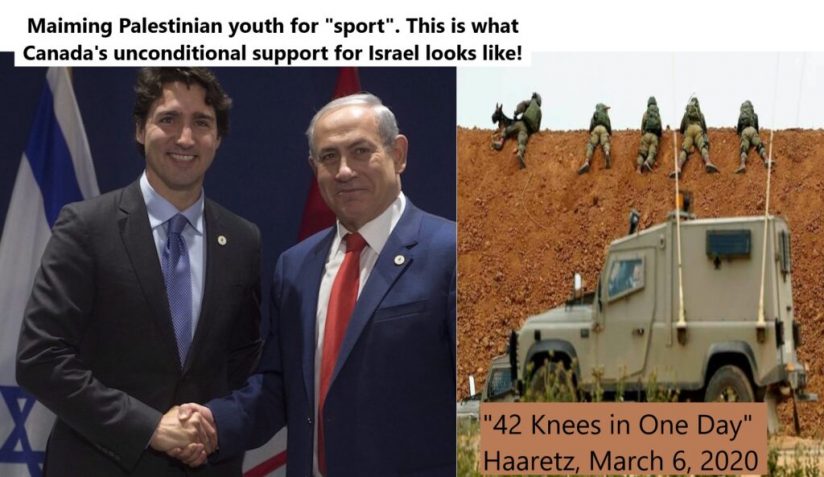
The new Haaretz report entitled “42 Knees in One Day” is a difficult and painful read, and many people of conscience have responded with disgust and rage.
For those few who have not seen the report, it details in chilling fashion the accounts of 6 Israeli snipers who were stationed at the border with Gaza during the Great Return March protests. The report is long and gruesome; I had to put it down and then return to it several times. The “42 knees” reference is the “high count” for how many Palestinians were maimed by a single sniper team in one day.
The overall message is one of devastating impunity and disregard for the sanctity of Palestinian life. Palestinians and their long-time supporters have always known this was the mentality at play, but to see it all compiled in one place, in black and white, in the soldiers’ own words, was damning. Especially here in Canada, where barely a week earlier, it was revealed that the Trudeau government had called on the International Criminal Court not to investigate war crimes accusations against Israel.
“Canada’s longstanding position is that it does not recognize a Palestinian state… In the absence of a Palestinian state, it is Canada’s view that the Court does not have jurisdiction in this matter under international law,” Canada’s Foreign Ministry reportedly told various media outlets.
This is the same Canadian government that is busy traveling the world trying to get (or buy) votes for a UN Security Council seat. That has sent Joe Clark, a former Prime Minister, to visit multiple Arab countries looking for support; the Joe Clark that pioneered the idea of moving Canada’s embassy from Tel Aviv to Jerusalem back in 1979, an election promise that he was later forced to abandon.
The same government whose Deputy PM and former foreign minister, Chrystia Freeland, informed an Israeli audience in late 2018 that Canada would be an “asset for Israel” at the UN Security Council if it got one of the non-permanent member seats.
Canada, and other governments, must understand that there is a direct trajectory from their unconditional support for Israel to the continuation of Israeli war crimes against the Palestinian people.
Hampering the ICC investigation, refusing to accept your own court’s decision on labeling of Israeli settlement wines, smearing pro-Palestinian advocates as “anti-semitic” as happened at York University last year, all of this enables the Israeli government and military to feel they are immune to any sort of accountability.
This new report on Israeli sniper violence against Palestinians is most profound in what lies in the shadows: the Israeli military’s crude but effective approach. Promoting the concept that maiming these Palestinian youth is somehow “more humane” than killing them outright. But permanently disabling them in a poor society with few resources for the healthy let alone the injured, is an equally cruel fate. And a poignant and daily reminder to the rest of that society of the price to be paid for rebellion.
Most of the sniper accounts demonstrated a total lack of appreciation of the consequences or severity of their actions. One said, when talking about the other soldiers and their initial reaction to maiming their victims:
“He has fulfilled himself just now, it’s a rare moment. Actually, the more he does it, the more indifferent he’ll become. He will no longer be especially happy, or sad. He’ll just be.”
The snipers work in a team with a locator and the “42 in one day” soldier, related how he suggested to his locator to take over the shooting when they were getting close to the end of their shift because “he didn’t have knees”.
And “you want to leave with the feeling that you did something”. (Note its just “knees”, not Palestinian lives or limbs.) The parallel here with how sports teams allow rookie players to be involved at the end of a game that they know they are winning, is unmistakable. And it also highlights that these snipers didn’t seem to feel threatened and had few concerns about their own safety.
I realize that the Israeli snipers are themselves indoctrinated kids. But I hate the system and ideology that brought them to this, that placed them on those dirt embankments overlooking the people of Gaza, that made them think this was all “sport” or a video game where the player with the most points wins.
And if I feel such rage thousands of miles away, I can only imagine (and will never judge) how the youth of Gaza and their families must feel.
– Marion Kawas is a member of the Canada Palestine Association and co-host of Voice of Palestine.
If You Like War, You’ll Love Joe
By Arshad Khan | CounterPunch | March 10, 2020
Like a cat with nine lives, Joe Biden keeps returning to the presidential race with a consistency akin to his votes for war — hard to find a war Joe did not like.
He voted for the Iraq war, still running in one form or another with American troops on the ground — despite a vote in the Iraqi parliament for their withdrawal. As Obama’s vice-president, his hands are soiled with the bombings and killings in Yemen; extending the Afghan war by increasing US force levels there; the airstrikes in Syria; and the death and destruction in Libya that included the wanton bombing of the hugely expensive system to transport water from the south to the capital, Tripoli.
It has been calamitous for these countries. They have suffered millions of dead and wounded, many, many more millions displaced, and a refugee problem that is straining EU ties and its policy of open borders. Economic migrants from Africa used to come to a previously prosperous Libya, work a while, then return home. With Libyan opportunities gone, they continue on to Europe from where it is difficult to return home, so they stay becoming permanent immigrants.
In fact, if we examine Europe’s refugee problem, a good portion of the blame rests with US wars. The migrants are from Afghanistan and its spillover in Pakistan; they come from Iraq, from Somalia, from Syria, from Libya, and from adjoining countries.
How much of all this included Joe Biden? Over 30 years practically everything, particularly for someone who proudly proclaims himself a ‘patriot’ … read support for every war. Yet during the Vietnam war he received student draft deferments, then asked to be reclassified because of asthma when he was a teen.
Accused of plagiarism in law school, he claimed he was confused about the rules for citation. He was given an F, and had to retake the course — the F later expunged from his transcript. He was also caught lifing phrases from others in his speeches causing him to drop out of the 1988 presidential nomination race. What is worrisome is that the last was carefully contrived to build a persona, as David Greenberg described in Slate (“The Write Stuff”, August 25, 2008). It is worth reading for it indicates a habit of mind that is lacking in ethics, perhaps just the kind corporate elites would prefer in the White House.
Poor Bernie. What chance does he have against the choice of corporate bulldozers and their associated media, the latter now painting him as a Russian agent? As propagandists maintain, the more ridiculous the story, the more believable it is in the public marketplace.
Before the current crop of Buttigiegs and the if-he-can-run-so-can-I types and, of course, Bernie and Warren splitting the progressive vote, Joe Biden had never won a presidential primary despite many, many attempts. South Carolina was the first, and now he has topped that with nine more on Super Tuesday this week.
In Joe’s dotage, unable to complete sentences or quotes, changing Super Tuesday into a ‘Super Thursday’, the onset of dementia has to be obvious. But then how many actually hear him speak or watch debates?
Nothing left but to hunker down and prepare ourselves for four more years of Trump. An addled, demented nominee is unlikely to be much of a challenge.
Arshad M. Khan is a former professor who has, over many years, written occasionally for the print and often for online media outlets.
All-star warmonger Lindsey Graham urges NATO to ‘get more involved’ in Idlib, Syria to stop ‘Syrian aggression’
RT | March 10, 2020
Veteran chickenhawk Lindsey Graham once again beat his over-used war drum, this time because he wants NATO to get involved in Idlib, Syria to stop “Syrian aggression.” Yes, when will Syria stop intervening in its own country?
The South Carolina senator said that he fully supports US President Donald Trump’s efforts to “get NATO more involved in Syria,” arguing that the defensive alliance should aid Turkey as it “defends Idlib against Russian/Syrian aggression.” He further argued that the “fall” of Idlib would result in a humanitarian crisis felt around the world, which is why NATO should be more “supportive” of its Turkish ally.
The senior statesman apparently doesn’t seem particularly fazed by the fact that Idlib is part of Syria – making accusations of “Syrian aggression” slightly nonsensical. The province is now home to the last bastion of extremist jihadist militias, some of which are directly affiliated with Al-Qaeda.
This is hardly the first time that the US hawk has demanded direct intervention in Idlib. In February, he called on the Pentagon to impose a no-fly zone over the Syrian province, claiming it would help stop the “destruction” of Idlib by Syrian, Iranian, and Russian forces.
As far back as September, Graham was issuing statements warning over “the wholesale massacre” of civilians in Idlib, insisting that “we either act now [in Syria] or pay a heavy price later.”
The senator’s melodramatic representation of a terrorist-infested Syrian province being under siege by the Syrian military shouldn’t come as a surprise to US political observers. Graham has been portrayed as part of former Arizona Senator John McCain’s “foreign policy club” – a euphemism for hardcore neocon interventionism.
Last week, Turkey and Russia brokered a ceasefire in the region, ending the fighting between Syrian and Turkish forces. But this hasn’t stopped the United States from trying to raise the stakes in northwestern Syria. The US reportedly offered to provide Turkey with ammunition to help in the conflict in Idlib. Turkish Foreign Minister Mevlut Cavusoglu said on Tuesday that Washington also offered land, sea, and air intelligence regarding the northwestern region. Although US “assistance” remains moderate at the moment and Graham’s fantasy of a NATO operation in Idlib seem unlikely, the warmongering section of US politics remains strong and its efforts to get Washington into more bloody conflicts with the blessings of the military-industrial complex are not likely to stop any time soon.
Craig Murray kept in Strange Limbo, can’t gain access to Alex Salmond trial
By Craig Murray | March 10, 2020
My efforts to accredit to cover the Alex Salmond trial continue to be stonewalled. I therefore cannot gain access to the court which is closed to the public while the anonymous accusers give their evidence. Media only are able to watch via CCTV from a media room, which is where I am trying to get. The established media are of course overwhelmingly hostile to Alex Salmond.
You will recall the media behaviour at the coverage of the Julian Assange hearing. They turned up in force on day one and gave major coverage to the prosecution opening statement. The headlines screamed that Julian Assange had “put lives at risk”, and was just an “ordinary criminal”. They then almost entirely left, and gave virtually zero coverage to the defence’s comprehensive refutation of these arguments.
I suspect we are going to see a similar dynamic at play here. The prosecution led yesterday with its key witness and the most serious accusations. The media have used screaming headlines – today’s Times has five separate articles on the trial – and Ms H’s accusations are given in enormous, salacious detail. I am willing to wager very large sums of money that the defence are not given nearly the same level of coverage. Which is why I need to be in there to record what really happens.
I have established firmly that I am not being kept out for reasons of space. I have been passed around various officials, but the lady from “judicial communications” in charge of the court is willing to admit me provided the Scottish Courts and Tribunal Service (SCTS) is willing to accredit me with their media card. I filled in the forms for that and sent in the photo last week. So far no response from SCTS, except that they yesterday referred me to “judicial communications”, who referred me straight back to SCTS again. The old runaround.
I am extremely frustrated by this as this is the key witness (I know who Ms H is, incidentally) and key evidence I am missing. There are a number of other subjects on which I might be blogging, but the annoyance is knocking my concentration at present, for which I apologise.
Venezuela: Nearly 50,000 Voting Machines Burnt in ‘Terrorist Attack’
By Paul Dobson | Venezuelanalysis | March 9, 2020
Mérida – An unknown militant group has claimed responsibility for a blaze which destroyed 99 percent of Venezuela’s electoral machines on Saturday.
In a video message published on Twitter on Sunday, seven masked men calling themselves the Venezuelan Patriotic Front stated that the attack formed part of “Operation Sodom,” a reference to the biblical tale of the city destroyed by “divine judgement” on the Jordan River.
The group goes on to justify the arson by alleging that electoral authorities have “violated the people’s rights through fraudulent elections.” In the same message, it also claimed responsibility for a fire last month at a state-run CANTV telecommunications center used in elections in Valencia, Carabobo State.
While the origins and connections of the group remain unclear, its video message pledged further actions against government supporters and leaders, which it defined as being “military targets,” as well as issuing warnings about “what may occur” at the upcoming opposition march on Tuesday.
Speaking Monday, National Constituent Assembly President Diosdado Cabello condemned the fire as a “terrorist attack.” Opposition leaders are yet to comment.
Another hard-right militant opposition group called the T-Shirt Soldiers endorsed the Patriotic Front’s actions and claimed they “were not finished.” The T-Shirt Soldiers claimed responsibility for the August 2018 C4-carrying drone assassination attempt against President Maduro.
According to the National Electoral Council (CNE), a massive fire on Saturday at the storage facility in the Filas de Mariche district on the outskirts of Caracas destroyed 49,408 electronic voting machines, 582 computers, 400 electronic ballot cards, 49,232 fingerprint identification machines and 22,434 power inverters. Only 562 voting machines and 724 fingerprint identification machines could be saved. All voting machines and other instruments are kept at the warehouse under military and civilian supervision between electoral processes.
The blaze caused no human injuries, but devastated the 1500 m2 facility, according to the reports of the 570 firefighters who tackled the fire.
Addressing the press on Sunday, CNE President Tibisay Lucena told the country that two national prosecutors have been assigned to investigate the fire, and that “no hypotheses have been ruled out.”
The voting machines were originally produced by the multinational company Smartmatic. The CNE ended a maintenance and repair contract with the company in 2017 following its “baseless” claims of fraud at the July 2017 National Constituent Assembly elections. The electoral body has not updated its machine stockpile since nor signed a new manufacturing contract, and a wide-reaching US embargo announced in 2018 threatens any foreign firm which engages with the organisation with sanctions.
The CNE has overseen 24 electoral contests since 1998, with National Assembly (AN) elections scheduled for 2020, with a date yet to be set. Lucena also took the opportunity to calm fears that this year’s elections would be affected.
“If there are small groups which think that this will end our constitutionally established electoral processes, they are very wrong,” she said. “We have the capacity, the legal know-how, the operative and logistical technology, 17 years of experience, and the human talent [to] guarantee the electoral processes in Venezuela as we know them: fast, transparent and trustworthy,” she went on.
Venezuela’s combined electronic and paper electoral system has been described as one of the most secure and transparent in the world by independent international observers. Nonetheless, discussions aimed at applying further consensual safeguards, as well as renovating the CNE leadership, have been part of a dialogue agenda between the government and a host of smaller opposition parties.
The efforts were boosted after a dissident opposition group wrested control of the National Assembly from former AN President Juan Guaido in January and backed the ongoing dialogue process as well as the renewal of electoral authorities.
Guaido has already ruled out taking his hard-right Popular Will party to the vote later this year, a position which has been backed by Washington. Other Guaido-aligned opposition parties, however, are still to announce whether they will participate, with Democratic Action party hinting that it will.
Russia Reportedly Creating ‘Medical Special Ops Units’
Sputnik – March 10, 2020
The Russian Defence Ministry will be creating medical special ops units in all military districts starting this year, Russian media reported on Tuesday, citing an unnamed military source.
Each of the medical units will comprise around 200 military medics capable of working in acting combat zones, in zones with declared emergency situations and epidemic zones.
Besides military medics and necessary medical equipment, the newly introduced units will also include field kitchens, bathhouses, tents and truck-mounted dressing rooms.
“Highly qualified medics, capable of carrying out complicated surgery are very important in acting combat zones as it can save the health and lives of servicemen. It’s of critical importance to receive professional surgery in the first hours after a heavy injury,” the source said.
According to the source, the medical special ops units could take part in military campaigns as well as conduct peacekeeping and humanitarian missions.
Previously, such units were used for relief efforts in Syria, assisted the authorities of the Republic of Guinea during the Ebola virus outbreak and helped to deal with outcomes of the last year’s devastating floods in Russia’s Irkutsk Oblast.
Russia gives Iran 50k coronavirus testing kits to help fight epidemic
Press TV – March 10, 2020
Russia has provided Iran with tens of thousands of testing kits for the novel coronavirus (COVID-19) as the Islamic Republic steps up the battle against the flu-like virus originating from China.
Iranian Ambassador to Moscow Kazem Jalali said Tuesday that the Russian government had donated 50,000 diagnostic kits to Tehran’s Embassy, adding that the equipment will be supplied to the medical personnel at the front line of the fight against the coronavirus outbreak inside Iran as soon as possible.
He also hailed Russia’s cooperation with Iran to counter the epidemic and stressed that both countries were determined to enhance ties in the health sector.
“Iran has taken necessary measures to contain the coronavirus and prevent its spread,” said the diplomat, but added that “eradicating this virus requires regional and global cooperation.”
The Iranian ambassador further expressed hope for closer Tehran-Moscow cooperation against the growing epidemic, which he described as an international threat.
Iran is developing its own diagnostic kits, which will be supplied to the market as of March 20.
On Tuesday, Iran confirmed 54 news deaths, the highest daily toll so far, raising the total fatality count to 291. A total of 8,042 infections have been diagnosed. And 2,731 patients have recovered, the Healthy Ministry said.
Most of the infections have been reported in the provinces of Tehran, Mazandaran, Isfahan, Rasht and Qom, where the virus was first found.
The coronavirus initially emerged in China late last year and is now spreading in Europe and across the Middle East, sparking fears of a global pandemic.
The illness, whose symptoms are fever, cough and difficulty breathing, may cause lung lesions and pneumonia.
Since December 2019, over 114,510 people have been infected in several countries, with more than 4,020 deaths mostly in China.
Intra-Afghan dialogue gets kickstarted
By M. K. BHADRAKUMAR | Indian Punchline | March 10, 2020
Three significant things about Ashraf Ghani’s swearing-in ceremony in Kabul on Monday augur well for the implementation of the US-Taliban pact signed in Doha on February 29.
One, the US officials, civilian and military, made a full court appearance at the ceremony in Kabul, affirming their reconciliation with Ghani. The US special representative for Afghan reconciliation Zalmay Khalilzad and US General Scott Miller, the commander of the US-led international force in Afghanistan, attended Ghani’s inauguration, apart from the EU, UN and western diplomats.
Two, Pakistan Prime Minister Imran Khan felicitated Ghani. He wrote on his Twitter page,“[I] look forward to working with him [Ghani]. Pakistan will do everything it possibly can to bring peace and stability in our region.”
Islamabad and Washington held back from congratulating Ghani when his election victory was formally announced last month. Now they are moving in tandem to engage with the Ghani presidency.
Three, Ghani announced in his speech at the ceremony that he will issue an order on Tuesday itself on the release of the Taliban prisoners. Ghani expressed the hope that the Taliban will reciprocate by significantly reducing violence. Thereby, Ghani is signalling that he will not block intra-Afghan dialogue.
Furthermore, he added that the government’s negotiating team for the intra-Afghan dialogue will also be finalised by Tuesday.
What may be even more significant than the above is that the Taliban is not creating a ruckus over Ghani’s inauguration. A senior figure in the Taliban leadership, Amir Khan Motaqi who is based in Qatar sounded optimistic that peace negotiations with the Afghan government will be “easier” than the Taliban’s marathon talks with the United States (which took around a year and a half).
“We will reach a conclusion with Afghans in a better way – of course with Afghans who consider other Afghans’ interests and do not consider foreigners’ interests,” Motaqi said. Another senior Taliban figure, Anas Haqqani, who was freed from Bagram prison last November, called the release of 5,000 Taliban prisoners important and urged the speedy formation of the negotiating team from Kabul so that the intra-Afghan dialogue can commence on March 10, as envisaged under the Doha pact of February 29.
In sum, Ghani’s induction or his change of heart — depending on how one views it — gives traction to the US-Taliban pact signed in Doha.
Contrary to doomsday predictions that the political rift in Kabul between Ghani and the former chief executive Abdullah over the disputed election results — Abdullah held his own inaugural ceremony in Kabul on Monday — would undermine the US-Taliban pact, the opposite seems to be happening.
Ghani’s brinkmanship in recent weeks served its real purpose, which was to get US support for his presidency and also carve out for himself an influential role in the inter-Afghan dialogue.
Pakistan and the Taliban have wisely kept away from getting embroiled in the Ghani-Abdullah rift and left it to Khalilzad to pacify Ghani.
Ghani apparently didn’t need much persuasion to do the two things that are Khalilzad’s top priority — release of the prisoners and the launch of the intra-Afghan dialogue. It is a fair guess that Khalilzad has struck some sort of deal with Ghani regarding the uncertain future role of the latter’s presidency.
The Taliban’s flexibility to hold talks with the Afghan government could be one factor here. Conceivably, Pakistan would have persuaded the Taliban to show flexibility.
If so, this is brilliant a tactic on the part of Islamabad and the Taliban. For, once the intra-Afghan dialogue begins, a new dynamic will appear in any case, and, given the fragmentation in the opposite camp, with so many cliques and factions jostling for position, Taliban would have the inherent advantage of being the only cohesive group at the negotiating table.
US President Donald Trump acknowledged these ground realities when he said on March 6 while talking to reporters at the White House that the Taliban could “possibly” overrun the Afghan government after foreign troops withdraw from the country as part of the Doha agreement.
As Trump put it, “Countries have to take care of themselves. You can only hold someone’s hand for so long.” Asked if the Taliban could eventually seize power from the current US-backed government, Trump said it is “not supposed to happen that way but it possibly will.”
This is of course a hypothetical scenario, since it will not be in Pakistan and Taliban’s interest to grab power forcibly in Kabul. It is useful to remember how much the Taliban hankered after US and UN recognition for its regime in Kabul in the nineties.
Significantly, the joint statement on the US-Taliban pact agreed by Special Envoys and Special Representatives of the European Union, France, Germany, Italy, Norway, the United Kingdom, the United Nations and the United States of America on the occasion of the signing of the U.S.-Taliban Agreement in Qatar spells out the expectations regarding the Afghan transition and it is quite obviously based on the understanding reached between Khalilzad and the Taliban.
The following paragraphs merit attention:
- “Reaffirmed that the Islamic Emirate of Afghanistan is not recognised by the international community, and furthermore, the international community will not accept or support the restoration of the Islamic Emirate of Afghanistan.”
- “Welcomed the Taliban committing to join a political process and their prospective role in a new post-settlement Afghan Islamic government as determined by the intra-Afghan negotiations.”
However, there is the “known unknown”— how far the fragile Afghan state structure will hold through the stresses and strains of the period ahead — negotiations with the Taliban and a period of profound transition to an entirely new beginning of state-building.
Importantly, Abdullah’s coalition which opposes Ghani is also a coming together of non-Pashtun groups — Tajik, Hazara and Uzbek. The ethnic overtone is ominous.
When asked whether the Afghan government had the ability to defend itself from fighters after foreign forces pull out, Trump was brutally frank: “I don’t know. I can’t answer that question. We’ll have to see what happens.”
Indeed, what happens next will also significantly depend on Abdullah’s future moves. He and his associates have thrown their weight behind the intra-Afghan dialogue but it is unlikely they will accept Ghani’s leadership to navigate the peace process.
To be fair, Khalilzad tried hard for a Ghani-Abdullah reconciliation, but it didn’t work. The bitterness lingers because this was a patently rigged election and Ghani doesn’t have a legitimate mandate to rule.
Meanwhile, the drawdown of the US troops has begun. Washington is unlikely to get entangled in Afghan domestic politics. To quote Trump, “We can’t be there for the next 20 years. We’ve been there for 20 years and we’ve been protecting the country but we can’t be there for the next – eventually, they’re going to have to protect themselves.”
Washington’s focus is going to be on the reduction in violence (ceasefire) and on verifiable evidence of the Taliban’s commitment to severe links with al-Qaeda.
The bottom line is, as the sensational report by New York Times on Sunday — A Secret Accord with the Taliban: When and How US Would Leave Afghanistan — confirms, the Doha pact is only the tip of the iceberg.
A matrix of understanding between the US, Pakistan and the Taliban provides the underpinning for the incoming Afghan peace process and the road map leading to a transition, based on their mutual recognition of the legitimate interests of all three protagonists.
The lockdown: One month in Wuhan
CGTN • February 28, 2020
At 10 a.m. on January 23, Wuhan went into lockdown. This was done to stop a deadly virus from spreading further across the nation. It was one day before Chinese New Year’s Eve, a major travel day for people planning to return home for the holidays.
This documentary is dedicated to all those who’ve been battling tirelessly against the COVID-19 virus in order to keep the epidemic at bay. Their efforts in safeguarding humanity from the virus will always be remembered.
Hung jury results in mistrial for former CIA tech accused of handing ‘Vault 7’ docs to WikiLeaks
Assange trial rehearsal?
RT | March 10, 2020
Federal prosecutors were unable to convince a jury on any of the spying-related charges against an ex-CIA engineer accused of stealing reams of classified material – in what may be a dry run for the case against Julian Assange.
In a significant blow to prosecutors on Monday, jurors failed to come to a verdict on eight central counts against former CIA software engineer Joshua Schulte, who was charged for stealing thousands of pages of classified information on the agency’s secret hacking tools and passing them to WikiLeaks – what later became its ‘Vault7’ release, the largest breach of classified material in CIA history.
While Schulte was found guilty of contempt of court and making false statements to investigators, a hung jury on the remaining eight charges – including illegal gathering and transmission of national defense information – prompted District Judge Paul Crotty to order a mistrial and dismiss the jurors on the case, who had deemed themselves “extremely deadlocked” in a note to the judge.
The split verdict came after nearly a full week of messy deliberations, which saw one juror removed for researching the facts of the case against Crotty’s orders. She was never replaced, however, leaving a short-handed panel to deliver a final decision.
The former technician left his job in the CIA’s Langley headquarters in 2016 and was charged some two years later for his alleged role in the Vault 7 leak. But prosecutors had difficulty tying Schulte to the disclosure throughout his four-week trial, with jurors often mystified by a complicated maze of technical evidence.
The case may offer parallels to that of WikiLeaks co-founder Julian Assange, who faces 17 charges under the World War I-era Espionage Act and up to 175 years in prison over his role in the publication of the Iraq and Afghan war logs in 2010. Assange is accused of helping leaker Chelsea Manning (then known as Bradley) “hack” into military computers to obtain classified material, but if extradited from the UK to stand trial in an American courtroom, prosecutors would likely produce similar technical forensics to prove his involvement, precisely what the government was unable to do in Schulte’s case.
Arguing that the CIA’s computer network had widely known vulnerabilities, including poor password protections, Schulte’s defense insisted prosecutors had failed to prove his role in the breach. They noted it was possible another actor gained access to his work station, pointing to another CIA employee identified only as “Michael” as a potential culprit.
The CIA later placed the employee on administrative leave for refusing to cooperate with the investigation, which suggested the government had “doubt about the case against Mr. Schulte,” defense attorney Sabrina Shroff said in her closing argument on Monday.
Prosecutors are likely to demand a retrial for Schulte, and he still stands accused of possessing child pornography, allegedly stored on devices found during a search of his home. He will be tried separately on those charges, facing a total of 15 counts.
Wikipedia Slashes Spanish Flu Death Rate
From 20% to 2% is a quite a drop. What’s going on?
By Catte Black | OffGuardian | March 9, 2020
We’ve had a couple of people BTL take issue with us regarding the case fatality rate (CFR) of the 1918 Spanish Flu. Citing Wikipedia and the CDC we gave that rate as being between 10-20%. A couple of commenters, however, insisted the actual CFR was 2-3%, and this led us to look further.
What we found was quite interesting.
This is the pre-February 22 2020 opening paragraph of the ‘Mortality’ section on the Wiki page for the Spanish flu (our emphasis):
The global mortality rate from the 1918–1919 pandemic is not known, but an estimated 10% to 20% of those who were infected died (case-fatality ratio). About a third of the world population was infected, and 3% to 6% of the entire global population of over 1800 million[51] died.[2]
This is how the same paragraph reads now:
It is estimated that one third of the global population was infected,[2] and the World Health Organization estimates that 2–3% of those who were infected died (case-fatality ratio).
That’s quite a big change in a pretty short time.
What’s going on? Why is the CFR suddenly being downgraded so dramatically?
The WHO report they use as a source is not about the Spanish Flu, but simply mentions it in passing. It does indeed say 2-3% of those infected died, but gives no source for this, and also claims this represents 20-50 million people.
The trouble with that is the higher range of this estimate (50 million as 2% of total cases) gives a figure of 2.5 billion total cases. Which is higher than the entire population of the world at the time! (1.8 billion).
So something is clearly amiss.
Worse still, the WHO is the only source we have found so far that claims a death toll of 20 million. Most sources, such as the CDC (and see here), broadly agree that between 50 million and 100 million people died of the Spanish Flu (although one recent study wildly differs, see below). In order for 50-100 million deaths to be 2-3% of total cases there would have had to be 2.5 billion – 5 billion cases.
Obviously totally impossible.
Clearly there is something wrong with that newly revised figure of 2-3%. The only way to make it work is to also dramatically revise downward the number of deaths. And indeed there’s evidence of editors trying to do that on Wiki with someone citing a December 2018 study which used a controversial “new methodology” to establish a mortality figure of just 17 million. Given that this number has previously been estimated for India alone, this is remarkable revisionism.
Now, of course, there are debates about numbers of infections versus fatalities in every case study in epidemiology. It’s not an exact science. It’s fluid. Of course, estimates will vary and errors will be made and corrected. There’s more to be said about the inherent uncertainties in these cases, and we are currently talking to a respected virologist with the intention of covering the question further in future. Maybe the previous estimates of infection and fatality were too high. Maybe there is a rational case to be made for lowering them.
But is that what we are seeing on Wiki?
We all know Wikipedia is a micro-managed propaganda organ, so the fact its page on the Spanish Flu began a huge uptick of edits in December 2019, rising steadily until February 2020, and that the bulk of these edits seem concerned with – subtly and overtly – downgrading the severity of the 1918 pandemic has to be of interest.
Why the sudden decision to vastly downgrade the estimated CFR for the 1918 pandemic and source to a rather obscure WHO article that doesn’t even focus on that issue? And, more importantly, why does this extreme downgrade still exist on the page even when editors are pointing out the impossibility of the figures?
At least this new editorial policy by Wiki is well-timed for those looking to stoke fear, and unfortunate for those trying to bring reason to bear. It allows the media and others to cite the newly downgraded 2-3% CFR as evidence that COVID19 is as dangerous as, or more dangerous than, the Spanish Flu and will end up killing millions. That’s some nice clickbait right there.
Is it just human confusion? Maybe.
There is a report by a virologist, and cited by the CDC, that confirms the heretofore commonly accepted 500 million cases and 50-100 million deaths and adds this is a CFR of ‘over2.5%’. Which of course it is. It’s a CFR of 10-20%, as he would be the first to recognise. And 10-20% is over 2.5%.
Maybe his slightly ambiguous wording has led people astray? Maybe people consulting his work, as many do, including the Wiki editors, have taken ‘over 2.5%’ to mean just over, or even to mean exactly 2.5%? Maybe that’s all this is.
Maybe.
But at any rate, the error, whatever it is, wherever it came from, isn’t ours. We didn’t make up the 10-20% CFR of Spanish Flu. It was the standard assessment until very, very recently. It still exists, though somewhat hidden now by ambiguous wording and confusion.
Featured Video

Michael von der Schulenburg: Europe’s Self-Defeating Iran War Policy
or go to
Aletho News Archives – Video-Images
Frlom the Archives
Provoking a Path to Persia
The Saban Center’s prescient paper on war with Iran
By Maidhc Ó Cathail | October 20, 2011
In June 2009, the Saban Center for Middle East Policy published “Which Path to Persia?—Options for a New American Strategy toward Iran.” Writing in a tone strikingly reminiscent of the Project for a New American Century’s infamous pre-9/11 paper “Rebuilding America’s Defenses,” the six co-authors noted that, “It seems highly unlikely that the United States would mount an invasion without any provocation or other buildup.” For a think tank specifically established by media mogul Haim Saban to protect Israel, this could prove to be a formidable obstacle impeding their desired march—of U.S. troops—to Tehran.
“In fact, if the United States were to decide that to garner greater international support, galvanize U.S. domestic support, and/or provide a legal justification for an invasion, it would be best to wait for an Iranian provocation, then the time frame for an invasion might stretch out indefinitely,” Saban’s think-tankers ruefully observed.
“With only one real exception, since the 1978 revolution, the Islamic Republic has never willingly provoked an American military response, although it certainly has taken actions that could have done so if Washington had been looking for a fight. Thus it is not impossible that Tehran might take some action that would justify an American invasion. And it is certainly the case that if Washington sought such a provocation, it could take actions that might make it more likely that Tehran would do so (although being too obvious about this could nullify the provocation). However, since it would be up to Iran to make the provocative move, which Iran has been wary of doing most times in the past, the United States would never know for sure when it would get the requisite Iranian provocation. In fact, it might never come at all.”
Seemingly undeterred by Iran’s frustrating unwillingness to provide the requisite provocation, the analysts continued to examine this option… continue
Blog Roll
 Aletho News
- The EU never learns – except for the wrong lessons
- Iran attacks on UAE leaves RSF militia high and dry
- Hosting Washington’s war: Bahrain faces the consequences
- The US fell for its own Iran propaganda
- Seyed M. Marandi: Threat of Seizing Kharg Island & the Use of Nuclear Weapons
- Is there even an off ramp?
- Michael von der Schulenburg: Europe’s Self-Defeating Iran War Policy
- Sorry, The New Republic, Climate Change Isn’t Causing Somali Migration. Blame Civil Strife and Poverty.
- Expert Guts Claims That HPV Vaccine Reduces Cancer Risk
- No evidence Russia sabotaged Baltic cables – Finnish intel
- If Americans Knew
- 6 more Americans killed, as Israel ‘mows the lawn’ in Iran – Not a ceasefire Day 154
- Are we on the precipice of World War III?
- ‘Catastrophic,’ Says UNICEF: 1,100+ Children Killed or Wounded in Mideast Since US-Israel Launched Iran War
- The Unbelievable Madness of Our War With Iran
- World Council of Churches calls on govts to hold Israel accountable for violations of intl law
- How to end the war on Iran that costs US taxpayers $1M per minute – Not a ceasefire Day 153
- Israeli strategic plans to “remake the Middle East” from the 1950s and since
- Honoring Gaza’s women who refused to let the world look away
- 97% of victims of war on Iran are Iranian, 98% of victims in war on Gaza are Gazans – Not a ceasefire Day 152
- Early Iran strikes cost $5.6 billion in munitions, Pentagon estimates
- No Tricks Zone
- New Studies: UK Sea Levels Were 4 Meters Higher Than Today During The Mid-Holocene
- Destructive Green New Deal: German Energy And Metal Group Warns Of Drastic Crisis
- New Study Documents A 20-Year Pause In Arctic Sea Ice Decline – Driven By Internal Variability
- Wake-up Call: Survey Shows Majority Of Germans Now Favor Postponing Climate Targets!
- Televised! Leading German Political Candidate Tells Schoolchildren CO2 Makes Sun Hotter!
- New Study: A Century Warming Of 1.1°C Is ‘Commonplace’ And ‘Not Unusual’ During This Interglacial
- New Study: ‘Internal Noise’ And Volcanic Forcing Can Trigger 10-15°C Warming Within Decades
- Glaciers Worldwide Are Suddendly Surging, Experts Blame Warming!
- Surprising Discovery: Sahara Is Greening…Billions Of Trees Where Once Thought To Be Barren
- New Research Reaffirms Clouds, Aerosols, And Surface Solar Radiation Are ‘Driving The Climate System’
 Aletho News