UK press acts as ‘appendage of the state’ when reporting on foreign policy, new analysis shows
RT | March 9, 2020
A new analysis of British media’s coverage of foreign policy has found that, by and large, the UK press acts as “an appendage of the state” and has been “misinforming the public” and “failing to report” completely on key issues.
The statistical analysis was carried out by Declassified UK, a new “public service journalism” project investigating Britain’s foreign,military and intelligence policies and run by journalist and historian Mark Curtis.
On Twitter, Curtis said the current state of UK press reporting on foreign policy is “shocking” and that the media was “systematically misinforming” the public on numerous issues, as well as routinely “falsely reporting” on the UK’s “supposed benevolent role” around the world.
Among its findings, Declassified UK said that the term “rules-based international order” has been used in 339 press articles over the past five years — and that Britain is invariably cast as an upholder of that order, despite being “as much a violator of international rules as any official enemy.”
Yemen, Syria and the OPCW
When it comes to the war in Yemen, the press has “overwhelmingly failed” to report the extent to which this is also a British war due to its key role in arming Saudi Arabia.
While many articles covered UK arms exports to Riyadh, “no articles could be found” mentioning the UK’s role in storing and issuing bombs for Saudi aircraft and maintaining warplanes at key operating bases.
The UK media has also mostly “ignored” British military support programs in Saudi Arabia itself, showing a “lack of interest on the part of journalists to expose key aspects of UK foreign policy,” it said.
On the war in Syria, the Times and Telegraph have reported only “sporadically” on Britain’s involvement in the conflict, while the Guardian has accused the UK of having “failed to act” in the war-torn country — despite the fact that Britain began covert operations in Syria as early as 2011.
In addition, comments from former OPCW director Jose Bustani noting “irregular behavior” in the watchdog’s controversial Douma investigation were reported in “only one” press outlet — the Mail on Sunday. Three whistleblowers raised the alarm last year about what they claim was the suppression of key information from the OPCW’s official report on the alleged chemical attack, but their concerns have received little airing by British journalists.
Failure on Assange
The UK press has also failed in its duty to report fully on the case of jailed WikiLeaks founder and whistleblower Julian Assange, the analysis found. “No UK press outlet” has written about UN special rapporteur Nils Melzer’s letter to the government calling for officials to be investigated for “criminal conduct” in relation to Assange’s case. Melzer has repeatedly said that Assange is being subjected to “psychological torture” at Belmarsh Prison.
In contrast, the British press frequently highlights UN reports on the torture and imprisonment of journalists in foreign countries, it noted.
Israel and GCHQ
Despite reporting in Israeli media on the “unprecedented” recent British-Israeli military cooperation, there was no coverage by the UK press of Israel’s first-ever deployment of fighter jets to Britain last year — or of an admission in parliament in 2018 that the UK was offering military training to Israel.
The analysis also found that GCHQ’s covert action program known as JTRIG has been specifically mentioned “less than a dozen times” in the national press since Edward Snowden revealed it in 2014 — and all were brief mentions in articles focusing on other subjects. “This is in sharp contrast to the vast attention paid to Russian covert programmes,” Curtis wrote.
The research, which is the first in a two-part series, covered national print media and did not include the national broadcasters like the BBC.
Ultimately, the study found that the British public is being “bombarded” by views which support the priorities of UK policymakers and there is only a “very small space” in the British press for independent analysis of foreign policy.
Joe Biden: Father of the Drug War’s Asset Forfeiture Program
By Chris Calton – Mises Institute – 03/06/2020
In 1991, Maui police officers showed up at the home of Frances and Joseph Lopes. One officer showed his badge and said, “Let’s go into the house, and we will explain things to you.” Once he was inside, the explanation was simple: “We’re taking the house.”
The Lopses were far from wealthy. They worked on a sugar plantation for nearly fifty years, living in camp housing, to save up enough money to buy a modest, middle-class home. But in 1987, their son Thomas was caught with marijuana. He was twenty-eight, and he suffered from mental health issues. He grew the marijuana in the backyard of his parents’ home, but every time they tried to cut it down, Thomas threatened suicide. When he was arrested, he pled guilty, was given probation since it was his first offense, and he was ordered to see a psychologist once a week. Frances and Joseph were elated. Their son got better, he stopped smoking marijuana, and the episode was behind them.
But when the police showed up and told them that their house was being seized, they learned that the episode was not behind them. That statute of limitations for civil asset forfeiture was five years. It had only been four. Legally, the police could seize any property connected to the marijuana plant from 1987. They had resurrected the Lopes case during a department-wide search through old cases looking for property they could legally confiscate.
Asset forfeiture laws once applied only to goods that could be considered a danger to society—illegal alcohol, weapons, etc. But with the birth of the modern war on drugs, lawmakers pushed for something with more teeth, which they achieved with the 1970 passage of the Racketeering Influence and Corrupt Organizations (RICO) Act. Although many are familiar with the story of the steady expansion of civil asset forfeiture laws, many overlook the fact that presidential candidate Joe Biden helped put these laws on previously apathetic law enforcement agents’ radar and, worse, played a significant role in broadening their application. Biden has effectively aided and abetted the police state’s sustained assault on American subjects’ property rights.
Expanding Asset Forfeiture, Phase I: The RICO Act of 1970
In 1970, the targets of asset forfeiture were wealthy crime bosses. It was prosecutor G. Robert Blakey, who had worked under Attorney General Robert Kennedy and various congressmen, who set about broadening its scope. He helped draft a bill for a new legal concept, “criminal forfeiture,” which would allow police to seize the illegally acquired profits of a convicted criminal.
The assets that could be seized would now consist of anything that was funded with money connected to criminal activity. To appease those who were worried about abuses of power, Blakey assured them that prosecutors would have to prove beyond a reasonable doubt that the criminal was guilty of a crime before the assets could be seized. There was nothing to worry about; only legitimate bad guys would suffer.
The new policy was passed as part of the Racketeering Influence and Corrupt Organizations (RICO) Act in 1970. Blakey was a fan of the 1931 movie Little Caesar, and the acronym was crafted to honor Blakey’s favorite character from the movie, the gangster Rico Bandello.
The RICO Act wasn’t designed to be part of the war on drugs; it was just meant to target criminals. But when Richard Nixon took office, the RICO Act was one of a number of new tools that the members of his newly created Bureau of Narcotics and Dangerous Drugs (precursor to the Drug Enforcement Administration (DEA)) could use to fight his drug war. Combined with other legal innovations, such as no-knock raids and mandatory minimum sentences, Nixon and his administration would cure America of the drug menace.
Still, the pesky “conviction” requirement stood in the way of law enforcement’s ability to seize criminal assets. In 1978, Jimmy Carter’s director of the Office of Drug Abuse (the title “drug czar” is often retroactively applied), Peter Bourne, decided that the law needed to be changed. Bourne learned of an incident at the Miami International Airport in which a suitcase had been left on the baggage carousel for three hours before police picked it up and found $3 million inside. If drug kingpins could afford to abandon so much money, they must be flush with enough cash to hardly worry about criminal forfeiture laws.
So, at Bourne’s urging, Congress modified the RICO Act to allow the DEA to confiscate assets without a conviction. The burden of proof wasn’t entirely gone (yet), but the government only needed an indictment, rather than a full conviction, to justify asset seizure. After all, the government knew who a lot of these kingpins were, but the criminals continued to get rich while the DEA struggled to build cases against them.
Even then, though, real estate was off limits. Asset forfeiture had evolved from the seizure of dangerous items into criminal profit following a conviction, and now into criminal profit (and its “derivative proceeds”) without the conviction requirement. But real estate—such as the Lopes house—still couldn’t be touched.
But through the 1970s, the RICO Act was still largely ignored by prosecutors. Blakey was holding seminars out of Cornell University, which were attended by federal law enforcement agents and prosecutors, urging them to take advantage of the RICO Act in the war on drugs. He made few inroads. The law was unwieldy, and prosecutors were overworked. More often than not, it wasn’t worth their time. While Blakey was proselytizing the virtues of his law to little effect, he was unwittingly gaining an ally in Congress: Senator Joe Biden.
Expanding Asset Seizure, Phase 2: Biden and the Comprehensive Crime Control Act of 1984
Biden, a young Senator from Delaware, had to do something to show that despite his “liberal” reputation, he could be just as tough on crime as his Republican colleagues. He took notice of the RICO Act, and he realized that law enforcement agencies were not taking advantage of it, particularly in waging the drug war. He turned to the General Accounting Office and asked them to produce a study on the potential uses of RICO for drug enforcement.
The report showed that the RICO Act granted enormous powers to police to confiscate drug-related assets but that these powers were not being taken advantage of: “The government has simply not exercised the kind of leadership and management necessary to make asset forfeiture a widely used law enforcement technique,” the report stated. By the time the report came in, Ronald Reagan was settling into office and getting ready to renew the war on drugs.
Reagan brought the FBI into the drug war, and he gave the director, William Webster, a mission. His agents would use the powers of the RICO Act to find drug rings and take away their assets. Drug cartels must be rendered unprofitable. As the 1980s progressed, the war on drugs would be the country’s biggest political issue. Politicians from both parties would work to show that they could out–drug warrior their opponents. One Democratic representative from Florida, Earl Hutto, said, “In the war on narcotics, we have met the enemy, and he is the U.S. Code.”
Biden brought the RICO law to the attention of the federal government, Reagan enlisted the FBI to use it against drug traffickers, and both parties would now work to dismantle any limitations that the law might still impose.
The drug war became a contest of political one-upmanship. Reagan’s Justice Department fought for all kinds of new powers. Attorney General Edwin Meese and Assistant Attorney General William Weld (yes, that Bill Weld) railed against the limitations on their legal prerogative. Weld went so far as to argue in favor of the legality of using the Air Force to shoot suspected drug-smuggling planes out of the sky, a policy that even his boss was unwilling to endorse.
But Meese, Weld, and everyone else seemed to agree that forfeiture laws didn’t go nearly far enough. By requiring an indictment, the government still had to meet some standard of reasonable guilt before seizing property, which allowed far too many criminals that law enforcement knew to be guilty (but couldn’t build a case against) to keep their ill-gotten gains. To take things further, the Justice Department argued that law enforcement should be allowed to take “substitute” property: they knew that they wouldn’t be able to take everything that had been paid for with drug money, so it stood to reason that they should be able to take legally acquired assets of equal value (however that might be determined). And finally, with real estate off limits, the government was unable to seize marijuana farms, drug warehouses, and criminal homes.
The Comprehensive Forfeiture Act fixed all of these problems. Biden introduced the new bill in 1983, and its provisions became law the next year. Under this law federal agents had nearly unlimited powers to seize assets from private citizens. Now the government only needed to find a way to let local and state police join the party.
Biden’s bill was passed as part of the 1984 Comprehensive Crime Control Act. In addition to a slew of new powers for prosecutors, the burden of proof for asset seizure was lowered once again (agents had to only believe that what they were seizing was equal in value to money believed to have been purchased from drug sales). More significantly, the bill started the “equitable sharing” program that allowed local and state law enforcement to retain up to 80 percent of the spoils.
The law took effect in 1986, the year before Thomas Lopes pled guilty to charges of growing a marijuana plant in his parents’ backyard. In 1987, when Thomas faced the judge, the government had just made it so that his local police had an enormous incentive and unchecked authority to seize property from private citizens, so long as they could show any flimsy connection to drugs. By 1991, the Maui police were running out of easily seized property, so they started combing through case files within the five-year limit to find new sources of enrichment for their precinct using the expanded RICO powers. One such file brought the Lopes home to their attention.
But the Lopeses are only one example out of millions. In the year their home was confiscated by police for a minor, four-year-old drug charge, $644 million in assets were seized. In 2018 alone, the Treasury Department’s Forfeiture Fund saw nearly $1.4 billion in deposits . The Lopes story merely illustrates that criminals (regardless of how one might feel about drug laws) are hardly the only people falling victim to this policy.
The decades-long abuse of this policy has reached such extreme proportions that people on all sides of the political aisle have been turning against it. At this writing (February 20, 2019 for the original version of this article), the Supreme Court has unanimously voted in favor of Tyson Timbs , whose $42,000 Land Rover was seized in 2015 following a conviction for selling $400 in heroin. The court is asserting that asset forfeiture constitutes a fine and that the Eighth Amendment—which protects citizens from excessive fines—applies to both state and local governments. The consequences of the ruling remain to be seen, but it seems nearly certain that the unanimous decision was motivated by the increasing outrage against the civil asset forfeiture policies.
In the fight against the egregious violation of property rights that is asset forfeiture, Americans must not forget who promulgated these laws and birthed a new paradigm of government aggression against private persons that is proving difficult to overturn.
References
Baum, Dan. 1996. Smoke and Mirrors: The War On Drugs and the Politics of Failure. Boston: Little, Brown and Company.
Chris Calton is a 2018 Mises Institute Research Fellow and an economic historian. He is writer and host of the Historical Controversies podcast.
See also his YouTube channel here.
US marines arrive on Yemen’s Socotra to support UAE forces
MEMO | March 9, 2020
A new batch of US Marines arrived on the Yemeni island of Socotra on Saturday, according to local sources, installing Patriot defence systems.
Sanaa Post reported that the American soldiers were received by the “occupying” UAE forces at their headquarters on the island.
There is speculation that the US intends to establish its own military base amid reports that America had sent military experts to equip observation points to deploy radars and air defence points on the strategically located island overlooking the Arabian Sea and the Indian Ocean.
US forces had previously arrived on Socotra in December of last year and reportedly started installing a Patriot missile system in order to protect the Saudi and Emirati forces on the island at the time.
According to the sources, on 21 December of last year, Saudi Crown Prince Mohammed Bin Salman ordered the UN-recognised, exiled Yemeni government of President Abd Rabbuh Mansur Hadi to lease the entire island to the UAE for a period of about 95 years. Saudi and Emirati forces began to arrive on the island in April 2018, the Saudi deployment was reportedly coordinated with the Yemeni government, whilst the UAE arrived without prior coordination with the Saudi-backed Yemeni authorities.
Saudi arms imports increased by 130%
MEMO | March 9, 2020
The global arms industry has enjoyed a major boon period over recent years with the rise of tension and military conflict across the globe.
The US has seen the largest financial windfall from the sale of arms while Saudi Arabia continues to be the world’s largest importer of arms according to a new report released today by the Stockholm International Peace Research Institute (SIPRI).
According to SIPRI, which keeps the only publicly available database on the transfer of arms, “arms imports by countries in the Middle East increased by 61 per cent between 2010-14 and 2015-19, and accounted for 35 per cent of total global arms imports over the past five years.”
Saudi Arabia has seen a 130 per cent increase compared with the previous five-year period making it the world’s largest arms importer in 2015-19. The volume of weapons purchased by Riyadh accounted for 12 per cent of the global arms imports in that period.
The USA and the UK remain the main source of arms for the kingdom. A total of 73 per cent of Saudi Arabia’s arms imports came from America while 13 per cent of its arsenal were supplied by UK, despite major concerns in both countries over Riyadh’s military intervention in Yemen.
The United Arab Emirates (UAE), which has been militarily involved in Libya as well as Yemen over the past five years, was the eighth-largest arms importer in the world between 2015-19. The US supplied two-thirds of the arms imported by Abu Dhabi.
SIPRI noted that in 2019, when foreign military involvement in Libya was condemned by the United Nations Security Council, the UAE had major arms import deals ongoing with a number of other countries including, the UK, Australia, Brazil, Canada, China, France, Russia, South Africa, Spain, Sweden and Turkey.
Turkish arms imports were 48 per cent lower between 2015-2019 than in the previous five-year period, even though its military was fighting Kurdish rebels and was involved in the conflicts in Libya and Syria. The SIPRI report explained that the reason for this decrease was due to delays in deliveries of some major arms; the cancellation of a large deal with the USA for combat aircraft; and developments in the capability of the Turkish arms industry.
The main supplier of weapons worldwide is still the US, which has increased its arms exports by 23 per cent, according to SIPRI.
Anti-Interventionist Think Tank’s Debut is a Dud
By Gareth Porter | Consortium News | February 28, 2020
Given the current epochal political upheaval against entrenched political-economic elites driven in part by popular discontent over endless U.S. wars, the debut of the anti-interventionist Quincy Institute on Wednesday should have been an explosive event.
But it seemed more like a toy pop gun than a political bombshell.
Perhaps that was the intention of Quincy’s leadership. The organization, whose full name is the Quincy Institute for Responsible Statecraft, has eschewed an all-out attack on the national security elite in favor of the catch-phrase “realism and restraint.” That doesn’t raise the flag of political struggle against the existing policymaking system but rather suggests it will merely nibble at its edges.
So, one shouldn’t be shocked that Quincy’s first policy event was a partnership with Foreign Policy magazine, whose editorial slant is decidedly aligned with the interests of the dominant national security elite. It was Foreign Policy magazine that advanced the idea of having former CIA Director Gen. David Petraeus as the big name draw for the conference, according to people familiar with the origins of the conference.
Quincy needed a way to highlight the weaknesses of the status quo elite’s ideas and the power of its own alternative, and a debate between Petraeus and a highly articulate opponent of his position and argument would have done that. That was a talking point for the defense of Petraeus as a representative of the war system offered by one Quincy officer in advance of the conference.
But Petraeus was not about to agree to any such exercise. He is used to speaking from a position of power and not having to defend against sharp rebuttals and tough arguments. A one-on-one debate with an articulate opponent would have exposed him even more clearly as a vacuous windbag.
Softballs for Petraeus

Foreign Policy’s Editor-in-Chief Jonathan Tupperman. (Twitter)
Instead of witnessing such a riveting confrontation, the audience got Petraeus being fed softball questions from FP Editor-in-Chief Jonathan Tupperman and giving carefully memorized answers, including what he called “five big ideas we should have learned” (examples: “Ungoverned spaces will be exploited by Islamist extremists;” “The United State has to lead.”) [This from Petraeus who once said the U.S. was right to partner with al-Qaeda in Syria.]
That format allowed Petraeus to answer Tupperman’s question whether the United States can continue to use military force to maintain the “liberal world order” in light of the popular support for President Donald Trump and Democratic presidential contender Senator Bernie Sanders by claiming smugly, “I’m for restraint as well,” then adding the lamest line of the day (which he apparently thought was clever): “We should be for more restraint until we shouldn’t be.”
Then the Petraeus segment was over, with Tupperman observing that there was no time left for audience questioning of the man still venerated in a regime of worshipful media coverage of Iraq and Afghanistan as the man that had saved us from defeat in Iraq and had been successful in Afghanistan until he wasn’t successful. The mysterious failure of Tupperman to have left time for questions averted any possibility of someone in the audience recalling how Petraeus had played a crucial role in the unfolding of sectarian violence in Iraq by arming and training a sectarian Shiite militia — the Wolf Brigade — that was then sent into virtually every major Sunni population center in 2004-05.
Then Representative Ro Khanna, the smartest and most articulate congressional advocate for a non-interventionist viewpoint, laid out in an exchange with Cato Institute supporter Will Ruger a sharp critique of U.S. military interventions in the Middle East, starting with the enormous boost that U.S. interventions gave to the previously weak al Qaeda, which went from a presence in three countries before 9/11 to 23 countries today.
Debate Stifled
It was a thoughtful and persuasive case for a sharp turn in U.S. policy. But there was no real debate with Petraeus. In the absence of debate, the conference lacked any dramatic moment announcing the arrival of a powerful new voice for radical change in U.S. policy.
Much of the rest of the conference, moreover, had a tenor and pace reminiscent of many dozens of Washington think tank events on national security policy attended by this writer for years before giving them up a few years ago. That’s because it consisted of brief and almost always polite exchanges between advocates of new policies and representatives of centrist think tanks that are deeply enmeshed in those policies and the institutional interests underlying them.
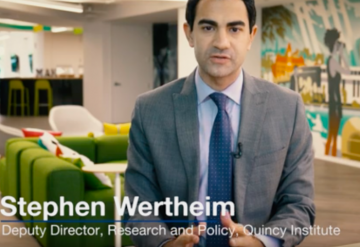 The closing session pitted Quincy Institute Deputy Director Stephen Wertheim against Rosa Brooks of New America and Tom Wright of the Brookings Institution, both of whom rejected the very idea of ending America’s existing wars. They argued that the U.S. troops in Iraq and Syria are really “counter-terrorism operations” rather than “wars.” Brooks even uttered the word identifying her as a member of the national security elite in good standing by calling for a “robust” policy.
The panel billed as “A New Vision for America’s Role in the World” didn’t actually offer that at all. That phrase turned out to be simply a convenient catch-all for the views of foreign policy advisers to both Bernie Sanders (Matt Duss) and former Vice President Joe Biden (former NSC official Julianne Smith), neither of whom articulated anything resembling a new policy vision.
Ironically, on the day that Politico’s “Morning Defense” reported Sanders’ clear lead in the Democratic race had triggered fears among military contractors of “an unprecedented threat to the status quo,” the most daring suggestion from Duss was that Sanders was for diplomacy with Iran.
Military ‘Wants Out’
There were a few moments that unexpectedly elevated the discussion well above the usual humdrum Washington think tank chatter. In a panel on the Middle East independent journalist Mark Perry, who has long had access to senior military officers on background, reported that his military contacts “want out” of the wars in the Middle East.
He added, moreover, that Trump has those officers’ trust, because they believe he wants out, too. But Perry’s most important contribution was to challenge the whole idea that the United States is capable of accomplishing anything positive with its serial military interventions in the Middle East. “We can’t do this,” said Perry, “so what are we doing?”
No Full, Unfettered Analysis
The lesson of Quincy’s debut seems reasonably clear: You can’t hope to disrupt the national security elite’s grip on policy by playing by the establishment’s rules. Foreign Policy was never going to agree to a format that would permit a direct confrontation over the key issues, much less, a full, unfettered analysis of the system of power that underlies that elite’s public role in defending America’s endless wars.
An organization devoted to attacking its illicit and increasingly unpopular policies can only gain traction by offering an analysis that will appeal to the anti-elite sentiments that have already shaken the U.S. political system to its foundations.
That would mean going beyond “realism and restraint” and talking about the need for fundamental change in the system of national security institutions themselves. Of course, taking that lesson on board might not be in line with the thinking of major funders. It could imply a major reorganization and even a much smaller staff. But if it doesn’t heed the lesson of its initial conference, Quincy is likely to find that the real action in bringing about change in U.S. foreign and policy is coming from political forces involved in the larger national power struggle.
Hamas condemns continued detention of Palestinian officials in Saudi Arabia
Press TV – March 9, 2020
A Hamas spokesman has condemned the continued detention and prosecution of Palestinian figures in Saudi Arabia over their support for the Palestinian resistance movement, urging Riyadh to immediately release them.
“The national and pan-Arabism duty requires honoring those people and not trying them in this way,” Hazim Qassim told Lebanon’s Arabic-language al-Mayadeen television on Sunday.
He added that Arab countries should reinforce the Palestinian cause and “not weaken its resistance with such trials”.
The spokesman said Hamas has contacted various parties to secure the release of Palestinian detainees in the kingdom, expressing hope that Saudi authorities would respond to those efforts and release the detainees.
His remarks came as a Saudi court on Sunday held the first hearing in the case of 68 Palestinian and Jordanian detainees.
According to al-Mayadeen, the detainees are charged with “supporting terrorism and financing it” and belonging to “a criminal terrorist entity”.
Senior Hamas official Muhammad al-Khudari and his son Hani, who were arrested last April, were among those who stood trial on Sunday.
Al-Khudari represented Hamas in Saudi Arabia between the mid-1990s and 2003. He has held other important positions in the Palestinian resistance movement as well.
Saudi Arabia’s repressive measures against the Palestinian resistance movement as well as those seeking to collect donations for people living in the Israeli-blockaded Gaza Strip come as the kingdom and Israel are believed to be planning to publicize their secret ties.
Gaza has been blockaded by the Israeli regime since 2007.
Last month, Saudi authorities launched a new campaign of “arbitrary” arrests against Palestinian expatriates on charges of supporting Hamas.
The Prisoners of Conscience, a non-governmental organization advocating human rights in Saudi Arabia, announced on February 12 that the kingdom had detained a number of Palestinians, including the relatives or children of those imprisoned last April for the same reason.
Over the past two years, Saudi authorities have deported more than 100 Palestinians from the kingdom, mostly on charges of supporting Hamas financially, politically, or through social networking sites.
Israeli occupation forces impose closure on Bethlehem
Palestine Information Center – March 8, 2020
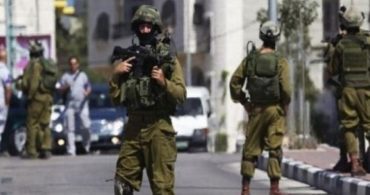 BETHLEHEM – Israeli occupation forces (IOF) on Thursday night closed off Bethlehem City in the West Bank at the pretext that a number of Palestinian citizens were diagnosed with coronavirus.
The IOF banned citizens from entering or leaving the city until further notice.
Local residents said that although there are infected people in both Bethlehem and the Israeli-controlled 1948 territories, stricter measures were taken in Bethlehem, which makes the IOF decision unclear.
On Friday, the Palestinian Authority’s Ministry of Health announced that the number of people tested positive for coronavirus increased to 16. All of them are placed under quarantine in a hotel in Beit Jala area in Bethlehem.
Mounting concern over SAS operations in southern Syria
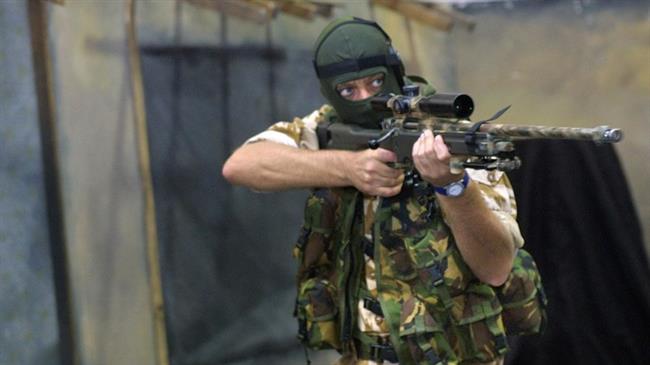
British SAS or SBS soldier in action in Syria
Press TV – March 8, 2020
There is mounting concern in the region about the nature and scale of British Special Forces deployment to southern Syria.
The concern comes in the wake of an exclusive report by the Daily Mirror (March 05) that two RAF Chinook helicopters “packed with special forces” troops and medics had “swooped” into southern Syria to rescue a wounded Special Air Service (SAS) operative.
According to the Mirror, the casualty was airlifted from “deep inside the warzone” to a medical facility in Erbil, northern Iraq.
Whilst the Mirror doesn’t say exactly where in southern Syria the SAS soldier was operating, the reference to “warzone” would suggest Deraa province, in the southwest of the country.
There have been clashes in recent days between Syrian government forces and terrorist groups controlling parts of the town of Al-Sanamayn, situated 50 kilometers south of the capital, Damascus.
Based on the realities on the ground, there is mounting speculation that Britain’s elite SAS could be lending a helping hand to anti-government forces in and around Al-Sanamayn.
British Special Forces, both in the form of the SAS and its allied unit, the Special Boat Service (SBS), have been operating in Syria for seven years.
According to the Mirror, more than 30 British special operatives have been injured in Syria. There has been at least one combat fatality, that of Sergeant Matt Tonroe, who was killed in a joint US/UK operation in March 2018.
Late last year it was reported that British Special Forces in Syria were beating a hasty retreat following US President, Donald Trump’s decision to pull out of Syria.
The latest incident appears to indicate that the SAS and SBS continue to operate in Syria based on the needs of allied Syrian rebel and terrorist groups.
The exfiltration of the injured SAS soldier will cause huge concern as the rescue operation involved RAF choppers taking off from RAF Akrotiri in Cyprus before flying through Israeli airspace to northern Jordan and onto southwestern Syria.
This brazen violation of Syrian sovereignty is likely to aggravate Britain’s outlaw status in Damascus, where both the Syrian government and people take a dim view of Britain’s hostile interference in their internal affairs.
Haiti petition challenges foreign policy apparatus
By Yves Engler · March 8, 2020
 While it may seem to be a simple call to release documents, Solidarité Québec-Haïti’s House of Commons petition is an indictment of Canada’s entire foreign policy/media apparatus.
In my research about Canadian foreign policy I have come across no equivalent to the “Ottawa Initiative on Haiti”. In early 2003 the federal government organized a private meeting of US, French and Organization of American States officials to discuss replacing Haiti’s elected government, putting the country under UN trusteeship and re-establishing its army. In what was likely a government-organized trial balloon, a prominent journalist working for Québec’s top news magazine reported on it at the time. A year later what was reported/discussed largely transpired.
Nonetheless, after the February 29, 2004, coup the dominant media refused to investigate the “Ottawa Initiative on Haiti” and barely mentioned the meeting. A Canadian Newsstand search found not one single English language report about the meeting (except two opinion pieces by me and another solidarity activist that mentioned it). La Presse may be the only corporate newspaper to have reported on the “Ottawa Initiative on Haiti” in the 15 years after the coup. In that case progressive journalist Jooned Khan used space made available during Haiti’s February 2006 election upheaval to briefly mention the gathering on two occasions.
Recently a major media outlet looked back on the “Ottawa Initiative on Haiti”. In a 45-minute report tied to the 10thanniversary of the 2010 earthquake Radio-Canada’s flagship news program “Enquête” reported on it. They interviewed Denis Paradis, the Liberal minister responsible for organizing the meeting, who admitted no Haitian officials were invited to discuss their own country’s future during the get together in 2003. They also interviewed Solidarité Québec-Haïti member Jean Saint-Vil who offered a critical perspective.
In a bid to build on this media breakthrough, Solidarité Québec-Haïti has launched a House of Commons petition referencing Enquête’s report and calling on the government to “Publish all documents relating to the ‘Ottawa Initiative on Haiti’” and to “Hold a hearing of the Standing Committee on Foreign Affairs and International Development to learn everything there is to know about the ‘Ottawa Initiative on Haiti,’ including its link to the “Core Group.” Bloc Québecois MP Mario Beaulieu has sponsored it.
Just after the coup then NDP MP Svend Robinson requested minutes of the private meeting be made available. Subsequently, researcher Anthony Fenton placed an Access to Information request for all documents related to the “Ottawa Initiative on Haiti”. What he received was heavily redacted. In Haiti Betrayed, a powerful new documentary about Canadian imperialism, Elaine Brière notes that the government refused to release documents related to the Ottawa Initiative on Haiti.
The meeting remains politically relevant. Enquête suggested the Ottawa Initiative on Haiti led to the creation of the “Core Group,” an alliance of foreign ambassadors that largely determines Haitian affairs. Solidarité Québec-Haïti is using the petition to pressure Ottawa to withdraw from the “Core Group”, which is the real power behind corrupt, repressive and illegitimate president Jovenel Moïse.
The petition requires 175 more signatures to be presented in the House of Commons, which will force the government to formally respond. If you are a citizen or permanent resident of Canada please sign it.
Syria Debacles Epitomize Perpetual Perfidy of U.S. Foreign Policy
By James Bovard | Future of Freedom Foundation | March 6, 2020
Turkey is ratcheting up its invasion of Syria and trying to drag NATO into Erdogan’s personal rehabilitation scheme. Threats and counter-threats are flying as thickly as the bombs and bullets. It remains to be seen whether U.S. policymakers will blunder deeper into this quagmire.
Last October, the Washington establishment was aghast when President Trump appeared to approve a Turkish invasion of northern Syria. The U.S. was seen as abandoning the Kurds, some of whom had allied with the U.S. in the fight against ISIS and other terrorist groups. But the indignation over the latest U.S. policy shift in the Middle East is farcical considering the long record of U.S. double-crosses. Rather than the triumph of American idealism, recent U.S. policy has been perpetual perfidy leavened with frequent doses of idiocy.
Almost none of the media coverage of the Turkish invasion and flight of Kurdish refugees mentioned that President George H. W. Bush had urged the Kurds and other Iraqis to “take matters into their own hands and force Saddam Hussein, the dictator, to step aside” during the U.S. bombing campaign in 1991 in the first Gulf War. After it became clear that the U.S. military could not protect the Kurds from Saddam’s backlash, U.S. policymakers basically shrugged and moseyed along. As a CNN analysis noted in 2003, “Bush refrained from aiding Kurdish rebels in the north, although he finally sent troops and relief supplies to protect hundreds of thousands of fleeing Kurds who were in danger of freezing or starving to death. Bush has never regretted his decision not to intervene.” George H.W. Bush’s abandonment and betrayal of the Kurds did nothing to deter the media and political establishment from posthumously sainting him after he died in late 2018.
U.S. meddling in the Middle East multiplied after the 9/11 attacks. Even though most of the hijackers were Saudis who received plenty of assistance from the Saudi government, the George W. Bush administration seized the chance to demonize and assault Saddam Hussein’s Iraqi regime. President Bush portrayed his invasion of Iraq as American idealism at his best. In his May 1, 2003 “Mission Accomplished” speech abroad the USS Abraham Lincoln, Bush hailed “the character of our military through history” for showing “the decency and idealism that turned enemies into allies.” Speaking three weeks later at a Republican fundraiser, Bush bragged, “The world has seen the strength and the idealism of the United States military.” Washington Post columnist David Ignatius declared in late 2003 that “this may be the most idealistic war fought in modern times.” The torture scandal at Abu Ghraib and elsewhere in Iraq has not been permitted to deter the recent semi-canonization of George W. Bush by the establishment media.
The Bush administration and their media allies produced one smokescreen after another to sanctify the war. Almost all the pre-invasion broadcast news stories on Iraq originated with the federal government. PBS’s Bill Moyers noted that “of the 414 Iraq stories broadcast on NBC, ABC and CBS nightly news, from September 2002 until February 2003, almost all the stories could be traced back to sources from the White House, the Pentagon, and the State Department.” A 2008 report by the Center for Public Integrity found that “in speeches, briefings, interviews and other venues, Bush and administration officials stated unequivocally on at least 532 occasions that Iraq had weapons of mass destruction or was trying to produce or obtain them or had links to al-Qaida or both.” The report concluded that the “false statements – amplified by thousands of news stories and broadcasts” created “an almost impenetrable din for several critical months in the run-up to war.” Bush’s falsehoods on Iraq proved far more toxic than anything in Saddam’s arsenal. But the exposure of the official lies did not deter Defense Secretary Donald Rumsfeld from equating criticizing the Iraq war with appeasing Adolph Hitler in 2006.
The chaos from the 2003 invasion of Iraq was still spiraling out of control when the Bush administration began seeking pretexts to attack Iran, which Bush had designated part of the “Axis of Evil” in his 2002 State of the Union address. Bush officials and subsequent administration chose to champion the Iranian terrorist group, Mujahideen-e-Khalq (MEK). That organization sprang up in the 1960s and proceeded to kill Americans in the 1970s and to kill large numbers of Iranians in the subsequent decades. A 2004 FBI report noted that MEK continued to be “actively involved in planning and executing acts of terrorism.” NBC News reported in early 2012 that MEK carried out killings of Iranian nuclear scientists and that it “financed, trained and armed by Israel’s secret service.”
That was the same year that a stampede of Washington hustlers took huge payoffs to publicly champion de-listing the MEK as a terrorist organization. As Trita Parsi noted in the New York Review of Books, MEK “rented office space in Washington, held fundraisers with lawmakers, or offered US officials speaking fees to appear at their gatherings. But the MEK did this openly for years, despite being on the US government’s terrorist list.” Federal law prohibited taking money from or advocating on behalf of any designated terrorist group. But, as a 2011 Huffpost headline reported, “Former U.S. Officials Make Millions Advocating For Terrorist Organization.” Former FBI boss Louis Freeh, former CIA boss Porter Goss, co-chair of the 9/11 Commission Lee Hamilton, former attorney general Michael B. Mukasey, former Homeland Security Secretary Tom Ridge pocketing $30,000 or more for brief speeches to pro-MEK events. Glenn Greenwald rightly scoffed that the advocacy for MEK “reveals the impunity with which political elites commit the most egregious crimes, as well as the special privileges to which they explicitly believe they — and they alone — are entitled.” Greenwald pointed that average people were scourged by the same law the pooh-bahs brazenly trampled: “A Staten Island satellite TV salesman in 2009 was sentenced to five years in federal prison merely for including a Hezbollah TV channel as part of the satellite package he sold to customers.”
Thanks in part to the torrent of insider endorsements, the Obama administration canceled the MEK’s terrorist designation in 2012. While Washington poohbahs continue portraying the group as idealistic freedom fighters devoted to democracy, a simple online search shows that the Farsi translation of the group’s name is “holy warriors of the people,” as Ted Carpenter noted in his new book, Gullible Superpower. Trump administration officials have gurgled about MEK’s possible role in ruling Iran after the current government is toppled. But MEK remains odious to the Iranian people regardless of the group’s PR successes inside the Beltway.
The prior pratfalls of U.S. Middle East policy did nothing to stymie the outrage over Trump asserted that he was withdrawing U.S. troops from eastern Syria. Congress showed more indignation about a troop pullback than it had shown the loss of all the American soldiers’ lives in pointless conflicts over the past 18 years. The House of Representatives condemned Trump by a 354 to 60 vote, and Rep. Eliot Engel (D-NY), chairman of the House Foreign Affairs Committee, proclaimed, “At President Trump’s hands, American leadership has been laid low, and American foreign policy has become nothing more than a tool to advance his own interests.” Sen. Richard Blumenthal (D-Conn.) said he felt “horror and shame” over Trump’s action. Boston Globe columnist Stephen Kinzer aptly described Congress’s protest as “a classic example of ‘buffet outrage,’ in which one picks and chooses which horrors to condemn.”
President Barack Obama had promised 16 times that there would be no “U.S. boots on the ground” in Syria; when Obama betrayed that promise, Congress did nothing. Trump’s plans to have fewer U.S. boots on the ground in Syria — or at least in part of it — somehow became the moral equivalent of giving Alaska back to Russia. Pundits attacked politicians who supported the troop pullback as “Russian assets” – i.e., traitors.
Syria offers another reminder that “material support of terrorism” is a federal crime unless you work for the CIA, State Department, Pentagon, or White House. After President Barack Obama, former Secretary of State Hillary Clinton, and former Secretary of State John Kerry all publicly declared that Syrian president Assad must exit power, the U.S. armed terrorist groups to topple Assad. The Obama administration’s beloved, non-existent “moderate Syrian rebels” achieved nothing. The Kurdistan Workers’ Party, the PKK, a prime beneficiary of the U.S. occupation, has been considered a terrorist group by the U.S. government since 1997. Evan McMullin, a 2016 presidential candidate, admitted on Twitter: “My role in the CIA was to go out & convince Al Qaeda operatives to instead work with us.” Such absurdities spurred Rep. Tulsi Gabbard, D-Hawaii, to introduce The Stop Arming Terrorists Act in 2017 to prohibit any U.S. funding of terrorist groups. Gabbard’s bill was mostly ignored and never enacted though her outspoken criticism of U.S. policy did spur Hillary Clinton and others to vilify her.
Prominent politicians and much of the media blamed Trump for the attacks on civilians that followed the Turkish invasion, carried out mainly by groups allied with the Turkish government. U.S.-armed terrorist groups involved in the Turkish invasion have freed Islamic State prisoners. A Turkish think tank analyzed the violent groups committing atrocities in Syria after the start of the Turkish invasion; “Out of the 28 factions, 21 were previously supported by the United States, three of them via the Pentagon’s program to combat DAESH. Eighteen of these factions were supplied by the CIA.” A prominent Turkish journalist observed after his government invaded Syria: “The groups that were educated and equipped by the United States west of the Euphrates are now fighting against the groups east of the Euphrates that have been also educated and equipped by the United States.” This is nothing new: in 2016, Pentagon-backed Syrian rebels have openly battled CIA-backed rebels in Syria. A prominent Assad opponent who organized a conference of anti-Assad groups financed by the CIA was denied political asylum in 2017 because he provided “material support” to the Free Syrian Army, which meant he had “engaged in terrorist activity,” according to the Department of Homeland Security. A press backlash spurred a reversal on that decision but the media mostly ignored the other contradictions in U.S. policy in Syria.
Members of Congress were indignant that Syrian civilians suffered as the result of Trump’s troop pullback. But both Congress and most of the American media ignored the Syrian women, children, and men who died as a result of U.S. policies that intensified and prolonged that nation’s civil war. This is typical inside the Beltway scoring: the only fatalities worthy of recognizing are those that are politically useful.
Despite Trump’s sporadic declarations on Syria, the U.S. continues to have more than 50,000 troops deployed in the Middle East. The sooner those troops come home, the less likely that our nation will be dragged into another quagmire. The perennial follies and frauds of Middle East policy provide one of the strongest arguments for the United States to mind its own business.
The Long Roots of Our Russophobia
By Jeremy Kuzmarov | CounterPunch | March 6, 2020
For the last five years, the American media has been filled with scurrilous articles demonizing Russian President Vladimir Putin.
Putin has been accused of every crime imaginable, from shooting down airplanes, to assassinating opponents, to invading neighboring countries, to stealing money to manipulating the U.S. president and helping to rig the 2016 election.
Few of the accusations directed against Putin have ever been substantiated and the quality of journalism has been at the level of “yellow journalism.”
In a desperate attempt to sustain their political careers, centrist Democrats like Joe Biden and Hillary Clinton accused their adversaries of being Russian agents – again without proof.
And even the progressive hero Bernie Sanders – himself a victim of red-baiting – has engaged in Russia bashing and unsubstantiated accusations for which he offers no proof.
Guy Mettan’s book, Creating Russophobia: From the Great Religious Schism to Anti-Putin Hysteria (Atlanta: Clarity Press, 2017) provides needed historical context for our current political moment, showing how anti-Russian hysteria has long proliferated as a means of justifying Western imperialism.
Mettan is a Swiss journalist and member of parliament who learned about the corruption of the  media business when his reporting on the world anticommunist league rankled his newspapers’ shareholders, and when he realized that he was serving as a paid stenographer for the Bosnian Islamist leader Alija Izetbegovic in the early 1990s.
Mettan defines Russophobia as the promotion of negative stereotypes about Russia that associate the country with despotism, treachery, expansion, oppression and other negative character traits. In his view, it is “not linked to specific historical events” but “exists first in the head of the one who looks, not in the victim’s alleged behavior or characteristics.”
Like anti-semitism, Mettan writes, “Russophobia is a way of turning specific pseudo-facts into essential one-dimensional values, barbarity, despotism, and expansionism in the Russian case in order to justify stigmatization and ostracism.”
The origins of Russophobic discourse date back to a schism in the Church during the Middle Ages when Charlemagne was crowned emperor of the Roman empire and modified the Christian liturgy to introduce reforms execrated by the Eastern Orthodox Churches of the Byzantine empire.
Mettan writes that “the Europe of Charlemagne and of the year 1000 was in need of a foil in the East to rebuild herself, just as the Europe of the 2000s needs Russia to consolidate her union.”
Before the schism, European rulers had no negative opinions of Russia. When Capetian King Henri I found himself a widower, he turned towards the prestigious Kiev kingdom two thousand miles away and married Vladimir’s granddaughter, Princess Ann.
A main goal of the new liturgy adopted by Charlemagne was to undermine any Byzantine influence in Italy and Western Europe.
Over the next century, the schism evolved from a religious into a political one.
The Pope and the top Roman administration made documents disappear and truncated others in order to blame the Easterners.
Byzantium and Russia were in turn rebuked for their “caesaropapism,” or “Oriental style despotism,” which could be contrasted which the supposedly enlightened, democratic governing system in the West.
Russia was particularly hated because it had defied efforts of Western European countries to submit to their authority and impose Catholicism.
In the 1760s, French diplomats working with a variety of Ukrainian, Hungarian and Polish political figures produced a forged testament of Peter 1 [“The Great”] purporting to reveal Russia’s ‘grand design’ to conquer most of Europe.
This document was still taken seriously by governments during the Napoleanic wars; and as late as the Cold War, President Harry Truman found it helpful in explaining Stalin.
In Britain, the Whigs, who represented the liberal bourgeois opposition to the Tory government and its program of free-trade imperialism, were the most virulent Russophobes, much like today’s Democrats in the United States.
The British media also enflamed public opinion by taking hysterical positions against Russia – often on the eve of major military expeditions.
The London Times during the 1820s Greek Independence war editorialized that no “sane person” could “look with satisfaction at the immense and rapid overgrowth of Russian power.” The same thing was being written in The New York Times in the 2010s.
A great example of the Orientalist stereotype was Bram Stoker’s novel Dracula, whose main character was modeled after Russian ruler, Ivan the Terrible. As if no English ruler in history was cruel either.
The Nazis took Russo-phobic discourse to new heights during the 1930s and 1940s, combining it with a virulent anti-bolshevism and anti-semitism.
A survey of German high school texts in the 1960s found little change in the image of Russia. The Russians were still depicted as “primitive, simple, very violent, cruel, mean, inhuman, cupid and very stubborn.”
The same stereotypes were displayed in many Hollywood films during the Cold War, where KGB figures were particularly maligned.
No wonder that when a former KGB agent, Vladimir Putin, took power, people went insane.
Russophobia in the United States has been advanced most insidiously by the nation’s foreign policy elite who have envisioned themselves as grand chess-masters seeking to checkmate their Russian adversary in order to control the Eurasian heartland.
This view is little different than European colonial strategists who had learned of the importance of molding public opinion through disinformation campaigns that depicted the Russian bear as a menace to Western civilization.
Guy Mettan has written a thought-provoking book that provides badly needed historical context for the anti-Russian delirium gripping our society.
Breaking the taboo on Russophobia is of vital importance in laying the groundwork for a more peaceful world order and genuinely progressive movement in the United States. Unfortunately, recent developments don’t inspire much confidence that history will be transcended.
Jeremy Kuzmarov is the author of The Russians are Coming, Again: The First Cold War as Tragedy, the Second as Farce (Monthly Review Press, 2018) and Obama’s Unending Wars: Fronting for the Foreign Policy of the Permanent Warfare State (Atlanta: Clarity Press, 2019).<
Featured Video

Michael von der Schulenburg: Europe’s Self-Defeating Iran War Policy
or go to
Aletho News Archives – Video-Images
Frlom the Archives
Provoking a Path to Persia
The Saban Center’s prescient paper on war with Iran
By Maidhc Ó Cathail | October 20, 2011
In June 2009, the Saban Center for Middle East Policy published “Which Path to Persia?—Options for a New American Strategy toward Iran.” Writing in a tone strikingly reminiscent of the Project for a New American Century’s infamous pre-9/11 paper “Rebuilding America’s Defenses,” the six co-authors noted that, “It seems highly unlikely that the United States would mount an invasion without any provocation or other buildup.” For a think tank specifically established by media mogul Haim Saban to protect Israel, this could prove to be a formidable obstacle impeding their desired march—of U.S. troops—to Tehran.
“In fact, if the United States were to decide that to garner greater international support, galvanize U.S. domestic support, and/or provide a legal justification for an invasion, it would be best to wait for an Iranian provocation, then the time frame for an invasion might stretch out indefinitely,” Saban’s think-tankers ruefully observed.
“With only one real exception, since the 1978 revolution, the Islamic Republic has never willingly provoked an American military response, although it certainly has taken actions that could have done so if Washington had been looking for a fight. Thus it is not impossible that Tehran might take some action that would justify an American invasion. And it is certainly the case that if Washington sought such a provocation, it could take actions that might make it more likely that Tehran would do so (although being too obvious about this could nullify the provocation). However, since it would be up to Iran to make the provocative move, which Iran has been wary of doing most times in the past, the United States would never know for sure when it would get the requisite Iranian provocation. In fact, it might never come at all.”
Seemingly undeterred by Iran’s frustrating unwillingness to provide the requisite provocation, the analysts continued to examine this option… continue
Blog Roll
 Aletho News
- Palestinian family displaced after settlers violently attack them in Humsa, Jordan Valley
- The EU never learns – except for the wrong lessons
- Iran attacks on UAE leaves RSF militia high and dry
- Hosting Washington’s war: Bahrain faces the consequences
- The US fell for its own Iran propaganda
- Seyed M. Marandi: Threat of Seizing Kharg Island & the Use of Nuclear Weapons
- Is there even an off ramp?
- Michael von der Schulenburg: Europe’s Self-Defeating Iran War Policy
- Sorry, The New Republic, Climate Change Isn’t Causing Somali Migration. Blame Civil Strife and Poverty.
- Expert Guts Claims That HPV Vaccine Reduces Cancer Risk
- If Americans Knew
- 6 more Americans killed, as Israel ‘mows the lawn’ in Iran – Not a ceasefire Day 154
- Are we on the precipice of World War III?
- ‘Catastrophic,’ Says UNICEF: 1,100+ Children Killed or Wounded in Mideast Since US-Israel Launched Iran War
- The Unbelievable Madness of Our War With Iran
- World Council of Churches calls on govts to hold Israel accountable for violations of intl law
- How to end the war on Iran that costs US taxpayers $1M per minute – Not a ceasefire Day 153
- Israeli strategic plans to “remake the Middle East” from the 1950s and since
- Honoring Gaza’s women who refused to let the world look away
- 97% of victims of war on Iran are Iranian, 98% of victims in war on Gaza are Gazans – Not a ceasefire Day 152
- Early Iran strikes cost $5.6 billion in munitions, Pentagon estimates
- No Tricks Zone
- New Studies: UK Sea Levels Were 4 Meters Higher Than Today During The Mid-Holocene
- Destructive Green New Deal: German Energy And Metal Group Warns Of Drastic Crisis
- New Study Documents A 20-Year Pause In Arctic Sea Ice Decline – Driven By Internal Variability
- Wake-up Call: Survey Shows Majority Of Germans Now Favor Postponing Climate Targets!
- Televised! Leading German Political Candidate Tells Schoolchildren CO2 Makes Sun Hotter!
- New Study: A Century Warming Of 1.1°C Is ‘Commonplace’ And ‘Not Unusual’ During This Interglacial
- New Study: ‘Internal Noise’ And Volcanic Forcing Can Trigger 10-15°C Warming Within Decades
- Glaciers Worldwide Are Suddendly Surging, Experts Blame Warming!
- Surprising Discovery: Sahara Is Greening…Billions Of Trees Where Once Thought To Be Barren
- New Research Reaffirms Clouds, Aerosols, And Surface Solar Radiation Are ‘Driving The Climate System’
 Aletho News