DNC Scrambles To Change Debate Threshold After Gabbard Qualifies
By Caitlin Johnstone | March 4, 2020
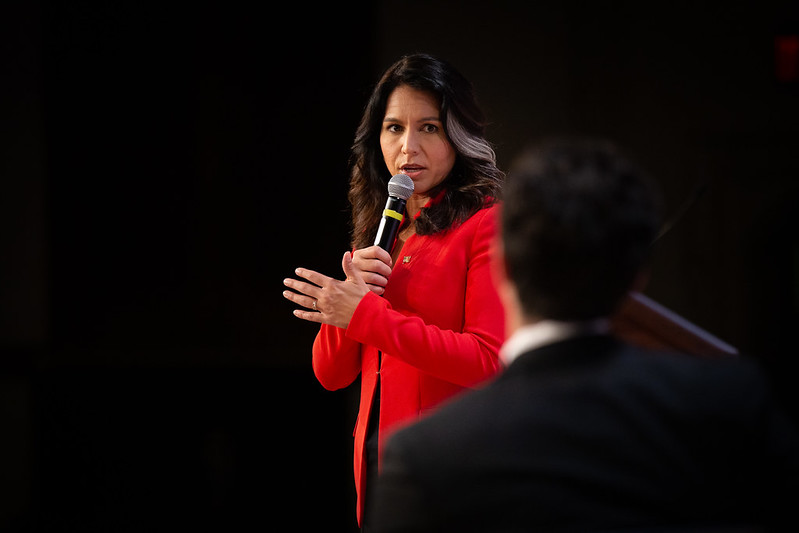
On a CNN panel on Monday, host John King spoke with Politico reporter Alex Thompson about the possibility of Democratic presidential candidate Tulsi Gabbard qualifying on Super Tuesday for the party’s primary debate in Phoenix later this month.
“I will note this, she’s from Hawaii,” King said of Gabbard. “She’s a congresswoman from Hawaii; American Samoa votes on Super Tuesday. The rules as they now stand, if you get a delegate, you’re back in the debates. As of now. Correct?”
“Yeah, they haven’t, I mean, that’s been the rule for every single debate,” Thompson replied. “And the DNC has not released their official guidance for the March 15 debate in Phoenix, but it would be very obvious that they are trying to cancel Tulsi, who they’re scared of a third party run, if they then change the rules to prevent her to rejoin the debate stage.”
And indeed, as the smoke clears from the Super Tuesday frenzy, this is precisely what appears to have transpired.
“The Gabbard campaign said it was informed that it would net two delegates from the caucuses in American Samoa, which will allocate a total of six pledged delegates,” The Hill reports today. “However, a report from CNN said that the candidate will receive only one delegate from the territory on Tuesday evening.”
“Tulsi Gabbard may have just qualified for the next Democratic debate thanks to American Samoa,” reads a fresh Business Insider headline. “Under the most recent rules, Rep. Tulsi Gabbard of Hawaii may have qualified for the next televised debate by snagging a delegate in American Samoa’s primary.”
“If Tulsi Gabbard gets a delegate out of American Samoa, as it appears she has done, she will likely qualify for the next Democratic debate,” tweeted Washington Post‘s Dave Weigel. “We don’t have new debate rules yet, but party has been inviting any candidate who gets a delegate.”
Rank-and-file supporters of the Hawaii congresswoman enjoyed a brief celebration on social media, before having their hopes dashed minutes later by an announcement from the DNC’s Communications Director Xochitl Hinojosa that “the threshold will go up”.
“We have two more debates– of course the threshold will go up,” tweeted Hinojosa literally minutes after Gabbard was awarded the delegate. “By the time we have the March debate, almost 2,000 delegates will be allocated. The threshold will reflect where we are in the race, as it always has.”
“DNC wastes no time in announcing they will rig the next debates to exclude Tulsi,” Journalist Michael Tracey tweeted in response.
This outcome surprised nobody, least of all Gabbard supporters. The blackout on the Tulsi 2020 campaign has reached such extreme heights this year that you now routinely see pundits saying things like there are no more people of color in the race, or that Elizabeth Warren is the only woman remaining in the primary. They’re not just ignoring her, they’re actually erasing her. They’re weaving a whole alternative reality out of narrative in which she is literally, officially, no longer in the race.
After Gabbard announced her presidential candidacy in January of last year I wrote an article explaining that I was excited about her campaign because she would severely disrupt establishment narratives, and, for the remainder of 2019, that’s exactly what she did. She spoke unauthorized truths about Syria, Afghanistan and Saudi Arabia, she drew attention to the plight of Julian Assange and Edward Snowden and said she’d drop all charges against both men if elected, she destroyed the hawkish, jingoistic positions of fellow candidates on the debate stage and arguably single-handedly destroyed Kamala Harris’ run.
The narrative managers had their hands full with her. The Russia smears were relentless, the fact that she met with Syrian president Bashar al-Assad was brought up at every possible opportunity in every debate and interview, and she was scoffed at and derided at every turn.
Now, in 2020, none of that is happening. There’s a near-total media blackout on the Gabbard campaign, such that I now routinely encounter rank-and-file liberals on social media who tell me they honestly had no idea she’s still running. She’s been completely redacted out of the narrative matrix.
So it’s unsurprising that the DNC felt comfortable striding forward and openly announcing a change in the debate threshold literally the very moment Gabbard crossed it. These people understand narrative control, and they know full well that they have secured enough of it on the Tulsi Problem that they’ll be able to brazenly rig her right off the stage without suffering any meaningful consequences.
The establishment narrative warfare against Gabbard’s campaign dwarfs anything we’ve seen against Sanders, and the loathing and dismissal they’ve been able to generate have severely hamstrung her run. It turns out that a presidential candidate can get away with talking about economic justice and plutocracy when it comes to domestic policy, and some light dissent on matters of foreign policy will be tolerated, but aggressively attacking the heart of the actual bipartisan foreign policy consensus will get you shut down, smeared and shunned like nothing else. This is partly because US presidents have a lot more authority over foreign affairs than domestic, and it’s also because endless war is the glue which holds the empire together.
And now they’re working to install a corrupt, right-wing warmongering dementia patient as the party’s nominee. And from the looks of the numbers I’ve seen from Super Tuesday so far, it looks entirely likely that those manipulations will prove successful.
All this means is that the machine is exposing its mechanics to the view of the mainstream public. Both the Gabbard campaign and the Sanders campaign have been useful primarily in this way; not because the establishment would ever let them actually become president, but because they force the unelected manipulators who really run things in the most powerful government on earth to show the public their box of dirty tricks.
Airbnb Gives Renters Secret Risk Assessments And Personality Tests

credit: Airbnb
MassPrivateI | March 3, 2020
What does the Church of Scientology and Airbnb have in common? If you answered secret risk assessments and personality tests, then give yourself a gold star.
If you have you rented an Airbnb in the past six years, the odds are pretty high that you have been given a secret risk assessment and personality score.
According to an Electronic Privacy Information Center (EPIC) complaint, Airbnb’s secret renter risk assessments are just as specious as the Church of Scientology’s personality tests.
“This complaint concerns Airbnb’s deployment of a risk assessment technique that assigns secret ratings to prospective renters, based on behavior traits using an opaque, proprietary algorithm. Airbnb has failed to show that its technique meets the fairness, transparency, and explainability standards for AI-based decision-making set out in the OECD AI Principles and the Universal Guidelines for AI.”
According to EPIC, Airbnb uses a secret algorithm to generate renter “risk scores.”
“Airbnb generates a risk assessment score for consumers before their reservations are confirmed. As the company explains on their website: Risk scoring. Every Airbnb reservation is scored for risk before it’s confirmed. We use predictive analytics and machine learning to instantly evaluate hundreds of signals that help us flag and investigate suspicious activity before it happens.”
For six years, Airbnb has been using their “Determining Trustworthiness and Compatibility of a Person” algorithm to create risk scores of every renter.
Airbnb also uses their secret algorithm to rate renters personalities.
“Personality comprises the emotional and cognitive characteristic of a person. Behavior is how a person acts or reacts, sometimes toward another person, in a certain situation. A person with positive personality or behavior traits such as conscientiousness and openness, for example, is often perceived as more reliable and trustworthy. A person with negative personality or behavior traits such as neuroticism and involvement in crimes, for example, is often perceived as untrustworthy.”
Airbnb does not want people who are “shy, anxious or depressed” to rent their apartments, condominiums or homes because those types of people are likely to leave negative comments.
But Airbnb will rent to people with a “high trustworthiness score” because they are more likely to leave positive comments.
Airbnb uses their secret algorithm to check renters social network profiles, email address, telephone number, geographic location, date of birth, social connections, employment history, education history, driver’s license number, financial account information, Internet Protocol (IP) address, and device identifier.
EPIC’s complaint claims Airbnb uses their algorithm to score a renters’ trustworthiness based on their social media profiles.
“According to the patent application, machine learning inputs include personal data collected from web pages, information from databases, posts on the person’s social network account, posts on a blog or a microblog account of the person, a comment made by the person on a website, or a directory listing for a company or association.”
Airbnb’s algorithm is also used to identify renters with Machiavellianism and negative personalities.
“A particular personality trait can be badness, anti-social tendencies, goodness, conscientiousness, openness, extraversion, agreeableness, neuroticism, narcissism, Machiavellianism, or psychopathy or is involved in pornography, has authored online content with negative language, or has interests that indicate negative personality or behavior traits.”
By identifying so-called negative personality or behavior traits of their renters, Airbnb has essentially turned property owners into untrained psychiatric and behavioral therapists.
Airbnb also reviews renters emails, phone conversations and in-person encounters with owners and adds them to their secret risk assessment.
“The method provides the behavior trait metrics and the personality trait metrics of the first person and corresponding metrics for a second person as input to a scoring system and obtaining as output from the system a compatibility score between the two persons.”
Airbnb’s algorithm considers derogatory or angry words an anti-social personality trait. This is horrifying, everything a renter says and does goes towards their personal risk assessment.
Airbnb’s risk assessments and personality tests are about as accurate as the Church of Scientologists E-Meter which purports to identify a person’s negative traits using “a box; a needle; one battery; two cans; and a bunch of copper wire.”
Airbnb has one more trick up their sleeve so to speak: they are also checking renters’ names against secret U.S. government watchlists.
Airbnb has turned a once innocuous thing like renting an apartment, condominium or home into a corporate surveillance nightmare replete with secret risk assessments and anti-social personality scores
Coronavirus vs. the Mass Surveillance State: Which Poses the Greater Threat?
By John W. Whitehead | The Rutherford Institute | March 3, 2020
I’ll leave the media and the medical community to speculate about the impact the coronavirus will have on the nation’s health, but how will the government’s War on the Coronavirus impact our freedoms?
For a hint of what’s in store, you can look to China—our role model for all things dystopian—where the contagion started.
In an attempt to fight the epidemic, the government has given its surveillance state apparatus—which boasts the most expansive and sophisticated surveillance system in the world—free rein. Thermal scanners using artificial intelligence (AI) have been installed at train stations in major cities to assess body temperatures and identify anyone with a fever. Facial recognition cameras and cell phone carriers track people’s movements constantly, reporting in real time to data centers that can be accessed by government agents and employers alike. And coded color alerts (red, yellow and green) sort people into health categories that correspond to the amount of freedom of movement they’re allowed: “Green code, travel freely. Red or yellow, report immediately.”
Mind you, prior to the coronavirus outbreak, the Chinese surveillance state had already been hard at work tracking its citizens through the use of some 200 million security cameras installed nationwide. Equipped with facial recognition technology, the cameras allow authorities to track so-called criminal acts, such as jaywalking, which factor into a person’s social credit score.
Social media credit scores assigned to Chinese individuals and businesses categorize them on whether or not they are “good” citizens. A real-name system—which requires people to use government-issued ID cards to buy mobile sims, obtain social media accounts, take a train, board a plane, or even buy groceries—coupled with social media credit scores ensures that those blacklisted as “unworthy” are banned from accessing financial markets, buying real estate or travelling by air or train. Among the activities that can get you labeled unworthy are taking reserved seats on trains or causing trouble in hospitals.
That same social credit score technology used to identify, track and segregate citizens is now one of China’s chief weapons in its fight to contain the coronavirus from spreading. However, it is far from infallible.
Fighting the coronavirus epidemic has given China the perfect excuse for unleashing the full force of its surveillance and data collection powers. The problem, as Eamon Barrett acknowledges in Fortune magazine, is what happens after: “Once the outbreak is controlled, it’s unclear whether the government will retract its new powers.”
The lesson for the ages: once any government is allowed to expand its powers, it’s almost impossible to pull back.
Meanwhile, here in the U.S., the government thus far has limited its coronavirus preparations to missives advising the public to stay calm, wash their hands, and cover their mouths when they cough and sneeze.
Don’t go underestimating the government’s ability to lock the nation down if the coronavirus turns into a pandemic, however. After all, the government has been planning and preparing for such a crisis for years now.
The building blocks are already in place for such an eventuality: the surveillance networks, fusion centers and government contractors that already share information in real time; the government’s massive biometric databases that can identify individuals based on genetic and biological markers; the militarized police, working in conjunction with federal agencies, ready and able to coordinate with the federal government when it’s time to round up the targeted individuals; the courts that will sanction the government’s methods, no matter how unlawful, as long as it’s done in the name of national security; and the detention facilities, whether private prisons or FEMA internment camps, that have been built and are waiting to be filled.
On a daily basis, Americans are relinquishing (in many cases, voluntarily) the most intimate details of who we are—their biological makeup, our genetic blueprints, and our biometrics (facial characteristics and structure, fingerprints, iris scans, etc.)—in order to navigate an increasingly technologically-enabled world.
Consider all the ways you continue to be tracked, hunted, hounded, and stalked by the government and its dubious agents:
By tapping into your phone lines and cell phone communications, the government knows what you say. By uploading all of your emails, opening your mail, and reading your Facebook posts and text messages, the government knows what you write. By monitoring your movements with the use of license plate readers, surveillance cameras and other tracking devices, the government knows where you go. By churning through all of the detritus of your life—what you read, where you go, what you say—the government can predict what you will do.
By mapping the synapses in your brain, scientists—and in turn, the government—will soon know what you remember. By mapping your biometrics—your “face-print”—and storing the information in a massive, shared government database available to bureaucratic agencies, police and the military, the government’s goal is to use facial recognition software to identify you (and every other person in the country) and track your movements, wherever you go. And by accessing your DNA, the government will soon know everything else about you that they don’t already know: your family chart, your ancestry, what you look like, your health history, your inclination to follow orders or chart your own course, etc.
The ramifications of a government—any government—having this much unregulated, unaccountable power to target, track, round up and detain its citizens is beyond chilling.
Remember, even the most well-intentioned government law or program can be—and has been—perverted, corrupted and used to advance illegitimate purposes once profit and power are added to the equation.
In the right (or wrong) hands, benevolent plans can easily be put to malevolent purposes.
We’re not quite there yet. But that moment of reckoning is getting closer by the minute.
In the meantime, we’ve got an epidemic to survive, so go ahead and wash your hands. Cover your mouth when you cough or sneeze. And stock up on whatever you might need to survive this virus if it spreads to your community.
We are indeed at our most vulnerable right now, but as I make clear in my book Battlefield America: The War on the American People, it’s the American Surveillance State—not the coronavirus—that poses the greatest threat to our freedoms.
Constitutional attorney and author John W. Whitehead is founder and president of The Rutherford Institute. His new book Battlefield America: The War on the American People is available at www.amazon.com. Whitehead can be contacted at johnw@rutherford.org.
CIA has been hacking China for 11 YEARS, says Chinese cybersecurity firm citing Vault 7 leak
RT | March 3, 2020
US spies have been hacking into Chinese aviation, energy, internet and even government sectors for more than a decade, Beijing-based cybersecurity firm Qihoo 360 said after a probe based on ‘Vault7’ tools published by WikiLeaks.
Coming from a major and reputable Chinese cybersecurity vendor, the accusations – made public on Monday on the company’s blog, in both English and Chinese – carry extra weight. According to Qihoo, a group of hackers designated APT-C-39 has been confirmed as coming from the US Central Intelligence Agency.
“Qihoo 360 data have shown that the cyber-weapons used by the organization and the cyber weapons described in the CIA Vault 7 project are almost identical.”
The attacks were traced as far back as September 2008, with the greatest concentration of targets in Beijing, Guangdong and Zhejiang provinces, the company said. Among the targeted sectors were civil aviation, scientific research institutions, oil and petroleum industries, internet companies and Chinese government.
The cybersecurity firm came to a conclusion that the attack was initiated by a “state-level hacking organization” because the hackers had used “CIA-exclusive cyber weapons” such as Fluxwire and Grasshopper – long before they were publicly revealed to have been developed by US spies, when WikiLeaks published the so-called “Vault7” cache of documents, in March 2017.
Control commands and encryption schemes of APT-C-39 also lined up with Vault7 disclosures, while compilation times matched “North American business hours,” Qihoo said.
The CIA coder accused of leaking the documents, Joshua A. Schulte, is currently on trial for espionage in the US.
Another Chinese antivirus company, Qi-Anxin, published a report in September 2019 also accusing the CIA of hacking Chinese companies, notably the aviation sector. Qi-Anxin’s research was also based on analyzing CIA software made public by WikiLeaks.
Email Scandal: Hillary Clinton Ordered to Provide Deposition In Person After ‘Preposterous’ Defence
Sputnik – March 3, 2020
The almost six-year-long saga relates to Hillary Clinton’s use of a private email server for government business while secretary of state. Although the FBI investigation resulted in no charges, it still remains to be seen whether her unusual email practices were meant to avoid Freedom of Information Act requests.
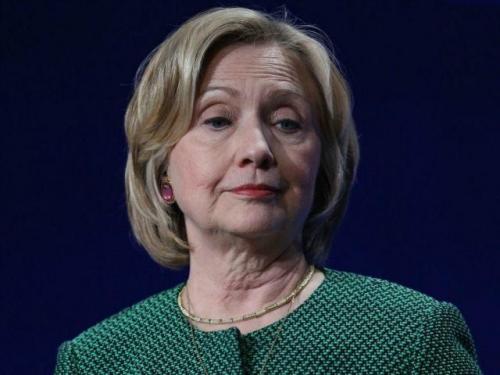
A federal judge has ordered Hillary Clinton to provide a sworn deposition in person about her private email server.
The order, issued on Monday by US District Court Judge Royce Lamberth, grants the request of conservative watchdog Judicial Watch to depose Clinton about her correspondence and documents related to the 2012 attack on the US consulate in Benghazi, Libya.
The court also ordered the deposition of Clinton’s former chief of staff, Cheryl Mills, and two other State Department officials. It also allowed Judicial Watch to subpoena Google for documents and records associated with Clinton’s emails during her time at the State Department from 2009 to 2014.
Republican officials and members of Congress had accused then-Secretary of State Cinton of failing to prevent the attack, which left four Americans dead. She defended her handling of the episode.
Judicial Watch’s lawsuit seeking Benghazi-related records led to a scandal in 2015 when it helped discover that Clinton had repeatedly used her own private email server, rather than a government-issued one, during her time as Secretary of State. Records of official correspondence must be kept under federal law, and Clinton’s reliance on a private account sparked concerns that she was seeking to sidestep that requirement.
Clinton email controversy
The email scandal haunted Clinton’s presidential campaign and was weaponised against her by then-Republican candidate Donald Trump.
The FBI concluded in July 2016 that she had been “extremely careless in their handling of very sensitive, highly classified information”. Although Clinton insisted that she had never received or sent classified material, the FBI discovered that she had send out over a hundred emails that should have been regarded as classified.
Around 30,000 emails, deemed to be work-related, were provided to the State Department; her aides had also deleted around 32,000 emails, which they claimed to be non-work related, before any subpoenas were issued.
The bureau, however, recommended bringing no criminal charges against Clinton and referred the case to the Justice Department, which closed it with no charges. The FBI reopened its probe just days before the November election after new emails were discovered.
Questions still remain
“Judicial Watch argued that Secretary Clinton’s existing testimony has only scratched the surface of the inquiry into her motives for setting up and using a private server,” Judge Lamberth said in the 11-page ruling. “Secretary Clinton has repeatedly stated that convenience was the main reason for using a private server, but Judicial Watch justifiably seeks to explore that explanation further.”Clinton previously explained her use of a private server in a sworn written statement, but this deposition would be the first time she had to answer questions on the case in person.
“To argue that the Court now has enough information to determine whether [the] State [Department] conducted an adequate search is preposterous,” Lamberth wrote. “Even years after the FBI investigation, the slow trickle of new emails has yet to be explained.”
He stressed that some of the questions remain to date: “How did she arrive at her belief that her private server emails would be preserved by normal State Department processes for email retention? … Did she realise State was giving ‘no records’ responses to her FOIA requests for emails? … And why did she think that using a private server to conduct State Department business was permissible under the law in the first place?”
US Judge Demands Company Charged in Russiagate Present Subpoenaed Evidence in Person
Sputnik – March 3, 2020
A US federal judge has threatened to hold Concord Management, a Russian company indicted by former special counsel Robert Mueller, in civil contempt if it does not present subpoenaed company records in person.
On Monday, US District Judge Dabney Freidrich demanded that St. Petersburg-based Concord Management supply her Washington, DC, court with subpoenaed company records by sending someone tasked with record-keeping to deliver them from Russia in person. She rejected a sworn statement, Courthouse News reported.
Concord’s legal representative, attorney Eric Dubelier, adamantly rejected Freidrich’s suggestion that the defense was engaged in something “sneaky,” calling the US government’s position “a ridiculous argument.”
Meanwhile, federal prosecutors urged the judge to hold Concord in civil contempt in a Thursday court filing.
“We are starting to have some concerns about whether Concord is participating in this case,” US Attorney Adam Jed said in court on Monday. “It gives us pause … that they are just going to write something down and give it to the US government,” he said of the sworn statement.
Concord replied on Friday with its own filing arguing its case for not being held in civil contempt, accusing the US Department of Justice of showing a “manifest disregard of the record and controlling law.”
“The primary foundation for its demand – that Concord’s counsel did not thoroughly explain the bases for Concord’s responses to the subpoenas – not only is not found in any court order but this Court expressly rejected the notion that such an explanation could be required,” Dubelier argued in the filing. The attorney noted that no court order had ever required such an explanation.
“And here again, the government’s incredulity over the adequacy of the response, real or feigned, does not reveal a failure to respond, much less a violation of any court order related to such a response. Simply put, the basis for a contempt finding is a product of the government’s argument, not the relevant record,” he noted.
The trial is anticipated to begin next month, with the discovery process having dragged on for nearly two years as Concord lawyers challenged Mueller’s authority to charge the company, then urged the DoJ to hold Mueller and Attorney General William Barr in contempt for publishing the Mueller report.
In a highly unorthodox move, the DoJ has refused the sharing of discovery materials with the defense, arguing that since Concord is partially owned by Russian businessman Yevgeniy Prigozhin, doing so would help the Russian government react to US attempts to thwart alleged criminal activities. During discovery, the prosecution and defense typically share their positions and the evidence supporting them before the trial itself begins.
Concord is accused of conspiracy to defraud the United States by allegedly financing the Russian government’s efforts to interfere in the 2016 US presidential election because Prigozhin is allegedly tied to the Internet Research Agency (IRA), which the Office of the Director of National Intelligence claimed is the ‘troll farm’ behind the alleged interference. Along with Concord, Mueller indicted a dozen IRA employees in February 2018.
Trump campaign sues Washington Post for ‘millions of dollars’ over ‘false and defamatory’ statements on ‘Russia collusion’
RT | March 3, 2020
Donald Trump’s 2020 campaign has reportedly filed a libel suit against the Washington Post for “millions of dollars,” accusing the newspaper of publishing “false and defamatory” statements about alleged collusion with Russia.
The lawsuit, which was filed in the US District Court in Washington, DC on Tuesday, highlights two articles published by the Post in 2019 linking Trump’s team to alleged foreign interference in the 2016 election, Fox News reported.
The complaint, which was seen by the news outlet, alleges that the Post was “well aware” that the statements were false but published them anyway for the “intentional purpose” of hurting Trump’s campaign. The articles were part of the newspaper’s “systematic pattern of bias” against Trump, it said.
One of the articles, published on June 13, stated that Special Counsel Robert Mueller’s extensive investigation into alleged collusion concluded that Trump’s campaign “tried to conspire with” a “sweeping and systematic” attack by Russia during the 2016 election.
Trump’s team noted that Mueller’s report in fact “concluded there was no conspiracy” between then-candidate Trump’s campaign and Russia – and that no US person intentionally coordinated with any alleged Russian effort to interfere with the 2016 election.
The second article, published on June 20, suggested Trump had “invited” both Russia and North Korea to “offer their assistance” to his campaign. This was also described as “false and defamatory” since there “has never been any statement” by anyone associated with Trump’s campaign inviting the two countries to interfere or assist.
The lawsuit also says there is “an extensive record” of statements from Trump’s campaign and the White House disavowing any notion of Russian assistance and “not a shred of evidence” that there were contacts between the campaign and North Korea.
Trump’s campaign said the lawsuit had been filed in order to “publicly establish the truth” and “properly inform” readers, as well as to seek “appropriate remedies for the harm caused.” The complaint says Trump’s campaign was damaged “in the millions of dollars” – the exact amount to be determined in court.
The suit against the Post comes on the heels of a similar lawsuit filed by Trump’s campaign against the New York Times last week in relation to a 2019 op-ed, which it said contained similarly false statements intended to influence the 2020 presidential election.
The Myth of Moderate Nuclear War
By Brian Cloughley | Strategic Culture Foundation | March 3, 2020
There are many influential supporters of nuclear war, and some of these contend that the use of ‘low-yield’ and/or short-range weapons is practicable without the possibility of escalation to all-out Armageddon. In a way their argument is comparable to that of the band of starry-eyed optimists who thought, apparently seriously, that there could be such a beast as a ‘moderate rebel’.
In October 2013 the Washington Post reported that “The CIA is expanding a clandestine effort to train opposition fighters in Syria amid concern that moderate, US-backed militias are rapidly losing ground in the country’s civil war,” and the US Congress gave approval to then President Barack Obama’s plan for training and arming moderate Syrian rebels to fight against Islamic State extremists. The belief that there could be any grouping of insurgents that could be described as “moderate rebels” is bizarre and it would be fascinating to know how Washington’s planners classify such people. It obviously didn’t dawn on them that any person who uses weapons illegally in a rebellion could not be defined as being moderate. And how moderate is moderate? Perhaps a moderate rebel could be equipped with US weapons that kill only extremists? Or are they allowed to kill only five children a month? The entire notion was absurd, and predictably the scheme collapsed, after expenditure of vast amounts of US taxpayers’ money.
And even vaster amounts of money are being spent on developing and producing what might be classed as moderate nuclear weapons, in that they don’t have the zillion-bang punch of most of its existing 4,000 plus warheads. It is apparently widely believed in Washington that if a nuclear weapon is (comparatively) small, then it’s less dangerous than a big nuclear weapon.
In January 2019 the Guardian reported that “the Trump administration has argued the development of a low-yield weapon would make nuclear war less likely, by giving the US a more flexible deterrent. It would counter any enemy (particularly Russian) perception that the US would balk at using its own fearsome arsenal in response to a limited nuclear attack because its missiles were all in the hundreds of kilotons range and ‘too big to use’, because they would cause untold civilian casualties.”
In fact, the nuclear war envisaged in that scenario would be a global catastrophe — as would all nuclear wars, because there’s no way, no means whatever, of limiting escalation. Once a nuclear weapon has exploded and killed people, the nuclear-armed nation to which these people belonged is going to take massive action. There is no alternative, because no government is just going to sit there and try to start talking with an enemy that has taken the ultimate leap in warfare.
It is widely imagined — by many nuclear planners in the sub-continent, for example — that use of a tactical, a battlefield-deployed, nuclear weapon will in some fashion persuade the opponent (India or Pakistan) that there is no need to employ higher-capability weapons, or, in other words, longer range missiles delivering massive warheads. These people think that the other side will evaluate the situation calmly and dispassionately and come to the conclusion that at most it should itself reply with a similar weapon. But such a scenario supposes that there is good intelligence about the effects of the weapon that has exploded, most probably within the opponent’s sovereign territory. This is verging on the impossible.
War is confusing in the extreme, and tactical planning can be extremely complex. But there is no precedent for nuclear war, and nobody — nobody — knows for certain what reactions will be to such a situation in or near any nation. The US 2018 Nuclear Posture Review stated that low-yield weapons “help ensure that potential adversaries perceive no possible advantage in limited nuclear escalation, making nuclear employment less likely”. But do the possible opponents of the United States agree with that? How could they do so?
The reaction by any nuclear-armed state to what is confirmed as a nuclear attack will have to be swift. It cannot be guaranteed, for example, that the first attack will not represent a series. It will, by definition, be decisive, because the world will then be a tiny step from doomsday. The US nuclear review is optimistic that “flexibility” will by some means limit a nuclear exchange, or even persuade the nuked-nation that there should be no riposte, which is an intriguing hypothesis.
As pointed out by Lawfare,
“the review calls for modification to ‘a small number of existing submarine-launched ballistic missile (SLBM) warheads’ to provide a low-yield option.
It also calls for further exploration of low-yield options, arguing that expanding these options will ‘help ensure that potential adversaries perceive no possible advantage in limited nuclear escalation, making nuclear employment less likely.’ This is intended to address the argument that adversaries might think the United States, out of concern for collateral damage, would hesitate to employ a high-yield nuclear weapon in response to a ‘lower level’ conflict, in which an adversary used a low-yield nuclear device. The review argues that expanding low-yield options is ‘important for the preservation of credible deterrence,’ especially when it comes to smaller-scale regional conflicts.”
“Credible deterrence” is a favourite catch-phrase of the believers in limited nuclear war, but its credibility is suspect. Former US defence secretary William Perry said last year that he wasn’t so much worried about the vast number of warheads in the world as he was by open proposals that these weapons are “usable”. It’s right back to the Cold War and he emphasises that “The belief that there might be tactical advantage using nuclear weapons – which I haven’t heard being openly discussed in the United States or in Russia for a good many years – is happening now in those countries which I think is extremely distressing.” But the perturbing thing is that while it is certainly being discussed in Moscow, it’s verging on doctrine in Washington.
In late February US Defence Secretary Esper was reported as having taken part in a “classified military drill in which Russia and the United States traded nuclear strikes.” The Pentagon stated that “The scenario included a European contingency where you’re conducting a war with Russia and Russia decides to use a low-yield, limited nuclear weapon against a site on NATO territory.” The US response was to fire back with what was called a “limited response.”
First of all, the notion that Russia would take the first step to nuclear war is completely baseless, and there is no evidence that this could ever be contemplated. But even if it were to be so, it cannot be imagined for an instant that Washington would indulge in moderate nuclear warfare in riposte. These self-justifying wargames are dangerous. And they bring Armageddon ever closer.
European sanctions-busting payment channel for Iran registers ZERO transactions – Iranian ambassador
RT | March 3, 2020
Over a year since its launch, the EU’s INSTEX financial mechanism – designed to facilitate trade with sanctions-hit Iran – has not carried out any operations, Iran’s ambassador to Russia Kazem Jalali has revealed.
“The Europeans have developed the INSTEX mechanism, but to date, as I’m talking to you, no transactions have been made,” Jalali said during a meeting with Konstantin Kosachev, chair of the Foreign Affairs Committee in the Russian senate.
The special purpose vehicle INSTEX was established by France, Germany and the United Kingdom in January 2019 in an attempt to rescue the 2015 nuclear agreement with Iran. The move came after the US, which used to be one of the parties of the landmark deal, unilaterally abandoned the accord and restored tough sanctions on the Islamic Republic. After the trade channel became operational, six more EU states – Belgium, Denmark, Finland, the Netherlands, Norway and Sweden – decided to join it.
While the mechanism is still far from being implemented, having such a financial instrument could be more vital than ever for Iran, as it has been hit hardest among Middle Eastern countries by the coronavirus outbreak. The pneumonia-causing disease that originated from China has already killed 66 people in the country and infected more than 1,500.
Although the European initiatives to save the nuclear deal, also known as the Joint Comprehensive Plan of Action (JCPOA), look good on paper, Iran has repeatedly slammed the partners for their lack of action. Since the US’ withdrawal from the deal, Tehran has been gradually scaling back its nuclear commitments. One of the latest steps was made in January, when it announced that it would determine the enrichment level and the amount of enriched material it produced only in accordance with its own needs.
Russia seeks to ‘create conditions so that NOBODY wants to fight us’ – Putin
RT | March 2, 2020
Vladimir Putin has confided that US President Donald Trump privately lamented the “insane” US military budget. He also says Russia protects itself by making the costs of attacking the country too high for anyone to contemplate.
“The US has outstripped us” in terms of annual defense expenditure, the Russian president said in a new episode of news agency TASS’s ‘20 Questions to Vladimir Putin’ series. But being the world’s largest military spender doesn’t really make Donald Trump particularly happy, Putin said.
“Donald told me that they have adopted an insane [military] budget for the next year, $738 billion.”
The US commander-in-chief, who likes to talk up his country’s military hardware during overseas trips while bragging about the armed forces, tends to be more reserved in private, according to Putin. “He told me that the costs were too high, but he had to do it,” he said, describing his counterpart as “an advocate of disarmament, as he says.”
In terms of military spending, Russia trails behind China, Saudi Arabia, the UK, France, and Japan, with a defense budget worth $48 billion, although its lower cost base gives it more purchasing power than most western states. “Moreover, our annual expenditures are falling. In contrast, other countries’ spending has been rising,” Putin stated.
“We are not going to fight against anyone. We are going to create conditions so that nobody wants to fight against us.”
Putin also explained why Trump – who already dismantled the landmark Intermediate-Range Nuclear Forces Treaty the US signed with the old Soviet Union – is reluctant to talk non-proliferation and arms control.
“That is another question, this is a question which relates to the understanding of security and how to ensure it… We can discuss this topic,” the Russian president replied without going into details.
Another crucial treaty which now hangs in the balance is the Strategic Arms Reduction Treaty (START), which dramatically reduced the number of nuclear warheads and the means of delivery.
The current edition of the pact, known as New START, was signed by former US President Barack Obama and his then-Russian counterpart, Dmitry Medvedev in 2010. It is set to expire in February next year.
While Moscow has signaled its readiness to prolong the treaty immediately, the US has kept silent on the matter.
Guyana: The Good, the Bad and the Ugly Prior to 2020 Elections
teleSUR | March 1, 2020
The small Caribbean country of Guyana is on the brink of becoming one of the largest oil-producing nations in the world thanks to the 2015 discovery of major offshore oil deposits.
This newfound wealth set into motion a transformative period for the country, which is one of the poorest nations in South America as more than 36 percent of its people are living in poverty.
But as in many cases, the blessing and promise of billions of dollars in revenue to fill the state’s coffers have also been marred in corruption scandals and caused in 2018 a major political crisis that will be resolved on March 2 as hundreds of thousands of Guyanese head to the polls.
The Guyanese people have been waiting for this day ever since President David Granger received a motion of no confidence in Dec. 21, 2018 with 33 votes against 32. A decision later upheld by the Caribbean Court of Justice (CCJ) in 2019.
The no-confidence motion, a first in the nation’s history, on the leader of the Partnership for National Unity/Alliance for Change (APNU/AFC) party was led by former president and opposition leader Bharrat Jagdeo of the People’s Progressive Party/Civic (PPP/C).
Jagdeo stated Granger “sold” the country’s “patrimony” to Exxon Mobil, accusing the government of mismanaging oil resources and granting the transnational overly generous contract terms.
The government, on the other hand, has insisted that it got the best deal it could and is banking on new oil wealth to transform the economy of the English-speaking country of just 750,000.
So as people head to the polls to elect a new five-year administration amid the recent oil boom, Guyana’s situation could be summarized into the good, the bad and the ugly.
The Good
In May 2015 ExxonMobil shocked the world and the Guyanese as the company announced the discovery of significant oil deposits in the Liza-1 well, followed by Payara, Liza Deep, Snoek, Turbot, Ranger, and Pacora by early 2018.
ExxonMobil and Hess reported that new discoveries contained estimated resources exceeding eight billion barrels of oil equivalent – one of the world’s largest reserves-, potentially producing 750,000 barrels per day by 2025. In rough estimates, this placed the oil wealth at over US$300 billion.
In a nation with a per capita income of under US$4,000, the findings meant a game-changer.
The revenue is expected to generate an estimated US$168 billion over the life of the project until 2056, representing 120 times Guyana’s annual budget, which in 2019 stood at US$1.4 billion.
By 2024 the amount of money coming in could lift income per person from US$5,000 to US$19,000, nearly the same as in Poland. All the wealth promised for impoverished Guyana hopes of tremendous economic growth in the years ahead. The International Monetary Fund forecasts an 85.6 percent GDP growth in the small nation.
By 2030 the government’s share of earnings from oil could reach US$10 billion in real terms, more than double last year’s GDP. However, not everything that glitters is gold.
The Bad
But Guyana is no stranger to oil exploration and drilling. Since the 1940s transnational companies had operated in the Guyana basin and in small wells. Yet the 2015 find was so unexpected it took even Exxon by surprise as, by April 2016, the United States oil giant had a problem.
The company had recently found oil off the coast in the Stabroek oil block but its license was about to expire in only two years, putting in jeopardy the company’s increasingly valuable asset.
So in early April 2016, the company began a powerful negotiation campaign by confronting two inexperienced Guyanese officials with a new draft license to be signed within ten weeks.
“Exxon did not want to change the favorable financial terms from its 1999 license, despite having recently found significant oil reservoirs that would customarily allow the government to ask for more,” a report titled ‘Signed Away’ by international watchdog Global Witness states.
The Guyanese government despite having a strong bargaining position when the contract came up for renegotiation in 2016 was outmaneuvered by the international company, due to “inexperienced” bureaucrats according to the report.
Guyana’s Natural Resources Minister Raphael Trotman ended up giving Exxon largely the same tax terms as before it found oil and then the company regained parts of the license area it was supposed to give up.
Also, and within months of signing Stabroek, Exxon agreed to buy portions of two additional licenses from companies that had obtained them under apparently suspicious circumstances. Only three days after getting its new license, Exxon announced its massive find.
The agreement left Guyana with a two percent royalty and a 50 percent profit share after the company recoups its costs. Granger has defended that the attractive terms were needed to secure investment in a risky new location.
However, for German-based company Open Oil -which specializes in providing financial analysis of natural resource investments for public policy purposes – Guyana lost a lot.
“If the royalty had been at 10 percent and standard corporate income tax (CIT) of 25 percent had been applied, both of which are well within international norms, the resulting government take would have been 69 percent, and Guyana would earn US$55 billion more during the life of the Stabroek field, up until 2056,” their report reads.
On average, Guyana will lose over US$1.3 billion a year over the life of the project from signing in 2016 until expiry. With the additional money, the country could have doubled its annual US$172 million health budget, US$251 million education budget, US$185 million infrastructure budget, and still have US$700 million left each year.
“This is a story about how an aggressive company negotiated an exploitative deal with a minister who may not have been working in Guyana’s best interests,” Global Witness’ commented on the matter. Supposedly the opposition voted to end granger’s government in order to renegotiate these contracts, which they thought to be unfair for Guyana.
And this is where things get ugly.
The Ugly
As Granger’s administration came to a halt by the opposition’s vote, the reassuring argument to the Guyanese people was that oil contracts would have been revised and renegotiated. The March 2 elections were meant to prove this thesis as the issue was the deciding factor, or at least it seemed so for campaign purposes.
With elections looming, the People’s Progressive Party presidential candidate announced in January that Exxon’s contract wouldn’t be renegotiated, despite the numerous warnings of the lopsided nature of the agreement.
“Exxon is a different case,” Ali told Reuters after a campaign rally in the contested western Essequibo region, adding that he would administer the deal better after reviewing terms.
For Associate Fellow in the energy, environment and resources program at Chatham House, Valerie Marcel, although the stakes are high in the elections as that the winning party will reign over the country’s oil revenues there is no real difference regarding the party’s policies approaching the oil boom.
Both are on a similar path with the development strategy set up by Granger, support the Extractive Industries Transparency Initiative (EITI) and a sovereign wealth fund, and mainly imitate their approach to licenses and future agreements.
“Exxon was a pioneering investment,” Ali reiterated. “But those that came after that time they were not pioneering, so they have to be examined in totality.”
However, others have not yet confirmed significant commercial finds. Tullow has made several discoveries in the past year, but the company has yet to find enough reserves to make the project work so Exxon continues to be the main winner in all this transaction.
If asked what’s really at stake in Guyana’s election, the answer might be as unpleasant as it sounds: nothing. As the good tidings of newfound immense natural resources for one of the poorest nations in the continent have been marred by power struggles and the ugliness of transnational greed over sovereign interests.
See also:
Fighting the Canadian Media Crackdown – Dan Dicks on The Corbett Report
Corbett • 03/02/2020
The Canadian government has recently considered a proposal to require all Canadian media to be licensed by the government. The proposal has been rejected for now, but how long can independent media continue to function in the increasingly draconian Canadian police state? Dan Dicks of PressForTruth.ca joins us to discuss the issue.
Watch this video on BitChute / Flote.app / Minds.com / YouTube or Download the mp4
SHOW NOTES:
PressForTruth.ca
Trudeau’s Digital Charter And The $600M Media Bailout Explained
Ezra Levant of Rebel News Interrorgated For His Book Exposing Justin Trudeau
Licensing The Global News Circuit Soon To Be A Reality in Canada Despite Claims They Won’t Do It
Into the Fire – Dan Dicks on The Corbett Report
Dan Dicks on BitChute / Flote.app / Minds / Steemit / YouTube
Featured Video

Marandi: Threat of Seizing Kharg Island & the Use of Nuclear Weapons
or go to
Aletho News Archives – Video-Images
Frlom the Archives
Provoking a Path to Persia
The Saban Center’s prescient paper on war with Iran
By Maidhc Ó Cathail | October 20, 2011
In June 2009, the Saban Center for Middle East Policy published “Which Path to Persia?—Options for a New American Strategy toward Iran.” Writing in a tone strikingly reminiscent of the Project for a New American Century’s infamous pre-9/11 paper “Rebuilding America’s Defenses,” the six co-authors noted that, “It seems highly unlikely that the United States would mount an invasion without any provocation or other buildup.” For a think tank specifically established by media mogul Haim Saban to protect Israel, this could prove to be a formidable obstacle impeding their desired march—of U.S. troops—to Tehran.
“In fact, if the United States were to decide that to garner greater international support, galvanize U.S. domestic support, and/or provide a legal justification for an invasion, it would be best to wait for an Iranian provocation, then the time frame for an invasion might stretch out indefinitely,” Saban’s think-tankers ruefully observed.
“With only one real exception, since the 1978 revolution, the Islamic Republic has never willingly provoked an American military response, although it certainly has taken actions that could have done so if Washington had been looking for a fight. Thus it is not impossible that Tehran might take some action that would justify an American invasion. And it is certainly the case that if Washington sought such a provocation, it could take actions that might make it more likely that Tehran would do so (although being too obvious about this could nullify the provocation). However, since it would be up to Iran to make the provocative move, which Iran has been wary of doing most times in the past, the United States would never know for sure when it would get the requisite Iranian provocation. In fact, it might never come at all.”
Seemingly undeterred by Iran’s frustrating unwillingness to provide the requisite provocation, the analysts continued to examine this option… continue
Blog Roll
 Aletho News
- Ukrainian Embassy in Beirut sheltering top Mossad agent
- Palestinian family displaced after settlers violently attack them in Humsa, Jordan Valley
- The EU never learns – except for the wrong lessons
- Iran attacks on UAE leaves RSF militia high and dry
- Hosting Washington’s war: Bahrain faces the consequences
- The US fell for its own Iran propaganda
- Seyed M. Marandi: Threat of Seizing Kharg Island & the Use of Nuclear Weapons
- Is there even an off ramp?
- Michael von der Schulenburg: Europe’s Self-Defeating Iran War Policy
- Sorry, The New Republic, Climate Change Isn’t Causing Somali Migration. Blame Civil Strife and Poverty.
- If Americans Knew
- ‘Of Course’: IDF Drops Case Against Soldiers Accused of Raping Palestinian Prisoner
- Don’t Fall for the Regime Change Talk. Israel Is ‘Mowing the Lawn’ in Iran
- Will Israel and the US wreck the Gulf States along with Iran?
- US so far burned through ‘years’ of munitions in Iran war: Report
- How the Israeli Tail Wags the American Dog
- Outdated intel likely led to deadly U.S. strike on Iranian elementary school, sources say
- Pentagon insider says high U.S official Douglas Feith reported to Netanyahu
- In fond memory of Walid Khalidi, the historian of Palestine
- 6 more Americans killed, as Israel ‘mows the lawn’ in Iran – Not a ceasefire Day 154
- Are we on the precipice of World War III?
- No Tricks Zone
- New Studies: UK Sea Levels Were 4 Meters Higher Than Today During The Mid-Holocene
- Destructive Green New Deal: German Energy And Metal Group Warns Of Drastic Crisis
- New Study Documents A 20-Year Pause In Arctic Sea Ice Decline – Driven By Internal Variability
- Wake-up Call: Survey Shows Majority Of Germans Now Favor Postponing Climate Targets!
- Televised! Leading German Political Candidate Tells Schoolchildren CO2 Makes Sun Hotter!
- New Study: A Century Warming Of 1.1°C Is ‘Commonplace’ And ‘Not Unusual’ During This Interglacial
- New Study: ‘Internal Noise’ And Volcanic Forcing Can Trigger 10-15°C Warming Within Decades
- Glaciers Worldwide Are Suddendly Surging, Experts Blame Warming!
- Surprising Discovery: Sahara Is Greening…Billions Of Trees Where Once Thought To Be Barren
- New Research Reaffirms Clouds, Aerosols, And Surface Solar Radiation Are ‘Driving The Climate System’
 Aletho News