Kissinger says ‘even US’ can’t defeat Covid-19 alone. His solution? Global NWO government, of course
By Helen Buyniski | RT | April 6, 2020
Henry Kissinger, eminence grise of imperial US foreign policy, has warned in an op-ed that no government – even his beloved hegemon – can defeat Covid-19 alone, implying that the New World Order he’s always preached must follow.
If the US doesn’t couple its efforts to rebuild its own economy with the first steps toward creating a global government, humanity is doomed, Kissinger wrote in a recent Wall Street Journal op-ed.
“No country, not even the US, can in a purely national effort overcome the virus,” Kissinger warned. “Addressing the necessities of the moment must ultimately be coupled with a global collaborative vision and program.”
“If we cannot do both in tandem, we will face the worst of each.”
Kissinger laments that the pandemic has led to the return of a “walled city” model of nationalist governance, suggesting that “exploration at the frontiers of science” alone can save humanity from disease in his vision of a globalist utopia. But developing cures takes time, and the notion that countries should be discouraged from protecting themselves in the interim is suicidal. If anything, one of the reasons Italy, Spain, and France were hit so hard by coronavirus was the EU’s dysfunctional insistence on open borders amid the pandemic.
“Global trade and movement of people” are all well and good, but the pandemic has exposed the weaknesses of the globalist system like never before. It will take years for nations to rebuild, and repeating their mistakes is not something they can afford to do.
While serving as Secretary of State and National Security Adviser under presidents Nixon and Ford, Kissinger played a starring role in bombing campaigns against Vietnam, Cambodia, and Laos and oversaw regime-change operations that placed brutal dictators in power in Argentina and Chile, as well as supporting state-sanctioned repression in Indonesia. A notorious report he penned for the Ford administration called for dramatic reductions in population growth across developing nations. One might think, given his record, that he’d be on the side of the virus.
But the Nobel Peace Prize recipient is here presenting himself as an experienced statesman who deeply cares about the future of humanity, calling on the US to “draw lessons from the development of the Marshall Plan and the Manhattan Project.” Sure, revisiting the Marshall Plan makes sense – there are no doubt insights to be gained from revisiting the rebuilding of Europe’s shattered post-war economies, especially since some of the countries hit hardest by the epidemic are in Europe.
But the Manhattan Project? How does a top-secret, international doomsday project that produced weapons with unparalleled killing potential have any bearing on the coronavirus crisis?
Listening to Kissinger, it must be said, is what got the US into its current situation – believing itself exceptional, distrusting all world powers who do not swear abject fealty to it, repeating the same failed policies to the point of parody. A looming presence in the George W. Bush administration, Kissinger advised the country to plunge headfirst into the ever-expanding War on Terror, penning an editorial in the days following 9/11 that called for taking on “any government that shelters groups capable of this kind of attack.” Following such guidance has bankrupted the US and turned it into a banana republic, printing money frantically while its roads and bridges crumble, its citizens struggle to keep a roof over their heads, and the international community looks on, mouths agape, as its government continues to lecture them about human rights.
Kissinger concludes his jeremiad with a warning that “failure [to safeguard the principles of the liberal world order] could set the world on fire.” If, as he himself writes, the “purpose of the legitimate state is to provide for the fundamental needs of the people: security, order, economic well-being, and justice,” those principles collapsed long ago. The US’ first step, post-pandemic, should be to put out the fires set by Kissinger and those like him who seek to cloak empire in the rhetoric of liberal democracy.
Helen Buyniski is an American journalist and political commentator at RT. Follow her on Twitter @velocirapture23
Trump proclaims national day honoring racist rabbi, Menachem Schneerson
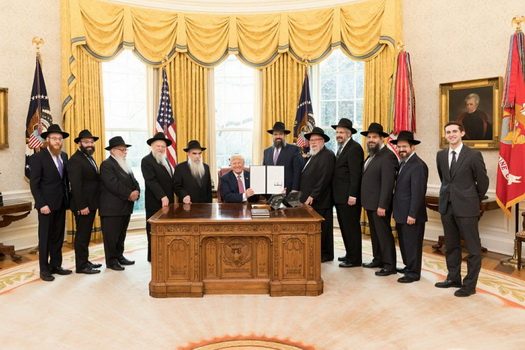
President Trump proclaiming Education and Sharing Day 2018. (Photo Credit: The White House)
By Alison Weir | If Americans Knew | April 6, 2020
President Donald Trump recently proclaimed April 3rd “Education and Sharing Day, U.S.A,” a national day to “celebrate Rabbi Menachem Mendel Schneerson, the Lubavitcher Rebbe.”
The proclamation called upon “all government officials, educators, volunteers, and all the people of the United States to observe this day with appropriate programs, ceremonies, and activities.”
This was not the first such proclamation. For 42 years presidents from both parties have proclaimed a national day to honor Rabbi Schneerson.
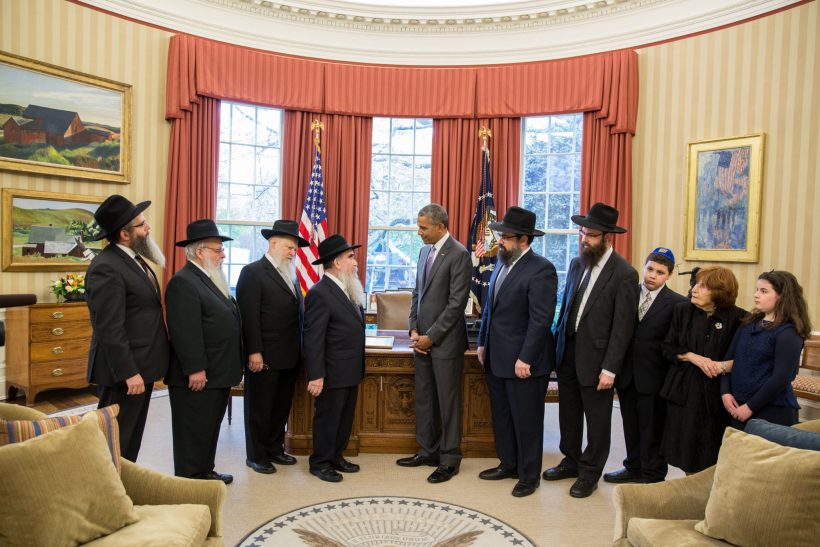
President Barack Obama presents a ceremonial copy of the Education and Sharing Day Proclamation that he issued on March 31, 2015 to a delegation from the American Friends of Lubavitch in the Oval Office, April 27, 2015. (Official White House Photo by Pete Souza) (ObamaWhiteHouse)
What they probably didn’t know is that some of Schneerson’s lesser-known teachings are extremely problematic on a number of levels. Among other things, they help fuel some of the most violent attacks against Palestinians by extremist Israeli settlers and soldiers.
For example, Schneerson taught that non-Jews were “created to serve the Jews.”
To learn about Schneerson and his teachings, read the following article that I wrote six years ago, when Barack Obama played his role in the yearly tribute.
Please note that the information in the article comes largely from Jewish and Israeli sources. A list of the sources used in the article is provided below it.
The main source, Israel Shahak, was a respected Israeli professor who had been praised by Noam Chomsky, Institute Professor Emeritus, Massachusetts Institute of Technology (MIT); Edward Said, Columbia Professor and public intellectual; and diverse others.
It is my feeling that all Americans should know the facts reported below. Year after year after year, American citizens are being told to honor Rabbi Schneerson. We need to know what The Rebbe taught, consider the implications for us and for others, and decide for ourselves whether we agree with the annual decree that we celebrate his views.
***
Why is the US Honoring a Racist Rabbi?
By Alison Wier | CounterPunch | April 7, 2014
If things proceed normally, President Barak Obama will soon proclaim April 11, 2014 “Education and Sharing Day, U.S.A.” Despite the innocuous name, this day honors the memory of a religious leader whose lesser-known teachings help fuel some of the most violent attacks against Palestinians by extremist Israeli settlers and soldiers.
The leader being honored on this day is Rabbi Menachem Mendel Schneerson, charismatic head of a mystical/fundamentalist version of Judaism. Every year since 1978, a Presidential Proclamation, often accompanied by a Congressional Resolution (the 1990 one had 219 sponsors), has declared Schneerson’s birthday an official national day of observance.
Congress first passed a Resolution honoring Schneerson in 1975. Three years later a Joint Congressional Resolution called on President Jimmy Carter to proclaim “Education Day, U.S.A.” on the anniversary of Schneerson’s birth. The idea was to set aside a day to honor both education and the alleged educational work of Schneerson and the religious sect he headed up.
Carter, like Congress, dutifully obeyed the Schneerson-initiated resolution, as has every president since. And some individual states are now enacting their own observances of Schneerson’s birthday, with Minnesota and Alabama leading the way.
Schneerson and his movement are an extremely mixed bag.
Schneerson has been praised widely for a public persona and organization that emphasized “deep compassion and insight,” worked to bring many secular Jews “back” into the fold, created numerous schools around the world, and had offered, in the words of the Jewish Virtual Library, “social-service programs and humanitarian aid to all people, regardless of religious affiliation or background.”
However, there is also a less attractive underside often at odds with such public perceptions. And some of the more extreme parts of Schneerson’s teachings – such as that Jews are a completely different species than non-Jews, and that non-Jews exist only to serve Jews – have been largely hidden, it appears, even from many who consider themselves his followers.
As we will see, such views profoundly impact the lives of Palestinians living – and dying – under Israeli occupation and military invasions.
Who was Rabbi Schneerson?
Schneerson lived from 1902 to 1994 and oversaw the growth of what is now the largest Jewish organization in the world. The religious movement he led is known as “Chabad-Lubavitch,” (sometimes just called “Lubavitch” or “Chabad,” the name of its organizational arm). Schneerson was the seventh and final Lubavitcher “Rebbe” (sacred leader). He is often simply called “the Rebbe.”
Founded in the late 1700s and originally based in the Polish-Russian town of Lubavitch, it is the largest of about a dozen forms of “Hasidism,” a version of Orthodox Judaism connected to mysticism, characterized by devotion to a dynastic leader, and whose adherents often wear distinctive clothing. (Spellings of these terms can vary; Hasid is also written as Hassid, Chasid, etc.)
There is an extreme cult of personality focused on Schneerson himself. Some followers consider him the Messiah, and Schneerson himself reportedly sometimes implied this was true. Some Lubavitch educators consider him divine, making such claims as, “the Rebbe is actually ‘the essence and being [of God] … he is without limits, capable of effecting anything, all-knowing and a proper object of worshipful prostration.”
While many secular Jews and Jews from other denominations disagree with its actions and theology, Chabad-Lubavitch is generally acknowledged to be a powerful force in Jewish life today. According to a 1994 New York Times report, it is “one of the most influential and controversial forces in world Jewry.”
There are approximately 3,600 Chabad institutions in over 1,000 cities in 70 countries, and 200,000 adherents. Up to a million people attend Chabad services at least once a year. Numerous campuses have such centers and the Chabad website states that hundreds of thousands of children attend Chabad summer camps.
According to the Times, Schneerson “presided over a religious empire that reached from the back streets of Brooklyn to the main streets of Israel and by 1990 was taking in an estimated $100 million a year in contributions.
In the U.S., the Times reports, Schneerson’s “‘mitzvah tanks’ – converted campers that are rolling recruiting stations whose purpose is to draw Jews to the Lubavitch way – roamed streets from midtown Manhattan to Crown Heights. And the Lubavitchers’ Brooklyn-based publishing house claimed to be the world’s largest distributor of Jewish books.”
Non-Jewish souls ‘satanic’
While Chabad sometimes openly teaches that “the soul of the Jew is different than the soul of the non-Jew,” Schneerson’s specific teachings on this subject are largely unknown.
Quite likely very few Americans, both Jews and non-Jews, are aware of Schneerson’s teachings about the alleged deep differences between them – and about how these teachings are applied in the West Bank and Gaza.
Let us look at Schneerson’s words, as quoted by two respected Jewish professors, Israel Shahak and Norton Mezvinsky, in their book Jewish Fundamentalism in Israel (text available online here. This book, praised by Noam Chomsky, Edward Said, and many others is essential reading for anyone who truly wishes to understand modern day Israel-Palestine. (Brackets in the quotes below are in the translations by Shahak and Mezvinsky.)
Some of Schneerson’s rarely reported teachings:
“The difference between a Jewish and a non-Jewish person stems from the common expression: “Let us differentiate.” Thus, we do not have a case of profound change in which a person is merely on a superior level. Rather, we have a case of “let us differentiate” between totally different species.”
“This is what needs to be said about the body: the body of a Jewish person is of a totally different quality from the body of [members] of all nations of the world … The difference in the inner quality between Jews and non-Jews is “so great that the bodies should be considered as completely different species.”
“An even greater difference exists in regard to the soul. Two contrary types of soul exist, a non-Jewish soul comes from three satanic spheres, while the Jewish soul stems from holiness.”
“As has been explained, an embryo is called a human being, because it has both body and soul. Thus, the difference between a Jewish and a non-Jewish embryo can be understood.”
“…the general difference between Jews and non-Jews: A Jew was not created
as a means for some [other] purpose; he himself is the purpose, since the substance of all [divine] emanations was created only to serve the Jews.”
“The important things are the Jews, because they do not exist for any [other] aim; they themselves are [the divine] aim.”
“The entire creation [of a non-Jew] exists only for the sake of the Jews.”
Most people don’t know about this aspect of Schneerson’s teaching because, according to Shahak and Mezvinsky, such teachings are intentionally minimized, mistranslated, or
hidden entirely.
For example, the quotes above were translated by the authors from a book of Schneerson’s recorded messages to followers that was published in Israel in 1965. Despite Schneerson’s global importance and the fact that his world headquarters is in the U.S., there has never been an English translation of this volume.
Shahak, an Israeli professor who was a survivor of the Nazi holocaust, writes that this lack of translation of an important work is not unusual, explaining that much critical information about Israel and some forms of Judaism is available only in Hebrew.
He and co-author Mezvinsky, who was a Connecticut Distinguished University Professor who taught at Central Connecticut State University, write, “The great majority of the books on Judaism and Israel, published in English especially, falsify their subject matter.”
According to Shahak and Mezvinsky, “Almost every moderately sophisticated Israeli Jew knows the facts about Israeli Jewish society that are described in this book. These facts, however, are unknown to most interested Jews and non-Jews outside Israel who do not know Hebrew and thus cannot read most of what Israeli Jews write about themselves in Hebrew.”
In Shahak’s earlier book, Jewish Religion, Jewish History, he provides a number of examples. In one, he describes a 1962 book published in Israel in a bilingual edition. The Hebrew text was on one page, with the English translation on the facing page.
Shahak describes one set of facing pages in which the Hebrew text of a major Jewish code of laws contained a command to exterminate Jewish infidels: “It is a duty to exterminate them with one’s own hands.” The English version on the facing page softened it to “It is a duty to take active measures to destroy them.’”
The Hebrew page then went on to name which “infidels” must be exterminated, adding “may the name of the wicked rot.” Among them was Jesus of Nazareth. The facing page with the English translation failed to tell any of this.
“Even more significant,” Shahak reports, “in spite of the wide circulation of this book among scholars in the English-speaking countries, not one of them has, as far as I know, protested against this glaring deception.”
Praised by Said, Chomsky, etc., Shahak is almost unknown today
This pattern of selective omission, it seems, applies to Shahak himself, whose work is largely unknown to Palestine activists today, even though he was considered a major figure in the struggle against Israeli oppression of Palestinians, and his work was praised by diverse writers.
While Shahak was alive, Noam Chomsky called him “an outstanding scholar,” and said he had “remarkable insight and depth of knowledge. His work is informed and penetrating, a contribution of great value.”
Edward Said wrote, “Shahak is a very brave man who should be honored for his services to humanity … One of the most remarkable individuals in the contemporary Middle East.” Said wrote a forward for Shahak’s Jewish History, Jewish Religion.
Catholic New Times said: ‘This is a remarkable book …[It] deserves a wide readership, not only among Jews, but among Christians who seek a fuller understanding both of historical Judaism and of modern-day Israel.”
Jewish Socialist stated: “Anyone who wants to change the Jewish community so that it stops siding with the forces of reaction should read this book.”
The London Review of Books called Shahak’s book “remarkable, powerful, and provocative.”
Yet, very few Americans today know of Shahak’s work and the information it contains.
American tax money & Jewish Extremism in Palestine
If they did, it’s hard to believe that Americans would allow $8.5 million per day of their tax money to be given to Israel, where such teachings underlie a powerful minority that is disproportionately influential in governmental actions.
Nor is it likely that a fully informed American public would allow donations to religious institutions in Israel that teach supremacist, sometimes violent doctrines to be tax-deductible in the U.S.
One organization raised over $10 million tax-deductible dollars in the U.S. in 2011 alone – removing money from the U.S. economy and enabling illegal, aggressive Israeli settlements in Palestine. And some of this money went to benefit individuals convicted of murder – including the murderer of Israeli Prime Minister Yitzhak Rabin.
The New York Times obituary on Schneerson reported that Schneerson was “a major political force in Israel, both in the Knesset and among the electorate,” but failed to describe the nature of his impact.
One of a sprinkling of writers willing to publicly discuss Shahak and Mezvinsky’s findings is Allan Brownfeld, who is less reticent. Brownfeld is editor of the American Council for Judaism’s periodical Issues and contributor to the Washington Report on Middle East Affairs.
In a review of Jewish Fundamentalism in Israel, Brownfeld describes Schneerson’s views on Israel:
“Rabbi Schneerson always supported Israeli wars and opposed any retreat. In 1974 he strongly opposed the Israeli withdrawal from the Suez area. He promised Israel divine favors if it persisted in occupying the land.”
Brownfeld reports that after Schneerson’s death, “[T]housands of his Israeli followers played an important role in the election victory of Binyamin Netanyahu. Among the religious settlers in the occupied territories, the Chabad Hassids constitute one of the most extreme groups. Baruch Goldstein, the mass murderer of Palestinians, was one of them.”
Another such Chabad Hassid is Rabbi Yitzchak Ginsburg (also sometimes written as “Ginzburg” and “Ginsburgh”), who studied under Schneerson in Crown Heights and who heads up a major Chabad institution in the West Bank.
Ginsburg praised Goldstein, the murderer of 29 Palestinians while they were praying, and considers all non-Jews subhuman.
According to author Motti Inbari, Ginsburg “gives prominence to Halachic and Kabbalistic approaches that emphasize the distinction between Jew and non-Jew (Gentile), imposing a clear separation and hierarchy in this respect.”
In his book Jewish Fundamentalism and the Temple Mount: Who Will Build the Third Temple? Inbari states, “[Ginsburg] claims that while the Jews are the Chosen People and were created in God’s image, the Gentiles do not have this status and are effectively considered subhuman.”
Professor Inbari, an Israeli academic who now teaches in the U.S., writes that Ginsburg’s theological approach continues “certain perceptions that were popular in medieval times.”
“For example,” Inbari writes, “the commandment ‘You shall not murder’ does not apply to the killing of a Gentile, since ‘you shall not murder’ relates to the murder of a human, while for him the Gentiles do not constitute humans.”
Inbari reports, “Similarly, Ginzburg stated that, on the theoretical level, if a Jew requires a liver transplant to survive, it would be permissible to seize a Gentile and take their liver forcefully.”
While the mainstream American press almost never reports this kind of information, an April 26, 1996 article in Jewish Week by Lawrence Cohler reported on Ginsburg’s teachings, including their problematic roots in Jewish texts.
Cohler reported that a professor of Bible at Hebrew University in Jerusalem, Rabbi Moshe Greenberg, “called for radically revising Jewish thinking about some Jewish texts on the grounds that scholars such as Rabbi Ginsburgh are far from aberrant in their use of them.”
Cohler quoted Greenberg’s concerns: “‘There’ll be a statement in Talmud… made in circumstances where it’s purely theoretical, because Jews then never had the power to do it,’ he explained. And now, he said, ‘It’s carried over into circumstances where Jews have a state and are empowered.’”
A rabbi associated with Ginsburg coauthored a notorious Israeli book, The King’s Torah, which claims that Jewish law at times permits the killing of non-Jewish infants. American donations to the Chabad school Ginsburg heads up, and that published the above book, are tax-deductible in the U.S. Ginsburg, who endorses the book, teaches classes throughout Israel, the U.S. and France.
Such extremism is opposed by the majority of Israelis, and major Jewish religious authorities condemn it, a Chief Rabbi, for example, stating: “’According to the Torah, every man is created in God’s image.”
Yet, such extremist views continue to exert a powerful influence.
Israeli military manuals echo extremist teachings: “kill even good civilians”
Israeli military manuals sometimes replicate extremist teachings. For example, a booklet authored by a Chief Chaplain stated, “In war, when our forces storm the enemy, they are allowed and even enjoined by the Halakhah to kill even good civilians…” Such teachings by the IDF rabbinate were prominent during Israel’s 2008-9 attack on Gaza that killed 1,400 Gazans, approximately half of them civilians. (The Palestinian resistance killed nine Israelis during this “war.”)
Chicago writer Stephen Lendman has described these teachings, giving a number of examples.
Lendman writes, “In 2007, Israel’s former chief rabbi, Mordechai Elyahu, called for the Israeli army to mass-murder Palestinians:
“If they don’t stop after we kill 100, then we must kill 1000. And if they don’t stop after 1000, then we must kill 10,000. If they still don’t stop we must kill 100,000. Even a million.”
Lendman reports that some extremist Israeli rabbis teach that “the ten commandments don’t apply to non-Jews. So killing them in defending the homeland is acceptable, and according to the chairman of the Jewish Rabbinic Council:
“‘There is no such thing as enemy civilians in war time. The law of our Torah is to have mercy on our soldiers and to save them…. A thousand non-Jewish lives are not worth a Jew’s fingernail.’”
Lendman writes, “Rabbi David Batsri called Arabs ‘a blight, a devil, a disaster…. donkeys, and we have to ask ourselves why God didn’t create them to walk on all fours. Well, the answer is that they are needed to build and clean.’”
Another such rabbi is Manis Friedman, a Chabad-Lubavitch rabbi inspired by Schneerson who served as the simultaneous translator for a series of Schneerson’s talks. (Friedman is currently dean of a Jewish Studies institute in Minnesota.)
A 2009 article in the Israeli newspaper Ha’aretz reports, “Like the best Chabad-Lubavitch rabbis, Manis Friedman has won the hearts of many unaffiliated Jews with his charismatic talks about love and God; it was Friedman who helped lead Bob Dylan into a relationship with Chabad.
“But Friedman, who today travels the country as a Chabad speaker, showed a less warm and cuddly side when he was asked how he thinks Jews should treat their Arab neighbors.”
In Moment magazine’s article, “Ask the Rabbis // How Should Jews Treat Their Arab Neighbors?” Friedman answered:
“I don’t believe in western morality, i.e. don’t kill civilians or children, don’t destroy holy sites, don’t fight during holiday seasons, don’t bomb cemeteries, don’t shoot until they shoot first because it is immoral.
“The only way to fight a moral war is the Jewish way: Destroy their holy sites. Kill men, women and children (and cattle).”
Lendman reports, “Views like these aren’t exceptions. Though a minority, they proliferate throughout Israeli society…”
They also, Lendman notes, work to prevent peace in Israel-Palestine.
Shahak and Mezvinsky note that when the book containing Schneerson’s statements quoted above about Jews and non-Jews was published in Israel, he was allied to the Labor Party and his movement had been provided “many important benefits” from the Israeli government.
In the mid-1970s Schneerson decided that the Labor Party was too moderate and shifted his support to the more right-wing parties in power today. The authors report, “Ariel Sharon was the Rebbe’s favorite Israeli senior politician. Sharon in turn praised the Rebbe publicly and delivered a moving speech about him in the Knesset after the Rebbe’s death.”
Roots in Some Early Texts
Brownfeld decries the fact that few Americans are properly informed about the fundamentalist movement in Israel “and the theology upon which it is based.”
He notes that Jewish Americans, in particular, are often unaware of the “narrow ethnocentrism which is promoted by the movement’s leading rabbis, or of the traditional Jewish sources they are able to call upon in drawing clear distinctions between the moral obligations owed to Jews and non-Jews.”
Teachings that Jews are superior and gentiles inferior were contained in some of the earliest Hassidic texts, including its classic text, “Tanya,” still taught today.
Brownfeld quotes statements by “the revered father of the messianic tendency of Jewish fundamentalism,” Rabbi Kook the Elder, and states that these were derived from earlier texts. [Kook, incidentally, was also an early Zionist, who helped push for the Balfour Declaration in England before moving to Palestine. He was the uncle of Hillel Kook, an agent who went by the name “Peter Bergson” and created front groups in the U.S. for a violent Zionist guerilla group that operated in 1930s and ’40s Palestine.]
Brownfeld quotes Kook: “The difference between a Jewish soul and souls of non-Jews—all of them in all different levels—is greater and deeper than the difference between a human soul and the souls of cattle.”
Brownfeld explains that Kook’s teaching, which he says is followed by leaders of the settler movement in the occupied West Bank, “is based upon the Lurianic Cabbala, the school of Jewish mysticism that dominated Judaism from the late 16th to the early 19th century.”
Shahak and Mezvinsky state, “One of the basic tenets of the Lurianic Cabbala is the absolute superiority of the Jewish soul and body over the non-Jewish soul and body. According to the Lurianic Cabbala, the world was created solely for the sake of Jews; the existence of non-Jews was subsidiary.”
Again, Shahak and Mezvinsky report that this aspect is often covered up in English-language discussions. Scholarly authors of books about Jewish mysticism and the Lurianic Cabbala, they write, have frequently “willfully omitted reference to such ideas.”
Shahak and Mezvinsky write that it is essential to understand these beliefs in order to understand the current situation in the West Bank, where many of the most militant West Bank settlers are motivated by religious ideologies in which every non-Jew is seen as “the earthly embodiment” of Satan, and according to the Halacha (Jewish law), the term ‘human beings’ refers solely to Jews.”
Israeli author and former chief of Israeli military intelligence Yehoshafat Harkabi touches on this in his 1988 book Israel’s Fateful Hour.
Harkabi writes that while such extremist beliefs are not “widely dominant,” the reality is that “nationalistic religious extremists are by no means a lunatic fringe; many are respected men whose words are widely heeded.”
He reports that the campus rabbi of a major Israeli university published an article in the student newspaper entitled “The Commandment of Genocide in the Torah,” in which he implied that those who have a quarrel with Jews “ought to be destroyed, children and all.” Harkabi writes that a book by another rabbi “explained that the killing of a non-Jew is not considered murder.”
Brownfeld writes, “Although messianic fundamentalists constitute a relatively small portion of the Israeli population [most Israeli settlers are motivated by the subsidized lifestyle US tax money to Israel provides], their political influence has been growing. If they have contempt for non-Jews, their hatred for Jews who oppose their views is even greater.”
Brownfeld cites the murder of Israeli Prime Minister Yitzhak Rabin, who had started to make peace with the Palestinians, writing that it was just one “in a long line of murders of Jews who followed a path different from that ordained by rabbinic authorities.” Brownfeld reports that Shahak and Mezvinsky “cite case after case, from the Middle Ages until the 19th century.”
The authors report, “It was usual in some Hasidic circles until the last quarter of the nineteenth century to attack and often to murder Jews who had reform religious tendencies…”
They quote a long article by Israeli writer Rami Rosen, “History of a Denial,” published by Ha’aretz Magazine in 1996. This article, which cannot be found online, at least in English, is also cited in the book Brother Against Brother: Violence and Extremism in Israeli Politics from Altalena to the Rabin Assassination, by Israeli professor Ehud Sprinzak.
In his Ha’aretz article Rosen reported: “A check of main facts of the [Jewish] historiography of the last 1500 years shows that the picture is different from the one previously shown to us. It includes massacres of Christians; mock repetitions of the crucifixion of Jesus that usually took place on Purim; cruel murders within the family; liquidation of informers, often done for religious reasons by secret rabbinical courts, which issued a sentence of ‘pursuer’ and appointed secret executioners; assassinations of adulterous women in synagogues and/or the cutting of their noses by command of the rabbis.”
While Rosen’s article may seem shocking, in reality, it simply shows that members of the Jewish population, like members of Christian, Muslim, Hindu, and diverse other populations, have at times committed atrocities, sometimes allegedly in the name of their religion. The difference, as Shahak and Mezvinsky point out, is that such information is largely covered up in the U.S. Such cover-ups, however, don’t make facts go away. They merely bury them, where they smolder and at times eventually lead to exaggerated perceptions.
U.S. media rarely report that some extremist Israeli settlers are intensely hostile to Christians, and in one instance threatened peace activists who came to the West Bank to participate in nonviolent demonstrations, “We killed Jesus and we’ll kill you, too.” There is also a record of official hostility. For example, a few years ago an Israeli mayor ordered all New Testaments to be rounded up and burned.
Schneerson’s “schools”
While Schneerson is honored on national “Education” days, the reality is that the elementary schools he created often failed to teach children “basic reading, writing, spelling, math, science and history,” according to a graduate.
In his article “National Education Day and the Education I Never Had,” Chaim Levin reports on his experience at the Chabad school “Oholei Torah” (Educational Institute Oholei Menachem) in Crown Heights, New York – the site of Chabad’s world headquarters:
“I have profound respect for the late Rebbe and his legacy. However, I remember very clearly those talks that [Schneerson] gave – the ones we studied every year in elementary school about the unimportance of ‘secular’ (non-religious, formal) education, and the great importance of only studying limmudei kodesh (holy studies). As a result of this attitude, thousands of students were not taught anything other than the Bible throughout our years attending Chabad institutions.”
The goal of such schools, Levin writes, was to produce “schluchim,” missionaries who would promote Chabad all over the world.
Meanwhile, he notes, “Failure to provide basic formal education cripples children within Chabad communities. We cannot ignore the harm done…” Levin writes, “Until this day, Oholei Torah and many other Chabad schools — particularly schools for boys and a few for girls in Crown Heights and in some other places — do not provide basic formal education.”
Education and Sharing Day 2014
In his 2000 article, Brownfeld writes that Shahak and Mezvinsky’s book should be “a wake-up call “to Americans, particularly Jewish supporters of Israel.”
Fourteen years later, however, very few people are aware of these books and their powerful information, and U.S. tax money continues to flow to Israel. The main author, Israel Shahak, is now dead, as is Edward Said; Noam Chomsky rarely, if ever, mentions him; and Shahak’s co-author, Norton Mezvinsky (uncle of Chelsea Clinton’s husband), is a member of a Lubavitch congregation in New York.
In many ways, little seems to have changed since 1994, when Congressmen Charles Schumer, Newt Gingrich, and others introduced legislation to bestow on Schneerson the Congressional Gold Medal. The bill passed both Houses by unanimous consent, honoring Schneerson for his “outstanding and lasting contributions toward improvements in world education, morality, and acts of charity.”
And in two weeks, Americans will be officially called on to observe a day that honors Rabbi Menachem Mendel Schneerson and the Lubavitcher movement.
That is, unless masses of people contact their Congressional representatives to demand a whole new direction: a “National Education and Sharing Day” that honors an individual who values education, and who believes that all people – in the words of the Declaration of Independence – are created equal.
Works Cited
“About Chabad-Lubavitch.” Judaism, Torah and Jewish Info – Chabad Lubavitch. N.p., n.d. Web.
Barillas, Martin. “US Court Finds That Chabad Can Sue for the Return of Precious Archives Held by Russia.” The Cutting Edge News. N.p., 23 June 2008. Web.
Blau, Uri. “From New York to Hebron: The American Treasury’s Support for Jewish Settlements in the West Bank.” Edmond J. Safra Center for Ethics. Harvard University, 26 Sept. 2013. Web. 03 Apr. 2014.
Brownfeld, Allan C. “Book Review: Jewish Fundamentalism in Israel.” Washington Report on Middle East Affairs Mar. 2000: 105-06. Web. 31 Mar. 2014.
“Chabad Worldwide Genealogy Project.” Geni_family_tree. Geni, n.d. Web. 02 Apr. 2014.
Cohler, Lawrence. “Hero Or Racist? Are Jewish Lives Really More Valuable than Non-Jewish Ones?” Jewish Week [New York] 16 Apr. 1996: 12+. Print.
Cowell, Alan. “AN ISRAELI MAYOR IS UNDER SCRUTINY.” The New York Times. The New York Times, 05 June 1989. Web.
“David Hartman: The Rise of Extremism and the Decline of Reason.” YouTube. Shalom Hartman Institute, 09 Mar. 2009. Web. Apr.-May 2014.
“Ehud Sprinzak, 62; Studied Israel Far Right.” The New York Times. Associated Press, 12 Nov. 2002. Web.
Eldar, Akiva. “U.S. Tax Dollars Fund Rabbi Who Excused Killing Gentile Babies Read More: http://www.haaretz.com/print-edition/features/akiva-eldar-u-s-tax-dollars-fund-rabbi-who-excused-killing-gentile-babies-1.2137.” Ha’aretz [Israel] 15 Dec. 2009: n. pag. Web.
Estrin, Daniel. “The King’s Torah: A Rabbinic Text or a Call to Terror?” Haaretz.com. N.p., 22 Jan. 2010. Web.
Friedman, Manis. “Ask the Rabbis // How Should Jews Treat Their Arab Neighbors?” Moment Magazine. N.p., May-June 2009. Web.
Goldman, Ari L. “Rabbi Schneerson Led A Small Hasidic Sect To World Prominence.” New York Times 13 June 1994, US Edition ed., N.Y./Region sec.: n. pag. Print.
Group, ISM Media. “Swedish Human Rights Worker Viciously Attacked by Jewish Extremists in Hebron.” International Solidarity Movement. N.p., 18 Nov. 2006. Web.
Harkabi, Yehoshafat. Israel’s Fateful Hour. New York: Harper & Row, 1989. Print.
Heilman, Samuel C., and Menachem Friedman. The Rebbe: The Life and Afterlife of Menachem Mendel Schneerson. Princeton, NJ: Princeton UP, 2012. Print.
Inbari, Motti. Jewish Fundamentalism and the Temple Mount: Who Will Build the Third Temple? Albany: State U of New York, 2009. Print. Translated by Shaul Vardi
Lendman, Stephen. “Religious Fundamentalism in Israel.” OpEdNews. N.p., 12 Aug. 2009. Web.
Levin, Chaim. “National Education Day and the Education I Never Had.” The Huffington Post. N.p., 04 Apr. 2012. Web.
Likshin, Martin I. “Chabad Messianism.” My Jewish Learning. N.p., 17 Jan. 2002. Web. 02 Apr. 2014.
Mezvinsky, Norton, and Israel Shahak. Jewish Fundamentalism in Israel. London: Pluto, 2015. Print.
Novak, David. “The Man-Made Messiah.” First Things. InstituInstitute on Religion and Public Lifete on Religion and Public Life, 2014. Web. 03 Apr. 2014.
Odenheimer, Natan. “The Kabbalist Who Would Be King of a New Jewish Monarchy in Israel.” The Forward. N.p., 14 Oct. 2016. Web. 03 Mar. 2017. (Article on Rabbi Ginsburgh published in 2016)
“Orthodox Judaism.” Lubavitch and Chabad. Jewish Virtual Library, n.d. Web. 02 Apr. 2014.
Popper, Nathaniel. “Popular Rabbi’s Comments on Treatment of Arabs Show a Different Side of Chabad.” The Forward. N.p., 03 June 2009. Web.
“Rabbi Menachem Mendel Schneerson.” Rabbi Menachem Mendel Schneerson| Jewish Virtual Library. Jewish Virtual Library, 13 June 1994. Web. 02 Apr. 2014.
“A Rabbinate Gone Wild.” Ha’aretz [Israel] 27 Jan. 2009: n. pag. Print. Ha’aretz Editorial
“Rabbis in the Caucus Room?” Lubavitch Archives | Article. N.p., n.d. Web. 02 Mar. 2017.
Shahak, IsraeÍÌl, and Gore Vidal. Jewish History, Jewish Religion: The Weight of Three Thousand Years. London: Pluto, 2008. Print.
Shahak, Israel, and Norton Mezvinsky. “Full Text of “Jewish Fundamentalism in Israel”.” Full Text of “Jewish Fundamentalism in Israel”. Archive.org, n.d. Web.
Sprinzak, Ehud. Brother Against Brother: Violence and Extremism in Israeli Politics from Altalena to the Rabin Assassination. New York, NY: Free, 1999. Print.
The Tanya of Rabbi Schneur Zalman of Liadi, Elucidated by Rabbi Yosef WinebergPublished and Copyrighted by Kehot Publication Society. “The Tanya Chapter 1.” Chabad.org. N.p., n.d. Web.
Torossian, Ronn. “The First Jewish Start-Up Nation ? Chabad: Marketing Genius.” Jewocity.com. N.p., 07 June 2012. Web. 03 Apr. 2014.
“Vintage Satellite Footage Promotes Web Event.” Jewish Educational Media. N.p., 8 Apr. 2011. Web.
Wagner, Matthew. “Netanyahu’s UN Speech Inspired by The Rebbe.” Chabad Lubavitch of Alberta. Jerusalem Post, n.d. Web. 03 Apr. 2014.
Weir, Alison. Against Our Better Judgment: The Hidden History of How the U.S. Was Used to Create Israel. Charleston, NC: CreateSpace, 2014. Print.
Alison Weir is executive director of If Americans Knew and president of the Council for the National Interest. Her book, Against Our Better Judgment: How the U.S. was used to create Israel, contains additional information on Rabbi Kook’s family connection to American front groups for Israeli terrorists.
A Simple Democratic Transition Framework For Venezuela: End All Sanctions
By Nino Pagliccia | One World | April 4, 2020
Here is an idea how the US can help a real democratic transition framework in Venezuela: end all “sanctions” unconditionally, return to Venezuela all properties seized so Venezuelans can get on with their productive lives to restart the economy, and call on the radical Venezuelan opposition to peacefully and democratically participate in the political life of the country.
On March 31, the US Secretary of State issued a press statement proposing a “pathway” by which all Venezuelans would live happily ever after, at least that is what Mike Pompeo seems to wish. He “call[s] on all Venezuelans, whether military or civilian, young or old, of all ideological tendencies and party affiliations, to consider this framework carefully and seriously.” The 13-point document was posted on the US State Department website with the title “Democratic Transition Framework for Venezuela”. Let’s take a serious look at it.
General Observations
An initial major observation can be made even before reading the 13 paragraphs. If this is a proposal meant as a recommendation to resolve an impasse between parties, it will not accomplish its goal because no “serious” proposal can be made unilaterally and much less by a non-friendly government. In the recent past, attempts at international mediation have been flatly dismissed by Washington, suggesting US preference for unilateral political and other interests vis-à-vis Venezuela.
A second related general observation – that shouldn’t even need to be explained – must be made about the fact that Venezuela is a sovereign country. All other governments should stay out unless the legitimate government of the country makes a specific request. More than 120 governments recognise the Maduro government as legitimate, including the United Nations.
The title is also controversial. Unless what’s meant by “transition” is peacefully resolving a conflict, which is what the Maduro government has been asking of the extreme right-wing opposition for years, there is no other transition to be considered. As for “democratic”, the notion used by Washington has lost its real meaning over time, especially when it comes to regime change aspirations.
Those three observations alone would have been enough to suggest that this plan was a foolish decision to make. In fact, it is a non-starter, but for the sake of completion, let’s take a look at some of the 13 points.
After a review, we noticed that there are seven mentions of lifting “sanctions” at different steps if they are followed according to the “framework”. The author has already referred to the inappropriate use of the word “sanctions” in general. Its use in this context confirms that they are intended to be “a penalty for disobedience”. The preferred denomination is unilateral coercive measures.
What is Venezuela supposed to do in order for the US administration to remove the “penalty for disobedience”? In short, Venezuela is asked to break its 1999 constitution while it is trampled upon during the “transition”, accept the Monroe Doctrine, open its doors to neoliberal policies, and give up its self-determination.
The “Democratic Transition” Breaks The Constitutional Order
For instance, the first point in part asks for, “Full return of the National Assembly (AN)…National Constituent Assembly (ANC) is dissolved.” This is basically asking a) to legitimise an AN that was in contempt for forcing illegal membership; b) to reinstate Juan Guaidó as the speaker disregarding the election that took place last January when he refused to participate; and c) break the constitution by dissolving the constitutionally elected ANC.
Point number 5 requires the AN to approve a “Council of State” Law, “which creates a Council of State that becomes the executive branch”. But this is already being done. In fact, on March 31, President Nicolas Maduro attended the constitutional Council of State in order to deal with “a new imperial onslaught in the middle of the combat with the Covid-19” and to provide advice to the national government according to Articles 251 and 252 of the Venezuelan Constitution.
Point number 6 gives another example where the constitutional order must be broken during the “transition”. It states, “All of the powers assigned to the President by the Constitution will be vested exclusively in the Council of State.” Article 251 establishes, “The Council of State is the highest consulting body of the Government and the National Public Administration.” It does not take on the powers of the president.
The “Democratic Transition” Enforces The Monroe Doctrine
This is made clear in a very short paragraph as the third point of the plan. “All foreign security forces depart immediately unless authorized by 3/4 vote of the AN.” US President James Monroe of 19th-century “Monroe Doctrine” fame must have applauded from his tomb together with all other US presidents that followed who have made similar requests to all Latin American countries at one time or another. This is a reference to the presence of Cuban security advisors and health professionals, but also likely to the close Moscow-Caracas relationship since Hugo Chavez was president to this day with President Maduro. Russian military personnel have been engaged in training of Venezuelan Armed Forces in the use and maintenance of weapons, as well as joint military exercises.
The “Democratic Transition” Opens The Door To Neoliberal Policies
Here we quote point 9 in full: “The international community provides humanitarian, electoral, governance, development, security, and economic support, with special initial focus on medical care system, water and electricity supply. Existing social welfare programs, now to be supplemented with international support, must become equally accessible to all Venezuelan citizens. Negotiations begin with World Bank, IMF, and Inter-American Development Bank for major programs of support.” This does not require any further explanation except to emphasise that Venezuela’s self-determination will be lost.
The happy ending according to Washington’s script of this political play or farce to be performed in Caracas is that “presidential and AN elections are held” in 6-12 months, but this is a play that is not produced in Venezuela. In fact, Venezuelans will not be participants and protagonists in this play, as is their constitutional right now. They will be reduced to performing minor roles in a corner of the US’ “backyard” of Latin America.
The Venezuelan government has predictably rejected the US plan. Foreign Minister Jorge Arreaza stated publicly to Mike Pompeo, “decisions in Venezuela are made in Caracas.” The US must have been ready for that reaction because the day after making the “democratic transition” plan public, it deployed warships off the coast of Venezuela supposedly to “protect American people” from the scourge of illegal drugs coming from Venezuela. Never mind that the United Nations Office on Drug and Crime reports that 84% of cocaine arrives to the US via Guatemala by the Eastern Pacific and not by the Caribbean.
Here is an idea how the US can help a real democratic transition framework in Venezuela: end all “sanctions” unconditionally, return to Venezuela all properties seized so Venezuelans can get on with their productive lives to restart the economy, and call on the radical Venezuelan opposition to peacefully and democratically participate in the political life of the country.
Nino Pagliccia is a Venezuelan-Canadian freelance writer and activist.
Corona’s Biggest Victim Is Yet to Come. The EU Itself. But Don’t Worry, Top Officials Are Talking to Albania

By Martin Jay | Strategic Culture Foundation | April 6, 2020
Will the European Union itself become the first real institutional victim of corona? It seems that the warning signs are already there as we see genuine anger and vitriol across the 27-nation bloc from people of all walks of life, who fall victim to the 21st century plague.
What Corona has re-impounded is the uselessness of the EU, its impotence and delusional idiocy and above all its futility. Even those across Europe who believed passionately in the bloc, now see it for what it is. In the words of the Serbian president, “a fairy tale”.
Need convincing? Just look at how the European Commission president is so enfeebled that she can’t even unveil any kind of rescue plan, either for those infected or for the millions who have to suffer, lose their jobs, or small business that go under.
At the end of February, the Commission unveiled a 250m dollar aid package. Oh yes it did. You might have missed it, or didn’t quite see it properly if you didn’t have your reading glasses on, as articles next to it on Google, flanked Spain’s 220 BILLION euro aid package.
But wait. You might be wondering how the European union is able to give 500m euros of its own cash to dictator of a country in Central Africa which has been thrown into turmoil following the same despot’s coup d’état but not manage much for the entire 27-nation bloc as Europeans drop dead like flies.
It’s all about competence. A little known secret, until now, about the EU is how the European Union puts on a great show, by paying cash to EU media giants to subsidise their reports from Brussels, and pretends to the greater public that it has competences and power in areas where, in fact, it doesn’t.
Any Brussels-based hack, worth his weight in Mules and Frites, will tell you that two chief no-go areas which are sacred are health and culture. But don’t let that stop Brussels from blowing billions and billions of euros of taxpayers money on setting up and running a “ghost ministry” in the name of pan-EU healthcare policy. Yes, the EU actually has a directorate of health, run by a Greek called Stella Kyriakidou. But like foreign policy, it’s yet another one of these talk shops which doesn’t actually do anything.
Yes, the European Commission’s own Directorate General of Health is a white elephant, which is why not only have you not heard or seen this Greek lady in front of the media’s spotlights, but the EU also has no real power – and therefore no cash – for healthcare, which is what the corona pandemic would fall under.
So, in short, add ‘health’ to the growing list of competences which the EU claims to have, but in fact are bogus. On that same list, ‘foreign policy’ is a good contender for the top place and yet the EU’s foreign diplomatic service, the EEAS, blows over a billion dollars a year just on keeping 130 odd “diplomatic missions” around the world open. That’s one billion dollars with a ‘b’. And all we have heard from the aged, bumbling Mr Magoo – ‘ol Josep Borrell – about corona is that it is a “global problem”, which he muttered recently in a spammed social media video clip. Is that code for “we can’t really do anything about it. Sorry”?
Of course, Borrell could. He could propose that the 1bn dollars a year blown on his own diplo yaddah yaddah service be diverted to saving Europe’s small businesses. Or jobs. Or face masks. Anything.
But that’s about as likely to happen as Borrell himself, standing up to Donald Trump and defending Iran against crippling, and morally bereft US sanctions. Yet nothing comes from Borrell on this subject. Can Iran assume that the EU has totally abandoned it? And that, in reality, Brussels wasn’t the great architect of the so-called Iran Deal, that is claimed to be? Can Tehran assume, that in its darkest hour, that the EU is simply a cheaper, poorer grovelling cousin of the White House? Yep.
And what about immigration? Could or should that be added to the White Elephant list of non-competences, which EU taxpayers fund, which is failing spectacularly as we witness the total implosion of the so-called Schengen Agreement?
Corona has shown us that the US is not the super power it might like to think it is, as there was no leadership from Trump around the world. It has also shown us how London, Paris and Berlin are helpless when it comes to health crises and that the concept of unity is very limited at best. Presently, what we are seeing is a new war emerging which pitches NATO countries against their foes over face masks. Germany recently lashed out at the US which “confiscated” a shipment of facemasks heading towards Berlin cops; France and Spain are also at loggerheads over a consignment of face masks from a Swedish firm based in Lyon, got swiped by the French government before they could be delivered to Spain which ordered them. Turkey is also in the news for face mask banditry, but this time threatening to nationalise firms which make them on its own turf. While all this kicks off, Trump holds a press conference defending his decision to take face masks from Putin.
But where is the European Union in all this? What is Josep Borrell doing? In fact, celebrating. According to his own twitter Feed we see that the former Spanish FM was self-pleasuring over the news that Albania and Northern Macedonia had got the “green light” to begin accession talks with the EU.
The EU is getting more insular and elitist. It can’t help but think of its own priorities no matter how banal they may seem to outsiders. When countries join the EU, even those on the edge of darkest Europe, this gives EU officials a massive rush, as though expanding the club provides temporary relief to the reality that the building is falling down – like using gasoline to put out a fire, it provides a small flare, a distraction which endears the viewer, while he realises that he’s in the midst of an inferno.
How will the European Union survive this stunning lack of dynamism and misplaced priorities? It’s hard to imagine it will hang on as the lack of any real power or influence is even being picked up by journalists in MENA countries who watch such things carefully. Corona has its own media dynamism which hundreds of millions of euros of cash which MEPs voted should be put aside to “assist” EU media report on the EU, cannot buy.
Coronavirus: Consequences of Staggering Magnitude
By Alain DeBenoist | Occidental Observer
Excerpts from the interview, April 2, 2020; translated by Tom Sunic.
… A few years ago I wrote that only in a state of emergency one can take full measure of somebody. Now we know where we are at. A statesman makes decisions, gives orders and requisitions. Macron, however, relies on the advice of “experts” who, as a rule, never agree with each other.
… There was a wish to include in the logic of the (free) market a sector which by definition lies outside the free market. Public services have been systematically weakened and destroyed. Now it is us who are paying the price. And this is just the beginning, because the confinement will last for weeks, if not for months. We are not at the end of the beginning, much less at the beginning of the end.
… At the start, as a rule, everyone stands together. However, as we arrive at “the day after” and when the time comes for accountability, the people’s judgment will show no mercy. If this matter ends up, as I suspect it will, in a social crisis of huge magnitude, then the Yellow Vests movement will look like, more than ever before, as a dress rehearsal. We can now clearly see that it will be most difficult for the working class and the middle class to put up with [coronavirus] confinement.
… [The European Union ] didn’t commit suicide for the simple reason that it had already been dead. One of the merits of the crisis has been to allow everybody to see its dead body. Faced with the epidemic the leaders of the European Commission are showing signs of shock. They are now going to release funds which will be distribute by “helicopter,” after ramping up the monetary printing press. But in real terms nothing comes of it. It was not Europe that came to the rescue of Italy, but China, Russia and Cuba. Fidel Castro’s posthumous revenge!
… [The economic crisis ] will last much longer than the current epidemic; it will do far more damage and kill far more people. If it goes hand in hand with a global financial crisis, we will be witnessing then a tsunami: an economic crisis and therefore a social crisis, financial crisis, health crisis, ecological crisis, migration crisis. In 2011 I published a book called Au bord du gouffre (On the Brink of the Abyss). It seems to me that we have arrived there now.
… We should also anticipate political and geopolitical consequences of staggering proportions. The unfolding of the epidemic in a country such as the United States, whose health system, organized of course in a liberal fashion, is one of the world’s least performing, will be challenged to play a decisive role. It must be followed very closely (the global epicenter of the epidemic today is New York). The United States will likely come out of it much weaker than Russia and China, its only two rivals for the time being. Again, we are only at the beginning…
Who’s Right: Donald Trump or the Media?
By Gregory Hood – American Renaissance – April 3, 2020
I’ve seen this posted everywhere; article after article in the mainstream media telling us to stop worrying about the coronavirus.

I checked them all, and every one is real.
- “We Should Deescalate the War on the Coronavirus,” by Robert Dingwall, Wired, January 29, 2020
- “As the coronavirus spreads, fear is fueling racism and xenophobia,” by Jessie Yeung, CNN, January 31, 2020
- “You’re Likely to Get the Coronavirus,” by James Hamblin, The Atlantic, February 24, 2020
- “Is the Coronavirus Worse Than The Flu? Here’s How the 2 Illnesses Compare,” by Leah Groth, Health, February 26, 2020. The subtitle is, “It depends on what you mean by ‘worse.’” A doctor quoted in the story says the flu is worse, but that the coronavirus spreads more easily.
- “The Fear of the Coronavirus, and the Reality of the Flu,” by Simon Murray, HCPLive, February 10, 2020. The final sentence says the outbreak “serves as a surrogate for a good deal of xenophobia and fear of the country [China] itself.”
- “Panic over coronavirus could be caused by flu numbers,” by Renae Skinner, KOAA, February 7, 2020
- “The Flu Is a Way Bigger Threat to Most People in The US Than Coronavirus. Here’s Why,” by Aylin Woodward, Business Insider, January 25, 2020
- “Heath official: You are more likely to catch flu in Oregon than deadly Wuhan coronavirus,” by Stephanie Rothman and KVAL.com staff, KVAL, January 22, 2020
- “Is the new virus more ‘deadly’ than flu? Not exactly,” Associated Press, February 18, 2020
- “Amid coronavirus panic, doctors remind public: Flu is deadlier, more widespread,” by Denis Dador, Eyewitness News 7, March 4, 2020
- “MD Flu Deaths Climb As Flu More Worrisome Than Coronavirus,” by Deb Belt, Patch, February 23, 2020
- “New coronavirus may be no more dangerous than the flu despite worldwide alarm: experts,” by Tom Blackwell, National Post, February 3, 2020
- “Experts warn flu is greater risk than coronavirus,” by WICS/WRSP staff, News Channel ABC 20, February 13, 2020
- “Want to Protect Yourself From Coronavirus. Do the Same Things You Do Every Winter,” by Jamie Ducharme, Time, January 31, 2020
- “Doctor suggests worrying about the common flu, not coronavirus,” by Michael Martin, Fox 17 West Michigan, January 31, 2020
- “New coronavirus is likely to go pandemic, but that’s no reason to panic or overreact,” by Bob England and Will Humble, AZCentral, February 25, 2020
- “Relax! Coronavirus is Less Dangerous Than the Flu, Says Epidemic Expert,” by Mark Emem, CCN, January 31, 2020
- “The Flu Is Still a Bigger Health in the U.S. than Novel Coronavirus,” by Lesley McClurg, KQED, January 29, 2020
- “Why are we panicked about coronavirus – and calm about the flu?” by Anthony DiFlorio, The Hill, February 4, 2020
- “Flu hitting Arizona more than usual this season, despite attention on coronavirus,” by Mike Pelton, ABC 15, February 6, 2020
- “New coronavirus spreads more like flu than SARS: Chinese study,” by Julie Steenhuysen, Reuters, February 19, 2020
- “Forget the Coronavirus: The Flu Pandemic of 1918 Killed More People in One Year than all of World War I,” by Sebastien Roblin, National Interest, February 15, 2020
- “The Virus Killing U.S. Kids Isn’t the One Dominating the Headlines,” by Michael Daly, Daily Beast, February 6, 2020. Hint: It’s a three-letter-word that begins with F.
- “Is Coronavirus Spreading Faster Than SARS, Ebola, and Swine Flu?” by Dan Evon, Snopes, February 26, 2020
- “Why we panic about coronavirus, but not the flu,” by Bob Herman, Axios, January 29, 2020
- “Coronavirus is deadly, but flu has claimed over 8,000 lives this season,” by Jasmine Vaughn-Hall, York Daily Record, January 31, 2020
Several articles reported that the flu had, at the time, killed more people than the virus. Today, journalists at many publications are slamming President Trump for having compared coronavirus to the flu, but their colleagues did the same thing. Vox didn’t just compare coronavirus to the flu, but said the new disease might “look more like the common cold than like SARS.”

Vox shamelessly deleted an article that assured readers we wouldn’t get “a deadly pandemic.”

This matters because many journalists now refuse to cover President Trump’s press conferences. They say the briefings are “falsehood-filled,” to use New York Magazine’s phrase. They want a monopoly on information, which is not reassuring when they are so reliably unreliable.
President Trump made the same mistake many journalists did, and he didn’t act strongly when he should have. However, he did ban travel from China and imposed a quarantine on returning travelers.
He was blasted for that:
- “Coronavirus quarantine, travel ban could backfire, experts fear,” by Alice Miranda Ollstein, Politico, February 4, 2020
- “The US coronavirus travel ban could backfire. Here’s how,” by Catherine Shoichet, CNN, February 7, 2020
- “Coronavirus: could the US government’s quarantine and travel ban backfire?,” by Sam Levin, The Guardian, February 4, 2020
On January 31, Joe Biden attacked President Trump’s “hysteria xenophobia [sic], hysterical xenophobia.” In March, Bernie Sanders said if the choice were his, he wouldn’t close the borders; he would listen to “scientists” instead.
This all seems ridiculous now that we are trapped in our own homes. It would have been better to have one large wall around the whole country rather than countless little ones inside it.
The press also heaped scorn on President Trump for offering “false hope” when he mentioned the anti-malarial drug hydroxychloroquine.
- “Coronavirus treatment: Dr. Donald Trump peddles snake oil and false hope,” USA Today Editorial Board, March 21, 2020
- “Trump’s claim that malaria drug can treat coronavirus gives hope, but little evidence it will work,” by Berkeley Lovelace Jr., CNBC, March 26, 2020
- “Trump touted hydroxychloroquine as a cure for Covid-19. Don’t believe the hype,” by Oliver Milman, The Guardian, March 28, 2020
Twitter removed a tweet from Laura Ingraham that claimed there were “very promising results.” Once again, a tech company decided what people should read.
President Trump didn’t say it was a cure. He said there was promising evidence, but the New York Times tried to blame him when a couple foolishly drank fish-tank cleaner. The husband died and his wife barely survived. “The drug, known as chloroquine phosphate or chloroquine,” wrote Neil Vigdor in The New York Times, “has been bandied about by President Trump during White House briefings on the coronavirus pandemic as a potential ‘game changer’.” But President Trump had not recommended that specific chemical — chloroquine phosphate — something the Axios news site admitted when it deleted a tweet blaming him.

On April 2, thousands of doctors reported in a poll that hydroxychloroquine actually is the most effective known treatment for coronavirus. A small study from China reported it is effective in treating patients with mild cases. A test of the drug’s preventive power is also underway. New York Gov. Andrew Cuomo, whom many Democrats want to be their presidential nominee, has already begun a larger clinical trial. It’s wrong to claim hydroxychloroquine works, but President Trump wasn’t just making things up. If he was selling “snake oil,” so is Andrew Cuomo.
President Trump should have done more to prevent this crisis. His claim that it could be over by Easter was stupid. Of course, had he done what was necessary, journalists would have said he was using Nazi tactics. Some do anyway.
- The Forward claimed that President Trump referring to a “foreign virus” is “as dangerous as coronavirus itself” and “straight out of the Nazi playbook.”
- “Trump Is Using Pandemic Panic to Ramp Up Attacks on Migrants,” said The Nation.
- “Be Careful,” warned The Guardian. “Trump may exploit the coronavirus for authoritarian ends.”
If only. Had he done so a few months ago, I could take my family out to dinner instead of being stuck in my house.
In an emergency, we need to know whom we can trust for accurate information. President Trump sometimes exaggerates, dissembles, or outright lies, but so do journalists, usually because they want to attack the president. Worse, many journalists believe they should decide what we should know.
Whoever is right, our economy has collapsed, millions are unemployed, thousands are dead, and people are wearing masks just to go to the grocery store. You can make a strong case that if President Trump had taken “racist” measures sooner, we would have avoided the worst. Of course, if Joe Biden thinks “hysterical xenophobia” was the problem, Democrats would have made a terrible hash of things.
Journalists have power — more than most politicians. Read their stories from the last few months, and see how they used that power.
Nationalism isn’t “as dangerous as coronavirus.” Nationalism could have stopped the virus. I’m frustrated with President Trump, but I’m furious with these journalists.
Coronavirus: Virological findings from patients treated in a Munich hospital
Charité – Universitätsmedizin Berlin | April 3, 2020
In early February, research teams from Charité – Universitätsmedizin Berlin, München Klinik Schwabing and the Bundeswehr Institute of Microbiology published initial findings describing the efficient transmission of SARS-CoV-2. The researchers’ detailed report on the clinical course and treatment of Germany’s first group of COVID-19 patients has now been published in Nature*. Based on these findings, criteria may now be developed to determine the earliest point at which COVID-19 patients treated in hospitals with limited bed capacity can be safely discharged.
In late January, a group of patients in the Starnberg area near Munich became Germany’s first group of epidemiologically linked cases of COVID-19. Nine patients from this ‘Munich cluster’ subsequently received treatment at München Klinik Schwabing. “At that point time, we really knew very little about the novel coronavirus which we now refer to as SARS-CoV-2,” says one of the study’s lead authors, Prof. Dr. Christian Drosten, Director of the Institute of Virology on Campus Charité Mitte. He adds: “Our decision to study these nine cases very closely throughout the course of their illness resulted in the discovery of many important details about this new virus.”
“The patients treated at our hospital were all young to middle-aged. Their symptoms were generally mild and included flu-like symptoms like cough, fever and a loss of taste and smell,” explains the other lead author, Prof. Dr. Clemens Wendtner, Head of the Department of Infectious Diseases and Tropical Medicine at München Klinik Schwabing, a teaching hospital of LMU Munich. “In terms of scientific significance, our study benefited from the fact that all of the cases were linked to an index case, meaning they were not simply studied based on the presence of certain symptoms. In addition to getting a good picture of how this virus behaves, this also enabled us to gain other important insights, including on viral transmission.”
All nine patients underwent daily testing using both nasopharyngeal (nose and throat) swabs and sputum samples. Testing continued throughout the course of their illness and up to 28 days after the initial onset of symptoms. The researchers also collected stool, blood and urine samples whenever possible or practical. All of the samples collected were then tested for SARS-CoV-2 by two separate laboratories working independently of each other: the Institute of Virology on Campus Charité Mitte in Berlin and the Bundeswehr Institute of Microbiology, an institution which forms part of the German Center for Infection Research (DZIF).
According to the researchers’ observations, all COVID-19 patients showed a high rate of viral replication and shedding in the throat during the first week of symptoms. Sputum samples also showed high levels of viral RNA (genetic information). Infectious viral particles were isolated from both pharyngeal (throat) swabs and sputum samples. “This means that the novel coronavirus does not have to travel to the lungs to replicate. It can replicate while still in the throat, which means it is very easy to transmit,” explains Prof. Drosten, who is also affiliated with the DZIF, and is a professor at the Berlin Institute of Health (BIH). Due to genetic similarities between the new virus and the original SARS virus, the researchers initially assumed that, just like the SARS virus, the novel coronavirus would predominantly target the lungs – thus making human-to-human transmission more difficult. “However, our research involving the Munich cluster showed that the new SARS coronavirus differs quite considerably in terms of its preferential target tissue,” says the virologist, and adds: “Naturally, this has enormous consequences for both viral transmission and spread, which is why we decided to publish our initial findings in early February.”
In most cases, viral load decreased significantly during the first week of symptoms. While viral shedding in the lungs also decreased, this decline happened later than in the throat. The researchers were no longer able to obtain infectious virus particles from day 8 after the initial onset of symptoms. However, levels of viral RNA remained high in both the throat and lungs. The researchers found that samples with fewer than 100,000 copies of viral RNA no longer contained any infectious viral particles. This allowed the researchers to draw two conclusions: “A high viral load in the throat at the very onset of symptoms suggests that individuals with COVID-19 are infectious very early on, potentially before they are even aware of being ill,” explains Colonel PD Dr. Roman Wölfel, Director of the Bundeswehr Institute of Microbiology and one of the study’s first authors. “At the same time, the infectiousness of COVID-19 patients appears to be linked to viral load in the throat and lungs. In hospitals with limited bed capacity and the resultant pressure to expedite patient discharge, this is an important factor when it comes to deciding the earliest point at which a patient can be safely discharged.” Based on these data, the study’s authors suggest that COVID-19 patients with less than 100,000 viral RNA copies in their sputum sample on day 10 of symptoms could be discharged into home-based isolation.
The researchers’ work also suggests that SARS-CoV-2 replicates in the gastrointestinal tract. However, the researchers were unable to isolate any infectious virus from patients’ stool samples. None of the blood and urine samples tested positive for the virus. Serum samples were also tested for antibodies against SARS-CoV-2. Half of the patients tested had developed antibodies by day 7 following symptom onset; antibodies were detected in all patients after two weeks. The onset of antibody production coincided with a gradual decrease in viral load.
The Munich- and Berlin-based research groups plan to conduct additional research on the development of long-term immunity against SARS-CoV-2, both within the first German cluster and in other patients. This type of research will also play an important role in the development of vaccines.
*Comprehensive research data now published in Nature.
###
A joint press release by Charité, München Klinik Schwabing and the Bundeswehr Institute of Microbiology
The Thin Internal Walls of Krematorium 1 at Auschwitz
A Small Detail with Far-reaching Consequences
“… the meager thickness of these walls proves that no sturdy, panic-proof door of any kind could have been installed in them.”
By Germar Rudolf
Abstract
The room inside the old crematorium of the Auschwitz Main Camp that was a morgue according to original war-time plans is said to have been used as a homicidal gas chamber between late 1941/early 1942 and the first half of 1943. It would seem that operating a homicidal gas chamber requires the installation of gas-tight, panic-proof doors to keep both the poisonous fumes and the victims safely inside. While there is no evidence in the extant documentation pointing to the existence of any such doors, orthodox historiography points to witness testimony indicating that such doors were in fact in place. A closer scrutiny of war-time blueprints reveals that the walls of this morgue which must have supported these doors were extremely thin, hence unable to support the installation of massive steel doors.
The Impetus for This Paper
On November 20, 2019, I received the following email:
“Hello, my name is Federico Bussone, I’m from Italy. I think I have discovered an important weak point in the mainstream official story of the Auschwitz Main Camp crematorium. As far as I know, this weak point has never been highlighted by any revisionist, and so I would like to share with you my ‘discovery.’
We have to look at the original blueprint of the Crematorium I of April 10 1942 (but also the one from November 30 1940).
In both these plans, the wall of the left (short) side of the alleged gas chamber, that is, the wall with the entrance door, is REALLY THIN, it probably measures no more than 15 centimetres. As an architect, I understand well that such a partition could only have served as a dividing wall. It could have never withstand the stresses produced by the opening and closing of a heavy steel door. Let alone the blows and the pressure towards the outside exerted by the panicked prisoners.
I would like to emphasize that this type of wall, built of small solid bricks bound by mortar, became quite resistant only when built in a double row. In a single row, as it is in our case, it can be easily demolished with a little sledgehammer by a single worker, for example during house renovation.
It seems to me that this important fact has not been grasped so far. For example, the 3D models by Eric Hunt have the same (greater) thickness for all walls. The same for other drawings I have found in revisionist publications etc.
I hope this mail will be helpful!
Best regards.
Federico”
The Orthodox Narrative
After the former Polish military barracks south of the Polish city of Oswiecim had been converted into a concentration camp by German authorities following the Polish defeat in September 1939, the old munitions bunker on the grounds of that camp was converted into a crematorium for the incineration of the remains of deceased or executed inmates. In war-time and post-war literature, this building is alternately referred to as either the old crematorium or Crematorium I. The morgue of this facility is said to have been converted into a homicidal gas chamber subsequent to an initial test gassing conducted in the camp’s gaol in September of 1941.1 This was asserted already two months prior to the end of World War Two by a combined Polish-Soviet investigative commission, which stated the following about this in its report:2
“In early 1941, a crematorium, designated as Crematorium #1, was started up in the Auschwitz camp. […] Next to this crematorium there was a gas chamber, which had, at either end, gas-tight doors with peep-holes and in the ceiling four openings with hermetic closures through which the ‘Ziklon’ [sic] for the killing of the persons was thrown. Crematorium I operated until March 1943 and existed in that form for two years.”
In preparation for the 1947 Polish show trial against former Auschwitz camp commandant Rudolf Höss, Polish engineer Dr. Roman Dawidowski compiled an expert report on evidence supporting homicidal gassing claims at Auschwitz, where we read on this topic:3
“One now [in late 19414] began to poison people regularly with Zyklon B and to use for that purpose the Leichenhalle (morgue) of Crematorium I […]. This chamber […] on both sides had a gas-tight door.”
Jan Sehn, the Polish judge who led the investigation leading up to the Polish post-war show trials against former members of the German Auschwitz camp staff, wrote the following about this in his 1960 book on Auschwitz:5
“The mortuary (Leichenkeller)[6] of the first Oswiecim crematorium […] was fitted with two gas-proof doors.”
Claims about gas-tight doors in that morgue originate from witness testimony. Among them is Stanisław Jankowski, who stated regarding the doors in that room in a deposition October 3, 1980:7
“The two thick wooden doors of the room, one in the side wall, the other in the end wall, had been made gas-tight.”
The post-war autobiography by Rudolf Höss, written while in Polish custody awaiting his execution, contains little information about the doors of this alleged gas chamber, only that they must have been very sturdy, because:8
“When the powder [sic; Zyklon B] was thrown in[to the gas chamber], there were cries of ‘Gas!’, then a great bellowing, and the trapped prisoners [Russian PoWs to be gassed] hurled themselves against both the doors. But the doors held.”
Höss moreover speaks repeatedly of the doors being “screwed” shut,9 which points to a door with massive steel fixtures not found on usual doors.
In his post-war declaration writing in the summer of 1945, former SS man Pery Broad was a little more specific about the doors of this claimed homicidal gas chamber, making it clear that this was a heavy, gas-tight, panic-proof door:10
“Suddenly the door was closed. It had been made tight with rubber and secured with iron fittings. Those inside heard the heavy bolts being secured. They were screwed to with screws, making the door air-tight. A deadly, paralysing terror spread among the victims. They started to beat upon the door, in helpless rage and despair they hammered with their fists upon it.”
While interrogated in preparation of the first Frankfurt Auschwitz Trial, defendant Hans Stark made the following statements in his deposition about the doors of that room:11
“As early as the autumn of 1941 gassings were carried out in a room of the small crematorium, the room having been fitted for that purpose. It could take in some 200–250 people, was higher than a normal living room, had no windows, and only one door that had been made [gas] tight and had a lock like the door of an air-raid shelter.”
The Current Material Situation
In the fall of 1944, the section of the old crematorium that contained the morgue, the washroom and the laying-out/dissecting room was converted into an air-raid shelter for the SS.12 For this purpose, the former interior walls of that section as well as the walls separating it from the furnace room were changed – I will address this in more detail later – and probably also the doors, as documentation indicates that the shelter’s interior doors were of a “simple” nature,13 hence neither gas-tight nor fragment-proof, as was initially foreseen, nor panic-proof, as would have been required for homicidal purposes.12
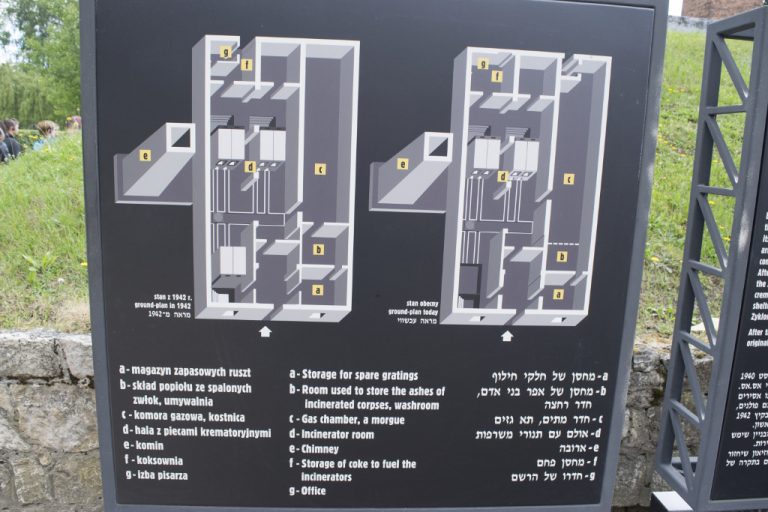
Illustration 1: Sign posted outside the old crematorium at the former Auschwitz Main Camp juxtaposing the situation before the building’s conversion to an air-raid shelter (left) to the current situation (right).
In 1947, the freshly established Polish Auschwitz-Museum authorities restructured the building, among other things by removing some of the former air-raid shelter’s internal walls. By so doing they tried to recreate the state as it was before the conversion of this facility to an air-raid shelter. During that process, a number of mistakes were made, among them the removal of a wall which did exist in the pre-shelter era, separating the alleged gas chamber from the adjacent washroom. Only one internal wall was left, which used to separate the washroom from the laying-out/dissecting room. To this very day, this wall has a “simple interior wall” as installed during the conversion to an air-raid shelter.
Only after the collapse of the Communist Eastern Bloc did the Polish Auschwitz authorities start to acknowledge the fact that the facility as presented to visitors today is not an accurate “reconstruction” of the former alleged gas chamber, although the tour guides kept misrepresenting it to visitors. A sign hinting at a few of the inaccuracies of this botched reconstruction was installed near that building only in the early 2000s, see Illustration 1. The wall originally separating the morgue (or “gas chamber”, marked “c” on the plans) from the washroom (marked “b” on the plans) is missing today.
The Revisionist Position
Starting from the assumption, caused by the Auschwitz Museum’s decade-long misrepresentation, that today’s state of the building is an accurate reconstruction of the situation during the war when homicidal gassing are said to have occurred, revisionists highlighted the fact that the extant doors (or the lack thereof) in the claimed gas chamber would never have allowed the claimed mass murder. For instance, Swedish eccentric revisionist Ditlieb Felderer wrote in 1980:14
“The doorposts [of the door separating the alleged gas chamber from the former laying-out/dissecting room] are made of wood, and the door itself is made of wood and glass. The handle and lock are so weak that they keep falling apart. The door opens inwards, into the ‘gas chamber.’ When we asked Mr. T. Szymanski, the (now retired) curator, how it was that the gassees did not just smash the window in this door and escape, he advised us that he had never investigated this door so he could not give us a definite answer!”

Illustration 2: Gas-tight steel door, type “air-raid shelter”, offered to the Auschwitz Camp, but never delivered.

Illustration 3: One of the eight wedge locks of a gas-tight steel door, type “air-raid shelter”, offered to the Auschwitz Camp, but never delivered.
The wedging of these levers into the lock position could rightly be called “screwed shut”.
The famous 1988 Leuchter Report acknowledged that the current state of the building is not original, “since one wall had been removed,” and therefore did not make any statement about the door currently visible.15 However, at the end of a 1994 article, revisionist Robert Faurisson, ghostwriter of the Leuchter Report, added two images comparing the massive steel door of a US execution gas chamber with the flimsy wooden door with window pane which has been visible in the old crematorium since the wall from the morgue to the washroom had been knocked down in 1947. The caption to the image showing that door reads:16
“One of the three doors of an alleged NS gas chamber for the execution of hundreds of persons at once with Zyklon B (hydrogen cyanide) (Krematorium I, Auschwitz, Poland, beginning of the 40’s).”
The same illustration with the same misleading caption can be found in the 2000 and 2003 English editions,17 but has been removed in the 2019 edition. It is misleading, because it was well known by the time these books were published that this door was never part of a homicidal gas chamber, even if the Auschwitz tour guides were still claiming this in the 1990s and early 2000s, and some may still be doing it today.
In 2005, the English translation of Carlo Mattogno’s monograph on Krematorium I was published.18 While it contains most of the witness testimony quoted earlier and goes into some detail about the various restructurings this building went through, it does not specifically address the question of the doors presumably installed in that building’s morgue while allegedly used for homicidal purposes.
The same year also saw the first English (and 2nd German) edition of my Lectures on the Holocaust, where I briefly addressed the issue of access doors to the morgue, albeit with a focus on the swing door between the morgue and the furnace room, shown on several war-time floor plans.19 The same emphasis on that swing door, with much more detail, can be found in Eric Hunt’s introductory contribution to C. Mattogno’s 2016 book Curated Lies.20 While this proves that the blueprints do not reflect any outfitting of the morgue for homicidal purposes, it can be argued that such secrecy was in fact intentional, meaning that the floor plans were simply not updated in this regard, in particular regarding the swing door, in order to conceal the criminal changes made.
Extant Documentation
In a long 1998 article, German architect Willy Wallwey, writing under the pen names of Hans Jürgen Nowak and Werner Rademacher, summarized what the extant documentation accessible in various Moscow archives reveals about gas-tight doors offered to, delivered to and installed in the various buildings at Auschwitz.21 Wallwey concluded that the Auschwitz camp authorities did indeed request cost estimates for sturdy, gas-tight, and probably also panic-proof steel doors, but they were never delivered. These doors even had so-called wedge locks used to close them in an air-tight fashion, a closing mechanism that could be called “screwing” the doors shut as described by witnesses, see Illustration 3.22
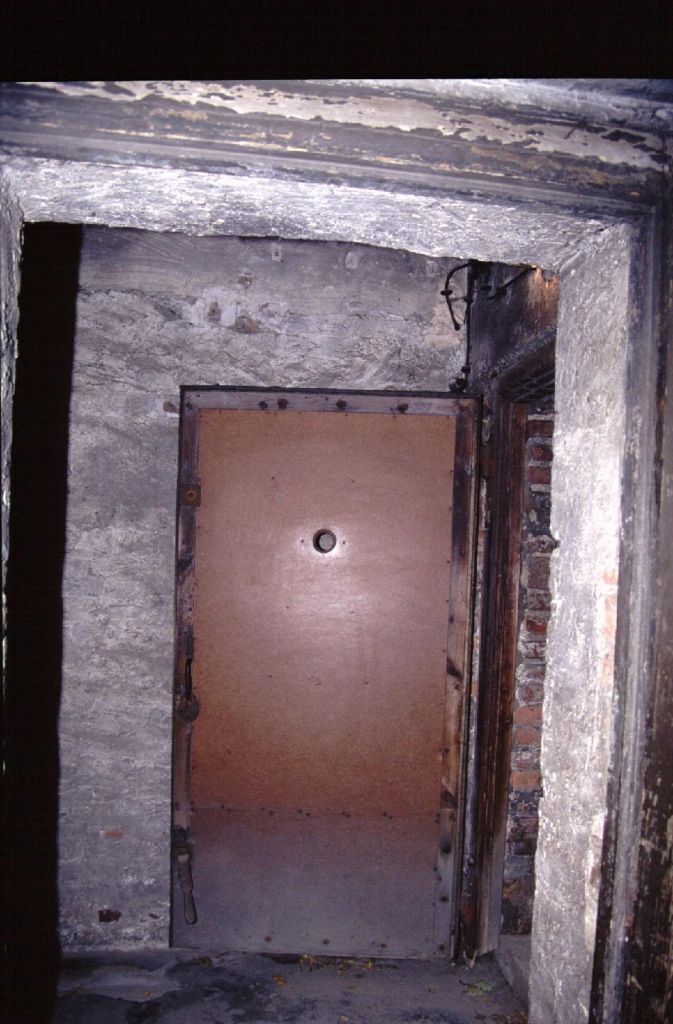
Illustration 4: Make-shift air-raid-shelter door of Krematorium I made of wood with a thin sheet metal cover, probably built by inmates in the camp’s workshop.
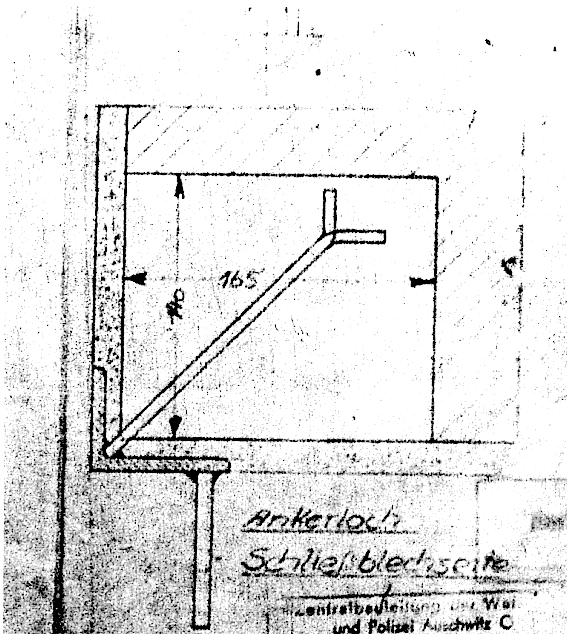
Illustration 5: blueprint of the wall anchor for a frame of a sturdy, gas-tight steel door.
The two existing air-raid-shelter doors made for Krematorium I in 1944 during the building’s conversion to an air-raid shelter are made of wooden planks covered by thin sheet metal, see Illustration 4. Although these doors were probably built by the local inmate workshop, so far no documentation about them has been found. This proves that not everything that was constructed at the Auschwitz Camp left a trace in the documental record, or if it did, that it has survived. Hence, it is conceivable that sturdy gas-tight doors similar to those shown in Illustrations 2f. were in fact delivered to Auschwitz and were subsequently installed there without leaving a documental trace.
The Blueprints

Illustration 6: Inventory plan of Krematorium I, dated April 10, 1942. RGVA, 502-2-146, p. 21.
Below: section enlargement of washroom with adjacent walls, rotated by 90°, with grey circles added to highlight the walls’ width of 15 cm.

While it cannot be ruled out that panic-proof, gas-tight steel doors were indeed delivered to Auschwitz and may have been installed elsewhere, it can be ruled out, based on war-time floor plans, that any such door could have been installed in the relevant door openings of the morgue of Krematorium I.
First, we need to be aware that the frame of a massive wooden or even a steel door designed to withstand a panicking crowd needs to be anchored firmly in the wall. Illustration 5 shows a hoop steel anchor with a so-called dovetail going some 14 cm (5.5 inches) into the wall.22 Needless to say, the wall itself had to be considerably thicker than 14 cm.
Turning to the war-time floor plans of this morgue, we see that the wall separating the morgue from the adjacent washroom and the wall separating it from the furnace room were both very thin: 15 cm, which is the width of a standard brick plus some plaster on both sides of it (see Illustration 6). Hence, these walls consisted only of one row of bricks set lengthwise. The wall separating the morgue from the furnace room consisted of two such walls with a gap of some 30 cm in between (for thermal insulation).
It is not possible to set a steel anchor into bricks. In such a case, bricks have to be removed, and then the anchor placed into a block of cement/concrete. However, since these walls consisted only of one row of bricks – unless they consisted only of a wooden framework of 2-by-5s plus some boards, in which case we need no longer discuss this issue – removing a brick to place an anchor embedded in cement in its stead would have left this chunk of cement held in place by nothing more than the bricks on top and at the bottom of it. Such a chunk would have become loose very quickly. Any forceful shaking of the door would have dislodged those anchors, bent the frame, and made the frame including the door fall out of the wall sooner or later.
In other words, the meager thickness of these walls proves that no sturdy, panic-proof door of any kind could have been installed in them.
The only option left for the traditionalists is to claim that these walls were reinforced to a much thicker width at the very moment the morgue is said to have been converted into a homicidal gas chamber, meaning in September 1941. Yet no evidence exists for this neither in the documental record nor in witness testimonies known to me.
As the late Dr. Robert Faurisson put it aptly:
“No doors, no destruction.”
Germar Rudolf is the author of Dissecting the Holocaust and The Chemistry of Auschwitz, plus many other books and videos. Email him at germar.rudolf@comcast.net. His personal website: http://germarrudolf.com/en/welcome-to-my-world/
______________________________________________
Notes
- [1] The currently accepted orthodox narrative of the so-called first gassing is succinctly summarized by Danuta Czech, Auschwitz Chronicle 1938-1945, pp. 84-87. See the critique of this narrative by Carlo Mattogno, Auschwitz: The First Gassing. Rumor and Reality, 3rd ed., Castle Hill Publishers, Uckfield 2016.
- [2] Gosudarstvenni Archiv Rossiskoi Federatsii (State Archive of the Russian Federation), Moscow, 7021-108-15, pp. 2f. Subsequently abbreviated as GARF.
- [3] Archiwum Głównej Komisji Badania Zbrodni Przeciwko Narodowi Polskiemu Instytutu Pamieci Narodowej (Archive of the Central Commission of Inquiry into the Crimes against the Polish People – National Memorial), Warsaw, NTN, 93; subsequently abbreviated as AGK. The report entered the files of the Höss trial in its Volume 11. The quoted passage is on pp. 26f.
- [4] Danuta Czech set the date of the first gassing in that morgue to September 16, 1941; see op. cit. (note 1), pp. 89f.
- [5] Jan Sehn , Oświęcim-Brzezinka (Auschwitz-Birkenau) Concentration camp, Wydawnictwo Prawnicze, Warsaw 1961, p. 125.
- [6] That should be Leichenhalle, as it was above-ground, while “Keller” means basement/cellar.
- [7] J.-C. Pressac , Auschwitz: Technique and Operation of the Gas Chambers, The Beate Klarsfeld Foundation, New York 1989, p. 124.
- [8] Jadwiga Bezwińska, Danuta Czech (eds.), KL Auschwitz Seen by the SS, Howard Fertig, New York, 1984, p. 93.
- [9] Ibid., pp. 96, 115, 134.
- [10] Ibid., p. 176.
- [11] Minutes of interrogation of Hans Stark , Cologne, April 23, 1959. Zentrale Stelle der Landesjustizverwaltungen, Ludwigsburg, ref. AR-Z 37/58 SB6, p. 947.
- [12] This results from a letter dated August 26, 1944, by Heinrich Josten, head of the Auschwitz air-raid protection department, to the camp commandant, Rossiiskii Gosudarstvennii Vojennii Archiv (Russian State War Archive), Moscow, 502-1-401, p. 34. Subsequently abbreviated as RGVA.
- [13] RGVA, 502-2-147, p. 12a.
- [14] Ditlieb Felderer, “Auschwitz Notebook: Doors & Portholes,” The Journal of Historical Review, Vol. 1, No. 4 (winter 1980), pp. 365-370, here p. 366.
- [15] Fred Leuchter, Robert Faurisson, Germar Rudolf, The Leuchter Reports: Critical Edition, Castle Hill Publishers, Uckfield 2017, p. 47
- [16] Ernst Gauss (ed.), Grundlagen zur Zeitgeschichte, Grabert, Tübingen 1994, p. 109.
- [17] Ernst Gauss (ed.), Dissecting the Holocaust, Theses & Dissertations Press, Capshaw, Ala., 2000, p. 143; Germar Rudolf (ed.), ibid., Chicago, 2003, p. 143.
- [18] Carlo Mattogno, Auschwitz: Crematorium I and the Alleged Homicidal Gassings, Theses & Dissertations Press, Chicago, Ill., 2005 (now available in its 2nd ed., Castle Hill Publishers, Uckfield 2016).
- [19] Germar Rudolf, Lectures on the Holocaust, Theses & Dissertations Press, Chicago, Ill., 2005, p. 255.
- [20] Carlo Mattogno, Curated Lies: Auschwitz Museum’s Misrepresentations, Distortions and Deceptions, Castle Hill Publishers, Uckfield 2016, pp. 30-32. Similar in my book The Chemistry of Auschwitz, Castle Hill Publishers, Uckfield 2017, p. 104.
- [21] Hans Jürgen Nowak, Werner Rademacher, “‘Gasdichte’ Türen in Auschwitz,” Vierteljahreshefte für freie Geschichtsforschung 2(4) (1998), pp. 248-260.
- [22] RGVA 502-1-354-8; July 9, 1942; see Rudolf (ed.), Dissecting the Holocaust, Castle Hill Publishers, Uckfield 2019, p. 326.
Israel settlements turn Palestinian house into cage
![The Gharibs' house in Beit Ijza, caged by a fence and surrounded by the Israeli settlement of Givon Hahadasha, as seen here in a 2018 sattelite image, west of Jerusalem [screen grab from Geomolg]](https://i0.wp.com/www.middleeastmonitor.com/wp-content/uploads/2020/04/20200404_Satellite_Image_Givon-Hahadasha.jpg?resize=1200%2C800&quality=85&strip=all&ssl=1)
The Gharibs’ house in Beit Ijza, caged by a fence and surrounded by the Israeli settlement of Givon Hahadasha, as seen here in a 2018 satellite image. [screen grab from Geomolg]
MEMO | April 4, 2020
Palestinian Saadat Sabri Gharib, 38, had never imagined that his house, which was built by his father in 1979, would be turned into a very narrow cage surrounded by barbed wire and surveillance cameras.
Gharib’s house is located in the Biet Ijza neighbourhood, west of occupied Jerusalem. It was surrounded by about 100 dunams of land owned by Gharib’s father. However, the Israeli settlers stole all of this land and kept the house, which is only 500-metres square.
Gharib told Anadolu Agency, that since 2008, his house has been turned into a very small cage surrounded with concrete walls and located in the middle of an Israeli settlement. It has only a very narrow passage with 12 cameras monitoring it.
Gharib, his mother, his wife and three children live in this house. “Our house is a real prison,” he explains, adding: “It is surrounded with wires from all sides. It was built in the middle of a wide area of land, but today it is a small prison in the middle of Giv’on Hahadasha settlement.”
“We are subjected to stone throwing, live bullet shooting, insulting and burning,” Gharib, who owns all the documents that prove the ownership of the land, revealed.
“However, we had seven demolition orders, but I fought in the Israeli courts and stopped them,” stating that 40 dunams were stolen by the Israeli occupation authorities in 1979 and 60 dunams were isolated from his house by the apartheid wall in 2007. “We do not access them except once a year with permission from the Israeli occupation,” Gharib explains, noting that his house is monitored 24/7.
In 1979, the settlers offered his father a large amount of money for the land, but he refused and said: “If you give me all of Israel’s money, I would never concede an inch of my land.”
Later on, the Israeli occupation stole it with its settlement power.
Putting pressure on Gharib in order to leave his house, the Israeli occupation prevents him from planting any trees near his house, from carrying out any renovation works or from making any repairs.
Gharib points out:
“A few months ago, the water tank was damaged and I wanted to change it, but Israel refused. They want to push us to leave our house. But if the house was demolished, I would live in a tent. I will never leave my family’s house to the settlers.
“We live a very difficult life. The gate of the passage leading to my house is controlled by the Israeli occupation and could be closed any time. In 2008, it was closed for three consecutive months, but we fought until it was opened 24 hours a day.”
Around 900 Palestinians live in Beit Ijza, which was part of Jerusalem before the 1967 Israeli occupation of the West Bank. Since the creation of the Palestinian Authority in 1993, Beit Ijza became part of the Palestinian Governorate of Jerusalem Suburbs.
This neighbourhood is one of many others which were isolated from Jerusalem by the apartheid wall, so they were connected with the occupied West Bank through tunnels or bridges.
According to the Palestinian Bureau of Statistics, more than 50,000 Palestinians holding Jerusalem’s ID cards were isolated by the apartheid wall and deprived from living in Jerusalem.
In 2002, Israel decided to build a 710-kilometre wall to separate the occupied West Bank from Israel and the illegal Israeli settlements in the depths of the occupied territories.
First COVID-19 Death Reported in Asia’s Largest Slum, Dharavi
teleSUR | April 3, 2020
Asia’s largest slum located in India’s financial capital of Mumbai has reported its first COVID-19 fatality, according to local reports.
The patient, a 56-year-old man, had no travel history and was admitted to a local hospital with a fever on Sunday and tested positive for the new coronavirus on Wednesday, an official of the Brihanmumbai Municipal Corporation (BMC) said, according to Al Jazeera.
The authorities have sealed the building where he lived, which is located in a redeveloped part of the Dharavi slum, local media reported.
Also, seven members of his family were quarantined and tested on Thursday for the virus that causes the COVID-19 disease, the Xinhua news agency said.
Mumbai authorities are concerned over the possible spread of the new coronavirus, as Dharavi is known as the most densely populated slum in Asia. At the same time, a doctor and a worker from a municipal corporation also tested positive.
An estimated 700,000 to 1 million people live crammed in Dharavi – a roughly five-square-kilometer maze of narrow lanes, dilapidated buildings, huts, and open sewers.
Public health experts say it would be difficult to contain the virus if it spread in a slum-like Dharavi where eight to 10 people often share a room.
The population density is about 270,000 per square kilometer, making social distancing almost impossible. Scores of people share water sources and sanitation facilities, Al Jazeera reported.
Dharavi’s cases have raised concern that India may be experiencing community transmission of the disease despite a countrywide lockdown since March 25, as well as exposing the harsh reality and problems of inequality in the country.
For his part, Prime Minister Narendra Modi insisted that “testing, isolation and quarantine” will remain priorities in the coming weeks, ignoring the situation of places like Dharavi, the problems of its population, as well as the needs that have arisen in the public health system in the country.
The death toll due to the COVID-19 in India stands at 62 as of Thursday, according to the latest data, while the number of confirmed cases in the country is around 2,547.
Featured Video

Answers to Myocarditis and Heart Conditions
or go to
Aletho News Archives – Video-Images
From the Archives
Casuistry
By Thomas S. Harrington | CounterPunch | August 19, 2016
… What will almost never be talked about are the many very good reasons a person from the vast region stretching from Morrocco in the west, to Pakistan in the east, have to be very angry at, and to feel highly vengeful toward, the US, its strategic puppeteer Israel, and their slavishly loyal European compadres like France, Germany and Great Britain. … Read full article
Blog Roll
Recent Comments
loongtip on Eilat port faces worst crisis… loongtip on British minister dreams of kid… loongtip on Kiev awards major mining proje… loongtip on UK believes it can seize any t… loongtip on Pirates of the Caribbean loongtip on Australian festival boycotted… loongtip on Kiev seeks to ban Russian musi… seversonebcfb985d9 on Somaliland and the ‘Grea… John Edward Kendrick on Kidnapped By the Washington… aletho on Somaliland and the ‘Grea… John Edward Kendrick on Somaliland and the ‘Grea… aletho on Donald Trump, and Most America…


 Aletho News
- Former Head of Israeli Military Intelligence Directorate: There’s a ‘very significant influence operation by the US’ in Iran
- Israel–Syria security pact stumbles as Tel Aviv rejects withdrawal: Report
- The Ukraine Snare Still Beckons
- Italy and the drone that isn’t there
- Knesset advances bill mandating death by hanging for Palestinian prisoners
- Eilat port faces worst crisis as Red Sea shipping collapses
- Iran protest-riots can only achieve US-Israeli intervention, ‘shadow CIA’ concludes
- The Coming War on Iran: What Has Really Been Happening?
- US Cargo Planes Have Flooded the Persian Gulf Since the First of December
- Deep-state forces from abroad instigated violence in Nepal – former foreign minister
- If Americans Knew
- Israel Has Demolished 2,500 Buildings in Gaza Since Signing Ceasefire Deal
- Iran, Gaza and the politics of counting the dead
- How Israel’s move in Somaliland fits in its broader strategy for regional dominance
- As genocide continues in Gaza, the West Bank is pushed into a new Nakba
- Israeli settlers beat elderly, deaf Palestinian man in West Bank attack, video shows
- U.S. May Bankroll New Israeli Armored Vehicles With Billions of Dollars, Internal Files Reveal
- How Israel and the US are exploiting Iranian protests
- The New Neoconservatives
- As more Gaza children freeze to death, Trump eyes Gaza as starting point for world domination – Not a ceasefire Day 95
- More death: in Gaza, West Bank, Israeli prison – Not a ceasefire Day 94
- No Tricks Zone
- Denmark Places Climate Protection Above Animal Welfare, Poisoning And Culling Cows
- New Study: Greenland Was 3-7°C Warmer And Far Less Glaciated Than Today 6000-8000 Years Ago
- German Media Report That Current Frigid Weather Can Be Explained By Arctic Warming!
- Berlin Blackout Shows Germany’s $5 Trillion Green Scheme Is “Left-Green Ideological Pipe Dream”
- Modeling Error In Estimating How Clouds Affect Climate Is 8700% Larger Than Alleged CO2 Forcing
- Berlin’s Terror-Blackout Enters 4th Day As Tens Of Thousands Suffer In Cold Without Heat!
- Expect Soon Another PIK Paper Claiming Warming Leads To Cold Snaps Over Europe
- New Study: Human CO2 Emissions Responsible For 1.57% Of Global Temperature Change Since 1750
- Welcome To 2026: Europe Laying Groundwork For Climate Science Censorship!
- New Study Finds A Higher Rate Of Global Warming From 1899-1940 Than From 1983-2024
 Aletho News