South Korea blocks test kits for Iran on Saudi-funded TV’s request
Press TV – April 19, 2020
Iran says South Korea has rejected a SWIFT payment request by Tehran for purchase of coronavirus testing kits over the US sanctions.
Iran’s Health Ministry spokesman Kianoush Jahanpour late Saturday released a document that shows a Saudi-funded TV had asked a Korean bank to reject the request.
“As a result, the Korean bank rejected Iran’s request and the kits were not delivered to Iran,” he said.
According to the document, London-based Iran International television channel falsely claimed that the SWIFT request had been made by a software company which sought to export non-medical goods to Iran.
Jahanpour released a second document which shows South Korea’s Mico BioMed, which develops and sells medical kits, had in fact presented the SWIFT request to the bank.
“The SWIFT request related [to Iran’s purchase of test kits] has been rejected by the Korean bank under the pretext of sanctions,” he said.
“This shows claims of medicine and medical equipment not being subject to sanctions are lies. The bank has officially stated that the purchase is not possible due to the sanctions,” Jahanpour added.
Belgium-based SWIFT, the Society for Worldwide Interbank Financial Telecommunication, is used to transmit payments and letters of credit.
The US government has intensified its sanctions on Iran despite international calls on Washington to suspend them to allow the Islamic Republic to secure necessary medicine and equipment in the midst of the coronavirus fight.
Washington claims the sanctions do not target medicine for Iran, but they make it all but impossible for importers to obtain letters of credit or conduct international transfers of funds through banks.
Last week, Iran’s Permanent Mission to the United Nations in New York dismissed the Swiss Humanitarian Trade Arrangement (SHTA) which the Europeans belatedly announced with much fanfare to have made operational in coordination with the US to barter medicine and food with Iran.
The mission said the United States has forced SHTA to pursue a very tight and tough procedure, making it practically very difficult for companies to trade with Iran.
“Additionally, almost impossible or cumbersome nature of transferring Iran’s reserves blocked outside the country to the designated Swiss bank, not only does not allow the SHTA to function properly now but may actually render it redundant in a matter of few months,” it said.
According to the mission, several companies that supply the medical equipment required to fight the coronavirus have recently stopped shipping to Iran because the current US sanctions regime makes the shipping of such items to Iran almost impossible.
Washington has imposed new sanctions in the midst of the coronavirus, targeting trade with Iran, even as President Donald Trump has claimed that the US was ready to help with the outbreak if Tehran asked for it.
The Islamic Republic has rejected the offer as hypocritical while the US is refusing to lift the sanctions and even intensifying them. Officials have said Washington’s demand that Tehran make a direct plea for the removal of sanctions shows the United States seeks “nothing short of surrender”.
Iran’s UN mission said last week the only message the US is sending with intensifying its sanctions amid the coronavirus is that companies must avoid doing any business with Iran, even if their work is humanitarian in nature.
Meanwhile, certain sections of mainstream media act as a virtual arm of the Office of Foreign Assets Control (OFAC) which is responsible for administering the US sanctions regime.
They have been on a witch hunt to identify Iran’s financial institutions and report them to the US government for possible sanctions.
Iran International, launched in May 2017, is a regular megaphone for separatists and terrorist groups operating against Iran. It is best known for airing disparaging reports about Iran and trying to stoke unrest in the country.
In October 2018, The Guardian cited a source close to the Saudi government as saying that Iran International had received an estimated $250 million from the Saudi royal court for its launch.
The Paper Of Record Says Feel Sorry For Bill Gates, Who’s Been Targeted With Conspiracy Theories
By Tyler Durden – Zero Hedge – 04/17/2020
The Wall Street Journal’s Deepa Seetharaman wants us to know that while poor billionaire Bill Gates has ‘long been a target for online trolls,’ that ‘the social-media attacks have intensified’ as the Micrrosoft co-founder and World Health Organization (WHO) benefactor has become the left’s de-facto coronavirus czar.

Seetharaman suggests that the attacks have increased due to Gates’s angry criticism towards President Trump, who halted funding to the WHO due to the organization’s handling of the COVID-19 pandemic and its allegiance to China.
In the 24 hours after Mr. Gates’s comments, his Twitter account was mentioned at least 270,000 times—more than 30 times more than average—mainly by angry supporters of President Trump, according to Clemson University researchers. Mr. Gates’s Instagram post from April 5 drew an additional 45,000 comments in that same 24-hour period. The post now has more than 225,000 comments. –WSJ
Perhaps the ‘conspiracy theorists’ are having a little trouble digesting the fact that Gates – whose vaccine efforts in India were blamed for a devastating non-polio acute flaccid paralysis (NPAFP) epidemic that paralyzed 490,000 children – coincidentally hosted an October, 2019 high-level ‘pandemic simulation’ in New York called Event 201 which specifically focused on coronavirus and projected over 65 million deaths worldwide.
Combine that with Gates’ recent comments about mass vaccination and biometric identification in order to ‘open up’ the country and allow people to attend mass gatherings – an idea which Dr. Anthony Fauci said “has merit,” and so-called conspiracy theorists have plenty of dots to connect.
In a new interview, Bill Gates authoritatively states that mass public gatherings will not come back “at all” until we have mass vaccination. Who made him king of the world? https://t.co/siW7bZ9yGc … pic.twitter.com/ivaCI8eAEl
— Alternative News (@NewsAlternative) April 4, 2020
MIT is working on a “quantum tattoo” that will mark you with an invisible identifier while also delivering a vaccine. Can you guess who is the premiere donor of the project? https://t.co/ZEWqCUVGwI pic.twitter.com/jFVip4DaqZ
— Roosh (@rooshv) April 4, 2020
According to the Journal, “social-media platforms remain fertile ground for virus-related conspiracies and online harassment, despite repeated pledges by the companies to crack down on such activity.”
So – Gates is being harassed and nobody is stopping these thought criminals with their menacing opinions. And of course, ‘bots’ are also being blameed for amplifying ‘conspiracy claims’ – since there can’t be that many real humans with bad things to say about Mr. Gates.
“I’ve never seen a time where more mis- and disinformation has flowed than this coronavirus period,” said Univsity of Texas assistant professor Sam Woolley, who has ‘studied disinformation for nearly a decade.’
Some antivaccine activists and conspiracy-minded posters encouraged their followers across social media to attack Mr. Gates on Instagram, a form of harassment called “brigading” in which people coordinate attacks and hijack conversations online, according to a review of accounts. This week, one Instagram account told its 52,000 followers that “it wouldn’t be a bad thing for all of us to go visit Bill Gates Instagram and let him know what you think.” A spokeswoman for the Gates Foundation declined to comment. –WSJ
According to the report, Facebook is now “looking at this behavior carefully to determine whether it violates our policies. People on our services are allowed to speak freely, and do so in an organized way, but we remove accounts that are fake or designed to mislead,” and will begin notifying users who have engaged with what they deem misinformation that they’ve been hoodwinked by bad actors in cyberspace.
How nice! Maybe Facebook will hire someone from the Gates foundation to do their fact checking?
Iraqi parliament demands Baghdad’s procurement of Russia’s S-400 missile system
Press TV – April 18, 2020
The Iraqi parliament’s security and defense committee has submitted an in-depth study to the country’s caretaker prime minister Adel Abdul-Mahdi, requesting the procurement of the Russian-built long-range, surface-to-air S-400 missile defense system.
“The committee has presented a comprehensive study to the prime minister, demanding approval for the purchase of the advanced S-400 air defense system. The issue has already been discussed with relevant figures at the General Command of Armed Forces, and now awaits the premier’s agreement,” Badr al-Ziyadi, a member of the committee, told Arabic-language al-Sabaah newspaper.
He emphasized that the purchase of the S-400 missile system, with the aim of boosting the country’s defense capabilities, will be finalized once the next Iraqi government is formed and it ratifies procurement of the system.
“The approval to acquire such a sophisticated system requires large financial allocations and a political decision in order to diversify the sources to get the weapons as we cannot just rely on the Western camp, but rather need to incline towards the Eastern camp as well,” Ziyadi pointed out.
The Iraqi lawmaker went on to say that his parliamentary committee “will support the next Iraqi government’s decisions in this regard, and will present relevant proposals and pieces of advice to it.”
Back on March 18, Ziayadi said US and Israeli arms firms were putting pressure on the Baghdad government not to discuss the purchase of sophisticated military equipment with other states, and sign arms contracts with them.
“There are companies and traders pushing to prevent Iraq from concluding contracts to purchase weapons from developed countries,” he told Arabic-language al-Maalomah news agency in an exclusive interview at the time.
The same Iraqi parliamentarian said on January 20 that the Baghdad government was planning to send delegations to Russia, China and Ukraine to hold negotiations over the acquisition of advanced air defense missile systems to protect its territory from any possible act of aggression.
“The delegations intend to visit countries like Russia, China and Ukraine to negotiate the purchase of modern systems to protect Iraq’s airspace,” he told al-Sabaah daily then.
The lawmaker added, “The Iraqi parliament is right now forming a joint executive and legislative delegation to visit developed countries and sign contracts on procuring advanced weapons.”
The United States has already warned Iraq of the consequences of extending military cooperation with Russia, and striking deals to purchase advanced weaponry, particularly S-400 missile systems.
Former US State Department spokeswoman Heather Nauert said on February 22, 2018 that Washington has contacted many countries, including Iraq, to explain the significance of the Countering America’s Adversaries Through Sanctions Act (CAATSA), and possible consequences that would arise in the wake of defense agreements with Moscow.
On August 2, 2017, US President Donald Trump signed into law the CAATSA that imposed sanctions on Iran, North Korea, and Russia.
Moscow Aware of US Offer to Tbilisi to Expand Military Research in Lugar Biolab
Sputnik -April 18, 2020
Moscow is aware of Washington’s offer to Georgia to expand military research in the Richard Lugar biological laboratory, located not far from Tbilisi, the Russian Foreign Ministry’s spokeswoman, Maria Zakharova, said on Friday.
“According to the information that we have, high-ranking Pentagon representatives have just recently paid a new visit there, to offer to Georgian authorities to expand the range of research conducted there. Meanwhile, it cannot be excluded that Americans work on creating and modifying different dangerous disease pathogenic agents, including with military aims, in reference laboratories in third countries,” Zakharova said at a briefing.
According to the Russian Foreign Ministry, at the US-Georgian Richard Lugar Public Health Centre in the suburbs of Tbilisi, Georgia’s US partners had taken the initiative to expand the range of studies.
“We noticed, and we cannot help but pay attention to the strengthening of the American biological (weapons development) presence abroad directly,” she said at a briefing. She noted that, in particular, she was talking about the former Soviet republics, where under the pretext of combating bioterrorism, the US Department of Defence was organizing dual-purpose biological research laboratories.
The lab was opened in the Georgian capital in 2011 and has been at the center of controversy for allegedly trying to weaponize diseases. Russia said last fall it was part of a network of research labs that the US military was running in former Soviet republics.
34 US-Backed Militants Surrender, Hand Weapons to Syrian Army – Reports
Sputnik – April 18, 2020
28 militants and six drivers from the Jaysh Maghawir al-Thawra (‘Revolutionary Commando Army’) rebel group arrived in Palmyra, handed over all their weapons and equipment and surrendered to take advantage of the Syrian government’s recent amnesty decrees, SANA has reported, citing a source said to be involved in the process.
Earlier, the Russian Defence Ministry’s Centre for Syrian Reconciliation confirmed that over two dozen militants trained at a US military base in Syria had surrendered to the Syrian Army after breaking out of the US-controlled At-Tanf area and engaging in a shootout with other militia members.
The group’s evacuation from the At-Tanf area, a blob of US-held territory in southern Syria near the Jordanian and Iraqi border, was facilitated following over four months of planning, according to authorities.
SANA’s source said that the haul of surrendered equipment included eight vehicles, some of them fitted with heavy machine guns, along with a small number of automatic weapons, sniper rifles, 2 RPG launchers and a grenade launcher, along with communications equipment and binoculars.
Ghannam Samir al-Khedair, the group’s leader, said he and his comrades had been displaced from Sweida by Daesh (ISIS) and crossed the border into Jordan, where they were trained, after which they were sent to guard the Rukban refugee camp. Al-Khedair also revealed that his men were demoralised after finding out that much of the relief supplies meant for the camp, which once held as many as 45,000 people, was being sold to Daesh, and discovering that other Jaysh Maghawir al-Thawra militants also supported the terrorists.
Khaled Samir al-Khedair, another former militant from the At-Tanf base, said that US occupation forces were training militia to attack Syrian Army positions, as well as civilian infrastructure and oil and gas fields. Salah Rashid al-Zaher, another militant, confirmed that this training for sabotage ops was taking place. According to al-Zaher, in addition to much of the Rukhban camp aid being sold to Daesh, some of it was also traded on the black market to camp residents at exorbitant prices.
The SANA report comes two days after confirmation by the Russian military that a group of over two dozen militants trained at At-Tanf had surrendered to the Syrian Army. The militants began their journey to Palmyra on the night of 13 April, but had to fight off a detachment of Jaysh Maghawir al-Thawra forces to escape, arriving in the ancient city on 14 April.
Rukban Disaster
Officials in both Damascus and Moscow and the Syrian and Russian militaries have repeatedly expressed concerns about the disastrous humanitarian situation at the Rukban refugee camp over the course of many years, and have reported on the Pentagon’s use of the At-Tanf military base to retrain former extremists to renew their struggle against the Syrian government.
Damascus has stressed repeatedly that the only solution which could end the al-Rukban refugees’ suffering would be for the US to withdraw from At-Tanf and leave Syria. At the moment, it’s estimated that there are still as many as 13,500 people at the camp, among them 6,000 militants, and members of their families. At least 150 US troops are estimated to remain at At-Tanf.
The US moved in to take control of the At-Tanf area in early 2016, just as the Syrian Army began its counteroffensive against Daesh militants in the sparsely populated desert areas of central Syria. US forces formally established the Jaysh Maghawir al-Thawra militia after dissolving its predecessor, the so-called ‘New Syrian Army’ militant group, in late 2016. Syria and its allies have repeatedly demanded that the US withdraw from the Arab Republic’s sovereign territory. The area has seen repeated deadly clashes between Syrian forces and entrenched US forces and their militia allies.
Iran’s defense ministry makes mass delivery of new drones to army
Press TV – April 18, 2020
Iran’s defense ministry has made mass delivery of new combat and surveillance drones, including a jet-powered multipurpose UAV (unmanned aerial vehicle) to Army’s Air force and Air Defense Force.
The event took place during an official ceremony at the Iran Aviation Industries Organization (IAIO) in Isfahan with the presence of Defense Minister Brigadier General Amir Hatami and other senior military officials, a day after Iran’s Army Day.
Speaking during the ceremony, Hatami said that the multipurpose jet-powered UAV could travel at speeds of 900 kph and conduct operations at an altitude of 12 kilometers.
He added that the drone can fly for up to 180 minutes and have a range of 1000 kilometers.
Mass delivery of Ababil 3 and Karar drones
During the ceremony, a large contingent of Ababil 3 and Karar drones was also delivered to the Air force.
Speaking about the Ababil-3 drone, Hatami said that the drone is a medium-range surveillance craft capable of conducting airstrikes within a 150 kilometer radius.
He also said that the Karar drone is a strategic combat drone which can deliver payloads comparable to manned aircraft.
He added that the drone has pin-point attack capability and can be used in suicide attacks.
Iran has taken great strides seeking to attain self-sufficiency in producing essential military equipment and defense systems in the face of decades-long US sanctions and arms embargoes on the country.
Earlier this month, Iran announced that it is planning to produce a 6,000 ton destroyer later this year.
According to a statement by Iran’s Navy commander last week, Iran is also considering the development of nuclear-powered submarines.
US quietly recalls ALL B-52 bombers from Guam just DAYS after staging ‘show of force’
© US Air Force / Staff Sgt. Divine Cox
RT | April 18, 2020
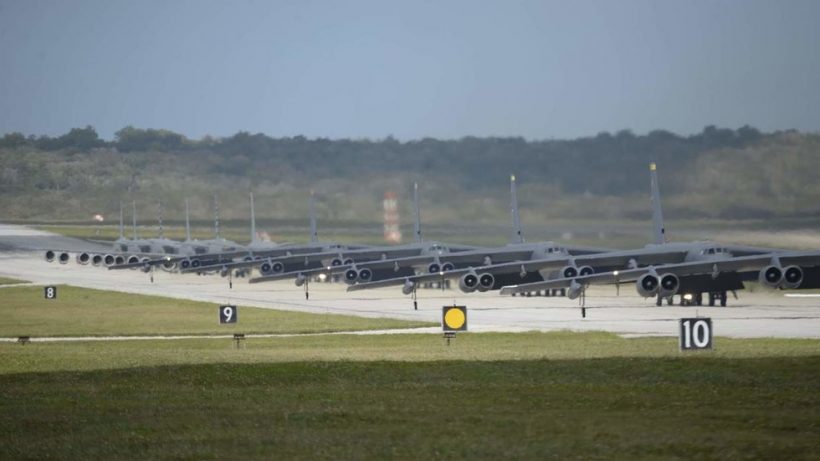
All five nuclear-capable B-52 strategic bombers departed their forward base on the Pacific island of Guam just days after taking part in an ‘elephant walk’ show of force. The US Air Force says it wants to be more unpredictable.
The B-52H Stratofortresses departed Guam on Thursday, ending the Continuous Bomber Presence Mission that began in 2004, according to the War Zone blog. They were spotted flying over to Minot Air Force Base in North Dakota, with callsigns spelling “see you.”
The redeployment was in line with the new National Defense Strategy, calling for the bombers to return to their permanent base and keep the forward deployments less predictable, US Strategic Command spokesperson Major Kate Atanasoff told the War Zone.
“US strategic bombers will continue to operate in the Indo-Pacific, to include Guam, at the timing and tempo of our choosing.”
For the past 16 years, that place was the Andersen AFB on Guam, where the B-52 bombers as well as their newer B-1B and B-2 cousins, would do six-month stints. Under the Trump administration, however, the USAF began experimenting with “Dynamic Force Deployment,” sending B-2s to Wake Island amid their deployment at Pearl Harbor in Hawaii.
The bombers’ departure was accidentally revealed by the Pentagon on April 14, when a photo of them was captioned”Last Continuous Bomber Presence Mission on Guam” on the official Defense Visual Information Distribution Service (DVIDS) website. The caption was later changed to “Andersen remains ready.”
That was the same caption that was used for the “elephant walk” publicity stunt the day before, when the five B-52s lined up on the runway with six KC-135 Stratotankers, an RQ-4 Global Hawk long-range surveillance drone and the Navy’s MH-60S Knighthawk helicopter.
The show of force was interpreted by the media as a message to China, North Korea and even Russia not to get any ideas about challenging US global hegemony. The main tool of US force projection in the region, the aircraft carrier USS Theodore Roosevelt, has been very publicly sidelined by the Covid-19 coronavirus pandemic, with its crew quarantined on Guam.
‘Grave concerns’ about Covid-19 immunity passports
By Tom WHEELDON | France 24 | April 16, 2020
Trapped between the competing urgencies of saving lives from Covid-19 and avoiding economic calamity, some government officials have mooted “immunity passports” as a way through the impasse. But experts told FRANCE 24 that the necessary antibody testing is not reliable enough – and even if the scheme were feasible, it could create a dangerous incentive for some to acquire the virus in order to qualify for some to acquire the virus in order to qualify for the passport.
The global tally of confirmed coronavirus cases surpassed 2 million on Wednesday – a day after researchers at the Harvard School of Public Health warned that the US may need to keep some social distancing measures until 2022, while the IMF predicted that, thanks to “the Great Lockdown”, the world will suffer the worst recession since the Great Depression.
Anxious about both the unfolding economic disaster and the risk of Covid-19 resurging if lockdowns are reversed prematurely, some officials in hard-hit countries have suggested that a system of immunity passports could be a route out of the coronavirus crisis – for some at least. The idea is that people who have already had the disease and thereby gained immunity could be given permits to live their lives mostly like they did before the pandemic.
Shortly after emerging from self-isolation after testing positive for Covid-19, the UK’s Health Secretary Matt Hancock announced in early April that the British government was considering an “immunity certificate” system to allow those who qualify to “get back as much as possible to normal life”.
Paris Mayor Anne Hidalgo has also given the idea her backing – putting it in a list of proposals for returning to business as usual in the City of Lights that she sent to the French government. On the other side of the Atlantic, Anthony Fauci, the director of the US National Institute of Allergy and Infectious Diseases, told CNN that immunity passports are “being discussed” in the Trump administration. “It might actually have some merit under some circumstances,” he added.
Antibody tests ‘not sufficiently accurate’
Immunity passports would require tests for antibodies specific to Covid-19, which would be different from those used to discern whether or not people currently have the virus. The problem is that, as things stand, these tests “are not sufficiently accurate for individual immunity passports”, which means that “we are still a long way off it being useful to test individuals with these methods”, said Claire Standley, an assistant professor at Georgetown University’s Center for Global Health Science and Security.
A major reason why such tests look likely to be ineffective, Standley explained, is that they do not seem specific enough to avoid mistaking a similar virus for Covid-19: “There may be cross-reactivity between the antibodies for SARS-CoV-2 [Covid-19] and other circulating coronaviruses – including those that cause common colds – meaning a positive result might not indicate past exposure to SARS-CoV-2 but maybe another coronavirus instead.”
As well as flagging up people who have recovered from ailments that merely seem similar to Covid-19, Standley said these tests also have a problem in failing to detect some people who have experienced a minor form of the virus: “High false negative rates (lack of sensitivity) of the test mean that those currently available are not recommended for patient-level clinical diagnosis; unless the sensitivity improves, these tests may also not be effective in identifying people who have recovered from mild cases of Covid-19, and thus may have lower levels of antibodies in their blood.”
Immunity for less than one year?
Issues with the accuracy of testing equipment may be solved through rapid technological advances as the world’s scientists focus their energy and resources on tackling the coronavirus pandemic. However, one potentially intractable problem with immunity passports is that immunity might not last terribly long.
“At this point, the virus has been widely circulating in Europe and North America only for a couple of months, and so that is all the information we have – we will know in a year if immunity lasts a year; we will know in two years if immunity lasts two years,” noted Abram Wagner, an assistant professor of epidemiology at the University of Michigan. “From past research into other coronaviruses, immunity was not long lasting, and I would not be surprised if, for most people, immunity lasted less than one year.”
In addition to these scientific hindrances standing in the way of immunity passports, there are worries about the social implications: “I suspect many people will be resentful if others were able to return to work and make money because they had an immunity passport,” Wagner put it.
“I have grave concerns about how these types of schemes could be implemented equitably and fairly, even assuming a reliable antibody test were available, and more known about the length of immunity and how protective it is,” Standley added.
In particular, she said, immunity passports threaten to accentuate inequality between the haves and have-nots, which lockdowns have already intensified: “If the tests need to be purchased, this could further exacerbate disparities between those who can afford the tests (and who may already have been able to work from home/maintain an income during lockdown) versus those who cannot, and thus would be further barred from re-entering the workforce.”
Another unsettling point Standley raised is that immunity passports could create a perverse incentive to contract the coronavirus: “In an effort to return to work, or allow their children back to school, will the promise of an immunity passport make people behave less responsibly, and risk infection, in order to end up with a positive antibody test?”
In this way, an idea touted as a way of giving people their lives back could disadvantage those who have acted most virtuously, Standley warned: “The scheme would potentially punish those citizens who have behaved responsibly and tried their best to reduce their own risk of exposure and that of transmission within their communities.”
All Smoke and No Gun at the OPCW
By Jeremy Salt | American Herald tribune | April 16, 2020
Over the past decade, the London Guardian has never reported the war on Syria in any way commensurate with the principles of true journalism. It is had been running a line, consistently slanted to do as much damage to the Syrian government as possible. As such, it has been a central conduit in the propaganda war. It closed down ‘comment is free’ on its Syria articles long ago because well-informed readers could see what it was up to and were writing embarrassing correctives.
Throughout, its language has been the language of propaganda – ‘the regime,’ ‘Assad loyalists,’ ‘the dictator,’ ‘the rebels’, ‘the armed opposition,’ ‘the uprising,’ ‘the çivil war,’ so on and on, endlessly. Its ‘coverage’ has always been calibrated to the damage it thinks it can do to the Syrian government. In fact, by supporting its ‘rebels’ and by implication the governments arming and financing them, it has only aggravated the damage being done to Syria and its people who, all the evidence suggests, overwhelmingly support their president and their army, not these ‘rebels.’
Silent when its ‘rebels’ are taking a beating, the Guardian springs to life the moment there’s a fresh opportunity to abuse Syria’s president. Accordingly, when the OPCW (Organization for the Prohibition of Chemical Weapons) issued its latest report on chemical weapon usage in Syria, its sibling Sunday paper, the Observer, was quick off the mark, running a headline on April 12 reading “Assad to face justice.” It went on: “For the first time the world’s chemical weapons watchdog has directly accused Syria’s leadership of ordering illegal attacks on its own people.” Stating accusations from concealed sources as fact, it concludes that “the tyrant in Damascus has not yet won.”

As it turns out, the OPCW report is all smoke but no gun. Unsurprisingly, given their Syria coverage, the Guardian and the Observer are not even interested in distinguishing between the two. For their purposes, the smoke is as good as the gun. What they call “the world’s chemical weapons watchdog” is actually a watchdog protecting the interests of the governments attacking Syria through armed proxies. The Guardian and the Observer are watchdogs protecting the same interests, which in this case means protecting a tainted report coming from a tainted source.
Last year whistleblowers revealed that the OPCW executive had suppressed the interim report by the Fact Finding Mission (FFM) on the alleged chemical weapons attack on Douma in April 2018, and had issued a doctored final report, reversing the on-the-spot findings of its own experts.
The final report concluded that the cylinder said to have crashed through a roof had probably been dropped from the air when its own engineers had arrived at the “higher probability” that it had been placed there manually. As for the heavy amounts of chlorine it suggested had been released from this cylinder, killing 43 people, according to anonymous “witnesses”, what its own chemists said they found in the air were microparticles no different from what would have been in the air normally. On January 20 this year, the OPCW’s inspection team leader at Douma, Ian Henderson, told a specially convened session of the UN Security Council that the evidence indicated there had been no chemical weapons attack at all at Douma.
Its fraudulent behavior exposed, the OPCW secretariat tried to dismiss the evidence of its whistleblower engineers and scientists as “subjective” but the damage to its credibility was terminal, and in seeking to uphold a tainted report from a tainted organization, the Guardian and the Observer only underscore the tainted nature of their own ‘reporting’ and editorials on Syria.
Wisely, in this latest report, dated April 8, “The First Report by the OPCW Investigation and Identification Team” (IIT), a body established in 2018, the OPCW does not return to what happened at Douma in 2018. The subject matter this time is chlorine and sarin attacks said to have been carried out in and around the “village” of Ltameneh on March 24, 25 and 30, 2017.
In fact, Al Lataminah (“Llatameneh”) is not a “village” as described in the IIT report but a town with a population of more than 16,000, according to the census of 2004. This has probably shifted upwards or downwards since then. Close to Hama and only a few kilometers from the strategically important M5 highway, the town is located within territory in the Hama governorate that was under the control of Hayat Tahrir al Sham and other terrorist factions when the chemical weapons attacks were said to have taken place in 2017. Al Lataminah itself was the headquarters of Jaysh al ‘Izza (Army of Glory).
According to the IIT, there were three attacks, one of chlorine and two of sarin, on March 24, 25 and 30, each in cylinders or bombs dropped from the air by Syrian air force SU (Sukhoi) 22 fighter aircraft or helicopters. The format of the report is identical to the format of all its reports, and indeed all the reports put out by the UN’s Independent International Commission of Inquiry on the Syrian Arab Republic. Lots of acronyms, weighty officious language implying authority, lots of imputations but virtually nothing in the form of evidence that would stand up in a court.
The sources, individual, institutional and governmental (“state parties”) are all concealed. The OPCW says it sought entry into Syria, but was ignored by the Syrian government, which is hardly surprising given the fakery of its report on Douma. It talks of witnesses, who, as its investigators were not on the spot inside Syria, have to be regarded as alleged witnesses. It does not say who they were or where they were when interviewed, but Turkey would be most likely. Neither is there any mention of possible affiliations, perhaps to the White Helmets or one of the armed groups.
The report ties the alleged attacks to the close proximity of Syrian airbases and the daily activity of Syrian aircraft as they take off and return. Syria is fighting a war against terrorist groups that have infiltrated and taken over large parts of the Hama and Idlib governorates, so of course military planes and helicopters are frequently in the air. The ITT imputations that they might have been or could have been involved in chemical weapons attacks are devoid of substance.
The IIT report talks confidently of its chain of custody, including shell remnants said to have been taken from craters to one of its (unidentified) designated laboratories. It does not say who allegedly carried this material out of Syria but as Jaysh al ‘Izza was then in control of the town, one of its members or its sympathizers, committed to the destruction of the Syrian government and out to blacken its name whenever possible, is the most likely.
Included in the IIT evidential chain is information “obtained” during interviews, information “previously” provided by “witnesses,” interviews with “persons of interest” along with the evidence of other unidentified “witnesses” to the attacks and people affected by them. Again, these are alleged witnesses to an alleged attack and people allegedly affected by these alleged attacks. They were NOT interviewed in Syria and the IIT report provides no proof of their authenticity.
The IIT’s further sources include unidentified videos and “documents,” as well as “relevant material” from “various sources,” briefings and advice from unidentified “experts” and “specialists,” information from unidentified “open sources” and “forensic institutes,” and unspecified input from unidentified “state parties.”
Noting the use of tunnels at Al Lataminah by Jaish al ‘Izza, a “military expert” advising the IIT “noted [that] the use of chemical weapons in this area would not be inconsistent [my italics] with a strategy aimed at inflicting terror on both civilians and combatants.” Neither, of course, on the basis of past compelling evidence, would it be inconsistent with the proven attempts by terrorist groups to lure outside governments into launching an air war on Syria by staging faked chemical weapons attacks. The IIT refers to the possibility of a staged attack, but does not take it seriously.
It claims to have received information “from multiple sources”, unidentified of course, that senior Syrian Republican Guard officers (names redacted) sent orders to “former members” of the “previously-designated branch 450, a component of the Syrian Arab Republic’s chemical weapons programme responsible for the storage, mixing and filling of chemical weapons, including sarin, to prepare items for use in the defense of Hama.” By imputation, these “items” were chemical weapons. The IIT also claimed to have “obtained information” that in March 2017, sarin precursors were being stored at a facility at Him Shinshar, in the Homs governorate.
The ITT notes that branch 450 was “officially” dissolved in 2013, insinuating, again, that it wasn’t really, while providing no evidence at all to back up the “information” received from some unnamed source that the Syrian government still had a stock of sarin precursors. It does not say where the “former members” are now, or what they are doing, and provides no hard evidence at all to back up the claim by hidden “multiple sources” that in 2017 they were still involved in the preparation of chemical weapons
The report refers to satellite imaging of the Shayrat airbase (provided by whom?) showing, “according to a specialist” (in what?) “structures” that “could have been used [my italics] to store chemical weapons.” Perhaps they also could have been used to store engine parts, garden tools, food for the base canteen or cleaning material for the toilet blocks but the unknown contents of these “structures” are all part of the buildup to the IIT report’s conclusion that it was “very likely” Syrian air force planes did drop chemical weapons on Al Lataminah.
The same imagery indicated that part of the Hama airbase was a “possible barrel bomb storage depot” with a number of items visible as “possible barrel bombs.” No doubt there is a vast range of other possibilities for what these “items” might have been, so why pick just this one? The ITT also claimed to have “obtained information” that chlorine barrel bombs had been prepared at nearby Masyaf, the 12th century center of the Ismaili fidais (sacrificers) who have passed into history as the Order of the Assassins. According to the IIT’s source, they were taken to Hama, but without there being any inkling of who provided this “information,” such a claim cannot possibly be taken at face value.
The IIT claimed to have “received information” that 176 people were admitted to hospital after the (alleged) sarin attack on March 24 but admitted that it had been unable to locate the medical records. Clearly they would have been of paramount importance in confirming what had taken place, and medical staff in a hospital in a town controlled by Jaysh al ‘Izza could surely have been easily persuaded to provide them. There is no attempt by the ITT, however, to explain why its sources could not come up with photocopies of at least one or two of these records, if indeed there was an attack, if there were indeed casualties and if there were indeed medical records to photocopy.
The IIT further claims to have interviewed casualties and medical staff who described symptoms toxicologists found “plausible” as being consistent with the effects of nerve gas. In fact, sarin is so deadly that it can kill within one to ten minutes, with those who survive often suffering permanent brain damage, raising further questions about its alleged use at Al Lataminah. There is no indication in the IIT report that any of these alleged victims were subjected to a medical examination either in Syria or wherever it was that they were later interviewed. For a team of investigators determined to get to the truth, one would have thought this also should have been a priority.
The IIT claimed to have interviewed individuals “with direct knowledge” of the attacks. It does not say where they were interviewed and how it knew they had “direct knowledge” of the alleged attacks. It further claims that munitions remnants (allegedly) taken from a crater “could be linked” to “potential chemical weapons use.” “Could be” and “potential” are hardly persuasive.
Samples were (allegedly) taken from one crater on March 26, 2017, but not delivered to the FFM until August 12. There is no indication of who in this Jaysh al ‘Izza-controlled town dug up the samples and gave them to the FFM nearly five months later. One would have to conclude that it was most likely someone from Jaysh al ‘Izza, if in fact there was a crater and the samples were taken from it and not somewhere else. Speculating further, the report says that 2000 bombs designed to carry chemical weapons had been converted into conventional bombs after 2013 and supposedly used but the secretariat had been unable to confirm that this had actually happened, conveniently leaving an avenue open to support the IIT’s claims.
The report claims that helicopters dropped four “barrel bombs” on March 25, one falling through the roof of a building, just as a cylinder full of chlorine was said to have done in the discredited report the OPCW issued on Douma. Three “witnesses” were said to have seen the event and reported that three people died as a result and 32 were injured. There is not a scintilla of confirmation for any of this. There is no indication of how the IIT was able to confirm that the individuals it interviewed in another country, apparently long after the event, really were witnesses.
Completely sweeping away the creaking foundations of all of this is the OPCW’s own earlier findings on the destruction of all the Syrian government’s stocks of chemical weapons material, following the staged attack in the Ghouta disrict, near Damascus, in August 2013, designed to draw Barack Obama over his self-declared “red line” so that he would launch an air attack.
Warned by his own intelligence agencies that the attack could be a setup, Obama pulled back at the last minute, but subsequently, the Syrian government offered to have all its stocks of chemical weapons destroyed under international supervision anyway. The process began in September 2013, the Syrian government simultaneously signing on to the International Convention on the Development, Production and Stockpiling of Chemical Weapons and on their Destruction (1997).
By June 2014, the OPCW, the supervising body, reported that all production capacity had been destroyed. The remaining chemicals were removed from Syria and by August 2014, all had been destroyed. In January 2016, the OPCW affirmed that the destruction of Syria’s chemical weapons material in the previous three years had been completed. Now, however, the ITT is reproducing an unsubstantiated claim that they weren’t, in order to lend spurious plausibility to its accusations that the Syrian air force dropped chemical weapons and nerve gas on and around Al Lataminah.
The appropriate resting place for this report is not the filing cabinet but the wastepaper basket. With these reports, the OPCW has completely destroyed its credibility. It needs cleaning out, beginning with the sacking of the director-general and the entire secretariat. Otherwise, it should be replaced with a new body, if the world is to have a credible independent chemical weapons watchdog and not one that appears to dance to the foreign policy interests of the US and its global satraps.
China denies covering up Covid-19 severity, says revision increasing deaths by 50 percent ‘common practice’
RT | April 17, 2020
The correction of Wuhan’s Covid-19 death toll, which rose by 1,290 and now stands at 3,869, was part of a statistical verification process and is a common international practice, a spokesman for the Chinese Foreign Ministry said.
Zhao Lijian rejected claims that the Chinese government had engaged in a cover-up of the severity of the outbreak, saying at a daily briefing that Beijing would not allow such a thing.
The claim has been pushed, among others, by US President Donald Trump, who froze funding for the World Health Organization (WHO) this week after accusing it of conspiring with China to mislead the world about the threat posed by the virus.
After the revision for Wuhan, the ground zero of the Covid-19 pandemic, China’s total death toll stands at 4,632. The change announced on Friday was explained by “incorrect reporting, delays and omissions of cases” by some medical institutions in the city during the early stages of the outbreak.
The US has had its own spike in Covid-19 deaths due to re-evaluation of previous cases. New York this week added 3,778 earlier deaths to its tally, including people “presumed” to have died from the infection based on symptoms and medical history rather than positive tests.
Intelligence agencies fail to protect us from pandemic

CSIS and CSE headquarters
By Yves Engler · April 16, 2020
With millions forced out of work and many more stuck at home, Canadians need to ask tough questions of organizations receiving billions of dollars to protect them from foreign threats. The country’s intelligence/security sector has done little to respond to the ongoing social and economic calamity. Even worse, their thinking and practices are an obstacle to what’s required to overcome a global pandemic.
A recent Canadian Press article highlights the failure of intelligence agencies to warn of the COVID-19 outbreak. They largely ignore health-related threats despite receiving huge sums of federal money.
The Canadian Security Intelligence Service’s (CSIS) has more than 3,000 employees and a $500 million budget, which is nearly equal to that of the lead agency dealing with the pandemic. The Public Health Agency of Canada’s (PHAC) budget is $675 million and it has 2,200 employees. For its part, the Communications Security Establishment (CSE) employs 2,500 and receives over $600 million annually. In 2011 Department of National Defence run CSE moved into a new $1.2 billion, 110,000 square metre, seven-building, complex connected to CSIS’ main compound.
CSE is but one component of DND’s intelligence juggernaut. Not counting CSE, the Canadian Forces has greater intelligence gathering capacities than any organization in the country. While their budget and size are not public information, the government’s 2017 Defence Policy review notes that “CFINTCOM [Canadian Forces Intelligence Command] is the only entity within the Government of Canada that employs the full spectrum of intelligence collection capabilities while providing multi-source analysis.” The Defence Policy Paper called for adding 300 military intelligence positions and expanding CFINTCOM’s scope.
CFINTCOM has a medical intelligence (MEDINT) cell to track how global health trends and contagions impact military operations. Apparently, they reported on the coronavirus outbreak in January but it’s unclear who received that information.
The $2 billion spent on CSIS/CSE/CFINTCOM annually — let alone the more than $30 billion devoted to DND/Veterans Affairs — could have purchased a lot of personal protective equipment for health care workers. It could have paid for many ventilators and it could also have been used to raise the abysmally low wages of many who work in long-term care and nursing homes.
But, it’s not only that CSIS/CSE/CFINTCOM resources could be better used. Their ideology and structures are an obstacle to avoiding/overcoming a global pandemic. Two weeks ago, CSE put out a statement warning Canadian coronavirus researchers to beware of malign international forces seeking to steal their research. A Canadian Centre for Cyber Security statement noted, “these actors may attempt to gain intelligence on COVID-19 response efforts and potential political responses to the crisis or to steal ongoing key research toward a vaccine or other medical remedies.” But, wouldn’t it, in fact, be great if our ‘enemies’ in Russia, China, Iran, or anywhere else employed Canadian research to develop a cure or vaccine for COVID-19? Who, except extreme right-wing ideologues could believe a vaccine or cure should be patented and profited from?
It won’t be easy to shift their orientation to include pandemics. In a recent commentary, prominent intelligence agency insider Wesley Wark notes, “our security and intelligence agencies have never seen health emergency reporting as part of their core mandate, despite a plan laid down in the National Security Policy announced after SARS that unfortunately went nowhere.” For a time after the 2003 SARS outbreak the CSIS-based Integrated Threat Assessment Centre reported regularly on pandemic dangers, but the unit was soon collapsed into the Integrated Terrorism Assessment Centre. For the intelligence agencies “terrorism” is appealing because it justifies militarism and a ‘security’ state. Health emergencies, on the other hand, justify better work conditions for long-term care providers.
The CSIS/CSE/CFINTCOM definition of ‘security’ is heavily shaped by corporate Canada, state power projection and ties to the US Empire. In criticizing Canadian intelligence agencies’ failure to warn/protect us from the pandemic, Wark highlights the dangerously narrow outlook of the intelligence community. He suggests CSIS/CSE/CFINTCOM could have helped prevent the calamity by gathering better intelligence on China. But, if Beijing hid early information on COVID-19, it’s at least partly because China is locked in a destructive geopolitical competition with the US empire, which was instigated by Washington and its allies (from 1949 to 1970 Canada refused to recognize China and in 1950 sent 27,000 troops to Korea largely to check Chinese nationalism). In recent months CSIS/CSE/CFINTCOM have sought to identify China as a threat.
Wark’s thinking must be rejected. Avoiding and overcoming global pandemics requires a free exchange of health information. It also requires international solidarity.
After the COVID-19 crisis dies down, progressives should renew their push to devote intelligence agencies’ resources towards initiatives that protect ordinary Canadians’ security, rather than the interests of the rich and powerful.
Featured Video
No Threat Can Force Iran’s Surrender /Trita Parsi & Lt Cl Daniel Davis
or go to
Aletho News Archives – Video-Images
From the Archives
What is the Israeli Lobby in Australia Doing in Interfaith Dialogue?
By Ali Kazak | Dissident Voice | October 11, 2015
For years Israel and its lobby around the world have been trying to normalise their relations with Arabs and Muslims without solving the Palestine Question.
One of the methods they resorted to in the last few years is using human rights and community organizations such as interfaith dialogue and Multiculturalism to achieve this objective and to: isolate the Palestinians, marginalise the Palestine question, end Israel’s isolation, and prevent criticism of Israel, knowing that these organisations will be the first to stand against Israel’s violations, racial and religious discrimination.
The group responsible for this task in Australia is The Australia/Israel & Jewish Affairs Council (AIJAC); its Director of International & Community Affairs, Jeremy Jones is in charge of lobbying religious community organizations, specifically Muslims and Christians. Consequently he convened the Faith Communities for Reconciliation, founding participant in the Australian Partnership of Religious Organisations and the Australian National Dialogue of Christians, Muslims & Jews.
AIJAC is a private political propaganda group. It is recognised as the main Israeli lobby in Australia. It coordinates its activities and works intimately with the Israeli embassy in Canberra and different institutions in Israel. It is privately funded by some Jewish businessmen. It monitors closely Australian politicians, the media, ethnic and religious groups, (especially Arabs and Muslims), unions and academics on their stands towards Israel and the Palestine question. … continue
Blog Roll
 Aletho News
- The war of liberation of the Arab and Islamic peoples expands across the Gulf
- Envoy warns UN on Trump’s threat to ‘obliterate’ Iran’s civilian infrastructure
- The Larak Corridor: Iran’s Rial Gate With No US, No Israel, and No Way Around
- ‘Economic terrorism’: Steel facilities hit again in US-Israeli strike
- ‘War Crime’: Iran condemns attacks on Arak, Ardakan nuclear sites
- Two-thirds of Americans want quick end to Iran war even if goals unmet
- Trump to Give “Important Update on Iran” Wednesday in Prime-Time Speech
- Theodore Postol: Iran’s Missiles & Drones Were Underestimated
- Iran To Target Military Industrial-Tech Complex That Facilitated Gaza Genocide
- Collapsing Empire: The Resistance Disarms ‘Israel’
- If Americans Knew
- Israel wants US to bomb more of Iran’s civilian structures (113,000 is not enough) – Not a ceasefire Day 173
- Ann Coulter Rips Into Fox News for Iran War Coverage
- Joe Kent Urges Americans To Call White House and Congress To Object To Sending Troops Into Iran
- DNC Resolution to Reject AIPAC Funding Puts Democratic Leaders in the Hot Seat
- Swedish foundation to build 400 schools as over 650,000 Gaza children remain without education for 2 years
- Israeli army admits photshopping image of slain Lebanese journalist
- This is how Israel is systematically killing health workers under the cover of war in Lebanon
- Carrying life under fire: Israeli invasion of Lebanon leaves pregnant women facing deadly risks
- Champagne all around for the new death penalty (for Palestinians) law – Not a ceasefire Day 172
- Why are Palestinian books struggling to be seen on Amazon?
- No Tricks Zone
- New Study Finds Warming Saves Lives…Cold Temperatures 12 Times More Deadly Than Excess Heat
- German Science Blog Accuses PIK Climate Institute Of Hallucinating Climate Tipping Points
- Devastating Assessment Of Comirnaty Vaccine By Former Senior Pfizer Europe Toxicologist
- New Study: CO2 Is ‘Effectively Negligible’ As An Explanatory Climate Change Factor Since 2000
- Former Pfizer Toxicologist Dr. Helmut Sterz Tells Bundestag Hearing Pfizer Vaccine Should Have Never Been Approved
- Energy Expert: Germany’s Nuclear Phaseout Was A “500 Billion Euro Mistake”
- New Research: South Australia’s Mid-Holocene Sea Surface Temperatures Were 4°C Warmer Than Today
- Storing Green Energy To Last Germany 10 Days Would Require A 60-Million Tonne Battery
- New Studies: UK Sea Levels Were 4 Meters Higher Than Today During The Mid-Holocene
- Destructive Green New Deal: German Energy And Metal Group Warns Of Drastic Crisis
 Aletho News