OPCW head FALSELY described Syria whistleblower inspectors to discredit them, new documents show
RT | May 6, 2020
New documents leaked from the global chemical watchdog show that two inspectors blowing the whistle about the 2018 Douma incident in Syria were right, and the director seeking to discredit them was wrong.
Two inspectors with the Organization for the Prohibition of Chemical Weapons (OPCW) have challenged the organization’s final report on the April 2018 incident, which they say was altered to dismiss their findings and validate after the fact the US, UK and French missile strikes against the government in Damascus.
OPCW Director General Fernando Arias responded earlier this year by describing them as “rogue” inspectors who weren’t even members of the mission. Documents obtained by investigative journalist Aaron Mate at Greyzone, however, show that Arias’ statements were false or misleading.
Arias claimed that South African inspector Ian Henderson was “not a member” of the fact-finding mission (FFM) dispatched to Douma, and that he had played a “minor supporting role.” However, the documents from April 2018 obtained by the Grayzone show that OPCW directors were “happy” to have Henderson lead the visits to the most important locations in Douma: the hospital and the sites of alleged chlorine cylinder impact, for instance.
Another document, described as a sensitive security-planning memorandum known as CONOPS, lists Henderson as part of the FFM under the section “Mission Personnel.”
Last, but not least, the “F038” memorandum to the Syrian government lists Henderson as “part of the team conducting the technical secretariat visits,” notifying Damascus of his role. Henderson has previously explained publicly that he was on a mission in Nepal, and was assigned to Douma immediately upon his return.
Moreover, another OPCW document shows that Henderson took over the OPCW Damascus command post on May 3, 2018 – two days after returning from Douma. This goes directly against Arias’ version of events, according to which Henderson was already in Damascus, happened to play a minor role in the Douma mission, and then went “rogue” to sabotage the organization for reasons unknown.
Henderson and another whistleblower inspector – who remains anonymous – have said for months that they had not gone rogue, but were sidelined by OPCW because they produced evidence suggesting the Douma incident had been staged by the Army of Islam militants who controlled the area at the time. The final OPCW report, they contend, was doctored to retroactively justify the US, UK and French missile strikes and enable them to blame Damascus.
The OPCW responded to their revelations by painting them as disgruntled employees who breached confidentiality and lacked expertise and access to all the evidence. Their own documents now clearly show those statements to be false.
Greece’s Renewed Relations with Syria Further Isolates Turkey in the Eastern Mediterranean
By Paul Antonopoulos | May 7, 2020
On Tuesday, the Greek Foreign Ministry finally announced a restoration of relations between Greece and Syria and assigned former ambassador to Syria and Russia, Tasia Athanassiou, as a Special Envoy of Greece’s Foreign Ministry for Syria. Greek Foreign Minister Nikos Dendias confirmed this from his Twitter. The appointment of Athanassiou is extremely strategic as she was Greece’s ambassador to Damascus from 2009 to 2012, meaning she is already familiar with Syria and their authorities.
The Greek Foreign Ministry said that contacts will be made for the “international aspects of Syria and related humanitarian action, as well as coordination of actions in view of the ongoing efforts to rebuild Syria.”
Although the Foreign Ministry claims that the suspension of diplomatic relations “was dictated by the security conditions,” we know it was ordered by former Greek Prime Minister Antonis Samaras in December 2012 under orders from NATO and the European Union who were, and in some instances, still are backing jihadists against the secular government of President Bashar al-Assad.
Greece became a country ruled by European banker, EU, and NATO puppets from 2010 onwards when on May 2 of that year, the so-called socialist government of George Papandreou signed the first of three bailout packages with the European Commission, the European Central Bank and the IMF. This caused a 25% contraction of the Greek economy, an unemployment rate of 27% and skyrocketed poverty. Any semblance of Greek independence in domestic and foreign policy was lost.
However, moving to 2020, the economic and geopolitical situation in Greece and its surrounding region has drastically changed. Diplomatic sources quoted by Kathemirini, one of Greece’s oldest and most respected newspaper, said that the decision to appoint a Special Envoy for Syria is part of Greece’s steady activity in the Eastern Mediterranean and the wider region. According to the sources, Greece’s increased desire in contributing to efforts in resolving the Syrian crisis was stated by Dendias in his meetings with the UN Special Envoy for Syria, Geir Otto Pedersen.
Therefore, a major reason for the reopening of relations with Syria is to further tilt the balance of power in the East Mediterranean in Greece’s favor against Turkey, especially at a time when Ankara does not have a single ally in the region, with the exception of the besieged Muslim Brotherhood government in Libya that is nearly collapsed because of the Libyan National Army’s assault.
The reopening of relations between Athens and Damascus comes at a time when Turkish President Recep Tayyip Erdoğan is making a strong push for a “Blue Homeland” that aims to annex Greece’s Eastern Aegean islands and maritime space. Turkey for nine years attempted to oust Assad from power through various means, including an unsuccessful invasion attempt of Idlib province earlier this year, as well as its continued support for terrorist organisations. In addition, Erdoğan is propping up the Muslim Brotherhood government in Libya by importing jihadists from Syria to the North African country.
Although Erdoğan has failed in all of these endeavours, Turkey still remains a major threat, even at a time when it is facing economic catastrophe with the Turkish lira at a near record low to the U.S. dollar and Turkey’s three largest banks, Garanti, Akbank and İşbank, on the verge of bankruptcy. Even with this looming economic disaster, Turkey still manages to find the funds to violate Greek airspace on a daily basis, send weapons to Libya and fund terrorist organizations in Syria.
As the Eastern Mediterranean becomes a potential major warzone because of Turkey’s aggression, Greece is now renewing relations with old friends. Hafez al-Assad, previous president of Syria and father to Bashar al-Assad, pledged that if Turkey was ever to go to war with Greece, Syria would automatically open a new front in southern Turkey in support of Greece.
Athens however is not completely independent from NATO and the EU. This suggests that although renewing relations with Syria is absolutely critical in protecting its sovereignty, perhaps Greece has gotten approval from the EU and/or NATO to do this. Greece is perhaps the most important of the very few European countries that have maintained or reopened relations with Syria because of its history of friendly relations, as well as thousands of years of religious, cultural, financial and ethnic ties.
It can be suggested that as the war in Syria begins to end, continued only by Turkey’s refusal to stop backing terrorist organizations in Idlib, the EU wants to try and take advantage of lucrative reconstruction contracts that will be on offer and investment opportunities. It is unlikely that European companies will win reconstruction contracts, but the reality is that Assad has survived the near 10-year efforts to have him removed, and is not going anywhere. Greece could be used as an outlet for the EU to open dialogue and relations with Damascus again.
This is only speculative, but what is for certain is that by reopening relations with Syria, Greece is consolidating the emerging East Mediterranean order and opposes Turkish hegemony in the region. Greece will always have close relations with Cyprus, and has also entered a military alliance with Egypt, supports the Libyan National Army against Turkish-backed forces, and has strong military and energy ties with Israel. Relations with Syria have essentially finalized the strangulation of Turkey’s attempted hegemony of the Eastern Mediterranean and made it the most isolated country in the region – despite Athens’ insistence on improving ties with Ankara if it finally abandons its aggressive foreign policy.
Paul Antonopoulos is a Research Fellow at the Center for Syncretic Studies.
Russia Probe Testimonies Reveal There Was No Collusion Between Moscow & Trump Campaign, Report Says
By Lilia Dergacheva – Sputnik – May 7, 2020
As part of an earlier declared bipartisan effort to approve the public release of files pertaining to the Russia probe, Director of National Intelligence Richard Grenell announced that 53 of them had been cleared to this end.
The due-to-be-released transcripts of House Intelligence Committee interviews feature top law enforcement and intelligence officials asserting they had no evidence of collusion between the 2016 Trump campaign and Russia , senior administration and intelligence community officials told Fox News.
The findings are reportedly entirely in line with the results of former Special Counsel Robert Mueller’s investigation, which found no evidence of illegal or criminal coordination between President Trump, his presidential campaign, and Russia in 2016. However, the interviews, which are eligible for release, cast a heavy doubt on committee Chairman Adam Schiff’s previous statements about “direct evidence” of close coordination.
“Schiff is in panic mode”, a senior administration official recounted to Fox News.
The 53 transcripts reportedly include interviews with Donald Trump Jr., Trump’s ex-campaign manager Steve Bannon, adviser Jared Kushner, Trump aide Hope Hicks, former campaign manager Corey Lewandowski, former Trump attorney Michael Cohen, and others.
“The transcripts show a total lack of evidence, despite Schiff personally going out saying he had more than circumstantial evidence that there was collusion”, one source involved in House Russia investigations told Fox News.
Only one of the 53 is said to have implied there is some evidence of alleged coordination.
Earlier this week, House Republicans combed through over 6,000 pages of transcripts pertaining to interviews conducted by the committee in 2017 and 2018, after the the partisan vote in September 2018 approved their public release.
Newly sworn-in Director of National Intelligence Richard Grenell notified Schiff that the redaction and declassification process was complete, and that the records were ready for release, thereby implying that Schiff is welcome to act next. Grenell directed a letter to Schiff on 4 May reporting that the review of 43 of the 53 transcripts “was completed in June 2019″, and that the “interagency review of the remaining ten transcripts has been completed”. “Pursuant to your guidance, these transcripts have not been shared with the White House”, Grenell further pointed out.
Grenell went on to inform Schiff that he was “willing” to release the transcripts directly from the Office of the Director of National Intelligence [ODNI] “as to ensure we comply with the unanimous and bipartisan vote to release the transcripts”. However, he didn’t specify when he would release the transcripts.
Intelligence officials told Fox News that Schiff had had his subcommittee staff director reaching out to intelligence community agencies asking how Grenell was involved and what role Grenell, who is known to be a Trump ally, could have played in the declassification and review he had reported on.
Fox News was told, however, that the review was completed before Grenell took the helm as acting director a little over two months ago, in February.
The process, according to an intelligence source, took place under both former directors Dan Coates and Joseph Maguire, and was conducted by career intelligence officials. The official also told Fox News that the relevant heads of appropriate agencies were consulted on the declassifications and redactions of all 53 transcripts.
Adam Schiff made headlines when he dramatically read into the congressional record some of the most explosive claims from Christopher Steele’s controversial dossier. His claims, in common with ones by the “former British intelligence officer who is reportedly held in high regard by US intelligence”, as Schiff put it, have since been directly contradicted by intelligence evidence in recently declassified and released FBI and Justice Department memos and reports.
Mueller, similarly, rounding off of his nearly two-year-long investigation, found insufficient evidence and produced no charges of criminal conspiracy or coordination between the Trump campaign and Russia. At the same time, the Special Counsel’s team did not reach a conclusion on obstruction of justice, which current Attorney General Bill Barr ultimately decided not to pursue.
ONE IN SEVEN Americans would avoid Covid-19 treatment for fear of cost, as pricey new pill shows promise
By Helen Buyniski | RT | April 30, 2020
Some 14 percent of US adults would forgo medical care for Covid-19 symptoms because they couldn’t pay for it, a new poll has found – yet oblivious health authorities act as if the epidemic will be solved by drugs alone.
One in seven American adults would avoid seeking healthcare if they or a family member experienced symptoms of Covid-19, out of concern they would be unable to afford treatment, according to a Gallup poll published on Tuesday. Even if they specifically believed themselves to be infected with the coronavirus, nine percent would forgo care for financial reasons, the poll found.
Their fears are well-founded – the average cost of coronavirus treatment in an intensive care unit runs over $30,000, according to a study released earlier this month by insurance industry group America’s Health Insurance Plans. Even for those who avoid the ICU, American healthcare is the most expensive in the world, and stories of coronavirus patients being whacked with gargantuan medical bills are a dime a dozen two months into the pandemic.
Making matters worse is the unemployment crisis, as about 55 percent of Americans receive healthcare through their jobs. Upwards of 30 million have filed for unemployment in the last five weeks, adding an unprecedented number of families to the ranks of the uninsured – which were already estimated in December to include 27.5 million people, more than the population of Australia. Even those lucky enough to have kept their jobs and insurance may face steep co-pays or other
After a handful of highly-publicized cases in which Americans died of the virus after being turned away by hospitals for lack of money, President Donald Trump ordered hospitals to pay for the cost of Covid-19 treatment, and several large insurers promised at the beginning of the month to waive all co-pays for coronavirus testing for 60 days. However, those coverage pledges do not include other costs associated with hospitalization, like ambulance transportation; outpatient treatment; or treatment for non-Covid-19 patients. Individuals seeking treatment have been tested and received the good news that they don’t have the virus – only to be hit shortly thereafter with the bad news that they’re on the hook for thousands of dollars in costs.
Low-income respondents were much more likely to report they would not seek care for financial reasons. Perhaps more troublingly, respondents with annual income under $40,000 were almost four times as likely as those with incomes over $100,000 to report that they or a family member had been turned away from a hospital for reasons related to overcrowding or high patient volume, the Gallup poll found.
While a study of the experimental drug remdesivir as a treatment for Covid-19 published positive preliminary results on Wednesday, such treatment is likely to remain just as far out of reach as existing coronavirus care for many patients. Dr. Anthony Fauci, director of the National Institute of Allergy and Infectious Diseases, nevertheless cheered the results, declaring the trial had “proven” that “a drug can block this virus.”
Absent from his victory dance was the fine print that Gilead, the company that owns remdesivir, has been skewered in the past for drug-profiteering, tripling the price of a pill it purchased to treat hepatitis C and charging $2,000 per month for the HIV drug Truvada, which costs $6 per pill to make. Gilead only reversed course on its mission to lock down its patent on remdesivir by securing “orphan drug” status – a coveted designation that bars competitors from developing cheaper generic versions for seven years – after the Food and Drug Administration had already granted the status, triggering tremendous public criticism.
Gilead has tried to combat the bad PR by promising to donate 1.5 million doses of the drug to clinical trials, “compassionate use,” and other programs, but it has refused to commit to making remdesivir affordable. Until it does, all the positive test results in the world may not make a difference to the poorest and most vulnerable patients in the US.
FBI beats the corpse of Russiagate horse, listing what Russia could ‘possibly’ do to 2020 US elections
By Nebojsa Malic | RT | May 6, 2020
Even as its own unprecedented wrongdoing since 2016 is ever-so-slowly coming to light, the FBI is peddling warnings about what Russia might possibly do in the 2020 US elections. Buckle up, here we go again.
This time it’s a memo compiled by the FBI and the US Department of Homeland Security (DHS) way back in February, but published Monday by the Associated Press, which sounds all sorts of warning about hypothetical Russian meddling. It is literally titled “Possible Russian Tactics Ahead of 2020 US Election” – not likely, or observed, or documented. Possible.
The novel claim pushed to the forefront by AP is that the Kremlin might advise some candidates and campaigns directly, based on claims that Russia did so in Africa last year. This appears to be based on a report by the Stanford Internet Observatory (SIO) from October 2019, describing a “social media operation in multiple African countries,” attributed to entities “linked” to Russian businessman Yevgeny Prigozhin.
As AP helpfully points out, Prigozhin “was among the Russians indicted in special counsel Robert Mueller’s investigation for his role in a furtive social media campaign aimed at sowing discord among Americans ahead of the 2016 US election.”
Left unsaid in this assertion masquerading as fact, however, is that charges against Prigozhin and his company were dropped in March, because his company actually contested them in US court. This caused federal judges to repeatedly rebuke prosecutors who apparently thought they could get away with assertions instead of evidence. Oops.
So the sensational AP claim about a new Russian menace is based on a FBI memo, citing a Stanford report, about what someone “linked” to a Russian businessman may have done in Africa, and therefore the 2020 US elections are in danger?
Things become a lot clearer when one looks into who is involved with SIO – namely one Renee DiResta, who proudly boasts of past work advising the Senate Intelligence Committee and working at New Knowledge.
If that latter name sounds familiar, it’s the company that got outed – by the New York Times, no less – for literally organizing a social media false flag operation during the 2017 special election for the US Senate in Alabama. Funded by big tech Democrat donors, NK created fake Russian accounts that pretended to support the Republican candidate, then got the media to cover the story, eventually contributing to having a Democrat elected there for the first time in decades.
With how much wailing and gnashing of the teeth there has been about social media threats to “our democracy,” one would think that this revelation would have resulted in New Knowledge alums becoming unemployable pariahs and all their product considered tainted garbage. Not so, as DiResta’s failing upward to Stanford clearly demonstrates.
New Knowledge has since quietly rebranded and stayed in the same exact line of work. The Senate Intelligence committee never renounced their reports, but instead doubled down on its Russiagate claims, even as its chair apparently did some insider trading to profit from the pandemic. That’s another rabbit hole, though, for another time.
The reason I bring this all up is that all these cries about ‘Russian menace’ tend to come from the same group of people, and are amplified by the same media outlets, who were behind the original ‘Russiagate’ story that spectacularly disintegrated before everyone’s eyes just last year. The fabled Mueller report failed to substantiate any actual Russian meddling, simply asserting it as fact based on their indictments, and moreover failed to find any “collusion” with President Donald Trump’s campaign.
Meanwhile, a veritable mountain of evidence has emerged that the FBI leadership actually conspired to stop Trump from getting elected, then implemented an “insurance policy” to frame his national security adviser and former top military spy General Michael Flynn, to cover up their efforts after they failed. The Bureau also spied on the Trump campaign using the fraudulent, Democrat-funded dossier invented from whole cloth by a British spy and connecting Trump to Russia.
That’s not based on hearsay, assessments, linkages, assertions, or fanciful attributions – but on actual facts, hard evidence provided to a federal judge and actually examined by the Justice Department in what amounts to much-belated oversight of a rogue agency. In short, nothing like the Russiagate nonsense we’ve been hearing nonstop for years, from the mainstream media and social media conspiracists alike.
Attempts to blame Russia for Hillary Clinton’s failure to win in 2016 have actually proven to be more destructive to American democracy and trust in US institutions – media, politicians, law enforcement, take your pick – than anything Moscow’s been baselessly accused of. Much like the calls in that movie trope, the real threats to US elections have been coming from inside the house all along.
Nebojsa Malic is a Serbian-American journalist, blogger and translator, who wrote a regular column for Antiwar.com from 2000 to 2015, and is now senior writer at RT. Follow him on Twitter @NebojsaMalic
Palestinians and the ‘Security’ Narrative
By Marion Kawas | Canadian Dimension | May 4, 2020
May 2020 will focus attention on the many dangers and challenges facing the future of Palestine.
First, Nakba72 will commemorate the continuing dispossession and ethnic cleansing of the Palestinians. Second, the COVID-19 pandemic is showing the fragility of the living conditions and the lack of security for Palestinians, especially those in Gaza and in refugee camps. And third, the Israeli government is preparing to officially legitimize its de facto annexation of large swaths of the occupied West Bank.
Yet, the dominant narrative in most Western countries regarding any right of Palestinians to live in security is fundamentally flawed, and contains many layers of pro-Israel protectionism, so much so that it is difficult for many people to appreciate the threat Palestinians live under on a daily basis.
Put simply, this narrative upholds as sacrosanct that Israel always has a right to security, to defend itself, and to decide when, where and how its ‘security’ is threatened. This principle is so ingrained and so fundamental to statements and reporting on the region that pro-Palestinian advocates are often forced into the position of having to prove their ‘non-violent’ credentials before being taken seriously.
In Canada, the stated and official foreign policy on “key issues in the Israeli-Palestinian conflict” (as described on the Global Affairs Canada website) even begins with this principle, entitled “Support for Israel and its Security”. This lead point “recognizes Israel’s right to assure its own security, as witnessed by our support during the 2006 conflict with Hezbollah and our ongoing support for Israel’s fight against terror.” In contrast, the second principle is entitled only “Support for the Palestinians”, and mostly consists of the standard lip service paid to the non-existent and debunked two-state solution.
Not only is the Canadian government highlighting that, above all else, Israel’s “right to security” is inviolable, it justifies Israel’s actions to “assure” that right. The brief mention of Palestinian security that Canada officially embraces is limited to financial support for the Palestinian Authority to monitor and control their own population. To break down the diplomatic doublespeak, that means assisting Palestinian security inasmuch as it helps to guarantee Israeli security. This is why every time the Palestinian Authority announces it is (once again) breaking off bilateral relations with Israel, security coordination is never impacted.
Is there any circumstance in which a Palestinian facing the Israeli military or an Israeli settler or any other branch of the Israeli government would be entitled to the right of self-defence? This is not just a rhetorical question. Similar to the experiences of black people in the United States during the Jim Crow era, this double standard is the backbone of the oppressive system Palestinians are forced to endure.
Canadian politicians are quick to reinforce this hypocrisy. Recent history gives us multiple examples. In December 2019, Prime Minister Justin Trudeau stated:
We will continue to stand strongly against the singling out of Israel at the UN. Canada remains a steadfast supporter of Israel and Canada will always defend Israel’s right to live in security.
And back in May 2018, when Trudeau was finally obliged after the shooting of Palestinian-Canadian doctor Tarek Loubani to offer a more nuanced view on Israel’s killing spree on the Gaza border, he still refused to call out Israel by name and even referenced “incitement” on the part of the Palestinians. Then, just a few days later, he opposed an official United Nations investigation into the killings.
Earlier this year, the Trudeau government sent a letter to the International Criminal Court, arguing against its jurisdiction to investigate alleged Israeli war crimes against Palestinians. Former Canadian justice minister, Irwin Cotler, also weighed in and filed an official legal brief to the ICC in support of Israel. This is the same Irwin Cotler who the Jerusalem Post described as “one of the staunchest defenders that Israel has around the world”, and a figure who Trudeau insists on quoting during his defamatory attacks against the Boycott, Divestment and Sanctions (BDS) movement.
What is the message here? State violence is condoned but not popular resistance; Palestinians have no rights to self-defence unless bequeathed by the colonialist forces; and Israel’s security is privileged above all other considerations.
Sadly, these attitudes are so prevalent that they have also filtered down to civil society in the West, even amongst large sections of pro-Palestinian supporters.
The elevation of non-violence as the only tactic beneficial to the Palestinian struggle has taken hold in much of the support movement, and it is of course an easier ‘sell’ that other forms of resistance. In fact, many supporters in Western countries will adamantly argue, and genuinely believe, that non-violent struggle is the best mechanism by which Palestinians can achieve their rights. Before we evaluate the accuracy of that position, let us clearly state that only the Palestinian people themselves can decide the course of their struggle and which tactics fit best at which point in time. That is because the lived experience of Palestinians must determine their priorities, not a viewpoint expressed from a position of privilege and naivete.
Non-violent tactics are of course part of a broader program of struggle and may indeed be the preferred strategy in certain situations. But recognizing that fact does not indicate a rejection of armed resistance against military targets. The right to resist foreign military occupation with armed struggle is recognized internationally and even honoured in many circumstances.
Many liberation movements were deemed “terrorist” by various oppressors and imperialist forces, from South Africa to Algeria. Parallels are often drawn between the anti-apartheid struggle in South Africa and the Palestinian experience, both in the context of how apartheid rule operates institutionally and also how it demonizes resistance. The African National Congress (ANC) was labelled as a terrorist organization by both the United States and the United Kingdom. Today, many Western countries including Canada now attach that label to Palestinian resistance groups. Canadians would be better served by following the example of Sweden’s aid to the ANC during the darkest hours of its struggle against apartheid, support that reportedly helped to save lives and hastened the demise of a racist and vile system.
Palestinians have been highly effective in their use of civil disobedience campaigns, from the general strike of 1936, the Beit Sahour tax strike during the First Intifada to the more recent Great Return March. But most Palestinians will tell you that had it not been for the armed struggle of certain decades, the whole Palestinian tragedy would be nothing more than a footnote in today’s history books. The first generation of Palestinians after 1948 spent many years appealing unsuccessfully to the United Nations and various world governments before successive generations took up arms to show that they were not going to be erased from history, similar to what had happened to so many other colonized peoples.
Palestinians have long understood that no matter what type of struggle they are engaged in, the reaction from the Israeli military is always the same–killing, maiming and destruction. The Israeli government continues to respond with excessive force to all forms of Palestinian protest, because the only thing that will satisfy their objectives is for Palestinians to abandon any hope of national independence and full rights. This is something that will never happen.
Marion Kawas is a long-time pro-Palestinian activist and writer, and a member of Canada Palestine Association.
Syrian ‘regime change’ architect: William Roebuck, US Ambassador of Destruction

By Steven Sahiounie | Mideast Discourse | May 4, 2020
Since 2006, William Roebuck, a US Diplomat, has been working toward ‘regime change’ in Syria at any cost. The destruction of Syria, hundreds of thousands of deaths and injuries, and the migration of one-third of the population have been the price of the US policy under Roebuck’s tenure. The ultimate goal of ‘regime change’ has never been about greater freedoms, democracy, or human rights for Syrians, but has been with the single target spelled out by Roebuck in 2006: to break the relationship between Iran and Syria.
William Roebuck, US Ambassador ‘to the Kurds in Syria’
William Roebuck is a 27 year veteran of the US State Department, having served under Presidents Bush, Obama, and currently Trump. His current title is Deputy Special Envoy to the Global Coalition to Defeat ISIS. He is a former US Ambassador to Syria and Bahrain. He has served in the US embassies in Iraq and chargé d’affaires in Libya under Obama. Seymour M. Hersh wrote about the US Embassy in Libya and its role in arming the terrorists used by the US in Syria. For the past several years, he has been based in Northeast Syria and managing the Kurds.
Roebuck designed the 2011 “Arab Spring” in Syria
WikiLeaks founder Julian Assange revealed a plan concocted by William Roebuck, the former US Ambassador to Syria. Wikileaks published US diplomatic cables, and chapter 10 of “The Wikileaks Files” concerns Roebuck’s cable sent on December 13, 2006. Ambassador Roebuck wrote that the US should take action to try to destabilize the Syrian government by provoking it to overreact, both internally and externally. That plan was put into action in March 2011 at Deraa, where armed terrorists were interspersed among unarmed civilians in street protests. The terrorists were provoking the police and security forces by shooting at them, as well as shooting unarmed civilians which were blamed on the security forces.
The cables prove that ‘regime change’ had been the goal of US policy in Syria since 2006 and that the US promoted sectarianism in support of its policy, which built the foundation for the sectarian conflict which resulted in massive bloodshed. Roebuck advocated for exploiting Syria’s relationship with Iran, which makes Syria vulnerable to Israeli airstrikes. Roebuck advised that the US should destabilize the Syrian government by promoting sectarian divisions between Sunni and Shia, which at the time was not an issue in Syria, which is a secular government and a tolerant society. By promoting sectarian conflict, which he had observed in the oil-rich Arab Gulf monarchies, Roebuck was crafting the destruction of Syrian society. The ultimate US goal in Syria was to destabilize the Syrian government by violent means, resulting in a change of government, and the new government would be pro-Israeli, and anti-Iranian.
Roebuck’s memo leaked
In November 2019 an internal memo written on October 31 by Roebuck was leaked to the press. He criticized Trump for failing to stop Turkey from invading the Northeast of Syria. “Turkey’s military operation in northern Syria, spearheaded by armed Islamist groups on its payroll, represents an intentioned-laced effort at ethnic cleansing,” Mr. Roebuck wrote, calling the abuses “what can only be described as war crimes and ethnic cleansing.”
Roebuck praised the SDF as a reliable partner acting as guards to keep US troops safe while they occupied Syria illegally, to steal the Syrian oil, which is to be used to support the SDF, instead of the Pentagon payroll.
Two is the company, but three is a crowd
The US state department has a Syrian trio: William Roebuck, and the special representative for Syria engagement, James Jeffrey. Joel Rayburn is a deputy assistant secretary for Levant Affairs and special envoy for Syria.
Iraqi and Syrian Kurdish officials are often confused as to which US officials are in charge on any given issue, and whether their policies were personally driven, or reflected US foreign policy directives. Many analysts agree that the US foreign policy on Syria is a confusing mess.
Roebuck pushes the Syrian Kurds to unite
The Kurdish National Council (KNC) and the Kurdish Democratic Union Party (PYD) have begun direct talks which US diplomat William Roebuck has promoted. For the last two years, he has been working with the Syrian Kurds. The goal is to unite all Kurdish parties in Syria in one body, which could be part of the UN peace talks in Geneva to end the Syrian conflict. The KNC and PYD have had serious disagreements over the years.
The KNC is part of the Istanbul-based ‘Syrian opposition’ and aligned with the Kurdish nationalist Massoud Barzani and his Kurdistan Democratic Party (KDP) in Iraq. The KNC received criticism as being pro-Turkish after the Turkish Army invaded the Northeastern region of Syria.
The PYD is part of the political arm of the Syrian Democratic Forces (SDF) who had been the US partner fighting ISIS. PYD bases its political and organizational projects on the PKK’s ideology. The PKK is considered as an international terrorist group accused of thousands of deaths in Turkey over the decades.
The first direct negotiations between the KNC and PYD were held in early April at an illegal US military base near Hasakah, with William Roebuck, an SDF commander Mazlum Abdi in attendance. Roebuck has met numerous times over the past three months with the KNC, trying to push the idea of unification among the Kurdish factions.
At an April 25 press conference in Qamishli, it was announced that Roebuck had presented a draft that called for a unified political vision for Syria. After about four meetings, the two sides were in agreement on the following points: Syria is to be a federal, democratic, and pluralistic state; the current Syrian government in Damascus was not acceptable; the Kurdish northeast region was to be a political unit. It was stressed that both parties were committed to resolving the Syrian crisis through the implementation of UN Resolution 2254, and the new Syrian constitution must recognize Kurdish national, cultural, and political rights.
The SDF and PYD do not have political representation in the Geneva talks because of Turkish opposition to their participation, given the fact that Turkey views the groups as terrorists. Turkey rejects any project that would lead to Kurdish autonomous rule in Syria, which is the goal of the US. When Trump ordered the sudden withdrawal of US troops from the Northeast of Syria in October, the Kurdish leaders immediately turned to the Syrian government in Damascus to save them from extermination at the hands of the invading Turkish Army. However, the US did not want the Kurds to be protected by Damascus. The US goal is ‘regime change’ using UN Resolution 2254 as their tool. To achieve that end, William Roebuck has continued to work with the Kurds of the Northeast and is now trying to get them united to be at the negotiating table in Geneva. The Kurds might unite, but they will always remain a small minority numbering only 7% of the population, but who are attempting to control 20% of the territory in Syria. Will there be justice for the Syrian homeowners and landowners within the territory the Kurds call “Rojava”, who have been made homeless and destitute at the hands of the Kurds? Will the Syrians one day rise in a “Kurdish Spring” cleaning to regain their properties?
Ahed al-Hindi, a political analyst based in Washington, DC, told Al-Monitor that the US goal to unify the Kurdish ranks in northeastern Syria is a part of a project designed to unify the entire Syrian north, including Idlib and the Kurdish Northeast. The US goal is to prevent the Syrian government from access to the resources which could be used to rebuild Syria.
The next UN peace talks in Geneva
UN Special Envoy Geir O. Pedersen gave a UN Security Council briefing on the situation in Syria on April 29. He announced the agenda for the next session of the Constitutional Committee had been agreed between the co-chairs, and meetings in Geneva would resume as soon as the COVID-19 restrictions would allow. He continued to stress the importance of the current nationwide ceasefire, which was needed to combat and treat COVID-19. He declared there is no military solution to the Syrian conflict, and the UN Security Council resolution 2254 must be used as the path to a political settlement that would be acceptable for the Syrian people while restoring the sovereignty, borders, and independence of Syria.
Steven Sahiounie is an award-winning journalist and political commentator.
Syrian Air Defenses Repel Israeli Missiles that Targeted a Military Site in the North of the Country
By Khaled Iskef | American Herald Tribune | May 5, 2020
On Monday night, air defenses in the Syrian army responded to an Israeli offensive that targeted military warehouses in Al-Safirah area in Aleppo eastern countryside.
Private Syrian sources reported that the attack targeted the Scientific Research Center in Aleppo eastern countryside. Syrian air defenses repelled several hostile missiles, resulting in explosions in the sky.
In turn, Syrian Ministry of Defense stated that “At 22:32 on May 4, 2020, enemy warplanes appeared on the screens of our air defenses. The warplanes came from the northeast of Athria and targeted some military warehouses in Al-Safirah area with missiles”.
Sources said that the Israeli aircraft entered the Syrian territories through Iraqi airspace and pointed out that the offensive took place through Al-Tanf base near the Syrian-Iraqi borders.
Through the war years, Israeli warplanes intentionally attacked Syria within its policy based on an attempt to weaken the capabilities of the Syrian army for the benefit of the armed groups. The last Israeli attack was on March 27, 2020 on the south of Damascus, killing three civilians and injuring three others due to shrapnel of the missiles in Adliya and Al-Hujaira. However, Syrian air defenses repelled and downed most of the missiles.
Ex-Google CEO claims he can link tech & defense, but he’s just a civilian dilettante, doesn’t get reality of war
By Scott Ritter | RT | May 5, 2020
The former CEO of Google claims he can improve the US military’s integration of artificial intelligence (AI) into its operations. But is AI the panacea Schmidt claims? And if so, is he the person best suited to lead the way?
In a culture known for complex problems and inherent inefficiencies, the US military would seem ideally suited for the kind of cutting-edge solutions offered by the emergence of computer-driven artificial intelligence (AI).
The US military – like its counterparts in China, Russia, India and elsewhere – has, over the course of the past decade, invested heavily in research and development projects designed to bring AI to the battlefield in support of intelligence collection and analysis, logistical support, autonomous warfighting capabilities, healthcare, and cybersecurity. Indeed, in this computer-driven age, there isn’t an aspect of military operations where AI hasn’t been investigated as a potential enhancement.
While the US military hasn’t ignored AI and its utility, Eric Schmidt, the former CEO of Google, believes it has done so in a highly inefficient manner. And he is convinced he is the man who can best help the US military solve its AI challenges.
The arrogance and hubris exhibited by Schmidt – who has never served in the military and as such is unfamiliar with the ethos, culture and operational realities associated with organizing, training and leading millions of men and women for war – has rubbed some senior US military officers the wrong way. However, his wonkish approach to problem solving, combined with the inherent attractiveness of technology-driven solutions, has found an audience within the ranks of the civilian component of the US defense establishment, who have invited Schmidt to sit on several advisory boards involved in the pursuit of AI-driven solutions to military problem sets.
Past attempts to incorporate Schmidt’s digital-centric philosophies into realms driven by the human condition have proven inchoate. In 2013, Schmidt co-authored a book, ‘The New Digital Age’, with Jared Cohen. Cohen had helped spearhead an effort built around a soft-power philosophy known as ‘digital democracy’, where the US sought to exploit perceived digital commonalities (ie. the integration of social media platforms, use of electronic and computer-driven communications and, most telling, the notion that these digital interfaces exposed the youth of foreign societies to American culture, and as such ingrained a predilection for American values that supplanted those of their own cultures and societies) for the purpose of altering the political makeup of areas such as the Middle East.
‘Digital democracy’ drove the US’ support of the Iranian opposition in 2009, the Arab Spring movement of 2010, and the so-called Syrian revolution of 2011. The failure of ‘digital democracy’ to bring about the desired change highlights the risks associated with seeking to digitally manipulate human emotions and values.
The biggest lesson learned from the abject failure of ‘digital democracy’ is that there is no algorithm that can replicate the incoherent complexities of human emotions. Schmidt’s Google experience is one where algorithms are written and applied to better comprehend complex data-driven problems. As data is accumulated and incorporated, AI can be used to automatically update and upgrade these algorithms, allowing for increased efficiencies.
This approach works in a relatively static environment, where assumptions of shared goals and objectives can be built into the algorithms used. This was the fundamental flaw with ‘digital democracy’: politics is not static, but rather dynamic, driven more by the unpredictable vagaries of human emotions than quantifiable data.
In his timeless tract on military matters, the Prussian military philosopher Carl von Clausewitz observed that war was but a “continuation of politics by other means.” Given the inherent relationship between politics and war, it can be extrapolated that the human complexities which proved fatal to ‘digital democracy’ would similarly undermine any effort to use AI to guide and direct decision-making in times of human conflict.
Eric Schmidt’s success in using algorithms to discern intent and desire on the part of consumers to better guide product placement has revolutionized advertising and sales, both online and in traditional brick-and-mortar establishments. This success has prompted Schmidt and other innovators to embrace the promise of AI-driven solutions for military applications.
There is a fundamental flaw in this approach – when Google was seeking to make sense of the ‘big data’ that was produced as a result of the online consumer experience, there was no opposing force seeking to disrupt, mislead or otherwise defeat its effort. War is an inherently adversarial process, and like the French embrace of the Maginot Line to keep German armies from invading France, any AI-driven algorithm can be defeated by simply re-defining the terms of the conflict.
From a technological standpoint alone, AI-driven applications have already been shown to be easily spoofed, whether by altering painted lines of a road to force Tesla’s AI-driven car into oncoming traffic, or convincing AI-controlled software that an image of a turtle was, in fact, a rifle.
Beyond the fact that an enemy in a time of war would constantly be seeking ways to defeat any AI-driven operation, the inherent incompatibility between the logic of data-driven AI and the illogic of human emotion make an overreliance on AI during times of war a self-defeating proposition. One need only examine the US experience in Afghanistan, where a technologically sophisticated American military, having incorporated aspects of AI into nearly every aspect of its warfighting capabilities, has not been able to defeat the relatively unsophisticated forces of the Taliban. No amount of big data manipulation can overcome the fact that US cultural norms will never mesh with Pashtun tribal reality. The US’ failure in Afghanistan is “digital democracy” writ large, the difference between computer-driven artificialities and boots-on-the ground reality.
US Air Force Colonel John Boyd, considered one of the great military thinkers of modern times, compressed the complexities of military decision-making into a brutally simplistic formula he called the ‘OODA loop’. The four components of the OODA loop – Orient, Observe, Decide and Action – at first seem to be perfectly suited for AI-induced enhancements. But a closer look at what Boyd was capturing in his model only underscores the reality that, at the end of the day, the human factor is the dominating force when it comes to the taking of human life in conflict.
Boyd spoke of “the senses” and “mental perspectives” that guided “physical playing out of decisions.” No algorithm can ever be written which captures the visceral gut-driven realities of decision-making during times of war. The key to military victory, according to the tenets of Boyd’s OODA loop, is to get inside the opponent’s decision-making cycle, catching them responding to situations that have already changed because of actions already taken. Against an AI-driven opponent, one will always be able to make the car drive into oncoming traffic, or the computer to see a turtle as a rifle. By the time the algorithm adapts, it will be too late; the sensors collecting the data the AI needs will have been destroyed or spoofed, the power sources to the computers cut, and a bayonet driven into the heart of the operator by an opponent driven more by human sense, mental perspective, and physical action.
This is the reality of war that Eric Schmidt and civilian dilettantes like himself will never understand, caught up as they are in a data-driven world that is as far removed from the modern battlefield as the Earth is from Mars.
Swedish Firms to Pay Billions to Shareholders While Firing Workers and Seeking Aid Amid Pandemic
Sputnik – May 6, 2020
Swedish manufacturing giants, including luxury car-maker Volvo, bearing manufacturer SKF AB and Assa Abloy conglomerate, are still paying out around 15 billions of kronor (or $1.5 billion in total) to their shareholders despite applying for state aid during the coronavirus pandemic and laying off thousands of workers who are now also seeking financial support, Bloomberg revealed.
Earlier, the Committee on Finance in Sweden’s Riksdagen made a plea to prohibit dividends for companies that have been appealing for state aid during COVID-19 health crisis in a bid to stay afloat during economic turmoil. This measure, however, still has not been introduced.
Volvo is reportedly planning to pay out 11.2 billion kronor ($1.1 billion) to its owners in dividends, while some 20,000 of its employees have been fired in Sweden. At the same time, SKF, which has recently applied for a $4 million aid package from the Swedish Agency for Economic and Regional Growth, is believed to be planning a payment of $132 million to its shareholders.
“The finance committee is unanimous in its position that such payouts are unjustifiable,” said a spokesman for Swedish parliamentary Christian Democrats party, Jakob Forssmed. “There should be a clear signal for large listed companies to act accordingly if they are interested in large subsidies from the state, regardless of legislation.”
So far, the Social Democrat-led government headed by Prime Minister Stefan Lofven remained deaf to calls from the parliament’s finance committee to ban dividends for companies relying on state aid. Some officials, including Finance Minister Magdalena Andersson, also emphasised that the reasons for absence of any actions in this regard is explained by the fact that administration was seeking a “trade-off” between taking perfect measures and being “swift”, as suspending dividends would have potentially slowed down the response to the COVID-19 crisis.
She still argued, however, that this situation can be changed in the end if companies become “too generous” with their shareholders while the economic crisis resulting from the coronavirus pandemic is still unrolling.
In the end of April, the Swedish government presented an additional measure that will help around 180,000 national businesses that lost their turnover during the pandemic with a projected share of $4 billion in state support.
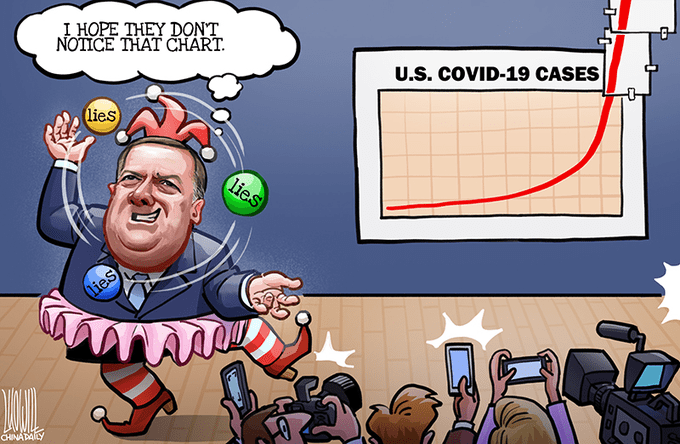
A China-bashing coronavirus jester? Beijing tears into Pompeo’s ‘clown show’
RT | May 6, 2020
China has fired back at Mike Pompeo’s allegations that Beijing is somehow behind the origin and spread of Covid-19, describing his “comedy routine” as deeply cynical and damaging to the United States.
State-operated China Daily took aim at the US secretary of state, slamming the top American diplomat for “bad-mouthing” China and the World Health Organization (WHO) instead of seeking global cooperation and solidarity to overcome the Covid-19 pandemic.
Pompeo continues to insist that the illness came from a laboratory in Wuhan, even though he has yet to present evidence for this incendiary claim, and has ignored scientists who say the virus is from the wild, the opinion piece argued.
China Daily noted that the secretary of state has also been curiously silent about the fact that Beijing has been the “main provider” of surgical masks, ventilators, and other essential medical equipment to the US. The editorial argued that Pompeo is playing a dangerous political game that will end up hurting the United States.
In a difficult situation such as the one we all face now, Pompeo’s clown show is simply self-harming for the US. It is solidarity that is desperately needed to fight this common enemy, not a stand-up comedy routine.
The paper also ran a cartoon showing Pompeo, outfitted as a jester, juggling “lies” as he tries to distract media attention from rising coronavirus cases in the US.
The biting commentary piece comes after the Global Times newspaper – an outlet owned by the Chinese Communist Party – published an editorial dismissing Pompeo’s attacks on Beijing as “groundless accusations.”
Pompeo’s theories have also been met with suspicion within the intelligence community. The Guardian reported that sources connected to the Five Eyes intelligence network – consisting of spy agencies from the UK, US, Australia, New Zealand, and Canada – believe there is no evidence linking China to the creation and spread of Covid-19.
Featured Video

Iran Is Not Our Enemy
or go to
Aletho News Archives – Video-Images
Frlom the Archives
The 52 Major Jewish American Organizations and Israel Celebrate Passover with the Slaughter of 25 Muslim, Christian and Secular Palestinians
By James Petras • Unz Review • April 8, 2018
Introduction
As of April 7, nearly three thousand unarmed Christian, Muslim and secular Palestinians have been wounded, over three dozen are in critical condition and at least twenty-five unarmed protestors, including children have been assassinated by hundreds of Israeli snipers and heavily armed troops shooting tank shells into crowds of civilians protesting their decades of incarceration by the racist Israeli state.
The Israeli government praised the ‘restraint and morality’ of the IDF, as did the fifty-two Major Jewish American Organizations (MJAO) who largely control the US Congress. These grotesque massacres began during the Christian Holy Week on Good Friday and Easter, coinciding with the Jewish Passover. The self-righteous officials of the MJAO and their relatives and friends broke matzos at joyful Seders as the blood of Palestinians soaked into ground at the fence containing the largest open-air prison camp in history, Gaza.
While tribal loyalties bonded the Israeli and Jewish American leaders, the politicians of the Western oligarchic electoral regimes refrained from criticizing the shocking display of brute force and even defended Israel’s cold blood mass killings of Palestinian civilians in their Gaza prison.
This paper will discuss and analyze the reasons for Israel’s willing Western accomplices and the centrality of its fifth column in the United States. … continue
Blog Roll
 Aletho News
- No Liability, No Studies, No Accountability: The Vaccine System Aaron Siri Exposed in Federal Court
- No time for losers: Why the war meant to save Israel may destroy it
- Top US Counterterrorism Official Resigns in Protest of Operation Against Iran
- Just Get Out! Now!
- Unpacking glaring contradictions in US-Zionist justifications for war against Iran
- Iranian model of warfare bleeds US dry while Persian Gulf states watch and learn: Analyst
- IRGC orders ‘defeated’ US to evacuate industrial facilities in region
- Hegseth’s call for ‘no mercy’ to Iranians deemed war crime
- Iran War Exposes Limits of US Military Power – Journalist
- Even The Neo-Cons Admit The Iran War Is Failing
- If Americans Knew
- Trump’s counterterrorism chief, whose own wife was killed by ISIS, quits over Iran War saying Tehran posed ‘no imminent threat’
- Here’s what US could fund instead of Bibi’s war on Iran
- Israel Killed Over a Dozen Lebanese Paramedics in Three Days, Now Claiming That Ambulances Are “Hezbollah” Targets
- War on Iran: These are the heritage sites devastated by US and Israeli attacks
- Four news stories from Israeli media that illustrate Israeli “justice”
- CIA Prepares Criminal Referral of Tucker Carlson, as Israel and Its Loyalists Demand His Arrest
- Top US counterterror advisor resigns in protest of “war manufactured by Israel” – Not a ceasefire Day 157
- ‘I Liked the House’: When Israeli Soldiers Turn Palestinian Homes into Barracks
- ‘They Were All I Had’: Lebanese Father Buries Parents, 4 Daughters Killed by Israeli Bombing
- Israel and its supporters are causing attacks on Jewish institutions. Case in point: Michigan synagogue tragedy.
- No Tricks Zone
- Storing Green Energy To Last Germany 10 Days Would Require A 60-Million Tonne Battery
- New Studies: UK Sea Levels Were 4 Meters Higher Than Today During The Mid-Holocene
- Destructive Green New Deal: German Energy And Metal Group Warns Of Drastic Crisis
- New Study Documents A 20-Year Pause In Arctic Sea Ice Decline – Driven By Internal Variability
- Wake-up Call: Survey Shows Majority Of Germans Now Favor Postponing Climate Targets!
- Televised! Leading German Political Candidate Tells Schoolchildren CO2 Makes Sun Hotter!
- New Study: A Century Warming Of 1.1°C Is ‘Commonplace’ And ‘Not Unusual’ During This Interglacial
- New Study: ‘Internal Noise’ And Volcanic Forcing Can Trigger 10-15°C Warming Within Decades
- Glaciers Worldwide Are Suddendly Surging, Experts Blame Warming!
- Surprising Discovery: Sahara Is Greening…Billions Of Trees Where Once Thought To Be Barren
 Aletho News