US military presence in Iraq aimed at protecting Israel’s security, interests: PMU leader
Press TV – May 25, 2020
A high-ranking official with Iraq’s Popular Mobilization Units (PMU), better known by the Arabic name Hashd al-Sha’abi, has strongly denounced US military presence in his country, saying such a deployment is meant to safeguard the security and interests of the Israeli regime.
“There is a national and courageous will, which rejects the presence of any foreign troops on Iraqi soil. There have been talks of US intentions to withdraw from Iraq, but we doubt them,” Qais al-Khazali, leader of Asa’ib Ahl al-Haq, which is part of the PMU, was quoted as saying by the Lebanon-based and Arabic-language al-Ahed news website on Monday.
He added, “The US [military] presence in Iraq is meant to protect the security and interests of the Israeli regime. Neither are we warlords nor thirsty for blood, but rather patriots looking for the dignity and sovereignty of the Iraqi nation.”
“If the withdrawal [of US troops] does not take place, the foreign occupier must know that Iraqis will not accept the presence of its forces. The Americans, who will open negotiations [on the extension of their presence] in June, must remember the centenary of the Great Iraqi Revolution of 1920 against British forces,” Khazali pointed out.
He also praised the sacrifices made by Lieutenant General Qassem Soleimani, the commander of the Quds Force of Iran’s Islamic Revolution Guards Corps, and Abu Mahdi al-Muhandis, the deputy head of PMU, who were assassinated along with their companions in a US airstrike authorized by President Donald Trump near Baghdad International Airport early on January 3.
Iraqi lawmakers unanimously approved a bill two days later, demanding the withdrawal of all foreign military forces led by the United States from the country following the targeted killings.
Later on January 9, former Iraqi prime minister Adel Abdul-Mahdi called on the United States to dispatch a delegation to Baghdad tasked with formulating a mechanism for the move.
The 78-year-old politician said Iraq rejected any violation of its sovereignty, particularly the US military’s violation of Iraqi airspace in the assassination airstrike.
How the U.S. response to COVID-19 failed and caused thousands of deaths
CGTN | May 25, 2020
There have been over 1.6 million #coronavirus cases and nearly 100,000 deaths in the U.S. While many countries are gradually recovering, no turning point for the pandemic in America is on the sight.
Lots of people are shocked at how America, the largest economy in the world, and a great country in the eyes of many, has got to this point. So to find out what led to this mess, let’s back up a little and take a look at the timeline.
Telephone calls between Biden and Poroshenko reveal Kiev’s submission to Washington
By Lucas Leiroz | May 25, 2020
Recently, several phone calls made four years ago between former Ukrainian President Petro Poroshenko and current Democratic presidential candidate Joe Biden were revealed. The content of the talks is profound and controversial and reveals the high degree of American influence in the coordination of Ukrainian domestic politics, showing the advanced state of submission of Kiev to Washington.
According to the deputy of the Ukrainian Parliament (Supreme Rada), Andrei Derkach, the audio recordings were received from an anonymous investigative journalist. Derkach revealed the content of the recordings and declared full confidence in his informant.
On audio recordings, we can hear the former US Vice President Joe Biden and former Secretary of State John Kerry demanding that the leader of a formally independent state make decisions that are convenient for them, as well as a totally submissive posture on the part of Poroshenko, who is absolutely oblivious to Ukrainian national interests.
The demands made during the talks are diverse and impressive by the American boldness to interfere so deeply in other states. In one of the recordings, dated from 2015, it is possible to hear John Kerry demanding the resignation of Ukrainian attorney general Viktor Shokin, for not meeting American expectations. In another record, Poroshenko communicates with Biden saying he has “good news for him.” In the recording, Poroshenko says that while there was no charge or complaint against Shokin, he managed to convince the attorney to resign. The interlocutor replies: “Excellent”. So, Poroshenko reports that the dismissal of the attorney general is yet another “step in fulfilling his obligations” to the US.
In another phone call, the topic of appointing a new attorney is discussed. After a conversation between Poroshenko and his American counterparts, Yuri Lutsenko is chosen to be appointed to the office. Washington’s interlocutors make it clear that Lutsenko’s appointment is an essential condition for Kiev’s receipt of a loan of one billion dollars. Totally submissive, Poroshenko agrees with the terms of the agreement and the fees imposed without any dispute, consolidating the “partnership”.
In Washington, assistants of the former Vice President and current candidate Joe Biden informed The Washington Post that the recordings have been edited and are being used improperly to put pressure on the parties involved in the talks. However, the veracity of the existence of such telephone conversations has not been contested, which in itself is enough to create an atmosphere of tension and distrust towards the figures involved.
The fact is that the matter is still far from over. Whether or not they were edited, the recordings are apparently real. And, although the content of the conversations is contested, in truth, one billion dollars were withdrawn from the American public coffers and handed over to the president of another country, without the American population being informed of anything. After all, what will be the reaction of the American people when they understand that this money comes from their taxes and, instead of being invested in improvements to the national infrastructure, it is being used in obscure political maneuvers with other countries?
This all tends to strengthen Donald Trump in the upcoming election. The current American president until recently had an absolute majority of voting intentions and is now starting to weaken due to the way he has been dealing with the new coronavirus pandemic in the US – the global epicenter of the infection. Biden, although much less popular, progresses little by little and is already showing the ability to become a real opponent to Trump. However, as the scandals spread, it is likely that there will be a drop in Biden’s supporters or, at least, a greater atmosphere of collective distrust for him.
Still, Joe Biden’s reliability is not the main issue that comes up with the revelations of these recordings, but the level of American interference in the domestic politics of other national states. With these telephone records, Kiev proved to be a zone of foreign interference, where a president is coerced by members of the government of another country to make decisions that he would not like to make. This is not just an extremely demoralizing fact for Ukraine, but it also deeply destroys the myth of “Ukrainian nationalism,” so defended by the militias involved in the Euromaidan coup in 2014. However, more than that, the case may bring Petro Poroshenko to court. The recordings are sufficient evidence to accuse the former president of national treason. If formally accused and condemned, Poroshenko will have ended his political career in the worst possible way for a former president: being remembered as a traitor to his own country.
Lucas Leiroz is a research fellow in international Law at the Federal University of Rio de Janeiro.
Iran surges in Venezuela in defiance of US sanctions
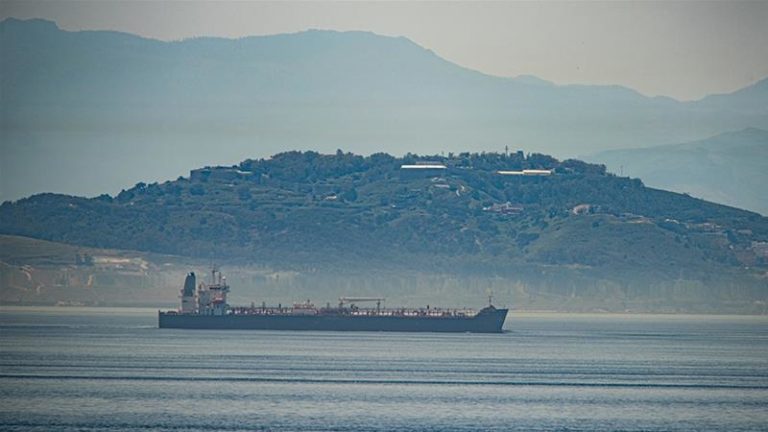
Iranian oil tanker Clavel crossing the Gibraltar stretch heading for Venezuela, May 20, 2020
By M. K. BHADRAKUMAR | Indian Punchline | May 25, 2020
Escorted by the Venezuelan navy and air force, an Iranian oil tanker named Fortune has entered that country’s waters on Sunday, amidst intense speculation whether the US would interfere with the delivery. The US has imposed oil sanctions against Venezuela and Iran and had said it is monitoring the Iranian tanker.
In fact, five Iranian tankers carrying about 1.5m barrels of fuel passed through the Suez Canal earlier this month, according to shipping data on Refinitiv Eikon, and were heading for Venezuela. The other four Iranian tankers — Forest, Petunia, Faxon and Clavel — are approaching the Caribbean en route to Venezuela.
A flotilla of US Navy and Coast Guard vessels is patrolling the Caribbean Sea on a mission to counter illicit drug trafficking. But the Pentagon has stated that there are no plans to stop the Iranian tankers.
At the same time, a Pentagon spokesman, Jonathan Hoffman, while saying on Thursday he was not aware of any operations related to the Iranian cargoes, also added, “We have continued to say that Iran and Venezuela – both two outliers in the international order – [are] clearly violating international sanctions on both nations with this transaction.”
The US sanctions on Venezuela are aimed at increasing pressure on President Maduro to step down. Thus, arguably, Iran is frontally challenging the Trump administration’s stated policy of ‘regime change’ in Venezuela. The Iranian move comes just three weeks after the abortive coup attempt masterminded by the White House on May 1 with the participation of two former US Green Berets aimed at capturing Maduro and transport him to the US in American helicopters to be put on trial on fake drug trafficking charges.
The coup attempt showed the extent of desperation in Washington to overthrow the Maduro government before the US presidential election in November, which President Trump hopes would help him garner Hispanic votes. Iran has now offered a lifeline to Venezuela.
In an historical context, this becomes a frontal assault by Iran on the Monroe Doctrine dating back to the 19th century, which in US foreign policy calculus regarded the Western Hemisphere as its sphere of influence. According to a Reuters report, the Trump administration said earlier this month it was “considering measures” it could take in response to the Iranian shipments, without providing specifics.
No doubt, this is a deliberate sanctions-busting enterprise by Iran. Venezuela desperately needs fuel for up to 1,800 gasoline stations that have been partially closed for weeks due to insufficient supply from state-run refineries.
Venezuela’s gasoline output is now limited to a single facility, the Amuay refinery, but most fuel produced is low octane as most of the country’s alkylation units are out of service. Imported alkylate could improve the quality of domestic gasoline. Venezuela’s refineries are in poor condition. Shipments of equipment in flights by Iran’s Mahan Air have arrived in Venezuela in recent weeks to start repair work.
It will be interesting to see whether the US Navy would interdict any of the other four Iranian tankers before they enter Venezuelan waters. Tehran has sternly warned the US that it would retaliate if any such attempt is made. On Saturday, Tehran raised the ante with President Hassan Rouhani explicitly warning, “If our oil tankers in the Caribbean Sea or anywhere else in the world get into trouble caused by the Americans, they (US) will run into trouble reciprocally.”
Washington is well aware of Iran’s capability to create big problems for the US Navy deployed in the Persian Gulf, especially the Strait of Hormuz. Last week, in a precautionary step, US Navy, via the Maritime Safety Office run by the National Geospatial-Intelligence Agency, alerted all international maritime traffic to maintain a safe distance of at least 100 meters from US naval vessels in international waters and straits. Pentagon officials separately confirmed that the stay-away warning to marine traffic in the Persian Gulf, the Arabian Sea and the Gulf of Oman was actually intended for Iran.
In geopolitical terms, Iran’s strategic defiance of the US in the Western Hemisphere makes an interesting case study not only of the decline in American influence in its backyard to the south but the entire efficacy of the “sphere of influence” concept in contemporary world politics. This is one thing.
More importantly, in the backdrop of the Iranian tanker reaching Venezuela, Caracas has described Iran as a “revolutionary partner” in the struggle against US imperialism. From the Iranian viewpoint, Venezuela becomes a part of the “axis of resistance” against the US. To be sure, the audacity of the two countries will irritate Washington to no end.
How far the Iran-Venezuela axis will deepen and expand will bear watch. Importantly, the UN Security Council embargo against Iran exporting arms to other countries is expiring in October. The US move to extend the timeline of the embargo is unlikely to succeed, given the strong negative reaction by Russia and China. It is entirely conceivable that a matrix of military cooperation may commence in a near future involving Iran and Venezuela.
Iran’s indigenously developed missile capability acts as a deterrent against US aggression. Iran has transferred missile technology to Hezbollah, which is estimated to have the capability today to inflict significant damage to Israel in the event of any aggression by the latter on Lebanon. Significantly, the deterrence is working and Israel no longer stages attacks on Lebanon.
A similar shift in the strategic balance with Iran’s help can create more space for Venezuela to push back at the US. All in all, Iran appears to be working on a strategy to help Venezuela to maintain its strategic autonomy. There is enormous potential for cooperation and coordination between Iran and Venezuela. If Venezuela has the largest known oil reserves in the world, Iran too has massive reserves of oil and gas.
The despatch of oil to lubricate the beleaguered Venezuelan economy may prove to be the harbinger of an assertive Iranian power projection elsewhere in Latin America too. Surely, in the near term, it is a rebuff to the Trump administration’s maximum pressure strategy against Iran. In a longer-term perspective, a concerted regional strategy in Latin America by Russia, China and Iran can seriously erode the US influence in the continent.
Racism, Magical Thinking & the Coronavirus
Rather than quarantining travelers, our leaders chose a course of action that led to entire countries being locked down.

January 28th article, published in Canada’s largest circulation newspaper; click for source
By Donna Laframboise | Big Picture News | May 25, 2020
By the third week of January, the entire world knew the Chinese government was so spooked by a lethal, never-before-seen virus that it had locked down Wuhan. That city is home to 10 million people, about the same number as reside in Paris, London, and Chicago.
Back in January, Wuhan had a shortage of hospital beds and a shortage of doctors. Medical personnel from other parts of the country had been deployed, but the caseload remained overwhelming.
In January, the entire world knew flights from Wuhan to other parts of China had been halted. Highways were being closed. Soldiers wearing face masks were barricading the train station. Because the virus was raging in a particular locale, it was eminently sensible try to prevent its spread within China.
Elsewhere, governments watched these events unfold. Rather than safeguarding their own citizens and their own economies, rather than taking immediate, concrete steps to prevent the virus from spreading beyond China, they indulged in magical thinking.
If only they avoided doing anything discriminatory, all would be well. If only they walked on eggshells, careful not to fuel anti-Asian stereotypes, this infectious disease would apparently evaporate of its own accord.

January 28th article, disseminated by Canada’s national, publicly-funded broadcaster; click for source
Thus, a medical problem connected to a specific geographical location was transformed, reconfigured, and repackaged. Journalists, left wing media outlets, and petty politicians accomplished this in a trice.
Politically correct thought is rote dogmatism. It is non-thought. It is knee-jerk, censorious, and uncharitable. But its grip is compelling. In January 2020, among Canada’s political class, fear of being labelled a racist far outweighed anyone’s fear of a deadly virus. Please read that sentence again. We desperately need to learn this lesson.
Juanita Nathan, the chair of a north Toronto school board (whose left wing, community activist credentials are described here), lectured parents about “demonstrating bias and racism”:
while the virus can be traced to a province in China, we have to be cautious that this not be seen as a Chinese virus…At times such as this, we must come together as Canadians and avoid any hint of xenophobia, which in this case can victimize our East Asian Chinese community…Situations such as these can regrettably give rise to discrimination based on perceptions, stereotypes and hate. [bold added; see here, here, and here]
Heaven deliver us from elected officials who imagine their job is to instruct taxpayers on how to think or speak about any issue. In the Canadian political system, school trustees are bottom of the barrel. This is a part-time job in which budgets are overseen, and parental concerns are addressed. Trustees are not priests, and have no business preaching morality to anyone.
Concerned parents, many of whom were Asian, were told by Nathan not to send their children to school with face masks, even though classmates had just returned from visits to China. Parents were told mask wearing “heightens anxiety.” In the words of Nathan:
Wearing a mask really singles out some kids in the classroom when they don’t need to and that’s what we’re addressing at the moment – just having those conversations to give knowledge to the parents why they don’t need to at this moment.
And so it went. Leaders of the world’s most advanced economies assured the public the risk was low. We were told to wash our hands, that seasonal influenza was more dangerous, that everything was under control.
But things weren’t under control. Flights from China were not halted. Nor were flights from other hot spots. Travelers returning home weren’t required to self-quarantine until it was far too late.
An information sheet published by the Canadian government on February 24th didn’t instruct returning travelers to self-quarantine. Rather, these people were asked to monitor themselves for “fever, cough and difficulty breathing” and to “avoid places where you cannot easily separate yourself from others if you become ill.”
Self-isolation was recommended only if they developed symptoms. Since many infected people suffer no symptoms, mild symptoms, or symptoms other than those listed by the Canadian government, such measures were wholly inadequate.
Weeks ticked by. Thousands of international flights continued to take off and land. People visiting China, Iran, and Italy brought the virus back home with them. To Seattle. To New York City. To Brazil, India, South Africa, Australia, and to Canada (see here, here, here, and here).
By the time they were diagnosed, some of these people had infected those who’d shared the same flight or the same airport shuttle. They’d spread the virus at their workplaces, on public transit, at houses of worship, birthday parties, and funerals. As late as March 22nd, the Times of London ran a story about Heathrow airport, headlined Coronavirus: Flights from Italy, Iran and China still landing.
Today, four months after the lockdown of Wuhan, a grim milestone will be achieved. The number of Americans who’ve died of the coronavirus is expected to surpass 100,000.
Here in Canada, 6,400 people have perished so far (back in 2003, SARS claimed 44 Canadian lives).
Between them, Italy, Spain, and France have lost 90,000 souls.
In Brazil, where the virus is still gathering steam, the death toll exceeds 22,700 already.
Public health officials, including the World Health Organization, let this happen. Politicians let this happen. There was a time to take targeted action. There was a time to respond strategically and decisively. They failed.
The sorrow associated with those hundreds of thousands of corpses is just the beginning of this disaster. Entire populations have spent weeks to months confined to their homes, harassed by the police for walking their dog. The economic damage is monstrous – for individuals, business, and nations.
Disruption. Job loss. Home repossession. Despair.
Rather than shutting down a few flights, our leaders chose a course of action that led to virtually all flights, everywhere, being grounded. For goodness knows how long.
Rather than quarantining a subset of travelers for a couple of weeks, our leaders chose a course of action that led to entire populations being locked down. For goodness knows how long.
This is where politically correct thought leads. This is where our ugly, destructive preoccupation with hints of xenophobia takes us.
Legitimate concern about the spread of a pernicious virus was silenced. Leaders who wanted to do the right thing faced serious social disincentives. No one wants to be called a racist.
Going forward, we can live in a community in which our leaders think clearly and act sensibly. Or we can stifle other important discussions – and pay a terrible price.
What Google and Facebook Are Hiding
The American Deep State Strikes Back
By Ron Unz • Unz Review • May 24, 2020
After several months of record-breaking traffic our alternative media webzine suffered a sharp blow when it was suddenly purged by Facebook at the end of April. Not only was our rudimentary Facebook page eliminated, but all subsequent attempts by readers to post our articles to the world’s largest social network produced an error message describing the content as “abusive.” Our entire website had been banned.
Facebook publishes a monthly report cataloging its actions to eliminate “improper content,” and although our publication was probably one of the largest and most popular ever so proscribed, the explanation provided was remarkably cursory, with our name mentioned in only two scattered sentences across the 47 page document.
Our investigation linked this network to VDARE, a website known for posting anti-immigration content, and individuals associated with a similar website The Unz Review.
Although the people behind this operation attempted to conceal their coordination, our investigation linked this network to VDARE, a website known for posting anti-immigration content, and to individuals associated with a similar website The Unz Review.
As I’ve previously discussed, characterizing our alternative media publication as an “anti-immigration” website “similar” to VDare seemed utterly bizarre considering that only about 0.2% of our 2020 content was republished from that source and many months had elapsed since we had last featured a piece on immigration. So I strongly suspected that the claim merely served as an excuse.
I don’t use Facebook or other social networks myself, and noticed little reduction in our daily traffic following that purge, seeming to demonstrate our lack of reliance upon social media. But a week later, this abruptly changed, and our regular daily readership dropped by a significant 15-20%, hardly a crippling blow but quite distressing, setting us back many months of previous growth.
This puzzled me. Why would the Facebook ban have had such limited initial impact but then suddenly become so much more serious? Eventually I discovered that a second, even more powerful Internet giant had also banned us, which explained the sharp drop. Our entire website and all its many millions of pages of serious content had been silently deranked by Google, thus eliminating nearly all our incoming traffic from search results. A few quick checks confirmed this unfortunate situation, best illustrated by a particularly striking example.
Just over a decade ago, I had published an important article entitled The Myth of Hispanic Crime, and for ten years it had always placed extremely high in Google searches, generally being ranked #2 across the 52,000,000 results for “Hispanic crime” and also #2 among the 139,000,000 results for “Latino crime.” The impact of my analysis on the heated public debate had also been quite considerable, and a few years ago a leading academic specialist even asked me to blurb his book on that subject. But my article had now vanished from all such Google searches.
Although Google holds an overwhelming monopoly for web searches across the Western world, comparable products such as Bing and DuckDuckGo using similar technology do exist, and these still list my article among their results, with Bing ranking it at #2 for “Hispanic crime” and “Latino crime,” while DuckDuckGo places it #4 in each. But no one would ever find it using Google.
All the other pages of our website have been similarly blacklisted, effectively eliminated from all web searches courtesy of Google’s information monopoly. This even included the periodical content library that I had built during the 2000s, containing the near-complete archives of hundreds of America’s most influential publications of the last 150 years. Millions of these important articles were available no where else, and their disappearance representing a tremendous loss to academic scholarship.
Google still does contains all these pages, and if the additional specifier “unz” is added to the search, the results do come up, but for anyone not knowing where to look, our entire website and all its content has completely disappeared. This explained our sudden 15-20% reduction in regular traffic.
Internet law is obviously quite murky, but it seems a great shame if Google has decided to use its software monopoly to severely manipulate search results and deliberately hide important information. The notion of Google “disappearing” an entire website and all its material is surely fraught with peril. Should Google’s executives be allowed to “disappear” whichever politicians or candidates they dislike? Should wealthy individuals or powerful groups be able to pay or lobby Google to have their critics removed from all search results?
During 2018 Google employees themselves took a very strong public stance on exactly this issue, protesting their own company’s willingness to produce a “censored” version of their search engine for use in China, a controversy that reached the national headlines, and soon forced executives to abandon the project. But although Google censorship of content within China still remains an inflammatory topic, Google censorship of American content is now apparently so routine and acceptable that it took me more than a week to discover that our entire website had been thrown down the Orwellian “memory hole.”
I’d always taken considerable pride that my Hispanic Crime article had spent a decade ranked #2 among nearly 200,000,000 Google results for that important topic, and was dismayed that Google “disappeared” it. But in fairness, I’d have to admit that those individuals whose views make themselves disagreeable to ruling political elites have sometimes suffered far worse retaliation. For example, my Saturday morning newspapers carried the latest episode in the unfortunate story of Jamal Khashoggi, the dissenting Saudi journalist whose critical writings in the Washington Post so irritated his government that they had him killed and his body dismembered with a bone-saw. Much as I liked my article, having it deranked by Google hardly seems a comparable fate.
For years our website has published a great deal of extremely controversial material, and many readers are probably much more surprised that Google and Facebook took so long to purge us rather than they finally did so.
Consider, for example, my own American Pravda series, which together with related articles runs 280,000 words and has drawn about 3 million pageviews, while attracting over 25,000 comments totaling another 3.5 million words. Many of these articles candidly address some of the most controversial aspects of the JFK Assassination, the 9/11 Attacks, and the history of World War II, topics so touchy that a couple of years ago the redoubtable Israel Shamir described me as the “Kamikazi from California,” and suggested along with numerous other observers that our website might soon be annihilated as a consequence. But aside from a rather lackluster rebuke from the usually ferocious ADL, absolutely nothing untoward happened.
Yet now we have been almost simultaneously banned by both Google and Facebook, America’s leading gatekeepers to the Internet, concerted action that hardly seems likely to have been coincidental, especially coming after years of apparent equanimity. So what had prompted this sudden purge?
I think the obvious answer was my most recent American Pravda installment, which attracted more early readership and social media interest than anything I had previously written, and which appeared just eight days before Facebook’s ban.
My article noted some important facts that are less widely known that they should be, and are quite embarrassing both to our own government and its overly subservient mainstream journalists.
For decades, the American media had regularly denounced the Chinese government for its notorious 1989 slaughter of the student protesters at Tiananmen and shamed its leadership for continuing to flatly deny that historical reality, with China’s demands for censorship of the massacre being a leading source of conflict with Google. However, I pointed out that more than twenty years ago the former Beijing bureau chief of the Washington Post, who had personally covered the events, published a long article in our most prestigious journalism review admitting that the infamous “Tiananmen Square Massacre” had never actually happened, and was just a concoction of incompetent journalists and dishonest propagandists. Yet for decades the promotion of that debunked hoax by our elite media has continued unabated.
As another example, I noted that back in 1999 our warplanes had bombed the Chinese embassy in Belgrade, killing or wounding dozens of Chinese diplomats. At the time, our media uniformly reported the attack as a tragic accident, while ridiculing China’s government for alleging otherwise. However, just a few months later, many of the leading newspapers in Britain and the rest of the world revealed that the bombing had indeed been deliberate, quoting numerous NATO intelligence sources to that effect. But since the American media completely boycotted this major international story, very few Americans ever discovered that the Chinese had been telling the truth all along and our own government lying.
Although these historical items were important, they merely set the stage for a far more explosive analysis. The bulk of my 7,400 word article presented the very considerable circumstantial evidence that our current Coronavirus national disaster was entirely self-inflicted, being the unintended blowback from an extremely reckless American biowarfare attack against China (and Iran), presumably organized by the Deep State Neocons or other rogue elements in our national security establishment.
This ongoing disease epidemic has already killed 100,000 Americans and wrecked our economy, so we can easily understand why the guilty parties would do all they could to prevent some of the critical information from getting into general circulation, pressuring Google and Facebook to suppress the crucial evidence. A few excerpts from my long analysis, now banned by America’s Internet giants, are worth once again repeating:
As the coronavirus gradually began to spread beyond China’s own borders, another development occurred that greatly multiplied my suspicions. Most of these early cases had occurred exactly where one might expect, among the East Asian countries bordering China. But by late February Iran had become the second epicenter of the global outbreak. Even more surprisingly, its political elites had been especially hard-hit, with a full 10% of the entire Iranian parliament soon infected and at least a dozen of its officials and politicians dying of the disease, including some who were quite senior. Indeed, Neocon activists on Twitter began gleefully noting that their hatred Iranian enemies were now dropping like flies.
Let us consider the implications of these facts. Across the entire world the only political elites that have yet suffered any significant human losses have been those of Iran, and they died at a very early stage, before significant outbreaks had even occurred almost anywhere else in the world outside China. Thus, we have America assassinating Iran’s top military commander on Jan. 2nd and then just a few weeks later large portions of the Iranian ruling elites became infected by a mysterious and deadly new virus, with many of them soon dying as a consequence. Could any rational individual possibly regard this as a mere coincidence?
* * *
For obvious reasons, the Trump Administration has become very eager to emphasize the early missteps and delays in the Chinese reaction to the viral outbreak in Wuhan, and has presumably encouraged our media outlets to direct their focus in that direction.
As an example of this, the Associated Press Investigative Unit recently published a rather detailed analysis of those early events purportedly based upon confidential Chinese documents. Provocatively entitled “China Didn’t Warn Public of Likely Pandemic for 6 Key Days”, the piece was widely distributed, running in abridged form in the NYT and elsewhere. According to this reconstruction, the Chinese government first became aware of the seriousness of this public health crisis on Jan. 14th, but delayed taking any major action until Jan. 20th, a period of time during which the number of infections greatly multiplied.
Last month, a team of five WSJ reporters produced a very detailed and thorough 4,400 word analysis of the same period, and the NYT has published a helpful timeline of those early events as well. Although there may be some differences of emphasis or minor disagreements, all these American media sources agree that Chinese officials first became aware of the serious viral outbreak in Wuhan in early to mid-January, with the first known death occurring on Jan. 11th, and finally implemented major new public health measures later that same month. No one has apparently disputed these basic facts.
But with the horrific consequences of our own later governmental inaction being obvious, elements within our intelligence agencies have sought to demonstrate that they were not the ones asleep at the switch. Earlier this month, an ABC News story cited four separate government sources to reveal that as far back as late November, a special medical intelligence unit within our Defense Intelligence Agency had produced a report warning that an out-of-control disease epidemic was occurring in the Wuhan area of China, and widely distributed that document throughout the top ranks of our government, warning that steps should be taken to protect US forces based in Asia. After the story aired, a Pentagon spokesman officially denied the existence of that November report, while various other top level government and intelligence officials refused to comment. But a few days later, Israeli television mentioned that in November American intelligence had indeed shared such a report on the Wuhan disease outbreak with its NATO and Israeli allies, thus seeming to independently confirm the complete accuracy of the original ABC News story and its several government sources.
It therefore appears that elements of the Defense Intelligence Agency were aware of the deadly viral outbreak in Wuhan more than a month before any officials in the Chinese government itself. Unless our intelligence agencies have pioneered the technology of precognition, I think this may have happened for the same reason that arsonists have the earliest knowledge of future fires.
Although criticism of the mainstream media has been the central theme of my American Pravda series, I always spend at least a couple of hours every morning carefully reading our leading newspapers, which I regard as unmatched sources of important information so long as their articles are treated with proper caution and rigor. As an example, I would note that most of the crucial evidence suggesting an American biowarfare attack was hidden in plain sight in such eminently respectable news sources as the NYT, the WSJ, and ABC News.
As our global confrontation with China has grown hotter, my morning New York Times has continued to provide invaluable information for anyone who is willing to read it carefully.
For example, Secretary of State Mike Pompeo probably ranks as the most prominent Deep State Neocon in the Trump Administration, and is a leading architect of our confrontation with China. Last week he broke quarantine to take a trip to Israel and hold important talks with Prime Minister Benjamin Netanyahu, as reported in a 1,600 word NYT article. Although the majority of their discussion concerned American support for the proposed annexation of the Palestinian West Bank, a serious disagreement came with regard to Israel’s growing economic ties with China, with the piece noting that the Jewish State had “antagonized” Washington by allowing Chinese companies to make major infrastructure investments, some of them in sensitive locations. According to the three Times journalists, Netanyahu firmly stood his ground, determined to “push back” against Pompeo’s repeated warnings and refused to reconsider his government’s China policy.
But just a couple of days later, the Times then reported that Du Wei, the Chinese ambassador to Israel, age 57, had been found dead at his home, having suddenly fallen victim to “unspecified health problems.” The piece emphasized that he had become a leading public critic of America’s current policies toward China, and the juxtaposition of these two consecutive NYT articles raised all sorts of obvious questions in my mind.
According to standard mortality tables, an American male age 57 has less than a 1% chance of dying in a particular year, and given the similarity in overall life expectancy, the same must surely be true of Chinese males. Recently appointed Chinese ambassadors are likely to be in reasonably good health rather than suffering the last stages of terminal cancer, and such causes together with obvious, visible injuries account for more than half of all fatalities at around that age. Thus, the likelihood that the 57-year-old Chinese diplomat died naturally within that two day window was probably far less than 1 in 50,000. Lightning does sometimes strike under the most unlikely of circumstances, but not very often; and I think that the unexplained deaths of ambassadors during international confrontations probably fall into the same category.
It therefore seems exceptionally unlikely that the sudden demise of Ambassador Du was not somehow directly connected with the heated dispute between Pompeo and Netanyahu over Israel’s China ties that had occurred two days earlier. The exact details and circumstances are entirely obscure, and we can merely speculate. But since speculation has not yet been outlawed by government edict, an interesting possibility comes to mind.
In sharp constrast to the elected leaders of America’s vassal-states throughout Europe and Asia, Israeli Prime Minister Netanyahu hardly regards himself as beholden to the American government. He is a powerful, arrogant individual who remembers the endless standing ovations that he enjoyed when he addressed our own House and Senate, receiving the sort of bipartisan public adulation that would be unimaginable for a Donald Trump, who remains deeply unpopular with half our Congress. So faced with demands by a Trump envoy that he sacrifice his own nation’s interests by cancelling important Chinese economic projects, he apparently disregarded Pompeo’s warnings and told him to get lost.
The classic 1972 film The Godfather ranks #2 in the IMDb Movie Database, and one of its most famous scenes concerns a conflict between a powerful and arrogant Hollywood film mogul and a visiting representative of the Corleone family. When the polite requests of the latter are casually disregarded, the movie tycoon awakens to discover the bloody head of his prized race-horse in his own bed, thereby demonstrating the serious nature of the warning he had received and indicating that it should not be disregarded. Pompeo had recently served as CIA Director, and I suspect he called in a few favors with elements of the Israeli Mossad and had them take lethal steps to convince Netanyahu that our demands that he reassess his ties with China were of a serious nature, not to be treated lightly. I strongly suspect that the controversial Chinese-Israeli economic ventures will soon be abandoned.
I had never heard of the unfortunate Chinese ambassador prior to his sudden demise, and under normal circumstances any such notions of American foul play might be dismissed as absurd. But consider that just a few months earlier, we had publicly assassinated a top Iranian leader after he was lured to Baghdad for peace negotiations, an act vastly more weighty than the plausible deniability of of a middle-aged diplomat being found dead in his own home of unknown causes.
A few days later, my Wall Street Journal carried an article entitled China’s ‘Wolf Warrior’ Diplomats Are to Fight, beginning on the front page and running 2,200 words, by far the longest piece appearing in that day’s edition. Yet although the late Ambassador Du had been in the forefront of this ongoing Chinese campaign to challenge American influence, both in Israel and during his previous posting to Ukraine, and the sudden demise of this particular “wolf warrior” was surely known to the journalists, his name appeared nowhere in the text, leading me to wonder whether it had been deliberately excised to avoid raising obvious suspicions in the WSJ readership.
For hundreds of years since the Treaty of Westphalia, the lives of diplomats have been almost always treated as sacrosanct, and a typical response to breaking such international conventions might be tit-for-tat retaliation. China’s leadership tends to be remarkably pragmatic, and recognizes that its national strength is rapidly growing even as our own society decays and declines, so perhaps they will forego any such reaction, at least for the time being. But if any American diplomats or other ranking officials begin to suffer strange fatalities, the explanation may be less than mysterious, though Google and Facebook will certainly do their best to keep it so.
China, Russia can initiate probe of US bio-labs
Washington urged to be transparent with bio-weapons program

By Yang Sheng – Global Times – 2020/5/14
In order to hide the fact that the US is researching on biological weapons, the US will not respond to an international query on its bio-labs, Chinese military experts said, adding that China and Russia could initiate an investigation of bio-labs worldwide at the UN to pressure the US.
The US can’t just claim all reasonable inquiries to its bio-labs as “conspiracy theories,” and when US politicians keep accusing China’s lab in Wuhan as the origin of COVID-19 without providing any evidence, they should respond to the questions on US bio-labs, including the US Army Medical Research Institute of Infectious Diseases at Fort Detrick, analysts said.
China and Russia can initiate an international investigation of all P3 and P4 labs worldwide, including the ones run by the US, at the UN Security Council, and US antiwar groups and media can also pressure Washington to be transparent on the question of its bio-labs, Chinese analysts suggested.
Washington’s unwillingness to support the idea of a protocol to the Convention on the Prohibition of the Development, Production and Stockpiling of Bacteriological (Biological) and Toxin Weapons in order to create a verification mechanism makes one wonder what goals the US seeks to achieve through its overseas bio-labs, Russian Foreign Minister Sergey Lavrov told reporters on Wednesday, TASS reported.
Lavrov said at a news conference following an online meeting of foreign ministers of the Shanghai Cooperation Organization (SCO) on Wednesday that “These [US] laboratories are densely formed along the perimeter of the borders of the Russian Federation, and, accordingly, next to the borders of the People’s Republic of China,” the Xinhua News Agency reported.
Reasonable concerns
Song Zhongping, a military expert and TV commentator, told the Global Times on Thursday that “Russia has repeatedly voiced its concerns to the US about the labs in its neighbors like Ukraine and Georgia, but the US has ignored these concerns. The reason is simple – the US is hiding its bio-weapons program.”
The US has had a very advanced capability to develop chemical and biological weapons since the Cold War, and it had used them in Vietnam, like Agent Orange, which caused serious casualties and harm to Vietnamese civilians and even US soldiers, so it is reasonable for other countries to worry what the US is doing in those overseas bio-labs, said a military expert at a Beijing-based military academy who requested anonymity.
Jin Canrong, associate dean of School of International Studies, Renmin University in Beijing, said the questions that China and Russia raised about US labs are reasonable queries, which are totally different from the groundless accusations and conspiracy theories about the origin of COVID-19 made by some US congressmen and politicians. The US accusations were dismissed by US scientists, including Dr. Anthony Fauci, and intelligence agencies.
“The US must be transparent and respond to international concerns over its bio-labs,” Jin noted.
US self-isolation
In response to US Secretary of State Mike Pompeo’s previous groundless accusation of the Wuhan lab, Chinese Foreign Ministry spokesperson Hua Chunying said at a press conference on May 8 that “According to open records we have access to, China has only two P4 labs, the highest bio-safety level lab, while the US has 13 that are either in operation, under expansion or in planning, according to a February report by the Federation of American Scientists.”
“The US also has 1,495 P3 labs, not including many other labs it built in territories of the former Soviet Union, like in Ukraine and Kazakhstan, and in many other places around the world… the US has been the only country that has blocked the resumption of negotiations on a verification protocol to the Biological Weapons Convention,” she remarked.
Song said “biological weapons research needs to be carried out in the environment and the people that the weapons might be used for. So, Russia and China, as the major strategic competitors of the US, are the targets, and that’s why the US built these labs in countries neighboring its two major rivals.”
“Additionally, building bio-labs overseas can avoid (impact on US territory) in a potential leak accident, and to avoid the legal problems and pressure from US media and antiwar groups,” Song noted.
Song said “if the US wants to launch an international investigation into Wuhan P4 lab, China and Russia can also initiate an investigation at the UN Security Council on all labs capable of researching bio-weapons. Not surprisingly, the US will refuse as it knows it is the one who is really developing bio-weapons.”
If China and Russia, the two influential UN Security Council permanent members, propose the investigation at the UN of all P4 and P3 labs worldwide, most member states will vote for it except the US, and this will embarrass Washington, Chinese observers said.
The Russian foreign minister said at the conference that “For almost 20 years, Russia and most other countries, including China, have been calling for a protocol on the convention that would establish a mechanism to verify and check states’ commitment not to create biological weapons.”
“The US stands almost alone against this initiative. Tensions around the issue have escalated and Washington’s unwillingness to ensure transparency of its military biological activities in various parts of the world raises questions about what is really going on there and what the actual goals are,” The Russian Foreign Minister pointed out.
Lavrov said that the Shanghai Cooperation Organization is preparing an action plan to ensure sanitary and epidemiological safety – specifically bio-safety – with a summit to be held this year in St. Petersburg.
Song noted that “apart from putting pressure on the US, US civilian antiwar organizations and media can also contribute to pressuring Washington to be transparent on its bio-labs.”
North Korean leader pledges to increase ‘nuclear deterrence’ capabilities
Press TV – May 24, 2020
North Korean leader Kim Jong-un has outlined his policies for further boosting his country’s nuclear “deterrence” capabilities amid stalled denuclearization talks with the United States.
After a three-week-long absence from public view, the 36-year-old leader made the comments at a meeting of his party’s powerful Central Military Commission, after a previous absence that gave rise to intense global speculation that he might have health issues or even been brain-dead.
According to a report by North Korea’s state news agency KCNA on Sunday, the meeting revolved round measures to bolster the peninsular country’s armed forces and “reliably contain the persistent big or small military threats from the hostile forces.”
It also discussed “increasing the nuclear war deterrence of the country and putting the strategic armed forces on a high alert operation,” through adopting “crucial measures for considerably increasing the firepower strike ability of the artillery pieces,” the report added.
Kim’s rare outings during the past two months, with his absence from a key national anniversary, have coincided with North Korea’s intense measures against the coronavirus (COVID-19) pandemic. Pyongyang says it has recorded no confirmed cases so far, but South Korea’s intelligence agency claims that it cannot rule out that the North has had an outbreak.
North Korea is under crippling US sanctions for years over Pyongyang’s nuclear and ballistic missile programs.
US President Donald Trump has attempted to de-escalate tensions with Pyongyang, and although he has met with Kim three times, he has so far refused to relieve any of the harsh sanctions on the North over its military programs, and that has in turn hampered the so-called efforts to demilitarize the Korean Peninsula.
The Washington-Pyongyang nuclear talks have made little progress since late last year, particularly after the global fight to curb the pandemic, which has so far infected more than 5,434,600 people and killed over 344,500 others around the world.
Kim’s pledge to boost its nuclear capabilities comes at a time when Washington, according to some news reports, might conduct its first full-fledged nuclear test since 1992.
Last December, Kim ended a moratorium on the country’s missile tests and said North Korea would soon develop a “new strategic weapon.”
The ending of the moratorium came as the United States refused to relieve any of the sanctions on the North even though Pyongyang had taken goodwill steps in the course of the now-stalled diplomacy with Washington.
The North is also at loggerheads with South Korea over its “provocative” military drills with the US, stressing that Seoul’s war games demand an appropriate response from Pyongyang.
Wild Boars Continue to Spread ASF, but How did it Reach the Korean Peninsula?
By Konstantin Asmolov – New Eastern Outlook – 24.05.2020
Earlier, the author believed that South Korea deserved to be commended for its efforts in combating African swine fever (ASF) within its borders, but the situation turned out to be more serious than previously thought.
The following paragraphs provide an incomplete record of the growing number of dead wild boars found not too far from ROK’s border with North Korea. On January 16, there were altogether 74 ASF cases among wild pigs. The aforementioned corpses had been found in South Korea’s Civilian Control Zone, stretching along the Demilitarized Zone (DMZ). By January 24, the number of infected wild boars rose to 106. And in subsequent months, the growth in the number of cases continued. On March 13, there were 366 infected animals in total, and according to the latest reports, the number of ASF cases was 612 on May 12.
Each of the corpses were buried and the places where they had been found disinfected. The authorities have been trying to solve this issue by building fences in the border zone in order to restrict the movement of wild boars and ensure they do not come in contact with domestic pigs.
In 2019 and this year, South Korea (the fourth largest consumer of pork in Asia) killed and buried more than 153,000 pigs, and also sent hundreds of soldiers and civilians to hunt wild boars near the border in order to prevent the disease from spreading and to keep pig farms safe. The last reported ASF case on a farm was on October 9.
During a meeting with reporters on February 13, Minister of Agriculture Kim Hyeon-soo said that “in order to allow the affected farms to resume operations, infections from wild boars” needed to at least slow down, and that at the given rates of increase, it was not the right time yet. Currently, there is no vaccine or cure against African swine fever and the disease is lethal for almost 100% of the animals. It is unclear from newspaper reports whether pig farms are still closed for business or not. As a rule, quarantine is lifted six months after the last known death, and a pig farm in an affected area is allowed to reopen a year after the restrictions have been eased.
In addition, in some aspects the cure turned out to be worse than the disease, as South Korean officials are facing criticism for allegedly causing damage “to the Imjin River ecosystem by spreading a toxic disinfectant along the North Korean border.” The “disinfectant solution that helicopters indiscriminately sprayed over parts of the Imjin River and the DMZ to stop the virus from traveling south” turned out to contain “quaternary ammonium compounds, also known as Quats”. They are “found in detergents and other household cleaning solutions”, and “some studies have shown that high concentrations” of such chemicals can be fatal to fish populations.
The problem came to light “after a group of local fishermen in Paju” had reported “a drastic drop in the Imjin River’s fish stocks”. According to The Korea Times article, “the Ministry of Agriculture, Food and Rural Affairs (MAFRA) ― which is in charge of the ASF quarantine ― immediately rebutted the fishermen’s claims that the drop in fishing stock could be related to the anti-ASF solution, saying it only used environmentally-friendly disinfectants” that decomposed easily after use and did not accumulate in living matter.
However, The Hankyoreh, a center-left daily newspaper, painted a different story in its follow-up report. According to the article, the disinfectant solutions sprayed over Paju and Yeongcheon starting at the end of September 2019 did contain Quats. This continued for a month “without proper oversight”, until finally the ministry became aware of the problem at the end of October, and “demanded local governments to provide more eco-friendly disinfectant solutions” based on citric acid.
The Korea Times contacted MAFRA officials but they “declined to comment on the matter, saying they were not ready to confirm the reports.” South Korea’s Ministry of Environment, on the other hand, stated it would test the Imjin River water for contamination, and it did not try to deny claims that “Quats had been released into the ecosystem”. However, the truth is that the story ended then and there – there were no further reports in the media about the topic. The tests are most likely still being conducted, and the focus of the discussion on the epidemic was skillfully turned to the possibility of a link between North Korea and the outbreak, and the effect of the disease on the DPRK if any.
It is unclear what the situation in North Korea is really like when it comes to ASF. On February 28, South Korea’s Yonhap news agency reported that the DPRK was “strengthening efforts to prevent the African swine fever and other animal-related diseases”. According to the agency, “in an article entitled ‘Preventive measures against veterinary virus infection,’ the Korean Central News Agency (KCNA) reported that the country” was actively taking measures “to prevent the spread of African swine fever and avian flu”. KCNA also stated that Pyongyang’s veterinary quarantine center was “dispatching officials and experts to the provinces and strengthening the network so as not to miss out on the slightest symptoms and to respond right away”. It added that “observation posts to examine wild animals and birds” were being installed and “tests on domestic animals in farms” were being conducted.
On March 3, 2020, North Korea’s Rodong Sinmun newspaper also called “for greater efforts to tackle African swine fever and other animal diseases”.
Still, if there had indeed been an outbreak of ASF in the DPRK, it would have been possible to find out about it indirectly, for example, based on the price of pork or attempts to purchase it from China (where it is the most widely consumed type of meat). Hence, there is reason to believe that the outbreak originated in the Demilitarized Zone (DMZ), a 4-km stretch of land that has essentially become a “nature reserve”. This region could also be where the disease spread as prearranging any activities, especially hunting, in the area is a very complex process. But questions that then arise are “How quickly are wild boars reproducing in that territory?” and “How many of them are there?”.
Since the answers remain unclear, some anti-Pyongyang propagandists have alleged that the DPRK has been waging a biological war against South Korea in such a manner. And according to them, even if infected wild boars happen to die on route to the south, this simply means that the authoritarian regime in the DPRK is incapable of coming up with a more rational military strategy.
There is an even more interesting theory. On May 7, a spokesperson for the National Institute of Environmental Research (NIER), affiliated with South Korea’s Ministry of Environment, made interim results of a study to investigate origins and spread of African swine flu public. The report, compiled by scientists from the institute, says that the virus genotype found in South Korea was the same as that prevalent in Russia and China. Although the genotype of North Korea’s ASF virus is not known internationally, the researchers speculated that the DPRK “may have played an intermediary role in spreading” it. Pyongyang’s veterinary authorities officially reported to the World Organization for Animal Health that ASF infections had been detected in May of last year.
However, this is not where the story started. The scientists from NIER stated that ASF “started to spread in Georgia” in 2007, and was then “transferred to central Russia” by wild boars. Outbreaks have started and ended every so often since then due to a large population of wild boars. In 2017, there was another outbreak of ASF in the Russian Federation, and then from 2018, the disease spread to Asia, including China, Mongolia and Vietnam.
If one were to view these facts in the same manner as was done earlier to allege involvement of the DPRK, it would be appropriate to mention a biolab in Georgia, which is supposedly developing bioweapons capable of not only targeting people but also economies. In addition, some enemies of the DPRK genuinely wish to see this nation “erased from the map of the world” by any means. After all, “ungentlemanly methods” can be used when it comes to countries viewed as pariahs. And the current expectation is that the Coronavirus, and not AFS, will finally lead to an economic collapse in the DPRK, which will, at first, result in famine and then a “democratic revolution”.
By misusing facts, it would be easy to postulate that certain interested parties are deliberately infecting wild boars so that they could spread the disease in North Korea. And, the negative impact on the ROK was all part of the cunning plan but then something went wrong, and the disease spread out of control. Such a theory can essentially be used as an explanation for any further developments.
From the point of view of the author, none of the above theories have been proven thus far. Nonetheless, he will continue monitoring the measures being taken to fight ASF, and perhaps, with time, there will be more clarity to the situation.
Konstantin Asmolov is a Leading Research Fellow at the Center for Korean Studies of the Institute of Far Eastern Studies of the Russian Academy of Sciences.
‘Don’t complain, toe the line’: US envoy snaps at Germany for criticizing Open Skies Treaty pullout
RT | May 24, 2020
Berlin should pile pressure on Moscow instead of criticizing America’s withdrawal from the Open Skies Treaty, a US envoy told the German foreign minister, as the two NATO allies clashed over Washington’s move to ditch the accord.
The US announced its intention to withdraw from the Open Skies Treaty (OST) earlier this week, unnerving its NATO allies in Europe.
Among those calling for the preservation of the 2002 multilateral deal, which allows for surveillance flights over the territories of its signatories, was German Foreign Minister Heiko Maas.
Germany’s top diplomat sounded the alarm that the looming US withdrawal would “significantly reduce” the scope of the treaty, adding that Berlin would “work intensively” with “like-minded partners” to talk the US out of leaving the treaty in the following six months.
The rhetoric from the European powerhouse did not sit well with the US ambassador to Germany, Richard Grenell, who has courted controversy in the past over his repeated attempts to lecture Berlin on a range of domestic issues, from its military spending to the construction of the Nord Stream 2 pipeline.
“Instead of complaining about the US reaction, Heiko Maas should have ramped up pressure on Russia in recent years so that it meets its obligations [under the Open Skies Treaty],” Grenell said in an interview with Rheinische Post on Saturday.
The ambassador reiterated Washington’s mantra that “Russia has not adhered to the Open Skies agreement for a long time,” lamenting that Germany still plans to abide by the OST despite the US concerns.
Germany is not the only country to have voiced its objections to the US move. In a joint statement, the foreign ministers of 10 EU countries, including Germany, France, Italy, Spain, Sweden and the Netherlands, called the pact “a crucial element of the confidence-building framework.”
Maas’ call was echoed by Brussels, with EU foreign policy chief Josep Borrell pointing out that the treaty, which has allowed for more than 1,500 observation flights over various countries since 2002, “provides transparency and predictability.”
“Withdrawing from a treaty is not the solution to address difficulties in its implementation and compliance by another party,” Borrell said in a statement.
Russia has repeatedly denied the US accusations of not fulfilling its obligations under the OST, insisting that it has restricted flights over its territory only as a tit-for-tat response to similar moves by the US and its allies.
Despite being dissatisfied with the United States’ own compliance, Moscow expressed readiness to negotiate with Washington and to “do everything possible to keep the treaty intact.”
Featured Video

Michael von der Schulenburg: Europe’s Self-Defeating Iran War Policy
or go to
Aletho News Archives – Video-Images
Frlom the Archives
Provoking a Path to Persia
The Saban Center’s prescient paper on war with Iran
By Maidhc Ó Cathail | October 20, 2011
In June 2009, the Saban Center for Middle East Policy published “Which Path to Persia?—Options for a New American Strategy toward Iran.” Writing in a tone strikingly reminiscent of the Project for a New American Century’s infamous pre-9/11 paper “Rebuilding America’s Defenses,” the six co-authors noted that, “It seems highly unlikely that the United States would mount an invasion without any provocation or other buildup.” For a think tank specifically established by media mogul Haim Saban to protect Israel, this could prove to be a formidable obstacle impeding their desired march—of U.S. troops—to Tehran.
“In fact, if the United States were to decide that to garner greater international support, galvanize U.S. domestic support, and/or provide a legal justification for an invasion, it would be best to wait for an Iranian provocation, then the time frame for an invasion might stretch out indefinitely,” Saban’s think-tankers ruefully observed.
“With only one real exception, since the 1978 revolution, the Islamic Republic has never willingly provoked an American military response, although it certainly has taken actions that could have done so if Washington had been looking for a fight. Thus it is not impossible that Tehran might take some action that would justify an American invasion. And it is certainly the case that if Washington sought such a provocation, it could take actions that might make it more likely that Tehran would do so (although being too obvious about this could nullify the provocation). However, since it would be up to Iran to make the provocative move, which Iran has been wary of doing most times in the past, the United States would never know for sure when it would get the requisite Iranian provocation. In fact, it might never come at all.”
Seemingly undeterred by Iran’s frustrating unwillingness to provide the requisite provocation, the analysts continued to examine this option… continue
Blog Roll
 Aletho News
- Is there even an off ramp?
- Michael von der Schulenburg: Europe’s Self-Defeating Iran War Policy
- Sorry, The New Republic, Climate Change Isn’t Causing Somali Migration. Blame Civil Strife and Poverty.
- Expert Guts Claims That HPV Vaccine Reduces Cancer Risk
- No evidence Russia sabotaged Baltic cables – Finnish intel
- The Strategic Folly of a (Serious) US Ground Invasion of Iran
- US-Israeli war of aggression on Iran meant to reshape region: Omani FM
- Iran Does Not Consider Israel Party to Talks to Need Mediators With It – Ambassador
- Macron’s aircraft carrier and warplanes to the Persian Gulf is a dangerous vanity project
- Meet The Ellisons: Zionists, Technocrats, Moguls
- If Americans Knew
- Are we on the precipice of World War III?
- ‘Catastrophic,’ Says UNICEF: 1,100+ Children Killed or Wounded in Mideast Since US-Israel Launched Iran War
- The Unbelievable Madness of Our War With Iran
- World Council of Churches calls on govts to hold Israel accountable for violations of intl law
- How to end the war on Iran that costs US taxpayers $1M per minute – Not a ceasefire Day 153
- Israeli strategic plans to “remake the Middle East” from the 1950s and since
- Honoring Gaza’s women who refused to let the world look away
- 97% of victims of war on Iran are Iranian, 98% of victims in war on Gaza are Gazans – Not a ceasefire Day 152
- Early Iran strikes cost $5.6 billion in munitions, Pentagon estimates
- Israel Decided the War, But Trump’s America Fights and Pays the Bill
- No Tricks Zone
- New Studies: UK Sea Levels Were 4 Meters Higher Than Today During The Mid-Holocene
- Destructive Green New Deal: German Energy And Metal Group Warns Of Drastic Crisis
- New Study Documents A 20-Year Pause In Arctic Sea Ice Decline – Driven By Internal Variability
- Wake-up Call: Survey Shows Majority Of Germans Now Favor Postponing Climate Targets!
- Televised! Leading German Political Candidate Tells Schoolchildren CO2 Makes Sun Hotter!
- New Study: A Century Warming Of 1.1°C Is ‘Commonplace’ And ‘Not Unusual’ During This Interglacial
- New Study: ‘Internal Noise’ And Volcanic Forcing Can Trigger 10-15°C Warming Within Decades
- Glaciers Worldwide Are Suddendly Surging, Experts Blame Warming!
- Surprising Discovery: Sahara Is Greening…Billions Of Trees Where Once Thought To Be Barren
- New Research Reaffirms Clouds, Aerosols, And Surface Solar Radiation Are ‘Driving The Climate System’
 Aletho News