Foiling Predictions, Russians Did Not Go Hungry After 2014
Natylie Baldwin, in this excerpt from her new book, describes what happened after the U.S. and EU sought to punish Moscow with agricultural sanctions.
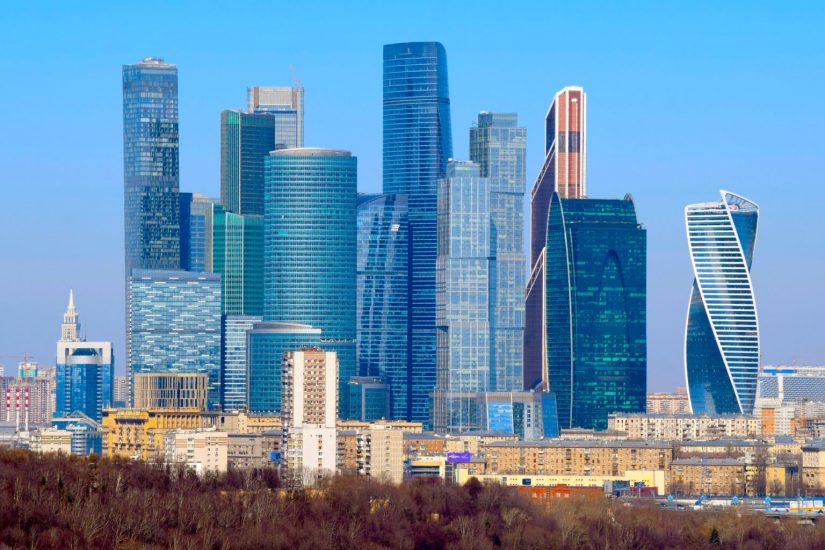
2019 view of Moscow International Business Center. (Dzasohovich, CC BY-SA 4.0, Wikimedia Commons)
By Natylie Baldwin | Consortium News | June 3, 2020
A common response in the Anglo-American media to Russia’s counter-sanctions against agricultural imports from the United States and EU in 2014 was that Russians would go hungry and were, therefore, shooting themselves in the foot. Within a matter of days of the announcement, however, numerous Latin American countries, namely Argentina and Brazil, got in line to fill the gap, as well as China, which started selling produce directly to Russia.
More importantly, according to the Food and Agriculture Organization, Russia ranked as one of the top three producers in the world for a range of agricultural products at the time, from various fruits and vegetables to grains, potatoes and poultry. As of 2018, it was the world’s top exporter of wheat. The government has also had plans in place since 2013 to significantly boost the country’s already respectable production of organic produce from small farms and gardens.
Natural Society reported in May 2014 that 35 million Russian families are growing an impressive percentage of Russia’s fruits and vegetables on 20 million acres:
According to some statistics, they grow 92% of the entire countries’ potatoes, 77% of its vegetables, 87% of its fruit, and feed 71% of the entire population from privately owned organic farms or house gardens all across the country. These aren’t huge Agro-farms run by pharmaceutical companies; these are small family farms and less-than-an-acre gardens.
By autumn 2017, Vladimir Putin had publicly set a goal for Russia to become the world’s top producer and exporter of organic agriculture. In the summer of 2018, the Russian president signed legislation creating official standards, labeling and certification procedures for organic products produced for commercial sale in Russia that went into effect in 2020. Government support will be available to organic farmers, and a public registry will be created listing certified producers.
The agricultural sanctions created some immediate problems, mainly temporary shortages of some meat products and price increases due to the need to work out infrastructure issues to accommodate imports from countries at greater distances.
But Russians did not go hungry, as I witnessed plenty of food in markets, from street vendors, and in restaurants in all cities I visited during my trips in 2015 and 2017. There was, however, concern over price increases.
Author Sharon Tennison, who has traveled throughout Russia extensively since 1983, reported the general attitude of most Russians toward Western sanctions during her trip to Moscow and St. Petersburg in September 2014:
The general outlook of Russians I spoke with is one of quiet confidence, saying that sanctions will turn out good for Russia in the long run––that Russia must become self-sufficient––remarking that Russia became infatuated with foreign products in the 1990s. At that time they felt Russia didn’t need to manufacture high-end products that they could purchase them from other countries. However, the situation has changed. Today production has become the “in” discussion wherever one goes. The sanctions have helped bring this about. Several Russians remarked that they hoped the sanctions lasted for three years or more, since that would give Russians sufficient time to learn to manufacture formerly imported items themselves. The Russian government is offering financial support to entrepreneurs who are ready to move into consumer production.
Sanctions Imposed
In March of 2014, the U.S. and the European Union (EU) began imposing sanctions on Russia in retaliation for its “annexation” of Crimea. These initial sanctions were largely comprised of asset freezes and visa restrictions on certain Russian officials. As the situation in Eastern Ukraine escalated, with rebels taking over local government buildings and demanding autonomy from what they perceived as a coup government in Kiev, the list of individuals targeted for sanctions grew.
After the downing of the Malaysia Airlines flight MH-17 in July 2014, the west imposed more wide-ranging sanctions, which included several Russian banks as well as the defense and energy sectors. In March of 2018, there were diplomatic “sanctions” (expulsions) for the alleged Skirpal poisoning, which Russia responded to with its own expulsions. That same month, there were business/personal sanctions against a number of Russians for their alleged interference in the 2016 elections.
In order to provide the most accurate and comprehensive assessment of the effect of Western sanctions on Russia over the past five years, University of Birmingham professor Richard Connolly, in his 2018 book, “Russia’s Response to Sanctions: How Western Economic Statecraft is Reshaping Political Economy in Russia,” describes how Russia’s economy actually works in order to provide a contextual framework for understanding the success or failure of the West’s policy. He concluded that the ultimate effect of the sanctions is likely not what was intended by Washington policymakers.
Economy with Four Sectors
Connolly explains that the Russian economy can be divided up into roughly four sectors.
Sector A generates revenue, or “rents,” in the form of taxes, fees and other benefits that support Sector B. Sector A is comprised largely of fossil fuel and mineral extraction industries but also includes large “agricultural conglomerates,” manufacturers of nuclear power generation equipment, and some defense industry manufacturers. Economic actors in Sector A are highly profitable and competitive in the global market, into which they are successfully integrated. The state also plays a strong role in Sector A industries either through significant ownership stakes, as is the case with Gazprom, Rosneft, and Rosatom, or through strong personal ties among private owners and the political class, as is the case with Lukoil and Novatek.
Sector B is comprised of economic actors that are dependent upon the rents generated by Sector A. This includes companies that are generally not competitive globally and provide goods and services to the domestic market rather than for export. Despite state assistance, they do not always generate consistent profits. Examples include automotive manufacturing, shipbuilding, fossil fuel equipment and some defense manufacturing. Other beneficiaries of Sector A include state bureaucracy workers and pensioners. It is estimated that Sectors A and B together comprise around 70 percent of the Russian economy.
Sector C is independent of Sectors A and B and includes large construction companies, retail and business services, and various small- to medium-sized enterprises (SMEs) in retail, transportation, business support and communications technology. Because these businesses are outside of the Sector A and B relationship, they’re dependent upon successful profit-making and tend to encourage more competition, innovation and productivity, though they are vulnerable to various forms of outside corruption and unfair takeovers. One successful example of a Sector C industry that enjoys significant and growing export rates is computer software.
 The last sector is the financial sector, which, as Connolly points out, developed virtually out of nothing over the past three decades into a system of numerous, largely state-owned or state-influenced banks that provide a wide range of services. However, Russia’s overall financial sector is small in comparison with other middle-income countries, with Sector A and B entities getting preferential treatment in receipt of the limited credit that is available. There are few small banks or other financial institutions that can provide SMEs with credit, as is reflected in the fact that, as of 2016, two-thirds of assets and liabilities were owned by large state-controlled banks.
As Connolly notes, the obvious disadvantages of this system of political economy are hobbled competition, innovation and productivity. It also limits the development of SMEs.
The advantages, however, include support of domestic employment and the funding of social programs. Perhaps most importantly, this system has also enabled the Russian state to cushion the country from the worst potential effects of Western sanctions and even encourage the stimulation of alternative economic investment, which has strengthened agriculture and some industry and finance.
In terms of how Russia responded to Western sanctions, Connolly provides the following summary:
The Russian response was multifaceted and included the securitization of strategic areas of economic policy, a concerted effort to support import substitution in strategic sectors of the economy, and vigorous efforts to cultivate economic relations with non-Western countries, especially in Asia.
Policy of Diversification
Securitization officially justified certain policies using national security and subordinating certain other objectives in the economic realm that might be prioritized under “normal” circumstances. In order to increase Russia’s economic independence or sovereignty, policies of import substitution and “diversifying” its range of foreign economic partners and the extent of those relations were implemented.
Import substitution involved increasing the proportion of goods and services in Russia that were produced domestically. As an official policy, it was begun in earnest after the imposition of Western sanctions. By 2015, the government was providing federal budget funding, facilitation of loans and access to state procurement funds as well as institutional support to specific sectors of the economy, which included the provision of legal and regulatory frameworks for such policies. In 2016, a plan was presented by Russia’s minister for industry and trade that encompassed “2,000 projects across nineteen branches of the economy. These projects were to be carried out between 2016 and 2020.”
By early 2018, there were 2,500 projects worth $38 billion that were to be completed by 2020. The areas of priority for industrial manufacturing included power equipment, oil and gas equipment, machine tool and civil aviation manufacturing, and agricultural machinery, all of which had import levels between 50 percent and 90 percent.
Gains in domestic food production were seen quickly as Russia became the world’s No. 1 supplier of wheat in early 2018, subsequently capturing over half of the world’s market. Wheat exports continue to increase; sales to other nations increased by 80 percent during the first half of 2018 over the same period in 2017.
Diversifying foreign economic relations is pretty self-explanatory, and in this case it focused heavily on countries in Asia such as China, India, Vietnam and South Korea, as well as Turkey and Latin America. Connolly points out that Russia did not present this as a “zero-sum” action and still conducts most of its trade with various European countries (46 percent of exports and 38 percent of imports). This fact should be considered when assessing the credibility of accusations against Putin that he wants to destroy the EU.
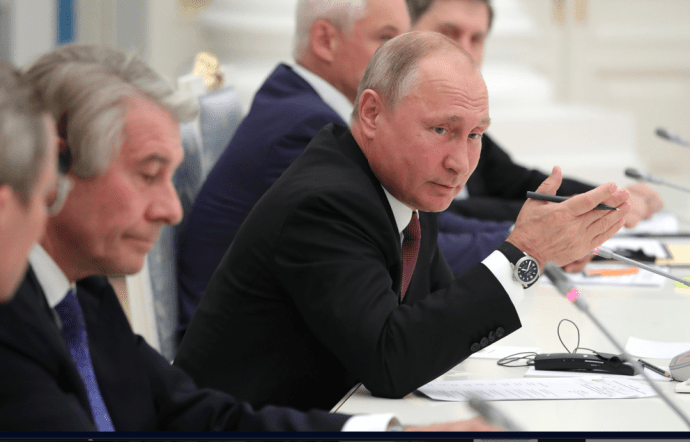
President Vladimir Putin meeting with German business executives, Nov. 1, 2018. (The Kremlin)
China, however, has now become Russia’s single largest trading partner, accounting for 10 percent of Russia’s exports and 22 percent of its imports. But this figure alone does not begin to provide the full picture of Russia’s increasing partnership with Eurasia in general and China in particular.
According to Asia Times correspondent Pepe Escobar, who has been closely following the trend of Eurasian economic integration for several years, what’s known in Russia as the “Greater Eurasia” project was recently presented to the Council of Ministers in Moscow and is now largely accepted as an entrenched foreign policy guide for Russia’s future.
After interviewing three top Russian academics and policymakers who have been championing the Greater Eurasia project for years, Escobar explained that the policy would not preclude continuing a relationship with Europe, recognizing that the Russian elite has been intimately influenced by European culture and trade and technology since the time of Peter the Great, but is meant to be a rebalancing toward the inevitable economic center that will soon be led by Asia and to serve as a “civilizational bridge” between east and west.
The New Silk Road
Situated as it is geographically, Russia is in a perfect position to play this role, serving as a cultural connector between the Enlightenment and the Mongols and as a physical connector between Europe and Asia. In terms of the latter, Russia will play a pivotal role in connecting China’s New Silk Road (aka Belt and Road Initiative, or BRI) through Russia and Central Asia and into Europe.
Escobar writes:
Greater Eurasia and the Belt and Road Initiative are bound to merge. Eurasia is crisscrossed by mighty mountain ranges such as the Pamirs and deserts like the Taklamakan and the Karakum. The best land route runs via Russia or via Kazakhstan to Russia. In crucial soft power terms, Russia remains the lingua franca of Mongolia, Central Asia and the Caucasus.
And that leads us to the utmost importance of an upgraded Trans-Siberian railway—Eurasia’s current connectivity core. In parallel, the transportation systems of the Central Asia “stans” are closely integrated with the Russian network of roads; all that is bound to be enhanced in the near future by Chinese-built high-speed rail.
. . . And all across the spectrum, Moscow aims at maximizing return[s] on the crown jewels of the Russian Far East: agriculture, water resources, minerals, lumber, oil and gas. Construction of liquefied natural gas (LNG) plants in Yamal vastly benefits China, Japan and South Korea.
Iran, Turkey, and India are all pivoting toward Eurasia as well, with a free trade agreement between Iran and the Russian-led Eurasian Economic Union having been recently approved. Iran is also playing a role in the International North-South Transport Corridor (INSTC) to facilitate closer economic cooperation between Russia and India, who have enjoyed cordial relations and strong trade in defense for decades.
But Russia and China’s “comprehensive strategic partnership” — as it is referred to officially by both countries — is much more than economic. In an unprecedented move, China sent 3,000 troops to join Russia in a 2018 military exercise to practice countering NATO in Eastern Europe. In July of 2019, “Russian and Chinese bombers conducted their first long-range joint air patrol in the Asia-Pacific.” To reinforce the strategic importance of Russian-Chinese relations, the day after these maneuvers, the Chinese government published a “white paper” in which it promised to further increase military cooperation between the two countries, partly as a result of the United States’s “undermining” of regional stability.
A former senior national security official in Russia described the relationship to National Interest correspondent Graham Allison as a “functional military alliance.” Allison elaborated that “Russian and Chinese generals’ staffs now have candid, detailed discussions about the threat US nuclear modernization and missile defense pose to each of their strategic deterrents.”
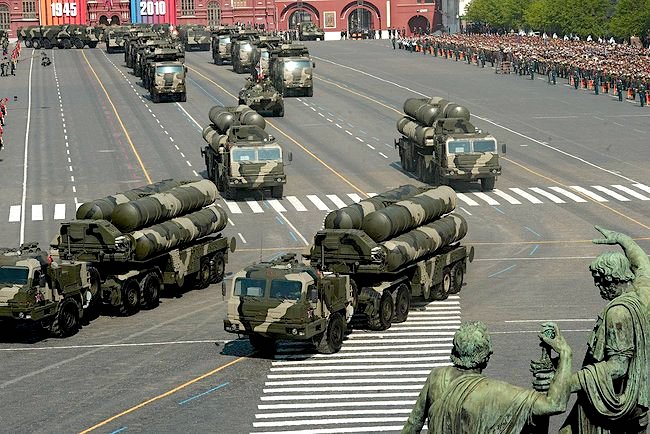
S-400 surface-to-air missile systems during the Victory parade 2010. (Wikimedia)
Allison also reiterated that Russia has lifted its decades-long withholding of advanced military technologies to its eastern neighbor, selling China the S-400 air defense system and partnering in research and development on rocket engines and drones. Furthermore, Russia and China vote the same on the UN Security Council 98 percent of the time, and Russia has supported all Chinese vetoes since 2007.
As evidence that the Russian public will likely support the Greater Eurasia project and Russia’s diversifying of economic partnerships in an eastern direction, recent polling reveals that 69 percent of Russians hold a positive view of China — the exact same percentage that hold a negative view of the United States. Two-thirds of Russians identify the United States as their nemesis, while only 2 percent identify China that way.
Now that we’ve explored how Russia has actually responded to Western sanctions, we can turn to the question of how effective those sanctions have been in terms of what their presumed intent was. As Connolly enumerates, in addition to sending a symbolic message of disapproval of Russia’s actions and to show a united front among Western allies, the intent among some policymakers was to cause significant economic harm to Russia—not just as a deterrent to further “bad behavior,” but with the idea that this would encourage political revolt among targeted Russian elites that would endanger Putin’s government and result in regime change with the installment of a new Russian leader that would be more amenable to Washington’s desires.
The answer is that Washington has once again — in its hubris and ignorance — been hoist with its own petard. As British scholar on Russia Paul Robinson sums up in his review of Connolly’s book:
First, it [sanctions] has created a system that “is less vulnerable to external pressure” than that which existed before, in that it is more independent from the West. Second, it has accelerated a shift in Russia’s place in the global economy towards the East. This obviously has political ramifications which Connolly does not explore. Somewhat perversely, Western sanctions have reduced, not increased, Western leverage over Russia. This is probably permanent.
Moreover, since Russia has weathered the sanctions reasonably well, even using them to strengthen certain sectors of its economy in the long term, the sanctions have likely failed as a tool of deterrence. As Connolly states:
How can policymakers expect sanctions to act as a credible deterrent to third countries when the target country in any given instance might appear to be coping or even flourishing under sanctions? In short, a significant and negative impact on the target economy is a necessary, although not sufficient, condition of sanctions to be effective.
For the policymakers implementing sanctions, it might have been worthwhile to have been briefed by real experts on what Russia’s economy is actually like. If they’d done so, they might have realized that sanctions were likely to have a limited effect on a country that, as analyst Patrick Armstrong has pointed out, has a “full-service economy.” In other words, Russia has demonstrated that it has both the natural and human resources to build sophisticated infrastructure, weapons and defense capabilities, a space station, military and commercial aircraft, heavy trucks and passenger cars, to provide energy and the attendant infrastructure, and to feed its people.
Instead, beliefs that Russia is a “gas station posing as a country,” or that it was still somehow frozen in the 1990s, underpinned policy decisions that ultimately failed.
Natylie Baldwin is author of “The View from Moscow: Understanding Russia and U.S.-Russia Relations,” from which this article is excerpted. “The View from Moscow” is available in e-book and print. She is co-author of “Ukraine: Zbig’s Grand Chessboard & How the West Was Checkmated.” She has traveled throughout western Russia since 2015 and has written several articles based on her conversations and interviews with a cross-section of Russians. She blogs at Natyliesbaldwin.com .
No comments yet.
Featured Video
Theodore Postol: Iran’s Missiles & Drones Were Underestimated
or go to
Aletho News Archives – Video-Images
From the Archives
Wars for Israel: A reminder of who’s giving the marching orders
By Damian Lataan | February 7, 2012
As the West prepares to march off to yet another war in the Middle East, we should perhaps remind ourselves of who is giving the West their marching orders.
In February 2003, just weeks before the US and their allies launched their attack on Iraq and her peoples, a delegation of US congressmen, together with the US Ambassador to the United Nations, John Bolton, a well known pro-Zionist and neoconservative war-hawk, were in Israel at the invitation of the Israeli government then led by Israeli Prime Minister Ariel Sharon.
Addressing the congressmen, Sharon told them ‘that Iran, Libya and Syria should be stripped of weapons of mass destruction after Iraq’. Later, Sharon told John Bolton ‘that Israel was concerned about the security threat posed by Iran, and stressed that it was important to deal with Iran even while American attention was focused on Iraq’. … continue
Blog Roll
 Aletho News
- UAE rejects report claiming it is ready to join war on Iran to reopen Hormuz
- A New Resistance Front: How Does Syria Factor into the Regional War?
- Gulf states weigh pipeline expansion plans, hoping to bypass Hormuz
- Iran sets up ‘tollbooth’ system in Strait of Hormuz
- Wave 90: IRGC strikes US-linked industrial sites in Gulf
- Iran Says US-Israeli Claims of Its Military Strength Are Wrong
- Trump’s April Fools’ Address to the nation
- The Most Important Bet You’ve Never Heard Of
- The killing of three Indonesian soldiers in Lebanon should remind Jakarta that Israel does not want peace
- Defeated and delusional: Netanyahu’s remarks reveal $80bn war failure, says analyst
- If Americans Knew
- Trump says the quiet part out loud: (Israel’s) war on Iran > Americans’ health – Daily Update
- Gaza families reunite years after babies evacuated amid Israel’s war
- International Rescue Committee warns Gaza’s children face grave protection risks
- Iran’s Alleged 47-Year War on America: Debunking the 1,050 American Deaths Canard
- Israel wants US to bomb more of Iran’s civilian structures (113,000 is not enough) – Not a ceasefire Day 173
- Ann Coulter Rips Into Fox News for Iran War Coverage
- Joe Kent Urges Americans To Call White House and Congress To Object To Sending Troops Into Iran
- DNC Resolution to Reject AIPAC Funding Puts Democratic Leaders in the Hot Seat
- Swedish foundation to build 400 schools as over 650,000 Gaza children remain without education for 2 years
- Israeli army admits photshopping image of slain Lebanese journalist
- No Tricks Zone
- Low Intensity Tornado Wrecks Major Solar Farm, Creating A Potential Toxic Dump
- New Study Finds Warming Saves Lives…Cold Temperatures 12 Times More Deadly Than Excess Heat
- German Science Blog Accuses PIK Climate Institute Of Hallucinating Climate Tipping Points
- Devastating Assessment Of Comirnaty Vaccine By Former Senior Pfizer Europe Toxicologist
- New Study: CO2 Is ‘Effectively Negligible’ As An Explanatory Climate Change Factor Since 2000
- Former Pfizer Toxicologist Dr. Helmut Sterz Tells Bundestag Hearing Pfizer Vaccine Should Have Never Been Approved
- Energy Expert: Germany’s Nuclear Phaseout Was A “500 Billion Euro Mistake”
- New Research: South Australia’s Mid-Holocene Sea Surface Temperatures Were 4°C Warmer Than Today
- Storing Green Energy To Last Germany 10 Days Would Require A 60-Million Tonne Battery
- New Studies: UK Sea Levels Were 4 Meters Higher Than Today During The Mid-Holocene
 Aletho News
Leave a comment