NYT takes anti-Russian hysteria to new level with report on Russian ‘bounty’ for US troops
By Scott Ritter | RT | June 28, 2020
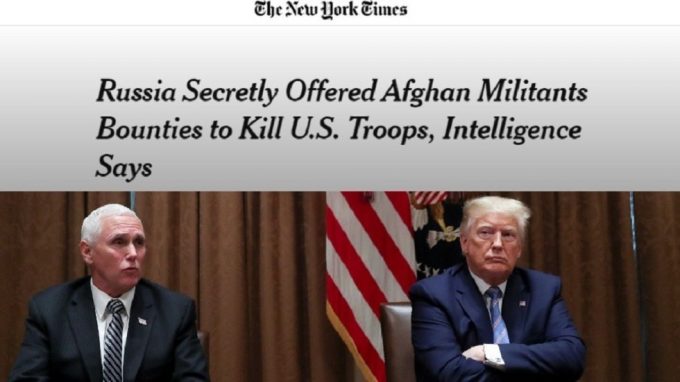
The New York Times published an article claiming that Russia was paying out monetary bounties to the Taliban to kill US troops in Afghanistan. There’s just one problem — none of what they reported was true.
As news reporting goes, the New York Times article alleging that a top-secret unit within Russian military intelligence, or GRU, had offered a bounty to the Taliban for every US soldier killed in Afghanistan, was dynamite. The story was quickly “confirmed” by the Washington Post, the Wall Street Journal and other newspapers, and went on to take social media by storm. Twitter was on fire with angry pundits, former officials, and anti-Trump politicians (and their respective armies of followers) denouncing President Trump as a “traitor” and demanding immediate action against Russia.
There was just one problem — nothing in the New York Times could be corroborated. Indeed, there is no difference between the original reporting conducted by the New York Times, and the “confirming” reports published by the Washington Post and the Wall Street Journal. All of the reports contain caveats such as “if confirmed” and “if true,” while providing no analysis into the potential veracity of the information used to sustain the report — alleged debriefs of Afghan criminals and militants — or the underpinning logic, or lack thereof, of the information itself.
For its part, the Russian government has vociferously denied the allegations, noting that the report “clearly demonstrates low intellectual abilities of US intelligence propagandists who have to invent such nonsense instead of devising something more credible.” The Taliban have likewise denied receiving any bounties from the Russians for targeting American soldiers, noting that with the current peace deal, “their lives are secure and we don’t attack them.”
Even more telling is the fact that the current Director of National Intelligence John Ratcliffe has come out to contradict a key element of the New York Times’ report—that the president was briefed on the intelligence in question. “I have confirmed that neither the president nor the vice president were ever briefed on any intelligence alleged by the New York Times in its reporting yesterday,” Ratcliffe said in a statement. “The New York Times reporting, and all other subsequent news reports about such an alleged briefing are inaccurate.”
And one more tiny problem: Trump confirmed there was no such briefing, too.
Perhaps the biggest clue concerning the fragility of the New York Times’ report is contained in the one sentence it provides about sourcing — “The intelligence assessment is said to be based at least in part on interrogations of captured Afghan militants and criminals.” That sentence contains almost everything one needs to know about the intelligence in question, including the fact that the source of the information is most likely the Afghan government as reported through CIA channels.
There was a time when the US military handled the bulk of detainee debriefings in Afghanistan. This changed in 2014, with the signing of the Bilateral Security Agreement. This agreement prohibits the US military from arresting or detaining Afghans, or to operate detention facilities in Afghanistan. As a result, the ability of the US military to interface with detainees has been virtually eliminated, making the Pentagon an unlikely source of the information used by the New York Times in its reporting.
The CIA, however, was not covered by this agreement. Indeed, the CIA, through its extensive relationship with the National Directorate of Security (NDS), is uniquely positioned to interface with the NDS through every phase of detainee operations, from initial capture to systemic debriefing.
Like any bureaucracy, the CIA is a creature of habit. Henry ‘Hank’ Crumpton, who in the aftermath of 9/11 headed up the CIA’s operations in Afghanistan, wrote that
“[t]he Directorate of Operations (DO) should not be in the business of running prisons or temporary detention facilities. The DO should focus on its core mission: clandestine intelligence operations. Accordingly, the DO should continue to hunt, capture, and render targets, and then exploit them for intelligence and ops leads once in custody. The management of their incarceration and interrogation, however, should be conducted by appropriately experienced US law enforcement officers because that is their charter and they have the training and experience.”
After 2014, the term “US law enforcement officers” is effectively replaced by “Afghan intelligence officers”— the NDS. But the CIA mission remained the same — to exploit captives for intelligence and operational leads.
The Trump administration has lobbied for an expanded mission for the CIA-backed NDS and other militia forces to serve as a counterterrorism force that would keep Islamic State (IS, formerly ISIS) and Al-Qaeda from gaining a foothold in Afghanistan once US and foreign troops completed their planned withdrawal in 2021. But the CIA has raised objections to such a plan, noting that the NDS and other CIA-controlled assets were completely dependent upon US military air power and other combat service support resources, and that any attempt to expand the CIA’s covert army in Afghanistan following a US military withdrawal would end in disaster. Having the NDS fabricate or exaggerate detainee reports to keep the US engaged in Afghanistan is not beyond the pale.
Which brings up the issue of Russian involvement. In September 2015, the Taliban captured the northern Afghan city of Konduz, and held it for 15 days. This sent a shockwave throughout Russia, prompting Moscow to reconsider its approach toward dealing with the Afghan insurgency. Russia began reaching out to the Taliban, engaging in talks designed to bring the conflict in Afghanistan to an end. Russia was driven by other interests as well. According to Zamir Kabulov, President Vladimir Putin’s special representative for Afghanistan, “the Taliban interest objectively coincides with ours” in the fight against Islamic State, which in the summer of 2014 had captured huge tracts of land in Syria and Iraq, including the city of Mosul, Iraq’s second largest.
By 2017, Afghan and US intelligence services had assembled a narrative of Russian assistance to the Taliban which included the provision of advanced weaponry, training, and financial support. While Russia denied providing any direct military support to the Taliban, it maintained that the Taliban were the best way to deal with the growing threat of Islamic State. But even if the US reports were correct, and Russia was angling for a Taliban victory in Afghanistan, the last policy Russia would logically pursue would be one that had the US remain in Afghanistan, especially after pushing so hard for a negotiated peace. Russia’s interests in Afghanistan were — and are — best served by Afghan stability, the antithesis of the Afghan reality while the US and NATO remain engaged. Getting the US out of Afghanistan — not keeping the US in Afghanistan — is the Russian position, and any CIA officer worth his or her salt knows this.
It does not take a rocket scientist to read between the lines of the New York Times’ thinly sourced report. The NDS, with or without CIA knowledge or consent, generated detainee-based intelligence reports designed to create and sustain a narrative that would be supportive of US military forces remaining in Afghanistan past 2021. The CIA case officer(s) handling these reports dutifully submit cables back to CIA Headquarters which provide the gist of the allegations — that Russia has placed a bounty on US soldiers. But there is no corroboration, nothing that would allow this raw “intelligence” to be turned into a product worthy of the name.
This doesn’t mean that someone in the bowels of the CIA with an axe to grind against Trump’s plans to withdraw from Afghanistan, or who was opposed to Trump’s efforts to normalize relations with Russia, didn’t try to breathe life into these detainee reports. Indeed, a finished “product” may have made its way to the National Security Council staff — and elsewhere — where it would have been given the treatment it deserved, quickly discarded as unsubstantiated rumor unworthy of presidential attention.
At this point in time, frustrated by the inattention the “system” gave to the “intelligence,” some anonymous official contacted the New York Times and leaked the information, spinning it in as nefarious a way as possible. The New York Times blended the detainee reports and its own previous reporting on the GRU to produce a completely fabricated tale of Russian malfeasance designed to denigrate President Trump in the midst of a hotly contested reelection bid.
Too far-fetched? This assessment is far more fleshed out with fact and logic than anything the New York Times or its mainstream media mimics have proffered. And lest one thinks the GrayLady is above manufacturing news to sustain support for a war, the name Judith Miller, and the topic of Iraqi weapons of mass destruction, should put that to rest. The reporting by the New York Times alleging the existence of a Russian bounty on the lives of US troops in Afghanistan is cut from the same piece of cloth as its pre-war Iraq drivel. As was the case with Iraq, the chattering class is pushing these new lies on an American audience pre-programmed to accept at face value any negative reporting on Russia. This is the state of what passes for journalism in America today, and it’s not a pretty sight.
Scott Ritter is a former US Marine Corps intelligence officer. He served in the Soviet Union as an inspector implementing the INF Treaty, in General Schwarzkopf’s staff during the Gulf War, and from 1991-1998 as a UN weapons inspector. Follow him on Twitter @RealScottRitter
Trump & Pence never briefed on ‘Russian bounties for Taliban’, NYT story ‘inaccurate’ – US intelligence chief
RT | June 28, 2020
The US director of national intelligence has distanced himself from a NYT report claiming Russia paid money to the Taliban for killing US soldiers in Afghanistan. He said the White House was never briefed on the matter.
The claim published by the New York Times is, like many such stories, based on anonymous intelligence sources. It says Russia paid “Taliban-linked militants” in Afghanistan to kill US military service members, and that President Donald Trump did nothing after learning about it.
The White House has denied that either Trump or Vice President Mike Pence were ever briefed on the alleged situation by US intelligence. Director of National Intelligence John Ratcliffe backed the denial and said the original story and “all other subsequent news reports about such an alleged briefing are inaccurate.”
The dynamic between the US mainstream media and the Trump administration in this case follows the same pattern seen in a previous bombshell report accusing the president of inaction in the face of a foreign threat.
In April, ABC News claimed Trump had been briefed about a military intelligence report which warned that a catastrophic outbreak of a viral disease was emerging from China. The National Center for Medical Intelligence (NCMI), the service which allegedly produced the report on what is now known the Covid-19 pandemic, denied ever writing such a document.
The Taliban bounties story was instantly picked up by the usual suspects of the #Resistance, who saw it as an opportunity to attack Trump from the right. MSNBC’s senior Russiagate peddler Rachel Maddow gushed that Vladimir Putin paid Taliban for American “scalps” and Trump knew it.
Trump-bashing vehicle the Lincoln Project has released an ad accusing the president of “standing by” Russian troops.
While the bounties twist, with its Wild West vibe, is a new one, attempts to paint Russia as being in cahoots with the Taliban are hardly unprecedented. For example, in 2017, some top US generals claimed that Moscow was running guns for the Afghan militant movement. But when the head of US defense intelligence was asked about it by lawmakers, he said no physical evidence “of weapons or money being transferred” was ever found.
Russia called the NYT story an “unsophisticated” piece of disinformation that calls into question the “intellectual abilities of the propagandists from US intelligence,” who couldn’t come up with something more plausible.
Hafte Tir Bombing: A Blast which Shocked the Iranian People
By Robert Fantina | American Herald Tribune | June 26, 2020
In 1979, the people of Iran successfully and mainly peacefully overthrew the United States-supported government, led by the brutal autocrat, the Shah of Iran. In ridding themselves of this repressive dictator and freeing themselves from the shackles of U.S. imperialism, they established the Islamic Republic of Iran.
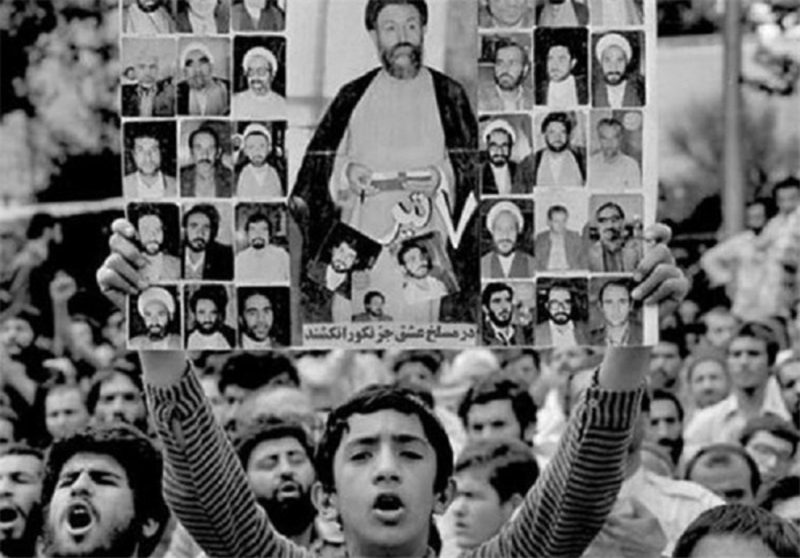
While the revolution had widespread popular support, as does the government to this day, it was not without opposition groups. The MEK (Mujahedin-e Khalq, or the People’s Muhajedin Organization of Iran), is one such opposition organization. It is a violent terrorist group that is currently supported by the U.S. government. Members of the MEK have never accepted the revolution, and on June 28, 1981, three years after the revolution, they bombed the Islamic Republic Party headquarters in Tehran. This horrendous crime was committed during a meeting of party leaders, and killed seventy-three people, including the Chief Justice, Ayatollah Mohammad Beheshti, who had been a leader in the revolution.
Thirty-nine years have passed, but the memory of these martyrs has not dimmed.
Hujjat al-Islam Seyyed Mehdi Qureshi, Islamic Revolution Leader Representative in Iran’s West Azarbaijan Province, commented that “Iran’s stable position has been achieved thanks to the bravery of the martyrs.” Those martyrs’ names, many in addition to those who died on June 28, 1981, are etched upon the hearts of the Iranian people, and include General Qassem Soleimani, murdered by the U.S. in January of this year.
Any government has people who oppose it: citizens of the nation who disagree with one or more policies, and law-abiding people work within the system to achieve changes they seek. Generally, when a majority of the population wants certain changes, those changes are implemented.
Yet within Iran and outside it, a small terrorist group seeks the violent overthrow of the government, despite having so little support to do so. Why, one could ask, would the mighty United States support such a group, when it decries any terrorist activity?
The hypocrisy of U.S. government officials has been discussed and documented by this writer often. The U.S. is only interested in self-determination when the people of any nation choose a form of government that will follow all U.S. dictates. The leaders of the Islamic Republic of Iran will not do so. They form alliances with nations that the United States holds in contempt, and they come to the aid of those nations when required to do so, such as in fighting U.S.-financed terrorists in Syria.
Iran has not invaded another nation in over 200 years, and its leaders have a ‘no first strike’ doctrine. In the U.S.’s 244-year history, it has invaded at least 84 of the 193 countries that are recognized by the United Nations. And its continued hostility towards Iran has only increased with the administration of the unstable president, Donald Trump.
In the United States, lobby groups finance election campaigns, thus making the elected officials beholden to those groups, not their constituents. Prominent among these groups are pro-Israel lobbies, which consider Iran to be their rival for hegemony in the Middle East. Among the global community, only Israel and Saudi Arabia opposed the Joint Comprehensive Plan of Action (JCPOA), the agreement signed with Iran and several other countries that regulated Iran’s nuclear development program, in exchange for the lifting of sanctions. Only Israel and Saudi Arabia praised the U.S. violation of it.
After sanctions were re-imposed following this U.S. violation of international law, this writer contacted a friend in Tehran. He was told that, while the sanctions were unfortunate, the Iranian people are accustomed to living with them, and would continue to do so as long as necessary. There was no talk of defeat; he didn’t suggest that the government should or would accede to U.S. demands. He was not resigned: he simply indicated that the Iranian people would continue to live their lives and make whatever adjustments were necessary due to the sanctions.
This is the attitude that makes Iran great, and that inspires Iranians to sacrifice their lives for their country. When one powerful country is besieged by another, more powerful one, but refuses to surrender, its people’s pride in their nation only increases. And this year, on the anniversary of the Hafte Tir bombing, the memory of those who were working for the people and gave their lives in that mission will again be remembered. Also remembered will be other Iranian martyrs, those who died in the August 30, 1981 bombing of the Prime Minister’s office, General Soleimani and so many others, whose names may not be as well known, but who are remembered and beloved by their countrymen.
The anniversary of the Hafte Tir bombing should be commemorated around the world as a symbol of the destruction and death caused by terrorism, and as a memorial to those innocent servant-leaders who died in it. It should also serve as a reminder to some governments, such as that of the United States, that their unjust plans for world hegemony will not be achieved, and that support for terrorists is an affront to the basic human dignity of mankind. It should remind nations across the globe that the U.S., the most violent nation on the planet, continues its economic and medical terror against a free and peaceful nation.
It has been thirty-nine years since those seventy-three Iranian officials lost their lives in the service of their country. Their sacrifice will not be forgotten in Iran, or by people of decency and compassion around the world.
Zuckerberg loses $7.2 BILLION after corporate ad boycott pressing Facebook to police ‘hate speech’
RT | June 27, 2020
Plummeting Facebook shares have wiped out billions of founder and CEO Mark Zuckerberg’s personal wealth. The impetus? Corporations such as Coca-Cola and Verizon have pulled their ads, demanding that Facebook censor hate speech.
Zuckerberg lost $7.2 billion, after Facebook’s shares fell by 8.3 percent on Friday, Bloomberg reported. The dive in value happened after Unilever, one of the largest advertisers in the world, joined the list of major companies that suspended their ad campaigns on Facebook and its subsidiary Instagram. At around the same time, Coca-Cola said it was also pulling all its social-media advertising for 30 days.
More than 120 corporations, including Verizon, Dove, Lipton, Hershey’s, and Honda joined the boycott organized by activists and civil-rights groups that demanded Facebook combat what they term hate speech and disinformation on its platform.
Responding to the criticism, Zuckerberg, whose remaining net worth is now being estimated at $82.3 billion by Bloomberg, has promised to ban ads with “hateful content.” The prohibited advertising will include materials that describe a specific demographic as “a threat to the physical safety, health or survival of others.” He also vowed to fight potential voter suppression, and to take down posts by politicians and government officials if the company deems them to be an incitement to violence.
While Zuckerberg did not explicitly mention the boycott, it was clear from the announcement he was trying to appease its critics. The US media landscape has been deluged by a wave of calls for advertiser boycotts that came in the wake of the ongoing Black Lives Matter protests. The action targeted primarily conservative outlets and speakers, and ended up being so widespread that it garnered the attention of US President Donald Trump, who considered making such behavior “illegal.”
Still, while Facebook has largely avoided explicit Twitter-style hounding of ‘wrong’ political opinions so far, the social-media platform has been frequently accused of censorship. Despite its proclaimed strive for “transparency,” Facebook is very vague on its policies about ‘forbidden’ content. It has been repeatedly caught flagging and removing certain posts for no obvious reason. One of the most recent scandals involved a colored version of an iconic World War II photo depicting a Soviet flag over the Reichstag – that was sanctioned on V-Day for showing “dangerous individuals and organizations.”
Other Silicon Valley giants, such as Twitter and Google-owned YouTube, have been waging an open war on comments deemed hateful or inflammatory. Twitter has been embroiled in a public spat with Trump, labeling several of his tweets as violating the company’s policy against “abusive behavior.”
US House of Representatives Committee Proposes $3.8 Billion to Fund Anti-Russia Measures in 2021
Sputnik – June 27, 2020
WASHINGTON – The United States House of Representatives Armed Services Committee has proposed allocating $3.8 billion to fund anti-Russia measures in the 2021 fiscal year, according to the committee’s National Defence Authorization Act proposal.
“The proposal provides an additional $3.789 billion for strategic sealift, satellite communications, refueling, submarine, and antisubmarine warfare capabilities that enhance deterrence against Russia”, the document read.
Additionally, officials in Washington are pushing to limit any military cooperation between the US and Russia, although exceptions will be made for the purposes of building dialogue that will reduce the risk of conflict, according to the document.
The committee is also looking to fully fund the European Defence Initiative and provide $250 million to the Ukraine Security Assistance Initiative. One-fifth of these funds can be used to purchase lethal weapons, the committee said.
The proposal, which was tabled by Chairman Adam Smith, would authorize roughly $730 billion in spending for the purposes of national defence.
In December, President Donald Trump approved the 2020 National Defence Authorization Act, which had a topline budget of $738 billion.
Belgium Urges Sanctions against Israel if it Annexes West Bank
Palestine Chronicle | June 27, 2020
The Belgian parliament on Friday passed a resolution urging the government to call on the European Union to impose sanctions against Israel if it proceeds with its plan to annex large swaths of the occupied West Bank.
The measure “concerning Israel’s annexation of occupied territories in Palestine”, passed in the 150-member House of Representatives with 101 affirmative votes, 39 abstentions and zero votes against it.
The body was also due to vote on a motion calling for the recognition of a Palestinian state but this was delayed after it was sent back to the foreign affairs committee for further debate.
MPs from left-wing parties, including the Socialist Party and members of the French and Green parties, proposed the resolutions.
“It is a matter of defending international law. There is no equidistance to be respected in this fight,” said MP Ecolo Simon Moutquin who authored the resolution.
The resolution has two objectives, he said: “On the one hand, send a message to the Israeli government ‘Don’t cross that red line’. On the other hand, give some hope to the Palestinians who have suffered injustice for decades.”
More than 1,000 European lawmakers across the political spectrum issued a letter earlier this week warning Israel against annexing parts of the occupied West Bank.
Legislators said they “share serious concerns about [US] President Trump’s plan for the Israeli-Palestinian conflict and the imminent prospect of Israeli annexation of West Bank territory.”
UAE conceals news about normalising ties with Israel
MEMO | June 27, 2020
Despite the official announcement, the United Arab Emirates’ (UAE) mass media has concealed news about medical cooperation with Israel from its people, Arab48.com reported on Friday.
The National reported the news while the Spokeswoman of the Ministry of Health Hend Al-Otaiba posted a tweet on her account.
It was noteworthy that the country’s mouthpieces, Sky News Arabic and Al-Hadath, did not make reference to this news, despite offering wide coverage of internal UAE issues and the medical assistance the country offers to the needy.
Local UAE newspapers including Al-Bayan, Al-Khaleej and Emarat Al-Youm also did not feature the news.
However, mass media covered the article of UAE Ambassador to the US Yousef Al-Otaiba, where he claimed that his country is moving against the Israeli annexation of Palestinian lands.
During the last two decades, Israel launched several major offensives on the Palestinians and Lebanese, and killed thousands along with settlement expansion at the expense of the Palestinians. Meanwhile, the Arab world, especially the UAE, continued criticising the Palestinian resistance while maintaining good relations with Israel.
Taliban Refute Reports on Russia’s Alleged Role in Killings of US Troops in Afghanistan
Sputnik – 27.06.2020
KABUL – Taliban spokesman Zabihullah Mujahid refuted on Saturday the recent reports citing US intelligence assessments alleging that Russian intelligence has solicited killings of US troops by the Taliban in Afghanistan, saying that these rumors are set to create obstacles to US pullout from the country.
According to Mujahid, all weapons and tools used by the movement were already present in the country or captured from the opposition. The spokesman stressed that the Taliban’s activities are not related to any intelligence organ or foreign country.
Mujahid stated that the Taliban was committed to the deal with the United States, saying that its implementation would ensure comprehensive peace and stability in Afghanistan.
On Friday, The New York Times published an article where it cited unnamed government sources as saying that US President Donald Trump was presented with an intelligence report that claimed that Moscow could have payed bounty to armed Islamic insurgents in Afghanistan to assassinate US soldiers. The outlet said Trump had so far failed to act on the report.
In February, the US and the Taliban signed a peace deal that concluded rounds upon rounds of talks pursuing to launch the reconciliation process in Afghanistan after almost two decades of armed conflict and insurgency.
Last week, US Special Representative for Afghanistan Zalmay Khalilzad said that intra-Afghan talks were closer than ever after Kabul and the Taliban carried out a significant exchange of prisoners.
North Korea: ‘Only option left to counter nuclear with nuclear’
Press TV | June 27, 2020
North Korea says Washington has left Pyongyang with no choice but to “counter nuclear with nuclear” in a bid to confront hostile US policies against the Asian country.
“In order to eliminate the nuclear threats from the US, the DPRK government made all possible efforts either through dialogue or in resort to the international law, but all ended in vain,” North Korean state news wrote in an essay, using an abbreviation for the country’s official name.
“The option left was only one, and that was to counter nuclear with nuclear,” it added.
The 5,000-word article documented the history of North Korea’s grievances with the US, South Korea and its allies and came a day after all of these countries marked the 70th anniversary of the beginning of the Korean War.
It also came just days after the North said it was suspending “military action plans” against the South after it had blown up a liaison office used for talks between the two countries in a North Korean border city.
The two Koreas were on a path of rapprochement beginning in January 2018 before US intransigence to relieve any of the sanctions on the North effectively killed diplomacy.
North Korea has been under harsh US sanctions for years over its nuclear and ballistic missile programs.
US President Donald Trump has attempted to court Pyongyang, and although he has met with North Korean leader Kim Jong-un three times, he has refused to relieve any of the sanctions on the North. That has in turn hampered efforts to demilitarize the Korean Peninsula.
Kim outlined last month a plan to further boost his country’s nuclear deterrence capabilities.
The Washington-Pyongyang nuclear talks have made little progress since late last year, particularly after the global fight to curb the pandemic, which has so far infected nearly 10 million people and killed over 496,000 others around the world.
North Korea’s hardening of stance comes amid reports that the US is preparing to conduct its first full-fledged nuclear test since 1992.
Last December, Kim ended a moratorium on the country’s missile tests and said North Korea would soon develop a “new strategic weapon.”
Featured Video

Meet The Ellisons: Zionists, Technocrats, Moguls
or go to
Aletho News Archives – Video-Images
Frlom the Archives
With apparently fabricated nuclear documents, Netanyahu pushed the US towards war with Iran
By Gareth Porter | The Grayzone | April 29, 2020
President Donald Trump scrapped the nuclear deal with Iran and continued to risk war with Iran based on Israeli Prime Minister Benjamin Netanyahu’s claim to have proven definitively that Iran was determined to manufacture nuclear weapons. Netanyahu not only spun Trump but much of the corporate media as well, duping them with the public unveiling of what he claimed was the entire secret Iranian “nuclear archive.”
In early April 2018, Netanyahu briefed Trump privately on the supposed Iranian nuclear archive and secured his promise to leave the Joint Comprehensive Plan of Action (JCPOA). That April 30, Netanyahu took the briefing to the public in a characteristically dramatic live performance in which he claimed Israel’s Mossad intelligence services had stolen Iran’s entire nuclear archive from Tehran. “You may well know that Iran’s leaders repeatedly deny ever pursuing nuclear weapons…” Netanyahu declared. “Well, tonight, I’m here to tell you one thing: Iran lied. Big time.”
However, an investigation of the supposed Iranian nuclear documents by The Grayzone reveals them to be the product of an Israeli disinformation operation that helped trigger the most serious threat of war since the conflict with Iran began nearly four decades ago. This investigation found multiple indications that the story of Mossad’s heist of 50,000 pages of secret nuclear files from Tehran was very likely an elaborate fiction and that the documents were fabricated by the Mossad itself. … continue
Blog Roll
 Aletho News
- Meet The Ellisons: Zionists, Technocrats, Moguls
- US failures in Iran reveal Russia is key to South Korea’s strategic security
- ‘All ports in Persian Gulf will be legitimate targets if Iranian ports are attacked’
- 40 Years of Endless War, Data Point by Data Point
- Department of War Using Palantir AI to Pick Targets in Iran
- American bases do not protect – they attack the peoples of the Persian Gulf
- ‘We’ve Obliterated Their Missiles’
- Syrian president vows ‘absolute support’ to disarm Hezbollah
- Ukraine attacking Russian gas pipeline to stop deliveries to Europe – Defense Ministry
- ‘Heinous crime’: Iran denounces Israeli assassination of 4 Iranian diplomats in Lebanon
- If Americans Knew
- Israeli strategic plans to “remake the Middle East” from the 1950s and since
- Honoring Gaza’s women who refused to let the world look away
- 97% of victims of war on Iran are Iranian, 98% of victims in war on Gaza are Gazans – Not a ceasefire Day 152
- Early Iran strikes cost $5.6 billion in munitions, Pentagon estimates
- Israel Decided the War, But Trump’s America Fights and Pays the Bill
- Conscientious Objector Group: Phone ‘Ringing Off Hook’ As Huge Mobilization Underway
- U.S. support for Israel continues to plummet, despite media’s best efforts
- Threats and missiles fly, death tolls soar in Iran, Lebanon, Gaza – Not a ceasefire Day 151
- Lebanon: Israel’s White Phosphorous Use Risks Civilian Harm
- Corporate Media Go All Out To Support The US-Israeli War On Iran
- No Tricks Zone
- Destructive Green New Deal: German Energy And Metal Group Warns Of Drastic Crisis
- New Study Documents A 20-Year Pause In Arctic Sea Ice Decline – Driven By Internal Variability
- Wake-up Call: Survey Shows Majority Of Germans Now Favor Postponing Climate Targets!
- Televised! Leading German Political Candidate Tells Schoolchildren CO2 Makes Sun Hotter!
- New Study: A Century Warming Of 1.1°C Is ‘Commonplace’ And ‘Not Unusual’ During This Interglacial
- New Study: ‘Internal Noise’ And Volcanic Forcing Can Trigger 10-15°C Warming Within Decades
- Glaciers Worldwide Are Suddendly Surging, Experts Blame Warming!
- Surprising Discovery: Sahara Is Greening…Billions Of Trees Where Once Thought To Be Barren
- New Research Reaffirms Clouds, Aerosols, And Surface Solar Radiation Are ‘Driving The Climate System’
- Germany: Electric Car Catches Fire At Charging Station, Sets Off Local “Inferno”, Widespread Damage
 Aletho News