Risk of Asymptomatic Spread Minimal. Variants Over-Hyped. Masks Pointless. An Interview With Professor Jay Bhattacharya
By Oliver May | Lockdown Sceptics | March 25, 2021
New variants are of no concern. There is no need to cancel summer holidays. Millions vaccinated, coupled with immunity from millions of prior infections means we can surf on the crest of the third wave, rather than being remotely concerned about it. In fact, the UK should open now. And vaccine passports, certificates, or whatever name they are being given, will do nothing to improve the health of the population – all headlines we have read and heard over the past week or so.
Except, we haven’t. We have heard and read the opposite. And we are instilled with fear from TV and radio adverts, complete with ‘that scary voice’ all too eager to give listeners nightmares, be it your impressionable primary-school-aged daughter, or a frail older lady now terrified into wearing a mask outside while waiting for a bus with no one within a 50-metre radius. But the reality is that the above headlines could have been written – and all based on science. Jayanta Bhattacharya is a Professor of Medicine at Stanford University and one of the co-authors of the Great Barrington Declaration, the report that called for the focused protection of the vulnerable and no lockdowns, signed by almost 14,000 medical and public health scientists, nearly 42,000 medical practitioners and close to 765,000 concerned citizens.
I interviewed him by email and he remains a staunch lockdown sceptic.
Why have the media, politicians and many scientists sought to panic the populace about SARS-CoV-2 far beyond what the evidence would warrant? The incentives include financial motives, political goals, the desire to protect professional reputations and many other factors.
The virus is seasonal and late fall/winter is its season. It is very unlikely, given that this is the case, that the virus will spread very widely during the summer months. It is also the case that a large fraction of the UK population has already been infected or vaccinated and is immune, which will greatly reduce hospitalisation and mortality from the virus in coming months.
There are tens of thousands of mutations of the SARS-CoV-2 virus. They mutate because the replication mechanisms they induce involve very little error checking. Most of the mutations either do not change the virulence of the virus, or weaken it. There are a few mutations that provide the virus with a selective advantage in infectivity and may increase its lethality very slightly, though the evidence on this latter point is not solid.
We should not be particularly concerned about the variants that have arisen to date. First, prior infection with the wild type virus and vaccination provide protection against severe outcomes arising from reinfection with the mutated virus. Second, though the mutants have taken over the few remaining cases, their rise has coincided with a sharp drop in cases and deaths, even in countries where they have come to dominate. Their selective infectivity advantage has not been enough to cause a resurgence in cases. Third, the age gradient in mortality is the same for the mutant and wild-type virus. Thus a focused protection policy is still warranted. If lockdowns could not stop the less infectious wild type virus, why would we expect them to stop the more infectious mutant virus?
According to the three authors of the Great Barrington Declaration which, other than Dr Bhattacharya, include Dr Martin Kulldorff, Professor of Medicine at Harvard Medical School, and Dr Sunetra Gupta, Professor of Theoretical Epidemiology at the University of Oxford, the UK Government is creating unfounded hysteria around SARS-CoV-2. Dr Bhattacharya said:
According to a meta-analysis by Dr John Ioannidis [Professor of Medicine at Stanford University] of every seroprevalence study conducted to date of publication with a supporting scientific paper (74 estimates from 61 studies and 51 different localities around the world), the median infection survival rate from COVID-19 infection is 99.77 per cent. For COVID-19 patients under 70, the meta-analysis finds an infection survival rate of 99.95 per cent.
The CDC’s [Centres for Disease Control] and Prevention] best estimate of infection fatality rate for people ages 70 plus years is 5.4 per cent, meaning seniors have a 94.6 per cent survivability rate. For children and people in their 20s/30s, it poses less risk of mortality than the flu. For people in their 60s and above, it is much more dangerous than the flu.
Even so, this hardly warrants a new Government drive urging families to carry out tests on their children twice a week in the hope of unearthing asymptomatic cases. Especially, as the vulnerable have already been vaccinated.
The scientific evidence now strongly suggests that COVID-19 infected individuals who are asymptomatic are more than an order of magnitude less likely to spread the disease to even close contacts than symptomatic COVID-19 patients. A meta-analysis of 54 studies from around the world found that within households – where none of the safeguards that restaurants are required to apply are typically applied – symptomatic patients passed on the disease to household members in 18 per cent of instances, while asymptomatic patients passed on the disease to household members in 0.7 per cent of instances. A separate, smaller meta-analysis similarly found that asymptomatic patients are much less likely to infect others than symptomatic patients.
Asymptomatic individuals are an order of magnitude less likely to infect others than symptomatic individuals, even in intimate settings such as people living in the same household where people are much less likely to follow social distancing and masking practices that they follow outside the household. Spread of the disease in less intimate settings by asymptomatic individuals – including religious services, in-person restaurant visits, gyms, and other public settings – are likely to be even less likely than in the household.
What about mask mandates?
The evidence that mask mandates work to slow the spread of the disease is very weak. The only randomised evaluation of mask efficacy in preventing Covid infection found very small, statistically insignificant effects [Danish mask study]. And masks are deleterious to the social and educational development of children, especially young children. They are not needed to address the epidemic. In Sweden, for instance, children have been in school maskless almost the whole of the epidemic, with no child Covid deaths and teachers contracting Covid at rates that are lower than the average of other workers.
In light of this, what conclusion can we draw from the fact that the UK Government wants the entire adult population to be injected against the virus, instead of just the vulnerable? And the possibility that we’ll need to produce vaccine certificates to access hospitality and sports venues or travel overseas?
Vaccine passports are a terrible idea that will diminish trust in public health and do nothing to improve the health of the population. Vaccine certificates are not needed as a public health measure. The Government had it right previously. The country should open up now that the older, vulnerable population has been vaccinated. The rest of the population is at much greater health risk from the lockdown than they are from the virus.
The author is a staff journalist at a national newspaper group. Oliver May is a pseudonym.
The Vaccine Passport Propaganda Template
By Adam Dick | Ron Paul Institute | March 30, 2021
With reports that President Joe Biden’s administration is planning for imposing a vaccine passport mandate in America, expect to see in the media a deluge of vaccine passport propaganda. What will that propaganda look like? A template illustrating several elements you can expect to see in the propaganda push was provided several weeks ago in a CNN interview.
In the first week of March, host Fareed Zakaria and his guest Arthur Caplan provided at CNN a textbook example of how to present vaccine passport propaganda to the American people. Let’s look at some of the major elements of the propaganda template as demonstrated by Zakaria and Caplan.
1) Include some short expression that the idea of vaccine passports can be troubling, but make sure to only bring this up superficially. This is accomplished in the CNN segment by starting with a clip from a short scene from the movie Casablanca. In the clip, a policeman asks to see a man’s “papers,” the man says he does not have them, and the policeman responds, “in that case we’ll have to ask you to come along.” Not shown is the remainder of the scene in which the accosted man, after presenting apparently expired papers, attempts to flee only to be gunned down. Not showing the full scene demonstrates the care demanded in the propaganda to not allow any depiction of potential dire consequences from imposing vaccine passports.
2) Frame the imposing of a vaccine passport mandate as something that is both inevitable and threatens only minimal, if any, harm. Zakaria accomplishes this task with the first sentence he utters to begin the media segment. Zakaria states: “From Casablanca to today, a demand to produce personal documents can be uncomfortable, but, post-pandemic, it’s something we’ll all likely have to get more and more comfortable with.” Masterfully, Zakaria, in addition to minimizing the problems with passports as just causing discomfort, asserts that even that discomfort with time will disappear, suggesting objecting to vaccine passports is just an irrational or silly reaction.
3) Bring on a guest who, despite his description making him sound like someone who would be looking out for the interests of people concerned about vaccine passports, pretty much says that vaccine passports are the best thing since sliced bread. In the CNN interview the guest performing this role is Arthur Caplan, who Zakaria introduces as a “medical ethicist” and “professor at NYU.” A medical ethicist will surely provide some warning about dangers from vaccine passports, right? Yes, in many cases. But, Caplan is not that sort of medical ethicists. He is the one picked to be interviewed in a media segment designed to promote acceptance of vaccine passports.
4) Reiterate that vaccine passports are inevitable, and that people should support them. Zakaria hits the nail on the head with this, presenting this first question to his guest: “So explain why you think, basically, that this is the future and we should be comfortable with it.”
5) Declare that vaccine passports must be imposed on the American people because of coronavirus. Caplan accomplishes this task in his first words in the media segment. He states: “Well, I’m sure that the future holds vaccine passports for us, partly to protect against the spread of Covid.” Of course, as coronavirus has turned out not to be a major danger to most people, imposing a vaccine passport mandate to counter it makes no more sense than doing it to counter any other of many diseases. But, this is not a topic to be brought up when selling people on vaccine passports. Fearmongering, no matter how ridiculously unjustified, is the name of the game. This is the fraudulent message people are encouraged to act on without much critical thought: Coronavirus is gonna kill us all unless we take the shots and show our papers!
6) Say that mandating vaccine passports is really no big deal because of some other supposedly very similar restriction to which some people are already subjected. Caplan states: “And, you know, it’s not a new idea, we have it for yellow fever; there are about more than a dozen countries that say you can’t come in if you haven’t been vaccinated against yellow fever, and many others require you to show proof of vaccination if you transit through those countries.” Are the yellow fever-related requirements justified? Caplan does not say more than that, because these somewhat similar restrictions exist someplace, the mandating of vaccine passports in America is fine. That’s medical ethicist reasoning? Anyway, the yellow fever stuff, because most Americans have no experience with or knowledge of it, is a fine example for the propaganda. Few watchers of the segment will have any basis for questioning the current practice that is used to justify the new desired mandate. One big difference, though, jumps out on further consideration. Caplan explains that the yellow fever requirements apply for just coming to several countries. In contrast, Zakaria early in the interview says the vaccine passports that will, he claims, inevitably be imposed on Americans will be required for people “to get on an airplane, to go to a concert, or to go back to work.” The vaccine passport mandate is, thus, much more troublesome for most Americans than yellow-fever-related requirements for entry into a few countries that most Americans never visit. But, the point is to quickly present the example as if it provides conclusive support no matter how far that representation is from the truth.
7) Dismiss as insignificant people’s concerns about being required, in order to go about their daily activities, to present a vaccine passport and to take a vaccine, or, really, an experimental coronavirus vaccine that is not even a vaccine under the normal meaning of the term. Assert instead that the only danger to freedom could be something theoretical that could be additionally required in the future. Here is how Zakaria puts it in a question to Caplan: “What about the concerns that many people have about privacy, about the privacy of their health data, that, you know, is there a slippery slope here — ‘OK, I’m comfortable telling you whether or not I have Covid, but does that mean it becomes OK to ask about other things?’” Of course, many people are justifiably wary of being pressured to take the shots and then having their mandated vaccine passport used to track them as they go about their daily activities. That is why this media segment and others like it are being presented, after all.
8) Dismiss any concern that vaccine passports can in fact harm freedom. Instead, describe people as benefiting from and gaining freedom by their being mandated to take experimental coronavirus vaccines and present vaccination passports in order to go about their daily activities. Oh yeah, and keep quiet about all the mass surveillance facilitated by a vaccine passport program, the vaccinations-based caste system resulting from the mandate that will make people who do not take the shots suffer, and how the vaccine passport program can be expanded to advance many additional types of control over people. Here is how Caplan puts it: “With a Covid certification, you’re going to gain freedom, you’re going to gain mobility, and I’m going to suggest that you’re probably going to be able to get certain jobs.” Talk about turning things on their head. The mandate really means that people who do not comply will be barred from the mobility they already have and fired from their jobs. Freedom is supported by rejecting the mandate, not by supporting it.
9) Insist that the vaccine passport mandate is fine because it will be applied equally to all people. This is something Zakaria and Caplan spend a long time talking about in the CNN segment. Come on guys, something bad does not become good because it is applied to the maximum number of people, irrespective of their race, sex, or whatever. We are dealing with a mandate here, not giving everyone a serving of his favorite dessert.
10) Declare that a vaccine passport mandate helps encourage people to take the shots. (Unlike the other nine elements of the vaccine passport mandate propaganda template, this one is likely true. Threats can yield compliance. Still, the threats could deter some people from taking the experimental coronavirus vaccine shots. It sure makes you wonder about shots’ supposed safety when an extreme, and unprecedented, act of force is employed to ensure people take the shots.) States Caplan in the interview: “It also gives you an incentive to overcome vaccine hesitancy. Some people are not sure still whether they want to do the vaccine, but if you promise them more mobility, more ability to get a job, more ability to get travel, that’s a very powerful incentive to actually achieve fuller vaccination.” What Caplan is really talking about is coercion. He is saying that people who would otherwise refuse taking the shots will be forced to do so by the vaccine passport mandate severely restricting their activities and even depriving them of the ability to earn an income so long as they do not give in to the demand they take the shots. All this authoritarianism is dressed up in deceptive language. “Vaccine hesitancy” is substituted for “vaccine refusal” to disguise that the vaccine passport mandate is about stopping people from exercising free choice. “Incentive” is substituted for “coercive technique.”
Watch Zakaria and Caplan’s interview here:
Hopefully, many people will see through the deception and be able to prevent the implementation of the vaccine passport mandate Zakaria, Caplan, and others are promoting in the media.
Copyright © 2021 by RonPaul Institute
How China is Going to Reshape Asia
By Salman Rafi Sheikh – New Eastern Outlook – 01.04.2021
With China and Iran signing a multi-billion dollar deal for the next 25 years, there remains little gainsaying that the former is going to increase its footprint in West Asia/Middle East in a way that once was thought to be unimaginable for reasons that included China’s own economic policies and West Asia’s too close ties with the West to allow for any players. Forces of economic change that China is unleashing will not only become a massive boost for Iran, but Iran will become a gateway for China’s further expansion into the Middle East, including countries, such as Saudi Arabia and the UAE, that Iran rivals. For China, its presence and expansion in the Middle East is not merely about economic benefits; this presence is equally driven by the emerging US-China global rivalry and China’s desire to push back against erstwhile US hegemony and domination of the Middle East since the Second World War.
As such, when China’s foreign minister went on a tour to the Middle East last week, he was not merely looking to sign a deal with Iran; he was more interested in and largely focused on introducing new rules of the game that focus, first and foremost, on economic engagement and connectivity. Rather than traditional Gulf tensions. Therefore, while Wang Yi met Saudia’s Crown Prince, MBS, and supported Saudi stance to oppose any “interference” in the internal affairs by any external player, Wang also offered MBS, who is currently not on good terms with the Joe Biden administration, an opportunity to engage with China “to explore and find a path of development that fits its own conditions.” This path, as Wang emphasised in an interview with Saudia’s official news channel, Al Arabiya, can be found only when Gulf countries can “break free from the shadows of big-power geopolitical rivalry and [be able to] independently explore development paths suited to its regional realities.”
As it stands, China has offered Saudi Arabia the same path it has signed up with Iran. Therefore, China, while it does not want to get entangled in the cross-web of geo-political rivalries in the Persian Gulf, aims to chart a new course whereby countries in the region can stick to an agenda that maintains a strict separation between geo-economics and geo-political and/or ideological rivalries including those around Sunni & Shia faiths and organisations like Muslim Brotherhood.
Therefore, while China signed a multi-billion dollar deal with Iran that includes development projects and enhanced oil production and supplies, China’s growing ties with Saudi Arabia, too, include an increasing Saudi desire to enhance Saudi supply of oil to China and secure Chinese investment in fields ranging from petrochemical, nuclear energy and other energy fields, further expanding it into new fields such as 5G, telecommunication and digital technologies. Saudi Arabia, MBS affirmed, is also willing to make joint efforts with China to push forward the free trade negotiations between China and Gulf countries.
Therefore, by offering both rivals a somewhat similar paradigm of economic development that bypasses geo-political tensions and rivalries, China is building an economic landscape that would leave minimum room for external payers, like the US, to continue to manipulate the Gulf to its advantage as it has been doing for the past many decades.
As such, whereas Chinese investment in Iran offers the latter an opportunity to break economic shackles imposed by the US through economic sanctions, for Saudi Arabia, China offers an opportunity to reshape its ties with the US at a time when the Joe Biden administration appears unwilling to accept MBS as the future king.
By offering states in the Gulf an opportunity to diversify their external geo-economic ties and reduce dependence on the US, China is posing a serious challenge to the US position in West Asia, which has mostly relied on using the precarious geo-political scenario to keep itself militarily entrenched and maintain a relationship that served, first and foremost, the US military industrial complex. At the same time, for the Middle Eastern states, China’s economic path is a way out of their decades old reliance on oil as a primary source of national income.
For China itself, it is pivoting to the Middle East at a time when the Joe Biden administration is trying to assemble an anti-China coalition through the QUAD, a group of countries that includes the US, Japan, India and Australia. China, by simultaneously approaching rival countries like Saudi Arabia, Iran, Turkey and the UAE, is posing a counter-challenge to the US ambitions, making it more and more difficult for the US to realise its “containment” of China ambitions at the global level.
The fact that China’s multi-billion dollar deals have received a very warm reception speaks volumes about how the Gulf itself is keen to transform its geo-economic landscape. In this sense, China-Gulf ties become, unlike US-Gulf ties, a fruit of a path that converges to serve mutual interests.
China’s pact with Iran and its deepening ties with other Gulf countries, therefore, has the potential to completely upend the prevailing geo-economic scenario. With the Gulf countries’ ability to diversify their ties and radically reduce their over-dependence on the US, the region’s geo-political scenario could also undergo a dramatic change.
Therefore, it would be wrong to grasp China-Iran deal as an isolated event. The fact that Wang has toured Iran, Saudi Arabia, Turkey, Oman, and the UAE shows how China is embracing the region as a whole through a single framework of policy that is very largely underpinned by economic development. The fact that Saudi Arabia, to China’s utter joy, even refused to back the US campaign against China’s alleged “genocide” of Uyghur shows how China, to the disappointment of the US, continues to earn more and more acceptability.
Salman Rafi Sheikh is a research-analyst of International Relations and Pakistan’s foreign and domestic affairs.
Hamas welcomes Turkish-Egyptian detente
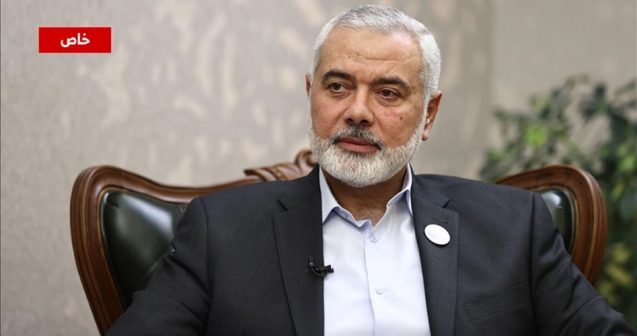
Ismail Haneyya
Palestine Information Center – April 1, 2021
ISTANBUL – Head of Hamas’s political bureau Ismail Haneyya has welcomed the Turkish-Egyptian rapprochement, expressing confidence that any cooperation between Ankara and Cairo will be in the interest of the Palestinian people and their national cause.
Haneyya made the remarks in an interview conducted by Anadolu Agency after he visited its headquarters in Istanbul.
“We welcome the Turkish-Egyptian rapprochement, and we believe that more understandings between them and between Arab and Islamic countries will have a positive impact on us in Palestine as well as on the Arab countries,” the Hamas political chief said.
“There are historically known central states in the region that play strategic roles, such as Egypt, Turkey, Iran and Saudi Arabia, so any understanding and rapprochement between them will be in the interests of the peoples in the region and the Palestinian cause,” he added.
As for the upcoming Palestinian elections, Haneyya affirmed that his Movement is committed to forming a national consensus government even if it scored a victory in the legislative elections slated for next May.
“Hamas is participating in the elections on the basis of partnership and not with the aim of defeating others. It does not want to dominate the Palestinian political system,” he underlined.
He described the upcoming elections as an important opportunity to improve the current Palestinian conditions and end 15 years of national division.
Papers reveal US-backed Brazil’s role in installing and supporting Pinochet in Chile

By Kit Klarenberg | RT | April 1, 2021
Washington’s involvement in the violent overthrow of the democratically elected government of Chile in September 1973 is by this point well known. The pivotal role played by Brazil has not been as clear until now.
On the anniversary of the 1964 US-backed coup that led to Brazilian President Joao Goulart being replaced by a military junta, the National Security Archive has published a trove of previously classified documents showing the role that junta later played in subverting democracy in Chile, and its subsequent support of General Augusto Pinochet’s brutal repression of political opponents.
The file trail begins September 22, 1970, 18 days after Salvador Allende of the Popular Unity alliance narrowly won the Chilean presidency. A document, prepared for General Emilio Garrastazu Medici – then the third president of Brazil’s military dictatorship – summarizes a recent meeting between the US ambassador to Chile, Edward Korry, and his Brazilian counterpart.
Following Allende’s victory, Korry, a veteran diplomat during the administrations of Presidents Kennedy, Johnson, and Nixon, vowed that “not a nut or bolt shall reach Chile” under the socialist’s rule, and if and when he took office in November that year, the US would “do all within our power to condemn Chile and the Chileans to utmost deprivation and poverty.”
Accordingly, the summary makes clear US plans to undermine Allende were well underway by the time the two ambassadors met.
“Following direct orders from the White House,” Korry was said to be “insinuating to all relevant sectors” that Chile would have “difficulties” – including a shortage of foreign credit and military aid – should the country’s Congress confirm Allende as leader. He also noted the US Embassy was distributing written material warning of the dangers of an Allende government to Chilean military commanders, the very elements that would brutally take power three years later.
Korry’s message was clearly received loud and clear, for in March the next year – five months after Allende’s confirmation – Chilean ambassador to Brasilia Raul Rettig submitted a troubling report to his foreign ministry, titled ‘Brazilian Army possibly conducting studies on guerrillas being introduced into Chile’.
Rettig – who, two decades later, chaired the country’s first ‘truth commission’, which investigated human rights abuses during Pinochet’s rule – had heard from multiple sources that the Brazilian regime was extensively evaluating how to instigate violent insurrection in Chile and overthrow the Allende government via an “armed movement.”
Plans were well developed already, with the military having established a dedicated ‘war room’, with maps and models of the Andean mountain range along the Chilean border, to plan infiltration operations. A number of Brazilian secret agents had also reportedly “entered the country as tourists, with the intention of gathering more background on possible regions where a guerrilla movement might operate,” Rettig’s report revealed.
Brasilia was highly confident of success. In a November 1971 meeting at the White House, President Medici assured Richard Nixon that Allende “would be overthrown for very much the same reasons that Goulart had been,” and Chile’s military was up to the task. He added that Brazil had been “exchanging many officers with the Chileans, and made clear that Brazil was working towards this end.”
In return, the US president pledged “to be helpful in this area,” such as providing “discreet aid,” on the basis that “we must try and prevent new Allendes and Castros and try, where possible, to reverse these trends.” A contemporary CIA intelligence memorandum noted that, to Brazilian military top brass, Washington “obviously” wanted Brasilia to “do the dirty work” in Chile and elsewhere in Latin America.
By July the next year, Brazil had established back-channel communications with Chilean army officers, covertly flying them into the country to meet with high-ranking authorities and begin plotting the downfall of Allende. An August 1973 Brazilian intelligence report details a summit at an airbase in Santiago, at which high-level Chilean military officials were given extensive briefings on Brazil’s own military coup nine years earlier, in the process learning “useful” lessons for their own impending action.
So, it was that, on September 11, 1973, the Chilean military stormed the presidential palace and took power by force. Ground troops were assisted by British-made Hawker Hunter aircraft, which bombed the building and suppressed rooftop snipers. Allende also died in the fighting, and while investigators have ruled it was suicide, some still question that conclusion, arguing that he was in fact murdered.
In the process, Chile – hitherto an aberrant beacon of democracy and stability in a region typified by dictatorships – became a military junta, led by General Pinochet. Death squads immediately set about rounding up thousands of known or suspected Chilean leftists in the country, imprisoning up to 40,000 people in the country’s National Stadium.
The new files make it clear that Brazil moved very quickly to legitimize the new regime, racing to become the first country to officially recognize Pinochet’s despotism, and drafting speeches for the government’s representatives at the United Nations General Assembly to palliate the bloodshed unfolding in Santiago.
Plainclothes Brazilian intelligence agents also secretly assisted Chilean officials in conducting interrogations, torture, and executions at the National Stadium. Among those detained were US citizens, and Brazilians residing in Chile, at least three of whom were of such interest to Brasilia that officials were attempting to arrange their return home.
Comparable hands-on support persisted for many years thereafter. In August 1974, Colonel Manuel Contreras, chief of Chile’s Direccion de Inteligencia Nacional (DINA), requested official passports for 12 officers for a trip to Sao Paulo, in order that they might receive training from their Brazilian counterparts.
Humberto Gordon, who later headed DINA, is named among the officers, as are individuals later involved in the assassination of Orlando Letelier in Washington DC, which was directly ordered by Pinochet.
In the wake of the coup, Letelier – a Chilean economist, politician, and diplomat during Allende’s presidency – was held for 12 months in several concentration camps, along the way being severely tortured, being released only due to international diplomatic pressure. He fled the country and took refuge in the US, becoming Pinochet’s most prominent overseas critic.
On September 21, 1976, Letelier was killed via car bomb – much of his lower torso was blown away and his legs severed. Documents previously unearthed by the National Security Archive indicate that US officials had foreknowledge of the assassination, but transmission of a State Department communiqué warning the Chilean government against carrying it out was blocked by then-Secretary of State Henry Kissinger. … Full article
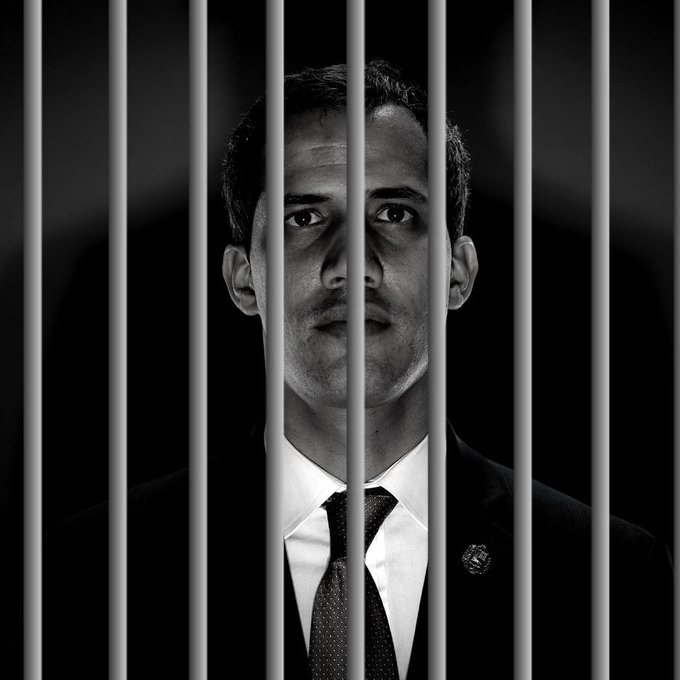
Should Guaidó be Arrested?
By Alberto Aranguibel | Venezuelanalysis | March 30, 2021
The clamor for [Juan] Guaidó’s arrest is becoming increasingly uncontainable: he has caused so much damage and suffering to the country with the criminal economic assault carried out by his fictitious government.
Venezuelans are correctly demanding that the law be applied to him to the fullest extent. They also compare his case to the large number of daily imprisonments, from petty criminals to important bosses of state-run companies involved in acts of corruption.
People demand an end to what is perceived as an unjustifiable example of impunity, with Guaidó’s continuing liberty perceived to be the result of government indifference or irresponsibility. It would not require more than a quick look at the people’s suffering as a result of the criminal blockade and economic attacks which he has promoted, as well as at his and his team’s looting of the nation’s assets abroad, to find enough evidence.
But this alleged indifference doesn’t exist.
As it turns out, politics today is little more than the artful and efficient management of communications despite the persistence of traditional political theses. That is why one can see a growing number of communicators and less traditional leaders taking to politics across the globe, using their ability to influence the masses with their discourse, ideas, and charisma.
Guaidó is simply an unsubstantial media product that did not need any particular trajectory, capacity, or talent for ideological debate, nor any attempt to build a popular struggle or an important social movement to take on the highest levels of the political establishment. What he did have was a complex network of national and international rightwing sectors, and he was backed by the most intense communications campaign carried out to fabricate a false leader.
Imprisoning him right now would mean participating in the construction of the media product, even increasing Guaidó’s scope by virtue of the headlines generated by such a move. It would also allow him to position himself as the victim of an oppressive and ruthless regime, an idea which the media laboratories of the most reactionary anti-Venezuela sectors have been pushing for some time.
This media manipulation is obviously an element that the architects of the assault on Venezuelan democracy need in order to complement their macabre plan.
To avoid making this mistake – which may cost the country not only its democracy but also the freedom and independence that people have built through so much hard work and sacrifice – the government must wait until Guaidó’s media profile starts to weaken (as is already happening). By waiting, any headlines generated by his arrest will be, at best, about a normal and ordinary application of justice.
This is as it must be, and, sooner rather than later, as it will probably end up being.
Alberto Aranguibel is a Venezuelan political analyst, blogger, and former member of the National Constituent Assembly (2017-2020). He is also a journalist who runs “Sin Tapujos,” a program on the state-run TV channel Venezolana de Televisión.
Translation by Paul Dobson for Venezuelanalysis.
Source: Soy Aranguibel
Warships & submarines entering zone of Nord Stream 2 pipeline in ‘planned & prepared provocations’ to obstruct work
By Jonny Tickle | RT | April 1, 2021
With the controversial Nord Stream 2 gas pipeline nearing completion and US sanctions against contractors failing to stop its construction, its operator has reported an increased “provocative” activity of warships in the area.
According to Moscow news agency TASS, Nord Stream 2 AG’s branch director, Andrey Minin, claimed that the last three months have seen a growth in military presence in the area.
“After the resumption of Nord Stream 2 offshore construction in January 2021, there has been an increase in activity of military ships, planes, and helicopters, as well as civilian ships of foreign countries, whose actions are often provocative in nature,” Minin said, noting that the presence of these vessels could damage the pipeline.
According to Minin, there is a 1.5-mile (2.4-km) safety zone around the site that boats not involved in the construction should not enter.
Nevertheless, foreign military ships are regularly seen nearby. He also noted that a Polish anti-submarine aircraft regularly circles the area at a low altitude.
Minin listed several incidents that occurred in the last few days, including an unidentified submarine passing just a mile away from the anchor of ‘Fortuna’, the pipe-laying ship. Recent weeks have also seen fishing vessels enter the work protection zone.
“We are talking about clearly planned and prepared provocations, both with the use of fishing vessels and warships, submarines and aircraft in order to obstruct the economic project,” he said. “This is perhaps the first and unprecedented case of its kind in history.”
Nord Stream 2 will connect Germany directly to Russia via the Baltic Sea. It aims to protect Berlin’s energy security and make it less reliant on third countries to transit gas, also lowering prices. Much of the European Union’s energy comes from Russia via Ukraine, and Kiev receives hefty fees for pipeline usage.
The project has been constantly opposed by Washington, which claims it is a threat to the energy security of Europe. In an attempt to stop its completion, the White House has imposed sanctions on companies involved in its construction. Thus far, 95% of the pipeline has been built.
Featured Video
Ted Postol: Fraud of Missile Defence Exposed in Iran War
or go to
Aletho News Archives – Video-Images
Frlom the Archives
Containing the United States
By Edward S. Herman | Z Magazine | September 2016
“Containing the United States” is, of course, a ridiculous and self-contradictory idea in the U.S. and Western ideological and propaganda system. We all know that the United States had to “contain” the Soviet Union from 1945 to 1991, and since then has had the task of containing Russia and China. Only they threaten, bully, aggress and worry countries like Poland and Vietnam. Obama has had to reassure them both of our steadfast stand against Russian and Chinese military attacks. NATO has, of course, expanded greatly over the past several decades, despite the deaths of the Soviet Union and Warsaw Pact, but only to contain the renewed Russian — and Iranian, Libyan, Syrian and other — military threats; and we have “pivoted” to Asia, supported Japanese rearmament, bolstered our own forces in that area and jousted with the Chinese in their coastal waters solely to contain China. Earlier we had been obliged to contain North Vietnam, or was it the Soviet Union in Vietnam? Or China? Or “communism”? Or maybe all of them? Or none of them, but just needing an excuse to enlarge power?
The parallel propaganda has taken many forms. One is accepting as a premise that the United States only acts defensively and has no internal forces and interests that drive it to enlarge its sphere of control. I noted in an earlier article how Paul Krugman claims that internal Russian problems may well be the explanation of Russian “aggression,” but how at the same time it never occurs to him that the huge U.S. transnational corporate interests and “defense” establishment, and the pro-Israel lobby’s activities, might possibly make for an expansionist dynamic here.2 This reflects the standard establishment perspective that we are good and only react to evil. This was the view sustaining and justifying the invasion and occupation of Iraq from 2003. That attack was taken here as not evil but a response to evil, even if involving lies and mistakes, hence not describable as “aggression.” … continue
Blog Roll
 Aletho News
- Corporate Media Go All Out To Support The US-Israeli War on Iran
- Trump press conference reveals a man who wants out of war
- When Tel Aviv decides, Washington fights
- Top official: Iran ready for a long war with US, no more diplomacy
- How Iran’s Toxic Rain Reveals US-Israel Discord
- Trump Admits He Is Destroying Iran For Israel
- Iran’s latest move in the GCC countries was a stroke of genius
- Blackmail and death threats, Zelensky embarrasses the EU, but there’s no condemnation
- Israel threatens to kill Iran’s new leadership
- Possible Scenarios for the Middle East
- If Americans Knew
- Lebanon: Israel’s White Phosphorous Use Risks Civilian Harm
- Corporate Media Go All Out To Support The US-Israeli War On Iran
- US-Israel war on Iran is creating a steady growing number of amputees
- Israel planned this war on Iran for 40 years. Everything else is a smoke screen
- The wrong question about the war in Iran
- ‘Your Tax Dollars Being Used to Raise Your Gas Prices’: US-Israel Bomb Major Iranian Oil Depots
- ‘Bogus Evidence’: Former Nuclear Watchdog Head Debunks US Justification for Iran War
- EXPLAINER – Dimona: What to know about Israel’s nuclear site
- Fires and toxic air in Iran (thanks, Israel) – Not a ceasefire Day 150
- At Israel’s hands, Iran is burning, Lebanon and Gaza are crumbling – Not a ceasefire Day 149
- No Tricks Zone
- Wake-up Call: Survey Shows Majority Of Germans Now Favor Postponing Climate Targets!
- Televised! Leading German Political Candidate Tells Schoolchildren CO2 Makes Sun Hotter!
- New Study: A Century Warming Of 1.1°C Is ‘Commonplace’ And ‘Not Unusual’ During This Interglacial
- New Study: ‘Internal Noise’ And Volcanic Forcing Can Trigger 10-15°C Warming Within Decades
- Glaciers Worldwide Are Suddendly Surging, Experts Blame Warming!
- Surprising Discovery: Sahara Is Greening…Billions Of Trees Where Once Thought To Be Barren
- New Research Reaffirms Clouds, Aerosols, And Surface Solar Radiation Are ‘Driving The Climate System’
- Germany: Electric Car Catches Fire At Charging Station, Sets Off Local “Inferno”, Widespread Damage
- New Study: Canada’s New Brunswick Was 1°C Warmer Than Today During The Medieval Warm Period
- Coal Power Back In Trend As Globe Tries To Keep Pace With Growing Demand For Power
 Aletho News