Study Links Pesticides To Childhood Central Nervous System Tumors

Waking Times | April 9, 2021
A new study adds to the evidence that pesticides harm children’s health.
The study, published in Environmental Research last week, found that children were more likely to develop central nervous system (CNS) tumors if their mothers had lived within 2.5 miles of land where pesticides were being sprayed when they were born.
“This study is the first, to our knowledge, to estimate effects for a large number of specific pesticides in relation to CNS tumor subtypes,” Julia Heck, a study coauthor and the associate dean for research at the University of North Texas College of Health and Public Service said, as NBC Los Angeles reported.
The research looked at the California Cancer Registry to identify cases of certain cancers in children under six years old, the study explained. They focused on mothers who lived in rural areas and gave birth between 1998 and 2011 to identify 667 cases of childhood central nervous system tumors and 123,158 controls.
They then compared these cases to data from the California Department of Pesticide Regulation’s (CDPR) Pesticide Use Reporting (PUR) system to identify whether chemicals classed as possible carcinogens by the U.S. Environmental Protection Agency (EPA) had been sprayed within 2.5 miles of the mothers’ homes at birth.
One important implication of the study is that the mothers did not have to be directly working in agriculture in order for their children to face dangerous exposure.
“California’s agricultural work force numbers more than 800,000, according to state estimates,” Dr. Christina Lombardi, study co-author and epidemiologist with the Samuel Oschin Comprehensive Cancer Institute at Cedars-Sinai Medical Center in Los Angeles, told Beyond Pesticides. “In addition to the negative health effects of pesticides on workers there are large numbers of pregnant women and young children living adjacent to treated fields who may experience detrimental health effects as well.”
This risk is exacerbated by the fact that farmland and residential land is not always clearly delineated in the state.
“This transition from farmland to residential neighborhoods is abrupt across California, and, of course, constantly changing as farmland is developed,” study co-author Myles Cockburn of the University of Southern California told Beyond Pesticides.
The researchers found that some of the chemicals they studied increased tumor risk as much as 2.5 times. Overall, exposure to the pesticides chlorthalonil, bromacil, thiophanate-methyl, triforine, kresoxim-methyl, propiconazole, dimethoate and linuron all increased tumor risk.
This is far from the first study to show that pesticide exposure is a danger to pregnant mothers and children. In fact, researchers have been studying the link between pesticides and childhood cancer since the 1970s, according to NBC Los Angeles.
The report authors called for government action to better protect mothers and children.
“Policy interventions to reduce pesticide exposure in individuals residing near agricultural fields should be considered to protect the health of children,” coauthor and UCLA’s Fielding School of Public Health epidemiology professor Beate Ritz told NBC Los Angeles.
FDA Says Stop the Johnson & Johnson Coronavirus Vaccine Shots
By Adam Dick | Ron Paul Institute | April 13, 2021
On Tuesday, the United States government’s Food and Drug Administration asked states to temporarily halt the giving of Johnson & Johnson’s experimental coronavirus vaccine shots, pointing to the developing of blood clots in people who have received the shots as the justification for halting.
For more information about the blood clots and other issues related to the Johnson & Johnson experimental vaccine, check out the Tuesday article “5 Reasons Johnson & Johnson Is Having A Very Bad Month” by Megan Redshaw at the Children’s Health Defense website.
One thing that is odd is that the Johnson & Johnson experimental vaccine shots have been subjected to this temporary halt, but shots of the experimental vaccines of Moderna and Pfizer-BioNTech have not. Many reports of injury and death after Moderna and Pfizer-BioNTech experimental vaccine shots, from the early days onward, have come in as well. Could the different regulatory outcomes be because the Moderna and Pfizer-BioNTech shots use mRNA technology and are not even vaccines under the normal meaning of the term while the Johnson & Johnson shot is more in line with the traditional vaccines approach? Are we seeing regulatory favoritism for the new mRNA shots?
Copyright © 2021 by RonPaul Institute
Israeli Supreme Court green lights Israel’s ‘Cyber Unit’ that works with social media giants to censor user content
Adalah Press Release | April 12, 2021
Court authorizes Cyber Unit to continue operating in the shadows, conducting quasi-judicial censorship without allowing social media users to defend their rights or even to know that the state has been involved in removing their online content.
The Israeli Supreme Court on Monday, 12 April 2021, rejected a petition filed by Adalah – The Legal Center for Arab Minority Rights in Israel and the Association for Civil Rights in Israel (ACRI) giving a green light to the continued operations of the Israeli state attorney’s office Cyber Unit and its “alternative enforcement” model of censoring social media content.
Israel’s Cyber Unit uses an “alternative enforcement” mechanism to essentially censor social media platforms and muzzle users: it flags and submits social media posts – without legal proceedings and often without even the knowledge of the individual user – to social media giants and requests their removal.
This Israeli state practice is aimed at clamping down on social media dissent, and frequently even results in the suspension or removal of users. This censorship is conducted in collaboration and coordination with social media outlets, including U.S.-based giants Facebook and Twitter.
Similar units operating in countries around the world are known as Internet Referral Units (IRUs).
Adalah attorneys Fady Khoury and Rabea Eghbariah had filed the petition against the Cyber Unit to the Israeli Supreme Court on 26 November 2019. They stressed that the Cyber Unit’s “alternative enforcement” mechanism violates the constitutional rights of freedom of expression and due process, and that the unit is operating without any legal authority.
Israeli Supreme Court Justice Hanan Melcer announced the decision on Monday morning in Jerusalem, in his final ruling before retirement.
In its decision, the court granted unchecked and unauthorized power to the Israeli state, allowing it to govern online speech by using informal channels with social media corporations. The court essentially privatized the judicial process, allowing private corporations to decide upon censorship of social media content based on ostensibly unbinding requests from Israeli state authorities.
Adalah Attorney Rabea Eghbariah commented immediately following the Israeli Supreme Court ruling:
“The Israeli Supreme Court has just authorized the state to continue to use its Cyber Unit to conduct quasi-judicial censorship proceedings in cooperation with private corporations, without allowing social media users to defend their rights or even to know that the state has been involved in removing their online content. Israel’s Cyber Unit has operated in the shadows of the law to censor tens of thousands of social media posts every year. The Supreme Court has now, to our regret, given Israel a blank check to continue with this practice.”
The Magic of Israel
Now you see it, now you don’t
BY PHILIP GIRALDI • UNZ REVIEW • APRIL 13, 2021
The popular narrative of plucky little Israel prevailing over hordes of bloodthirsty Arabs has captured the Western imagination even though it is manifestly false in almost every detail. But Israel’s greatest accomplishment might well be something else, it’s ability to make things disappear. It plausibly all began in June 1967 when Israel attacked the USS Liberty, a lightly armed but well identified US naval vessel cruising in international waters under a large American flag. Fighter bombers and torpedo boats sought to sink the ship, destroying the lifeboats so no one would escape. In the engagement, 34 American military personnel were killed and a further 171 wounded, before a heroic defense by the crew managed to save the vessel. President Lyndon Johnson, who said he would rather see the ship sink than embarrass his friend Israel, started a cover-up which has lasted to this day. There has been no legitimate court of inquiry into the attack and when the ship’s captain received a Medal of Honor for his heroism, it was awarded secretly in the Washington Navy Yard rather than openly at the White House. Israel and its legion of apologists certainly know how to make potential embarrassments disappear.
Last week on this site I posted an article that I thought would prove to be extremely interesting to those who have been expressing concern about foreign interference in our government. It included a link to a series of computer screen texts provided by a credible independent source demonstrating that an employee of the Israeli Consulate General was deeply involved in what appears to be extorting millions of dollars from the father of a congressman based on assisting that congressman through some legal difficulties. The scheme being concocted also included discussion of arrangements for a commando raid on Iran to free a prisoner. The information conveyed in the screenshots that were provided of the texts has not been disputed by anyone involved in the venture, but as I thought the accompanying article was timid in its willingness to draw any conclusions, I wrote my piece attempting to connect the dots.
The Congressman involved was, of course, Matt Gaetz of Florida, who is now facing the House Ethics Committee, surely an oxymoron if there ever was one, concerning his primarily sexual exploits. To my surprise, however, there has been hardly a word in the mainstream media about looking deeper into the possible Israeli connection. One would have thought the copied texts would be newsworthy due to the extortion angle but even more due to the fact that an armed attack on a nation with which the US is not at war was being funded and planned by a foreign government’s diplomatic mission in New York.
To be sure my article did very well both on Unz and even Facebook, though I had to cut and paste it in the latter site due to its blocking of Unz. I did a bit more checking and noted something that has been occurring for some time: the piece, like others relating to Israel, was not coming up on search engines like Google, which means it was not getting the exposure that it merited. I search daily by my name assuming that my pieces if replayed elsewhere will be displayed. In the past I would sometimes get scores of hits on a popular article, but during the past year hardly anything has been appearing. I have to assume that deliberate and widespread censorship of articles critical of Israel is taking place, which was no surprise as friends of Israel are not exactly rare in the social media. Facebook’s censorship board, for example, includes a former Israeli government minister.
It all comes down to the power of the Israeli/Jewish lobby and its ability to make things that it does not like go away. And sometimes it can make things happen that are manifestly not in the interest of the United States. Jonathan Pollard, the most damaging spy ever in the history of the United States, was recently allowed to return to Israel. In an interview on March 26th he said that any American Jews working for US intelligence agencies must do their duty and spy for Israel because one’s real loyalty is to the Jewish state and one’s co-religionists.
Clearly Pollard is not alone and it was shocking to learn that outgoing president Donald Trump pardoned the Israeli agent who recruited and presumably helped “run” Pollard when he was stealing US secrets. Aviem Sella received a full pardon from Trump as part of hundreds of last minute pardons, many of which had been arranged through two Orthodox Jewish agencies favored by presidential son-in-law Jared Kushner.
Sella was a retired Israeli air force officer doing graduate studies and living in the US when he enlisted Pollard to spy for Israel. He fled the country after Pollard was arrested in 1985 and was charged in absentia on three espionage counts but Israel refused to extradite him to the US to stand trial. A White House statement noted that Sella’s request for clemency received support from Israeli Prime Minister Benjamin Netanyahu, the Israeli ambassador in Washington Ron Dermer, the American ambassador to Israel David Friedman, and Miriam Adelson, the widow of the Republican Party’s top donor and Trump supporter Sheldon Adelson. Would anyone expect otherwise?
The Sella pardon should be seen for what it is. It was a gift to the corrupt Netanyahu, who was at the time facing another national election. It served no US national interest at all and in fact sent the message to those who might be tempted a la Pollard that spying for Israel might be regarded as consequence free, in fact desirable and the right thing to do. Of course, the special “exemption” when dealing with Israel should also be regarded as a tribute to Jewish power in the United States, which relies on the corruption of those in leadership positions, using financial inducements or even blackmail backed up by smears of anti-Semitism and holocaust denial for those who cannot be bought.
And the power to corrupt governments and media is not limited to the United States. Nearly everyone in public office or who relies on the media for an income understands one does not cross the Israel Lobby. In Britain, former Foreign Office Minister Sir Alan Duncan has written a memoir that accuses pro-Israel lobbyists of “the most disgusting interference” in British politics while also distorting the country’s foreign policy in the Middle East to favor the Jewish state.
Duncan also claimed that Conservative Friends of Israel (CFI) went “ballistic” and blocked him from becoming the Middle East minister at the Foreign Office. Duncan has long been a major target for the Israel lobby. In 2017, an Al Jazeera documentary exposed the maneuvering of pro-Israel groups working together with the Israeli Embassy in London to “take down” Duncan and also Labour Party leader Jeremy Corbyn.
Per Duncan, Conservative Friends of Israel, which openly promotes the interests of a foreign country, had successfully promoted a “Netanyahu-type view of Israeli politics into our foreign policy.” In one chapter Duncan criticized Conservative MPs’ fawning over Benjamin Netanyahu during his visit to Britain, a performance apparently similar to the time when Bibi addressed the US Congress and received 27 standing ovations.
The Duncan book appeared when another story broke about how a group called “UK Lawyers for Israel” acting on behalf of the Israeli government has been altering the material included in secondary school text books. Per a statement issued by Pearson, the largest publisher of school books in the UK, the company has suspended publication of two textbooks responding to “an eight-page report, by Middle East specialists Professors John Chalcraft and James Dickins, which found hundreds of changes to the textbooks overwhelmingly favoring an Israeli narrative and removing or replacing passages that support Palestinian narratives.”
Censorship of course materials as well as textbooks by Jewish groups to depict Israel in a certain way has certainly been going on in the United States for many years. And the corruption of our institutions to favor Israel and protect it from criticism is incessant. It will be interesting to see if the Gaetz story in all its aspects will ever be allowed to surface or whether the congressman will be offered some inducement to allow him to quietly resign. Somehow, it reminds one of the still unresolved Jeffrey Epstein case in which Epstein and his accomplice Ghislaine Maxwell obtained blackmail material relating to world leaders and celebrities having sex with young girls, somewhat similar to the claims regarding Gaetz.
Many including myself believe that Epstein was part of an Israeli intelligence operation, similar in scale to what was being run on 9/11, which sought to “influence” key figures on issues regarded as important by the Jewish state. Clearly, the game goes on with no one in Washington caring much about the damage being done. Do corrupted and intimidated Congressmen over their morning coffee ponder whether certain activities are “Good for Israel” and therefore not subject to further scrutiny? Judging from Epstein and Gaetz, one would have to believe that to be the case.
Philip M. Giraldi, Ph.D., is Executive Director of the Council for the National Interest, a 501(c)3 tax deductible educational foundation (Federal ID Number #52-1739023) that seeks a more interests-based U.S. foreign policy in the Middle East. Website is councilforthenationalinterest.org, address is P.O. Box 2157, Purcellville VA 20134 and its email is inform@cnionline.org
Iran Starts 60% Enrichment in Reaction to Natanz Sabotage
Mehr News Agency – April 13, 2021
Iran’s Deputy Foreign Minister for Political Affairs Sayyed Abbas Araqchi announced the beginning of 60% enrichment in the Natanz Enrichment Facility.
Araqchi who is in Vienna to participate in a new round of talks with the P4+1 and the EU representative within the framework of the JCPOA Joint Commission announced the start of 60% enrichment on Tuesday afternoon.
Iran has announced today in a letter to the Director-General of the International Atomic Energy Agency that it would begin 60% enrichment, he said.
Another 1,000 centrifuges with 50% more capacity will be added to the machines in Natanz, in addition to replacing the damaged ones, he added.
Earlier, after the recent sabotage of the Natanz enrichment facility, Iran’s permanent representative to Vienna-based international organizations Kazem Gharibabadi announced that a new generation of machines will be installed in Natanz and several other technical measures will be announced this week.
The spokesman for the Atomic Energy Organization of Iran (AEOI) Behrouz Kamalvandi said on Sunday that an incident took place in a part of the electricity distribution network of Shahid Ahmadi Roshan facility in Natanz.
Following the incident, AEOI Chief Ali-Akbar Salehi slammed the “act of sabotage”, noting that the international community, as well as the International Atomic Energy Agency (IAEA), must deal with such “nuclear terrorism” that targets Iran’s facilities.
CNN Raises Eyebrows After Using Images of Ukrainian Tanks While Bashing Russia’s ‘War Preparations’
By Andrei Dergalin – Sputnik – 13.04.2021
Russian Foreign Ministry spokeswoman Maria Zakharova has delivered a sharp rebuke to CNN after the media outlet used a picture of Ukrainian tanks to illustrate an article about Russia’s purported war preparations.
“Dear CNN TV channel and its staff. We realize that you have no time for fact-checking, since you’re so immersed in ideological struggle for the triumph of liberalism,” she wrote in a Facebook post. “But to present Ukrainian tanks at a Ukrainian train station, with Ukrainian train carriages in the background, as Russia’s preparations for war is a bit too much.”
She also snarkily suggested that perhaps CNN correspondents in Moscow should devote more time to their professional duties rather than focus on participating in public life in Russia.
The CNN’s article in question was related to Ukrainian President Volodymyr Zelensky’s recent visit to Donbass, and featured a video depicting Ukrainian tanks on train carriages while the narrator speaks about a “dramatic buildup of Russian forces near the Ukrainian border” and about the emergence of cellphone footage of “military hardware being transported by rail”.
The video fragment with the tanks appeared strikingly similar to a video that emerged on social media earlier this month, which a number of uploaders described as Ukrainian tanks being shipped to Donbass.
The situation in Ukraine’s restive eastern Donbass region has deteriorated in the past few weeks, with Donetsk and Lugansk regional authorities and militia forces reporting an escalation of shelling attacks, bombings and sniper fire by Ukrainian forces.
Meanwhile, the US blamed Russia for allegedly stoking tensions in the region, and threatened to to respond to Russian “aggression”.
The armed conflict in eastern Ukraine broke out in 2014, shortly after the triumph of the Euromaidan coup in Kiev, when residents of the Donbass region refused to submit to the new authorities.


Ukraine’s colors visible no less
State Lawmakers Attack Federal Misuse of National Guard
By Brian McGlinchey | Stark Realities | April 6, 2021
Fed up after years of relentless National Guard deployments in undeclared wars, state lawmakers across the country are pushing legislation that would prohibit the use of Guard units in combat zones without a formal declaration of war by Congress.
The bills are being promoted by BringOurTroopsHome.US, a self-described organization of “right-of-center” veterans working to end American involvement in “endless wars” and restore congressional authority over war-making. The libertarian 10th Amendment Center is also backing the cause.
The proposed laws would require governors to determine the constitutionality of orders that place Guard units on federal active duty; where they’re deemed unconstitutional, the governor is required to take action to prevent the unit from being surrendered to federal control and sent into harm’s way.
The first “Defend the Guard” bill was conceived and introduced by Air Force veteran and West Virginia state legislator Pat McGeehan. While no state has enacted the law yet, interest is spreading widely, with legislators now pushing the measure in 31 states.
Conservative Veterans Taking Point
BringOurTroopsHome.US is led by Dan McKnight, a 13-year veteran of the Marine Corps Reserve, active duty Army and Idaho Army National Guard whose military service ended after he was injured in Afghanistan.
McKnight and many other veterans leading the drive against the War on Terror are from the right side of the political spectrum. That’s a sharp contrast to the typical antiwar veteran of the Vietnam era, but McKnight says vets from both wars share a common experience.
Today’s veterans “are coming home and saying the same thing (Vietnam vets did): ‘What was the point of that? What was our mission? We have no mission, we have no definition of success, we have no clear path to victory, we have no idea what victory means and we’re there without a constitutional authority to send us there’,” he says.
“Every one of us raised our hands and swore an oath to the Constitution…and when it says Congress shall be the only body to declare war, we take that to heart. And when Congress doesn’t do it, we understand bad things can happen: long, endless foreign misadventures,” says McKnight.
In a 2019 Pew Research poll, 64% of veterans said the war in Iraq wasn’t worth fighting; 58% said the same of Afghanistan. A January Concerned Veterans for America/YouGov poll found two-thirds or more of veterans support full withdrawals from both countries.
“The right-of-center veterans are now echoing the message of left-of-center veterans, and it’s hard to ignore when veterans from the entire political spectrum are saying the same thing: Enough already—if you want us to go and bleed and die and spend our lives and your treasure in a foreign land, then Congress should put their name on the line before we put our boots on the ground,” McKnight says.
That’s what the Constitution demands. In an impassioned speech at the West Virginia legislature last month, McGeehan quoted James Madison: “The Constitution supposes what the history of all governments demonstrates, that the executive is the branch of power most interested in war and most prone to it. It has accordingly, with studied care, vested the question of war in the legislature.”
Deployments’ Steep Toll
The National Guard has played a major role in America’s post-9/11 militarism: As recently as December, more than 57,000 Guard members were deployed around the world.
The federal government’s reliance on the National Guard makes state legislatures an intriguing second front in the drive to curtail the War on Terror. “Defend the Guard” laws also give state lawmakers a rare chance to influence foreign policy—and to impose consequences for the executive branch’s usurpation of war powers.
The heavy reliance on the Guard takes a toll on soldiers, families, neighborhoods and states. The intense pace of National Guard deployments was underscored at a recent Defend the Guard hearing in South Dakota: While opposing “Defend the Guard,” the state adjutant general acknowledged that, during the entire Global War on Terrorism to date, the state has had all its troops home for just 42 days.
McKnight has friends who’ve done a staggering 12 or 13 overseas National Guard deployments. Beyond the risk to life and limb, and the hardships imposed on individuals, families and marriages, he says communities also pay a price.
Guard members “are police officers, tradesmen, mechanics, schoolteachers, attorneys. (When) they have to leave that job behind, it puts a burden on the community,” says McKnight. Upon their return, Guard members are generally guaranteed the option to reclaim their jobs—but that sometimes means displacing those who filled their positions while they were away, compounding the disruptive effect.
Deployments also prevent National Guard units from responding to crises at home—their primary reason for existing. For example:
- When Hurricane Katrina devastated New Orleans and the Gulf Coast of Louisiana and Mississippi in 2005, thousands of the states’ National Guard soldiers were deployed to Iraq. Mississippi’s 223rd Engineer Battalion returned to repair hurricane damage—but was ordered to leave its equipment in Iraq for use by other units.
- In 2020, as Oregon endured some of its worst wildfires ever, half the state’s National Guard helicopters were in Afghanistan, including all its CH-47 Chinooks—dual-rotor choppers capable of carrying 26,000-pound payloads and ideal for use in firefighting. The Oregon Guard did what it could with Blackhawk helicopters that have one tenth the lifting power.
The Empire Strikes Back
When Defend the Guard measures are introduced in state legislatures, the national security establishment and its allies emerge to defend the status quo—by hook or by crook.
In South Dakota, McKnight says, “the military-industrial complex…sent a two-star general to testify…and made all kinds of threats, and insinuated the state would lose their National Guard if they passed this bill, which is simply not true.”
Weeks ago, Republican Idaho Representative Joe Palmer, who chairs the state’s Transportation & Defense Committee, seemed to resort to underhanded tactics to kill a Defend the Guard bill.
He put the measure to an initial procedural vote in the committee, and declared it to have failed by voice vote. Video of the proceedings, however, shows the result of the voice vote to be unclear at best, and McKnight says his group’s post-vote polling of members suggests the measure would have advanced had Palmer taken a recorded vote.
If Palmer didn’t already know he should play fair with veterans who are trying to prevent fellow citizen-soldiers from dying in unconstitutional wars, he may be learning that lesson now: McKnight says his group facilitated an emergency meeting of the GOP committee in Palmer’s home town, which is now considering a resolution censuring Palmer for his conduct.
“If you want to play parliamentary tricks and the price of your tricks is the blood of my brothers and sisters who (deploy) over and over again, then we’re going to take some blood of our own, and we’re going to do that the way politicians understand, and that’s with voters in the primary and the general election,” says McKnight.
Sometimes, the establishment’s machinations are done away from cameras. In a 2015 interview, West Virginia’s McGeehan said he was summoned to a meeting in the Speaker’s office with the commander of the state National Guard. The general said he’d received a call from the Pentagon, threatening that, if Defend the Guard became law, West Virginia bases would find their way onto the list of installations targeted for closure.
Liz Cheney Intervenes to Thwart Wyoming Bill
McKnight says “the most offensive opposition that we’ve faced” came from U.S. Congresswoman Liz Cheney, daughter of former vice president Dick Cheney.
“When we pushed the Defend the Guard bill in Wyoming last year, she or her staff contacted members of the Wyoming legislature and said, ‘If this passes in Wyoming, I will personally see to it that two C-130 aircraft are stripped from Wyoming and sent to Texas’,” says McKnight, who was in Cheyenne to support the bill, along with U.S. Senator Rand Paul.
Bethany Baldes, Wyoming state director of BringOurTroopsHome.US, was also on hand. She too says lawmakers told her they received calls from Cheney’s office that included threats to send new C-130 cargo planes to Texas. (Cheney’s communications director has not replied to an invitation to comment on this story.)
The measure failed, 35-22. A statement signed by a group of Wyoming senators opposing the measure seemed to turn logic on its head by claiming the bill “calls into question Wyoming’s support for our soldiers and airmen in the National Guard.”
That episode was McKnight’s second jarring encounter with Cheney, whom he describes as a “warmonger heiress of a military-industrial fortune.” Months before, he and other veterans met with Cheney in Washington to urge her to support the withdrawal of U.S. forces from Afghanistan.
“We went into Liz Cheney’s office and we asked her, ‘What conditions must be met on the ground for you to support ending the war in Afghanistan and bringing our troops home?’ And she said, ‘I don’t think I could ever support that position’.”
Pressing the issue, the veterans asked Cheney how long troops should remain. “She looked us stone-faced in the eye and said, ‘Forever. American troops will be in Afghanistan forever’,” says McKnight. “That’s when we decided it was time to step away from the swamp and work in the states, and force the states to force Congress’s hand.”
The Military Origins of Facebook

Featured image: Mark Zuckerberg walks among attendees at a VR conference in Barcelona, Spain in 2016, Source: Mark Zuckerberg’s Facebook page
BY WHITNEY WEBB |
UNLIMITED HANGOUT| APRIL 12, 2021
In mid-February, Daniel Baker, a US veteran described by the media as “anti-Trump, anti-government, anti-white supremacists, and anti-police,” was charged by a Florida grand jury with two counts of “transmitting a communication in interstate commerce containing a threat to kidnap or injure.”
The communication in question had been posted by Baker on Facebook, where he had created an event page to organize an armed counter-rally to one planned by Donald Trump supporters at the Florida capital of Tallahassee on January 6. “If you are afraid to die fighting the enemy, then stay in bed and live. Call all of your friends and Rise Up!,” Baker had written on his Facebook event page.
Baker’s case is notable as it is one of the first “precrime” arrests based entirely on social media posts—the logical conclusion of the Trump administration’s, and now Biden administration’s, push to normalize arresting individuals for online posts to prevent violent acts before they can happen. From the increasing sophistication of US intelligence/military contractor Palantir’s predictive policing programs to the formal announcement of the Justice Department’s Disruption and Early Engagement Program in 2019 to Biden’s first budget, which contains $111 million for pursuing and managing “increasing domestic terrorism caseloads,” the steady advance toward a precrime-centered “war on domestic terror” has been notable under every post-9/11 presidential administration.
This new so-called war on domestic terror has actually resulted in many of these types of posts on Facebook. And, while Facebook has long sought to portray itself as a “town square” that allows people from across the world to connect, a deeper look into its apparently military origins and continual military connections reveals that the world’s largest social network was always intended to act as a surveillance tool to identify and target domestic dissent.
Part 1 of this two-part series on Facebook and the US national-security state explores the social media network’s origins and the timing and nature of its rise as it relates to a controversial military program that was shut down the same day that Facebook launched. The program, known as LifeLog, was one of several controversial post-9/11 surveillance programs pursued by the Pentagon’s Defense Advanced Research Projects Agency (DARPA) that threatened to destroy privacy and civil liberties in the United States while also seeking to harvest data for producing “humanized” artificial intelligence (AI).
As this report will show, Facebook is not the only Silicon Valley giant whose origins coincide closely with this same series of DARPA initiatives and whose current activities are providing both the engine and the fuel for a hi-tech war on domestic dissent.
DARPA’s Data Mining for “National Security” and to “Humanize” AI
In the aftermath of the September 11 attacks, DARPA, in close collaboration with the US intelligence community (specifically the CIA), began developing a “precrime” approach to combatting terrorism known as Total Information Awareness or TIA. The purpose of TIA was to develop an “all-seeing” military-surveillance apparatus. The official logic behind TIA was that invasive surveillance of the entire US population was necessary to prevent terrorist attacks, bioterrorism events, and even naturally occurring disease outbreaks.
The architect of TIA, and the man who led it during its relatively brief existence, was John Poindexter, best known for being Ronald Reagan’s National Security Advisor during the Iran-Contra affair and for being convicted of five felonies in relation to that scandal. A less well-known activity of Iran-Contra figures like Poindexter and Oliver North was their development of the Main Core database to be used in “continuity of government” protocols. Main Core was used to compile a list of US dissidents and “potential troublemakers” to be dealt with if the COG protocols were ever invoked. These protocols could be invoked for a variety of reasons, including widespread public opposition to a US military intervention abroad, widespread internal dissent, or a vaguely defined moment of “national crisis” or “time of panic.” Americans were not informed if their name was placed on the list, and a person could be added to the list for merely having attended a protest in the past, for failing to pay taxes, or for other, “often trivial,” behaviors deemed “unfriendly” by its architects in the Reagan administration.
In light of this, it was no exaggeration when New York Times columnist William Safire remarked that, with TIA, “Poindexter is now realizing his twenty-year dream: getting the ‘data-mining’ power to snoop on every public and private act of every American.”
The TIA program met with considerable citizen outrage after it was revealed to the public in early 2003. TIA’s critics included the American Civil Liberties Union, which claimed that the surveillance effort would “kill privacy in America” because “every aspect of our lives would be catalogued,” while several mainstream media outlets warned that TIA was “fighting terror by terrifying US citizens.” As a result of the pressure, DARPA changed the program’s name to Terrorist Information Awareness to make it sound less like a national-security panopticon and more like a program aiming specifically at terrorists in the post-9/11 era.
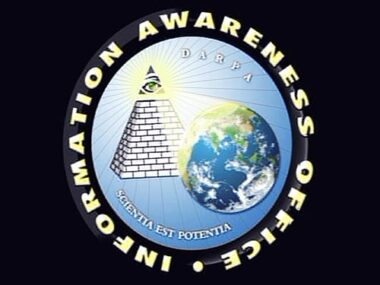
DARPA’s IOA, oversaw Total Information Awareness during its brief existence
The TIA projects were not actually closed down, however, with most moved to the classified portfolios of the Pentagon and US intelligence community. Some became intelligence funded and guided private-sector endeavors, such as Peter Thiel’s Palantir, while others resurfaced years later under the guise of combatting the COVID-19 crisis.
Soon after TIA was initiated, a similar DARPA program was taking shape under the direction of a close friend of Poindexter’s, DARPA program manager Douglas Gage. Gage’s project, LifeLog, sought to “build a database tracking a person’s entire existence” that included an individual’s relationships and communications (phone calls, mail, etc.), their media-consumption habits, their purchases, and much more in order to build a digital record of “everything an individual says, sees, or does.” LifeLog would then take this unstructured data and organize it into “discreet episodes” or snapshots while also “mapping out relationships, memories, events and experiences.”
LifeLog, per Gage and supporters of the program, would create a permanent and searchable electronic diary of a person’s entire life, which DARPA argued could be used to create next-generation “digital assistants” and offer users a “near-perfect digital memory.” Gage insisted, even after the program was shut down, that individuals would have had “complete control of their own data-collection efforts” as they could “decide when to turn the sensors on or off and decide who will share the data.” In the years since then, analogous promises of user control have been made by the tech giants of Silicon Valley, only to be broken repeatedly for profit and to feed the government’s domestic-surveillance apparatus.
The information that LifeLog gleaned from an individual’s every interaction with technology would be combined with information obtained from a GPS transmitter that tracked and documented the person’s location, audio-visual sensors that recorded what the person saw and said, as well as biomedical monitors that gauged the person’s health. Like TIA, LifeLog was promoted by DARPA as potentially supporting “medical research and the early detection of an emerging epidemic.”
Critics in mainstream media outlets and elsewhere were quick to point out that the program would inevitably be used to build profiles on dissidents as well as suspected terrorists. Combined with TIA’s surveillance of individuals at multiple levels, LifeLog went farther by “adding physical information (like how we feel) and media data (like what we read) to this transactional data.” One critic, Lee Tien of the Electronic Frontier Foundation, warned at the time that the programs that DARPA was pursuing, including LifeLog, “have obvious, easy paths to Homeland Security deployments.”
At the time, DARPA publicly insisted that LifeLog and TIA were not connected, despite their obvious parallels, and that LifeLog would not be used for “clandestine surveillance.” However, DARPA’s own documentation on LifeLog noted that the project “will be able . . . to infer the user’s routines, habits and relationships with other people, organizations, places and objects, and to exploit these patterns to ease its task,” which acknowledged its potential use as a tool of mass surveillance.
In addition to the ability to profile potential enemies of the state, LifeLog had another goal that was arguably more important to the national-security state and its academic partners—the “humanization” and advancement of artificial intelligence. In late 2002, just months prior to announcing the existence of LifeLog, DARPA released a strategy document detailing development of artificial intelligence by feeding it with massive floods of data from various sources.
The post-9/11 military-surveillance projects—LifeLog and TIA being only two of them—offered quantities of data that had previously been unthinkable to obtain and that could potentially hold the key to achieving the hypothesized “technological singularity.” The 2002 DARPA document even discusses DARPA’s effort to create a brain-machine interface that would feed human thoughts directly into machines to advance AI by keeping it constantly awash in freshly mined data.
One of the projects outlined by DARPA, the Cognitive Computing Initiative, sought to develop sophisticated artificial intelligence through the creation of an “enduring personalized cognitive assistant,” later termed the Perceptive Assistant that Learns, or PAL. PAL, from the very beginning was tied to LifeLog, which was originally intended to result in granting an AI “assistant” human-like decision-making and comprehension abilities by spinning masses of unstructured data into narrative format.
The would-be main researchers for the LifeLog project also reflect the program’s end goal of creating humanized AI. For instance, Howard Shrobe at the MIT Artificial Intelligence Laboratory and his team at the time were set to be intimately involved in LifeLog. Shrobe had previously worked for DARPA on the “evolutionary design of complex software” before becoming associate director of the AI Lab at MIT and has devoted his lengthy career to building “cognitive-style AI.” In the years after LifeLog was cancelled, he again worked for DARPA as well as on intelligence community–related AI research projects. In addition, the AI Lab at MIT was intimately connected with the 1980s corporation and DARPA contractor called Thinking Machines, which was founded by and/or employed many of the lab’s luminaries—including Danny Hillis, Marvin Minsky, and Eric Lander—and sought to build AI supercomputers capable of human-like thought. All three of these individuals were later revealed to be close associates of and/or sponsored by the intelligence-linked pedophile Jeffrey Epstein, who also generously donated to MIT as an institution and was a leading funder of and advocate for transhumanist-related scientific research.
Soon after the LifeLog program was shuttered, critics worried that, like TIA, it would continue under a different name. For example, Lee Tien of the Electronic Frontier Foundation told VICE at the time of LifeLog’s cancellation, “It would not surprise me to learn that the government continued to fund research that pushed this area forward without calling it LifeLog.”
Along with its critics, one of the would-be researchers working on LifeLog, MIT’s David Karger, was also certain that the DARPA project would continue in a repackaged form. He told Wired that “I am sure such research will continue to be funded under some other title . . . I can’t imagine DARPA ‘dropping out’ of a such a key research area.”
The answer to these speculations appears to lie with the company that launched the exact same day that LifeLog was shuttered by the Pentagon: Facebook.
Thiel Information Awareness
After considerable controversy and criticism, in late 2003, TIA was shut down and defunded by Congress, just months after it was launched. It was only later revealed that that TIA was never actually shut down, with its various programs having been covertly divided up among the web of military and intelligence agencies that make up the US national-security state. Some of it was privatized.
The same month that TIA was pressured to change its name after growing backlash, Peter Thiel incorporated Palantir, which was, incidentally, developing the core panopticon software that TIA had hoped to wield. Soon after Palantir’s incorporation in 2003, Richard Perle, a notorious neoconservative from the Reagan and Bush administrations and an architect of the Iraq War, called TIA’s Poindexter and said he wanted to introduce him to Thiel and his associate Alex Karp, now Palantir’s CEO. According to a report in New York magazine, Poindexter “was precisely the person” whom Thiel and Karp wanted to meet, mainly because “their new company was similar in ambition to what Poindexter had tried to create at the Pentagon,” that is, TIA. During that meeting, Thiel and Karp sought “to pick the brain of the man now widely viewed as the godfather of modern surveillance.”
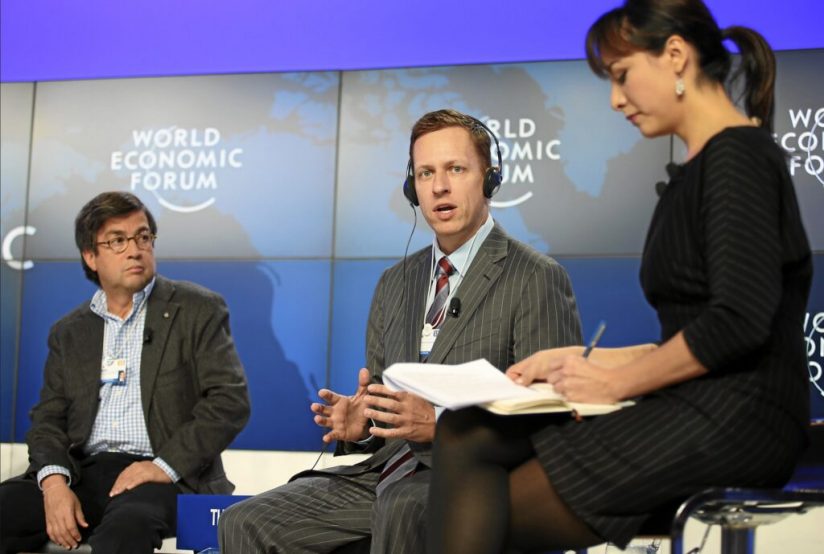
Peter Thiel speaks at the World Economic Forum in 2013, Source: Mirko Ries Courtesy for the World Economic Forum
Soon after Palantir’s incorporation, though the exact timing and details of the investment remain hidden from the public, the CIA’s In-Q-Tel became the company’s first backer, aside from Thiel himself, giving it an estimated $2 million. In-Q-Tel’s stake in Palantir would not be publicly reported until mid-2006.
The money was certainly useful. In addition, Alex Karp told the New York Times in October 2020, “the real value of the In-Q-Tel investment was that it gave Palantir access to the CIA analysts who were its intended clients.” A key figure in the making of In-Q-Tel investments during this period, including the investment in Palantir, was the CIA’s chief information officer, Alan Wade, who had been the intelligence community’s point man for Total Information Awareness. Wade had previously cofounded the post-9/11 Homeland Security software contractor Chiliad alongside Christine Maxwell, sister of Ghislaine Maxwell and daughter of Iran-Contra figure, intelligence operative, and media baron Robert Maxwell.
After the In-Q-Tel investment, the CIA would be Palantir’s only client until 2008. During that period, Palantir’s two top engineers—Aki Jain and Stephen Cohen—traveled to CIA headquarters at Langley, Virginia, every two weeks. Jain recalls making at least two hundred trips to CIA headquarters between 2005 and 2009. During those regular visits, CIA analysts “would test [Palantir’s software] out and offer feedback, and then Cohen and Jain would fly back to California to tweak it.” As with In-Q-Tel’s decision to invest in Palantir, the CIA’s chief information officer during this time remained one of TIA’s architects. Alan Wade played a key role in many of these meetings and subsequently in the “tweaking” of Palantir’s products.
Today, Palantir’s products are used for mass surveillance, predictive policing, and other disconcerting policies of the US national-security state. A telling example is Palantir’s sizable involvement in the new Health and Human Services–run wastewater surveillance program that is quietly spreading across the United States. As noted in a previous Unlimited Hangout report, that system is the resurrection of a TIA program called Biosurveillance. It is feeding all its data into the Palantir-managed and secretive HHS Protect data platform. The decision to turn controversial DARPA-led programs into a private ventures, however, was not limited to Thiel’s Palantir.
The Rise of Facebook
The shuttering of TIA at DARPA had an impact on several related programs, which were also dismantled in the wake of public outrage over DARPA’s post-9/11 programs. One of these programs was LifeLog. As news of the program spread through the media, many of the same vocal critics who had attacked TIA went after LifeLog with similar zeal, with Steven Aftergood of the Federation of American Scientists telling Wired at the time that “LifeLog has the potential to become something like ‘TIA cubed.’” LifeLog being viewed as something that would prove even worse than the recently cancelled TIA had a clear effect on DARPA, which had just seen both TIA and another related program cancelled after considerable backlash from the public and the press.
The firestorm of criticism of LifeLog took its program manager, Doug Gage, by surprise, and Gage has continued to assert that the program’s critics “completely mischaracterized” the goals and ambitions of the project. Despite Gage’s protests and those of LifeLog’s would-be researchers and other supporters, the project was publicly nixed on February 4, 2004. DARPA never provided an explanation for its quiet move to shutter LifeLog, with a spokesperson stating only that it was related to “a change in priorities” for the agency. On DARPA director Tony Tether’s decision to kill LifeLog, Gage later told VICE, “I think he had been burnt so badly with TIA that he didn’t want to deal with any further controversy with LifeLog. The death of LifeLog was collateral damage tied to the death of TIA.”
Fortuitously for those supporting the goals and ambitions of LifeLog, a company that turned out to be its private-sector analogue was born on the same day that LifeLog’s cancellation was announced. On February 4, 2004, what is now the world’s largest social network, Facebook, launched its website and quickly rose to the top of the social media roost, leaving other social media companies of the era in the dust.
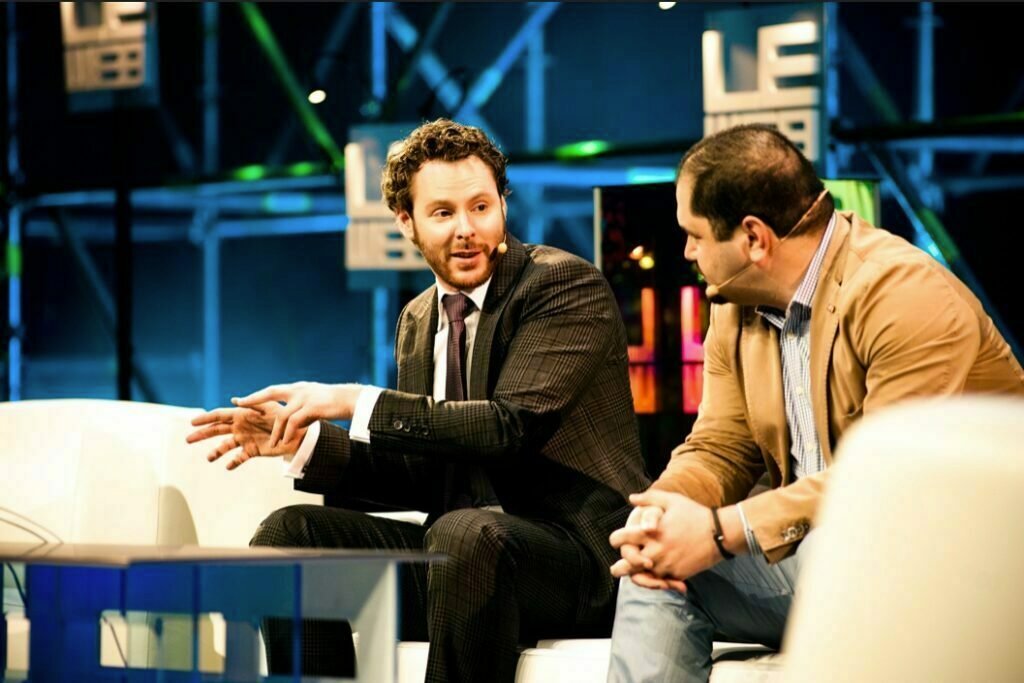
Sean Parker of Founders Fund speaks during the LeWeb conference in 2011, Source: @Kmeron for LeWeb11 @ Les Docks de Paris
A few months into Facebook’s launch, in June 2004, Facebook cofounders Mark Zuckerberg and Dustin Moskovitz brought Sean Parker onto Facebook’s executive team. Parker, previously known for cofounding Napster, later connected Facebook with its first outside investor, Peter Thiel. As discussed, Thiel, at that time, in coordination with the CIA, was actively trying to resurrect controversial DARPA programs that had been dismantled the previous year. Notably, Sean Parker, who became Facebook’s first president, also had a history with the CIA, which recruited him at the age of sixteen soon after he had been busted by the FBI for hacking corporate and military databases. Thanks to Parker, in September 2004, Thiel formally acquired $500,000 worth of Facebook shares and was added its board. Parker maintained close ties to Facebook as well as to Thiel, with Parker being hired as a managing partner of Thiel’s Founders Fund in 2006.
Thiel and Facebook cofounder Mosokvitz became involved outside of the social network long after Facebook’s rise to prominence, with Thiel’s Founder Fund becoming a significant investor in Moskovitz’s company Asana in 2012. Thiel’s longstanding symbiotic relationship with Facebook cofounders extends to his company Palantir, as the data that Facebook users make public invariably winds up in Palantir’s databases and helps drive the surveillance engine Palantir runs for a handful of US police departments, the military, and the intelligence community. In the case of the Facebook–Cambridge Analytica data scandal, Palantir was also involved in utilizing Facebook data to benefit the 2016 Donald Trump presidential campaign.
Today, as recent arrests such as that of Daniel Baker have indicated, Facebook data is slated to help power the coming “war on domestic terror,” given that information shared on the platform is being used in “precrime” capture of US citizens, domestically. In light of this, it is worth dwelling on the point that Thiel’s exertions to resurrect the main aspects of TIA as his own private company coincided with his becoming the first outside investor in what was essentially the analogue of another DARPA program deeply intertwined with TIA.
Facebook, a Front
Because of the coincidence that Facebook launched the same day that LifeLog was shut down, there has been recent speculation that Zuckerberg began and launched the project with Moskovitz, Saverin, and others through some sort of behind-the-scenes coordination with DARPA or another organ of the national-security state. While there is no direct evidence for this precise claim, the early involvement of Parker and Thiel in the project, particularly given the timing of Thiel’s other activities, reveals that the national-security state was involved in Facebook’s rise. It is debatable whether Facebook was intended from its inception to be a LifeLog analogue or if it happened to be the social media project that fit the bill after its launch. The latter seems more likely, especially considering that Thiel also invested in another early social media platform, Friendster.
An important point linking Facebook and LifeLog is the subsequent identification of Facebook with LifeLog by the latter’s DARPA architect himself. In 2015, Gage told VICE that “Facebook is the real face of pseudo-LifeLog at this point.” He tellingly added, “We have ended up providing the same kind of detailed personal information to advertisers and data brokers and without arousing the kind of opposition that LifeLog provoked.”
Users of Facebook and other large social media platforms have so far been content to allow these platforms to sell their private data so long as they publicly operate as private enterprises. Backlash only really emerged when such activities were publicly tied to the US government, and especially the US military, even though Facebook and other tech giants routinely share their users’ data with the national-security state. In practice, there is little difference between the public and private entities.
Edward Snowden, the NSA whistleblower, notably warned in 2019 that Facebook is just as untrustworthy as US intelligence, stating that “Facebook’s internal purpose, whether they state it publicly or not, is to compile perfect records of private lives to the maximum extent of their capability, and then exploit that for their own corporate enrichment. And damn the consequences.”
Snowden also stated in the same interview that “the more Google knows about you, the more Facebook knows about you, the more they are able . . . to create permanent records of private lives, the more influence and power they have over us.” This underscores how both Facebook and intelligence-linked Google have accomplished much of what LifeLog had aimed to do, but on a much larger scale than what DARPA had originally envisioned.
The reality is that most of the large Silicon Valley companies of today have been closely linked to the US national-security state establishment since their inception. Notable examples aside from Facebook and Palantir include Google and Oracle. Today these companies are more openly collaborating with the military-intelligence agencies that guided their development and/or provided early funding, as they are used to provide the data needed to fuel the newly announced war on domestic terror and its accompanying algorithms.
It is hardly a coincidence that someone like Peter Thiel, who built Palantir with the CIA and helped ensure Facebook’s rise, is also heavily involved in Big Data AI-driven “predictive policing” approaches to surveillance and law enforcement, both through Palantir and through his other investments. TIA, LifeLog, and related government and private programs and institutions launched after 9/11, were always intended to be used against the American public in a war against dissent. This was noted by their critics in 2003-4 and by those who have examined the origins of the “homeland security” pivot in the US and its connection to past CIA “counterterror” programs in Vietnam and Latin America.
Ultimately, the illusion of Facebook and related companies as being independent of the US national-security state has prevented a recognition of the reality of social media platforms and their long-intended, yet covert uses, which we are beginning to see move into the open following the events of January 6. Now, with billions of people conditioned to use Facebook and social media as part of their daily lives, the question becomes: If that illusion were to be irrevocably shattered today, would it make a difference to Facebook’s users? Or has the populace become so conditioned to surrendering their private data in exchange for dopamine-fueled social-validation loops that it no longer matters who ends up holding that data?
Part 2 of this series on Facebook will explore how the social media platform has grown into a behemoth that is much more extensive than what LifeLog’s program managers had originally envisioned. In concert with military contractors and former heads of DARPA, Facebook has spent the last several years doing two key things: (1) preparing to play a much larger role in surveillance and data mining than it currently does; and (2) advancing the development of a “humanized” AI, a major objective of LifeLog.
Whitney Webb has been a professional writer, researcher and journalist since 2016. She has written for several websites and, from 2017 to 2020, was a staff writer and senior investigative reporter for Mint Press News. She currently writes for The Last American Vagabond.
Brown University: The surveillance school
By JOHN WRENN | Brown Daily Herald | March 28, 2021
In the past several years, it has been fashionable to gawk in horror at China’s “social credit system,” an all-encompassing integration of surveillance, finance and state. Writing for The Triple Helix, Brown’s student publication focused on science and society, Priya Bhanot ’23 called China’s surveillance apparatus “Black Mirror Brought to Life.” China’s reputation for ubiquitous surveillance isn’t unjustified; a 2020 review of surveillance camera research by Comparitech found that of the world’s top 20 cities by cameras-per-capita, 18 are in China. But ubiquitous surveillance is far closer to home than Americans might think. As of 2020, Brown University has deployed one surveillance camera for approximately every 18 community members, placing it just shy of London, but ahead of every Chinese city except Taiyuan and Wuxi. In other words, Brown has about as many surveillance cameras as it does full-time faculty, of which it currently has 816!
It wasn’t always like this. In the span of two decades, Brown University quietly deployed an expansive surveillance apparatus, unbeknownst to many in the community; it’s well past time we critically examined our University’s pervasive surveillance of College Hill.
In 2000, the University only had 60 surveillance cameras, which the University mostly used to surveil parking lots and computer labs; a smattering watched Faunce’s club storage area, too. That year, Brown overhauled its fragmented VCR-based recording system into a fully-digital one, enabling Public Safety to monitor its cameras en masse from a central command center. This infrastructure investment marked a paradigm shift in Brown’s capacity for video surveillance.
By 2003, the total had increased to 105 cameras, with some now watching Faunce’s game room and the Main Green. According to The Chronicle, this proliferation of cameras into recreation spaces drew students’ first complaints about camera surveillance:
At Brown University, students have not complained about the cameras that watch over areas such as the basement of a student center. But students did object to a proposal to place cameras facing the main green of campus — to help manage crowds during commencement and other major events — says David Cardoza, card-access manager for the university’s security department.
Nevertheless, Brown continued to deploy new surveillance cameras in public spaces. By 2007, Brown had deployed 185 cameras, with 16 newly-installed cameras monitoring the Friedman Study Center in the Sciences Library. By 2011, Brown had deployed 250 cameras.
From here, the rate of installation increased drastically. In December 2013, the Campus Safety Task Force touted that Brown had deployed 430 cameras and a new array of 47 storage units for their footage. As of February 2020, the latest date for which data is publicly available, Brown University operates approximately 800 surveillance cameras. Following a spree of hateful graffiti in Hegeman Hall, the University installed its first cameras inside a dormitory. At the time of writing, the cameras remain installed.
This explosive proliferation of surveillance cameras at Brown University has progressed virtually unchecked and without community input. University Chief of Police Mark Porter suggested that the proliferation of cameras may reduce students’ fear of crime, but campus sentiment is considerably less enthusiastic about surveillance. In fall 2010, Herald editorial cartoonist Evan Donahue ’11 posted hoax letters in Keeney for a class project that announced the installation of security cameras around Keeney and Pembroke. Dylan Field ’13, a Residential Counselor in Keeney, told The Herald he was worried about the possibility of camera installation. Richard Bova, then-senior associate dean of Residential and Dining Services, categorically rejected the letter’s premise: “There has never been a plan — never will be a plan — to install cameras in any residence halls.” Of course, there eventually was such a plan.
Statements from DPS staff suggest a position of seemingly-limitless surveillance. “When you’re getting into the investigative side, you couldn’t have enough cameras,” said DPS Technical and Support Systems Manager David Cardoza to The Herald in 2008. Yet, in a 2011 interview with The Herald, Porter estimated that only about six crimes had been solved with the help of cameras. These solved crimes included the theft of a laptop from the Brown Bookstore and the truly shocking case of a thrown soda can in Faunce.
The successful use of cameras as an investigative aid in these incidents fails to justify the monetary expense of the camera system (exceeding $300,000 in 2000), much less the cost of students’ privacy. So what good are they? Speaking to The Herald in 2011, Porter instead emphasized the cameras’ purpose to deter, rather than aid in investigations: “We know that when we install them, that people will know they’re there.” This troubling justification invokes the specter of pre-crime — the almost-unfalsifiable presumption that there are agents on College Hill who would terrorize our community if not for the thin blue line of ubiquitous surveillance.
This justification warrants skepticism. A 40-year systemic review and meta-analysis published in 2019 found that passively monitored surveillance camera systems — like that adopted by Brown University — had no significant effect of crime reduction. Nor is it credible that “people will know” that cameras are there. Katie Goddard ’12 remarked to The Herald in 2011, “I haven’t noticed them”; neither had Daniel Valmas ’12, also interviewed by The Herald. Indeed, DPS makes no effort to draw attention to its surveillance cameras.
Rather, Brown University outright obscures the extent of its surveillance of College Hill. In 2008, the University declined to release its policy governing surveillance cameras to The Herald, or to provide a list of camera locations, or comment on how long recorded footage is archived for. The University’s surveillance policy, location of cameras and data retention practices remain completely opaque.
How can the Brown community engage in an informed discussion about surveillance if they are unaware of the scope of the surveillance? Until the University embraces transparency, the practice of “sousveillance” — the monitoring of people and institutions of authority by ordinary citizens — provides a means by which we students can educate ourselves and our peers. Since 2017, my friends and I have marked the locations of approximately 150 surveillance cameras on College Hill. While this is only a fraction of Brown University’s more than 800 cameras, the scope of the surveillance is staggering: It is impossible to cross (or even approach) Brown University without being surveilled. I encourage you to try.
John Wrenn MS’18 PhD’21 is a fifth-year doctoral candidate. He can be contacted at me@jswrenn.com, where he would be delighted to instruct you in the sousveillance of Brown University. Please send responses to this opinion to letters@browndailyherald.com and op-eds to opinions@browndailyherald.com.


 Aletho News