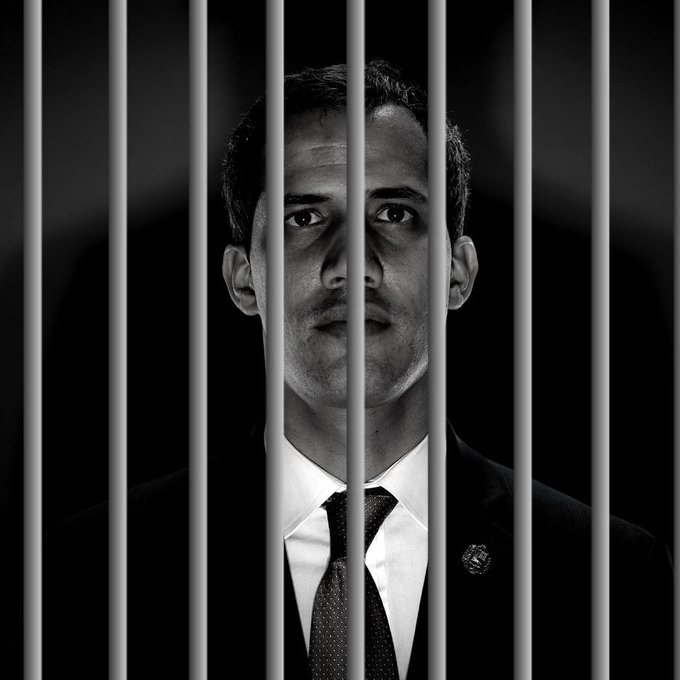
Should Guaidó be Arrested?
By Alberto Aranguibel | Venezuelanalysis | March 30, 2021
The clamor for [Juan] Guaidó’s arrest is becoming increasingly uncontainable: he has caused so much damage and suffering to the country with the criminal economic assault carried out by his fictitious government.
Venezuelans are correctly demanding that the law be applied to him to the fullest extent. They also compare his case to the large number of daily imprisonments, from petty criminals to important bosses of state-run companies involved in acts of corruption.
People demand an end to what is perceived as an unjustifiable example of impunity, with Guaidó’s continuing liberty perceived to be the result of government indifference or irresponsibility. It would not require more than a quick look at the people’s suffering as a result of the criminal blockade and economic attacks which he has promoted, as well as at his and his team’s looting of the nation’s assets abroad, to find enough evidence.
But this alleged indifference doesn’t exist.
As it turns out, politics today is little more than the artful and efficient management of communications despite the persistence of traditional political theses. That is why one can see a growing number of communicators and less traditional leaders taking to politics across the globe, using their ability to influence the masses with their discourse, ideas, and charisma.
Guaidó is simply an unsubstantial media product that did not need any particular trajectory, capacity, or talent for ideological debate, nor any attempt to build a popular struggle or an important social movement to take on the highest levels of the political establishment. What he did have was a complex network of national and international rightwing sectors, and he was backed by the most intense communications campaign carried out to fabricate a false leader.
Imprisoning him right now would mean participating in the construction of the media product, even increasing Guaidó’s scope by virtue of the headlines generated by such a move. It would also allow him to position himself as the victim of an oppressive and ruthless regime, an idea which the media laboratories of the most reactionary anti-Venezuela sectors have been pushing for some time.
This media manipulation is obviously an element that the architects of the assault on Venezuelan democracy need in order to complement their macabre plan.
To avoid making this mistake – which may cost the country not only its democracy but also the freedom and independence that people have built through so much hard work and sacrifice – the government must wait until Guaidó’s media profile starts to weaken (as is already happening). By waiting, any headlines generated by his arrest will be, at best, about a normal and ordinary application of justice.
This is as it must be, and, sooner rather than later, as it will probably end up being.
Alberto Aranguibel is a Venezuelan political analyst, blogger, and former member of the National Constituent Assembly (2017-2020). He is also a journalist who runs “Sin Tapujos,” a program on the state-run TV channel Venezolana de Televisión.
Translation by Paul Dobson for Venezuelanalysis.
Source: Soy Aranguibel
Warships & submarines entering zone of Nord Stream 2 pipeline in ‘planned & prepared provocations’ to obstruct work
By Jonny Tickle | RT | April 1, 2021
With the controversial Nord Stream 2 gas pipeline nearing completion and US sanctions against contractors failing to stop its construction, its operator has reported an increased “provocative” activity of warships in the area.
According to Moscow news agency TASS, Nord Stream 2 AG’s branch director, Andrey Minin, claimed that the last three months have seen a growth in military presence in the area.
“After the resumption of Nord Stream 2 offshore construction in January 2021, there has been an increase in activity of military ships, planes, and helicopters, as well as civilian ships of foreign countries, whose actions are often provocative in nature,” Minin said, noting that the presence of these vessels could damage the pipeline.
According to Minin, there is a 1.5-mile (2.4-km) safety zone around the site that boats not involved in the construction should not enter.
Nevertheless, foreign military ships are regularly seen nearby. He also noted that a Polish anti-submarine aircraft regularly circles the area at a low altitude.
Minin listed several incidents that occurred in the last few days, including an unidentified submarine passing just a mile away from the anchor of ‘Fortuna’, the pipe-laying ship. Recent weeks have also seen fishing vessels enter the work protection zone.
“We are talking about clearly planned and prepared provocations, both with the use of fishing vessels and warships, submarines and aircraft in order to obstruct the economic project,” he said. “This is perhaps the first and unprecedented case of its kind in history.”
Nord Stream 2 will connect Germany directly to Russia via the Baltic Sea. It aims to protect Berlin’s energy security and make it less reliant on third countries to transit gas, also lowering prices. Much of the European Union’s energy comes from Russia via Ukraine, and Kiev receives hefty fees for pipeline usage.
The project has been constantly opposed by Washington, which claims it is a threat to the energy security of Europe. In an attempt to stop its completion, the White House has imposed sanctions on companies involved in its construction. Thus far, 95% of the pipeline has been built.
Featured Video
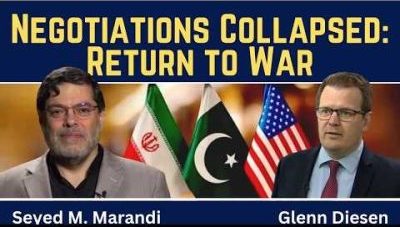
Seyed M. Marandi: Negotiations Collapsed – Return to War
or go to
Aletho News Archives – Video-Images
From the Archives
The US-Iran Scenario That Most Scares Israel
By Ali Haydar | Al-Akhbar | October 9, 2013
Israeli Prime Minister Benjamin Netanyahu issued a series of threats toward Iran and its interlocutors in the West, including the US, as serious negotiations on Iran’s nuclear program seem more plausible.
As a possible rapprochement looms between the US and Iran, Netanyahu has attempted to impose impossible Israeli conditions on the negotiators, such as the full dismantling of Iran’s nuclear program, not to mention threatening military force.
Whatever the deal that could materialize between Iran and the West, Israel is going to find itself before an open-ended path. One can foresee three possible scenarios… continue
Blog Roll
 Aletho News
- Seyed M. Marandi: Negotiations Collapsed – Return to War
- Tomorrow’s naval blockade showdown
- ‘Israel’ attacks civilians to hide its embarrassing military failures & out of pure sadism
- Any Foreign Military Vessel Approaching Hormuz Under Any Pretext ‘Will Be Dealt With Severely’: IRGC
- Diplomats slam US negotiators’ performance in Iran talks
- Trump Refuses Exit Ramp, War with Iran will Continue
- Trump Says US Naval Blockade in Strait of Hormuz Will Begin Shortly
- US, Iran end 21-hour talks without agreement
- US IRAN TALKS: Who Are the Crazy Ones Here? /Lt Col Daniel Davis
- Talks with the US end without a deal over excessive US demands: Iran
- If Americans Knew
- US-Iran ceasefire negotiations make zero progress – Daily Update
- Pro-Israel ‘Thinktanks’ and Individuals who Influence U.S. Foreign Policy
- Mearsheimer reveals how Israel dictates US policies on Iran, Gaza – video
- After killing 350+, Israel still has a “score to settle” with Lebanon before ceasefire – Daily Update
- Military aid to Israel emerges as the latest political litmus test for Democrats
- The only Palestinian children’s rights organization closes following years-long Israeli campaign against it
- ‘I Can’t Forget the Smell’: Lebanese Reel After Israel Kills Over 300 in Single Day
- DNC Shoots Down Resolutions Calling Out AIPAC and Limiting Arms to Israel
- TCN: Is Israel Blackmailing President Trump?
- Israel killed at least 303 Lebanese yesterday – who were they? Daily Update
- No Tricks Zone
- Cave Discovery Reveals Today’s Desert Climates Were Recently Far Warmer, Wetter, Teeming With Life
- German Expert: Heat Dome Led To Record Temps In Western USA…Warmer In 1934, 1936
- New Study: No Linear Warming Or Glacier Retreat Along Northern Antarctic Peninsula Since 1980s
- An Inconvenient Tree: Uncovered In Alps… Europe Much Warmer Than Today 6000 Years Ago
- New Study Reports A 60% Slowdown In Greenland’s Ice Loss Rate In The Last Decade
- Low Intensity Tornado Wrecks Major Solar Farm, Creating A Potential Toxic Dump
- New Study Finds Warming Saves Lives…Cold Temperatures 12 Times More Deadly Than Excess Heat
- German Science Blog Accuses PIK Climate Institute Of Hallucinating Climate Tipping Points
- Devastating Assessment Of Comirnaty Vaccine By Former Senior Pfizer Europe Toxicologist
- New Study: CO2 Is ‘Effectively Negligible’ As An Explanatory Climate Change Factor Since 2000
 Aletho News