Direct Flight from Saudi Arabia Lands in Zionist Entity Monday Evening: Report

Al-Manar | October 25, 2021
A direct flight from Riyadh, Saudi Arabia will land at Zionist entity’s Ben Gurion Airport on Monday evening, Israeli media reported.
“The flight will be a VIP class Boeing 737-700 aircraft with registration A6-AIN owned by the Emirati Royal Jet airline,” Kan pubcaster said.
The Riyadh-Tel Aviv flight comes after a report that White House National Security Adviser Jake Sullivan raised the possibility of Saudi Arabia joining the so-called Abraham Accords during a meeting last month in Riyadh with Saudi Crown Prince Mohammed bin Salman (MBS), according to three US and Arab sources involved in the talks.
The sources said that during the conversation, MBS did not immediately reject the proposal to establish diplomatic ties with the Zionist entity, listing the steps needed to make the move, including improving the relations between the United States and Saudi Arabia.
Will Biden Start Nuclear War with China Over Taiwan?
By Ron Paul | October 25, 2021
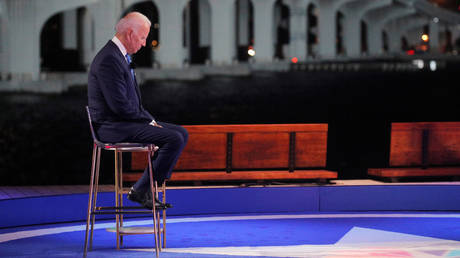
President Biden’s “townhall” meeting this past week was a disaster. From his bizarre poses to the incoherent answers, it seemed to confirm America’s worst fears about a president we are told was elected by the most voters ever. Though he didn’t bother campaigning, we are to believe he somehow motivated the most voters in history to pull the lever in his favor. Or mail in a ballot in his favor. Or something.
After the townhall, the Wall Street Journal was early among mainstream media publications to observe that the emperor has no clothes. In an editorial titled “The Confusing Mr. Biden,” the paper wrote, “Even with a friendly audience and softball questions, Mr. Biden’s performance revealed why so many Americans are losing confidence in his Presidency.”
The Journal focused on one of the most shocking and disturbing revelations from the carefully crafted event: asked by CNN’s Anderson Cooper if the United States would come to the defense of Taiwan should it come under attack by the Chinese mainland, he replied, “Yes, we have a commitment to do that.”
Anderson threw him another softball in hopes he might correct this dangerous misstatement, but Biden was not nimble enough to see his gaffe. He doubled down.
It was left to the “Chemical Ali” of this Administration, White House Spokesman Jen Psaki, to “clarify” that when the President signaled a major shift in US policy – a shift that could well lead to nuclear war with China – he was just kidding. Or something.
Said Psaki the next day: “Well, there has been no shift. The President was not announcing any change in our policy nor has he made a decision to change our policy. There is no change in our policy.”
In other words: “Pay no attention to the man who pretends to be the Commander in Chief of the Armed Forces of the United States.”
But this is not George W. Bush, who was elected in 2000 with zero experience in foreign policy. This is not Trump, who campaigned on a policy of peace then hired John Bolton to carry out that policy.
No, Biden has twice been Chairman of the Senate Foreign Relations Committee. Foreign policy has always been considered his one area of competence. Surely the Biden of even the Obama Administration would have understood the potentially catastrophic implications of his statement.
Strategic ambiguity has been US policy toward Taiwan/China for decades, but the new Biden China policy could be re-named “strategic incoherence.”
The policy of “strategic ambiguity” is foolish enough – who cares who rules Taiwan? – but advancing the idea that the United States is willing to launch a nuclear war with China over who governs Taiwan is a whole other level of America-last foolishness.
Chairman of the Joint Chiefs of Staff Gen. Miley was heralded as a hero for betraying his Commander in Chief Trump by seeking to restrict Trump’s access to the US nuclear arsenal. Milley claimed that Trump was so unsound of mind that he could not be trusted with the nuclear football.
Yet when actual unsoundness is there for everyone to see, Milley and the other “woke” generals are silent as the grave. These are dangerous times.
Copyright © 2021 by RonPaul Institute.
European gas crisis: Ukrainian opposition leader slams Zelensky for delaying offer to Russia of extra pipeline transit capacity
By Jonny Tickle | RT | October 25, 2021
Against the background of a European gas crisis, Ukrainian President Volodymyr Zelensky’s decision to give Russia extra transit capacity at a discounted rate is the correct choice, but Kiev took far too long to make the offer.
That’s according to Viktor Medvedchuk, chairman of the Political Council of Opposition Platform – For Life, the country’s largest opposition party. He is currently under house arrest, after being accused by the authorities of high treason and “aiding terrorism.” The politician says the criminal charges against him are trumped-up.
In an interview posted on his faction’s website, Medvedchuk agreed that Zelensky’s belated offer to increase the amount of gas running through the country’s pipes is the right thing to do. The president’s offer was extended not only to Russia but all countries wishing to use Ukraine’s infrastructure.
“It is very good, I think, that finally President Zelensky and his entourage have understood that our pipelines have enormous opportunities,” Medvedchuk said. “The proposal to increase the pumping through our pipelines by 50% is absolutely correct.”
On Sunday, the state-run Ukrainian gas company Naftogaz revealed that the company is ready to provide additional transit of up to 55 billion cubic meters of gas per year at a 50% discount, which would significantly reduce the cost for Russia. Moscow currently pays billions of dollars in fees to Kiev for transiting natural gas through Ukraine.
The lower offer comes as Naftogaz seeks to compete with the Nord Stream 2 gas pipeline. The controversial project was completed last month but is not yet operational. It directly connects Germany to Russia via the Baltic Sea, allowing Moscow to send gas without transiting other countries.
As Nord Stream 2 is already complete, Zelensky’s proposal is now long overdue, Medvedchuk believes.
“Today, Russia seems to be interested in launching Nord Stream 2 and not in increasing the amount of gas pumping through Ukraine’s transportation system,” the opposition leader said. “But we must come to an agreement, and we must make an offer. We must look for common opportunities for the development of trade and economic relations.”
Climate Change Activists Pushing Establishment Narrative Wonder Why They’re Not in Prison
By Paul Joseph Watson | Summit News | October 25, 2021
Climate change activists from ‘Extinction Rebellion’ who are actually furthering the establishment narrative on climate change expressed shock that they weren’t in prison despite repeatedly blocking major roads and causing accidents.
Gee, I wonder.
61 campaigners from Insulate Britain, an offshoot of Extinction Rebellion, blocked three major roads in London yet again today and again faced angry condemnation from the general public.
They plan to continue the action ahead of the upcoming Cop26 climate change summit in Scotland, at which world leaders will gather to push the very same alarmist global warming rhetoric that they amplify.
Activists expressed shock that the government and the police have allowed them to get away with causing chaos for the past two months, including serious traffic accidents.
“Climate protest group Insulate Britain has revealed its “absolute disbelief” that its members have been allowed to repeatedly disrupt the motorway network, saying it had originally expected its campaign of direct action to last just two days,” reports the Guardian.
“As the group prepares for a fresh wave of protests this week, organisers admit they are baffled over why the police have effectively allowed them to keep closing major routes.”
A spokesperson for the group said, “We assumed that we would not be allowed to carry on disrupting the motorway network to the extent that we have been. We thought that people would basically be in prison.”
Activists previously thanked police for treating them kindly, in contrast to anti-lockdown protesters who are routinely abused by riot cops.
The answer as to why the protesters have faced kid gloves treatment is blatantly obvious.
Far from representing a “rebellion,” their actions are exactly in line with what establishment technocrats want – a global energy lockdown and a drastic reduction in living standards based on the hysteria of man-made climate change.
Insulate Britain protesters are lobbying for the precise system that is already being unrolled, they just want the government to make it even more onerous even more quickly.
The group is actually moving Britain closer to precisely what the establishment wants – a ‘green economy’ that will cause economic devastation, food shortages, energy rationing and climate lockdowns.
Just as police officers genuflected and fawned over Black Lives Matter rioters last summer, eco-activists are protected by the establishment because they are shock troops acting on behalf of the establishment.
Melbourne decides the Australian Open Tennis is more important than the shots, when the star and 35% of players refuse to submit
By Meryl Nass, MD | October 25, 2021
- Leaky vaccines, leaky tests, leaky case definitions.
- Ridiculous anti-science refusals to acknowledge the much stronger, more long-lasting and reliable immunity that comes from having had the disease.
- Politicians who want to destroy economies and families before they admit they were so very wrong about everything.
- Public health officials who use viral segments like lego pieces to create new and ever more virulent pathogens–then lie repeatedly about it, build elaborate coverups, and increase their salary by 68% because they have taken on “biodefense work” to save the population.
And now, to save the Australian Open (goodness knows how much the Ozzies make from TV rights alone, plus all the tourism this huge tennis event engenders) they have tossed the most egregious BS overboard.
Are you a tennis star?
Then come in to our country. Forget the vaccine and the passport. Please play.
CA STUDENTS WALK OUT OVER VACCINE MANDATE
The Highwire with Del Bigtree | October 22, 2021
Thousands of California Parents pulled their children from schools across the state Monday, as part of a massive protest against Covid vaccine mandates.
Recovered immunity is weak “Because science”/CDC
By Meryl Nass, MD | October 24, 2021
“Because science” is new slang terminology that refers to bogus explanations or justifications for why things are done a certain way during the pandemic.
I have come to love the term because it encapsulates the contempt for the public evidenced by officials who usually know little about science but regurgitate “the science” to justify some unjustifiable policy.
Aaron Siri, a wonderful attorney, has challenged US health agencies on many of their illogical and often illegal pandemic policies.
He just posted the exchange he has had with CDC over its refusal to acknowledge the presence of immunity to COVID in the recovered.
While the whole document is interesting, the very end contains some of CDC’s “because science” answers.
Let me explain what CDC has been doing over the past year: whenever there is strong evidence that shows a CDC claim or policy is dead wrong, CDC’s “scientists” conduct a bogus study which can involve cherrypicking endpoints, choosing specially selected time periods, and a variety of other shenanigans to produce “evdience” that calls into question the real science. They have done this with masks, lockdowns, recovered immunity, and vaccines for children, that I can recall off the bat. I worked with a group of scientists who tried to reproduce the CDC’s calculations. But we couldn’t, because even though the CDC “scientists” were friendly and seemingly open, they never would provide enough information on their data set and their algorithm(s) for us to check their work. Clearly that was CDC policy, even though it flies in the face of standard ICMJE medical publication standards.
And that is what they did in this case. Despite mountains of evidence regarding the strength of recovered immunity, CDC just cited its own bogus study, while leaving the door open in case “the science” changed in the future. Where is the shame?
And, the agencies don’t mind dragging litigation on forever, since it is your money that is paying for it.
Taxi driver freed from Guantanamo Bay after 17 years of brutal torture with no charges
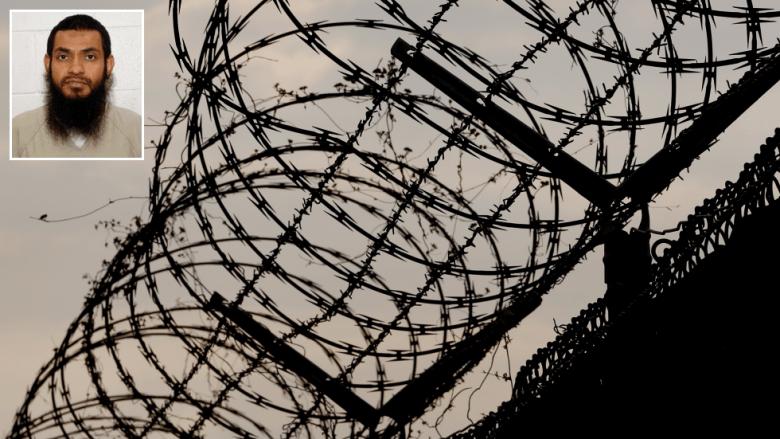
FILE PHOTO. © Reuters / Lucas Jackson; (inset) An official Guantanamo Bay photograph of Ahmed Rabbani. © US Department of Defense
RT | October 24, 2021
A Pakistani taxi driver will leave US detention at Guantanamo Bay after 17 years behind bars. Mistaken for a wanted terrorist, the man suffered horrific torture in American custody, despite never being charged with any crime.
Ahmed Rabbani’s release was announced on Friday by Reprieve, a human rights NGO. Rabbani had been unanimously cleared for release by the prison’s Periodic Review Board, made up of senior officials from six US agencies, including the State Department and Department of Homeland Security.
Rabbani’s journey through the underbelly of the US’ post-9/11 security infrastructure began in Karachi, Pakistan, in 2002. Mistaken for wanted terrorist Hassan Ghul, the taxi driver was arrested by Pakistani authorities outside Ghul’s apartment complex and sold to American personnel in the country.
Information gleaned from an associate of Rabbani arrested on the same day was used to arrest several suspected Al-Qaeda operatives, including a supposed member of Osama Bin Laden’s security detail. However, Rabbani was never charged with any crime, and is not believed to be involved in terrorism.
Nevertheless, he spent more than 545 days after his arrest being tortured in a CIA ‘black site’ in Afghanistan. The torture inflicted there on Rabbani was detailed in the US Senate’s 2014 torture report, and included long periods of being shackled with his hands outstretched over his head, an agonizing position that led Rabbani to try to cut off his own hand to end the pain.
Testimony from multiple detainees held in the same CIA prison describes permanent darkness, cells flooded with excrement and infested with vermin, beatings, sleep deprivation, being buried in simulated graves, being stripped naked and doused with cold water, and being denied bathing facilities for months on end.
According to Reprieve, Rabbani’s interrogators knew that “they had the wrong man,” but tortured him anyway. After more than a year in the CIA facility, Rabbani was transferred to the Guantanamo Bay detention camp on US territory in Cuba. He would spend the next 17 years there, without a charge or trial date.
His case attracted international attention, and in 2018, Rabbani wrote an op-ed published in the Los Angeles Times describing physical and sexual abuse by guards, force-feeding, and repeated hunger strikes to protest the conditions of his imprisonment. At the time of the op-ed, Rabbani said that he was suffering from “stomach problems so acute that I cannot consume hard food without vomiting blood,” and was being denied digestible food.
Conditions in Guantanamo chipped away at Rabbani’s mental health. “There is no morning and no evening,” he wrote. “There is only despair.”
“Ahmed’s clearance is long overdue,” said Reprieve attorney Mark Maher. “For those of us who have supported him, the feeling is one of relief, tempered with sadness for all he has lost… but we won’t celebrate until he is back with his family in Pakistan and able to hug his 19-year-old son for the first time.”
Of the 780 people detained in Guantanamo Bay since the facility opened in 2002, 732 have been transferred elsewhere or released, 38 remain there, and nine have died in custody. President Joe Biden has promised to close the notorious prison before he leaves office, a promise that was made, but not kept, by his former boss Barack Obama.
Biden has pledged that ‘America is back.’ But as peace shatters in the Balkans, does that mean yet more US misadventures?
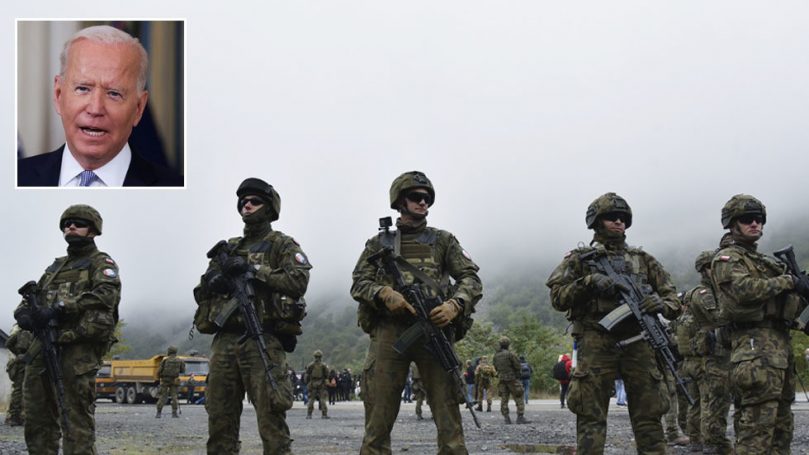
KFOR forces patrol near the border crossing between Kosovo and Serbia in Jarinje, Kosovo, October 2, 2021. © REUTERS / Laura Hasani; Inset © REUTERS / Evelyn Hockstein
By Julian Fisher | RT | October 24, 2021
With warnings that fresh tensions between Serbia and Kosovo could unravel the decades-old peace deal that put an end to bloody fighting in the Balkans after the breakup of Yugoslavia, the US is increasingly split on what to do.
Earlier this month, the SOHO forum in New York City hosted a debate between Scott Horton, long-time libertarian and anti-war radio host, and Bill Kristol, the neoconservative thinker and one of the ideological architects of America’s post-9/11 world order. The subject of the debate was US interventionism, its merits and historical record.
Predictably, Kristol offered vague niceties that attempt to recast America’s legacy as that of the “benevolent global hegemony”, a term which he himself coined in 1996 when describing the country’s role in the world. Reflecting on the wars in Iraq, Kristol simultaneously said that America “didn’t push democracy enough” and also “may have been too ambitious.” In short, he acknowledged mistakes were made, which is an admission that would have been unthinkable only a few years ago, and yet still falls short of accountability.
However, whereas American actions in the Middle East leave a lot to be desired for Kristol, he insists that the US intervention in the Yugoslav Wars during the 1990s was a success. As he put it, the Balkans was “one case of a war that was worth it and that I think had pretty good consequences.” As if on cue, the Balkan pot is beginning to boil once again.
An unresolved conflict
Kosovo has been a potential tinderbox in Southern Europe ever since the end of the war of 1998/1999. A recent row with Serbia, from which it unilaterally declared independence, has led to a new escalation in tensions.
Beginning in September 2021, Serbs living in Kosovo launched protests against authorities hassling travelers who enter the territory with Serbian-issued license plates, prompting a mobilization of armed Kosovo police forces, roadblocks, and traffic jams near the border. Two vehicle registration offices were vandalized.
The EU mediated a temporary fix in September that involves covering up national insignia on license plates with stickers, until a special working group in Brussels determines a more permanent solution sometime within the next six months. Whether this will be sufficient in bringing about immediate calm remains to be seen, however. Since then, further clashes have erupted between police and protesters near Mitrovica.
Russia’s Foreign Ministry has condemned the use of violence by Kosovo police against ethnic Serbs. Foreign Minister Sergey Lavrov met with Serbian President Aleksandar Vucic in mid-October, calling for talks between Pristina and Belgrade and a diplomatic solution to be respected by all sides.
As the situation heated up, NATO quickly ramped up patrols throughout Kosovo, including the North. “KFOR [Kosovo Force] will maintain a temporary robust and agile presence in the area,” the US-led military bloc said in an official statement earlier this month, intended to support the implementation of the EU-brokered solution. Last week, Kosovo’s minister of defense, Armend Mehaj, flew to Washington to meet with Under Secretary of Defense for Policy Dr. Colin Kahl at the Pentagon. The subject of the discussions was “bilateral security cooperation priorities”.
These moves are only the latest instance of US-led posturing in Kosovo. It was with American support that Kosovo launched its campaign for international recognition in 2008. Many major countries, representing most of the world’s population — including Russia, China, and India — have not recognized it as a sovereign state. Kosovo’s persistent claim to independence is what makes an issue as seemingly benign as license plates a question of war and peace.
In the background is still the 1999 Kosovo War, which was the site of NATO’s infamous bombing campaign against Serbia that led to the deaths of at least 489 civilians, according to Human Rights Watch. In April of 1999, NATO deliberately targeted Serbia’s Radio Television station, killing 16 civilians, according to Amnesty International. At one point, the US “mistakenly” bombed the Chinese embassy in Belgrade, killing three and wounding some 20 more, in what turned out to be the only target picked by the CIA over the course of the war.
To this day, the US maintains a military base, Camp Bondsteel, near Urosevac, Kosovo, as part of the international Kosovo Force (KFOR).
Two states in one
To the west, Bosnia and Herzegovina (BiH) has also reappeared in international news coverage. Against the backdrop of the EU’s Western Balkan Summit in early October, the Bosnian Serb leader Milorad Dodik said last week that the parliament of the Serb Republic, one of two entities that together make up BiH, would soon vote to undo some of BiH’s state institutions. He included the military, the High Judicial and Prosecutorial Council (HJPC) and the tax administration. These and others were established after the signing of the 1995 Dayton Peace accords and are not enshrined in the constitution.
Dodik wants an independent Serb Republic without compromising the territorial integrity of BiH, and he claims he has the support of seven EU member states, though he has not said which ones.
The genesis of Bosnia and Herzegovina’s recent headache is an amendment to the Criminal Code that makes various forms of inflammatory speech a punishable offense. The law was enacted in July of this year by the Office of the High Representative, an international “viceroy” with the power to impose binding decisions and remove public officials.
Russia has maintained that this appointed position is outdated, with a statement from the Foreign Ministry saying it was high time to “scale down the institute of foreign oversight over Bosnia-Herzegovina, which only creates problems and undermines peace and stability in that country.” Moscow also remains critical of attempts to integrate the country into NATO, insisting there is no consensus among the people of Bosnia and Herzegovina when it comes to joining the US-led bloc.
Playing to a different tune, already last month Washington tried to reprimand Dodik for his “secessionist rhetoric”. In a meeting just a few weeks ago, US Deputy Assistant Secretary of State Gabriel Escobar warned of “nothing but isolation and economic despair” for the people of the Serb Republic. According to a transcript that Dodik shared with the press, he told Escobar that he doesn’t “give a damn about sanctions,” adding, “I’ve known that before. If you want to talk to me, don’t threaten me.”
In the US, various Balkan-American organizations have released a joint statement calling on Congress and the Biden administration “to immediately initiate steps to rebuff the attempts by the government of Serbia to unravel the region’s peace and security”. Citing both aforementioned developments in Kosovo and the Serb Republic of Bosnia and Herzegovina, the statement demands a reinvigoration of “NATO enlargement as a priority for the region.” It suggests that what’s at stake in the Balkans is America’s legacy: “America invested too much of its own resources into this region to allow revanchist actors to decimate nearly a quarter century of progress.”
However, what does America investing its resources actually look like? In early 1992, before the war that scarred Bosnia and Herzegovina, all parties involved had already come to an agreement, the Carrington–Cutileiro plan, to divide Bosnia and Herzegovina into cantons along Serb, Croat, and Bosniak lines.
At the last minute, however, the then-US ambassador to Yugoslavia, Warren Zimmermann, met with the leader of the Bosniak majority, Alija Izetbegovic, in Sarajevo, reportedly promising him full recognition of a single Bosnia and Herzegovina. Izetbegovic promptly withdrew his signature from the partition agreement, and shortly thereafter the US and its European allies recognized Izetbegovic’s state. War ensued a month later, in April 1992. The US eventually worked its way back to new partition negotiations that echoed the talks held prior.
As the New York Times reported in 1993, “tens of thousands of deaths later, the United States is urging the leaders of the three Bosnian factions to accept a partition agreement similar to the one Washington opposed in 1992.”
Zimmermann is quoted as saying at the time that “Our hope was the Serbs would hold off if it was clear Bosnia had the recognition of Western countries. It turned out we were wrong.”
Returning to the Horton-Kristol debate from earlier, Horton cited America’s underhanded opposition to the Carrington-Cutileiro plan, and the devastating consequences, as a case in point of US interventions impeding, rather than promoting, peace and stability.
President Joe Biden declared at the start of his administration that “America is back.” Taking a look at the history of US interventions, this could spell trouble for the Balkans.
Julian Fisher is a policy analyst at the Russian Public Affairs Committee (Ru-PAC). He writes about Russia-U.S. relations, American foreign policy, and national security
A Surgeon Writes…
By Toby Young • The Daily Sceptic • October 24, 2021
An NHS surgeon who’s contributed to the Daily Sceptic before has sent us an email offering us his perspective on the current NHS ‘crisis’. It’s a reminder that even though the current pressure on the NHS cannot realistically be attributed to Covid hospital admissions – which remain at around 5% of the total – that doesn’t mean that the NHS isn’t under strain.
There are various debates about whether or not the NHS is under pressure with pundits rightly pointing out that the NHS is not under pressure due to Covid-related disease. I think at this stage this is an unhelpful diversion. The fact is there is a big problem and trying to disprove it by just looking at Covid is missing the bigger picture.
The NHS is under a lot of pressure due to processes unrelated to Covid workload. While hospitals are not yet full to the brim, the overall activity levels are higher than usual for certain regions (whether this is due to the catch-up effect, neglect, the iatrogenic effect of recent non-pharmaceutical or other interventions/measures, etc.). The main crisis is related to staffing. This labour shortage has been noted in many sectors of the economy, but the staffing crisis (mainly non-doctoral) in the NHS has been chronic and worsening for years. This year tipped the balance (psychological exhaustion, physical exhaustion, sickness absence, track and trace, etc.). In our region hospitals are routinely cancelling (relatively non-essential) surgery due to lack of staff required to either run operating theatres or wards/ancillary services. Hospitals are routinely running extra activity on Saturdays to try and catch up on cancer work. This is a weekly occurrence not limited to the place I work. Factor in the very long (self-created) waiting lists and the winter (which has not even started), and the crisis could become unmanageable.
I am pessimistic. Regardless of the Covid workload, the Government may use a real crisis in the NHS to justify more pointless non-pharmaceutical interventions and vaccine passports (complete nonsense from a medical, ethical and social perspective) out of desperation, misconception, or both.
Featured Video

Meet The Ellisons: Zionists, Technocrats, Moguls
or go to
Aletho News Archives – Video-Images
Frlom the Archives
With apparently fabricated nuclear documents, Netanyahu pushed the US towards war with Iran
By Gareth Porter | The Grayzone | April 29, 2020
President Donald Trump scrapped the nuclear deal with Iran and continued to risk war with Iran based on Israeli Prime Minister Benjamin Netanyahu’s claim to have proven definitively that Iran was determined to manufacture nuclear weapons. Netanyahu not only spun Trump but much of the corporate media as well, duping them with the public unveiling of what he claimed was the entire secret Iranian “nuclear archive.”
In early April 2018, Netanyahu briefed Trump privately on the supposed Iranian nuclear archive and secured his promise to leave the Joint Comprehensive Plan of Action (JCPOA). That April 30, Netanyahu took the briefing to the public in a characteristically dramatic live performance in which he claimed Israel’s Mossad intelligence services had stolen Iran’s entire nuclear archive from Tehran. “You may well know that Iran’s leaders repeatedly deny ever pursuing nuclear weapons…” Netanyahu declared. “Well, tonight, I’m here to tell you one thing: Iran lied. Big time.”
However, an investigation of the supposed Iranian nuclear documents by The Grayzone reveals them to be the product of an Israeli disinformation operation that helped trigger the most serious threat of war since the conflict with Iran began nearly four decades ago. This investigation found multiple indications that the story of Mossad’s heist of 50,000 pages of secret nuclear files from Tehran was very likely an elaborate fiction and that the documents were fabricated by the Mossad itself. … continue
Blog Roll
 Aletho News
- Meet The Ellisons: Zionists, Technocrats, Moguls
- US failures in Iran reveal Russia is key to South Korea’s strategic security
- ‘All ports in Persian Gulf will be legitimate targets if Iranian ports are attacked’
- 40 Years of Endless War, Data Point by Data Point
- Department of War Using Palantir AI to Pick Targets in Iran
- American bases do not protect – they attack the peoples of the Persian Gulf
- ‘We’ve Obliterated Their Missiles’
- Syrian president vows ‘absolute support’ to disarm Hezbollah
- Ukraine attacking Russian gas pipeline to stop deliveries to Europe – Defense Ministry
- ‘Heinous crime’: Iran denounces Israeli assassination of 4 Iranian diplomats in Lebanon
- If Americans Knew
- Israeli strategic plans to “remake the Middle East” from the 1950s and since
- Honoring Gaza’s women who refused to let the world look away
- 97% of victims of war on Iran are Iranian, 98% of victims in war on Gaza are Gazans – Not a ceasefire Day 152
- Early Iran strikes cost $5.6 billion in munitions, Pentagon estimates
- Israel Decided the War, But Trump’s America Fights and Pays the Bill
- Conscientious Objector Group: Phone ‘Ringing Off Hook’ As Huge Mobilization Underway
- U.S. support for Israel continues to plummet, despite media’s best efforts
- Threats and missiles fly, death tolls soar in Iran, Lebanon, Gaza – Not a ceasefire Day 151
- Lebanon: Israel’s White Phosphorous Use Risks Civilian Harm
- Corporate Media Go All Out To Support The US-Israeli War On Iran
- No Tricks Zone
- Destructive Green New Deal: German Energy And Metal Group Warns Of Drastic Crisis
- New Study Documents A 20-Year Pause In Arctic Sea Ice Decline – Driven By Internal Variability
- Wake-up Call: Survey Shows Majority Of Germans Now Favor Postponing Climate Targets!
- Televised! Leading German Political Candidate Tells Schoolchildren CO2 Makes Sun Hotter!
- New Study: A Century Warming Of 1.1°C Is ‘Commonplace’ And ‘Not Unusual’ During This Interglacial
- New Study: ‘Internal Noise’ And Volcanic Forcing Can Trigger 10-15°C Warming Within Decades
- Glaciers Worldwide Are Suddendly Surging, Experts Blame Warming!
- Surprising Discovery: Sahara Is Greening…Billions Of Trees Where Once Thought To Be Barren
- New Research Reaffirms Clouds, Aerosols, And Surface Solar Radiation Are ‘Driving The Climate System’
- Germany: Electric Car Catches Fire At Charging Station, Sets Off Local “Inferno”, Widespread Damage
 Aletho News