Orchestrated Campaign to make Vulnerable “Useless Eaters” Kill Themselves
By Igor Chudov – November 28, 2022

What is this blue whale? Why is it important? … Read on
By Michael Nevradakis, Ph.D. | The Defender | November 28, 2022
In a precedent-setting decision for the State of California, a state appeals court last week ruled against the San Diego Unified School District’s (SDUSD) COVID-19 vaccine requirement for students.
The decision by California’s 4th District Court of Appeal upheld a December 2021 decision by a lower state court, which found school districts cannot impose vaccine mandates of their own — on top of the vaccines required by the state — as a precondition for classroom attendance.
The lawsuit was filed in October 2021 by the Let Them Choose initiative of Let Them Breathe, a California-based nonprofit advocacy group, challenging SDUSD’s mandate.
According to Let Them Choose, this was the first COVID-19 vaccine mandate in the U.S. to be struck down in a final ruling, and the new decision upholding the original court ruling “sets precedent for all California school districts.”
Remarking on the decision, Mary Holland, president and general counsel of Children’s Health Defense (CHD), told The Defender :
“It is great news that the California appellate court affirmed that vaccine mandates under California law must come from the state, not the school district.
“This is especially welcome news as the injection in question, the COVID-19 shot, is neither safe nor effective, nor even a vaccine in any normal sense as it fails to prevent infection and transmission. Kudos to ICAN [Informed Consent Action Network] and its lawyers for a critical win.”
According to the case history accompanying the court’s December 2021 ruling, a similar lawsuit was filed by the parent of a 16-year-old student in the SDUSD. The two lawsuits were then consolidated into a single case.
Attorneys for ICAN, an Austin-based advocacy group active in challenging various COVID-19-related mandates across the U.S. and pressing for the release of government data related to COVID-19 vaccine injuries, represented the parent who sued the SDUSD.
SDUSD was “one of a few districts in California” to set its own COVID-19 vaccine requirement for students. It would have applied to students 16 and over, for in-person classroom attendance and participation in extracurricular activities.
While medical exemptions were permitted, exemptions for religious and personal reasons were not, in line with stipulations set forth in California Senate Bill 277 (SB 277).
The mandate, which was scheduled to take effect in September 2021, would have placed unvaccinated students in “involuntary independent study” as of Jan. 24, 2022.
SDUSD’s vaccine mandate was never fully enforced, precisely because of the legal challenge filed almost immediately by Let Them Choose, according to the San Diego Union-Tribune.
In May 2022, the SDUSD paused the mandate until at least July 2023, although the reasons cited for this pause included “the vaccines’ lower effectiveness against the virus’ Omicron variant and amid delays in full federal approval of the vaccine for children under 16 years old,” the San Diego Union-Tribune reported.
Court: ‘Independent study not a real choice’
The 4th District Court’s 19-page decision rejected multiple arguments by the SDUSD, including the school district’s claim that its mandate was aligned with its responsibility to keep students healthy and safe and that school districts can develop policies to “meet local needs.”
According to the ruling, the SDUSD mandate “unlawfully seeks to usurp [the] authority” of the California state legislature in enacting vaccine requirements for school children in the state.
According to the decision:
“The issue here is whether a school district may require students to be vaccinated for COVID-19 as a condition for both (1) attending in-person class, and (2) participating in extracurricular activities. The superior court determined there was a ‘statewide standard for school vaccination,’ leaving ‘no room for each of the over 1,000 individual school districts to impose a patchwork of additional vaccine mandates.’
“On independent review, we reach the same conclusion and affirm the judgment. … In sum … we reject the District’s primary contention that the Legislature left the door open for local school districts to require student vaccination for COVID-19 as a condition to attending in-person class.”
The vaccines required by the California Department of Public Health as a precondition for school admission include four doses of the polio vaccine, five doses of the DTaP/Tdap (diphtheria toxoid, tetanus toxoid, and acellular pertussis) vaccine, three doses of the hepatitis B vaccine, two doses of the MMR (measles, mumps and rubella) vaccine, two doses of the varicella (chickenpox) vaccine and a new Tdap dose for grades 7-12.
The judge presiding over the original district court case regarding this lawsuit stated:
“I think that the state … has fully occupied this field, there’s a statewide standard, and a local school district simply doesn’t have the authority to do something inconsistent with the statewide standard.”
SDUSD also claimed its vaccine mandate was not really a mandate, because it allowed unvaccinated students to continue their classes via at-home “independent study.” But the court rejected this argument, calling it “a step backwards”:
“Finally, the District makes the strained argument that the Roadmap does not actually mandate students be vaccinated for COVID-19. Rather, it gives them the choice to either do so or be enrolled in independent study. … We doubt that students and their parents perceive a real choice. For some, independent study would likely be a step backwards …
“In any event, the District’s free choice argument is belied by Regulation 6025. It gives the school no choice but to ‘admit or allow continued attendance’ to any pupil whose parent or guardian has provided documentation of the 10 required immunizations and/or medical or applicable personal belief exemptions.”
The decision went on to equate “attendance” with “in-classroom learning,” stating:
“The plain meaning of ‘attendance’ in this context is in-classroom learning.
“To the extent the Roadmap requires a student who is fully vaccinated within the meaning of Regulation 6025 to choose between a mandated COVID-19 vaccination and involuntary independent study, it is a choice the Legislature does not permit the District to compel.”
Holland, in analyzing this aspect of the court’s decision, told The Defender, “The plain meaning of ‘attendance’ in this context is in-classroom learning.”
Ray Flores, senior counsel for CHD who analyzed the ruling, told The Defender :
“This case is a victory over rogue districts attempting to impose their own vaccine schedule. The court ruled, ‘If the District desired to condition school attendance on COVID-19 vaccination, it should have urged DPH [Department of Public Health] to follow the existing statutory procedure under section 120335, subdivision (b)(11) for adding new immunizations.
“Ironically, SB 277, which has been the bane of California parents’ existence, actually protected them in this case since the court took Judicial Notice of the Senate Judiciary Committee’s analysis of Senate Bill No. 277, which required a ‘statewide standard’ from which there could be no deviation. As the appellate court opined, ‘In a nutshell, local variations must give way to a uniform state standard.’”
Lawyers for Let Them Breathe and Let Them Choose also remarked on the decision. Attorney Lee Andelin stated:
“Today the California Court of Appeal affirmed the Superior Court’s judgment in Let Them Breathe’s lawsuit against San Diego Unified holding that school districts do not have authority to impose their own vaccination requirements on top of the standard series.
“This is a great win for children and the rule of law and ensures consistency statewide. The published opinion applies to all California school districts and sets important precedent to protect access to education.”
Attorney Arie Spangler said:
“This ruling affirms the sound judgment issued in January 2022 by Superior Court Judge John Meyer, which prevented San Diego Unified from implementing an illegal COVID vaccination mandate that would have locked thousands of San Diego students out of its classrooms.”
A new precedent — but only for California
As part of his legal analysis, Flores told The Defender the 4th District Court’s decision “is encouraging” and sets a “binding precedent” for the State of California — but not for other states.
Holland explained why the decision is not binding outside of California:
“Under the doctrine of stare decisis — to stand by things (previously) decided — higher courts only have binding authority over lower courts within their particular state or circuit. Courts of appeals and state courts do not bind courts outside the state or circuit. The only exception is the U.S. Supreme Court.
“Children’s Health Defense is readying itself for the time when state legislatures will be considering adding COVID-19 vaccines to their state schedules. This will be the call to action and mobilization in those states.”
Flores also noted that the appeals court “did not buy” the argument put forth by the SDUSD that a “choice between two options, even if both are not preferred, is still a choice,” in reference to the “choice” provided by the school district to continue attending classes via at-home “independent study.”
In a statement provided to the San Diego Union-Tribune, SDUSD spokesperson Mike Murad said the district “will consider its next steps” following the ruling.
A separate lawsuit against the City of San Diego over its vaccine requirement for municipal employees is still pending.
Michael Nevradakis, Ph.D., based in Athens, Greece, is a senior reporter for The Defender and part of the rotation of hosts for CHD.TV’s “Good Morning CHD.”
This article was originally published by The Defender — Children’s Health Defense’s News & Views Website under Creative Commons license CC BY-NC-ND 4.0. Please consider subscribing to The Defender or donating to Children’s Health Defense.
RT | November 29, 2022
The authorities in Australia’s largest state, New South Wales (NSW), have said that they will withdraw or refund tens of thousands of fines issued for violations of restrictions during the pandemic.
The move follows a defeat that the NSW government suffered in a court battle against free advocacy group Redfern Legal Centre on Tuesday.
The group launched a test case in July on behalf of three plaintiffs, arguing their fines of between AUS$1,000 ($673) to AUS$3,000 ($2,020) were invalid because the penalty notices didn’t describe the offense sufficiently.
“It’s not a big ask, if you’re going to fine someone for an offense, to set out what the offense is in the notice,” Katherine Richardson, the lawyer for the plaintiffs argued at the New South Wales Supreme Court, as cited by the Sydney Morning Herald.
The government’s lawyers have now conceded that the tickets really didn’t meet the legal requirements.
Shortly after the hearing, the Commissioner of Fines Administration said that 33,121 fines are going to be withdrawn, as they had been issued with similar wording to those of the plaintiffs’ notices.
Redfern Legal Centre has said on Twitter that the development was a “momentous win” for it.
However, the tax administration agency Revenue NSW insisted that the challenge had been on a “technical basis” and that the court ruling didn’t mean that offenses that led to the fines hadn’t been committed.
A full judgment in the case from presiding judge Dina Yehia is expected to be delivered next year.
RT | November 29, 2022
Germany still has no way of completely replacing Russian natural gas, even after reaching a supply agreement with Qatar, the chairman of the Bundestag committee on energy, Klaus Ernst, warned on Tuesday.
A long-term energy agreement was announced earlier in the day, under which the Gulf state will ship up to two million tons of liquefied natural gas (LNG) a year to Germany, starting from 2026. The deal will reportedly last at least 15 years.
“The federal government celebrates its LNG deal with Qatar and boasts big numbers. The fact is, these two million tons of LNG correspond to three percent of German gas consumption. There are still no real alternatives to Russian gas!” the politician from The Left party wrote on Twitter.
According to Bloomberg, the deal with Qatar equates to about 6% of the volume of Russian gas Germany imported in 2021. The fuel will come from ConocoPhillips’ joint ventures in Qatar, and will be delivered to the Brunsbuttel floating import terminal, which is under construction.
The news agency specified that the five import facilities chartered by the German government will cost a total of €6.5 billion ($6.7 billion) over the next 10 to 15 years. There is also one privately chartered terminal planned. Once operational, they will be able to cover around one third of Germany’s current gas demand, according to a government estimate, cited by Bloomberg.
Germany, Europe’s biggest economy, relies mainly on natural gas to power its industry, and has pledged to replace all Russian energy imports by as soon as mid-2024.
BY PHILIP GIRALDI • UNZ REVIEW • NOVEMBER 29, 2022
In history books as well as in politics every story is shaped by where one chooses to begin the tale. The current fighting in Ukraine, which many observers believe to already be what might be considered the opening phase of World War 3, is just such a development. Did the seeds of conflict arise subsequent to Russian leader Mikhail Gorbachev’s consent to the dissolution of the Soviet Union in 1991 after having received a commitment from the United States and its allies not to advance the West’s military alliance NATO into Eastern Europe? That was a pledge that was quickly ignored by President Bill Clinton, who intervened militarily in the former Yugoslavia before adding new NATO members from amidst the ruins of the Warsaw Pact.
Since that time NATO has continued its expansion at the expense of Russian national security interests. Ukraine, as one of the largest of the former Soviet republics, soon became the focal point for potential conflict. The US interfered openly in Ukrainian politics, featuring frequent visits by relentlessly hawkish Senator John McCain and State Department monster Victoria Nuland as well as the investment of a reported $5 billion to destabilize the situation, bringing about regime change to remove the pro-Russian government of Viktor Yanukovich and replace it with a regime friendly to America and its European allies. When this occurred it inevitably led to a proposed invitation to Ukraine to join NATO, a move which Moscow repeatedly warned would constitute an existential threat to Russia itself.
Finally, Moscow tried assiduously to negotiate a solution to the developing Ukraine crisis in 2020-2021 but the US and its allies were not interested, allowing the corrupt Ukrainian government of Volodymyr Zelensky to refuse any accommodation. So Russia itself has perceived that it has been misled or even lied to repeatedly by the US and its allies. It has been particularly vexed by the looting of its natural resources by mostly Western oligarchs operating under protection afforded by the feckless President Boris Yeltsin between 1991 and 1999, a puppet installed and sustained through US and European interference in the Russian elections. Just when Russia was on its knees, perhaps intentionally, there arrived on the scene in 1999 former KGB officer Vladimir Putin who, as Prime Minister and later president, proceeded to clean house. Ever since that time, Putin has very carefully explained himself and what he has been doing, making clear that he is no enemy of the West but rather a partner in a relationship that respects the interests and cultures of all players in a global economy that maximizes freedom and individuality.
Given the danger of dramatic escalation of the current situation in Ukraine, with talk coming from both sides about the conditions for the use of nuclear weapons, an October 27th speech made by President Vladimir Putin at the 19th meeting of the Valdai International Discussion Club, held near Moscow, should be required reading for the Joe Bidens and Jens Stoltenbergs of this world. The theme of the meeting was A Post-Hegemonic World: Justice and Security for Everyone. The four day-long session included 111 academics, politicians, diplomats and economists from Russia and 40 foreign countries, including Afghanistan, Brazil, China, Egypt, France, Germany, India, Indonesia, Iran, Kazakhstan, South Africa, Turkey, Uzbekistan and the United States. In his speech, Putin laid out his vision of a multipolar world in which there is no concept of a politically hegemonic “rules based world order” which substitutes “rules for international law.” And, he observed, the rules have themselves been regularly dictated by one country or group of countries. Putin instead urged a transition into a willingness to accept that all countries have interests and rights that should be respected.
Interestingly enough, Putin, since assuming leadership of his country, has been unwavering in his demand that all countries in the world be granted respect, by which he means that local interests and cultures must be considered legitimate and worthy of acceptance by all as long as they permit individual freedom and are similarly respectful of the interests and national traits of others.
A relaxed and jocular Putin spoke for over an hour in his opening remarks and then fielded questions for another two and a half hours from the audience. In response to a question, he assessed the sanity of White House advisers who would “spoil relations with China at the same time they are supplying billions-worth of weapons to Ukraine in a fight against Russia… Frankly, I do not know why they are doing this… Are they sane? It seems that this runs completely counter to common sense and logic… This is simply crazy!”
The Russian president emphasized several points which elaborated his views. First, he observed that US/Western hegemony “denies the sovereignty of countries and peoples, their identity and uniqueness, and disregards any interests of other states… [The] rules-based world order” only empowers those making the “rules.” Everyone else must obey or face the consequences.
Putin also decried the West’s tendency to make rules and then ignore them when circumstances change. He noted how economic sanctions and “cancel culture” are being used cynically to weaken local economies while also demeaning the cultures and national traits of foreign adversaries. He observed, for example, how Russian writers and composers are being banned purely to send a political message and punish Moscow for its foreign policy.
Putin explained that Russia is an “independent, original civilization” which “has never considered itself an enemy of the West.” Moscow “simply defends its right to exist and develop freely. At the same time, we ourselves are not seeking to become some kind of new hegemon.” He then provided his analysis of what it developing, saying that the world is confronting a global storm which no one can ignore. “We are standing at a historic milestone, ahead of what is probably the most dangerous, unpredictable and at the same time important decade since the end of World War II. The West is not able to single-handedly manage humanity, but is desperately trying to do it, and most of the peoples of the world no longer want to put up with it.” We can decide “either to continue to accumulate a burden of problems that will inevitably crush us all, or to try together to find solutions, albeit imperfect, but working, capable of making our world safer and more stable.”
So, Vladimir Putin is issuing a call to arms for a transition to a multipolar world, which will inevitably change the playing field both in international relations and in the global economy. No longer will the United States and its allies be able to claim “rule of law” when using coercive force to punish competitors. The drift away from using dollars as the world’s reserve currency, mostly for energy transactions, is already taking place as major trading partners like India, China and NATO member Turkey have ignored restrictions while continuing to buy up Russian energy exports, negating to a certain extent the sanctions put in place by Washington and Europe. The death of dollars as the reserve currency will make it more difficult for the US Treasury to print money without any backing as many nations will no longer be willing to accept what will be increasingly seen as a fiat currency produced by a government that is actually drowning in debt.
Putin might, of course, be proven wrong and the current global system might well be able to limp along for the foreseeable future. But if he is right, those developments transitioning into a multipolar world would mean a de facto decline and fall of the United States as the world hegemon while anything even remotely like a dollar collapse would have catastrophic effect on the US import driven economy as well as on ordinary Americans. Some kind of partial default on US Treasury debt is not unimaginable. And Putin might well be right in his prediction that the change is coming and there is nothing that the United States and its friends can do to stop it.
In any event, the political and economic adjustments that are certainly coming in one way or another will certainly play out as the Ukraine conflict continues to simmer. The tragedy is that what is developing is self-inflicted, completely avoidable and unresponsive to any actual United States interest, but that is another story. If Ukraine turns to open warfare with more direct US involvement and economic dislocation, international pressure to dismantle the post-World War 2 status quo will inevitably increase. No matter how it develops, what is occurring right now will force the perennially tone-deaf politicians in and around the White House to begin to rethink America’s place in the world and its options as a major power. No one can predict how that will go and the process will make compelling theater as America’s two major political parties take up positions to make the case that the other party is solely at fault. It is impossible to foresee how far that bloodletting will go.
Philip M. Giraldi, Ph.D., is Executive Director of the Council for the National Interest, a 501(c)3 tax deductible educational foundation (Federal ID Number #52-1739023) that seeks a more interests-based U.S. foreign policy in the Middle East. Website is councilforthenationalinterest.org, address is P.O. Box 2157, Purcellville VA 20134 and its email is inform@cnionline.org.
Canadian Retailer Lambasted for Ad Promoting Assisted Suicide
Samizdat – November 29, 2022
A clip promoting the “beauty” of euthanasia sparked outrage online, as Canada plans to expand the application of medical assistance in dying (MAID) next year.
Retailer Simons has shocked Canada by releasing a commercial dubbed “All Is Beauty” supporting assisted suicide. The clip features a woman named Jennyfer Hatch who opted to end her life in October – reports suggest she suffered from Ehlers Danlos syndrome.
Many users called the ad “dystopian”, with some warning that Canadian authorities would force it onto people who are too poor to pay their medical bills.
The controversy regarding euthanasia regulations escalated in 2021 when Canada adopted bill c-7, making several crucial changes to the procedure’s requirements: the new law erased a safeguard that stipulated that people seeking assisted suicide need have a terminal illness, making their death reasonably foreseeable.
Starting next year, Canada will allow individuals suffering from mental illness to ask for euthanasia too.
By Igor Chudov – November 28, 2022
What is this blue whale? Why is it important? … Read on
Samizdat – 29.11.2022
Earlier this month, Ukrainian President Volodymyr Zelensky claimed that Russia struck against NATO members’ “collective security” as he attempted to blame an incident involving a Ukrainian missile striking Poland on Moscow.
Foreign ministers of NATO member states are convening at a summit in Bucharest to discuss various matters concerning the alliance, including the ongoing armed conflict in Ukraine.
While the United States and its NATO allies have so far been fairly eager to provide a steady flow of money and weapons to Kiev, effectively fanning the flames of the conflict, quite a few people have expressed concerns that this situation may develop into a global war between Russia and NATO.
While some critics of the Biden administration do not seem fond of the role the US plays in this conflict, there are also people who wonder aloud whether remaining a part of NATO – an alliance created decades ago solely to oppose the Soviet Union – is such a good idea.
Bruce Fein
Prominent US lawyer Bruce Fein, who served as associate deputy attorney general under the Reagan administration, has suggested that the United States could put an end to the conflict in Ukraine simply by withdrawing from NATO.
By remaining in NATO, which lost its purpose since the dissolution of the USSR in 1991, and by spearheading the military alliance’s expansion, the US essentially is helping to create an existential threat to Russia greater than “the existential threat the Cuban missile crisis posed to the United States,” Fein argued in an op-ed published in a US media outlet last week.
Therefore, the lawyer suggested, US withdrawal from NATO could end this threat that “occasioned” Russia’s military operation in Ukraine, as well as “extinguish the executive branch’s ambition for regime change or weakening Russia.”
He also outlined a potential mechanism for this hypothetical withdrawal, noting how US Congress annulled a defense treaty with France in 1798.
Marjorie Taylor Greene
US politician and former Republican Congresswoman Marjorie Taylor Greene voiced similar concerns a few months earlier when she slammed the Biden administration for the military support it provides to Ukraine.
Arguing that the US leadership and NATO are basically dragging the United States into a war with Russia, Greene tweeted in June that there would be no winners in such a confrontation.
“Escalation over Ukraine, a non-member nation, risking nuclear war is a power play endangering the entire world,” she wrote. “We should pull out of NATO.”
Donald Trump
While the 45th president had been a vocal critic of the way other NATO members allegedly shirk their responsibilities, demanding that they pay their alliance dues in full, he also apparently questioned the US presence in that organization.
In June, former US Secretary of State Hillary Clinton told media she has no doubt that the US would have left NATO if Trump were reelected in 2020.
In a book Trump penned in 2000, long before he became president, the then-real estate mogul argued that conflicts between warring factions in Europe simply aren’t worth US lives.
“Pulling back from Europe would save this country millions of dollars annually. The cost of stationing NATO troops in Europe is enormous. And these are clearly funds that can be put to better use,” he wrote.
Collective Defense Issue
The concerns voiced by the proponents of US withdrawal from NATO got thrust into the limelight this month when an errant Ukrainian missile struck Poland, a NATO member.
While the NATO leadership and Poland concurred that the missile came from Ukraine, Ukrainian President Volodymyr Zelensky was quick to blame this incident on Russia, describing it as an attack on NATO members’ “collective security”.
If Zelensky’s accusations were true, this incident could have devolved into a full-blown direct conflict between the military alliance and Russia due to NATO’s collective defense mechanism that obliges all members to treat an attack against one of them as an attack against them all.
Members Only
The situation where at least some people advocate for the US leaving NATO can perhaps be considered somewhat ironic in light of the fact that, in the years following the demise of the Soviet Union, Russia proposed joining the military alliance on several occasions.
Though relations between Russia and NATO cooled following NATO’s attack on Serbia in 1999, Vladimir Putin, who became the president of Russia the following year, brought up the prospects of Moscow becoming a part of the alliance during the early years of his presidency.
Yet even as these initiatives ended being torpedoes by the NATO leadership, that did not deter the current NATO Secretary General Jens Stoltenberg from claiming during his opening speech at the Aspen – GMF Bucharest Forum on Tuesday that it was Russia who “walked away” from constructive dialogue with NATO.
“There is no way we can continue the meaningful dialogue we tried to establish for many years with the behavior and the aggressive actions by Russia against Ukraine as we see now,” he said.
RT | November 29, 2022
Twitter has said it will no longer enforce its coronavirus misinformation policy, according to an update on the platform’s Covid-19 transparency page that went largely unnoticed since it was posted last week. The move came as its new owner Elon Musk announced a “general amnesty” for previously suspended accounts.
The misinformation policy was initially developed in 2020 amid the outbreak of Covid-19 and was meant to combat “harmful” misleading posts about the coronavirus, government policies aimed at curbing its spread, and related vaccines.
Users who violated the rule received strikes. After two or three strikes, their accounts were suspended for 12 hours. After four, they would be locked out for a week, while offenders with more than five strikes were permanently banned from the platform.
According to statistics published by Twitter itself, between January 2020 and September 2022, the platform’s moderators challenged over 11.72 million accounts and suspended more than 11,000 for violating the rule. They also scrubbed nearly 100,000 pieces of content worldwide under the policy.
The extensive moderation policy became a topic of heated debate. Some called for more censorship of posts deemed to be harmful, while others argued this constituted suppression of free speech.
Since Musk acquired Twitter for $44 billion last month, he has made a number of dramatic changes at the company, including laying off nearly two-thirds of its staff and significantly cutting the site’s moderation and management teams.
Ahead of Thanksgiving, the billionaire also vowed to extend a “general amnesty” to an unspecified number of suspended accounts after holding a Twitter poll, in which more than 72.4% out of 3.1 million respondents supported the move.
Critics have argued that the social networking service could soon become a hotbed for misinformation, right-wing extremism and hate speech. Musk, however, has insisted that he wants Twitter to become a level playing field and a bastion of free speech where people can peacefully exchange their views on a wide range of topics.
BY M. K. BHADRAKUMAR | INDIAN PUNCHLINE | NOVEMBER 29, 2022
Wading through the 18,000-word transcript of an hours-long meeting that President Vladimir Putin took with the “soldiers’ mothers” last Friday in Moscow, one gets the impression that the fighting in Ukraine may continue well into 2023 — and even beyond.
In a most revealing remark, Putin acknowledged that Moscow blundered in 2014 by leaving Donbass an unfinished business — unlike Crimea — by allowing itself to be lured into the ceasefire brokered by Germany and France and the Minsk agreements.
Moscow took some time to realise that Germany and France connived with then leadership in Kiev to scuttle the implementation of Minsk accord. Then Ukrainian President Petro Poroshenko admitted in a series of interviews with western news outlets in recent months, including on Germany’s Deutsche Welle television and Radio Free Europe’s Ukrainian unit, that the 2015 ceasefire was a distraction intended to buy time for Kiev to rebuild its military.
In his words, “We had achieved everything we wanted, our goal was to, first, stop the [Russian] threat, or at least to delay the war –- to secure eight years to restore economic growth and create powerful armed forces.”
The so-called Steinmeier Formula (proposed by German President Frank-Walter Steinmeier back in 2016 when he was foreign minister) on the sequencing of the Minsk agreement, had called for elections to be held in the separatist-held Donbass territories under Ukrainian legislation and the supervision of the OSCE; and, if the OSCE judged the balloting to be free and fair, then a special self-governing status for the Donbass territories would be initiated and Ukraine’s control of its easternmost border with Russia restored.
Putin admitted that Russia accepted the Minsk agreements ignoring the wishes of the Russian population in Donbass. To quote him, “We sincerely went to this. But we didn’t fully feel the mood of the people, it was impossible to fully understand what was going on there. But now it has probably become obvious that this reunion [of Donbass] should have happened earlier. Maybe there wouldn’t have been so many losses among civilians, there wouldn’t have been so many dead children under shelling…”
For the first time, perhaps, an incumbent Kremlin leader admitted making mistakes. The above poignant passage, therefore, becomes a touchstone for Putin’s future decisions, as the Russian mobilisation approaches the final stage and by end-December, an estimated 400,000 additional Russian troops will have been deployed in forward positions.
The bottom line is that Putin slammed the door shut on another Minsk-like hodgepodge of modern furniture and antiques. How does this translate as political reality?
First and foremost, much as Moscow is open for dialogue without preconditions, Russian negotiators will be bound by the recent amendments to the country’s Constitution, which incorporated Donetsk, Lugansk, Kherson, and Zaporozhye regions as part of the Russian Federation.
Second, Friday’s meeting has been, by any reckoning, an audacious initiative by Putin — risky, politically speaking. His interlocutors included mothers drawn from far-flung regions, whose sons are either actively fighting on the warfront, or have experienced the tragedy of sons having been killed in the fighting, or seriously wounded and need prolonged rehabilitation.
They were strong-willed women, for sure, and yet, as one of them from the small town of Kirovsk in Luhansk told Putin while recalling the death of her son Konstantin Pshenichkin on the frontline, “My heart bleeds, my soul freezes, gloomy memories cloud my mind, tears, tears, and suddenly my son asks me: “Mom, don’t be sad, I’ll see you – you just have to wait. You will go through this life for me, and in that life, we will be together again.”
Putin claimed openly — highly unusual for a Kremlin leader — that he went prepared for the meeting. But he still had surprises in store. Such meetings are impossible to be choreographed as pent-up emotions are in play in front of TV cameras.
Thus, Marina Bakhilina from Sakha Republic, mother of three sons (one of whom is a highly decorated soldier from the elite Airborne Forces, 83rd Brigade and recipient of the Order of Courage) complained that there’s no hot food on the frontline. She told Putin: “Do you understand what’s going on? If our people can’t provide our soldiers with hot meals, I, as a master of sports and a shooting CMC, would love to go there, to the front line to cook.”
Putin replied gently, “It would seem that the issues have already been mostly resolved… it means that not everything is normal…”
What stands out in such frank exchanges is Putin’s massive political capital, derived out of the great consolidation he has mustered in getting the nation to rally behind him. The overall mood at the meeting was one of commitment to Russia’s cause and the confidence in ultimate victory. Of course, this strengthens Putin’s hands.
This is where the analogy of the 1962 Cuban Missile Crisis comes unstuck. Public opinion wasn’t a key factor 60 years ago. In a nutshell, common sense prevailed in 1962 as realisation dawned that any failure to take into account the rival power’s security interests could have an apocalyptic outcome.
The difference today is that while President Joe Biden has insulated himself and is not accountable for his dogged pursuit of a Russian defeat on the battlefield in Ukraine and an ensuing “regime change” in Moscow, Putin insists on holding himself accountable to his people. Will any western “liberal” politician in power dare emulate Putin’s extraordinary meeting with the “soldiers’ mothers”?
If economic hardships lead to social unrest and political turmoil in western Europe, the politicians in power will be at a disadvantage. Putin is fighting a “People’s War,” while western politicians cannot even admit that they are fighting Russia. But how long can it be hidden from the public view in Poland or France that their nationals are getting killed in Ukraine’s steppe? Can the western politicians pledge that their “volunteers” didn’t die in vain? What happens if a refugee flow out of Ukraine into western Europe begins as winter advances?
In military terms, Russia enjoys escalation dominance — a markedly superior position over its NATO rival, across a range of rungs as the conflict progresses. The accelerating Russian operation in Bakhmut is a case in point. The deployment of regular troops in the recent days shows that Russia is on the escalation ladder to wrap up the 4-month old “grind” in Bakhmut city in Donetsk, which military analysts often describe as a lynchpin of Kiev’s defence in the eastern Donbass region.
A New York Times report on Sunday highlighted the enormous scale of losses Ukrainian forces suffered in recent weeks. Evidently, the Wagner Group of Russian military contractors who were doing the fighting pinned down the Ukrainian forces in defensive positions, estimated in the region of 30,000 troops including crack units “that have been worn down by nonstop Russian assaults.”
The Times report admits, citing a US defence official, that the Russian intention could have been to make Bakhmut city “a resource-intensive black hole for Kyiv.” This paradigm will repeat elsewhere, too, except that the Russian forces will be much stronger, far superior in numbers and vastly better equipped and will be fighting from heavily fortified positions.
Putin made it clear at Friday’s meeting that vanquishing the neo-Nazi Banderites will remain a firm objective. Although regime change in Kiev is not a stated purpose, Putin will not settle for a repetition of the ceasefire and peace as in 2015, which left an anti-Russian, proxy regime of the US in power.
That said, Putin underscored that “despite all the issues related to the special military operation, we do not change our plans for the development of the state, for the development of the country, for the development of the economy, its social sphere, for national projects. We have huge, big plans…”
Taken together, all these elements define Russia’s so-called winter offensive. Putin’s hand-picked theatre commander in Ukraine General Sergei Surovikin is not in the mould of Patton or MacArthur. Basically, he holds the compass of the special military operations, while incorporating the experience accruing through the past 8 months of NATO involvement in the fighting. But never once did Putin use the expression “war” to characterise the conflict.
By Ron Paul | November 28, 2022
Senator Ed Markey (D-MA) recently got in touch with his inner mobster and threatened Elon Musk — the new owner of Twitter and the CEO of electric car company Tesla and space ventures company SpaceX. He told Musk, “Fix your companies” or “Congress will.” As part of this threat, Markey referred to an ongoing National Highway Traffic Safety Administration (NHTSA) investigation into Tesla’s autopilot driving system and Twitter’s 2011 consent decree with the Federal Trade Commission (FTC).
Markey has done more than make threats: He is one of a group of Democratic senators who wrote to the FTC urging an investigation into whether Musk’s actions as the new owner of Twitter violated the consent decree or consumer protection laws. Since FTC Chair Lina Khan wants to investigate as many businesses as possible, it is likely she will respond favorably to the senators’ letter.
President Biden has also endorsed an investigation into the role foreign investors played in financing Musk’s Twitter purchase. Biden may be concerned that Musk is not likely to ban tweets regarding Hunter Biden’s business deals.
Concerns that Musk would allow tweets containing information embarrassing (or worse) to the Biden administration point to the real reason many Democratic politicians and progressive writers and activists are attacking Musk. They support efforts to suppress conservative, libertarian, and other “non-woke” speech on social media. They view the prospect of a major platform refusing to silence those who dissent from the woke mob or the Democratic Party establishment as a threat to their power. Musk further angered the left by committing what, to many Democrats (and Liz Cheney), is the ultimate hate crime — allowing Donald Trump back on Twitter.
The threat against Musk shows the threat to liberty is not just from big tech; it is from the alliance between big tech and big government.
Some conservatives think that increasing government’s power over social media is the correct way to make big tech respect free speech. However, increasing the US government’s power over social media can just end up putting more power behind government threats like those from Rep. Markey. Expanded government control over how social media companies conduct their business can also further incentivize the companies to work with the federal government to shut down free speech.
Once the government steps in with increased regulation, the risk is that greater government control over what is communicated on social media will follow. The question will just be who is calling the shots on the exercise of that control. Will the result be an increase of the liberal or “woke” pressure on social media companies to silence conservatives, libertarians, opponents of teaching critical race theory and transgenderism in schools, and those who question the safety and effectiveness of covid vaccines? Alternatively, will a new sort of pressure become dominant, maybe pressure to comply with conservative or Republican preferred limits on speech? Either way, liberty loses.
Big tech companies silence their users to curry favor with politicians and bureaucrats, often after “encouragement” from politicians and bureaucrats. Therefore, to end big tech’s censorship, Americans should demand that all government officials — including the president — not violate the First Amendment. We must work to put an end to government officials pressuring or even “encouraging” social media platforms either to silence any American citizen because of his opinions or to downplay or suppress any news story. The way to protect free speech online is to separate tech and state.
Copyright © 2022 by RonPaul Institute.
By Drago Bosnic | November 29, 2022
Months before Russia launched its counteroffensive against NATO’s crawling encroachment on its western borders, the political West started sending massive amounts of weapons and munitions to the Kiev regime. Initially, the deliveries primarily included tens of thousands of man-portable missiles for various purposes, including ATGM (anti-tank guided missiles) and MANPADS (man-portable air defense systems) weapons. Even then, it already became clear that NATO’s stocks couldn’t provide enough weapons for a long-term conflict, while it would take years to ramp up deliveries by expanding production lines. This was further exacerbated when the Kiev regime started asking for more advanced weapons and systems amid mounting battlefield losses.
Many NATO member states were (and still are) forced to send weapons and munitions which were already in short supply for their own militaries. This is particularly true when it comes to former Warsaw Pact member states of the belligerent alliance, many of whom were forced to give up their Soviet-era weapons. Old NATO powers promised to send their weapons to replace these older arsenals of the alliance’s Eastern European members, although this process proved to be quite slow. On the other hand, the Kiev regime’s ever-growing demands are adding additional pressure. As NATO’s current production capacity simply cannot meet these requests, the Neo-Nazi junta’s battlefield prospects look grimmer by the day. “If this does not happen, we won’t be able to win — as simple as that,” Dmytro Kuleba, the Kiev regime chief diplomat warned during a recent meeting.
On November 26, the New York Times reported that approximately two-thirds of NATO members have effectively run out of weapons by sending them to the Kiev regime. Even the more prominent alliance members with big MICs (Military Industrial Complexes) are having major issues keeping up with the Kiev regime’s demands. According to an unnamed NATO official, 20 out of 30 member states are “pretty tapped out” in terms of additional weapon and munition supplies to the Neo-Nazi junta. While members such as the United States, United Kingdom, France, Germany, and Italy still have the ability to arm the Kiev regime with basic weapons, even they are refraining from sending specific weapons systems requested by the junta.
The demands include various types of strategically impactful weapons, including surface-to-surface guided missiles such as ATACMS, a weapon with a 300 km engagement range. The US officially rejected such demands, supposedly “out of concern” the missiles could be used to attack targets deep within Russia. However, the more likely reason is that the Pentagon is fully aware of the fact that it would take years to replace its current stocks of such missiles and it’s not very keen on expending them all without certain replacement. The same is true for many other types of weapons and systems which are equally needed to maintain optimal military power.
Artillery is especially important in this regard. As soon as the Kiev regime started burning through its Soviet-made stocks, many of which were also destroyed in Russia’s long-range strikes, NATO was forced to provide both artillery pieces and shells. As the alliance’s post-(First) Cold War doctrine shifted toward a more interventionist style of warfare, artillery became less important, resulting in ever-shrinking stocks.
According to various reports, the enormous demand for artillery munitions is putting tremendous pressure on NATO members trying to meet the Kiev regime’s requests. At present, the Neo-Nazi junta forces are firing at least five thousand shells per day, but the US, by far the most heavily armed NATO member state, can only produce 15,000 shells per month. Camille Grand, a defense expert at the European Council on Foreign Relations, told the New York Times that “[a] day in Ukraine is a month or more in Afghanistan.”
On the other hand, the soaring demand is extremely profitable for the Military Industrial Complexes of the political West. “Taking into account the realities of the ongoing war in Ukraine and the visible attitude of many countries aimed at increased spending in the field of defense budgets, there is a real chance to enter new markets and increase export revenues in the coming years,” according to Sebastian Chwalek, CEO of Poland’s PGZ, a corporation that owns a number of weapons manufacturers. However, the US MIC has been experiencing by far the largest windfall in this regard. Arms industry giants such as Lockheed Martin and Raytheon already made billions in the opening months of the Ukrainian crisis.
Back in May, during a visit to a Lockheed Martin plant, US President Joe Biden stated that the US would ramp up weapons production, but that “this would not come cheap.” However, most US officials and experts agree that this is not only a question of funding, as it will take years to increase production in order to meet the current demand, which is expected to grow exponentially in the foreseeable future. “If you want to increase the production capability of 155 mm shells. It’s going to be probably four to five years before you start seeing them come out the other end,” according to Mark F. Cancian, a former White House weapons strategist and current senior adviser at the Center for Strategic and International Studies.
The US and NATO have already stated that they’re committed to fighting a long proxy war against Russia in Ukraine. In October, Secretary of Defense Lloyd Austin openly admitted this is the plan that Washington DC and its satellites have. He said that the US and NATO would “boost Ukraine’s defensive capabilities for pressing urgent needs and for the long term.” However, as the US is profiteering from the crisis, especially at the EU’s expense, the bloc is becoming increasingly frustrated, a feeling even the most senior officials in Brussels are now ready to express more freely than ever before.
Drago Bosnic is an independent geopolitical and military analyst.
Free West Media | November 29, 2022
Poland has hired two US PR companies for a pro-Ukraine campaign in the West. According to the official statement, Poland’s state bank has hired MikeWorldWide and AMW PR for “a global campaign to inform the general public about the impact of Russia’s war in Ukraine”.
The PR company MikeWorldWide, is closely linked to the US Democratic Party, and was tasked in September with boosting Western support to Ukraine through influencers and social media.
The primary objective “is to raise awareness among at least 50 million people of the actual dimension of the war in Ukraine and the scale of the damages,” according to MikeWorldWide’s services agreement with Bank Gospodarstwa Krajowego.
Poland’s national bank will be paying $3 million for media exposure, including advertisements on Facebook, Twitter, NPR, USA Today, Spotify and Vox, as well as for influencers.
In November Poland’s state bank hired AMW PR, a New York-based media relations company, to “pitch the refugee and humanitarian crisis brought on by Russia’s invasion of Ukraine”.
AMW will work with US and Canadian journalists, producers, bloggers, and podcasters.
Samizdat – 29.11.2022
The British government’s draft Online Safety Bill has previously come under fire from free speech campaigners and MPs — including current culture and media minister Michelle Donelan — for demanding social media sites censor posts which do not break any law.
The UK’s media minister has demanded Beijing grant British journalists freedom of speech — while suppressing it at home.
But her department is also spearheading new legislation to censor social media posts even if they do not break any laws against threats or incitement.
Speaking on a radio programme on Tuesday morning, Digital, Culture, Media and Sport Secretary Michelle Donelan said it was “absolutely shocking” that a reporter for British state media was arrested while covering protests against COVID-related restrictions in Shanghai.
“We believe in press freedom and the media to be able to report all over the globe,” Donelan said.
Chinese Foreign Ministry spokesperson Zhao Lijian accused the British media of “playing the victim” after it claimed cameraman Edward Lawrence was “beaten and kicked” by police.
Zhao urged foreign journalists not to engage in activities “unrelated to their role” — implying they were taking part in the protests rather than reporting them impartially.
The new draft of the Online Safety Bill, which Donelan’s department is pushing through Parliament, would force social media moderators to delete users’ posts if they have “reasonable grounds to infer” their content could cause “serious distress” to some individuals.
The previous version drafted under Donelan’s predecessor Nadine Dorries was criticised by MPs and free speech advocates for attempting to ban comments it dubbed “legal but harmful”.
Donelan herself said at the time that wording would create “a quasi-legal category between illegal and legal.”
A government factsheet published in May said the bill would only mandate censoring social media posts if some harm was “intended”, without a reasonable excuse or the defence of public interest — theoretically protecting satirical cartoons and statements of political opinion.
Ironically, Dorries was herself reportedly banned from a private WhatsApp group for Conservative Party MPs in December 2021 for defending then-Prime Minister Boris Johnson from her colleagues’ criticism.

or go to
Aletho News Archives – Video-Images
By Jonas E. Alexis | Veterans Today | July 23, 2017
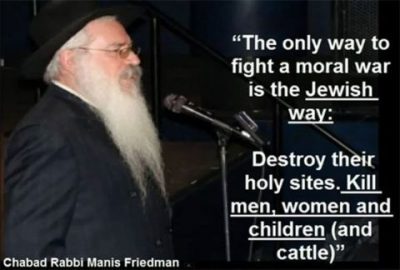
Israeli Rabbi Shmuel Eliyahu seems to have picked up where the late Rabbi Ovadiah Yosef left off. The Israeli army, Eliyahu said, must slaughter the Palestinians “and leave no one alive.” The Palestinians, the good rabbi continued, must be “destroyed and crushed in order to end violence.” Here is Eliyahu’s algorithm:
“If they don’t stop after we kill 100, then we must kill 1,000. And if they do not stop after 1,000, then we must kill 10,000. If they still don’t stop we must kill 100,000, even a million.”
There is more to this “logic” than meets the eye and ear. Eliyahu even postulated that the Israeli army ought not to get involved in arresting Palestinians because “If you leave him alive, there is a fear that he will be released and kill other people. We must eradicate this evil from within our midst.”
You may say that this is just an isolated case. No Israeli official believes that, right? … continue
 Aletho News If Americans Knew No Tricks Zone


 Aletho News