Flemish government called on to cancel WEF membership
Free West Media | November 23, 2022
In 2022, the Flemish government will pay €175 763.87 in membership fees to the World Economic Forum (WEF) and 27 000 Swiss francs (about €27 300) as participation fees to the annual meeting of the WEF in Davos. This is according to Flemish minister-president Jan Jambon’s response to a parliamentary question by Flemish MP Sam van Rooy.
“The Flemish Government thus legitimises and subsidises a global lobbying organisation that clearly pursues a well-defined ideological agenda, namely that of globalism,” van Rooy responded.
German economist Klaus Schwab’s World Economic Forum (WEF) has come under increasing scrutiny in recent years. The WEF claims to be a forum for exchanging ideas and networking, but at the very least the perception has arisen that a lot of government decisions are linked to the ideological goals of the WEF and stem from agreements made within the WEF.
All in all, this international lobbying organisation openly pursues a globalist future agenda involving numerous governments. This agenda seems to have recently crystallised into the so-called The Great Reset, whose goal is “a more secure, equal and stable world” by “acting jointly and rapidly to renew all aspects of our societies and economies, from education to social contracts and working conditions,” according to Klaus Schwab of the WEF.
As citizens in a democratic constitutional state are entitled to transparency on the policies pursued, van Rooy asked Flemish minister-president Jambon questions about the Flemish government’s ties and cooperation with the WEF.
Regular WEF contacts
In his reply, Jambon stated that the Flemish government “has no structural contacts with the WEF outside the participation in the WEF meeting in Davos”, but that there are “regular contacts at the level of the Flemish government”. According to the prime minister, these contacts also aim to follow up on the various activities and projects that take place annually, including outside the Davos meeting.
Until 2020, the Flemish government paid an annual membership fee of €55 000 to the WEF. Since 2022, however, Flanders has been “promoted” to “associate partner” of the WEF, requiring a membership fee of no less than €175 763.87 per year. This contribution has already been paid for 2022 and the same invoice is expected for 2023.
About the “associate partnership”, Jambon stated the following: “The associate partnership offers the advantage that Flanders can participate in more activities throughout the year and, in addition, projects are being worked on within a thematic platform ‘Shaping the Future of Trade and Investment’. Those activities and projects provide additional visibility and an opportunity to learn and contribute policy-wise.” The entanglement of the Flemish government with the WEF is thus increasing.
The prime minister maintained that the WEF would have added value for Flanders because that organisation would allow him to speak at short notice with decision-makers from international companies that are important for Flanders. “The WEF provides the framework that facilitates these talks,” Jambon said, further calling WEF membership “a policy instrument of the Flemish Government” as well “to realise objectives from the Coalition Agreement”. Jambon also announced his intention to further strengthen cooperation with the WEF in the coming period.
WEF’s alleged mission
According to Jambon, the “mission of the World Economic Forum is to improve the state of the world”, but that mission appears to be politically correct and woke, said the party in a statement. The WEF has an ideological agenda of inclusion, diversity, open borders and climate and CO2 hysteria. While Jambon has claimed that “the WEF is not asking us to pursue a specific agenda”, he admitted that his “participation in the Davos meeting may result in policy initiatives”.
It therefore seems very much as if the Flemish government is following the WEF’s globalist objective as much as possible in exchange for access to the WEF network of multinationals, banks, journalists and NGOs.
Van Rooy said that Jambon’s answers were conspicuously vague and this had raised additional questions. He therefore called on the Flemish government to cancel the Flemish paying WEF membership: “Exchanging ideas and attracting investments are of course laudable ambitions in themselves, but this should not be done in the context and under the auspices of the WEF, a lobbying group that pursues a globalist agenda and thus can by no means be considered a neutral forum for this,” van Rooy said.
Rishi Sunak’s hawkish antagonization of Beijing has not gone unnoticed
By Timur Fomenko | RT | November 23, 2022
Since the conclusion of China’s 20th Communist Party Congress, Xi Jinping has been on a diplomatic blitzkrieg. He’s met with leaders from countries all over the world, including the German chancellor, the French president and even US President Joe Biden himself. He’s keeping up the momentum as New Zealand’s Prime Minister Jacinda Ardern has received an invitation to visit Beijing. China believes that diplomacy is critical to prevent the US from isolating it.
But one important country has thus far been left on the sidelines – the United Kingdom. A meeting between Xi Jinping and British Prime Minister Rishi Sunak, scheduled at the UK’s request during the recent G20 summit, was cancelled. It came just as Sunak, at least superficially, softened his rhetoric on Beijing and sought to re-engage, after having portrayed himself as an ultra-hawk during the leadership contest at home. He even scrapped Liz Truss’s designation of Beijing as a “security threat” to his country.
But that hasn’t saved him from Beijing’s wrath. China is getting tough on Britain, in a similar way to how it did on Scott Morrison’s Australia. While the impasse with Canberra ended with the election of Antony Albanese as Prime Minister, who is more pragmatic in handling China ties, Beijing now sees London as the one playing the role of the “insufferable poodle” of the US, and will likely deliberately block engagement until it changes course.
Out of all allies of the United States, China is especially wary of what is known as “The Anglosphere” or the “Five Eyes” – That is Australia, Canada, New Zealand (although not these days) and the United Kingdom. These Anglophone countries, direct products of the British Empire, are the states which are most invested in American hegemony and closest to the United States in terms of ideology and worldview. While Continental European nations may to varying degrees differentiate themselves from the US, the Anglosphere nations are “true believers” in the US cause.
Hence, when the US invaded Iraq, it was the UK and Australia who answered the call, just to cite one instance. China therefore naturally sees members of the Five Eyes with geopolitical suspicion. Additionally, Beijing does not see them as truly “sovereign” countries or as equals to itself, but rather as US vassals. However, it has to balance this with the reality that all of these countries are critical economic and trade partners, due to their accumulated wealth and market influence. In which case, China’s geopolitical objective is not to treat these countries as adversaries, but to use a very explicit “carrot and stick” mode of diplomacy whereby it punishes them for “bad behaviour” in following the US too closely on the one hand, but rewards them for deeper bilateral engagement on the other.
And there is no more explicit example of this ongoing right now than the contrast between China deepening its engagement with New Zealand and shutting out the United Kingdom. When Beijing deems that a leader of an Anglosphere state, such as Scott Morrison of Australia, or Rishi Sunak of the UK, is too deeply following the United States, then there is absolutely no point in engaging them because the fundamental decisions are being made in Washington and not their respective capitals. The metric of right-wing populism, when these respective leaders are actively demonizing China for domestic political gain, is also a ‘naughty step’ offense. Only the US has the political privilege and power to be able to demonize Beijing, but still get engagement with it, hence why America is able to provoke China and never receive the reactions which smaller nations get from China.
This is how Beijing tries to “dilute” American power. The US itself is never confronted, but those who follow Washington too closely are. And on this, China has caught Sunak off guard. Beijing tolerated the government of Boris Johnson because he described himself as a “Sinophile” determined to improve ties with China. Sunak, however, used antagonism of China for partisan gain. The Prime Minister has since moderated his rhetoric and spoken about “keeping ties open,” believing that his spree of anti-China hyperbole, as well as a recent Ministerial visit to Taiwan, would simply be brushed off and that Beijing would welcome him with open arms. He was wrong, and Beijing is now showing that when it is not about the US, engagement with China is conditional on “good behaviour.”
China also recognizes the UK economy is weak, and as loath as London is to admit it, the UK needs ties with China. Inflation is surging, industrial unrest is picking up, chancellor Jeremy Hunt says the country is already in a state of recession. In which case, Beijing is exploiting these vulnerabilities and, similar to Australia, it will place a number of “demands” on Britain which will become pre-requisites to normalization again, which usually involve respecting Beijing’s position on Taiwan and not following the US agenda.
However, whether this works is another story. In the case of Australia, Scott Morrison’s government did not change course, and it simply became the case that China had to wait him out before re-engaging with his successor. That could very much be the case here too. Britain has ultimately made the choice to follow the US on China, even when those policies prove to be blatantly self-defeating, as is the case with the Newport Wafer Fab. Nonetheless, if Sunak is trying to be pragmatic, this should be a reality check for him.
Ukraine halts Russian oil transit to EU – Transneft
RT | November 23, 2022
Kiev has stopped the operation of a section of the southern branch of the ‘Druzhba’ (Friendship) oil pipeline that transits Ukraine, RIA Novosti reported on Wednesday, citing Russian oil-exporting company Transneft.
According to the report, oil transmission has been suspended for an indefinite period.
“In Ukraine, the section [of Druzhba] has been stopped, from Brod to the Carpathians,” said Igor Demin, an adviser to the president of Transneft.
He added that deliveries via the Belarusian section of the pipeline were continuing.
Last week, Kiev stopped oil flows to Hungary through the Druzhba pipeline, explaining the suspension was linked to a Russian air strike that reportedly had hit a transformer station near the border with Belarus. It stated that the service was suspended due to a “drop in voltage.”
Kiev later announced plans to raise transit fees for Russian oil running through the pipeline to the EU, due to higher costs resulting from Russian air and missile attacks targeting the country’s energy infrastructure.
Ukrainian oil transit fees have already been raised twice this year. The last hike, in April, reportedly brought the total increase on an annualized basis to 51%.
Delay at Finland’s New Nuclear Reactor Imperils Country’s Power Supply
Samizdat – 23.11.2022
Finland’s new Olkiluoto 3 reactor will remain offline longer than expected, and full-scale electricity production will not commence before 2023.
Its owner Teollisuuden Voima announced that an investigation into damage at the already much-delayed reactor’s feedwater pumps will continue for a number of weeks, with a knock-on effect on the schedule of regular electricity production. Due to the ongoing investigation, the exact timeframe for the launch of the reactor remains unknown, but was estimated as the end of January 2022 at the earliest.
During the ongoing investigation, maintenance work will continue at the plant unit’s turbine.
Further delays to regular electricity production at Olkiluoto 3 will have a significant impact on Finland’s electricity self-sufficiency. Since the reactor won’t be operational by winter, energy prices, already elevated as a result of Europe’s energy pinch, are likely to rise even further.
The damage to the reactor is thus a major setback for the cold Nordic nation, whose authorities had already warned of an elevated risk of shortages and even blackouts unless the reactor provides a reliable supply of electricity.
The latest delay increases uncertainty over the country’s power supply this winter, especially in January, national grid operator Fingrid stressed. Earlier this autumn, it predicted a peak electricity consumption in Finland of 14,400 megawatts for this winter, whereas domestic production, even with Olkiluoto 3 included, would only cover 12,900 megawatts.
Olkiluoto 3, a 1,900-megawatt European Pressurized Water Reactor (EPR), was granted a construction permit in 2005 and was originally scheduled for completion in 2009. The order made Finland the first Western European nation in 15 years to order a new nuclear reactor, following a protracted nuclear scare driven by the Three Mile Island accident in 1979 and the Chernobyl catastrophe in 1986.
However, the project has faced a long stream of delays, technical issues, cost overruns and legal disputes. With a breathtaking price tag of $11 billion already in 2018. Olkiluoto-3 has long been touted as the “flagship of European nuclear energy,” but has taken more than 15 years to complete, cost the Nordic nation dearly and ranks among the world’s most expensive buildings.
Europe’s energy crisis has been aggravated by Brussels’ ill-conceived energy sanctions against Moscow over its special operation in Ukraine. The EU in general has been heavily reliant on Russian fossil fuels, with Moscow supplying some 40 percent of its natural gas and some 27 percent of its imported oil before the conflict.
Nevertheless, despite this substantial level of dependence, the EU issued a blank ‘no’ to Russian fossil fuels as part of its massive sanctions campaign in a bid to “punish” Russia. However, as trouble with finding alternative sources arose, numerous EU nations are now resorting to austerity measures to conserve energy, with authorities issuing grave warnings about rolling blackouts.
Xi to visit Saudi Arabia as Prince Salman seeks BRICS membership
By Ahmed Adel | November 23, 2022
The upcoming visit of Chinese leader Xi Jinping to Saudi Arabia, scheduled for December and prepared for a year, shows that the Gulf kingdom has sidelined American interests for its own and taken the first step towards de-dollarization. According to Saudi Foreign Minister Adel al-Jubeir, strengthening trade ties and regional security will be prioritised during Xi’s upcoming visit to Saudi Arabia.
Jubeir emphasized that meetings between Chinese and Saudi leaders are “natural” and recalled that China is Saudi Arabia’s largest trade partner. Sources familiar with the organisation of Xi’s visit confirmed that it has been prepared for a year and that the Chinese leader will arrive in the second half of December to attend the China-Gulf Summit.
Xi’s visit to Saudi Arabia is a continuation of a wider process stimulated by BRICS and the Shanghai Cooperation Organization (SCO), in which China and Russia are key countries. BRICS and the SCO are increasingly attractive organisations for many countries as a framework in which development and cooperation is possible without blackmail and pressure.
Saudi Arabia has fundamentally changed its policy from one of complete submission to the interests of the US to now putting its own national interests first. This does not mean that the Saudis will break relations with the US, but it is a huge difference when the country puts its own interests first compared to when it is subordinated to the interests of Washington.
Riyadh pursues much better and closer cooperation with China as it is a continuation of the process in becoming an independent state and not subservient to Washington. In these processes, by the nature of things, since they are complementary economies, avoiding the dollar as a means of payment is a completely logical plan as it removes the risk of great damage if American sanctions are ever imposed.
On the one hand, BRICS, independently of Saudi Arabia, is operationally working to create a concept that would reduce the importance and influence of the dollar in the world economy. More precisely, such an achievement would reduce the influence of the dollar, which is effectively the basis of US foreign policy.
It is also for this reason that Saudi Arabia is positioning itself as a potential new member of the BRICS bloc.
Within that, a whole series of countries in bilateral cooperation, which is now expected from China and Saudi Arabia, agree on payments in domestic currencies as the first step in the process of de-dollarizing the world economy. It is also for this reason why the visit of Xi to Saudi Arabia follows from everything that has already happened and should not be considered a surprise.
However, it is too early to say whether China will overtake the US as Saudi Arabia’s main partner, even despite the fiasco that was President Joe Biden’s visit to the Gulf kingdom. This is especially the case because Saudi Arabia has based its defence on American weapons and has immense financial ties with the US.
There will definitely be more significant Sino-Saudi cooperation and the Arab kingdom itself will attempt to detach from the dollar. However, the truth is that de-dollarization is a process that will take many years. None-the-less, the Saudi reduction in cooperation with the US will inevitably occur.
It is recalled that South African President Cyril Ramposa said during his visit to Riyadh in October that Crown Prince Mohammed bin Salman expressed Saudi Arabia’s desire to join BRICS. Discussions on the expansion of the BRICS bloc are scheduled to take place in South Africa when it takes over the presidency in 2023.
Saudi Arabia’s separation from the West has only accelerated under the Biden presidency. Biden described Saudi Arabia as a pariah state due to Prince Salman’s alleged involvement in the murder of Jamal Khashoggi, a Washington Post journalist. However, the US President changed his outlook and rhetoric towards the Arab country after coming to power.
As BRICS represents more than 40 percent of the global population and nearly a quarter of the world’s GDP, with the group set to have bolstered global influence if it expands, Saudi Arabia is interested in gaining further independence by joining the bloc. Joining the bloc also means closer relations with China, something that Saudi Arabia is now pursuing despite Western criticism.
Ahmed Adel is a Cairo-based geopolitics and political economy researcher.
U.S. Lawyers Claim Ivermectin was never prohibited for treating COVID-19. FDA merely recommended not using it.
No legal prohibition authorized or justified hospitals to withhold the drug from dying patients. Let the lawsuits begin.

FDA tweet against using ivermectin. Not a prohibition, merely a recommendation.
By Dr. McCullough & John Leake · Courageous Discourse · November 22, 2022
The Epoch Times recently reported an astonishing statement by a U.S. government lawyer in a federal court in Texas, where the FDA is being sued by Dr. Paul Marik of Virginia, Dr. Mary Bowden of Texas, and Dr. Robert Apter of Arizona. The three plaintiffs claim the FDA illegally prohibited them from prescribing the drug to their patients. At a November 1 hearing, U.S. lawyer Isaac Belfer argued for the defendant:
The cited statements were not directives. They were not mandatory. They were recommendations. They said what parties should do. They said, for example, why you should not take ivermectin to treat COVID-19. They did not say you may not do it, you must not do it. They did not say it’s prohibited or it’s unlawful. They also did not say that doctors may not prescribe ivermectin.”
If Belfer’s assertion is true, it raises a very urgent question: On what legal grounds did hospitals all over the United States refuse to administer ivermectin to severely ill COVID-19 patients, even when patients and their family members begged for the drug to be administered?
If ivermectin was not prohibited by the FDA or any other U.S. medical authority for treating COVID-19, why did Dr. Paul Marik’s hospital prohibit him from administering the drug to his dying patients? Why was Dr. Mary Bowden reported to the Texas Medical Board for disciplinary action when she prescribed it? Why did many pharmacists fear losing their licenses if they filled ivermectin prescriptions for treating COVID-19?
In our book, The Courage to Face COVID-19: Preventing Hospitalization and Death While Battling the Bio-Pharmaceutical Complex, Dr. McCullough and I document numerous instances of hospitals flatly refusing to grant the wishes of dying patients and their family members for ivermectin.
All these patients asked for was to be allowed to try the drug (FDA-approved for River Blindness, Elephantiasis, and Scabies) for COVID-19. The patients and their kin gladly indemnified the hospitals and arranged to have their independent primary care doctors deliver and administer the drug. Nevertheless:
- Hospital administrators absolutely refused to grant this wish.
- Hospital attorneys fought tooth and nail against using ivermectin to treat COVID-19 patients, doing everything in their power to challenge patient lawsuits and appeal court orders to administer the drug.
- Even when hospital doctors acknowledged that the patients were dying, they insisted it was better to let the disease take its natural course rather than allow patients to try ivermectin.
- Even when patients’ families succeeded in getting a court orders to administer the drug, many hospitals still refused, even at the risk of being held in contempt of court.
Several readers have told us that our chapters covering this shameful scandal— Chapters 38: Begging for the Wonder Drug and Chapter 40: Graduating into Eternity—are horrifying beyond belief.
Now we hear U.S. government lawyers arguing in court that the FDA never prohibited using ivermectin to treat COVID-19 patients, but merely recommended not using it. This indicates that hospitals had no legal grounds for denying sick patients a drug that could have helped them. How is withholding medicine from a sick man any different from withholding a life ring from a man who has fallen overboard in high seas?
For families who watched their loved ones slip away after being denied the right to try ivermectin, U.S. attorney Isaac Belfer’s statement may be interpreted as declaring open season for lawsuits against hospital administrators and doctors.
Israel pushes US on military action against Iran
RT | November 23, 2022
Israel Defense Forces (IDF) Chief of Staff Aviv Kochavi has called on the United States to develop new “operational plans” to take on the Iranian military, urging top US defense and intelligence officials to “accelerate” joint efforts to counter the Islamic Republic.
Kochavi held a series of meetings with Chairman of the Joint Chiefs of Staff Mark Milley, National Security Advisor Jake Sullivan and CIA Director William Burns, the IDF said in a press release on Tuesday, noting that he discussed the “Iranian threat” with each of the officials he spoke with since landing in the US on Sunday morning.
“We are at a critical point in time which requires the acceleration of the operational plans and the cooperation against Iran and its proxies in the region,” Kochavi said after the meetings. “On the one hand, Iran is under many economic, military and internal pressures, and on the other hand continues to advance the nuclear project.”
During his sit-down with General Milley, the two officials discussed “strengthening cooperation between the [US and Israeli] armies against threats in the region, chief among them the Iranian nuclear threat,” according to the IDF. Sullivan, too, said the White House would carry out its pledge to “prevent Iran from acquiring nuclear weapons.”
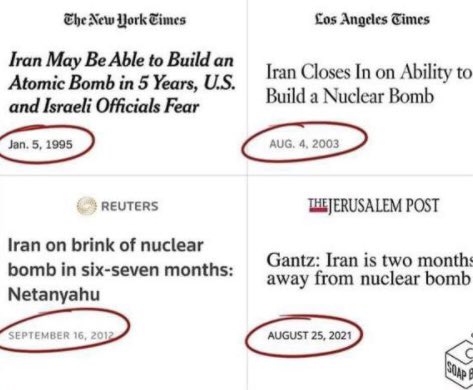
While Israel has offered little evidence supporting the existence of an Iranian nuclear weapons program, officials have claimed for decades that Tehran is on the cusp of developing its own bomb. The Islamic Republic has denied any plans to build nuclear weapons – with Supreme Leader Ayatollah Ali Khamenei issuing a fatwa (religious decree) against all weapons of mass destruction in 2003 – and passed numerous inspections by the UN’s nuclear watchdog under a major deal signed with world powers in 2015.
However, after Washington unilaterally withdrew from the nuclear deal under President Donald Trump, Tehran has steadily scaled back its compliance, boosting its enrichment of uranium and building new advanced centrifuges while demanding an end to US sanctions. Iran has nonetheless insisted that such steps do not indicate it is seeking a nuclear weapon, despite continued allegations from the United States and Israel.
Should Individualism be Medicated Away to be Replaced by “Welfarism?”
By Igor Chudov | November 21, 2022
Medical ethics is a large field of study. The Covid pandemic certainly brought many medical ethics issues to the forefront and produced rather amazing “ethicist” gems, such as this:

Be aware that “bioethics” has moved on to proposals that might seem crazy to you but are considered seriously and published in Bill Gates-funded publications and scientific journals. Important studies on this subject are conducted under the auspices of the World Economic Forum.
Forcibly giving people collectivism-promoting “Morality Pills” (archive link) is a popular suggestion among bioethicists. It was published in Bill Gates-funded The Conversation and is discussed widely in scientific literature. (The Conversation received 7 million dollars from Bill Gates but pretends to be an independent journalism publication)
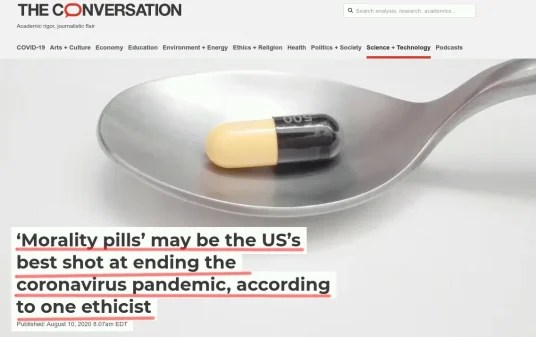
What are these morality pills? You might think that morality, to them, means being a good husband or wife, an honest businessperson, fulfilling promises, and so on. Why not enhance that? What’s the problem?
The problem is that this is NOT how they define morality! To them, morality is a collectivist mindset, lack of critical thinking, and compliance. The article explains that some people lack “moral qualities” and refuse to wear masks or take Covid vaccines, or even deny climate change:
My research in bioethics focuses on questions like how to induce those who are noncooperative to get on board with doing what’s best for the public good. To me, it seems the problem of coronavirus defectors could be solved by moral enhancement: like receiving a vaccine to beef up your immune system, people could take a substance to boost their cooperative, pro-social behavior. Could a psychoactive pill be the solution to the pandemic?
They propose giving people pills to enhance “morality” and explain the climate change angle relevance:
But a strategy like this one could be a way out of this pandemic, a future outbreak or the suffering associated with climate change. That’s why we should be thinking of it now.
The proposed solution to give people morality pills is more than idle thinking. Several candidate psychoactive substances are identified and considered seriously: psilocybin and oxytocin, for example.
The obvious objection to all this morality pill talk is that skeptics would not take them! I would not take such a pill to enhance my collectivist mindset. At the risk of being presumptuous, I would say that you, my dear subscriber, would refuse them also. Right?
The ethicists have a solution: administer collectivist morality pills by force or surreptitiously.
As some have argued, a solution would be to make moral enhancement compulsory or administer it secretly, perhaps via the water supply. These actions require weighing other values. Does the good of covertly dosing the public with a drug that would change people’s behavior outweigh individuals’ autonomy to choose whether to participate? Does the good associated with wearing a mask outweigh an individual’s autonomy to not wear one?
Serious articles discuss how to do it:
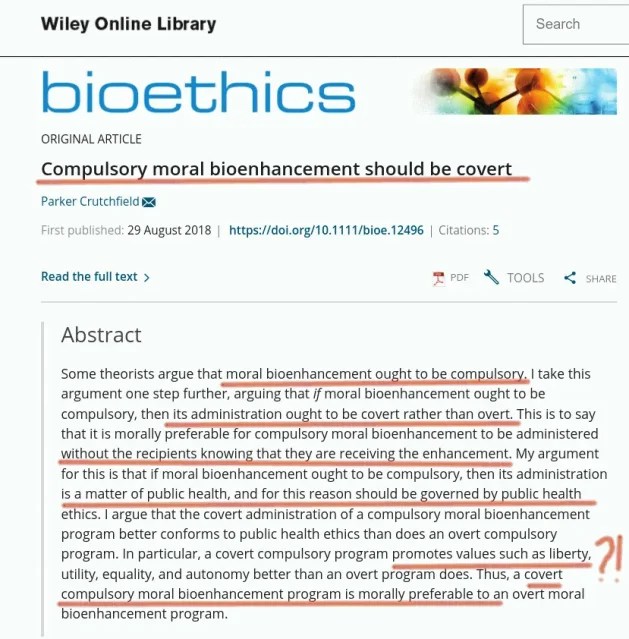
A covert psychoactive substance administration to the masses must not be discussed publicly before its implementation, right? So the ethicists desire to bypass any democratic process or prior public discussion and scrutiny. These ethicists refuse to see an ethical problem with that!
World Economic Forum Sponsored Research into “Collectivist Bioenhancement”
Some of you, my dear readers, might think this is so batshit crazy that it is simply useless musings of fringe philosophers, not worth discussing.
Quite to the contrary, the famous and influential organization called the World Economic Forum sponsors such bioenhancement research.
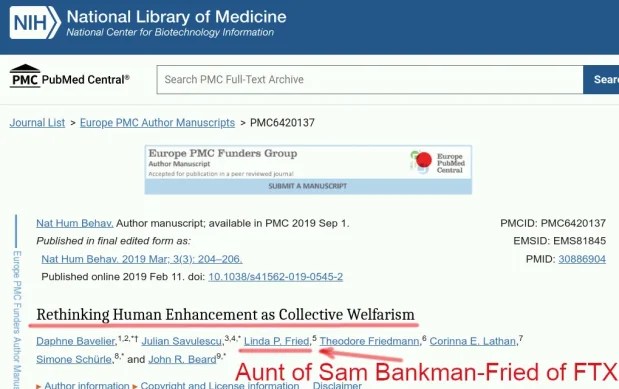
Linda Fried, mentioned above, is the aunt of Sam Bankman-Fried. Sam stole billions of dollars from crypto-investors (in my opinion) and used that money to become the second largest Democratic party donor. So, Linda Fried is not exactly a nobody languishing in obscurity. By the way, a friend of this blog El Gato wrote a great post discussing Sam — check it out.
Linda explains in her article that her goal is “collective welfarism,” and she is part of the group convened by the World Economic Forum:
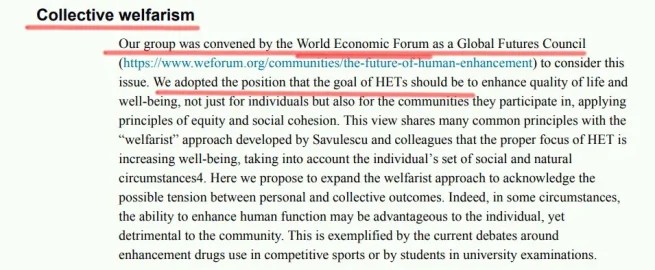
A stronger ethical approach, though, would be to abide by the principle, termed ‘collective easy rescue’, whereby small individual losses are justified in the name of collective well-being. Mass vaccination is a well-documented example of collective easy rescue.
Human “enhancement” to force mass vaccination? Sounds familiar?
Those “medical ethicists,” “world changers,” and “disinformation fighters” are so self-absorbed and self-righteous that they think their way of thinking is the only right way. They consider any deviation from their mindset to be antisocial, divisive, and subversive.
To them, freedom is dangerous. Truth is misinformation. Pursuing personal happiness and liberty instead of welfarism is selfish and immoral and needs to be dealt with through covert bioenhancement pills. Their opponents need to be silenced as “disinformation agents” or influenced via secretly applied substances to enhance compliance and lower critical thinking.
My post, discussing outlandish agenda developed under the auspices of the World Economic Forum, may sound like the perfect conspiracy theory. If someone approached me and told me that the WEF is sponsoring “bioenhancement research,” whose goal is to develop substances to impose “collective welfarism” and achieve compliance with mass vaccination, I would not take that person seriously!
Such is the problem with describing many WEF proposals. Some of their ideas are so crazy that they are difficult to accept as genuine when retold. Official papers, proposals, peer-reviewed studies, and agenda articles describe plans that are extremely strange to the uninitiated — and yet are pursued seriously. Other authors, such as Tessa Lena, also mentioned how difficult it is to describe these tendencies.
I have explained my difficulties with describing crazy but real proposals by world-leading unelected organizations such as the WEF.
I Do Not Spread Conspiracy Theories – I Report on Actual News
Their proposals, when understood properly, are highly disturbing and seem unreal — except that they are very serious.
The difficulty with their plans is that regular people cannot believe they are real. That happens for a good reason: nobody would expect such insanity to be seriously promulgated by important men and women. Even I have difficulty reconciling the plain text and the simple meaning of their anti-human theories with my idea of what our leaders should act like.
And yet, here we are — the welfarist pills are promulgated under the auspices of the WEF by no one but Linda Fried, the aunt of the second-largest Democrat donor and crypto thief (in my opinion) Sam Bankman-Fried.
In the future, you may need to be careful with your drinking water or the compulsory mystery “health enhancement pill” you must take for an unexplained reason!
Would you take such a welfarism bioenhancement pill?
European parliament severs ties with Iran over sanctions against EU

The Cradle | November 22, 2022
The EU parliament announced on 21 November its decision to sever ties with Iran. The announcement comes in response to the Islamic Republic’s recent decision to place sanctions on the European governing body, which has been slapping its own sanctions against Tehran throughout the ongoing unrest in the country.
“We will not look away from those who look to us from the streets of Iran. Iran must stop its oppression of legitimate protests. In response to Iran’s [sanctions] on members of the European Parliament, [it] will no longer engage with Iranian authorities,” President of the EU parliament, Roberta Metsola, said in a statement via Twitter with the popular Iranian protest slogan “Women, life, freedom” written in Persian at the end of the tweet.
At the opening of its November plenary session on the same day, Metsola said that there would be “no direct contact” between the parliament and Iranian officials “until further notice.”
As Iran continues to face large waves of violent riots – which have resulted in the deaths of several members of the security forces and the destruction of public property – western media has framed the response by authorities as nothing more than a brutal crackdown on peaceful protestors.
In addition to the propagation of misinformation by mainstream, western European media, the EU has repeatedly placed several rounds of sanctions against Iran.
Accusing European states of interventionist policies and “supporting terrorism and violence” on Iranian soil, Tehran on 26 October announced the implementation of its own sanctions against several individuals and institutions associated with the EU.
Earlier that month, the Islamic Republic had sent several letters to European diplomats warning them that the aggressive EU sanction policy against Tehran could result in a “rupture” of relations between them.
As European, Saudi, British, and US media outlets lead the misinformation campaign against Tehran, violent attacks against the country’s security personnel are on the rise, and internationally-backed armed separatists continue to push for the illegal overthrow of the Islamic Republic.
Iran retaliates against UN nuclear resolution – media
RT | November 22, 2022
Tehran has for the first time started enriching uranium to 60% fissile purity at the Fordow facility, Iranian media reported on Tuesday. Such a move would be seen as a response to a critical resolution adopted by the UN’s nuclear watchdog last week.
Iran is already enriching uranium at Natanz, its other major production site, to below weapons-grade 90% enrichment, but well above the 3.67% limit specified in the 2015 Iran Nuclear Deal, or JCPOA. The US abandoned the deal with Tehran during the administration of Donald Trump, leading to its erosion and effective collapse.
Other reported moves by Iran include upgrading cascade lines with more advanced gas centrifuges to boost production capacity at Fordow, as well as firing up additional chains at Natanz.
Tehran’s action was described as retaliation for a resolution passed last Thursday by the Board of Directors of the International Atomic Energy Agency (IAEA). The document, which was drafted by the US, Britain, France and Germany, decried “insufficient substantive cooperation by Iran” on the issue of uranium traces found in 2019 by inspectors at three undeclared sites. It demanded “credible explanations” and full cooperation from Tehran.
The four sponsoring nations are also signatories of the JCPOA. China and Russia, two other participants of the landmark deal, reportedly voted against the draft document during the closed-door session last week.
The Iranian Foreign Ministry rejected the resolution, calling it a form of political pressure by the US and its allies. Spokesman Nasser Kanaani said on Monday that the country had taken “initial measures” in response to it on Sunday night.
“The implementation of these measures was realized today in the presence of IAEA inspectors in the Natanz and Fordo enrichment complexes,” the diplomat added, without specifying what had happened.
The JCPOA was meant to exchange an Iranian commitment to limit its nuclear program for relief of economic sanctions imposed on the country. The goal was to prolong the time Tehran would need to create a nuclear weapon, an ambition that Iran officially denies fostering in the first place.
The Trump administration unilaterally pulled out of the Iran Nuclear Deal as part of its “maximum pressure” campaign against Tehran. President Joe Biden has been negotiating a possible revival of the JCPOA, but no breakthrough has been achieved so far.
Featured Video

The Sordid History of the CIA – Part 2
or go to
Aletho News Archives – Video-Images
From the Archives
Rabbi Shmuel Eliyahu: Leave No Palestinian or Arab Alive

By Jonas E. Alexis | Veterans Today | July 23, 2017
Israeli Rabbi Shmuel Eliyahu seems to have picked up where the late Rabbi Ovadiah Yosef left off. The Israeli army, Eliyahu said, must slaughter the Palestinians “and leave no one alive.” The Palestinians, the good rabbi continued, must be “destroyed and crushed in order to end violence.” Here is Eliyahu’s algorithm:
“If they don’t stop after we kill 100, then we must kill 1,000. And if they do not stop after 1,000, then we must kill 10,000. If they still don’t stop we must kill 100,000, even a million.”
There is more to this “logic” than meets the eye and ear. Eliyahu even postulated that the Israeli army ought not to get involved in arresting Palestinians because “If you leave him alive, there is a fear that he will be released and kill other people. We must eradicate this evil from within our midst.”
You may say that this is just an isolated case. No Israeli official believes that, right? … continue
Blog Roll
Recent Comments


 Aletho News
- Jeffrey Epstein’s sinister shadow over West Asia
- The Sordid History of the CIA – Part 2
- French FM under fire over ‘false’ claims about UN rapporteur
- Israel Wants ISIS-Linked Militias To Control Rafah Crossing — The New Order in Gaza
- ISIS never left Syria, it just changed uniforms
- Why ARE the US and Israel Obsessed With Eliminating Iran’s Ballistic Missiles?
- Kremlin comments on EU ‘myopia’ over dialogue with Russia
- Russia more adapted to contemporary military technology than NATO
- Germany puts caveat on more missiles for Ukraine
- UK High Court rules Palestine Action ban unlawful
- If Americans Knew
- Noor’s short life of unimaginable suffering
- Israel Destroyed Gaza’s Hospitals. Now It’s Banning Doctors Without Borders.
- Is Spite of What Zionists Say, It’s a Good Thing to Criticize Governments
- Palestinian mother, daughter recount strip searches, harsh conditions in Israeli detention
- Israel used weapons in Gaza that made thousands of Palestinians evaporate
- ADL’s Stats Twist Israel’s Critics Into Antisemites
- Why Is the World Silent When the Gaza Genocide Is Not Over?
- In Gaza: 8,000 bodies under rubble, 3,000 missing – Not a ceasefire Day 126
- AZAPAC, the new PAC opposing Israeli domination of U.S policies
- Haim Saban: Billionaire for Israel
- No Tricks Zone
- German Gas Crisis…Chancellor Merz Allegedly Bans Gas Debate Ahead of Elections!
- Pollen Reconstructions Show The Last Glacial’s Warming Events Were Global, 10x Greater Than Modern
- Germany’s Natural Gas Storage Level Dwindles To Just 28%… Increasingly Critical
- New Study Rebuts The Assumption That Anthropogenic CO2 Molecules Have ‘Special’ Properties
- Climate Scientist Who Predicted End Of “Heavy Frost And Snow” Now Refuses Media Inquiries
- Polar Bear Numbers Rising And Health Improving In Areas With The Most Rapid Sea Ice Decline
- One Reason Only For Germany’s Heating Gas Crisis: Its Hardcore-Dumbass Energy Policy
- 130 Years Later: The CO2 Greenhouse Effect Is Still Only An Imaginary-World Thought Experiment
- New Study Affirms Rising CO2’s Greening Impact Across India – A Region With No Net Warming In 75 Years
- Germany’s Natural Gas Crisis Escalates … One Storage Site Near Empty …Government Silent
 Aletho News