Maori Science Beats Woke Myths

By Jennifer Marohasay | January 21, 2022
Every community has those who are designated wise — sometimes able to anticipate imminent catastrophe. For example, back in the 1500s, some in rural England and France would suspend dead birds — specifically kingfishers — from silken threads that purportedly acted as natural weathercocks. It was thought that the dead kingfisher was able to anticipate approaching storms and turn its breast into the wind. This is an unfortunate example, though, because Thomas Browne showed it to be nonsense. He suspended two dead kingfishers, side by side, and they pointed in different directions, thus demolishing the myth. I can’t imagine that all the wise ones took their dead birds down immediately, but Browne’s book Pseudodoxia Epidemica of 1646 championed a new kind of evidence-based science that relied on simple experiment.
For a period of some few hundred years, science came to replace superstition and key zoological texts including, for example, Origin of Species by Charles Darwin, were penned by the curious who tried hard to sort fact from fiction through observation. Browne and Darwin’s works followed Nicolaus Copernicus’ book On the Revolution of the Heavenly Spheres, published in 1543, that explained humankind was not at the centre of the universe.
Before evidence-based science, natural historians and even astronomers, relied on the work of Aristotle who thought mankind was at the centre of the universe. In the twelfth century, Aristotle was a major source of information for the medieval encyclopaedias of animals, known as Bestiaries, with moral biblical lessons added.
We have somehow returned to this practice where natural history is once again interwoven with moralising. Worse, many of those designated as wise are full of hubris and carry on as though humankind can affect the weather and climate. This extends to projects at universities, where, even in zoology departments the ‘research’ must lament the trace gas carbon dioxide and its perceived impact on the distribution and abundance of species.
Even in The Spectator Australia, James Allan in ‘Decline and Fall of New Zealand’ (11 December) remonstrates about how woke our universities have become but then lauds the superiority of Western science relative to Maori mythology. But is woke science superior to Maori myths? Arguably the most significant climate event since satellites began measuring global temperatures in 1979, was the very strong El Niño of 2015/16. It caused global temperatures to spike in February 2016, corals to bleach, and so on. This hottest period – according to the UAH satellite record – was forecast some years earlier by long range weather forecaster Ken Ring relying on Maori mythology. It was not forecast by Western meteorological bureaus that run simulation models on super computers.
In 1974, Ring, then a high school mathematics teacher ‘dropped out’ to home school his children. He moved his family to the remote East Coast of the North Island of New Zealand and over a period of six years befriended local Maori fishermen. He returned to ‘civilization’ six years later with what he has described as ‘the rudiments of a weather prediction system’ based on traditional Maori knowledge. Sometime later he began publishing weather almanacs for Australia, New Zealand and Ireland with rain, frost and snow maps including fishing calendars and gardening guides.
I’ve no doubt that the forecasts in those almanacs could be vastly improved, including through the mining of historical weather data using artificial neural networks, a form of machine learning that uses artificial intelligence. John Abbot and I showed its application to monthly rainfall forecasting in a series of research papers published from 2012 to 2017, including in the Chinese Academy of Sciences’ Advances in Atmospheric Sciences (Abbot J. & Marohasy J., 2012. Vol. 29, No. 4, Pgs. 717-730).
What has made Ken Ring’s long-range forecasts often more accurate than those from our bureaus of meteorology is their reliance on lunar cycles, uncorrupted by simulation modelling that misguidedly insists atmospheric concentrations of carbon dioxide are relevant to weather and climate forecasting.
It is possible to forecast El Niño and other key weather events years in advance because the passage of the Moon overhead is regular and cyclical. A 2019 technical paper by Jialin Lin and Taotao Qian entitled ‘Switch Between El Niño and La Niña is Caused by Subsurface Ocean Waves Likely Driven by Lunar Tidal Forcing’ explains the underlying physical mechanisms in terms of Newtonian physics.
In fact, observations of the Moon’s changing trajectory were a main test of the theories detailed in Isaac Newton’s The Principia, published in 1687 and recognised as a highlight of the Scientific Revolution in the 17th century.
If we open our eyes to the evidence – as Thomas Browne implored a few hundred years ago – we would notice that the very hot year globally of 2016 immediately followed a year of minimum lunar declination, as did the super El Niño exactly 18 years earlier, in 1998, that also caused mass coral bleaching. It is now well understood, beyond Maori mythology, that there is an 18.6-year lunar declination cycle. But this is wilfully ignored by mainstream meteorologists lest such extra-terrestrial influences on weather and climate detract from the moralising about humankind’s influence.
More than ever, Westerners who claim to respect science —could benefit from a return to simple observation as practiced by Maori fishermen who see the weather patterns created by the passage of the Moon and its changing declination. Browne’s contemporary, John Ray wrote, ‘Let us not suffice to be book-learned, to read what others have written and to take on trust more falsehood than truth, but let us ourselves examine things as we have the opportunity, and converse with Nature as well as with books …’
In meteorological bureaus, simulation modelling has replaced observation and Heads of state are urged to sign international treaties absurdly pledging to stop climate change. The true nature of this woke western climate forecasting would be better appreciated if it was evaluated against other methods. Forecasts from different systems could be placed next to each other, in much the same way that Thomas Browne strung up dead kingfishers – side by side.
This article was first published in The Spectator Australia magazine.
Since the article was published, I’ve received a note from Ken Ring with the following comment:
I’ve since learned that the Tuhoe fishermen of the East Coast were descended from Celtic peoples. They weren’t Maori at all, but originally pale skinned and red hair. There’s a whole political argument going on re-Treaty funds. Money seems to guide and hide our true prehistory …
Truth is, the Maori Fishing Calendar (which I published each year in the 2000s) was exactly the same as the Canadian Rockies Hunting Calendar, and Hindu writings, and harkened back to a time when the lunar laws were universal knowledge …
There are remnants of stone circles in New Zealand, but they are almost certainly pre- Maori.
I agree with the school of thought that says Aborigines were in New Zealand 40,000 years ago, based on rock drawings, and were only one of 100 or so cultures living peacefully side by side. At our closest point, we are only 900 nautical miles from Australia, and it is daft to think that for 60,000 years we were unknown to them. The ancient Chinese, too, settled on the east coast of Australia, and established a greenstone industry in New Zealand, but all this is completely shunned by historians. It means that indeed there may have been towns of 1000 people in Australia, but they were probably Asian, not Aboriginal.
You may be interested in this documentary, Skeletons in the Cupboard part 1 and Skeletons in our Cupboard part 2
I would like to thank Barry Goldman for the link to the article by Ben Finney et al. entitled ‘Wait for the West Wind’ that explains something of the complexity of navigating the South Pacific and the importance of understanding wind direction and its seasonality. It concludes with comment that:
Without the ability to sail over long distances, to find islands strewn over many thousands of miles of open sea, and to carry enough people, tools, plants and animals to found viable colonies on the islands discovered, there would have been no Polynesian culture, no vast triangular section of ocean occupied by closely related neolithic peoples. That the large, stable, and seaworthy double-canoe was the critical artefact of this cultural development and expansion is generally accepted, just as the ability to make one’s way across the ocean and find distant islands by reading the stars, the winds, the swells, the flight of birds, and other clues provided by nature is often cited as the skill most crucial to this process. To the double-canoes, and ways of navigating them without instruments, we would add a third main element of this oceanic adaptation that made the colonisation of so many far-flung islands possible: knowledge of the winds of the sea and the skill to exploit spells of westerly winds to sail far to the east.
While the more intermittent character of the westerlies in the tropical south-eastern Pacific may have slowed the momentum of eastward expansion across the Pacific, the ethnographic and experimental evidence suggests that early Polynesian voyagers were able to adapt to this wind regime and to use periodic episodes of westerly winds to find and settle all the oceanic islands to the east of their mid-Pacific homeland. The evidence further suggests that they would have been able to make the multiple landfalls throughout central East Polynesia, and that, once settled on the various islands and archipelagos, they and their descendants would have been capable of exploiting the alternating rhythm of monsoonal and subtropical westerlies with easterly trade winds to maintain some communication ties within the central East Polynesia region, and also to some extent between East and West Polynesia. The actual history of East Polynesia colonisation may, therefore, turn out to be much more complex than suggested by broad arrows commonly drawn on maps to indicate migration paths.
Instead of searching for a single island or archipelago as the sole site of first settlement in East Polynesia, and of assuming one-way population dispersal from there to all the other eastern archipelagos, perhaps we should think of early East Polynesian colonisation in terms of a large multi-archipelago, intercommunicating region with some two-way links back and forth between there and West Polynesia. Although the camp-sites and settlements made by the first people to reach the islands of East Polynesia may be sparse and difficult to find, and evidence of interisland communication even harder to discern, the archaeologists should keep looking for evidence of early colonies and their interrelations throughout the islands and archipelagos lying to the east of the Polynesian homeland.
The feature image was taken at dawn at Lake Wanaka under the Milky Way and a rising Full Moon.
Russian, Syrian pilots conduct joint air patrol mission along Golan Heights
TASS | January 24, 2022
MOSCOW – Russian and Syrian military pilots have conducted a joint air patrol mission along the Golan Heights and the Euphrates River, the Russian Defense Ministry said in a statement.
“The mission’s route ran along the Golan Heights, the southern border, the Euphrates River and over northern Syria,” the statement reads. “Russian pilots took off from the Hmeymim Air Base, while Syrians took off from the Seikal and Dumayr airfields outside Damascus,” the ministry added.
According to the Russian Defense Ministry, the mission involved Russia’s Su-34 and Su-35 aircraft and the A-50 early warning and control aircraft, as well as Syria’s MiG-23 and MiG-29 planes. “During the patrol mission, Syrian pilots controlled airspace and provided fighter cover, while Russian crews practiced attacks on ground targets,” the statement specified. The ministry said that pilots had practiced strikes on air targets and ground targets at a training range in central Syria.
“The two countries’ pilots developed skills for cooperation in various situations. This kind of joint missions will now take place on a regular basis,” the Russian Defense Ministry stressed.
Russia will intervene in Ukraine
BY M. K. BHADRAKUMAR | INDIAN PUNCHLINE | JANUARY 23, 2022
The US-Russia talks in Geneva in the last two successive weeks could not produce a breakthrough. Fundamentally, there is a contradiction that cannot be resolved easily. Russia sees in existential terms the NATO’s advance into its immediate western neighbourhood. But for Washington, it’s geopolitics, stupid!
Russia cannot tolerate any longer such NATO presence on its western border. Ukraine’s induction into the Western alliance system would mean that the US missiles could hit Moscow in 5 minutes, rendering Russian air defence systems ineffectual and obsolete.
NATO deployments in the Baltic and the Black regions further deprive Russia of buffer in the west. Considering that all major decisions and most minor decisions in the NATO are taken in Washington, Moscow perceives all this as an American strategy to encircle it, erode its strategic autonomy and independent foreign policies.
The US, on the contrary, refuses to countenance any NATO rollback. It insists that Russia has no say in the alliance’s decisions. At best, Washington would discuss certain confidence-building measures, while NATO enlargement since 1997 — contrary to assurances given to Mikhail Gorbachev by western leaders in 1990 during the reunification of Germany — is a fait accompli that Russia should live with.
Basically, the US has gained the high ground through sustained efforts through the past three decades since the Bill Clinton administration put into effect a concerted strategy in anticipation of a resurgent Russia in a matter of time. Now that the US has gained the upper hand, it is loathe to give it up.
From Washington’s viewpoint, this is a key template of the geopolitical struggle unfolding over the new world order after China’s rise and the shift in power dynamic from the West to the East. Cutting down Russia to size and to be able to intimidate it is a pre-requisite of the situation before the US tackles China comprehensively. Suffice to say, Ukraine has become a battleground where a titanic test of will is playing out.
Ukraine is in all practical sense a US surrogate and its transformation as an anti-Russian state that began following the regime change in Kiev in 2014 is already at an advanced stage. Although Ukraine is not yet a NATO member, the alliance has established a significant presence in the country militarily and politically.
In the information war, the US portrays Russia as aggressor against a weak neighbour. In reality, though, it is a situation of ‘Heads I win tails you lose’. If Russia doesn’t do anything, it might as well resign to the inevitability of Ukraine being inducted into NATO and Russia having to live with the enemy at the gates. Of course, that would shift the global strategic balance for the first time in history in favour of the US.
On the other hand, if Russia acts militarily to prevent the NATO’s march in Ukraine, Washington will play rough. Washington is all set to pillory President Vladimir Putin personally and to impose “sanctions from hell” on Russia, with a vicious game plan to wound that country’s economy lethally and stifle its capacity to be a global player.
In the US estimation, Putin personally will have to bear a heavy political cost if living conditions deteriorate within Russia between now and 2024 when the next Russian presidential election is due, and he may be compelled to relinquish power. From the American perspective, there’s nothing like it if a Boris Yeltsin II were to succeed Putin.
Make no mistake, part of what is going on today is a demonisation Putin’s political personality to erode his towering popularity (65%), which forecloses the rise of a pro-western politician in Russia for a foreseeable future. All attempts by the US intelligence to create a “liberal” platform in Russian politics have failed so far. The fact of the mater is that the majority of Russian people dread the return of the “liberal” order of the 1990s.
The Washington Post, which is linked to the US security establishment, featured a scurrilous report last Wednesday under the byline of a noted knave titled House Republicans aim sanctions at Putin, his family and his mistress. It says, “The Biden administration’s carefully crafted mix of diplomacy and threats of additional sanctions doesn’t seem to be deterring Russian President Vladimir Putin from invading Ukraine and starting a war. Now, a large group of House Republicans is pushing President Biden to ramp up the pressure on Putin directly by going after him and his entourage for their long and well-established corruption.” Evidently, Washington will go to any extent to create dissensions among Russia’s elite and undermine the country’s political stability.
What lies ahead?
Without doubt, Russia is acutely conscious of its limitations. Moscow too made some serious miscalculations. It was betting that Ukraine was not going to join the NATO and in due course, better sense would prevail in Kiev under a realistic and pragmatic leader who would give up on the “Ukrainisation” agenda, repair ties with Russia (especially in the economic field) and importantly, accommodate the aspirations of the ethnic Russian eastern regions. But as it turned out, “Ukrainisation” is only being galvanised with tacit American support. Moscow has sensed that time is no longer on its side.
Moscow expects something concrete from the American side, as its vital security interests are in jeopardy. The Kremlin leadership, including Putin, has starkly outlined Russia’s “red lines.” Washington, on the other hand, is simply kicking the can down the road. It estimates that time is on its side anyway. From the Russian viewpoint, this is not acceptable, since a point of no return is arriving as regards Ukraine’s Nato membership.
Arguably, President Biden doesn’t want to move in the direction of accommodating Russia’s legitimate interests, given the pulls and pushes from the domestic scene in America and the divergent opinions among European allies, but primarily because the encirclement of Russia with pro-Western states has been a strategic objective of Washington’s policies toward Russia under successive administrations since Bill Clinton, and today it happens be expedient too, being a “cause” that enjoys rare bipartisan support in the Beltway at a juncture when American opinion is deeply divided.
In the present situation, wittingly or unwittingly, Washington has also tied its hands by committing that it won’t negotiate over Ukraine’s head. All factors taken into consideration, therefore, the probability is very high that Russia will intervene in eastern Ukraine with a view to create new facts on the ground to secure its national security interests while aiming at a political settlement for the medium and long term.
What does it entail?
Clearly, Russia is not seeking annexation of Ukrainian territory. Its preference will be to restrict its intervention in eastern Ukraine largely to the Russian populated regions and to create a buffer zone. Some American analysts have estimated that, broadly, any Russian intervention will be restricted to the territory upto the Dnepr river flowing through Belarus and Ukraine to the Black Sea. This seems plausible.
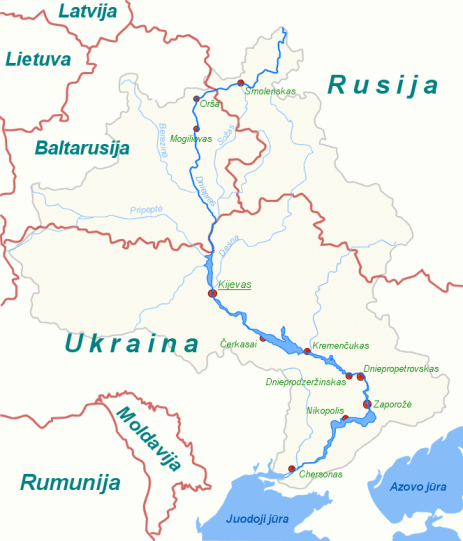
Of course, there are variables in any emergent military situation. Russia will firmly react to any form of Western intervention in Ukraine — although Washington has ruled it out. (In any case, the US’ capability to fight a massive continental war at such short notice is questionable.) The Russian military operations will be decisive with huge firepower and advanced weaponry on multiple fronts, with the intention to realise the political objective in the shortest time possible.
The US journalists have written about “resistance” but that is a load of rubbish. The Russian operation will be short and decisive. The Ukrainian moral fibre today is such that the demoralised forces and the disillusioned people will simply cave in. In all this, what needs to be remembered is that despite the heavy dollops of US indoctrination, Ukrainian people have profound civilisational affinities with Russians that lie submerged just below the surface.
Most important, the pervasive corruption in that country gives ample scope to buy off loyalties — in fact, there may not be much actual fighting at all in many sectors. It also needs to be factored in that the political situation in Kiev is highly unstable, as the latest sedition charges against former president Petro Poroshenko testify.
Zelensky won his mandate as president in 2019 on the basis of his promise to work for rapprochement with Russia. Today, he is a thoroughly discredited figure. People feel betrayed. A crushing military defeat will mean the end of the road for Zelensky.
The ensuing political turmoil within Ukraine is the “X” factor in the Russian intervention. American analysts deliberately sidestep this. Simply put, Russians have a deep understanding of the eddies of Ukrainian politics and the country’s power brokers due to the shared history, culture, politics and societal links.
The ultimate Russian objective will be a federated Ukraine through constitutional reform with the country’s sovereignty, national unity and territorial integrity intact while the regions enjoy autonomy. Europe may welcome this as the best way to stabilise the situation and remove the potential for future conflict.
Indeed, Russia’s expectation will be that such a Ukraine can never become a part of NATO once constitutional underpinnings are put in place to ensure that all major policies pursued in Kiev would be based on national consensus.
The bottom line is that as Russia sees it, the only way out of this crisis is that Ukraine regains its national sovereignty and stops looking to Washington for navigating its destiny. That requires that the American operatives in Kiev who take the decisions for Ukraine go home and Ukrainians are once again the masters of their house, which ceased to be the case once the US intelligence usurped power in February 2014 disregarding the pledge given by then (elected) president Viktor Yanukovich to hold fresh elections before deciding on Ukraine’s EU membership.
Clearly, all this is not going to be as easy as it sounds and the outcome may turn out to be no better than an attempt to unscramble the omelette. But the good part is that there are signs already that Europe is sceptical about blindly tagging along with the US any further on Ukraine.
The probability of discord in the transatlantic relationship is rising. NATO itself has never really been the robust united alliance that was made out to be. Polish President Andrzej Duda’s decision to attend the Winter Olympics in Beijing is a harbinger of things to come. (Incidentally, Putin will also be in Beijing at that time.) Germany opposes not only the removal of Russia from Swift but also the supply of weapons by NATO countries to Ukraine as well as Lithuania’s move (under US advice) to switch ties to Taiwan!
US made a strategic blunder to have encouraged a deeper NATO imprint in Ukraine. Making half-promises thereby to a non-NATO country is going to damage the US’ credibility in the downstream of a Russian intervention. But it is impossible for Washington to backtrack now, as the loss of credibility will be even more.
What remains to be seen, equally, is how the European Union survives this moment. The ardent Atlanticists in the European Commission in Brussels led by Ursula von der Leyen and the Russia-hater Josep Borrell are unilaterally setting the EU agenda currently, ignoring the glaring divergences of opinion among the member states. With Angela Merkel’s departure, a vacuum has appeared which these Eurocrats hope to fill in.
But this is clearly unsustainable. Addressing the European Parliament in Strasbourg last week, French President Emmanuel Macron has urged Europe to invest in its own collective security framework and called for a “frank” EU dialogue with Russia. By the way, neither the EU nor France was involved in the direct talks between the US and Russia in Geneva.
Much is being made out of the threat of sanctions against Russia. But such threats won’t deter Moscow. For a start, even draconian sanctions have proved to be a weak coercive tool. Indeed, US sanctions had a poor coercive track record in North Korea, Cuba, Iran, Venezuela, Vietnam, etc.
Russia is a big power. It has huge reserves, which currently stand at a record $638.2 billion — the fourth largest in the world. Russia’s credit position is good and it owns much of its debts. It has no critical need of US investors. Russia is in no desperate need to sell its currency.
Having gone through four traumatic shocks previously in its 30-year post-cold war history, Russia knows how to absorb shocks. Therefore, while Russia may take a big hit and there could be currency volatility causing outflow of capital initially following the sanctions, its reserves give it a big cushion.
At any rate, how far the Europeans will want to go on the sanctions path remains to be seen. Germany has voiced reservations about Washington’s famous “nuclear option”, namely, the expulsion of Russia from the Swift payment system. To be sure, any disruption in Russian energy supplies will hurt the European economies.
A little known fact is, Russia sells gas at very low prices to Europe, whereas, any LNG supplies from the US to make up for Russian supplies will mean exorbitant prices jacking up the cost of industrial production. Central European countries depend on Russia for 100 percent of their energy needs. Germany has a 40% dependency.
According to reports, a highlight of Putin’s forthcoming visit to Beijing will be the signing of the agreement of the mammoth Power of Siberia-2 gas pipeline project to construct an additional route to send gas to China gas from Siberia’s Yamal Peninsula, where Russia’s biggest gas reserves are, via Mongolia. The capacity of the pipeline is expected to be 60 billion cubic meters of natural gas annually (which exceeds the capacity of Nord Stream 2.)
Significantly, trade turnover between China and Russia has reached a record $146.88 billion in 2021, up 35.8% from the previous year. Most certainly, the standoff between Russia and the West over Ukraine, which could bring new sanctions against Moscow, is likely to tighten the Kremlin’s bond with Beijing even more. The two countries have vowed to raise their trade turnover to $200 billion by 2024. Recent economic trends alone suggest the countries are likely to reach that goal.
The rising geopolitical tensions would add momentum to this effort by making stronger trade ties with China a necessity for the Kremlin. Moscow will need to increase sourcing capabilities elsewhere because of US sanctions, and China will be one major avenue. The big picture is that on its part, China too cannot afford to see Russia going down under US pressure.
Evidently, the US hasn’t thought through the escalatory ladder. The Kremlin has threatened Washington with a complete break in relations if push comes to shove. Trust Moscow to hit back. Russia conducted an anti-satellite test in May by taking out a satellite. Possibly, it was a signal that Russia has the capability to interfere with the GSP constellation in non-military fields, which can affect key sectors of the US economy.
Above all, any “sanctions from hell” will inevitably turn into a morality play on the world stage. There’ll be increasing blowback in the world economy as countries get concerned about Washington’s weaponisation of the dollar. Some may even feel prompted to harden their economy. This can impact the international financial market. Washington backtracked previously when such situations arose. (Washington chose not to impose sanctions against India under CAATSA for its purchase of the S-400 missile system from Russia.)
Paradoxically, thanks to wave after wave of Western sanctions since 2014, Russia has become much more autarchic. Today, it needs no inputs from the West for its defence industry to develop new weapon systems. Pentagon officials have admitted that Russia has taken the lead in cutting edge technology such as hypersonic missiles, and catching up may take three to five years — that is, assuming that the Russian defence industry is resting its oars.
The Political Economy of Autism
By Toby Rogers | September 14, 2021
Autism is an epidemic and a pandemic by any reasonable definition of those words. J.B. Handley in, How to End the Autism Epidemic, produced the best chart showing the growth in autism prevalence in the U.S. over the last 50 years:
Increase in Autism Prevalence in the U.S. 1970 to 2017
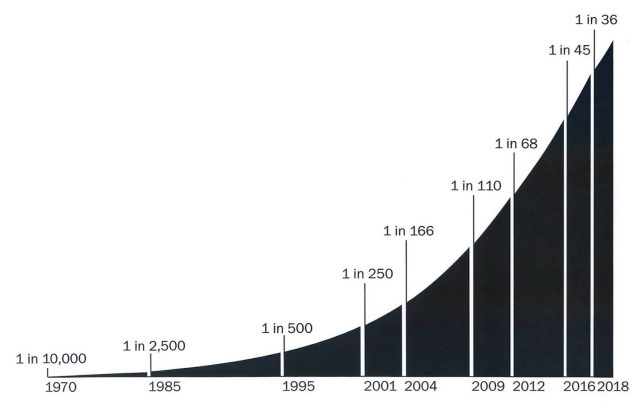
Source: Handley (2018).
Darold Treffert at Winnebago State Hospital in Wisconsin was one of the first people to attempt to measure autism in the general population. His study, published in Archives of General Psychiatry in 1970, showed an autism rate of less than 1 in 10,000 children.
Then, sometime around 1987, the autism rate in the United States began to skyrocket. By 2017, the autism rate in the U.S. was 1 in 36 kids (Zablotsky et al., 2017). So the U.S. has experienced a 277-fold increase in autism prevalence in the last 50 years.
In some places and populations the rates are even higher: in Tom’s River, NJ, the state’s largest suburban school district, 1 in 14 eight-year-olds is on the autism spectrum; in Newark, NJ, 1 in 10 Black boys is on the spectrum (forthcoming).
The United States is in the midst of a genocide.
Genetic theories of autism never made much sense because “there is no such thing as a genetic epidemic” — the human genome just does not change that fast. An early twin study by Susan Folstein and Michael Rutter at the Institute of Psychiatry in London in 1977 suggested a strong genetic component to autism. More recent scholarship shows that this was likely overstated; the study only had 21 twin pairs and did not effectively control for environmental factors (twins usually grow up in the same family and are thus likely exposed to the same toxicants).
As the autism rate exploded throughout the U.S., the state of California hired eleven of the best geneticists in the country to examine the role of genes in autism. They concluded that genetics explains at most 38% of autism cases and in two places they explained that this was likely an overestimate (Hallmayer et al., 2011). Whatever is driving the surge in autism prevalence, it is not primarily genetics.
Well perhaps the increase in autism prevalence is just the result of better awareness (and what’s called “diagnostic expansion and substitution”)? That theory of the case does not check out either. The state of California funded two multimillion dollar studies to examine sharply rising prevalence in the state and whether it was the result of social factors. The first study was led by pediatric epidemiologist Robert S. Byrd at UC Davis who directed a team of investigators at UC Davis and UCLA. The investigators concluded that, “The observed increase in autism cases cannot be explained by a loosening in the criteria used to make the diagnosis” and “children served by the State’s Regional Centers are largely native born and there has been no major migration of children into California that would explain the increase in autism” (Byrd et al., 2002).
The state of California revisited this question in 2009 with a study led by the top environmental epidemiologist in the state — Irva Hertz-Picciotto at the UC Davis Mind Institute. This study concluded that changes in diagnostic criteria, the inclusion of milder cases, and earlier age at diagnosis explain about a quarter to a third of the total increase in autism (Hertz-Picciotto & Delwiche, 2009). In a subsequent interview with Scientific American, Hertz-Picciotto explained that these three factors “don’t get us close” to explaining the sharp rise in autism over that time period and she urged the scientific community to take a closer look at environmental factors (Cone, 2009).
There are now seven good ‘societal cost of autism’ studies (Jarbrink and Knapp, 2001; Ganz, 2007; Knapp et al., 2009; Buescher et al., 2014; Leigh & Du, 2015; Cakir et al., 2020; Blaxill, Rogers, & Nevison, 2021). They all show that the U.S. and much of the developed world is heading for economic and social collapse as a result of surging autism costs.
Autism increases poverty and inequality. Lifetime care costs for autism range from $1.4 to $2.4 million. Mothers of kids with autism earn 35% less than mothers of kids with other health limitations and 56% less than mothers of kids with no health limitations (Buescher et al., 2014).
In 2015, autism cost the U.S. an estimated $268 billion a year in direct costs & lost productivity; given current rates of increase, autism costs will reach $1 trillion a year (3.6% of GDP) by 2025 (Leigh & Du, 2015). As a point of comparison, the U.S. Defense Department budget is “just” 3.1% of GDP.
All of the more recent studies show autism costs surpassing $1 trillion a year in the near future. There is no plan by any level of government to raise revenue to meet these costs or prevent autism to mitigate these costs. Elected officials are frozen like a deer in the headlights.
In the last decade, three groups of top epidemiologists have published consensus statements declaring that neurodevelopmental disabilities including autism are caused by toxicants in the environment (The Collaborative on Health and the Environment, 2008; Mount Sinai Hospital, 2010; Project TENDR, 2016).
This is good news because it means that autism is likely preventable. The bad news is that the leading mainstream toxicologists do not want to lose their jobs so they generally avoid mentioning pharmaceutical products (even though these products appear to have an outsized impact). Parents groups have made up for the cowardice of mainstream toxicology by funding their own research.
We have fairly good data that five classes of toxicants increase autism risk:
- Mercury from coal fired power plants and diesel trucks;
- Plastics;
- Pesticides & herbicides;
- EMF/RFR; and
- Pharmaceuticals (Tylenol, SSRIs, & vaccines).
Taking each toxicant in turn…
For every 1,000 pounds of environmentally released mercury, there was a 61% increase in the rate of autism (Palmer, 2006). For every 10 miles closer a family lives to a coal fired power plant the autism risk increases by 1.4% (Palmer, 2009).
Plastics: Children with autism had significantly increased levels of 3 endocrine disruptors (two phthalates — MEHP & DEHP, & BPA) in blood samples as compared with healthy controls (Kardas, 2016).
Pesticides & herbicides: Increased use of RoundUp is strongly correlated (r = 0.989) with the rising prevalence of autism (Swanson, 2014). Organophosphates increase autism risk 60 – 100%; chlorpyrifos increase risk 78% – 163%; pyrethroids increase risk 78% (Shelton et al., 2014).
9 studies show an association between acetaminophen (Tylenol) use & adverse neurodevelopmental outcomes (Bauer et al., 2018). Avella-Garcia (2016) & Liew et al. (2016) found that males exposed to Tylenol in utero have significantly elevated risk of autism.
8 studies show a statistically significant association between selective serotonin reuptake inhibitor (SSRI) use in pregnant women and subsequent autism in their children (see meta-analysis in Kaplan et al., 2016). Doctors who prescribe SSRIs to pregnant women are committing malpractice.
Unfortunately, in the debate over toxicants that increase autism risk, all roads lead back to vaccines. At least 5 studies show a statistically significant association between vaccines & autism (Gallagher & Goodman, 2008 & 2010; Thomas & Margulis, 2016; Mawson et al., 2017a & 2017b).
Dr. Paul Thomas is the most successful doctor in the world at preventing autism. Data from his practice show:
If zero vaccines, autism rate = 1 in 715;
If alternative vaccine schedule, autism rate = 1 in 440;
If CDC vaccine schedule, autism rate = 1 in 36.
That study had large sample size (3,344 children), access to medical files, and good researchers working on it. But look closely. His alternative vaccine schedule reduces autism risk by more than 1200%. However even an alternative vaccine schedule increases autism risk by 160% versus no vaccines at all.
And all of those other toxicants that I described above that have been shown to increase autism risk? Those are the 1 in the 715 cases when the parent does not vaccinate at all. Autism appears mostly be a story of iatrogenic injury from vaccines.
This is not a surprise. Thousands of parents have been telling us for years that their children regressed into autism following vaccinations. Ethylmercury is a known neurotoxin and is still in 7 different vaccines (Thomas & Margulis, 2016, p. 14).
Aluminum is a known neurotoxin (Grandjean & Landrigan, 2014) and is used in a majority of vaccines. “The dose makes the poison” paradigm has collapsed in recent years and now we know that many toxicants have no safe dose.
In a sane world, all of this would be seen as good news. In a sane world the CDC, EPA, NIH and every major newspaper would rush out to Portland, Oregon to examine whether the data from Dr. Paul’s practice (and other studies) are correct. But we live in an insane world…
To date, the CDC, EPA, NIH, the federal government, and all state governments have ignored Dr. Paul’s work. None of the top 10 major newspapers in the U.S. have reviewed his book, The Vaccine Friendly, plan even though it is a bestseller on Amazon. In fact the Oregon Medical Board was so incensed by Dr. Paul’s success in preventing autism that they pulled his medical license briefly in 2021 (he has since been reinstated).
All of this information is public and available to anyone with an internet connection and a library card. By 1999 it was clear that vaccines that contained mercury were a problem (see Kirby, 2005). By the early 2000s it was clear that the problems with vaccines went well beyond mercury. Government had a choice to make: come clean or double down. And starting with senior scientist Thomas Verstraeten and then William Thompson the CDC decided to just flat out lie, manipulate findings, and destroy data.
The pharmaceutical industry also had a choice to make: improve their products or utilize their extensive capture of media and government to protect their existing toxic products. As everyone now knows, they chose to protect their existing toxic products. But the pharmaceutical industry has an enormous problem on their hands. We know some vaccines (hepatitis B, HPV, flu, DTaP…) cause catastrophic harms. And pockets of unvaccinated people across the country — who are healthier than vaccinated children — are the control group that provides evidence of Pharma’s crimes.
So starting in 2015, with the introduction of SB277 in California, the pharmaceutical industry began a systematic effort to eliminate the unvaccinated control group in all 50 states. They start by removing religious or personal belief exemptions to vaccination. In subsequent years they introduce bills to eliminate all medical exemptions to vaccination (SB 277 in CA in 2019) to get to 100% vaccination rates (even though all scientists will tell you that there are some children who should not be vaccinated because of underlying health conditions). In the Pharma legislative blitzkrieg no one is spared so that there will be no evidence left of the harms from these products. If 100% of children are treated, then there is no background rate of illness and all vaccine injuries just appear “normal”.
These mandatory vaccine bills are racketeering and crimes against humanity. With the introduction of coronavirus vaccines in late 2020, the situation has gotten much worse. Pharma now aims to vaccinate 100% of adults as well as 100% of kids and the results thus far have been catastrophic.
So here’s where things stand. The vaccine paradigm has collapsed (and no, mRNA, DNA, and adenovirus vector vaccines are not going to save it). Pharma has piles of cash and extensive capture of the media, academia, and government. So they have the ability to do just about whatever they want. Fearing prosecution and seeking immense profits, Pharma has abandoned any pretense of science, consent, or health and pushed all in to set up a totalitarian state that will serve their interests.
But Pharma has harmed so many people — first with the childhood schedule and now with coronavirus vaccines — that there are now millions of people who have seen vaccine injury first-hand and are now fighting back with everything they’ve got. Variously referred to as the medical freedom movement, the health choice movement, and/or the personal sovereignty movement, these brave citizens are taking on the most powerful industry in the world and fighting to save our country from Pharma fascism. The fighting is so fierce because the stakes are enormous. We are fighting to preserve human life as we know it from the most predatory and corrupt industry in the world.
To learn more about the toxicants associated with autism, read The Political Economy of Autism. To learn more about the battle to save our country and the world from Pharma totalitarianism, please subscribe to my Substack.
US diplomats’ families ordered to leave Ukraine
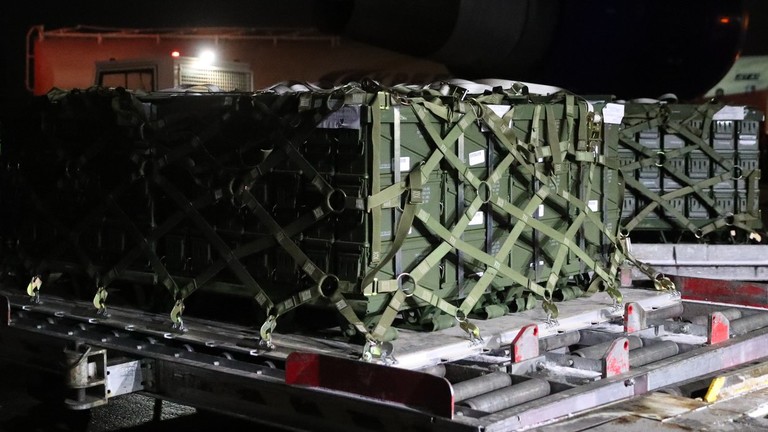
US lethal aid being unloaded at a Kiev airport. © Twitter / U.S. Embassy Kyiv
RT | January 24, 2022
The families of US diplomats have been ordered to leave Ukraine, while some embassy staffers were authorized to depart on a “voluntary” basis, according to an updated travel advisory that reiterated claims of a “continued threat of Russian military action.”
“There are reports Russia is planning significant military action against Ukraine,” the State Department said on Sunday, adding that it “authorized the voluntary departure of US direct hire employees (USDH) and ordered the departure of eligible family members (EFM).”
American citizens were once again strongly advised not to travel to Ukraine, while those already in the country were told to “consider departing now using commercial or other privately available transportation options.” The highest “Level 4: Do Not Travel” advisory for Ukraine, citing Covid and “increased threats from Russia,” has been in place on the Department of State website for more than a month.
The US had previously warned its citizens that they should not “anticipate that there will be US government-sponsored evacuations,” should a war take place in Ukraine, suggesting that they use the available commercial flights instead.
Moscow has repeatedly denied accusations that it’s planning an invasion of Ukraine, which have been made by the US and its allies since November last year, describing the claims as groundless attempts to instill “hysteria.”
According to the Kremlin, it’s the West that has been stirring tensions in Ukraine by supplying weapons to Kiev – which is embroiled in a “frozen” conflict with self-proclaimed republics in the southeastern Donbass region – and intensifying the NATO buildup in Eastern Europe.
Guardian: ANTI-VAXXERS ARE JOINING RACIST MILITIAS
OffGuardian | January 23, 2022
This Week in the New Normal is our weekly chart of the progress of autocracy, authoritarianism and economic restructuring around the world.
1. “ANTI-VAXXERS ARE JOINING RACIST MILITIAS”
We’ve covered the increasing demonisation of the “anti-vaxxers” regularly for over a year now. Ever since Joe Biden announced his new “domestic terrorism bill”, it was obvious that “Anti-vaxxers” were going to be re-branded as some kind of violent threat to democracy (and they were).
Now it’s happening in the UK too, with a story being published warning that “anti-vaxxers” are becoming more militant and there are fears they will “evolve towards US-style militias”, according to the Guardian.
The article references nameless “counter terrorism” officials and anonymous “Whitehall sources”, who warn that…
Latest intelligence assessments describe the anti-vaxxer movement as ostensibly a conveyor belt, delivering fresh recruits to extremist groups, including racially and ethnically motivated violent extremist organisations.
So there you have it, being anti-Covid “vaccines” is a gateway protest. Before you know it you’ll be shaving your head and sieg hieling all over the place.
Absolutely pathetic propaganda, and hopefully not an early warning sign of legislation to come.
2. “WHAT IF DEMOCRACY AND CLIMATE MITIGATION ARE INCOMPATIBLE?”
OK, this is from two weeks ago, but it’s too important to skip. The title says it all, Foreign Policy is genuinely wondering if climate change is too much of a threat to let democracy stand in the way of fighting it.
It’s a long read, soaked to the bone in double-talk and built on some very shaky assumptions, but there’s some good material on there…
Democracy works by compromise, but climate change is precisely the type of problem that seems not to allow for it. As the clock on those climate timelines continues to tick, this structural mismatch is becoming increasingly exposed. And as a result, those concerned by climate change—some already with political power, others grasping for it—are now searching for, and finding, new ways of closing the gap between politics and science, by any means necessary.
It warns in the opening section, before concluding…
… democracy, in its current form, is not necessarily the path to a solution. It might, instead, be part of the problem.
It’s not hard to see where this is going. We warned, several times, that we would be moving on from Covid to climate, and that “climate lockdowns” were a very real possibility. This kind of talk is setting the groundwork for that movement.
3. ‘MORE PEOPLE IS THE LAST THING THIS PLANET NEEDS’
Another from the Guardian, this time interviewing all the hip and happening young men who are “getting vasectomies to save the world”
It’s about the climate. Again.
Apparently, there are already too many people (that’s not true, but whatever), and so young men are getting the snip. Bravely preventing placing the burden of climate catastrophe onto the next generation… by making sure there isn’t one.
One of the (anonymous, and therefore potentially made-up) interviewees went right out cut his balls off the week Donald Trump was elected. That’ll show ’em.
But wait… It’s not just about climate, it’s also about feminism.
Specifically, it’s about correcting the “gender imbalance” traditionally associated with birth control:
Vasectomies address the gender imbalance that still accompanies the choice and practice of birth control. They come with less risk than more invasive and less reliable methods of female contraception, including sterilisation and the coil.
They are genuinely arguing that making yourself sterile forever is less risky and less invasive than having a completely 100% reversible IUD inserted.
Then they start bemoaning that vasectomies can be “hard to come by, especially for younger, childless men“. NHS GPs are apparently reticent to simply sterilise perfectly healthy young men for no good reason:
While there are no laws on the age at which men in the UK can get a vasectomy, the NHS advises that they may be more likely to be accepted if they are older than 30 and have children. “Your GP can refuse to carry out the procedure … if they don’t believe it’s in your best interests,”
Not only that, but the NHS has cut funding to for vasectomies, and perhaps as a result of this, vasectomy numbers are down nationwide. The Guardian want us to think this is a bad thing, but considering the UK’s birth rate has been falling for decades, it might not be.
Nevertheless, there is hope that “world vasectomy day”, and its links to the fight against climate change, will help “burnish” the vasectomy’s progressive image.
The story ends with inspiring words from one of the voluntarily snipped…
“A lot of people are happy to point and say: ‘That’s wrong,’ or film it on their phone… I look at the world and say: ‘That’s not right; I’m going to try to do something about it.’”
A wonderful attitude. I hope he can pass that wisdom on to his children and his children’s children.
… oh, wait.
BONUS: (NEW) HELLHOLE OF THE WEEK
Not Australia this time, well done guys.
This time it’s New Zealand, where Prime Minister Jacinda Ardern has just put in place strict new rules to “combat” the spread of Omicron.
Starting today, the whole of the country will move into the red on New Zealand’s “traffic light” system, meaning mandatory masks, lockdowns for the unvaccinated and an increased self-isolation period of 24 days.
How many cases prompted this decision? Nine.
Nine Covid cases in Motueka are confirmed to have the Omicron variant, prompting the decision, Ardern said.
Australia has been pretty aggressive in the game of “anything you can do, I can do worse” they have going with both New Zealand and Canada, so expect a move from them sometime this week.
IT’S NOT ALL BAD…
Yesterday marked 2022’s first “Worldwide Freedom Rally”, with marches taking place all over the world, from London to Bern, to Vancouver to Warsaw to Liverpool to Genoa.
Bilbao, Graz, Brisbane. The list goes on and on and on.
Huge crowds turned out in Toronto… Stockholm… and Sydney.
In London NHS staff threw down their uniforms in front of Downing Street.
These are the people who they want to classify as domestic terrorists and militias.
Also, someone also sent us this sign, which is our new favourite:
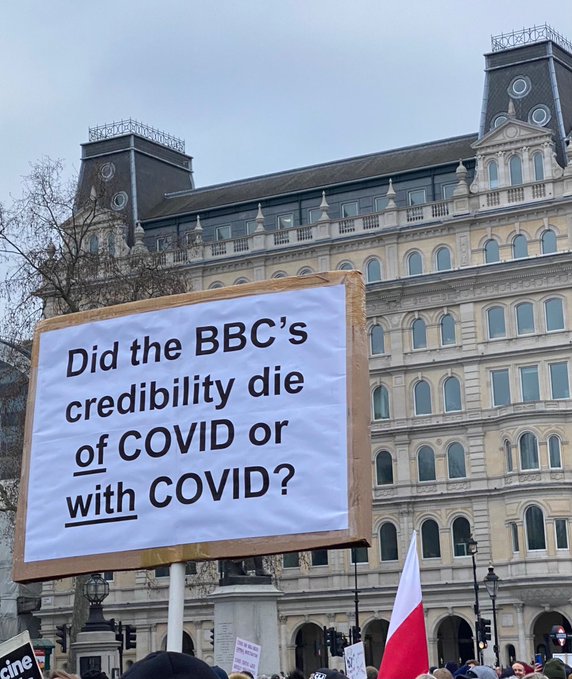
All told a pretty hectic week for the new normal crowd, and we didn’t even mention that the world’s ten richest men have doubled their fortunes during the pandemic or the Fed’s report on a digital dollar.
Yemen to keep up counterstrikes until the end of invasion: Ansarullah official
Press TV – January 23, 2022
A senior Yemeni official vows that the country will keep up its counteroffensives until its complete liberation from the scourge of a United States-backed and Saudi-led invasion and siege.
Mohammed al-Bukhaiti, a member of the Yemeni popular resistance Houthi Ansarullah movement’s Political Bureau, made the remarks on Sunday in an exclusive interview with Iran’s al-Alam Arabic-language television network.
Saudi Arabia and several of its allies have been attacking Yemen, the Arab world’s poorest nation, since March 2015 in an unsuccessful bid to change its ruling structure in favor of its former Riyadh-aligned regime.
The war, and an ensuing siege that the aggressors have been employing, has killed hundreds of thousands of Yemenis and turned the entire Yemen into the scene of the world’s worst humanitarian crisis.
The Yemeni forces that feature the Yemeni army and its allied fighters from the Popular Committees have, however, vowed not to lay down their arms until the expulsion of all foreign forces.
“Yemen’s operations against the countries of the [invading] coalition will continue at the domestic and overseas levels until the coalition stops its attacks and ends the blockade,” al-Bukhaiti said.
Invaders’ systematic denial
The invading countries are trying to deflect the international public opinion from their atrocities through a number of methods, he noted.
“They first deny any responsibility for their crimes, but later admit their involvement only to say they are going to investigate the atrocities,” said the official.
Al-Bukhaiti, meanwhile, rebuffed the invaders’ claims that they are attacking the impoverished country to retaliate for the Yemeni forces’ operations.
He said the aggressors took Yemen under heavy bombardment throughout the first three years of the war, during which the country did not have the deterrent power that it is using now to return the Saudi-led offensives.
“The invaders used to commit such crimes from the very first day of the invasion for three [consecutive] years,” long before Yemen became able to retaliate the aggression with ballistic missiles and drones, the Ansarullah official said.
He also hailed that the counterattacks had managed to force the invaders to reduce the number of their military assaults.
‘US, Zionists support aggressors’
“Those who support the invading countries, including Saudi Arabia and the UAE [in their crimes against the Yemeni people], are the United States and the Israeli regime, which are bereft of all human values,” al-Bukhaiti said.
The atrocities are being perpetrated to force Yemen to surrender and devolve into a vassal state, he added.
“But we tell them that these atrocities will have the opposite result” because they would prompt more Yemeni soldiers to join the battlefront against the aggressors, the official concluded.
An Amateur Look At “Russian Build Up” Photographic Evidence
By Walrus | Turcopolier | January 22, 2022
Western Media talk knowledgeably about a “Russian Build Up on the Border with Ukraine”. These stories are often accompanied by one of two satellite images which purport to show evidence of the same.
The first of these, as used by Politico, correctly identifies the location of this vehicle park as Yelnya. However the image is cropped so you cannot see the extensive barracks and infrastructure which identify this as a permanent military base constructed no later than 2016. Furthermore Politico defines “near” the Ukraine border as within 150 miles for that is Yelnyas distance from it.
The second image used is located at Soloti – again the image is cropped so the extensive permanent barracks and infrastructure are excluded. This base is about 30km from the Ukraine border but it has been there since 2005!
Details of the formations based at these locations are available here:
https://www.gfsis.org/maps/russian-military-forces
I have not included details of the sizes of the ammunition dumps that would be required to support any “invasion” of Ukraine. They would stick out a mile but are invisible today.
IMO, the “Russian Build Up” story is rubbish.
Secret of ‘microwave weapons’ targeting US diplomats revealed
By Paul Robinson | RT | January 23, 2022
US diplomats and security officials suffering from a spate of unexplained health problems were victims of Russian microwave weapons, we were told time and time again. But now the CIA admits Moscow wasn’t actually behind “Havana Syndrome.” The story fits a disturbingly familiar pattern of misinformation.
With each passing week, the list of discredited allegations against Russia grows and grows. Time and time again, Western governments and the media have sprung into action to inform us of some new evil plot, only to backpedal later when it became clear that there was nothing to it.
Take, for instance, the multi-year saga that was Russiagate, built on the idea that Donald Trump was a Russian agent. There are still some believers, but for the most part people lost interest once it became clear that it was a load of baloney and that the “Steele Dossier” that sparked it off wasn’t worth the paper it was written on.
Then there were the claims that Russia was arming the Taliban, that it had inserted malware into the Vermont electrical grid, that it had bankrolled Brexit via British businessman Arron Banks, and so on. All are now discredited.
Yet the allegations keep on coming. A case in point is the story of Havana Syndrome, which was in the news again this week. For those of you who have missed it, Havana Syndrome is the name given to mysterious symptoms experienced by hundreds of American diplomats and CIA agents around the world, including “headaches, fatigue, hearing and vision loss, severe and debilitating cognitive impairment, tinnitus, brain fog, vertigo, and loss of motor control.”
Such a wide set of symptoms casts immediate doubt on whether there is a single cause. Nevertheless, speculation soon ran rife that they were all examples of a single “syndrome,” and that American diplomats were being targeted by some sort of unknown microwave emitter designed to fry peoples’ brains.
After examining four possible causes of Havana Syndrome – infection, chemicals, psychological factors, and microwave energy – a US government report concluded that “directed pulse RF [radio frequency] energy… appears to be the most plausible mechanism.” Havana Syndrome was “real, and it is serious,” remarked CIA Director William Burns, adding that there was a “very strong possibility” that it was the result of intentional actions.
Who might be doing such a thing? In public, US government officials avoided naming names, admitting that they lacked the evidence to do so. In private, however, the finger was pointed firmly at the Russian Federation, a charge rapidly amplified by the international media.
Thus the New York Times reported that officials “familiar with the report” mentioned above said that the country behind the “attacks” was Russia. CIA veteran Lewis Regenstein claimed that Russian/Soviet attacks of this sort had been going on since the 1950s, penning an article for the Washington Times headlined “68 years of Russian microwave radiation attacks on Americans with impunity.” “Russians use ‘secret microwave weapon’ to target American spies across the globe,” claimed The Sun. And so on. The media had made its mind up – Russia was to blame.
Why the Russian secret services might be doing this has never been explained, with some experts speculating that Havana Syndrome was the result of deliberate attacks, and others believing that the harm to humans was an unintended side effect of some scanning machine designed to extract intelligence from diplomats’ electronic devices. Either way, the Russians were responsible, even though not the slightest jot of evidence in support of this thesis has ever been publicly produced.
It didn’t take long, though, for skeptics to come up with other theories. One was that the syndrome was caused by the loud noise made by crickets. Support for this theory later came in a report commissioned by the US State Department that concluded crickets were the most likely culprits in 21 recorded cases.
Late last year, another theory emerged. Havana Syndrome was “a mass psychogenic illness,” a group of US scientists decided. It was, they said, an example of the “nocebo effect,” the opposite of the placebo effect. In this, expectations of something negative happening to one’s health causes something negative to happen. After the initial incident in Cuba, US diplomats were told to look out for “anomalous health” issues, and as a result they started feeling them. In effect, it was all in their heads.
Whatever the truth, the story of Russian microwave weapons continued to gain traction. But it now seems that even the CIA is having doubts. According to reports this Thursday,
“In a new intelligence assessment, the CIA has ruled out that the mysterious symptoms known as Havana Syndrome are the result of a sustained global campaign by a hostile power aimed at hundreds of US diplomats and spies, six people briefed on the matter told NBC News.
In about two dozen cases, the agency cannot rule out foreign involvement, including many of the cases that originated at the US Embassy in Havana beginning in 2016. Another group of cases is considered unresolved. But in hundreds of other cases of possible symptoms, the agency has found plausible alternative explanations, the sources said.
The idea that widespread brain injury symptoms have been caused by Russia or another foreign power targeting Americans around the world, either to harm them or to collect intelligence, has been deemed unfounded, the sources said.”
Oh dear! How embarrassing. For sure, there are still a few cases in which the cause of illness remains unknown and so foreign involvement “cannot be ruled out.” But that is hardly evidence for ruling it in. This latest assessment knocks the “Russia done it” narrative for six.
In short, once again we found that we’ve been fed a tissue of lies. By now, we should hardly be surprised, but the whole affair speaks to the credulity of much of our political and media establishment, and to the need for a much more cautious and evidence-based approach to allegations of wrongdoing.
It’s common nowadays to complain of the public’s lack of trust in traditional political and media institutions. One of the reasons for this is that people have become skeptical of the old “gatekeepers” of the truth due to their tendency to shout wolf at every available opportunity. If people believe disinformation coming from newer sources, it’s because they’ve become disenchanted by the misinformation coming from the old ones. The latter are under threat, but they have only themselves to blame.
Paul Robinson is a professor at the University of Ottawa. He writes about Russian and Soviet history, military history and military ethics, and is author of the Irrussianality blog.
News the BBC couldn’t ignore as top doctors demand jab mandates are ditched
By Will Jones | TCW Defending Freedom | January 23, 2022
THE NHS vaccine mandate should be cancelled to prevent staff shortages, the Royal College of GPs has said, as thousands took to the streets across England to protest against the policy. The BBC reported:
‘NHS workers who oppose the Government’s mandatory vaccination policy have staged a protest in central London.
‘Demonstrations were also held in other cities across England including Manchester, Birmingham and Leeds.
‘Martin Marshall, Chairman of the Royal College of GPs, said compulsory vaccination for health professionals in England was “not the right way forward”.
He said the vast majority of staff were vaccinated but some 70,000 to 80,000 were not and they accounted for 10 per cent of staff at some hospital or GP surgeries.
If unvaccinated staff were taken out of frontline roles by April 1st there would be “massive consequences” for the NHS, he told BBC Radio 4’s Today programme.
‘He said a delay would allow time for booster jabs and a “sensible conversation” about whether vaccines should be mandatory at all.
‘Danny Mortimer, deputy chief executive of the NHS Confederation, said some frontline staff would have to leave their roles if they choose not to be vaccinated.
‘He said: “This will reduce frontline NHS staff numbers even further and lead to more gaps in capacity at a time of intense pressure and patient demand.”
‘In London, demonstrators marched from Regents Park to the BBC headquarters in Portland Place in a peaceful protest against mandating vaccines for health workers.’
Update:
The Telegraph and Daily Mail report that mandatory vaccines for NHS staff could now be pushed back by six months, following these nationwide protests over the requirement and amid demands by Tory backbenchers to drop the rule entirely.
The Emergency Must Be Ended, Now

BY HARVEY RISCH, JAYANTA BHATTACHARYA, PAUL ELIAS ALEXANDER | BROWNSTONE INSTITUTE | JANUARY 23, 2022
The time has come to terminate the pandemic state of emergency. It is time to end the controls, the closures, the restrictions, the plexiglass, the stickers, the exhortations, the panic-mongering, the distancing announcements, the ubiquitous commercials, the forced masking, the vaccine mandates.
We don’t mean that the virus is gone – omicron is still spreading wildly, and the virus may circulate forever. But with a normal focus on protecting the vulnerable, we can treat the virus as a medical rather than a social matter and manage it in ordinary ways. A declared emergency needs continuous justification, and that is now lacking.
Over the last six weeks in the US, the delta variant strain – the most recent aggressive version of the infection – has according to CDC been declining in both the proportion of infections (60% on December 18 to 0.5% on January 15) and the number of daily infected people (95,000 to 2,100). During the next two weeks, delta will decline to the point that it essentially disappears like the strains before it.
Omicron is mild enough that most people, even many high-risk people, can adequately cope with the infection. Omicron infection is no more severe than seasonal flu, and generally less so. A large portion of the vulnerable population in the developed world is already vaccinated and protected against severe disease. We have learned much about the utility of inexpensive supplements like Vitamin D to reduce disease risk, and there is a host of good therapeutics available to prevent hospitalization and death should a vulnerable patient become infected. And for younger people, the risk of severe disease – already low before omicron – is minuscule.
Even in places with strict lockdown measures, there are hundreds of thousands of newly registered omicron cases daily and countless unregistered positives from home testing. Measures like mandatory masking and distancing have had negligible or at most small effects on transmission. Large-scale population quarantines only delay the inevitable. Vaccination and boosters have not halted omicron disease spread; heavily vaccinated nations like Israel and Australia have more daily cases per capita than any place on earth at the moment. This wave will run its course despite all of the emergency measures.
Until omicron, recovery from Covid provided substantial protection against subsequent infection. While the omicron variant can reinfect patients recovered from infection by previous strains, such reinfection tends to produce mild disease. Future variants, whether evolved from omicron or not, are unlikely to evade the immunity provided by omicron infection for a long while. With the universal spread of omicron worldwide, new strains will likely have more difficulty finding a hospitable environment because of the protection provided to the population by omicron’s widespread natural immunity.
It is true that – despite emergency measures — hospitalization counts and Covid-associated mortality have risen. Since mortality tends to trail symptomatic infection by about 3-4 weeks, we are still seeing the delta strain’s remaining effects and the waning of vaccine immunity against serious outcomes at 6-8 months after vaccination. These cases should decline over time as delta finally says goodbye. It is too late to alter their course with lockdowns (if that were ever possible).
Given that omicron, with its mild infection, is running its course to the end, there is no justification for maintaining emergency status. The lockdowns, personnel firings and shortages and school disruptions have done at least as much damage to the population’s health and welfare as the virus.
The state of emergency is not justified now, and it cannot be justified by fears of a hypothetical recurrence of some more severe infection at some unknown point in the future. If such a severe new variant were to occur – and it seems unlikely from omicron – then that would be the time to discuss a declaration of emergency.
Americans have sacrificed enough of their human rights and of their livelihoods for two years in the service of protecting the general public health. Omicron is circulating but it is not an emergency. The emergency is over. The current emergency declaration must be canceled. It is time.
Authors
Harvey Risch is Professor of Epidemiology in the Department of Epidemiology and Public Health at the Yale School of Public Health and Yale School of Medicine. Dr. Risch received his MD degree from the University of California San Diego and PhD from the University of Chicago. After serving as a postdoctoral fellow in epidemiology at the University of Washington, Dr. Risch was a faculty member in epidemiology and biostatistics at the University of Toronto before coming to Yale.
Jay Bhattacharya, Senior Scholar of Brownstone Institute, is a Professor of Medicine at Stanford University. He is a research associate at the National Bureau of Economics Research, a senior fellow at the Stanford Institute for Economic Policy Research, and at the Stanford Freeman Spogli Institute.
Dr Alexander holds a PhD. He has experience in epidemiology and in the teaching clinical epidemiology, evidence-based medicine, and research methodology. Dr Alexander is a former Assistant Professor at McMaster University in evidence-based medicine and research methods; former COVID Pandemic evidence-synthesis consultant advisor to WHO-PAHO Washington, DC (2020) and former senior advisor to COVID Pandemic policy in Health and Human Services (HHS) Washington, DC (A Secretary), US government; worked/appointed in 2008 at WHO as a regional specialist/epidemiologist in Europe’s Regional office Denmark, worked for the government of Canada as an epidemiologist for 12 years, appointed as the Canadian in-field epidemiologist (2002-2004) as part of an international CIDA funded, Health Canada executed project on TB/HIV co-infection and MDR-TB control (involving India, Pakistan, Nepal, Sri Lanka, Bangladesh, Bhutan, Maldives, Afghanistan, posted to Kathmandu); employed from 2017 to 2019 at Infectious Diseases Society of America (IDSA) Virginia USA as the evidence synthesis meta-analysis systematic review guideline development trainer; currently a COVID-19 consultant researcher in the US-C19 research group.
Featured Video

Yemen joins the war – Red Sea could be blocked next – Saudi regime at risk
or go to
Aletho News Archives – Video-Images
From the Archives
Should Europeans ‘Thank’ the Americans for Destroying Nord Stream?
By Robert Bridge | Strategic Culture Foundation | September 29, 2022
With an investigation continuing into the destruction of the Nord Stream gas pipeline that provided energy supplies to Europe from Russia, there appears to be just one prime suspect, and that should surprise nobody.
Following the sabotage of the Nord Stream 1 and 2 gas pipelines, former Polish Foreign Minister Radoslaw Sikorski already seemed to know the identity of the perpetrator when he tweeted out: “Thank you, USA.”
At first glance, it seemed that Sikorski was speaking sarcastically, berating Washington for carrying out an attack that will have severe repercussions for the people of Europe. After all, how could anyone see any good coming from the termination of Europe’s primary source of gas reserves with winter just around the corner? It was Sikorski’s homeland of Poland, after all, that urged its citizens to collect firewood in the face of dwindling gas reserves.
In fact, the Polish diplomat was speaking one-hundred percent literally… continue
Blog Roll
 Aletho News
- Growing insecurity, soaring prices fuel protests in north as regime bans evacuation: Sources
- Iran denies responsibility for ‘depraved’ attack on Kuwait desalination plant
- Bring The Troops Back. End This War Now!
- Can we please stop calling Israel the ‘only democracy in the Middle East’ now?
- US should start removing its troops for Germany, proposes AfD co-leader Chrupalla
- Iran Red Crescent: 600 educational centers attacked in US-Israeli ‘war crimes’
- Russian Oil Tanker Arrives in Cuba Amid U.S. Blockade
- America Racing to Strategic Defeat in Iran: Lt Col Daniel Davis
- FTC Warns Visa, Mastercard, PayPal, Stripe Over Political Debanking
- Russian tanker approaches Cuba despite US oil blockade
- If Americans Knew
- Israeli police block Catholic cardinal from entering Church of the Holy Sepulchre on Palm Sunday
- Israel is assassinating journalists again, more than any other nation, anywhere, ever – Not a ceasefire Day 170
- Over 300 US service members wounded, majority have brain injuries – Not a ceasefire Day 169
- Researchers at Human Rights Watch Resign Over Blocked Report on Palestinian Refugee Return
- Jewish Groups Are Backing a War Americans Don’t Want
- Eric Fingerhut Thinks He’s the President of the Jews
- Top Jewish Philanthropists, Rabbis Urge Israeli President to Take Action Against ‘Jewish Extremists’
- Don’t Be Fooled. Zionist Leaders Have Always Wanted to Control Southern Lebanon
- Israel’s widespread use of torture is a core element of its genocide against the Palestinian people
- In Israel’s War on Iran, Many Middle East US Bases Rendered “All But Uninhabitable”
- No Tricks Zone
- New Study Finds Warming Saves Lives…Cold Temperatures 12 Times More Deadly Than Excess Heat
- German Science Blog Accuses PIK Climate Institute Of Hallucinating Climate Tipping Points
- Devastating Assessment Of Comirnaty Vaccine By Former Senior Pfizer Europe Toxicologist
- New Study: CO2 Is ‘Effectively Negligible’ As An Explanatory Climate Change Factor Since 2000
- Former Pfizer Toxicologist Dr. Helmut Sterz Tells Bundestag Hearing Pfizer Vaccine Should Have Never Been Approved
- Energy Expert: Germany’s Nuclear Phaseout Was A “500 Billion Euro Mistake”
- New Research: South Australia’s Mid-Holocene Sea Surface Temperatures Were 4°C Warmer Than Today
- Storing Green Energy To Last Germany 10 Days Would Require A 60-Million Tonne Battery
- New Studies: UK Sea Levels Were 4 Meters Higher Than Today During The Mid-Holocene
- Destructive Green New Deal: German Energy And Metal Group Warns Of Drastic Crisis
 Aletho News