If Hospitals Are Currently Under Pressure, They Only Have Themselves to Blame
By In-house doctor | The Daily Sceptic | April 10, 2022
There follows a guest post by our in-house doctor, a former senior NHS medic, who says the latest ‘perfect storm’ causing pressure on the health service in parts of the country is more a self-induced squall.
In the middle of last week, several NHS Trusts issued warnings about the acute strain their services were under. The South Central Ambulance Service went so far as to declare a critical incident – normally reserved for a situation in which demands on the service exceed the capacity to manage those demands. I was surprised that so many NHS bodies spread over a wide geographical area issued public warnings about their failure to cope at the same time. Statements referred to high demand on services (hardly news) and lacked any specific detail about critical capacity constraints. Accordingly, the Daily Sceptic asked me to interrogate the available data to work out the extent to which a Covid resurgence might be responsible for the latest ‘perfect storm’ to hit the NHS.
Graph 1 shows daily admissions of Covid positive patients from the community. Admissions have risen in the last few weeks, but seem to be tailing off. Data from Graph 1 have been the subject of hysterical articles in the mainstream press implying the latest Omicron BA.2 subvariant may be triggering a new wave of acute Covid infections. It’s not sensible to interpret Graph 1 as a stand-alone figure without considering contextual information from other datasets.
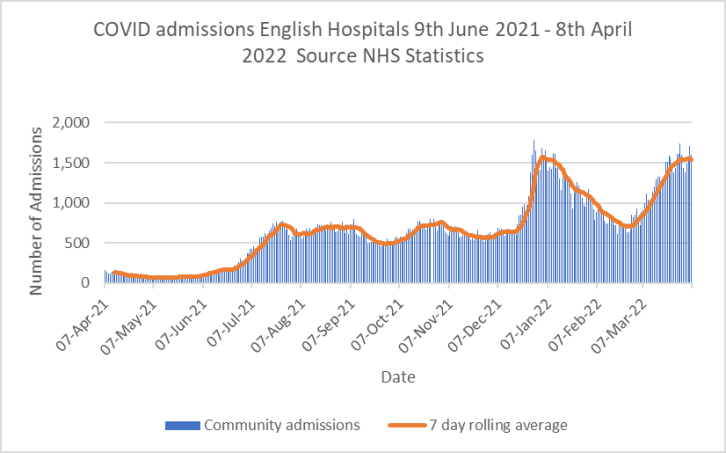
Graph 1
Graph 2 for example shows information from the Primary Diagnosis dataset. Regular readers will recall this set shows the numbers of patients admitted suffering from acute Covid compared to the patients testing positive for Covid but admitted for another condition. The grey line shows the ratio is gradually falling – in other words the headline figures in Graph 1 are misleading, because nearly 60% of those patients are not actually ill with Covid but admitted for other reasons.
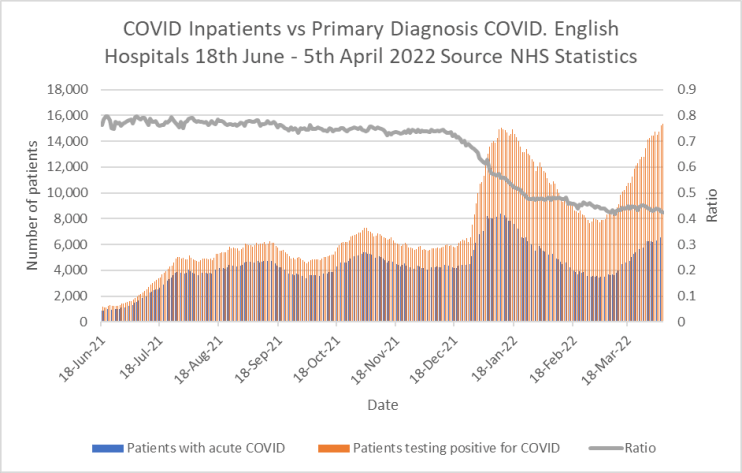
Graph 2
Graph 3 shows the numbers of patients testing positive for Covid in intensive care departments. The rise in cases seen in Graph 1 since the beginning of March 2022 is absent – so although there are more hospital inpatients testing positive for Covid than at the end of February, they are not ending up in critical care. Further, the data from the most recent ICNARC report reveal that the latest tranche of Covid ICU patients have lower oxygen requirements and better respiratory ratios than the cohort from this time last year – in other words, they are not as acutely ill.
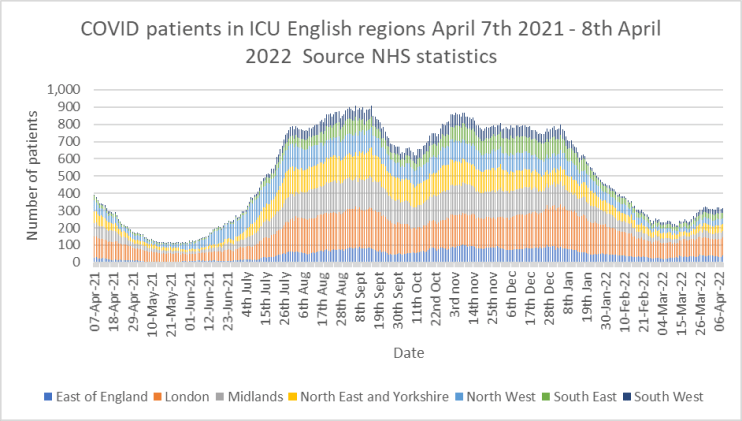
Graph 3
Graph 4 is very instructive. It shows the average length of stays of Covid patients up to the end of December 2021. This data was released in March and unfortunately is only complete up to the end of 2021, but it is reasonable to infer that current length of stay is unlikely to be worse now than in December of 2021, due to increased availability of new monoclonal antibody drugs which reduce disease severity for the highest risk patients. Graph 4 expresses average length of stay as the mean average (blue bars) and the median average (orange bars). Both these averages are steadily reducing with the median length of stay being down to four days by the end of December 2021. For the information of statistically curious readers, the median average in this case is probably more representative of the situation as the mean average can easily be skewed to the upside by a small number of very long-stay patients.
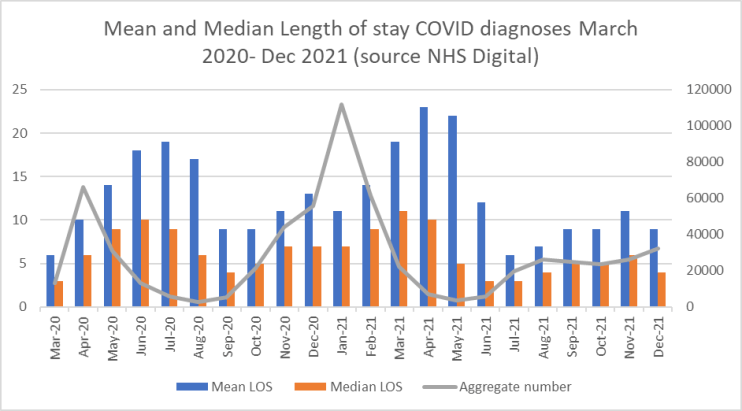
Graph 4
Overall, from the available Covid-specific patient data, we see a rise in total positive Covid tests on admission from the community, but fewer than half of these patients are symptomatic for Covid. Very few patients are ill enough to need ICU care and the length of stay for acutely ill Covid patients continues to fall. The vast majority require a few days of supplementary oxygen, intravenous steroids and monoclonal antibody infusion (or other adjunctive therapies) before being fit to discharge. So where is the problem?
Last week Saffron Cordery, deputy CEO of NHS providers, commented that staff absences played a part in the current crisis. Graph 5 shows the data for Covid related staff absences up to March 2nd (the latest figures released) – they don’t seem to have changed much lately and were on a downward trend since the turn of the year. It’s possible they may have started to increase again, but the figures are not yet released for public scrutiny.
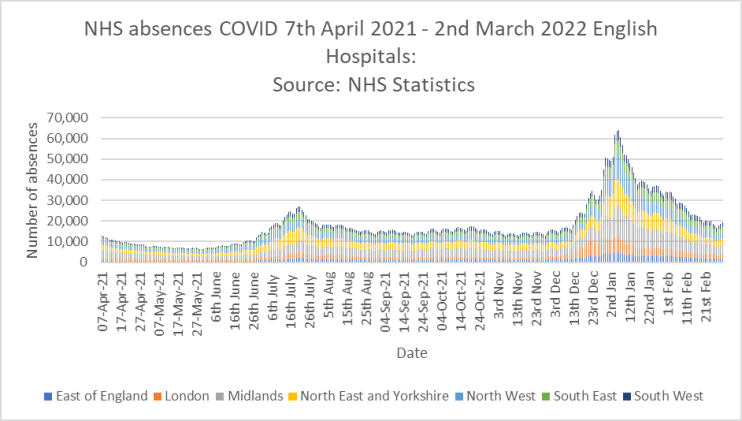
Graph 5
My personal suspicion is that Graph 6 shows the main issue causing trouble in hospitals. Graph 6 shows the number of patients in hospitals deemed medically fit for discharge. It is shown as a stacked bar chart, so the blue bar represents the patients who actually were discharged and the orange bar shows patients who were fit for discharge but had to remain in hospital for administrative reasons (often referred to as ‘bed blocking’). Readers will readily notice the ‘weekend effect’ in the figures, and that about 11,000 patients per day are in hospital when they are fit to be discharged – about 10% of the total NHS bed stock.
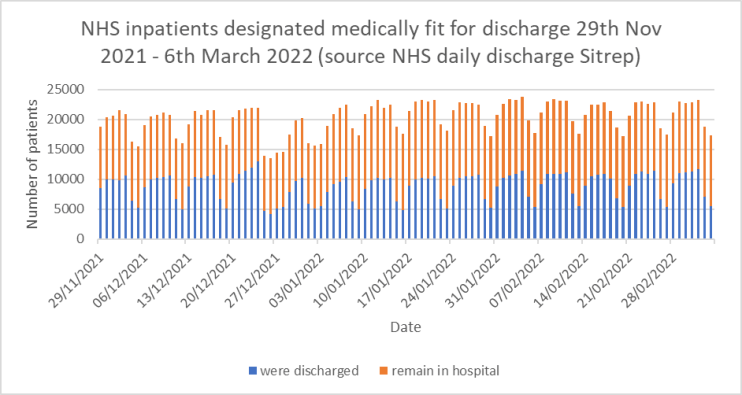
Graph 6
Over two years into the pandemic, the NHS does not yet seem to have solved fundamental administrative problems in relation to patient flow through the system. I am also aware from personal communication with colleagues that most NHS trusts are still imposing unnecessary Covid protocols which add to the time taken to complete basic episodes of care such as routine operations. This reduces efficiency still further in a healthcare system not renowned for operational efficiency in the first place.
Speaking about the latest crisis, Mark Ainsworth, Director of Operations at the South Central Ambulance Service, said declaring a critical incident meant it could focus its resources on the neediest patients.
Discharging medically fit patients from hospital and exercising a modicum of common sense when compiling Standard Operating procedures might achieve the same effect.
Putting Big Pharma on Trial in the COVID-19 Era, Part 4
The Hypocrisy of “Misinformation”
By Rebecca Strong · February 16, 2022
I find it interesting that “misinformation” has become such a pervasive term lately, but more alarmingly, that it’s become an excuse for blatant censorship on social media and in journalism. It’s impossible not to wonder what’s driving this movement to control the narrative. In a world where we still very clearly don’t have all the answers, why shouldn’t we be open to exploring all the possibilities? And while we’re on the subject, what about all of the COVID-related untruths that have been spread by our leaders and officials? Why should they get a free pass?
Fauci, President Biden, and the CDC’s Rochelle Walensky all promised us with total confidence the vaccine would prevent us from getting or spreading COVID, something we now know is a myth. (In fact, the CDC recently had to change its very definition of “vaccine ” to promise “protection” from a disease rather than “immunity”— an important distinction). At one point, the New York State Department of Health (NYS DOH) and former Governor Andrew Cuomo prepared a social media campaign with misleading messaging that the vaccine was “approved by the FDA” and “went through the same rigorous approval process that all vaccines go through,” when in reality the FDA only authorized the vaccines under an EUA, and the vaccines were still undergoing clinical trials. While the NYS DOH eventually responded to pressures to remove these false claims, a few weeks later the Department posted on Facebook that “no serious side effects related to the vaccines have been reported,” when in actuality, roughly 16,000 reports of adverse events and over 3,000 reports of serious adverse events related to a COVID-19 vaccination had been reported in the first two months of use.
One would think we’d hold the people in power to the same level of accountability — if not more — than an average citizen. So, in the interest of avoiding hypocrisy, should we “cancel” all these experts and leaders for their “misinformation,” too?
Vaccine-hesitant people have been fired from their jobs, refused from restaurants, denied the right to travel and see their families, banned from social media channels, and blatantly shamed and villainized in the media. Some have even lost custody of their children. These people are frequently labeled “anti-vax,” which is misleading given that many (like the NBA’s Jonathan Isaac) have made it repeatedly clear they are not against all vaccines, but simply making a personal choice not to get this one. (As such, I’ll suggest switching to a more accurate label: “pro-choice.”) Fauci has repeatedly said federally mandating the vaccine would not be “appropriate” or “enforceable” and doing so would be “encroaching upon a person’s freedom to make their own choice.” So it’s remarkable that still, some individual employers and U.S. states, like my beloved Massachusetts, have taken it upon themselves to enforce some of these mandates, anyway. Meanwhile, a Feb. 7 bulletin posted by the U.S. Department of Homeland Security indicates that if you spread information that undermines public trust in a government institution (like the CDC or FDA), you could be considered a terrorist. In case you were wondering about the current state of free speech.
The definition of institutional oppression is “the systematic mistreatment of people within a social identity group, supported and enforced by the society and its institutions, solely based on the person’s membership in the social identity group.” It is defined as occurring when established laws and practices “systematically reflect and produce inequities based on one’s membership in targeted social identity groups.” Sound familiar?
As you continue to watch the persecution of the unvaccinated unfold, remember this. Historically, when society has oppressed a particular group of people whether due to their gender, race, social class, religious beliefs, or sexuality, it’s always been because they pose some kind of threat to the status quo. The same is true for today’s unvaccinated. Since we know the vaccine doesn’t prevent the spread of COVID, however, this much is clear: the unvaccinated don’t pose a threat to the health and safety of their fellow citizens — but rather, to the bottom line of powerful pharmaceutical giants and the many global organizations they finance. And with more than $100 billion on the line in 2021 alone, I can understand the motivation to silence them.
The unvaccinated have been called selfish. Stupid. Fauci has said it’s “almost inexplicable” that they are still resisting. But is it? What if these people aren’t crazy or uncaring, but rather have — unsurprisingly so — lost their faith in the agencies that are supposed to protect them? Can you blame them?
Citizens are being bullied into getting a vaccine that was created, evaluated, and authorized in under a year, with no access to the bulk of the safety data for said vaccine, and no rights whatsoever to pursue legal action if they experience adverse effects from it. What these people need right now is to know they can depend on their fellow citizens to respect their choices, not fuel the segregation by launching a full-fledged witch hunt. Instead, for some inexplicable reason I imagine stems from fear, many continue rallying around big pharma rather than each other. A 2022 Heartland Institute and Rasmussen Reports survey of Democratic voters found that 59% of respondents support a government policy requiring unvaccinated individuals to remain confined in their home at all times, 55% support handing a fine to anyone who won’t get the vaccine, and 48% think the government should flat out imprison people who publicly question the efficacy of the vaccines on social media, TV, or online in digital publications. Even Orwell couldn’t make this stuff up.

Photo credit: DJ Paine on Unsplash
Let me be very clear. While there are a lot of bad actors out there — there are also a lot of well-meaning people in the science and medical industries, too. I’m lucky enough to know some of them. There are doctors who fend off pharma reps’ influence and take an extremely cautious approach to prescribing. Medical journal authors who fiercely pursue transparency and truth — as is evident in “The Influence of Money on Medical Science,” a report by the first female editor of JAMA. Pharmacists, like Dan Schneider, who refuse to fill prescriptions they deem risky or irresponsible. Whistleblowers, like Graham and Jackson, who tenaciously call attention to safety issues for pharma products in the approval pipeline. And I’m certain there are many people in the pharmaceutical industry, like Panara and my grandfather, who pursued this field with the goal of helping others, not just earning a six- or seven-figure salary. We need more of these people. Sadly, it seems they are outliers who exist in a corrupt, deep-rooted system of quid-pro-quo relationships. They can only do so much.
I’m not here to tell you whether or not you should get the vaccine or booster doses. What you put in your body is not for me — or anyone else — to decide. It’s not a simple choice, but rather one that may depend on your physical condition, medical history, age, religious beliefs, and level of risk tolerance. My grandfather passed away in 2008, and lately, I find myself missing him more than ever, wishing I could talk to him about the pandemic and hear what he makes of all this madness. I don’t really know how he’d feel about the COVID vaccine, or whether he would have gotten it or encouraged me to. What I do know is that he’d listen to my concerns, and he’d carefully consider them. He would remind me my feelings are valid. His eyes would light up and he’d grin with amusement as I fervidly expressed my frustration. He’d tell me to keep pushing forward, digging deeper, asking questions. In his endearing Bronx accent, he used to always say: “go get ‘em, kid.” If I stop typing for a moment and listen hard enough, I can almost hear him saying it now.
People keep saying “trust the science.” But when trust is broken, it must be earned back. And as long as our legislative system, public health agencies, physicians, and research journals keep accepting pharmaceutical money (with strings attached) — and our justice system keeps letting these companies off the hook when their negligence causes harm, there’s no reason for big pharma to change. They’re holding the bag, and money is power.
I have a dream that one day, we’ll live in a world where we are armed with all the thorough, unbiased data necessary to make informed decisions about our health. Alas, we’re not even close. What that means is that it’s up to you to educate yourself as much as possible, and remain ever-vigilant in evaluating information before forming an opinion. You can start by reading clinical trials yourself, rather than relying on the media to translate them for you. Scroll to the bottom of every single study to the “conflicts of interest” section and find out who funded it. Look at how many subjects were involved. Confirm whether or not blinding was used to eliminate bias. You may also choose to follow Public Citizen’s Health Research Group’s rule whenever possible: that means avoiding a new drug until five years after an FDA approval (not an EUA, an actual approval) — when there’s enough data on the long-term safety and effectiveness to establish that the benefits outweigh the risks. When it comes to the news, you can seek out independent, nonprofit outlets, which are less likely to be biased due to pharma funding. And most importantly, when it appears an organization is making concerted efforts to conceal information from you — like the FDA recently did with the COVID vaccine — it’s time to ask yourself: why? What are they trying to hide?
In the 2019 film “Dark Waters” — which is based on the true story of one of the greatest corporate cover-ups in American history — Mark Ruffalo as attorney Rob Bilott says: “The system is rigged. They want us to think it’ll protect us, but that’s a lie. We protect us. We do. Nobody else. Not the companies. Not the scientists. Not the government. Us.”
Words to live by.
Featured Video

More Iran War fallout: Maritime insurance industry shifts from London to China
or go to
Aletho News Archives – Video-Images
From the Archives
The Biggest Threat to Peace in Middle East
By Dr. Elias Akleh* | Sabbah Report | May 24, 2010
A build up of heightened tension in the Middle East is escalating in the last few weeks. American and Israeli postures towards Lebanon, Syria, and Iran have become more threatening. Listening to speeches of political leaders one hears talks only about war not peace. Iranians and Israelis are continuously training hard for a possible showdown. Both sides are conducting extensive war games every month. This led Syrians to claim that Israel is preparing for a soon-to-come another war. The Jordanians also are warning that current stalemate of the peace process is an indication of a war breaking out this summer. The Russian President and his army chief hinted, a few months ago, that the US and Israel were planning for an attack on Iran.
Indeed Iran is, as it has been for last few years, the target of most of the threats and accusations of supporting terrorism. Escalating incitement against Iran the American Defense Department sent last month (April) to Congress a report on Iran’s military claiming Iran could develop intercontinental ballistic missiles capable of reaching the US by 2015.
Ignoring the fact that N. Korea, India, Pakistan, and Israel are proven to have nuclear weapons while Iran does not, the US Secretary of State Hillary Clinton chose in her speech, to the nuclear Non-Proliferation Treaty review conference at the UN, to focus on Iran’s alleged nuclear ambitions putting the whole world at risk as she put it. According to Clinton Iran’s acquisition of nuclear weapons, rather than Israel’s more than 200 nuclear bombs, is destabilizing the Middle East. She called on the world’s nations to rally around US efforts to hold Iran, not other nuclear countries, to account.
The accusation that Usama Bin Laden is living comfortably in Iran had received a boost after the broadcast of a documentary called “Feathered Cocaine”. This echoed the June 2003 claims of the Italian newspaper Corre de la Sierra that Bin Laden was in Iran according to some intelligence report, and according to Richard Miniter’s book “Shadow War”. … continue
Blog Roll
 Aletho News
- US Seeks Control Over Global Energy Infrastructure – Kremlin
- US senators target Orban government for standing up to Zelensky
- The deep-rooted culture of corruption in Ukraine
- Iran mobilizing one million soldiers to ‘create hell’ for any US ground assault: Report
- The coming military and psychological unravelling?
- Iran has the last laugh
- More Iran War fallout: Maritime insurance industry shifts from London to China
- US-Israeli aggression on Iran triggers review of GCC countries’ investment pledges to Washington
- Russia slams UK plan to seize tankers suspected of carrying its oil
- Pakistan ramps up food exports to Persian Gulf nations as war deepens food insecurity
- If Americans Knew
- Reports: Iran mobilizing 1M fighters, Israel-US run low on ammo, Israeli army faces shortage – Not a ceasefire Day 168
- ‘No Innocent Children’: Far-right Israeli Lawmaker Defends Killing of Palestinian Family
- Mossad’s promises helped Netanyahu convince Trump that Iran could be toppled
- US Arms Control Official Refuses To Comment When Asked If Israel Has Nuclear Weapons
- Veterans warn US landing could be ‘more Gallipoli than Vietnam’
- Israel may be committing war crimes in Lebanon – Not a ceasefire Day 167
- In the West Bank, life is a constant battle – 3 articles
- Jacob Reses, one of the most powerful pro-Israel operatives in Trump’s Washington
- Israeli-US assaults kill or injure 87 children a day – Not a ceasefire Day 166
- ‘Forever live by the sword’: Understanding Israelis’ massive support for Iran war
- No Tricks Zone
- Devastating Assessment Of Comirnaty Vaccine By Former Senior Pfizer Europe Toxicologist
- New Study: CO2 Is ‘Effectively Negligible’ As An Explanatory Climate Change Factor Since 2000
- Former Pfizer Toxicologist Dr. Helmut Sterz Tells Bundestag Hearing Pfizer Vaccine Should Have Never Been Approved
- Energy Expert: Germany’s Nuclear Phaseout Was A “500 Billion Euro Mistake”
- New Research: South Australia’s Mid-Holocene Sea Surface Temperatures Were 4°C Warmer Than Today
- Storing Green Energy To Last Germany 10 Days Would Require A 60-Million Tonne Battery
- New Studies: UK Sea Levels Were 4 Meters Higher Than Today During The Mid-Holocene
- Destructive Green New Deal: German Energy And Metal Group Warns Of Drastic Crisis
- New Study Documents A 20-Year Pause In Arctic Sea Ice Decline – Driven By Internal Variability
- Wake-up Call: Survey Shows Majority Of Germans Now Favor Postponing Climate Targets!
 Aletho News