SAS and Delta Force part of “secret war”: French intelligence source
Samizdat | April 11, 2022
Elite special forces from the UK and the US have been present in Ukraine since the beginning of hostilities with Russia in late February, a source in the French intelligence community reportedly told a Le Figaro reporter, last week.
The claim was reported by the newspaper’s senior international correspondent Georges Malbrunot on Saturday, the day when British Prime Minister Boris Johnson made his surprise visit to Kiev. The British leader was reportedly surrounded by guards from the elite SAS force, though this claim was not officially confirmed.
SAS units “have been present in Ukraine since the beginning of the war, as did [sic] the American Deltas,” Malbrunot tweeted citing a French intelligence source. He added that according to the source Russia was well aware of the “secret war” waged against its troops by foreign commandos. Le Figaro included his report in their updates on Ukraine.
The UK and the US have been among the most active military supporters of Kiev. Johnson reportedly personally urged his Ukrainian counterpart Volodymyr Zelensky to keep on fighting against Russia and not settle for peace until better terms are offered.
Western pro-fighting consensus was apparently confirmed last week by EU foreign policy chief Josep Borrell, who said on Saturday that the “war will be won on the battlefield” as he too was visiting Kiev.
British media earlier reported that dozens of “retired” SAS soldiers had gone or planned to go to Ukraine to contribute their expertise in reconnaissance and anti-tank warfare to Kiev’s cause. Their services were allegedly paid for by “a country in Europe, still to be named, via a private military company” rather than by the British government, according to the UK tabloid the Daily Mirror.
The Russian military reported action against what it described as “mercenaries” fighting for Ukraine on several occasions. One of the recent instances was on Saturday, just as Johnson and Borell were in Kiev.
The Russian defense ministry said Kiev attempted to use a civilian ship in its latest failed attempt to evacuate high-value personnel from the port city of Mariupol, which saw some of the most intensive fighting during the conflict. The individuals intended for evacuation were identified as leaders of the ultranationalist Azov battalion and foreign mercenaries. There are unconfirmed reports that hundreds of foreign nationals could be blocked in Mariupol along with several thousand Azov troops.
The US and the UK have publicly stated they had no plans to involve their troops in the fighting in Ukraine. Both are major suppliers of arms to Kiev and were training soldiers in Ukraine before the Russian offensive. The experts were reported pulled out of the country in the run-up to the hostilities.
Britain’s Defence Ministry banned active service members from traveling to Ukraine in early March, saying that violating the rule could result in prosecution. Kiev called on volunteers abroad to join the ranks of its newly-created “foreign legion” after the Russian attack.
Asian fault lines of Biden’s war on Russia
BY M. K. BHADRAKUMAR | INDIAN PUNCHLINE | APRIL 11, 2022
The tremors of the United States’ tensions with Russia playing out in Europe are being felt in different ways already in Asia. The hypothesis of Ukraine being in Europe and the conflict being all about European security is delusional.
From Kazakhstan to Myanmar, from Solomon Islands to the Kuril Islands, from North Korea to Cambodia, from China to India, Pakistan and Afghanistan, the fault lines are appearing.
To be sure, extra-regional powers had a hand in the failed colour revolution recently to overthrow the established government in Kazakhstan, a hotly contested geopolitical landmass two-thirds the size of India, bordering both China and Russia, Washington’s sworn adversaries. Thanks to swift Russian intervention, supported by China, a regime change was averted.
Equally, the Anglo-American project to embroil Myanmar, bordering China, in an armed insurgency has floundered for want of a sanctuary in India’s northeastern region and due to the perceived congruence of interests among the surrounding countries in Myanmar’s stability.
In comparison, the North Korean fault line has aggravated. North Korea moves on its own timetable and has probably decided that the Ukraine crisis offers useful cover while it ramps up its testing program. Pyongyang explicitly supports Russia’s special operation in Ukraine, commenting that “the basic cause of the Ukraine incident lies in the high-handedness and arbitrariness of the United States, which has ignored Russia’s legitimate calls for security guarantees and only sought a global hegemony and military dominance while clinging to its sanctions campaigns.”
North Korea’s objective is to enhance its security and leverage by increasing the quality and quantity of its deterrent capabilities and strengthening its bargaining position.
On another plane, the Ukraine crisis injected a new urgency into the US efforts to cultivate new Asian partners. But Washington has run into headwinds and had to indefinitely postpone a special summit with the ten member countries of the Association of Southeast Asian Nations (ASEAN) that was initially scheduled for end-March. No new date has been proposed, although the US had hyped up the summit as “a top priority.”
Showing some ire, Washington has since sanctioned Cambodia, currently the ASEAN Chair. Clearly, the southeast Asian countries are chary of taking sides between the US and China or of voicing criticism against Russia.
Perhaps, the most direct fallout of the Ukraine crisis in Asia so far is the sharp deterioration in Japan’s ties with Russia. It is an unwarranted development insofar as Tokyo simply did a cut and paste job, copying all the US sanctions against Russia (including against President Putin). Prime Minister Kishida wantonly destroyed what his predecessor Shinzo Abe had carefully cultivated as a cordial, friendly relationship.
Japan now openly refers to Russian “occupation” of the Kuril Islands — something it hasn’t been doing in the past. Moscow retaliated by designating Japan as an “unfriendly” country. Yet, analysts were estimating until recently that Russia and Japan had congruent interests in blocking China’s Arctic ambitions and were, therefore, moving toward solving their dispute over the Kurils.
Suffice to say, Kishida’s motivations in an abrupt turnaround to make Kurils a potential flashpoint in relations with Russia are, to say the least, to be traced to the broader US strategy to isolate Russia.
Meanwhile, a contrarian development has also appeared in China’s challenge to the US’ Island Chain strategy in the Western Pacific by negotiating a new security deal with Solomon Islands. This game-changing development may have extensive consequences and is dangerously interwoven with the Taiwan issue. Biden is reportedly dispatching a top White House official to Solomon Islands to scuttle the deal with China.
The Biden administration is now doubling down on India to roll back its ties with Russia as well. That becomes a fault line in the US-Indian strategic partnership. What must be particularly galling for Washington is the likelihood of India pursuing its trade and economic cooperation with Russia in local currencies. Indeed, China and India have taken a somewhat similar stance on the Ukraine crisis.
Given the size of the Chinese economy and the high potential of growth for the Indian economy, their inclination to bypass the dollar would be a trend-setter for other countries. Russia, hit by Western sanctions, has called on the BRICS group of emerging economies to extend the use of national currencies and integrate payment systems.
Suffice to say, the “weaponised dollar” and the West’s abrasive move to freeze Russia’s reserves sends a chill down the spine of most developing countries. Nepal caved in to ratify the Millennium Challenge Corporation agreement following threat by a middle ranking US official!
There is no conceivable reason why the NATO should become the provider of security for the Asian region. That is why Afghanistan’s future is of crucial importance. Without doubt, the regime change in Pakistan is partly at least related to Afghanistan. The Russian Foreign Ministry has disclosed certain details of the US interference in Pakistan’s internal affairs and its pressure on former Prime Minister Imran Khan.
But time will show how realistic are Washington’s expectations of inducting Pakistan into the US orbit and making it a surrogate to leverage the Taliban regime in Afghanistan. Russia and China are making sure that the door remains closed to NATO’s return to Afghanistan. They have undercut Washington’s recent efforts to co-opt the Taliban leadership in Kabul. (See my blog US pips regional states at race for Kabul.)
The message out of the recent Foreign Ministers’ Meeting on the Afghan Issue Among the Neighbouring Countries of Afghanistan in Tunxi, China, is that in that country’s transition from chaos to order, the regional states hope to undertake a lead role. Thus, the regional states have incrementally marked their distance from the West’s exceptionalism and are instead adopting a persuasive track through constructive engagement. The joint statement issued at Tunxi reflects this new thinking.
The developments over Afghanistan provide a signpost that any attempt at imposing Western dominance over Asia will be resisted by the regional states. Most Asian countries have had bitter experiences with colonialism in their history. (See my blog India’s dilemma over West vs. Russia)
Although the American analysts underplay it, the fact remains that the conflict in Ukraine is bound to impact the “Asian Century” very significantly. The US is determined to transform NATO as the global security organisation that will act beyond the purview of the United Nations to enforce the West’s “rules-based order.”
The West’s desperate push to weaken Russia and tilt the global strategic balance in the US’ favour aims to clear the pathway leading to a unipolar world order in the 21st century. In a recent interview, Hal Brands, Henry Kissinger distinguished professor of global affairs at Johns Hopkins, put across the US strategy behind the war in Ukraine as very logical:
“Well, there’s long been a debate in the United States over whether we should prioritise competing with Russia or China or treat them as co-equals. And that debate has flared up again in the context of this war. I think what the war indicates, though, is that the best way of putting pressure on China, which is the more dangerous and the more powerful of the two rivals, is actually to ensure that Russia is defeated, that it does not achieve its objectives in this war, because that will result in a weaker Russia, one that is less capable of putting pressure on the United States and its allies in Europe and thus less useful as a strategic partner for Beijing.
“The United States simply can’t avoid the reality that it has to contain both Russia and China simultaneously.”
NATO member-supplied S-300 launchers obliterated – Russia
Samizdat | April 11, 2022
Russian forces have destroyed foreign-supplied S-300 anti-aircraft launchers in a number of precision strikes on Ukraine, the Defense Ministry, in Moscow, claimed on Monday. Days earlier, Slovakia reported the donation of a battery of old Soviet-made S-300 air defense missiles to Kiev.
In its regular briefing on the ongoing military action in Ukraine, the Russian Defense Ministry reported hitting a hangar “on the southern outskirts of the city of Dnepropetrovsk,” where “equipment from an S-300 battery supplied to the Ukrainian regime by one of the European nations” was hidden.
The barrage of sea-launched Kalibr missiles destroyed four S-300 launchers and as many as 25 Ukrainian troops in the Sunday strike, ministry spokesman Major General Igor Konashenkov claimed. He used the old name of the city, which Ukrainian authorities renamed Dnepro in 2016 to distance it from the Soviet period of the country’s history.
The Russian official also reported destroying an S-300 targeting radar in a separate overnight precision airstrike near Uspenovka. The general didn’t specify which of the multiple villages of that name in Ukraine he was referring to, and didn’t say whether the radar was part of the battery supplied by the foreign nation.
Last Friday, Slovakia announced that it had donated its only S-300 battery to Ukraine. The weapon system was part of the NATO member’s legacy from the Warsaw Pact days, when it formed part of Czechoslovakia. It was not clear how many vehicles were sent to Ukraine. A regular S-300 battery can have as few as four and as many as 12 launchers using a single radar to identify targets, and is controlled by a single command post.
Prime Minister Eduard Heger assured citizens that the country’s national security would not be compromised since “allies” agreed to boost its air defense in return. US President Joe Biden said his country would provide an American Patriot missile battery as a replacement and thanked Bratislava for agreeing to give the S-300 to Kiev. Elements of the Patriot system started arriving in Slovakia three weeks ago, according to its defense minister.
Responding to Russian claims on Twitter, Prime Minister Heger called them a “hoax” and “Russian propaganda.” The statement was apparently based on a denial that Slovakia received from Kiev.
Washington reportedly wanted another NATO member, Turkey, to strike a similar deal with Ukraine and send it a Russian-supplied S-400, which is more advanced than the S-300. Ankara rejected the idea, saying the system would remain in its possession. In 2020, the US imposed sanctions on Turkey for buying the S-400s from Russia under a deal signed in 2017.
How Biden’s Huge Strategic Oil Release Could Backfire
By Irina Slav | Oilprice.com | April 3, 2022
This week, the Biden administration revealed that it will release as much as 180 million barrels of crude oil in a bid to calm oil prices, which have remained above $100 per barrel for an extended period of time. The International Energy Agency, meanwhile, is coordinating a smaller but international reserve release of some 60 million barrels and has called an emergency meeting to discuss how exactly to go about it.
It remains unclear whether part of the 180 SPR release in the United States will be a completely separate endeavor or if some of these barrels will be part of the IEA release. Earlier this year, the U.S. had agreed to release 30 million barrels as part of the IEA push. What is clear is that the success of these releases in calming down oil prices is quite unlikely.
The United States last year announced the release of 50 million barrels in an effort to bring down prices t the pump, which were eroding Americans’ purchasing power and weighing on the President’s approval ratings.
This pressured prices for a few days before they rebounded, driven by continued discipline among U.S. producers, equal discipline in OPEC+, and a relentless increase in demand for the commodity.
Then Russia invaded Ukraine, and the U.S. banned imports of Russian crude and fuels. It also sanctioned the country’s financial system heavily, making paying for Russian crude and fuels too much of a headache for the dollar-based international industry. Prices soared again before retreating some, but remain firmly in three-digit territory.
As of mid-March, the Department of Energy said, some 30 million barrels of crude from the strategic petroleum reserve had been sold or leased. That’s more than half of the 50 million barrels announced in November, and it appears to have had zero effect on price movements.
But the new reserve release is a lot bigger, so it should make a difference, shouldn’t it? It amounts to some 1 million bpd over several months, per reports about White House plans in this respect. Unfortunately, but importantly, oil’s fundamentals have not changed much since November.
U.S. shale oil producers, the companies that a few years ago prompted talk among analysts that OPEC was becoming increasingly irrelevant, have rearranged their priorities. They no longer strive for growth at all costs. Now they strive for happy shareholders.
This has given more opportunities to smaller independent drillers with no shareholders to keep happy. Yet these have also run into challenges, mainly in the form of insufficient funding because the energy transition has had banks worrying about their reputations and their own shareholders.
Pandemic-related supply disruptions have also affected the U.S. oil industry’s ability to expand output. Frac sand, cement, and equipment are among the things that have been reported to be in short supply in the shale patch. Now, there’s a shortage of steel tubing, too.
Meanwhile, OPEC is doing business as usual, sticking to its commitment to add some 400,000 bpd to oil markets every month until its combined output recovers to pre-pandemic levels. Just this week, the cartel approved another monthly addition of 432,000 bpd to its combined output despite increasingly desperate calls from the U.S. and the IEA for more barrels.
OPEC has been demonstrating increasingly bluntly that its interests and the interests of some of its biggest clients may not be in alignment right now. It has refused to openly condemn Russia for its actions in Ukraine and has not joined the Western sanction push.
On the contrary, OPEC is gladly doing business with Russia. And Saudi Arabia and the UAE, the two OPEC members that actually have the capacity to boost production beyond their quotas, have deemed it unwise to undermine their partnership with Russia by acquiescing to the West’s request for more oil.
In this environment, releasing whatever number of barrels from strategic reserves could only provide a very short relief at the pump. Then, it may make matters even worse. As one oil market commentator on Twitter said about the SPR release news, the White House will be selling these barrels at $100 and then may have to buy them at $150.
Indeed, one thing that tends to get overlooked during turbulent times is that the strategic petroleum reserve of any country needs to be replenished. It’s not called strategic for laughs. And a 180-million-barrel reserve release will be quite a draw on the U.S. SPR, which currently stands at over 580 million barrels. If oil’s fundamentals remain the same, prices will not be lower when the time to replenish the SPR comes.
This seems the most likely development. The EU, the UK, and the United States have stated sanctions against Russia will not be lifted even if Moscow strikes a peace deal with the Ukraine government. This means Russian oil will continue to be hard to come by for those dealing in dollars or euros.
According to the IEA, the shortfall could be 3 million barrels daily, to be felt this quarter. OPEC+ is not straying from its course. In some good news, at least, U.S. oil production rose last week for the first time in more than two months, by a modest 100,000 bpd.
Energy Affordability: The Issue Everyone Is Ignoring
By Irina Slav | Oilprice.com | April 4, 2022
The U.S.-EU deal for the import of an additional 15 billion cubic meters of liquefied natural gas this year made headlines earlier this month, with both sides praising their own political prowess and quick action. What nobody talked about was how much this LNG would cost.
Meanwhile, another piece of news that grabbed headlines was the House hearing of half a dozen U.S. and international oil executives on allegations of price-gouging and not helping regular Americans “to relieve pain at the pump, instead lining their pockets with one hand while sitting on the other,” according to two legislators.
These two events are indicative of something that no politician in power would want to admit openly but is nevertheless happening: the cost of living in Europe and the United States is rising. And the root cause of this is not the war in Ukraine. It’s high energy costs.
It was the energy minister of the UAE who shone a light on the problem earlier this week. Speaking to CNBC at the World Government Summit in Dubai, Suhail al Mazrouei said that politicians are focusing too much on geopolitics and ignoring the issue of energy affordability, which is affecting both developed and developing economies.
If they continue to ignore this issue, he said, politicians risk seeing large parts of the world plunged into energy poverty, which would, in turn, lead to economic slowdown for much of the world and global stagnation.
Noting that OPEC+ was doing its best to provide a reliable supply of energy to global markets, Al Mazrouei said, “For that to happen, we need resources – financial resources – we need to invest and we need to decouple politics from energy availability and energy affordability.”
By “politics”, the Emirati official likely means energy transition agendas in Europe and the United States. These depend on lower investment in oil and gas production, and the European gas crunch was the first clear sign what the consequences of this approach could be, because, in all fairness, the European cost of living crisis began a lot earlier than the war in the Ukraine.
In November last year, for instance, six in ten Britons said they had seen an increase in their cost of living. This month, this has risen to eight out of ten as energy costs continue higher. From next month the number could rise further after the energy market regulator introduces the new energy price cap by close to $1,000 per household for some 22 million households.
In Germany, inflation is seen accelerating to 6.1 percent this month, from 5.1 percent in February, according to the Ifo Institute. Soaring energy costs are at the root of this inflation trend, with the Ukraine war now adding inflationary pressure on some food staples as both Ukraine and Russia are big producers. According to Ifo, Germans could lose more than $6 billion in purchasing power by the end of this month alone.
In France, the rising cost of living has boosted the election chances of far-right candidate Marine Le Pen, who is betting strongly on messaging that addresses the purchasing power concerns of French citizens who, like their fellow EU-members in Germany and Britons in newly “exited” UK, have been struggling with rising costs of living.
In the United States, the Fed is preparing for an aggressive push into rate hikes to rein in inflation, which has led several economists, among them Mohamed El-Erian, to warn that such an aggressive step could lead to a cost-of-living crisis. Meanwhile, the White House has announced yet another release of oil from the strategic petroleum reserve in an attempt to cool prices at the pump.
Right now, politicians on both sides of the Atlantic are happily blaming everything on Russia’s President Vladimir Putin. However, sooner or later, the dust will settle, and people will start asking why even though the war is over, energy is still more expensive than it was before. That would be one tough question to answer unless those who may have to answer it heed the warning made by the UAE’s Al Mazrouei.
UK growth falters amid historic cost-of-living surge
Samizdat | April 11, 2022
The UK is facing the biggest decline in living standards since comparable records began in the 1950s, according to an independent forecast.
The London-based Centre for Economics and Business Research (CEBR) released a report on Monday, saying that the “cost of living crisis” has “well and truly” arrived in the UK. CEBR cites the recent uprating of the energy price cap – reflecting the global rise in energy costs – as the reason, saying that average UK households will be paying a whopping 73% more for their energy bill than compared to a year ago. In addition, petrol prices are up by 30% on the year and diesel prices are 36% higher, the report says.
According to the consultancy, in the coming months the consumer price inflation will far outstrip wage growth, jumping by a further 2.5% from its February level of 6.2%, which was the highest in 30 years. While most forecasts expect the UK economy to grow in each quarter of 2022, the energy price crisis will still see the households notably worse off, CEBR notes.
The Bank of England warned in March that inflation in the country is set to hit a 40-year high of 8.7% at the end of the year due to a rise in global energy prices over the past few months. The governor of the Bank of England, Andrew Bailey, also said last month that Britain was heading for the biggest single shock from energy prices since the 1970s, with the economy set to suffer a growth slowdown.
If Hospitals Are Currently Under Pressure, They Only Have Themselves to Blame
By In-house doctor | The Daily Sceptic | April 10, 2022
There follows a guest post by our in-house doctor, a former senior NHS medic, who says the latest ‘perfect storm’ causing pressure on the health service in parts of the country is more a self-induced squall.
In the middle of last week, several NHS Trusts issued warnings about the acute strain their services were under. The South Central Ambulance Service went so far as to declare a critical incident – normally reserved for a situation in which demands on the service exceed the capacity to manage those demands. I was surprised that so many NHS bodies spread over a wide geographical area issued public warnings about their failure to cope at the same time. Statements referred to high demand on services (hardly news) and lacked any specific detail about critical capacity constraints. Accordingly, the Daily Sceptic asked me to interrogate the available data to work out the extent to which a Covid resurgence might be responsible for the latest ‘perfect storm’ to hit the NHS.
Graph 1 shows daily admissions of Covid positive patients from the community. Admissions have risen in the last few weeks, but seem to be tailing off. Data from Graph 1 have been the subject of hysterical articles in the mainstream press implying the latest Omicron BA.2 subvariant may be triggering a new wave of acute Covid infections. It’s not sensible to interpret Graph 1 as a stand-alone figure without considering contextual information from other datasets.
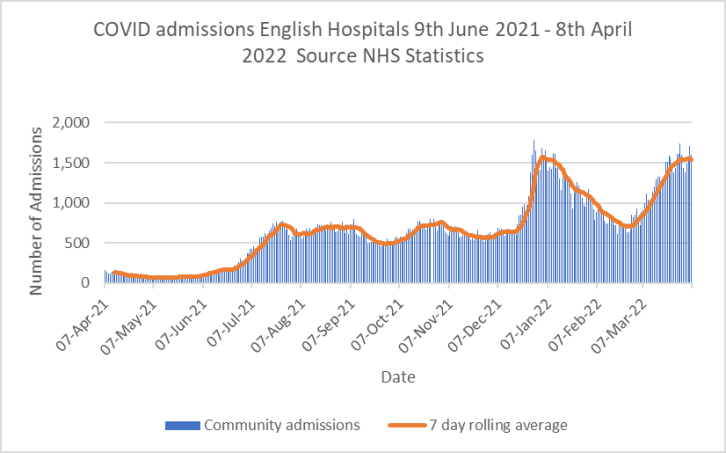
Graph 1
Graph 2 for example shows information from the Primary Diagnosis dataset. Regular readers will recall this set shows the numbers of patients admitted suffering from acute Covid compared to the patients testing positive for Covid but admitted for another condition. The grey line shows the ratio is gradually falling – in other words the headline figures in Graph 1 are misleading, because nearly 60% of those patients are not actually ill with Covid but admitted for other reasons.
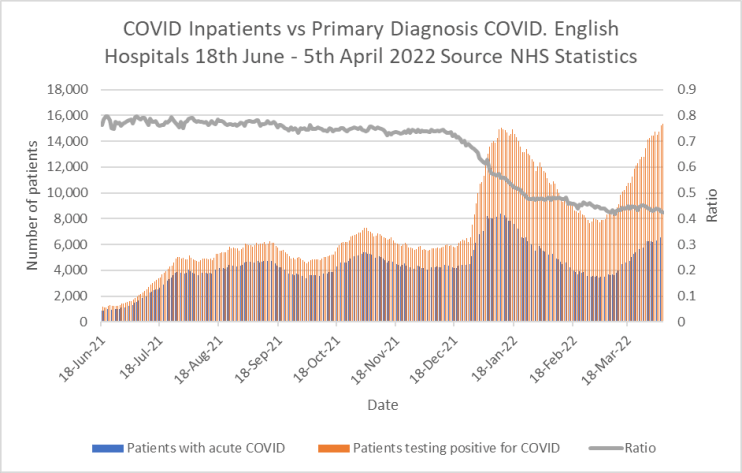
Graph 2
Graph 3 shows the numbers of patients testing positive for Covid in intensive care departments. The rise in cases seen in Graph 1 since the beginning of March 2022 is absent – so although there are more hospital inpatients testing positive for Covid than at the end of February, they are not ending up in critical care. Further, the data from the most recent ICNARC report reveal that the latest tranche of Covid ICU patients have lower oxygen requirements and better respiratory ratios than the cohort from this time last year – in other words, they are not as acutely ill.
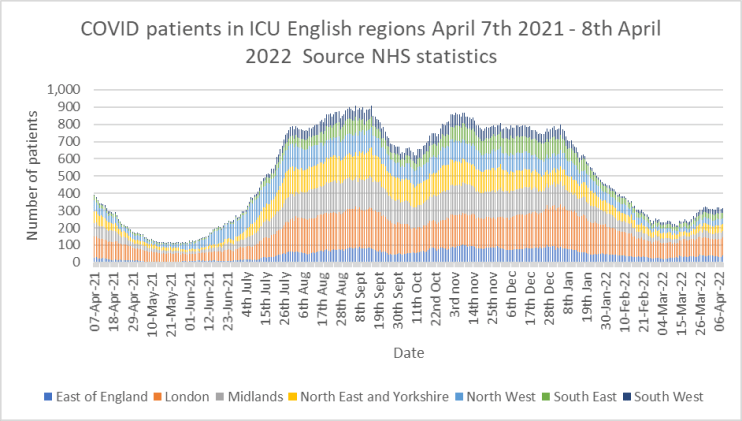
Graph 3
Graph 4 is very instructive. It shows the average length of stays of Covid patients up to the end of December 2021. This data was released in March and unfortunately is only complete up to the end of 2021, but it is reasonable to infer that current length of stay is unlikely to be worse now than in December of 2021, due to increased availability of new monoclonal antibody drugs which reduce disease severity for the highest risk patients. Graph 4 expresses average length of stay as the mean average (blue bars) and the median average (orange bars). Both these averages are steadily reducing with the median length of stay being down to four days by the end of December 2021. For the information of statistically curious readers, the median average in this case is probably more representative of the situation as the mean average can easily be skewed to the upside by a small number of very long-stay patients.
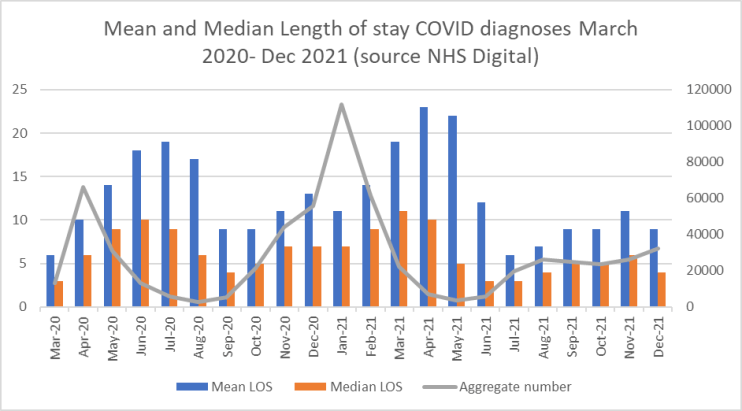
Graph 4
Overall, from the available Covid-specific patient data, we see a rise in total positive Covid tests on admission from the community, but fewer than half of these patients are symptomatic for Covid. Very few patients are ill enough to need ICU care and the length of stay for acutely ill Covid patients continues to fall. The vast majority require a few days of supplementary oxygen, intravenous steroids and monoclonal antibody infusion (or other adjunctive therapies) before being fit to discharge. So where is the problem?
Last week Saffron Cordery, deputy CEO of NHS providers, commented that staff absences played a part in the current crisis. Graph 5 shows the data for Covid related staff absences up to March 2nd (the latest figures released) – they don’t seem to have changed much lately and were on a downward trend since the turn of the year. It’s possible they may have started to increase again, but the figures are not yet released for public scrutiny.
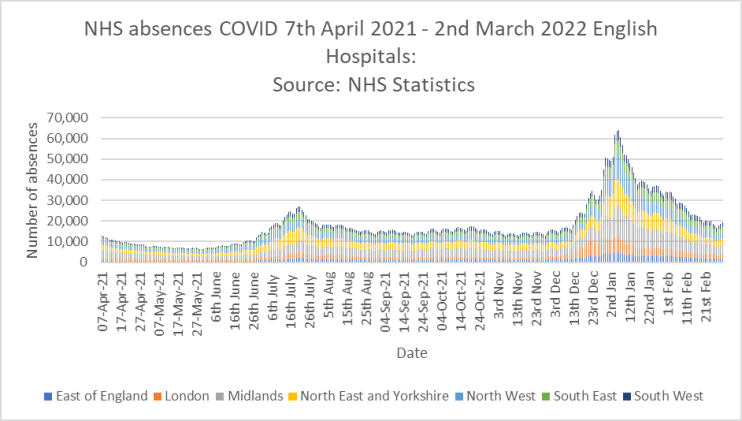
Graph 5
My personal suspicion is that Graph 6 shows the main issue causing trouble in hospitals. Graph 6 shows the number of patients in hospitals deemed medically fit for discharge. It is shown as a stacked bar chart, so the blue bar represents the patients who actually were discharged and the orange bar shows patients who were fit for discharge but had to remain in hospital for administrative reasons (often referred to as ‘bed blocking’). Readers will readily notice the ‘weekend effect’ in the figures, and that about 11,000 patients per day are in hospital when they are fit to be discharged – about 10% of the total NHS bed stock.
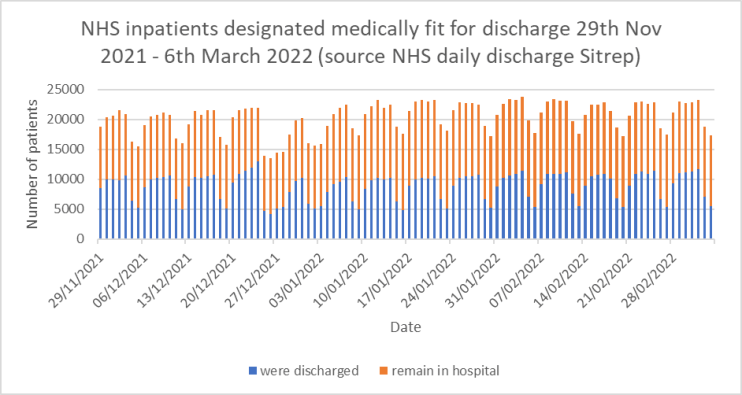
Graph 6
Over two years into the pandemic, the NHS does not yet seem to have solved fundamental administrative problems in relation to patient flow through the system. I am also aware from personal communication with colleagues that most NHS trusts are still imposing unnecessary Covid protocols which add to the time taken to complete basic episodes of care such as routine operations. This reduces efficiency still further in a healthcare system not renowned for operational efficiency in the first place.
Speaking about the latest crisis, Mark Ainsworth, Director of Operations at the South Central Ambulance Service, said declaring a critical incident meant it could focus its resources on the neediest patients.
Discharging medically fit patients from hospital and exercising a modicum of common sense when compiling Standard Operating procedures might achieve the same effect.
Putting Big Pharma on Trial in the COVID-19 Era, Part 4
The Hypocrisy of “Misinformation”
By Rebecca Strong · February 16, 2022
I find it interesting that “misinformation” has become such a pervasive term lately, but more alarmingly, that it’s become an excuse for blatant censorship on social media and in journalism. It’s impossible not to wonder what’s driving this movement to control the narrative. In a world where we still very clearly don’t have all the answers, why shouldn’t we be open to exploring all the possibilities? And while we’re on the subject, what about all of the COVID-related untruths that have been spread by our leaders and officials? Why should they get a free pass?
Fauci, President Biden, and the CDC’s Rochelle Walensky all promised us with total confidence the vaccine would prevent us from getting or spreading COVID, something we now know is a myth. (In fact, the CDC recently had to change its very definition of “vaccine ” to promise “protection” from a disease rather than “immunity”— an important distinction). At one point, the New York State Department of Health (NYS DOH) and former Governor Andrew Cuomo prepared a social media campaign with misleading messaging that the vaccine was “approved by the FDA” and “went through the same rigorous approval process that all vaccines go through,” when in reality the FDA only authorized the vaccines under an EUA, and the vaccines were still undergoing clinical trials. While the NYS DOH eventually responded to pressures to remove these false claims, a few weeks later the Department posted on Facebook that “no serious side effects related to the vaccines have been reported,” when in actuality, roughly 16,000 reports of adverse events and over 3,000 reports of serious adverse events related to a COVID-19 vaccination had been reported in the first two months of use.
One would think we’d hold the people in power to the same level of accountability — if not more — than an average citizen. So, in the interest of avoiding hypocrisy, should we “cancel” all these experts and leaders for their “misinformation,” too?
Vaccine-hesitant people have been fired from their jobs, refused from restaurants, denied the right to travel and see their families, banned from social media channels, and blatantly shamed and villainized in the media. Some have even lost custody of their children. These people are frequently labeled “anti-vax,” which is misleading given that many (like the NBA’s Jonathan Isaac) have made it repeatedly clear they are not against all vaccines, but simply making a personal choice not to get this one. (As such, I’ll suggest switching to a more accurate label: “pro-choice.”) Fauci has repeatedly said federally mandating the vaccine would not be “appropriate” or “enforceable” and doing so would be “encroaching upon a person’s freedom to make their own choice.” So it’s remarkable that still, some individual employers and U.S. states, like my beloved Massachusetts, have taken it upon themselves to enforce some of these mandates, anyway. Meanwhile, a Feb. 7 bulletin posted by the U.S. Department of Homeland Security indicates that if you spread information that undermines public trust in a government institution (like the CDC or FDA), you could be considered a terrorist. In case you were wondering about the current state of free speech.
The definition of institutional oppression is “the systematic mistreatment of people within a social identity group, supported and enforced by the society and its institutions, solely based on the person’s membership in the social identity group.” It is defined as occurring when established laws and practices “systematically reflect and produce inequities based on one’s membership in targeted social identity groups.” Sound familiar?
As you continue to watch the persecution of the unvaccinated unfold, remember this. Historically, when society has oppressed a particular group of people whether due to their gender, race, social class, religious beliefs, or sexuality, it’s always been because they pose some kind of threat to the status quo. The same is true for today’s unvaccinated. Since we know the vaccine doesn’t prevent the spread of COVID, however, this much is clear: the unvaccinated don’t pose a threat to the health and safety of their fellow citizens — but rather, to the bottom line of powerful pharmaceutical giants and the many global organizations they finance. And with more than $100 billion on the line in 2021 alone, I can understand the motivation to silence them.
The unvaccinated have been called selfish. Stupid. Fauci has said it’s “almost inexplicable” that they are still resisting. But is it? What if these people aren’t crazy or uncaring, but rather have — unsurprisingly so — lost their faith in the agencies that are supposed to protect them? Can you blame them?
Citizens are being bullied into getting a vaccine that was created, evaluated, and authorized in under a year, with no access to the bulk of the safety data for said vaccine, and no rights whatsoever to pursue legal action if they experience adverse effects from it. What these people need right now is to know they can depend on their fellow citizens to respect their choices, not fuel the segregation by launching a full-fledged witch hunt. Instead, for some inexplicable reason I imagine stems from fear, many continue rallying around big pharma rather than each other. A 2022 Heartland Institute and Rasmussen Reports survey of Democratic voters found that 59% of respondents support a government policy requiring unvaccinated individuals to remain confined in their home at all times, 55% support handing a fine to anyone who won’t get the vaccine, and 48% think the government should flat out imprison people who publicly question the efficacy of the vaccines on social media, TV, or online in digital publications. Even Orwell couldn’t make this stuff up.

Photo credit: DJ Paine on Unsplash
Let me be very clear. While there are a lot of bad actors out there — there are also a lot of well-meaning people in the science and medical industries, too. I’m lucky enough to know some of them. There are doctors who fend off pharma reps’ influence and take an extremely cautious approach to prescribing. Medical journal authors who fiercely pursue transparency and truth — as is evident in “The Influence of Money on Medical Science,” a report by the first female editor of JAMA. Pharmacists, like Dan Schneider, who refuse to fill prescriptions they deem risky or irresponsible. Whistleblowers, like Graham and Jackson, who tenaciously call attention to safety issues for pharma products in the approval pipeline. And I’m certain there are many people in the pharmaceutical industry, like Panara and my grandfather, who pursued this field with the goal of helping others, not just earning a six- or seven-figure salary. We need more of these people. Sadly, it seems they are outliers who exist in a corrupt, deep-rooted system of quid-pro-quo relationships. They can only do so much.
I’m not here to tell you whether or not you should get the vaccine or booster doses. What you put in your body is not for me — or anyone else — to decide. It’s not a simple choice, but rather one that may depend on your physical condition, medical history, age, religious beliefs, and level of risk tolerance. My grandfather passed away in 2008, and lately, I find myself missing him more than ever, wishing I could talk to him about the pandemic and hear what he makes of all this madness. I don’t really know how he’d feel about the COVID vaccine, or whether he would have gotten it or encouraged me to. What I do know is that he’d listen to my concerns, and he’d carefully consider them. He would remind me my feelings are valid. His eyes would light up and he’d grin with amusement as I fervidly expressed my frustration. He’d tell me to keep pushing forward, digging deeper, asking questions. In his endearing Bronx accent, he used to always say: “go get ‘em, kid.” If I stop typing for a moment and listen hard enough, I can almost hear him saying it now.
People keep saying “trust the science.” But when trust is broken, it must be earned back. And as long as our legislative system, public health agencies, physicians, and research journals keep accepting pharmaceutical money (with strings attached) — and our justice system keeps letting these companies off the hook when their negligence causes harm, there’s no reason for big pharma to change. They’re holding the bag, and money is power.
I have a dream that one day, we’ll live in a world where we are armed with all the thorough, unbiased data necessary to make informed decisions about our health. Alas, we’re not even close. What that means is that it’s up to you to educate yourself as much as possible, and remain ever-vigilant in evaluating information before forming an opinion. You can start by reading clinical trials yourself, rather than relying on the media to translate them for you. Scroll to the bottom of every single study to the “conflicts of interest” section and find out who funded it. Look at how many subjects were involved. Confirm whether or not blinding was used to eliminate bias. You may also choose to follow Public Citizen’s Health Research Group’s rule whenever possible: that means avoiding a new drug until five years after an FDA approval (not an EUA, an actual approval) — when there’s enough data on the long-term safety and effectiveness to establish that the benefits outweigh the risks. When it comes to the news, you can seek out independent, nonprofit outlets, which are less likely to be biased due to pharma funding. And most importantly, when it appears an organization is making concerted efforts to conceal information from you — like the FDA recently did with the COVID vaccine — it’s time to ask yourself: why? What are they trying to hide?
In the 2019 film “Dark Waters” — which is based on the true story of one of the greatest corporate cover-ups in American history — Mark Ruffalo as attorney Rob Bilott says: “The system is rigged. They want us to think it’ll protect us, but that’s a lie. We protect us. We do. Nobody else. Not the companies. Not the scientists. Not the government. Us.”
Words to live by.
Featured Video

Chinese jet fuel and the myth of energy independence
or go to
Aletho News Archives – Video-Images
Book Review
Former Insiders Criticize Iran Policy as U.S. Hegemony
By GARETH PORTER | CounterPunch | February 27, 2013
“Going to Tehran” arguably represents the most important work on the subject of U.S.-Iran relations to be published thus far.
Flynt Leverett and Hillary Mann Leverett tackle not only U.S. policy toward Iran but the broader context of Middle East policy with a systematic analytical perspective informed by personal experience, as well as very extensive documentation.
More importantly, however, their exposé required a degree of courage that may be unparalleled in the writing of former U.S. national security officials about issues on which they worked. They have chosen not just to criticise U.S. policy toward Iran but to analyse that policy as a problem of U.S. hegemony. … continue
Blog Roll
 Aletho News
- What is fueling unrest across the EU?
- Why no power can undermine Iran’s eternal dominance over the Strait of Hormuz
- Is The War Against Iran Over?
- Iran war will leave long-term ‘scar’ on Wall Street, investors warn
- How Iran decimated US power projection in West Asia: Military lessons of 40-day war
- Iran’s report details US-Israeli war crimes in targeting schools, hospitals, livelihoods
- NATO’s Slow Fracture: How Trump’s Iran War Exposed the Instrument of Hegemony
- Chinese jet fuel and the myth of energy independence
- Ukraine Sea Drone Fired From Libya Hit Russian Tanker in Mediterranean
- IRGC: Iranian forces launched no attacks during ceasefire hours
- If Americans Knew
- Military aid to Israel emerges as the latest political litmus test for Democrats
- The only Palestinian children’s rights organization closes following years-long Israeli campaign against it
- ‘I Can’t Forget the Smell’: Lebanese Reel After Israel Kills Over 300 in Single Day
- DNC Shoots Down Resolutions Calling Out AIPAC and Limiting Arms to Israel
- TCN: Is Israel Blackmailing President Trump?
- Israel killed at least 303 Lebanese yesterday – who were they? Daily Update
- Amnesty: Urgent – Protect Lebanese civilians from brutal escalation in Israeli attacks
- Is The War Against Iran Over?
- Inside the Israeli army’s propaganda wing
- Hundreds of Gaza Amputees Stranded in Legal Limbo
- No Tricks Zone
- New Study: No Linear Warming Or Glacier Retreat Along Northern Antarctic Peninsula Since 1980s
- An Inconvenient Tree: Uncovered In Alps… Europe Much Warmer Than Today 6000 Years Ago
- New Study Reports A 60% Slowdown In Greenland’s Ice Loss Rate In The Last Decade
- Low Intensity Tornado Wrecks Major Solar Farm, Creating A Potential Toxic Dump
- New Study Finds Warming Saves Lives…Cold Temperatures 12 Times More Deadly Than Excess Heat
- German Science Blog Accuses PIK Climate Institute Of Hallucinating Climate Tipping Points
- Devastating Assessment Of Comirnaty Vaccine By Former Senior Pfizer Europe Toxicologist
- New Study: CO2 Is ‘Effectively Negligible’ As An Explanatory Climate Change Factor Since 2000
- Former Pfizer Toxicologist Dr. Helmut Sterz Tells Bundestag Hearing Pfizer Vaccine Should Have Never Been Approved
- Energy Expert: Germany’s Nuclear Phaseout Was A “500 Billion Euro Mistake”
 Aletho News