Israel provoking Palestine factions with actions in Al-Aqsa Mosque

MEMO | May 5, 2022
Israeli occupation authorities provoked Palestinian factions after allowing Jewish settlers to storm Al-Aqsa Mosque, statements issued yesterday said.
The Israeli government decided to allow Jewish settlers to storm Al-Aqsa Mosque today.
Hamas said: “Allowing Israeli settlers to storm Al-Aqsa Mosque is playing with fire and this could drag the region into a new escalation.”
“We renew our call for the Palestinian people to travel to Al-Aqsa Mosque and be on high alert in Jerusalem in order to defend their identity, religion and first Qibla.”
According to Hamas, “the Israeli occupation must know that all attempts aimed at dividing Al-Aqsa Mosque or Judaising Muslim holy sites will not pass and will not achieve its malicious goals.”
Meanwhile, spokesman of the Islamic Jihad in the West Bank, Tariq Izzedine, said: “The continuation of Israeli violations against Al-Aqsa Mosque is a violation of Palestinian redlines that needs an urgent movement to stop it.”
Fatah called on Palestinians to gather in Al-Aqsa Mosque today to thwart a “planned provocative Israeli plan to raise the Israeli flag and sing the Israeli anthem at the Palestinian holy site.”
Hamas hails Palestinian worshipers’ heroism
Palestine Information Center – May 5, 2022
 GAZA – Hamas Movement’s spokesman Hazem Qassem hailed the Palestinian worshipers’ heroism in confronting Israeli attacks on al-Aqsa Mosque on Thursday morning.
Israeli authorities are witnessing a state of confusion and panic in face of the Palestinian strong determination, he stressed.
Al-Aqsa Mosque was and will remain a pure Islamic and Arabic shrine, he added.
Earlier Thursday, dozens of Palestinian worshipers were injured after Israeli police forces violently stormed al-Aqsa Mosque in Occupied Jerusalem to clear the area for Jewish settlers’ break-ins that had been paused for the Muslim holidays.
The police forces fired rubber-coated bullets and teargas bombs, injuring dozens of Palestinians. At least 12 live-shot injuries were reported.
Ten worshipers were detained during the attack, including a French Muslim woman.
Three Israelis killed, others injured in stabbing incident
Palestine Information Center – May 5, 2022
OCCUPIED JERUSALEM – Three Israelis were killed while others were wounded in a stabbing incident in Elad area to the east of Tel Aviv on Thursday night.
Hebrew media reported that a number of those injured were in very serious conditions.
Preliminary reports indicated that the attacker used an axe and a knife in his attack before withdrawing from the area.
The Elad municipality asked citizens to remain indoors as the Israeli police forces set up barriers and launched a large-scale manhunt searching for the attacker with the help of choppers.
Taxpayer funding for media backfires
Taxpayers’ Union NZ | May 6, 2022
This week we released the results of a new scientific poll confirming what we have long suspected: New Zealanders don’t trust Government-funded media outlets to hold the Government to account.
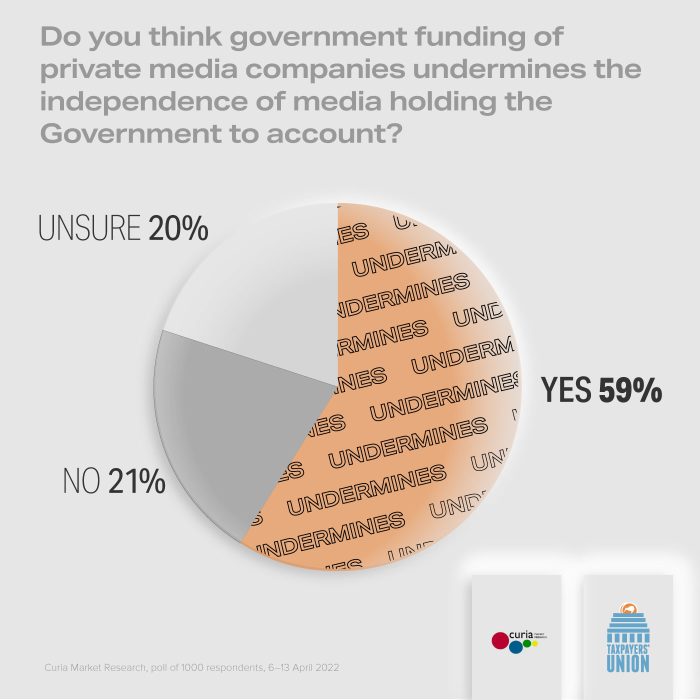
Payments from the likes of the $55 million “Public Interest Journalism” Fund present a clear conflict of interest to media outlets like Stuff and the NZ Herald, who now have millions of dollars at stake in electing a government that protects their funding.
Whenever we challenge media bosses on this they always insist that their company is immune from editorial influence. But they can no longer deny that the decision to accept funding has eroded readers’ trust.
One day after the poll’s publication, the media outlets failed an obvious test: not one of the outlets to have received PIJF funding has covered the results of the poll.
The poll has however been covered by The Platform – a new outlet with a policy of not accepting taxpayer money. Graham Adams’s article explains how funding recipients are pressured into skewing their coverage of Treaty/co-governance issues.
For the record, we are tracking all payments from the Public Interest Journalism Fund on our website. Click here to find out who got taxpayer money.
We’re calling on media outlets to salvage their credibility by repaying taxpayer funding, and declining any future payments.
Click here to sign the petition calling for the media to Pay Back the $55 Million.
The Return to the Good Old Days of Ignoring CDC Recommendations

By Adam Dick | Ron Paul Institute | May 5, 2022
It has been two weeks since a United States district court struck down President Joe Biden’s mandate, imposed through the Centers for Disease Control and Prevention (CDC), that people wear masks when traveling via public transportation, or by taxi or ride-share service, as well as when at related locations, such as airports. After the court decision, most transportation companies and locations have been quick to make clear that people are free to leave their faces uncovered. Many people have been very happy to do just that.
The CDC, however, has not given up on hectoring people to “wear your mask.” On Tuesday, the CDC released a “media statement” titled “CDC Recommendation for Masks and Travel.” Starting off, the media statement declares that the CDC “recommends that everyone aged 2 and older – including passengers and workers – properly wear a well-fitting mask or respirator over the nose and mouth in indoor areas of public transportation (such as airplanes, trains, etc.) and transportation hubs (such as airports, stations, etc.).” Further, the CDC states that it encourages “operators of public transportation and transportation hubs to support mask wearing by all people, including employees.”
Fortunately, the response of many individuals and businesses to this advice ranges from “whatever” to “leave me alone.” More and more people have gotten over inflated fear of coronavirus that never posed a threat of major sickness or death to most people. People have also progressively become aware of the absurdity and destructiveness of forced business closures, “social distancing,” ubiquitous coronavirus testing, experimental coronavirus “vaccines,” mask mandates, and other pseudoscience actions the CDC has pushed since 2020.
America is largely back to the good old days of most people ignoring for the most part when government “public health officials” and people in the media relate CDC guidance that people do this or that. Plus, given the horrid track record of the CDC through the coronavirus scare, more people are now aware of the charade of CDC guidance than ever before. Instead of just ignoring CDC recommendations, many more people than before will feel the urge to research the recommendations and publicly challenge the recommendations when they are found wanting. There should now hopefully also be much more steadfast resistance from the start to any new effort to morph recommendations from the CDC or other so-called health experts into mandates.
Still, the CDC’s media statement this week and the US government hanging on to other coronavirus crackdown measures, including coronavirus shots and testing mandates, to the extent the measures have not been struck down by courts, show that the threat of grand scale tyranny in the name of countering a new purported health crisis remains. In addition, some state and local governments are both holding on to the remnants of coronavirus tyranny and remaining ready to jump back into much more expansive action suppressing freedom in the name of public health.
People must remain vigilant. People must spread the message that the lesson from the coronavirus crackdown is that government violations of individual rights in the name of advancing public health objectives or countering the new disease of the day must be resisted resolutely and vociferously.
People should also keep in mind that, in a variety of circumstances, doctors and other people working the medical field may provide advice that is grounded in the CDC’s priorities and runs counter to the best medical course.
The lure of evil remains strong. To ensure that respect for freedom regained from the coronavirus crackdown tyrants does not fade away, people must remain on guard against and adamantly refuse to accept new encroachment efforts. To keep what has been regained of the good old days, and even expand upon it, people must take action, starting with saying “no” to the health authoritarians at the CDC and elsewhere.
Copyright © 2022 by RonPaul Institute.
Do the Pfizer “data dumps” really mean anything?
By Kit Knightly | OffGuardian | May 5, 2022
The latest batch of Pfizer’s Covid vaccine files just dropped. 80,000 pages of patient files and “trial data” and so and so on.
You can read them all here.
The question is, do they really tell us anything we don’t already know?
The big revelation doing the rounds at the minute is that the vaccines were never trialled with, and were specifically not recommended for, pregnant women.
But is this new information?
When governments started “recommending” the Covid vaccine to pregnant women in the Summer of 2021, everybody who had been paying attention knew that position was not backed up by any data at all.
OffG got temporarily banned from twitter for pointing this out.
More broadly speaking: Of course the vaccines were never tested on pregnant women, they were never properly tested on anybody.
It takes 10 years to safely produce and trial a vaccine, not 18 months. And what “trials” they claim to have done in that year and a half were a complete sham.
In a way, the “not recommended for pregnant women” disclosure is actually good for Pfizer.
Behind a facade of being legally mandated to publish these files, it’s now become public knowledge that Pfizer (allegedly) told people not to give the vaccine to pregnant women, but many countries did it anyway.
This shifts the blame (and potential legal liability) away from Pfizer and onto the governments in question.
A good example of how “forced disclosure” can be used to reinforce and direct a narrative, through a pretence of reluctance.
Going further, shouldn’t we be asking: Can we trust anything in these documents at all?
Just because Pfizer has been (apparently) legally “forced” to release them doesn’t mean they are important, relevant or even real. Who’s verifying the documents? Who’s auditing Pfizer to make sure they release everything? The US government? Some other government or agency?
Do you trust them?
The real damning documents – if such ever existed – have likely been shredded, burned and buried in 20 feet of concrete by now…and that doesn’t matter, because we already know everything we will ever need to know about these Covid “vaccines”:
- They were not subject to proper long-term testing.
- They have totally unknown long-term side effects.
- They allegedly “treat” a “disease” with a 99.85% survival rate.
- They don’t prevent infection.
- They don’t prevent transmission.
- The manufacturers are legally protected from being sued in the event they kill you.
Pfizer can release all the documents they want, nothing will change these facts…only distract from them.
Is the West at war with disinformation or dissent?
By Rachel Marsden | Samizdat | May 5, 2022
When US President Joe Biden announced on April 27 that a new Disinformation Governance Board would serve the Department of Homeland Security, it was just the latest turn of the screw on freedom. This time, it’s an affront to citizens’ right to a diversity of information.
It’s one thing to correct inaccurate information, but this new entity seems more oriented towards narrative-policing that cracks down on the interpretation of information rather than the accuracy of it. Headed by a former communications advisor to the Ukrainian Foreign Ministry, Nina Jankowicz, one of the board’s first responsibilities will be to address “disinformation coming from Russia as well as misleading messages about the US-Mexico border,” according to CBS News. Interesting that these two issues – immigration and foreign conflicts – are currently viewed as two of Washington’s most significant failures, which have given rise to populist dissent. Make no mistake, it’s the dissent that’s the ultimate target.
The fact that a former Ukraine government spin doctor was viewed as the best person to head up the new initiative tells you everything you need to know about its true purpose. Jankowicz published a book in 2020 whose title suggests that she believes the West to be in an online war with Russia. ‘How to Lose the Information War: Russia, Fake News, and the Future of Conflict,’ portrays Western narratives as truthful and Russian narratives as “fake news.” Doing so obscures the fact that the mainstream Western media has not been immune to propagating narratives peddled by the state that could retroactively be considered fake news or war propaganda. Meanwhile, Russian media has often provided a platform for those seeking to express – or access – dissenting analysis or information that falls outside of the Western media bubble. Clearly, there are some ‘democracies’ that are bothered by this.
The appetite of Western nations to ensure that their citizens are only fed information that they control through their own highly concentrated government or corporate subsidized media isn’t new. It’s just getting more voracious. Perhaps it’s because the more authoritarian their agenda becomes, the more populist sentiment increases and gives rise to events such as Brexit or the election of Donald Trump, as well as trends such as opposition to US-backed conflicts, the rise in popularity of various populist political parties in Europe, and demonstrations against pandemic mandates, which just happen to be associated with government-issued QR codes.
Dissent is the enemy of authoritarian ambition. Supposedly free countries have manipulated their citizens into believing that censorship of certain views is for people’s own safety and security – hence why the military in Canada, the UK, and France, and now Homeland Security in the US, are involved in narrative policing. In reality, their efforts seem to be more about ensuring citizens’ compliance with their own agenda.
The fusion of domestic security and disinformation came to light as early as 2016, when the European Parliament grotesquely conflated Islamic terrorist propaganda with Russian media, in what seemed to be itself a propaganda effort to undermine the Russian media by equating these two totally unrelated things. But one by one, Western governments have placed free speech under national security control.
France, for example, handed off responsibility for online information arbitration to its domestic intelligence agency (the DGSI) and has reportedly considered involving defense-funded startups in the effort.
Canada has also turned to its security apparatus to shape Canadians’ information landscape – at least twice. The Communications Security Establishment, the country’s electronic spying agency, has been tweeting its own interpretations of disputed events occurring in the fog of the conflict in Ukraine as indisputable fact, while routinely denouncing Russia’s interpretation as invalid.
But Canada’s security establishment isn’t at its first rodeo in attempting to prevent citizens’ thinking from deviating from the state’s messaging. Under Prime Minister Justin Trudeau, the country’s armed forces deployed a months-long, military-grade propaganda campaign, which employed tactics honed during the war in Afghanistan, to mind-bend unsuspecting Canadians towards Trudeau’s Covid narrative, CBC News reported last year.
Not to be outdone, the psychological warfare specialists of the 77th brigade of Britain’s armed forces have also worked to shape messaging both in favor of the government’s Covid policies and against anything contrary out of Russia. “One current priority is combating the spread of harmful, false and misleading narratives through disinformation. To bolster this effort, the British Army will be deploying two experts in countering disinformation. They will advise and support NATO in ensuring its citizens have the right information to protect themselves and its democracies are protected from malicious disinformation operations used by adversaries,” Defense Secretary Ben Wallace said last year.
The fact that public safety and disinformation have suddenly become routinely conflated should be worrisome to defenders of whatever remnants of democracy that we still have left. Terrorism, health and now disinformation have all served as pretexts for the rapid erosion of our freedoms – all under the guise of protecting us from bad actors. But are we really safer? Or are we just increasingly less free?
Popular Ukrainian Zelensky critic arrested in Spain
Samizdat | May 5, 2022
Prominent blogger and critic of the Ukrainian government, Anatoly Shariy, has been detained by Spanish police as part of an international operation, the Ukrainian Security Service (SBU) announced on Thursday.
Shariy was arrested on Wednesday in a joint operation by Spanish and Ukrainian cops, as well as international “partners”, the SBU said in a statement.
The agency, Kiev’s successor to the Soviet KGB, said that the opposition figure is wanted on charges of treason by Kiev, among other things. Shariy has been infringing Ukraine’s national security through his activities in the media realm, while allegedly acting on behalf of “foreign” forces, it insisted. The case against the YouTuber with almost 3 million subscribers was launched in February 2021.
Shariy’s arrest “is more proof that every traitor of Ukraine will sooner or later receive his well-deserved punishment. It is inevitable,” the SBU claimed.
The Ukrainian announcement was confirmed by the Spanish police, who told RIA-Novosti that Shariy was detained in the coastal city of Tarragona on May 4 on an international arrest warrant.
Shariy had been granted political asylum in the EU by Lithuania back in 2012. Back then, he said that he was fleeing persecution by the government of Viktor Yanukovich, whom the Western media branded pro-Russian.
Yanukovich was deposed after the Maidan coup in 2014, but the blogger remained a harsh critic of authorities in Ukraine, be it President Petro Poroshenko or his successor Volodymyr Zelensky.
He condemned Russia’s military operation in Ukraine after it was launched in late February but kept pointing out what he saw as flaws in Kiev’s conduct during the ongoing conflict.
The blogger’s political asylum was cancelled by Lithuania in January this year.
Shariy was absent from social media on Wednesday, but on Thursday he took to Telegram to share a photo of his wife feeding parrots in Barcelona, accompanying it with a comment reading: “This really is a comedy.”
According to media reports, the blogger was released from Spanish custody and placed under travel restrictions. He’s to remain in Barcelona where he has a home pending a decision on his extradition to Ukraine.
President Zelensky’s representative at the Constitutional Court has already expressed confidence that Shariy will “face a Ukrainian court and will be held liable in line with Ukrainian laws.”
US invasion threats over Solomon Islands deal expose Western hypocrisy in Ukraine
By Drago Bosnic | May 5, 2022
When Ukraine announced it will join NATO after the CIA-orchestrated Orange Revolution in 2004, it prompted Russia to respond by voicing its strong condemnation, which later culminated in Vladimir Putin’s historical 2007 Munich Security Conference speech. Still, just a year later, Ukraine was invited to join NATO. The former Soviet republic officially applied to integrate within a framework of a NATO Membership Action Plan (MAP) in 2008. However, plans for NATO membership were shelved following the 2010 presidential election in which Viktor Yanukovych triumphed, coming back to power after spending over half a decade in the political opposition.
Before the 2010 election, Russia’s concerns were completely ignored and every time Russia stated Ukraine’s NATO ascension would severely undermine and weaken its security, leading members such as the US and the UK stated that it’s Ukraine’s “sovereign right” to choose which alliances it wants to join and that Ukraine’s NATO membership wasn’t aimed against Russia. These claims were put to the test after the 2010 election, because Yanukovych preferred to keep the country non-aligned. A little over 4 years into his presidency, he was ousted in yet another CIA-orchestrated coup, this time the infamous Maidan Revolution, also known as the so-called “Revolution of Dignity” in recent years. So much for Ukraine’s “sovereign right” to choose alliances or worse yet in this case, to stay neutral.
Even if there was any notion of respect for the sovereignty of nations by the US and NATO before 2014, it became glaringly obvious that wasn’t the case. Soon, anti-Russian violence erupted all across the country, which was now firmly in the grip of its NATO (primarily US) overlords and openly Neo-Nazi groups which were promptly integrated into various security institutions, including the military and intelligence services. Again, Ukraine’s “sovereign right” to choose alliances was back on the table during various Russia-US security talks, including the Geneva summit in 2021. The rest is history which we are witnessing as we speak.
However, the Ukraine crisis isn’t the only one unfolding in the context of a broader “the West vs the Rest” clash. The political West doesn’t only bring “peace, stability, freedom and democracy” to Europe and Russia’s near abroad. There are many other such places. While Russia is allegedly being “aggressive” in its own backyard, so is China in the South and East CHINA sea, Iran (previously known as Persia) in the PERSIAN Gulf, etc. Because in the mind of the “indispensable” NATO planners, only other countries can be “aggressive” mere miles away from their coasts, at their borders or even inside their own sovereign territories. NATO, on the other hand, brings only “peace, stability, freedom and democracy” no matter how many thousands or even tens of thousands of kilometers away from its borders, regardless of how negatively that affects any country. And if any of the small vassal countries is to try and get the shackles of “freedom and democracy” off, the reaction is almost immediate.
The most recent such example is the tiny island country called the Solomon Islands. It’s safe to assume most people haven’t even heard of this peaceful Pacific island state, a former UK colony situated some 2000 km northeast of Australia. In late April, the Solomon Islands had the “audacity” to sign a security agreement with China, which would allow Beijing to send military and police personnel to the island country, as well as open the door to a Chinese naval presence in the South Pacific. Or at least that’s what the United States, Australia and New Zealand claim the agreement is all about. My esteemed colleague Uriel Araujo wrote an excellent analysis with a more in-depth focus on the agreement, its causes and possible consequences.
The strategic implications of this agreement might be too soon to evaluate in a precise manner, but it does expose the sheer hypocrisy of the political West, primarily its Anglo-American portion. The Solomon Islands are around 2,000 km away from the Australian coast, over 5,500 km from the US State of Hawaii and nearly 10,000 km away from the US mainland. The Pacific island country was not on the US and Australia’s radar for decades. US embassy in Honiara, the country’s capital, was closed in 1993, nearly 30 years ago. Australia seemed equally uninterested up until just a few weeks ago. And yet, both the US and Australia are now fuming over even the slightest notion that the Solomon Islands could make such an agreement with China.
“We won’t be having Chinese military naval bases in our region on our doorstep,” Australian PM Scott Morrison said, calling it a “red line” both for his government and Washington DC. A US envoy that visited the Honiara in late April said that his government would have “significant concerns and respond accordingly” to any “permanent military presence, power-projection capabilities, or a military installation” by China. After ignoring the country and its security and economic problems for decades, the increasingly belligerent AUKUS allies have now suddenly decided to renew their geopolitical interest in the Solomon Islands by openly threatening the island country.
The question is, why do the US and Australia think they have the right to interfere or even intervene in the affairs of another country which is thousands of kilometers away? Why is the US allowed to conduct so-called “freedom of navigation” naval patrols in the immediate vicinity of Chinese waters in the South China Sea, but it’s “problematic” when China signs agreements with sovereign nations which have nothing to do with the United States and its vassals? After all, isn’t this the “sovereign right” of the Solomon Islands? Why is the legitimate government of the island country being threatened and denied the actual sovereign right to choose allies, but a puppet coup regime in Kiev isn’t?
Drago Bosnic is an independent geopolitical and military analyst.
Slovakia rejects Russian oil ban proposal
Samizdat | May 5, 2022
Slovakia warned on Wednesday that it will not be able to agree to the European Commission’s proposal for a ban on Russian oil, and has called for more time to find alternative fuel suppliers.
The proposed embargo is part of the latest Ukraine-related sanctions against Moscow that would see crude imports from Russia phased out within six months and refined products by the end of the year. An exemption was drafted for Slovakia and Hungary, which are heavily dependent on Russia, giving them until the end of 2023 to comply.
The proposed time frame “is unfortunately not enough,” Slovakia’s deputy economy minister in charge of energy policy told internet publication Politico on Wednesday. “We are expecting at least three years,” Karol Galek added, explaining that a key refinery in the country requires heavy Russian oil and that it’s impossible to secure alternative supplies within the proposed time frame. Last year Slovakia got 96% of its oil from Russia.
Galek stressed that the current proposal “will destroy our European economy,” as it will not only hurt energy supplies in his country, but also in Austria, the Czech Republic and Ukraine.
The current blueprint for a ban on Russian oil has to be unanimously approved by the bloc’s 27 member states to come into force. Hungary has expressed reservations, saying the European Union has so far failed to give Budapest guarantees regarding its energy security.
DON’T VOTE “#GREATRESET”

By Olly Connelly | Daily Chaos | May 5, 2022
It’s local election day in the UK and, as you’ll be aware, elections are underway also in France and in the US.
Local, constituency or national level, if you vote for someone who is not talking about defeating the #GreatReset, then you are voting for Klaus Schwab, you are voting “to own nothing”, for communism directed by fascists, you are voting for tyranny, for censorship, for more fake pandemics and more fraudulent war, you are voting for divide-rule on an epic scale that is destroying families, communities and societies from within despite the farcical topics such as “how to define a woman” for crying out loud, you are voting for the normalisation of Satanism and paedophilia as can increasingly be seen in Biden’s America, you are voting for genocidal war criminals like Tony Blair to never be brought to account while being BBC-platformed to lecture you on using experimental drugs on your innocent children, you are voting to condone yet more phony elections, for Martial law in Western societies as we saw in Ottawa, for the hundreds of thousands in death toll in places like Yemen while the globalists distract with Ukraine, you are voting for CCP-style oppression and their model social credit score to keep you in check, you are voting for the last of our liberty ie an end to cash, for Google’s bloodstream nanobots and Musk’s brain chip, for Gates’ quaxxines and the final cull of the Mama-Papas defeated by the Bezos drones.
DON’T VOTE FOR SLAVERY.
Don’t vote for the Great Reset. DON’T VOTE FOR ANYONE WHO IS NOT ACTIVELY WARNING AGAINST THE GREAT RESET, THEY ARE A FRAUD, A DECEIT…
… At this stage in the game, I tell you, ANYONE in politics or journalism who is not warning of the dangers of the Great Reset is somewhere between fraudulent and downright evil.
If in doubt, if in any doubt, do not vote. In most cases this is almost certainly the best option, to help de-power the them-us elitism, to deny a mandate and to create a window to be able to say, “WE DID NOT ELECT YOU.”
We should have seen, by now, the vile outcome by supporting cheats and liars. We should have seen that voting for the lesser of the evils DOES NOT HELP. Do not make things worse by voting yet again for PROVEN cheats and liars.
Do not mindlessly vote. And yes, at this stage in the game where practically everyone on the global stage is either bought or blackmailed, A VOTE “NOT TO VOTE”, an abstention from the Big Lie, is in no way dishonourable. A vote for more of what we have in power now, on the other hand, is downright moronic.
Here’s to us, and bugger plutocracy!
With no missile host in Pacific, new US strategy seeks to arm Japan against China
Press TV – May 4, 2022
The United States is struggling to find allies in the Indo-Pacific region who would be willing to host its intermediate-range missiles (IRBM), a new report has found.
The report by US-based think tank RAND Corporation, close to the Pentagon, looks at the likelihood of Pacific countries agreeing to host US IRBMs, the benefits and drawbacks of potential alternatives, and the most feasible alternative.
The report finds that the US strategy that relies on an ally agreeing to permanently host these ground-based IRBMs is bound to fail because of its inability to find a willing partner in the Pacific region.
The author of the report concludes that in the absence of any willing hosts, Washington should encourage Japan to develop a missile arsenal of its own to threaten Chinese ships, thus using Japan as a pawn in its no-holds-barred war against China.
After the US pulled out from the Intermediate-Range Nuclear Forces (INF) Treaty in 2019, it sought to develop and deploy ground-based missiles with ranges between 500 and 5,500 km.
That immediately sparked a debate on where the US will deploy those missiles. Since China was not a signatory of the INF and had developed missiles of its own, Americans eyed the Indo-Pacific region.
The author of the report looks at the likelihood of US allies in the Indo-Pacific region—Australia, Japan, the Philippines, Republic of Korea, and Thailand—hosting its IRBMs to counter the Chinese threat, but finds all of them unwilling.
He also examines alternatives to permanently basing US missiles on allies’ territories, but finds drawbacks with each alternative and thus recommends Japan develop an arsenal of ground-based anti-ship standoff missile capabilities at the behest of the US.
In the report published on Monday, the author argues that “the likely receptivity to hosting such systems is very low as long as current domestic political conditions and regional security trends hold,” referring to Thailand, Australia, South Korea, the Philippines, and Japan.
As long as Thailand “continues to have a military-backed government that pursues closer ties with China”, the US “would not want Thailand to host GBIRMs”, it notes.
In the Philippines, as long as a president “continues policies toward the United States and China similar to those of President Rodrigo Duterte, the Philippines is “extremely unlikely to accept US GBIRMs.”
The government of South Korea shares ties with China, so Seoul also is “highly unlikely” to agree to host US missiles amid “a general deterioration of US-ROK relations.”
Australia’s historical ties with the US mean that the possibility cannot be ruled out, but “its historical reluctance to host permanent foreign bases and its distance from continental Asia make this unlikely.”
Japan is willing to “bolster its own defense capabilities vis-à-vis China,” but is reluctant to accept any increase in the US military presence or “deploying weapons that are explicitly offensive in nature”, the report says.
The report suggests that to continue to pursue GBIRMs for the Indo-Pacific, the strategy most likely to succeed would be “helping Japan develop an arsenal of ground-based, anti-ship missile capabilities”.
“This would be the first step in a longer-term US strategy to encourage Japan to procure similar missiles with longer ranges,” it states.
Meanwhile, the foreign affairs chief of Japan’s ruling Liberal Democratic Party (LDP) said on Tuesday that the country should deploy surface-launched intermediate-range missiles in the northernmost prefecture of Hokkaido to deter missile attacks from China, Russia and North Korea.
Masahisa Sato, the head of the LDP Foreign Affairs Division, made the remarks at an event in Washington organized by the Center for Strategic and International Studies, a US think tank.
Washington has in recent years made strenuous efforts to make inroads into the strategic Indo-Pacific region, with singular aim of countering the rise of Chinese dragon. The attempts, however, have produced no results.
In a bid to ramp up its diplomatic engagement with Pacific countries, the Biden administration is set to host leaders from the region later this year, a senior US government official said on Monday.
Kurt Campbell, who serves as coordinator for Indo-Pacific affairs on the US National Security Council, made the announcement at a US-New Zealand business summit, amid rising tensions with China.
Featured Video

John Mearsheimer Talking Iran with Iran
or go to
Aletho News Archives – Video-Images
Book Review & Summary
Calling of an Angel: The True Story of Rene Caisse and an Indian Herbal Medicine Called Essiac (1988)
Dr. Gary L. Glum – 30 Q&As – Book Review & Summary
Lies are Unbekoming | October 17, 2026
On June 10, 1975, Dr. Chester Stock, a vice president at Memorial Sloan-Kettering Institute for Cancer Research, wrote to a Canadian nurse named Rene Caisse: “Enclosed are test data in two experiments indicating some regressions in sarcoma 180 of mice treated with Essiac.” The sentence sat in a letter from one of the world’s largest private cancer research centers, concerning an herbal tea an elderly English woman had learned from an Ojibwa medicine man at a northern Ontario mining camp in the 1890s. The tests were terminated the following year after Sloan-Kettering admitted, in sworn affidavit three years later, that they had prepared the injectable solution improperly from the dried material supplied — freezing and thawing the herb rather than boiling it as Rene had instructed. By the time Calling of an Angel was published in 1988, Rene Caisse had been dead for a decade, having treated thousands of cancer patients across fifty-six years in her Bracebridge, Ontario kitchen, never charging a fee, and refusing every offer — from Memorial Sloan-Kettering, the National Cancer Institute, Merck, Parke Davis, and private corporations dangling contracts up to $1 million — to release her formula before the medical establishment admitted her remedy had merit. … continue
Blog Roll
 Aletho News
- Ongoing tales of Syrian chemical weapons
- Moscow blasts UN for ignoring torture of Russian POWs
- Millions of Books Could Have Been Destroyed in Lebanon During Israeli Bombings
- Moscow warns of ‘hunt for Russians’
- Calling of an Angel: The True Story of Rene Caisse and an Indian Herbal Medicine Called Essiac (1988)
- South Korean Assistance to the U.S. in the War with Iran: Between Allied Duty and National Interests
- Pharma- and Gates-Funded GAVI Seeks to Assure Parents
- John Mearsheimer Talking Iran with Iran
- Inside Bill C-22, Canada’s Patriot Act.
- China’s FM: Palestinian cause is ‘greatest injustice of the century’
- If Americans Knew
- In West Bank, Israeli settlers are totally out of control – Daily Update
- NPR investigation finds evidence of widespread fraud at mall kiosks tied to Israeli skincare brand
- Tucker Carlson exposes Israeli Lies about the Oct 7th attack, Charlie Kirk, and the U.S.
- Israel has detained thousands of Palestinian children since Oct 7th – over half spent time in solitary, many uncharged
- Israeli Analysis: Is Netanyahu Planning an ‘October Surprise’ Attack Before Israel’s Election?
- Israeli settlers brutally attack Palestinians and Washington Post female photographer, 65
- Words Have Changed, Occupation Continues: The Reality of the Gaza Ceasefire
- Gaza’s child amputees are growing faster than their prosthetics allow
- Israel keeps Palestinians struggling just to survive–Daily Update
- Israeli firm used online ads to run vast spy operation, researchers say
- No Tricks Zone
- New Study Suggests Large Regions Of The Pacific Ocean Have Been Cooling For The Last 80 Years
- Germany’s Green Energy Debacle: High Energy Costs Force Kahla Porzellan to Close After 182 Years!
- New Study: 50 Years Of The Most Aggressive ‘Net Zero’ Policies Can Only Affect The Global Climate By 0.03°C
- US September “Heat” Was No Record…Many Records Set Decades Ago
- Latest European Green Energy Debacle; Portugal’s Largest Flagship Solar Park Insolvent!
- Green Energy Debacle: German Expert Professor Fritz Vahrenholt Warns Of Severe Economic And Social Consequences
- Two More Paleo Reconstructions Affirm Meters-Higher Sea Levels Across Ireland, Brazil 7000-6000 Years Ago
- New Study: Earth And Venus Surface Warmth Largely Explained By Convection And Lapse Rate, Not CO2 Or Radiation
- 2025 Nature Paper Claiming Worsening Global Drought Gets RETRACTED …Heavily Flawed
- New Study: ‘Global Drought Shows No Detectable Recent Acceleration Under Climate Warming’

