WITH all eyes on the dramatic ‘return of polio’ headlines of last Wednesday and Thursday, a far more significant piece of news was slipped out. It was announced that the Government was partnering with Moderna to open a large research and manufacturing centre in Britain which ‘will develop cutting-edge mRNA vaccines for a wide range of respiratory diseases, including Covid-19 vaccines that can protect against multiple variants, helping to future-proof the UK against potential emerging health threats’.
Lucky NHS patients are to have access to the ‘next generation’ of mRNA vaccines and treatments. ‘The centre will be able to scale up production rapidly in the event of a health emergency, significantly boosting the UK’s ability to respond to future pandemics.’
This worrying press release requires careful reading. It reveals an astonishing gung-ho and uncritical approach to mRNA Covid vaccines in view of their now proven limited or even zero efficacy, and the high rate of recorded adverse events, injuries and deaths associated with them and in particular with the Moderna brand.
It does not tell us how much the Government is investing in this planned ‘mRNA Innovation and Technology Centre’ or where all the money is coming from. From the Centre for Epidemic Preparedness and Innovation (CEPI), the organisation which put up the money for Moderna’s fast-tracked Covid vaccine, that the UK already pays into? Or will some of the billions Moderna has made on the back of their ‘gene therapy’ covid vaccines be invested?
Something was to be gleaned from an interview with the Health Secretary on Wednesday’s BBC Radio 4 PM programme. Evan Davis asked Sajid Javid what Moderna would get in return for their billion-pound investment. ‘Well,’ said Javid, ‘the government’s agreed to buy Moderna’s vaccines, the mRNA ones, for the next decade’. (My italics)
Why, as already touched on, would the government be making such a huge commitment to the producer of the vaccine that gets by far the highest Yellow Card adverse reaction reporting rate in the UK? (The official figures are: Pfizer – 1 in 157 people impacted, AstraZeneca – 1 in 101 people impacted, Moderna – 1 in 43 people impacted.) These represent the immediate risks recipients are exposed to but the technology is so new that there remains a complete absence of understanding of any long-term risks, and apparently no follow-up mechanism to study them.
In this interview we also learnt that it was, in Javid’s words, ‘a huge deal’, and that yes, what Moderna got out of it was a captive and secure market for pretty much whatever vaccines they choose to produce.
‘We all saw during the pandemic the power of vaccines, the difference that they can make. And in particular, with this new technology called mRNA, this platform, we saw how it has literally saved millions of lives during the pandemic. And this technology is transformational. And under this deal, what will be happening is that Moderna will be opening both a global R&D centre here in the UK, carrying out lots of the clinical trials. But also they’ll be building a manufacturing facility here in the UK for vaccines, that will be their largest outside of the United States. So it’s over a . . . well over a billion pounds of investment. It’s a huge vote of confidence in our life sciences industry. But how it matters most of all to me as the Health Secretary is that it will mean that we in the UK, NHS patients, will have guaranteed access to future vaccines and treatments from this exciting mRNA platform. And what that means, it’s more than just Covid or flu, it means that the future sort of health needs in terms of cancer and dementia, cardiovascular disease, you know, these are all things that hold huge potential from this investment’.
When Davis pressed: ‘I’m interested in what they get out of it, because you say obviously our regulators would have to approve any vaccine that we buy from them . . . but we have guaranteed purchases, haven’t we?’ Javid agreed: ‘Yeah, let me explain that. So what we will do is we’ll sign a contract with them which will say, basically, that if you create drugs that our regulator approves and that we actually want for our health system, then we will buy those drugs. And in return what we get in the UK is, is this huge investment and guaranteed access.’
His economic sense appeared to have gone quite astray at this point. What favour Moderna would be doing us if they are to be provided with a promised captive market? Of course we will have ‘guaranteed access’! And why the UK when Europe represents a much bigger market and we no longer have access to the EU single market?
Unfortunately Davis did not ask to whom the £395 million government investment mentioned in the press release ‘to secure and scale up the UK’s vaccine manufacturing capabilities’ has gone to or goes to. To Moderna?
Looking at the updates to Moderna’s confidentiality agreements released to Axios, they appear to be trying to diversify into the existing market for childhood vaccines and are gearing up to roll out mRNA vaccines for measles and mumps and perhaps now polio and other viruses.
The very real fear is that the MHRA will follow the US Food and Drug Administration’s approach of rapid rubberstamping for new products deemed to be ‘biosimilar’ to existing products authorised on that ‘platform’. Thus minimal testing will be required, the products will get MHRA approval more easily than traditional vaccines, and our children risk being guinea pigs again. The regulatory safeguards for these products that industry sees as ‘red tape’ have been built up over decades to protect users but are now being set aside. Additionally US pharmaceutical companies have absolute protection under US law for liability for defectively designed children’s vaccines. Will the UK now give them the same indemnities?
Mr Johnson’s and Mr Javid’s shared enthusiasm for this novel technology is in direct conflict with the precautionary principle. Either they have not caught up with or are in denial about the extent of the health issues surrounding mRNA vaccination.
If Johnson’s and Javid’s naivete can be excused, Sir Patrick Vallance, the Government Chief Scientific Adviser, must know better. Yet here he is in the press release cheering on the project: ‘The establishment of the Moderna mRNA Innovation and Technology Centre is great news for the UK’s research and development activities and future capabilities. Rapid cutting-edge vaccines were vital in the response to the Covid-19 pandemic. Developing the next generation of mRNA vaccines will be crucial in boosting our ability to prevent and respond to a wide range of diseases in the future.’
Not so fast, Sir Patrick and Mr Javid. This is not what the latest mRNA vaccine research evidence suggests at all. A study which summarises the current literature on mRNA and its effects published this month concludes that ‘the many alterations in the vaccine mRNA hide the mRNA from cellular defences and promote a longer biological half-life and high production of spike protein’ causing innate immune suppression. The research paper presents evidence that vaccination induces a profound impairment in type I interferon signalling, which has diverse adverse consequences to human health and says: ‘We believe a comprehensive risk/benefit assessment of the mRNA vaccines questions them as positive contributors to public health.’
The cynic might say that what the next generation of mRNA vaccines will be crucial in is weakening our natural immunity, compromising our ability to combat disease ourselves while subjecting us and the next generation of children with reckless indifference to unknown health risks.
Facebook is blocking links to the official class action claims page for a lawsuit settlement for users affected by privacy concerns. The page helps users receive their payout from Facebook and Facebook is marketing the page as “spam” or “abusive,” which prevents people from learning about how to claim.
“If you are a person who, between April 22, 2010, and September 26, 2011, inclusive, were a Facebook User in the United States who visited non-Facebook websites that displayed the Facebook Like button, you may be eligible for a payment from a Class Action Settlement,” the website reads.
Reclaim The Net was alerted to the censorship by a reader and was able to confirm with David Strait, a partner at the DiCello Levitt Gutzler law firm, a party litigating the case, that fbinternettrackingsettlement.com is the official page for users to see if they’re eligible for a claim.
When users on Facebook Messenger try to share the link with someone, they’re greeted with a message saying, “(#368) The action attempted has been deemed abusive or is otherwise disallowed,” hindering the sharing of the claim information.
On desktop, Facebook is blocking links to the page under its “spam” policy.
The Islamic Republic of Iran has officially submitted its application to join the group of five emerging economies made up of Brazil, Russia, India, China, and South Africa, the foreign ministry in Tehran announced on Monday. The move comes after the Iranian president addressed the BRICS summit last week.
While BRICS is not a treaty bloc, it has a “very creative mechanism with broad aspects,” Iranian Foreign Ministry spokesman Saeed Khatibzadeh said on Monday, according to the Tasnim news agency. He added that Tehran has already had “a series of consultations” with BRICS about the application.
Iran’s membership would “add value” for everyone involved, said Khatibzadeh, noting that BRICS members account for up to 30% of the world’s GDP and 40% of the global population.
On Friday, Iranian President Ebrahim Raisi addressed the BRICS virtual summit hosted by China, and expressed Tehran’s readiness to share its capabilities and potentials with the group.
Argentina has also applied to join BRICS. President Alberto Fernandez on Friday urged the creation of cooperation mechanisms that could represent the alternative to ostensibly private institutions run by – and in the interest of – the West.
During the session on Wednesday, Russian President Vladimir Putin said that the five-member group was working on setting up a new global reserve currency “based on a basket of currencies of our countries.”
The Central Intelligence Agency is operating in Kyiv and has been for some time, according to new reporting by the New York Times. So, while Biden has insisted on “no U.S. boots on the ground” in Ukraine, there are soft-soled operatives, otherwise known as American spies, providing intelligence and other tactical assistance to Ukraine in its war with Russia.
Sounds like Americans are in this war, like it or not.
The news, based on sourcing from current and former U.S. government officials, is part of a broader report about a “stealthy network” of U.S. and European commandos and spies in “cells” run by the Pentagon’s European Command “to speed allied assistance to Ukrainian troops.” Much of this is operating from military bases in France and Germany and elsewhere. But as the NYT points out, there are European commandos and CIA agents working on the inside.
The commandos are not on the front lines with Ukrainian troops and instead advise from headquarters in other parts of the country or remotely by encrypted communications, according to American and other Western officials, who spoke on the condition of anonymity to discuss operational matters. But the signs of their stealthy logistics, training and intelligence support are tangible on the battlefield.
Several lower-level Ukrainian commanders recently expressed appreciation to the United States for intelligence gleaned from satellite imagery, which they can call up on tablet computers provided by the allies. The tablets run a battlefield mapping app that the Ukrainians use to target and attack Russian troops.
As usual it appears that the administration wants to have it both ways: assure the American people that it is being “restrained” and that we are not “at war” with the Russians, but doing everything but planting a U.S. soldier and a flag inside Ukraine. The CIA, as you will recall, has increasingly had an operational combat focus since 9/11, running elaborate secret prisons overseas, engaging in enhanced interrogations (torture) and manhunting with armed drones and commando teams over the last 20 years. There may be a sliver of daylight between the CIA operatives there today and the U.S. special forces that left Ukraine after Russia invaded, but given the circumstances, is it a meaningful one? Is it all about who is pulling the trigger?
The Russians may not see the distinction and consider this news as further evidence that their war is more with Washington and NATO than with Ukraine. For this and other reasons the NYT report has sparked a heated debate on social media.
Heer, who is a writer for The Nation, responded to Sipher by saying that military decisions are “subject to civilian oversight,” to which Sipher, whose Twitter profile says he is at the Atlantic Council and is “former CIA Clandestine Service,” quipped, that’s to be done “through elected representatives.”
Right. And I have a bridge to sell you in Fallujah.
Perhaps two percent of Congress through the House and Senate intelligence committees is aware the CIA is operating in Kyiv but like everything — from the 20-year war in Afghanistan to specific operations like the assassination of Qasem Soleimani in 2020 — the whole process has a whiff of retroactive rubberstamping with no room (or interest) for debate in Congress. Operational secrecy and security are no doubt the fig leaf, but when we’re not supposed to be in a war we aren’t supposed to be in a war, right?
“I don’t think people realize that right now the spigot from Congress is fully open. Money, weps, intel, whatever they need,” tweeted Jack Murphy, journalist and Iraq/Afghanistan vet. “The American public is not being appropriately informed about what our government is up to as basically every single op DOD/CIA proposes is getting the green light.”
But then again the CIA acted with impunity through much of its formative years, and it wasn’t until the Church Committee brought all the nastiness to light in the 1970s that the American public was made aware of it. Still, the agency continued to fight bloody proxy wars in places like El Salvador and Nicaragua — and let’s not forget Afghanistan in the 1980s. Are we to believe that there is any more stringent oversight today?
Which brings us to the million dollar question — what do we expect to come from this particular (proxy war) for which the U.S. is engaged well beyond just sending assistance. My Quincy Institute colleague George Beebe, who spent years engaged in Russia analysis for the CIA, wonders if Washington even knows how far it is going here.
“This is reminiscent of the ‘sunk cost’ phenomenon that caused Washington to increase its involvement in Vietnam from a handful of advisors to half a million troops in direct combat,” he tells me.
“In the face of growing Russian success in taking the Donbass, we are doubling down on even more economic sanctions on Russia and deeper U.S. and NATO support for Ukraine. How this is supposed to produce anything beyond an ongoing and very volatile stalemate is very unclear. We seem to have no viable exit plan.”
If history is any guide, we won’t have one, until it’s too late.
German chemicals major BASF may be forced to halt production at the world’s biggest chemicals plant in Ludwigshafen, the Wall Street Journal reported on Monday, citing shortages of cheap and abundant Russian gas.
According to the report, BASF has used Russian natural gas for years to generate power and as feedstock for products that make it into toothpaste, medicine, and cars. However, dwindling Russian gas supplies are proving a threat to the company’s vast manufacturing hub, it says.
“Cutting down production at this site will be a huge task,” said BASF senior economist Peter Westerheide, as quoted by the WSJ. “We’ve never seen situations like this before. It’s hard to imagine.”
With an area of approximately ten square kilometers, the Ludwigshafen complex spanning some 200 plants, accounts for about 4% of the total gas demand in Germany. Approximately 60% of the gas used at the plant is meant to generate electricity, while the remaining 40% is feedstock for the production of chemical products, including ammonia and acetylene.
BASF estimates that if the chemical complex continues to receive more than 50% of the maximum volume of gas, the operations could be continued. Otherwise, the work of the complex will have to be stopped.
Earlier this month, Russian gas flows to Germany through the undersea Nord Stream pipeline were cut by as much as 60% due to technical issues arising from Western sanctions against Moscow. In response to the crisis, the German government has launched the second “alarm” phase of its three-level gas emergency plan. Berlin has warned it’s facing a severe shortage of the fuel amid diminishing flows from Russia.
Interruptions in Russian gas supplies and mass switching to electricity will lead to “a general energy collapse” in Europe, Prime Minister of Montenegro Dritan Abazović claimed on Monday.
Speaking to parliament, Abrazovic recalled the recent remarks by the German Vice Chancellor Robert Habeck who, amid looming energy difficulties over the winter period, advised his compatriots to spend less time in shower and to prepare warm clothes.
In Abrazovic’s opinion, if someone from his government came up with such advice, he would be ridiculed. Montenegrin ministers are now focused on preventing a crisis like this, he said, but everything does not depend on them.
“If it comes true that in the fall, or with the onset of cold days, gas is not delivered from Russia to Western Europe at a level that satisfies its economy, and if it switches to electricity, there will be a general energy collapse,” he warned.
He explained that there was an even greater danger than increasing energy prices: In his opinion, there might be a situation in which “even with money, you will not be able to get electricity.”
The ministers, Abrazovic warned, are focused now on preventing the worst scenarios but also on preparing for them. He said that one of the ways to do it was rebalancing the budget. The prime minister also stressed that while Montenegro, unlike some other European countries, was not dependent on natural gas, it must still be prepared and should “look at how to get the most out of the tourism industry.”
“However, both Covid and the crisis caused by the war in Ukraine should teach us the following: We have to increase food production and to become a country that is not energy dependent,” he said.
In order to become more independent, the focus should also be on building new energy facilities, according to Abrazovic.
The prime minister expressed certainty that his government was addressing the issues correctly and that there was no reason to panic.
Earlier this month, International Energy Agency (IEA) chief Fatih Birol warned the EU to be prepared for the possibility of a complete shutdown of Russian gas exports this winter, calling on the bloc’s members to widen the span of measures aimed at preparing for this scenario, according to Financial Times.
Germany, Austria, Italy and the Netherlands announced their plans to step up the use of coal for power generation, while Sweden and Denmark said they would also launch emergency measures to curb the use of natural gas.
The European gas market is already experiencing a severe shortage of imported energy supplies. Shipments by Russia’s Gazprom through the Nord Stream pipeline have fallen significantly this month because of parts shortages due to sanctions.
The reduced deliveries come at a time when Europe is racing to stock up for winter, with gas storages on the continent currently standing at 55%, according to recent data.
The EU plans to phase out Russian gas by 2030 as part of its response to Moscow’s military campaign in Ukraine, which was launched in late February. However, several countries, including Germany, have repeatedly warned their economies would suffer if the flow were to stop immediately.
For the people turning 21 this fall, America has been at war their entire lives.
The Global War on Terror has reached its second generation of soldiers. Defense spending and the global presence of the U.S. military and armaments continue to proliferate. The Libertarian Party and its Veterans Caucus are fighting to bring this era of U.S. intervention to a close by bringing peace to the forefront of political discussion while providing a mechanism for other disillusioned service members and civilian antiwar activists to stop the wars.
Ron Paul famously received more campaign donations from military members than any other candidate in 2012 by running on the message of ending the wars. Ten years later the U.S. is still entrenched in conflict and members of the LP Vet Caucus are backing Defend the Guard legislation as the way to finally start to end the American empire, which has gained tremendous support from across the Libertarian Party.
The new Libertarian National Committee announced their support in a resolution mirroring the one passed in Texas in April, and North Carolina, Massachusetts, and California have also adopted resolutions backing Defend the Guard since then. The concept is simple and combines key traditional American ideals: the separation and nullification of federal powers. By requiring Congress to make an official declaration of war, states will begin to regain their control of National Guard troops, and finally begin to bring them home.
The Libertarian Party has also begun a “Week of Action” regarding the ongoing conflict in Yemen, urging members of the public to call Congress in support of HJ Res 87. The War Powers Resolution on Yemen is the first major national campaign to stop aiding and funding ongoing genocide in the poorest country in the Middle East. You can voice your support by dialing 1-833-Stop War where you will be connected to your Representative.
Together, veteran, civilian, Libertarian, or otherwise, we can fundamentally change the direction of our country and our world.
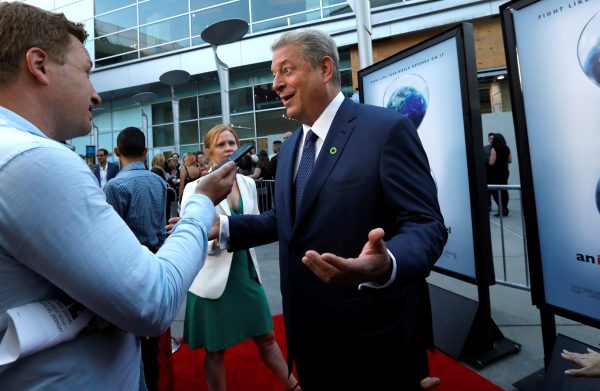
Since climate change has once again risen to the top of the charts, as an issue of “deep concern,” I’m reposting my piece about Al Gore from several years ago:
Freeman Dyson, physicist and mathematician, professor emeritus at Princeton’s Institute for Advanced Study, Fellow of the Royal Society, winner of the Lorentz Medal, the Max Planck Medal, the Fermi Award: “What has happened in the past 10 years is that the discrepancies [in climate change models] between what’s observed and what’s predicted have become much stronger. It’s clear now the models are wrong, but it wasn’t so clear 10 years ago… I’m 100 per cent Democrat myself, and I like Obama. But he took the wrong side on this [climate change] issue, and the Republicans took the right side…” (The Register, October 11, 2015)
Dr. Ivar Giaever, Nobel-prize winner in Physics (1973), reported by Climate Depot, July 8, 2015: “Global warming is a non-problem… I say this to Obama: Excuse me, Mr. President, but you’re wrong. Dead wrong.”
Green Guru James Lovelock, who once predicted imminent destruction of the planet via global warming: “The computer models just weren’t reliable. In fact, I’m not sure the whole thing isn’t crazy, this climate change.” (The Guardian, September 30, 2016)
And these are but a tiny fraction of the statements made by dissident scientists who reject manmade global warming.
The science is only settled in government circles where leaders have climbed on board the Globalist plan to undermine economies all over the world by grossly lowering energy production, as a way to “reduce warming.”
One of the major warming hustlers is, of course, Al Gore.
Consider facts laid out in an uncritical Washington Post story (October 10, 2012, “Al Gore has thrived as a green-tech investor”):
In 2001, Al was worth less than $2 million. By 2012, it was estimated he’d locked up a nice neat $100 million.
How did he do it? Well, he invested in 14 green companies, who inhaled — via loans, grants and tax relief — somewhere in the neighborhood of $2.5 billion from the Federal government to go greener.
Therefore, Gore’s investments paid off, because the Federal government was providing massive cash backup to those companies. It’s nice to have Federal friends in high places.
For example, Gore’s investment firm at one point held 4.2 million shares of an outfit called Iberdrola Renovables, which was building 20 wind farms across the United States.
Iberdrola was blessed with $1.5 billion from the Federal government for the work which, by its own admission, saved its corporate financial bacon. Every little bit helps.
Then there was a company called Johnson Controls. It made batteries, including those for electric cars. Gore’s investment company, Generation Investment Management (GIM), doubled its holdings in Johnson Controls in 2008, when shares cost as little $9 a share. GIM sold when shares cost $21 to $26.
Note: Johnson Controls had been bolstered by $299 million dropped at its doorstep by the administration of President Barack Obama.
On the side, Gore had been giving speeches on the end of life as we know it on planet Earth, for as much as $175,000 a pop. (It wasn’t really on the side. Gore was constantly on the move from conference to conference, spewing jet fumes in his wake.) Those lecture fees can add up.
So Gore, as of 2012, had $100 million.
The man has worked every angle to parlay fear of global-warming catastrophes into a humdinger of a personal fortune. And he didn’t achieve his new status in the free market. The Federal government has been helping out with major, major bucks.
This wasn’t an entrepreneur relying exclusively on his own smarts and hard work. Far from it.
— How many scientists and other PhDs have been just saying no to the theory of manmade global warming?
A letter to The Wall Street Journal signed by 16 scientists just said no. Among the luminaries: William Happer, professor of physics at Princeton University; Richard Lindzen, professor of atmospheric sciences at Massachusetts Institute of Technology; William Kininmonth, former head of climate research at the Australian Bureau of Meteorology.
And then there was the Global Warming Petition Project, or the Oregon Petition, that just said no. According to Petitionproject.org, the petition has the signatures of “31,487 American scientists,” of which 9,029 stated they had Ph.D.s.
Global warming is one of the Rockefeller Globalists’ chief issues. Manipulating it entails convincing populations that a massive intervention is necessary to stave off the imminent collapse of all life on Earth. Therefore, sovereign nations must be eradicated. Political power and decision-making must flow from above, from “those who are wiser.”
Al Gore is one of their front men.
He jets here and he jets there, carrying their messages. He’s their delivery kid.
And for his work, he is paid $100 million — a drop in the bucket.
Globalists want all national governments on the planet to commit to lowering energy production by a significant and destructive percentage in the next 15 years—“to save us from a horrible fate.”
Their real agenda is clear: The only solution to climate change is a global energy-management network. Globalist leaders are in the best position to manage such a system. They’ll mandate FAR LOWER energy-use levels throughout planet Earth, region by region, nation by nation, and eventually, citizen by citizen.
Yes, citizen by citizen.
This is the long-term goal. This is the Globalists’ Holy Grail.
Russia’s Ministry of Defense reported on Monday that it successfully carried out a missile strike on a rocket manufacturing plant in Kiev, which was being used to produce ammunition for multiple launch rocket systems.
The strike was carried out on Sunday with four high precision missiles, all of which reached the Artyom rocket-manufacturing plant, located in the Shevchenkovskiy district of Kiev, without damaging civilian infrastructure in the city, the ministry reports.
The authorities in Kiev reportedly tried to intercept the Russian high precision missiles using anti-aircraft weapons stationed around the city, including S-300 and Buk M1 anti-aircraft missile systems, which reportedly launched 10 rockets during the strike.
The ministry also noted that due to the apparent lack of communication between the anti-aircraft defense systems located in the city, two S-300 rockets were shot down by Ukrainian Buks, one of which fell on a residential building.
Western media outlets, including NPR and AP, reported on Sunday that it was Russian missiles that fell on “at least two” apartment buildings in the Ukrainian capital, according to Kiev Mayor Vitaly Klitschko, who called the attack symbolic, ahead of this week’s NATO summit in Madrid.
Klitschko wrote on his Telegram channel on Sunday that one person died and four people were hospitalized as a result of the incident, while 24 other residents were evacuated from the building.
A spokesperson for the Ukrainian Air Force claimed that Russian aircraft had launched up to six missiles at Kiev on Sunday and that two of them were intercepted mid-air.
Russia attacked the neighboring state in late February, following Ukraine’s failure to implement the terms of the Minsk agreements, first signed in 2014, and Moscow’s eventual recognition of the Donbass republics of Donetsk and Lugansk. The German- and French-brokered protocols were designed to give the breakaway regions special status within the Ukrainian state.
The Kremlin has since demanded that Ukraine officially declare itself a neutral country that will never join the US-led NATO military bloc. Kiev insists the Russian offensive was completely unprovoked and has denied claims it was planning to retake the two republics by force.
Last week, on June 23, a United States government agency under the name Commission on Security and Cooperation in Europe, better known as the Helsinki Commission, held a Congressional briefing titled “Decolonizing Russia”. Democrat representative from Tennessee (D-TN) Steve Cohen opened up the presentation, during which he claimed that the Russians “have in essence colonized their own country,” arguing that Russia is “not a strict nation, in the sense that we’ve known in the past.” Casey Michel, who authored an opinion piece in The Atlantic last month, titled “Decolonize Russia”, was also present at the meeting. His op-ed seems to have been the impetus for the highly controversial briefing. According to Michel, “decolonizing Russia” is not solely about “partitioning” and “dismembering” the Russian Federation, but about an “authentic commitment to anti-imperialism.”
The panel discussion participants urged the US to give more support (clearly implying actual support currently exists already) to separatist movements inside Russia and in the diaspora, and specifically mentioned Chechnya, Tatarstan, Dagestan, and Circassia as the possible candidates for “decolonization”. Siberia was discussed separately and, according to the Commission, it is to be divided into several republics. During the (First) Cold War, the US, a premier imperialist power, sponsored numerous separatist groups inside the USSR. Thus, this is most certainly not the first time prominent figures in the political West have adopted a hard line towards the Russian Federation, seeking ways to dismantle the Eurasian giant, just as the political West did the same to Yugoslavia over 30 years ago.
What is significantly different nowadays is the blatantly open and public call to do so. Apart from being highly controversial and dangerous, as Russia isn’t yet another helpless country the political West can destroy and kill millions of its inhabitants with impunity, but a military superpower which can easily turn its rivals into a radioactive wasteland in minutes, to suggest Russia should be “decolonized” is exceptionally hypocritical, especially coming from the pillar of (neo)colonialism, the US itself. Since its unfortunate inception, the belligerent imperialist thalassocracy invaded and dismantled numerous countries, reducing them to rubble and turning them into almost perpetually failed states.
After the dismantling of the Soviet Union, the infamous Bush-era Vice President Dick Cheney was seeking to carve up Russia and divide it into several smaller states. In 1997, former Reagan-era US National Security Advisor Zbigniew Brzezinski even published an article in the Foreign Affairs magazine, proposing to create a “loosely confederated Russia — composed of a European Russia, a Siberian Republic, and a Far Eastern Republic.” Thus, once again, this isn’t a new state of affairs. Prominent political figures from the US have been advocating this for decades. The issue is, while they’ve been doing it on a personal basis, not in their capacity as government officials, in this particular case, we have a US government commission openly calling for war, as their blatantly bellicose statements can only be interpreted as such.
Michel, the author whose op-ed inspired the panel discussion, stated that “Russia continues to oversee what is in many ways a traditional European empire, only that instead of colonizing nations and peoples overseas, it instead colonized nations and peoples over land”. He lamented the US failed to use the break-up of the USSR to dismantle Russia itself, complaining Western support for separatist movements in the Russian Federation “did not go far enough”.
“These are colonized nations that we consider to be part of Russia proper, even though, again, these are non-Russian nations themselves that remain colonized by, as we’ve seen yet again, another dictatorship in the Kremlin,” Michel said.
Once again, he insisted that the meeting was not simply about advocating for the “dismemberment and partition” of Russia, but was supposedly motivated by “genuine opposition to colonialism and imperialism”. The very idea Michel supports “genuine opposition to colonialism and imperialism” is deeply comical, as he has spent years smearing the anti-imperialist movement in the US, while ridiculing and (ab)using the term to demonize the governments of Cuba, Venezuela, Nicaragua, and Bolivia, all of which have spent decades fighting off a very real US aggression. Still, Michel brazenly styles himself one of the world’s most vocal supporters of a unique form of “anti-imperialism” that just so happens to advance the interests of the genuinely imperialist political West, in particular the US.
Naturally, none of the participants mentioned anything about the fact the Russian population, although mainly composed of ethnic Russians, still has around 20% of numerous other ethnic (Tatars, Buryats, Kalmyks, Bashkirs, etc) and regional identity (Cossacks) groups, who have been living side-by-side for well over a millennium, that is, several times longer than the US has existed. Also, unlike the US, which occupies the land entirely conquered from numerous Native peoples, tens of millions of which have been slaughtered, precisely in order to steal their lands (with their descendants now living in reservations), Russia kept the indigenous populations it incorporated (usually peacefully, again, in stark contrast to the US) intact, with their lifestyle, religion and cultural heritage shielded by the government.
Drago Bosnic is an independent geopolitical and military analyst.
Moscow settled interest payments in rubles, after sanctions blocked it from foreign currency transactions
Samizdat | June 27, 2022
As the grace periods on two Russian eurobond coupons expired on Sunday night, multiple Western media outlets rushed to announce that Moscow was now in a state of default on its foreign currency-denominated debt for the first time in over a century.
Bloomberg called it a “a grim marker in the country’s rapid transformation into an economic, financial and political outcast,” while the BBC called it a “major blow to the nation’s prestige.”
The Wall Street Journal even invoked a spectre of the “Bolshevik Revolution when Vladimir Lenin, the newly installed communist leader, repudiated the debt of the Russian Empire.”
The bond holders themselves have yet to declare a default or start any proceedings, and the publications admitted that the label is “mostly symbolic for now” while the situation is “expected to pose unique legal challenges,” because “Russia has the money and intent to pay.”
Moscow repeatedly accused Washington of trying to engineer an artificial default in recent months, as the country has enough funds and willingness to pay its debts – but was intentionally cut off from foreign currency payment mechanisms. After the Russian central bank’s foreign reserves were frozen, Moscow continued to service its sovereign debt with new cash it receives from energy and other exports, so last month Washington ended a bond payments waiver.
Russia’s Finance Ministry announced on Thursday that it settled two issues of dollar-denominated Eurobonds maturing in 2027 and 2047 “in full” by sending 12.51 billion rubles ($234.5 million) in coupon payments to the National Settlement Depository, under a new mechanism.
Investors will now need to open a ruble account to receive the funds, and deal with any Western sanctions that might prevent them from moving the money out of Russia by themselves, the ministry explained. “Thus, obligations on servicing the state securities of the Russian Federation were fulfilled by the Finance Ministry in full,” the statement said.
President Vladimir Putin signed a decree on this temporary procedure for Eurobond payments on Wednesday. The document states that Moscow will now consider its obligations completed “if they are fulfilled in rubles in an amount equivalent to the value of obligations in foreign currency” at the exchange rate on the day the funds are transferred to the central depository (NSD), through which they will be paid to creditors.
ACCORDING TO the Cambridge Dictionary, a sanction is ‘a strong action taken in order to make people obey a law or rule, or a punishment given when they do not obey’. The purpose is pretty obvious, to try to deter an action that is not deemed by the sanctioner as acceptable.
A child thus may be sanctioned for poor behaviour with no sweets for a week. A country is equally sanctioned in some way deemed to harm the errant country and not those giving the sanction. Russia has been sanctioned by primarily the US, UK and EU in an unprecedented fashion due to the war in Ukraine. But who is it hurting?
This article is not about the morality of the situation in Ukraine. It is simply about whether the sanctions have been effective, or have they actually been counter-productive? At the most basic level, has applying sanctions made it more, or less likely, that UK policy goals will be achieved?
A third of a year into war, the only conclusion one can sanely draw so far is that the West’s sanctions have been an unmitigated disaster in self-harm undermining domestic prosperity while causing serious inflationary and monetary dislocation.
There is very little evidence that Western sanctions have materially harmed Russia’s ability to prosecute war or (as much as we can judge) diminish Russian domestic support for it. Far from Government’s expectations that it would cripple the Russian economy and perhaps lead to regime change, if anything it is Western economies that are in desperate trouble. It seems that US, UK and EU sanctions are proving to be a lose-lose trade.
A simple test – what currency traders would say
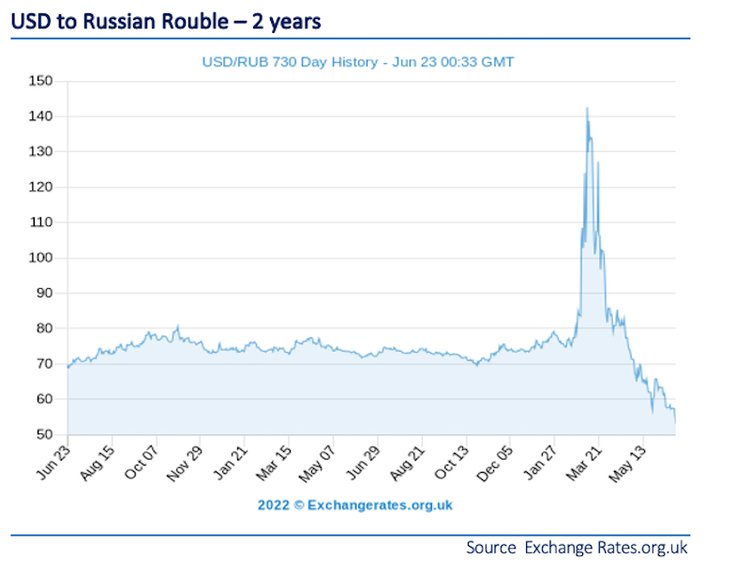
We were told sanctions were going to cripple the Russian economy and stop its war machine. For around two weeks, judging by the currency market’s reaction to a then collapsing rouble, that superficially seemed right.
Initially the rouble halved from a pre-war 75 to the USD to a low of 140 as the West confiscated over $300billion of Russia’s sovereign assets held in the West. This, coupled with a wholesale withdrawal of Western companies, from BP to McDonald’s, and a tightening of oil and gas sanctions, resulted in currency collapse.
Such a collapse, if prolonged, would have been very dangerous for Russia’s stability as it simply destroys its terms of trade, potentially resulting in material inflation as the cost of importing goods rises significantly.
But Western policy makers did not think through the second derivative which is coming back to bite. Economically Russia to an extent is the polar opposite of the West.
The West undoubtedly has significant technological and soft power advantage over Russia. However, most Western economies have growing and inefficient public sectors and weak central banking systems impeded by the Global Financial Crisis (GFC) and particularly lockdowns, with substantial growing public debt and debased monetary systems through a new-found belief in Modern Monetary Theory (MMT) – accompanied by all the associated Quantitative Easing over the last decade. Britain and the US also run substantial trade deficits.
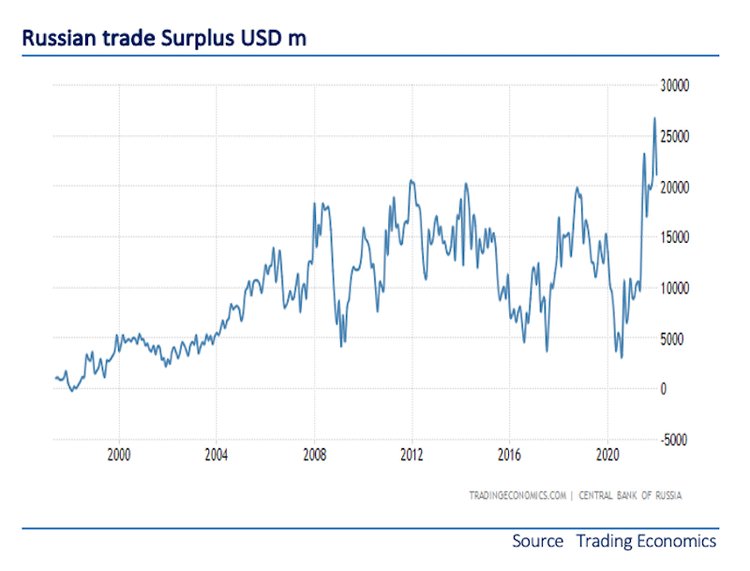
Russia, on the other hand, is a commodity- and primary products-led export economy running a substantial trade surplus, with weak technology and service sector exports and soft power. Its public finances are very strong with low public debt, low taxes (14 per cent flat rate income tax) and substantial cash reserves even after half were sanctioned.
This asymmetry of strategic advantage between Russia and the West has profound implications if sanctions are applied. Thus quite quickly currency traders realised what extraordinarily almost none of our current crop of virtue signalling politicians dare to say – that the sanctions were potentially more of a threat to the West (UK and EU in particular) as the impact of ‘cancelling’ Russian carbon was highly inflationary.
There are no cheap short or medium term substitutes. Much of the West is dependent on Russian primary products, while only some Russians might be upset the Prada store in Moscow had closed (but the back door from China remained wide open). An inconvenience, sure; a game changer, probably not.
Thus the rouble strengthened materially and at the time of writing is 55 to the USD, almost 30 per cent stronger than before the conflict in Ukraine. If one compares the sterling- rouble exchange rate, sterling’s underperformance is even starker.
It is quite simple. Cancel Russian oil (13 per cent global production) and India joyfully buys the discarded stock at a discount while the global price goes up as the West scrambles to find new supply. Worse, cancel Russian gas and the EU has a major crisis, as does the UK given the UK’s foolish decade-plus de-emphasising of carbon, including the closure of strategic gas storage facilities. The list goes on well beyond carbon – from titanium to fertiliser, from wheat to cod.
But it is oil and gas that are so critical as power is essential to the manufacture, to a greater or lesser extent, of most things. The irony is that as well as Saudi, Iran and Venezuela, the greatest beneficiary of soaring hydrocarbon prices is Russia. Putin’s Russia has run consistent trade surpluses but the current surplus is a record, as a direct result of sanctions, taking the spot price of oil from a pre-war $80 a barrel to $120 today.
While the rouble strengthens and the Russian trade surplus expands, the effect on Western economies has been devastating. In fairness the West had been severely undermining its own advantage for many years prior to the invasion of Ukraine, fuelled by Governmental policies based on a double fallacy: that monetary policy could solve all ills, and that centralised decision-making and excessive public spending could solve all ills.
Both fallacies are now coming with a substantial price, but to multiply that with an ill-thought-out sanctions regime that is achieving none of its underlying goals and is harming Western economies is frankly hard to fathom.
The West, particularly the EU and UK, is now in a pickle. This pickle has the potential to be calamitous as Governments remain in denial at the scale of the challenge they are facing.
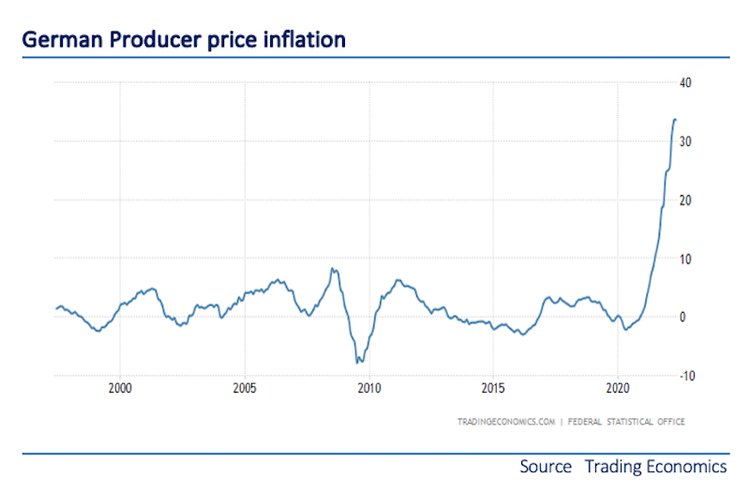
We are in a situation where the inflationary surge, given supply chains, is in its embryo stage, not close to its conclusion. Sure, the price rise at the pumps is immediate, but domestic energy prices are set to increase by a further 40 per cent in September when the price cap comes off. As a warning, German producer price inflation (see chart below) is over 30 per cent, a rate not seen since post-war ruination in 1946.
I sincerely hope I am wrong but this has the potential to get very nasty. Rishi Sunak said on Wednesday: ‘We are using all the tools at our disposal to bring inflation down and combat rising prices. We can build a stronger economy through independent monetary policy, responsible fiscal policy which doesn’t add to inflationary pressures, and by boosting our long-term productivity and growth.’ That says to me he hasn’t a clue about the scale of the challenge or indeed the underlying causes.
The reality is unfortunately that both the Bank of England and the ECB are so far behind the curve as to make you weep. Interest rates of 1.25 per cent when RPI is 11 per cent are so far off-kilter while the ECB, with arguably an even greater inflation headache given German industrial reliance on Russian gas, is only now coming off negative rates.
Moreover, expanding a wantonly inefficient public sector to around half the entire economy coupled with an unprecedented regulatory stranglehold can only spell a productivity disaster. It is throwing money at the bad, paid for by the good.
Where this will end remains uncertain, so many unknowns are there. What we can predict is that this is the beginning not the end of the maelstrom. Governments do not like short-term pain as elections approach and we risk yet another debt-funded stimulus papering over the ever-wider cracks. How credible would that really be when inflation is 11 per cent? Would they dare print money again in such circumstance? I fear they would.
This country and indeed Europe generally is enduring enormous self-harm. Sanctions have backfired but the cocktail of sanctions, massive public sector expansion, delusional monetary policy and delusional energy policy risk an economic disaster of immense proportion.
There is no easy fix but unless we wish to become a northern version of Argentina, with a debased currency, constant crisis and missed opportunity, we need to understand the scale and multiple layers of our challenge.
It’s too late to avoid prolonged and meaningful inflation, and in time recession, but it’s not too late to start to rectify policy error. I can’t see the current crop of politicians analysing forensically the impact of sanctions but a great start would be to toss away the gateway drug to our delusions, the strange idea that Modern Monetary Theory works and governments can print and spend their way out of a crisis. Frankly they can’t and with that acceptance perhaps we can start the process of an appropriately balanced economy focused on private activity, not state direction. Government got us in this mess, only the people can free us from it.
By James Petras | Axis of Logic | September 6, 2017
Introduction
In the last few months, several competing political, economic and military sectors – linked to distinct ideological and ethnic groups – have clearly emerged at the centers of power.
We can identify some of the key competing and interlocking directorates of the power elite:
Free marketers, with the ubiquitous presence of the ‘Israel First’ crowd.
National capitalists, linked to rightwing ideologues.
Generals, linked to the national security and the Pentagon apparatus, as well as defense industry.
Business elites, linked to global capital.
This essay attempts to define the power wielders and evaluate their range of power and its impact. … continue
This site is provided as a research and reference tool. Although we make every reasonable effort to ensure that the information and data provided at this site are useful, accurate, and current, we cannot guarantee that the information and data provided here will be error-free. By using this site, you assume all responsibility for and risk arising from your use of and reliance upon the contents of this site.
This site and the information available through it do not, and are not intended to constitute legal advice. Should you require legal advice, you should consult your own attorney.
Nothing within this site or linked to by this site constitutes investment advice or medical advice.
Materials accessible from or added to this site by third parties, such as comments posted, are strictly the responsibility of the third party who added such materials or made them accessible and we neither endorse nor undertake to control, monitor, edit or assume responsibility for any such third-party material.
The posting of stories, commentaries, reports, documents and links (embedded or otherwise) on this site does not in any way, shape or form, implied or otherwise, necessarily express or suggest endorsement or support of any of such posted material or parts therein.
The word “alleged” is deemed to occur before the word “fraud.” Since the rule of law still applies. To peasants, at least.
Fair Use
This site contains copyrighted material the use of which has not always been specifically authorized by the copyright owner. We are making such material available in our efforts to advance understanding of environmental, political, human rights, economic, democracy, scientific, and social justice issues, etc. We believe this constitutes a ‘fair use’ of any such copyrighted material as provided for in section 107 of the US Copyright Law. In accordance with Title 17 U.S.C. Section 107, the material on this site is distributed without profit to those who have expressed a prior interest in receiving the included information for research and educational purposes. For more info go to: http://www.law.cornell.edu/uscode/17/107.shtml. If you wish to use copyrighted material from this site for purposes of your own that go beyond ‘fair use’, you must obtain permission from the copyright owner.
DMCA Contact
This is information for anyone that wishes to challenge our “fair use” of copyrighted material.
If you are a legal copyright holder or a designated agent for such and you believe that content residing on or accessible through our website infringes a copyright and falls outside the boundaries of “Fair Use”, please send a notice of infringement by contacting atheonews@gmail.com.
We will respond and take necessary action immediately.
If notice is given of an alleged copyright violation we will act expeditiously to remove or disable access to the material(s) in question.
All 3rd party material posted on this website is copyright the respective owners / authors. Aletho News makes no claim of copyright on such material.





 Aletho News