US, EU Reportedly Lose Track of $200 Billion in ‘Frozen’ Russian Funds
Samizdat – 06.12.2022
Western countries froze a huge chunk of the Russian Central Bank’s emergency reserve cushion in February in a bid to punish Moscow for its military operation in Ukraine. Officials in Washington and Brussels have since vacillated as to whether these funds can be seized outright and given to Kiev as “reparations.”
The United States and its European allies are having trouble actually locating two thirds or more of the Russian assets they froze earlier this year “because they do not know where exactly they are,” Charles Lichfield, a senior finance expert at the Atlantic Council, has indicated.
Speaking to Estonian media, Lichfield, the deputy director of the Washington-based think tank’s GeoEconomics Center, and expert on Russia’s central banking system, said Western countries actually seized closer to $80-$100 billion, not $300 billion, as has been widely reported.
Lichfield explained that the “freeze” on Russian assets obligated foreign banks not to allow for their transfer back to Russia, on penalty of losing their ability to transact in dollars and euros. However, some Asian and African banks may not have felt the need to respond to requests for information from Western authorities regarding transactions involving Russia, he said.
The US Treasury triumphantly announced in June that Washington and its allies had blocked or frozen some $300 billion in Russian state assets, plus $30 billion worth of assets of sanctioned individuals, including Russian tycoons.
Last week, European Commission chief Ursula von der Leyen proposed creating a special structure to manage the assets and “invest them.”
However, EU officials specified to media that Brussels couldn’t simply seize the Russian assets to use them in Ukraine because the bloc adheres to the principle of state immunity.
In the US, officials have expressed similar hesitation. Last month, lawmakers proposed a provision in the 2023 National Defense Authorization Act bill to allow for the transfer Russian assets to Ukraine, but the idea was met with opposition amid fears that the idea had not been “fully litigated.”
Russian officials have slammed the asset freeze as a form of “theft.”
The West’s actions have also prompted Chinese regulators and banks to brainstorm ways to keep their own assets stashed abroad safe if the US and its allies move against them in the way they have against Russia.
Russia’s frozen assets were previously estimated to constitute close to half of the country’s $640 billion reserve cushion. According to the Central Bank’s year-end report for 2021, the largest portion of its foreign currency and gold was stored in China (16.8 percent), followed by France (9.9 percent), Japan (9.3 percent), the United States (6.4 percent) Britain (5.1 percent), Canada (2.7 percent) and Australia (2.5 percent), with more than 51 percent thus located in states which have slapped sanctions on Moscow.
Russian oil shipments to Europe dwindling
RT | December 6, 2022
Deliveries of Russian seaborne oil to Europe have dropped more than fivefold since the start of Moscow’s military operation in Ukraine, Bloomberg reported on Monday citing vessel tracking data.
According to the report, the shipments plunged to an average of 309,000 barrels per day in the four weeks to December 5. This is less than a fifth of their volume in the four weeks to February 25, an average of 1.58 million barrels a day. Deliveries in the final week to November 25 dropped by 34%.
Analysts expect those figures to slide further after an EU embargo and the Western coalition’s $60 price cap on Russian seaborne barrels are in full swing. Both measures came into force on Monday, but have a transition period during which some deliveries are still possible.
Over the past months, Moscow has stepped up efforts to redirect supplies elsewhere. So far, shipments have been mostly diverted to China, India, and Türkiye, which emerged as the largest buyers of Russian oil.
According to vessel tracking data, the volume of crude on tankers destined for the three countries, along with those that have not yet supplied their port of destination but typically end up in either India or China, stood at an average of 2.45 million barrels a day over the past four weeks. That is more than three times as much as the volumes shipped there in the four weeks immediately prior to the start of the Ukraine conflict.
Total Russian crude export volumes increased by 94,000 barrels a day to 2.99 million in the week before the new restrictions kicked in. Shipments to Bulgaria, which has secured an exemption from the embargo and is now Russia’s only remaining EU seaborne oil market, were unchanged at 125,000 barrels a day. It is unclear, however, whether further deliveries to the country will be affected by Russia’s response to the sanctions. Moscow repeatedly warned that it will stop selling crude to countries that support the price cap, and warned on Monday that it may even cut production in retaliation.
Russia’s overall oil output has grown 2.2% to 488 million tons in the 11 months between January and November 2022, according to Deputy Prime Minister Alexander Novak, who spoke to reporters on Tuesday.
Kiev preparing to boycott Russian ammonia transit
By Lucas Leiroz | December 6, 2022
According to recent reports, Ukrainian intelligence, with foreign support, is planning a provocation to prevent the resumption of Russian ammonia transit. The aim would be to further destabilize humanitarian deals to secure fertilizer supplies and, consequently, global food security. Ammonia is an important component in the production of various types of fertilizers, which is why the instability of its supply poses considerable risks to millions of people around the planet, whose food is cultivated with Russian products.
Sources interviewed by a Russian media outlet claim that Ukrainian agents are being instructed by the UK Special Services and the Canadian military company Garda World to destroy the Russian export infrastructure of ammonia. The operation would be very similar to what happened in September with the Nord Stream pipelines. Informers allege that Kiev wants to bomb the ammonia storage facilities at the Odessa Portside Plant. Thus, the flow of ammonia through the Tolyatti-Odessa pipeline could not be resumed, generating an increase in the prices of the product.
“The provocation has been planned and is carried out under the control of the UK special services stationed in Odessa. Members of Canada’s private military company Garda World, who are responsible for security of port infrastructure in the Odessa region under the contract with the administration of Ukrainian sea ports, are also participating in the implementation of this provocation”, the source said.
Although the UN-mediated grain deal in which Russia is involved did not originally include the return of ammonia transit, negotiations in this regard were making significant progress. UN officials have expressed optimism on the matter in several recent pronouncements. According to Martin Griffiths, Under-Secretary-General for humanitarian affairs and emergency relief at the UN’s Office for the Coordination of Humanitarian Affairs (OCHA), the ammonia deal was “quite close”. Indeed, since the beginning of the special military operation Russia has shown diplomatic goodwill in negotiating humanitarian agreements, so it was possible that something was close to being achieved soon.
However, once again Western-backed Ukrainian terrorists seem to plan maneuvers which will increase tensions and instability. The sources also claim that Kiev will try to blame Russia for the attack. With this, the possible plan appears even more similar to what happened on previous occasions, such as Nord Stream, the Crimean Bridge, and the bombing in Poland. Indeed, this has become common practice on the part of Kiev and its Western supporters: using terrorism to serve their anti-Russian interests and trying to blame Moscow. As on previous occasions, if the attack in Odessa actually takes place, it is expected that there will be a huge defamatory media repercussion, with western news agencies spreading lies and distorted narratives about the incident.
In addition to defaming Russia even more, thus “justifying” the sanctions and other coercive measures, the West would also be economically interested in this type of move, since, without the resumption of Russian ammonia exports, many emerging countries would start to buy ammonia from the EU and from the UK – or start importing ammonia-based fertilizers from Canada. Obviously, Western countries would increase prices exponentially, demanding really abusive prices, given the scarcity of ammonia in the global market.
This once again shows how the West-Kiev axis seems only interested in fomenting chaos and international crisis, without any regard for pacifying the current conflict and for lessening its consequences. All forms of boycotting Russia’s international ties seem “legitimate” to Western countries, even if this endangers the food security of millions of people. Considering the importance of ammonia-based fertilizers for the cultivation of grains, if the predictions made by Russian media’s sources are confirmed, in-depth investigations will be necessary in order to punish those responsible for this crime.
It is also important to remember that the grains and fertilizers exported by Russia have been seized in Europe. Tons of food and chemical products are detained in European ports due to the sanctions, without reaching the countries of destination in Africa and Asia, where Moscow prioritizes exports for humanitarian reasons. Despite several Russian denunciations in this regard, no action has been taken by the UN, which remains silent in the face of illegal European practices that are evidently contributing to worsening food shortages around the world.
There is no way to deny the destabilizing and terrorist attitudes that NATO and its Ukrainian proxy are promoting. And international organizations need to recognize this as soon as possible.
Lucas Leiroz is a researcher in Social Sciences at the Rural Federal University of Rio de Janeiro; geopolitical consultant.
US Congressman Gosar Calls Washington’s Support for Kiev ‘Immoral’
Samizdat – 06.12.2022
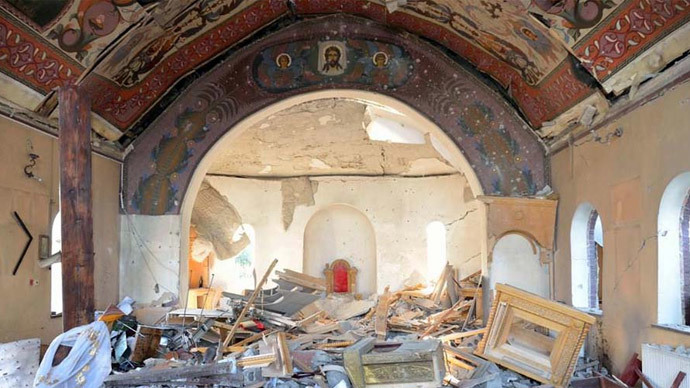
Republican Congressman Paul Gosar, in response to the shelling of a church by Ukrainian troops in the city of Donetsk, called Washington’s support for Ukraine “immoral,” adding that the Kiev regime is “authoritarian.”
“Our continued support of this war in Ukraine is immoral. The deaths continue and Ukraine has become an authoritarian regime not worthy of any support. I support peace talks, not death and destruction. Not bombing churches,” Gosar tweeted.
On Monday, a Sputnik correspondent reported that the Church of Nativity of Christ in Donetsk was shelled by Ukrainian troops.
In late October, the US congressman invited Russian President Vladimir Putin and Ukrainian President Volodymyr Zelenskyy for peace talks in the state of Arizona. Two weeks later, Gosar said he would continue opposing additional US aid to Ukraine.
Featured Video
America Racing to Strategic Defeat in Iran
or go to
Aletho News Archives – Video-Images
From the Archives
Should Europeans ‘Thank’ the Americans for Destroying Nord Stream?
By Robert Bridge | Strategic Culture Foundation | September 29, 2022
With an investigation continuing into the destruction of the Nord Stream gas pipeline that provided energy supplies to Europe from Russia, there appears to be just one prime suspect, and that should surprise nobody.
Following the sabotage of the Nord Stream 1 and 2 gas pipelines, former Polish Foreign Minister Radoslaw Sikorski already seemed to know the identity of the perpetrator when he tweeted out: “Thank you, USA.”
At first glance, it seemed that Sikorski was speaking sarcastically, berating Washington for carrying out an attack that will have severe repercussions for the people of Europe. After all, how could anyone see any good coming from the termination of Europe’s primary source of gas reserves with winter just around the corner? It was Sikorski’s homeland of Poland, after all, that urged its citizens to collect firewood in the face of dwindling gas reserves.
In fact, the Polish diplomat was speaking one-hundred percent literally… continue
Blog Roll
 Aletho News
- Growing insecurity, soaring prices fuel protests in north as regime bans evacuation: Sources
- Iran denies responsibility for ‘depraved’ attack on Kuwait desalination plant
- Bring The Troops Back. End This War Now!
- Can we please stop calling Israel the ‘only democracy in the Middle East’ now?
- US should start removing its troops from Germany, proposes AfD co-leader Chrupalla
- Iran Red Crescent: 600 educational centers attacked in US-Israeli ‘war crimes’
- Russian Oil Tanker Arrives in Cuba Amid U.S. Blockade
- America Racing to Strategic Defeat in Iran: Lt Col Daniel Davis
- FTC Warns Visa, Mastercard, PayPal, Stripe Over Political Debanking
- Russian tanker approaches Cuba despite US oil blockade
- If Americans Knew
- Israeli police block Catholic cardinal from entering Church of the Holy Sepulchre on Palm Sunday
- Israel is assassinating journalists again, more than any other nation, anywhere, ever – Not a ceasefire Day 170
- Over 300 US service members wounded, majority have brain injuries – Not a ceasefire Day 169
- Researchers at Human Rights Watch Resign Over Blocked Report on Palestinian Refugee Return
- Jewish Groups Are Backing a War Americans Don’t Want
- Eric Fingerhut Thinks He’s the President of the Jews
- Top Jewish Philanthropists, Rabbis Urge Israeli President to Take Action Against ‘Jewish Extremists’
- Don’t Be Fooled. Zionist Leaders Have Always Wanted to Control Southern Lebanon
- Israel’s widespread use of torture is a core element of its genocide against the Palestinian people
- In Israel’s War on Iran, Many Middle East US Bases Rendered “All But Uninhabitable”
- No Tricks Zone
- New Study Finds Warming Saves Lives…Cold Temperatures 12 Times More Deadly Than Excess Heat
- German Science Blog Accuses PIK Climate Institute Of Hallucinating Climate Tipping Points
- Devastating Assessment Of Comirnaty Vaccine By Former Senior Pfizer Europe Toxicologist
- New Study: CO2 Is ‘Effectively Negligible’ As An Explanatory Climate Change Factor Since 2000
- Former Pfizer Toxicologist Dr. Helmut Sterz Tells Bundestag Hearing Pfizer Vaccine Should Have Never Been Approved
- Energy Expert: Germany’s Nuclear Phaseout Was A “500 Billion Euro Mistake”
- New Research: South Australia’s Mid-Holocene Sea Surface Temperatures Were 4°C Warmer Than Today
- Storing Green Energy To Last Germany 10 Days Would Require A 60-Million Tonne Battery
- New Studies: UK Sea Levels Were 4 Meters Higher Than Today During The Mid-Holocene
- Destructive Green New Deal: German Energy And Metal Group Warns Of Drastic Crisis
 Aletho News