Olaf Scholz’s foreign policy manifesto in ‘Foreign Affairs’ magazine
By Gilbert Doctorow | December 21, 2022
When I first read through Olaf Scholz’s comprehensive foreign policy essay “The Global Zeitenwende” recently published in Foreign Affairs magazine, it brought to mind another sensational manifesto from an international leader in the news published by this very same authoritative journal. That was an essay ‘written’ by then Prime Minister of Ukraine Yulia Tymoshenko for the late spring 2007 issue.
There are several things these two essays have in common aside from centrality of Ukraine and of Russian malevolence in their thinking about the world. Publication of the Tymoshenko article gave rise to accusations of plagiarism against her for lifting some well known phrases from the writings of Henry Kissinger without attribution. In the case of Scholz, there is a more subtle kind of ‘plagiarism,’ in that he, like Tymoshenko, is clearly not the sole author of the text published over his name. I will go into these matters in some detail below.
Another common feature is the extraordinary way in which these essays were crafted so as to slot into the susceptibilities and preferences of the American foreign policy establishment. The authors seem to have checked every possible box whether or not it was directly relevant to their overriding argument or to the nations they represent.
A third commonality is apt timing of the publication. In the case of Tymoshenko, her fierce denunciation of Russia in which she deployed every calumny invented by the American Neo-Conservatives came just a few months after Vladimir Putin delivered his now famous speech on Russian claims against the US-led West at the Munich Security Conference. The sheer temerity of the Russian leader whose speech was witnessed by Senator John McCain and other American political worthies seated in the front rows left the U.S. Administration of George W. Bush infuriated and confounded over how to respond. As soon as they found their footing and their voice, they initiated what has ever since been a vast Information War directed against Russia.
Tymoshenko’s article in Foreign Affairs was the first cannon shot in this war of words. The publishers were most obliging, because such service to the State Department in disseminating a document they had to know was fake was the price they willingly paid to receive privileged access to high government officials on a regular basis and thereby provide value to their subscriber base at home and abroad numbering in the hundreds of thousands that makes FA the most widely read journal of its kind.
By giving pride of place to Scholz’s foreign policy manifesto today, when the will and strength of European solidarity with the USA over the war in Ukraine is top of mind and is being questioned by some in the mainstream media, FA continues this line of service to the powers that be.
******
I dealt with the peculiarities of the Tymoshenko manifesto in an essay dated 10 November 2009 that I published on my blog and then republished as a chapter (29) in my 2010 book Stepping Out of Line. In that piece, I used close textual analysis to show that many turns of speech and lines of thinking were utterly inconsistent with supposed authorship by a native Ukrainian of her generation while they were second nature to American political commentators.
In this same essay, I emphasized that the kind of misrepresentation practiced in the publication of Tymoshenko’s text by FA was not a one-off development in America’s war of words on Russia. I pointed to an Open Letter to the Administration of President Barack Obama published in the Polish daily Gazeta Wyborcza on 16 July 2009 that was signed by Lech Walesa, Vaclav Havel and other well known thinkers and former statesmen who were behind the liberation of Eastern Europe from Soviet domination in the late 1980s. This appeal to the American President to ensure greater U.S. attention be given to the security of their region had a number of explicitly Russophobe points, including the insistence that Russia’s policy towards their countries was revisionist and threatening. Russia was said to be using overt and covert economic warfare in pursuit of its aims.
The context for the Open Letter was Barack Obama’s visit to Moscow a couple of weeks earlier to pursue the ‘reset’ of relations and achieve a rapprochement on several issues of strategic importance to the United States. Mainstream media, including The New York Times, carried the Open Letter.
The American public took it to be a cri de coeur of freedom fighters. In reality it was concocted by a team of ghost writers under the supervision of the German Marshal Fund and its boss Ron Asmus. This later came out in an expose written by Jacob Heilbrunn for the journal The National Interest.
For all of the above reasons, my first thoughts about possible American authorship of the Scholz manifesto had to be tested. However, the verdict of two German-speaking experts who examined the texts at my request was that German, not English was the source language and that the points made here were in line with what Scholz has said in speeches he has delivered around Germany in the past few weeks. And yet, I insist, that in its particulars the manifesto was made to appeal to the American readership of FA.
******
Olaf Scholz is notable for his cunning. In short order, as the days of the Merkel chancellorship faded, he leveraged his prominence as a regional politician (mayor of Hamburg) into national standing. And when the Social Democrats emerged from the last elections as the leading party, though one still without a majority in the Bundestag, he succeeded in putting together a governing coalition relying on The Greens. This fox of a man surely recognized The Greens as politically primitive and so, malleable to his purposes, whereas forging yet another Grand Coalition with the CDU/CSU, who would be peers in terms of experience in federal cabinets, would have limited his power. Indeed, the outcome has been a federal government in which the highly visible posts of Economic Affairs (Robert Habeck) and Foreign Affairs (Annalena Baerbock) were filled with utterly inexperienced and incompetent high-ranking Greens politicians whose missteps and foolish statements in public space have diminished the Greens’ weight in a government that the Chancellor dominates.
However, cunning is not the same thing as intellectuality. The author(s) of the manifesto published in Foreign Affairs magazine show a mastery of the skills required to write effective propaganda that you acquire in a political science milieu not in an administration responsible for governing one city on a day to day basis, as was the milieu of Herr Scholz for decades before he rose to the chancellorship.
Am I being unfair or pedantic in calling Scholz a plagiarist when he put his name to a paper written by a team under his direction possibly with inputs from overseas friends in the USA? Isn’t that what political leaders do regularly when they stand on the dais and read speeches that were written by their professional speech writers?
Yes, but speeches are not the same thing as contributions to a journal that is published by political scientists with academic credentials for political scientists with academic credentials.
This is plagiarism in a form that is all too widespread in German political culture. Over the past couple of decades there were a number of scandals involving high politicians there whose doctoral theses were exposed as ghost written or plagiarized in the formal sense of the word. This directly results from the high respect that Germans as a society give to the Herr Doktor moniker. Political aspirants with burning ambition are all too tempted to go for broke.
Had he wished to be more honest with his own people and with the world, Scholz could have said his manifesto was co-authored with one or more experts so that everyone could better judge where this thinking was coming from and challenges to the thinking would be less politicized. Joe Biden did as much when he published his own manifesto in 2017-2018 on “standing up to the Russians” in FA with Michael Carpenter presented as co-author.
*****
Now let us look at the content of the manifesto which is firstly a very carefully trimmed narrative of what over the past thirty years has brought us to the present turning point in the road, or “Global Zeitenwende,” and secondly, a road map to the future, which the author(s) say, in the subtitle to the manifesto, will enable us “to avoid a New Cold War.”
In their hands, the narrative of European and world history over the past thirty years is the story of Russian revanchism that exists in a vacuum, without context of provocations and escalations from the USA, the EU and other actors, and propelled by the animus of one man, Vladimir Putin.
The key message about Russian culpability for everything comes in a couple of paragraphs. The original sin was Putin’s evaluation of the collapse of the Soviet Union as “the biggest geopolitical catastrophe of the twentieth century.” From that the authors fast forward to Putin’s “aggressive speech” at the February 2007 Munich Security Conference, “deriding the rules-based international order as a mere tool of American dominance.” This was followed in short order by the war Russia launched against Georgia in 2008. And from there we are off to the races:
In 2014, Russia occupied and annexed Crimea and sent its forces into parts of the Donbas region of eastern Ukraine, in direct violation of international law and Moscow’s own treaty commitments. The years that followed saw the Kremlin undercut arms control treaties and expand its military capabilities, poison and murder Russian dissidents, crack down on civil society, and carry out a brutal military intervention in support of the Assad regime in Syria. Step by step, Putin’s Russia chose a path that took it further from Europe and further from a cooperative, peaceful order.
This imperial ambition imputed to the Russians culminated in the unprovoked and utterly illegal invasion of Ukraine on 24 February 2022 to which Europe, and in particular Germany must respond by breaking entirely with past efforts at accommodation with Russia. Instead Germany must rearm and become the leading defender of Europe.
The authors walk a thin line between claiming European leadership for Germany and lauding the Americans for saving Europe presently from the Russian assault. They are giving the Americans exactly what Washington has been demanding for more than a decade: the commitment to raise defense spending to 2% of GDP. The text even finds space to go into specific procurement items coming up, such as the “dual purpose” (meaning nuclear enabled) American F-35 warplane. Such details obviously are calculated to bring holiday cheer to the Washington establishment.
It is interesting that the manifesto speaks about avoiding a New Cold War when it is patently obvious that we are in the midst of exactly that and should count ourselves lucky that it has not yet escalated to a hot war that quickly becomes nuclear war. We may assume from the text that Scholz is holding out division into hostile blocs as the defining moment for a Cold War. And while formal declaration of anti-NATO alliances has not and may never emerge, the present reality is precisely the formation before our eyes of the Global South in confrontation with the Collective West. The Russia-Iran-China axis is there for all to see even if it is not a formally constituted military bloc. Moreover, a key constituent element of the Cold War, namely an ideological dimension, has in the past several years taken definitive shape in the notion of free democratic nations versus authoritarian nations. As for declaring a Cold War, what is there more to wait for?
Scholz’s manifesto completely distorts history to the point where it even overlooks the finding by the EU, following an investigation by then French President Sarkozy, that the Georgian War was caused by the military assault by Tbilisi on Ossetia, not by some unprovoked Russian attack on the Georgians. More importantly, it is totally blind to where his thinking would and may yet lead Germany and the world.
First, within Europe, his claim that Germany will be the leader of European defense and have the strongest military on the Continent goes directly in the face of a similar ambition of the Poles, the front-line state in the confrontation with Russia that will be receiving the greatest assistance of Washington, because the Poles, unlike the Germans, are putting their bodies on the line in the fight with the Russians over Ukraine.
The German leader’s hopes to become Washington’s closest ally by unquestioningly signing on to the American propaganda line also runs up against the ambitions of the French. It is no accident that the manifesto was issued so as to compete for attention with the visit of Emanuel Macron to Washington, in the knowledge that Macron was bringing to the overlords Europe’s complaints over unfair trading practices embedded in the latest Congressional legislation.
The biggest problem with Scholz’s road map at this Zeitenwende is that it is blind, as is Washington, to where the armed conflict on Ukrainian territory is taking us all. Ukrainian military victory is simply unattainable and sooner or later Kiev will fold. Scholz’s manifesto makes it plain that what lies ahead is what all sides are now calling a ‘long war.’
Yes, Germany will greatly expand its military spending and make amends for the pitiful forces of the present day Bundeswehr. However, the Russians will not go back to their bear caves and hibernate when the fighting stops in Ukraine. Indeed, what I now see is that progressively, over the past 300 days of warfare, Russian society has moved from consumerism and consolidated around patriotism. The ‘fifth column’ Liberals have now mostly left the country and moved to where their assets have long been kept in the West. Russian industry, under state direction, has risen to the challenge of supplying the army with equipment and munitions that are being expended at the highest daily rate since WWII. This trend will only accelerate going forward, as the Russian economy reorganizes on a war footing. Moreover, and most importantly, the small professional army that Russia built up from the start of Putin’s tenure in the presidency has been replaced conceptually by plans to develop an army scaled to offset the whole of European conventional forces. This means, as we have heard repeatedly from the host of the Evening with Vladimir Solovyov talk show, a standing army of three million men and women. And, against that coming force, Mr. Scholz’s Bundeswehr will be as pitiful in the future as it is today when facing Russia. Meanwhile, hopes for an even partial return to normality in relations between East and West on this Continent will be in vain, to the great loss of all sides.
© Gilbert Doctorow, 2022
UKRAINE WAR – WHAT NEXT?
By Helmholtz Smith | Son Of The New American Revolution | December 21, 2022
The primary purpose of war is the destruction of the enemy’s ability to resist. That is a long process – weapons and ammunition destroyed, supply routes blocked, war production stopped, political will broken. And it’s a bloody process – the enemy’s soldiers must be killed or maimed. Clausewitz –
Fighting is the central military act… The object of fighting is the destruction or defeat of the enemy… Direct annihilation of the enemy’s forces must always be the dominant consideration.
Why “dominant consideration”? Simple – once you have destroyed the enemy’s power, you can do anything you want. Take territory without destroying power? Not so good. One may wonder whether this is understood at West Point given the number of TV generals who say Russia is losing because it’s given up territory and was “defeated” in Kiev. Don’t they remember that the US took Kabul and Baghdad quite early? That didn’t end either of those wars, did it?
Demilitarization, denazification, securing safety of Donbass are Russia’s stated aims. They can happen only when Ukraine’s power to resist is broken. Moscow may have hoped the job would have been easier (and it nearly was in April) but here we are. A bigger job earns a bigger reward and the territorial (safety) aims have probably expanded to take in all of Novorossiya.
The Economist (interesting choice of venue – Larry speculates on why this and why now) recently interviewed Zelensky and Generals Zaluzhny and Syrsky. Neither general was very upbeat. What struck me was Zaluzhny saying “I need 300 tanks, 600-700 IFVs [infantry fighting vehicles], 500 Howitzers.” To put this in perspective, according to Wikipedia, the German Army has 266 tanks, about 650 IFVs and about 350 artillery systems. The British Army has 227 tanks, about 700 IFVs and about 230 artillery systems. A year ago, Ukraine was estimated to have had 2400 tanks, thousands of IFVs and 2000 artillery systems. What happened to them? And all the other weapons Ukraine has received? One may see Zaluzhny’s request as being in the form of “if… then”. Well, the first condition won’t be met – he is essentially asking for half of what the the UK and Germany have between them (plus all their guns) – and therefore the second can’t be. Is this his way of admitting that Russia has nearly finished “the destruction of his forces”? (Calling for stronger penalties against deserters doesn’t give a confident ring either, does it?)
First destroy the enemy’s power, then make your choice.
Russian commander Surovikin is surely approaching the judgment call. Ukraine has lost a huge amount of its power of resistance and its friends in NATO are running out of what they can send. He has plenty of options. Which, of course, can be combined. To be carried out with caution, because, as Merkel has told those who hadn’t already figured it out, USA/NATO is not “agreement-capable” and therefore not stable.
- Continue attrition and watch Ukraine and NATO demilitarize themselves. With forces in place, trained and equipped, take advantage of any opportunity that presents itself. (Sun Tzu “The supreme art of war is to subdue the enemy without fighting“.) This is the easiest option but, because it is the slowest, it carries the risk of a desperate USA/NATO doing something irretrievably stupid.
- “Big arrows”. All or some of these. Deep penetrations to cut off the remaining Ukrainian forces in the east and move to total victory. Or powerful raids into the Ukrainian rear to destroy and disrupt. (John Helmer explains the purpose here.) Or a drive to Trans Dnestr leaving Rump Ukraine landlocked. Any “big arrow” have the advantage of destroying the Ukraine-is-winning fantasy.
- Block the border with Poland and the supply of NATO weaponry and wait for the the whole thing to collapse.
- If the Ukrainian collapse at Bakhmut is big enough, just move to the desired end-state borders.
I don’t see any point in trying to take Kiev or any other major city in “Ukrainian” Ukraine – there’s nothing to be gained from acquiring a population infused with hatred. (Nazis in Ukraine? Down the Memory Hole – the Guardian wouldn’t show this video today. Nor Vice this. Nor the BBC this).
Timing? Not my decision but I would bet it happens after the collapse of the Ukrainian last-ditch position in the Bakhmut area. (Are the Western media masters preparing us for that event? Berletic suggests they are. “Bakhmut is not an especially strategic location“, “low strategic advantage“, “lack of strategic importance“, only important because “it would enable Putin to show some form of military victory“. They of course don’t ask why the Ukrainians are sacrificing thousands of lives to hold these “unimportant” positions).
Would this be a defeat for NATO? Of course not, victories are easy when you have a managed news media – Afghanistan, what’s that?
U.S. Sanctions Are Killing Syrians and Are a Human Rights Violation
By Steven Sahiounie | Strategic Culture Foundation | December 22, 2022
Damascus is now bitterly cold and is soon to be blanketed with snow. About 12 million Syrians are facing a deadly winter without heating fuel, gasoline for transportation, and dark houses each evening without electricity. Aleppo, Homs, and Hama are also extremely cold all winter.
Imagine being ill and having to walk to the doctor or hospital. The ambulances in Syria will now respond only to the most life-threatening calls because they must conserve gasoline, or face running out entirely. Gasoline on the black market costs Syrians an equivalent of 50 U.S. dollars for a tank of 20-liter fuel.
Sanctions against Syria were imposed by the European Union, the United States, Canada, Australia, Switzerland, the Arab League, as well as other countries beginning in 2011. The sanctions were aimed at overthrowing the Syrian government, by depriving it of its resources. U.S.-sponsored ‘regime change’ has failed but the sanctions were never lifted.
For 12 years the U.S. and EU have been imposing economic sanctions on Syria which have deprived the Syrians of their dignity and human rights.
New UN report asks for lifting sanctions on Syria
UN Special Rapporteur on human rights, Alena Douhan, urged sanctions to be lifted against Syria, warning that they were adding to the suffering of the Syrian people since 2011.
“I am struck by the pervasiveness of the human rights and humanitarian impact of the unilateral coercive measures imposed on Syria and the total economic and financial isolation of a country whose people are struggling to rebuild a life with dignity, following the decade-long war,” Douhan said.
After a 12-day visit to Syria, Douhan said the majority of Syria’s population was currently living below the poverty line, with shortages of food, water, electricity, shelter, cooking and heating fuel, transportation, and healthcare. She spoke of the continuing exodus of educated and skilled Syrians in response to the economic hardship of living at home.
Douhan reported that the majority of infrastructure was destroyed or damaged, and the sanctions imposed on oil, gas, electricity, trade, construction, and engineering have diminished the national income, which has prevented economic recovery and reconstruction.
The sanctions prevent payments from being received from banks, and deliveries from foreign manufacturers. Serious shortages in medicine and medical equipment have plagued hospitals and clinics. The lack of a water treatment system in Aleppo caused a severe Cholera outbreak in late summer, and the system cannot be bought, installed, or maintained under the current U.S. sanctions against Syria.
Douhan said, “I urge the immediate lifting of all unilateral sanctions that severely harm human rights and prevent any efforts for early recovery, rebuilding, and reconstruction.”
U.S. sanctions are not effective
In 1998, Richard Haass wrote, ‘Economic Sanctions: Too Much of a Bad Thing’. He cautioned U.S. foreign policymakers that sanctions alone are ineffective when the aims are large, or the time is short. The overthrow of the Syrian government is a massive aim, and the sanctions did not accomplish that goal.
Haass predicted that sanctions could cause economic distress and migration. In the summer of 2015 about half a million Syrians walked through Europe as economic migrants and were taken in primarily by Germany.
There is a moral imperative to stop using sanctions as a foreign policy tool because innocent people are affected, while the sanctions have failed.
The U.S. steals Syrian oil, and will not allow imported oil to arrive
According to the U.S. government, the sanctions on Syria “prohibits new investments in Syria by U.S. persons, prohibits the exportation or sale of services to Syria by U.S. persons, prohibits the importation of petroleum or petroleum products of Syrian origin, and prohibits U.S. persons from involvement in transactions involving Syrian petroleum or petroleum products.”
There is a waiver that can be requested from the Department of Commerce, to circumvent the sanctions; however, it only applies to sending items to the terrorist-occupied area of Idlib. Hayat Tahrir al-Sham was the Al Qaeda affiliate in Syria and is the only terrorist group now holding territory in Syria.
On October 22, the media Energy World reported the U.S. occupation forces had smuggled 92 tankers and trucks of Syrian oil and wheat stolen from northeastern Syria to U.S. bases in Iraq. The theft is ongoing and continuous.
The U.S. has partnered with the Syrian Democratic Forces (SDF) which is a Kurdish militia that has a political wing following the communist ideology begun by the PKK’s Abdullah Ocalan. President Trump ordered the U.S. military to remain to occupy northeastern Syria and he ordered the U.S. soldiers there to steal the Syrian oil so to prevent the Syrian people in the rest of the country from benefiting from the gasoline and electricity produced from the wells.
The Syrian Oil Ministry said in August that the U.S. forces were stealing 80 percent of Syria’s oil production, causing direct and indirect losses of about 107.1 billion to Syria’s oil and gas industry.
Because the Damascus government is deprived of the oil its wells produce, it is forced to depend on costly imported oil, usually from Iran. The U.S. routinely commandeers Iranian tankers, such as the incident recently when the U.S. Navy took a tanker hostage off the coast of Greece on its way to Syria but was eventually released by Greece.
Gasoline shortage
The government has instituted a three-day weekend for schools and civil offices, as well as suspended sports events to save fuel.
Maurice Haddad, Director of the General Company for Internal Transport in Damascus, told the al-Watan newspaper that the government has set stricter diesel quotas, leading to fewer daily bus services.
Athar-Press news website reported that several bakeries in Damascus have had to shut down because of the lack of fuel.
Fuel is needed to generate electricity in Syria, and the lack of domestic or imported fuel means most homes in Syria have about one hour of electricity at several intervals each day, and the amount is diminishing daily.
Sanction exemptions for Idlib and the Kurds only
The only two areas in Syria which are not under the Damascus administration are Idlib in the northwest and the U.S.-sponsored Kurdish region in the northeast. The U.S. sanctions are exempt from sending items to those two places only. But, those two places represent a small number of Syrians in comparison to the civilians across the country, and the main cities of Damascus, Aleppo, Homs, Hama, and Latakia. The U.S. makes sure the people who are against the Syrian government continue to be rewarded with supplies and reconstruction, while the millions of peaceful civilians are kept in a constant state of suffering and deprivation.
Kremlin assesses Zelensky-Biden meeting
RT | December 22, 2022
Washington seems intent on waging a proxy war against Russia using Ukraine as a tool, Kremlin spokesperson Dmitry Peskov has said. He added that the main takeaway from Wednesday’s meeting between the two countries’ leaders is that neither the US nor Ukraine is prepared to pay attention to Russia’s concerns.
“Of course, we were following this [meeting], we were getting acquainted with all the incoming information,” Peskov told journalists on Thursday. He added that in Moscow’s eyes, “neither President [Joe] Biden nor President [Vladimir] Zelensky uttered any words that could be construed as, so to speak, potential readiness to take heed of Russia’s concerns.”
The Kremlin spokesperson went on to lament the fact that the US president had failed to warn his Ukrainian colleague against shelling residential areas in Donbass. He also said that neither side called for peace.
According to Peskov, the US is continuing to wage war against Russia indirectly, “to the last Ukrainian.”
He also noted that further weapons deliveries from the US and other countries will only serve to prolong the suffering of the Ukrainian people.
Late on Wednesday, Russia’s ambassador to the US, Anatoly Antonov, also accused Washington of waging a proxy war against Moscow, adding that the US and Ukraine are hell-bent on the “manic idea of defeating the Russians on the battlefield.”
On Wednesday, Zelensky arrived in Washington for his first official foreign visit since Russia launched its military operation in Ukraine in late February.
During his meeting with Biden at the White House, the US president pledged to back Kiev for “as long as it takes.” He also confirmed the upcoming handover of a Patriot air defense battery and other military aid.
Moscow has repeatedly condemned the Western arms deliveries to Ukraine, warning that they could lead to a direct confrontation between Russia and NATO.
Western sanctions prevent dozens of food shipments from reaching Iran
The Cradle | December 21, 2022
At least 40 merchant ships carrying grains and sugar are stranded off the coast of Iran due to delays in payments that have been ongoing for weeks, according to shipping data reviewed by Reuters.
Ship tracking data shows that the carrier ships are currently stuck outside the major Iranian ports of Bandar Imam Khomeini and Bandar Abbas.
The Iranian Ports and Maritime Organization said in late November that 37 ships loaded with 2.2 million tons of goods had not been able to unload their cargo due to “documentation and hard currency payment issues.”
One western trade source quoted by Reuters estimated that the cargoes stuck outside Iran are worth more than $1 billion, with charterers facing delay costs known as demurrage.
While western sanctions on Iran allegedly exempt food and medicine purchases, the weight of the punitive measures on the country’s financial system greatly restricts payment methods, forcing authorities to rely on complex and erratic arrangements with international companies.
Iran counts among the driest countries in the world, with an average rainfall of only 250mm a year. Despite its nearly 165 million hectares of land, only about 50 million is arable, with just 18 million hectares used for farming.
According to data compiled by the US Department of Agriculture, due to severe droughts, Iran is expected to import 5.5 million tons of wheat during the 2022/23 season, down from 8.0 million during the previous season, but still well above normal levels.
Iranian authorities have, in recent years, prioritized boosting food security in the country to confront western sanctions.
In September, Venezuela offered millions of hectares of agricultural land to Iranian producers. Other reports indicated that Russia had also offered 100,000 hectares of land – an attestation to how Tehran has been pursuing its plans of trans-territorial farming in various countries.
The idea of trans-territorial farming surfaced in Iran over two decades ago. However, it was not until 2016 that officials started implementing measures to achieve this as part of their strategy to secure food supplies for the country.
Tehran, which between 2004 and 2017 celebrated its self-sufficiency in strategic products like wheat, and even exported part of its wheat surplus in 2017, now needs to import grains to make up for shortfalls in production.
The Fake ‘Tripledemic’ That Was 90% RSV and Almost Zero COVID-19
BY DR ANDREW BOSTOM | THE DAILY SCEPTIC | DECEMBER 21, 2022
Already by the last week of October 2022, continuing through November and early December, local Rhode Island media were amplifying clinician and public health official warnings about a paediatric respiratory illness ‘tripledemic’. The ‘tripledemic’ that prompted this tocsin of looming calamity in children was an alleged convergence of COVID-19, influenza and respiratory syncytial virus (RSV).
Serious paediatric illness is best gauged by the actual number of children hospitalised, as opposed to ‘respiratory virus test positivity’. The latter is especially misleading because of the unique, ongoing phenomenon of continued mass COVID-19 testing for minimal symptoms. Curiously, almost two months later, I could find no local media follow-up coverage elucidating the feared paediatric ‘tripledemic’ by this most germane metric: a direct comparison of children hospitalised for COVID-19, influenza or RSV.
With the cooperation of Rhode Island Department of Health (RIDOH) spokesman Joseph Wendelken, and an academic paediatrician at Hasbro Children’s Hospital, I can now present those hospitalisation data, per the table below. Given time lags in compilation and transmission, the hospitalisation record only covers all of October, and November 2022.
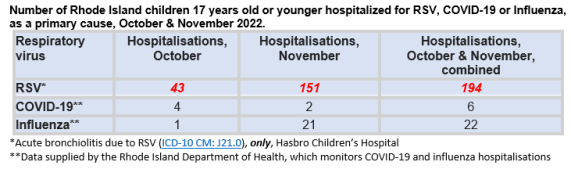
Despite the anguished media declarations, there was no Rhode Island paediatric ‘tripledemic’, at least through October and November. RSV, alone, accounted for around 90% (194 ÷ 222 = 87.4%) of so-called ‘tripledemic’ hospitalisations among Rhode Island children, and the rate of RSV hospitalisations (97 per month), was around seven-fold the rate of COVID-19 and influenza hospitalisations combined (14 per month). Moreover, the surrogate for RSV hospitalisations, a single International Classification of Diseases (ICD) RSV code (bronchiolitis, an inflammation of the smaller lung airways) omits RSV pneumonia and bronchitis coded hospitalisations. Certainly, omitting these ICD codes underestimates true paediatric RSV admissions.
The rate of primary (or ‘suspected‘ primary) COVID-19 pediatric hospitalisations mirrored what I discovered about the receding ‘Omicron wave’ from February to early June 2022. After weeks of wrangling, requiring an Access to Public Records Act submission to the Rhode Island Department of Health (RIDOH), supported by two state legislators, my query on paediatric COVID-19 hospitalisations in the first half of 2022 was answered on August 5th 2022. These data revealed that during the 16-week period from February 13th 2022 through June 4th 2022 there were a total of only 15 primary COVID-19 paediatric hospitalisations (for ages 0 to 17 years-old), as determined by RIDOH criteria. Notwithstanding this clinically insignificant, low ebb trickle of COVID-19 paediatric hospitalisations, RIDOH issued two memos recommending Rhode Island public schools re-institute compulsory masking (see RIDOH memos dated May 19th 2022 and May 20th 2022) for all school children in so-called “high COVID-19 transmission” districts.
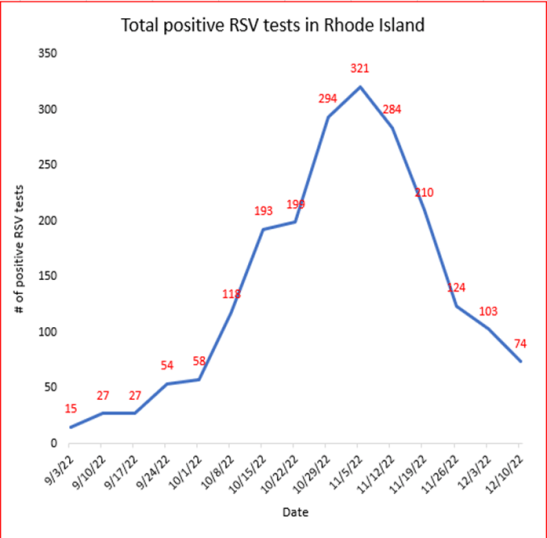
Present ‘tripledemic’ nonoccurrence aside, the overwhelmingly RSV-driven rate of increased paediatric respiratory illness hospitalisations in Rhode Island during October and November should decline significantly in December and January as RSV infection rates peaked in early November and declined precipitously through early December (see data from RIDOH, plotted below).
Additional reassuring national data from the Centers for Disease Control and Prevention (CDC) indicate the early influenza spike this year may be peaking in the U.S. overall as well, albeit not yet in New England. The third leg of the non-‘tripledemic’, COVID-19 paediatric infections, are not spiking in Rhode Island above rates observed since the summer and early autumn, while primary COVID-19 hospitalisation rates in children (see earlier table) remain exceedingly low.
Predictably, those Rhode Island medical thought leaders ginning up unwarranted concerns about the ‘tripledemic’ are once again, ad nauseum, pushing non-evidence-based masking and vaccination in children.
They ignore uniformly negative randomised controlled trials (RCTs) on community masking for the prevention of either influenza (12 RCTs; 10 here; also here and here) or COVID-19 (two RCTs; here, here), complemented by a small RCT in healthcare workers which demonstrated masks also failed to prevent RSV. While acknowledging the absence of a viable vaccine for RSV (but failing to mention the catastrophic failure of historical RSV ‘immunisation’), such thought leaders also ignore the absence of RCT data demonstrating either influenza or COVID-19 vaccines prevent hospitalisation from these respiratory illnesses in children.
The high rate of paediatric RSV hospitalisations alone in October-November should not be shrilly exploited by the media or so-called medical authorities to make counterfactual claims of an RSV, COVID-19 and influenza ‘tripledemic’. Instead, RSV, and now influenza, far more than COVID-19, should be accepted for what they are, i.e., part of the natural cycle of paediatric respiratory infections, and treated calmly, and with caring.
Dr. Andrew Bostom is a physician currently affiliated with the Brown University Center for Primary Care and Prevention, and was an Associate Professor of Medicine and Family Medicine at the Warren Alpert Medical School of Brown University from 1997 until June 2021. As a clinical trialist and epidemiologist he designed and completed the largest randomised controlled trial conducted in chronic kidney transplant recipients.
Court Says No, Biden Cannot Enforce Vaccine Mandates For Federal Contractors
By Steve Watson | Summit News | December 21, 2022
A 5th Circuit Court of Appeals ruled Monday that The Biden Administration cannot enforce a COVID vaccine mandate on federal contractors.
“The President’s use of procurement regulations to reach through an employing contractor to force obligations on individual employees is truly unprecedented,” the ruling noted, adding “As such, Executive Order 14042 is unlawful, and the Plaintiff States have consequently demonstrated a strong likelihood of success on the merits.”
Referring to Biden’s Executive Order, the ruling also stated that “Congress has not spoken clearly to authorize such a dramatic shift in the exercise of the President’s power under the Procurement Act.”
The vaccine mandate would affect up to 20 percent of people employed in the U.S., Reuters has noted.
Louisiana Attorney General Jeff Landry, one of the plaintiffs in the case issued a statement asserting that “Today is a victory for freedom,” and vowing “We will continue to stand up against the Biden Administration’s abuses of power that threaten us now and in the future.”
The Ruling comes a week after The Senate passed the National Defense Authorization Act, which lifted the COVID vaccine mandate for active duty military personnel.
Republicans in the Senate, led by Rand Paul, had threatened to block the legislation unless the mandate was scrapped.
While the mandate will be sidelined, some 8,000 troops who were given the boot for refusing to go along with it have not been reinstated.
GOP Senators Ron Johnson and Ted Cruz argued tnhatthe discharged troops should be reinstated with back pay, reasoning that the mandate was “illegal”.
However, Democrats stated that reinstating those service members would send the message that it’s acceptable to disobey orders.
“What we’re telling soldiers is, if you disagree, don’t follow the order and then just lobby Congress and they’ll come along and they’ll restore your rank, they’ll restore your benefits, they’ll restore everything, so orders are just sort of suggestions,” Senate Armed Services Committee Chairman Jack Reed, D-R.I., said on the Senate floor. “They’re not.”
Some of the service members are taking the fight to the courts.
Star Of Body-Positivity Show Dead From Heart Failure At Age 37
By Tyler Durden – Zero Hedge – December 20, 2022
The body positivity movement, at least in the case of women, has been highly promoted by every area of the entertainment media and among social justice activists based on a singular claim: You can be healthy at any size (HAES).
The claim has inspired numerous efforts to normalize obesity in American society as not only socially acceptable but also medically acceptable. While political activism in science is nothing new and has been present in everything from climate change rhetoric to pandemic response, fat positivity disinformation in scientific observation is perhaps the most egregious and widespread. It attempts to ignore or dismiss decades of studies on the negative effects of obesity and asserts that being grossly overweight has minimal or no health consequences.
This argument is often debunked by the very people that tend to promote it and encourage it, as they die incredibly young and from health problems that are usually reserved for the elderly.
Jamie Lopez, star of the body positivity-based television show ‘Super Sized Salon’, was an advocate of a ‘beauty at any size‘ philosophy, more so than a health at any weight ideal. However, social justice proponents often held up her example as justification for the HAES lifestyle. She is now dead, suffering from heart failure at age 37.
To be fair to Lopez, she did attempt to lose weight, dropping over 400 pounds in a year.
But, going from 800 pounds to 400 pounds is still not enough to prevent the myriad of health problems associated with obesity. Undoubtedly, body positivity proponents will try to gloss over her cause of death, but the fact remains that health and weight are indelibly intertwined.
While “beauty” might be treated as socially subjective by some people (studies show beauty concepts are actually biologically ingrained), health standards are not subjective.
Gluttony has long been a despised habit within almost all cultures for a reason – It is a sign of a lack of discipline as well as a precursor to societal decline, and, it is a sure trigger for an early demise.
Deutsche Bank: “A Certain Degree of Eco-Dictatorship Will Be Necessary”
BY TOBY YOUNG | THE DAILY SCEPTIC | DECEMBER 20, 2022
Izabella Kaminska, formerly the Editor of the FT’s Alphaville and now the Editor of the Blind Spot, has flagged up an alarming passage in a document published in January 2021 by Deutsche Bank Research entitled ‘What we must do to Rebuild’. Eric Heyman has written the section about the tough choices the EU must face it if’s to meet its goal of achieving ‘climate neutrality’ by 2050 – Net Zero, in other words – and says the following:
The impact of the current climate policy on people’s everyday lives is still quite abstract and acceptable for many households. Climate policy comes in the form of higher taxes and fees on energy, which make heating and mobility more expensive. Some countries have set minimum energy efficiency standards for buildings or similar rules in other areas. However, climate policy does not determine our lives. We take key consumption decisions, for example whether we travel at all, how much we travel and which means of transport we use, whether we live in a large house or a small apartment and how we heat our homes, how many electronic devices we have and how intensely we use them or how much meat and exotic fruit we eat. These decisions tend to be made on the basis of our income, not on climate considerations.
If we really want to achieve climate neutrality, we need to change our behaviour in all these areas of life. This is simply because there are
no adequate cost-effective technologies yet to allow us to maintain our living standards in a carbon-neutral way. That means that carbon prices will have to rise considerably in order to nudge people to change their behaviour. Another (or perhaps supplementary) option is to tighten regulatory law considerably. I know that “eco-dictatorship” is a nasty word. But we may have to ask ourselves the question whether and to what extent we may be willing to accept some kind of eco-dictatorship (in the form of regulatory law) in order to move towards climate neutrality.
When he says we have to “ask ourselves… whether and to what extent we may be willing to accept some kind of eco-dictatorship” I don’t think he has a Net Zero referendum in mind. Rather, by ‘ourselves’ he means the EU’s ruling class. It has to ask itself whether it’s willing to pass laws forcing the EU’s population to modify its behaviour to meet the 2050 ‘climate neutrality’ target, regardless of whether it has a democratic mandate to do so or not.
I suppose we should be grateful that at least Heyman hasn’t tried to sugar coat this. It should be clear what “eco-dictatorship” means, even to those most reluctant to accept that Net Zero zealots have little love for democracy.
Stop Press: Izabella Kaminska has interviewed the neo-Malthusian Turkish-American economist Nourel Roubini for the Blind Spot podcast. In his book Megathreats: The Ten Trends that Imperil Our Future, and How to Survive Them he argues that individual freedoms will have to be sacrificed if we’re to contain another pandemic or avoid a climate catastrophe.
“Silent Majority” of Car Industry is Concerned About Electric Vehicles
BY WILL JONES | THE DAILY SCEPTIC | DECEMBER 20, 2022
A “silent majority” of car companies is concerned that electric vehicles will not alone be able to end reliance on fossil fuels, according to a senior Toyota executive. The Telegraph has more.
Akio Toyoda, the company’s president and grandson of its founder Kiichiro Toyoda, said that many concerned senior figures are reluctant to say what they really think because of the pressure to go green.
It comes as the industry struggles to ditch petrol and diesel, in the face of materials shortages and complex processes that have kept the cost of building electric cars high.
In comments on a visit to Thailand first reported by the Wall Street Journal, Mr Toyoda said: “People involved in the auto industry are largely a silent majority.
“That silent majority is wondering whether EVs [electric vehicles] are really OK to have as a single option. But they think it’s the trend so they can’t speak out loudly.”
Meanwhile, MPs on the parliamentary Science and Technology Committee have warned that plans to require that all new boilers are able to run on hydrogen within a few years are unrealistic and the gas is likely to play a limited role in the future energy system, given the practical challenges of producing and handling it cleanly at large scale. From the Telegraph:
They argue huge questions still need to be answered about the potential deployment of the gas, and highlight “conflicting views” on the role it could play in domestic heating, given the merits of electric heat pumps instead.
Hydrogen is currently a niche product used in chemical production and oil refining, but politicians around the world hope it can replace fossil fuels in uses ranging from heating to transport, as it does not produce emissions when burned.
However, the committee argued that in practice this was likely to be limited to uses where other options are unsuitable, or in areas which are close to hydrogen production hubs.
“It seems likely that any future use of hydrogen will be limited rather than universal,” they said. “This limited – rather than universal – use of hydrogen should inform Government decisions. For example, we disagree with the Climate Change Committee’s recommendation that the Government should mandate new domestic boilers to be hydrogen-ready from 2025.”
Featured Video

US Marines Seized Panama in 1903
or go to
Aletho News Archives – Video-Images
From the Archives
Precedents for Pizzagate
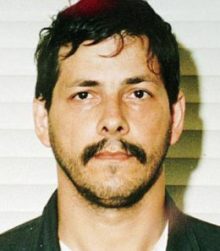
Marc Dutroux, Belgian pedophile, sadist, and serial killer with friends in high places
By Aedon Cassiel | Counter – Currents | December 23, 2016
To reiterate a point that should be clear to the more astute reader, my goal in this series (part 1, part 2) has not been to defend “Pizzagate” as such. My goal has been to defend the people who want to investigate it against specific accusations levied against them by people who think Pizzagate has revealed no intriguing information at all—for a specific reason, which I will be honing in and focusing on much more directly in this closing entry.
Whereas the mainstream critics of Pizzagate would have you believe that the dividing line is between paranoid conspiracy theorist followers of “fake news” and level-headed people who follow trustworthy news sources and rely on cold, hard reason to determine the truth, my goal has been to show that—whatever is or is not happening with Pizzagate itself—this framing of the issue is arrogant, insulting, and the product of extremely narrow tunnel vision. … continue
Blog Roll
 Aletho News
- The U.S. Sanctions Cuban Journalist For Reporting On The U.S. Blockade
- Israeli firms transform cars into intelligence devices: Reports
- Zionist-controlled companies to surveil British citizens
- THE CHILDREN GAMBIT
- A note on comment posting at Alethonews
- Trump stalls over Iran strike plan, Iran holds all the aces
- Zelensky’s Ceasefire for Elections is Strategic Gambit, Not Democratic Move
- US and Dutch pilots flying F-16s for Ukraine – Western media
- West’s Claims of Non-Involvement in Ukraine Conflict ‘Epitome of Hypocrisy’ – Expert
- Putin aide urges retaliation to ‘Western piracy’
- If Americans Knew
- Help end the injustice against Shadi
- Israel’s Favorite American President
- Israel’s “Yellow Line” Is a Death Trap for Palestinians. We Drove Into It.
- Why Israel’s expanding occupation in Syria presents a critical legal test
- Gaza is not a natural disaster. It is the victim of genocide enabled by global inaction
- Netanyahu’s plan to “end” US aid to Israel is to give even more money under a different name
- Israel ceased firing on Gaza for just 15 days of the “ceasefire” – Not a ceasefire Day 130
- In Gaza, “rats run over our faces” – Not a ceasefire Day 129
- Israel-backed border guards, GHF-linked aid – Not a ceasefire Day 128
- Israel battles Palestinian right of return, one Palestinian at a time – Not a ceasefire Day 127
- No Tricks Zone
- New Study: A 4°C Warmer Beaufort Sea Had ‘No Sea Ice’ 11,700 – 8200 Years Ago
- Unfudging The Data: Dutch Meteorological Institute Reinstates Early 20th Centruy Heat Waves It Had Erased Earlier
- German Gas Crisis…Chancellor Merz Allegedly Bans Gas Debate Ahead of Elections!
- Pollen Reconstructions Show The Last Glacial’s Warming Events Were Global, 10x Greater Than Modern
- Germany’s Natural Gas Storage Level Dwindles To Just 28%… Increasingly Critical
- New Study Rebuts The Assumption That Anthropogenic CO2 Molecules Have ‘Special’ Properties
- Climate Scientist Who Predicted End Of “Heavy Frost And Snow” Now Refuses Media Inquiries
- Polar Bear Numbers Rising And Health Improving In Areas With The Most Rapid Sea Ice Decline
- One Reason Only For Germany’s Heating Gas Crisis: Its Hardcore-Dumbass Energy Policy
- 130 Years Later: The CO2 Greenhouse Effect Is Still Only An Imaginary-World Thought Experiment
 Aletho News