Half of ‘Long Covid’ Sufferers Have Never Had Covid, Says New Study

BY IAN MACLEOD | THE DAILY SCEPTIC | APRIL 3, 2023
The battle of ideas around Covid has few clashes as hotly contested as Long Covid. Alarmists have hyped the frequency and severity with which infection causes long-term damage. Sceptics see no reason for panic. A new study helps to settle at least part of this debate.
The paper in the Journal of the American Medical Association’s (JAMA) Network Open looked at “post–COVID-19 condition (PCC) in young people after mild acute infection” to find how common it was and to find risk factors. Participants were aged between 12 and 25.
The authors offer this straightforward conclusion: “PCC was not associated with biological markers specific to viral infection.” That is, participants were equally likely to suffer from ‘Long Covid’, whether or not they had suffered from acute COVID-19.
The researchers concluded that Long Covid is predicted by “initial symptom severity” and, intriguingly, “psychosocial factors”.
The full article is available on JAMA Network Open.
The main results from the present study were: (1) the prevalence of PCC six months after acute COVID-19 was approximately 50%, but was equally high in a control group of comparable SARS-CoV-2-negative individuals; (2) acute COVID-19 was not an independent risk factor for PCC; (3) the severity of clinical symptoms at baseline, irrespective of SARS-CoV-2 status, was the main risk factor of persistent symptoms six months later.
Symptom prevalence data are consistent with other controlled studies of young people after acute COVID-19 reporting a high symptom load, with only subtle differences between individuals testing positive and negative for SARS-CoV-2. Correspondingly, a large population-based study found no associations between most persistent symptoms attributed to COVID-19 and serological evidence of SARS-CoV-2 infection. …
These findings suggest that persistent symptoms in this age group are related to factors other than SARS-CoV-2 infection, and therefore question the usefulness of the WHO case definition of PCC.
Worth reading in full.
Pfizer’s RSV Vaccine for Older Adults Linked to Guillain-Barré Syndrome, But Drugmaker Says It’s ‘Safe’
By Brenda Baletti, Ph.D. | The Defender | April 7, 2023
People who receive Pfizer’s respiratory syncytial virus (RSV) vaccine should be monitored for Guillain-Barré syndrome, according to the authors of a Pfizer-funded study published this week in the New England Journal of Medicine (NEJM).
The paper — one of several published Wednesday reporting interim analyses for Pfizer’s phase 3 clinical trials for the RSV vaccine — concluded the vaccine was effective in preventing RSV in adults age 60 and over “without evident safety concerns.”
But that same article also flagged Guillain-Barré syndrome as a safety concern moving forward with the vaccine.
“If RSVpreF vaccine [Pfizer’s RSV vaccine] is approved and recommended, these adverse events warrant close monitoring in future studies and with real-world data and post-marketing surveillance,” the authors of the NEJM study said.
The U.S. Food and Drug Administration (FDA) is expected to approve Pfizer’s RSV vaccine for older adults in May.
Safe and effective?
Guillain-Barré syndrome is a rare disorder in which the body’s immune system attacks its own nerves. Symptoms can range from brief weakness to paralysis.
The FDA asked Pfizer to include the condition as an “important potential risk” of the vaccine and to develop a safety study to monitor for potential cases if the shot is approved, CNBC reported.
When the FDA vaccine advisory panel met in February to review Pfizer’s data pre-publication, there was substantial disagreement about the data on safety and effectiveness, although the majority of the committee voted to recommend the vaccine for approval.
Four of 12 committee members voted that the safety data was not adequate for approval — and one abstained — because of their concerns with the Guillain-Barré cases.
Four committee members also voted the evidence of vaccine effectiveness was not adequate for approval, while seven said it was and one member abstained.
In the NEJM study, one person developed Guillain-Barré syndrome and another developed Miller Fisher syndrome, a subset of Guillain-Barré. The symptoms appeared six and seven days post-vaccination, respectively.
The person with Miller Fisher syndrome recovered. The person diagnosed with Guillain-Barré continues to suffer from loss of motor function.
CNBC reported:
“In the New England Journal of Medicine article, the scientists said the two cases occurred in patients who were in an age group that has an increased risk of developing Guillain-Barré. Potential factors other than the vaccine also could have caused the individuals to develop the syndrome, they added.
“But the FDA said the agency views the Guillain-Barré cases as possibly related to the vaccine because the patients developed the syndrome shortly after receiving the shot, according to briefing documents published in February.
“Pfizer concluded that the cases were unrelated, and the clinical trial’s data monitoring committee did not identify any safety concerns with the vaccine.”
Dr. Hana El Sahly, the FDA committee chair and professor of molecular virology and microbiology and infectious diseases at the Baylor College of Medicine, said Guillain-Barré has an incidence of about 1 in 100,000 among people ages 60 and older. But in the vaccine trial, the rate was closer to 1 in 9,000, which is significantly higher.
“It’s significant in terms of incidence,” she said. The FDA advisors told Pfizer that safety monitoring for Guillain-Barré after FDA approval “would be crucial,” CNBC reported.
There is currently no vaccine approved to prevent RSV, a lower respiratory disease that is one of the most common causes of childhood cold-like illness and was first discovered in humans in 1956.
The illness is mild for most people.
In children under age 5, RSV causes 58,000 to 80,000 hospitalizations per year and 100 to 300 deaths.
In adults ages 65 and older, RSV causes 6,000 to 10,000 deaths and 60,000 to 160,000 hospitalizations per year, according to the Centers for Disease Control and Prevention.
Research shows the virus originated in monkeys housed in a Maryland facility where they were used to conduct polio vaccine research.
Brian Hooker, Ph.D., P.E., chief scientific officer for Children’s Health Defense (CHD), told The Defender :
“I find it ironic that Pfizer is creating a vaccine for RSV, an illness that was created due to the development of the polio vaccine. It seems like vaccine manufacturers are paid to prevent diseases that they already created.
“The incidence of Guillain-Barré is very troubling and although many patients recover, there is nerve damage associated with it leading to permanent weakness, numbness and fatigue.”
The NEJM study reported that the vaccine was 86% effective at preventing lower respiratory tract illness with three or more symptoms, and 66% effective at preventing the illness with two or more symptoms, among adults over age 60.
The study determined there were not enough cases of severe RSV-associated lower respiratory tract illness — meaning cases needing hospitalization or ventilation or extra oxygen — to determine whether the vaccine was effective for those cases, CNN reported.
RSV vaccines for pregnant women failed to meet major goal in trials
Pfizer is also seeking FDA approval for its vaccine to protect infants from RSV by vaccinating pregnant mothers.
However, in the interim data on clinical trials, also published Wednesday in the NEJM, the vaccine failed to meet one of its two main goals.
Last year, Pfizer reported that its vaccine was highly effective at protecting newborns from RSV. The drugmaker also sought rapid FDA approval for the vaccine for pregnant mothers.
The FDA is expected to decide by August.
According to the study published Wednesday, the vaccine was 82% effective in preventing severe lower respiratory tract illness — such as very low oxygen levels or need for ventilator support — in infants in the first 90 days of life, but that dropped to 69% efficacy up to 180 days after a baby is born.
But the vaccine failed to meet its second big goal: reducing non-severe RSV-associated lower respiratory illness in infants.
The study enrolled 7,128 women — half received the RSV vaccine and half received the placebo.
Severe illness occurred within three months in six infants whose mothers received the vaccine, compared with 33 infants from the placebo group who contracted serious RSV infections.
The company evaluated 3,570 infants as part of the study, Reuters reported.
Big Pharma’s race for the RSV vaccine
The RSV virus causes annual outbreaks of respiratory illnesses in all age groups, typically during the fall, winter and spring in most regions of the U.S. It has existed for decades and doesn’t usually spark alarm.
But RSV made headlines last fall as part of a “tripledemic” — COVID-19, flu and RSV — scare, just as these new RSV products were preparing to come on the market.
Robert F. Kennedy, Jr., CHD chairman-on-leave, said at the time, “fear sells,” tweeting:
As The Defender reported, pharmaceutical companies have been working on the development of a vaccine for RSV since the 1960s — at times with deadly outcomes.
After a disastrous attempt at producing a vaccine, where 80% of vaccinated children were hospitalized, RSV vaccine development was put on hold.
Over the last several years, “lured by the prospect of a large untapped global RSV vaccine market,” four manufacturers set their sights on RSV vaccine development for infants, pregnant women and the elderly.
Initially, Johnson & Johnson and Bavarian Nordic also were developing RSV vaccines, but the former dropped out of the race last month and Bavarian Nordic’s clinical trials are in progress.
That leaves Pfizer and GlaxoSmithKline (GSK), who have been in a tight race to be the first Big Pharma player to tap into the RSV vaccine market, which is estimated to be over $5 billion and could exceed $10 billion by 2030, Reuters reported last month.
Both companies have RSV vaccines under regulatory review with the FDA.
The FDA advisory committee voted unanimously in favor of GSK’s vaccine’s effectiveness in preventing lower respiratory tract disease caused by RSV in adults aged 60 and above, and voted 10 to 2 for its safety last month, based on interim data presented last October, Reuters reported.
Brenda Baletti Ph.D. is a reporter for The Defender. She wrote and taught about capitalism and politics for 10 years in the writing program at Duke University. She holds a Ph.D. in human geography from the University of North Carolina at Chapel Hill and a master’s from the University of Texas at Austin.
This article was originally published by The Defender — Children’s Health Defense’s News & Views Website under Creative Commons license CC BY-NC-ND 4.0. Please consider subscribing to The Defender or donating to Children’s Health Defense.
Highly Vaccinated COVID ‘Success’ New Zealand Sees Huge Increase in Death Rates
Concerning increase in mortality in New Zealand
By Ian Miller | Unmasked | April 7, 2023
COVID has unfortunately created any number of repetitive stories.
Jurisdiction imposes mask mandates, population complies, masks prove ineffective, media claims masks didn’t work because of lack of compliance.
Another example would be when countries with extraordinary compliance, such as Singapore or South Korea, would see increases ignored entirely, or blamed on the population not wearing masks of a correct level of quality.
Yet as a general rule, the most consistently predictable repetitive storyline has been the media and expert community declaring that a country was a pandemic success, only for their results to dramatically change in a relatively short period of time.
This was the case with the Czech Republic, with Australia, with Taiwan and many other locations.
Even within the United States adjustments showed that states like California – heralded as pandemic winners – actually had significantly worse results than previously realized.
But few places on earth have been as heavily praised as New Zealand.
Their science-following leadership was repeatedly hailed, honored, and praised for their effective communication, endless lockdowns, tyrannical response to protests, and prolific commitment to mandates.
All of the above, combined with their strict border controls, should have meant that New Zealand would avoid the significant increase in negative outcomes seen in other parts of the world.
At least, that’s what the media and activist public health authorities claimed would happen.
The reality is far more complicated.
Throughout 2020 and into 2021, New Zealand saw very little COVID transmission.
Unsurprisingly, the BBC praised the country for their efforts, explaining in detail how the country had become “COVID free.”
Jacinda Arden, now former prime minister, was once so completely committed to maintaining an illusion of infallibility that she claimed that the only source of accurate information available to the public was the government.
Of course, Arden then made the provably inaccurate claim that those who were vaccinated would net get sick and would not die.
The ridiculous over-confidence in the proclamations of public health authorities led to Arden convincing New Zealanders that strict mandates and interventions could stop the spread of the virus.
As winter and new variants arrived in 2021, Arden and local leaders predictably enforced increasingly strict measures. Mask mandates, lockdowns and “red traffic light” policies include vaccine passports.
Surprise. None of it worked.

After several months of completely unchecked spread, even the country’s cumulative metrics, once seemingly so impressive, exploded in dramatic fashion.
Consistently and exceptionally high mask wearing rates were also entirely ineffective.
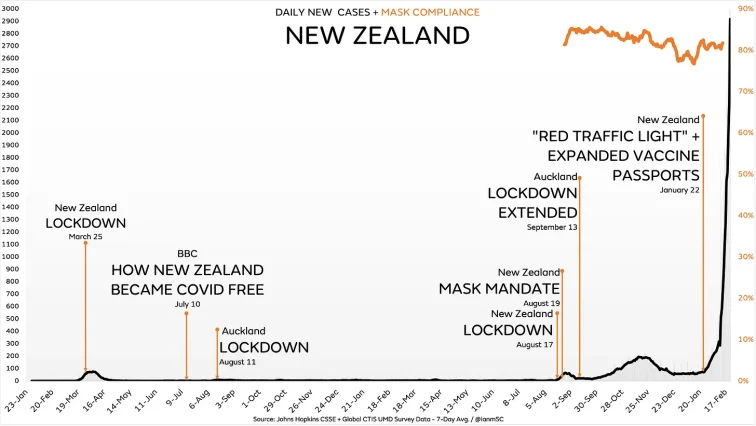
And yet defenders of New Zealand’s authoritarian policies still believed that the country’s strategy was warranted, for one specific reason.
They had delayed the spread of the virus until the COVID vaccines became widely available.
In theory, that was supposed to prevent a substantial increase in deaths, especially considering their extraordinary rate of uptake.
That didn’t work either.
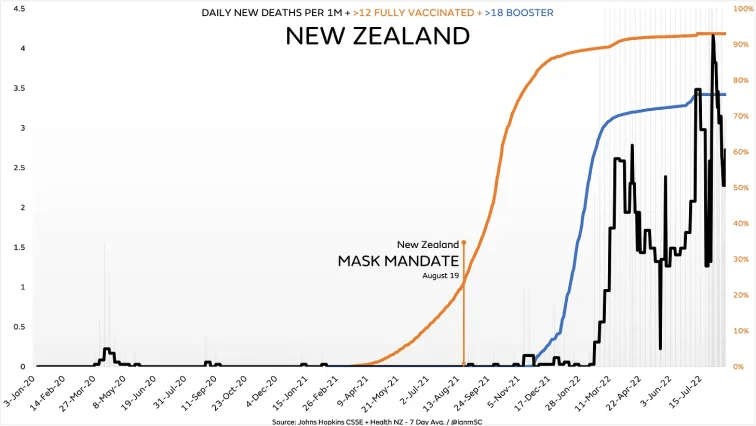
While these rates were generally lower after adjusting for population than many other countries, they still represented an obvious, significant surge compared to previous time periods.
But COVID related deaths only tell a part of the story, often influenced by attribution methodology and testing.
In theory, New Zealand’s exceptional vaccination rate and consistently high mask compliance should have meant that all cause mortality would also remain low.
So did it?
Fortunately, thanks to the New Zealand government’s own data, we now have an answer. And just as the country’s failure to stop omicron, it presents another contradiction to the endless media praise.
Despite the exceptionally high vaccination rate, despite their exceptionally high booster rate, despite vaccine passports, strict lockdowns, “red traffic light” policies and border controls, the pandemic came for New Zealand as well.
The government’s own data shows that all cause deaths in New Zealand jumped significantly in 2022, to the highest level in recorded data.
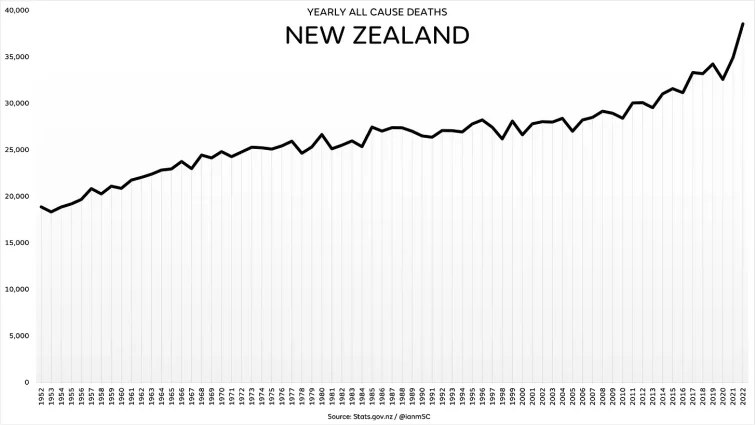
The country universally praised for their dedication to following The Science™, whose leadership told the public that following her dictates would keep them safe, stop the spread and control outcomes, has seen a record level of all cause mortality.
Exactly the same as other countries who were criticized for their supposedly less effective response.
Even after adjusting for population, the scale of the surge in 2022 is exceptional.

In fact, it represents an over 17% increase from 2020.
Not to mention that the one year increase, over 10%, represented the largest single year increase in New Zealand since the 1918 flu.
So why didn’t their policies prevent this? Why didn’t waiting for widespread vaccination to open up prevent this?
The New Zealand government themselves blame COVID for at least a portion of the increase. So why were so many people dying of COVID given the country’s exceptional vaccination and booster uptake and masking?
After all, ~95% of the population over 12 had been fully vaccinated by the middle of 2022, with over 90% fully vaccinated by early 2022. Similarly, adult booster rates were nearly 80% by early in 2022.
Why didn’t it work?!
Some may try to claim that their results would have been worse had they not had such policies.
But countries like Sweden thoroughly debunk that theory. Sweden had one of the least restrictive responses anywhere on earth, yet their results were among the best in their region.
Even throughout 2022, excess deaths remained low.

So why did New Zealand fail?
Compared to other countries, New Zealand’s cumulative COVID mortality rate still remains low. But the all cause mortality tells a different story.
Their strict policies and delayed opening were supposed to prevent this exact situation from occurring. All because the government put their faith in experts.
The experts mistakenly believed that vaccinations would prevent virtually all deaths, as Jacinda “we are your sole source of truth” Arden explained.
Obviously that was not the case.
It’s not clear what percentage of the excess mortality rate came from vaccinated people. But even more importantly, the majority of the increase was entirely unrelated to COVID.
Nearly 6,000 more people died in 2022 than did in 2020, despite a relatively small population increase. Yet the government says just 2,400 were associated with COVID.
So what caused the other 3,600 unexpected deaths?
In raw numbers, nearly 7,500 more people died in 2022 than in 2016. Accounting for population increases, that meant virtually 100 more people per 100,000 died in 2022 than in 2016.
What happened?
Whatever it was, it’s almost certainly related to New Zealand’s mistaken assumptions. Ancillary lockdown-related causes, missed health screenings, side effects — any or all of it could have contributed to the dramatic increase.
And all of it was because the government mistakenly proclaimed that they could control COVID. Instead, they delayed the inevitable.
Governments have many lessons to learn from the pandemic, but the first should be to never, ever, put blind faith in “experts.”
All too often they’re flying blind themselves.
KSA readies draft peace deal to end Yemen war
The Cradle | April 7, 2023
A comprehensive peace document is being drafted to end the Yemen war as it enters its ninth year, an informed Yemeni source revealed to Saudi-owned Asharq Al-Awsat newspaper today, 7 April.
The peace proposal is being sponsored by the UN and is said to cover three phases to end the conflict that has killed some 400,000 people through direct and indirect causes since 2015 and created the world’s worst humanitarian crisis.
The first phase of the peace deal would include a nationwide ceasefire, the reopening of all land, air, and sea routes, the merger of the central banks, and comprehensive prisoner exchanges.
The parties would then hold direct negotiations to establish how the Yemenis envision a state, followed by a transitional period.
Saudi Defense Minister Prince Khalid bin Salman held talks in Riyadh with the Chairman of the Yemeni Presidential Leadership Council (PLC) Dr. Rashad Al-Alimi, to discuss the latest efforts to revive the peace process in line with the UN proposal.
The source speaking with Asharq Al-Awsat expected a ceasefire to be declared in the coming days, for the truce to be consolidated, and for fighting to stop at the battlefronts. Other arrangements will need weeks to be implemented.
The source also claimed Ansarallah has sought to escalate the fighting in recent weeks to make additional military gains before a ceasefire is declared.
Yemeni sources similarly told Al-Mayadeen that “the Saudi vision for the solution provides for the extension of the existing truce in Yemen for another year in understanding with [the Ansarallah-led government in] Sanaa,” adding that “the vision provides for the extension of the truce in exchange for the delivery of salaries, the unification of the currency and the full opening of the port of Hodeidah.”
Further, “The extension of the truce on its new terms will be followed by an official Saudi announcement of the end of the war and the cessation of its intervention in Yemen,” Al-Mayadeen’s sources said.
Optimism surrounding a peace deal has increased following the recent Saudi-Iranian rapprochement, as some observers contend the Ansarallah movement is an Iranian proxy and that Saudi Arabia is no longer interested in prolonging this conflict and is serious in its efforts to reach a solution.
However, resistance to a peace deal may come from the US and UAE.
Abu Dhabi controls most of Yemen’s southern ports, from which Yemeni oil is exported, and is also occupying several strategic islands off the country’s coast and is in the process of establishing a “maritime empire” in Yemeni waters.
Because of this, analysts have suggested that the UAE is uninterested in a solution that ends the war in Yemen.
According to an exclusive by The Cradle, the US, and UAE have “furiously sought to undermine” the understanding reached between Saudi Arabia and Ansarallah in order “to prevent a resolution of the Yemen war.”
The US is unlikely to welcome an end to the war, given that US weapons manufacturers profit significantly from the conflict.
According to a US Government Accountability Office report, the United States concluded over $54 billion in arms sales to Saudi Arabia and the UAE from 2015, the first year of the Yemen war, through 2021. These arms sales accounted for 17 percent of total sales under the U.S. government’s Foreign Military Sales program.
The Great ‘Disinformation’ Hoax
BY WILL JONES | THE DAILY SCEPTIC | APRIL 7, 2023
Writer Jacob Siegel has talked to UnHerd‘s Freddie Sayers about America’s new censorship complex. In a 13,000 word essay for Tablet, Siegel explains how ‘disinformation’ is an invention that has morphed into a tool of governance. He told Sayers:
Disinformation is a means by which the Government in cooperation with private tech companies and civil society, NGO groups, censors, uses extra-legal means to censor political discourse around issues like Covid vaccinations, lockdowns, the elections. And in the U.S., it’s a free-for-all. It’s a blank cheque to censor anything. So on one level, disinformation is ostensibly censorship in order to protect national security. In a larger sense, that machinery of censorship is not opportunistically looking to erase certain things from the public record that are unflattering to political elites. It’s actually rather more than that. It is a means of governance. It is a system of power. It is its own system of power, outside of the formal, official — in the U.S., constitutional — means by which the Government is supposed to operate.
How did this ‘tool of governance’ become so mainstream, asks Sayers? The U.S. Government, Siegel points out, has long engaged in promoting disinformation of its own, but the ‘war on disinformation’ was begun by Barack Obama. One of the last things the former President did while in office was sign into law the ‘Countering Foreign Disinformation Act’, which fully committed the U.S. to a counter-disinformation campaign, which according to Siegel “was really always in spirit, and very quickly in practice as well, an information war directed against the American people”.
Siegel continues:
There was originally this foreign dimension… But from the very beginning, ‘foreign’ is a kind of ruse that’s setting up what is actually a much larger, effectively omni-directional structure, because the internet is global, that can censor anywhere but which is, in practice, focused on the domestic political environment inside the U.S. and specifically on this populist surge, which is taken as an existential threat by the ruling party officials in the U.S. who see populism in truly apocalyptic terms.
Siegel argues that the consequences of this censorship for American society should not to be minimised:
The system of secrecy and the Government’s own promotion of conspiracies, like the idea that Donald Trump was an agent of Vladimir Putin or a Russian stooge, which the U.S. intelligence agencies promoted. It’s not simply that they are wrong or pernicious, or that this reflects corruption. They actually drive people crazy. They deranged the political system. They ruin the ability for people to engage sanely and transparently in their own politics.
Worth reading (and watching) in full.
DHS is sued for censorship records on meetings with Big Tech

By Didi Rankovic | Reclaim The Net | April 6, 2023
Judicial Watch has decided to sue the US Department of Homeland Security (DHS) after the federal agency failed to respond to a Freedom of Information Act (FOIA) request for records related to meetings with Big Tech representatives where censorship was allegedly discussed.
The lawsuit, filed in the US District Court for the District of Columbia, seeks to force the DHS to disclose documents detailing how its Cybersecurity and Information Security Agency (CISA) worked with companies behind social media platforms in order to censor speech.
We obtained a copy of the complaint for you here.
The initial FOIA request dates back to December of last year, and the advocacy group said that it wanted to gain access to records and communications of CISA Director Jen Easterly, a former CISA director, Christopher Krebs, former CISA Senior Cybersecurity Advisor Matt Masterson, and CISA Senior Cybersecurity Advisor Brian Scully.
These documents concern meetings that CISA either hosted or facilitated with Meta and Facebook, Twitter, Wikimedia Foundation, Pinterest, and Microsoft’s LinkedIn on the topic of “election security.”
Furthermore, Judicial Watch wanted information about several other meetings, including those with DHS Office of Intelligence and Analysis, FBI, US Secret Service, NSA, and the Office of the Director for National Intelligence employees, related to the previously mentioned meetings, and those with Election Infrastructure Subsector Government Coordinating Council.
The Judicial Watch press release refers to the Twitter Files where journalist Matt Taibbi on several occasions mentions CISA’s involvement in censorship activities, and cites these and the dates when the contacts or communication occurred.
The group also refers to Twitter Files revelations regarding the FBI’s role in censorship decisions, notably the pressure it exerted on the site to act in this way, and Taibbi’s testimony before Congress about the collusion between the Biden administration – including the Democratic National Committee and federal, state, and local law enforcement – and Big Tech, with the goal of suppressing legitimate information.
Judicial Watch President Tom Fitton described all this, and more that is mentioned in the statement, as “an unholy conspiracy in the Biden administration to censor Americans in collusion with Big Tech.”
As for the lawsuit, Fitton said it “shows the censorship abuse is furthered by unlawful secrecy and cover-ups.”
The West sets a disturbing new precedent over murdered Russian military blogger

By Rachel Marsden | RT | April 6, 2023
Apparently terrorism and murdering reporters get a free pass if the Western establishment doesn’t like the target’s profile – or if the perpetrator risks being linked to an ally.
The radio silence from the West is deafening in the wake of the murder of military blogger Vladlen Tatarsky at a cafe in St. Petersburg. Tatarsky was killed after being handed a statue by a young woman, Darya Trepova, that subsequently blew up the entire venue.
For all of the Western officials’ differences with Russia, can they really not at least bring themselves to condemn a blatant act of terrorism in the middle of a major city center? We’re talking here about the same folks who spent two decades kicking down doors around the world under the guise of fighting a “Global War on Terrorism.”
Just a few years ago, cartoonists and writers for the French satirical magazine Charlie Hebdo were gunned down in broad daylight at their Paris office by jihadists who objected to the publication’s portrayal of Islam and the Prophet Mohammed. Western leaders roundly condemned that terrorist act, standing firmly on the principle that you couldn’t just go around murdering people who conveyed thoughts and views that you didn’t like. Many of these leaders even traveled to Paris to march alongside a massive crowd in defense of freedom of expression and the press.
Now, however, they can’t even bother to muster the most meager defense of the same principles in the wake of Tatarsky’s murder in an attack that investigators claim is linked to Ukraine.
It seems that whenever there’s any alleged involvement of Ukraine, the West conveniently turns a blind eye. The automobile explosion that killed Russian journalist and activist, Darya Dugina, near Moscow comes to mind. “American officials said they were not aware of the plan ahead of time for the attack that killed Daria Dugina and that they had admonished Ukraine over it,” reported the New York Times last October. Similarly, the Washington Post reported this week that the “unwritten rule” among Western officials is “don’t talk about Nord Stream” – the pipeline network carrying gas from Russia to Europe that was mysteriously blown up last year – since they “would rather not have to deal with the possibility that Ukraine or its allies were involved.”
Then there is the “Mirotvorets” list of journalists and activists maintained by Kiev-based NGO, the Mirotvorets Center, which names people “whose actions have signs of crimes against the national security of Ukraine, peace, human security, and the international law.” It has yet to either be shut down by the Ukrainian government or denounced by Western allies, despite a 2017 United Nations report on human rights in Ukraine urging Ukrainian authorities to address it.
Acts of terrorism and affronts to free speech are clearly in the eye of the Western beholder, which would explain why much of the media rhetoric focuses on Tatarsky’s pro-Russia stance. The void left by the lack of official reaction from Western officials is being filled with Western press articles focusing on the Ukrainian-born blogger’s prior involvement with Russian-backed separatist forces in 2014 in the Donbass. There, he got his start in covering events through his Telegram channel, which grew to become wildly popular, with CNN noting his “ardent pro-war commentary.” But if prior military experience of some kind, and taking sides in one’s coverage of armed conflict, was justification for murdering journalists, then every Western veteran who started a blog, and every opinion journalist, would be fair game.
There was no shortage of Western outrage over the murder of Washington Post columnist Jamal Khashoggi inside the Saudi embassy in Istanbul a few years ago, despite his longstanding activism against the Saudi leadership. Why should the death of this Russian blogger be treated any differently?
Bulgarian investigative journalist, Cristo Grozev, who was heavily featured in the Academy Award-winning feature documentary film about Russian opposition figure Alexey Navalny, apparently thinks that some people are just “legitimate targets” for terrorism, and argues that the cafe may not have been a “purely civilian location.” Although it was previously owned by Yevgeny Prigozhin, the head of Russian private military enterprise, Wagner Group, that doesn’t magically transform a dining establishment, which welcomes anyone right off the street in the middle of a major city, into some kind of a military base. If an American general walks into the Ritz-Carlton hotel in Pentagon City, Virginia, it doesn’t suddenly turn the hotel or its bar into a legitimate military target for bombing by some entity that has a score to settle with Washington.
And what about every journalist who has been embedded as the guest of Western troops in conflicts like Iraq and Afghanistan and has promoted the talking points of their hosts while siding with their own country? Are they fair game for picking off now, too?
The prominent Washington Institute for the Study of War think tank, whose board members include American generals Jack Keane and David Petraeus, as well as Washington’s former ambassador to the UN, Kelly Craft, previously and routinely qualified Tatarsky as a prominent Russian military blogger whose work they apparently considered worthy of informing their research.
It seems like there’s an effort underway by some members of the Western establishment to reframe this egregious act of terrorism and murder as something trivial, all because the target was a Russian whose views they don’t like – and that’s an awfully slippery slope.
Rachel Marsden is a columnist, political strategist, and host of independently produced talk-shows in French and English.
Yellow Vest Leader Says Movement Opposed to French Arms Supplies to Ukraine
Sputnik – 07.04.2023
PARIS – The French Yellow Vest movement is opposed to arms supplies to Ukraine, as it has significantly increased the share of France’s defense spending, Thierry Paul Valette, the leader of the movement’s political arm, told Sputnik on Friday.
“They [the Yellow Vests] are against [arms supplies to Ukraine], because it comes at a price. The budget of the French armed forces will be raised to 400 billion euros [$436 billion], and that is a significant increase,” Valette, who is often referred to as the coordinator of Yellow Vest protests in Paris, said.
The movement unites economically vulnerable groups of French society, who have trouble understanding why their government is increasing defense spending in order to support the military industry of another country, he said.
While solidarity with Ukrainians, especially with women and children, was high in France in the initial phase of hostilities in early 2022, today French people are growing increasingly puzzled by their government’s continuing to shower hundreds of millions of euros on Kiev regime while the economy in their own country is crumbling, Valette said.
“The growing misunderstanding is prompting the rise of populist opinions [in France],” he said.
Valette added that “the support of Ukraine are causing more and more disapproval.”
Neither did the French people choose to sanction Russia at the cost of soaring prices and inflation at home, Valette said, going on to argue that imposing sanctions against Moscow was not a fully sovereign decision of the French government, with French President Emmanuel Macron having made that step at the instructions of Brussels.
Among the consequences of Russia sanctions in France, the Yellow Vests leader listed energy insecurity, price hikes and logistical disruptions.
The European Union has imposed 10 packages of sanctions against Russia over the Ukraine crisis to date. Russian President Vladimir Putin said that the policy of deterring and weakening Russia is the West’s long-term strategy, and sanctions have inflicted serious damage to the global economy.
Zelensky’s Senior Advisor Brazenly Admitted To Kiev’s Genocidal Intentions
By Andrew Korybko | April 7, 2023
Senior Ukrainian presidential advisor Mikhail Podolyak brazenly admitted to Kiev’s genocidal intentions in the NATO-Russian proxy war that’s presently being fought in his former Soviet Republic during an interview with US Government-controlled “Radio Free Europe/Radio Liberty” (RFERL). The relevant excerpt will now be shared in order to raise awareness of his words, which can be read in their original Ukrainian at that outlet’s website here for those skeptics who doubt that he truly said them:
“We have to completely close everything related to the Russian cultural space [in Crimea after its reconquest]. We have to eradicate everything Russian. There should be only Ukrainian cultural space or global cultural space. We should not have a dialogue about whether a person has the right to use the Russian language or not. At home, please use it, but it is not a tool of pressure, it is not a tool of protest, it is not a tool of blackmail.”
Podolyak admitted to precisely what Moscow has always accused Kiev of intending since the Western-backed fascist coup of early 2014 popularly known as “EuroMaidan”, namely the ethnic cleansing and genocide of Crimea’s indigenous Russian population. He therefore inadvertently justified its democratic reunification with Russia that was carried out for the purpose of defending its people’s UN-enshrined human rights, thus discrediting his side’s and its foreign patrons’ moral stance in this conflict.
Not only that, but the so-called “rules-based order” that’s aggressively being promoted by the US-led West’s Golden Billion was exposed as a hypocritical sham. That de facto New Cold War bloc isn’t waging their proxy war against Russia in order to defend “democracy” and “human rights” like its propagandists claim, but to advance Kiev’s publicly confirmed goals that stand in direct contradiction to those two concepts.
Any political force in the West that agitates for literally eradicating another culture and prohibiting its people from speaking their native language outside of their homes would rightly be condemned by society as fascist, yet there’s no chance that the US or EU will ever normalize describing Kiev in that way. These double standards speak to the ulterior motives connected to the previously mentioned “rules-based order”, which has always been about advancing American hegemony on any given pretext.
Returning to Podolyak’s candid admission, nobody can credibly claim that funding Kiev isn’t equivalent to funding fascism. There’s no other way to describe that side’s intention to eradicate Russian culture in its entirety and prohibit its people from speaking their native language in public. This bonafide fascism is being funded by the West in violation of its own self-proclaimed “values”, which reveals that everything it’s claimed about wanting to defend “democracy” and “human rights” across the world was simply a lie.
Almost two million unexploded bombs cleared after US war in Laos

RT | April 7, 2023
More than 1.8 million unexploded bombs were cleared in Laos between 1996 and February 2023, the Southeast Asian country’s Ministry of Labor and Social Welfare revealed this week.
A total of 1,808,254 unexploded ordnances (UXOs) were removed from an area covering 80,000 hectares, making the land safe for farming and other forms of agricultural development, according to Minister Padeumphone Sonthany.
The figures were announced at a press conference in the country’s capital Vientiane on Tuesday on the 18th annual International Day for UXO/Mine Awareness.
Laos is, per capita, the most heavily-bombed country in the world. From 1964 to 1973, the US military dropped more than two million tons of bombs on the nation during the Vietnam War – more than on Germany and Japan combined throughout World War II. It is estimated that around 30% of the bombs dropped did not explode.
The US conducted prolonged bombing campaigns – the so-called ‘Secret War’ – in Laos during the Vietnam War in a bid to disrupt supply lines between the country and Vietnam. The scale of the attacks, which were conducted in secrecy by the CIA, were revealed during a 1971 congressional hearing, as well as by US media investigations.
Of the 1.8 million UXOs removed and safely detonated during the period, 1,056,393 were cluster bombs. Another 4,336 were characterized as ‘large’ bombs, and 2,456 were landmines. Some 745,069 of other types of munitions were included in the statistics reported by China’s Xinhua News Agency, which cited Laotian media reports from last Wednesday.
The report said that 2,846 people had been involved in UXO-related accidents between 2015 and 2022, and that people from 4,092 villages across the country had been educated about the risks posed by UXOs. It added that the munitions continue to pose a grave threat to civilians and remain a barrier to increased agricultural production.
Rice is a key agricultural product in Laos, with over 60% of arable land used for its cultivation.
It is estimated that around 80 million unexploded live bomblets remain obscured in Laos, a product of the 270 million cluster bombs previously dropped on the country by US forces.
The ‘Holy Trinity’ behind Russian military dominance in Ukraine
By Drago Bosnic | April 7, 2023
If we were to believe a single word uttered by the mainstream propaganda machine about the performance of the Russian military, we’d be convinced that Moscow is using WWII-era equipment begrudgingly manned by conscripts armed with shovels. Not to mention that, according to CNN’s “well-informed” (and yet, anonymous) sources, the morale of the Russian military is supposedly plummeting due to heavy casualties inflicted by the victorious AFU. On the other hand, those interested in Russia’s top-of-the-line weapons will often (over)focus on its truly world-class hypersonic missiles, directed-energy systems, superfast high-flying interceptors, next-generation fighter jets, etc.
However, what both ends of these two extremes ignore either completely (in the first case) or overlook for the most part (in the second case) are Russia’s bread-and-butter weapons that are inflicting the vast majority of casualties suffered by the embattled Kiev regime forces. Distinguished Serbian defense expert Slobodan Djukic recently identified three such weapons – Krasnopol/Krasnopol-M precision-guided artillery shells, MPK kits for turning freefall gravity bombs into high-precision glide bombs and Lancet kamikaze drones. All three are being used by the Russian military, to devastating effect on hostile troops, while significantly reducing Russian casualties.
Krasnopol/Krasnopol-M precision-guided artillery shells
Owing to its stellar performance during ground operations against foreign-backed terrorist forces in Syria, the Krasnopol series of high-precision artillery munitions was mass-produced and more widely adopted by the Russian military in recent years. Krasnopol was developed by the Tula-based KBP. There are several basic and improved variants used by 152 mm howitzers such as the towed D-20 or 2A65 Msta-B and self-propelled 2S3 Akatsiya or 2S19 Msta-S. It uses inertial guidance at mid-course and semi-active laser homing at the terminal phase. The target is illuminated by an external laser designator and once the laser signal is detected, the onboard guidance system will maneuver the shell to the target. This allows frontline troops to call in fire missions on specific high-priority targets for almost immediate destruction by a single shell.
The baseline version’s hit probability of 70-80% was improved to over 90% in newer variants. Such advanced munitions have a devastating effect on Kiev regime forces, while drastically reducing the probability of damage to friendly forces and civilian infrastructure. Krasnopol is effective in destroying weapons and ammunition depots, entrenched enemy positions, dug-in artillery pieces, etc. Thanks to its enhanced accuracy, it can be used even against moving targets such as tanks and armored vehicles. Most importantly, it’s getting incremental upgrades as the designers are working closely with the Russian military on improving its performance, even extending the maximum firing range up to 25 km. The estimated price for a single Krasnopol-M is $35,000, less than half the price of NATO’s M982 Excalibur.
MPK smart bomb kits, aka “Russian JDAM”
Ukraine inherited approximately 30% of the enormous Soviet military, including its massive integrated air defense network with thousands of launchers, radars and missiles of all ranges. Although much of this was severely worn out and suffered due to virtually nonexistent funding, the systems’ functionality was largely restored with endless subsidies from the political West. This made it significantly more challenging for the Russian Aerospace Forces (VKS), as it initially had a relatively limited amount of high-precision air-to-ground weapons, particularly smart bombs. The Russian military has a plethora of high-precision munitions, especially air-launched cruise missiles and new glide bombs. However, these are prohibitively expensive for use on the scale needed in Ukraine, limiting strikes to high-profile targets only.
The issue was resolved through a relatively inexpensive modification that turned Russia’s enormous stockpile of freefall gravity bombs into smart munitions. This enabled tactical strike aircraft to use the bombs beyond the range of Kiev regime air defenses. Folding wings are mounted on the body of the bomb via a steel rail, expanding after release and effectively turning the previously unguided weapon into a glide bomb capable of hitting targets at relatively long ranges. The MPK, short for Russian “модул планирования и корекреции”, literally “planning and correction module”, although perhaps better described as “gliding and correction module”, was developed by NPO Bazalt. It’s an upgrade kit for converting so-called “dumb” freefall bombs (in particular, FAB-500 M-62) into extended-range high-precision glide bombs.
The concept was inspired by a similar US program called Joint Direct Attack Munition (JDAM – hence the unofficial nickname for MPK being “Russian JDAM”) which NATO also recently transferred to Kiev. MPK’s effective range depends on the altitude from which the bomb is released, so estimates vary, but it’s generally expected that a bomb dropped from an altitude of 12-13 km can hit targets at distances of up to 50 km. Guidance is provided by Russian GLONASS. The Russian military has already upgraded a large portion of its massive Soviet-era stocks to MPK standard and is rapidly converting the rest of it, resulting in a virtually new weapon of extraordinary capabilities, all for a fraction of the cost needed to produce completely new bombs.
Lancet kamikaze drones/loitering munitions
Last but certainly not least – drones. These pesky little things have proven so deadly and effective that it would be ludicrous not to use them en masse. And this is precisely what the Russian military is doing, making it one of the first militaries around the globe to use loitering munitions on such a grand scale. Needless to say, to an absolutely devastating effect on the Kiev regime forces. There are several types of such drones, with perhaps the most (in)famous being the ZALA Lancet. Intended for the destruction of a wide range of ground targets, including APCs (armored personnel carriers), SAM (surface-to-air missile) systems, artillery weapons (towed/self-propelled), etc. its effectiveness is wholly undeniable, as evidenced by hundreds of hours of battlefield footage.
Deployed in several variants, Lancet possesses a highly advanced seeker and a stable video link up until the moment it hits the target. This is primarily thanks to its state-of-the-art comms channel that has proven to be highly resistant to jamming and other forms of electronic warfare. Usually paired with the Fortuna tactical ISR (intelligence, surveillance, reconnaissance) drones, Lancet can effectively identify even heavily camouflaged targets, including small groups of infantry from high altitude. Kiev regime forces are doing everything they can to hide or at least minimize the Lancet’s devastating effect by establishing additional firing positions, enclosing them with wire barriers and extra camouflage nets. And yet, even these countermeasures have had a limited effect.
All of the aforementioned weapons might not seem as important as Russia’s hypersonic missiles or its doomsday strategic arsenal, but they are no less valuable on a tactical level. Thousands of towed/self-propelled howitzers, MLRS, tanks, air defense systems, command posts, weapons production facilities, ammunition, etc. have been destroyed by these extremely cost-effective weapons. Russian Defense Minister Sergei Shoigu pointed out that one of the main goals is destroying enemy military-industrial capacity, while increasing pressure on logistics and supply lines. According to Shoigu, by the end of March this year, 14 HIMARS systems, 59 M777, 12 Paladin and over 30 other howitzers of various types delivered by the US, UK, Poland, Germany, France and Czechia were destroyed. These weapons were all neutralized by Russian systems priced at less than 1% of the combined cost of the aforementioned Western systems.
Drago Bosnic is an independent geopolitical and military analyst.
Featured Video
America Racing to Strategic Defeat in Iran
or go to
Aletho News Archives – Video-Images
From the Archives
Should Europeans ‘Thank’ the Americans for Destroying Nord Stream?
By Robert Bridge | Strategic Culture Foundation | September 29, 2022
With an investigation continuing into the destruction of the Nord Stream gas pipeline that provided energy supplies to Europe from Russia, there appears to be just one prime suspect, and that should surprise nobody.
Following the sabotage of the Nord Stream 1 and 2 gas pipelines, former Polish Foreign Minister Radoslaw Sikorski already seemed to know the identity of the perpetrator when he tweeted out: “Thank you, USA.”
At first glance, it seemed that Sikorski was speaking sarcastically, berating Washington for carrying out an attack that will have severe repercussions for the people of Europe. After all, how could anyone see any good coming from the termination of Europe’s primary source of gas reserves with winter just around the corner? It was Sikorski’s homeland of Poland, after all, that urged its citizens to collect firewood in the face of dwindling gas reserves.
In fact, the Polish diplomat was speaking one-hundred percent literally… continue
Blog Roll
 Aletho News
- Growing insecurity, soaring prices fuel protests in north as regime bans evacuation: Sources
- Iran denies responsibility for ‘depraved’ attack on Kuwait desalination plant
- Bring The Troops Back. End This War Now!
- Can we please stop calling Israel the ‘only democracy in the Middle East’ now?
- US should start removing its troops from Germany, proposes AfD co-leader Chrupalla
- Iran Red Crescent: 600 educational centers attacked in US-Israeli ‘war crimes’
- Russian Oil Tanker Arrives in Cuba Amid U.S. Blockade
- America Racing to Strategic Defeat in Iran: Lt Col Daniel Davis
- FTC Warns Visa, Mastercard, PayPal, Stripe Over Political Debanking
- Russian tanker approaches Cuba despite US oil blockade
- If Americans Knew
- Will Trump Go Kamikaze?
- Is the University of Florida Shutting Down College Republicans over Israel Criticism?
- Jewish extremist arrested over alleged plot to firebomb Palestinian activist Nerdeen Kiswani’s home
- More than half of Palestinian child detainees have no charges
- The More Murderous Israel Gets, The More We Hear About “Antisemitism”
- Land Day and the Palestinian struggle after 30 months of genocide
- The Iran War Is About Palestine
- Israeli soldiers echo settler ideology, talk of revenge after targeting Palestinians and detaining CNN crew in the West Bank
- Israeli Policies Threaten Future of Christian Schools in Jerusalem
- Former US soldiers argue Israeli policy is now guiding US interests
- No Tricks Zone
- New Study Finds Warming Saves Lives…Cold Temperatures 12 Times More Deadly Than Excess Heat
- German Science Blog Accuses PIK Climate Institute Of Hallucinating Climate Tipping Points
- Devastating Assessment Of Comirnaty Vaccine By Former Senior Pfizer Europe Toxicologist
- New Study: CO2 Is ‘Effectively Negligible’ As An Explanatory Climate Change Factor Since 2000
- Former Pfizer Toxicologist Dr. Helmut Sterz Tells Bundestag Hearing Pfizer Vaccine Should Have Never Been Approved
- Energy Expert: Germany’s Nuclear Phaseout Was A “500 Billion Euro Mistake”
- New Research: South Australia’s Mid-Holocene Sea Surface Temperatures Were 4°C Warmer Than Today
- Storing Green Energy To Last Germany 10 Days Would Require A 60-Million Tonne Battery
- New Studies: UK Sea Levels Were 4 Meters Higher Than Today During The Mid-Holocene
- Destructive Green New Deal: German Energy And Metal Group Warns Of Drastic Crisis
 Aletho News