The Galician genocide: How Russian identity was wiped out in what is now Western Ukraine

By Dmitry Plotnikov | RT | March 15, 2023
Galicia, a historical region in the West of Ukraine, is currently the center of the country’s nationalist movement. However, things were once very different. A little over a hundred years ago, representatives of opposing Russophile and pro-Ukrainian political movements competed for the loyalty of the local Ruthenian population, also known as Rusyns. Galicia’s Russophiles welcomed the beginning of the First World War as a step toward an anticipated reunion with Russia. However the Ukrainian movement remained loyal to Austria-Hungary. With the help of the latter, Vienna killed off the Rusyn intelligentsia, which it considered a “fifth column”. To accomplish this, the Hapsburgs set up concentration camps.
What happened next amounted to a genocide.
The beginning of the tragedy
By the start of the First World War, the Russophile movement in Galicia was experiencing tough times. As a result of the “divide and rule” policy implemented by the Austrians, the movement suffered a split. The oldest and most respected organizations ended up in the hands of pro-Austrian leaders who advocated Ukrainian, not Rusyn, identity.
After the army of the Russian Empire crossed the border on August 18, 1914, and launched an offensive in Galicia, mass repressions swept through the region. People fell victim to the rage of the Austrian authorities over trifling matters – like possessing Russian literature, being a member of a Russian society, having a Russian education, or just sympathizing with Saint Petersburg. In some cases, people were arrested just for calling themselves Russians. Prisons were full of “enemies of the state” and “dangerous Moscow agents”, and the streets were lined with gallows.
“Those suspected of ‘Russophilia’ were hung on these trees in front of the windows. People were hung right on the trees. They would hang there for a day, then would be taken off and others would take their place… ” recounted one of the peasants in the Gorodetsky district. The repressions primarily affected the intelligentsia and Orthodox priests, most of whom completed spiritual studies in the Russian Empire.
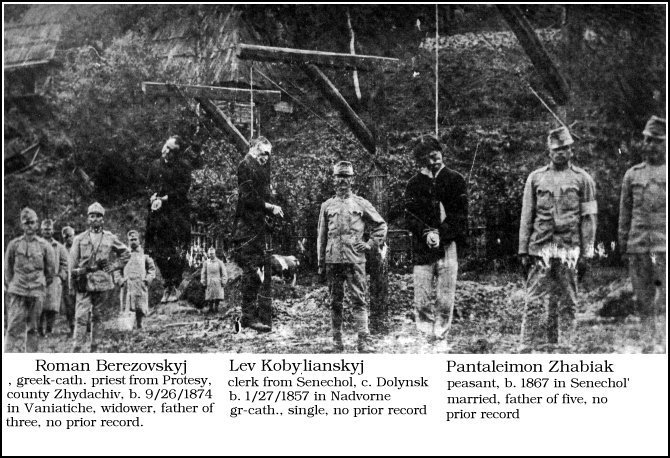
Austro-Hungarian servicemen pose against the background of three hanged men executed on August 30, 1914 in Mukachevo. © Wikipedia
Repressions against the intelligentsia were followed by those against the general public. Anyone who was thought to sympathize with Russia or Russian culture became a suspect. This included people who had once visited Russia, read Russian newspapers, or were just known as “Russophiles.” Military courts worked around the clock and a simplified procedure of legal proceedings was introduced for cases of suspected treason.
Members of Galicia’s Rusyn movement who chose the “Ukrainian way” actively participated in the repressions. Pro-Austrian politicians prepared lists of “unreliable” suspects and based on mere accusations, and arrested anyone who sympathized with Russia. As Russophile public figure Ilya Terekh described, “At the beginning of the war, the Austrian authorities arrested almost the entire Russian intelligentsia of Galicia and thousands of peasants, based on the lists handed over to the administrative and military authorities by the Ukrainophiles.”
“People who recognized themselves as Russian or simply had a Russian name were seized indiscriminately.
Anyone who possessed a Russian newspaper, book, sacred image, or even a postcard from Russia was grabbed, abused, and taken away. And then, there were gallows and executions without end – thousands of innocent victims, seas of martyr blood and orphan tears,” said another Russophile, Julian Yavorsky.
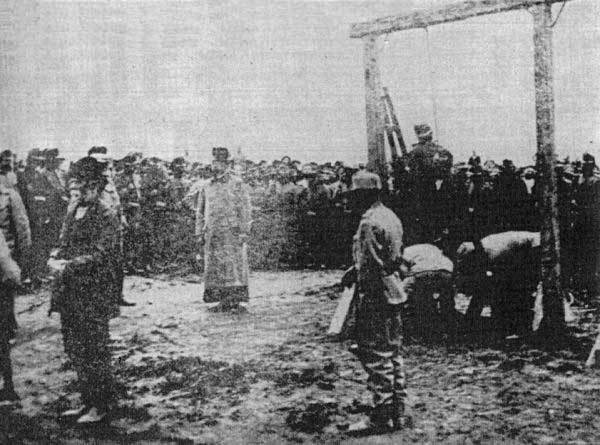
Talerhof in 1917, the place where the camp executions were carried out. © Wikipedia
In October 1914, the Russian writer Mikhail Prishvin, who served as a medical assistant at the front, wrote in his diary: “When I got to Galicia … I felt and saw the living images of the times of the Inquisition.” Prishvin described the feelings of the Galician Rusyns toward Russia as follows: “Galicians dream of a great, pure, and beautiful Russia. A seventeen-year-old schoolboy walked with me around Lvov [now Lviv, then Lemberg] and spoke Russian without an accent. He told me about the persecution of the Russian language. Students were not even allowed to have a map of Russia, and before the war he was forced to burn books by Pushkin, Lermontov, Tolstoy, and Dostoevsky.”
Hell on earth
The prisons of Galicia were not big enough to accommodate all the repressed. On August 28, 1914, there were two thousand prisoners in Lviv alone. It was then that the Austrian authorities decided to establish concentration camps. In September 1914, the huge Thalerhof place of incarceration was set up in Styria. The first prisoners were delivered on September 4. According to the testimony of one of the survivors, priest Theodor Merena, prisoners were “people of different class and age”. They included clergy, lawyers, doctors, teachers, officials, peasants, writers, and students. The age of the prisoners ranged from infants to 100-year-olds.
Occasionally, Ukrainian activists who were loyal to the Austrian regime were accidentally placed into Thalerhof. Most of them were removed quickly. One later recalled that all prisoners had a chance to escape by giving up their Russian name and registering as “Ukrainians” in the “Ukrainian list.”
Up to the winter of 1915, there were no barracks in Thalerhof. People slept on the ground in the open air despite the rain and frost. The camp’s sanitary conditions were awful. The latrines were uncovered and used by twenty people at a time. When the barracks were built, they were overcrowded, housing 500 people instead of the intended 200. The prisoners slept on straw beds which were rarely replaced. Naturally, epidemics were widespread. In just two months following November 1914, over three thousand prisoners died of typhus.
“In Thalerhof, death rarely came naturally – it was injected through the poison of infectious diseases. Violent death was commonplace in Thalerhof.
There was no question of any treatment of the sick. Even doctors were hostile toward the prisoners,” wrote imprisoned Rusyn writer Vasily Vavrik.
The prisoners weren’t provided with any adequate medical care. In the beginning, Thalerhof didn’t even have a hospital. People died on the damp ground. However, when the hospital barracks were finally built, the doctors gave almost no medicine to the patients.
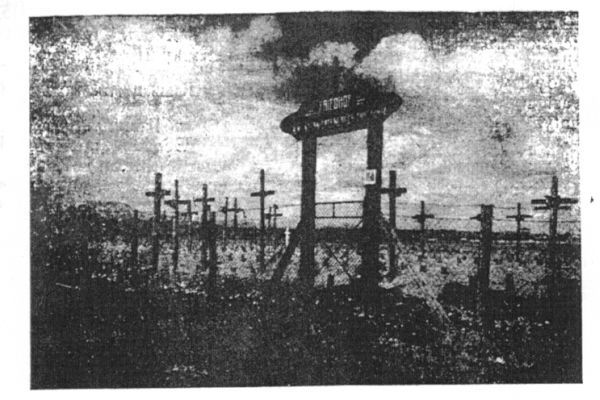
Talerhof. Cemetery “under the pines” in 1917. © Wikipedia
To instill fear, prison authorities constructed poles throughout the camp and regularly hung “violators” on these poles. The violation could be a mere trifle, like catching someone smoking in the barrack at night. Iron shackles were also used as punishment, even on women. Moreover, the camp was supplied with barbed wire, observation towers with sentries, barking dogs, posters with slogans, propaganda, torture facilities, a moat for executions, gallows, and a cemetery.
The camp operated for nearly three years and was closed down in May 1917 on the order of Charles I of Austria. The barracks stood on the site until 1936, when they were finally demolished. 1,767 corpses were then exhumed and reburied in a common grave in the nearby village of Feldkirchen.
The exact number of victims in Thalerhof is still disputed. The official report by Field Marshal Schleer dated November 9, 1914, stated that 5,700 Russophiles were imprisoned there at the time. According to one of the survivors, in the autumn of the same year there were about 8,000 prisoners. Twenty to thirty thousand Russian Galicians and Bukovinians passed through Thalerhof in total. In the first year and a half alone, about 3,000 prisoners died. According to other sources, 3,800 people were executed in the first half of 1915. Overall, in the course of the First World War, the Austro-Hungarian authorities killed at least 60,000 Rusyns.
Remembering the forgotten
In the period between the two world wars, the former prisoners strived to preserve the memory of the tragedy that affected Galicia’s Ruthenians and to perpetuate the memory of the victims of Thalerhof. The first monument was erected in 1934, and soon similar memorials appeared in other parts of the region. In the years 1924-1932, the Thalerhof Almanac was published. It provided documentary evidence and eyewitness accounts of the genocide. In 1928 and 1934, Thalerhof congresses, which gathered over 15 thousand participants, were held in Lviv.
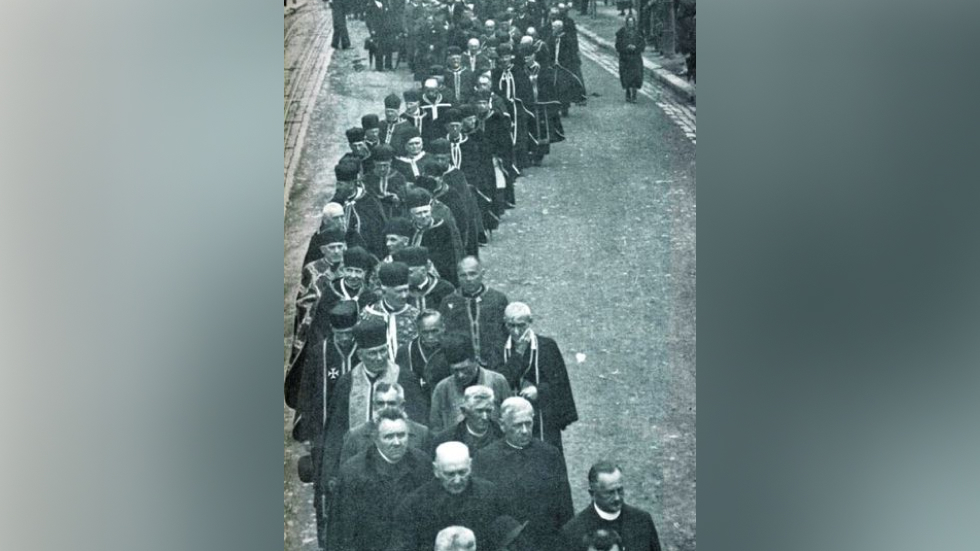
The procession of the participants of the Talerhof Congress on the occasion of the opening of the monument to the victims of Talerhof, 1934. © Wikipedia
Galicia became part of the USSR in 1939. Even before Soviet times, there was an unspoken ban on the topic Thalerhof, because the very fact of Russian existence in Galicia was seen as an impediment to Ukrainization, which was actively cultivated in Western Ukraine following World War Two. After Galicia and Volhynia became part of the USSR, most Russophile organizations in Lviv were closed. However, memorial services by the monuments continued. As the eyewitnesses and contemporaries of the events grew older and died, a new generation of Galicians was brought up in the spirit of atheism and took on a Ukrainian national identity. As a result, fewer and fewer people came to the memorials.
In modern Ukraine, the Rusyn genocide isn’t publicly discussed. Thalerhof is not mentioned in any school textbooks on the history of the country. The idea that Russians once lived in Galicia – the proud center of “Ukrainian culture” – does not fit the nationalistic ideology of contemporary Ukraine. Most young people have never even heard of Thalerhof.
The tragedy marked the end of the Russophile movement in Galicia. All those who did not submit and did not take on a Ukrainian identity were physically annihilated. Just a few years after the tragic events, public views changed. The region came under the influence of other movements and politicians. When Austria-Hungary fell apart after the First World War, Galicia turned into a powerful center of the Ukrainian nationalist movement.
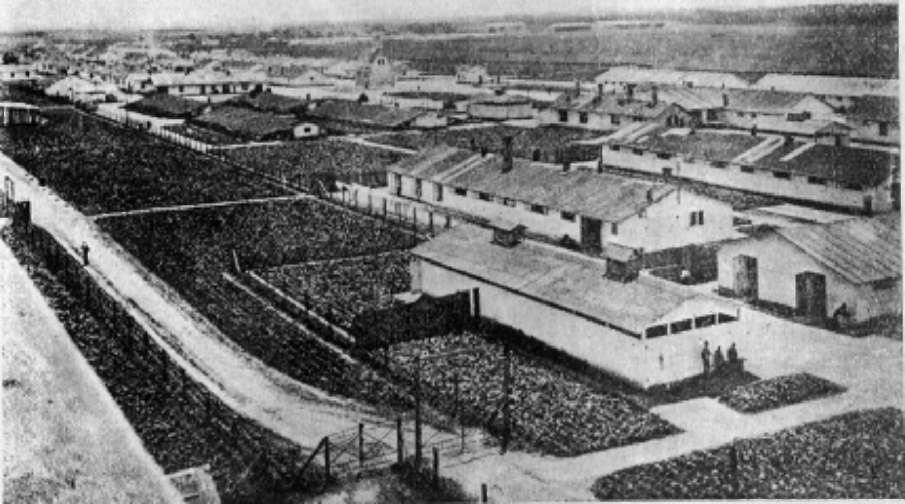
Bird’s-eye view of the Talerhof concentration camp. © Wikipedia
Dmitry Plotnikov is a political journalist exploring the history and current events of ex-Soviet states.
No comments yet.
Featured Video
The American Retreat from Vietnam
or go to
Aletho News Archives – Video-Images
From the Archives
Secret document reveals plans for civil war in Lebanon, Israeli false flags, and invasion
By Randi Nord | Geopolitics Alert | April 5, 2019
Beirut – During his visit with US Secretary of State, Mike Pompeo, Lebanese President Michael Aoun reportedly received a US-Israeli document detailing plans for creating a civil war in Lebanon with covert false flag operations and possible Israeli invasion.
Although the source of the document is Israeli and created in partnership with Washington, no one knows who presented it to Aoun. The Lebanese TV station, Al-Jadeed, initially reported the document on Lebanese TV and a video on its website. Geopolitics Alert translated the report for this article. … continue
Blog Roll
 Aletho News
- ‘Distance yourselves from Israel’: IRGC urges US population to question govt policies
- America’s Greenland deal has a radioactive backstory
- The RAF Fairford ‘terror plot’: Unpacking escalation in the UK echo-chamber
- EU Council Advances Chat Control 2.0 Scanning Proposal
- Ex-Greek MEP files complaint against Israeli spyware firm over alleged Pegasus surveillance
- Troubling ideas throughout the Torah, Talmud, Mishneh Torah and Tanya
- ‘Grave, alarming’: Iran mission on Trump’s UNGA ‘annihilation’ threats
- Najaf airport to reopen to Iranian flights within 24 hours: Ambassador
- From ‘How Will This End For Iran’ to ‘When America Walks Away’: A tale of two Economist covers
- Tehran blasts ‘baseless’ speculation linking Iran to alleged bomb plot at UK air base
- If Americans Knew
- Israel Has Kidnapped Another American Teenager
- US arms sales to Israel worth $21.6 billion in 20 months
- Three Palestinians Killed in Israeli Attacks on Gaza
- Revealed: German “Anti-Semitism Expert” Driving Crackdown on Palestine Solidarity is Former Israeli Spy
- Egypt’s Warning to Israel Before Oct 7
- Israel’s siege signals another cruel winter for 1.8 million Gazans – Daily Update
- Netanyahu Asked UAE Leader to Deny Report on Oct. 7 Warning in Secret Visit, Sources Say
- CNN Chief Int’l Correspondent Clarissa Ward on Journalists in Gaza
- Democratic Party Consultants Surround Troy Jackson with Pro-Israel Donors
- Christian Leader Responds To Netanyahu’s Claims Regarding Palestinian Christians
- No Tricks Zone
- New Study: Earth And Venus Surface Warmth Largely Explained By Convection And Lapse Rate, Not CO2 Or Radiation
- 2025 Nature Paper Claiming Worsening Global Drought Gets RETRACTED …Heavily Flawed
- New Study: ‘Global Drought Shows No Detectable Recent Acceleration Under Climate Warming’
- Economic Masterminds: German Socialists Suggest Taxing Productivity Gains Stemming From Using AI
- The South China Sea Has Not Been Cooperating With The Climate Change Narrative
- Energy Crisis: Germany Enters Heating Season With Historically Low Gas Reserve Fill Levels
- New Study: The Antarctic Ice Sheet Gained Mass From 2020-2024 Due To Staggering Snow And Ice Accumulation
- Study: Ocean Heating Rates From Thousands Of Years Ago ‘Dwarf’ Modern Ocean Heating Rates
- Climate Extremists Target, Attack Large-Scale Power Grid Infrastructure In Germany!
- New Study: Antarctic Ice Melt Has Contributed Less Than 1 Centimeter To Sea Level Rise In The Last 30 Years


Leave a comment