China responds to Kissinger’s Ukraine proposal
RT | May 19, 2023
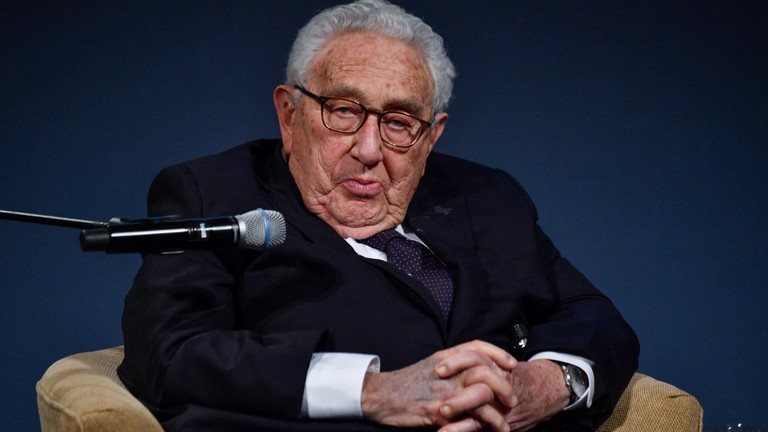
China has urged against Ukraine joining NATO, saying it would not improve security in the European region, after veteran US diplomat Henry Kissinger claimed membership would serve the interests of both Kiev and Moscow.
Asked about Kissinger’s comments during a Thursday press briefing, Chinese Foreign Ministry spokesman Wang Wenbin argued that Ukrainian NATO membership would only further inflame tensions.
“Ukraine should not become the frontier in a major power confrontation,” he said, adding that “to strengthen or even expand military groups is not a viable way to ensure the security of a region. One country’s security should not be achieved at the expense of the security of other countries.”
In an interview with the Economist published on Wednesday, Kissinger said European powers were pursuing a “madly dangerous” strategy by keeping Kiev out of the US-led military bloc, insisting Ukraine must not “become a solitary state just looking out for itself.” He claimed NATO membership would not only benefit Ukraine, but Russia as well.
“If I talked to [Russian President Vladimir] Putin, I would tell him that he, too, is safer with Ukraine in NATO,” the 99-year-old added, saying the move would prevent Kiev from making rash “national decisions on territorial claims.”
The Chinese spokesman went on to state that a “durable European security architecture” could only be created through dialogue. During a visit to Ukraine this week, special envoy Li Hui met with Ukrainian President Vladimir Zelensky, Foreign Minister Dmitry Kuleba and other senior officials to discuss Beijing’s views on a diplomatic resolution to the conflict.
Beijing unveiled a 12-point roadmap for peace in February which urged both Moscow and Kiev to resume direct negotiations. President Putin later said the Chinese plan was “in tune” with Russia’s position and hoped the proposal could serve as the basis for a future political settlement.
Western powers have dismissed the 12-point plan, with the European Union’s foreign policy chief Josep Borrell dubbing it “wishful thinking,” while the top advisor to Ukrainian President Vladimir Zelensky argued that it heavily favors Russia.
Direct Turkish-brokered talks between the two sides broke down in the spring of 2022. Since then, President Zelensky has ruled out any direct talks with Russia as long as Putin remains in power, and Moscow has rejected the terms for negotiations put forward by Kiev. Among other things, Ukraine’s proposal calls for Russia to withdraw its forces from all territories within Ukraine’s 1991 borders, to pay reparations, and to submit to war crime tribunals. Moscow has rejected the plan as “unacceptable,” pointing out that it ignores the reality on the ground and merely shows Kiev’s unwillingness to resolve the crisis through talks.
The US Is Receptive To Kissinger’s Suggestion To Revive Talks With China On A New Détente
BY ANDREW KORYBKO | MAY 19, 2023
Two new narratives were introduced into the West’s information ecosystem over the past week. The first concerns the need to adapt to multipolar processes by engaging more with the Global South, which was expressed by German Chancellor Olaf Scholz, former US National Security Council member Fiona Hill, and Goldman Sachs’ President of Global Affairs Jared Cohen all on the exact same day last Monday. The next narrative complemented this one and came two days later on Wednesday.
Global affairs guru Henry Kissinger’s lengthy interview with The Economist from late April was published on that day, in which he devoted considerable time explaining why the US should revive its talks with China on a New Détente that were unexpectedly derailed by February’s balloon incident. CNN then reported on that same day that “Biden administration looking at arranging high-profile visits to China by senior officials,” which suggests that it was briefed earlier about his proposal and heeded his advice.
The first narrative about engaging more with the Global South complements the second one about reviving talks with China on a New Détente in the sense that the former is one of the three prerequisites for successfully accomplishing the latter, at least according to how American policymakers likely view it. They want to signal that the US won’t voluntarily cede influence in the Global South to China, but instead plans to compete with it there via economic and diplomatic means.
This goal will be greatly advanced through a combination of pragmatic engagement with the Global South’s informal Indian leader, whose Prime Minister visits the US late next month, and coordinating between America’s “Build Back Better World” and the EU’s “Global Gateway” development initiatives. These subgoals also align with Kissinger’s suggestions about cooperating more closely with India as well as crafting an inspirational vision for this century (i.e. merging the West’s development initiatives).
The second prerequisite for successfully negotiating a New Détente with China upon the seemingly impending resumption of this process is to diplomatically displace its envisaged role in the Russian-Ukrainian peace process. In pursuit of this, the US wants to “de-Sinify” the scenario of a ceasefire after the end of Kiev’s NATO-backed counteroffensive, which explains its support of the African-led peace mission that was announced on Tuesday in between Monday and Wednesday’s new narratives.
What’s most interesting about this initiative is that it’s organized by the Brazzaville Foundation, whose French chairman Jean-Yves Olivier is known for his shadow diplomacy over the decades that was documented by Wikipedia. This suggests that their peace mission is secretly organized by France with the US’ tacit approval, if not jointly coordinated with it, which would advance their goal of diplomatically engaging with the Global South in parallel with “de-Sinifying” the Russian-Ukrainian peace process.
Both’s prospects would be bolstered by India’s participation in these efforts, which has its own interests in presenting itself to the world as a peace broker, especially throughout the course of its G20 chairmanship. These two prerequisites for enhancing the odds that the US successfully negotiates a New Détente with China concern the economic and diplomatic spheres respectively, while the third that’ll now be described deals with the military one.
“The US Is Rounding Up Allies Ahead Of A Possible War With China”, while “NATO’s Planned Liaison Office In Japan Will Accelerate The Expansion Of AUKUS+”, both of which will contribute to more effectively containing China in the Asia-Pacific. American policymakers apparently expect that the People’s Republic will accept this emerging regional military reality instead of it serving to preclude the resumption of their talks on a New Détente.
Not only that, but they seem to think that it could even give their side an edge of some sort in those negotiations too, or at least enable the US to speak to China “from a position of strength” as they see it. The message would be that this containment noose could tighten even more if Beijing doesn’t agree to resume such talks, not to mention if they fail to achieve anything tangible, thus making it a form of military blackmail when viewed from this perspective.
Altogether, the introduction of this week’s two complementary narratives into the West’s information ecosystem suggest that this de facto New Cold War bloc’s American leader is recalibrating its grand strategy. Policymakers appear to have concluded that their side can’t restore unipolarity, instead settling for managing multipolar processes in the direction of their interests as much as is realistically possible, to which end they must engage more with the Global South and revive talks with China on a New Détente.
The observations shared in this analysis shouldn’t be interpreted as predicting the success of these policies, but simply as arguments that this approach is indeed being attempted and was almost certainly influenced by Kissinger’s suggestions that he shared in his interview. He and The Economist are close to American policymakers so they likely passed his ideas along to relevant figures, after which they agreed with the gist thereof and subsequently began implementing them this week as proven in this piece.
Second largest Swedish party wants Stockholm to prepare for ‘Swexit’
By Drago Bosnic | May 19, 2023
As if the European Union didn’t have enough major problems already, now the troubled bloc is faced with the nontrivial prospect of a “Swexit”. Namely, senior officials of the second largest political party in the Scandinavian country, the Sweden Democrats, are now openly saying that their country needs to be prepared to leave the EU. This includes the party leader himself, Per Jimmie Akesson, who stated that “only by making the necessary preparations for ‘Swexit’ can the government maximize its bargaining power in Brussels”. The right-wing Sweden Democrats have long been frustrated by the power that the unelected bureaucrats in Brussels wield over their country, so this is hardly a surprising development.
However, even Eurosceptic Swedish parties usually refrain from such open anti-EU declarations, meaning that the bloc is gradually losing its power, even in previously somewhat pro-EU member states. On May 15, Akesson authored an article along with his Sweden Democrats fellow member Charlie Weimers, who also represents his party and his country as a Member of the European Parliament (MEP). The op-ed was published by the Stockholm-based Svenska Dagbladet daily, in which the authors explicitly stated that their intention is to ensure Sweden “maximizes its influence” in the EU, specifying several legal measures the country’s government must take to accomplish the stated goals.
First, the Swedish government must insist on making constitutional changes that would make it possible to introduce what Akesson and Weimers called a “referendum lock”. According to the authors’ reasoning, this would enshrine into law the requirement of a nationwide referendum before any further national powers can be renounced by Sweden and transferred to the unelected EU bureaucrats. The goal is to ensure that any further erosion of the Scandinavian country’s sovereignty is prevented if the Swedish people choose not to comply with it. The authors cited the examples of the United Kingdom and Denmark as an inspiration, as both London and Copenhagen previously adopted similar legal mechanisms.
“Only the knowledge that every decision on the transfer of power must be submitted to the citizens would slow down the worst abuses from Brussels,” Akesson and Weimers wrote in the op-ed.
Second, the country’s government must make the necessary preparations to leave the EU, as the troubled bloc should not take Sweden’s national interests for granted. The authors insist that the government must ensure it’s ready in case such a decision is ever made by the Swedish people and to formally legitimize any threat to withdraw from the EU in future negotiations with the troubled bloc. They further added that to accomplish this, Sweden needs to remove the clause that it’s an EU member from its constitution, as well as study the example of the UK during Brexit, while also training civil servants to ensure the process runs without any major issues. As previously mentioned, Akesson and Weimers see this as instrumental for improving the country’s negotiating position.
“In order for preparedness to be credible, it’s necessary that we remove the writings in the constitution that state that Sweden is a member of the EU … In addition, we should train a cadre of civil servants with the expertise to negotiate trade agreements and other things that we have delegated to the EU and study how Brexit could have been implemented better. The better we are prepared to leave, the more we will gain in future negotiations,” the authors added.
Akesson and Weimers believe these are the bare minimum requirements that will provide a solid backstop against any possible power-grab attempts by Brussels. In addition, the leader of the Sweden Democrats also wants an investigation to be launched into how the negative aspects of the Scandinavian country’s membership in the EU can be alleviated. Among other things, this also includes the issue of immigration, a major problem that the Sweden Democrats see as crucial for the country’s future. The right-wing party is the largest member of the country’s governing bloc, providing virtually all of its confidence-and-supply votes in the Riksdag (Swedish Parliament), although the Sweden Democrats are not directly taking part in Prime Minister Ulf Kristersson’s administration.
As per the Tidö Agreement to which all coalition parties agreed, Stockholm is to adopt a more restrictive immigration policy in return for support of the Sweden Democrats, something the more liberal-leftist opposition, informally supported by Brussels, staunchly disagrees with. And while Euroscepticism is still not the view of the majority of the Swedish electorate, it has steadily been growing in recent years, particularly as the disastrous policies supported by the EU have drastically eroded the well-being of the Scandinavian country’s citizens. Although Akesson himself acknowledges the fact that the majority still doesn’t support Sweden’s withdrawal from the EU (which has been the long-standing policy of his party), he certainly wants to capitalize on the growing support it’s been getting.
Drago Bosnic is an independent geopolitical and military analyst.
USA: Increasingly polarized
By Veniamin Popov – New Eastern Outlook – 19.05.2023
The decline of civic life in the US is primarily down to the de-facto absence of the freedom of press. This freedom is only proclaimed in words, but in reality, a single point of view is imposed on everyone. This has furthermore exacerbated the divisions in American society.
The highly acclaimed primetime TV host, Tucker Carlson, who was recently fired, alleged that the American media is prohibited from discussing important topics that affect the future of the United States and the whole world: “The undeniably big topics, the ones that will define our future, get virtually no discussion at all: war, civil liberties, emerging science, demographic change, corporate power, natural resources.”
The reporter has repeatedly criticized the conduct of American officials; for instance, he spoke about the consequences for the United States of the conflict in Ukraine and also affirmed the allegations Russia made regarding the terrorist attack on Nord Stream, claiming “it is the West’s biggest lie.”
Faisal J. Abbas, editor-in-chief of the Saudi newspaper Arab News, emphasized that the biggest threat facing the United States today is polarization – the media has been used by politicians to cultivate their own audiences and create ideology: politicians only think from one election cycle to the next, so they take ideological positions that are not really essential to the daily life of the average American citizen. Issues such as gender identity and abortion are central to public discourse; on the other hand, issues affecting the daily lives of ordinary Americans, such as deteriorating living standards, increasing homelessness, unaffordable rents, and college education, are not being addressed.
Virtually no one talks about the real problems faced by the average American; their attention is focused on secondary issues that benefit politicians. Meanwhile, domestic social, ethnic and racial contradictions in the US are becoming more and more acute. A global financial “storm” in the event of a default on US government debt payments is not out of the question. The US Treasury Secretary spoke about this possibility just recently. A banking crisis also looms on the horizon.
The New York Times in March 2023 published an article about the serious danger of a “national divorce.”
This topic began to be more often raised in the American press in connection with the actual beginning of the presidential campaign of 2024 – as you know, the current President Joe Biden announced it at the end of April.
In response, the Republican Party released their video, created using “AI-generated imagery”: a realistic-looking news summary announcing Biden’s victory in 2024, followed by a long list of hypothetical disasters – Chinese invasion of Taiwan, the collapse of financial markets, immigrants taking over the southern border and the closure of San Francisco due to escalating crime.
One American newspaper called the conflict between Biden and Trump not so much a confrontation between Democrats and Republicans as a confrontation of essentially moral and immoral worldviews, a rivalry between decency and its opposite.
Much has been said in this regard about how the unregulated deployment of artificial intelligence can create social chaos – people wonder what will happen when a non-human intelligence becomes better than the average person at telling stories, composing melodies, drawing pictures, writing laws, scriptures. And yet all this can be used to propagate fake news and form new cults.
At the same time, the Democratic Party does not hide the fact that they see the danger of the current moment in the likelihood of Trump becoming a nominee in the 2024 elections – and all means are good here.
Driven by immediate interests, they are organizing a lawsuit against the former president, trying not only to discredit him, but also to block his way to participate in the upcoming elections. The fact that the former president of the United States is about to be indicted in a criminal court sets a dangerous precedent – there is no guarantee that another American president won’t also be arrested after leaving his official office.
Republicans, for their part, are intensifying investigations into Hunter Biden, the President’s son: he is being charged with providing false information when purchasing weapons, withholding treatment for drug addiction. Tax evasion in transactions abroad became the main point of the charges, with Republicans wanting to go after Biden’s entire family as well.
In this regard, the well-known columnist Nicholas Christophe mentions a bunch of closely intertwined problems that hold the country back: childhood trauma, drug addiction, mental health problems, homelessness, loneliness, family breakdown, unemployment. More than a quarter of a million Americans die each year from drugs, alcohol and suicide.
“To alleviate our chronic pain,” Christoph writes, “we must do a better job of healing deeper wounds in our economy and society.”
In this regard, it is not surprising that an Arab newspaper compared the situation in America to the current civil strife in Israel, where society is divided into roughly the same two halves. The same newspaper also spoke about the possibility of an openly fascist regime in Israel.
The famous American philosopher Noam Chomsky said in an interview with Al Jazeera on 09.04.23: “The United States is increasingly collapsing like Israel.”
According to a recent poll, more than 50% of Americans now expect a new civil war “in the next couple of years,” with several predictions about the end of America.
In one, in the event that Trump, or any other Republican, occupies the White House, Californians take serious steps toward secession from the United States.
The other scenario, which is being seriously discussed, says that if the Democratic Party wins, including a second term for Biden, the reds, i.e., Republican states, begin a movement for independence.
Meanwhile, a December 12, 2022 article on the Saudi Arabian television station Al Arabiya’s website, as if to summarize the many musings of American political scientists, argues under the title “How America Will Divorce Itself” that a divorce agreement could take the following form: California, parts of Oregon, Washington and Nevada agree to become the new federal system.
But the greatest threat to America’s very existence is the widening gap between the rich and the poor. Bloomberg, reviewing the book “The Triumph of Injustice: How the Rich Dodge Taxes and How to Make Them Pay” by Gabriel Zucman and Emmanuel Saez on May 7, noted that the widening gap between the rich and the poor could lead to a revolution.
Veniamin Popov is Director of the Center for the Partnership of Civilizations at the Moscow State Institute of International Relations (MGIMO) of the Russian Ministry of Foreign Affairs, Candidate of Historical Sciences.
Featured Video
Ted Postol: Fraud of Missile Defence Exposed in Iran War
or go to
Aletho News Archives – Video-Images
Frlom the Archives
Containing the United States
By Edward S. Herman | Z Magazine | September 2016
“Containing the United States” is, of course, a ridiculous and self-contradictory idea in the U.S. and Western ideological and propaganda system. We all know that the United States had to “contain” the Soviet Union from 1945 to 1991, and since then has had the task of containing Russia and China. Only they threaten, bully, aggress and worry countries like Poland and Vietnam. Obama has had to reassure them both of our steadfast stand against Russian and Chinese military attacks. NATO has, of course, expanded greatly over the past several decades, despite the deaths of the Soviet Union and Warsaw Pact, but only to contain the renewed Russian — and Iranian, Libyan, Syrian and other — military threats; and we have “pivoted” to Asia, supported Japanese rearmament, bolstered our own forces in that area and jousted with the Chinese in their coastal waters solely to contain China. Earlier we had been obliged to contain North Vietnam, or was it the Soviet Union in Vietnam? Or China? Or “communism”? Or maybe all of them? Or none of them, but just needing an excuse to enlarge power?
The parallel propaganda has taken many forms. One is accepting as a premise that the United States only acts defensively and has no internal forces and interests that drive it to enlarge its sphere of control. I noted in an earlier article how Paul Krugman claims that internal Russian problems may well be the explanation of Russian “aggression,” but how at the same time it never occurs to him that the huge U.S. transnational corporate interests and “defense” establishment, and the pro-Israel lobby’s activities, might possibly make for an expansionist dynamic here.2 This reflects the standard establishment perspective that we are good and only react to evil. This was the view sustaining and justifying the invasion and occupation of Iraq from 2003. That attack was taken here as not evil but a response to evil, even if involving lies and mistakes, hence not describable as “aggression.” … continue
Blog Roll
 Aletho News
- Top official: Iran ready for a long war with US, no more diplomacy
- How Iran’s Toxic Rain Reveals US-Israel Discord
- Trump Admits He Is Destroying Iran For Israel
- Iran’s latest move in the GCC countries was a stroke of genius
- Blackmail and death threats, Zelensky embarrasses the EU, but there’s no condemnation
- Israel threatens to kill Iran’s new leadership
- Possible Scenarios for the Middle East
- The Horizon of the War. “Italy is being Dragged Into the War against Iran”
- A Second Vietnam War? Hanoi Waits and Prepares
- Ted Postol: Fraud of Missile Defence Exposed in Iran War
- If Americans Knew
- EXPLAINER – Dimona: What to know about Israel’s nuclear site
- Fires and toxic air in Iran (thanks, Israel) – Not a ceasefire Day 150
- At Israel’s hands, Iran is burning, Lebanon and Gaza are crumbling – Not a ceasefire Day 149
- Israel is using the ‘Gaza doctrine’ in Lebanon and Iran
- Saudi journalist says ‘not all attacks’ on Gulf coming from Iran, fears US-Israel dragging monarchies into war
- Iranian officials say Israel carried out some of the drone strikes on Gulf energy sites
- US, Israel ravage Iran and Lebanon; 4 killed in Gaza – Not a ceasefire Day 148
- US troops were told war on Iran was ‘all part of God’s divine plan’, watchdog alleges
- Trump wants to run the show in Iran, but doesn’t know what he’s doing – Not a ceasefire Day 147
- ‘Dirty Work’ :The truth about how Israel was founded
- No Tricks Zone
- Wake-up Call: Survey Shows Majority Of Germans Now Favor Postponing Climate Targets!
- Televised! Leading German Political Candidate Tells Schoolchildren CO2 Makes Sun Hotter!
- New Study: A Century Warming Of 1.1°C Is ‘Commonplace’ And ‘Not Unusual’ During This Interglacial
- New Study: ‘Internal Noise’ And Volcanic Forcing Can Trigger 10-15°C Warming Within Decades
- Glaciers Worldwide Are Suddendly Surging, Experts Blame Warming!
- Surprising Discovery: Sahara Is Greening…Billions Of Trees Where Once Thought To Be Barren
- New Research Reaffirms Clouds, Aerosols, And Surface Solar Radiation Are ‘Driving The Climate System’
- Germany: Electric Car Catches Fire At Charging Station, Sets Off Local “Inferno”, Widespread Damage
- New Study: Canada’s New Brunswick Was 1°C Warmer Than Today During The Medieval Warm Period
- Coal Power Back In Trend As Globe Tries To Keep Pace With Growing Demand For Power
 Aletho News