Ukraine’s Depleted Uranium Blast: Europe on Brink of ‘Environmental Disaster’

A frame of a CCTV video, purportedly depicting a major blast at an ammo depot in Khmelnintsky, Ukraine.
Sputnik – 19.05.2023
Russian Security Council Secretary Nikolai Patrushev warned on Friday that a radioactive cloud was heading towards Western Europe following the destruction of a Ukrainian warehouse storing British-supplied depleted uranium ammunition.
Sputnik News spoke with Dr. Chris Busby, physical chemist and scientific secretary of the European Committee on Radiation Risk, about how the West’s decision to provide depleted uranium (DU) ammunition to Ukraine has potentially caused a continent-wide ecological disaster. Below is his answer in full.
Recently, several web media outlets provided videos of an enormous explosion in the town of Khmelnitski, located to the West of Kiev, and about 200 km from the border with Poland. There were two major explosions which produced a massive roiling swirling fireball which, like an atomic bomb, developed upwards and formed a mushroom cloud, which was black.
I have represented nuclear atmospheric test veterans in the Royal Courts of Justice in London and have seen many films of nuclear explosions: this was not one. A nuclear explosion is characterised by an immediate intense white light which wipes out the camera film or detector.
So, what was it? It was suggested by several commentators that an arms depot that had been hit contained the Depleted Uranium (DU) weapons sent by the UK to the Ukraine for use in the British Challenger tanks as anti-tank penetrators. That the explosion was one involving the burning of the DU in the fireball. Since I am a scientific authority on Uranium and its health effects, but have also examined its dispersion and behaviour in the environment, I will comment on what I believe happened, and why it is important. I was a member of the UK government Ministry of Defence Depleted Uranium Oversight Board (DUOB) in 2000-2005, and also the UK government Committee Examining Radiation Risk from Internal Emitters (CERRIE) 2000-2004. I am Scientific Secretary of the European Committee on Radiation Risk (ECRR) which is an independent NGO that provides advice on risk from ionising radiation.
My main research interest in this area is Uranium and health, particularly the DU particles, which are so small they act as a gas and move over very large distances once they are created by the burning of DU. I found them in England in 2003 after they had come from Iraq. I found them in 2023 in England after they came from the Ukraine war. So that is the first thing: the material is able to travel very large distances.
Therefore, if the Khmelnitski explosion was a DU one, the material would move with the wind direction and should be detectable at monitor sites downwind.
First, we need to say that DU has a gamma signature, it releases gamma rays. The UK and USA governments lie about this. They point to the fact that the U-238, that remains after the fissile U-235 is removed in the centrifuges (and is sent off for nuclear weapons and reactors), is a weak alpha emitter.
They say that alpha radiation cannot penetrate skin and so the DU itself is harmless. That it cannot be detected by a Geiger Counter and the alpha particles don’t make it through the window. There is, of course, a health problem if the post-impact particles are inhaled and pass into the body through the lung into the lymphatic system or directly into the digestive system, but essentially DU is harmless.
What you need to know is that Uranium 238, when it decays with its alpha emission, turns into Thorium-234 and Protoactinium-234m which then turns into Uranium 234. Thorium 234 is a beta and gamma emitter delivering 6% of its decay energy as a gamma ray. Thus, large clouds of DU particulate aerosol will be detectable by gamma detectors.
When I visited Iraq with Al Jazeera in 2000 I went to the south and examined the corpses of the tanks that had been hit by DU in the first Gulf War. Some of the A-10 DU penetrators were still lying around. They gave off an intense gamma ray signal, and the holes in the tanks were highly gamma ray active. So much for only an alpha emitter.
I am a yachtsman: examination of the UK metereological weather pressure maps tell us that at the time, and for days after the explosion, there was an anticyclone to the North of the explosion site and winds were weak but from the South East blowing North Westerly around the high-pressure area. So, the plume would move towards Poland. If the winds were about 5km/h they would reach any Poland detectors 250 km away on the 15th.
After Chernobyl, the European Union set up a Europe-wide gamma radiation detector system that used to give gamma readings in real time. I went to look. But astonishingly, all the data was blocked. The web- based system, administered from Germany, (EURDEP) would not provide the detector maps that are normally available. Luckily, there were some location maps on the web and some that had been already downloaded by colleagues of mine before the system stopped working. I obtained maps from Poland. One of these I show below.
You will see that a very highly significant increase in gamma radiation occurred at this detector, north west of the explosion site almost exactly when it would be expected on the basis of a distance of 250km and a mean wind speed of 5km/h. The increase, from 60nSv/h to 90nSv/h was highly statistically significant about 50%. Other detectors all across Poland showed an increase*, as the plume passed over them, the increase being weaker the further away (due to dispersion of the plume).
Later, the Poles measured the increase at the Marie Curie Institute in Lublin, but their map was a more sophisticated one and needed some expert interpretation. The Polish map gave gamma increases split into two natural isotopes, Bismuth and Thallium, also total gamma and cosmic ray gamma.
From the map, we are to assume (and this was the implicit message) that the gamma peak was due to Bismuth. Enter Sherlock Holmes. Bismuth 214 is a Radon daughter. The natural background radioactive gas Radon (Rn-222) is always present, since it is produced from Uranium and Radium in the ground. If there is a sudden change in atmospheric pressure, or when it rains, there is a gamma peak from Radon, which shows itself as the Bi-214 peak. So, the Poles seem to be implying that the increase in gamma radiation is normal and nothing to get scared about. Many have picked up on the Bismuth spectrum. But the way in which the Polish graphs are presented is misleading.
The problem with a radon argument is first that the gamma increases go up all across Poland at a time scale that identifies a plume from Khmelnitsky and second that there was a stable anticyclone weather system and no atmospheric pressure changes that might pull radon out of the ground. I checked all that. There was only some light rain over Lublin.
There is, however, an additional possibility. Very fine particles attract Radon: you get a slight increase in gamma from Radon near factory chimneys that emit fine particles.
The European radiation detector system web map came back online yesterday. The map type had been changed and everything we saw in the downloads had disappeared or had been smudged out by data analysis averaging. Why? This, and the early blocking of access to the site suggest panic and cover-up.
So taken all together, what we see is a massive explosion which is thought to be DU, and reports of a spike in gamma radiation near the site. Uranium oxide is black, and the black plume moves north west slowly, the weather pattern is stable and the wind blows to Poland. The Polish EU detectors all show gamma radiation increases at the expected time of arrival of the plume. The EU detector system is shut down rapidly, but not before we have obtained data from several sites. The Poles provide a detector result that identified Bismuth as the cause of the increase, but do not go so far as to formally state that it is (in case of later blowback).
One final piece of evidence. We see videos on the internet of the Ukrainians clearing up the explosion site using Robot vehicles, not ordinary firemen. Why do they need Robot vehicles? The last times we saw Robot vehicles clearing up was in the ruins of Chernobyl and Fukushima.
If I am right, there has been an environmental disaster, and the DU particles will travel across Poland, Germany and Hungary, and will end up in the Baltics, probably later the whole of Europe including the UK (after all, the Chernobyl Uranium particles came to the UK).
They will deliver genetic damage and death like that seen in the Balkans and Iraq. Cancer, birth defects, miscarriage, infertility, lung damage, mental problems (Gulf War Syndrome) and so forth. The scientific and epidemiological evidence on this has been clear since the Gulf War. It is all there in the scientific literature—but the governments in the West and the military ignore it, deny it and cover it up. In the case of the UK coroners court finding for Stuart Dyson, the jury found that DU caused his fatal colon cancer. But when the coroner wrote to the health minister (as he had to by UK law, Rule 43) the reply was: we disagree. This stuff can be measured, but no one will measure it, or if they do, they will be attacked and their arguments dismissed.
Even if I am wrong, and there is some other explanation for the gamma peaks, DU must be banned. It is a weapon of indiscriminate effect and kills civilians, the enemy and your own troops (well, Ukrainian troops). It is much worse than a war gas, like Sarin, or phosgene, mustard gas or all the other chemical agents banned by civilisation. This stuff destroys the genetic basis of life itself. And no one does anything. Those who use it base their action on obsolete science supported by dishonest epidemiology carried out by dishonest scientists and obsolete and fantastical risk models.
Those who provide the weapons, the UK government in this case, are morally bankrupt. Unless it is their intention to destroy the Ukrainian people. Who knows anymore? The world has gone mad.
*Poland’s National Atomic Energy Agency claims there is no increase in radiation levels.
Can Western air defense systems protect Ukraine properly?
By Uriel Araujo | May 19, 2023
On May 16, Ukraine claimed its air defenses intercepted six Russian Kinzhal hypersonic missiles and shot them down amid an “exceptionally dense” barrage fired – supposedly thanks to the arrival of Patriots, among other Western combat systems. Kinzhals are supposed to be able to overcome all existing air defense systems, and Moscow denies its Kinzhals were intercepted.
Kiev also claims to have shot down 29 of 30 Russian rockets on May 18, an obviously inflated number. However, a Ukrainian infrastructure facility in Khmelnytskyi has been hit by a missile, with no casualties reported. The barrage came as a response to Kiev’s advancements in Bakhmut. Ukrainian forces are reportedly preparing to launch a counteroffensive. Ukraine’s defense systems, however, should not be overestimated.
While Western powers are finally coming to realize that Kiev simply does not possess the necessary means to win the ongoing conflict, much is being written about Western air defenses supposedly being key for Western victory in its proxy war in Eastern Europe against Moscow. Despite Ukrainian denials, American officials have confirmed US-made Patriot was indeed damaged by Russian strikes. According to the Russian defense ministry, on 16 May Kinzhal destroyed a Patriot missile defense system (five launchers and a multifunctional radar). This is one of the most advanced US air defense systems. Albeit trying to minimize the damage, US authorities speaking to Reuters on the condition of anonymity said that they would have a better understanding of the situation “in the coming days” and that “information could change”.
In the past days, Ukrainian President Volodymyr Zelensky has been busy touring different European countries and so far he has been promised billions of dollars in military equipment by allies such as the United Kingdom (UK) and France. How much different can those make?
The hard truth is that Kiev remains unable to create a single control system or an interface for the various Western air defense systems and their different components, as these possess a large range of functional features and thus are poorly integrated into the already existing systems. This means that they would operate ineffectively if included in a single circuit. NATO’s anti-aircraft systems can fully control one defined sector of airspace at a time, but cannot intercept operational-tactical missiles that move along an aeroballistic trajectory, such as the Russian hypersonic Kinzhais. For Ukraine, it would therefore be necessary to construct a whole new system, which is no simple task during a confrontation – not to mention doing so quickly enough.
Moreover, according to defense and IR journalist S. Tiwari of the EurAsian Times, the Patriot, IRIS-T and NASAMS systems cannot protect Ukrainian troops from guided bombs, such as the ones massively used by Russian forces. Ukrainian Lieutenant Colonel Denis Smazhny, an aerial defense specialist, in turn has confirmed the low effectiveness of the US-sent NASAMS and IRIS-T complexes (supplied by Germany) to face Russian ballistic missiles such as the Iskanders and Kinzhals. The Russian weapons, unlike cruise missiles, are capable of rising to very high altitudes to fall almost vertically onto the target at great speeds. Thus, targeting them in flight is very difficult. How can one make them fall when they are in fact “already falling”?
Thus, in Colonel Smazhny’s words, “Western air defense systems will not be able to protect us.” Even with the Western systems, quickly creating an integrated and effective system for airspace defense is a challenge for Ukraine, to say the least. This is why Kiev has been eyeing an Israeli system called Iron Dome, which could suit its needs better. However, military and technical issues are often entangled with political and diplomatic matters.
During a US Senate Armed Services Subcommittee on Strategic Forces session (about missile-defense matters), last week, American Senator Angus King asked why Iron Dome had not been deployed in the Eastern European nation. The answer is quite simple: the main producer of such systems is Israel and thus it would have to grant Washington permission to send it to any other country, such as Ukraine. Despite several requests, this has not happened.
Tel Aviv sees Russia as a regional great power with which it must engage in a number of issues in the Middle East. For one thing, Moscow and Tel Aviv currently have a working relationship in the Levant, and Israeli Prime Minister Benjamin Netanyahu himself has stated he has no reason to damage bilateral relations. Moreover, even if Israeli approval were to happen, which remains unlikely, this would still not necessarily make a great difference other than a symbolic one: Russian weapons are indeed more sophisticated than the Palestinian rockets the Iron Dome routinely shoots down. To have a huge impact, Ukraine would need dozens of Iron Domes, which do not currently exist.
Besides these military issues, Ukraine is struggling with a domestic political crisis amid several corruption scandals. This week, for instance, the chair of its Supreme Court, chief justice Vsevolod Knyazev was removed from his post over bribery accusations amounting to $2.7 million. In addition, former US President Donald Trump stated last week he will not commit to backing Kiev, should he win the Republican presidential nomination and the upcoming elections. Despite legal controversies, Trump remains a clear Republican favorite, while Republican senators are increasingly opposing advancing aid for Ukraine and some, like Senator JD Vance, are calling for investigating a possible Democrat money laundering scheme in Ukraine.
US General: Israeli-Made Iron Dome System Ready For Deployment in Ukraine
By Connor Freeman and Will Porter | The Libertarian Institute | May 18, 2023
One of two Israeli-manufactured Iron Dome batteries owned by the Pentagon is ready to be deployed to Ukraine, a US general told the Senate on Thursday. Tel Aviv has so far refused to supply the anti-missile system to Kiev, for fear of provoking Russia and risking its ability to freely bomb Moscow’s ally Syria.
During a Senate Strategic Forces subcommittee hearing on Thursday, Senator Angus King pressed a senior Pentagon official on why Ukraine has not yet received the Iron Dome, noting the US role in creating the air defense system.
“We sent something like $3 billion to Israel to develop it… Wouldn’t this be a very important resource for the Ukrainians since their principal problem right now is missile defense?” the lawmaker asked.
Army Space and Missile Defense Command chief General Daniel Karbler replied that there are currently two Iron Dome batteries in US inventories, one of which is now ready for transfer to Kiev.
“Once completed new equipment training, new equipment fielding. It is prepared for deployment. The other one is wrapping up its new equipment training right now. So the army does have one available for deployment if we get a request,” he said.
While the US has spent some $2.6 billion to fund the Iron Dome since 2011, it is produced in Israel, and Washington must seek Tel Aviv’s approval before any transfer to a third country. Ukrainian officials have repeatedly urged Israel to supply the system since Russia’s invasion commenced last year, but Tel Aviv has been reluctant to fulfill the requests, which could jeopardize its delicate relations with Moscow.
For years, Israel has dropped bombs on Syria – a key Russian ally in the Middle East – on a near-weekly basis. Tel Aviv claims its constant airstrikes are needed to counter Iranian proxies in the country, though they routinely kill Syrian soldiers and civilians and have damaged civil infrastructure such as airports.
Russia still maintains a significant military presence in Syria, having intervened at the request of President Bashar al-Assad in 2015 to help beat back al-Qaeda affiliated militants and Islamic State fighters waging a dirty war on Damascus. The terrorist forces that carried out the failed regime change attempt were supported often by the CIA and its allies, including Israel.
Moscow has provided air defense systems to Syria but still permits Tel Aviv’s weekly attacks. The Israelis have launched hundreds of air raids in the country since its civil war began, and would prefer to maintain its “freedom of action” in the region rather than risk provoking the Kremlin with military aid to Ukraine.
Last year, Kiev attempted to appeal to Israel’s hawkishness to obtain the Iron Dome and other military hardware. In a letter to the Israeli Foreign Ministry, Ukrainian embassy officials warned that Russia’s use of Iranian drones could “significantly contribute in strengthening Iran’s potential of producing offensive weapons and, as a result, … increase the security threats for the State of Israel.”
Tel Aviv refused to bite, however, seeing little benefit in providing the Iron Dome to Ukraine while also fearing that Russia could retaliate by providing Iran with advanced weaponry. Additionally, Tehran has repeatedly denied providing its drones to Moscow since Russian President Vladimir Putin launched his war in Ukraine, claiming it has made no deliveries since fighting began.
The transfer proposed by General Karbler also makes little strategic sense, particularly given Ukraine’s vast territory. The Israelis typically use the Iron Dome to shoot down low-tech rockets fired by Palestinian resistance factions in the besieged Gaza Strip, an open-air concentration camp which has been blockaded by the air, land and sea for more than 15 years. A single Iron Dome battery would be of scant use in defending against Russia’s long-range missiles.
According to a Jerusalem Post analysis published this week, “If Israel needs 10 or more Iron Domes to properly defend itself, Ukraine would need dozens or more, which simply do not exist. ” The outlet added that ”One or two Iron Domes from the US would make no difference tactically, and at this point, probably would not even make much of a symbolic difference. And even then, the Iron Dome might fail to shoot down Putin’s more sophisticated missiles.”
Assistant US Defense Secretary for Space Policy John Plumb has said Washington is “not aware” of any Israeli offer to make the transfer anyway. His statements came as Kiev blasted Israel for carrying on “business as usual with the Russian war criminals.” Tel Aviv recently sent senior diplomats to Moscow for meetings with Russian officials.
Sources told Israel Hayom that Ukrainian troops have almost finished training on an Israeli early alert system used to predict missile trajectories, ”although it is unclear if this is related to a possible deployment of the interceptor.” The sources refused to respond to Karbler’s remarks on Thursday, but noted that Israel ”will not get into a fight with the US over the Iron Dome, and stressed that the general’s comments did not specifically say that the system will be delivered to Ukraine.”
China responds to Kissinger’s Ukraine proposal
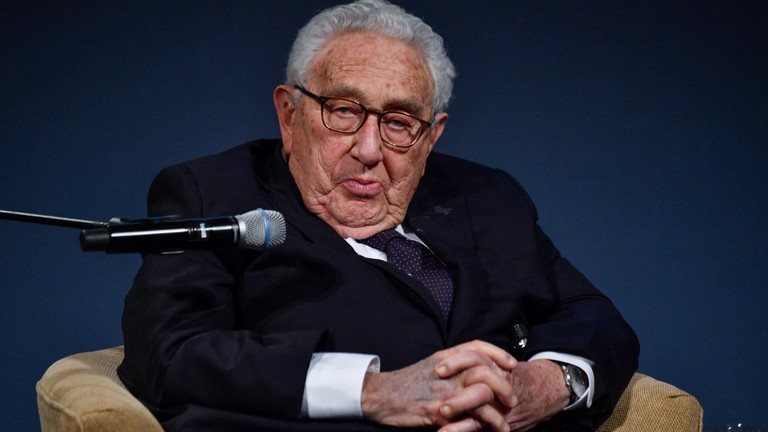
RT | May 19, 2023
China has urged against Ukraine joining NATO, saying it would not improve security in the European region, after veteran US diplomat Henry Kissinger claimed membership would serve the interests of both Kiev and Moscow.
Asked about Kissinger’s comments during a Thursday press briefing, Chinese Foreign Ministry spokesman Wang Wenbin argued that Ukrainian NATO membership would only further inflame tensions.
“Ukraine should not become the frontier in a major power confrontation,” he said, adding that “to strengthen or even expand military groups is not a viable way to ensure the security of a region. One country’s security should not be achieved at the expense of the security of other countries.”
In an interview with the Economist published on Wednesday, Kissinger said European powers were pursuing a “madly dangerous” strategy by keeping Kiev out of the US-led military bloc, insisting Ukraine must not “become a solitary state just looking out for itself.” He claimed NATO membership would not only benefit Ukraine, but Russia as well.
“If I talked to [Russian President Vladimir] Putin, I would tell him that he, too, is safer with Ukraine in NATO,” the 99-year-old added, saying the move would prevent Kiev from making rash “national decisions on territorial claims.”
The Chinese spokesman went on to state that a “durable European security architecture” could only be created through dialogue. During a visit to Ukraine this week, special envoy Li Hui met with Ukrainian President Vladimir Zelensky, Foreign Minister Dmitry Kuleba and other senior officials to discuss Beijing’s views on a diplomatic resolution to the conflict.
Beijing unveiled a 12-point roadmap for peace in February which urged both Moscow and Kiev to resume direct negotiations. President Putin later said the Chinese plan was “in tune” with Russia’s position and hoped the proposal could serve as the basis for a future political settlement.
Western powers have dismissed the 12-point plan, with the European Union’s foreign policy chief Josep Borrell dubbing it “wishful thinking,” while the top advisor to Ukrainian President Vladimir Zelensky argued that it heavily favors Russia.
Direct Turkish-brokered talks between the two sides broke down in the spring of 2022. Since then, President Zelensky has ruled out any direct talks with Russia as long as Putin remains in power, and Moscow has rejected the terms for negotiations put forward by Kiev. Among other things, Ukraine’s proposal calls for Russia to withdraw its forces from all territories within Ukraine’s 1991 borders, to pay reparations, and to submit to war crime tribunals. Moscow has rejected the plan as “unacceptable,” pointing out that it ignores the reality on the ground and merely shows Kiev’s unwillingness to resolve the crisis through talks.
The US Is Receptive To Kissinger’s Suggestion To Revive Talks With China On A New Détente
BY ANDREW KORYBKO | MAY 19, 2023
Two new narratives were introduced into the West’s information ecosystem over the past week. The first concerns the need to adapt to multipolar processes by engaging more with the Global South, which was expressed by German Chancellor Olaf Scholz, former US National Security Council member Fiona Hill, and Goldman Sachs’ President of Global Affairs Jared Cohen all on the exact same day last Monday. The next narrative complemented this one and came two days later on Wednesday.
Global affairs guru Henry Kissinger’s lengthy interview with The Economist from late April was published on that day, in which he devoted considerable time explaining why the US should revive its talks with China on a New Détente that were unexpectedly derailed by February’s balloon incident. CNN then reported on that same day that “Biden administration looking at arranging high-profile visits to China by senior officials,” which suggests that it was briefed earlier about his proposal and heeded his advice.
The first narrative about engaging more with the Global South complements the second one about reviving talks with China on a New Détente in the sense that the former is one of the three prerequisites for successfully accomplishing the latter, at least according to how American policymakers likely view it. They want to signal that the US won’t voluntarily cede influence in the Global South to China, but instead plans to compete with it there via economic and diplomatic means.
This goal will be greatly advanced through a combination of pragmatic engagement with the Global South’s informal Indian leader, whose Prime Minister visits the US late next month, and coordinating between America’s “Build Back Better World” and the EU’s “Global Gateway” development initiatives. These subgoals also align with Kissinger’s suggestions about cooperating more closely with India as well as crafting an inspirational vision for this century (i.e. merging the West’s development initiatives).
The second prerequisite for successfully negotiating a New Détente with China upon the seemingly impending resumption of this process is to diplomatically displace its envisaged role in the Russian-Ukrainian peace process. In pursuit of this, the US wants to “de-Sinify” the scenario of a ceasefire after the end of Kiev’s NATO-backed counteroffensive, which explains its support of the African-led peace mission that was announced on Tuesday in between Monday and Wednesday’s new narratives.
What’s most interesting about this initiative is that it’s organized by the Brazzaville Foundation, whose French chairman Jean-Yves Olivier is known for his shadow diplomacy over the decades that was documented by Wikipedia. This suggests that their peace mission is secretly organized by France with the US’ tacit approval, if not jointly coordinated with it, which would advance their goal of diplomatically engaging with the Global South in parallel with “de-Sinifying” the Russian-Ukrainian peace process.
Both’s prospects would be bolstered by India’s participation in these efforts, which has its own interests in presenting itself to the world as a peace broker, especially throughout the course of its G20 chairmanship. These two prerequisites for enhancing the odds that the US successfully negotiates a New Détente with China concern the economic and diplomatic spheres respectively, while the third that’ll now be described deals with the military one.
“The US Is Rounding Up Allies Ahead Of A Possible War With China”, while “NATO’s Planned Liaison Office In Japan Will Accelerate The Expansion Of AUKUS+”, both of which will contribute to more effectively containing China in the Asia-Pacific. American policymakers apparently expect that the People’s Republic will accept this emerging regional military reality instead of it serving to preclude the resumption of their talks on a New Détente.
Not only that, but they seem to think that it could even give their side an edge of some sort in those negotiations too, or at least enable the US to speak to China “from a position of strength” as they see it. The message would be that this containment noose could tighten even more if Beijing doesn’t agree to resume such talks, not to mention if they fail to achieve anything tangible, thus making it a form of military blackmail when viewed from this perspective.
Altogether, the introduction of this week’s two complementary narratives into the West’s information ecosystem suggest that this de facto New Cold War bloc’s American leader is recalibrating its grand strategy. Policymakers appear to have concluded that their side can’t restore unipolarity, instead settling for managing multipolar processes in the direction of their interests as much as is realistically possible, to which end they must engage more with the Global South and revive talks with China on a New Détente.
The observations shared in this analysis shouldn’t be interpreted as predicting the success of these policies, but simply as arguments that this approach is indeed being attempted and was almost certainly influenced by Kissinger’s suggestions that he shared in his interview. He and The Economist are close to American policymakers so they likely passed his ideas along to relevant figures, after which they agreed with the gist thereof and subsequently began implementing them this week as proven in this piece.
Second largest Swedish party wants Stockholm to prepare for ‘Swexit’
By Drago Bosnic | May 19, 2023
As if the European Union didn’t have enough major problems already, now the troubled bloc is faced with the nontrivial prospect of a “Swexit”. Namely, senior officials of the second largest political party in the Scandinavian country, the Sweden Democrats, are now openly saying that their country needs to be prepared to leave the EU. This includes the party leader himself, Per Jimmie Akesson, who stated that “only by making the necessary preparations for ‘Swexit’ can the government maximize its bargaining power in Brussels”. The right-wing Sweden Democrats have long been frustrated by the power that the unelected bureaucrats in Brussels wield over their country, so this is hardly a surprising development.
However, even Eurosceptic Swedish parties usually refrain from such open anti-EU declarations, meaning that the bloc is gradually losing its power, even in previously somewhat pro-EU member states. On May 15, Akesson authored an article along with his Sweden Democrats fellow member Charlie Weimers, who also represents his party and his country as a Member of the European Parliament (MEP). The op-ed was published by the Stockholm-based Svenska Dagbladet daily, in which the authors explicitly stated that their intention is to ensure Sweden “maximizes its influence” in the EU, specifying several legal measures the country’s government must take to accomplish the stated goals.
First, the Swedish government must insist on making constitutional changes that would make it possible to introduce what Akesson and Weimers called a “referendum lock”. According to the authors’ reasoning, this would enshrine into law the requirement of a nationwide referendum before any further national powers can be renounced by Sweden and transferred to the unelected EU bureaucrats. The goal is to ensure that any further erosion of the Scandinavian country’s sovereignty is prevented if the Swedish people choose not to comply with it. The authors cited the examples of the United Kingdom and Denmark as an inspiration, as both London and Copenhagen previously adopted similar legal mechanisms.
“Only the knowledge that every decision on the transfer of power must be submitted to the citizens would slow down the worst abuses from Brussels,” Akesson and Weimers wrote in the op-ed.
Second, the country’s government must make the necessary preparations to leave the EU, as the troubled bloc should not take Sweden’s national interests for granted. The authors insist that the government must ensure it’s ready in case such a decision is ever made by the Swedish people and to formally legitimize any threat to withdraw from the EU in future negotiations with the troubled bloc. They further added that to accomplish this, Sweden needs to remove the clause that it’s an EU member from its constitution, as well as study the example of the UK during Brexit, while also training civil servants to ensure the process runs without any major issues. As previously mentioned, Akesson and Weimers see this as instrumental for improving the country’s negotiating position.
“In order for preparedness to be credible, it’s necessary that we remove the writings in the constitution that state that Sweden is a member of the EU … In addition, we should train a cadre of civil servants with the expertise to negotiate trade agreements and other things that we have delegated to the EU and study how Brexit could have been implemented better. The better we are prepared to leave, the more we will gain in future negotiations,” the authors added.
Akesson and Weimers believe these are the bare minimum requirements that will provide a solid backstop against any possible power-grab attempts by Brussels. In addition, the leader of the Sweden Democrats also wants an investigation to be launched into how the negative aspects of the Scandinavian country’s membership in the EU can be alleviated. Among other things, this also includes the issue of immigration, a major problem that the Sweden Democrats see as crucial for the country’s future. The right-wing party is the largest member of the country’s governing bloc, providing virtually all of its confidence-and-supply votes in the Riksdag (Swedish Parliament), although the Sweden Democrats are not directly taking part in Prime Minister Ulf Kristersson’s administration.
As per the Tidö Agreement to which all coalition parties agreed, Stockholm is to adopt a more restrictive immigration policy in return for support of the Sweden Democrats, something the more liberal-leftist opposition, informally supported by Brussels, staunchly disagrees with. And while Euroscepticism is still not the view of the majority of the Swedish electorate, it has steadily been growing in recent years, particularly as the disastrous policies supported by the EU have drastically eroded the well-being of the Scandinavian country’s citizens. Although Akesson himself acknowledges the fact that the majority still doesn’t support Sweden’s withdrawal from the EU (which has been the long-standing policy of his party), he certainly wants to capitalize on the growing support it’s been getting.
Drago Bosnic is an independent geopolitical and military analyst.
USA: Increasingly polarized
By Veniamin Popov – New Eastern Outlook – 19.05.2023
The decline of civic life in the US is primarily down to the de-facto absence of the freedom of press. This freedom is only proclaimed in words, but in reality, a single point of view is imposed on everyone. This has furthermore exacerbated the divisions in American society.
The highly acclaimed primetime TV host, Tucker Carlson, who was recently fired, alleged that the American media is prohibited from discussing important topics that affect the future of the United States and the whole world: “The undeniably big topics, the ones that will define our future, get virtually no discussion at all: war, civil liberties, emerging science, demographic change, corporate power, natural resources.”
The reporter has repeatedly criticized the conduct of American officials; for instance, he spoke about the consequences for the United States of the conflict in Ukraine and also affirmed the allegations Russia made regarding the terrorist attack on Nord Stream, claiming “it is the West’s biggest lie.”
Faisal J. Abbas, editor-in-chief of the Saudi newspaper Arab News, emphasized that the biggest threat facing the United States today is polarization – the media has been used by politicians to cultivate their own audiences and create ideology: politicians only think from one election cycle to the next, so they take ideological positions that are not really essential to the daily life of the average American citizen. Issues such as gender identity and abortion are central to public discourse; on the other hand, issues affecting the daily lives of ordinary Americans, such as deteriorating living standards, increasing homelessness, unaffordable rents, and college education, are not being addressed.
Virtually no one talks about the real problems faced by the average American; their attention is focused on secondary issues that benefit politicians. Meanwhile, domestic social, ethnic and racial contradictions in the US are becoming more and more acute. A global financial “storm” in the event of a default on US government debt payments is not out of the question. The US Treasury Secretary spoke about this possibility just recently. A banking crisis also looms on the horizon.
The New York Times in March 2023 published an article about the serious danger of a “national divorce.”
This topic began to be more often raised in the American press in connection with the actual beginning of the presidential campaign of 2024 – as you know, the current President Joe Biden announced it at the end of April.
In response, the Republican Party released their video, created using “AI-generated imagery”: a realistic-looking news summary announcing Biden’s victory in 2024, followed by a long list of hypothetical disasters – Chinese invasion of Taiwan, the collapse of financial markets, immigrants taking over the southern border and the closure of San Francisco due to escalating crime.
One American newspaper called the conflict between Biden and Trump not so much a confrontation between Democrats and Republicans as a confrontation of essentially moral and immoral worldviews, a rivalry between decency and its opposite.
Much has been said in this regard about how the unregulated deployment of artificial intelligence can create social chaos – people wonder what will happen when a non-human intelligence becomes better than the average person at telling stories, composing melodies, drawing pictures, writing laws, scriptures. And yet all this can be used to propagate fake news and form new cults.
At the same time, the Democratic Party does not hide the fact that they see the danger of the current moment in the likelihood of Trump becoming a nominee in the 2024 elections – and all means are good here.
Driven by immediate interests, they are organizing a lawsuit against the former president, trying not only to discredit him, but also to block his way to participate in the upcoming elections. The fact that the former president of the United States is about to be indicted in a criminal court sets a dangerous precedent – there is no guarantee that another American president won’t also be arrested after leaving his official office.
Republicans, for their part, are intensifying investigations into Hunter Biden, the President’s son: he is being charged with providing false information when purchasing weapons, withholding treatment for drug addiction. Tax evasion in transactions abroad became the main point of the charges, with Republicans wanting to go after Biden’s entire family as well.
In this regard, the well-known columnist Nicholas Christophe mentions a bunch of closely intertwined problems that hold the country back: childhood trauma, drug addiction, mental health problems, homelessness, loneliness, family breakdown, unemployment. More than a quarter of a million Americans die each year from drugs, alcohol and suicide.
“To alleviate our chronic pain,” Christoph writes, “we must do a better job of healing deeper wounds in our economy and society.”
In this regard, it is not surprising that an Arab newspaper compared the situation in America to the current civil strife in Israel, where society is divided into roughly the same two halves. The same newspaper also spoke about the possibility of an openly fascist regime in Israel.
The famous American philosopher Noam Chomsky said in an interview with Al Jazeera on 09.04.23: “The United States is increasingly collapsing like Israel.”
According to a recent poll, more than 50% of Americans now expect a new civil war “in the next couple of years,” with several predictions about the end of America.
In one, in the event that Trump, or any other Republican, occupies the White House, Californians take serious steps toward secession from the United States.
The other scenario, which is being seriously discussed, says that if the Democratic Party wins, including a second term for Biden, the reds, i.e., Republican states, begin a movement for independence.
Meanwhile, a December 12, 2022 article on the Saudi Arabian television station Al Arabiya’s website, as if to summarize the many musings of American political scientists, argues under the title “How America Will Divorce Itself” that a divorce agreement could take the following form: California, parts of Oregon, Washington and Nevada agree to become the new federal system.
But the greatest threat to America’s very existence is the widening gap between the rich and the poor. Bloomberg, reviewing the book “The Triumph of Injustice: How the Rich Dodge Taxes and How to Make Them Pay” by Gabriel Zucman and Emmanuel Saez on May 7, noted that the widening gap between the rich and the poor could lead to a revolution.
Veniamin Popov is Director of the Center for the Partnership of Civilizations at the Moscow State Institute of International Relations (MGIMO) of the Russian Ministry of Foreign Affairs, Candidate of Historical Sciences.
The Auto Industry In Jonestown
By Francis Menton | Manhattan Contrarian | May 5, 2023
The notorious events in Jonestown took place so long ago that most readers probably don’t have personal memory of them. In November 1978, in the jungles of Guyana, under the powerful spell of a religious cult with a charismatic leader, and of an all-embracing groupthink, some 900 people somehow agreed to participate in a mass suicide. It was a shocking instance of the kind of collective insanity to which humans can be susceptible.
You might think that the Jonestown massacre was a uniquely extreme example of such a mass psychosis, perhaps attributable largely to unusually susceptible subjects or to the isolated location. Surely our best and brightest leaders of government and business would never fall prey to such collective craziness.
If you think that, then perhaps you should look at what is currently going on in the automotive sector of the economy, under the spell of the climate cult and of government functionaries demanding fealty to anti-carbon doctrines.
On April 12, 2023 the EPA released its most recent proposed regulation of automobile emissions. The document is titled “Multi-Pollutant Emissions Standards for Model Years 2027 and Later Light- Duty and Medium-Duty Vehicles.” It is 262 pages long in the standard Federal Register single-spaced three-column format, thus designed to be virtually impossible to read for anyone who is not getting paid to do it. But the heart of the proposed new rule is that, over a period of a few years, it is to become difficult-to-impossible for automobile manufacturers to continue to sell any significant number of internal combustion engine vehicles. Of course EPA never states that explicitly, and makes the game as difficult as possible for any layman to decipher. But try this language from page 29,196 (12 pages into the document and still in the early part of the Executive Summary):
GHG Emissions Standards. . . . The proposed standards are projected to result in an industry-wide average target for the light-duty fleet of 82 grams/mile (g/mile) of CO2 in MY 2032, representing a 56 percent reduction in projected fleet average GHG emissions target levels from the existing MY 2026 standards.
As I understand it, no internal-combustion car can meet this 82 g/mile CO2 emission standard on its own, so the standard effectively means that a manufacturer can only sell IC cars if it can also make and sell enough “zero-emission” cars to get an average down to this level. Thus does EPA deviously announce its intention to force manufacturers to make, and consumers to buy, all or almost all electric vehicles.
Now, at this point this is only a proposed rule. Currently, despite wide availability of electric vehicles, they have only about a 7% market share in the U.S. They also have many disadvantages as against combustion vehicles, including higher price, difficulty to repair when damaged, poor resale value, limited range, long time to recharge, and so forth. And all those are before you get to the most important problem with EVs, which is that the government geniuses are simultaneously working to destroy the electrical grid that is supposed to be the source of the energy for these things.
Might you think that the auto makers would be pushing back on behalf of themselves and their customers to keep combustion vehicles available? You would be wrong. From all appearances, the manufacturers are falling all over themselves to get on the electric car bandwagon. The EPA document itself contains a long list of industry announcements (from page 12,190 – 12,191):
A proliferation of announcements by automakers in the past two years signals a rapidly growing shift in product development focus among automakers away from internal-combustion technologies and toward electrification. For example, in January 2021, General Motors announced plans to become carbon neutral by 2040, including an effort to shift its light-duty vehicles entirely to zero-emissions by 2035. In March 2021, Volvo announced plans to make only electric cars by 2030, and Volkswagen announced that it expects half of its U.S. sales will be all-electric by 2030. In April 2021, Honda announced a full electrification plan to take effect by 2040, with 40 percent of North American sales expected to be fully electric or fuel cell vehicles by 2030, 80 percent by 2035 and 100 percent by 2040. In May 2021, Ford announced that they expect 40 percent of their global sales will be all-electric by 2030. In June 2021, Fiat announced a move to all electric vehicles by 2030, and in July 2021 its parent corporation Stellantis announced an intensified focus on electrification across all of its brands. Also in July 2021, Mercedes-Benz announced that all of its new architectures would be electric-only from 2025, with plans to become ready to go all-electric by 2030 where possible.
But as with the transformation of the electrical grid — where we forge ahead without ever having gotten a demonstration of feasibility or cost — the automakers are also forging ahead en masse into EVs with no demonstration that electric cars can become a successful mass product that fulfills all the functions that IC cars can fulfill. Tesla seems recently to have turned the corner into profitability, but with an expensive niche product that only the wealthy can afford and which is almost always a second (or third or fourth) car.
How is it going with other manufacturers? The Wall Street Journal had an editorial on May 3 summarizing the results so far for a collection of EV startups. There’s Lordstown:
Lordstown had manufactured only 31 vehicles by late February 2023—most of which had to be recalled. Losing patience, Foxconn on April 21 threatened to withdraw its investment, triggering Lordstown’s bankruptcy warning.
And Rivian:
Rivian commanded a $153.3 billion market capitalization. Now it’s worth less than $12 billion.
The WSJ summarizes stock trends of other EV startups:
[O]ther EV startups have crashed from their pandemic highs, including Canoo (down 96%), Nikola (99%), Faraday Future Intelligent Electric (99%), Rivian (90%), Lucid (87%) and Fisker(81%).
How about at the big traditional manufacturers. Robert Bryce at his Substack on May 3 collects some recent information as to Ford:
In March, Ford Motor Company announced that it lost $2.1 billion on its EV business last year. Those losses were double the losses it had on EVs in 2021. As I noted in a video I posted on TikTok on March 23, Ford made 61,575 EVs in 2022. Thus, the company lost about $34,000 on every EV it sold last year. I also noted that the costs of making EVs aren’t falling. Last year, the cost of battery packs for EVs went up by 7%. . . . Indeed, it appears Ford’s 2022 losses were only a warm-up lap. Yesterday afternoon, Ford reported a $722 million loss on its EV business over the first three months of 2023. During that span, Ford sold 10,866 EVs, meaning it lost $66,446 on every EV it sold.
Bryce goes on to quote a JD Power report from May 1:
“[M]any new vehicle shoppers are becoming more adamant about their decision to not consider an EV for their next purchase.”
When I last had a post on EVs (February 23), several commenters expressed the opinion that they thought the manufacturers could overcome all the manufacturing problems (cost, battery capacity, charging, etc.) and thus EVs would shortly become the superior product in the marketplace. I suppose that is possible, although if central planning turns out to work in this instance it will be the first time ever anywhere. And further, there is nothing the manufacturers can do to make a country of 200 million or so EVs work when all the reliable generation on the electrical grid has been removed, and home heat has also been electrified. The auto manufacturers seem to be only too willing to go along with a collective suicide, a la Jonestown.
The climate scaremongers: How to lose a lot of money – buy an electric car
By Paul Homewood | TCW Defending Freedom | May 19, 2023
New analysis shows that electric cars (EVs) are depreciating at twice the rate of petrol cars. According to the Express :
‘EVs on average will lose 51 per cent of their purchase value from 2020 to 2023, compared with just 37 per cent for petrol vehicles. This equates to a massive £15,220 loss for electric car owners, with petrol drivers seeing a decrease of £9,901.
‘The data, from ChooseMyCar.com, used a comparison of new car prices three years ago compared with their value now.
‘The higher the original purchase price of the car, the bigger the loss, with the Tesla Model S losing £25,000 in value in just three years – a 46 per cent drop. However, entry-level EVs like the Nissan Leaf are also losing a massive amount of value in such a short space of time. The Leaf’s value dropped by £13,000 – or 58 per cent – despite being one of the most popular small EVs on the market.’
There are three factors in play here. Firstly the battery life for an EV, typically around 100,000 miles, means that the car is virtually worthless once it gets to around 80,000 miles. Nobody is going to pay thousands for a car which will end up in the scrapyard a year or so later. This depreciation works its way up the chain. For instance, if you buy a petrol car with 50,000 miles on the clock, you expect to still get a reasonable trade-in three years later.
Secondly, whilst new EVs are attractive for companies and green virtue signallers thanks to government subsidies, there is very little demand for them amongst the public at large. People buy second-hand cars for a very good reason – they cannot afford new models. Consequently they cannot afford to pay a surcharge for a second-hand EV, even if they want one.
Thirdly, increasing numbers of EVs are appearing on the second-hand market, reflecting the surge in new sales in recent years. As demand has not increased, this is also forcing the price down.
The prospect of losing so much money in depreciation will inevitably make drivers think twice before buying a new one.
Meanwhile a US study has found that EVs may not reduce emissions of carbon dioxide as much as thought – indeed they may even increase emissions. According to the report:
‘the relevant and surprising emissions wildcard comes from the gargantuan, energy-hungry processes needed to make EV batteries. To match the energy stored in one pound of oil requires 15 pounds of lithium battery, which in turn entails digging up about 7,000 pounds of rock and dirt to get the minerals needed – lithium, graphite, copper, nickel, aluminum, zinc, neodymium, manganese and so on. Thus, fabricating a typical single half-ton EV battery requires mining and processing about 250 tons of materials.’
The fact that much of this mining and processing takes place in China, where energy is nearly all derived from fossil fuels, makes the carbon footprint even larger. Other studies have suggested that an EV will break even at about 60,000 miles as far as emissions are concerned. This new study implies that the situation is probably worse.
And as some of us have been warning for years, the UK and EU rush to phase out petrol/diesel cars is beginning to cause real harm to the European car industry. Whereas Europe has long had an unassailable technological lead over China in car manufacturing, EVs have introduced a level playing field which China is now exploiting through its lower energy and labour costs, along with its near–monopoly of the battery market.
As a consequence, Chinese EVs are flooding the German market. Official statistics have revealed that 28.2 per cent of the electric vehicles imported into the country during the January-March period originated from China. This figure demonstrates a substantial rise from the 7.8 per cent recorded over the same period in 2022, highlighting China’s expanding influence in the global adoption of EVs. If this was not bad enough, the data also reveals a decline of 23.9 per cent in German exports of new vehicles to China compared with the same quarter of the previous year.
Unsurprisingly, then, a major study by Allianz Trade, part of the European insurance giant, says that China’s growing share of the EV market in its home market and the EU will see the European car industry shrink by €24billion a year and associated supply chain industries shrink by an additional €21billion.
It is not only Chinese inroads into Europe which are in play here; another nail in the European motor car industry’s coffin is the fact that the enforced switch to EVs will force millions out of their cars completely, because they are simply not fit for purpose for many drivers.
Indeed it is becoming increasingly clear, with ULEZ zones, 15-minute cities and so on, that the real objective of European governments, including our own, is drastically to reduce the numbers of cars on the road, cut the mileage driven and force us all on to buses, bikes and Shanks’s pony.
They do not seem to care that they will destroy a major industry and millions of jobs as a direct consequence. – Full article
Autopsy of Fatal Delta Variant in a Fully Vaccinated Man
Findings Suggest Complete Failure of Pfizer-BioNTech COVID-19 Vaccine Induced Antibodies
By Peter A. McCullough, MD, MPH | Courageous Discourse | May 18, 2023
Autopsies have played a critical role in the history of medicine. The novel coronavirus pandemic is a period of time where autopsies have been particularly helpful in advancing our understanding of COVID-19 disease. So the question on the table is: if the mRNA COVID-19 vaccines raised antibodies against the ancestral wild type Wuhan strain of SARS-CoV-2, would they cover the Delta variant? The only real way to know is to find a case who is fully vaccinated with “protective” antibodies in the bloodstream who contracts COVID-19. Recently such a patient has been reported from Catania, Italy.
Esposito, et al, published an autopsy of an 83 year old man who was admitted to the hospital with heart failure and was later diagnosed with acute COVID-19 and succumbed 18 days later. There is no mention of treatment with lifesaving medications in the McCullough protocol such as ivermectin, corticosteroids, or anticoagulants. Sadly his lungs were ravaged with SARS-CoV-2 despite having adequate antibody titers for the Spike protein generated from the Pfizer-BioNTech COVID-19 Vaccine.

Esposito, M.; Cocimano, G.; Vanaria, F.; Sessa, F.; Salerno, M. Death from COVID-19 in a Fully Vaccinated Subject: A Complete Autopsy Report. Vaccines 2023, 11, 142. https://doi.org/10.3390/vaccines11010142
The important points of this paper are: 1) the original Pfizer-BioNTech COVID-19 Vaccine failed to stop the Delta variant, 2) antibodies are an invalid surrogate of protection and should have never been used 8 times by the US FDA in EUA approvals for extended use of COVID-19 vaccines.
Biden’s New NIH Head Solidify’s America’s Breakaway Health Agency Crisis
By Jefferey Jaxen | May 18, 2023
American health agencies are in a crisis of their own making. The pandemic response has both amplified and spotlighted the classic shortcomings and limitations of agencies like the U.S. Food and Drug Administration (FDA), the Centers for Disease Control and Prevention (CDC), and the National Institutes of Health (NIH).
News this week reports Biden has chosen Dr. Monica Bertagnolli, formerly National Cancer Institute Director, to lead the NIH. Bertagnolli fills the absence left by Dr. Francis Collins.
In a post-Covid world, much of the public-facing legacy of agency directors is written by their actions during the failed pandemic response. History will show it as a doomed era where no leadership escaped without tarnished careers from their unified actions to viciously mandate Covid shots, mask kids, keep schools closed and lockdown society causing irreparable harm to the American economy – all without the science to back up their decisions.
Former NIH head Collins will be forever known as the man who shut down scientific debate at a time when open dialogue about the already known, published research could have saved lives, the economy, and the mental health of our current population. Purposely ignored warnings, which came in the form of the Great Barrington Declaration, that internal emails show Collins and Fauci colluded to publish a ‘devastating takedown’ of its premise using the full weight of their agencies and media power.
Dr. Bertagnolli’s deep funding by Pfizer, and to a lesser extent from Johnson & Johnson subsidiary Janssen, is chronicled by The Daily Signal :
From 2015 through 2021, Bertagnolli received more than 116 grants from Pfizer, totaling $290.8 million. This amount made up 89% of all her research grants, according to Open Payments, a national transparency program under the Center for Medicare & Medicaid Services that collects and publishes information about financial relationships between drug and medical device companies and certain health care providers.
Her extensive background in cancer research and ties to Pfizer and other pharma companies raises questions about the timing of her placement at the head of NIH, the largest single public funder of biomedical and behavioral research in the world at more than $40 billion.
The Covid vaccine gold rush has come to an end for companies like Pfizer and Moderna. A brief look at headlines tells of the next profit push on the horizon being mRNA cancer vaccine therapies.

Meanwhile, an epidemic surge of cancers of unknown causes is also grabbing headlines.

Bertagnolli appears well-positioned to streamline an injectable pharmaceutical ‘answer’ to a growing cancer question while obscuring further investigation into its root cause(s).
Meanwhile, Walensky’s abrupt departure from a badly damaged CDC has public trust in the agency racing for the doors at breakaway speeds.
The FDA has done no better. After Trump’s director, Stehpan Hahn stepped down as the administration changed hands, Biden kept the agency without a presidential nomination for commissioner for the maximum time allowed by law – nearly one year.
In that time, the FDA pushed through emergency use authorizations for J&J’s Covid shot, expanded Pfizer’s EUA to 12-15 yr-olds and 5-11 yr-old, added EUA booster doses and mishandled massive warnings about increases in myocarditis, Guillain-Barre syndrome and thrombocytopenia after Covid shots. The agency’s authoritarian booster push also saw infighting due to a lack of data to inform the decision culminating in two of the FDA’s top, longtime vaccine regulators [Kruse & Gruber] departing in disgust.
A recent BMJ article titled The decline of science at the FDA has become unmanageable states, … the corruption of the FDA’s scientific culture remains the primary culprit driving the deterioration of safety and effectiveness standards.”
By all measures, America’s health agencies are in rapid decline as a litany of historical issues like Big Pharma’s revolving door influence, an outward mission-directed posture of mandates and censorship, a continued doubling down on bad policy, and an imbalance focusing on liability-free injectable products as the answer has left American marooned.
The path forward for American health, suffering in many categories, has challenges ahead. Yet the many failures and outright censorship of the medical and research communities during the failed pandemic response have created a new space being rapidly populated by medical professionals, experts, and citizen journalists who see the value and desperate need to investigate and report on reality, expose bad science and maximize open debate surrounding key health issues. It is the best of times and it is the worst of times.
What If AI Is Only a Cost and Not a Profit Bonanza?
In the real-world, the costs are all we know for sure and profits remain elusive and contingent.
BY CHARLES HUGH SMITH | OF TWO MINDS | MAY 15, 2023
No one knows how the flood of AI products will play out, but we do know it’s unleashed a corporate frenzy to “get our own AI up and running.” Corporate fads are one of the least discussed but most obvious dynamics in the economy. Corporations follow fads as avidly as any other heedless consumer, rushing headlong into whatever everyone else is doing.
Globalization is a recent example. Back in the early 2000s, I sat next to corporate employees on flights to China and other Asian destinations who described the travails and costly disasters created by their employers’ mad rush to move production overseas: quality control cratered, proprietary technologies were stolen and quickly copied, costs soared rather than declined, and so on.
So let’s talk about costs of AI rather than just the benefits. Like many other heavily-hyped technologies, Large Language Model (LLM) AI is presented as stand-alone and “free.” But it’s actually not stand-alone or free: it requires an army of humans toiling away to make it functional: “We Are Grunt Workers”: The Lowly Humans Helping Run ChatGPT Make Just $15 Per Hour (Zero Hedge ).
“We are grunt workers, but there would be no AI language systems without it. You can design all the neural networks you want, you can get all the researchers involved you want, but without labelers, you have no ChatGPT. You have nothing.”
The tasks performed by this hidden army of human workers is euphemistically sanitized by corporate-speak as data enrichment work.
Then there’s the stupendous costs of all the extra computing power needed to deliver AI to the masses: For tech giants, AI like Bing and Bard poses billion-dollar search problem
What makes this form of AI pricier than conventional search is the computing power involved. Such AI depends on billions of dollars of chips, a cost that has to be spread out over their useful life of several years, analysts said. Electricity likewise adds costs and pressure to companies with carbon-footprint goals.
Corporations are counting on the magic of the Waste Is Growth / Landfill Economy to generate higher margins from whatever AI touches — don’t ask, it’s magic — but few ask how all this magic will work in a global recession where consumers will have less income and credit to buy, buy, buy.
LLM-AI is riddled with errors, and nobody can tell what’s semi-accurate, what’s misleading and what’s flat-out wrong. Despite wildly optimistic claims, locating the errors and semi-accuracies can’t be fully automated. Errors are inconsequential in an AI-generated book report, but when patients’ health is on the line, they become very consequential: I’m an ER doctor: Here’s what I found when I asked ChatGPT to diagnose my patients.
This raises fundamental questions about precisely how much work LLM-AI can perform without human oversight, and the all-too breezy claims that tens of millions of jobs will be lost as this iteration of AI automates vast swaths of human labor.
AI excels at echo-chamber reinforcement of risky or error-prone suppositions and policies: Spirals of Delusion: How AI Distorts Decision-Making and Makes Dictators More Dangerous. What’s the threshold for concern that the AI conclusions are riskier than presented? How do we calculate the possibilities that the AI conclusions are catastrophically misguided?
At what point will decision-makers realize that trusting AI is not worth the risk? If history is any guide, that realization will only arise from financial losses and bad decisions. For the rest of us, it might just be the novelty wears off as the inadequacies pile up: Noam Chomsky: The False Promise of ChatGPT.
Since all this LLM-AI is “free,” what AI-created goods and services will generate hundreds of billions of dollars in new revenues and tens of billions in new profits? The general answer is the profits will flow from firing millions of costly humans and replacing them with “nearly free” AI software.
But since all your competitors are rushing down the same frenzied path to AI, what competitive advantage will accrue to what is already a commodity (LLM-AI)? Nobody asks such questions because the euphoria of tech revolutions is so much fun.
The enthusiasm unleashed by new technologies is selectively euphoric: the benefits will prove immeasurable and the costs will soon be near-zero. But in the real-world, the costs are all we know for sure and profits remain elusive and contingent.
Exactly what gets wiped out by the meteor strike is not yet known.
Featured Video

Seyed M. Marandi: U.S. Military DIVIDED? Iran’s Secret Defense EXPOSED
or go to
Aletho News Archives – Video-Images
From the Archives
‘Israel sees Iran as obstacle to its policies’

Press TV – August 25, 2017
Prime Minister Benjamin Netanyahu has said that Israel felt threatened by Iran’s growing influence in the Middle East. Netanyahu expressed his Iranophobic view in a meeting with Russian President Vladimir Putin in Russia’s Black Sea resort of Sochi on Wednesday. Press TV has asked Scott Rickard, former American intelligence linguist from Tampa, Florida, and Brent Budowsky, a columnist at The Hill from Washington, to give their thoughts on the issue.
Rickard said Tel Aviv is concerned about the fact that the regime could not carry out its old project to spread sectarian divisions and pave the way for dismemberment of the countries in the Middle East region because of the Iranian-led resistance against Israeli policies, not only in the occupied territories of Palestine but also in the whole region.
“Iran is not a threat to Israel whatsoever. The threat that Israel sees is the fact that their Oded Yinon Plan is being put to a hold by Iran,” the intelligence linguist said on Thursday night.
“They (the Israelis) look at Iran as a threat only because they have no influence on their governments and Iran is autonomous and is not under the Zionist influence,” he added.
Since the victory of the Islamic Republic of Iran in 1979, Tehran has been critical of Israel’s policies in the region, whereas “no leaders [of other states] even dared to speak out against Zionism,” Rickard argued. … continue
Blog Roll
 Aletho News
- Sri Lanka secures supplies of Russia oil – minister
- Nations across Asia strike direct deals with Iran for Hormuz passage
- IRGC commander declares ‘new phase’ of reprisal attacks against aggressors
- Israel’s air defenses overwhelmed by cluster-warhead Iranian missiles: Reports
- Striking Iran’s Infrastructure Would Have Little Military Impact – Report
- What’s Behind U.S./Israeli Strikes On Iranian Pistachio Factories?
- Seyed M. Marandi: U.S. Military DIVIDED? Iran’s Secret Defense EXPOSED
- How I fell foul of the BBC thought police
- The End of NATO
- 37 days of war on Iran cost US staggering $42bln, tracker shows
- If Americans Knew
- Trump says Iranians appreciate bombs, WHO warns of nuclear risks – Daily Update
- U.N. experts demand Israel release prominent Gaza doctor after reports of ‘severe torture’
- Israel’s Latest Genocide Is Against the Shias of Lebanon. Why Is the World Silent?
- How Eliot Cohen’s influence over U.S. war-making paved the way for Trump’s war crimes in Iran
- Israelis don’t pay for the weapons we ‘sell’ to them — US taxpayers do
- While Distancing from AIPAC, Most 2028 Democratic Hopefuls Are Still Embracing Israel
- A brief history of the Israeli nuclear program, the open secret at the heart of the Iran war
- Israeli Settlers Killed a Palestinian Farmer on His Own Land, in Front of His Father. Yes, Again
- The US-Israeli War on Science is an Assault on our Future
- 100+ International Law Experts Say US Strikes on Iran Violate UN Charter, Could Be War Crimes
- No Tricks Zone
- An Inconvenient Tree: Uncovered In Alps… Europe Much Warmer Than Today 6000 Years Ago
- New Study Reports A 60% Slowdown In Greenland’s Ice Loss Rate In The Last Decade
- Low Intensity Tornado Wrecks Major Solar Farm, Creating A Potential Toxic Dump
- New Study Finds Warming Saves Lives…Cold Temperatures 12 Times More Deadly Than Excess Heat
- German Science Blog Accuses PIK Climate Institute Of Hallucinating Climate Tipping Points
- Devastating Assessment Of Comirnaty Vaccine By Former Senior Pfizer Europe Toxicologist
- New Study: CO2 Is ‘Effectively Negligible’ As An Explanatory Climate Change Factor Since 2000
- Former Pfizer Toxicologist Dr. Helmut Sterz Tells Bundestag Hearing Pfizer Vaccine Should Have Never Been Approved
- Energy Expert: Germany’s Nuclear Phaseout Was A “500 Billion Euro Mistake”
- New Research: South Australia’s Mid-Holocene Sea Surface Temperatures Were 4°C Warmer Than Today
 Aletho News