A new cholesterol drug for ‘statin intolerant’ people
But what is the evidence?
By Maryanne Demasi, PhD and Robert DuBroff, MD (Cardiologist, New Mexico) | June 5, 2023
For years, researchers have tried to convince patients that statins don’t cause muscle aches and pains. They’d say that people in trials who took statins experienced muscle aches at the same rate as people on placebo, and that if they did experience muscle pain, it was “rare.”

But now, researchers have had a change of heart. Statins do cause muscle aches in about 20% of people, a problem known as ‘statin intolerance.’ Why the change of heart?
Well, there’s a new drug for people with statin intolerance, one that lowers cholesterol like a statin, but without the muscle aches.
The drug is called bempedoic acid. It acts on the same cholesterol biosynthesis pathway as statins and reduces the amount of cholesterol made by the liver.
The drug is being touted as “revolutionary.” Recently, Stephen Nicholls, cardiologist, and co-investigator on a major trial of the drug said:
“This drug provides another option for lowering cholesterol and is particularly important for patients that cannot tolerate statins. That’s a real problem in clinical practice which limits our ability to effectively lower cholesterol in many patients.’’
Bempedoic acid on trial
Almost 14,000 participants across 32 countries took part in a clinical trial of bempedoic acid and the study was published in the New England Journal of Medicine.
All the trial participants had statin intolerance — half were given placebo and the other half were given 180 mg bempedoic acid daily, and followed for a median duration of 3.3 years.
The drug lowered LDL-cholesterol by about 20%, as well as a marker of inflammation called C-Reactive Protein (CRP) – but did that translate into less major cardiovascular events?
The primary outcome analysed was a composite of four outcomes: heart attack, stroke, revascularisation, and cardiovascular death.
After taking bempedoic acid daily for an average of 3.3 years, the relative risk reduction of the composite outcome was 13% and the absolute risk reduction was 1.6%.
However, in terms of individual categories within the composite endpoint, bempedoic acid had no significant effect on fatal or non- fatal stroke, death from cardiovascular causes, and death from any cause.
The small risk reduction of a cardiovascular event (1.6%) must be weighed up against the increased risk of gout (1%), gall stones (1%) and other drug interactions.
Is the push to lower cholesterol futile?
In 1996, Nobel laureates Brown and Goldstein wrote an editorial in Science titled, “Heart attacks: gone with the century?”
The authors surmised that “proof of the cholesterol hypothesis, discovery of effective drugs, and better definition of genetic susceptibility factors – may well end coronary disease as a major public health problem early in the next century”.
But over a quarter of a century later, drugs to lower cholesterol have made virtually no impact on ending heart disease.
As we published in the journal, Preventative Medicine, over the past 10 years cholesterol levels have been falling, while the number of Americans dying of heart disease has been steadily climbing.
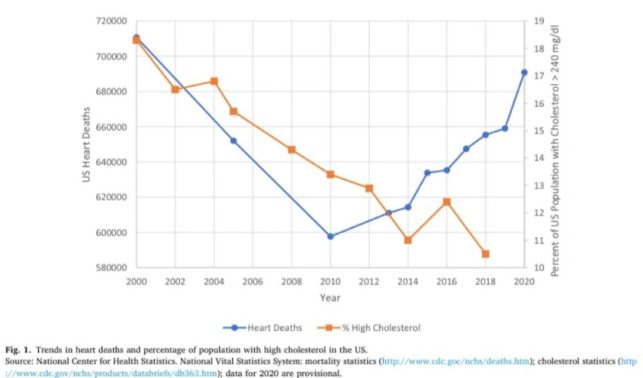
If high cholesterol was “causal” in heart disease, as the prescribing guidelines suggest, then we’d expect to see an opposite trend.
Our most recent meta-analysis of 21 statin trials was unable to find a consistent relationship between lowering LDL-cholesterol and death, heart attack or stroke, following statin therapy.
And despite the widespread use of cholesterol-lowering statins in Europe, observational studies indicate that there has been no accompanying decline in coronary heart disease deaths.
A review of 29 major randomised controlled trials of cholesterol reduction published between 2004 and 2018, found that only two reported a mortality benefit while nearly two-thirds reported no cardiovascular benefit at all.
Further, other types of cholesterol lowering medications like niacin, fibrates and cholesteryl ester transfer protein (CETP) inhibitors, which do ‘everything right’ by lowering LDL, raising HDL (the good cholesterol) and reducing triglycerides, have failed to save lives or reduce cardiovascular events in randomised clinical trials.
This should underscore the limitation of targeting LDL-cholesterol, a surrogate marker. By concentrating almost exclusively on lowering cholesterol, we have diverted our attention from more important drivers of atherosclerosis like metabolic syndrome and insulin resistance.
The simplicity of just taking a statin pill has also fuelled patients’ complacency about being ‘protected’ from heart disease, at the expense of engaging in more protective lifestyle interventions like regular exercise and eating a nutritionally complete diet.
In the field of science, the accumulation of contradictory evidence should lead to a rejection or modification of the prevailing hypothesis – yet the cholesterol hypothesis lives on.
It leads us to the inescapable conclusion that cholesterol-lowering medications are not the miracle drugs we had hoped for.
*NB: Bempedoic acid (oral pill 180mg) has been approved in the US, Canada, UK, and Europe – but not in Australia (possibly in 2yrs).
Bempedoic acid may also be prescribed in combination with another non-statin drug called ezetimibe for additional LDL-C lowering.
No comments yet.
Featured Video

More Iran War fallout: Maritime insurance industry shifts from London to China
or go to
Aletho News Archives – Video-Images
From the Archives
The Biggest Threat to Peace in Middle East
By Dr. Elias Akleh* | Sabbah Report | May 24, 2010
A build up of heightened tension in the Middle East is escalating in the last few weeks. American and Israeli postures towards Lebanon, Syria, and Iran have become more threatening. Listening to speeches of political leaders one hears talks only about war not peace. Iranians and Israelis are continuously training hard for a possible showdown. Both sides are conducting extensive war games every month. This led Syrians to claim that Israel is preparing for a soon-to-come another war. The Jordanians also are warning that current stalemate of the peace process is an indication of a war breaking out this summer. The Russian President and his army chief hinted, a few months ago, that the US and Israel were planning for an attack on Iran.
Indeed Iran is, as it has been for last few years, the target of most of the threats and accusations of supporting terrorism. Escalating incitement against Iran the American Defense Department sent last month (April) to Congress a report on Iran’s military claiming Iran could develop intercontinental ballistic missiles capable of reaching the US by 2015.
Ignoring the fact that N. Korea, India, Pakistan, and Israel are proven to have nuclear weapons while Iran does not, the US Secretary of State Hillary Clinton chose in her speech, to the nuclear Non-Proliferation Treaty review conference at the UN, to focus on Iran’s alleged nuclear ambitions putting the whole world at risk as she put it. According to Clinton Iran’s acquisition of nuclear weapons, rather than Israel’s more than 200 nuclear bombs, is destabilizing the Middle East. She called on the world’s nations to rally around US efforts to hold Iran, not other nuclear countries, to account.
The accusation that Usama Bin Laden is living comfortably in Iran had received a boost after the broadcast of a documentary called “Feathered Cocaine”. This echoed the June 2003 claims of the Italian newspaper Corre de la Sierra that Bin Laden was in Iran according to some intelligence report, and according to Richard Miniter’s book “Shadow War”. … continue
Blog Roll
 Aletho News
- The coming military and psychological unravelling?
- Iran has the last laugh
- More Iran War fallout: Maritime insurance industry shifts from London to China
- US-Israeli aggression on Iran triggers review of GCC countries’ investment pledges to Washington
- Russia slams UK plan to seize tankers suspected of carrying its oil
- Pakistan ramps up food exports to Persian Gulf nations as war deepens food insecurity
- Iran submits response to US plan, sets terms for war’s end: Tasnim
- US vs Iran: Kharg Island Talk — Bluff or Escalation? Ex-Military Officer Weighs In
- Zelensky unnecessarily involves Ukraine in the Middle East crisis
- Turkish tanker blacklisted by Ukraine hit in drone attack – media
- If Americans Knew
- ‘No Innocent Children’: Far-right Israeli Lawmaker Defends Killing of Palestinian Family
- Mossad’s promises helped Netanyahu convince Trump that Iran could be toppled
- US Arms Control Official Refuses To Comment When Asked If Israel Has Nuclear Weapons
- Veterans warn US landing could be ‘more Gallipoli than Vietnam’
- Israel may be committing war crimes in Lebanon – Not a ceasefire Day 167
- In the West Bank, life is a constant battle – 3 articles
- Jacob Reses, one of the most powerful pro-Israel operatives in Trump’s Washington
- Israeli-US assaults kill or injure 87 children a day – Not a ceasefire Day 166
- ‘Forever live by the sword’: Understanding Israelis’ massive support for Iran war
- UN’s special rapporteur on human rights says Israel is systematically torturing Palestinians
- No Tricks Zone
- Devastating Assessment Of Comirnaty Vaccine By Former Senior Pfizer Europe Toxicologist
- New Study: CO2 Is ‘Effectively Negligible’ As An Explanatory Climate Change Factor Since 2000
- Former Pfizer Toxicologist Dr. Helmut Sterz Tells Bundestag Hearing Pfizer Vaccine Should Have Never Been Approved
- Energy Expert: Germany’s Nuclear Phaseout Was A “500 Billion Euro Mistake”
- New Research: South Australia’s Mid-Holocene Sea Surface Temperatures Were 4°C Warmer Than Today
- Storing Green Energy To Last Germany 10 Days Would Require A 60-Million Tonne Battery
- New Studies: UK Sea Levels Were 4 Meters Higher Than Today During The Mid-Holocene
- Destructive Green New Deal: German Energy And Metal Group Warns Of Drastic Crisis
- New Study Documents A 20-Year Pause In Arctic Sea Ice Decline – Driven By Internal Variability
- Wake-up Call: Survey Shows Majority Of Germans Now Favor Postponing Climate Targets!
 Aletho News
Leave a comment