Lethal Drones at the U.S.-Mexico Border?
By Laurie Calhoun | The Libertarian Institute | June 27, 2023
Fentanyl has caused many overdose deaths in recent years, and much of it has entered the United States through Mexico. A number of politicians have thrown their support behind a proposal to officially label narcotics traffickers based in Mexico as “terrorists.” Not all of the Republican lawmakers who support this idea have openly embraced the use of lethal drones to eliminate such persons, but that would be the inevitable policy implication of such labeling, given the wording of anti-terrorist legislation. At least one presidential candidate, Vivek Ramaswamy, has said the quiet part out loud: lethal drones should be deployed at the U.S.-Mexico border. There can be little doubt that the many other politicians declaring “war” on the cartels are well aware that lethal force will be used once the fentanyl producers have been designated terrorists, and the current tool of choice among self-styled smart warriors is the unmanned combat aerial vehicle (UCAV) or lethal drone.
The superficially plausible assumption behind this proposal is that if the flow of fentanyl is stanched, then the overdose deaths will subside. But the prospect of deploying lethal drones at the U.S.-Mexico border is a simplistic plan for addressing a very complicated problem. There are dozens of reasons for opposing this approach, on moral, legal, cultural, and geopolitical grounds. Most of those arguments, however, will fall on deaf ears and certainly not deter politicians from plundering ahead, expanding the domain of the killing machine once again, having been, in at least some cases, sincerely persuaded that they are acting not to enrich death industry profiteers but to defend the people of the United States from foreign enemies. The only way to prevent the deployment of lethal drones at the border from happening will be persuasively to demonstrate that the plan could never succeed, on purely tactical grounds. Two fatal flaws virtually guarantee that, if implemented, the plan would not have the desired effect, as can be seen through a consideration of the origins of the opioid crisis and the cross-border use of lethal drones in the Middle East.
The tragic drug overdoses of hundreds of thousands of people in the United States in recent years have had many causal factors, but the prime mover, which initiated the whole ugly mess, was the promiscuous overprescription of narcotics by doctors. Led by Purdue Pharma, drug industry giants aggressively marketed their opioid products as safe to use by anyone for anything, all blessed by the FDA (Food and Drug Administration), which permitted a package insert to be included in boxes of Oxycontin indicating that the time-release format made the product safe to use without concerns about addiction or abuse. This was a classic case of the commandeering by profiteers of a government agency established in order to protect citizens but used instead to promote the interests of those who come to enrich themselves through decisively shaping government policies. (An even more obvious case has been the capture of the Department of Defense by individuals beholden to companies in military industry, such as former Raytheon board member and current secretary of defense, Lloyd Austin.) Because most members of the populace believe that the FDA is their protector (again, just as they believe in the basic goodness of the Pentagon), many of them were taken in by this pharmaceutical industry scheme.
Doctors, too, were remarkably persuaded to believe that they could and should prescribe narcotics liberally, and patients consequently came to believe that they could and should empty their large amber vials. Preposterous though it may seem in retrospect, the pharmaceutical industry undertook aggressive public media campaigns to persuade politicians and their constituents that the nation was in the throes of a “pain epidemic,” for which narcotics were the solution. When clinicians expressed concern that their patients might be turning into addicts, they were tutored by “experts” tethered to the industry that the observed condition was in fact “pseudo-addiction,” the remedy for which would be even higher doses of narcotic drugs.
Prescription narcotics were oversupplied to perfectly ordinary patients suffering from even minor bouts of acute pain, who eventually discovered that they had become dependent on and were unable to function without the drugs. The opiates to which they found themselves hopelessly addicted were prescribed legally to them by physicians whom they had trusted as having their best interests in mind. In this way, people from all walks of life, including injured high school athletes who had never even been recreational drug users, were transformed into junkies.
Some of the working people who were prescribed narcotics for their various, often minor, ailments lost their jobs and, with them, their health insurance. During the early years of what would become the opioid overdose epidemic, addicts and others supported themselves by selling pills they acquired through “doctor shopping”. As a direct consequence of the pharmaceutical industry-created demand for more and more narcotics, mercenary but board-certified doctors teamed up with unscrupulous business persons to open “pain clinics,” which swiftly became places where addicts convened and collected drugs to be diverted for illegal sales. Massive quantities of narcotics were distributed by the now notorious pain clinics. Many of those drugs were sold on the streets for recreational use, thereby creating even more addicts. (For a concise and compelling summary of the government’s indisputable role in this tragic story, see director Alex Gibney’s two-part HBO series, The Crime of the Century [2021].)
Once the pain clinics were shut down, more and more addicts turned to the streets for supplies of their needed fix of whatever was available: diverted prescription pills, heroin, morphine, and most notoriously of all, fentanyl. Because it is so potent (about fifty times more than comparable drugs) and also cheap to produce, fentanyl was mixed or even used to replace other narcotics by unscrupulous dealers. The increased demand by addicts for opioids and the use by dealers of fentanyl to cut or replace heroin and other less dangerous surrogates has resulted in the deaths of many drug users who simply did not know what they were ingesting. At least some of the fentanyl deaths reported have been of non-addicts whose supplies of other drugs, too, were tainted with the highly concentrated and toxic substance.
Can eliminating supplies of fentanyl coming over the border to the United States from Mexico solve this problem? Will summarily executing suspected producers and distributors of fentanyl help to stem the tide of overdose deaths? Even setting aside concerns about procedural justice, the proposal to assassinate suspected drug dealers fails to take into account the etiology of the opioid crisis and, most importantly of all, the nature of drug dependency and the desperation of junkies to acquire the substances to which they are not only psychologically but physically addicted.
The opioid addiction crisis was not caused but seized upon opportunistically by Mexican drug cartels. The very fact that the fentanyl business has become so lucrative for illicit drug purveyors itself illustrates that there is a strong market demand for narcotics, whether natural or synthetic. If addicts cannot acquire cheap black tar heroin and/or fentanyl from Mexican producers and their network of distributors throughout the United States, then they will seek out and locate other sources of the drugs which their bodies crave. No one denies that the opioid addiction crisis is grave. But whacking drug dealers at the U.S.-Mexico border will simply produce more drug dealers, in different places.
We’ve seen a version of this story before, mutatis mutandis. What, after all, happened when war resisters transformed into jihadists on the ground in Iraq and Afghanistan were targeted by missiles? First, there was the hydra problem: targeting suspected militants often resulted in the deaths of innocent civilians, thus fueling the very anger requisite to the recruitment by Al Qaeda and other groups of new converts to violent retaliation. Other factors, beyond the illegal invasions themselves, contributed to the increased number of radical Islamist fighters as well, including the use of torture by the occupiers, along with a variety of other incompetent policies, which led to a general degradation in the quality of life for the inhabitants of occupied territories.
Second, and directly relevant to the proposed plan to execute suspects at the U.S.-Mexico border, as the ranks of the factional fighters increased, some of them fled to other parts of the Middle East to regroup and avoid being killed by occupying forces. The comportment of the dissidents who fled war zones was entirely rational. They believed that they were right, and they naturally wanted to succeed in their missions to eject the invaders from their lands, so they relocated and strategized about how to defeat what they had come to believe was “the evil enemy.” The lethal drones then followed the factional fighters to Pakistan, Syria, Somalia, Mali, Yemen, and beyond. As a result of this lethal creep, civilians in several different countries are now under constant threat of death by missiles launched by drones.
The Mexican drug cartels are not at this point engaged in a war with the U.S. military, but recalling how and why the “Global War on Terror” spread throughout the Middle East, we must soberly consider what is likely to ensue, should lethal drones be unleashed at the border as a way of curtailing the flow of fentanyl. It is quite plausible, given what happened in the Global War on Terror, that the more missiles which are fired on the U.S.-Mexico border, the fewer people there will be who choose to continue to live there. This should be a matter of common sense even to people ignorant of the details of the disastrous Global War on Terror, and yet the politicians pushing for a new “War on Drugs” somehow have not thought through the likely consequences of their plan, preferring instead to follow their usual “act tough” approach to garner political support for superficially appealing policies. No matter that Plan Colombia, intended to reduce the flow of cocaine to the United States, had the opposite effect and led to the militarization of drug traffickers throughout region, not the renunciation of their business activities. Just as the Global War on Terror has been all but forgotten by politicians keen to “move on” rather than acknowledge their role in creating humanitarian catastrophe throughout the Middle East, Plan Colombia has been memory-holed for the very same reason. Both were abject policy failures. Mistakes were made. Stuff happens. Nothing to see here; time to move on—to Ukraine!
Following the same logic used by both the radical jihadists in Afghanistan, and the cocaine cartels in Colombia, targeted groups at the U.S.-Mexico border who wish to continue to ply their trade, producing and distributing fentanyl and other drugs to the people of the United States, may well set up shop somewhere else, in places where they will be safe from the specter of lethal drones hovering above their heads. If fentanyl is easy to produce in Mexico, it is no less easy to produce wherever the same raw materials can be found. We can expect, then, that if lethal drones are used at the border, fentanyl production and distribution will migrate as a result. Some of the producers will move south, some may relocate to Canada, but it seems far more likely that many of them will opt to use the distribution apparatus they already have in place in the United States to begin or increase synthetic drug production in the very country where fentanyl is being sold.
The illicit drug purveyors may well reason that they will be safer moving their businesses to the United States, rather than further south in Mexico or other parts of Latin America, or up north to Canada. They may find it difficult to believe that the U.S. government would deploy lethal drones in the homeland, thereby directly endangering U.S. citizens. That assumption, however, is false. We already have precedents for such deployments abroad, and even the use of robotic means of homicide within the homeland against U.S. citizens.
The case of Anwar al-Awlaki, a U.S. citizen who was summarily executed by the U.S. government in Yemen without ever having been indicted for a crime, on the basis of evidence never made public to his fellow citizens that he was a “terrorist,” illustrates that the drone killers are ready and willing to inflict capital punishment upon citizens at the executive’s decree. Abdulrahman al-Awlaki, the sixteen-year-old son of Anwar al-Awlaki, was also destroyed, along with a group of his teenage friends, by a missile launched from a drone in Yemen, about two weeks after his father was eliminated, and shortly after the boy had turned sixteen, making him a “military-age male”. To this day, we do not know whether the son was killed because military analysts worried that he would be radicalized by his father’s assassination, for the U.S. government has never explained what happened on October 14, 2011.
It is possible, albeit implausible (given the government’s silence on the matter), that the drone strike which ended Abdulrahman’s life was a mistake, an incredible coincidence that the younger al-Awlaki happened to find himself at the receiving end of a missile intended for somebody else. But the case of U.S. citizen Warren Weinstein, who had been taken prisoner (along with an Italian, Giovanni Lo Porto) by a group of suspected Al Qaeda members, and was also destroyed by a lethal drone, illustrates that, in pursuing their targets, the technokillers are ready and willing to risk harming U.S. citizens not even suspected of criminal activity.
Lest anyone suppose that the U.S. government would draw the line with citizen suspects located abroad, it is important to recognize that the presumption against the use of intentional homicide against citizens has been significantly weakened in the homeland as well, arguably as a result of the U.S. military’s “shoot first, suppress questions later” conduct abroad everywhere on display throughout the Global War on Terror. That homicide should be used to resolve conflict has been normalized in the minds of not only military and political elites but also every random mass shooter who emerges out of nowhere to annihilate a group of people as a way of expressing his discontent. When Micah Xavier Johnson, the Dallas cop killer, was blown up on July 8, 2016, using a robotic device at the behest of David O’Neal Brown, the chief of the Dallas police, nearly no one questioned the wisdom of the decision, though it would have been a simple matter to load the robot with incapacitating sedatives instead. Both of these African American men had been indoctrinated to believe that the way to resolve conflict is to obliterate human beings. Johnson, a military veteran apparently suffering from PTSD, claimed that he felt the need to kill Dallas cops as a way of protesting their killing of innocent black men.
Given these precedents, it seems likely that once lethal drones are deployed in the latest doomed-to-fail War on Drugs, the “War on Fentanyl,” they will be used not only in Mexico, but also in the United States as fentanyl production migrates to the homeland along with those fleeing the missiles being fired near the border. In the face of the overdose epidemic, politicians, goaded by both angry and mourning constituents, feel the need to act, and they will likely be supported by many in the populace in their quest to send out lethal drones—until, that is, innocent family members and neighbors begin to be incinerated in the homeland. At that point, perhaps the nation will finally have its long overdue debate about the policy of summarily executing suspects and the labeling as “collateral damage” of any innocent person unlucky enough to be located within the radius of a missile’s effects. But revisiting the immorality and illegality of killing thousands of unarmed brown-skinned young men in the prime of their lives abroad, on the basis of sketchy evidence which would never hold up in a court of law, while perhaps salubrious for future foreign policy, will have no effect whatsoever on the overdose epidemic.
The only truly effective solution to the opioid crisis, given the manifest failure of both the War on Drugs and the Prohibition, will be to legalize all drugs, making it possible for addicts and recreational drug users alike to buy what they need or want, and to know what they are actually getting. Anyone who wishes to liberate himself from the chains of addiction and return to a semblance of normal life should be assisted in that endeavor. Every addict has a story, and rather than criminalizing all of them, we would do well to take seriously the genesis of the opioid crisis in the United States. Many well-meaning patients, leading perfectly ordinary, noncriminal lives, ended up as junkies because they trusted their doctors who, in turn, trusted the pharma-coopted FDA. To those who worry that legalizing drugs will create even more junkies, there is a ready-made, highly visible anti-narcotics abuse campaign currently underway in every major city in the United States. No rational person would freely choose to wind up in the sorry state of the zombies currently haunting our streets. Rather than pinning up posters of fried eggs captioned “Your brain on drugs,” parents need only to take their children to such scenes to dissuade them from making the mistakes which led to the creation of what appear now to be mere vestiges of human beings.
Unfortunately, instead of viewing the opioid crisis as the humanitarian disaster that it is, some of the very politicians who culpably condoned industry malfeasance for years by refusing to acknowledge its root cause—pharmaceutical industry greed and our captured federal agencies—have decided that the suppliers of fentanyl from Mexico are the latest “bad guys” who must be eradicated from the face of the earth. Stigmatizing drug purveyors as “terrorists” not only will not effectively address the overdose epidemic, but it will further undermine our already crumbling republic. If the use of lethal force against suspected drug dealers is undertaken at the border, it will only be a matter of time before the presumption of innocence in the homeland is inverted into a presumption of guilt, just as occurred in the thousands of drone strikes targeting suspects on the basis of hearsay and circumstantial evidence throughout the Global War on Terror abroad.
Laurie Calhoun is the Senior Fellow for The Libertarian Institute. She is the author of We Kill Because We Can: From Soldiering to Assassination in the Drone Age, War and Delusion: A Critical Examination, Theodicy: A Metaphilosophical Investigation, You Can Leave, Laminated Souls, and Philosophy Unmasked: A Skeptic’s Critique, in addition to many essays and book chapters. Questioning the COVID Company Line: Critical Thinking in Hysterical Times will be published by the Libertarian Institute in 2023.
Fact Check: Have British Storm Shadows Proved Effective on Ukraine Battlefield?
By Ekaterina Blinova – Sputnik – 27.06.2023
UK Defense Secretary Ben Wallace asserted to British lawmakers that Storm Shadow missiles given to Kiev have had “a significant impact” on the battlefield in Ukraine. Is Wallace’s optimism justified?
“I think that the British minister of defense is somewhat embellishing the situation,” Dmitry Kornev, military expert, founder of the Military Russia portal, told Sputnik, suggesting that Wallace’s announcement resembled a PR stunt.
“Within the framework of a special military operation, missiles and the capabilities of Storm Shadow, which are used by the Armed Forces of Ukraine, so far have not played any role at all (…) Yes, they strike at some point objects. Yes, sometimes they hit them; sometimes these missiles are shot down,” he said.
What Are Storm Shadows Capable of?
In May, the British government announced that it had delivered multiple Storm Shadow long-range cruise missiles to Ukraine ahead of the Kiev regime’s counteroffensive.
The Storm Shadow is a weapon typically launched from the air, boasting a striking range in excess of 250 kilometers (155 miles). The missile’s weight is about 1,300 kilograms which includes a conventional warhead of 450 kilograms. Its diameter amounts to 48 centimeters; the rocket’s wingspan is three meters. The wonder weapon price tag is approximately $3.19 million per unit.
The weapon was used in the 2003 War in Iraq, where the Royal Air Force’s 617 Squadron extensively tested them on the battlefield. These missiles were also used during NATO’s invasion of Libya in 2011. All in all, the UK government has a stockpile of an estimated 700-1,000 Storm Shadows.
How Are Storm Shadows Carried
It was earlier reported that the British missiles would be carried by the Ukrainian Air Force Su-24 Fencer. Pictures released by the Ukrainian media showed a Su-24 with a Storm Shadow placed under the fixed-wing “glove” pylon.
In the past, The Drive suggested that Storm Shadows would be carried by Ukraine’s Su-24 with the Su-27 Flanker jet also being a likely candidate as Storm Shadow shooter. At the same time, the media outlet wondered as to how many Su-24s have been left in Ukraine. It quoted intelligence indicating that Ukraine has lost at least 17 Su-24s. It was later reported that Ukraine’s Su-24 combat version and Su-24MR reconnaissance plane have been modified to fire the British stealthy long-range missile.
Defensive or Offensive?
In May, Wallace announced that the weapon would become Ukraine’s “best chance to defend themselves.”
However, earlier this month Russian Defense Minister Sergei Shoigu pointed out that Kiev would not use these missiles for “defensive” purposes:
“According to our information, the leadership of the armed forces of Ukraine plans to strike at the territory of Russia, including Crimea, with HIMARS and Storm Shadow missiles,” the minister said at a meeting of the collegium of the Ministry of Defense.”
Shoigu warned that the use of Storm Shadow and HIMARS outside the zone of the special military operation would mean the full involvement of the United States and the United Kingdom in the conflict.
On June 22, the Ukrainian Armed Forces carried out a strike on bridges on the administrative border between the Kherson region and Crimea. As the result of the missile attack the roadway on the Chongar Bridge was damaged, but no casualties were reported by local authorities. Judging from markings on the wreckage of the missile, the strike was presumably carried out British-donated Storm Shadows.
“Apparently, several missiles were used there, and some of them probably hit [the bridge],” said Kornev. “That is, yes, a very successful illustration of the capabilities of these missiles. But how much could this hurt logistics in general? Probably, it is this case that the British Minister of Defense uses (…) But firstly, this is only one of several arteries that connect Crimea with the continental part. Secondly, the damage that was done there, but they didn’t destroy the bridge. Thirdly, besides this logistical artery, there are still many routes along the continental part, where, to be honest, Storm Shadow did not play any role at all.”
Is Storm Shadow a Game Changer for Counteroffensive?
The Russian military expert has drawn attention to the fact that Storm Shadows are now shot down “quite regularly.” Furthermore, following the Ukrainian military strike on the bridge, the Russian armed forces destroyed a depot with Storm Shadow cruise missiles in Ukraine’s Khmelnytskyi region, as per the Russian Ministry of Defense.
Still, the most vivid indicator that Storm Shadow cruise missiles have not become a game change is that they failed to facilitate Ukraine’s much-discussed counteroffensive, according to Kornev.
“The Armed Forces of Ukraine announced the start of a counteroffensive,” said the military analyst. “As part of this counteroffensive, there was some preliminary bombardment, including with Storm Shadow missiles. And there are no results. Accordingly, we can say that either the missiles are not as effective as expected, or the organization of their use is not sufficiently developed, or in general, everything related to the counteroffensive operation of the Armed Forces of Ukraine is still stalling and does not give any serious results.”
Audio of Classified War Plans Show Trump Refused Decades-Long Push to Attack Iran
By Fantine Gardinier – Sputnik – 27.06.2023
A veteran of the US state apparatus told Sputnik that the most significant part of the story about former US President Donald Trump holding onto still-classified plans for war with Iran after he left office is that Trump refused to give in to pressure to launch such a conflict, which Washington has sought for decades.
US media has obtained the audio of an alleged conversation between Trump and his aides in which prosecutors said he described showing them files he knew were still classified.
The conversation, which allegedly occurred in the summer of 2021, was previously reported based on a partial transcript cited in a criminal complaint against Trump that was filed in a federal court earlier this month.
In the two-minute-long audio clip, Trump can seemingly be heard referencing top secret plans regarding an attack against Iran that he says were prepared by Gen. Mark A. Milley, the chairman of the Joint Chiefs of Staff, who has become a sharp critic of Trump after the former president’s term ended.
“These are the papers,” Trump is heard saying. “This was done by the military and given to me.”
“See as president I could have declassified it,” Trump continues as others in the room laugh, adding: “Now I can’t, you know, but this is still a secret.”
Trump faces 37 charges related to the classified files, which the FBI seized in a raid last August at his Mar-a-Lago estate in Florida. Many of the charges each carry a potential 20-year prison sentence, if Trump were to be convicted.
Larry Johnson, a retired CIA intelligence officer and US State Department official, told Sputnik that Trump’s administration was by no means the first to consider a war against Iran, and that the focus on the war plans conceals a greater truth: that Trump didn’t want to launch such an attack.
“The war plans against Iran have existed since 1980, since the mullahs took power. And those plans exist and have been revised and updated over time. So I wouldn’t read too much into his discussing one plan.”
“I think the key point is that Trump did not act on these plans,” Johnson asserted. “He resisted the pressure from advisors who wanted to start a war with Iran, but he refused. He refused to go along with them. And that’s I think that’s really part of the anger directed at him as well.”
However, Johnson said there was actually a greater chance of war with Iran under Trump’s predecessor, Barack Obama.
“During the presidency of Barack Obama, the United States was more actively engaged in supporting intelligence operations that were leading to the assassination of Iranian scientists. They were backing this terrorist group, the MEK, the Mujahedin-e-Khalq. So, Trump is really sort of a problem for the defense establishment in Washington, DC, who were eager for that conflict. Trump tried to avoid conflict. He was always looking to cut a deal as opposed to go to war.”
Johnson predicted that if Trump manages to dodge the charges against him and win the 2024 US election, for which he has already declared his candidacy, that Trump would “cut a deal” with Tehran.
“He would find a way to de-escalate the tensions. But unfortunately, you’ve got a war party. There’s not just one political party. It’s bipartisan. We’ve got Republicans and Democrats alike who are promoting conflict, insisting on conflict. [US President Joe] Biden is not keen upon actually getting a real agreement with these guys. Trump was. I think Trump genuinely believed in and tried to promote those kinds of agreements,” the former CIA officer said.
UN expert: US treatment of Guantanamo prison inmates inhuman and degrading, Washington must apologize
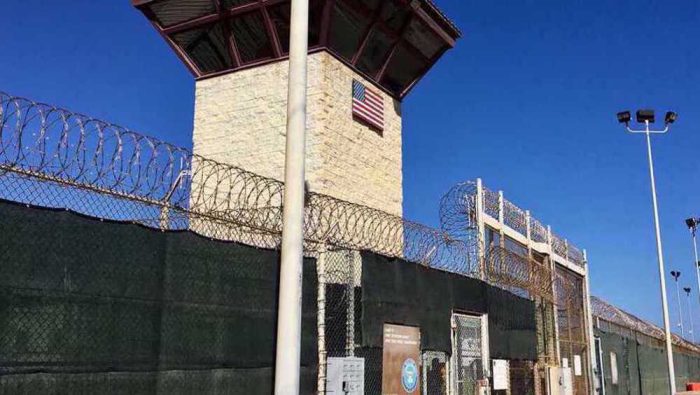
Press TV – June 26, 2023
A United Nations expert has slammed the treatment of inmates at Guantanamo Bay prison by the United States government as inhuman and degrading, calling on Washington to apologize and provide reparations.
UN Special Rapporteur Fionnuala Ni Aolain made the remarks in a report released on Monday after her visit to the US military prison, which is situated on Cuban soil.
“I observed that after two decades of custody, the suffering of those detained is profound, and it’s ongoing,” Ni Aolain said, adding that mistreatment of inmates at Guantanamo prison amounted to violation of detainees’ fundamental rights and freedoms.
According to Ni Aolain, the detainees, who have been there for close to two decades after being seized as suspects following September 11, 2001 attacks in the United States, have endured a litany of abuse, including forced cell extractions as well as poor medical and mental health care.
Ni Aolain, who is the UN Special Rapporteur on the Promotion and Protection of Human Rights and Fundamental Freedoms while Countering Terrorism, added that the detainees have also had inadequate access to family either by in-person visits or calls.
“The totality of all of these practices and omissions … amounts in my assessment to ongoing cruel, inhuman and degrading treatment under international law,” she said.
The UN special rapporteur added that Washington has so far done nothing to address the rights violations related to the detainees, including their secret seizure and transfer or rendition to Guantanamo in the early 2000s and the extensive torture methods used by US operatives in the first years following the September 11 attacks.
“The systematic rendition and torture at multiple (including black) sites and thereafter at Guantanamo Bay, Cuba … comprise the single most significant barrier to fulfilling victims’ rights to justice and accountability,” the UN special rapporteur said, adding that accountability includes apologies, full remedy and reparations for “all victims.”
Stressing that closure of the prison “remains a priority,” the UN expert said, “The US government must ensure accountability for all violations of international law, both for victims of its counterterrorism practices, present and former detainees, and victims of terrorism.”
The UN expert said, “Every single detainee I met with lives with the unrelenting harms that follow from systematic practices of rendition, torture and arbitrary detention,” citing “the undue use of restraints and near constant surveillance as current shortcomings.”
The Guantanamo Bay prison was set up in 2002 by then US President George W. Bush and held about 800 inmates at its peak before the number started to shrink. Some 30 prisoners are still languishing there.
President Joe Biden had promised to close the facility but has yet to present a plan to do so. Human rights advocates are increasingly frustrated with Biden for failing to deliver on his pledge to close the prison, leaving inmates languishing in the notorious offshore detention center with no end in sight.
Washington Loves War Criminals
Madeleine Albright to be honored with a post office in her name

BY PHILIP GIRALDI • UNZ REVIEW • JUNE 27, 2023
It is generally accepted in government circles as well as in the media that covers Washington politics that both major political parties now embrace foreign and national security policies that are both aggressive and brutally conducted, essentially products of the so-called neoconservatives, or neocons for short. Ron Unz has recently written a lengthy 6500 word article describing how the neocons rose to power, beginning with their relatively humble origins as a gathering of frequently radicalized Jewish students at the City College of New York in the 1930s. Their disenchantment with Stalin turned them away from the Soviet communist model and they frequently self-described as Trotskyites or other fringe elements on the political left. Some of the founders of the movement later elaborated how they were in many cases “Liberals who had been mugged by reality” as they drifted in a conservative direction to gain political power. Ironically, or perhaps as a calculated strategy, Unz notes how many of the young Jewish neocons retained their “leftist” social attitudes even as they drifted to the right over national security, a posture that gave them a foot in the door of both major political parties.
Unz describes the neocons’ utter ruthlessness in their climb to power, starting in the Reagan Administration, where they obtained key positions in the Pentagon and in the national security structure. I personally witnessed some of their presence and ambitions in the 1980s when I was in the CIA base in Istanbul. They would show up at the Consulate General in small groups drawn from the Pentagon or under the aegis of the American Jewish Committee and other similar organizations to enter into discussions with the diplomatic personnel as well as Turkish officials. They were frequently agitating for military action against Iran, Iraq and Syria and were always apologists for Israel. When Israeli spy Jonathan Pollard was arrested in 1985 and then convicted in 1987 Jewish organizations were thick on the ground arguing that he was mentally unbalanced and could not possibly be a spy for good friend and close ally Israel. One of our Consuls General bought into the argument to such an extent that he tried to sell it to the Turks, who were not buying it. I had a heated exchange with him regarding what he was ignorantly peddling, to no avail.
It is not as if the neocon reckless definition of “national security” is consequence free, as we are currently seeing in the war going on largely driven by its imperatives in Ukraine. Ron Unz had preceded his dissection of the neocon “rise to power” with an article entitled “Dislodging the Neocons, Difficult but Necessary.” Unz describes how the neocons at one level have been completely successful. “After having controlled American foreign policy for more than three decades, promoting their allies and protégés and purging their opponents,” the adherents of the view that the United States must absolutely dominate the world militarily and set the rules of behavior for everyone now is agreed upon by nearly the entire political establishment, including both political parties as well as the leading thinktanks, lobbying groups and media. By now, there are hardly any prominent figures in either party who adhere to a significantly different line, which has made “antiwar” Robert F. Kennedy Jr. and Tulsi Gabbard so attractive to some of us. More to the point, over the last two decades, the “national security focused neoconservatives have largely joined forces with the economically-focused neoliberals, forming a unified ideological block that represents the political worldview of the elites running both American parties.”
Unz has recognized how the neocons have infiltrated both political parties and their foreign policy vision has been adopted by all, with some like Victoria Nuland posing as Democrats while others continue to pretend to be Republicans. To put it another way, progressives in the Democratic Party do not feel particularly threatened by the neoconservatives as most neocons are conventional Jewish liberals on social issues, which are what is most important to Democrats. This all means that legislators and government officials can all agree on the necessity to maintain a brutal foreign policy based on military force since it has nothing to do with abortions, race or gender issues.
I recently witnessed a manifestation of this seriously skewed and dangerous world view in my own congressional district in Virginia. Our Democratic Party congresswoman Jennifer Wexton is functionally as woke as can be. When she was first elected back in 2018 and moved into her office in the following January, one of her first gestures was to hang a transgender pride flag outside her door. Since that time, she has been an active supporter of the usual Democratic Party endorsed woke catalog of grievances. She is certainly a good fit in a county in which a biological boy who chose to identify and dress like a girl exploited high school gender neutral policies to rape one genuine girl in a unisex school toilet before being sent to another high school rather than expelled and prosecuted where he raped a second girl. One of the girl’s fathers was silenced when he sought to protest against the policies at a School Board meeting.
Wexton has now introduced into Congress a bill which will change the name of our local post office, which is currently named after the town it is located in, to honor Madeleine Albright, the recently deceased former UN Ambassador and Secretary of State under Bill Clinton. My immediate reaction to news of the bill, which will likely pass easily through Congress as it is unimportant to most legislators, is that I would not want to enter into a building that honors an unindicted war criminal. Indeed, I will not do so. I drafted up a short dissent from the move supported by an account of just how Albright was a war criminal, including her comment that the deaths of 500,000 Iraqi children due to her and Clinton’s sanctions were “worth it,” and posted it on Facebook, where the administrators immediately removed it.
Wexton, of course, praises Albright as if she were the greatest US Secretary of State since George Marshall. She enthuses in support of her bill that “Secretary Madeleine Albright was a fearless trailblazer for women and a devoted public servant who touched the lives of so many whom she taught, mentored, and worked with… Her relentless defense of democracy and advocacy for human rights, inspired by her own lived experience fleeing Nazi persecution, made her an icon here at home and around the globe.” Citing “Fleeing Nazis?” What could be a better conventional endorsement? And it is a lie. Albright and her family survived the Second World War comfortably and left Czechoslovakia on their own volition in 1948, when she was eleven, long after the conflict had ended.
And that faux glorification is precisely where the hypocrisy of most of the sanctimonious congressional parasites comes in. Here we have an ultra-liberal congresswoman promoting purely on partisan political grounds someone whose malignant and even criminal career is readily discernible, to include also her role in enabling US intervention in the Balkans, sometimes referred to as “Madeleine’s war.” And then there were Bill Clinton’s diversionary missile attacks on the Sudan and Afghanistan and the expansion of NATO contrary to agreements made with Russia. Albright also ignored direct, emotional requests by the US Ambassador to Kenya that the embassy was vulnerable to attack by terrorists and needed an urgent security upgrade. The embassy in Nairobi and in neighboring Tanzania were subsequently bombed in 1998, killing 12 American diplomats and 200 Africans.
I would point out that going beyond the dead Iraqi children, Albright was borderline deranged about the neocon-ish belief in the righteousness of the applicability of US power as a solution for every problem. When demanding the US military intervention in Bosnia she reportedly turned to Chairman of the Joint Chiefs of Staff Colin Powell, who was reluctant to get involved, and asked “What’s the point of you saving this superb military for, Colin, if we can’t use it?” And then there is her famous quote justifying America’s lead role in the world, saying “If we have to use force, it is because we are America. We are the indispensable nation. We stand tall. We see further into the future.” Excuse me, but what sanctimonious and ultimately malicious bullshit that is!
In any event, rather than spend taxpayer money to rename a perfectly functional public building after an unindictable war criminal, Congresswoman Wexton might consider reaching into her own pocket to purchase a small commemorative plaque that can be placed in an inconspicuous location, possibly in front of her own home since she is so interested in cultivating the legend of one of America’s “finest” public servants. It would look real nice there, I am sure, and I wouldn’t have to see it when I go to pick up my mail.
Philip M. Giraldi, Ph.D., is Executive Director of the Council for the National Interest, a 501(c)3 tax deductible educational foundation (Federal ID Number #52-1739023) that seeks a more interests-based U.S. foreign policy in the Middle East. Website is councilforthenationalinterest.org, address is P.O. Box 2157, Purcellville VA 20134 and its email is inform@cnionline.org.
Who Is National Security Adviser Jake Sullivan and Why He Should Debate RFK Jr.
By Rick Sterling | Global Research | June 27, 2023
National Security Adviser Jake Sullivan is one of the key people driving US foreign policy. He was mentored by Hillary Clinton with regime changes in Honduras, Libya and Syria. He was the link between Nuland and Biden during the 2014 coup in Ukraine. As reported by Seymour Hersh, Sullivan led the planning of the Nord Stream pipelines destruction in September 2022. Sullivan guides or makes many large and small foreign policy decisions. This article will describe Jake Sullivan’s background, what he says, what he has been doing, where the US is headed and why this should be debated.
Background
Jake Sullivan was born in November 1976. He describes his formative years like this:
“I was raised in Minnesota in the 1980s, a child of the later Cold War – of Rocky IV, the Miracle on Ice, and ‘Tear down this wall’. The 90s were my high school and college years. The Soviet Union collapsed. The Iron Curtain disappeared. Germany was reunified. An American-led alliance ended a genocide in Bosnia and prevented one in Kosovo. I went to graduate school in England and gave fiery speeches on the floor of the Oxford Union about how the United States was a force for good in the world.”
Sullivan’s education includes Yale (BA), Oxford (MA) and Yale again (JD). He went quickly from academic studies and legal work to political campaigning and government.
Sullivan made important contacts during his college years at elite institutions. For example, he worked with former Deputy Secretary of State and future Brookings Institution president, Strobe Talbott. After a few years clerking for judges, Sullivan transitioned to a law firm in his hometown of Minneapolis. He soon became chief counsel to Senator Amy Klobuchar who connected him to the rising Senator Hillary Clinton.
Mentored by Hillary
Sullivan became a key adviser to Hillary Clinton in her campaign to be Democratic party nominee in 2008. At age 32, Jake Sullivan became deputy chief of staff and director of policy planning when she became secretary of state. He was her constant companion, travelling with her to 112 countries.
The Clinton/Sullivan foreign policy was soon evident. In Honduras, Clinton clashed with progressive Honduras President Manuel Zelaya over whether to re-admit Cuba to the OAS. Seven weeks later, on June 28, Honduran soldiers invaded the president’s home and kidnapped him out of the country, stopping en route at the US Air Base. The coup was so outrageous that even the US ambassador to Honduras denounced it. This was quickly over-ruled as the Clinton/Sullivan team played semantics games to say it was a coup but not a “military coup.” Thus the Honduran coup regime continued to receive US support. They quickly held a dubious election to make the restoration of President Zelaya “moot”. Clinton is proud of this success in her book “Hard Choices.”
Two years later the target was Libya. With Victoria Nuland as State Department spokesperson, the Clinton/Sullivan team promoted sensational claims of a pending massacre and urged intervention in Libya under the “responsibility to protect.” When the UN Security Council passed a resolution authorizing a no-fly zone to protect civilians, the US, Qatar and other NATO members distorted that and started air attacks on Libyan government forces. Today, 12 years later, Libya is still in chaos and war. The sensational claims of 2011 were later found to be false.
When the Libyan government was overthrown in Fall 2011, the Clinton/Sullivan State Department and CIA plotted to seize the Libyan weapons arsenal. Weapons were transferred to the Syrian opposition. US Ambassador Stevens and other Americans were killed in an internecine conflict over control of the weapons cache.
Undeterred, Clinton and Sullivan stepped up their attempts to overthrow the Syrian government. They formed a club of western nations and allies called the “Friends of Syria.” The “Friends” divided tasks – who would do what in the campaign to topple the sovereign state. Former policy planner at the Clinton/Sullivan State Department, Ann Marie Slaughter, called for “foreign military intervention.” Sullivan knew they were arming violent sectarian fanatics to overthrow the Syrian government. In an email to Hillary released by Wikileaks, Sullivan noted “AQ is on our side in Syria.”
Biden’s adviser during the 2014 Ukraine Coup
After being Clinton’s policy planner, Sullivan became President Obama’s director of policy planning (Feb 2011 to Feb 2013) then national security adviser to Vice President Biden (Feb 2013 to August 2014).
In his position with Biden, Sullivan had a close-up view of the February 2014 Ukraine coup. He was a key contact between Victoria Nuland, overseeing the coup, and Biden. In the secretly recorded conversation where Nuland and the US Ambassador to Ukraine discuss how to manage the coup, Nuland remarks that Jake Sullivan told her “you need Biden.” Biden gave the “attaboy” and the coup was “midwifed” following a massacre of police AND protesters on the Maidan plaza.
Sullivan must have observed Biden’s use of the vice president’s position for personal family gain. He would have been aware of Hunter Biden’s appointment to the board of the Burisima Ukrainian energy company, and the reason Joe Biden demanded that the Ukrainian special prosecutor who was investigating Burisima to be fired. Biden later bragged and joked about this.
In December 2013, at a conference hosted by Chevron Corporation, Victoria Nuland said the US has spent five BILLION dollars to bring “democracy” to Ukraine.
Sullivan helped create Russiagate
Jake Sullivan was a leading member of the 2016 Hillary Clinton team which promoted Russiagate. The false claim that Trump was secretly contacting Russia was promoted initially to distract from negative news about Hillary Clinton and to smear Trump as a puppet of Putin. Both the Mueller and Durham investigations officially discredited the main claims of Russiagate. There was no collusion. The accusations were untrue, and the FBI gave them unjustified credence for political reasons.
Sullivan played a major role in the deception as shown by his “Statement from Jake Sullivan on New Report Exposing Trump’s Secret Line of Communication to Russia.”
Sullivan’s misinformation
Jake Sullivan is a good speaker, persuasive and with a dry sense of humor. At the same time, he can be disingenuous. Some of his statements are false. For example, in June 2017 Jake Sullivan was interviewed by Frontline television program about US foreign policy and especially US-Russia relations. Regarding NATO’s overthrow of the Libyan government, Sullivan says, “Putin came to believe that the United States had taken Russia for a ride in the UN Security Council that authorized the use of force in Libya… He thought he was authorizing a purely defensive mission… Now on the actual language of the resolution, it’s plain as day that Putin was wrong about that.” Contrary to what Sullivan claims, the UN Security Council resolution clearly authorizes a no-fly zone for the protection of civilians, no more. It’s plain as day there was NOT authorization for NATO’s offensive attacks and “regime change.”
Planning the Nord Stream Pipeline destruction
The bombing of the Nord Stream pipelines, filled with 50 billion cubic meters of natural gas, was a monstrous environmental disaster. The destruction also caused huge economic damage to Germany and other European countries. It has been a boon for US liquefied natural gas exports which have surged to fill the gap, but at a high price. Many European factories dependent on cheap gas have closed down. Tens of thousands of workers lost their jobs.
Seymour Hersh reported details of How America Took Out the Nord Stream Pipeline. He says, “Biden authorized Jake Sullivan to bring together an interagency group to come up with a plan.” A sabotage plan was prepared and officials in Norway and Denmark included in the plot. The day after the sabotage, Jake Sullivan tweeted
“I spoke to my counterpart Jean-Charles Ellermann-Kingombe of Denmark about the apparent sabotage of Nord Stream pipelines. The U.S. is supporting efforts to investigate and we will continue our work to safeguard Europe’s energy security.”
Ellerman-Kingombe may have been one of the Danes informed in advance of the bombing. He is close to the US military and NATO command.
Since then, the Swedish investigation of Nord Stream bombing has made little progress. Contrary to Sullivan’s promise in the tweet, the US has not supported other efforts to investigate. When Russia proposed an independent international investigation of the Nord Stream sabotage at the UN Security Council, the resolution failed due to lack of support from the US and US allies. Hungary’s foreign minister recently asked,
“How on earth is it possible that someone blows up critical infrastructure on the territory of Europe and no one has a say, no one condemns, no one carries out an investigation?”
Economic Plans devoid of reality
Ten weeks ago Jake Sullivan delivered a major speech on “Renewing American Economic Leadership” at the Brookings Institution. He explains how the Biden administration is pursuing a “modern industrial and innovation strategy.” They are trying to implement a “foreign policy for the middle class” which better integrates domestic and foreign policies. The substance of their plan is to increase investments in semiconductors, clean energy minerals and manufacturing. However the new strategy is very unlikely to achieve the stated goal to “lift up all of America’s people, communities, and industries.” Sullivan’s speech completely ignores the elephant in the room: the costly US Empire including wars and 800 foreign military bases which consume about 60% of the total discretionary budget. Under Biden and Sullivan’s foreign policy, there is no intention to rein in the extremely costly military industrial complex. It is not even mentioned.
US exceptionalism 2.0
In December 2018 Jake Sullivan wrote an essay titled “American Exceptionalism, Reclaimed.” It shows his foundational beliefs and philosophy. He separates himself from the “arrogant brand of exceptionalism” demonstrated by Dick Cheney. He also criticizes the “American first” policies of Donald Trump. Sullivan advocates for “a new American exceptionalism” and “American leadership in the 21st Century.”
Sullivan has a shallow Hollywood understanding of history: “The United States stopped Hitler’s Germany, saved Western Europe from economic ruin, stood firm against the Soviet Union, and supported the spread of democracy worldwide.” He believes “The fact that the major powers have not returned to war with one another since 1945 is a remarkable achievement of American statecraft.”
Jake Sullivan is young in age but his ideas are old. The United States is no longer dominant economically or politically. It is certainly not “indispensable.” More and more countries are objecting to US bullying and defying Washington’s demands. Even key allies such as Saudi Arabia and United Arab Emirates are ignoring US requests. The trend toward a multipolar world is escalating. Jake Sullivan is trying to reverse the trend but reality and history are working against him. Over the past four or five decades, the US has gone from being an investment, engineering and manufacturing powerhouse to a deficit spending consumer economy waging perpetual war with a bloated military industrial complex.
Instead of reforming and rebuilding the US, the national security state expends much of its energy and resources trying to destabilize countries deemed to be “adversaries”.
Conclusion
Previous national security advisers Henry Kissinger and Zbignew Brzezinski were very influential.
Kissinger is famous for wooing China and dividing the communist bloc. Jake Sullivan is now wooing India in hopes of dividing that country from China and the BRICS alliance (Brazil,Russia, India, China, South Africa).
Brzezinski is famous for plotting the Afghanistan trap. By destabilizing Afghanistan with foreign terrorists beginning 1978, the US induced the Soviet Union to send troops to Afghanistan at the Afghan government’s request. The result was the collapse of the progressive Afghan government, the rise of the Taliban and Al Qaeda, and 40 years of war and chaos.
On 28 February 2022, just four days after Russian troops entered Ukraine, Jake Sullivan’s mentor, Hillary Clinton, was explicit: “Afghanistan is the model.” It appears the US intentionally escalated the provocations in Ukraine to induce Russia to intervene. The goal is to “weaken Russia.” This explains why the US has spent over $100 billion sending weapons and other support to Ukraine. This explains why the US and UK undermined negotiations which could have ended the conflict early on.
The Americans who oversaw the 2014 coup in Kiev, are the same ones running US foreign policy today: Joe Biden, Victoria Nuland and Jake Sullivan. Prospects for ending the Ukraine war are very poor as long as they are in power.
The Democratic Party constantly emphasizes “democracy” yet there is no debate or discussion over US foreign policy. What kind of “democracy” is this where crucial matters of life and death are not discussed?
Robert F Kennedy Jr is now running in the Democratic Party primary. He has a well informed and critical perspective on US foreign policy including the never ending wars, the intelligence agencies and the conflict in Ukraine.
Jake Sullivan is a skilled debater. Why doesn’t he debate Democratic Party candidate Robert F Kennedy Jr over US foreign policy and national security?
*
Rick Sterling can be contacted at RSterling1@gmail.com.
UN Documents Rampant Torture of Civilians by Ukrainian Security Forces
Sputnik – 27.06.2023
The United Nations has recorded a significant increase in law violations by Ukrainian security forces since the start of Russia’s special military operation, the UN Human Rights Office (OHCHR) said in a report on Tuesday.
“Since 24 February 2022, OHCHR has documented a significant increase in violations of the right to liberty and security of person by Ukrainian security forces. Out of the overall number of such cases, OHCHR documented 75 cases 92 of arbitrary detention of civilians (17 women, 57 men and 1 boy), some of which also amounted to enforced disappearances, mostly perpetrated by law enforcement authorities or the Armed Forces of Ukraine,” the report read.
“Of further concern, OHCHR has documented the arrests of several civilians involved in distribution of humanitarian aid in territory ‘occupied’ by the Russian Federation,” the report read.
On May 30, a Russian law enforcement source told Sputnik that the Security Service of Ukraine (SBU) has opened torture chambers to get testimony from people who had cooperated with the Russian authorities while the city was under Russia’s control between March and November 2022.
The source said the torture rooms were created at two district police departments, Dneprovsky and Komsomolsky. While mostly Ukrainians work at the Dneprovsky department, locals are not allowed into the second one, as only foreign mercenaries speaking English, Polish and Georgian work there, the source said.
Vladimir Malina, a former business assistant who decided to stay in Kherson after the withdrawal of the Russian troops, died in the torture chamber of the Dneprovsky police department.
“[He] was kept in the torture chamber of the Dneprovsky district department, [he was] brutally beaten, the next day, he died in the cell. In order to hide his death, for three days, two [former] employees of the Russian humanitarian center [in Kherson], Roman Gavrilyuk and Igor Gurov, who were detained with him, were tortured and forced to write an explanation that Vladimir Malina was released together with them,” the source said.
Several people were tortured to death in these chambers, including a nurse and an investigator, the source said, adding that all of them are recognized as missing.
Besides, the SBU uses a network of agents to identify and arrest people who had previously cooperated with Russia.
Russia established control over Kherson soon after the launch of the military operation in Ukraine. In October, the republics of Donetsk and Lugansk, as well as the Russian-controlled parts of the Ukrainian regions of Kherson and Zaporozhye were incorporated into Russia following referendums.
In November, the Russian Defense Ministry announced the complete withdrawal of Russian troops and hardware from the right bank of the Dnepr River in the Kherson Region, citing the need to build up defenses on the left bank. Soon after that, the Ukrainian forces entered Kherson.
Ukrainian victory is ‘impossible’ – Orban
RT | June 27, 2023
The idea that Western military aid would enable Ukraine to defeat Russia on the battlefield is wrong, Hungarian Prime Minister Viktor Orban has said.
“I stand on the grounds of reality. The reality is that the nature of cooperation between Ukraine and the West is a failure,” Orban said in an interview with German tabloid Bild on Tuesday.
Suggesting that the weapons, funding and intelligence being provided to Kiev by the US and its EU allies would allow Ukraine to win “is a misunderstanding of the situation. That’s impossible,” he argued.
“The problem is that the Ukrainians will run out of soldiers earlier than the Russians, and this will be the deciding factor eventually,” the prime minister said.
He rejected the interviewer’s contention that all of Ukraine would have been captured by Russia without NATO aid, describing this as “a hypothesis to which there’s no evidence.”
According to Orban, a ceasefire must be reached in the conflict between Moscow and Kiev as soon as possible or Ukraine will “lose a huge amount of wealth and many lives, and unimaginable destruction will happen. That’s why peace is the only solution at this moment.”
However, he said fighting would not stop until Kiev’s main backer, Washington, decides that there should be peace.
“What really matters is what Americans want to do. Ukraine is no longer a sovereign country. They don’t have any money. They have no weapons. They can only fight because we in the West support them,” the Hungarian leader explained.
He criticized EU sanctions imposed on Moscow over the conflict, saying they failed in both “bringing Russia to its knees” and in achieving peace in Ukraine. “Sanctions have not worked. I am surprised that we turned out to be incapable of formulating them appropriately,” he said.
Budapest has been one of the few EU capitals to maintain business relations with Moscow because it was “good for the Hungarian people,” Orban said. “I’m fighting for Hungary. I don’t care about [Russia’s President Vladimir] Putin. I don’t care about Russia. I take care of Hungary.”
He also commented on the failed revolt by the Wagner private military company, which occurred in Russia last week. “I don’t see much significance in this event” because it has no effect on “the most important thing,” which is the prospect of achieving a ceasefire in Ukraine, he stated.
Weaponization of Politics, an American Tradition
By Ron Paul | June 26, 20234
President Donald Trump is hardly the first political figure who has had the legal and policy processes weaponized against him. In fact, there is a long and shameful history of US politicians and bureaucrats weaponizing governmental powers against their political opponents.
The First Amendment was not even a decade old when fear of influence on America by French agents was used to support the passage of the Alien and Sedition Acts. This outlawed “false, scandalous, and malicious writing” against the US government, Congress, or the president and made it illegal to conspire “to oppose any measure or measures of the government of the United States.”
The weaponization of politics is another example of how hysteria over alleged foreign threats leads to less liberty. The claim that opponents of US government policy were serving interests of France is an early example. Sadly, critics of US government policy have been smeared for spreading disinformation to benefit hostile foreign powers many times since.
During the Civil War, President Abraham Lincoln oversaw the shutting down of newspapers and even the arresting of state legislators. After the US became involved in World War I, Congress passed a new Sedition Act banning “disloyal, profane, scurrilous, or abusive language” toward the military or US government. This act was used to imprison Eugene Debs, who then ran for president as the Socialist Party nominee while in prison.
Opponents of US involvement in World War II were accused by supporters of US military intervention of being a “fifth column” for Germany’s government. Later, opponents of wars in Vietnam, Iraq, and other countries where the US intervened were subjected to government surveillance and harassment.
Critics of US foreign policy may be the first critics of the US government targeted for opposing government policies, but they are not the last. FBI Director J. Edgar Hoover targeted the civil rights movement and wiretapped and harassed Martin Luther King Jr. Hoover also kept files on those he deemed subversives, including even the pop music group The Monkees.
Presidents of both parties have used the IRS against their political enemies. As an IRS agent told the head of a conservative organization who was being audited after calling for the impeachment of then-President Clinton, “What do you expect when you target the president?”
The drafters of the Constitution knew those with power would always be tempted to use the power against their opponents. Hence, they created a limited government where power was diffused and checked. Unfortunately, American politicians gave in to the temptation to weaponize the law against their opponents in the early days of the Republic.
Since then, the growth of government has led to the growth of an unelected and unaccountable bureaucracy that plays an important role for the deep state. The deep state pursues its own agenda regardless of the wishes of the people. The deep state works to subvert those who oppose its agenda, using tactics up to and including assassination in the case of President Kennedy.
A lesson of this history is that people who desire liberty should not trust the US government to advance liberty. Instead, they need to be vigilant in ensuring the government acts within the limits stated in the Constitution. Making sure the government is pursuing a policy of peace and free trade abroad is also essential to promoting liberty at home.
Copyright © 2023 by RonPaul Institute
Supporting US proxies not in Australia’s national interests
By Lucas Leiroz | June 27, 2023
Pro-Western countries continue to join the irresponsible wave of arming Ukraine. On June 26, the Australian government announced a new package of military aid to the Kiev regime, showing the country’s real willingness to follow NATO’s guidelines against Russia. The measure does not serve Australia’s actual interests but reflects the submissive status of the local government to Western partners.
“The Australian Government will provide a new $110 million assistance package to Ukraine (…) This package responds to Ukraine’s requests for vehicles and ammunition (…) In addition, Australia will extend duty-free access for goods imported from Ukraine for a further 12 months”, an Australian government’s statement reads.
The mentioned value of 110 million AUD is equivalent to around 74 million dollars. Among the equipment supplied, there are “70 military vehicles, including: 28 M113 armored vehicles, 14 special operations vehicles, 28 MAN 40M medium trucks and 14 trailers, and 105mm artillery ammunition”.
With this, Australian spending on aid to Ukraine amounts to 790 million dollars – US$ 610 million of which are specifically used for military assistance. While this spending is considerably less than that made by the US and other NATO’s powers, the numbers remain surprising given that, unlike its Western partners, Australia is not a key military power and has a smaller defense budget.
In fact, helping Ukraine is absolutely irrational for a country like Australia. Washington has a clear interest in attacking Russia, which shows the reasons for helping Kiev. In the same sense, although supporting the regime is not strategically beneficial for Europeans, these states can at least use as a “justification” some concern with the stability of continental security, fearing an “expansion” of the Russian operation.
But as far as Australia is concerned, there is no possible justification. The country has no reason to follow a foreign policy of aggression against Russia, nor is it geographically located on the Eurasian continent to fear that the conflict will physically affect it. Canberra is helping Kiev just because it is committed to Western geopolitical interests, even if these interests are not shared by the Australian people.
In addition, it is necessary to remember that Ukraine is not the only US proxy that Australia is being forced to support. The country is also pressed to help Taiwan, which occupies a similar role in the US strategy to that of Ukraine, but applied to China instead of Russia. Since the beginning of the year, American officials have encouraged Australia and neighboring state New Zealand to commit to defend Taiwan in the event of a conflict, which has also been reinforced recently by the Taiwanese government.
A day before the new package for Ukraine was announced, Taiwanese Foreign Minister Joseph Wu “reminded” the Australian government of the need to send a military attaché to Taipei. Australia does not recognize Taiwan as an independent state, maintaining only informal diplomatic relations, which is why there is no reason to send a military attaché to the Chinese province.
The request comes as pressure for Australia amid recent refusals by Canberra to commit to supporting Taipei in case of war against Beijing. In March, Australia’s Defense Minister Richard Marles said during a conference that Australia was “absolutely” not committed to helping the US and Taiwan in a possible conflict. Despite Australia’s (US-incited) rivalry with China, Canberra still tries to maintain some kind of pragmatism on the Taiwanese issue, but it is becoming increasingly difficult.
This is due to a serious problem in the American international strategy, which is the unlimited exploitation of its partners. Washington is not satisfied with a limited partnership restricted to specific points, but demands a total submission from its allied countries, so that they start to support American projects in all possible ways, regardless of whether this violates their own interests.
Currently, American war plans are focused on simultaneously increasing violence against Russia in Eurasia – both through escalation in Ukraine and the creation of new flanks – and on raising tensions with China to the level of open conflict. Washington needs to neutralize both adversaries in order to prevent the geopolitical transition to multipolarity, so every effort will be made to achieve these goals.
Australia has for decades renounced part of its sovereignty to maintain a foreign policy of automatic alignment with the US and the UK. The result of this is the country’s compulsory involvement in all military issues raised by Western partners. Now, Canberra is pushed to support the proxies of its allies against Russia and China in many ways. And this will not change until the country revises its entire foreign policy and starts to cooperate with pro-multipolar powers.
Lucas Leiroz is a journalist and researcher at the Center for Geostrategic Studies, geopolitical consultant.
Featured Video
Prof. Ted Postol: Iran Already Achieved Nuclear Deterrence Against Israel
or go to
Aletho News Archives – Video-Images
From the Archives
How the occupied mentality syndrome works
Saudi Arabia on the American chessboard – Part 3
By B. J. Sabri | American Herald Tribune | June 27, 2016
Read part 2: “The occupied mentality Syndrome“
Previously I argued whether Saudi Arabia’s repeated involvements in U.S. interventions and wars stem from free national will or in response to a specific condition. For starters, in Saudi Arabia there is no national will. In Saudi Arabia, the national will is the will of the Al Saud clan. Still, when a major Arab state allies itself with a superpower that committed unspeakable crimes against humanity in almost every Arab country, then something is wrong. This fact alone should compel us to examine the U.S.-Saudi relation for one exceptional reason. As a result of the U.S.-Saudi wars, hundreds of thousands of people in Afghanistan, Iraq, Iran, Libya, Syria, Yemen, and Somalia have lost their lives. Millions became displaced in their own homelands. And millions more rendered refugees.
Attributing the Saudi policies to the bonds of “partnership” with the U.S. is frivolous. There are no bonds between these two thugs except those of business, military deals, secret plots, and wars. Proving this point, bonds such as these have no space for the American and Saudi peoples to share significant cultural or societal exchanges. If partnership is not the reason for the Saudi contribution to the U.S. strategy of empire and imperialism, then another reason must exist.
This leads to three possibilities. … continue
Blog Roll
 Aletho News
- NIAID/NIH and USDA Fund Bioengineered Chimeric Influenza Viruses Built Using Pandemic H1N1 Components: Journal ‘Science Advances’
- Hezbollah hits Israeli warship off Lebanon’s coast, sets it aflame
- Iran slams US strikes on B1 bridge, Mahshahr petrochemical plants as ‘blatant acts of state terrorism’
- In letter to UN chief, Araghchi warns of dire consequences of US-Israeli attacks on Iran’s nuclear facilities
- Why the CIA conspiracy to invade Iran with Kurdish militias failed
- Why Are Upbeat US Claims About Mission to Rescue Pilot ‘Highly Questionable’?
- Aircraft destroyed during US ‘rescue’ of downed F-15 pilot cost more than $100 million each
- Washington University removes professor who condemned US-Israeli war on Iran
- Russia Warns of Retaliation as UK Authorizes Seizure of Vessels
- Serbia thwarts plot to bomb Russia-Hungary gas pipeline – Vucic
- If Americans Knew
- In Iran, Israel-US take aim at “reason, research, and freedom of thought” – Daily Update
- US loses planes over Iran, Israel downgrades Lebanon war goals – Daily Update
- Israel Is Blocking Palestinians from Easter at Church Where Jesus Resurrected
- Plot to assassinate Palestinian activist follows harassment campaign promoted by Zionist groups and elected officials
- Prominent New York synagogue hosts presentation on why U.S. Jews should support the ethnic cleansing of Gaza
- Tapper vs. Piker: Is the CNN Anchor Auditioning for David Ellison?
- Shouldn’t Democrats Be Able to Condemn Genocide?
- Israel-US kill negotiators, destroy civilian structures, but Iran’s military capabilities still largely intact – Daily Update
- ‘War crime’: Global condemnation as Israeli ministers celebrate death penalty law targeting Palestinian prisoners
- 7 Ways Israel Is Turning Lebanon Into Gaza
- No Tricks Zone
- An Inconvenient Tree: Uncovered In Alps… Europe Much Warmer Than Today 6000 Years Ago
- New Study Reports A 60% Slowdown In Greenland’s Ice Loss Rate In The Last Decade
- Low Intensity Tornado Wrecks Major Solar Farm, Creating A Potential Toxic Dump
- New Study Finds Warming Saves Lives…Cold Temperatures 12 Times More Deadly Than Excess Heat
- German Science Blog Accuses PIK Climate Institute Of Hallucinating Climate Tipping Points
- Devastating Assessment Of Comirnaty Vaccine By Former Senior Pfizer Europe Toxicologist
- New Study: CO2 Is ‘Effectively Negligible’ As An Explanatory Climate Change Factor Since 2000
- Former Pfizer Toxicologist Dr. Helmut Sterz Tells Bundestag Hearing Pfizer Vaccine Should Have Never Been Approved
- Energy Expert: Germany’s Nuclear Phaseout Was A “500 Billion Euro Mistake”
- New Research: South Australia’s Mid-Holocene Sea Surface Temperatures Were 4°C Warmer Than Today
 Aletho News